










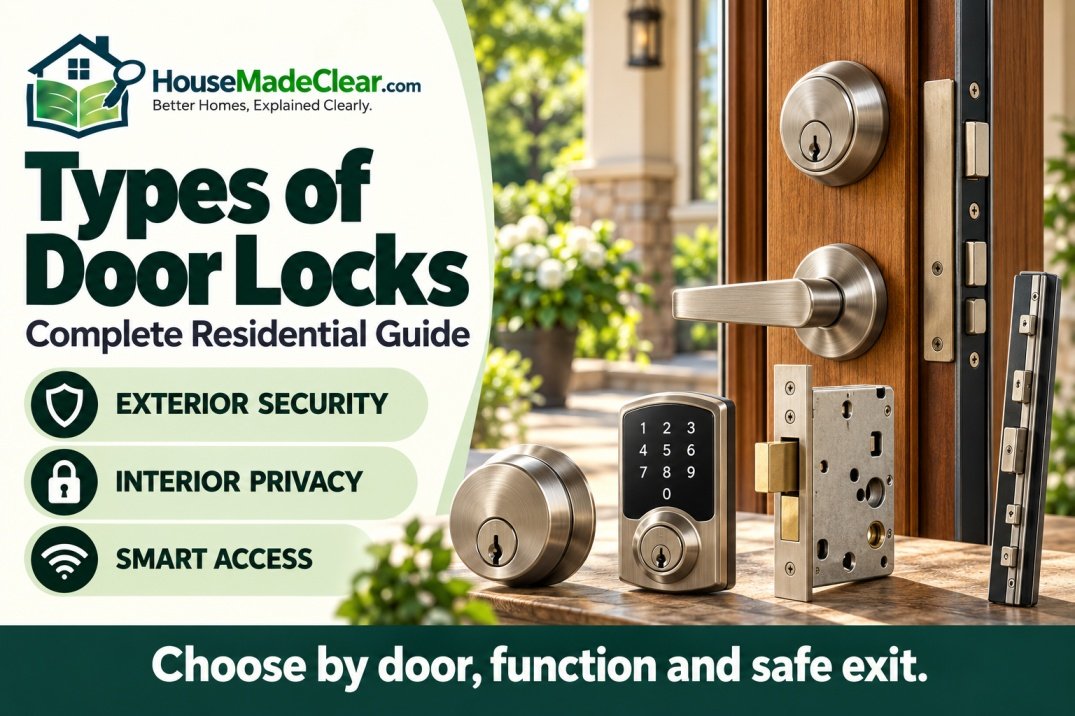
Door locks are commonly described by their appearance: knob lock, lever lock, keypad lock or smart lock. That description is incomplete.
Two locks that look different may use the same internal mechanism, while two identical-looking handles may provide completely different functions. One may secure an exterior entrance, another may provide bedroom privacy, and a third may not lock at all.
Choosing the correct lock requires matching the hardware to the door, room, security risk, emergency-exit requirements and existing door preparation.
Quick Answer
The main residential door-lock types include:
- Single-cylinder deadbolts
- Double-cylinder deadbolts
- One-sided deadbolts
- Keyed entry knobs and levers
- Handlesets
- Mortise locks
- Multipoint locks
- Keypad and electronic locks
- Smart locks
- Rim and surface-mounted locks
- Sliding patio-door locks
- French-door locking systems
- Privacy locks
- Passage latches
- Dummy handles
- Pocket-door locks
- Barrel bolts and surface bolts
- Door chains and guards
For many conventional exterior doors, a certified single-cylinder deadbolt combined with a correctly installed latch or entry handle provides a practical starting point. Interior bedrooms and bathrooms normally use privacy locks, while closets usually need passage or dummy hardware.
The strongest lock will still perform poorly if the door, frame, strike, hinges or installation are weak.
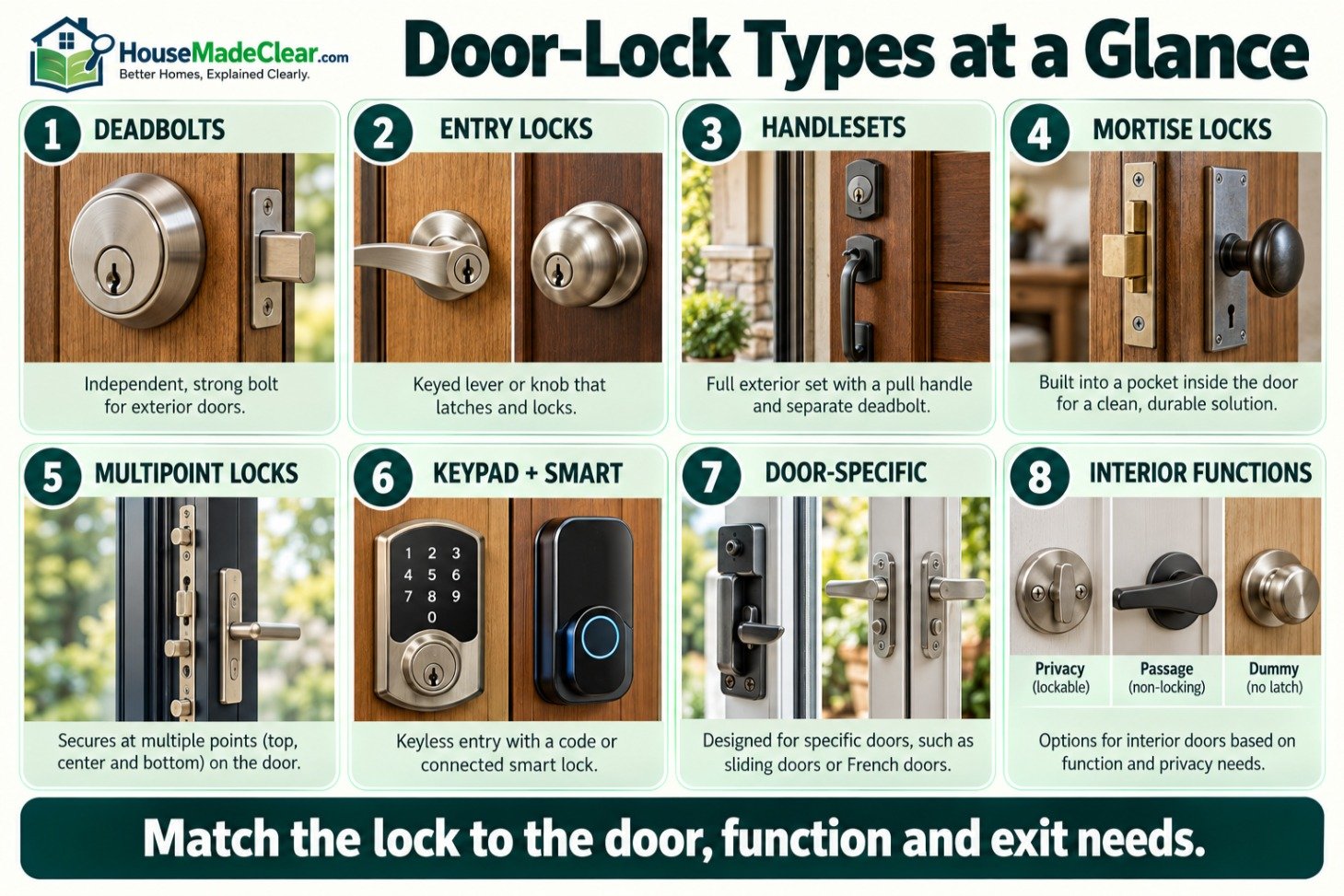
Door-Lock Types at a Glance
| Lock Type | Common Application | Key Outside | Interior Operation | Security Role |
|---|---|---|---|---|
| Single-cylinder deadbolt | Exterior hinged doors | Yes | Thumbturn | Primary residential security |
| Double-cylinder deadbolt | Limited glass-adjacent applications | Yes | Key | Reach-through protection with egress concerns |
| One-sided deadbolt | Doors not requiring exterior key access | No | Thumbturn | Supplemental interior locking |
| Keyed entry knob | Exterior or utility doors | Yes | Knob button or thumbturn | Latching and basic access control |
| Keyed entry lever | Exterior or utility doors | Yes | Lever button or thumbturn | Similar to keyed knob with easier operation |
| Handleset | Front entrance | Usually | Thumbturn or lever | Decorative entry hardware, often paired with deadbolt |
| Mortise lock | Older homes and substantial entry doors | Usually | Lever or knob | Integrated latch and lock body |
| Multipoint lock | Tall, French or modern exterior doors | Usually | Handle and thumbturn | Secures door at several points |
| Keypad lock | Exterior or interior controlled-access door | Optional | Thumbturn or lever | Code-based access |
| Smart lock | Exterior entrance | Optional | Thumbturn or lever | Electronic access management |
| Rim lock | Older or specialty doors | Varies | Surface-mounted control | Door-dependent supplemental or primary lock |
| Jimmy-proof deadbolt | Some apartment and inward-opening doors | Usually | Thumbturn | Surface-mounted deadbolt |
| Sliding-door lock | Sliding patio doors | Varies | Latch or auxiliary control | Prevents horizontal movement |
| Privacy lock | Bedroom or bathroom | No | Button or turn | Privacy, not high security |
| Passage latch | Hallway or closet | No | Always operable | Keeps door closed without locking |
| Dummy handle | Closet or inactive leaf | No | No latch operation | Decorative pull only |
| Pocket-door lock | Pocket doors | Optional | Thumbturn or edge pull | Privacy or passage control |
| Barrel or surface bolt | Gates, inactive leaves and secondary use | No | Sliding bolt | Supplemental holding |
| Door chain or guard | Main entrance | No | Interior release | Limited partial-opening control |
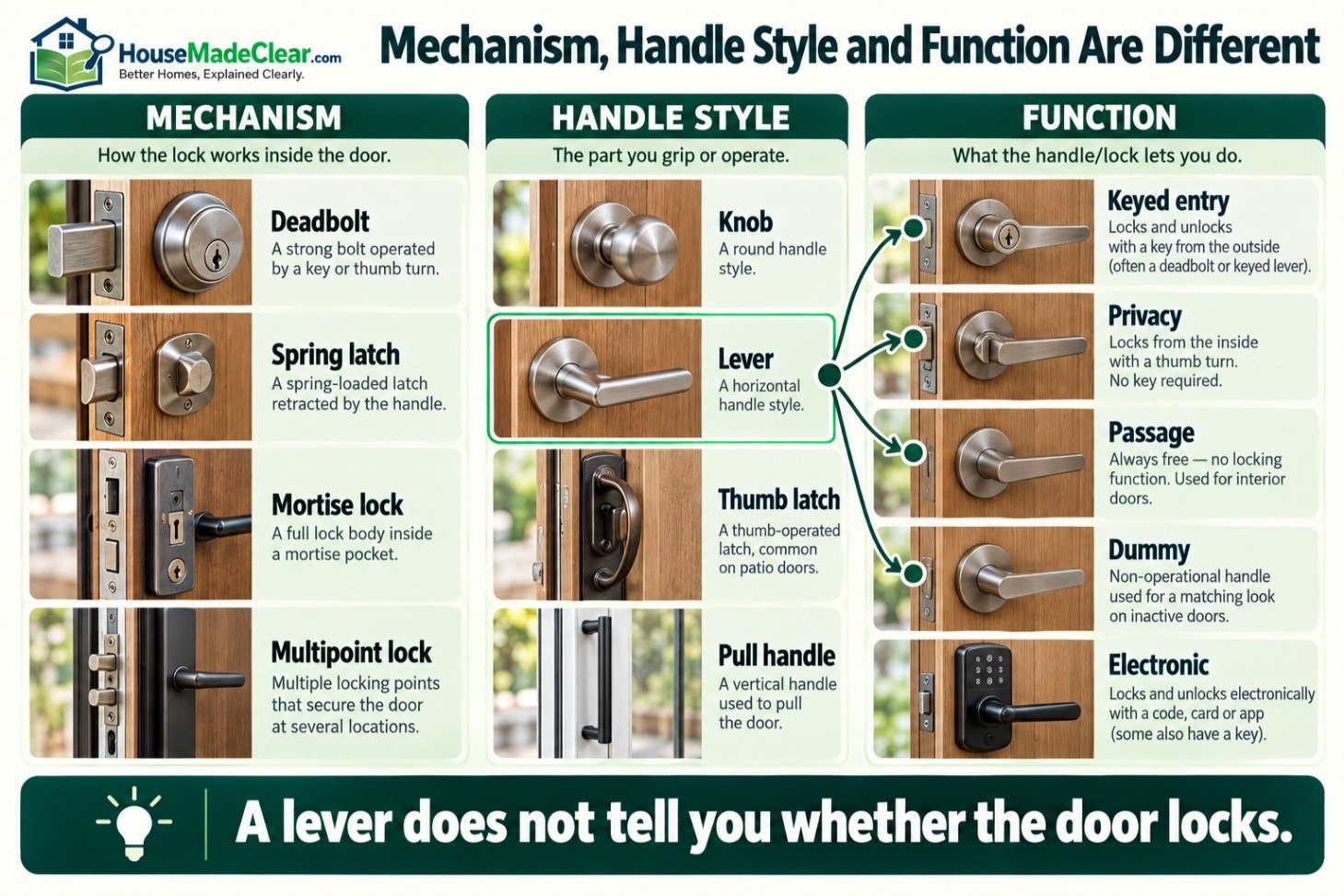
Lock Type, Handle Style and Function Are Different
A door lock can be classified in several ways.
Operating Mechanism
The mechanism describes how the hardware secures the door.
Examples include:
- Deadbolt
- Spring latch
- Mortise lock
- Multipoint lock
- Rim lock
- Hook lock
- Electronic locking mechanism
Handle Style
The handle style describes how the user operates the latch.
Examples include:
- Round knob
- Lever
- Thumb latch
- Pull handle
- Recessed pocket-door pull
A knob and lever may use similar internal cylindrical lock mechanisms. The visible handle changes, but the fundamental lock function may remain the same.
Lock Function
Function describes how the lock is intended to behave.
Common residential functions include:
- Keyed entry
- Privacy
- Passage
- Dummy
- Classroom or storeroom functions in some nonresidential applications
- Electronic access
- Exit-only operation
The word “lever” does not tell you whether the door locks. You must check whether it is an entry, privacy, passage or dummy lever.
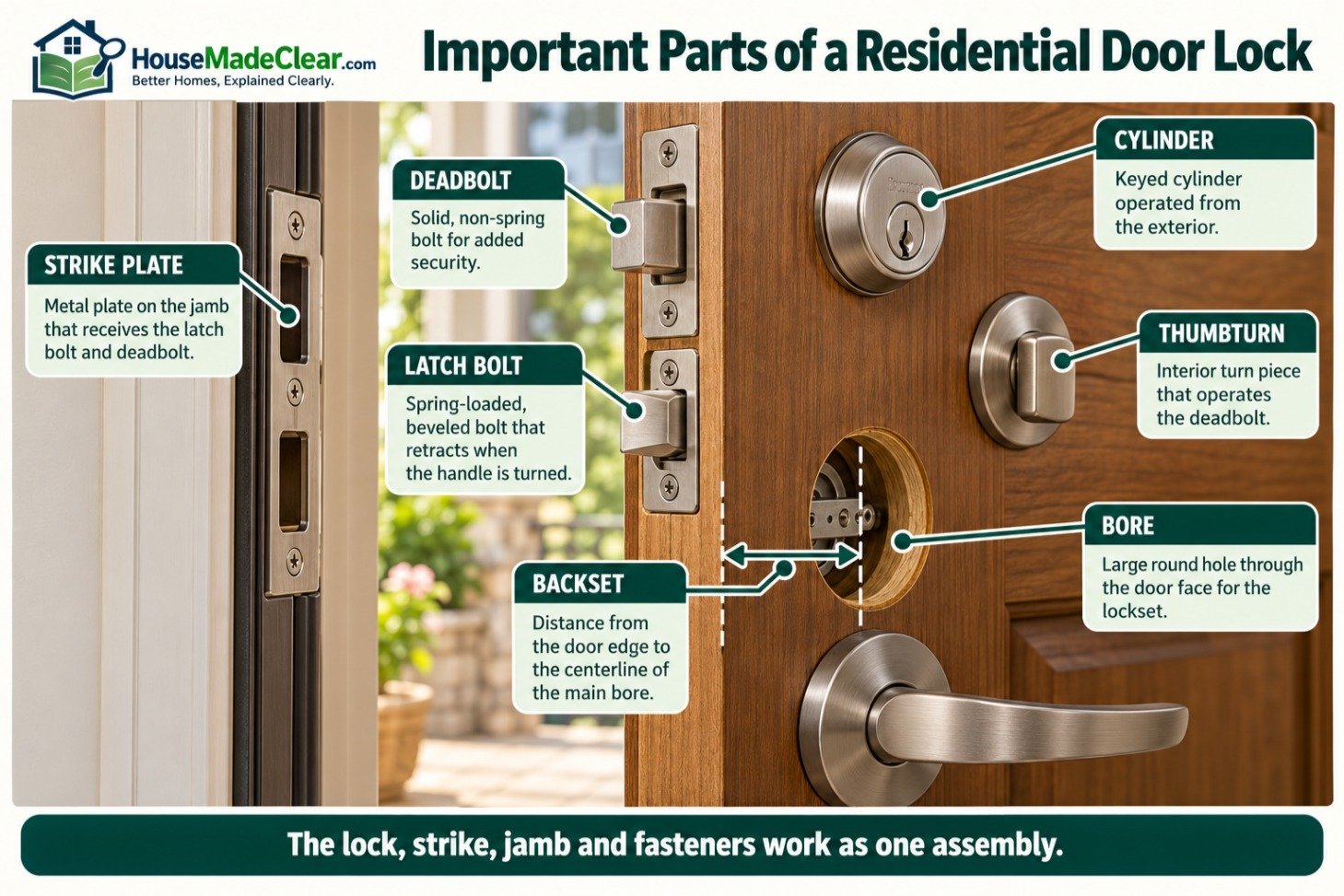
Important Door-Lock Parts
Before comparing lock types, understand the components that affect installation and security.
Latch Bolt
A latch bolt is normally spring-loaded. It retracts when the knob or lever is operated and extends automatically when the door closes.
Its angled face allows the door to close without manually retracting the latch.
Deadbolt
A deadbolt extends and retracts through deliberate key or thumbturn operation. It is not normally spring-loaded like a latch bolt.
A deadbolt provides an important security layer on many exterior hinged doors.
Cylinder
The cylinder is the keyed part of a mechanical lock. It contains the components that interact with the key.
The number of cylinders does not, by itself, indicate the strength of the complete lock.
Thumbturn
A thumbturn allows a lock or deadbolt to be operated from inside without a key.
Strike Plate
The strike is mounted on the jamb or receiving part of the door assembly. The latch or deadbolt enters its opening.
The strike, fasteners, jamb and wall framing influence how the assembly handles force.
Backset
Backset is the distance from the door edge to the centerline of the main bore or lock spindle.
Common residential backsets exist, but they are not universal. Measure before ordering replacement hardware.
Bore
The bore is the large hole through the face of a conventionally prepared door. A smaller cross-bore enters from the door edge.
Mortise locks and multipoint systems use different door preparation.
Handing
Some hardware is reversible, while other products are manufactured for a specific door handing.
Handing depends on factors such as:
- Which side the hinges are on
- Whether the door swings inward or outward
- Which side is considered secure
- Which way the lever or latch must operate
Follow the manufacturer’s handing instructions rather than relying on an informal left-versus-right description.
Exterior Door-Lock Types
Exterior locks need to provide access control while preserving reliable emergency exit.
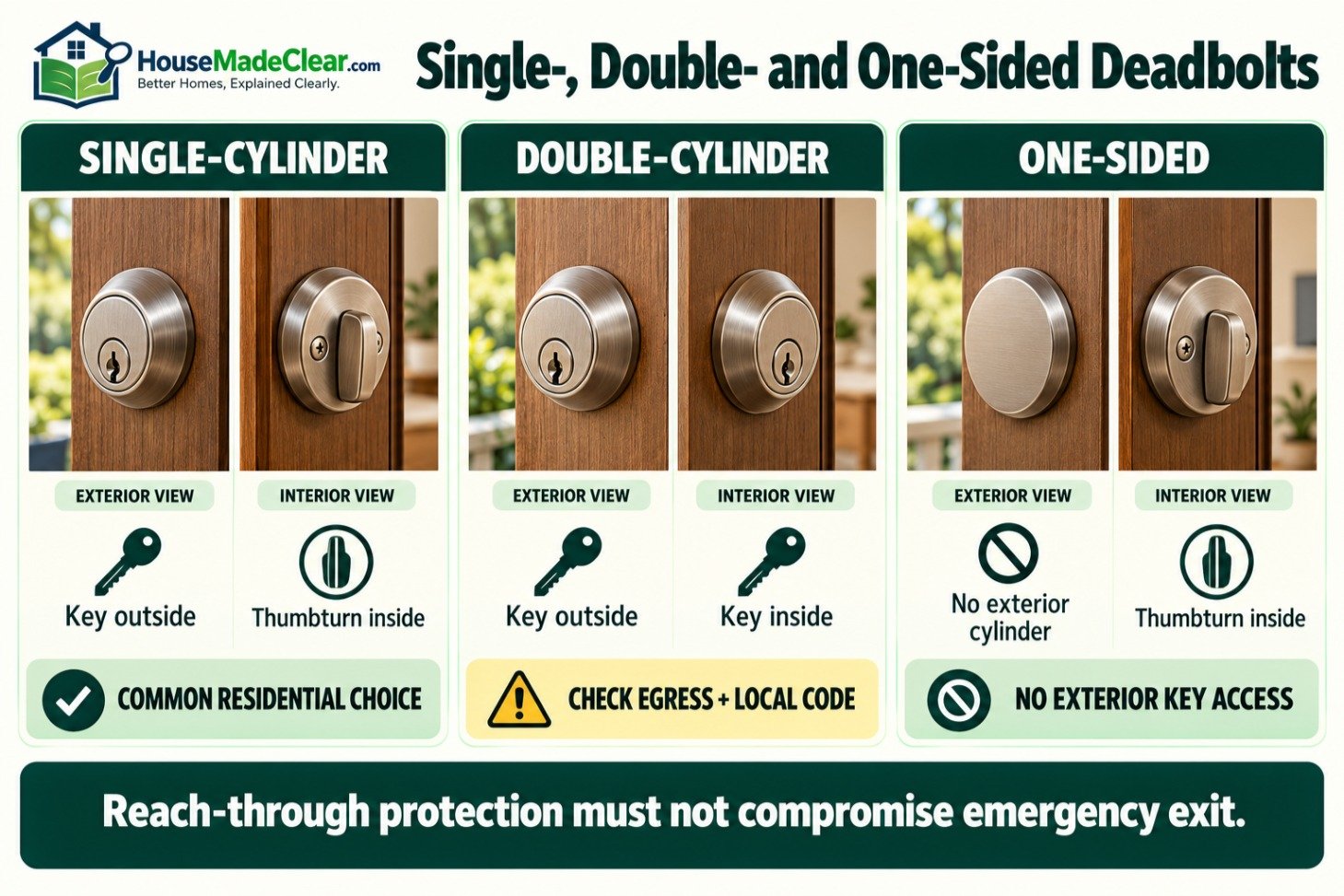
1. Single-Cylinder Deadbolt
A single-cylinder deadbolt has:
- A keyed cylinder outside
- A thumbturn inside
This is one of the most common residential exterior-door lock types.
Best Uses
- Front doors
- Back doors
- Side entrances
- Garage-to-house doors when compatible with the door assembly
- Exterior doors without a serious reach-through risk
Advantages
- Quick interior operation
- No key required for exit
- Widely available
- Compatible with many standard door preparations
- Available in mechanical, keypad and smart versions
Limitations
A person may be able to operate the thumbturn after creating an opening through nearby glass, a mail slot or another accessible opening.
The correct response is not automatically a double-cylinder lock. Improving the glass, door or opening may preserve safer interior operation.
For a detailed comparison, see single-cylinder vs double-cylinder deadbolts.
2. Double-Cylinder Deadbolt
A double-cylinder deadbolt requires a key on both sides.
It can prevent someone from reaching through broken glass and turning an interior thumbturn when the key has been removed.
Best Uses
Its use should be limited to carefully evaluated situations where:
- A genuine reach-through risk exists
- Local code permits keyed interior operation
- The door’s emergency-exit function has been evaluated
- Safer glazing or door modifications are impractical
- Every occupant understands the system
Main Disadvantage
The same feature that prevents reach-through operation can delay occupants trying to escape.
Local building and fire requirements may prohibit double-cylinder deadbolts on required egress doors.
Leaving the key permanently in the interior cylinder undermines much of the reach-through advantage.
3. One-Sided Deadbolt
A one-sided deadbolt has an interior thumbturn but no exterior key cylinder.
Some versions are visible from outside only as part of the door surface, while others are concealed.
Best Uses
- Doors that do not require exterior keyed access
- Supplemental locking in limited applications
- Some patio, side or connecting doors
Limitations
A one-sided deadbolt can prevent authorized exterior access through that door. This may create problems for household members, property managers or emergency access.
It must not be installed where it creates an unsafe exit or conflicts with local requirements.
4. Keyed Entry Knob
A keyed entry knob combines a spring latch with a keyed exterior cylinder.
The interior side may use:
- A push button
- A turn button
- Another release mechanism
Advantages
- Latches the door automatically when closed
- Familiar operation
- Fits many standard residential door preparations
- Available at many performance levels
Limitations
A keyed knob should not be treated as a complete substitute for an appropriate deadbolt on a conventional exterior entrance.
The spring latch and surrounding trim perform differently from a solid deadbolt. The knob can also be harder to operate for users with limited hand strength or dexterity.
5. Keyed Entry Lever
A keyed entry lever performs a function similar to a keyed entry knob but uses a lever handle.
Advantages
- Easier to operate with an elbow or limited grip
- Suitable for many standard door preparations
- Available in coordinated residential finishes
- Can improve usability for many occupants
Limitations
The lever shape does not make the lock mechanically stronger. Security depends on the lock body, latch, cylinder, strike, door and installation.
Some lever designs can catch on clothing or bags.
6. Handleset
A handleset normally combines:
- An exterior pull handle
- A thumb-operated latch
- An interior knob or lever
- A separate or integrated deadbolt
Handlesets are commonly used on front entrances.
Advantages
- Large exterior grip
- Decorative appearance
- Can combine latch operation with a deadbolt
- Available in mechanical and electronic configurations
Limitations
Handlesets have specific mounting dimensions. Replacing one can expose old holes or require new door preparation.
The decorative lower handle should not be mistaken for the primary security component. The deadbolt and complete door assembly still determine much of the forced-entry resistance.
7. Mortise Lock
A mortise lock uses a rectangular lock body installed inside a pocket cut into the door edge.
The lock body may combine:
- Latch bolt
- Deadbolt
- Cylinder
- Spindle
- Lever or knob controls
- Auxiliary locking functions
Mortise locks are common in:
- Older houses
- Historic properties
- Apartment buildings
- Substantial wood doors
- Commercial-style entrances
Advantages
- Robust integrated construction
- Serviceable components on many models
- Supports numerous functions
- Long history of architectural use
- Can work well on substantial doors
Limitations
A mortise pocket removes significant material from the door edge. The lock and replacement hardware must match the existing preparation.
Replacing a mortise lock with an incompatible cylindrical lock can leave large openings, weaken the door or damage historic material.
Professional service is often appropriate. Not every door-security solution involves replacing the existing lock. Renters who cannot install a new deadbolt may consider compatible removable devices or entry sensors instead. Our guide to apartment door security without drilling compares these options and their limitations.
8. Multipoint Lock
A multipoint lock secures the door at more than one location when the handle or key is operated.
Locking points may include:
- Central latch
- Deadbolt
- Hooks
- Rollers
- Top shoot bolt
- Bottom shoot bolt
Multipoint systems commonly appear on:
- French doors
- Tall entrance doors
- Modern patio doors
- European-style doors
- Some fiberglass and composite doors
Advantages
- Distributes locking across the door height
- Can improve compression against weather seals
- Helps control tall door panels
- Can provide strong integrated locking when correctly installed
Limitations
Multipoint systems are not standardized replacements. Components must match the:
- Door profile
- Backset
- Faceplate
- Handle spacing
- Locking-point locations
- Keeps
- Door height
- Manufacturer
Do not force a stiff multipoint handle. Stiffness may indicate misalignment, damaged keeps or internal wear.
Our guide to securing French doors explains how multipoint locks work with the inactive leaf, astragal and flush bolts.
Electronic and Connected Door Locks
Electronic access changes how the user is authorized. It does not automatically determine the physical strength of the bolt, latch, door or frame.
9. Keypad Lock
A keypad lock uses a numeric code instead of, or in addition to, a physical key.
It may control:
- A deadbolt
- A latch
- A lever lock
- A mortise lock
- An electronic strike in specialized installations
Advantages
- No physical key required for normal entry
- Codes can sometimes be changed without rekeying
- Temporary codes may be available
- Useful for household members, cleaners or contractors
- No internet connection required on many models
Limitations
- Batteries require monitoring
- Shared codes can spread beyond the intended users
- Worn buttons may reveal frequently used digits
- Some models have limited code management
- Mechanical installation remains critical
Use separate codes where the product supports them. Delete temporary codes when they are no longer needed.
10. Smart Lock
A smart lock adds connected or automated access features.
Depending on the model, it may support:
- Smartphone control
- Remote locking
- Temporary credentials
- Access history
- Automatic locking
- Voice-assistant integration
- Geofencing
- Fingerprint access
- Home-security integration
- Low-battery alerts
Smart Locks Are Not Automatically Stronger
A smart lock may operate the same type of deadbolt used by a conventional mechanical lock.
Its advantages usually concern:
- Access management
- Convenience
- Notifications
- Accountability
- Automation
Its physical security still depends on:
- Mechanical certification
- Bolt and strike
- Door alignment
- Frame strength
- Installation
- Override cylinder
- Interior operation
Digital Responsibilities
Connected locks also require:
- Strong account passwords
- Multifactor authentication where available
- Current software
- Controlled account access
- Secure household Wi-Fi
- Review of old users and integrations
- Battery maintenance
- A documented manual-entry method
Do not share the primary account password when a separate user or temporary code can be created.
11. Retrofit Smart-Lock Adapter
A retrofit smart device fits over or operates the interior side of an existing deadbolt.
Advantages
- Exterior hardware may remain unchanged
- Existing physical keys may still work
- Installation may require fewer exterior modifications
- Some models suit renters with permission
Limitations
The existing deadbolt must already operate smoothly. A motorized adapter should not be expected to overcome:
- Door sag
- Strike misalignment
- A binding bolt
- Warped weatherstripping
- Frame movement
Repair the mechanical problem before adding automation.
Surface-Mounted Door Locks
Surface-mounted locks attach largely to the face of the door rather than being completely contained inside its edge.
12. Rim Lock
A rim lock is mounted on the door surface. Depending on the design, it may use:
- Latch bolt
- Deadbolt
- Key cylinder
- Interior knob
- Surface-mounted keeper
Rim locks are found on:
- Older doors
- Historic homes
- Gates
- Specialty installations
- Doors with limited internal preparation
Advantages
- Visible and often serviceable construction
- Can suit certain thin or historic doors
- Requires a different preparation than a mortise lock
Limitations
The door and frame must provide suitable mounting strength. Decorative reproduction locks vary widely in security performance.
Do not assume an antique-style rim lock is suitable as the only exterior security lock.
13. Jimmy-Proof Deadbolt
A jimmy-proof deadbolt is a surface-mounted lock designed so that interlocking components resist separation between the door and jamb.
It is commonly associated with:
- Inward-opening apartment doors
- Older residential entrances
- Doors where conventional edge preparation is difficult
Advantages
- Surface-mounted construction
- Interlocking bolt and strike design
- Can reduce certain prying opportunities
Limitations
It is not suitable for every frame, swing direction or property. Installation still depends on secure mounting material.
Apartment tenants need permission before altering an entry door, particularly when the door is fire-rated or part of a managed key system.
Door-Specific Lock Types
Some doors need locks designed around their movement and construction.
14. Sliding Glass Door Lock
A sliding patio door commonly uses a hook, clasp or mortise-style latch that engages a keeper.
Additional devices may include:
- Track bars
- Pin locks
- Loop locks
- Foot bolts
- Clamp locks
- Keyed handles
- Anti-lift retainers
A conventional hinged-door deadbolt is usually unsuitable for a narrow sliding-door stile.
Sliding-door security must address:
- Horizontal movement
- Vertical lifting
- Roller alignment
- Fixed-panel retention
- Frame condition
- Glass
See our complete guide to securing a sliding glass door.
15. French-Door Locking System
French doors use two hinged leaves that meet in the center.
A complete system may include:
- Active-leaf latch
- Deadbolt
- Multipoint lock
- Astragal
- Top and bottom flush bolts
- Automatic inactive-leaf bolts
- Shoot bolts
- Hinges and security studs
The inactive leaf often provides the receiving support for the active door’s lock. A strong deadbolt cannot compensate for weak flush bolts or a loose astragal.
16. Storm-Door or Security-Screen Lock
Storm and screen doors use specialized narrow hardware.
A standard insect-screen door provides ventilation and insect control, not substantial security.
A security screen or storm-door system may include:
- Keyed latch
- Deadbolt
- Multipoint lock
- Reinforced mesh
- Substantial frame
- Tamper-resistant hinges
The lock is only one part of the tested or designed assembly.
Do not install generic hardware that interferes with the main entrance door or prevents emergency exit.
Interior Door-Lock Types
Interior locks normally provide privacy or basic room control rather than exterior security.
17. Privacy Lock
Privacy locks are commonly used on:
- Bedrooms
- Bathrooms
- Dressing rooms
- Home offices needing limited privacy
The interior side may use a push button or thumbturn. The exterior side usually provides emergency release access rather than a keyed security cylinder.
Privacy Is Not High Security
Privacy locks are designed to discourage accidental entry. They are not intended to provide the same resistance as an exterior deadbolt.
Keep the manufacturer’s emergency-release tool accessible to responsible household members but away from very young children.
18. Passage Latch
A passage latch keeps a door closed without locking it.
Common applications include:
- Hallways
- Closets
- Laundry rooms
- Pantries
- Shared interior rooms
Both sides remain operable.
A passage latch is appropriate when the room does not need privacy or access restriction.
19. Dummy Knob or Lever
Dummy hardware is a fixed pull with no operating latch.
It may be used on:
- Closet doors
- Inactive double-door leaves
- Decorative panels
- Cabinets
- Doors using separate roller catches
Dummy hardware can be:
- Single-sided
- Paired
- Surface-mounted
Do not install dummy hardware where a functioning latch or lock is required.
20. Pocket-Door Lock
A pocket door slides into a wall cavity. It cannot use a projecting conventional knob without interfering with movement.
Pocket-door hardware may include:
- Recessed pull
- Edge pull
- Privacy thumbturn
- Passage latch
- Keyed lock for specialized applications
Important Installation Concern
The wall cavity beside a pocket door often contains limited space for fasteners, electrical boxes and other hardware.
Do not drive long screws into a pocket-door wall without locating the door and concealed components.
21. Barn-Door Lock
An interior barn door slides across the face of a wall.
Possible locking methods include:
- Privacy latch
- Hook-and-eye mechanism
- Teardrop latch
- Surface bolt
- Floor bolt
- Specialized keyed lock
Barn doors normally leave gaps around the opening and are difficult to seal acoustically. A small privacy latch does not convert one into a high-security door.
They are generally unsuitable where substantial security, sound control or fire separation is required.

Supplemental Door-Locking Devices
Supplemental hardware should support—not replace—the correct primary lock.
22. Barrel Bolt or Surface Bolt
A barrel bolt slides into a receiver mounted on the frame, floor or adjacent leaf.
Common uses include:
- Inactive French-door leaves
- Gates
- Shed doors
- Interior secondary security
- Cabinets
- Utility areas
Limitations
Small decorative bolts may use short screws and thin materials. Their appearance does not prove forced-entry strength.
Surface bolts must not create an unsafe emergency-exit condition.
23. Flush Bolt
A flush bolt is recessed into the face or edge of a door so that it sits relatively flat.
It is commonly used on the inactive leaf of double doors.
The bolt may engage:
- Head jamb
- Threshold
- Floor receiver
Flush bolts may be:
- Manual
- Automatic
- Constant-latching
Both the bolt and receiver need correct alignment and adequate supporting material.
24. Door Chain
A door chain allows a door to open a short distance while remaining connected to the frame.
Appropriate Role
A chain may provide limited control when checking who is outside.
Limitations
A standard door chain should not be treated as the primary exterior lock. Its small fasteners and attachment points may provide limited resistance.
Opening the main door against the chain can also expose the interior and create an opportunity to apply force.
A camera, peephole or video doorbell allows the visitor to be assessed without opening the door.
25. Swing-Bar Door Guard
A swing-bar guard serves a purpose similar to a door chain but uses a rigid bar and retaining arm.
It is common in hotels and apartments.
Its resistance depends on:
- Product construction
- Mounting material
- Fasteners
- Door direction
- Installation
It remains supplemental hardware and should not replace the main lock.
26. Door Security Bar or Floor Barricade
An interior security bar braces an inward-opening door against the floor or another supported surface.
A floor barricade attaches to or engages a floor-mounted receiver.
Advantages
- Adds resistance from inside
- Does not depend solely on the latch
- Some portable models require no door modification
Limitations
- Usually ineffective on outward-opening doors
- Can slip on some flooring
- May damage the floor
- Can delay emergency exit
- Cannot normally be operated from outside
- May be prohibited in certain applications
Do not install a barricade on a required exit without confirming that it preserves compliant emergency operation.
27. Padlock and Hasp
Padlocks are commonly used with a hasp on:
- Sheds
- Gates
- Storage boxes
- Utility enclosures
- Outbuildings
The padlock, hasp, staple, fasteners and supporting material must work as an assembly.
A strong padlock attached to a thin hasp or weak shed siding provides limited security.
Exposed fasteners should not be removable from the unsecured side.
Mechanical, Electronic and Smart Locks Compared
| Feature | Mechanical Lock | Electronic Keypad Lock | Connected Smart Lock |
|---|---|---|---|
| Normal access | Physical key | Code, credential or key | App, code, credential or key |
| Internet required | No | Usually no | Depends on model |
| Batteries required | No | Usually | Usually |
| Remote control | No | Usually no | Often |
| Temporary access | Requires spare key or rekeying | Often available | Common |
| Access history | No | Limited on some models | Often available |
| Cybersecurity exposure | Minimal | Limited | Higher |
| Mechanical installation | Critical | Critical | Critical |
| Emergency override | Key or interior control | Product-dependent | Product-dependent |
| Best advantage | Simplicity | Keyless local access | Access management and alerts |
A connected lock is not automatically a better security choice. Select it when its access-management benefits solve a real household need.

Door-Lock Grades and Certification
Appearance, weight and price are unreliable ways to judge lock performance.
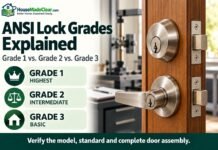
ANSI/BHMA standards use product grades within applicable hardware categories:
- Grade 1: Highest performance level
- Grade 2: Intermediate performance level
- Grade 3: Basic performance level
BHMA explains that certified products undergo independent testing covering applicable cycle, operational, strength, security and finish requirements. The BHMA Certified Products Directory provides current listings of certified products.
The grade must apply to the exact product or series being purchased. Do not assume that every product from a certified manufacturer carries the same certification.
A higher grade does not repair:
- A cracked jamb
- A loose strike
- A hollow or damaged door edge
- Poor alignment
- Inadequate installation
- Uncontrolled keys
Which Lock Is Best for Each Door?
| Door or Room | Practical Starting Point | Important Considerations |
|---|---|---|
| Front entrance | Certified single-cylinder deadbolt plus latch or handleset | Frame, strike, glass and emergency exit |
| Back or side door | Single-cylinder deadbolt plus entry latch | Lighting, visibility and door condition |
| Door with nearby glass | Keyless interior egress plus improved glazing | Reach-through risk and local code |
| Garage-to-house door | Compatible latch and lock for the listed assembly | Closing, latching and fire-separation requirements |
| Apartment entry | Existing approved lock plus authorized upgrades | Lease, fire rating and management access |
| French doors | Multipoint or deadbolt system plus secure inactive leaf | Astragal, flush bolts and hinges |
| Sliding patio door | Factory latch, track blocker, secondary lock and anti-lift device | Rollers, fixed panel and glass |
| Bedroom | Privacy lock | Emergency exterior release |
| Bathroom | Privacy lock | Simple emergency release |
| Closet | Passage or dummy hardware | Door configuration |
| Pocket door | Recessed passage or privacy lock | Wall-cavity clearance |
| Interior barn door | Compatible privacy latch | Gaps and limited security |
| Shed | Outdoor-rated lock, hasp or integrated lockset | Door and fastener strength |
| Gate | Weather-resistant latch, lock or padlock system | Corrosion and accessible fasteners |
Best Lock for a Front Door
For many conventional front doors, a practical arrangement includes:
- Certified single-cylinder deadbolt
- Properly aligned latch
- Secure strike
- Sound door and jamb
- Controlled keys
- Keyless interior operation
- Protected nearby glass
- Secure hinges
A handleset, lever or knob can operate the spring latch, but the deadbolt normally provides the main deliberate locking layer.
The correct hardware must match:
- Door thickness
- Backset
- Bore diameter
- Edge preparation
- Swing direction
- Existing holes
- Glass location
- Frame construction
Best Lock for a Bedroom Door
A privacy lock is normally appropriate.
It should:
- Lock from inside
- Provide an emergency-release method outside
- Operate without a key for routine use
- Be understandable to household members
- Not trap a child or vulnerable occupant
A keyed exterior-style lock may be inappropriate for an ordinary bedroom and can complicate emergency access.
Best Lock for a Bathroom Door
Use a privacy lock with a simple exterior emergency release.
Avoid storing the release tool somewhere inaccessible. Household members should understand how the mechanism works before an emergency occurs.
Best Lock for a Door With Glass
The lock cannot be considered separately from the glazing.
Evaluate:
- Distance from glass to interior control
- Glass type
- Glass-retention system
- Size of the opening after breakage
- Nearby sidelights
- Mail slots
- Other reachable hardware
A double-cylinder deadbolt may reduce reach-through operation, but it can delay emergency exit and may be prohibited.
Laminated glazing, improved glass retention or another professionally designed solution may preserve safer thumbturn operation.
Door-Lock Egress and Life-Safety Considerations
At least one qualifying egress door is required for a dwelling under common residential model-code provisions. The required door must be readily openable from inside without a key or special knowledge or effort. Local adoption and amendments determine the enforceable requirements.
Security hardware should not prevent occupants from leaving during:
- Fire
- Gas leak
- Medical emergency
- Power failure
- Severe weather
- Another urgent evacuation
The U.S. Fire Administration advises households to keep escape routes unobstructed and warns that residents may have less than two minutes to escape after a smoke alarm sounds. Review the USFA home fire escape guidance.
Avoid interior arrangements that depend on:
- Finding a key
- Remembering a hidden release
- Unusual physical strength
- Moving furniture
- Releasing several unfamiliar devices
- Electronic power without mechanical backup
How to Choose the Right Door Lock
1. Identify the Door’s Purpose
Determine whether the door needs:
- Exterior security
- Interior privacy
- Simple latching
- Decorative pulling
- Electronic access
- Temporary access control
- Child-safety support
- Weather resistance
2. Identify the Door Type
Record whether the door is:
- Hinged
- Sliding
- French or double
- Barn style
- Storm or security screen
- Gate
- Shed or outbuilding door
3. Inspect the Existing Preparation
Measure:
- Door thickness
- Backset
- Bore size
- Cross-bore size
- Center-to-center spacing
- Edge-plate dimensions
- Strike location
- Existing handleset mounting holes
For mortise and multipoint locks, identify the manufacturer and exact mechanism wherever possible. Before buying a replacement lock, measure the door slab and confirm its thickness rather than relying on a standard size. Interior and exterior doors commonly use different thicknesses, which can affect hardware compatibility. Our standard door height, width, and thickness guide explains how to measure the slab and distinguish nominal door sizes from actual dimensions.
4. Check the Swing and Handing
Confirm:
- Inward or outward swing
- Hinge side
- Secure side
- Latch-bevel direction
- Lever orientation
5. Evaluate the Door and Frame
Look for:
- Cracked jamb
- Loose strike
- Door sag
- Rot
- Corrosion
- Damaged hinges
- Enlarged holes
- Glass near the lock
- Previous forced-entry damage
6. Check Certification
Verify the exact product rather than relying on phrases such as:
- Heavy duty
- Premium security
- Commercial style
- Professional grade
- Maximum protection
These phrases do not substitute for a recognized test or certification.
7. Protect Emergency Operation
Every occupant who may need the door should be able to release it quickly from inside.
8. Plan Key and Credential Management
Decide:
- Who receives keys
- Whether old keys are accounted for
- Who receives codes
- How temporary access is removed
- Who manages the smart-lock account
- What happens during battery or network failure
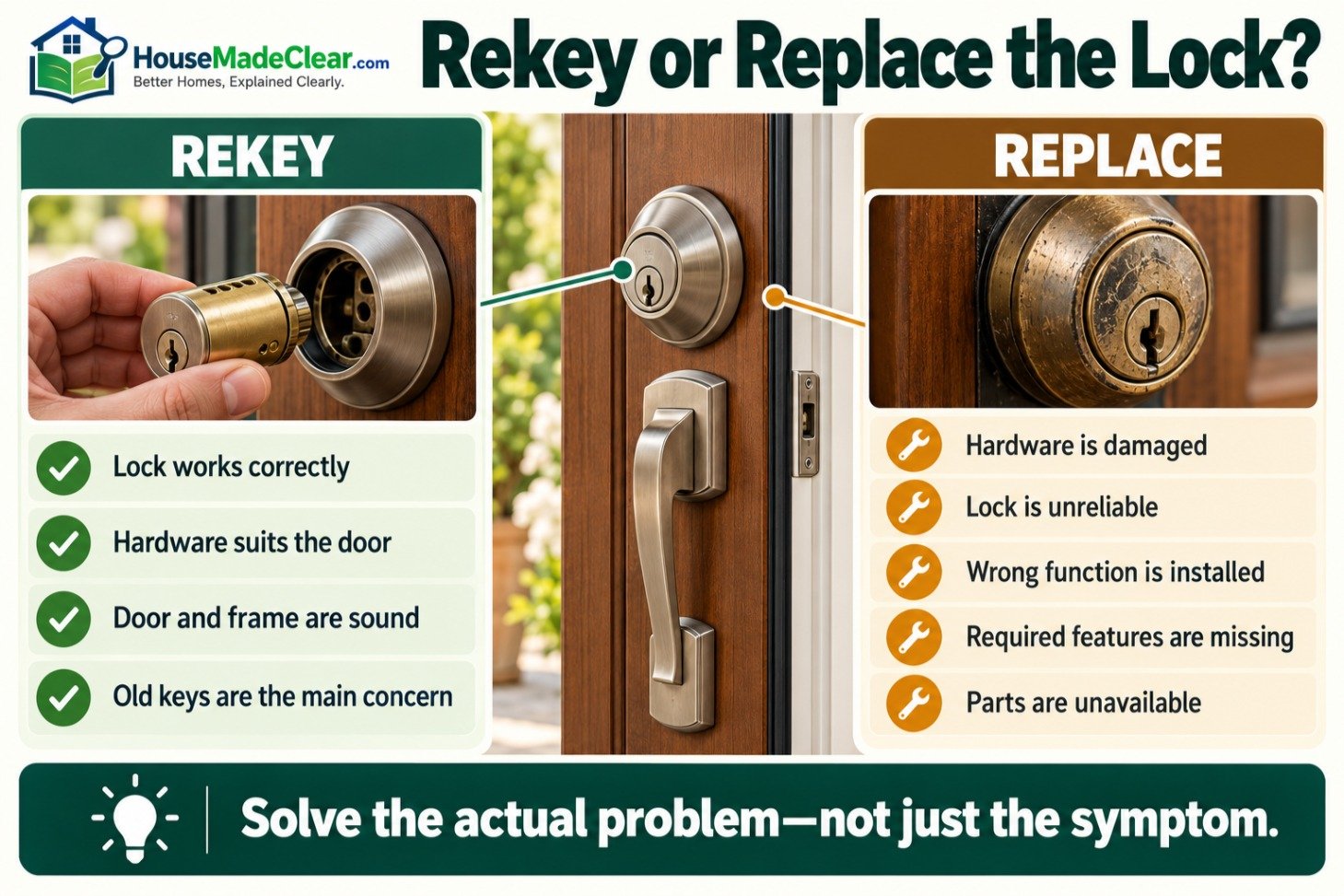
Rekeying vs Replacing a Lock
Rekeying changes the cylinder so old keys no longer operate it. The main lock body and visible hardware may remain in place.
Rekeying can be appropriate when:
- The lock works correctly
- The hardware is suitable
- The door and frame are sound
- The main concern is uncontrolled keys
Replacement is more appropriate when:
- Hardware is damaged
- The lock is unreliable
- The wrong function is installed
- The product lacks necessary features
- The door is being upgraded
- A new access system is required
- Parts are unavailable
Do not replace a sound lock solely because old keys exist if professional rekeying solves the actual problem.
Common Door-Lock Selection Mistakes
Choosing by Appearance Alone
A decorative handleset may contain basic or high-performance hardware. Its appearance does not reveal its certification or installation quality.
Calling Every Lock a Deadbolt
A spring latch, hook lock, multipoint system and deadbolt operate differently.
Treating a Smart Lock as Automatically Stronger
Connected features improve access management. They do not automatically strengthen the bolt, strike or frame.
Ignoring Door Preparation
A replacement lock that does not match the existing backset, bore or door thickness may not install correctly.
Installing an Exterior Lock on an Interior Door
A keyed lock may create unnecessary emergency-access problems in a bedroom or bathroom.
Using a Privacy Lock for Exterior Security
Privacy hardware is designed to discourage casual entry—not resist determined forced entry.
Ignoring the Strike and Frame
The lock, strike, jamb, door and fasteners work as one assembly.
Adding a Double-Cylinder Lock Without Checking Code
The reach-through benefit may be outweighed by the emergency-exit risk.
Drilling a Fire-Rated Door
Unapproved modifications can affect a listed door assembly. Use compatible hardware and qualified installation.
Forgetting Key Control
A strong lock provides limited access control when former occupants, contractors or others retain keys.
Door-Lock Inspection Checklist
| Item | What to Check |
|---|---|
| Lock function | Entry, privacy, passage, dummy or electronic |
| Door type | Hinged, sliding, double, pocket or specialty |
| Door thickness | Compatible with selected hardware |
| Backset | Matches the latch or lock |
| Bore preparation | Correct size and position |
| Handing | Compatible or reversible |
| Latch | Extends and retracts smoothly |
| Deadbolt | Extends completely |
| Strike | Secure and aligned |
| Frame | Sound and stable |
| Door edge | Not cracked or weakened |
| Hinges | Tight and correctly supported |
| Glass | Reach-through risk evaluated |
| Certification | Exact product verified |
| Key control | Unauthorized keys invalidated |
| Codes | Local requirements checked |
| Emergency exit | Interior release remains simple |
| Smart-lock account | Protected and maintained |
| Battery backup | Known and tested |
| Manufacturer instructions | Followed during installation |
Frequently Asked Questions
What are the main types of door locks?
The main residential types include deadbolts, keyed knobs and levers, handlesets, mortise locks, multipoint locks, keypad locks, smart locks, rim locks, sliding-door locks, privacy locks, passage latches and pocket-door locks.
What type of lock is best for a front door?
For many homes, a certified single-cylinder deadbolt combined with a properly aligned latch or handleset is a practical starting point. The strike, frame, door, glass, hinges and installation must also be secure.
Is a deadbolt better than a doorknob lock?
A deadbolt provides a separate solid locking bolt, while most locking doorknobs use a spring latch. A properly installed deadbolt generally adds an important security layer to a conventional exterior door.
What is the difference between a single-cylinder and double-cylinder deadbolt?
A single-cylinder deadbolt uses a key outside and thumbturn inside. A double-cylinder deadbolt requires a key on both sides. Double-cylinder locks can reduce reach-through risk but may delay emergency exit.
What is the difference between a mortise lock and cylindrical lock?
A mortise lock uses a rectangular lock body installed in a pocket cut into the door edge. A cylindrical or bored lock fits round holes through the door and is common in modern residential construction.
Are lever locks more secure than knob locks?
Not automatically. Lever and knob describe the handle style. Security depends on the internal lock, cylinder, latch or deadbolt, certification, strike, frame and installation.
Are smart locks safer than traditional locks?
Not automatically. Smart locks can improve code management, remote access and alerts, but their mechanical strength varies. Connected models also require account security, updates and battery maintenance.
What lock should I use for a bedroom?
A privacy lock is normally appropriate. It locks from inside and provides an exterior emergency-release method. It is not intended to provide exterior-door security.
What lock should I use for a bathroom?
Use a privacy knob or lever with a simple exterior emergency release. Avoid a keyed exterior-style lock that could delay access during an emergency.
What lock is used on a sliding glass door?
Sliding glass doors commonly use hook or mortise-style latches. Track bars, pin locks, foot bolts and anti-lift devices can provide additional protection.
What type of lock is used on French doors?
French doors may use a deadbolt or multipoint lock on the active leaf and flush bolts or shoot bolts on the inactive leaf. The astragal and inactive-leaf security are essential parts of the system.
What do ANSI/BHMA lock grades mean?
ANSI/BHMA grades indicate tested performance within an applicable hardware standard. Grade 1 is the highest level, followed by Grades 2 and 3. Verify the exact product in the BHMA Certified Products Directory.
Can I install a new door lock myself?
DIY replacement may be reasonable when the new hardware precisely matches a sound, conventionally prepared door. Professional help is safer for mortise locks, multipoint systems, damaged frames, glass-adjacent drilling and fire-rated doors.
Should I rekey or replace my locks after moving?
Rekeying is often sufficient when the existing hardware is suitable and works correctly. Replace the lock when it is damaged, unreliable, inappropriate or being upgraded to a different access system.
Final Recommendation
Choose a door lock by answering these questions in order:
- Is the door exterior or interior?
- Does it swing, slide, fold or enter a wall pocket?
- Does it need security, privacy, access control or simple latching?
- What preparation already exists in the door?
- Does the lock have appropriate certification?
- Is the strike and frame strong enough?
- Can occupants exit quickly without a key?
- Are keys, codes and accounts properly controlled?
For a conventional exterior entrance, begin with a certified single-cylinder deadbolt and correctly functioning latch. For bedrooms and bathrooms, use privacy hardware. For closets, use passage or dummy hardware. Use purpose-built systems for sliding, French, pocket and multipoint doors.
The correct lock is the one that fits the complete door assembly, performs the required function and preserves safe operation.





[…] Types of Door Locks: Complete Residential Guide […]
[…] Types of Door Locks: Complete Residential Guide […]
[…] Types of Door Locks: Complete Residential Guide […]