















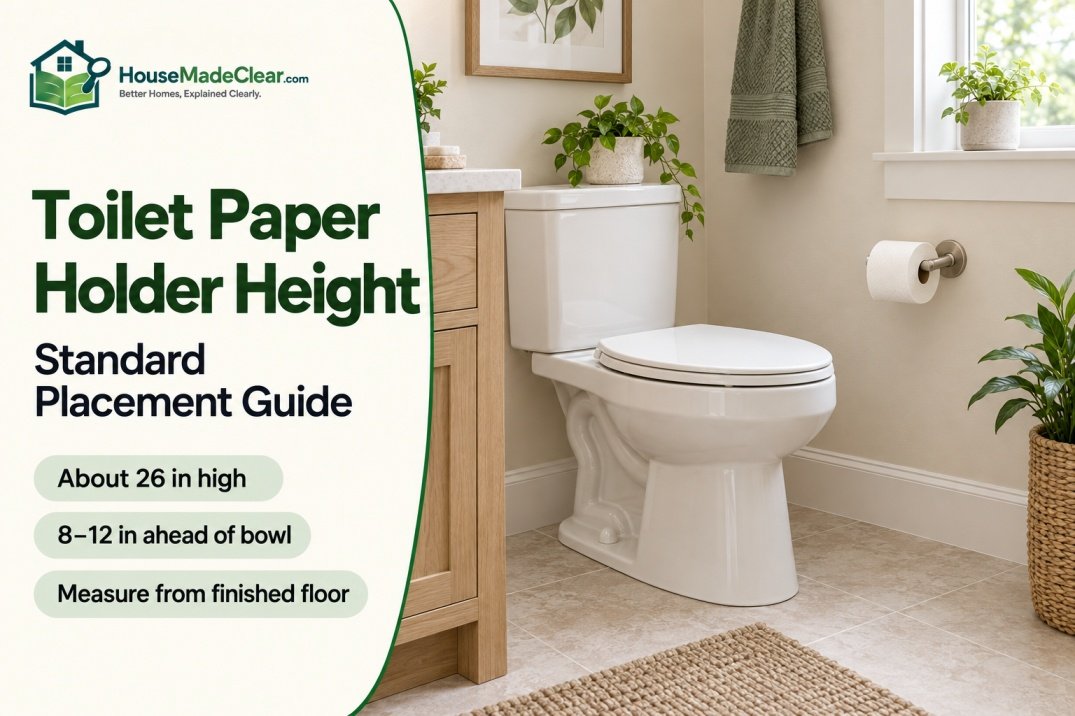
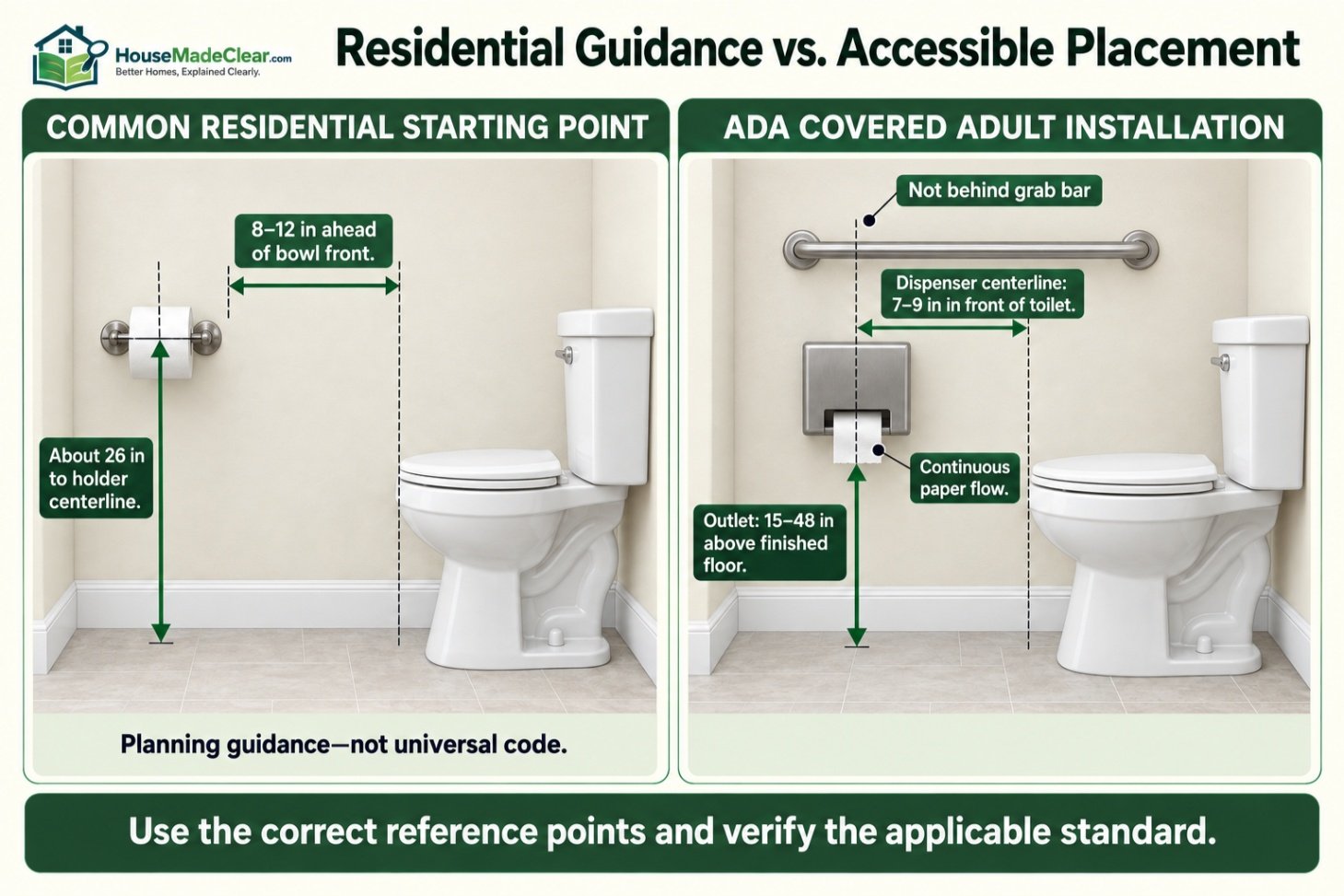
A toilet paper holder is commonly mounted with its center approximately 26 inches above the finished floor. For comfortable residential use, position the holder approximately 8 to 12 inches in front of the toilet bowl’s front edge, measured horizontally to the center of the holder.
These measurements provide a useful starting point, but they are not universal building-code requirements. The best location depends on the toilet’s projection, the user’s reach, the available wall or vanity surface, and whether accessibility requirements apply.
Quick Answer
For a conventional residential bathroom, start with:
- Holder center height: approximately 26 inches above the finished floor
- Practical residential range: approximately 24 to 30 inches
- Horizontal placement: approximately 8 to 12 inches in front of the bowl’s leading edge
- Preferred location: on the side wall or vanity beside the toilet
- Measurement point: usually the holder’s centerline for residential planning
For an accessible installation covered by the ADA Standards:
- The dispenser centerline must be 7 to 9 inches in front of the water closet
- The dispenser outlet must be 15 to 48 inches above the finished floor
- The dispenser cannot be behind a grab bar
- The dispenser must permit continuous paper flow
Residential planning conventions and accessibility requirements use different reference points. Confirm which rules apply before installation.
Toilet Paper Holder Dimensions at a Glance
| Installation | Vertical Position | Horizontal Position | Measurement Reference |
|---|---|---|---|
| Common residential placement | About 26 inches high | 8–12 inches in front of bowl | Holder centerline |
| Lower residential placement | About 24 inches high | 8–12 inches in front | Holder centerline |
| Taller-user placement | Up to about 28–30 inches | Test from seated position | Holder centerline |
| Accessible adult installation | Outlet 15–48 inches high | Centerline 7–9 inches in front of toilet | Dispenser outlet and centerline |
| Accessible children’s installation | Outlet 14–19 inches high | Centerline 7–9 inches in front | Dispenser outlet and centerline |
| Freestanding holder | Product-dependent | Within easy seated reach | Test with actual holder |
| Recessed holder | User- or code-dependent | Must remain within reach | Outlet and dispenser centerline where applicable |
The residential dimensions in this table are practical planning ranges rather than mandatory standards. Accessible installations must be designed using the applicable standard and local requirements.
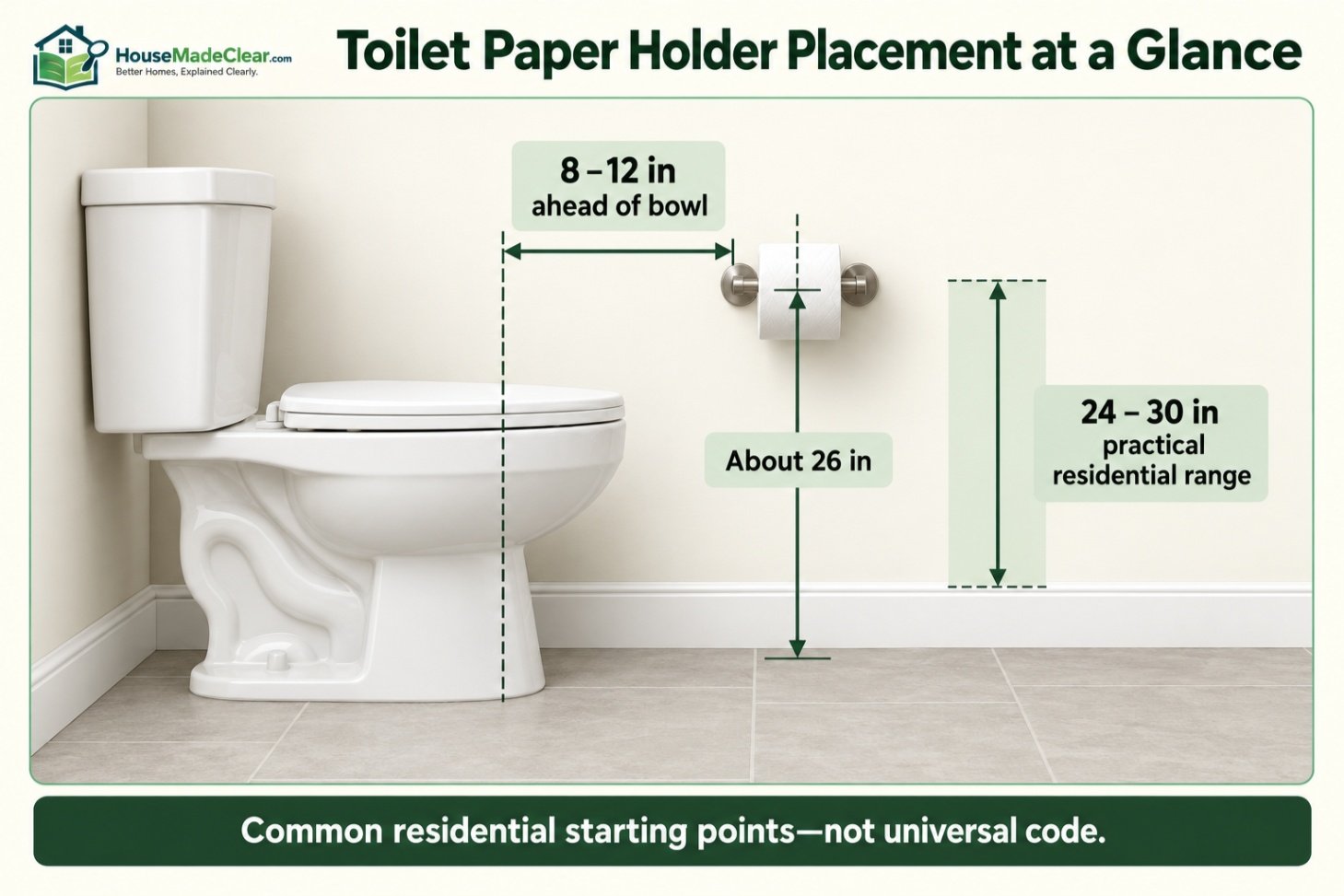
What Is the Standard Toilet Paper Holder Height?
The most commonly used residential toilet paper holder height is approximately:
26 inches above the finished floor
This measurement is usually taken to the center of the holder or roll.
A practical residential range is approximately:
24 to 30 inches above the finished floor
Twenty-six inches works for many bathrooms because the roll remains within seated reach without being so low that it is difficult to see, replace or clean around.
However, there is no single mandatory residential mounting height that works for every toilet and every user.
The correct height can change based on:
- Toilet-seat height
- User height and mobility
- Holder design
- Wall or vanity configuration
- Grab-bar placement
- Whether children regularly use the bathroom
- Whether accessibility standards apply
Is 26 Inches a Building-Code Requirement?
No. The often-repeated 26-inch dimension is a residential planning convention, not a universal building-code requirement.
Building codes may regulate the toilet’s position and clearances, while accessibility standards can regulate dispenser placement in covered installations. A conventional private residential bathroom may not have a specific code-mandated toilet paper holder height.
Treat 26 inches as a practical starting point. Test the location with the actual toilet, holder and users before drilling.
How Far Should a Toilet Paper Holder Be From the Toilet?
For many residential bathrooms, position the center of the holder approximately:
8 to 12 inches in front of the toilet bowl’s front edge
This normally places the roll slightly ahead of a seated user rather than directly beside or behind the hip.
A holder that is too far behind the front edge can require uncomfortable shoulder and torso rotation. One positioned too far forward may require leaning or stretching.
What Does “In Front of the Toilet” Mean?
Imagine a vertical line rising from the frontmost edge of the toilet bowl.
The holder center should generally be about 8 to 12 inches farther toward the front of the room than that line.
For example, if the front edge of the bowl is 29 inches from the rear wall and you want the holder center 10 inches forward:
29 inches + 10 inches = 39 inches
The holder center would be approximately 39 inches from the rear wall, assuming the walls are square and the measurements use the same reference surface.
This calculation is only a starting point. A user should still test the reach while seated.
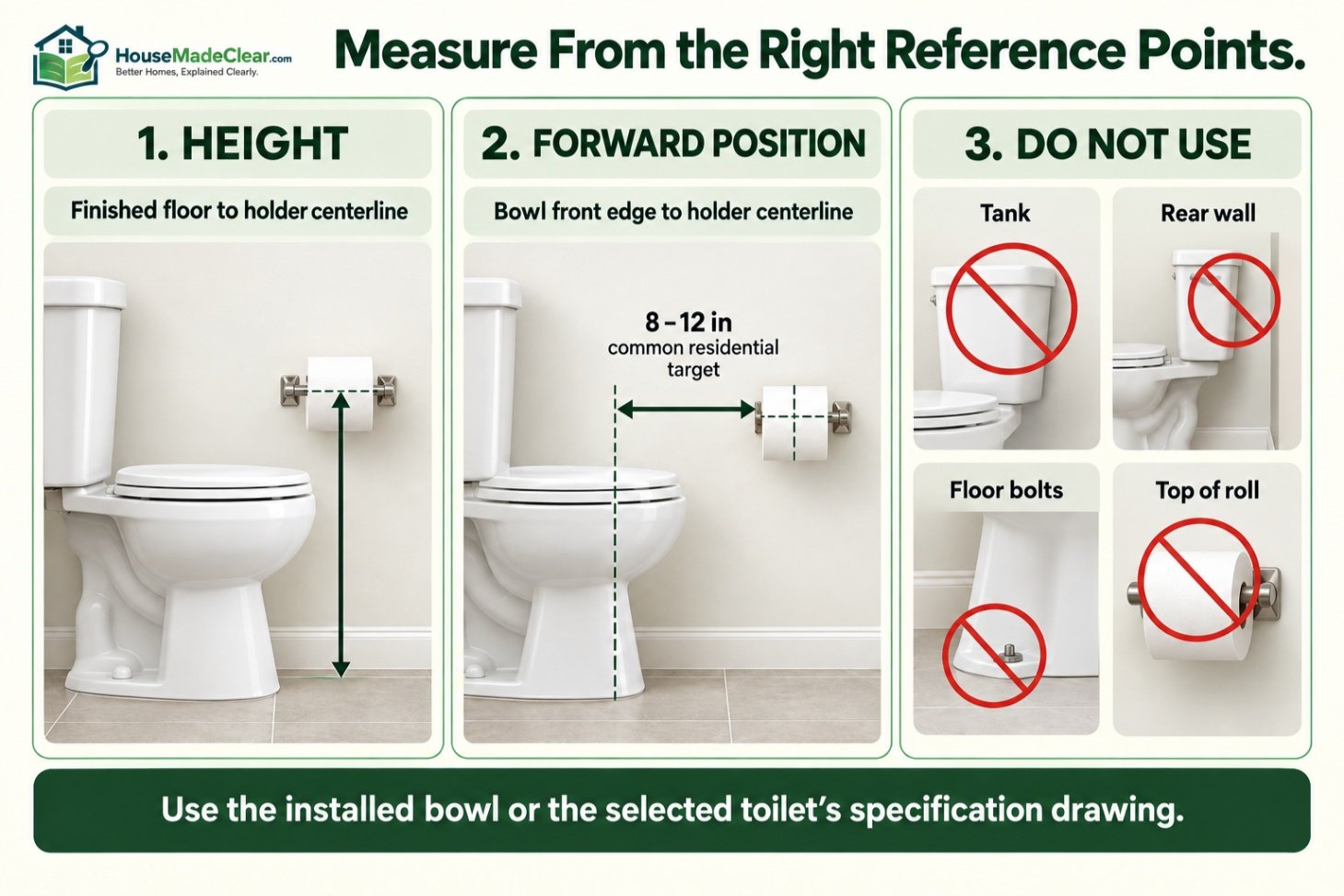
Measure From the Bowl, Not the Tank
Do not measure horizontal holder placement from:
- Rear wall
- Toilet tank
- Closet flange
- Floor bolts
- Toilet centerline
These reference points do not tell you where the seated user’s body will be relative to the holder.
Round-front, elongated and compact elongated toilets can project different distances from the wall even when they use the same rough-in.
Measure from the installed bowl’s leading edge or use the selected toilet’s specification drawing.
Our toilet-clearance guide explains the difference between a toilet’s rough-in, centerline, projection and usable clearance.
Toilet Paper Holder Height vs. Toilet-Seat Height
A typical residential toilet seat may finish at a different height depending on the toilet model.
A holder mounted at 26 inches above the floor will normally sit above the toilet seat. That is usually easier to reach and helps keep the roll visible.
However, selecting a holder height solely by adding a fixed amount to the seat height can be misleading. User reach is affected by both vertical and horizontal distance.
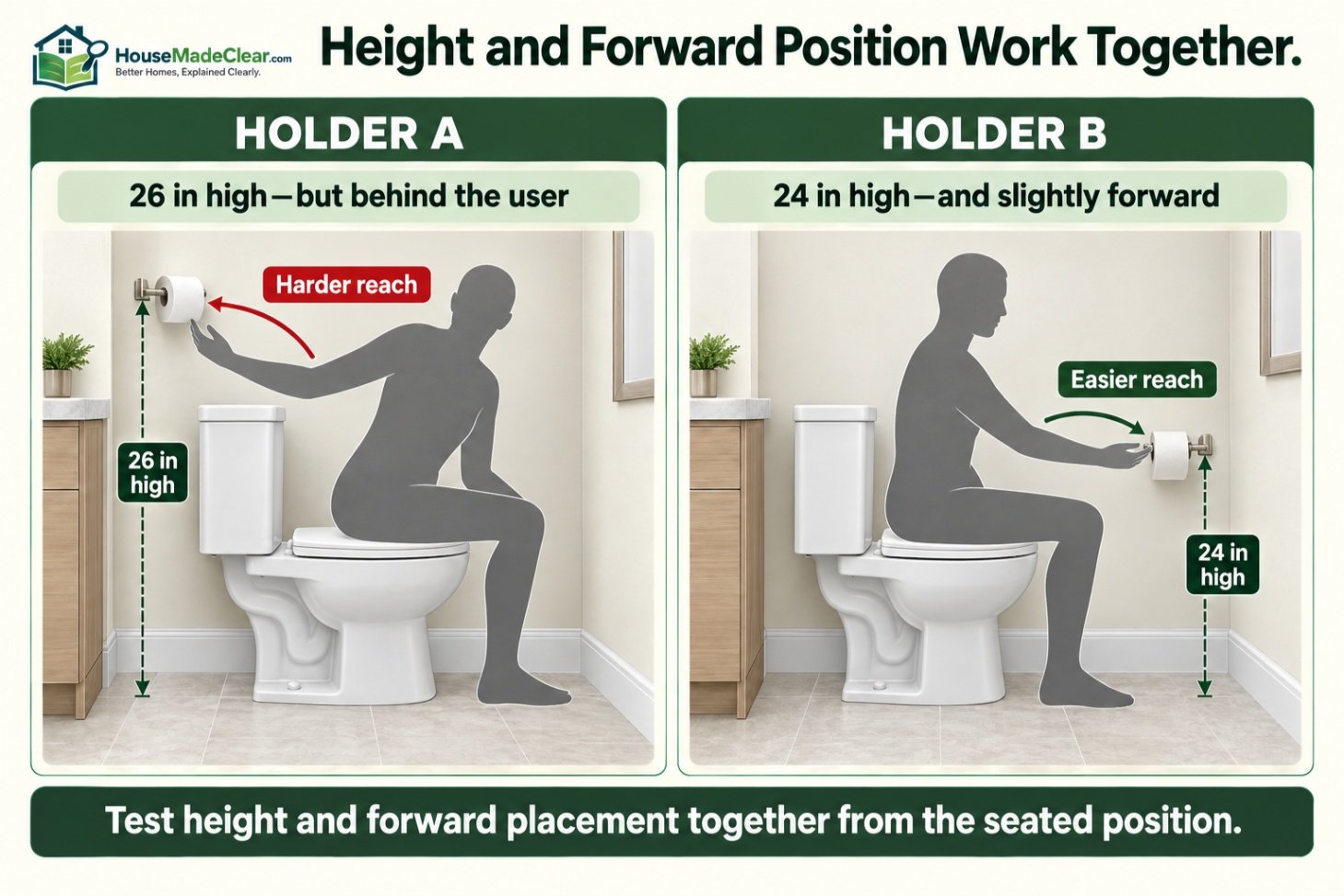
Consider these two holders:
- Holder A is 26 inches high but positioned behind the user
- Holder B is 24 inches high and positioned slightly forward
Holder B may be considerably easier to reach despite being lower.
Evaluate height and forward placement together.
How to Measure Toilet Paper Holder Height Correctly
A measurement is useful only when its reference point is clear.
Residential Holder Height
For a conventional residential holder, measure:
From the finished floor to the centerline of the holder
If the roll is already installed, the centerline passes through the cardboard tube or spindle.
Do not measure to:
- Top of the mounting plate
- Bottom of the mounting plate
- Top of the roll
- Bottom of the roll
- End of the paper
Different holders and roll sizes would produce inconsistent results.
Accessible Dispenser Height
Accessibility standards commonly measure to the:
Dispenser outlet
The outlet is the point where paper is dispensed. It may not be at the same height as the dispenser’s center.
This distinction matters with:
- Large-roll dispensers
- Double-roll dispensers
- Recessed units
- Covered commercial dispensers
- Vertical dispensers
Do not use a residential centerline dimension when the applicable standard requires measurement to the outlet.
Measure From the Finished Floor
All final mounting heights should be measured from the completed floor surface.
Account for:
- Tile
- Stone
- Vinyl
- Underlayment
- Floor leveling
- Raised platforms
- Other finished materials
If the holder is marked before the floor finish is installed, add the complete finished-floor buildup to the calculation.
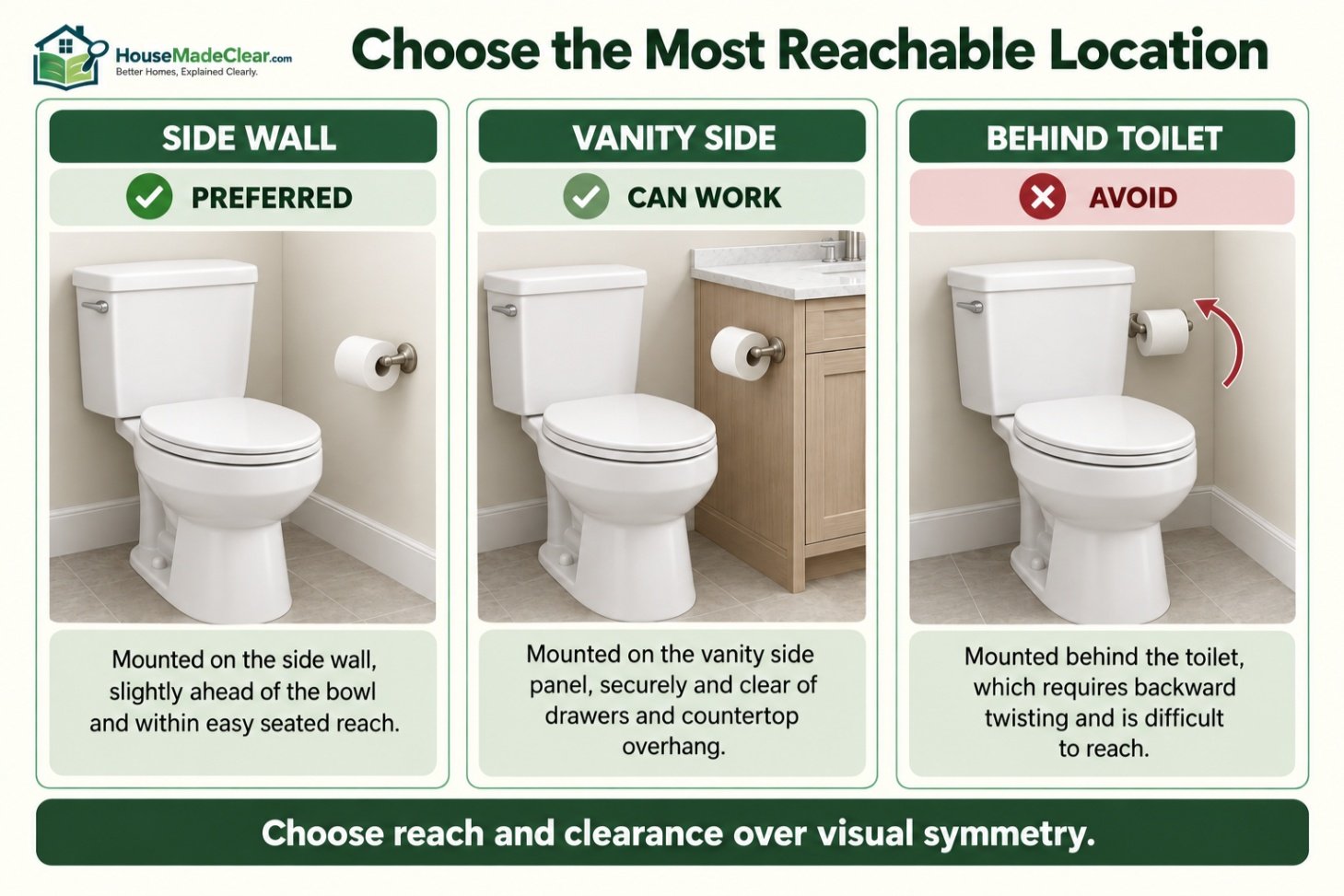
Best Side for a Toilet Paper Holder
A toilet paper holder can be installed on either side of the toilet.
The better side is normally the one that provides:
- The easiest seated reach
- A suitable mounting surface
- No conflict with a grab bar
- No conflict with vanity drawers or doors
- Adequate space for a full roll
- Convenient roll replacement
- Clear access for cleaning
Right-Side Placement
Right-side placement may feel natural to right-handed users, but handedness should not be the only consideration.
A right-side wall may be unsuitable if it contains:
- Plumbing
- A door swing
- A narrow gap
- A towel warmer
- A radiator
- A shower enclosure
- A required grab bar
Left-Side Placement
Left-side placement can work equally well when it provides a better wall surface or more comfortable approach.
In shared bathrooms, locate the holder based on general reach and layout rather than one person’s dominant hand.
Test Both Sides
Before drilling, sit on the closed toilet seat and test both locations.
Keep your shoulders relatively relaxed and reach naturally. You should not need to:
- Twist sharply
- Lean toward the floor
- Reach behind your hip
- Lift your shoulder excessively
- Stretch across a wide gap
Use painter’s tape to mark the proposed holder position and repeat the test with different household members.
Toilet Paper Holder Placement on a Side Wall
A side wall is usually the best mounting location because it creates a predictable relationship between the toilet and holder.
A practical side-wall arrangement provides:
- Holder center about 26 inches above the floor
- Holder center about 8 to 12 inches ahead of the bowl
- Enough wall area for the mounting plate
- Enough clearance for a full roll
- Convenient access for changing the roll
Check the wall for:
- Plumbing supply lines
- Drain or vent pipes
- Electrical cables
- Wall framing
- Blocking
- Tile joints
- Baseboard or trim
- Grab-bar reinforcement
Do not select the final mounting point based only on appearance.
Toilet Paper Holder Placement on a Vanity
Where the toilet sits beside a vanity, the holder can sometimes be attached to the vanity’s side panel.
This approach can work when the vanity:
- Is within comfortable seated reach
- Has a sufficiently strong side panel
- Provides enough screw depth
- Does not have a drawer or moving component behind the panel
- Leaves room for the full paper roll
- Does not place the roll in a direct splash zone
Before drilling into a cabinet, check its construction.
A decorative side panel may be thin, hollow or loosely attached. Screws that are too long can penetrate:
- Drawer boxes
- Stored items
- Interior plumbing space
- The visible cabinet interior
Review the vanity manufacturer’s instructions and use fasteners appropriate for the material.
The position of the cabinet also affects toilet usability. Compare the holder location with our guide to standard bathroom cabinet sizes.
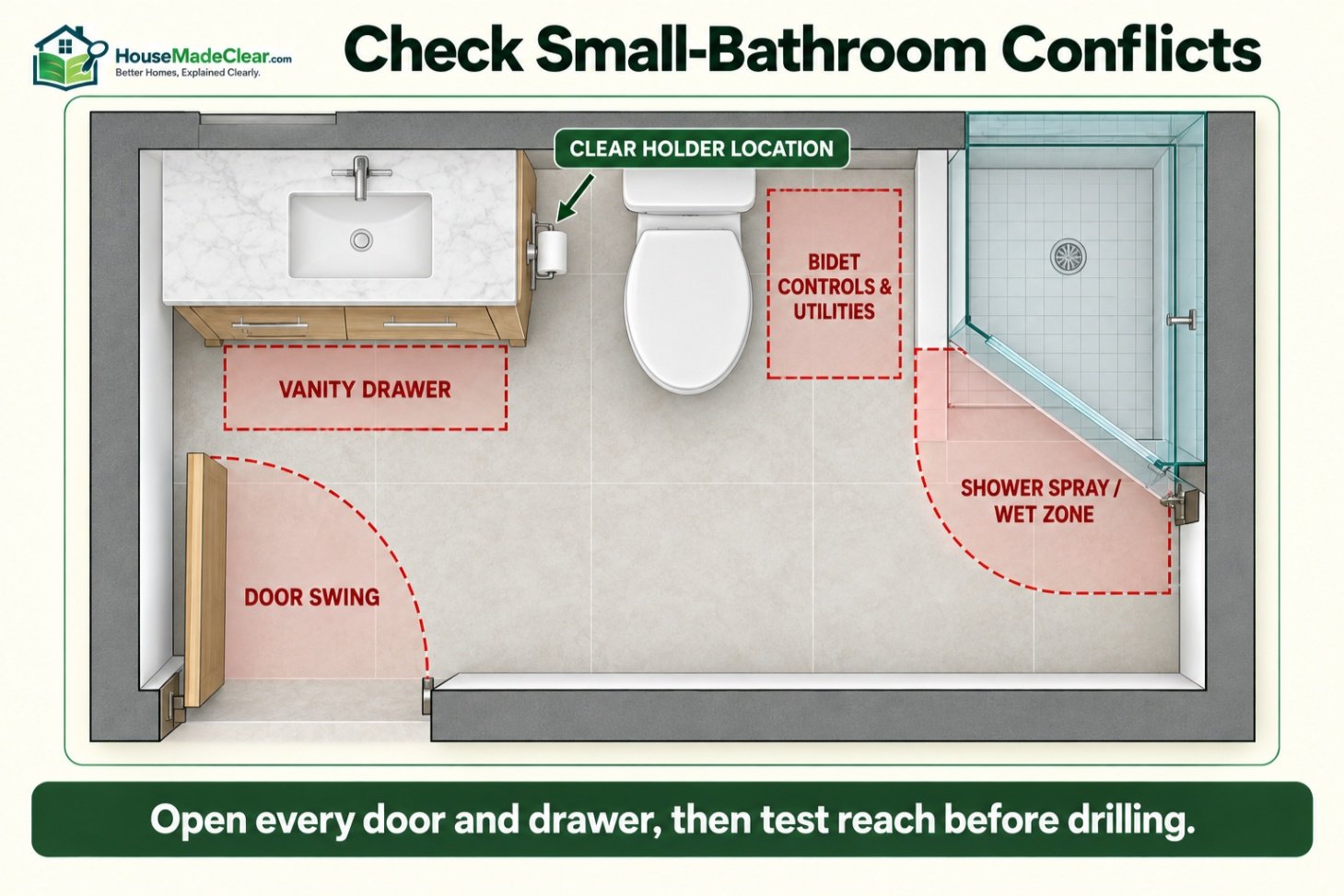
Check Vanity Drawers and Doors
Open every nearby drawer and cabinet door fully.
A holder may fit perfectly when the vanity is closed but interfere with:
- A deep drawer
- A pullout organizer
- A cabinet door
- A door handle
- The user’s knee
- The toilet lid
Mounting the holder closer to the front of the vanity can improve reach, but it may also increase the chance of accidental contact when walking past.
Can a Toilet Paper Holder Go Behind the Toilet?
Mounting the primary holder behind the toilet is usually a poor choice.
It forces the user to rotate backward, which may be difficult for:
- Older adults
- People with limited mobility
- People recovering from surgery
- Users with back, shoulder or balance problems
- Children
The area behind the toilet is better suited to spare-roll storage than the primary dispenser.
If the bathroom has no usable side wall, consider:
- A freestanding holder
- A holder attached to the vanity
- A recessed holder in an appropriate side wall
- A floor-mounted storage-and-dispenser stand
Do not trade basic reachability for visual symmetry.
Toilet Paper Holder Placement in a Small Bathroom
A compact bathroom may not have a clear side wall next to the toilet.
Potential conflicts include:
- Vanity side panel
- Shower curb
- Tub apron
- Bathroom door
- Baseboard heater
- Toilet supply line
- Wall trim
- Narrow passage
- Trash can
Start by verifying the toilet’s required side and front clearances. Then identify where a seated user can reach without interfering with other fixtures.
Small Powder Room
In a powder room, the sink or vanity often sits directly beside the toilet.
Possible solutions include:
- Holder on the vanity side
- Recessed holder in the side wall
- Narrow-profile pivot holder
- Freestanding holder placed ahead of the bowl
- Vertical holder where horizontal wall width is limited
A compact sink or shallow vanity may provide more usable circulation space. Our guide to standard bathroom sink dimensions explains how sink projection and vanity width affect small-bathroom layouts.
Toilet Beside a Shower
If the holder is positioned on a wall near the shower, keep it away from:
- Direct spray
- Shower-door movement
- Wet towels
- Condensation-prone corners
- Areas where users step out while dripping
Repeated moisture can damage paper, corrode hardware and affect wall finishes.
Toilet Beside a Bathtub
A holder mounted on the side of a vanity is generally preferable to mounting it where a person in the tub could strike or soak it.
Avoid a location that obstructs entry into the bathtub or becomes a handhold when someone stands up. Toilet paper holders are not designed to function as grab bars.
Toilet Paper Holder Placement With a Wall-Hung Toilet
A wall-hung toilet can have a different projection from a conventional floor-mounted model.
Do not assume the holder location used with the previous toilet will remain suitable.
After selecting the toilet, record:
- Front edge of bowl
- Seat height
- Side-wall distance
- Flush plate location
- In-wall carrier location
- Service access
- Grab-bar plan
Because the carrier and plumbing occupy the wall behind the toilet, side-wall mounting may still be the simplest solution.
Toilet Paper Holder Placement With a Bidet Seat or Smart Toilet
Bidet seats and smart toilets can introduce additional controls and utilities beside the toilet.
Potential conflicts include:
- Side-mounted control panel
- Handheld remote holder
- Water shutoff valve
- Bidet supply hose
- Electrical receptacle
- Power cord
- Manual cleaning controls
Do not mount the toilet paper holder where it blocks access to these components.
Place the paper within convenient reach even if the bidet reduces paper use. Guests and users who prefer paper should still be able to reach it without difficulty.
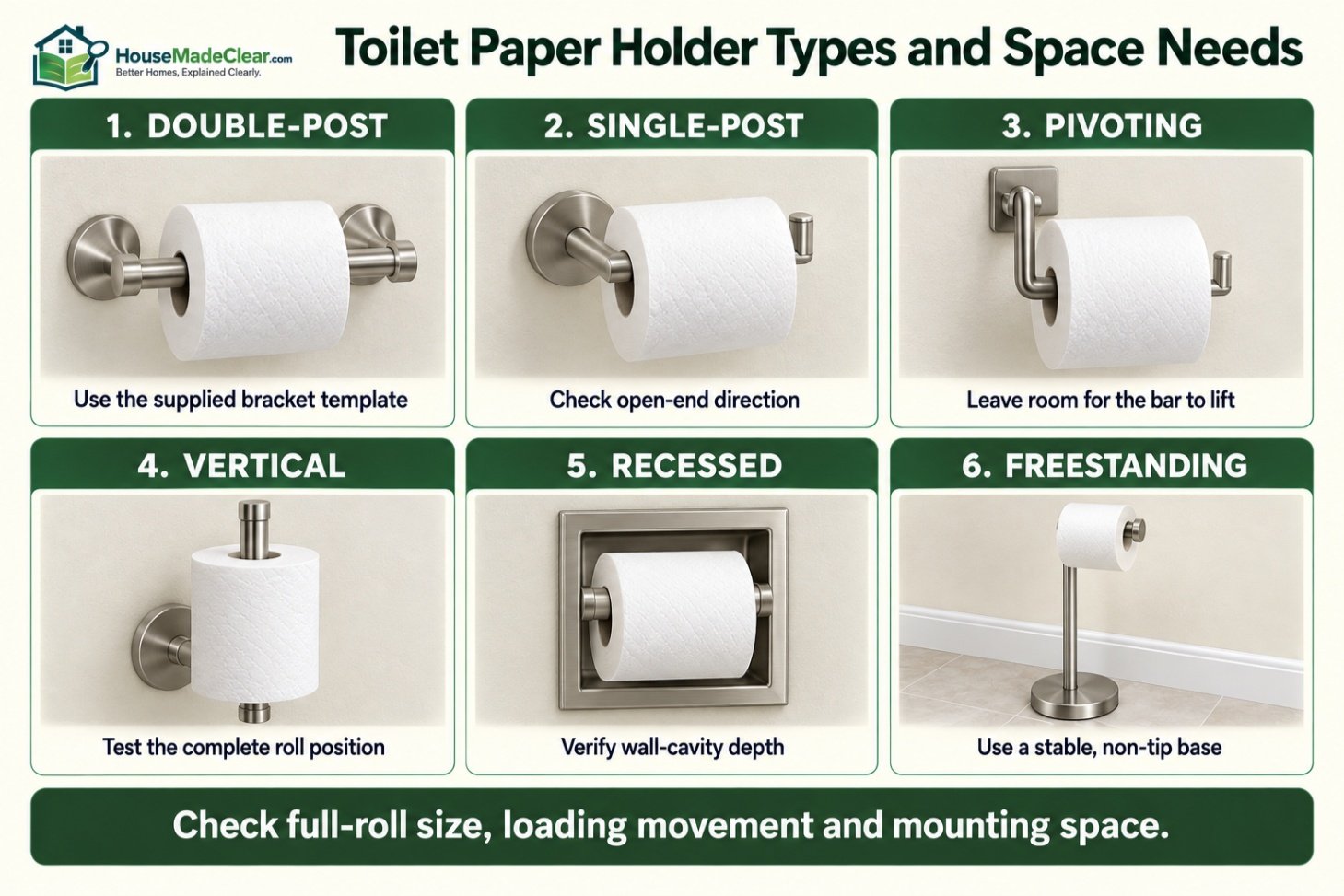
Types of Toilet Paper Holders and Their Placement
Different holder designs require different amounts of wall space.
Double-Post Holder
A double-post holder uses two mounting brackets with a spindle or pivoting bar between them.
Advantages include:
- Stable appearance
- Familiar operation
- Good roll support
Installation requires accurate bracket spacing. Use the supplied template rather than measuring between product edges.
Single-Post Holder
A single-post holder supports the roll from one side.
Advantages include:
- Easier roll replacement
- Compact mounting footprint
- Fewer wall penetrations
Check which direction the open end faces. If it faces the wrong way, the roll may slide off during use.
Pivoting Holder
A pivoting holder uses a bar that lifts at one end.
It combines the appearance of a double-post holder with easier roll replacement.
Leave enough surrounding space for the bar to move fully.
Vertical Holder
A vertical wall-mounted holder can work where horizontal wall space is limited.
Because the roll sits above or below the mounting point, test the complete roll position rather than using only the bracket center.
Vertical holders can also unroll differently from horizontal holders, so test actual operation before installation.
Recessed Holder
A recessed holder sits partly inside the wall.
Advantages include:
- Reduced projection
- Cleaner toilet clearance
- Lower risk of bumping the holder
- Better use of a narrow side space
However, installation requires an appropriate wall cavity.
Before cutting the wall, confirm there are no:
- Water lines
- Drainpipes
- Vent pipes
- Electrical cables
- Structural members
- In-wall toilet carriers
- Required fire-rated assemblies
A recessed holder may need to fit between studs or use an approved backing box.
Freestanding Holder
A freestanding holder requires no wall penetrations and can be repositioned.
It can be useful for:
- Rental homes
- Tiled bathrooms
- Bathrooms without a suitable side wall
- Temporary accessibility needs
- Flexible layouts
Choose a model with a stable base that does not tip during use.
The holder should not reduce required toilet clearance or create a tripping hazard.
Combination Holder and Spare-Roll Stand
Combination stands store extra rolls below the active roll.
Check:
- Base diameter
- Overall height
- Stability
- Distance from shower spray
- Whether spare rolls touch the floor
- Whether the unit obstructs movement
The active roll should remain within easy reach even when the stand is fully loaded.
Commercial and Large-Roll Dispensers
Commercial dispensers can be much larger than residential holders.
Their dimensions affect:
- Reach
- Grab-bar clearance
- Wheelchair transfer space
- Wall projection
- Refill access
- Door and partition clearance
Do not locate a large-roll dispenser based only on the position of its mounting screws. Applicable accessibility measurements may use the dispenser centerline and outlet.
Accessible Toilet Paper Dispenser Placement
Accessible dispenser placement is not the same as conventional residential placement.
Under Section 604.7 of the 2010 ADA Standards for Accessible Design, a toilet paper dispenser must generally be:
- 7 to 9 inches in front of the water closet, measured to the dispenser centerline
- 15 to 48 inches above the finished floor, measured to the dispenser outlet
- Located so it is not behind a grab bar
- Usable with continuous paper flow
- Not designed to control paper delivery
These requirements apply to covered accessible installations, not automatically to every private bathroom.
Why ADA Measurements Differ
A residential recommendation such as “26 inches high and 8 to 12 inches ahead of the bowl” is intended to create a comfortable general-use location.
ADA measurements establish specific accessible reach and usability requirements.
They also use precise reference points:
- Dispenser centerline for horizontal placement
- Dispenser outlet for vertical placement
- Leading edge of the toilet for forward position
- Finished floor for height
Do not substitute the center of the roll for the dispenser outlet where the standard measures the outlet.
Dispenser Placement Around Grab Bars
The U.S. Access Board toilet-room guide explains that toilet paper dispensers can be positioned below or above a grab bar but cannot be located behind it.
A non-recessed dispenser must also preserve the required clear space around the grab bar.
The Access Board notes that a non-recessed dispenser above a 36-inch-high grab bar creates a very limited vertical placement condition because it must remain sufficiently above the bar while keeping its outlet no higher than 48 inches.
Recessed dispensers can reduce projection and help keep the transfer area clearer.
Large and Double-Roll Dispensers
The ADA forward-position requirement is measured to the centerline of the complete dispenser, including large-roll and multiple-roll models.
Do not measure to:
- First roll
- Paper outlet alone
- Nearest edge of dispenser
- Mounting bracket
- Cover edge
A large housing can make the paper difficult to reach even when its mounting location appears close to the toilet. Review the complete product dimensions.
Accessible Children’s Toilet Paper Dispenser Height
For water closets and toilet compartments designed primarily for children ages 12 and younger, the ADA Standards provide different dispenser dimensions.
The dispenser must generally be:
- 7 to 9 inches in front of the water closet, measured to its centerline
- 14 to 19 inches above the finished floor, measured to its outlet
- At least 1½ inches below the grab bar
- Designed to permit continuous paper flow
The U.S. Access Board also provides advisory height ranges by age group.
These children’s specifications should not be mixed randomly with adult toilet and grab-bar dimensions. The complete children’s installation should use the relevant coordinated provisions.
Does the ADA Apply to a Private Home?
A conventional owner-occupied private home is not automatically required to comply with the ADA Standards.
Accessibility requirements may apply to:
- Public accommodations
- Commercial facilities
- State and local government facilities
- Certain multifamily housing
- Covered residential projects
- Bathrooms serving business activities
- Projects governed by other federal, state or local regulations
Even where the ADA does not legally apply, its guidance can help with accessible and aging-in-place planning. However, copying the dispenser height alone does not make a bathroom accessible.
Toilet Paper Holder Placement for Aging in Place
For an aging-in-place bathroom, the holder should be reachable with minimal twisting and leaning.
A good planning process includes:
- Testing the holder from the actual toilet
- Keeping it slightly forward of the user
- Avoiding placement behind the shoulder
- Coordinating it with current or future grab bars
- Using an easy-loading holder
- Providing stable wall support
- Keeping the floor area uncluttered
A freestanding holder may seem flexible, but it can move unexpectedly or become a tripping hazard.
A recessed or securely wall-mounted holder may provide a more predictable location.
Do Not Use the Holder as a Grab Bar
A toilet paper holder is not designed to support body weight.
It should not be positioned in a way that encourages users to grab it when sitting or standing.
If support is needed, install a properly designed and secured grab bar in the correct location. Coordinate the paper dispenser around it.
Toilet Paper Holder Height for Children
A family bathroom used by both adults and children does not necessarily need an unusually low holder.
Children grow quickly, and lowering the primary holder too far may make it uncomfortable for adults.
Options include:
- Mounting the primary holder near 24 inches
- Testing the location with the shortest regular user
- Using a stable step arrangement only where safe
- Providing a temporary freestanding holder
- Selecting an easy-loading open-arm design
A bathroom designed specifically for young children may use a substantially lower holder, but accessibility or institutional projects should follow the applicable children’s standards.
Toilet Paper Holder Placement Beside Bathroom Storage
Wall cabinets, shelves and vanity storage can interfere with the holder.
Before installation, operate every nearby component.
Check:
- Drawer extension
- Cabinet-door swing
- Pullout hamper
- Medicine or supply cabinet
- Open shelving
- Waste bin
- Spare-roll basket
The holder should remain usable when storage is open, but it should not occupy the main standing area in front of the vanity.
The heights of nearby bathroom accessories should be coordinated rather than chosen independently. See our towel-bar height guide for towel bars, rings, hooks and related spacing.
How Much Clearance Does a Toilet Paper Roll Need?
A holder needs enough space for both the hardware and the complete roll.
Check the selected product with the type of paper normally used in the home.
Large household rolls can be:
- Wider
- Greater in diameter
- More likely to contact the wall
- Harder to install in a recessed holder
- Too large for older spindle designs
Confirm:
- Roll diameter
- Roll width
- Space behind the roll
- Space below the roll
- Clearance from trim
- Clearance from the toilet
- Clearance for the holder’s moving parts
A mounting template normally locates the brackets but may not show the full outline of an oversized roll.
How to Choose the Final Holder Location
Step 1: Install or Select the Toilet
If the toilet has not been installed, obtain its specification sheet.
Record:
- Toilet projection
- Bowl shape
- Seat height
- Centerline
- Tank width
- Side clearances
Do not place the holder from a generic floor-plan symbol.
Step 2: Identify the Available Mounting Surfaces
Possible surfaces include:
- Side wall
- Vanity panel
- Partition
- Half wall
- Recessed wall cavity
Eliminate locations that interfere with plumbing, electrical work, grab bars or moving fixtures.
Step 3: Mark the Common Starting Point
For conventional residential use, mark:
- Approximately 26 inches above the finished floor
- Approximately 8 to 12 inches ahead of the bowl’s front edge
Use painter’s tape rather than drilling immediately.
Step 4: Mock Up the Holder and Roll
Tape the installation template or a cardboard model to the wall.
Include the approximate diameter of a full roll.
A small mounting plate can conceal how far the paper itself projects.
Step 5: Test From the Seated Position
Sit on the closed seat and reach naturally.
Test with:
- Tallest regular user
- Shortest regular user
- Older household members
- Anyone with limited mobility
Adjust the position if reaching requires excessive leaning or twisting.
Step 6: Test Nearby Fixtures
Open:
- Vanity drawers
- Cabinet doors
- Bathroom door
- Shower door
- Toilet lid
Confirm that the holder does not interfere with normal movement.
Step 7: Inspect the Wall or Cabinet
Determine whether the mounting location contains:
- Stud
- Blocking
- Hollow drywall
- Tile
- Masonry
- Thin cabinet panel
Choose an attachment method appropriate for the substrate and holder.
Step 8: Check Applicable Requirements
For accessible, public, commercial, multifamily or regulated projects, confirm the applicable standards and locally adopted requirements before installation.
How to Install a Toilet Paper Holder
Always follow the product manufacturer’s instructions. The following process is a general overview.
1. Gather the Necessary Tools
Depending on the surface, you may need:
- Tape measure
- Level
- Pencil
- Painter’s tape
- Mounting template
- Drill
- Appropriate drill bit
- Screwdriver
- Wall anchors
- Stud or utility detector
- Safety glasses
Use fasteners and drill bits suitable for the wall material.
2. Mark the Center Height
Measure from the finished floor and mark the desired centerline.
For common residential use, begin around 26 inches.
3. Mark the Forward Position
Measure from the front edge of the toilet bowl.
Mark a point about 8 to 12 inches ahead of that edge, or use the required accessible position where applicable.
4. Apply the Installation Template
Level the template and secure it temporarily with painter’s tape.
Make sure the template is facing the correct direction. Some single-arm and pivot holders cannot be reversed after drilling.
5. Verify What Is Behind the Surface
Check for plumbing, wiring and structural elements before drilling.
This is particularly important beside a toilet because the wall may contain:
- Toilet supply plumbing
- Sink supply lines
- Drain vents
- Electrical circuits
- In-wall carriers
- Blocking for grab bars
If the location is uncertain, stop and investigate before drilling.
6. Drill the Mounting Holes
Use the bit and method recommended for the surface.
Tile, stone, drywall, wood and masonry require different tools and anchors.
Avoid using a drilling method that can crack the finished surface.
7. Install the Mounting Brackets
Secure the brackets firmly without overtightening and damaging the wall, tile or cabinet.
Check that the brackets remain level.
8. Attach the Holder
Fit the decorative components to the brackets and tighten any set screws.
Install a full roll and test:
- Rotation
- Paper removal
- Roll replacement
- Holder stability
- User reach
- Nearby drawer movement
9. Recheck the Hardware
Mounting screws and set screws can loosen after initial use.
Inspect the holder periodically and tighten it according to the manufacturer’s instructions.
Installing a Toilet Paper Holder on Tile
Tile installation requires more planning than ordinary drywall installation.
Use Grout Lines Only When Appropriate
A grout joint may be easier to drill than tile, but it is not automatically the best location.
The holder still needs:
- Correct reach
- Suitable backing
- Adequate fastener support
- Proper bracket spacing
Do not move the holder to a poor position simply to align both screws with grout.
Avoid Cracking the Tile
Use drilling tools appropriate for the tile material.
Ceramic, porcelain, glass and natural stone do not necessarily use the same bit or technique.
Follow the tile, fastener and holder manufacturers’ instructions. If the tile is expensive, difficult to replace or installed over an uncertain substrate, professional installation may be safer.
Seal Penetrations Where Necessary
In moisture-exposed locations, penetrations may require suitable sealing.
A holder beside a toilet normally should not be inside a direct wet area, but bathrooms experience humidity and occasional splashing.
Installing a Holder on a Vanity Cabinet
Before drilling a cabinet panel:
- Measure panel thickness.
- Check the interior for drawers and plumbing.
- Confirm screw length.
- Test the roll against the countertop overhang.
- Open nearby doors and drawers.
- Check whether the hardware affects the finish warranty.
Thin engineered panels may require different fasteners from solid wood.
Do not assume the screws supplied for wall installation are appropriate for cabinetry.
Installing a Recessed Toilet Paper Holder
A recessed holder requires a wall opening larger than its visible face.
Before cutting:
- Use the product’s cutout template
- Locate studs
- Identify pipes and wiring
- Confirm wall-cavity depth
- Check the direction of plumbing vents
- Review fire- and moisture-resistance requirements
- Confirm the trim will cover the opening
The visible flange does not reveal the complete box size behind the wall.
In a wall containing major plumbing, a surface-mounted holder is often simpler and less risky.
Toilet Paper Holder Placement Examples
Example 1: Standard Side-Wall Installation
Assume:
- Toilet bowl front edge: 29 inches from rear wall
- Desired forward placement: 10 inches
- Holder center height: 26 inches
Horizontal calculation:
29 + 10 = 39 inches
Mark the holder center approximately:
- 39 inches from the finished rear wall
- 26 inches above the finished floor
Then test the location from the seated position.
Example 2: Compact Powder Room
Assume the toilet is beside a shallow vanity and the available side wall is only 7 inches wide.
A conventional horizontal holder may not fit.
Possible alternatives include:
- Vertical holder on the wall
- Holder on the vanity panel
- Recessed holder
- Stable freestanding holder
Select the option that preserves comfortable reach and room circulation.
Example 3: Holder on a Vanity Panel
Assume:
- Vanity side is 9 inches ahead of the bowl
- Panel is within comfortable seated reach
- Drawer does not extend behind the proposed location
- Countertop overhang clears a full roll
A holder centered around 25 to 27 inches above the floor may work. Confirm the panel thickness and use appropriate screws.
Example 4: Accessible Adult Installation
Assume a covered accessible toilet room uses a side-wall dispenser.
The design must locate:
- Dispenser centerline 7 to 9 inches in front of the toilet
- Dispenser outlet 15 to 48 inches above the floor
- Dispenser outside prohibited grab-bar locations
- Paper where continuous flow is possible
A 26-inch residential centerline alone does not confirm compliance.
Example 5: Replacing a Round Toilet With an Elongated Toilet
Suppose the new bowl projects 2 inches farther into the room.
If the holder remains in its original position, it will effectively become 2 inches less forward relative to the bowl.
A holder that was previously 9 inches ahead of the bowl may now be only 7 inches ahead.
Retest the reach whenever the toilet is replaced with a different projection.
Common Toilet Paper Holder Placement Mistakes
Treating 26 Inches as a Universal Code
Twenty-six inches is a common residential planning height, not a rule that applies to every installation.
Measuring to the Top of the Holder
Residential height is generally discussed using the holder centerline. Measuring to the top creates inconsistent results.
Ignoring the Bowl’s Front Edge
The holder may be the correct height but still sit too far behind the user.
Mounting the Holder Behind the Shoulder
This requires twisting and can be difficult for people with limited mobility.
Placing the Holder Too Far Forward
Excessive forward placement requires leaning and may obstruct the walking path.
Ignoring Full-Roll Size
A large roll may touch the wall, vanity or toilet even when the empty holder fits.
Failing to Test Vanity Drawers
A drawer or cabinet door can strike the roll or mounting arm.
Using the Holder as a Support
Toilet paper holders are not grab bars and should not be treated as weight-bearing safety devices.
Mounting Into Weak Drywall
A loose holder can damage the wall. Use suitable backing or approved anchors.
Drilling Without Checking the Wall
Bathroom walls frequently contain water lines, drain vents, electrical cables and structural supports.
Blocking a Grab Bar
Accessible and aging-in-place layouts require the dispenser and grab bars to be planned together.
Measuring Accessible Height to the Wrong Point
ADA height is measured to the dispenser outlet, not necessarily to the center of the roll.
Mixing Adult and Children’s Accessibility Dimensions
Children’s water-closet provisions are coordinated. Do not use one lower accessory height while ignoring the other applicable dimensions.
Choosing Appearance Over Reach
A visually centered holder is not useful if the user cannot reach it comfortably.
Toilet Paper Holder Measurement Checklist
| Item | What to Verify |
|---|---|
| Finished floor | Use the completed floor as the vertical reference |
| Holder height | Common residential center around 26 inches |
| Forward position | Common residential target 8–12 inches ahead of bowl |
| Measurement point | Centerline for residential planning; outlet where required |
| Toilet projection | Use the installed toilet or specification sheet |
| User reach | Test from the seated position |
| Side selection | Choose the more usable wall or vanity side |
| Roll size | Test with a full-size roll |
| Mounting surface | Stud, blocking, anchor, tile, masonry or cabinet |
| Wall contents | Check plumbing, wiring and structural elements |
| Vanity operation | Open all doors and drawers |
| Door clearance | Check bathroom and shower doors |
| Moisture exposure | Keep paper away from spray and dripping water |
| Grab bars | Preserve required clearance and reach |
| Accessibility | Apply the correct standard and reference points |
| Children’s use | Test reach or apply coordinated children’s provisions |
| Product template | Use the manufacturer’s bracket spacing |
| Fasteners | Match the wall or cabinet material |
| Replacement access | Make sure rolls are easy to change |
| Maintenance | Inspect loose screws and brackets periodically |
Frequently Asked Questions
What is the standard height for a toilet paper holder?
A common residential toilet paper holder height is approximately 26 inches above the finished floor, measured to the holder’s centerline. A practical range of about 24 to 30 inches can work depending on the toilet and users.
How far should a toilet paper holder be from the toilet?
For conventional residential use, position the holder center approximately 8 to 12 inches in front of the toilet bowl’s leading edge. Test the location while seated before drilling.
Is toilet paper holder height measured to the top or center?
For common residential planning, measure from the finished floor to the holder or roll centerline. Accessible standards may measure vertical placement to the dispenser outlet instead.
Should the holder be in front of or beside the toilet?
It should normally be mounted on a side wall or vanity and slightly in front of the bowl’s leading edge. This makes it easier to reach without twisting backward.
Can a toilet paper holder be mounted behind the toilet?
It can, but it is usually inconvenient. Reaching behind the toilet requires torso and shoulder rotation. A side-mounted or freestanding holder is generally more practical.
Can I install a toilet paper holder on a vanity?
Yes, provided the vanity side panel is strong enough, the screws are the correct length, and the holder does not interfere with drawers, plumbing, countertop overhangs or walking space.
What is the ADA toilet paper dispenser height?
Under the 2010 ADA Standards, the dispenser outlet must generally be 15 to 48 inches above the finished floor. The dispenser centerline must be 7 to 9 inches in front of the water closet, and the dispenser cannot be behind a grab bar.
Is 26 inches an ADA-compliant toilet paper holder height?
Not necessarily. ADA compliance depends on the dispenser outlet height, horizontal centerline position, grab-bar relationship and paper delivery. A 26-inch residential centerline alone does not establish compliance.
How high should a toilet paper holder be for children?
In a shared residential bathroom, test the holder with the regular users; a position around 24 inches may work for both children and adults. In accessible facilities designed for children, the ADA Standards generally place the dispenser outlet 14 to 19 inches above the floor.
Which side of the toilet should the holder go on?
Either side can work. Choose the side that offers the easiest seated reach, strongest mounting surface and least interference with doors, drawers, grab bars and plumbing.
Is a freestanding toilet paper holder a good option?
A freestanding holder is useful when wall mounting is not practical or permitted. Select a stable model and place it where it does not reduce toilet clearance or create a tripping hazard.
Can a toilet paper holder be installed on tile?
Yes, but the correct drill bit, fastener and technique depend on the tile and substrate. Verify what is behind the tile and follow the product and surface manufacturers’ instructions.
Should the toilet paper holder align with a grout line?
Not necessarily. Correct user reach and secure support are more important than visual alignment with grout. Use a grout line only when it also provides an appropriate mounting position and fastening method.
How much space does a toilet paper holder need?
The holder needs enough space for its mounting hardware, a full roll and any pivoting or loading movement. Check the selected product with the actual roll size you normally purchase.
Where should spare toilet paper be stored?
Spare rolls can be stored in a vanity, wall cabinet, basket, shelf or freestanding holder. Keep them dry, clean and accessible without obstructing toilet clearance.
Do I need to move the holder when replacing the toilet?
Possibly. A new toilet may have a different bowl projection or seat height. Retest the holder location, especially when changing from a round-front to an elongated model.







[…] Toilet Paper Holder Height: Standard Placement Guide […]
[…] Toilet Paper Holder Height: Standard Placement Guide […]
[…] Toilet Paper Holder Height: Standard Placement Guide […]
[…] Toilet Paper Holder Height: Standard Placement Guide […]
[…] Toilet Paper Holder Height: Standard Placement Guide […]