
















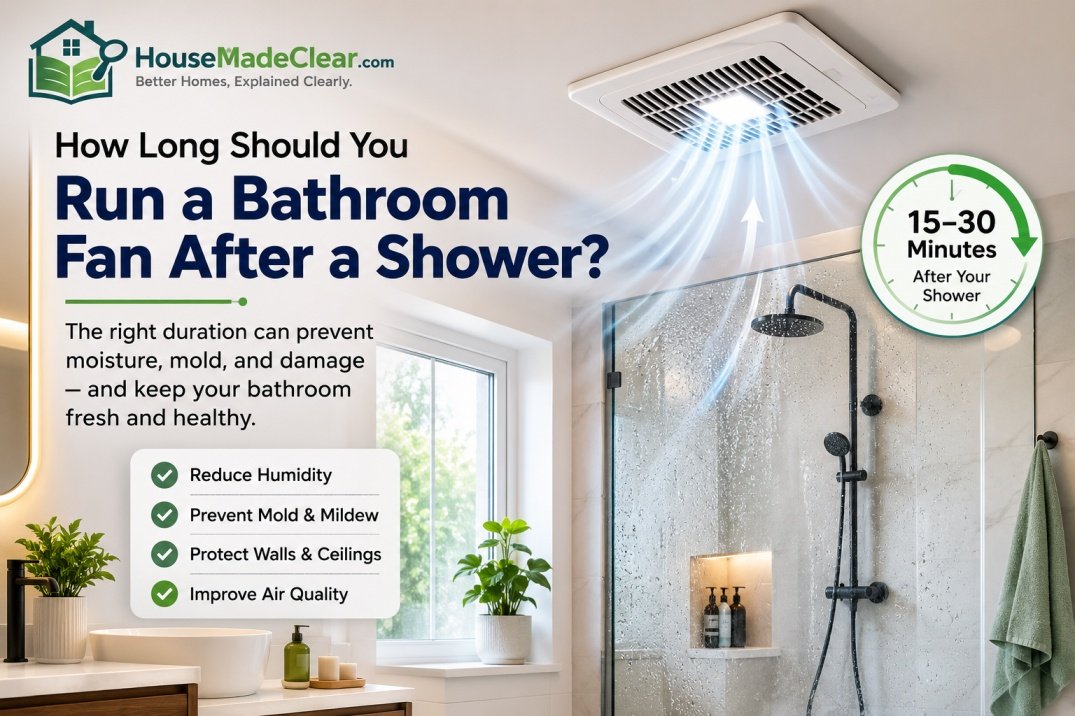
Run your bathroom exhaust fan during the shower and leave it on for about 20 minutes afterward. This helps remove humid air before moisture accumulates on walls, mirrors, ceilings, and other surfaces.
Twenty minutes is a recommended starting point, not a guarantee that every bathroom will be dry. A long hot shower, undersized fan, restrictive ductwork, or high indoor humidity can make additional ventilation necessary.
If your bathroom remains damp after the fan runs, it’s worth checking whether the ventilation system is working properly rather than simply leaving it on for hours.
This guide explains the recommended bathroom fan runtime, when to extend it, and how to identify ventilation problems.
Quick Answer
The Home Ventilating Institute recommends running a bathroom exhaust fan for 20 minutes after bathroom use.
For everyday showers:
- Turn the exhaust fan on when showering begins.
- Keep it running throughout the shower.
- Leave it on for approximately 20 minutes afterward.
- Check whether excessive humidity and condensation are clearing.
If moisture remains unusually high, additional ventilation may be needed. Persistent dampness can indicate a problem with fan capacity, ductwork, or the bathroom’s overall moisture conditions.
How Long Should a Bathroom Fan Run After Showering?
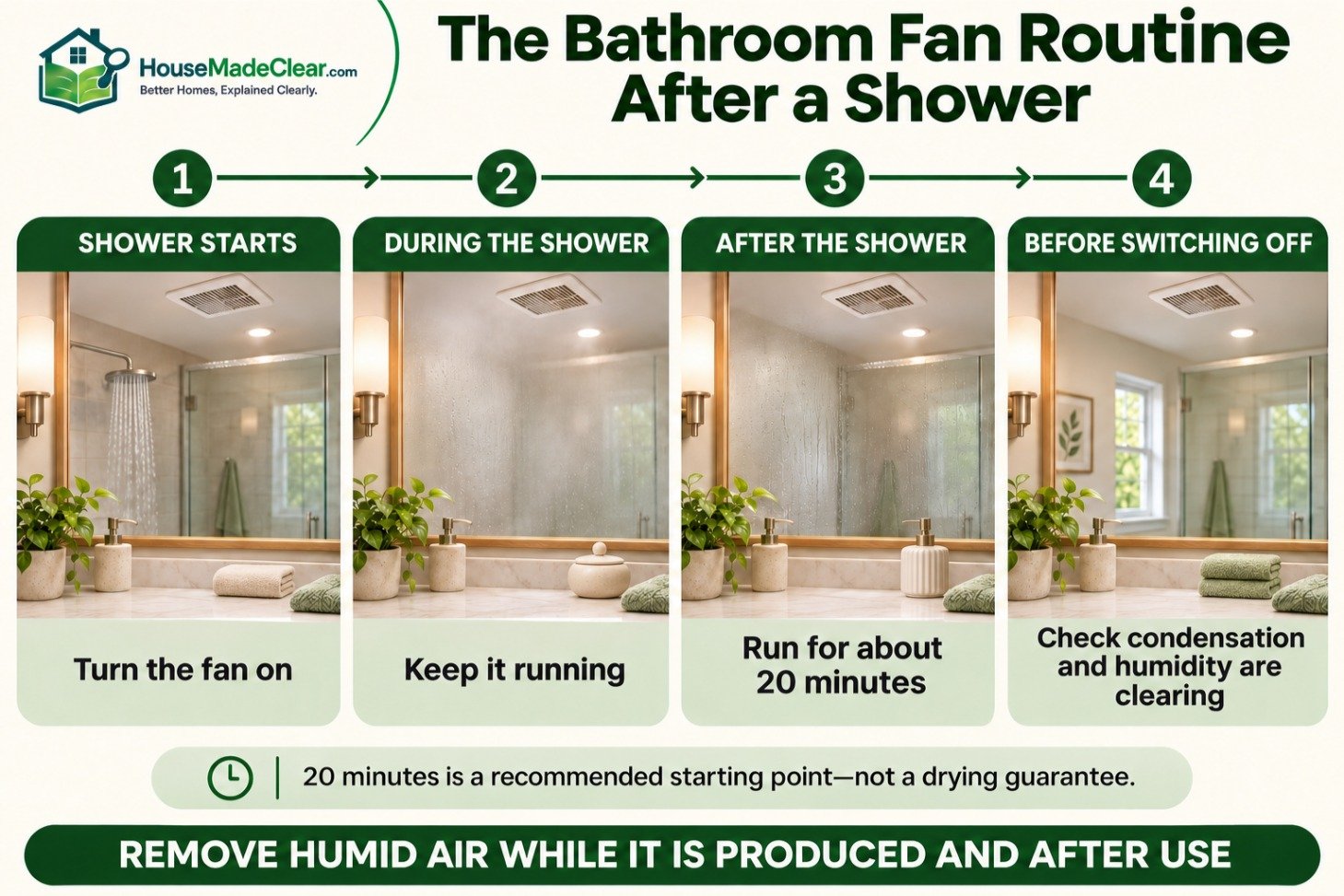
Most bathrooms can start with the same routine: operate the fan while showering and for 20 minutes afterward.
The Home Ventilating Institute’s bathroom ventilation guidelines support this recommendation and suggest using a timer to switch the fan off automatically.
However, the appropriate runtime also depends on how much moisture the bathroom produces and how efficiently the fan removes it.
Bathroom Fan Runtime by Situation
| Bathroom Situation | Recommended Approach |
|---|---|
| Normal daily shower | Run during the shower and approximately 20 minutes afterward |
| Long or very hot shower | Start with 20 minutes afterward; continue if excessive humidity remains |
| Small bathroom | Use the 20-minute guideline; room size alone doesn’t justify a shorter runtime |
| Large bathroom | Use the 20-minute guideline and confirm fan capacity is adequate |
| Several showers in a row | Keep the fan operating between showers and for about 20 minutes after the last one |
| Steam shower | Follow the steam shower’s ventilation design and equipment instructions |
| Bathroom with persistent dampness | Investigate airflow and moisture sources rather than relying on longer runtime alone |
A bathroom that stays humid well beyond normal use may need better ventilation, not just a longer timer setting.
Why Should You Keep the Bathroom Fan Running After a Shower?
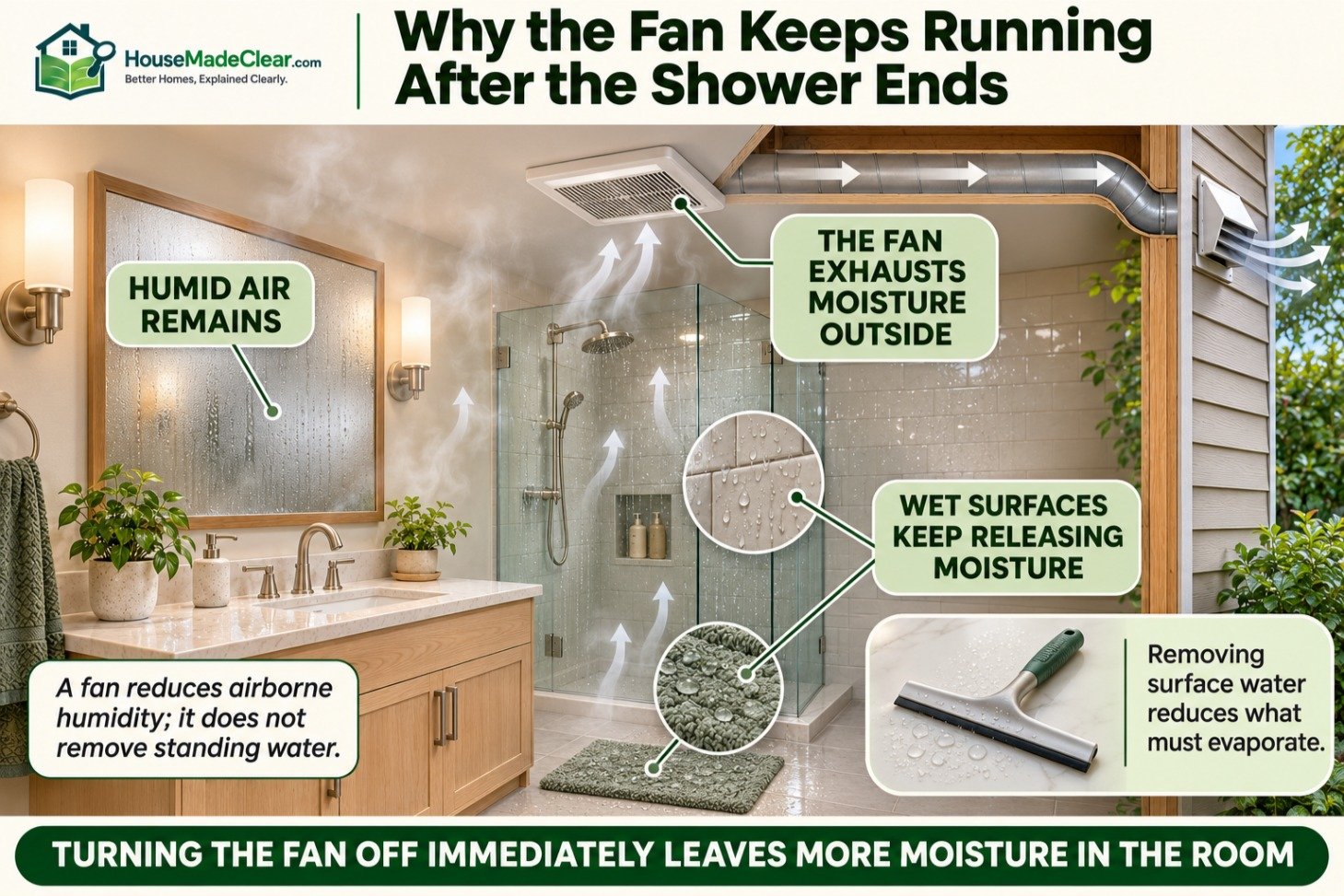
A hot shower introduces water vapor into the bathroom.
Some of that moisture condenses on cooler surfaces, including mirrors, walls, windows, and ceilings. Water also remains on the shower enclosure, tiles, and bath mat after you’ve finished.
Turning the fan off immediately allows excess humidity to remain while those wet surfaces continue releasing moisture.
The U.S. Environmental Protection Agency’s moisture-control guidance recommends bathroom ventilation and keeping indoor relative humidity below 60%, ideally between 30% and 50% where practical.
Controlling moisture helps reduce conditions associated with mold growth, peeling paint, and damage to moisture-sensitive materials.
A properly installed exhaust fan removes humid air from the building rather than simply moving it into another room.
Does the Fan Dry Shower Tiles and Grout?
The fan helps reduce airborne humidity, which supports drying, but it doesn’t remove standing water from shower surfaces.
Using a squeegee on glass and tiled walls can reduce the amount of water left to evaporate.
If you want to understand how moisture levels change after bathing, see our guide to bathroom humidity after a shower.
How Do You Know When to Turn Off the Bathroom Fan?
The 20-minute rule is useful because it’s simple. But you should also observe how the bathroom responds.
Three signs are particularly helpful.
1. Condensation Is Clearing
Heavy fogging on mirrors and windows should gradually decrease.
However, mirror temperature affects condensation. A heated mirror may stay clear even when humidity is high.
If your mirror repeatedly stays fogged long after bathing, our guide to stopping bathroom mirror fogging covers additional causes and solutions.
2. Humidity Is Returning Toward Normal

A digital hygrometer can show how relative humidity changes during and after a shower.
For example, a bathroom might measure:
| Time | Example Relative Humidity |
|---|---|
| Before shower | 45% |
| Immediately after shower | 75% |
| After 20 minutes | 55% |
| After 30 minutes | 48% |
These readings are illustrative, not a universal drying timeline.
The useful question is whether humidity returns toward the home’s normal level within a reasonable period.
Our guide to recommended humidity levels for a house explains appropriate indoor ranges and why seasonal conditions matter.
3. The Room Isn’t Staying Damp
Watch for recurring water droplets on walls, wet window frames, musty odors, and paint that begins peeling.
A wet shower floor immediately after bathing is normal. Persistent condensation on surrounding building surfaces deserves more attention.
If these symptoms occur after nearly every shower, investigate ventilation performance.
Why Is My Bathroom Still Humid After Running the Fan for 20 Minutes?

A functioning fan can sound normal while moving too little air.
The most common causes include a dirty grille, restricted exhaust duct, inadequate fan capacity, blocked exterior vent, or insufficient replacement air.
1. The Exhaust Fan May Be Too Small
Bathroom fans are rated in cubic feet per minute (CFM), which describes airflow.
For bathrooms up to 100 square feet, the Home Ventilating Institute recommends approximately 1 CFM per square foot for intermittent ventilation.
For example:
| Bathroom Size | HVI Airflow Planning Guideline |
|---|---|
| 5 × 8 ft. — 40 sq. ft. | 40 CFM |
| 6 × 10 ft. — 60 sq. ft. | 60 CFM |
| 8 × 10 ft. — 80 sq. ft. | 80 CFM |
| 10 × 10 ft. — 100 sq. ft. | 100 CFM |
These are HVI sizing recommendations, not universal building-code minimums. Local codes, ceiling height, fixture arrangement, and manufacturer instructions may require different capacities.
For larger bathrooms, HVI provides fixture-based sizing recommendations.
Also remember that a fan’s advertised airflow may be higher than the airflow achieved after installation.
If you’re remodeling, our guide to standard bathroom sizes can help with overall room dimensions and planning.

2. The Fan Grille Is Dirty
Dust can accumulate around the grille and reduce airflow.
Turn the fan off and clean accessible parts according to the manufacturer’s instructions.
Avoid putting fingers, cleaning tools, or water near electrical components.
If the fan is unusually noisy or difficult to access, arrange professional maintenance.
3. The Exhaust Duct Is Restricted
Even a properly sized fan may underperform when the duct has:
- Excessive length or bends
- Crushed flexible sections
- Loose connections
- Inadequate duct diameter
- An obstructed exterior termination
The fan should discharge air outdoors, not into an attic, wall cavity, ceiling space, or crawl space.
If you cannot confirm where the duct ends, have the installation inspected.
4. The Bathroom Lacks Replacement Air
An exhaust fan removes air, so replacement air must enter the bathroom.
This commonly happens through a gap beneath the door or another designed air-transfer path.
A tightly sealed room can restrict exhaust performance.
Don’t cut or modify a bathroom door without checking applicable building and fire-safety requirements, especially in multifamily properties.
5. The Entire Home Has High Humidity
If indoor humidity is already elevated, the bathroom may take longer to return to a comfortable level.
In that situation, evaluate whole-home moisture conditions, air conditioning, leaks, and ventilation.
A longer bathroom fan runtime cannot correct every source of household humidity.
Can You Test Whether a Bathroom Fan Is Working?

You can perform a basic airflow check without opening the fan housing.
With the fan running, hold a lightweight tissue near the intake grille.
If the tissue is drawn toward the grille, the fan is producing noticeable suction.
However, this test cannot establish the actual airflow rate or prove that the ventilation system meets its design requirements.
A fan may pass the tissue test while still being undersized or restricted by ductwork.
For persistent moisture problems, a qualified professional can measure airflow and inspect the exhaust system.
Should You Leave the Bathroom Fan On for 30 Minutes or Longer?
Running the fan somewhat longer after an unusually steamy shower is reasonable when excessive humidity remains.
But leaving it on for hours shouldn’t be the default solution to persistent dampness.
If the room regularly needs much longer than the usual post-shower period, check whether:
- The fan is correctly sized.
- The exhaust path is clear.
- The fan actually vents outdoors.
- Replacement air can enter the bathroom.
- Moisture is coming from a leak or another source.
Can You Leave a Bathroom Fan Running All Night?
Some exhaust systems are specifically designed for continuous ventilation, and their operating schedules differ from ordinary switched bathroom fans.
For a conventional intermittent-use fan, overnight operation is generally unnecessary once excess moisture has cleared.
Unnecessary operation can waste energy, create noise, and exhaust conditioned indoor air.
Follow the equipment manufacturer’s operating instructions.
Bathroom Fan Timer vs. Humidity Sensor: Which Is Better?

Automatic controls can prevent the common mistake of turning the fan off as soon as someone leaves the bathroom.
| Control Type | How It Works | Best For |
|---|---|---|
| Manual switch | User turns fan on and off | Bathrooms with consistent use habits |
| Countdown timer | Fan switches off after a selected period | Predictable post-shower ventilation |
| Delay-off switch | Fan continues after the control is switched off | Avoiding premature shutdown |
| Humidity sensor | Responds to humidity conditions | Variable shower use or frequently forgotten fans |
| Motion sensor | Responds to occupancy | General bathroom use when paired with suitable overrun control |
Is a 20-Minute Fan Timer Worth Installing?
For many households, yes.
A countdown timer helps provide post-shower ventilation without requiring someone to remember to switch the fan off.
Are Humidity-Sensing Fans Better?
They can be useful, especially when shower duration and household schedules vary.
However, sensor performance depends on its settings, location, and the bathroom’s normal humidity.
A poorly configured sensor may stop too early or operate longer than necessary.
Should the Fan and Light Have Separate Switches?
Separate controls can be practical because you can turn off the lights while the fan continues operating.
If you’re planning control changes, our standard light switch height guide explains common mounting heights and accessibility considerations.
Our bathroom lighting planning guide also covers how to coordinate vanity, ceiling, shower, and general lighting with the room layout.
Electrical modifications should be carried out according to local requirements by someone appropriately qualified.
Should You Leave the Bathroom Door or Window Open After Showering?
Opening a bathroom door may improve replacement airflow, but it can also allow humid air to spread into adjoining rooms.
A correctly functioning exhaust fan provides a more direct method of removing moisture from the house.
Opening a window may help under suitable outdoor conditions. During humid weather, however, outside air may offer little drying benefit.
The best arrangement depends on the room and its ventilation design.
What If the Bathroom Has No Exhaust Fan?
If your bathroom doesn’t have mechanical exhaust, an open window may provide some ventilation when outdoor conditions are suitable.
However, window ventilation depends on weather and airflow and may not meet local ventilation requirements.
For persistent moisture problems, consider having the room assessed for an appropriately installed exhaust system.
You can explore additional planning and maintenance information in our bathroom improvement guides.
Does a Dehumidifier Replace a Bathroom Exhaust Fan?
No. They perform different functions.
An exhaust fan removes humid bathroom air and discharges it outdoors.
A dehumidifier removes moisture from indoor air but generally returns that air to the room.
A dehumidifier may be useful for broader indoor humidity problems, but it shouldn’t automatically replace required bathroom ventilation.
Portable electrical appliances also need safe placement away from water exposure.
For specific placement considerations, read our guide to where to put a dehumidifier in a bathroom.
When Should You Call a Professional?
Arrange an inspection if:
- The bathroom stays excessively humid despite normal fan use.
- Water drips from the fan housing or ceiling.
- The exhaust duct appears damaged or disconnected.
- You cannot confirm that the fan vents outdoors.
- Mold or moisture damage repeatedly returns.
- The fan makes unusual noises or stops working.
- You want to replace the fan or modify electrical controls.
- A steam shower requires specialized ventilation.
Dripping water can indicate condensation inside cold ductwork, poor installation, or moisture entering from an exterior termination. Turning the fan off earlier is not necessarily the correct fix.
Poor ventilation may also leave shower curtains damp longer. If you’re noticing persistent pink or orange staining, our guide to why shower curtains turn orange explains possible causes and how to address them.

Frequently Asked Questions
How long should you leave a bathroom fan on after showering?
Approximately 20 minutes after showering is the recommended starting point. Keep the fan running during the shower, too. Extend ventilation if excessive moisture remains.
Is 10 minutes enough for a bathroom exhaust fan?
Ten minutes may not be sufficient after a hot shower. The Home Ventilating Institute recommends 20 minutes after bathroom use.
Should the exhaust fan run while you’re showering?
Yes. Running the fan during the shower removes humid air as it’s produced, rather than waiting until moisture accumulates.
How long should a bathroom fan run after a bath?
For a hot bath, running the fan during use and for about 20 minutes afterward is a practical starting point. Adjust based on the moisture produced and the bathroom’s ventilation performance.
Should you use a bathroom fan after every shower?
Yes, when the bathroom uses an intermittent exhaust system. Even a short shower can increase indoor moisture.
How long should a fan run after a steam shower?
Steam showers may need specialized exhaust arrangements and longer post-use ventilation. Follow the steam shower system’s ventilation design and manufacturer instructions rather than assuming the standard 20-minute routine is sufficient.
Can a bathroom exhaust fan prevent mold?
Proper exhaust ventilation helps reduce excess moisture that supports mold growth. However, it cannot fix plumbing leaks, water intrusion, or existing mold problems by itself.
Is it okay to run a bathroom fan continuously?
Only if the fan and ventilation system are suitable for continuous operation. Some whole-home ventilation systems are designed this way, while conventional bathroom fans may be intended for intermittent use.
Final Thoughts
For most homes, the simplest approach is to run the bathroom exhaust fan during the shower and for approximately 20 minutes afterward.
If humidity returns toward normal and excessive condensation clears, that routine may be sufficient.
If the bathroom repeatedly stays damp, inspect the fan, ductwork, and moisture conditions instead of relying only on a longer timer.
Effective ventilation is about removing moisture reliably—not running the fan for the longest possible time.






[…] How Long Should You Run a Bathroom Fan After a Shower? […]
[…] How Long Should You Run a Bathroom Fan After a Shower? […]