
















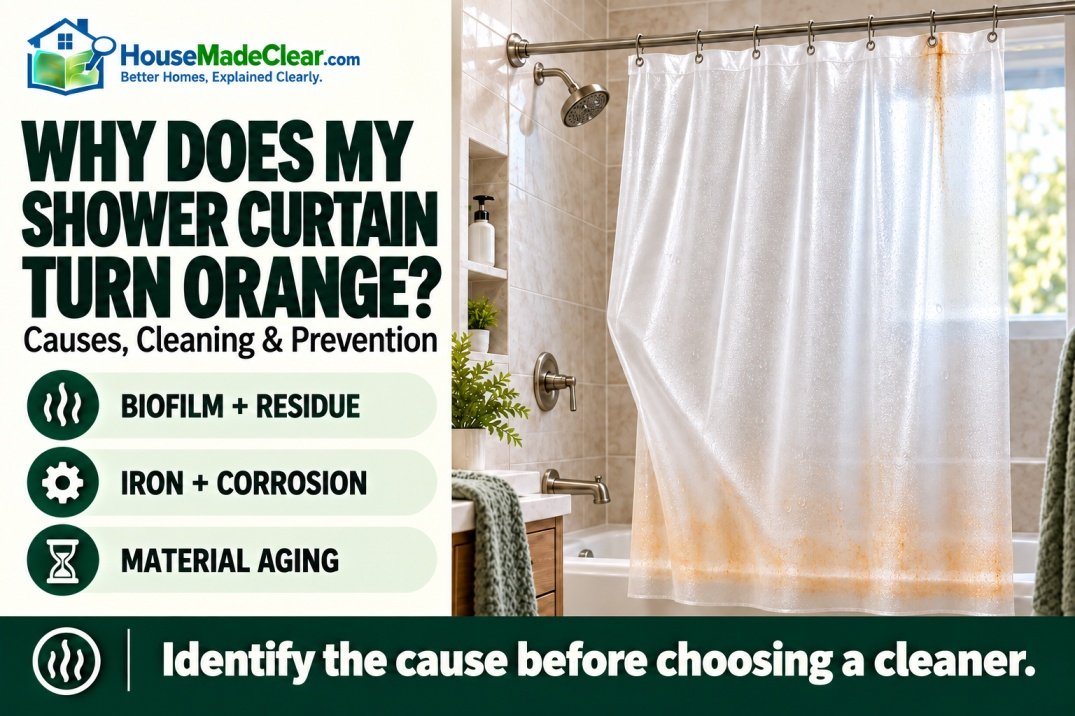
If you’ve noticed orange, peach, or pinkish stains appearing along the bottom of your shower curtain, you may be wondering whether the discoloration is caused by rust, hard water, bacteria, or mold.
An orange shower curtain is most commonly a sign of surface buildup, moisture-related microbial growth, or mineral staining. However, the exact cause depends on the color, texture, location, and behavior of the marks.
For example, a slippery pink-orange film that also appears around the shower drain may be microbial buildup. A rusty-orange stain that develops near metal fixtures could involve iron deposits or corrosion. Yellow-orange discoloration across an older plastic liner may be a change in the material itself.
These problems do not all require the same cleaning method.
Using the wrong cleaner can damage a plastic liner, permanently discolor fabric, or create unnecessary exposure to harsh chemicals.
The good news is that many orange shower-curtain stains can be removed with appropriate cleaning and improved bathroom maintenance.
This guide explains why shower curtains turn orange, how to distinguish common causes, safe cleaning methods for different materials, when to replace the liner, and how to prevent the stains from returning.
Quick Answer
A shower curtain may turn orange because of:
- Pink or orange microbial film: Moisture-related buildup, sometimes involving pigmented bacteria.
- Iron or rust deposits: Orange-brown staining associated with iron-containing water or corroding metal.
- Soap and body-product residue: Deposits that trap discoloration and provide material for microbial growth.
- Mold or other microbial growth: Possible where the curtain stays wet and dirty.
- Material aging: Permanent yellow-orange discoloration in some older plastic liners.
What to do first: Check whether the stain is slippery, powdery, crusty, or embedded in the material. Then clean the curtain according to its care label, rinse thoroughly, and allow it to dry.
If the staining returns quickly, investigate bathroom ventilation, standing water, iron deposits, and other moisture sources.
Why Does a Shower Curtain Turn Orange?
Shower curtains are repeatedly exposed to water, soap, shampoo, body oils, minerals, and humid air.
Over time, these substances can accumulate on the curtain’s surface.
The lower portion is particularly vulnerable because it receives runoff and may remain wet long after showering.
Several different processes can produce orange discoloration.
Some involve material deposited on the curtain. Others involve organisms growing on damp residue or changes within the liner itself.
This is why identifying the stain is more useful than assuming every orange mark is mold.
Orange Shower Curtain Stains: Quick Diagnosis Chart
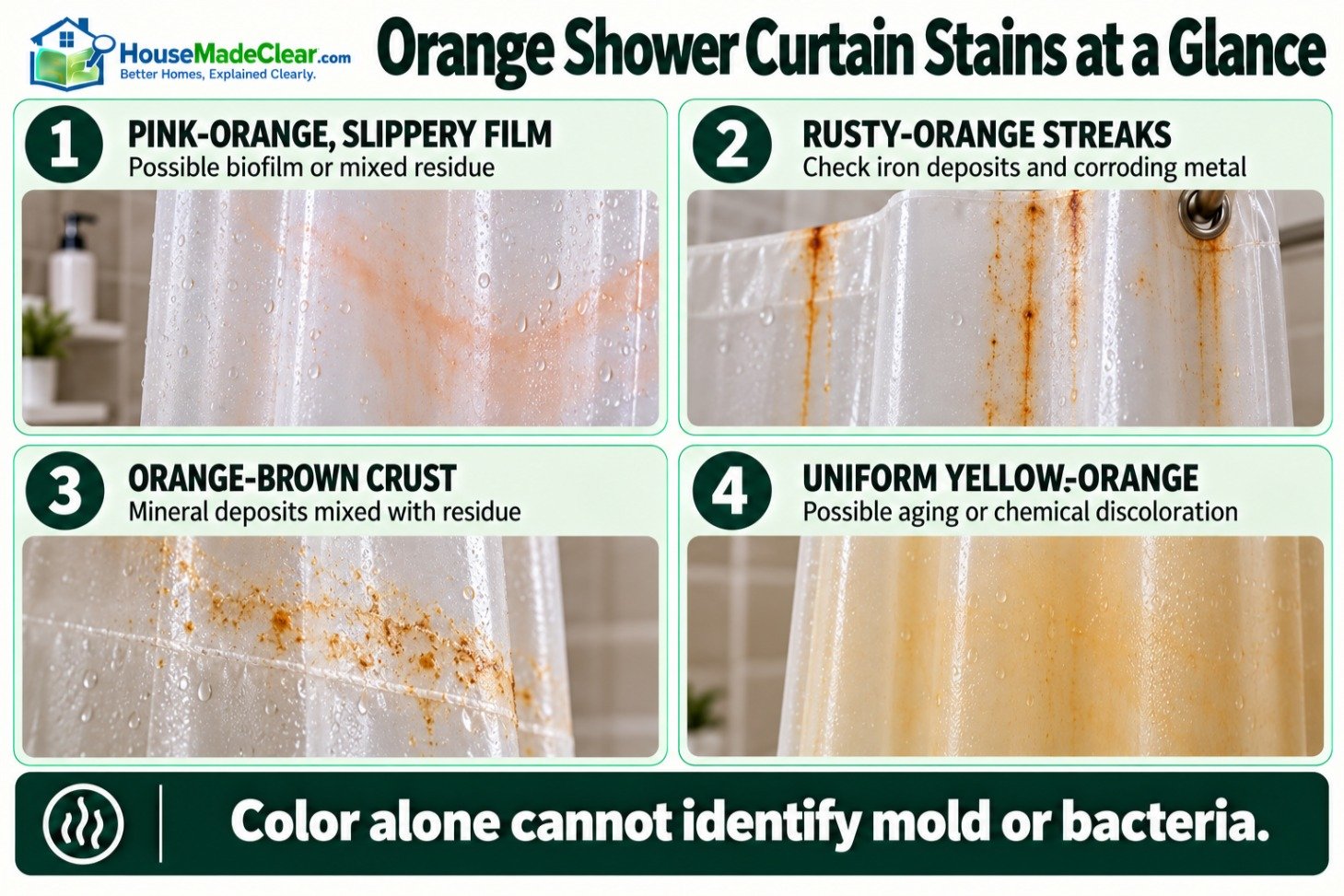
| Appearance | Possible Cause | What to Check |
|---|---|---|
| Pink-orange, slippery film | Microbial biofilm | Similar residue around drains and grout |
| Rusty-orange streaks | Iron or corrosion products | Water staining, metal hooks, or fixtures |
| Orange-brown crust | Mineral deposits mixed with residue | Hard buildup on nearby surfaces |
| Peach-colored film near bottom | Soap residue and microbial buildup | Persistent wetness and product deposits |
| Dark orange or brown spots | Various stains or possible microbial growth | Texture, spread, and odor |
| Uniform yellow-orange discoloration | Aging or chemical staining | Whether color is embedded in plastic |
| Orange marks near metal grommets | Corrosion-related staining | Rust or coating damage |
| Stains that quickly reappear | Ongoing moisture or contamination | Ventilation and cleaning frequency |
These observations can help narrow the possibilities, but color and texture alone cannot establish a definitive microbiological identification.
1. Pink or Orange Bacterial Biofilm
One possible cause of a pink-orange shower-curtain stain is microbial biofilm.
Biofilm is a layer of microorganisms and surrounding material that can develop on repeatedly wet surfaces.
Bathrooms provide several conditions that can support this buildup:
- Frequent moisture
- Warm temperatures
- Soap residue
- Body oils
- Limited drying time
- Small amounts of organic material
Some microorganisms produce pinkish or reddish pigments, which can make their surface growth appear orange.
Is the Orange Film Serratia marcescens?
The bacterium Serratia marcescens is commonly associated with pink or reddish residue on wet bathroom surfaces.
It is one possible contributor to certain pink biofilms.
However, you cannot confirm the identity of a bacterium from the color of a shower curtain.
Different microorganisms, mixtures of organisms, pigments, and chemical deposits can create similar-looking stains.
The CDC’s guidance on waterborne germs and biofilm explains how microorganisms can grow in slime layers associated with household water systems.
Although that guidance focuses primarily on water systems and fixtures rather than shower curtains, it helps explain why repeatedly damp environments require regular cleaning.
What Does Bacterial Film Look Like?
Possible signs include:
- A thin pink or orange surface layer
- A slippery feeling when wet
- Residue that appears in folds and along the hem
- Similar buildup around shower drains
- Rapid recurrence after incomplete cleaning
These signs suggest that surface contamination may be involved, but they are not a laboratory diagnosis.
Why Does It Keep Coming Back?
Even after visible residue has been removed, the conditions that supported it may remain.
For example, the curtain may continue to stay wet in tightly folded sections.
Soap residue can also accumulate again after each shower.
Without better cleaning and drying habits, the discoloration may return.
2. Iron and Rust Stains From Water or Metal Fixtures
Orange-brown stains can also result from iron-containing deposits.
Iron in water or corrosion products from metal components can leave rusty-colored marks.
This is particularly worth investigating when nearby bathroom surfaces develop similar stains.
Can Well Water Turn a Shower Curtain Orange?
Yes, under some conditions.
Water containing elevated iron concentrations can leave orange-brown staining when iron compounds precipitate or accumulate on surfaces.
A shower curtain may catch some of these deposits during repeated use.
However, the presence of orange stains does not by itself prove that the home’s well water contains excessive iron.
Signs That Iron Might Be Responsible
Look for:
- Rust-colored marks around the bathtub
- Orange streaks below fixtures
- Similar discoloration in sinks or toilets
- Sediment collecting near drains
- Orange staining on other repeatedly wet surfaces
If multiple fixtures show persistent rusty staining, consider having the water evaluated.
Can Metal Shower Curtain Hooks Cause Orange Stains?
Yes.
Corroding metal hooks, grommets, or other accessories may transfer rust-colored residue to surrounding material.
This pattern is especially plausible when stains develop near hanging holes or other metal contact points.
Replace damaged hardware with accessories suitable for wet bathroom use.
Is Rust Staining the Same as Orange Mold?
No.
Rust-related staining involves chemical deposits associated with iron.
Mold is biological growth.
The two can look somewhat similar, but they require different solutions.
3. Soap Scum, Shampoo, and Body-Product Residue
Soap, shampoo, conditioner, and body washes can leave material on shower curtains.
These residues may combine with minerals from water or other deposits.
Over time, the accumulation can become discolored.
Why Does It Build Up Near the Bottom?
Water and cleaning-product residues travel downward during showering.
The bottom edge frequently catches runoff.
If the curtain touches the tub or stays folded while wet, residue can accumulate more heavily there.
Can Soap Scum Look Orange?
Soap deposits are not always orange by themselves.
However, they can trap iron-containing particles, colored product ingredients, or microbial material.
The result may be an orange, yellowish, or pinkish coating.
How Can You Tell Whether It Is Surface Buildup?
A surface deposit may feel:
- Waxy
- Slippery
- Slightly gritty
- Sticky
- Uneven or layered
Gentle cleaning may remove some of it.
If the color remains embedded in the material after compatible cleaning, the stain may be permanent.
4. Mold or Other Microbial Growth
An orange-colored stain can sometimes involve mold or other microbial growth.
However, not every orange stain is mold, and not all mold appears black or green.
Color is not a reliable way to identify an organism or determine its health significance.
Can Mold Grow on a Plastic Shower Curtain?
Yes.
Even though plastic shower liners resist water penetration, deposits of dirt and organic material can collect on their surfaces.
Microbial growth can occur on those deposits when moisture remains available.
What Conditions Encourage Growth?
Common contributing conditions include:
- Persistent dampness
- Poor airflow
- Wet folds
- Residue buildup
- Leaks
- Frequent condensation
- Inadequate cleaning
The U.S. EPA’s guide to mold, moisture, and your home recommends controlling moisture, improving ventilation, and cleaning affected surfaces appropriately.
Does an Orange Shower Curtain Always Mean a Health Problem?
No.
Discoloration alone does not establish whether harmful exposure is occurring.
However, visible microbial growth should not be ignored.
Clean or replace affected materials as appropriate, correct moisture problems, and use additional caution if household members have respiratory conditions or weakened immune systems.
If contamination is extensive or part of a larger water-damage problem, professional assessment may be appropriate.
5. Aging or Chemical Discoloration of the Curtain
Sometimes the orange color is not removable because it reflects a change in the material.
Certain plastic liners can yellow or discolor with age, exposure, product residue, or incompatible cleaning chemicals.
This may produce a yellow-orange appearance.
How to Recognize Material Discoloration
Possible signs include:
- Broad, relatively uniform color change
- No obvious surface coating
- Little improvement after gentle cleaning
- Increased stiffness or brittleness
- Cracking or weakening around folds
Does PEVA Turn Orange Over Time?
Some PEVA shower liners may discolor over time.
However, discoloration is not inevitable, and the material label alone cannot predict a product’s lifespan or behavior.
Film formulation, additives, cleaning methods, and environmental exposure all matter.
Our article on what a PEVA shower curtain is explains the material and how it differs from traditional PVC vinyl liners.
Can Bleach Cause Yellowing?
Some materials may become discolored or damaged when exposed to incompatible cleaning chemicals.
Do not assume bleach is appropriate for every PEVA, EVA, PVC, polyester, or fabric curtain.
Always check the care instructions before applying a product.
Why Does the Bottom of My Shower Curtain Turn Orange?
The lower edge is often the first area to become discolored.
This happens because it receives the most runoff and can remain wet longer than the rest of the curtain.
Water Collects Along the Hem
The curtain’s lower edge may touch the tub or fold into standing water.
This slows drying.
Soap Residue Flows Downward
Body wash, shampoo, and other residues move toward the bottom during showering.
Folds Trap Moisture
Tightly gathered plastic can hold moisture between layers.
The Curtain Touches Dirty Surfaces
Contact with deposits on the bathtub wall or rim can transfer staining.
Magnetic or Weighted Hems Create Additional Contact Points
Weighted components can be useful for keeping a shower curtain in place.
However, their surrounding folds and attachment areas still need regular cleaning.
If movement is also a problem, our guide to keeping a shower curtain from blowing in explains how to stabilize a liner without compromising water containment.
Orange vs. Pink vs. Black Shower Curtain Stains
Different colors may suggest different possibilities, but none provides a conclusive identification.
| Stain Color | Possible Explanations | Best Initial Response |
|---|---|---|
| Light pink | Pigmented biofilm or product residue | Clean and dry |
| Pink-orange | Microbial film or mixed residue | Inspect moisture and buildup |
| Bright orange | Iron-related staining or colored deposits | Check water and nearby surfaces |
| Rusty brown | Corrosion or accumulated mineral deposits | Inspect fixtures and hardware |
| Black spots | Possible mold or another stain | Clean appropriately and assess damage |
| Yellow-orange | Aging, residue, or chemical discoloration | Check material condition |
| Mixed colors | Multiple overlapping causes | Inspect and clean in stages |
Avoid identifying a substance as a specific species of mold or bacteria solely from a photograph.
How to Remove Orange Stains From a Shower Curtain
The best cleaning method depends on the curtain’s material and the likely cause of the staining.
For most ordinary residue, a gentle cleaning method is the safest starting point.
Do not begin with concentrated bleach or an aggressive rust remover.
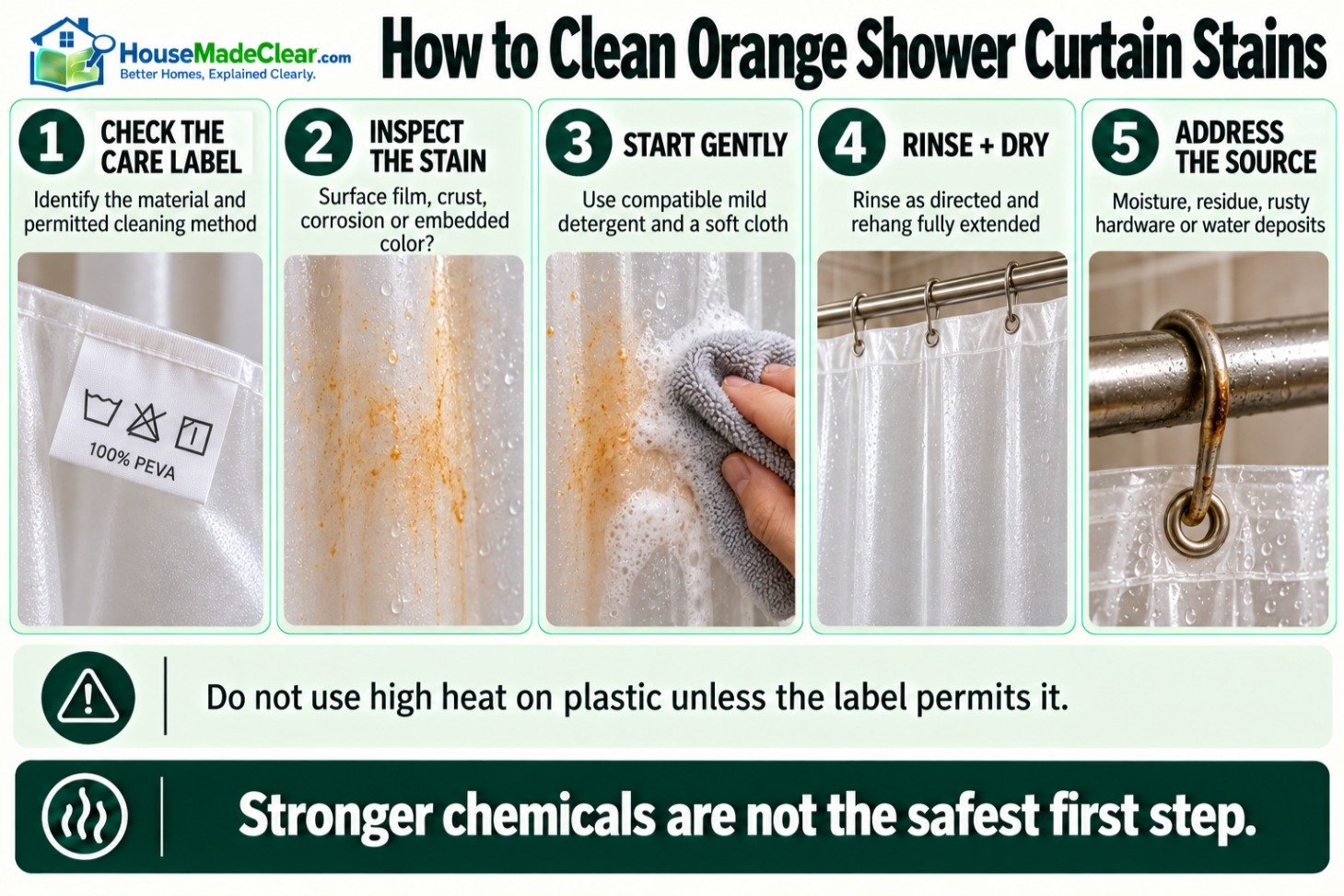
Step 1: Identify the Curtain Material
Check the care label.
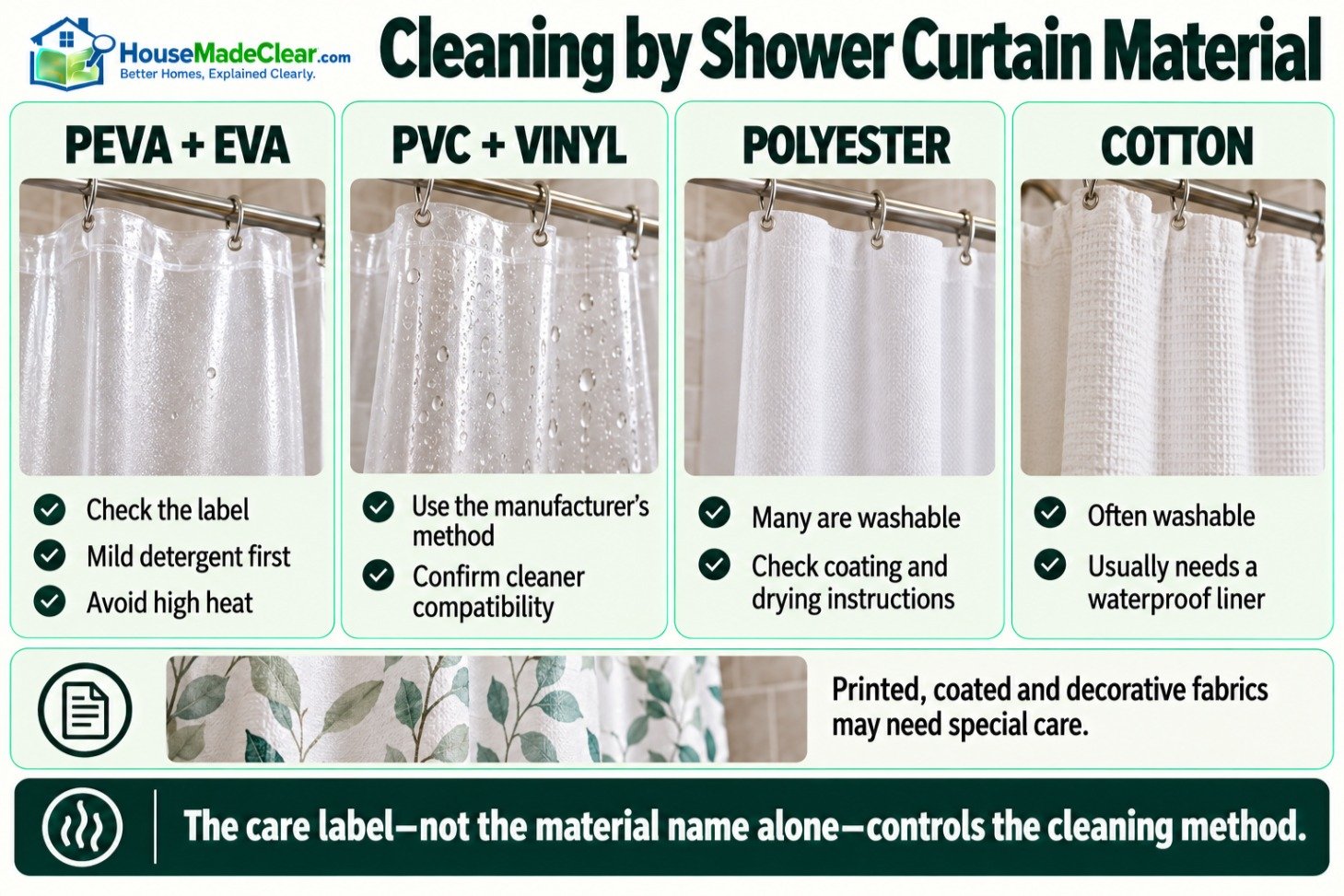
Common materials include:
- PEVA
- EVA
- PVC or vinyl
- Polyester
- Cotton
- Other blended fabrics
Each may have different care requirements.
Step 2: Inspect the Staining
Look at where the marks occur.
Are they concentrated along the bottom edge?
Do they appear near corroded metal hooks?
Are similar marks present on the tub or sink?
Does the discoloration appear to be a surface film or part of the material?
Step 3: Remove the Curtain
Carefully take the curtain or liner off its hooks.
Avoid tearing thin plastic around the grommets.
Step 4: Clean With a Compatible Mild Detergent
If the manufacturer permits hand cleaning:
- Wet the affected area with an appropriate water temperature.
- Apply a small amount of mild detergent diluted as directed.
- Gently wipe using a soft cloth or nonabrasive sponge.
- Avoid vigorous scrubbing that can damage thin plastic.
- Rinse thoroughly.
If the curtain is machine washable, follow its care label rather than applying a generic wash cycle.
Step 5: Inspect the Result
Check whether the orange coating has been removed.
If the stain remains, consider whether it might be a mineral deposit or permanent discoloration.
Step 6: Allow the Curtain to Dry
Rehang it fully extended where practical.
Do not put a plastic liner in a heated dryer unless the manufacturer explicitly permits machine drying.
Step 7: Address the Underlying Cause
If the curtain became orange because of persistent moisture, poor drying, or rusty hardware, cleaning alone may not prevent recurrence.
For material-specific washing instructions, see our complete guide to cleaning a shower curtain and liner.
How to Clean Orange Stains From a Plastic Shower Curtain
Plastic liners require particular care because aggressive cleaners and high heat may damage the film.
PEVA or EVA Liners
Check the label before washing.
For hand-washable products, mild detergent and gentle wiping are a practical first approach.
Avoid strong solvents, abrasive tools, and excessive heat.
PVC or Vinyl Liners
Use the manufacturer’s recommended cleaning procedure.
Do not assume that every vinyl liner tolerates bleach or machine washing.
What if the Stain Is Rust?
Ordinary detergent may not remove iron staining completely.
A product specifically formulated to remove rust may work on some compatible materials, but many are unsuitable for shower-curtain plastics.
Do not use a bathroom rust remover on a liner unless the product label and curtain manufacturer both permit the application.
If the stain cannot be removed safely, replacement may be preferable.
How to Clean Orange Stains From a Fabric Shower Curtain
Fabric curtains may tolerate different cleaning methods from plastic liners.
Polyester Curtains
Many polyester curtains are machine washable, but not all.
Follow the manufacturer’s instructions for water temperature, detergent, and drying.
Cotton Curtains
Cotton may absorb moisture and residue.
Some cotton curtains are machine washable, while decorative finishes or special constructions may need different care.
Printed or Coated Fabrics
Use extra caution with coated fabrics, printed designs, and delicate finishes.
Spot-test any permitted cleaning product on a concealed area when the manufacturer recommends it.
Should You Use Stain Removers?
Only use products compatible with the fabric and its finish.
Do not assume that a rust remover, chlorine bleach, or oxygen bleach is safe for every curtain.
The original care label remains the most reliable starting point.
Can Vinegar Remove Orange Shower Curtain Stains?
Vinegar is sometimes used to remove certain mineral deposits from household surfaces.
However, it is not a universal solution for orange shower-curtain stains.
Its effectiveness depends on the chemistry of the deposit and the curtain material.
Vinegar may be ineffective against a stain caused by permanent material aging or some corrosion products.
It may also be incompatible with certain finishes, accessories, or cleaning treatments.
If the manufacturer permits an acidic cleaner, follow that guidance.
Never combine vinegar with bleach or use it to rinse a surface that still has bleach residue.
The CDC’s cleaning and disinfecting guidance warns against mixing bleach with other cleaning products because dangerous vapors may result.
Should You Use Bleach on an Orange Shower Curtain?
Bleach is not always necessary.
For many routine household cleaning situations, detergent and water are sufficient.
The CDC’s home cleaning guidance explains that routine cleaning removes dirt and many germs, while disinfection is more important in particular circumstances.
If disinfection is appropriate, use a product specifically authorized for the surface and intended purpose.
When Bleach May Be Inappropriate
Avoid bleach when:
- The curtain label prohibits it.
- The material is sensitive to chlorine.
- The curtain contains finishes or colors that may be damaged.
- You do not know which cleaning chemicals were previously applied.
- The product is unsuitable for flexible plastic.
- Adequate ventilation cannot be maintained.
Critical Cleaning Safety Rules
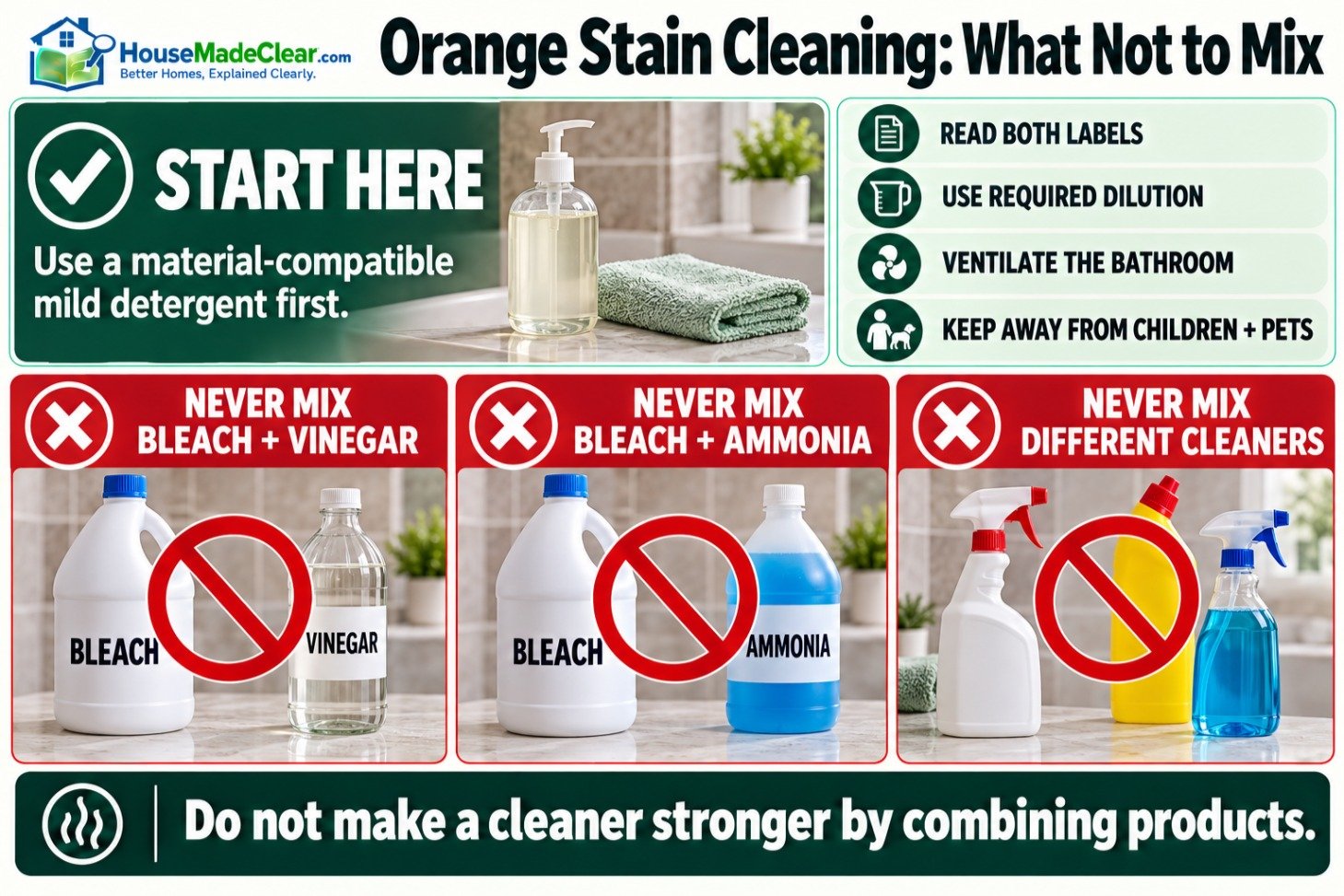
- Never mix bleach with vinegar.
- Never mix bleach with ammonia.
- Never mix different cleaning or disinfecting chemicals.
- Follow label directions, including dilution and contact time.
- Wear the protective equipment specified by the product.
- Keep cleaning chemicals away from children and pets.
- Ventilate the bathroom during cleaning.
Do not attempt to make a cleaner stronger by combining products.
How to Remove Pink-Orange Slime From a Shower Curtain
If the stain is a removable slippery film, start with ordinary surface cleaning.
Recommended Approach
- Remove the curtain carefully.
- Follow its care instructions.
- Clean visible deposits using a material-compatible detergent.
- Rinse thoroughly if directed.
- Dry the curtain fully.
- Clean nearby surfaces where similar residue is accumulating.
- Improve ventilation and reduce moisture retention.
The goal is to remove the buildup and make the environment less favorable for recurrence.
Do You Need to Identify the Bacteria?
Usually not for routine household cleaning.
A visual guess about the species is not necessary to remove ordinary residue safely.
However, recurring unusual contamination, widespread water-system problems, or concerns involving medically vulnerable household members may warrant professional advice.
What if the Pink Film Returns Within Days?
Investigate:
- Whether the bottom hem remains wet
- Whether residue is collecting on nearby surfaces
- Whether the bathroom exhaust fan is functioning
- Whether the curtain is kept bunched up
- Whether cleaning is removing the full surface deposit
- Whether the curtain is damaged or difficult to clean
A heavily contaminated or deteriorated liner may be easier to replace.
How to Tell Whether Orange Stains Come From Your Water
If the stain appears repeatedly after cleaning, the water supply may be contributing.
This possibility becomes more significant when orange-brown deposits appear elsewhere in the house.
Check Other Fixtures
Inspect:
- Bathroom sinks
- Toilet bowls
- Bathtub surfaces
- Showerheads
- Faucets
- Laundry fixtures
Similar rust-colored staining across multiple locations may suggest a water-related source.
Check for Corroding Hardware
Examine hooks, grommets, drain covers, and nearby metal components.
If the staining is concentrated near one corroded item, replace that component before investigating the whole water supply.
Consider Water Testing
Homeowners using private wells may benefit from appropriate testing when persistent iron-related staining is present.
If you use municipal water and notice unusual color or sediment, contact the water utility for information.
Do not infer drinking-water safety or quality from shower-curtain staining alone.
Why Does My Shower Curtain Keep Turning Orange After Cleaning?
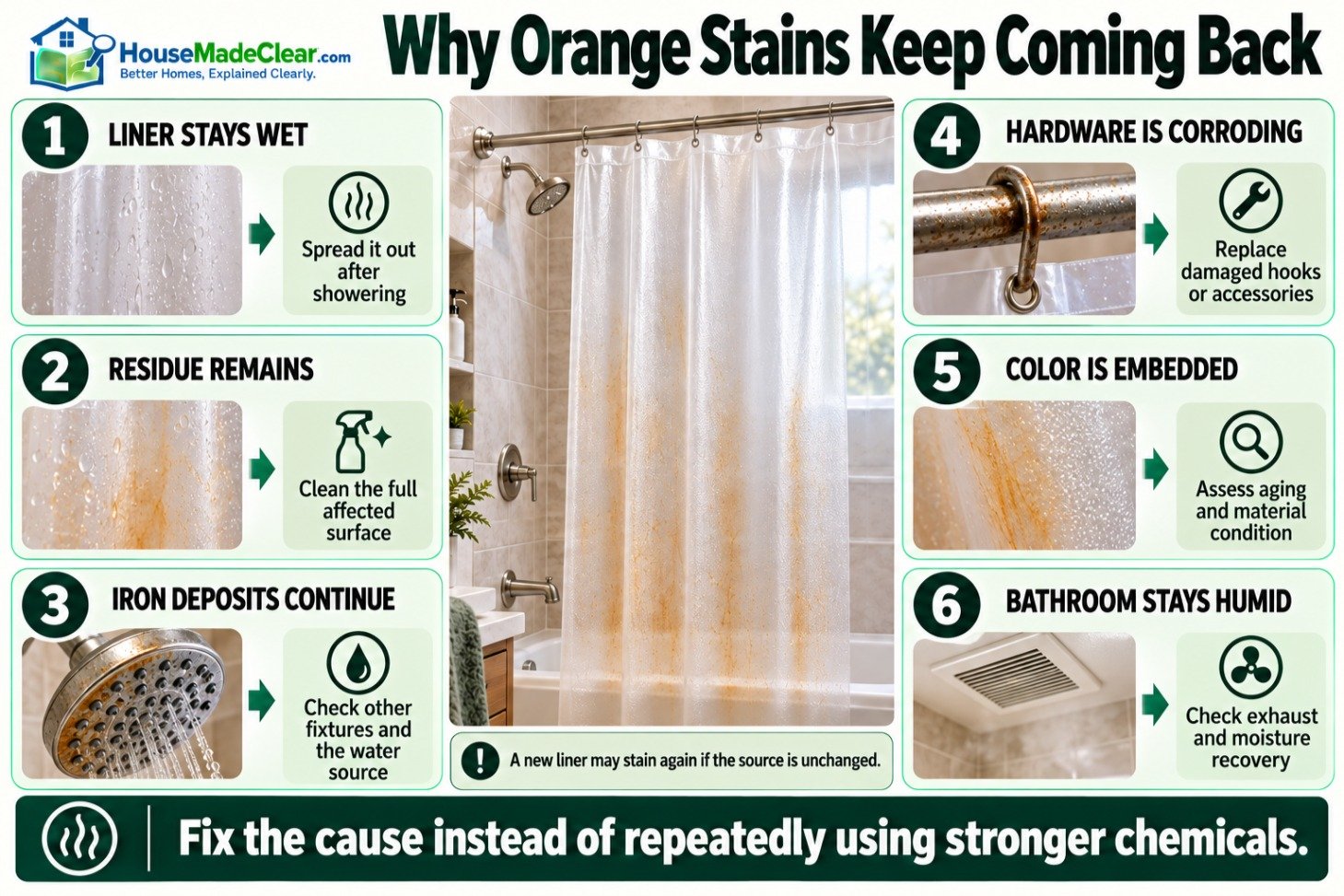
Repeated staining usually means the underlying conditions have not changed.
Possible explanations include:
- The curtain remains wet for long periods.
- Residue is not being removed completely.
- Iron-containing deposits continue entering the shower.
- Rusty hardware is transferring color.
- The liner has permanent discoloration.
- Microbial film is repeatedly forming on damp surfaces.
- The material is too damaged to clean effectively.
Identifying which pattern applies is more useful than repeatedly increasing the strength of the cleaning chemicals.
Can a New Shower Curtain Turn Orange Quickly?
Yes.
If the discoloration comes from water deposits or recurring surface buildup, a new liner may develop similar marks.
Replacing the curtain does not automatically correct a moisture or water-quality problem.
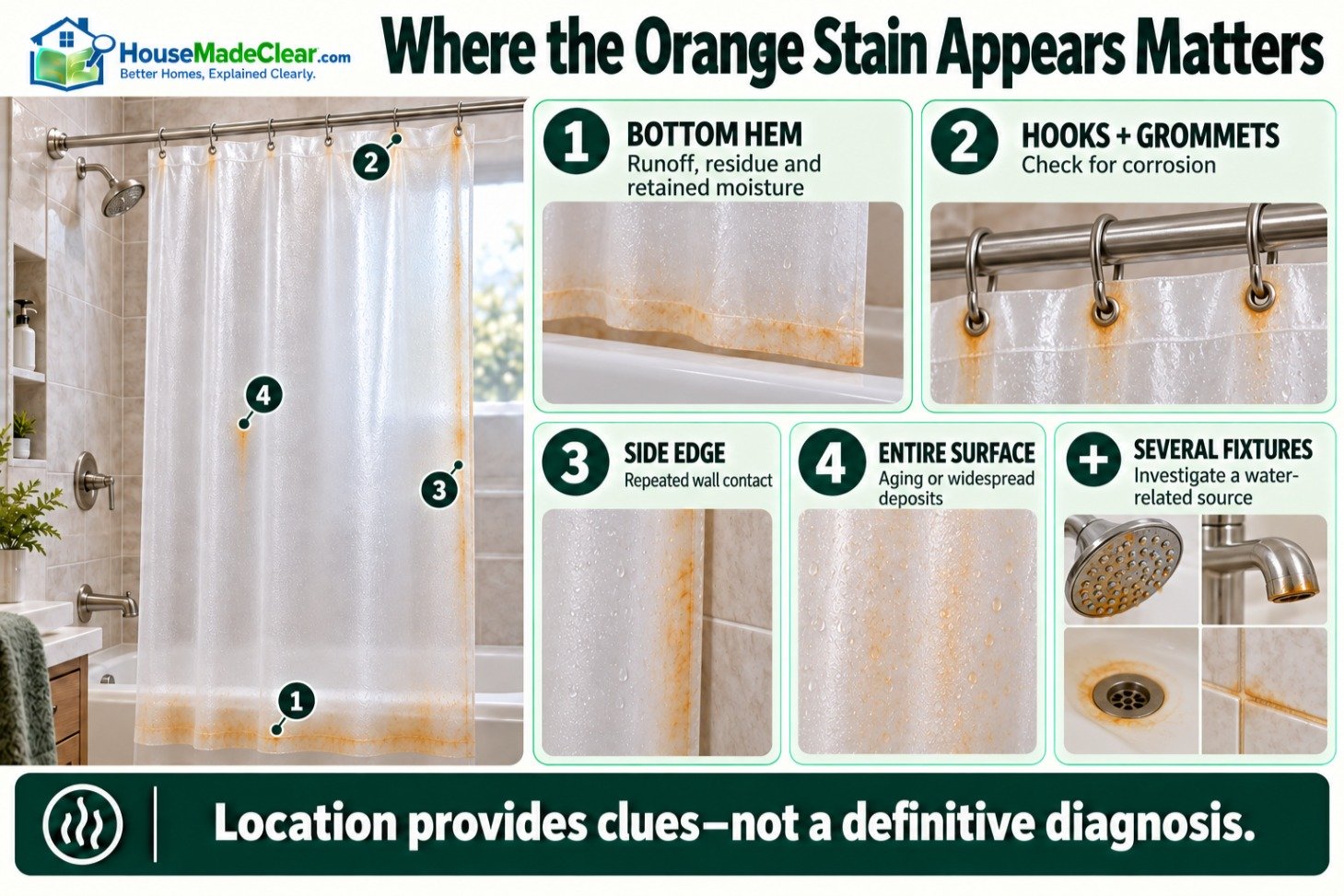
What if Only One Part Turns Orange?
Localized staining can provide a clue.
For example:
- Bottom hem: runoff and retained moisture
- Hook area: possible hardware corrosion
- Side edge: repeated wall contact
- Entire surface: material aging or widespread deposits
These patterns are useful observations, not definitive diagnoses.
How to Prevent Orange Stains on Shower Curtains
Prevention depends on reducing residue and improving drying.
1. Spread the Curtain Out After Showering
Avoid leaving the liner tightly gathered while wet.
Spreading it out allows more of the surface to dry.
2. Keep the Liner Positioned Correctly
For a conventional bathtub-shower combination, position the waterproof liner so water drains back into the tub.
An incorrectly positioned curtain can leave surrounding surfaces wet.
Our guide to whether a shower curtain goes inside or outside the tub explains correct placement.
3. Run the Bathroom Exhaust Fan
Use appropriate exhaust ventilation during showering and afterward as needed.
If moisture remains for a long period, investigate fan performance.
See our guide to how long to run a bathroom fan after showering.
4. Clean Residue Before It Becomes Heavy
Do not wait for thick deposits to accumulate along the bottom edge.
Clean according to the curtain’s care instructions.
5. Avoid Leaving the Hem in Standing Water
Ensure the liner is long enough to contain water without excessive bunching at the bottom.
6. Maintain Shower Hardware
Replace rusting hooks or accessories.
7. Investigate Iron Deposits
If rusty staining appears across multiple fixtures, consider whether the water supply needs evaluation.
8. Monitor Bathroom Humidity
Humidity often rises during showering.
The important issue is whether moisture is removed afterward.
For ordinary indoor conditions, EPA guidance favors relative humidity below 60%, ideally around 30–50% where practical.
Our guide to recommended humidity levels for a house explains these targets and how they change with seasonal conditions.
9. Clean Nearby Shower Surfaces
A clean liner may become stained again if it repeatedly touches surfaces covered in residue.
10. Replace Severely Damaged Liners
Torn, brittle, or persistently contaminated material may no longer be practical to maintain.
Does Bathroom Humidity Cause Orange Shower Curtain Stains?
Humidity can contribute, but it is not necessarily the direct source of the orange pigment.
High humidity can extend the time that surfaces remain damp, supporting microbial growth and slowing drying.
However, iron deposits and material discoloration can occur for reasons other than humidity.
What Should Bathroom Humidity Be After a Shower?
During a hot shower, humidity can rise temporarily.
The room should subsequently return toward normal indoor conditions.
A continuously humid bathroom may indicate poor ventilation or excessive moisture production.
Our article on bathroom humidity after a shower explains how to assess recovery and identify persistent dampness.
Can a Dehumidifier Help?
A dehumidifier may be useful in some bathrooms or homes with wider humidity problems.
However, it will not directly remove iron from water or reverse permanent material staining.
If considering one, review our guide to where to put a dehumidifier in a bathroom for placement and electrical-safety considerations.
When Should You Replace an Orange Shower Curtain?
Not every stained curtain needs to be discarded.
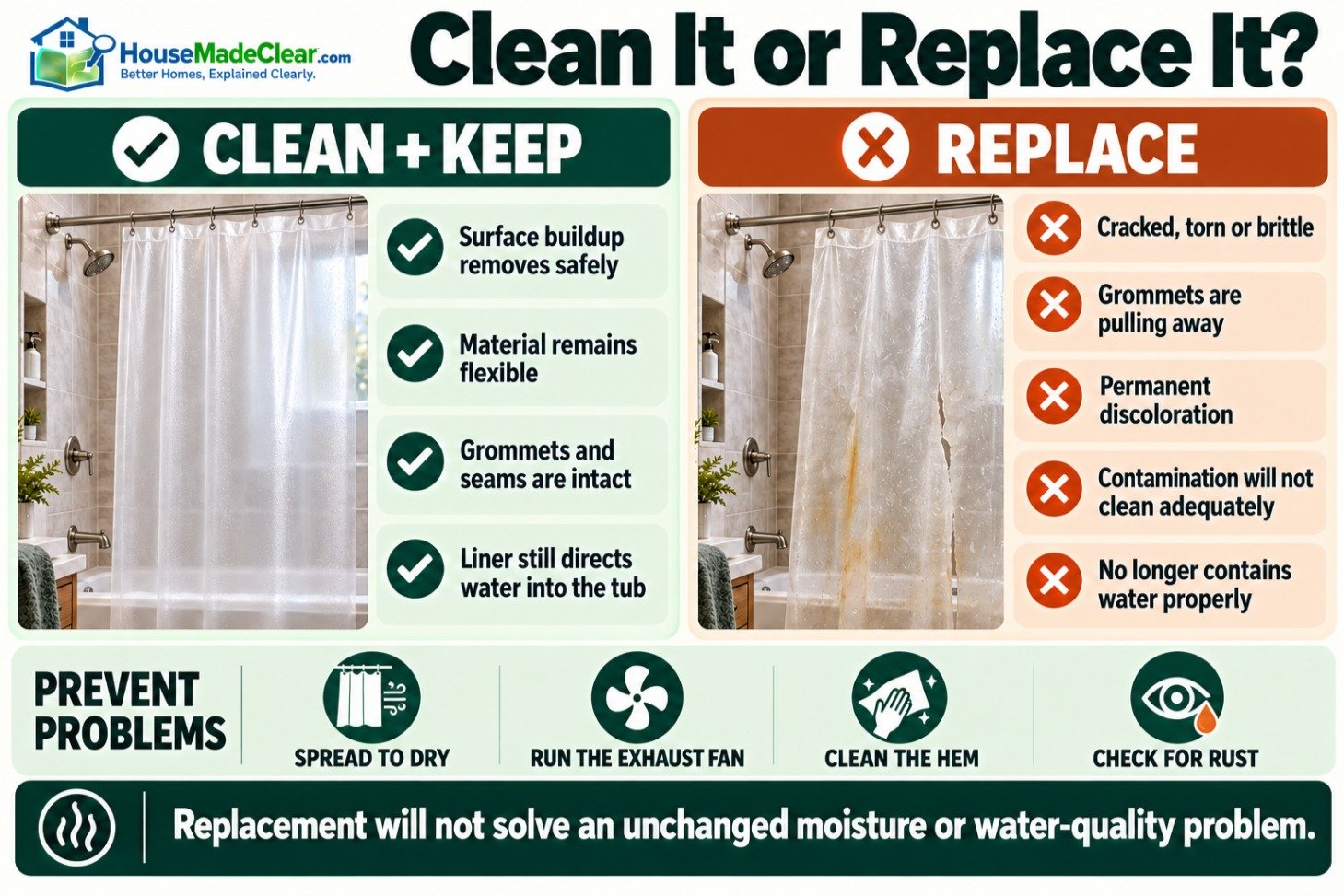
If the material is intact and the stain can be removed safely, cleaning may be sufficient.
However, replacement becomes more reasonable when the liner is damaged, permanently discolored, or difficult to maintain.
Replace the Curtain If:
- It has cracks or tears.
- The plastic has become brittle.
- Grommets are pulling away.
- Staining remains after appropriate cleaning.
- Persistent contamination cannot be removed adequately.
- The liner no longer directs water into the shower properly.
- Its condition makes routine cleaning impractical.
Should You Replace an Orange Shower Curtain Immediately?
Not necessarily.
A mild rust-colored mark may be a cosmetic issue.
A removable surface film may respond to ordinary cleaning.
However, visible growth that cannot be cleaned, widespread material deterioration, or conditions creating significant moisture damage should be addressed promptly.
Is It Better to Buy a Different Material?
Possibly, but changing materials is not guaranteed to eliminate orange staining.
If water deposits or moisture conditions are responsible, the same problem may affect a replacement.
Select a curtain based on suitability, durability, and ease of cleaning rather than assuming one material is permanently stain-proof.
Best Shower Curtain Materials for Easy Maintenance
| Material | Common Maintenance Characteristics | Important Consideration |
|---|---|---|
| PEVA | Often wipe-clean | Follow label; can accumulate surface residue |
| EVA | Often wipe-clean | Product-specific care and thickness |
| PVC/vinyl | Usually moisture resistant | Confirm compatible cleaners |
| Polyester | Many products are washable | Check coating and washing instructions |
| Cotton | Often washable | May need a waterproof liner |
| Treated fabric | Varies widely | Follow coating-specific care guidance |
A curtain that dries properly and can be cleaned according to its instructions is more useful than a product marketed as completely mold-proof.
Orange Shower Curtain Troubleshooting Chart
| What You Notice | Likely Explanation to Investigate | First Action |
|---|---|---|
| Pink-orange slippery film | Biofilm or product residue | Gentle cleaning and drying |
| Orange-brown crust | Mineral deposits | Inspect water and nearby surfaces |
| Stain near metal hooks | Corrosion | Check or replace hardware |
| Orange stain along bottom hem | Residue and trapped moisture | Clean and improve drying |
| Orange staining across several fixtures | Water-related deposits | Investigate water source |
| Color remains after cleaning | Embedded stain or aging | Assess replacement |
| Orange film returns quickly | Ongoing moisture and buildup | Review cleaning and ventilation |
| Orange stains with cracked plastic | Material deterioration | Replace liner |
| Orange marks with musty odor | Persistent dampness or possible growth | Clean and investigate moisture |
| Similar pink film around drain | Surface biofilm | Clean both surfaces appropriately |
Common Mistakes When Cleaning an Orange Shower Curtain
Mistake 1: Assuming Orange Always Means Mold
Multiple causes can produce orange discoloration.
Mistake 2: Identifying Bacteria From Color Alone
A pink-orange film cannot confirm a particular organism.
Mistake 3: Using Bleach on Every Curtain
Some materials and finishes are not compatible with bleach.
Mistake 4: Mixing Cleaning Products
Combining bleach with acids, ammonia, or other cleaners can be dangerous.
Mistake 5: Scrubbing Thin Plastic Aggressively
Abrasive tools may scratch or tear the liner.
Mistake 6: Ignoring Rusting Hardware
Corroding metal can repeatedly transfer orange stains.
Mistake 7: Leaving the Curtain Folded While Wet
Trapped moisture encourages residue accumulation and microbial growth.
Mistake 8: Cleaning Only the Curtain
Nearby dirty surfaces can contribute to recurring contamination.
Mistake 9: Assuming a New Liner Solves Water Staining
If the water source is responsible, stains may return.
Mistake 10: Ignoring Persistent Bathroom Moisture
Recurring dampness should be investigated rather than treated only as a cosmetic problem.
Shower Curtain Stain Prevention Checklist
| Task | What to Do |
|---|---|
| After showering | Spread curtain to dry |
| Liner positioning | Keep water directed inside shower |
| Cleaning | Follow material care label |
| Bottom hem | Inspect and remove buildup |
| Bathroom ventilation | Operate appropriate exhaust fan |
| Hardware | Check for rust |
| Water stains | Look for similar marks on fixtures |
| Material condition | Check for tears and brittleness |
| Cleaning chemicals | Never mix products |
| Discoloration | Identify likely source before treatment |
| Replacement | Based on condition and cleanability |
| Recurrence | Investigate moisture, deposits, and nearby surfaces |
Final Thoughts
So, why does your shower curtain turn orange?
The discoloration can result from several different sources, including pink-orange microbial film, iron or rust deposits, accumulated soap residue, or aging of the curtain material.
The stain’s appearance and location can provide clues, but color alone cannot reliably identify mold, bacteria, or a chemical deposit.
Start with the curtain’s care instructions and a gentle cleaning method.
If the orange marks return, check whether the liner stays wet, whether nearby metal components are corroding, and whether similar stains appear elsewhere in the bathroom.
For prevention, the most effective habits are straightforward: clean residue regularly, spread the curtain out after showering, maintain ventilation, and address persistent moisture problems.
If the material is cracked, brittle, or no longer cleanable, replacing the liner may be the practical solution.
The goal is not simply to remove the orange color once. It is to identify why the staining developed and reduce the conditions that allow it to return.
Frequently Asked Questions
Why does my shower curtain turn orange?
A shower curtain may turn orange because of microbial biofilm, iron or rust deposits, soap residue, or aging of the material. The likely cause depends on whether the stain is slippery, crusty, localized, or permanently embedded.
Is orange stuff on a shower curtain mold?
Not necessarily. Orange discoloration may involve microbial growth, but it can also be caused by iron, rust, or product residue. Color alone cannot identify mold or bacteria.
What is the pink-orange slime on my shower curtain?
Pink-orange slime may be microbial biofilm associated with damp bathroom surfaces. Certain pigmented bacteria can contribute to this appearance, but the organism cannot be reliably identified from color alone.
Is orange shower curtain slime Serratia marcescens?
It may involve Serratia marcescens or other microorganisms, but visual appearance is not enough to confirm a species. Routine surface cleaning, drying, and moisture control are appropriate first steps for ordinary bathroom buildup.
How do I remove orange stains from a shower curtain?
Check the curtain’s care label, then use a permitted mild detergent and gentle cleaning method. Rinse and dry thoroughly. If the stain remains, investigate mineral deposits or permanent material discoloration before applying stronger cleaners.
Can hard water turn a shower curtain orange?
Water containing iron can contribute to orange-brown staining. Other mineral deposits may also trap discoloration, but hard water does not automatically cause orange stains. Check for similar marks on bathroom fixtures.
Why is the bottom of my shower curtain orange?
The bottom edge collects water runoff, soap residue, and other deposits. It also tends to remain wet longer, particularly when folded or touching the tub, which can contribute to staining and microbial buildup.
Can I use bleach to remove orange shower curtain stains?
Only if the curtain manufacturer permits bleach and the product is suitable for the intended use. Never mix bleach with vinegar, ammonia, or other cleaners. Many ordinary stains can be addressed with material-compatible detergent first.
Will vinegar remove orange stains from a shower curtain?
Vinegar may help with some mineral deposits on compatible surfaces, but it does not remove every orange stain and may be unsuitable for certain materials. Follow the curtain’s care instructions and never mix vinegar with bleach.
Why does my shower curtain keep turning orange after cleaning?
The underlying source may still be present, such as repeated moisture retention, soap buildup, iron deposits, corroding hardware, or material discoloration. Identify the cause rather than repeatedly using stronger cleaning products.
Can PEVA shower curtains turn orange?
Yes. PEVA liners can collect stained surface deposits, and some products may discolor with age or exposure. PEVA material does not make a curtain immune to staining or microbial buildup.
Can rust cause orange stains on a shower curtain?
Yes. Corroding metal hooks or grommets, or iron-related deposits from water, may leave orange-brown stains. Inspect nearby metal components and other bathroom surfaces for similar discoloration.
Is orange shower curtain buildup dangerous?
The color alone does not establish whether the buildup is hazardous. Remove visible residue using appropriate cleaning methods and address moisture problems. People with relevant health concerns or heightened infection risks should seek individualized professional advice.
How do I prevent my shower curtain from turning orange?
Clean the curtain regularly, spread it out to dry after showering, maintain bathroom ventilation, inspect metal hardware for corrosion, and investigate recurring orange water deposits.
Should I throw away a shower curtain that has orange stains?
Not always. A curtain that is intact and can be cleaned appropriately may remain usable. Replace it if it is brittle, torn, permanently stained, or contaminated in a way that cannot be adequately cleaned.
Why is my shower curtain orange but my bathtub is clean?
The curtain may retain moisture and residue longer than the smooth bathtub surface, especially around folds and the lower hem. Material aging or staining from curtain hardware may also affect the liner without discoloring the tub.