















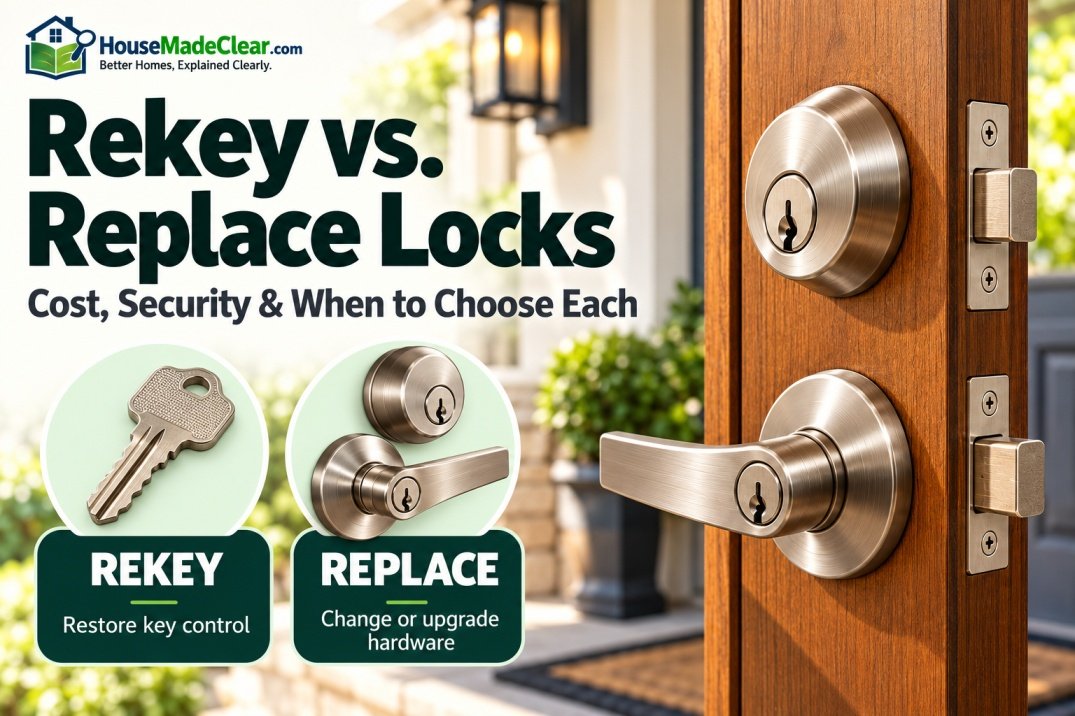
Rekeying and replacing a lock solve different problems.
Rekeying changes which key operates the existing lock. Replacing installs new hardware. If the lock is suitable, undamaged, and operating correctly, rekeying is usually the faster and less expensive way to prevent old keys from working. Replacement is the better choice when the hardware is damaged, unreliable, incompatible, poorly installed, or no longer provides the function or security you need.
The most common mistake is assuming that rekeying makes a weak lock stronger. It does not. Rekeying restores key control, but the same lock, cylinder, deadbolt, strike, and frame remain in place.
Quick Answer
Rekey the lock when:
- The existing hardware works correctly
- You moved into a home and cannot account for every old key
- A key was lost, stolen, or not returned
- A tenant, contractor, cleaner, or caregiver no longer needs access
- You want compatible locks to operate with one key
Replace the lock when:
- It is damaged, worn, corroded, or unreliable
- The key sticks even after alignment and maintenance problems are corrected
- The bolt does not extend correctly
- The existing hardware is unsuitable for an exterior door
- You want a smart lock, keypad, different function, or upgraded security
- The door preparation or keyways are incompatible
- The lock was damaged during an attempted break-in
Rekeying normally costs less because you keep the existing hardware. Replacement costs more because it includes new hardware and may require additional installation or door preparation.
Rekey vs. Replace Locks at a Glance
| Factor | Rekey Existing Lock | Replace Lock |
|---|---|---|
| What changes | Internal keying or rekeyable cylinder setting | Complete lock or selected hardware components |
| Do old keys still work? | No, after successful rekeying | No, unless the replacement is intentionally keyed to the old key |
| Does the exterior appearance change? | Usually no | Usually yes |
| Does it improve physical lock strength? | No | Potentially, if better hardware is selected and installed correctly |
| Can it fix broken hardware? | No | Yes |
| Can it add keypad or smart access? | Usually no | Yes, unless the existing system supports an upgrade module |
| Can several doors use one key? | Yes, if the cylinders and keyways are compatible | Yes, by purchasing or configuring compatible keyed-alike hardware |
| Typical cost | Usually lower | Usually higher |
| Best use | Restoring key control | Correcting hardware problems or changing the locking system |
| Main limitation | Existing hardware remains unchanged | Higher cost and possible door modifications |

What Does Rekeying a Lock Mean?
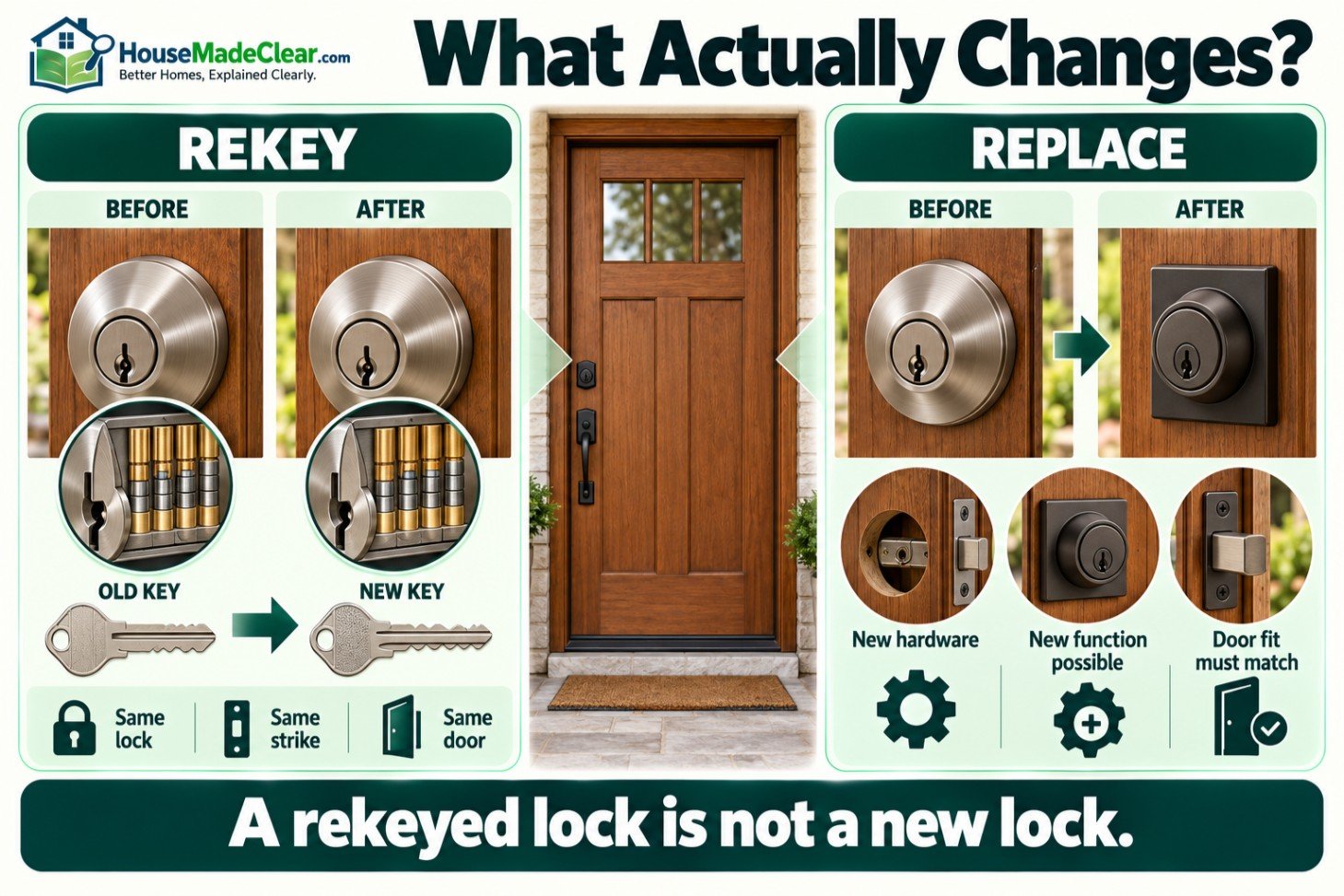
Rekeying changes the lock so that a new key operates it and the previous key no longer works.
In a conventional pin-tumbler cylinder, a locksmith typically changes or rearranges internal pins so they align with the cuts on a new key. Other lock designs use different rekeying methods. Some consumer locks include manufacturer-specific technology that allows the owner to change the working key with a supplied tool and the current valid key.
The exterior and interior trim normally stay on the door. Depending on the product, the cylinder may be serviced while installed, removed from the lock, or replaced with another compatible cylinder.
Rekeying can:
- Invalidate old keys
- Establish a new operating key
- Make compatible locks use the same key
- Preserve existing door hardware
- Avoid unnecessary lock replacement
- Reduce the cost of changing access
Rekeying cannot:
- Repair cracked, loose, or corroded hardware
- Strengthen a weak deadbolt
- Reinforce the strike or door frame
- Correct severe door misalignment
- Change a knob lock into a deadbolt
- Add electronic access to a mechanical-only product
- Repair damage from forced entry
- Make incompatible keyways accept the same key without other changes
A rekeyed lock is not a new lock. It is the same hardware configured to accept a different key.
What Does Replacing a Lock Mean?
Lock replacement involves removing existing hardware and installing a new lock, deadbolt, handleset, cylinder, or complete locking assembly.
Replacement may be a straightforward like-for-like installation when the new hardware matches the existing door preparation. It becomes more complicated when the replacement requires:
- Different bore holes
- A different backset
- Strike modification
- Door-edge preparation
- Mortise-pocket changes
- Electrical wiring
- New reinforcement
- A different latch location
- Repairing damage around the old hardware
- Coordinating a multipoint locking system
Replacement allows you to change:
- Lock quality
- Lock grade or residential rating
- Cylinder type
- Keyway
- Handle style
- Finish
- Deadbolt configuration
- Locking function
- Keypad access
- Smart-home features
- Accessibility
- Key-control system
Our guide to the different types of door locks explains the functions of deadbolts, keyed knobs and levers, mortise locks, multipoint systems, smart locks, privacy hardware, and other residential lock types.
The Main Difference: Key Control vs. Hardware Condition
The most useful way to make the decision is to identify the actual problem.
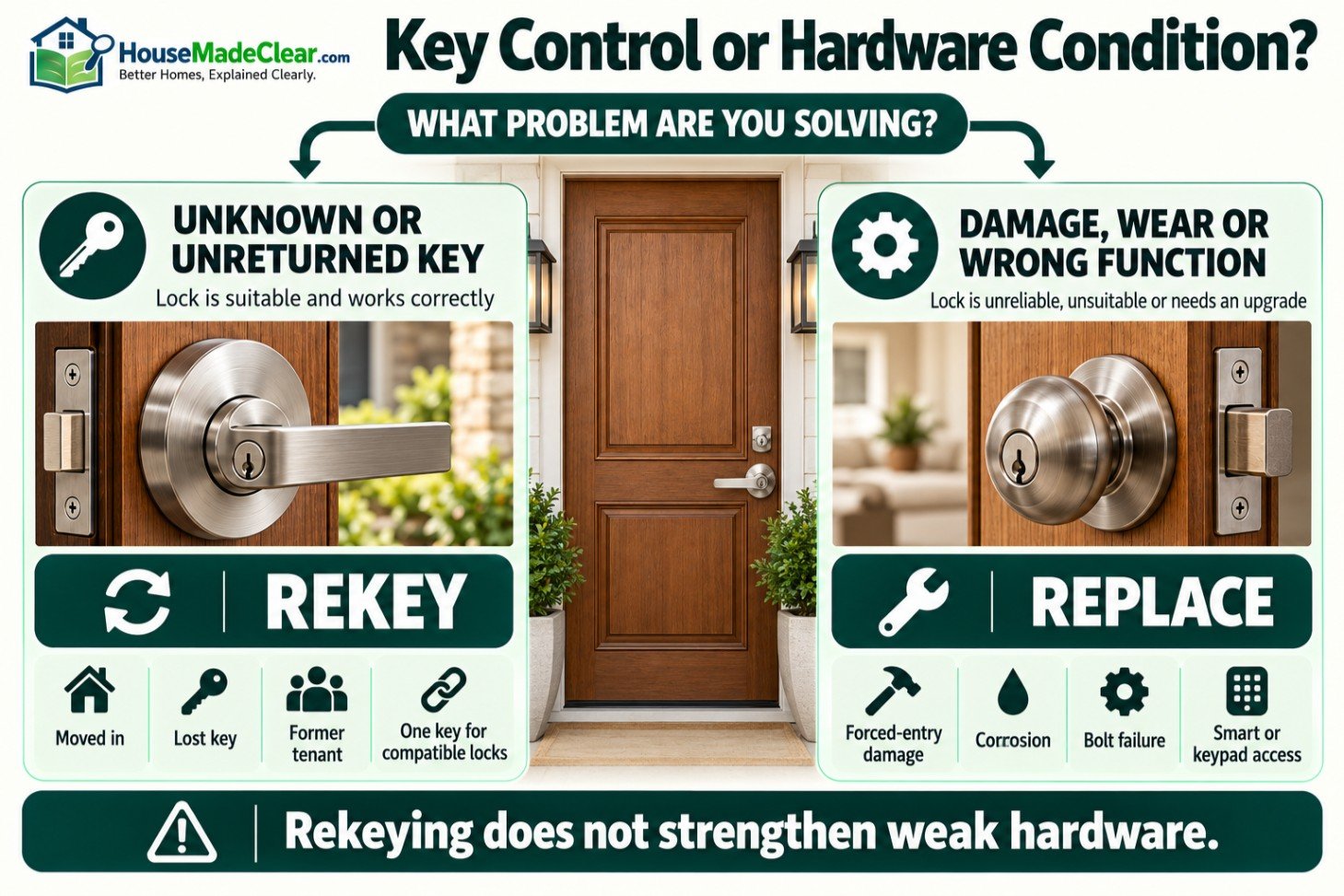
Rekeying Solves a Key-Control Problem
Choose rekeying when the concern is primarily:
- Who may have a copy of the key
- Whether a lost key can still open the door
- Whether a former occupant retains access
- Whether several compatible locks can use one key
- Whether keys issued to workers or service providers should be invalidated
The existing hardware must still be appropriate and functional.
Replacement Solves a Hardware or Function Problem
Choose replacement when the concern is:
- Weak or unsuitable hardware
- Damage
- Wear
- Corrosion
- Repeated jamming
- Missing components
- Incorrect installation
- An incompatible keyway
- A desired smart or keypad upgrade
- A change in lock function
- A change in appearance
- Hardware that no longer fits the door
Some situations involve both problems. A damaged lock after an attempted break-in may need replacement, and the replacement should use a new key to restore key control.
Is Rekeying as Secure as Replacing a Lock?
Rekeying can be just as effective as replacement for invalidating old keys, but only when the existing lock is already suitable and in good condition.
If an unknown person has a copy of the old key, rekeying prevents that key from operating the reconfigured lock. Replacing the hardware also prevents access, assuming the replacement is not keyed to the old key.
The difference is physical performance:
- Rekeying preserves the existing lock’s strength, condition, grade, strike, and installation.
- Replacement can improve physical performance if the new product is more suitable and correctly installed.
- Replacing a good lock with a low-quality or poorly installed lock can reduce security.
Do not assume that replacement is automatically more secure. The result depends on what replaces the old hardware.
When selecting new hardware, verify the exact model and certification. Our guide to ANSI lock grades explains traditional Grade 1, Grade 2, and Grade 3 classifications and modern residential Security, Durability, and Finish ratings.
Rekeying vs. Replacing Locks: Cost Comparison
Rekeying is generally less expensive because the existing hardware remains in place. Replacement adds the price of the new lock and may require more labor.
Current U.S. planning figures vary considerably. Angi’s 2026 cost data places a straightforward professional rekeying service broadly around $50 to $160, depending on how the company bills the service. Some locksmiths charge a service or trip fee plus an additional amount for each cylinder.
Professional lock replacement commonly falls around $60 to $350 per installed lock, with an average near $150. Basic mechanical hardware can cost less, while smart locks, mortise locks, high-security products, multipoint systems, and doors requiring modification can cost substantially more.
These figures are planning ranges, not fixed prices. Review current local estimates using a source such as Angi’s rekey-versus-replacement cost guide.
| Cost Factor | Rekeying | Replacement |
|---|---|---|
| Hardware cost | Usually minimal | New lock, cylinder, trim, strike, batteries, or accessories |
| Labor | Cylinder servicing and testing | Removal, installation, adjustment, and testing |
| Door modification | Usually unnecessary | May be required |
| Additional keys | Usually extra | Some keys normally included; extras may cost more |
| Missing working key | May increase labor | Usually less important for basic replacement |
| Multiple locks | Per-cylinder charges may apply | Hardware and labor for every opening |
| Smart-lock upgrade | Not normally included | Hardware and setup can substantially increase cost |
| After-hours visit | Higher service charge possible | Higher service charge possible |
| Door or frame repair | Separate from rekeying | Separate unless included in the quote |
Ask How the Locksmith Calculates the Price
Before authorizing work, ask whether the estimate includes:
- Service or trip fee
- Labor
- Price per cylinder
- New keys
- Key duplication
- Hardware
- Sales tax
- After-hours charges
- Lockout or picking charges
- Drilling
- Door preparation
- Strike adjustment
- Frame repair
- Smart-lock configuration
- Disposal of old hardware
A low advertised service price may not represent the final bill.

When Should You Rekey Your Locks?
After Moving Into a Home
You normally cannot confirm how many copies of the old keys exist.
Previous owners may have given keys to:
- Relatives
- Neighbors
- Housekeepers
- Contractors
- Real estate agents
- Pet sitters
- Caregivers
- Former tenants
- Maintenance workers
ALOA Security Professionals Association recommends addressing the locks promptly after taking possession and notes that rekeying can restore control over access. Its guidance for changing locks after moving also advises including garages and storage buildings.
If the existing locks are suitable and operate correctly, rekeying may be sufficient. Replace them if they are damaged, unreliable, inconsistent, or unsuitable for the doors.
After Losing a Key
Rekey the affected locks when a key cannot be accounted for, especially if:
- It was lost with identification
- It was stolen with a bag or wallet
- The finder could associate it with your address
- The key can be identified by a label
- You suspect unauthorized possession
Replacing the entire lock is usually unnecessary when the hardware remains secure and serviceable.
When a Key Is Not Returned
Rekeying is appropriate when a key remains with a:
- Former tenant
- Former partner
- Former employee
- Contractor
- Cleaner
- Babysitter
- Pet sitter
- Caregiver
- Neighbor
- Previous roommate
Do not rely on an assurance that every duplicate has been returned. A physical key can be copied without your knowledge.
When You Want One Key for Several Doors
Compatible locks can often be rekeyed to operate with one key. This arrangement is called keyed alike.
The locks must use compatible cylinders and keyways. Locks from different manufacturers—or even different product lines from the same manufacturer—may not accept the same key.
A locksmith may be able to:
- Rekey compatible locks
- Replace selected cylinders
- Replace only incompatible hardware
- Establish a new keyed-alike system
- Preserve suitable existing locks
Do not assume that every key that slides into a keyway is compatible with the cylinder.
After Changing Service Providers
Rekeying may be appropriate when changing workers or businesses that previously held a key, including:
- Property managers
- Cleaning companies
- Home-health providers
- Construction crews
- Landscaping services
- Short-term rental managers
For future access, consider whether individually managed keypad codes would provide better control than distributing more physical keys.
When Should You Replace Your Locks?
When the Hardware Is Damaged
Replace a lock when you find:
- Cracked housing
- Broken trim
- Loose or missing components
- A bent latch
- A damaged bolt
- Severe corrosion
- A broken key inside the mechanism
- A cylinder pulling away from the door
- Damage from drilling or forced entry
- Internal failure that cannot be repaired reliably
Rekeying does not correct structural or mechanical damage.
After an Attempted Break-In
Inspect the complete door assembly after a forced-entry attempt.
Damage may affect:
- Lock
- Cylinder
- Deadbolt
- Latch
- Strike
- Door edge
- Jamb
- Frame
- Hinges
- Glass
- Fasteners
- Wall connection
Replacing only the lock may still leave a split jamb, bent strike, cracked door, or loose frame.
Photograph the damage before repairs if you may file an insurance claim. If the opening cannot be secured reliably, arrange temporary protection and professional repair promptly.
When the Lock Is Worn or Unreliable
Replacement may be necessary when:
- The key repeatedly sticks
- The key will not insert or withdraw normally
- The cylinder turns inconsistently
- The latch does not retract
- The bolt will not extend fully
- The thumbturn binds
- Parts feel loose
- Corrosion returns after maintenance
- The mechanism fails under normal use
First determine whether the door is misaligned. A lock may appear defective when a sagging door or shifted strike is placing pressure on the latch or bolt.
Open the door and operate the lock. If it works normally while open but binds when closed, alignment is likely contributing to the problem.
When the Existing Lock Is Unsuitable
Replacement is appropriate when an exterior entrance relies on hardware that does not match its security needs.
Examples include:
- A spring latch without a separate deadbolt
- Interior privacy hardware used on an exterior door
- Low-quality or uncertified hardware
- An incompatible lock fitted into damaged holes
- Hardware that does not allow the bolt to engage fully
- An inappropriate double-cylinder configuration
- A product not designed for the door material or thickness
Review the entire opening before selecting a new product. Our guide to improving home security with better locks explains why the lock, strike, frame, door, and fasteners must work together.
When You Want Smart or Keypad Access
Moving from a mechanical lock to a smart lock, electronic deadbolt, or keypad normally requires replacement or a compatible retrofit product.
Before buying, check:
- Door thickness
- Backset
- Bore dimensions
- Bolt alignment
- Interior clearance
- Exterior clearance
- Wi-Fi or hub requirements
- Battery type
- Manual key override
- Offline operation
- Access-code management
- Software-support policy
- Weather rating
- Applicable certification
A smart lock solves access-management problems. It does not automatically reinforce a weak door or frame.
When the Locks Cannot Be Keyed Alike
If you want one household key but the existing locks use incompatible keyways, options may include:
- Replacing selected cylinders
- Replacing only the incompatible locks
- Installing a compatible lock family
- Keeping separate keys where replacement is unnecessary
Replacing every lock is not always required. A locksmith can identify which cylinders can be preserved.
When You Want a Different Function
Replace the hardware when the door needs a different locking function.
Examples include changing:
- Passage hardware to privacy hardware
- A keyed knob to an entry lever
- A basic latch to a deadbolt
- Mechanical access to keypad access
- A conventional deadbolt to an interconnected lock
- A single-cylinder deadbolt to another permitted configuration
Do not select a function based only on perceived security. Interior operation and emergency exit still matter. Our guide comparing single-cylinder and double-cylinder deadbolts covers the reach-through and egress tradeoffs.
Rekey or Replace After Buying a House?
Rekey the locks if:
- They operate correctly
- They are suitable for exterior use
- The cylinders can be serviced
- The keyways can be coordinated
- The door and frame are sound
- You do not need a different lock function
Replace the locks if:
- They are damaged or unreliable
- They show severe wear or corrosion
- The exterior doors have inadequate hardware
- The locks use incompatible systems
- You want smart or keypad access
- The hardware is improperly installed
- The keys or cylinders cannot be managed as intended
- You cannot identify or verify the product
- The appearance or function does not suit the home
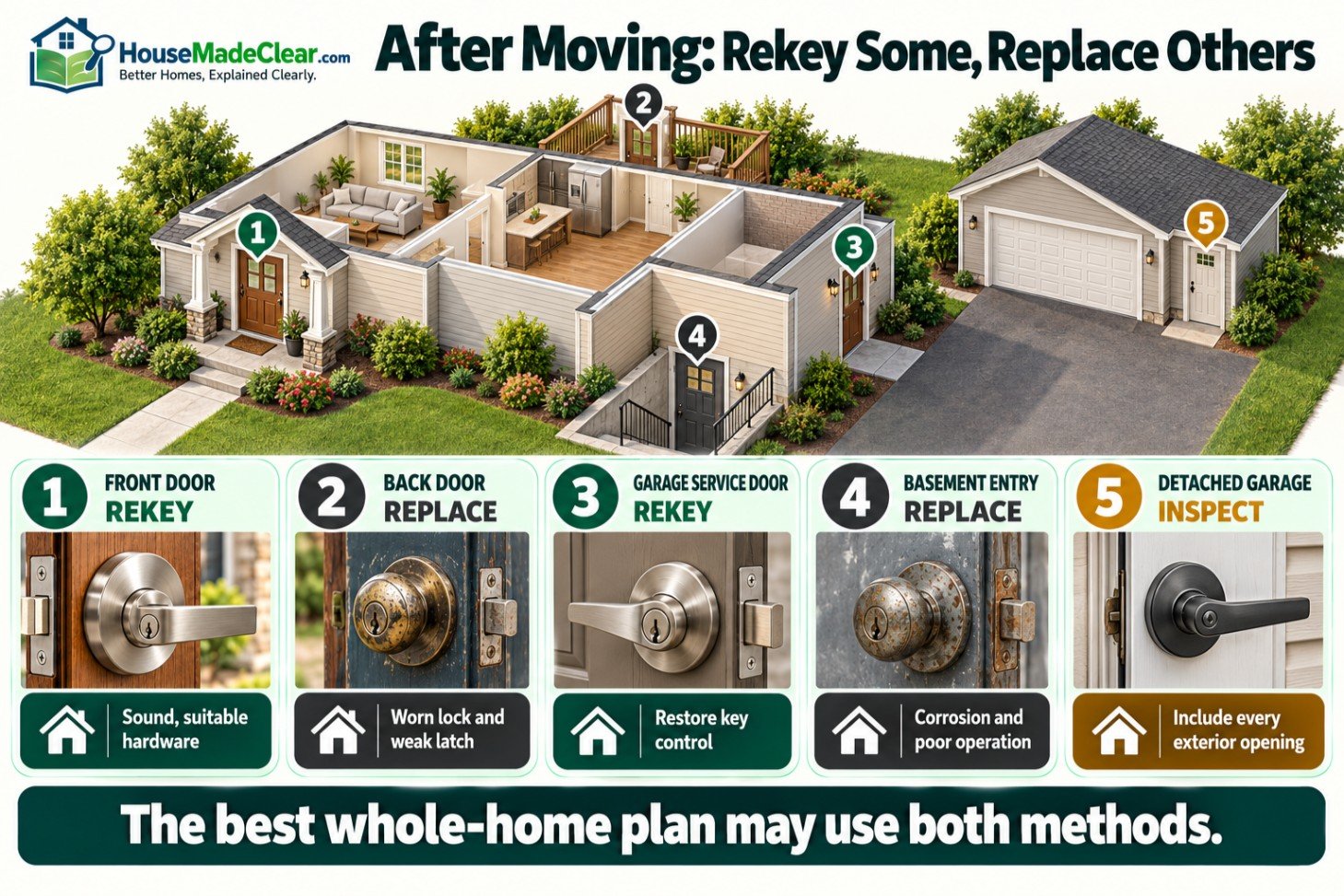
A practical approach is to inspect every exterior opening and use a combination of both methods. Rekey suitable locks and replace only the hardware that needs an upgrade.
Do not overlook:
- Back door
- Side door
- Garage service door
- Door from an attached garage
- Basement entrance
- Exterior storage room
- Detached garage
- Gate
- Mailbox where applicable
Rekey or Replace After Losing a Key?
Rekeying is normally sufficient if:
- The lock remains in good condition
- The key was the only compromised item
- The lock can be rekeyed
- You do not need different hardware
Replace the lock when:
- The lost key exposed a weakness in the access system
- The lock was already worn or unreliable
- The keyway cannot be reconfigured conveniently
- You want to move to keypad or smart access
- The hardware is inappropriate for the door
- The lock was damaged at the same time
If the missing key can be linked to your address, treat the situation as time-sensitive.
Rekey or Replace After a Tenant Moves Out?
Landlords and property managers should restore key control between occupants, subject to applicable laws, lease terms, and property policies.
Rekeying is often appropriate when:
- Existing hardware is standardized
- Locks are maintained between tenancies
- The property uses compatible cylinders
- The locks pass inspection
- Only the tenant-level operating key needs to change
Replacement may be necessary when:
- The lock is damaged
- Hardware is missing
- Unauthorized modifications were made
- The product no longer meets property requirements
- The key system cannot be maintained
- The door or frame requires repair
- A smart lock needs ownership or account reset
For electronic locks, remove former users, codes, mobile credentials, administrator accounts, and integrations. Changing only the mechanical key may not remove digital access.
Can Different Lock Brands Be Rekeyed to the Same Key?
Sometimes, but not always.
The critical issue is the keyway and cylinder compatibility, not simply the name printed on the lock.
Two locks may look similar but use:
- Different keyway profiles
- Different numbers of pins
- Different cylinder formats
- Different spacing and depth systems
- Proprietary rekeying technology
- Restricted or controlled keys
A locksmith may be able to key different brands alike if their cylinders use compatible keyways. In other cases, one or more cylinders or complete locks must be replaced.
Do not force a key into a cylinder to test compatibility. Give the locksmith the model information or allow the hardware to be inspected.
Keyed Alike vs. Master Keyed
These terms are often confused.
Keyed Alike
Several locks are keyed alike when one key opens all of them.
Example:
- Front-door deadbolt
- Back-door deadbolt
- Garage service door
All three use the same household key.
Keyed Different
Locks are keyed different when each lock uses its own unique key.
Master Keyed
A master-key system allows individual keys to open specific locks while another master key opens multiple locks.
For example:
- A tenant key opens one apartment.
- A maintenance master key opens several authorized apartments.
Master keying increases administrative complexity and can affect key control. Most homeowners asking for “one key for every exterior door” want their locks keyed alike, not master keyed.

Can Smart Locks Be Rekeyed?
It depends on the product.
A smart lock may have:
- No mechanical key cylinder
- A conventional key cylinder
- A manufacturer-specific self-rekeying cylinder
- A removable cylinder
- A proprietary emergency key
- A credential-only access system
If the smart lock has a rekeyable mechanical cylinder, rekeying changes the physical key. It does not automatically remove:
- PIN codes
- Mobile users
- Digital keys
- Shared app access
- Voice-assistant connections
- Automation permissions
- Administrator accounts
After moving or changing occupants, review both mechanical and digital access.
Can You Rekey Locks Yourself?
Some locks are specifically designed for homeowner rekeying. Follow the instructions for the exact model.
A self-rekey process may require:
- Current working key
- New compatible key
- Manufacturer-provided tool
- Correct lock position
- A specific sequence of turns
Do not use instructions intended for another brand or cylinder.
Traditional pin-tumbler rekeying may require:
- Correct pin kit
- Plug follower
- Cylinder tools
- Exact key-cut information
- Careful handling of springs and pins
- Functional testing after reassembly
Mistakes can leave the lock inoperable or create a condition in which the key cannot be removed.
Professional rekeying is safer when:
- No working key is available
- Several locks need coordination
- The cylinders use different keyways
- The lock is historic or unusual
- A master-key system is involved
- The hardware is high security
- The cylinder is damaged
- You cannot identify the product
Can You Replace Locks Yourself?
A straightforward lock replacement may be suitable for DIY installation when:
- The new hardware exactly matches the door preparation
- The door and frame are undamaged
- The backset is compatible
- The door thickness is within specification
- No new drilling is required
- The manufacturer provides complete instructions
- You can test the installation thoroughly
Hire a qualified professional when dealing with:
- Mortise locks
- Multipoint locks
- Historic doors
- Damaged frames
- Misaligned doors
- New hole preparation
- Glass-adjacent drilling
- Fire-rated door assemblies
- Interconnected hardware
- High-security cylinders
- Complex smart-lock integration
- Master-key systems
Do not enlarge holes or cut into a door until you have confirmed the exact template and dimensions.
Should Renters Rekey or Replace Their Locks?
Renters should not rekey or replace locks without checking the lease and obtaining any required approval.
The property owner may need:
- Emergency access
- A management key
- Compatibility with a master-key system
- A copy of the new key
- Approved lock hardware
- Documentation of the change
- Restoration of the original hardware at move-out
Local laws and property policies can also affect lock changes.
If you believe an old tenant or unauthorized person may have a key, notify the landlord or property manager in writing and request rekeying or replacement.
Do not disable required access systems or alter a fire-rated apartment entrance without authorization. Apartment renters should confirm the building’s lock policy before rekeying or replacing an entrance lock. Where unauthorized modifications are prohibited, there may still be other renter-friendly ways to improve apartment door security without drilling, including appropriate door sensors and landlord-approved maintenance.
How to Inspect a Lock Before Deciding
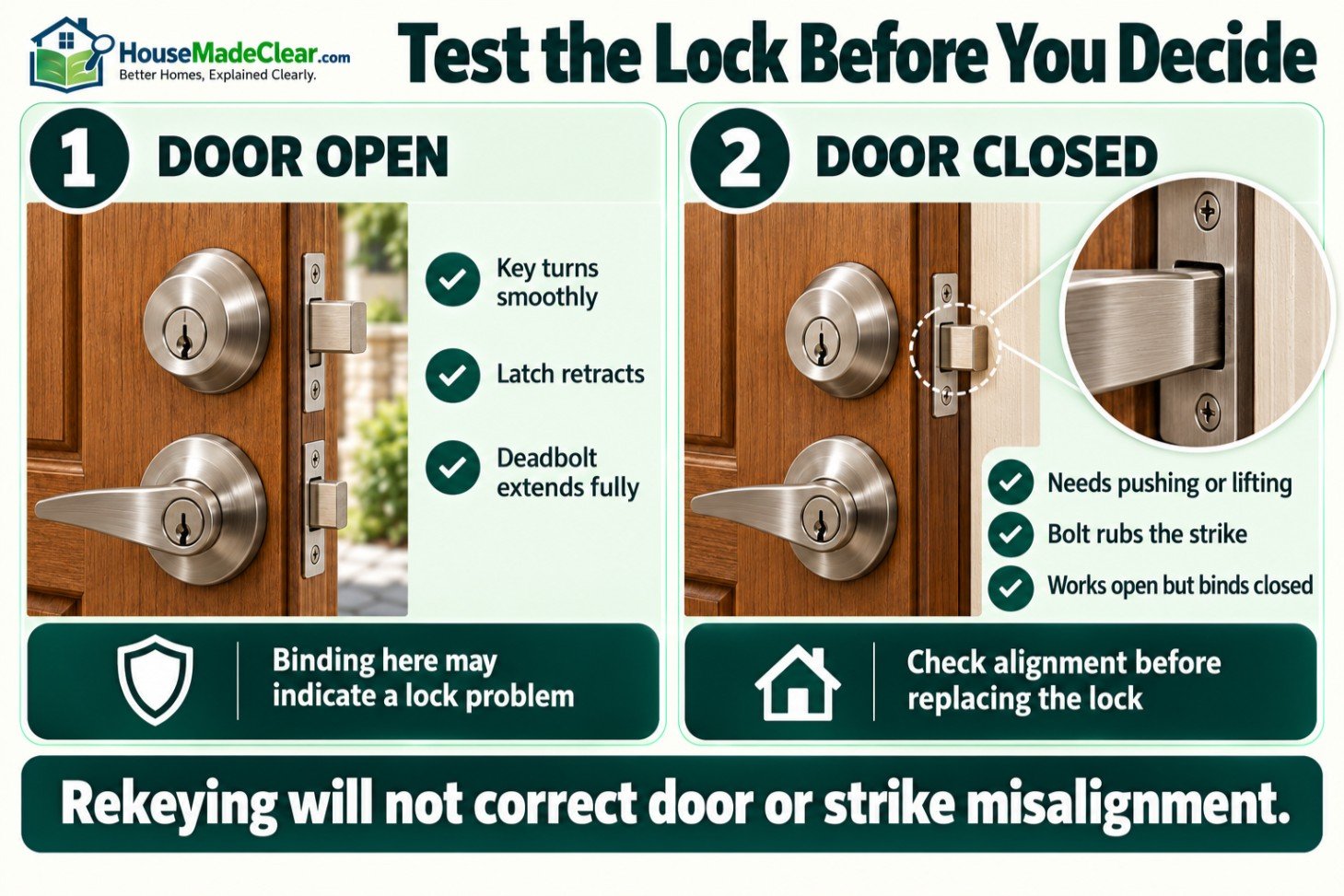
1. Operate the Lock With the Door Open
Test:
- Key insertion
- Key rotation
- Thumbturn
- Latch retraction
- Bolt extension
- Handle movement
If the hardware binds while the door is open, the lock itself may need service, repair, or replacement.
2. Operate the Lock With the Door Closed
If it works when open but not when closed, check:
- Door sag
- Strike alignment
- Weatherstripping pressure
- Loose hinges
- Frame movement
- Swelling
- Paint buildup
- Debris
Rekeying will not solve an alignment problem.
3. Inspect the Hardware
Look for:
- Corrosion
- Cracks
- Loose trim
- Missing screws
- Bent parts
- Drill marks
- Forced-entry damage
- Excessive movement
- Worn keyway
- Damaged bolt
4. Inspect the Door and Frame
Check:
- Door-edge damage
- Split jamb
- Loose strike
- Cracked frame
- Rot
- Rust
- Inadequate bolt engagement
- Loose hinges
- Nearby breakable glass
5. Identify the Product
Record:
- Manufacturer
- Model or series
- Lock type
- Keyway where known
- Door thickness
- Backset
- Cylinder configuration
- Certification markings
6. Account for Every Access Method
List:
- Physical keys
- Spare keys
- Hidden keys
- Keypad codes
- Smart-lock users
- App administrators
- Temporary codes
- Voice assistants
- Rental-platform integrations
- Garage remotes
- Building access credentials
The decision is incomplete if you change the physical key but leave unauthorized digital access active.
How to Hire a Locksmith Safely
Locksmith pricing and business requirements vary by state and locality.
Before scheduling service:
- Confirm the company’s physical business name
- Ask for a written estimate
- Describe every lock and door
- Ask whether the quote includes the service call
- Ask about per-cylinder charges
- Ask whether missing keys increase the price
- Confirm hardware prices before installation
- Ask about after-hours fees
- Check licensing where required
- Verify insurance where appropriate
- Keep the invoice
When the technician arrives:
- Confirm the company matches the business you contacted
- Ask for identification
- Request an updated price before additional work
- Do not authorize unnecessary drilling immediately
- Ask why replacement is required if rekeying was expected
- Retain the old hardware if you want to inspect it
- Test every new key before payment
- Test the door from both sides
- Confirm all agreed old keys no longer work
ALOA’s locksmith-scam guidance warns about bait-and-switch pricing, mismatched company identities, immediate unnecessary drilling, and cash-only demands.
Common Rekeying and Replacement Mistakes
Assuming “Change the Locks” Always Means Replacement
The phrase can mean either rekeying or installing new hardware. Specify the exact service in writing.
Replacing Good Hardware Unnecessarily
If the lock is suitable and the only problem is an unaccounted-for key, rekeying may solve the issue for less money.
Rekeying Damaged Hardware
New pins or a new key will not repair a damaged bolt, loose cylinder, broken trim, corroded mechanism, or split frame.
Ignoring Door Alignment
A misaligned door can make both old and new locks difficult to operate. Correct the underlying door or strike problem.
Assuming Every Lock Can Use One Key
Keyed-alike operation requires compatible keyways or replacement cylinders.
Asking for a Master Key When You Mean Keyed Alike
A master-key system is more complex than using one household key for several compatible locks.
Forgetting Secondary Entrances
Rekey or inspect garages, storage areas, basement doors, side entrances, and outbuildings where applicable.
Changing Apartment Locks Without Permission
The property owner may require master-key compatibility, an emergency key, or approved hardware.
Ignoring Smart-Lock Accounts
Changing a mechanical cylinder does not necessarily remove codes, app users, or connected accounts.
Judging Security by the Lock Alone
The lock, strike, door, frame, hinges, fasteners, glass, and installation form one assembly.
Rekey vs. Replace Decision Checklist
| Question | If Yes | Likely Action |
|---|---|---|
| Is the lock suitable and working correctly? | Yes | Rekeying may be sufficient |
| Are unknown copies of the key the main concern? | Yes | Rekey |
| Was a key lost, stolen, or not returned? | Yes | Rekey promptly if the hardware remains suitable |
| Is the lock damaged or unreliable? | Yes | Repair or replace |
| Does the key bind only when the door is closed? | Yes | Correct alignment before deciding |
| Do you want a smart lock or keypad? | Yes | Replace or install a compatible retrofit |
| Are the existing keyways incompatible? | Yes | Replace selected cylinders or locks |
| Is the hardware unsuitable for an exterior entrance? | Yes | Replace |
| Was the lock damaged during forced entry? | Yes | Replace damaged hardware and inspect the complete opening |
| Do you want one key for compatible doors? | Yes | Ask for keyed-alike rekeying |
| Is the property rented? | Yes | Obtain required approval first |
| Is the door fire-rated, historic, mortised, or multipoint? | Yes | Use a qualified professional |
Frequently Asked Questions
What is the difference between rekeying and replacing a lock?
Rekeying changes the existing lock so a new key operates it and the previous key no longer works. Replacement removes the old hardware and installs a new lock, cylinder, or locking system.
Is it cheaper to rekey or replace locks?
Rekeying is usually cheaper because the existing hardware remains in place. Replacement includes new hardware and may require more labor, door preparation, strike adjustment, or smart-lock setup.
Is rekeying as secure as replacing locks?
Rekeying is equally effective at invalidating old keys when the existing lock is suitable and works correctly. It does not strengthen the lock, door, strike, or frame. Replacement can improve physical security if better hardware is selected and installed properly.
Should I rekey or replace locks after buying a house?
Rekey suitable locks that operate correctly. Replace locks that are damaged, unreliable, incompatible, poorly installed, or unsuitable for exterior security. Many homes need a combination of both approaches.
Should I rekey the locks if I lose a key?
Yes, particularly when the missing key can be associated with your address or may have been stolen. Replacement is usually unnecessary unless the existing lock also needs an upgrade or repair.
Can every lock be rekeyed?
No. Rekeying depends on the lock type, cylinder, keyway, condition, and availability of compatible parts or tools. Some locks require cylinder replacement or complete hardware replacement.
Can different brands of locks use the same key?
Sometimes. The cylinders must use compatible keyways and keying systems. Brand name alone does not determine compatibility. A locksmith can identify which locks can be keyed alike.
Can a smart lock be rekeyed?
Some smart locks have rekeyable mechanical cylinders, while others are key-free or use proprietary cylinders. Rekeying the physical cylinder does not remove digital codes, app users, or connected accounts.
How long does it take to rekey a lock?
A straightforward residential cylinder may take a locksmith only several minutes after gaining access to it. The complete visit takes longer when multiple locks, missing keys, incompatible cylinders, damaged hardware, or door-alignment problems are involved.
Can I rekey a lock myself?
Some homeowner-rekeyable locks can be reconfigured with the current key and manufacturer-provided tool. Traditional cylinders may require a model-specific pin kit and locksmith tools. Follow instructions for the exact product.
Can a renter rekey or replace a lock?
A renter should first check the lease and obtain any required permission. The landlord may require approved hardware, master-key compatibility, emergency access, or a copy of the new key.
Should locks be replaced after a break-in?
Replace any damaged or compromised hardware, but also inspect the strike, jamb, frame, door edge, hinges, glass, and fasteners. Replacing the lock alone may not correct damage to the rest of the opening.
What is the difference between keyed alike and master keyed?
Keyed-alike locks all operate with the same key. A master-key system allows individual keys to open selected locks while a master key opens multiple locks. Most homeowners asking for one key for all exterior doors want keyed-alike locks.
When should a lock be replaced instead of rekeyed?
Replace a lock when it is damaged, worn, corroded, unreliable, incompatible, unsuitable for the door, or being upgraded to a different function, keyway, keypad, or smart-lock system.
Final Recommendation
Rekey when the existing lock is sound and the problem is an old, missing, stolen, or unreturned key.
Replace when the hardware itself is the problem.
Before spending money, test the lock with the door open and closed, inspect the strike and frame, identify the keyway, and account for both physical and digital access. Rekeying suitable locks while replacing only damaged or inadequate hardware is often the most economical whole-home solution.






[…] Rekey vs. Replace Locks: Cost, Security and When to Choose Each […]