















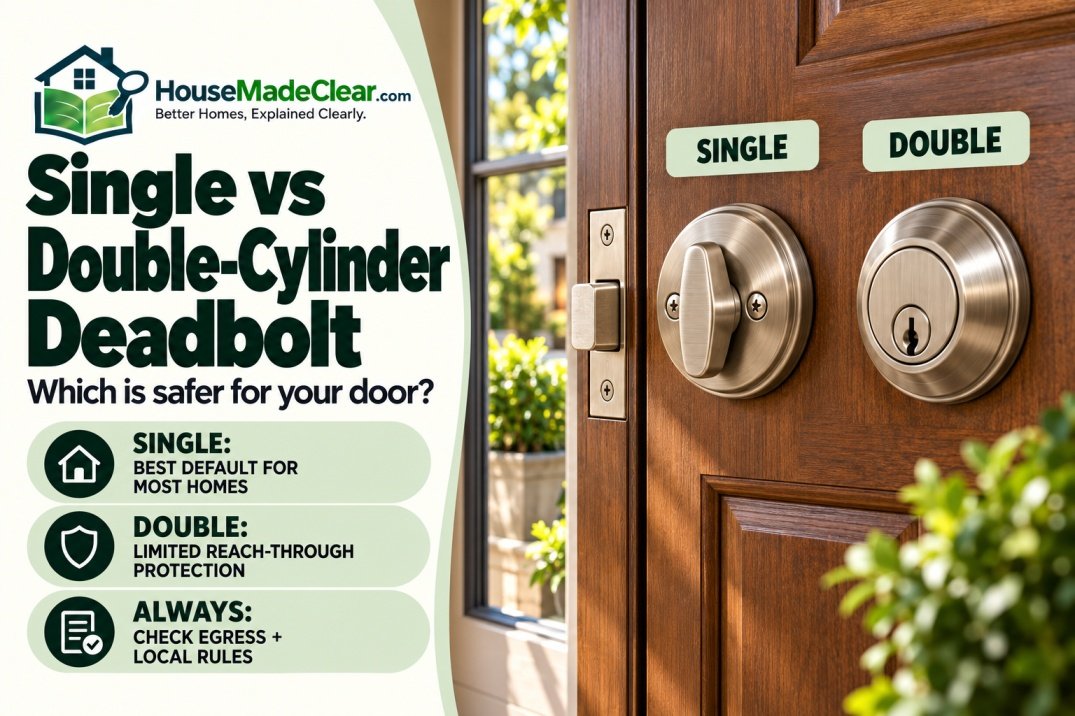
Choosing between a single-cylinder and double-cylinder deadbolt is not simply a matter of buying the lock that sounds stronger.
A single-cylinder deadbolt uses a key outside and a thumbturn inside. A double-cylinder deadbolt requires a key on both sides. Requiring an interior key can prevent someone from breaking nearby glass and turning the lock, but it can also delay evacuation during a fire or another emergency.
For most homes, a properly installed, certified single-cylinder deadbolt is the better default. A double-cylinder deadbolt should be considered only for a specific reach-through risk, where local code permits it and the door remains safe to use as an emergency exit.
Quick Answer
A single-cylinder deadbolt is usually the safer and more practical choice for a residential exterior door because occupants can unlock it immediately from inside without finding a key.
A double-cylinder deadbolt may provide additional protection when breakable glass is close enough to the lock for someone to reach through and operate an interior thumbturn. However, it requires a key for both entry and exit, which can create a serious emergency-egress hazard and may be prohibited on required exit doors.
Whichever type you choose, the deadbolt will not perform properly unless the door, strike, jamb, frame, fasteners and installation are also strong.
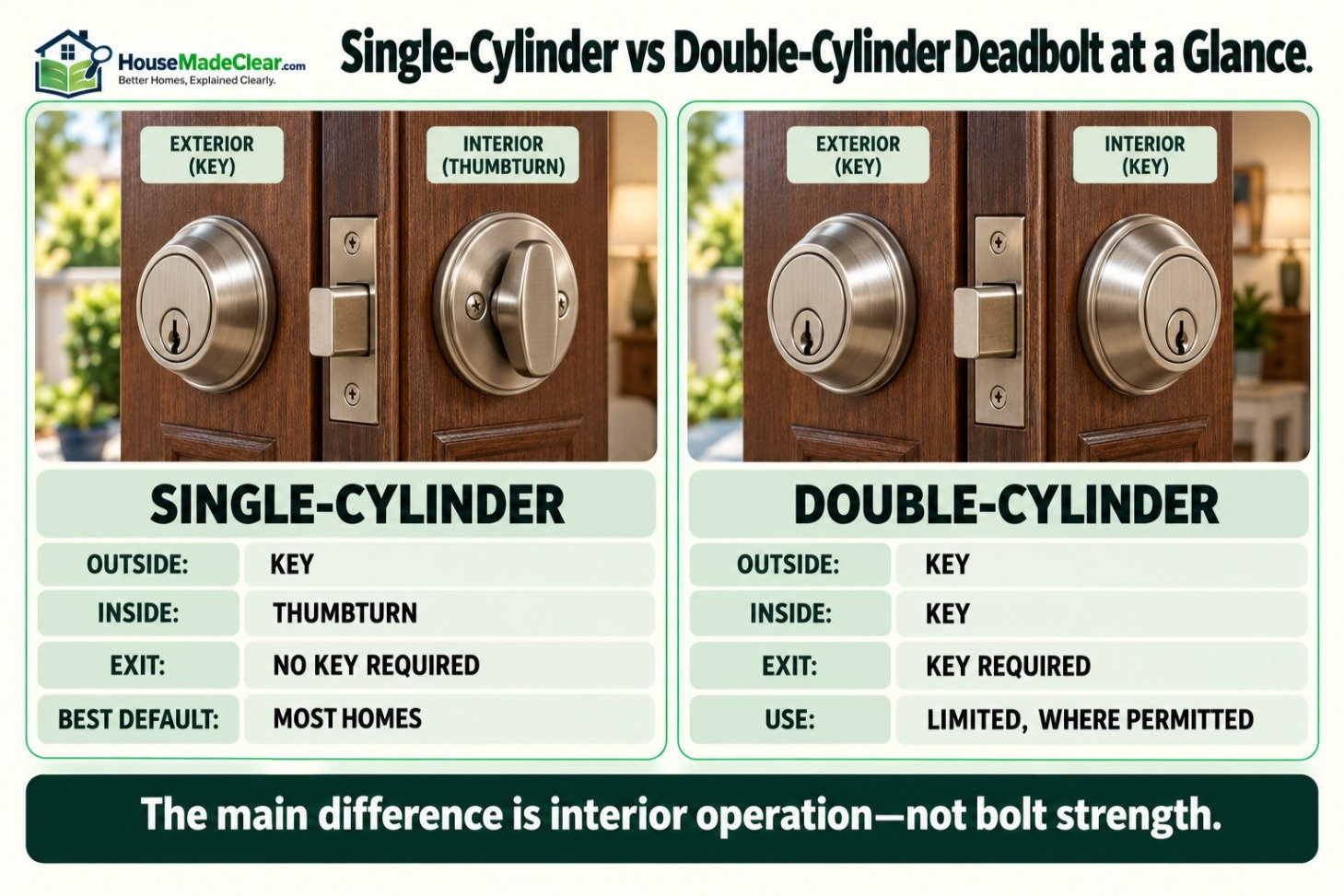
Single-Cylinder vs Double-Cylinder Deadbolt at a Glance
| Feature | Single-Cylinder Deadbolt | Double-Cylinder Deadbolt |
|---|---|---|
| Exterior operation | Key | Key |
| Interior operation | Thumbturn | Key |
| Emergency exit | Fast; no key required | Key must be located and inserted |
| Protection from reach-through near glass | Interior thumbturn may be reachable | Cannot be turned without the key |
| Everyday convenience | More convenient | Less convenient |
| Risk if keys are misplaced | May prevent exterior entry | May also prevent or delay exit |
| Code concerns | Commonly accepted when correctly installed | Frequently restricted on egress doors |
| Best general application | Most residential exterior doors | Limited, professionally evaluated applications |
| Main security limitation | Thumbturn may be reachable through nearby broken glass | Creates an emergency-exit risk |
| Main misconception | “Convenient” does not mean weak | Two cylinders do not automatically make the door stronger |
The most important difference is the interior operation—not necessarily the strength of the bolt.
What Is a Single-Cylinder Deadbolt?
A single-cylinder deadbolt has:
- A keyed cylinder on the exterior side
- A thumbturn on the interior side
- A solid bolt that extends into the strike and door frame
From outside, the door is locked or unlocked with a key. From inside, the user rotates the thumbturn.
This design allows fast exit because the occupant does not need to find a key. That makes it appropriate for many front, back and side doors used as normal household entrances and emergency exits.
Advantages of a Single-Cylinder Deadbolt
A single-cylinder deadbolt offers several practical advantages:
- Quick unlocking from inside
- No interior key required during an emergency
- Easier operation for children, guests and many older adults
- Less risk of someone becoming trapped when a key is missing
- Convenient daily locking and unlocking
- Broad compatibility with residential doors and smart-lock systems
Its primary limitation appears when breakable glass is located close enough to the interior thumbturn for someone to reach it after breaking or removing the glass.
What Is a Double-Cylinder Deadbolt?
A double-cylinder deadbolt has a keyed cylinder on both sides of the door.
A key is required to:
- Unlock the door from outside
- Unlock the door from inside
- Lock the door from either side, depending on the design
The interior side does not have a conventional thumbturn.
The main security argument for this design is that a person cannot break nearby glass, reach inside and simply rotate a thumbturn. If the interior key has been removed, the lock cannot normally be operated through the broken opening.
Advantages of a Double-Cylinder Deadbolt
A double-cylinder deadbolt can:
- Reduce the risk of unlocking the door through nearby broken glass
- Prevent an intruder from operating an interior thumbturn through a mail slot or other opening
- Make it more difficult to open the door after gaining partial access through a glass panel
- Prevent someone inside from unlocking the door without a key in specialized controlled-access situations
However, these advantages must be weighed against emergency-egress requirements. The same feature that prevents an intruder from turning the lock can prevent an occupant from opening the door quickly.
Does “Double-Cylinder” Mean the Lock Is Stronger?
Not necessarily.
The terms single-cylinder and double-cylinder describe how the deadbolt is operated. They do not, by themselves, indicate:
- Bolt strength
- Resistance to drilling
- Resistance to forced entry
- Cylinder quality
- Strike-plate strength
- Fastener length
- Door-frame strength
- Certification grade
- Installation quality
Two deadbolts can use similar bolts and fit the same door preparation while having different interior controls.
A poor-quality double-cylinder lock installed in a weak frame may provide less useful protection than a well-certified single-cylinder deadbolt installed as part of a reinforced door assembly.
When comparing locks, evaluate the complete product rather than assuming that two keyed cylinders equal twice the security.
Which Deadbolt Is Safer?
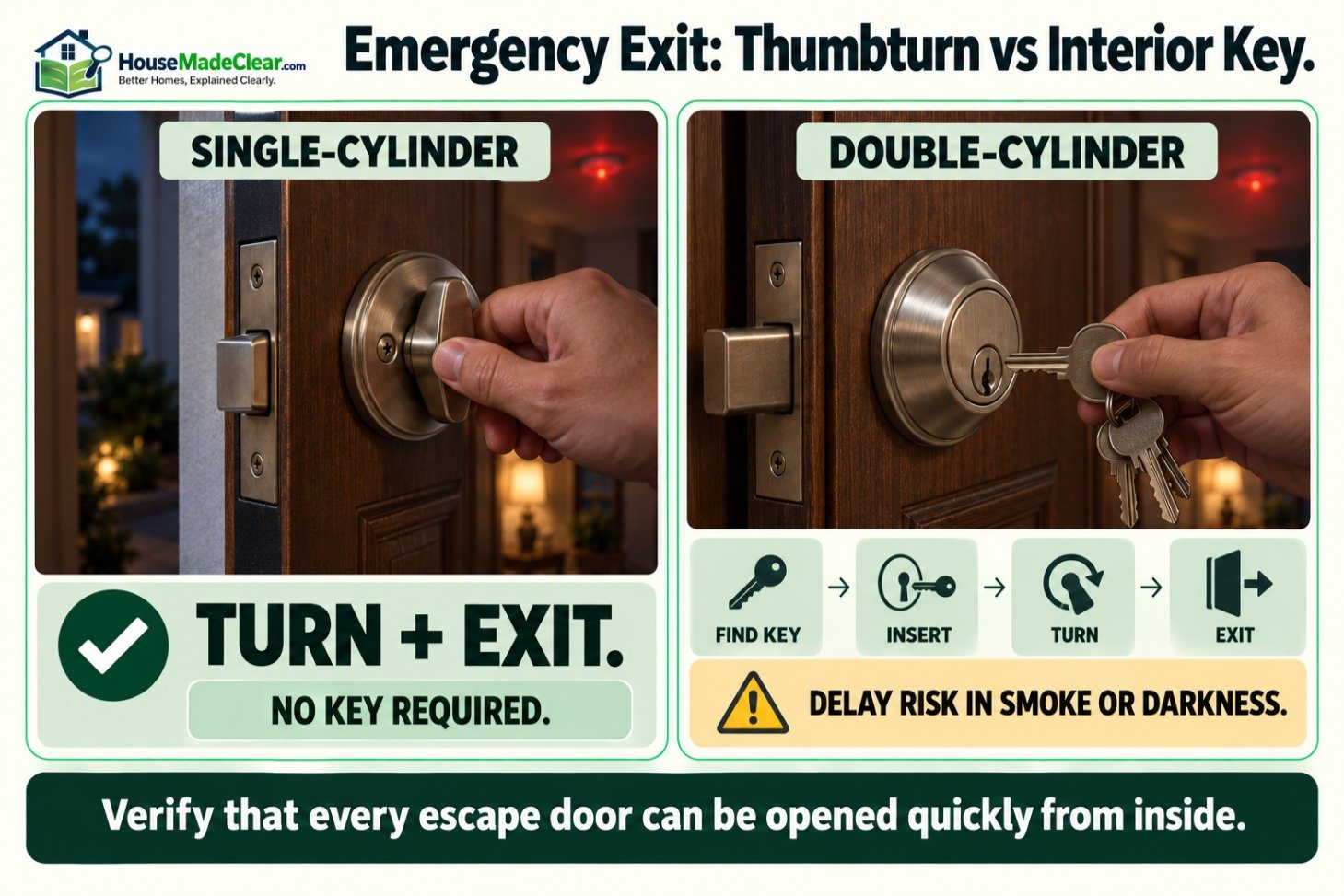
For most occupied homes, a single-cylinder deadbolt offers the better balance between security and life safety.
The interior thumbturn lets people leave immediately without:
- Locating a key
- Identifying the correct key in darkness or smoke
- Inserting it into the cylinder
- Turning the lock correctly
- Removing the key or opening the door
A double-cylinder lock eliminates the interior thumbturn, but every person using the door must have access to the key during an emergency.
The U.S. Fire Administration advises households to maintain usable escape routes and notes that occupants may have less than two minutes to escape after a smoke alarm sounds. Doors and windows forming part of an escape plan must remain accessible and operable. Read the USFA home fire escape guidance.
The Practical Verdict
Choose a single-cylinder deadbolt for most:
- Front doors
- Back doors
- Side entrances
- Garage-to-house doors
- Rental-property entrances
- Doors used by children or guests
- Doors forming part of the household escape plan
Consider a double-cylinder deadbolt only when:
- Breakable glass or another opening creates a genuine reach-through risk
- Local building and fire requirements permit keyed interior operation
- The door is not made dangerously difficult to use during an emergency
- All household members understand the locking system
- A qualified locksmith or code professional has evaluated the application
- Safer methods of protecting the glass or thumbturn are not practical
Why Double-Cylinder Deadbolts Can Be Dangerous
A double-cylinder deadbolt can delay escape at the exact moment when speed matters most.
During a fire, occupants may be dealing with:
- Smoke
- Darkness
- Confusion
- High temperatures
- Power failure
- Panic
- Children or pets
- Reduced visibility
- Injuries
- A key that is missing or stored in another room
Even when residents normally know where the key is kept, it may be moved, dropped or obscured. A visitor or babysitter may not know that a key is required.
Emergency-Egress and Code Concerns
Common model-code provisions generally require egress doors to be readily openable from the egress side without a key, special knowledge or unusual effort. The exact rules and exceptions depend on the building type, occupancy, adopted code edition and local amendments.
This means a double-cylinder deadbolt may be prohibited on a door serving as a required exit, even if the homeowner prefers it for security.
Before installing one, check with:
- The local building department
- The local fire marshal
- A licensed locksmith familiar with local requirements
- The property manager or housing authority
- The insurance provider where relevant
Do not assume a lock is permitted merely because it is sold locally or fits the existing door.
Is a Double-Cylinder Deadbolt Better for a Door With Glass?
It can reduce one particular vulnerability: reaching through broken glass to operate the interior thumbturn.
This risk is most relevant when the door has:
- A glass panel near the lock
- Narrow glass sidelights
- A decorative glass insert
- A mail slot or large opening
- French-door glazing close to the hardware
- A damaged or easily removable panel
A double-cylinder deadbolt may prevent the lock from being turned through the opening when the key is removed. Security guidance recognizes this limited advantage, while also advising that local code restrictions must be checked.
It does not prevent the glass from being broken, however. It also does not necessarily prevent someone from:
- Reaching another latch
- Accessing a nearby window
- Damaging the door
- Attacking the frame
- Entering through another opening
- Using a stolen or copied key
The decision should therefore consider the entire entrance, not only the cylinder configuration.

Safer Alternatives for a Door With Glass
Before installing a keyed interior cylinder, consider whether the reach-through risk can be reduced without compromising emergency exit.
Possible options include:
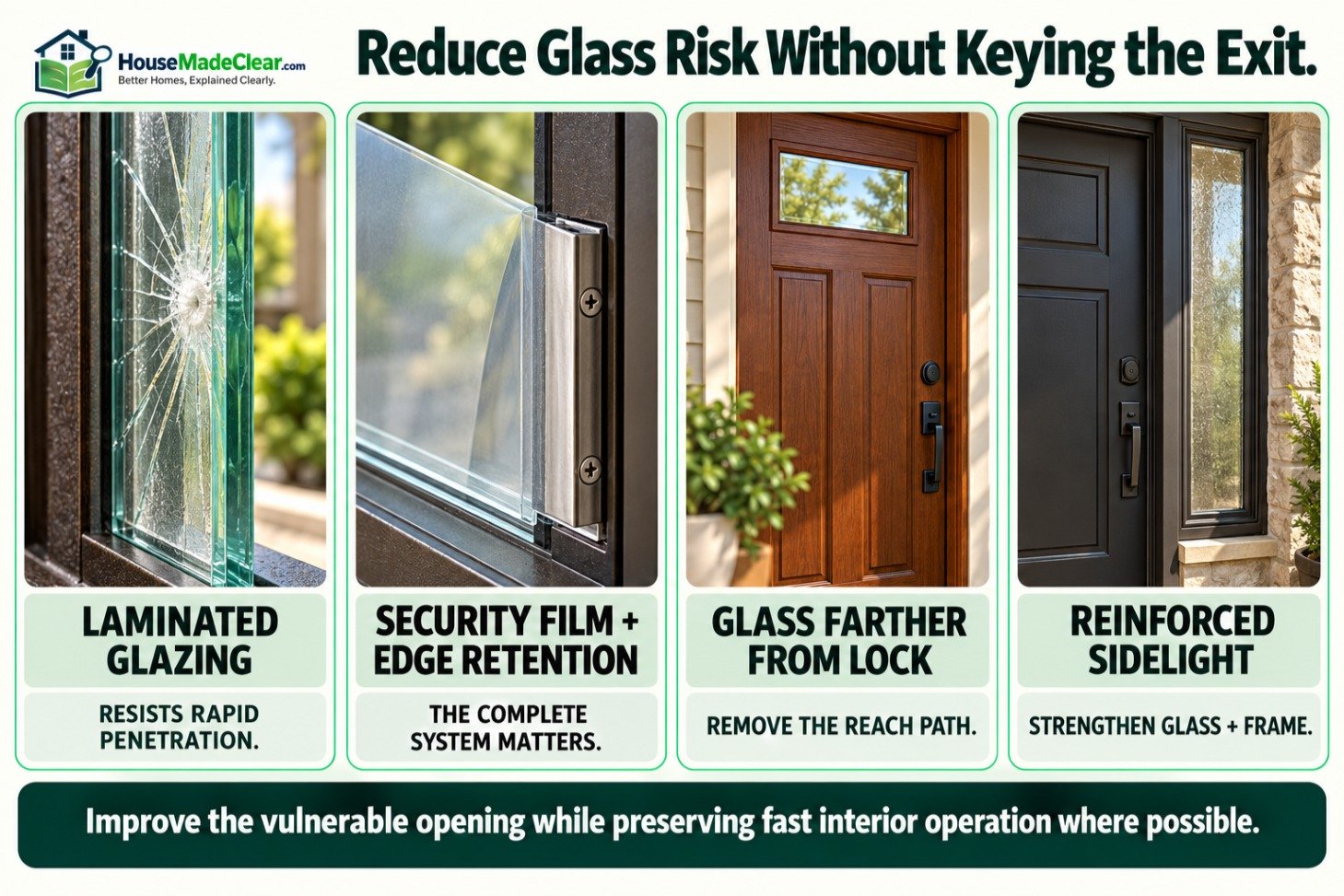
Laminated Security Glazing
Laminated glass contains an interlayer that helps hold broken pieces together. It is generally more resistant to rapid penetration than ordinary annealed glass.
The framing and method used to retain the glass are also important. Strong glazing installed in a weak removable frame may still be vulnerable.
Professionally Installed Security Film
Security film can help hold broken glass together, but the complete installation matters. Film applied only to the visible glass may not prevent the pane from being pushed out of its frame.
Ask whether the system includes appropriate edge retention or attachment to the frame. Do not treat ordinary window film as an impenetrable barrier.
A Different Door or Glass Insert
A solid exterior door or a door with glass positioned farther from the lock can remove the immediate reach-through opportunity.
Where appearance is important, a smaller or higher glass panel may preserve natural light while increasing the distance from the lock.
Reinforced Sidelights
A door may be solid while the adjacent sidelight creates the vulnerability. Laminated glazing, stronger framing or a properly designed security panel may be more appropriate than changing the lock.
Alarm Sensors
Glass-break, door-contact and motion sensors do not physically reinforce the door, but they can provide an additional detection layer.
Sensors should supplement—not replace—strong doors, locks and frames.
Professionally Evaluated Multipoint Locking
Some doors use multipoint locks that secure the door at several locations. These systems can improve resistance to door deformation, but they must be compatible with the door and correctly installed.
The interior operating method must still comply with applicable egress requirements.
Does a Double-Cylinder Deadbolt Prevent Kick-In Attacks?
Not by itself.
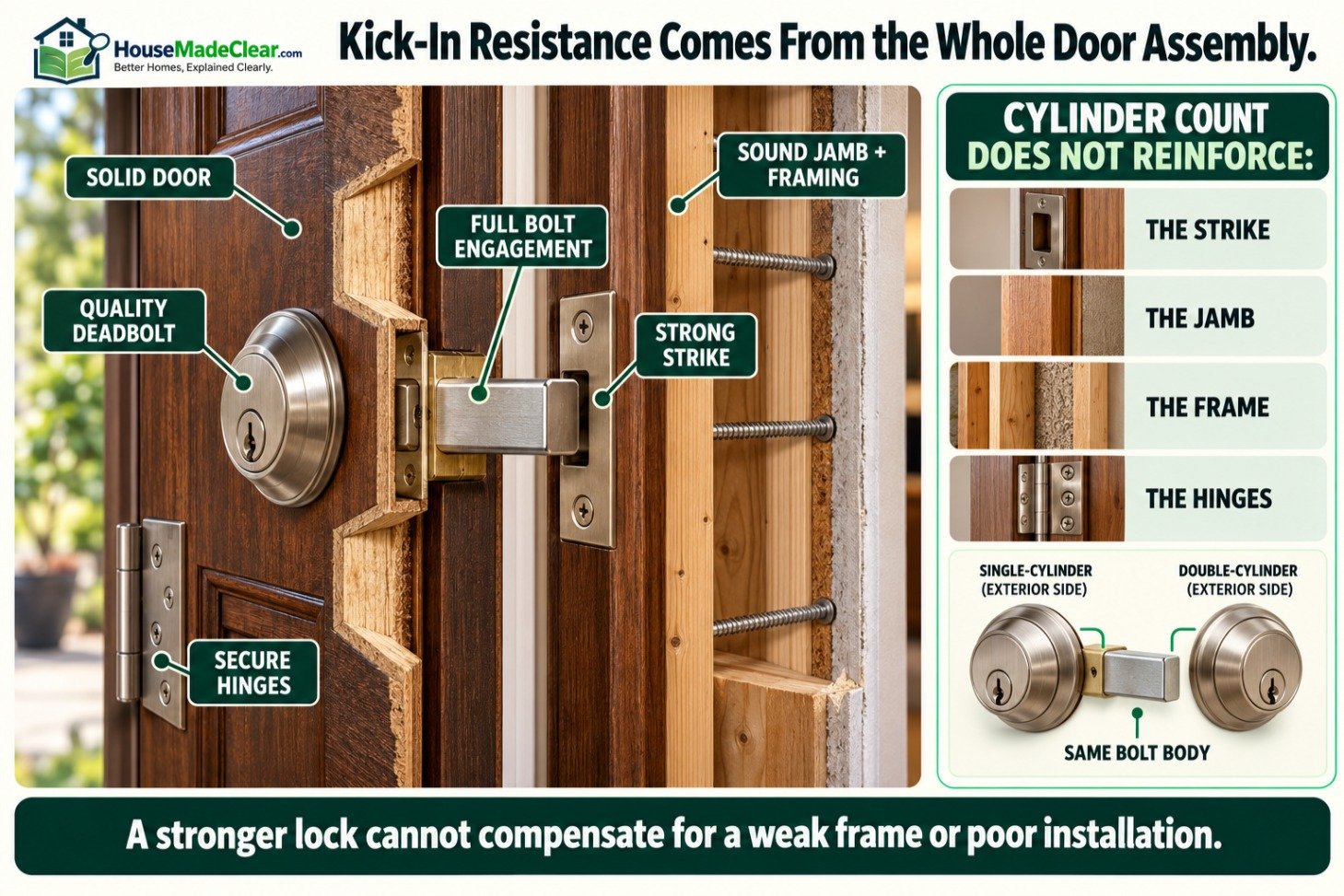
A kick-in attack usually targets the door assembly around the lock rather than the interior thumbturn. The force may split the jamb, pull fasteners out of the framing or break the door around the hardware.
Resistance depends on the complete assembly:
- Door material and condition
- Door-edge preparation
- Deadbolt quality
- Bolt engagement
- Strike construction
- Strike fasteners
- Jamb condition
- Wall framing
- Hinges
- Installation accuracy
Changing from a single-cylinder to a double-cylinder deadbolt may provide little improvement against a frame-focused attack if the strike and jamb remain weak.
For a broader approach, see our guide to improving home security with better locks.
Why the Door Frame Matters More Than Many Homeowners Realize
A deadbolt extends into a strike mounted on the jamb. If the jamb splits or the strike detaches, the bolt may remain extended while the door opens with part of the frame still attached.
Inspect the following before upgrading the cylinder:
- Cracked or repaired jambs
- Loose strike plates
- Stripped screw holes
- Misaligned bolts
- Damaged door edges
- Rot or water damage
- Excessive gaps
- Loose hinges
- Movement when the locked door is pushed
- A bolt that does not extend fully
The deadbolt should operate smoothly without lifting, pushing or pulling the door into position. If the bolt binds, correct the alignment rather than forcing the key or thumbturn.
What ANSI/BHMA Lock Grades Mean
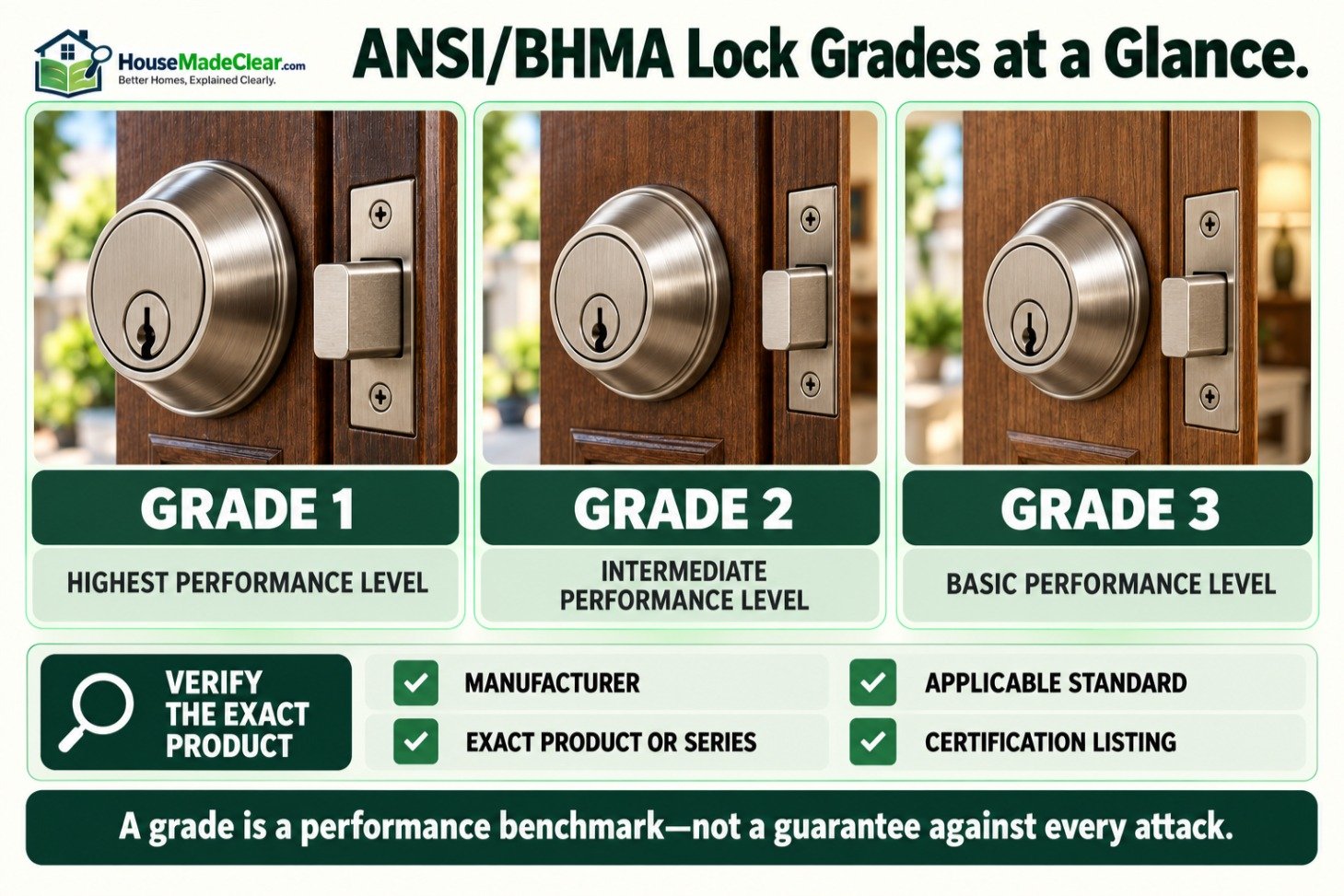
ANSI/BHMA grading helps compare tested hardware performance.
BHMA lock standards use three commonly recognized grade levels:
- Grade 1: Highest performance level
- Grade 2: Intermediate performance level
- Grade 3: Basic performance level
Testing can address characteristics such as operation, cycle durability, strength, security, material evaluation and finish. Grade 1 represents the highest performance benchmark within the applicable standard, but the grade must relate to the actual product being purchased.
Do not rely only on a large “Grade 1” phrase printed on marketplace packaging. Verify:
- The manufacturer
- Exact product or series
- Applicable ANSI/BHMA standard
- Grade level
- Certification listing
- Whether the listed configuration matches the product being sold
The BHMA Certified Products Directory can help verify participating certified products.
A grade does not guarantee that a lock will defeat every attack. It provides a standardized performance benchmark, while real-world performance still depends on the door, frame and installation.
Single-Cylinder vs Double-Cylinder Security Comparison
Cylinder count does not determine key control.
Either type can be vulnerable if:
- Keys have been copied
- Former occupants still have keys
- A contractor or cleaner retained a key
- Spare keys are hidden outside
- The cylinder is worn
- The keyway provides little duplication control
Rekeying or replacing the cylinder may provide a greater immediate benefit than changing from single- to double-cylinder operation.
Resistance to Lock Manipulation
Picking, drilling and other cylinder attacks depend on the construction of the individual lock—not whether the inside uses a key or thumbturn.
Look for relevant certification and manufacturer-documented resistance features. Avoid assuming that decorative appearance, weight or price alone indicates tested performance.
Resistance to Reach-Through Entry
This is the area where a double-cylinder deadbolt can offer a direct advantage.
If someone can create an opening within arm’s reach of a thumbturn, a single-cylinder deadbolt may be operated from outside. A double-cylinder lock with its interior key removed prevents this simple turning action.
The benefit disappears or decreases if:
- The key is left in the interior cylinder
- Another nearby lock can be reached
- The glass opening allows entry through the door
- The attacker can manipulate other hardware
- The door or frame can be forced more easily
Emergency Exit
This is the major advantage of a single-cylinder deadbolt.
A thumbturn can be operated immediately. A double-cylinder deadbolt requires access to the correct key, making it less forgiving when visibility, mobility or judgment is impaired.
Daily Use
A single-cylinder lock is easier for ordinary household use. A double-cylinder lock adds an extra key operation whenever someone needs to leave through the locked door.
Repeated inconvenience can also encourage unsafe habits, such as:
- Leaving the interior key in the cylinder
- Keeping the door unlocked
- Hiding the key close to the door
- Using an easy-to-reach labeled key
- Removing the deadbolt from normal use
A security feature that residents routinely bypass may provide little practical value.
Can You Leave the Key in a Double-Cylinder Deadbolt?
Leaving the key in the interior cylinder makes the door easier to operate, but it creates two problems.
First, the arrangement functions much like an interior thumbturn. If someone can break nearby glass and reach the key, they may be able to unlock the door.
Second, relying on a key being left in place is not equivalent to a lock that can always be operated without a key. Someone may remove it, move it or accidentally lock it elsewhere.
Keeping the key close to the door but out of reach through the glass also has limitations. In an emergency, a person still has to:
- Know where it is
- Reach it
- Identify it
- Insert it
- Operate the lock
Do not use key placement as a substitute for verifying the applicable egress requirements.
What About Captive-Key or Removable-Thumbturn Deadbolts?
Some locks use a removable thumbturn, captive key or similar component intended to provide thumbturn operation while occupied and additional reach-through protection at other times.
These products can still create operational and code concerns:
- The removable part may be lost
- Residents may remove it at the wrong time
- Guests may not understand the mechanism
- The interior may still require special knowledge
- The configuration may not comply with local egress rules
- Product instructions may restrict its application
Treat these as specialized hardware rather than an automatic compromise between single- and double-cylinder designs. Obtain local approval where required.
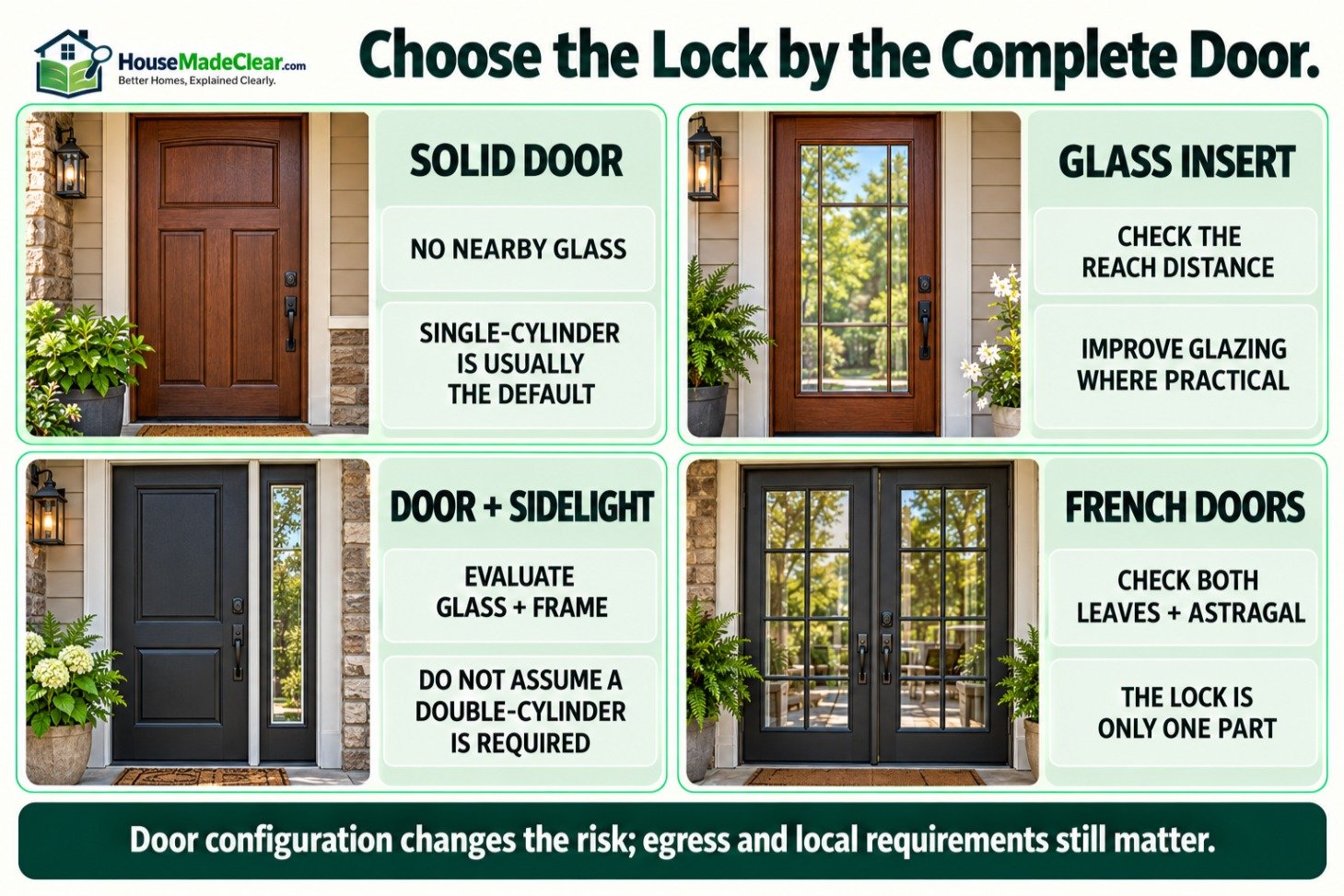
Single-Cylinder vs Double-Cylinder Locks for Different Doors
Solid Front Door Without Nearby Glass
A single-cylinder deadbolt is usually the appropriate choice.
There is no nearby glass-related thumbturn vulnerability, and the door remains easy to unlock from inside.
Focus on:
- Certified hardware
- Correct installation
- Full bolt extension
- A strong strike
- A sound jamb
- Controlled keys
- Clear emergency operation
Front Door With a Glass Insert
Start by measuring the distance from the lock to the glass.
If breaking the glass would allow someone to reach the thumbturn, evaluate the glazing, glass-retention system and door construction. A double-cylinder deadbolt is only one possible response and may not be permitted.
Improving the glass and frame while retaining a single-cylinder deadbolt often provides a better balance between security and escape.
Door Beside a Sidelight
A narrow sidelight next to the lock may create reach-through access even if the door itself is solid.
Evaluate:
- Glass type
- Sidelight frame
- Distance to the thumbturn
- Width of the potential opening
- Whether the sidelight panel can be removed
- The entrance’s role in the escape plan
Do not install a double-cylinder lock solely because the door has a sidelight. Determine whether the sidelight actually places the interior control within reach.
French Doors
French doors require more than a cylinder decision.
Check:
- Which leaf is active
- How the inactive leaf is secured
- Top and bottom bolts
- Astragal design
- Glass type
- Door alignment
- Multipoint hardware
- Threshold attachment
- Interior emergency operation
A strong lock on the active leaf will provide limited protection if the inactive leaf or astragal can be forced open.
Back or Side Door
These doors may receive less natural surveillance and may contain glass panels. However, they frequently serve as important household exit routes.
Use the same life-safety standard applied to the front door. Do not make a secondary exit difficult to open merely because it is used less often.
Garage-to-House Door
Requirements for doors between an attached garage and dwelling can include fire-separation, closing and latching provisions. The applicable requirements depend on local code and construction.
Do not replace listed or specialized hardware without confirming compatibility. A single-cylinder deadbolt is generally more practical where the door is used frequently, but the entire assembly and applicable rules must be considered.
Apartment or Rental Door
Tenants should not replace or add locks without permission.
Additional hardware may conflict with:
- The lease
- Property-management access
- Fire-safety requirements
- Emergency entry
- The door’s fire rating
- Community key systems
- Insurance conditions
Report damaged or inadequate hardware to the landlord or property manager in writing. Avoid drilling into a rated apartment-entry door without authorization.
Are Smart Deadbolts Single- or Double-Cylinder?
Many residential smart deadbolts function like single-cylinder locks:
- Electronic keypad, fingerprint reader, app or key outside
- Thumbturn or fast mechanical release inside
This preserves interior egress while adding electronic access control.
A smart lock is not automatically more physically secure than a conventional deadbolt. Evaluate:
- ANSI/BHMA certification
- Mechanical construction
- Door compatibility
- Battery warnings
- Manual override
- Account security
- Unique user codes
- Software-update support
- Auto-lock behavior
- Emergency operation
- Privacy and access logs
Avoid sharing one household code with every user. Individual codes make it easier to revoke access without changing everyone’s credentials.
When a Single-Cylinder Deadbolt Is the Best Choice
Choose a single-cylinder deadbolt when:
- The door is part of a normal exit route
- Fast evacuation is a priority
- Children, older adults or guests use the door
- There is no reachable glass near the thumbturn
- The nearby glazing can be upgraded
- Local requirements call for keyless interior operation
- The home uses a smart lock
- Convenience affects whether residents consistently lock the door
For most houses, this is the recommended starting point.
When a Double-Cylinder Deadbolt Might Be Considered
A double-cylinder lock may be considered when all the following conditions are satisfied:
- A genuine reach-through vulnerability exists
- The glazing or opening cannot reasonably be improved
- The door’s role in emergency egress has been evaluated
- Local code allows the installation
- The property’s occupants can operate it safely
- A qualified professional recommends it
- Key management has been carefully planned
- The installation does not affect a listed fire-rated assembly
This is a narrow use case—not a general upgrade for every exterior door.
Deadbolt Selection Checklist
Before purchasing either type, verify:
| Item | What to Check |
|---|---|
| Interior operation | Thumbturn or keyed cylinder |
| Emergency use | Door can be opened quickly by all occupants |
| Local code | Keyed interior operation is permitted |
| Glass location | Thumbturn cannot be easily reached through an opening |
| Certification | Exact product appears in an appropriate certification listing |
| Door thickness | Lock supports the measured finished door thickness |
| Backset | Usually determined by the existing door preparation |
| Bore dimensions | Lock matches existing holes or approved new preparation |
| Bolt engagement | Bolt extends completely into the strike opening |
| Strike | Compatible, secure and correctly aligned |
| Frame condition | No cracks, rot, looseness or severe previous damage |
| Fasteners | Appropriate for the door, frame and manufacturer’s instructions |
| Key control | Old and unauthorized keys have been invalidated |
| Fire rating | Replacement hardware preserves any required listing |
| Household users | Everyone can operate the lock safely |
| Professional support | Locksmith or contractor is properly qualified where needed |
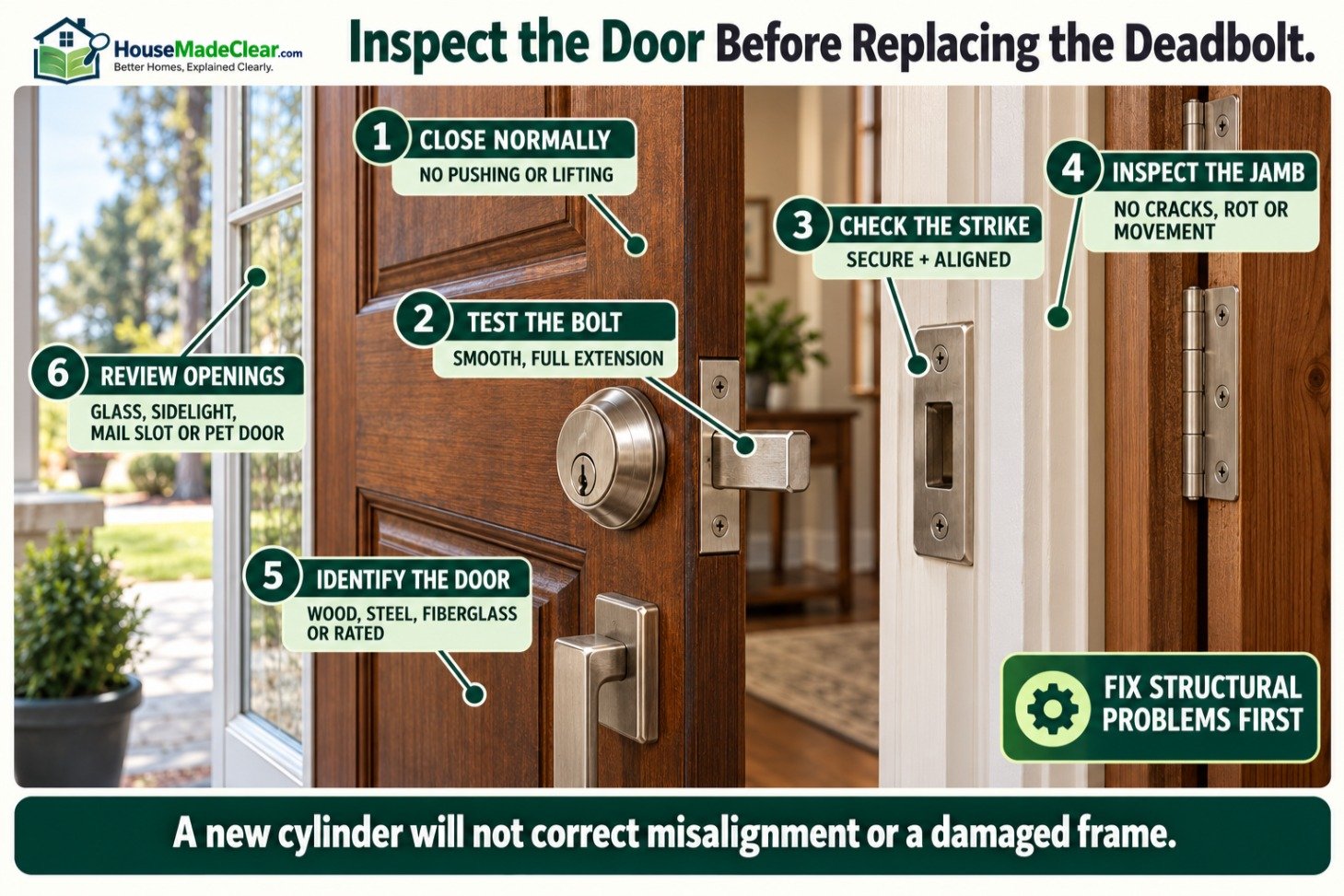
How to Inspect the Door Before Replacing the Deadbolt
1. Close the Door Normally
Do not lift the handle, pull the door or push against it. The latch and deadbolt should align during normal closing.
2. Operate the Existing Deadbolt
Check whether the bolt:
- Turns smoothly
- Extends completely
- Rubs against the strike
- Requires pressure on the door
- Feels loose or stiff
- Retracts fully
Misalignment may indicate hinge movement, seasonal swelling, frame damage or poor installation.
3. Inspect the Strike and Jamb
Look for:
- Loose screws
- Cracked wood
- Oversized or damaged holes
- Multiple abandoned screw holes
- Split trim
- Signs of forced entry
- Repairs that move when pressed
Repair structural weaknesses before assuming a new cylinder will solve the problem.
4. Check the Door Material
Determine whether the door is:
- Solid wood
- Wood composite
- Steel
- Fiberglass
- Glass-panel construction
- Fire-rated
- Part of a multipoint system
Hardware and installation methods must match the door. Door material is only one compatibility factor. Before selecting a replacement deadbolt, measure the slab thickness and confirm the existing hardware preparation. A lock designed for one door thickness may require different components or may not fit another. See our standard door dimensions and measuring guide for common interior and exterior thicknesses and replacement measurements.
5. Review Every Nearby Opening
Check whether someone could reach the interior lock through:
- Door glass
- Sidelights
- A mail slot
- A pet door
- A damaged panel
- An adjacent operable window
Also evaluate whether modifications could weaken weather resistance, fire protection or structural integrity.
Common Deadbolt Mistakes
Assuming Two Cylinders Mean Twice the Security
A double-cylinder deadbolt changes interior operation. It does not automatically strengthen the bolt, strike or frame.
Ignoring Emergency Exit
Burglary resistance should not be improved by creating an avoidable life-safety hazard.
Leaving the Interior Key in the Lock
This can defeat the main reach-through advantage while still creating uncertainty about emergency operation.
Hiding the Key Near the Door
A key hidden near the entrance may be found by an intruder and may still be difficult for an occupant to locate in smoke or darkness.
Installing High-Grade Hardware in a Damaged Frame
The lock and door assembly perform together. A weak jamb can undermine expensive hardware.
Trusting Unverified Grade Claims
Check the exact product and certification listing instead of relying solely on advertising language.
Selecting Hardware Before Measuring
Door thickness, backset, bore size, strike location and trim clearance must be verified before purchase.
Drilling a Fire-Rated Door Without Approval
Unapproved modifications can affect the door assembly’s listing. Use compatible hardware and qualified installation.
Failing to Rekey After Moving
Even strong hardware provides little key control when unknown copies remain in circulation.
How to Decide Between a Single- and Double-Cylinder Deadbolt
Use this sequence:
- Identify whether the door is part of the normal or required exit route.
- Check local rules governing interior keyed locks.
- Measure the distance between the lock and nearby glass or openings.
- Determine whether the glass or frame can be strengthened instead.
- Inspect the door, jamb, strike and hinges.
- Select appropriately certified hardware.
- Confirm that every occupant can operate the lock during an emergency.
- Have uncertain or specialized installations evaluated professionally.
If the decision remains unclear, retain keyless interior operation and address the glass or door weakness through another method.
Frequently Asked Questions
Which is safer: a single-cylinder or double-cylinder deadbolt?
For most occupied homes, a single-cylinder deadbolt is the safer overall choice because it allows immediate exit without a key. A double-cylinder deadbolt can reduce reach-through risk near glass, but it may delay emergency evacuation and may not be permitted on an egress door.
Are double-cylinder deadbolts legal?
They are not universally legal or illegal. Their use depends on the adopted building and fire codes, occupancy, door function and local amendments. Many egress applications require the door to open from inside without a key. Check with the local building department or fire marshal before installation.
Is a double-cylinder deadbolt better for a door with glass?
It can prevent someone from breaking nearby glass and turning an interior thumbturn when the key is removed. However, laminated glazing, reinforced framing or another professionally designed solution may reduce the same risk without requiring a key to exit.
Can I leave the key in a double-cylinder deadbolt?
Leaving the key in the interior cylinder makes everyday exit easier, but someone may be able to reach the key through broken glass. It also does not guarantee that the key will remain available during an emergency.
Does a double-cylinder deadbolt stop someone from kicking in the door?
Not necessarily. Kick-in resistance depends heavily on the strike, jamb, frame, door, fasteners and installation. Adding an interior keyed cylinder does little to strengthen a weak frame.
What is the best deadbolt for a front door?
For many homes, the best starting point is a properly installed, certified single-cylinder deadbolt fitted to a sound exterior door and reinforced frame. The exact product must match the door thickness, backset and preparation.
What ANSI/BHMA grade should I choose?
Grade 1 represents the highest performance level within the applicable ANSI/BHMA standard, followed by Grades 2 and 3. Choose a certified product suitable for the application and verify the exact listing. Installation and the condition of the door assembly remain equally important.
Can a locksmith convert a single-cylinder deadbolt to double-cylinder?
In many cases, the existing lock can be replaced with a compatible double-cylinder model, but the locksmith must verify door preparation, hardware compatibility and local egress requirements. Conversion should not proceed if it makes the exit unsafe or noncompliant.
Are smart locks single-cylinder deadbolts?
Many residential smart locks operate like single-cylinder deadbolts, with electronic access outside and a thumbturn inside. Designs vary, so check the product’s interior operation, certification, battery system and emergency override.
Should I use a double-cylinder deadbolt on a back door?
Only after evaluating the glass risk, emergency-exit function and local code. A back door may be an important escape route even when it is used less often than the front door.
Should renters change their deadbolts?
Renters should obtain authorization before changing or adding locks. The lease, fire rating, management access system and local housing requirements may limit modifications. Ask the landlord to rekey damaged or insecure locks when appropriate.
Is a single-cylinder deadbolt easy to defeat through a window?
Only when an opening is close enough for someone to reach the interior thumbturn. If that condition exists, improve the glazing, frame or door design and have the locking arrangement evaluated. Do not automatically install a double-cylinder lock without checking egress safety.
Final Recommendation
For most residential exterior doors, use a certified single-cylinder deadbolt with fast thumbturn operation inside.
Then strengthen the rest of the assembly:
- Repair alignment problems
- Use a compatible reinforced strike
- Secure the jamb appropriately
- Replace damaged doors or frames
- Control and rekey old keys
- Protect reachable glass
- Test the door’s emergency operation
- Follow the lock manufacturer’s instructions
Consider a double-cylinder deadbolt only where a documented reach-through risk justifies it, the applicable code allows it and the installation has been evaluated for safe emergency exit.
A secure door should resist unauthorized entry without preventing the people inside from getting out.






[…] Single-Cylinder vs Double-Cylinder Deadbolt: Which Is Safer? […]
[…] Single-Cylinder vs Double-Cylinder Deadbolt: Which Is Safer? […]