














A room can feel dark even when it technically has a window.
The problem may be a small opening, poor window orientation, an overhang outside, heavy curtains, deep wall colors, bulky furniture, inadequate lighting or simply a room layout that blocks the daylight already available.
The good news is that you do not necessarily need to add another window.
In many homes, a dark room can feel significantly brighter by improving how existing daylight enters the room, how artificial light is distributed and how surfaces reflect that light.
Quick answer:
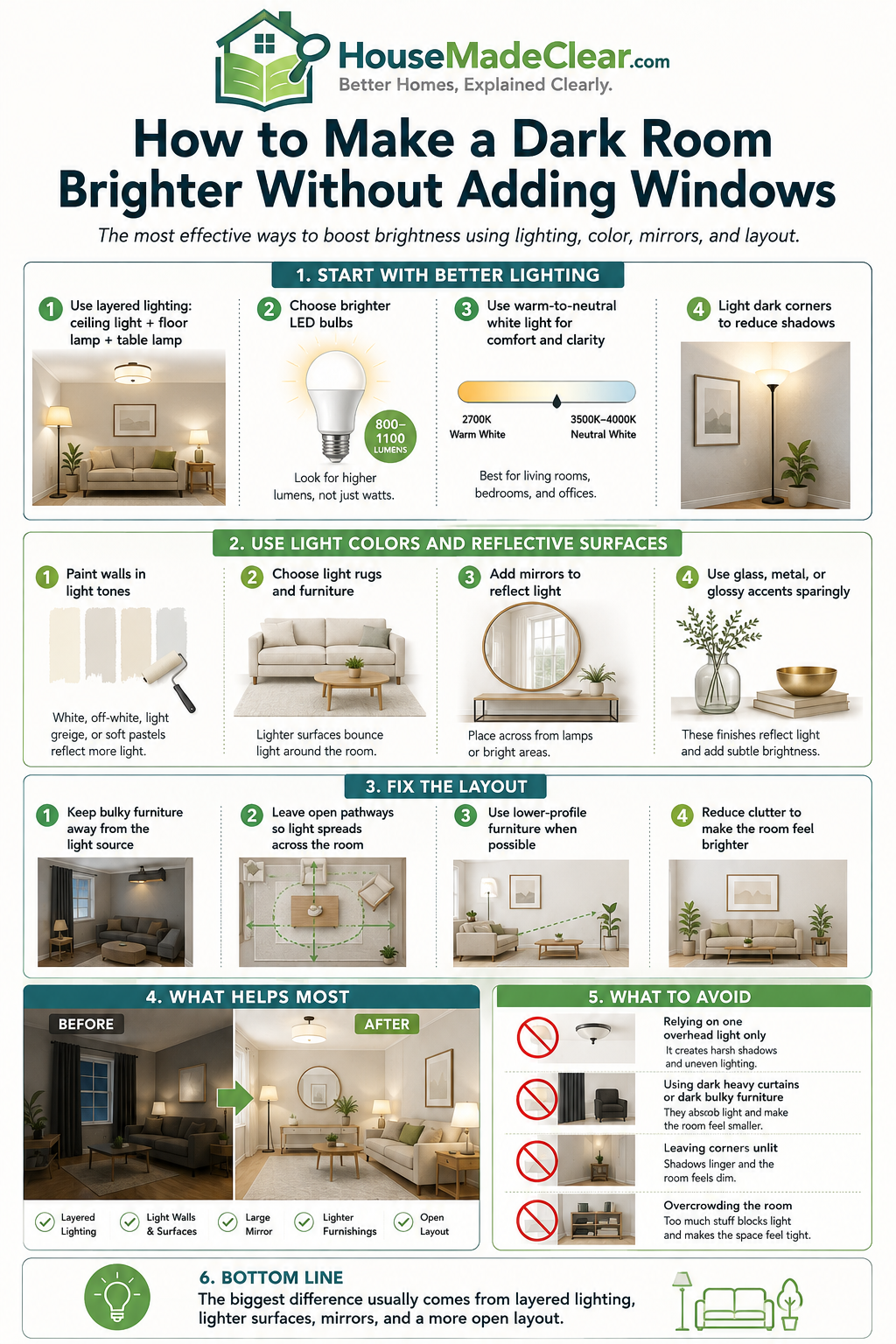
Start by uncovering as much of the existing window as practical, use lighter window treatments, add more than one source of artificial light, choose bulbs by lumens rather than watts, brighten large surfaces such as walls and ceilings, and move tall furniture away from windows. Mirrors and reflective finishes can help distribute existing light, but they cannot replace adequate lighting on their own. ENERGY STAR notes that a bulb’s brightness is measured in lumens, with higher lumen output producing more light. That makes lumens more useful than watts when your goal is to make a room brighter.
Why Does a Room Feel So Dark?
Before buying lamps or repainting everything white, identify why the room feels dark.
Common causes include:
- Small windows
- North-facing or shaded windows
- Nearby buildings
- Deep exterior overhangs
- Trees blocking daylight
- Dark curtains
- Furniture positioned in front of windows
- Dark walls or ceilings
- Insufficient light fixtures
- One central ceiling light doing all the work
- Dark flooring and furniture
- Deep room proportions
- Poor lamp placement
Sometimes several of these problems occur together.
For example, a living room might have an adequate window, but dark curtains cover part of it, a tall bookcase blocks one side, and one ceiling fixture leaves the corners dim.
In that situation, changing only the wall color may help—but it will not solve the whole problem.
Start With the Existing Window
If the room already has natural light, use it more effectively before adding more artificial lighting.
Look at the window during the day.
Ask:
- How much of the glass is actually uncovered?
- Do curtains cover the sides of the window even when open?
- Is furniture blocking the lower portion?
- Is there a dark blind reducing daylight?
- Are plants obstructing the opening?
- Is the glass dirty?
Small changes here can have an immediate effect.
1. Move Curtains Away From the Window Glass
Curtains can reduce daylight simply because too much fabric remains in front of the window after they are opened.
A wider curtain rod can allow the panels to stack farther beyond the window opening.
That exposes more glass.
House Made Clear’s guide to how high to hang curtains explains why rod width matters as much as rod height: extending the rod beyond the window can allow open curtains to sit farther to the sides rather than covering part of the glass.
Try this first
During daylight:
- Open the curtains completely.
- Push the fabric as far away from the window as possible.
- Compare the room.
- Check whether the permanent rod position is limiting how far they can open.
If the room becomes noticeably brighter, curtain placement is part of the problem.
2. Replace Heavy Curtains With Lighter Window Treatments
Heavy blackout curtains are useful when you need darkness, privacy or thermal control.
But they can make a room feel dark even when partially open.
For rooms where daylight is a priority, consider layering:
- Sheer curtain
- Light-filtering shade
- Full curtain for nighttime privacy
This gives you more control.
During the day, the sheer layer can soften the view while allowing more daylight than a heavy opaque curtain.
At night, close the main curtain.
Do not automatically remove blackout treatments from bedrooms if they serve an important sleep function. The aim is to improve flexibility rather than sacrifice privacy or comfort.
3. Keep Tall Furniture Away From Windows
A tall cabinet or bookshelf beside a window can block light entering at an angle.
Furniture directly beneath a window can also interfere with the lower portion of the opening if it is too tall.
Move bulky pieces such as:
- Bookcases
- Wardrobes
- Tall cabinets
- Large plants
away from the window where practical.
This can allow daylight to spread farther into the room.
The same principle is important in room planning generally: fixed features such as windows and doors should be considered before large furniture is positioned. House Made Clear’s functional living-room layout guide recommends mapping windows, doors and circulation before finalizing furniture placement.
4. Clean the Window
This sounds minor, but accumulated:
- Dust
- Exterior dirt
- Water marks
- Film
can reduce clarity.
Clean both sides of accessible glazing according to the window manufacturer’s recommendations.
Also check the screen.
A dark or dirty insect screen can make the view and daylight appear noticeably duller.
5. Trim Exterior Vegetation Where Appropriate
Sometimes the problem is outside the room.
Large shrubs, vines or tree branches can shade the window.
Do not remove mature landscaping automatically—shade may be valuable for privacy and heat control—but check whether unnecessary vegetation is blocking a significant portion of the opening.
A modest trim may improve daylight without completely exposing the room.
6. Use Several Light Sources Instead of One Ceiling Fixture
This is one of the most effective changes.
A single bright ceiling fixture may illuminate the center of the room while leaving:
- Corners
- Walls
- Reading areas
- Desk areas
comparatively dark.
Instead, use layered lighting.
A typical room might include:
Ambient lighting
General illumination for the room.
Examples:
- Ceiling light
- Recessed lights
- Large floor lamp
Task lighting
Light where an activity happens.
Examples:
- Reading lamp
- Desk lamp
- Table lamp
Accent lighting
Light that brightens walls, shelves or architectural features.
Examples:
- Wall lights
- Picture lights
- Shelf lighting
House Made Clear uses the same layered-lighting principle in its bathroom lighting guide, where one central ceiling fixture is often insufficient for the different tasks performed in the room.
7. Add a Floor Lamp to the Darkest Corner
Dark corners make the entire room feel darker.
A floor lamp can help because it introduces light away from the central ceiling fixture.
Good locations include:
- Behind an armchair
- Beside a sofa
- Near a bookshelf
- In a corner opposite the window
Choose the lamp style according to the effect you want.
Uplighter
Directs light toward the ceiling.
Useful for making the overall room feel brighter.
Reading lamp
Directs light toward a specific task.
Useful beside seating.
Multi-head lamp
Can direct light toward different areas.
Useful where one fixture needs to serve several functions.
8. Brighten the Ceiling
The ceiling is one of the largest surfaces in the room.
If it is very dark, it can absorb a large amount of the visual brightness created by your lighting.
A lighter ceiling usually makes it easier for the room to feel open and illuminated.
You do not necessarily need pure white.
Possible choices include:
- Warm white
- Soft ivory
- Pale neutral
- Very light version of the wall color
The exact choice depends on the room’s finishes.
9. Choose Lighter Wall Colors Strategically
Light-colored walls generally make better use of available illumination than very dark surfaces.
However, “paint everything bright white” is not always the best answer.
A dark room with weak artificial light may make a cold white paint look:
- Gray
- Flat
- Dull
Instead, choose a light color that works with the room’s actual lighting.
Possible directions include:
- Warm white
- Cream
- Pale beige
- Light greige
- Soft warm gray
- Pale muted color
Always test paint in the actual room.
Observe it:
- Morning
- Afternoon
- Evening
- With lights on
because color appearance changes dramatically with lighting.
10. Do Not Forget the Trim
Dark:
- Window trim
- Door frames
- Baseboards
can create strong visual boundaries.
If appropriate for the design, lighter trim can make the room feel more open.
However, you do not need every surface to be the same color.
Contrast can still work well if the room has enough overall illumination.
11. Use Mirrors to Redistribute Existing Light
Mirrors do not generate light.
But they can reflect:
- Windows
- Lamps
- Bright surfaces
and help visually distribute brightness.
Possible locations include:
- Opposite a window
- At an angle to a window
- Behind a lamp
- Above a console
- On a wall facing a brighter part of the room
Do not place a mirror randomly
Stand where people normally sit or enter the room and check what the mirror will reflect.
A mirror reflecting:
- Blank dark wall
- Clutter
- Television
- Doorway
may add less value than expected.
Aim to reflect something useful:
- Daylight
- Lamp
- Attractive light-colored wall
- Open part of the room
12. Use Reflective Surfaces in Small Amounts
You can also distribute light through surfaces such as:
- Glass
- Glossy ceramic
- Metallic finishes
- Satin paint
- Polished furniture details
But avoid turning the room into a highly reflective box.
Too many glossy surfaces can create:
- Glare
- Visual clutter
- Harsh reflections
The goal is controlled reflection.
13. Use Lighter Furniture When Replacing Pieces
You do not need to replace perfectly good furniture just to brighten a room.
But if you are already buying something new, consider how much visual weight it adds.
A large dark sofa plus:
- Dark rug
- Dark coffee table
- Dark curtains
- Dark walls
can make a room feel heavier.
Instead, balance darker pieces with:
- Light rug
- Pale cushions
- Lighter wood
- Glass table
- Light-colored curtains
House Made Clear’s guide to affordable living-room updates recommends reviewing layout and visual clutter before replacing large pieces of furniture.
14. Choose a Lighter Rug
Flooring occupies a large visual area.
If the existing floor is dark, a lighter area rug can brighten the center of the room without replacing the flooring.
Consider:
- Cream
- Beige
- Light gray
- Pale natural fiber look
- Light patterned rug
A lightly patterned rug can be easier to maintain visually than a completely solid pale rug.
15. Add Light-Colored Textiles
Textiles are one of the cheapest ways to change the balance of a room.
Try lighter:
- Cushion covers
- Throws
- Curtains
- Bedding
- Upholstery accents
These surfaces can help break up a large amount of dark furniture.
This is particularly useful in rental homes where painting may not be practical.
16. Use Light Wood Instead of Adding More Dark Wood
Dark timber can look elegant, but too much of it can make a low-light room feel visually heavy.
If you are adding new pieces, balance existing dark wood with:
- Oak
- Ash
- Maple
- Light bamboo finishes
- Pale painted furniture
You do not need everything to match exactly.
A controlled mix often feels lighter than a room filled with one dark furniture finish.
17. Reduce Visual Clutter
A room full of small objects can feel darker and more crowded even when the light level has not changed.
Try removing:
- Excess decorative objects
- Items stacked on surfaces
- Unused furniture
- Bulky storage containers
Then reassess the room.
Open wall and floor areas allow light-colored surfaces to remain visible and can make the space feel calmer.
18. Avoid Overfilling the Window Wall
Try not to crowd the wall around the window with:
- Tall bookcases
- Heavy artwork
- Dark cabinets
- Dense curtains
Let the window remain the visual source of daylight.
Keeping the surrounding wall simpler can make the opening appear larger and brighter.
19. Use Transparent or Visually Light Furniture
In a small dark room, furniture with:
- Open legs
- Glass tops
- Slim frames
- Light-colored upholstery
can reduce visual density.
For example, a heavy solid coffee table may visually block more of the floor than a slimmer table with open legs.
This does not literally increase the light output, but it can make the room appear less crowded and therefore brighter.
20. Choose Bulbs by Lumens, Not Watts
One of the most useful lighting rules is simple:
Watts describe energy use; lumens describe light output.
ENERGY STAR advises looking at lumens when choosing how bright a bulb should be.
If a room is too dark, check the actual lumen output of the existing bulbs.
Do not assume that replacing an old bulb with another bulb of the same wattage will provide the same brightness.
Modern LED products can produce similar light levels while using significantly less power than older technologies. ENERGY STAR’s consumer guidance similarly emphasizes comparing brightness using lumens.
21. Do Not Use Maximum Brightness Everywhere
A dark room does not necessarily need one extremely powerful fixture.
Very bright localized light can create uncomfortable contrast:
- Bright center
- Dark walls
- Dark corners
Instead, distribute light.
For example:
- Ceiling light
- Floor lamp
- Table lamp
may produce a more comfortable result than one overpowering ceiling bulb.
22. Add Task Lighting Where You Actually Need It
Do not increase the brightness of the whole room just because one activity area is dark.
For example:
Reading
Add a reading lamp.
Desk work
Add a controllable desk lamp.
Crafting
Use focused task lighting.
Makeup
Use appropriate face lighting near the mirror.
This is particularly important for home offices. OSHA notes that good desk lighting depends on the task and recommends controlling light placement, angle and intensity rather than relying on uncontrolled glare.
23. Avoid Creating Screen Glare
If the dark room contains a:
- Television
- Computer
- Monitor
do not solve the lighting problem by pointing a strong lamp directly at the screen.
OSHA advises arranging workstation lighting to minimize glare from windows, desk lamps and overhead lighting.
For computer rooms:
- Put light beside or behind the working area
- Avoid direct reflections
- Use adjustable task lighting
House Made Clear’s guide to where a home-office desk should face also discusses window position and screen glare.
24. Use Wall Lighting to Brighten Vertical Surfaces
A room often feels brighter when the walls themselves are illuminated.
Possible solutions include:
- Wall sconces
- Picture lights
- Floor lamps aimed upward
- Adjustable lamps aimed toward a wall
This can be particularly effective in:
- Long rooms
- Hallways
- Basement living rooms
- Rooms with a central ceiling light only
Instead of lighting only the floor, you are increasing the amount of illuminated surface visible at eye level.
25. Consider LED Strip Lighting Carefully
LED strips can help in specific locations such as:
- Under shelves
- Behind a headboard
- Inside display cabinets
- Under kitchen cabinets
They are usually better as supplementary lighting rather than the main source for a dark room.
Avoid placing exposed strips where individual LEDs create distracting glare.
A diffuser channel can create a cleaner appearance where appropriate.
26. Use Smart Lighting Only If It Solves a Real Problem
Smart bulbs or smart plugs can help create different brightness levels throughout the day.
For example:
Daytime
Lower supplementary lighting.
Evening
Ceiling light + floor lamp.
Reading
Floor lamp + task lamp.
Smart controls can make this more convenient, but the physical lighting plan still matters.
A poorly positioned light does not become good lighting simply because an app controls it.
27. Brighten a Dark Living Room
For a dark living room, prioritize:
- Open window treatments fully.
- Move large furniture away from the window.
- Add a floor lamp to the darkest seating zone.
- Add a table lamp.
- Use a lighter rug.
- Reduce dark visual clutter.
- Add a mirror where it reflects useful light.
Also check whether the furniture arrangement itself is blocking the room. The House Made Clear living-room layout guide recommends testing circulation and furniture placement before buying additional pieces.
28. Brighten a Dark Bedroom
Bedrooms usually need a balance between brightness and comfort.
Try:
- Lighter curtains with blackout layer behind
- Pale bedding
- Bedside lamps
- Light-colored rug
- Mirror positioned to reflect daylight
- Lighter wall color
Avoid relying only on a harsh ceiling fixture.
A bedroom can feel bright during the day while still supporting a darker sleeping environment at night.
29. Brighten a Dark Home Office
A home office needs more than decorative brightness.
It needs usable light without screen reflections.
Try:
- Desk perpendicular to the window
- Light-filtering blinds
- Adjustable desk lamp
- Floor or ceiling ambient lighting
- Lighter wall behind or beside desk
OSHA specifically advises arranging office lighting to minimize glare from windows and artificial light sources.
For a full workspace plan, see House Made Clear’s functional home-office guide.
30. Brighten a Dark Bathroom
Bathrooms may have:
- Small privacy windows
- Frosted glass
- No direct sunlight
That makes artificial lighting particularly important.
Use separate lighting for:
- Vanity
- General room illumination
- Shower where appropriate
The House Made Clear bathroom lighting guide explains why one ceiling fixture can leave the face poorly lit even when the room appears bright overall.
31. Brighten a Windowless Room
A completely windowless room requires a different strategy because there is no daylight to redistribute.
Focus on:
- Layered artificial lighting
- Illuminated walls
- Light ceilings
- Mirrors
- Pale large surfaces
- Clear visual organization
Use at least two or three light sources where the room function warrants them.
For example:
Windowless office
- General ceiling light
- Desk lamp
- Wall or floor light
Windowless dressing room
- General ceiling light
- Mirror/task lighting
- Wardrobe lighting
32. Brighten a Basement Room
Basement rooms often struggle with:
- Small high windows
- Deep room proportions
- Low ceilings
- Dark structural finishes
Helpful changes include:
- Keep window wells clear
- Use light walls and ceiling
- Add floor lamps
- Illuminate walls
- Avoid tall furniture near windows
- Use lighter flooring or rugs
If the basement receives very little natural light, prioritize artificial-light distribution rather than trying to make one tiny window do all the work.
33. Brighten a North-Facing Room
In the Northern Hemisphere, north-facing rooms generally receive less direct sunlight than many south-facing spaces, so their light often feels cooler and more consistent.
Instead of forcing the room to appear extremely bright with cool white finishes, consider:
- Warm light wall colors
- Warm neutral textiles
- Multiple lamps
- Light wood
The goal is to create a comfortable bright room rather than imitate direct sunlight.
34. Brighten a Room With Dark Furniture
You do not need to replace everything.
If the sofa or bed is dark, balance it using:
- Pale rug
- Light cushions
- Light throw
- Bright wall behind it
- Lamp nearby
Think in terms of large visual areas.
A single white cushion will not change a room dominated by several large dark surfaces.
35. Brighten a Room Without Painting
Renters often cannot repaint.
You can still use:
- Light curtains
- Pale rug
- Mirrors
- Floor lamps
- Table lamps
- Light bedding
- Removable artwork
- Light furniture covers where appropriate
Focus on the largest surfaces you can legally and easily change.
36. Brighten a Room on a Small Budget
Start with the changes that cost little or nothing:
Free or very low cost
- Clean windows.
- Open curtains fully.
- Move tall furniture.
- Rearrange lamps.
- Remove clutter.
- Replace overly dark accessories with items already owned.
Low cost
- Higher-lumen LED bulbs.
- Light cushion covers.
- Sheer curtains.
- Small mirror.
- Table lamp.
Larger changes
- Paint.
- New rug.
- Additional permanent lighting.
- New window treatments.
Do not start with the most expensive step.
Common Mistakes When Trying to Brighten a Dark Room
1. Painting Everything Stark White
Why it can fail:
Weak or cool lighting may make the paint look gray and flat.
Better approach:
Test several light neutrals in the actual room.
2. Installing One Very Bright Ceiling Light
Why it can fail:
Corners and walls remain dark.
Better approach:
Use several lighting layers.
3. Buying More Lamps Without Checking Bulb Brightness
Why it can fail:
Several low-output lights may still leave the room dim.
Better approach:
Compare lumens. ENERGY STAR identifies lumens as the measure of bulb brightness.
4. Covering Half the Window With Curtains
Why it fails:
Existing daylight never fully enters the room.
Better approach:
Extend the curtain rod and allow panels to stack beyond the glass where the room permits.
5. Putting a Huge Mirror Anywhere
Why it fails:
It may reflect another dark wall.
Better approach:
Position it to reflect a brighter area.
6. Ignoring the Ceiling
Why it fails:
A dark ceiling can visually lower and darken the room.
Better approach:
Consider a lighter finish.
7. Filling Every Corner With Furniture
Why it fails:
The room becomes visually dense.
Better approach:
Protect open floor and wall areas.
8. Blocking Windows With Plants
Why it fails:
Large indoor plants can reduce useful daylight.
Better approach:
Move them beside rather than directly in front of the opening.
9. Using Only Decorative Lighting
Why it fails:
A beautiful fixture may not produce enough useful light.
Better approach:
Check actual lumen output and task requirements.
10. Creating Glare
Why it fails:
More light is not always better if it reflects directly into eyes or screens.
Better approach:
Adjust lamp positions and control windows. OSHA specifically recommends reducing glare in computer workspaces.
Step-by-Step: Make a Dark Room Brighter
Step 1: Assess the Room During Daylight
Turn all lights off.
Identify:
- Brightest area
- Darkest corner
- Furniture blocking daylight
- Curtain obstruction
Step 2: Open the Window Completely
Move curtains and blinds out of the way as much as practical.
Step 3: Move Tall Furniture
Clear the areas beside the window.
Step 4: Turn the Lights On One at a Time
Identify what each fixture actually illuminates.
Step 5: Check the Bulb Lumens
Replace underpowered bulbs where the fixture permits.
Step 6: Add Light to Dark Corners
Use a floor or table lamp.
Step 7: Brighten the Largest Surfaces
Consider:
- Ceiling
- Walls
- Rug
- Curtains
Step 8: Add a Mirror Strategically
Reflect daylight or a useful light source.
Step 9: Reduce Dark Visual Clutter
Remove unnecessary items before buying new décor.
Step 10: Test the Room at Night
Your daylight solution and nighttime lighting solution may need to be different.
Quick Comparison: Which Changes Help Most?
| Change | Daytime Impact | Nighttime Impact | Cost |
|---|---|---|---|
| Open curtains wider | High | None | Low |
| Move furniture from window | Medium–High | Low | Free |
| Clean windows | Small–Medium | None | Low |
| Add floor lamp | None | High | Low–Medium |
| Higher-lumen bulbs | None | High | Low |
| Light wall paint | Medium | Medium–High | Medium |
| Light rug | Medium | Medium | Medium |
| Strategic mirror | Medium | Medium | Low–Medium |
| Layered lighting | Low | Very high | Medium |
| Add permanent fixtures | Low | Very high | High |
Dark Room Brightening Checklist
Before buying expensive renovations, check:
- Curtains open beyond window glass
- Blinds allow useful daylight
- Windows are clean
- Tall furniture is away from windows
- Dark corners have dedicated lighting
- Bulb brightness checked in lumens
- Ceiling is not unnecessarily dark
- Large wall surfaces considered
- Rug/flooring balance checked
- Furniture is not overcrowding room
- Mirror reflects something useful
- Task areas have dedicated light
- Computer/TV glare has been tested
- Room has been checked during day and night
What Should You Change First?
If you only want to make three changes, start here:
1. Expose more of the window
It costs little and improves the daylight you already have.
2. Add a second or third light source
Do not rely on one ceiling fixture.
3. Brighten one large surface
Choose the wall, ceiling, curtain or rug that currently contributes the most darkness.
Then reassess.
You may find that a room you thought needed major renovation simply needed better light distribution.
Final Thoughts
Making a dark room brighter without adding windows is less about finding one clever trick and more about managing the light already available.
Start with natural light:
- Open window treatments fully
- Keep furniture away from the glass
- Reduce unnecessary exterior obstruction
Then improve artificial lighting:
- Check lumens
- Add task lighting
- Illuminate dark corners
- Spread light across walls and ceiling
Finally, review the room itself:
- Wall color
- Curtains
- Rug
- Furniture
- Mirrors
- Clutter
ENERGY STAR’s guidance is useful here because it separates brightness from energy consumption: lumens tell you how much light a bulb produces, so they are the number to compare when a room simply needs more illumination.
And if your room has usable daylight but curtains are limiting it, start with House Made Clear’s curtain-height and rod-placement guide. For living rooms, the functional layout guide can help you move furniture without blocking windows or circulation.
Frequently Asked Questions
How can I make a dark room brighter without adding a window?
Expose as much of the existing window as possible, move furniture away from it, add multiple artificial-light sources, use higher-lumen bulbs where appropriate, brighten large surfaces and use mirrors to reflect useful light.
What color makes a dark room look brighter?
Light warm whites, pale neutrals and other light colors can help a room make better visual use of available light. Test samples in the actual room because a color can look very different under weak or cool lighting.
Do mirrors make a dark room brighter?
Mirrors can reflect daylight and artificial light, helping redistribute existing brightness. They work best when positioned to reflect a window, lamp or brighter area rather than another dark wall.
Should curtains be light or dark in a dark room?
If maximizing daylight is the priority, lighter or more easily opened treatments are usually more practical. A layered setup with sheer or light-filtering curtains plus a separate privacy or blackout layer can provide flexibility.
How can I brighten a room with only one small window?
Keep the window unobstructed, mount curtains so they stack outside the glass, move tall furniture away from it and supplement daylight with layered artificial lighting.
Is white paint always best for a dark room?
No. Some stark whites can appear dull or gray in rooms with little natural light. Warm whites, creams or pale neutrals may work better, depending on the room and artificial lighting.
What type of lamp is best for a dark room?
There is no single best type. A floor lamp can brighten a dark corner, a table lamp can add ambient light and a task lamp can improve visibility for reading or work. Most rooms benefit from combining more than one type.
How do I know if a bulb is bright enough?
Check its lumen rating. Lumens indicate the amount of light produced; a higher lumen number generally means a brighter bulb.
How can I brighten a dark room without painting?
Use lighter curtains, a pale rug, mirrors, brighter bulbs, floor lamps, table lamps and lighter textiles. Rearranging furniture and removing visual clutter can also help.
Can too much lighting make a room uncomfortable?
Yes. Very bright or poorly positioned lights can create glare and strong contrast. Spread light through the room and avoid placing bright sources where they reflect directly into eyes, televisions or computer screens. OSHA specifically recommends minimizing glare around computer workstations.