

















Installing a closet rod at the wrong height can make even a spacious closet inconvenient. Hang it too low, and long dresses or coats may touch the floor. Install it too high, and everyday clothes become difficult to reach.
The right closet rod height depends on three things: the clothes you’re storing, the available vertical space, and the person using the closet.
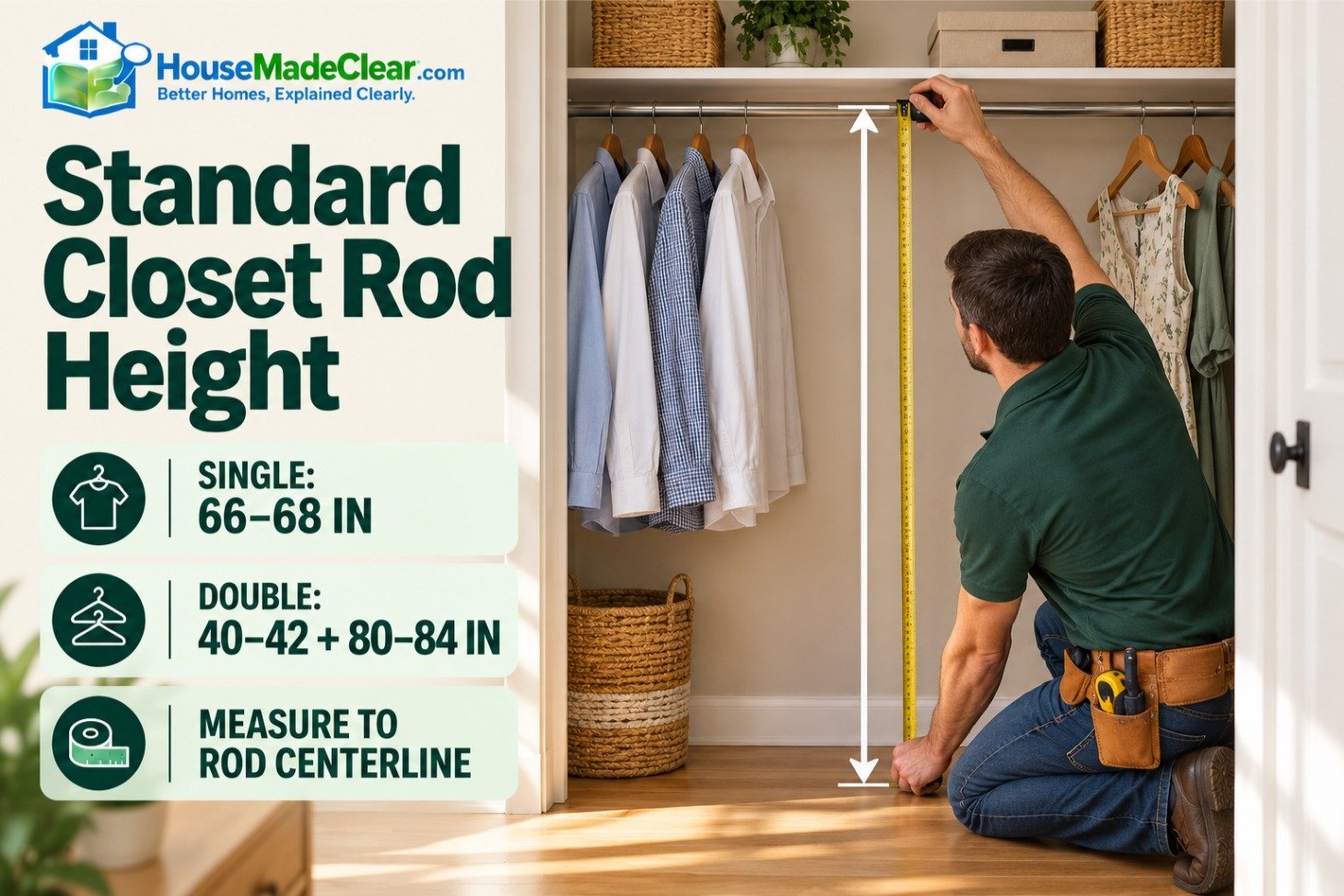
For most adult closets, a single hanging rod is commonly installed 66–68 inches above the finished floor. Double-hanging systems usually position the lower rod around 40–42 inches and the upper rod around 80–84 inches.
These measurements are practical starting points rather than universal requirements. A closet filled with shirts needs a different layout from one containing floor-length dresses, long coats, and bulky jackets.
This guide explains standard closet rod heights, double-hanging dimensions, shelf and wall clearances, and how to plan a functional closet without wasting space.
Quick Answer
The standard closet rod height is approximately 66–68 inches from the finished floor for a single hanging rod.
Common measurements include:
- Single hanging rod: 66–68 inches
- Double hanging upper rod: 80–84 inches
- Double hanging lower rod: 40–42 inches
- Distance between double rods: Commonly 40–42 inches, adjusted for clothing
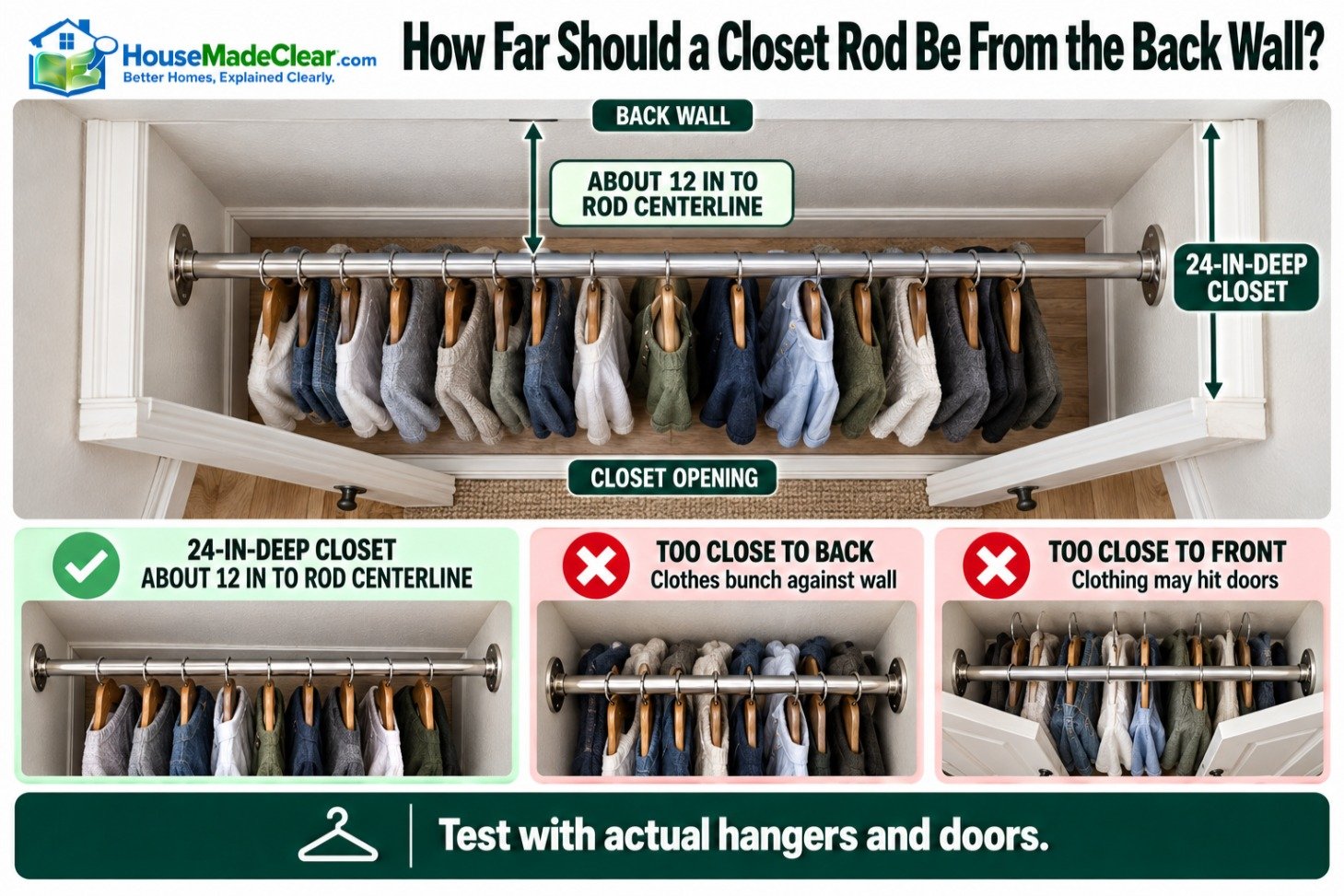
- Distance from back wall: Approximately 12 inches in a conventional 24-inch-deep closet
Measure rod heights from the finished floor to the rod’s centerline. Always check the length of your hanging clothes and the installation requirements of your chosen closet system.
Standard Closet Rod Height Chart
The following measurements are commonly used in residential closet planning.
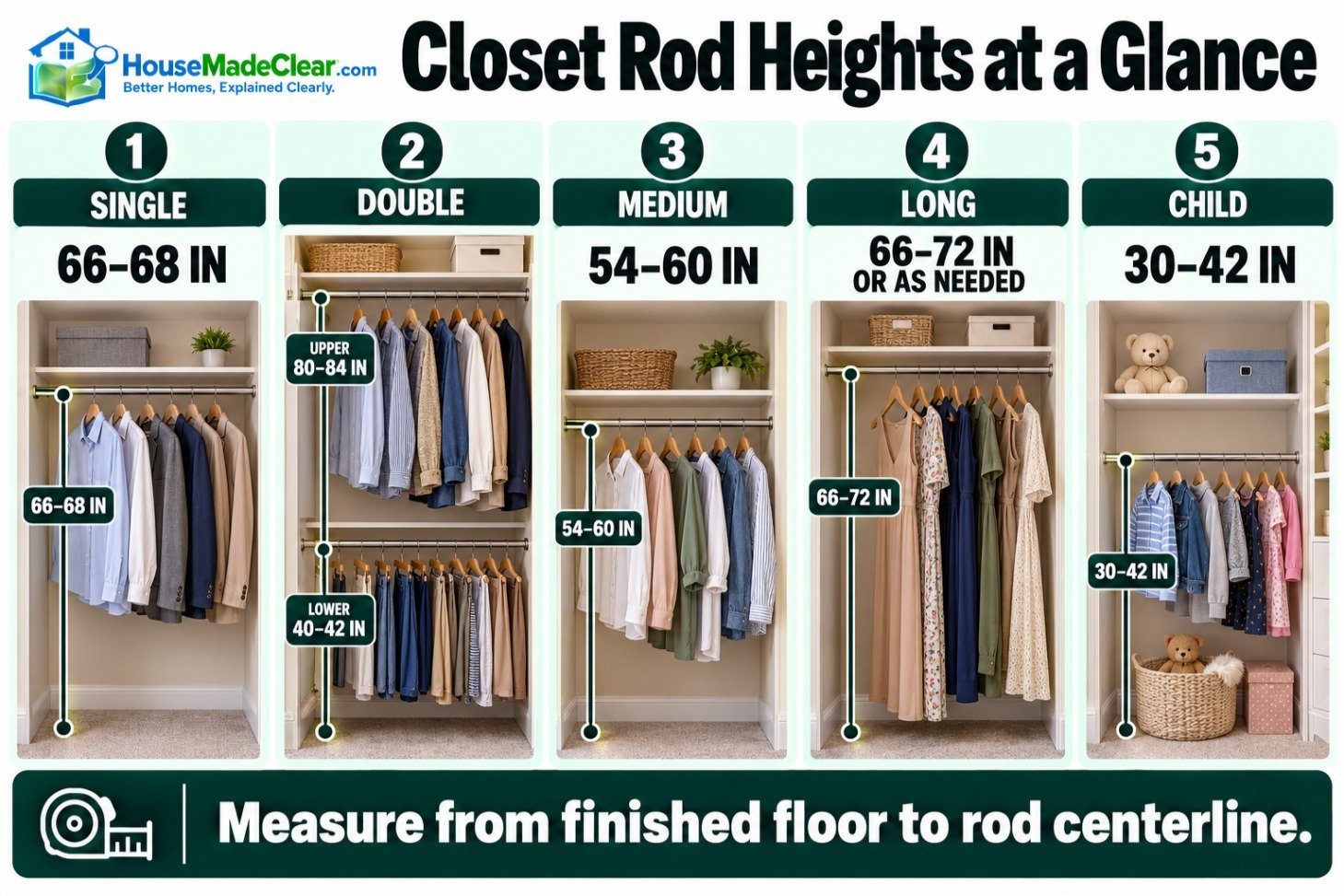
| Closet Configuration | Typical Rod Height | Best Application |
|---|---|---|
| Single hanging rod | 66–68 inches | Mixed adult clothing |
| Double hanging — upper rod | 80–84 inches | Shirts, blouses, short jackets |
| Double hanging — lower rod | 40–42 inches | Shirts, folded pants, skirts |
| Long-hanging section | 66–72 inches or as required | Dresses, long coats |
| Medium-hanging section | 54–60 inches | Short dresses, skirts, full-length pants |
| Children’s lower rod | 30–42 inches | Children’s everyday clothing |
| Accessible hanging storage | Based on applicable reach range | Wheelchair-accessible storage |
These measurements are planning references, not mandatory dimensions for every home.
For example, closet-storage manufacturer Organized Living illustrates common systems using a 68-inch long-hanging rod and double-hanging arrangements around 42 and 84 inches.
Actual dimensions may vary with the closet hardware, shelf arrangement, and garment length.
What Is the Standard Height for a Single Closet Rod?
A single closet rod is typically positioned 66–68 inches above the finished floor.
This height works for many adult wardrobes and creates a single uninterrupted hanging area.
Single hanging is particularly useful for closets containing a mixture of shirts, jackets, pants, dresses, and coats.
When Is a 66-Inch Rod Appropriate?
A 66-inch rod can work well when:
- Most clothes are regular-length garments.
- The primary user can reach the rod comfortably.
- The closet has sufficient vertical clearance.
- A storage shelf is installed above the hanging area.
Should You Install the Rod at 68 Inches Instead?
An extra two inches may provide additional clearance for some garments.
However, the highest possible installation isn’t necessarily the best one.
If the user has difficulty reaching the hangers, a slightly lower rod may make the closet more practical.
The available space also depends on furniture and circulation in the bedroom. Our standard bedroom size guide explains how room dimensions affect closet access, furniture placement, and usable floor space.
When Does a Single Rod Make More Sense Than Double Hanging?
Choose a single rod when most of your clothing needs considerable vertical space.
Examples include:
- Long dresses
- Full-length coats
- Long skirts
- Pants hung from the waistband
- Formalwear
If the closet mostly contains shirts and shorter clothes, double hanging may be more efficient.
Standard Double Closet Rod Height
Double hanging divides one tall closet section into two shorter hanging spaces.
This is especially useful in bedroom closets where most garments are shirts, blouses, jackets, or folded pants.
Recommended Double-Hanging Measurements
| Measurement | Common Starting Point |
|---|---|
| Lower rod height | 42 inches |
| Upper rod height | 84 inches |
| Distance between rod centerlines | 42 inches |
For example, a closet with a lower rod at 42 inches and an upper rod at 84 inches provides two hanging levels.
However, each section must have enough space for the garments and hangers.
How Much Additional Storage Does Double Hanging Provide?
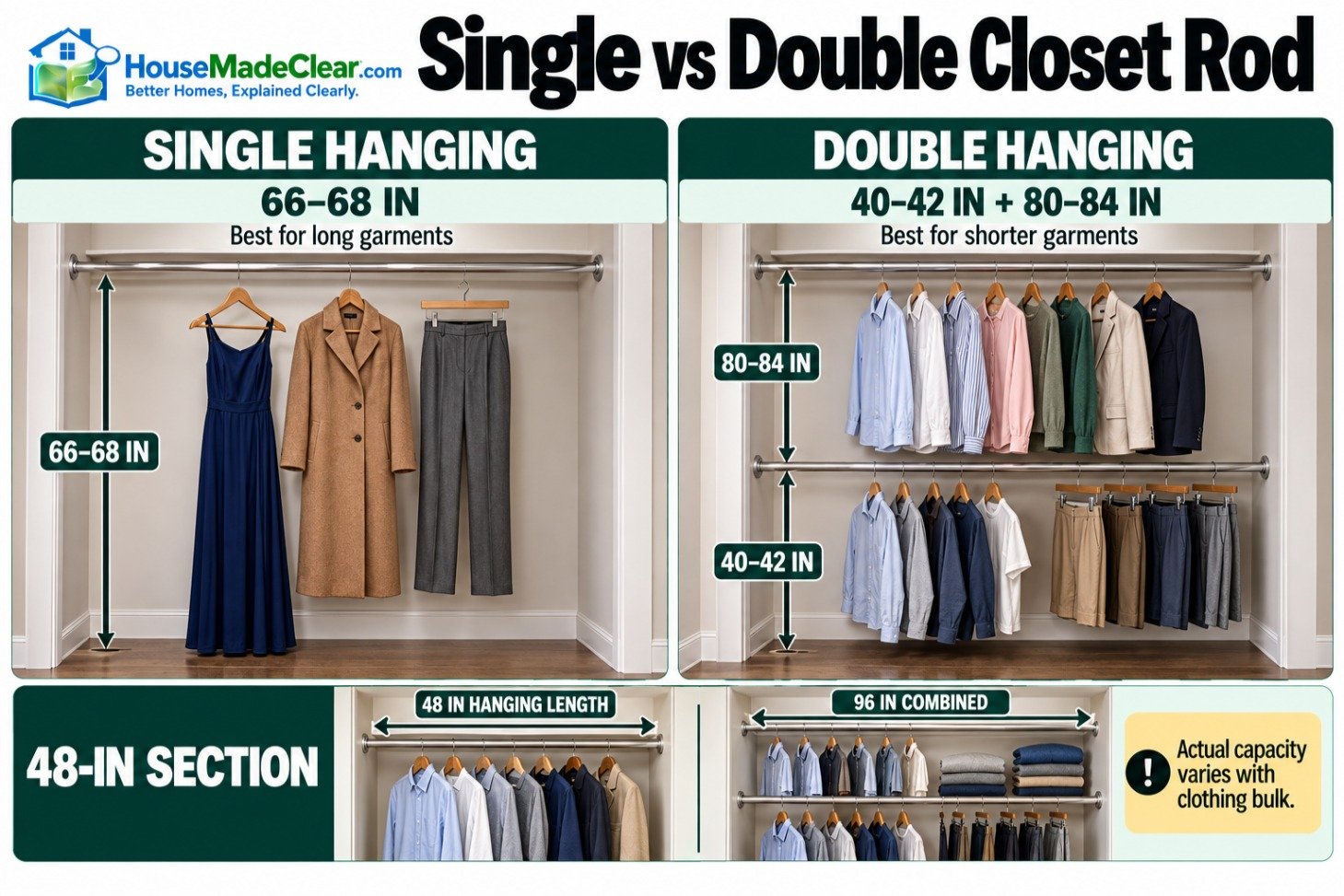
Consider a closet section measuring 48 inches wide.
With one rod, you have approximately 48 inches of horizontal hanging length.
With two rods, the same section provides approximately 96 inches of combined hanging length.
That can substantially increase capacity for shorter clothes.
However, it doesn’t necessarily double the number of garments you can store comfortably.
Bulky jackets, thick clothing, hanger spacing, and accessibility can reduce the practical capacity.
What Clothes Work Best With Double Hanging?
Double hanging works especially well for:
- Shirts
- Blouses
- T-shirts on hangers
- Short jackets
- Suit jackets
- Folded trousers
- Short skirts
Long dresses and coats usually need a separate taller hanging section.
How Much Space Should Be Between Double Closet Rods?
For many double-hanging layouts, 40–42 inches between rod centerlines is a practical starting point.
But the correct spacing depends on what you intend to hang.
Clothing on the upper rod should not bunch against the lower rod, its support shelf, or clothing stored underneath.
How to Determine the Correct Rod Spacing
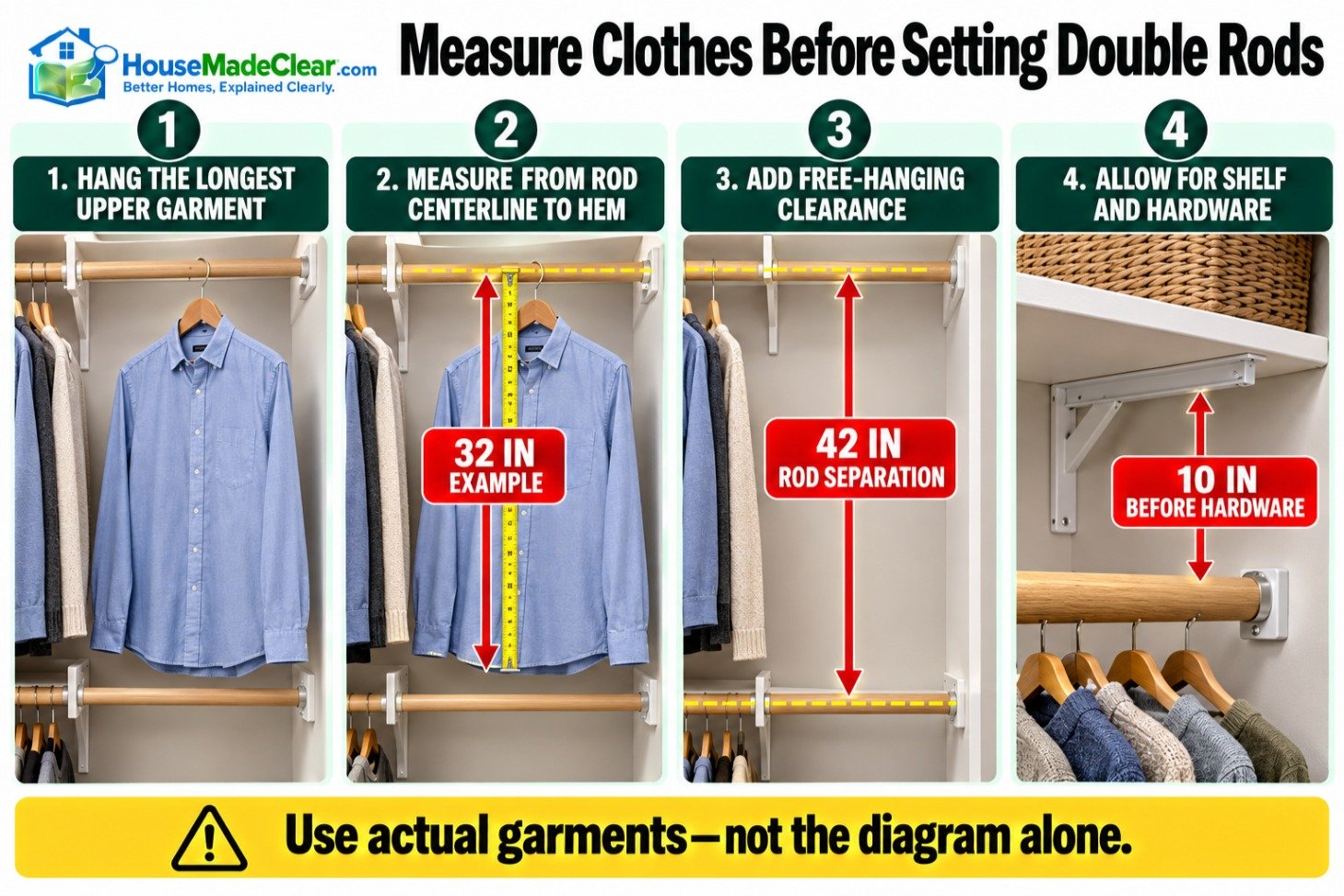
- Place your longest upper-section garment on its usual hanger.
- Measure downward from the rod’s centerline to the garment’s hem.
- Add clearance so the garment hangs freely.
- Check whether a shelf or bracket will occupy part of that space.
- Confirm that clothing on the lower rod has enough space above the floor.
Example
Suppose the longest garment hanging from the upper rod extends 32 inches below the rod centerline.
With a 42-inch separation between rods, approximately 10 inches remain between the garment’s hem and the lower rod centerline.
However, any shelf or hardware mounted above the lower rod reduces the usable clearance.
This is why checking the actual hanging clothes is more reliable than choosing measurements from a diagram alone.
Closet Rod Height for Different Types of Clothing
The clothes you own should guide the hanging arrangement.
| Clothing Type | Suitable Hanging Setup | Important Consideration |
|---|---|---|
| Shirts | Double hanging | Allow space below hems |
| Blouses | Double hanging | Avoid crowding |
| Short jackets | Double hanging | Check garment length |
| Suit jackets | Double hanging | Allow shoulder and length clearance |
| Folded pants | Double hanging | Check folding length |
| Full-length pants | Medium or long hanging | Prevent hems touching floor |
| Short skirts | Double hanging | Allow hanger clearance |
| Long skirts | Medium or long hanging | Measure actual length |
| Dresses | Single long hanging | Check longest dress |
| Long coats | Single long hanging | Allow vertical clearance |
Closet Rod Height for Dresses
A rod around 66–68 inches may accommodate many dresses.
However, floor-length dresses can require more height.
Rather than choosing a fixed number, hang your longest dress on its intended hanger and measure how far it extends below the rod.
Leave sufficient clearance above the floor.
If your closet is being integrated into a freestanding wardrobe, our standard wardrobe dimensions guide explains how wardrobe height, width, and depth influence hanging capacity.
Closet Rod Height for Pants
Folded pants often fit comfortably in double-hanging sections.
Pants hung from waistband clips require more vertical clearance.
Choose the configuration based on how you prefer to store them.
Closet Rod Height for Coats
Long winter coats and trench coats generally need single hanging.
Short jackets may fit in a double-hanging section.
Bulky coats also occupy more horizontal hanging space than lightweight shirts, so capacity should be considered alongside height.
How Far Should a Closet Rod Be From the Back Wall?
A closet rod must have enough space behind and in front of it for the hangers and clothing.
For a conventional closet approximately 24 inches deep, positioning the rod’s centerline around 12 inches from the back wall is a common starting point.
This places the rod near the middle of the available depth.
Closet Depth and Rod Placement
| Closet Type | Rod Position Consideration |
|---|---|
| Standard 24-inch-deep closet | Approximately 12 inches from back wall |
| Shallow closet | Check hanger width and clothing clearance |
| Sliding-door closet | Allow clearance from moving doors |
| Deep walk-in closet | Position according to shelving and access |
| Wardrobe cabinet | Follow internal dimensions and hardware specifications |
What Happens if the Rod Is Too Close to the Wall?
Hangers may press against the back wall.
This can cause clothing to bunch, become difficult to remove, or hang unevenly.
What if the Rod Is Too Close to the Front?
Clothing may interfere with closet doors.
This can be particularly troublesome with sliding doors or compact wardrobes.
For bedrooms where closet and dresser access compete for limited space, our guide to where to put a dresser in a small bedroom explains how to avoid blocking closet openings and everyday walkways.
How High Should a Shelf Be Above a Closet Rod?
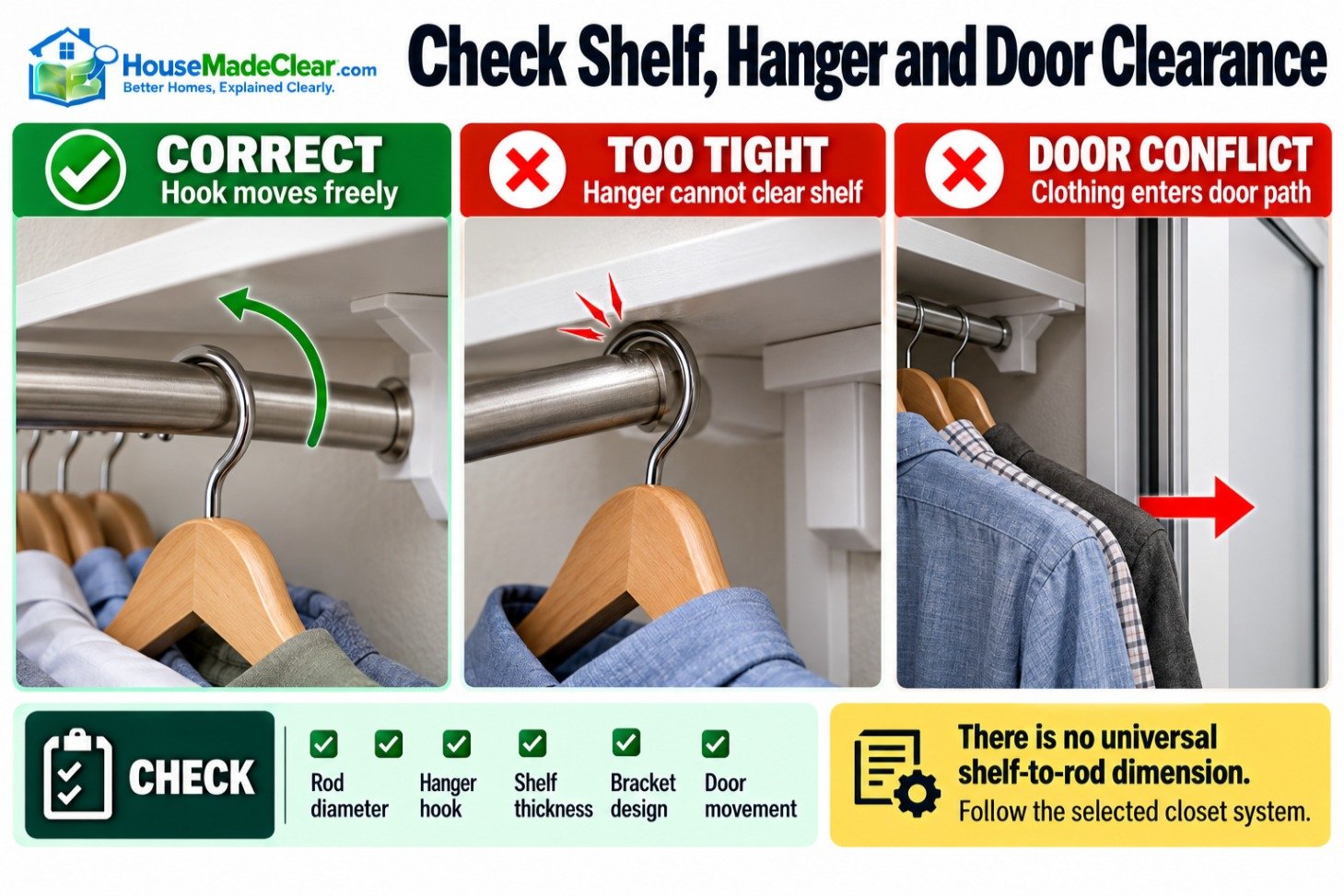
The right shelf-to-rod spacing depends on the installation hardware.
Some closet systems use brackets that support the shelf and rod together.
Others have separate mounting brackets.
The goal is to leave enough room to place and remove hangers easily.
Factors to Check
- Rod diameter
- Hanger hook size
- Shelf thickness
- Bracket design
- Distance between shelf and rod
- Access to the hanging clothes
If the rod is mounted directly beneath a shelf, follow the closet-system manufacturer’s dimensions.
For custom installations, test hanger movement before permanently mounting the shelf.
Should You Install a Shelf Above Every Rod?
Not necessarily.
A shelf above a single hanging section can provide useful storage for boxes, accessories, or seasonal items.
But in a double-hanging section, additional shelves may reduce vertical space and make the upper rod difficult to reach.
Use shelves only where they improve the storage arrangement.
Closet Rod Height for Children’s Closets
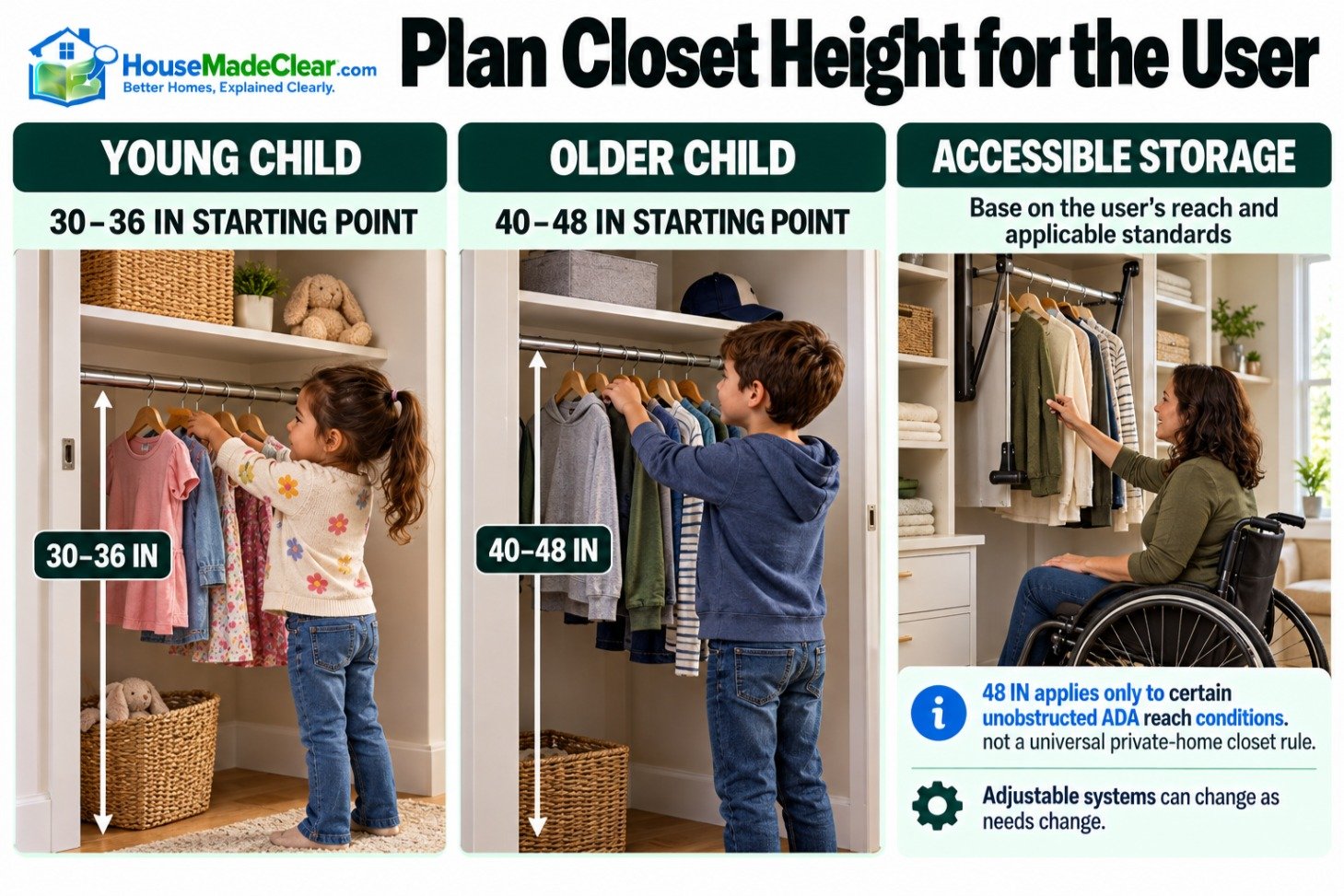
Children’s clothing is usually shorter, and the rods should be positioned at an appropriate reaching height.
A fixed adult-height rod may make a child’s closet difficult to use independently.
Children’s Closet Rod Height Chart
| Closet User | Possible Starting Height |
|---|---|
| Young child | 30–36 inches |
| Older child | 40–48 inches |
| Teenager | Adjust to individual reach |
These are planning suggestions rather than universal standards.
The ideal height depends on the child’s actual reach and the clothing being stored.
Are Adjustable Closet Rods Better for Children?
Adjustable rods or modular closet organizers can be useful because storage needs change as children grow.
You can use lower hanging space for everyday clothes and upper shelves for items that require adult assistance.
Accessible Closet Rod Height and ADA Considerations
An accessible closet should be designed around the user’s reach and movement.
A conventional 66–68-inch hanging rod may be too high for some wheelchair users.
The 2010 ADA Standards for Accessible Design include a maximum high reach of 48 inches above the finished floor for certain unobstructed reach conditions.
However, this is not a universal closet rod height requirement for every private residence.
Accessibility rules differ according to the building, the applicable standards, and the storage arrangement.
Practical Accessible Closet Planning
Consider:
- The person’s comfortable reach
- Clear floor space
- Access through closet doors
- Obstructions from shelving
- Rod hardware
- Clothing length
- Pull-down or adjustable storage systems
For a home designed for a specific user, usability should guide the rod position.
Where formal accessibility compliance is required, consult the applicable standards rather than relying only on residential design recommendations.
Standard Closet Rod Height for an 8-Foot Ceiling
An eight-foot ceiling is 96 inches high.
That usually provides enough vertical space for single- and double-hanging configurations.
Single Hanging Example
- Ceiling height: 96 inches
- Rod height: 68 inches
- Space above rod centerline: 28 inches
Part of the upper space may be used for storage shelving, provided hanger clearance and hardware requirements are satisfied.
Double Hanging Example
- Ceiling height: 96 inches
- Upper rod: 84 inches
- Lower rod: 42 inches
- Distance between rods: 42 inches
- Space above upper rod centerline: 12 inches
This is a commonly used double-hanging arrangement.
However, a shelf above the upper rod may interfere with hanger access if it is positioned incorrectly.
What if the Ceiling Is Only 7 Feet High?
A seven-foot ceiling is 84 inches high.
Installing an upper rod at 84 inches would place it at ceiling height, leaving no practical room for hanger hooks.
In a shorter closet, you may need a lower upper rod and shorter garments or a different combination of hanging and shelving.
When deciding whether to prioritize a built-in closet, freestanding wardrobe, or dresser, our guide to planning a functional bedroom layout can help balance storage needs with room circulation.
How to Measure Closet Rod Height Correctly
Before installing the rod, measure the space and the clothing.
Step 1: Measure From the Finished Floor
Use the final floor surface as the measurement reference.
If flooring will be added later, account for the finished height.
Step 2: Measure Closet Height and Depth
Record:
- Floor-to-ceiling height
- Usable interior closet width
- Closet depth
- Door opening dimensions
- Existing shelf positions
Step 3: Choose Single or Double Hanging
Base the decision on your wardrobe.
Do not install double rods throughout the entire closet if you need space for long dresses or coats.
Step 4: Measure the Longest Garments
Hang the clothes on their intended hangers and measure their vertical length.
Step 5: Mark the Rod Centerline
Mark the intended centerline on the wall or support panels.
Closet rod brackets may have mounting holes above or below the actual rod centerline.
Step 6: Test Hanger Clearance
Hold a hanger in the intended position.
Confirm that it clears the back wall, shelf, and closet doors.
Step 7: Check Structural Support
Locate appropriate support points and follow the rod manufacturer’s installation and load-rating requirements.
Step 8: Install and Test
After installation, check that the rod is level, secure, and properly positioned.
Load it gradually rather than immediately filling it with heavy clothing.
How to Install a Closet Rod
Installing a closet rod is generally a manageable home-improvement project when the wall construction and support requirements are understood.
Tools and Materials
You may need:
- Tape measure
- Pencil
- Level
- Stud finder
- Drill and suitable drill bits
- Closet rod
- Compatible rod brackets or sockets
- Manufacturer-approved fasteners
- Intermediate support bracket if necessary
Installation Steps
- Determine the correct rod height.
- Mark the rod centerline.
- Verify wall and door clearance.
- Locate suitable structural supports.
- Position the mounting brackets.
- Install brackets with fasteners rated for the wall and expected load.
- Place the rod into the supports.
- Check for level and secure attachment.
- Test the system with a modest load.
- Confirm that doors, shelves, and hanging clothing function without interference.
How Much Weight Can a Closet Rod Hold?
There is no universal load capacity.
Capacity depends on:
- Rod material
- Rod diameter
- Unsupported length
- Bracket spacing
- Fastener type
- Wall structure
- Manufacturer rating
A long wooden rod without adequate support may sag, while a properly supported steel rod may accommodate a different load.
Always follow the complete system’s specified weight capacity.
Single vs. Double Closet Rod: Which Should You Choose?
| Feature | Single Hanging | Double Hanging |
|---|---|---|
| Long dresses | Better | Usually unsuitable |
| Long coats | Better | Usually unsuitable |
| Shirts and blouses | Suitable | Very efficient |
| Folded pants | Suitable | Very efficient |
| Hanging capacity | One level | Two levels |
| Everyday accessibility | Depends on height | Upper rod may be difficult to reach |
| Installation | Simpler | Requires more planning |
| Short-garment storage | Good | Often better |
| Mixed wardrobe flexibility | Good | Best combined with long-hanging section |
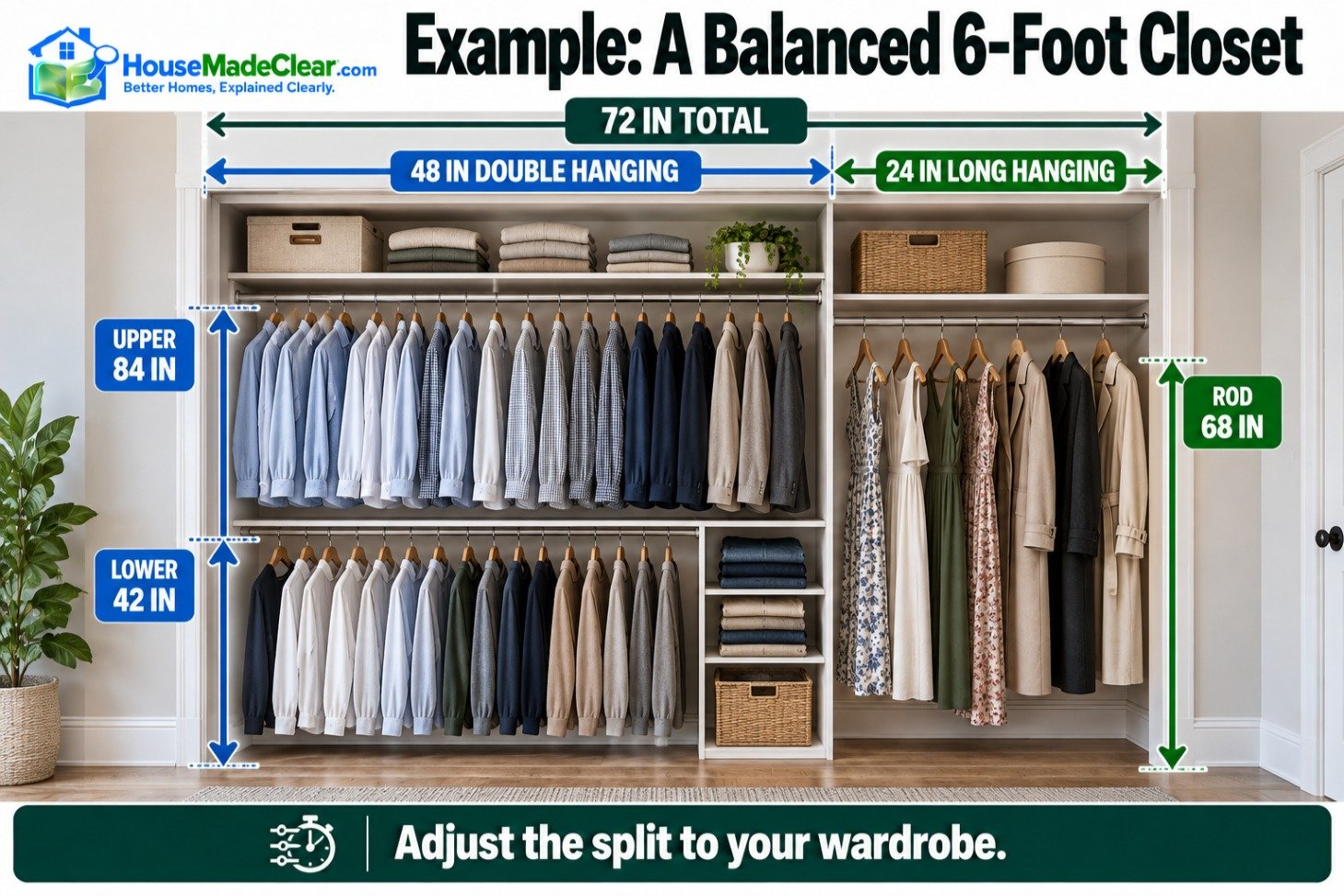
Example: A 6-Foot-Wide Closet
Suppose you have a 72-inch-wide reach-in closet.
One practical layout might be:
- 48 inches of closet width for double hanging
- 24 inches for long hanging
This creates two levels of storage for shirts and folded pants while preserving a taller section for dresses and coats.
However, the optimal proportion depends on your clothing.
A household with more long garments may need a larger single-hanging section.
If your bedroom doesn’t have enough room for a conventional built-in closet, our small bedroom storage ideas without a closet guide covers wardrobes, garment racks, and other hanging-storage alternatives.
What About a Dresser Inside the Closet?
Some closets can accommodate a small dresser or drawer unit beneath a hanging section.
This may make sense when shorter garments leave usable space below the rod.
However, always measure the dresser height, drawer extension, and clothing clearance before combining them.
Our dresser dimensions guide provides common dresser heights, widths, and depths to help you evaluate this arrangement.
Common Closet Rod Height Mistakes
1. Choosing Height Without Measuring Clothes
Standard dimensions are useful, but your longest garments determine the actual clearance required.
2. Installing Double Rods Too Close Together
Upper clothes may press against the lower rod or shelf.
3. Positioning the Rod Too Close to the Back Wall
Clothes may bunch against the wall instead of hanging naturally.
4. Ignoring Closet Doors
Sliding or hinged doors require adequate operating space.
5. Installing the Upper Rod Too High
A rod that requires constant stretching or a step stool may be inconvenient for daily use.
6. Using Inadequate Brackets
Poor support can cause sagging or detachment.
7. Failing to Reserve Space for Dresses
Double hanging cannot accommodate every garment type.
8. Forgetting Shelf and Hanger Clearance
The relationship between the shelf and rod matters as much as rod height.
9. Measuring Before Flooring Is Finished
Changes in floor height can affect the final rod position.
Closet Rod Height Checklist
| Item | Recommended Starting Point |
|---|---|
| Single rod height | 66–68 inches |
| Double lower rod | 40–42 inches |
| Double upper rod | 80–84 inches |
| Distance between double rods | Around 40–42 inches, adjusted to clothing |
| Long-hanging section | Measure longest garments |
| Back-wall clearance | Approximately 12 inches in a 24-inch-deep closet |
| Shelf clearance | Verify with selected hardware and hangers |
| Children’s rod | Adjust to reach, often 30–42 inches |
| Accessible rod | Base on reach and applicable standards |
| Bracket support | Follow manufacturer rating |
| Door clearance | Test with actual hangers and clothing |
Final Thoughts
The standard closet rod height is typically 66–68 inches for single hanging, while double-hanging closets commonly use lower rods at 40–42 inches and upper rods at 80–84 inches.
These measurements are a reliable starting point for closet planning, but they shouldn’t override the needs of the person using the space.
Measure the clothes, check hanger and shelf clearance, and make sure everyday items remain comfortably accessible.
For closets storing mostly shirts, jackets, and folded pants, double hanging can increase usable storage. For dresses and long coats, reserve a taller single-hanging section.
A well-designed closet isn’t simply one with the maximum number of rods or shelves. It’s one where clothing fits properly, can be reached easily, and remains organized without crowding the space.
Frequently Asked Questions
What is the standard height for a closet rod?
A typical single closet rod is installed approximately 66–68 inches above the finished floor. The exact height should be adjusted for clothing length and user reach.
What is the standard height for double closet rods?
Common double-hanging heights are approximately 40–42 inches for the lower rod and 80–84 inches for the upper rod, measured from the finished floor.
How far apart should double closet rods be?
Approximately 40–42 inches between rod centerlines is a common starting point, but the correct spacing depends on the length of the garments and any shelves or hardware between them.
How far should a closet rod be from the back wall?
In a conventional 24-inch-deep closet, the rod centerline is commonly positioned around 12 inches from the back wall. Actual clearance should be checked with the hangers and clothing being used.
How high should a closet rod be for dresses?
A rod around 66–68 inches may accommodate many dresses, but long or floor-length dresses may need a taller hanging section. Measure the longest garment on its hanger before installation.
Is an 84-inch closet rod too high?
An 84-inch rod is commonly used for the upper tier in double-hanging closets. It may be difficult to reach as an everyday single rod, depending on the user’s height and accessibility needs.
What height should a child’s closet rod be?
A lower rod around 30–42 inches can be a useful starting point for younger children, but the ideal height depends on their actual reach. Adjustable systems make future changes easier.
Do closet rods have to meet ADA height requirements?
Not every private residential closet is governed by ADA standards. Where accessibility requirements apply, the appropriate reach range depends on the facility, approach, and obstructions. The 2010 ADA Standards specify a 48-inch maximum high reach for certain unobstructed conditions.








[…] Standard Closet Rod Height: Single and Double Hanging Dimensions […]