
















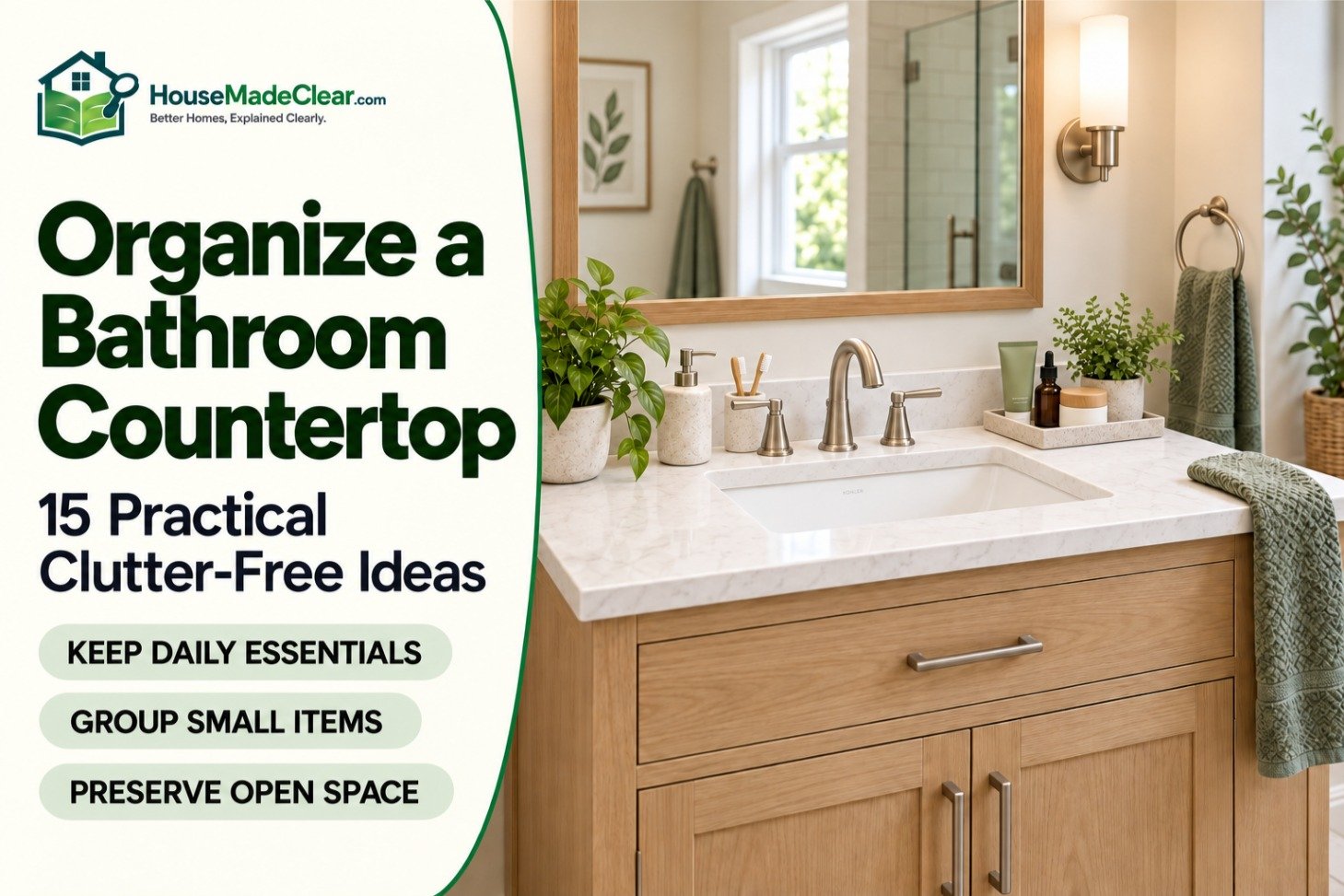
A bathroom countertop can become cluttered surprisingly quickly. A toothbrush holder, a few skincare bottles, toothpaste, a hairbrush, and a soap dispenser might not seem like much individually. But together, they can leave barely enough room to wash your hands comfortably.
The usual response is to buy a tray, a tiered organizer, or another storage container. Sometimes that helps. Often, it just turns a messy counter into a crowded counter with more accessories.
The better approach is to decide what genuinely needs to stay beside the sink and give everything else a more suitable home.
You don’t need a large vanity or a complete bathroom renovation to make that happen. Even a 24-inch bathroom vanity can feel more functional when its limited counter space is used intentionally.
This guide explains how to organize a bathroom countertop, choose storage that fits, manage skincare and toiletries, and keep the space tidy without constantly rearranging everything.
Quick Answer
To organize a bathroom countertop without clutter, keep only essential daily-use items on the surface and move the rest into drawers, cabinets, or nearby storage.
Start by:
- Removing everything from the counter.
- Sorting products into daily-use, occasional-use, backup, and discard groups.
- Measuring the usable space around the sink.
- Returning only the items that need immediate access.
- Grouping small essentials on one washable tray or organizer.
- Using vanity drawers and cabinets for everything else.
- Keeping a clear area for washing and getting ready.
A small bathroom doesn’t necessarily need more organizers. It needs fewer items competing for its most useful surface.
How to Organize a Bathroom Countertop in 20 Minutes
If your bathroom counter is already cluttered, begin with a short reset rather than planning an entire bathroom makeover.
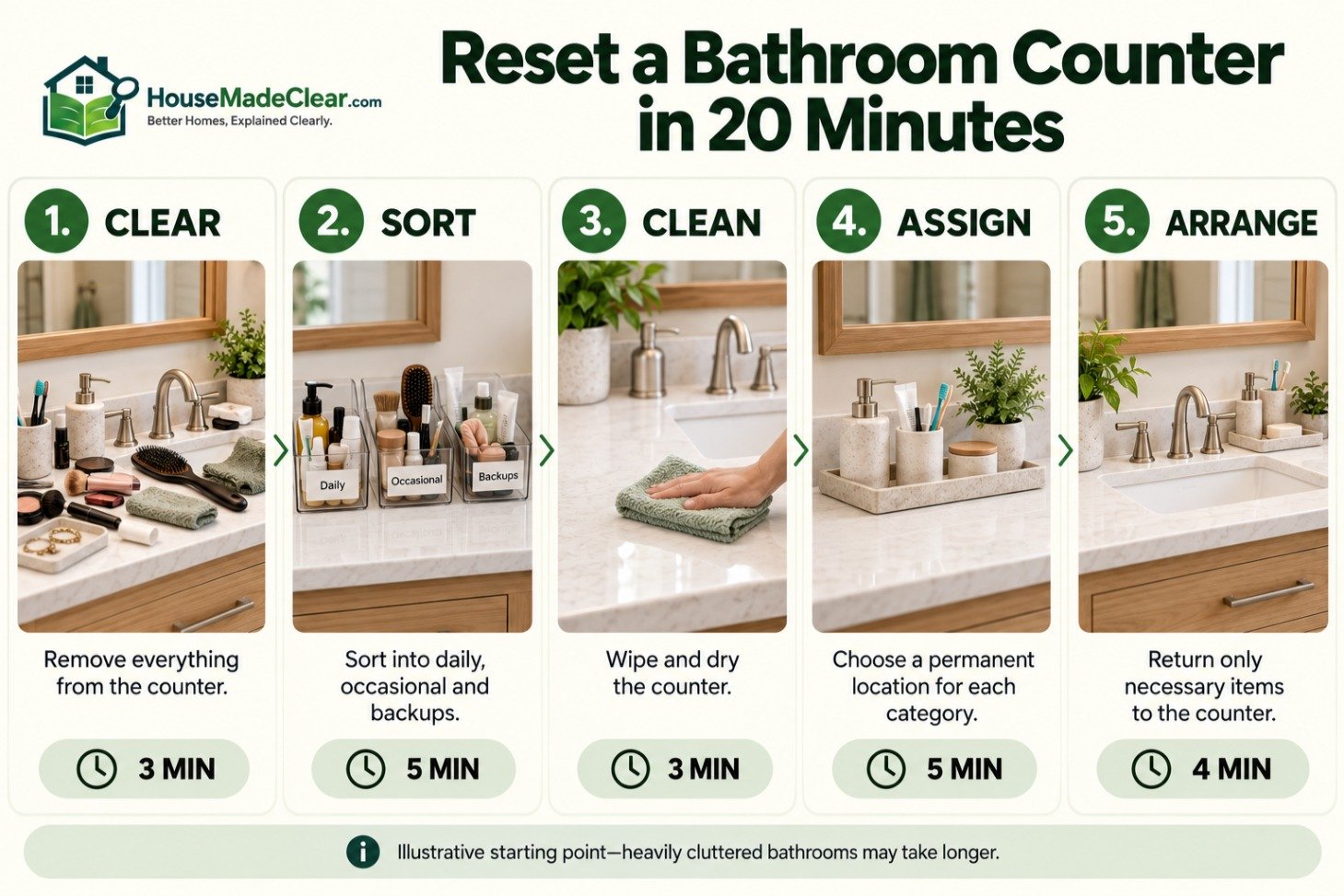
| Step | What to Do | Suggested Time |
|---|---|---|
| Clear | Remove everything from the countertop | 3 minutes |
| Sort | Separate daily items, occasional products, and backups | 5 minutes |
| Clean | Wipe the counter and dry around the sink | 3 minutes |
| Assign | Choose a permanent location for each category | 5 minutes |
| Arrange | Return only necessary items | 4 minutes |
The 20-minute target is an illustrative starting point; heavily cluttered bathrooms may take longer.
Step 1: Remove Everything
Start with a completely empty counter.
Move the products onto a towel or another clean surface.
This makes it easier to see how much usable countertop you actually have, including narrow spaces beside the faucet that were previously hidden under bottles.
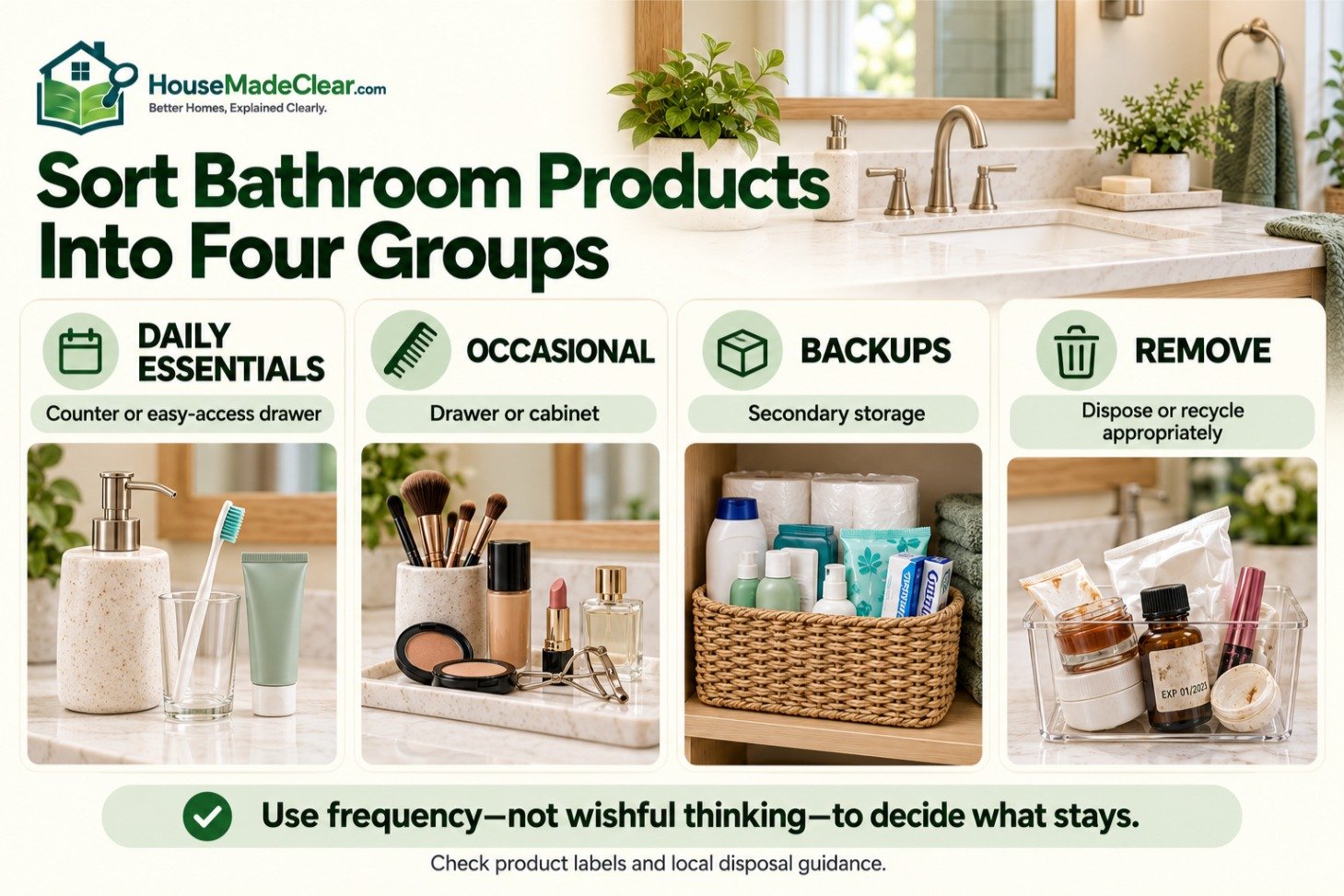
Step 2: Sort Products by Frequency of Use
Divide everything into four groups.
| Group | Examples | Where It Belongs |
|---|---|---|
| Daily essentials | Hand soap, toothbrush, frequently used skincare | Counter or easy-access drawer |
| Occasional items | Makeup, hair treatments, specialty grooming products | Vanity drawer or cabinet |
| Backups | Unopened toothpaste, spare soap, extra skincare | Cabinet or secondary storage |
| Remove | Empty containers, expired products, unnecessary duplicates | Appropriate disposal or recycling |
Be selective with the daily-use category.
Something you use once a week doesn’t automatically deserve permanent countertop space.
Step 3: Clean and Measure
Wipe the countertop using a cleaner compatible with its material.
Dry around the sink and faucet.
Measure the usable area on both sides of the basin, accounting for the faucet, backsplash, and any built-in soap dispenser.
Step 4: Return the Essentials
Place back only what you genuinely need immediately accessible.
For one person, that may be a soap dispenser, toothbrush holder, and a compact skincare tray.
For a household sharing one bathroom, the arrangement will need to accommodate more users without spreading products across the whole surface.
Step 5: Give Everything Else a Home
Move occasional-use products into designated drawers, cabinets, or baskets.
The important part is making that storage easy to use.
If someone has to move six containers to retrieve a hairbrush, the hairbrush will probably end up back on the counter.
15 Bathroom Countertop Organization Ideas That Actually Work
Not every idea below is necessary in every bathroom. Choose the ones that solve a problem you currently have.
1. Keep Only Everyday Essentials on the Counter
This is the most effective change for many bathrooms.
The counter is a working surface, not the main storage area for every product you own.
A reasonable everyday setup might include:
- Hand soap
- Toothbrush holder
- Toothpaste
- One or two frequently used skincare products
If you use multiple products every morning, keeping them in a nearby drawer may be more practical than leaving them all visible.
Best for: Any bathroom, especially narrow vanities.
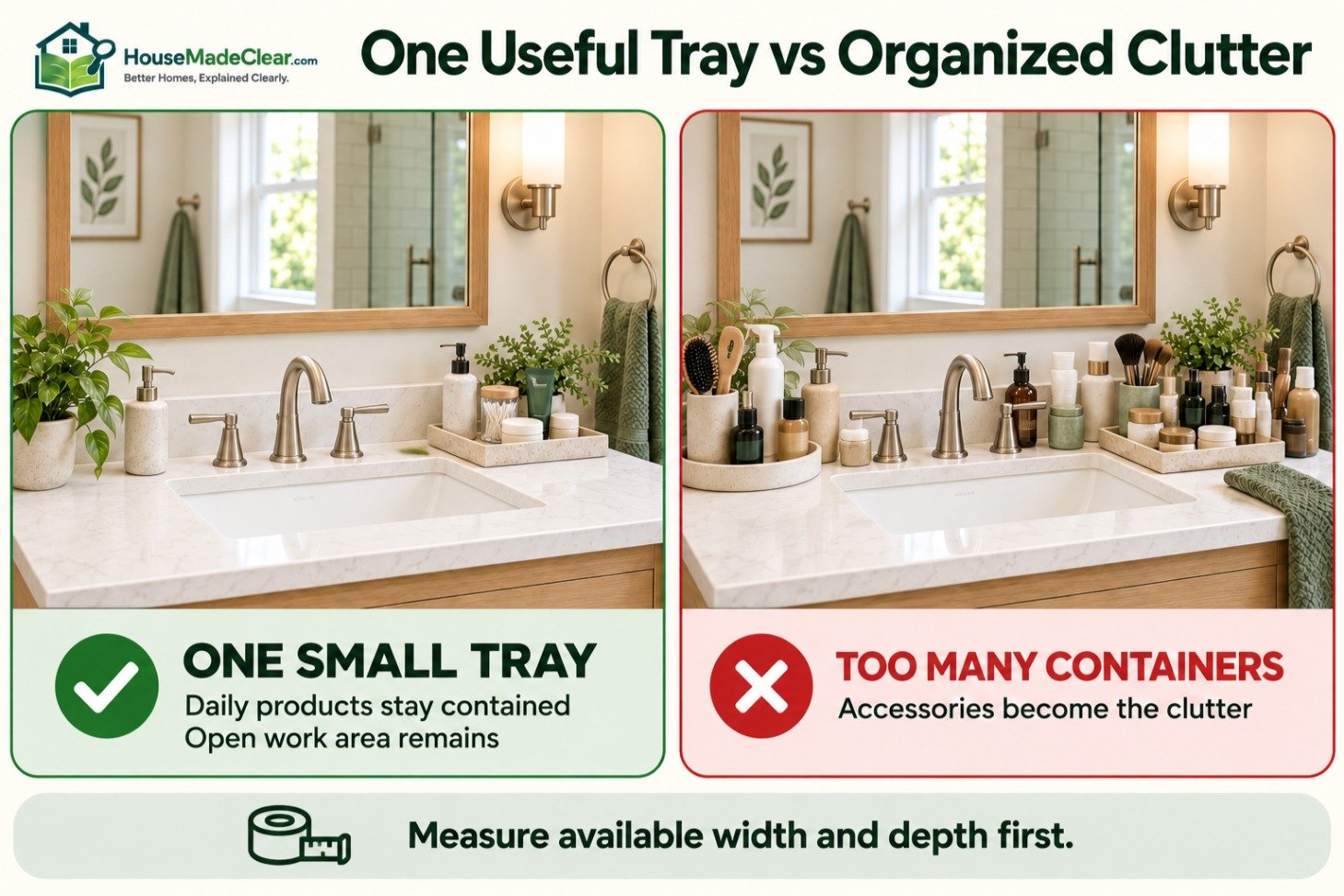
2. Use One Tray to Group Small Items
A tray creates a defined area for products that would otherwise spread across the countertop.
It also makes wiping easier because you can move several items at once.
Choose a tray that:
- Fits beside the sink without obstructing it
- Is easy to wipe clean
- Tolerates bathroom moisture
- Holds the necessary items without overcrowding
- Doesn’t interfere with faucet controls
A tray containing four frequently used products is useful. Three trays holding twenty products may simply relocate the clutter.
HGTV’s bathroom countertop decluttering guide also recommends trays as a practical way to keep toiletries contained.
Best for: Skincare, soap, and small grooming essentials.
3. Use Vanity Drawers for Daily Skincare
You don’t need to display every moisturizer, cleanser, sunscreen, or serum.
A shallow vanity drawer can hold everyday skincare in one easily accessible location.
Arrange products by routine:
- Morning products
- Evening products
- Occasional treatments
A drawer with simple dividers often works better than several countertop containers.
If you’re remodeling or replacing your vanity, our guide to standard bathroom cabinet sizes explains how cabinet width, drawer configuration, and plumbing affect usable storage.
Best for: Bathrooms with drawers below the countertop.
4. Use a Wall-Mounted Toothbrush Holder
A wall-mounted holder frees a small amount of countertop space without requiring another shelf.
Look for a design that allows toothbrushes to drain and dry and that can be cleaned easily.
Check installation suitability before mounting anything.
For renters, removable holders may be appropriate on compatible surfaces, but adhesive strength, moisture exposure, and surface-finish compatibility vary.
Avoid positioning the holder where it repeatedly receives direct shower spray.
Best for: Narrow counters and shared bathrooms.
5. Use a Compact Two-Tier Organizer
A small tiered organizer can help when several daily-use products genuinely need to remain visible.
It takes advantage of vertical space instead of spreading everything in a single row.
However, measure before purchasing.
A tall organizer may block the mirror, interfere with a faucet, or make the counter harder to clean.
Choose one that is stable, moisture-resistant, and easy to remove.
Best for: Medium-sized vanities with limited drawer storage.
6. Move Backup Toiletries Under the Sink
Unopened products are inventory, not daily essentials.
Extra bottles of shampoo, toothpaste, soap, and skincare usually do not need to stay beside the sink.
Store them in a cabinet or suitable secondary storage area.
Use a separate basket for backups so you can see what you already own before buying more.
Keep cleaning chemicals separate from personal-care items, and follow product storage and child-safety directions.
Best for: Households that buy toiletries in bulk.
7. Give Makeup Its Own Drawer or Caddy
Makeup can take over a countertop because it includes many small products.
Rather than spreading everything around the sink, use a single dedicated storage location.
Separate items such as:
- Face products
- Eye makeup
- Brushes
- Lip products
- Daily essentials
A portable makeup caddy can work well when the same bathroom is used by several people.
However, consider product storage conditions. The U.S. Food and Drug Administration explains that heat, humidity, sunlight, and contamination can affect cosmetic shelf life.
If the bathroom becomes very hot or humid, a cooler, drier storage location may be better for some cosmetics.
Best for: Makeup-heavy morning routines and shared bathrooms.
8. Store Hair Dryers and Styling Tools Safely
Hair dryers, straighteners, curling irons, and their cords can quickly dominate a small vanity.
A suitable dedicated holder or drawer can keep them organized.
But storage must not compromise electrical or heat safety.
Allow heated tools to cool according to their manufacturer’s instructions before putting them into ordinary drawers or containers.
Use only holders rated for hot tools if storing them while still warm is expressly permitted.
Unplug tools after use and keep electrical appliances away from sinks and water.
Best for: Bathrooms where grooming appliances occupy most of the counter.
9. Use the Medicine Cabinet for Small Items
A medicine cabinet can keep small products at eye level without using countertop space.
Depending on its dimensions and product instructions, it may hold:
- Small grooming products
- Oral-care supplies
- Cotton swabs
- Lightweight accessories
However, do not assume all medications belong in a humid bathroom. Follow the storage instructions for each medication; many require a cool, dry location.
Before installing a recessed or surface-mounted cabinet, check available wall depth, plumbing, wiring, and mirror clearance.
Best for: Bathrooms without convenient vanity drawers.
10. Use Small Bins Inside the Vanity
Vanity cabinets often contain unused space around plumbing.
Small removable bins can help organize that area.
Give each bin a clear purpose, such as spare soap, extra washcloths, or grooming supplies.
Avoid placing a large organizer where it blocks drain connections, shutoff valves, or maintenance access.
Our standard bathroom sink dimensions guide explains how sink type, cabinet dimensions, and plumbing can affect available storage.
Best for: Single-sink vanities with cabinet doors.
11. Take Advantage of an Unused Wall
When the counter is too narrow for a tray or organizer, nearby wall space may be more useful.
Consider:
- A shallow shelf
- A small wall cabinet
- A suitable recessed niche outside wet areas
- A compact wall-mounted storage unit
Avoid installing shelves where someone could strike their head or where they interfere with bathroom mirrors, outlets, or door movement.
A wall shelf should also be properly secured for its expected load.
Best for: Very small bathrooms and powder rooms.
A bathroom used by two or more people needs a clear storage system.
Otherwise, every user’s products compete for the same limited surface.
Use separate drawers, baskets, or sections for personal products.
Keep shared items—such as hand soap—in a central location.
For a double vanity, each sink can have a small daily-use zone. For a single vanity, shared products can remain on the counter while individual items stay in assigned storage.
Best for: Couples, families, and shared apartments.
13. Use Small Containers for Cotton Pads and Accessories
Cotton pads, swabs, hair ties, and similar items are easier to manage when they aren’t loose.
Use small, washable containers that fit the quantity you actually keep in the bathroom.
Avoid transferring products out of original packaging when doing so would remove important identification, instructions, expiration details, or safety warnings.
A container is useful only when it makes the contents easier to access and maintain.
Best for: Small grooming accessories.
14. Keep Towels Off the Counter
Wet hand towels and washcloths take up space and make the countertop harder to clean.
Install an appropriate towel ring, hook, or bar near the sink.
Position it where users can reach it without dripping water across the bathroom.
Our toilet paper holder height guide and towel bar height guide can help when planning bathroom accessories and fixture placement.
Best for: Bathrooms where towels routinely end up beside the sink.
15. Make a Simple End-of-Day Reset Part of the Routine
An organized counter won’t stay that way if everything is left out after use.
At the end of the day:
- Return products to their assigned places.
- Put away grooming tools.
- Remove empty packaging.
- Wipe up splashes.
- Put damp towels where they can dry.
This should be a quick reset, not a full cleaning project.
If maintaining the system takes too much effort, simplify it.
Best for: Every bathroom.
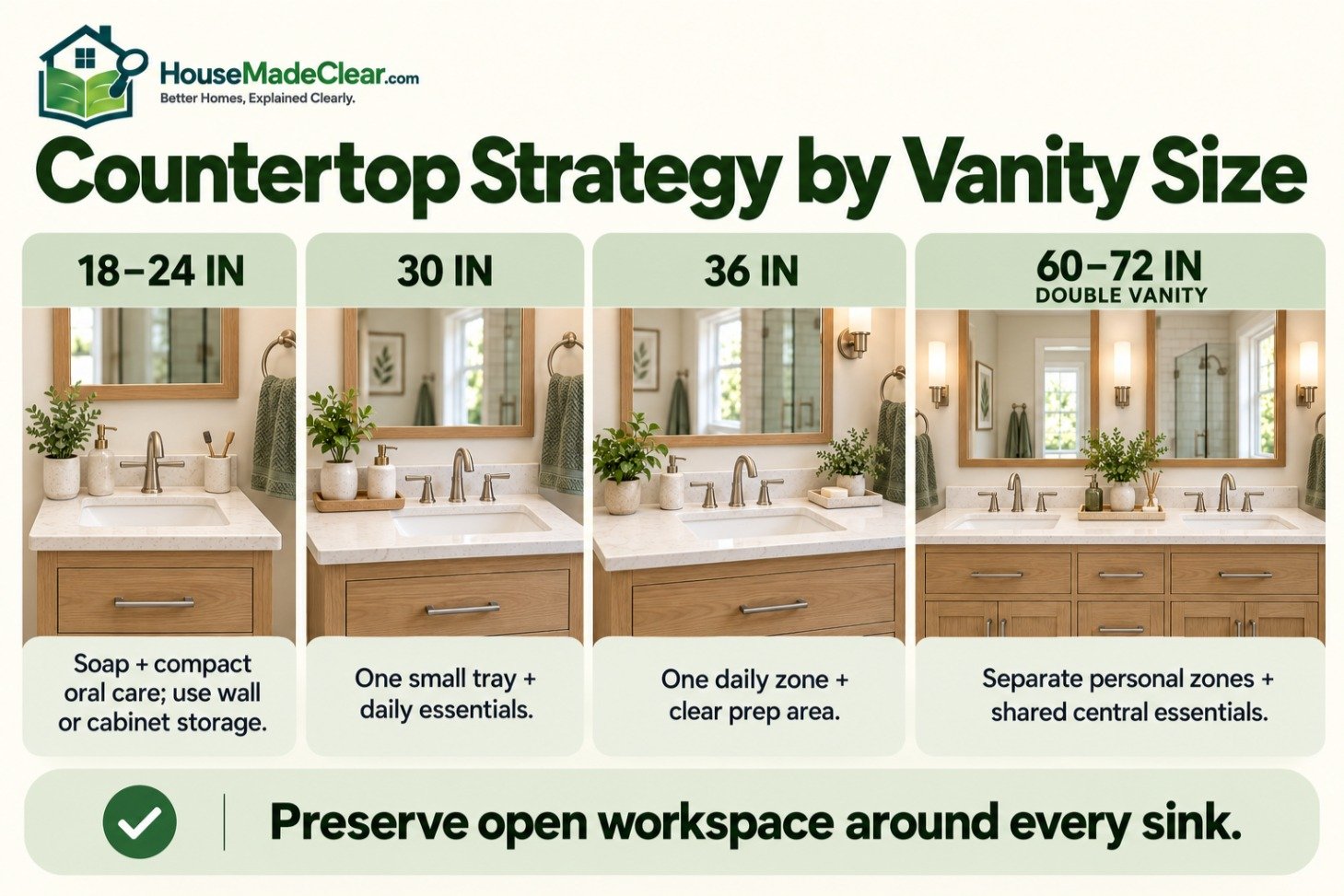
Bathroom Countertop Organization Ideas by Vanity Size
Countertop organization should be matched to the space available around the sink.
A 24-inch vanity and a 60-inch double vanity don’t have the same storage capacity.
| Vanity Width | Practical Countertop Strategy |
|---|---|
| 18–24 inches | Keep only soap and a compact oral-care setup; use wall or cabinet storage |
| 30 inches | One small tray plus basic essentials |
| 36 inches | One daily-use zone and clear preparation space |
| 42–48 inches | A dedicated tray or modest organizer with room for grooming |
| 60–72 inches | Separate personal-use zones and one shared essentials area |
These are suggested arrangements, not fixed product requirements. Sink dimensions and placement determine how much usable counter remains.
How to Organize a 24-Inch Bathroom Vanity
A 24-inch vanity may offer very little counter space once the sink and faucet are installed.
Keep the arrangement simple:
- Soap near the basin
- Toothbrushes in a wall-mounted or compact holder
- Skincare inside the cabinet
- Hair tools stored elsewhere
Don’t fill the remaining space with decorative jars simply because they match the bathroom.
How to Organize a 36-Inch Bathroom Countertop
A 36-inch vanity can often accommodate a small tray on one side.
For example:
- Left side: Compact tray with daily-use skincare
- Center: Sink and faucet
- Right side: Clear space for temporary items during grooming
The exact arrangement depends on basin width and faucet position.
How to Organize a Double Vanity
With a double vanity, give each user a defined area.
Keep shared items in a central storage location if the design allows.
Avoid using every inch of the longer counter as display space.
A larger counter is easier to maintain when it still has open work areas.
If you are planning a bathroom remodel, our standard bathroom size guide can help evaluate whether the vanity, circulation space, and surrounding fixtures fit the room.
How Much Bathroom Counter Space Should You Leave Empty?
There is no mandatory percentage of countertop that must remain clear in an ordinary residential bathroom.
However, leaving an uninterrupted usable area makes everyday routines easier.
Instead of aiming for an arbitrary percentage, consider whether you can:
- Wash your hands without knocking over products
- Set down a grooming item temporarily
- Clean around the faucet
- Use the sink without moving containers
- Reach everyday items without disturbing other products
A Simple Measurement Example
Suppose your vanity is 36 inches wide.
The sink and faucet occupy much of the middle, leaving two usable counter sections.
You have a tray that measures 10 inches wide by 6 inches deep.
Before placing it, check whether the remaining section still provides enough room for your daily routine.
If the tray occupies the entire available side, a smaller tray or drawer organizer may be more useful.
The tray’s dimensions matter more than whether the organizer is marketed as suitable for a 36-inch vanity.
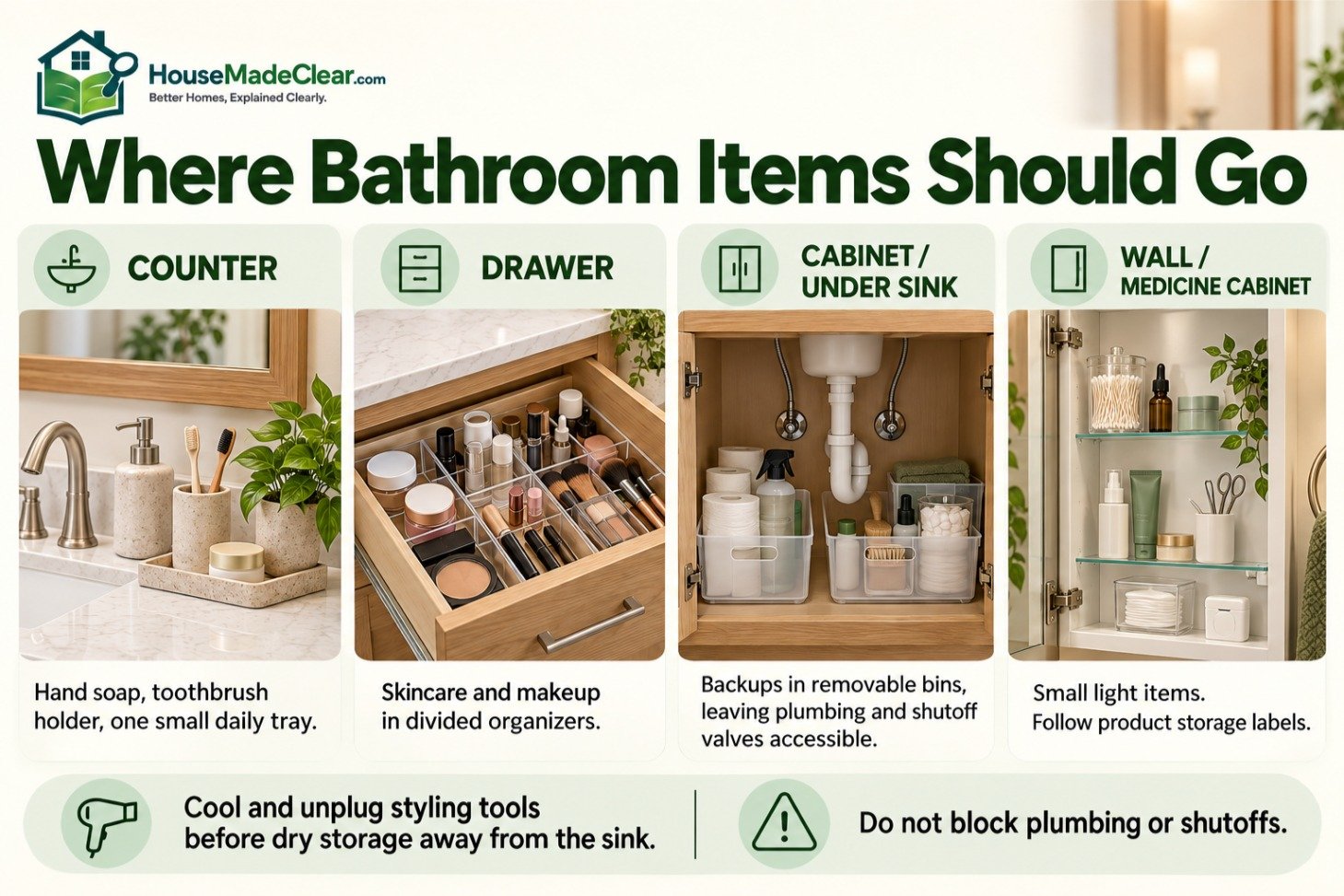
Where Should Common Bathroom Items Be Stored?
Use the following guide to decide which belongings deserve countertop space.
| Item | Recommended Location | Why |
|---|---|---|
| Hand soap | Counter near sink | Used frequently |
| Toothbrush | Holder or suitable cabinet storage | Easy access and drying |
| Toothpaste | Holder or nearby drawer | Avoids loose tubes |
| Daily moisturizer | Tray or easy-access drawer | Depends on routine |
| Sunscreen | Suitable drawer or storage area | Follow label storage requirements |
| Makeup | Dedicated drawer or portable organizer | Reduces visual clutter |
| Perfume | Cool, dry location as appropriate | Avoid unnecessary heat and humidity |
| Hair dryer | Dry, secure storage | Keeps cords off counter |
| Hot styling tools | Manufacturer-approved storage after cooling | Prevents heat damage |
| Cotton pads | Small container or drawer | Easy to manage |
| Extra shampoo | Cabinet or backup storage | Doesn’t need daily counter access |
| Cleaning chemicals | Secure, suitable storage | Keep separate from personal-care items |
| Towels | Ring, bar, hook, or linen storage | Frees counter and allows drying |
| Medication | As specified on label | Bathrooms may be too humid |
| Spare toilet paper | Cabinet or appropriate enclosed storage | Better protected and out of the way |
A bathroom organizer should support the way you use the room rather than create extra steps.
How to Organize a Bathroom Counter With No Drawers
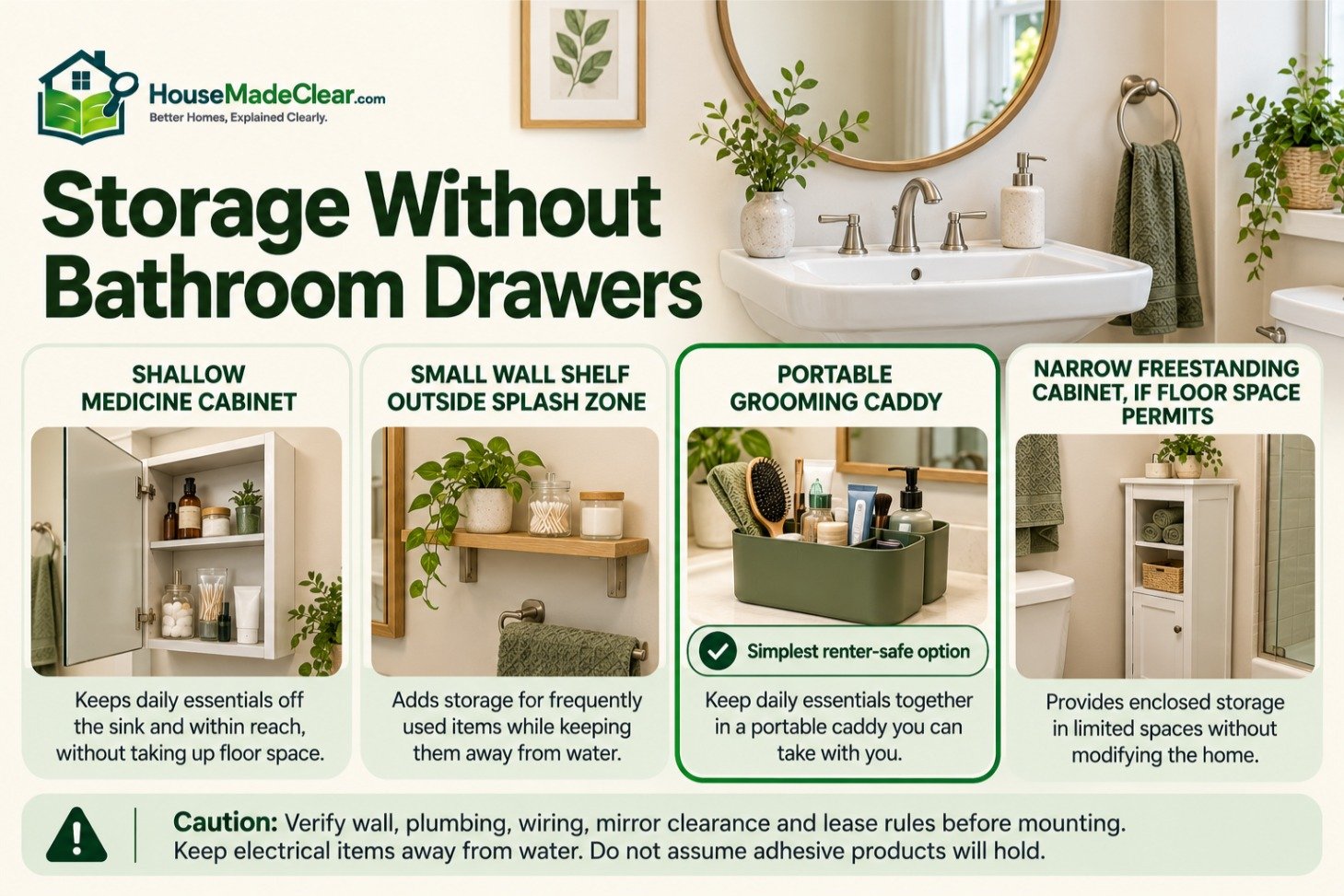
Some bathrooms have pedestal sinks, wall-mounted basins, or vanities with no drawers.
In these situations, countertop space may be extremely limited.
Use a Shallow Medicine Cabinet
A compact medicine cabinet can hold small everyday items.
Verify installation requirements and make sure doors open freely.
Add a Small Wall Shelf
A shelf outside the splash area can hold a few lightweight items.
Choose a location that doesn’t interfere with the mirror or sink.
Use a Portable Grooming Caddy
Keep personal-care products in a portable container stored elsewhere.
Bring it to the sink when needed and put it away afterward.
Consider a Narrow Freestanding Cabinet
Where floor space permits, a slim cabinet may provide more usable storage than a crowded countertop organizer.
However, check its stability, installation requirements, and any tip-over restraints.
For bathrooms with very limited dimensions, our guide to what a 3/4 bathroom is explains common bathroom fixture arrangements and how different layouts affect available space.
How to Keep a Bathroom Counter Looking Organized
A bathroom counter can be functional and visually appealing without being completely empty.
Choose accessories deliberately.
Limit the Number of Visible Containers
Several small jars, trays, baskets, and holders can look just as cluttered as loose products.
Start with one or two containers that solve a clear problem.
Choose Easy-to-Clean Materials
Bathrooms are exposed to water, soap, and humidity.
Trays made from moisture-tolerant materials can be easier to maintain than unfinished wood or absorbent decorative containers.
Check the manufacturer’s care guidance, particularly for natural stone, metal finishes, and coated surfaces.
Keep Similar Products Together
A skincare tray or oral-care station is easier to understand than unrelated items scattered around the basin.
Avoid Overdecorating the Vanity
A decorative plant or small accessory can work on a large countertop.
But in a narrow bathroom, decoration should not displace the space needed for washing and grooming.
Keep Lighting and Mirrors Unobstructed
Tall organizers and shelves shouldn’t block task lighting or interfere with the mirror.
Our guide to how to plan bathroom lighting explains how fixture placement affects visibility and everyday grooming.
Bathroom Countertop Organization for Renters
Renters often need solutions that don’t require permanent changes.
Practical options include:
- Freestanding trays
- Removable dividers
- Portable grooming caddies
- Appropriate over-door storage
- Small cabinet organizers
- Removable wall accessories used on compatible surfaces
Check lease requirements before mounting hardware.
Don’t assume adhesive products are damage-free or suitable for every tile, paint, or wall finish.
A removable tray or inside-cabinet organizer is usually a simpler starting point than drilling into bathroom walls.
A shared bathroom can become cluttered even when every person owns relatively few products.
The solution is to separate personal storage from shared essentials.
Examples include:
- Hand soap
- A suitable hand towel
- Frequently used shared hygiene supplies
Give Each Person a Storage Zone
Assign drawers, bins, or cabinet sections.
Avoid leaving everyone’s individual products on the countertop.
Make Storage Easy for Children
Store children’s everyday items at suitable reachable heights.
Keep medicines, cleaning chemicals, sharp grooming accessories, and potentially hazardous products secured according to their safety instructions.
Avoid Overloading the Counter Before School or Work
A portable caddy can help when several people use the sink at different times.
Products can be brought out for a routine and returned afterward.
The counter stays useful for the next person.
Bathroom Countertop Organization Mistakes to Avoid
Buying Organizers Before Decluttering
More storage accessories won’t solve a counter that holds too many products.
Decide what belongs there first.
Using Containers That Are Too Large
A bulky organizer may eliminate the very workspace you’re trying to protect.
Measure the available area.
Storing All Skincare on Display
Keep only the products that need immediate access. Store the rest according to their labels.
Ignoring Cabinet Storage
A crowded counter and an underused vanity cabinet often indicate a storage-allocation problem.
Keeping Backup Products Beside the Sink
Spare toiletries belong in secondary storage, not prime countertop space.
Leaving Wet Towels on the Vanity
Use appropriate towel storage so the countertop stays easier to clean and dry.
Storing Heated Tools Carelessly
Allow appliances to cool and follow their storage instructions.
Creating a System That’s Too Complicated
If returning an item takes several steps, people may leave it out.
Simple storage usually lasts longer.
A Practical Bathroom Counter Layout Example
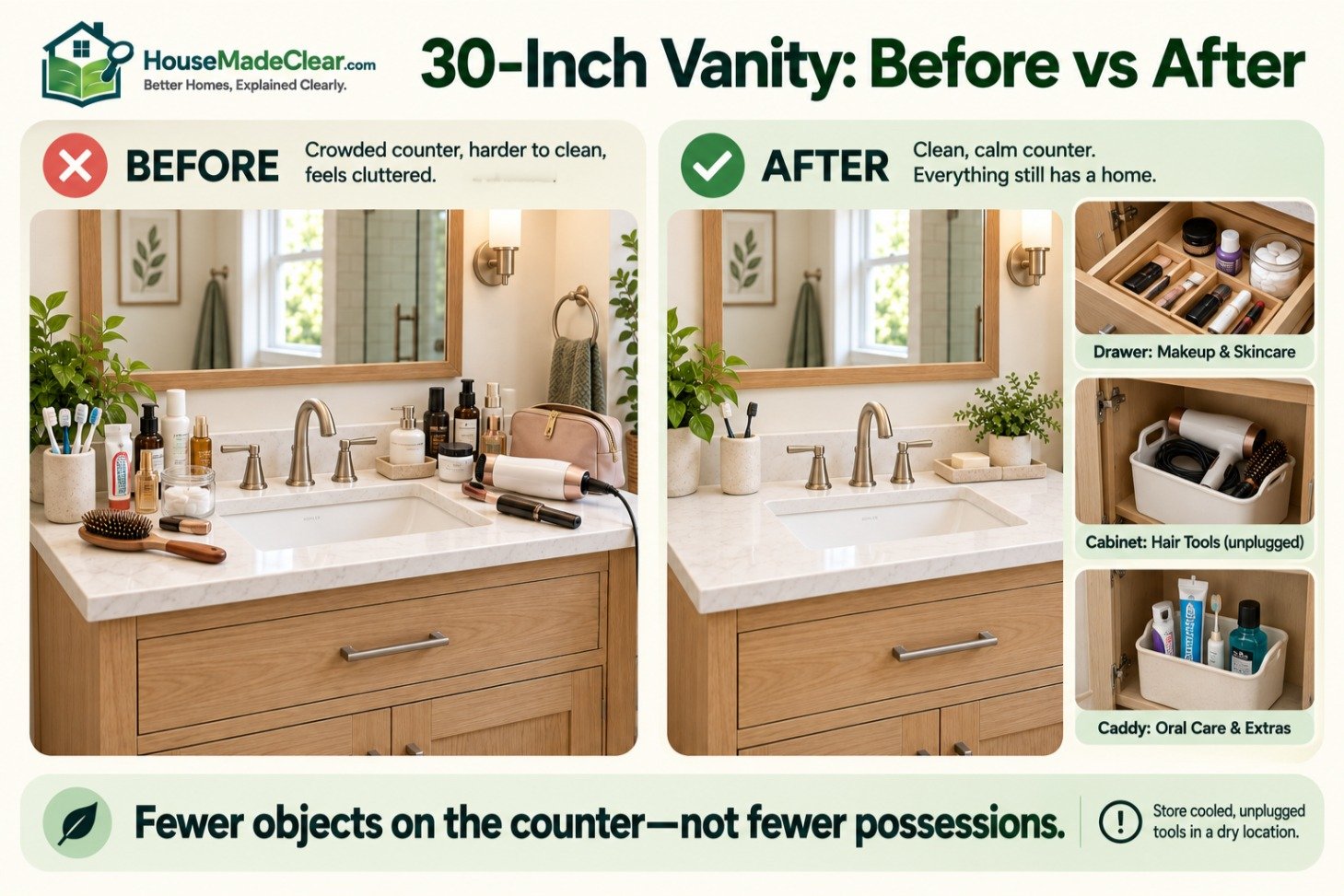
Consider a small bathroom with a 30-inch-wide vanity and one sink.
Before organizing, the counter contains:
- Two toothbrushes
- Two toothpaste tubes
- Four skincare bottles
- A hairbrush
- A hand-soap dispenser
- A perfume bottle
- Cotton pads
- A makeup bag
- A hair dryer
That’s fourteen separate items or groups competing for limited space.
Before: Crowded Vanity
| Item | Current Location |
|---|---|
| Toothbrushes and toothpaste | Loose on counter |
| Soap | Counter |
| Skincare | Counter |
| Hairbrush | Counter |
| Perfume | Counter |
| Cotton pads | Counter |
| Makeup bag | Counter |
| Hair dryer | Counter |
After: Organized Vanity
| Item | New Location |
|---|---|
| Toothbrushes and toothpaste | Compact oral-care holder |
| Soap | Beside sink |
| Frequently used skincare | Small tray or top drawer |
| Occasional skincare | Vanity cabinet |
| Hairbrush | Drawer or caddy |
| Perfume | Suitable storage outside humid bathroom if needed |
| Cotton pads | Drawer container |
| Makeup bag | Dedicated drawer or portable caddy |
| Hair dryer | Safe, dry storage away from sink |
The result is not necessarily fewer possessions.
It’s fewer objects occupying the countertop at the same time.
This is the difference between organizing the surface and simply rearranging the clutter.
How to Maintain a Clutter-Free Bathroom Countertop
Once the counter is organized, maintaining it should be straightforward.
| Frequency | Task |
|---|---|
| After daily routines | Return products to assigned storage |
| Daily or as needed | Wipe water and obvious residue |
| Weekly | Lift trays, clean underneath, and remove misplaced items |
| Monthly | Check duplicates, containers, and product condition |
| Seasonally | Review unused products and adjust storage |
If moisture routinely remains on the counter or nearby cabinets, investigate splashing, leaks, or ventilation.
Our guide to bathroom humidity after a shower explains how moisture can linger and when ventilation problems deserve attention.
A tidy surface should also be easy to clean. If an organizer makes wiping the vanity difficult, it may not be the right solution.
Frequently Asked Questions
How do I organize my bathroom counter without buying anything?
Remove everything, keep only daily essentials on the counter, and use existing drawers or cabinets for the rest. Group similar products together and repurpose suitable washable containers where needed.
What should I keep on a bathroom countertop?
Usually, only frequently used items such as hand soap, toothbrushes, toothpaste, and a small number of daily grooming products. Other items can go into drawers, cabinets, or nearby storage.
How do you organize a very small bathroom counter?
Keep the surface nearly clear, use a compact holder for daily essentials, and move toiletries into wall storage, a medicine cabinet, or a portable caddy. Avoid oversized countertop organizers.
What is the best organizer for a bathroom counter?
The best organizer depends on the available space and what you need to store. A small washable tray is useful for a few daily products, while a compact tiered organizer may help when several bottles must remain accessible.
How do you organize a bathroom counter with no drawers?
Use a suitable wall-mounted shelf, medicine cabinet, narrow storage unit, or portable grooming caddy. Keep only the essentials at the sink and store everything else nearby.
How can I keep my bathroom counter from getting cluttered again?
Assign every product a permanent location and return it after use. Keep backups off the counter and review the arrangement when the number of products increases.
Give each person a separate drawer, basket, or storage section. Keep only shared essentials and a few genuinely daily-use products on the countertop.
Final Thoughts
Organizing a bathroom countertop starts with deciding what deserves to stay there.
A small tray, divided drawer, or wall-mounted holder can make everyday items easier to access, but none will help much if the counter is still storing every product in the bathroom.
Keep the essentials close, move backups and occasional-use products into appropriate storage, and preserve enough open space to use the sink comfortably.
For small bathrooms, focus on compact storage and simplicity. For larger or shared vanities, assign clear personal-use zones rather than spreading everything across the surface.
The best bathroom counter organization system is one that fits your routine and takes very little effort to maintain.