

















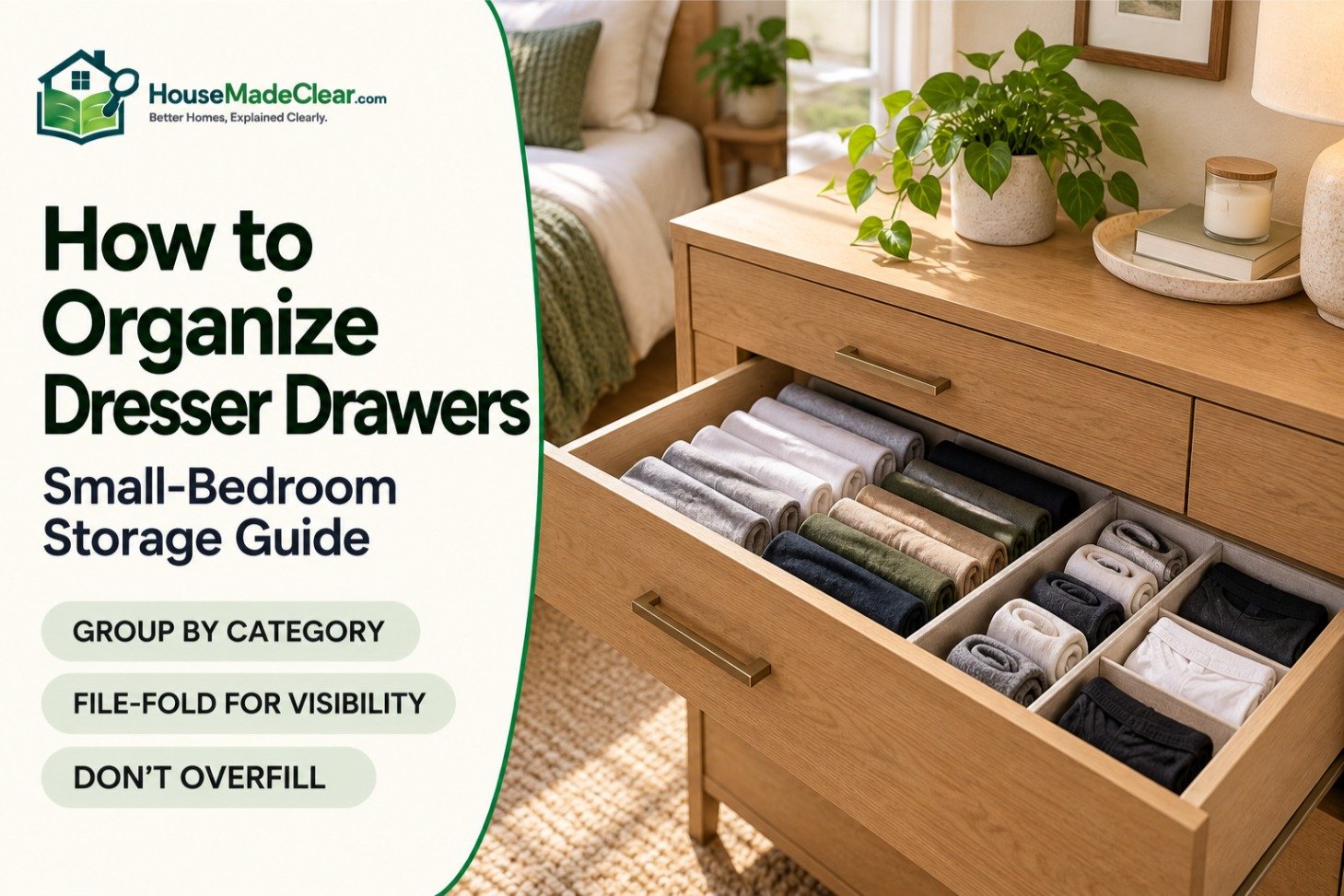
A small bedroom can feel cluttered even when everything technically fits. Open a dresser drawer, and you might find T-shirts buried under jeans, socks mixed with underwear, or clothes you forgot you owned.
The problem isn’t always that you need more storage. Often, the space inside your dresser simply isn’t being used effectively.
When drawers are filled with uneven stacks, bulky organizers, and clothes you rarely wear, it’s difficult to find what you need. You end up rearranging the same items every time you get dressed.
Organizing dresser drawers in a small bedroom starts with a few simple changes: remove what you don’t use, group similar clothing, fold items so they’re visible, and divide each drawer into practical sections.
You don’t need an expensive organizing system or a bigger dresser to make these changes.
This guide explains how to organize dresser drawers step by step, where to store different clothing types, how to fold clothes to save space, and what to do when your dresser is too small for everything.
Quick Answer
The best way to organize dresser drawers in a small bedroom is to group clothes by category, use vertical file folding, and create separate sections for smaller items.
Start with these steps:
- Empty one drawer at a time.
- Remove clothes you no longer wear.
- Group similar items, such as T-shirts, socks, and underwear.
- Measure the usable drawer dimensions.
- File-fold clothing into visible rows instead of tall stacks.
- Use dividers or small bins where they genuinely help.
- Place frequently worn clothes in the easiest drawers to reach.
- Move bulky or seasonal items elsewhere.
The main goal: You should be able to open a drawer, see what it contains, and remove one item without disturbing everything else.
How to Organize Dresser Drawers: Step-by-Step
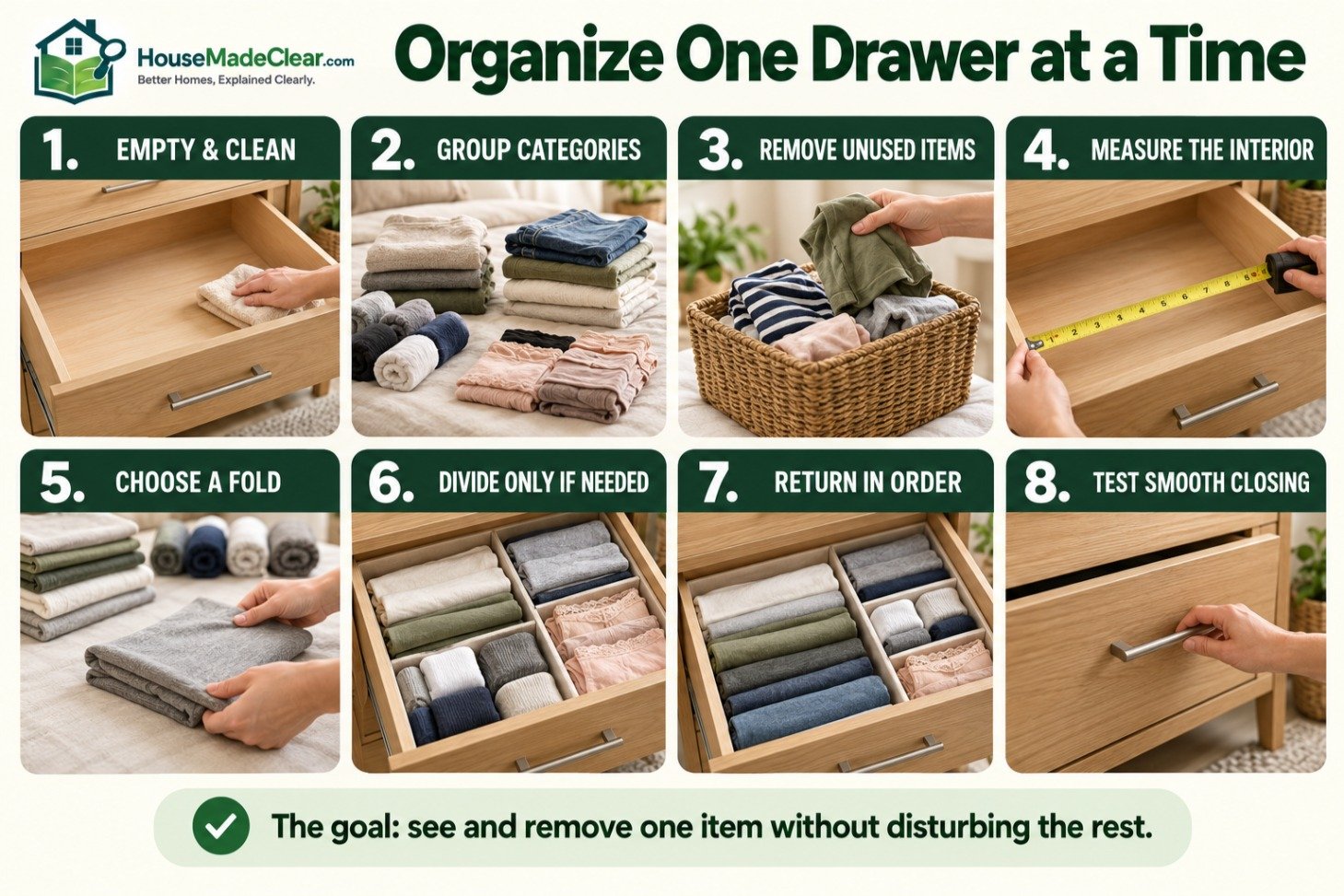
The easiest way to organize a dresser is to work through it one drawer at a time.
Emptying an entire wardrobe onto the bed may seem efficient, but it can quickly turn a small bedroom into a temporary storage problem.
Working drawer by drawer keeps the project manageable.
Step 1: Empty and Clean the Drawer
Remove everything from the first drawer.
Set the contents on the bed or another clean surface.
Check for:
- Clothes that don’t belong in the drawer
- Damaged garments
- Items you no longer wear
- Loose accessories
- Forgotten receipts or small objects
- Dust and lint
Wipe the drawer interior using a cleaning method suitable for the furniture finish, and let it dry before putting clothing back.
Inspect drawer slides and bottoms for damage before adding heavy items.
Step 2: Sort Clothes Into Categories
Don’t begin folding immediately.
First, group similar items.
Useful categories include:
- Everyday T-shirts
- Work or casual tops
- Underwear
- Socks
- Pajamas
- Workout clothes
- Leggings
- Jeans
- Shorts
- Seasonal accessories
Avoid creating a separate drawer for every category unless you have enough drawers to support that arrangement.
For a small dresser, several related categories can share a drawer using simple dividers.
Step 3: Remove Clothes You Don’t Need
The fastest way to make a dresser feel larger is to stop storing unused clothes in its prime space.
Ask yourself:
- Have I worn this recently?
- Does it still fit?
- Is it comfortable?
- Is it damaged beyond practical repair?
- Do I already have several similar items?
- Does it belong in this season’s wardrobe?
Keep what you regularly wear or have a clear reason to retain.
Move out-of-season items to a suitable secondary storage area.
Don’t force yourself to discard useful clothing just to make a drawer look minimalist. The goal is functional organization, not an arbitrary item count.
Step 4: Measure the Drawer Interior
Before buying organizers, measure the usable interior.
Record:
- Width
- Front-to-back depth
- Usable height
- Any obstruction caused by drawer construction
Remember that the inside dimensions are smaller than the dresser’s external measurements.
Our dresser dimensions guide explains how dresser size, drawer depth, and floor-space requirements affect bedroom storage.
Step 5: Choose a Folding Method
For most shirts, leggings, and lightweight clothing, vertical file folding is a practical choice.
For bulky jeans or sweaters, you may prefer file folding, a short stack, or shelf storage.
Choose the method that keeps items visible and easy to remove.
Step 6: Divide the Drawer Where Needed
Use organizers to separate categories, not simply to fill every available inch.
For example, a drawer containing socks and underwear may benefit from compartments.
A drawer holding only file-folded T-shirts may need no dividers at all.
Step 7: Return Clothing in a Consistent Order
Place clothes with the most frequent use where they’re easiest to reach.
Items used less often can go toward the back or into lower drawers.
Check that each drawer opens and closes without catching fabric.
Best Dresser Drawer Layout by Clothing Type
A practical dresser arrangement depends on the number of drawers available.
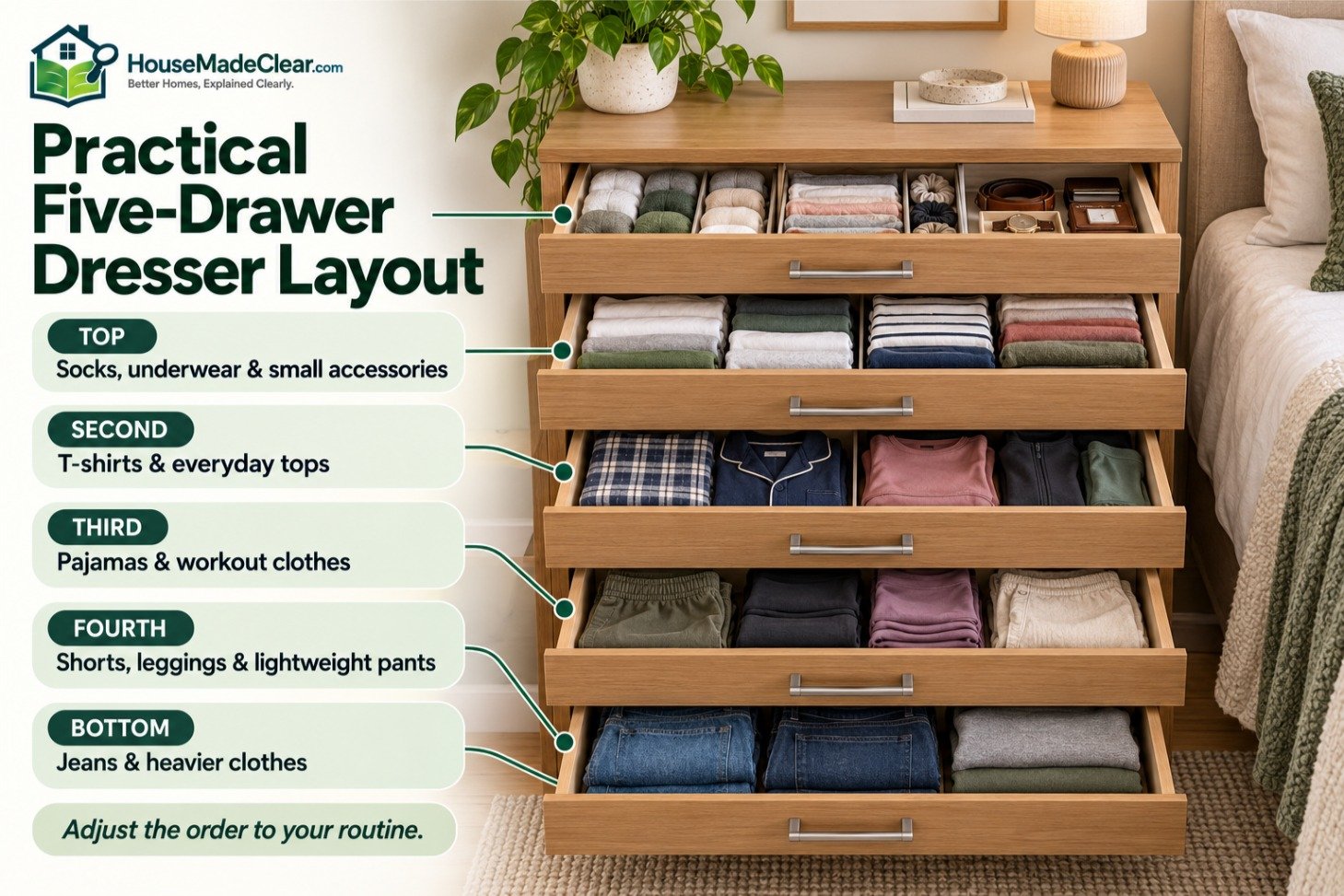
Here is one example for a five-drawer dresser.
| Drawer | What to Store | Organization Method |
|---|---|---|
| Top drawer | Socks, underwear, small accessories | Small divided sections |
| Second drawer | T-shirts and everyday tops | Vertical file folding |
| Third drawer | Pajamas and workout clothes | Separate rows or compartments |
| Fourth drawer | Shorts, leggings, lightweight pants | File folding |
| Bottom drawer | Jeans or heavier casual clothes | Short stacks or vertical folding |
This isn’t a rule that every dresser must follow.
If you exercise daily, workout clothes may belong in a higher drawer. If you wear jeans every day, keeping them in the bottom drawer may be inconvenient.
Design the layout around your routine.
What Should Go in the Top Dresser Drawer?
The top drawer is often a practical place for smaller, frequently used items.
Examples include:
- Underwear
- Socks
- Handkerchiefs
- Lightweight accessories
- Everyday essentials
Using dividers can prevent these items from becoming mixed together.
Avoid treating the top drawer as a miscellaneous junk drawer.
What Should Go in the Middle Drawers?
Middle drawers are commonly easy to see and access.
They’re useful for everyday clothing such as:
- T-shirts
- Casual tops
- Sleepwear
- Workout clothing
- Leggings
Vertical folding works especially well here because you can see many items at once.
What Should Go in the Bottom Drawer?
Lower drawers can hold clothes you use less frequently or items that are more convenient to store near the floor.
Examples include:
- Jeans
- Thick sweatshirts
- Seasonal clothing
- Spare pajamas
Do not overload a drawer or exceed the furniture manufacturer’s weight limit.
Heavy loads and extended drawers can affect dresser stability.
How to Fold Clothes to Save Space in Dresser Drawers
The way you fold clothes often matters more than how many organizers you buy.
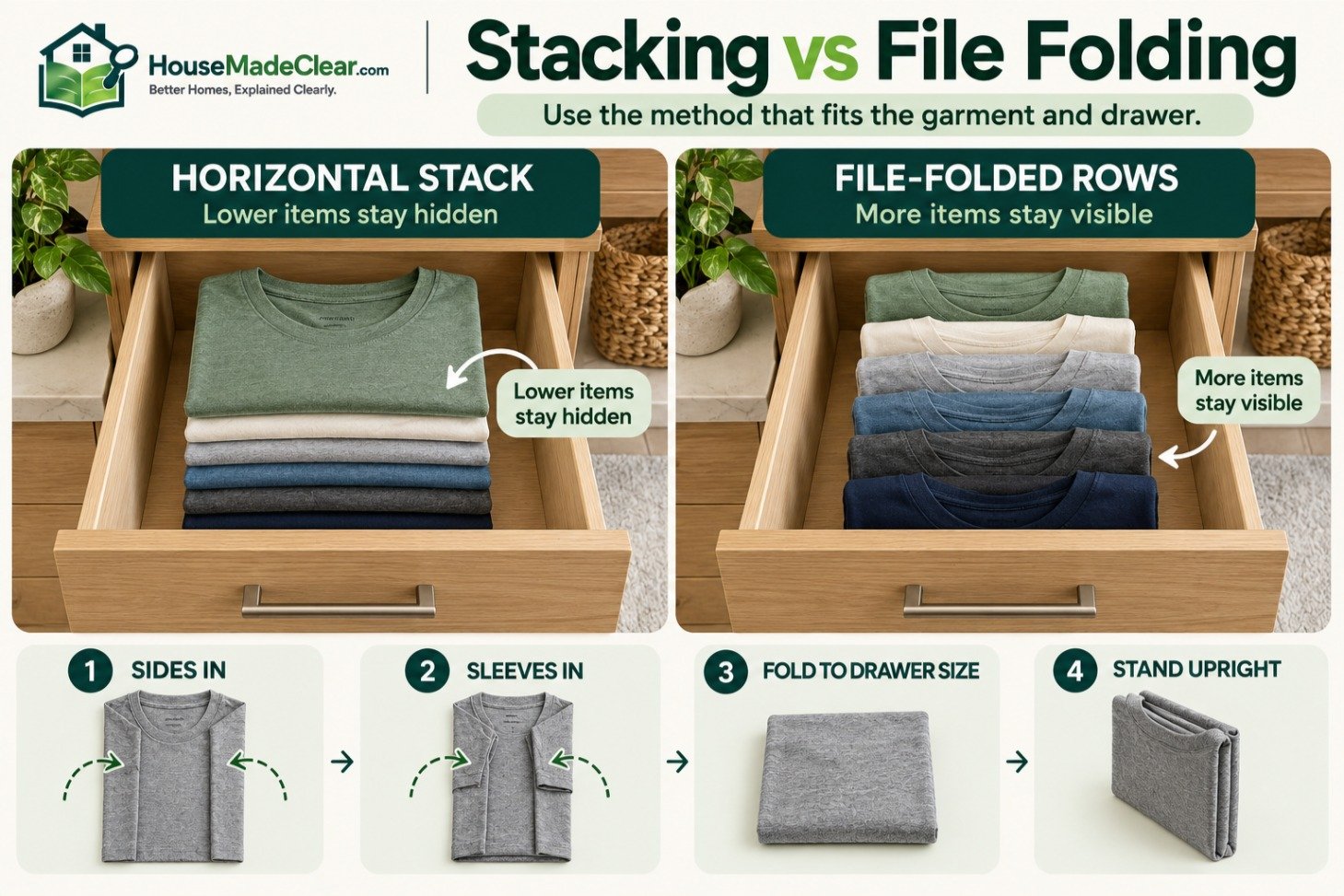
Traditional horizontal stacking places one garment on top of another.
That works for some items, but it makes the clothes underneath harder to see.
Vertical file folding arranges garments in rows, similar to folders in a filing cabinet.
This allows you to see more of the drawer’s contents without lifting the entire stack.
Professional organizers interviewed by Good Housekeeping recommend file folding for better visibility and easier access, particularly for T-shirts, sweaters, and casual clothing.
How to File-Fold T-Shirts
- Lay the T-shirt flat.
- Smooth out major wrinkles.
- Fold one side toward the center.
- Fold the sleeve inward.
- Repeat on the opposite side.
- Fold the shirt lengthwise as needed to match your drawer width.
- Fold the bottom upward into a compact rectangle.
- Check that the finished bundle fits below the drawer’s usable height.
- Stand it upright inside the drawer.
Arrange the folded shirts in rows.
If the clothes fall over, adjust the fold or add a simple divider.
The exact number of folds depends on the shirt size and drawer height.
How to Fold Jeans in a Drawer
Jeans are thicker than T-shirts, so they require a slightly different approach.
- Lay the jeans flat.
- Fold one leg over the other.
- Smooth the fabric.
- Fold the bottom upward.
- Make another fold if the drawer depth and height allow.
- Store vertically if the folded bundle stays stable.
For heavy denim, short horizontal stacks may be more practical.
Don’t force thick jeans into narrow vertical compartments if doing so makes the drawer hard to close.
How to Fold Leggings
Leggings are usually easy to store vertically.
Fold them lengthwise, then fold into a compact rectangle.
Avoid tightly rolling every pair if the resulting bundles take up awkward amounts of space.
Keep similar workout bottoms together so you can find a complete outfit without searching several drawers.
How to Fold Sweaters
Sweaters often take up more volume than shirts.
Fold sleeves inward and create a flat rectangle.
For thick knitwear, shallow stacks on a closet shelf may work better than squeezing several bulky sweaters into a dresser.
Hanging some knitted garments can cause stretching, so follow the garment’s care instructions.
If you’re choosing between drawers and open shelving, our closet shelf height and spacing guide explains how to accommodate folded clothing without creating unnecessarily tall stacks.
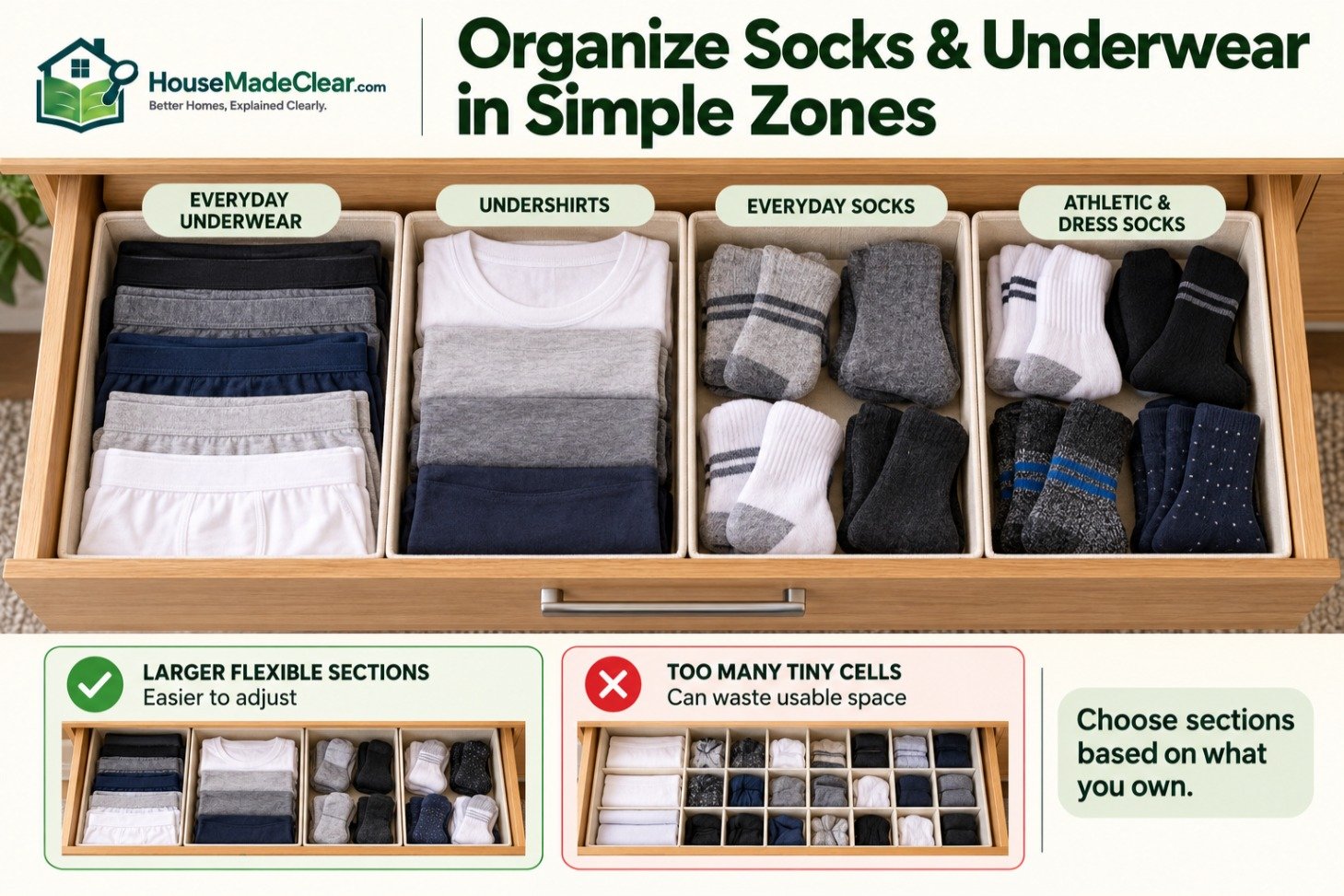
How to Organize Socks and Underwear Drawers
Socks and underwear are small enough to fit almost anywhere, but they can become difficult to manage when mixed together.
The simplest solution is to create separate zones.
Organizing Underwear
Group underwear by type or everyday use.
For example:
- Everyday underwear
- Specialty or occasional-use items
- Undershirts or similar small garments
Use compact dividers if they help keep categories separate.
Avoid organizers with compartments so small that clothing must be forced into them.
Organizing Socks
Store pairs together and group them by purpose.
Possible categories include:
- Everyday socks
- Athletic socks
- Dress socks
- Winter socks
Rolling socks into tight balls can stretch the cuffs of some designs. Folding pairs together loosely may be gentler.
Do You Need Individual Sock Compartments?
No.
Small individual compartments look tidy, but they don’t always use drawer space efficiently.
A few larger sections may accommodate more socks and be easier to maintain.
Choose the arrangement based on how many pairs you have.
Best Drawer Organizers for a Small Bedroom
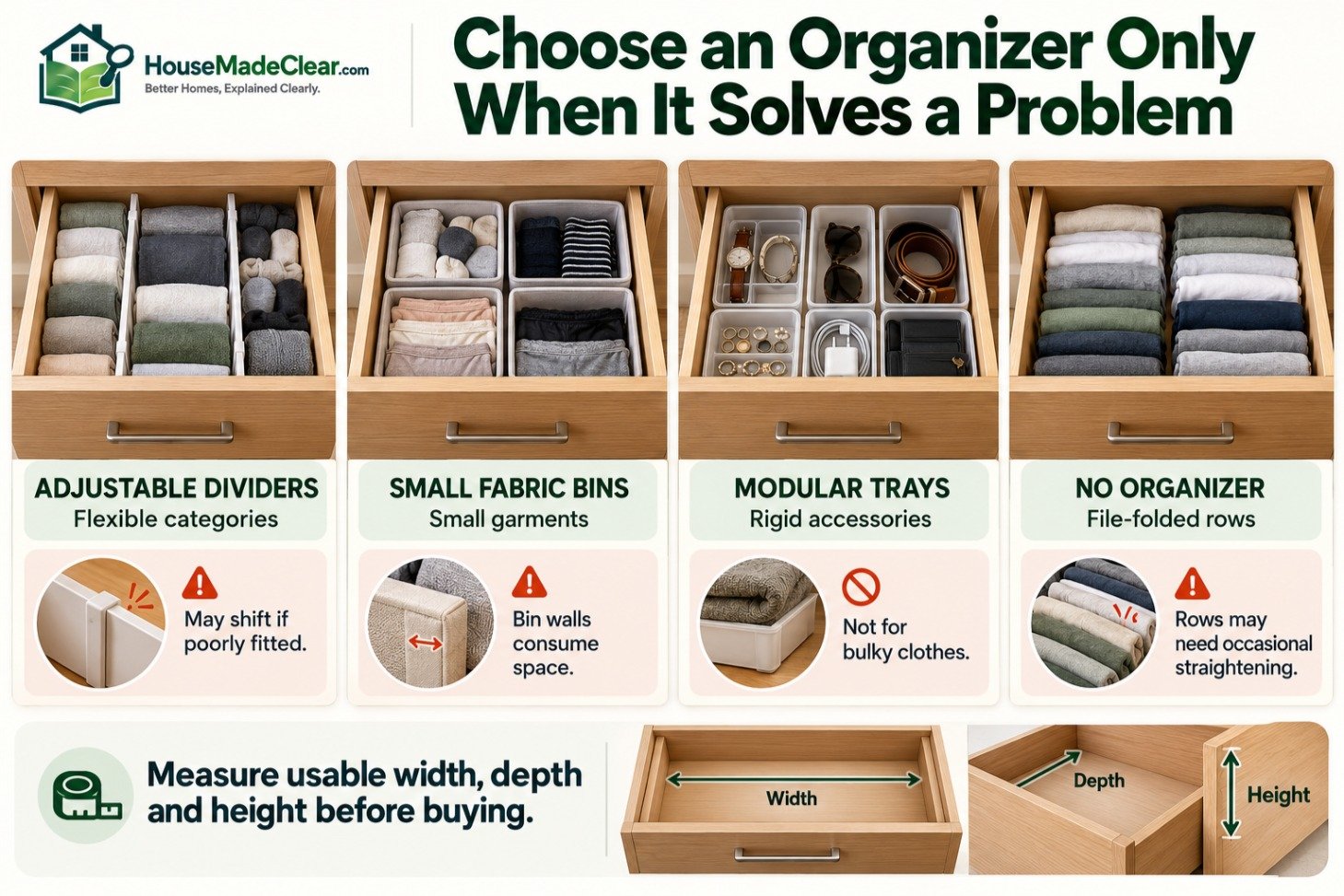
Drawer organizers can help, but buying too many is a common mistake.
Every organizer occupies some usable space.
A thick divider may consume space that could otherwise hold another garment.
Choose organizers according to a specific problem.
| Organizer | Best Use | Main Limitation |
|---|---|---|
| Adjustable dividers | Separating clothing categories | May shift if poorly fitted |
| Small fabric bins | Socks, underwear, accessories | Walls reduce usable space |
| Modular plastic trays | Small rigid objects | Less useful for bulky clothing |
| Fabric drawer cells | Lightweight folded garments | Fixed compartment sizes |
| Shallow baskets | Seasonal accessories | Can waste height |
| DIY cardboard dividers | Low-cost temporary organization | Less durable |
| No organizer | File-folded T-shirts and jeans | Rows may need occasional adjustment |
Are Adjustable Drawer Dividers Worth It?
They can be useful when you want one drawer to hold several categories.
For example, a wide drawer may have three sections:
- Socks
- Underwear
- Undershirts
Adjustable dividers make it easier to adapt the arrangement later.
Are Fabric Drawer Organizers Better?
Fabric bins can work well for delicate clothing and small accessories.
However, some collapse or lose their shape when only partly filled.
Measure the usable drawer height before buying them.
Can You Organize Drawers Without Buying Anything?
Yes.
Try folding clothes into uniform rows first.
If you need dividers, repurpose clean, sturdy boxes with finished edges and a suitable fit.
Only buy dedicated organizers if the simple arrangement doesn’t remain stable.
How to Organize Deep Dresser Drawers
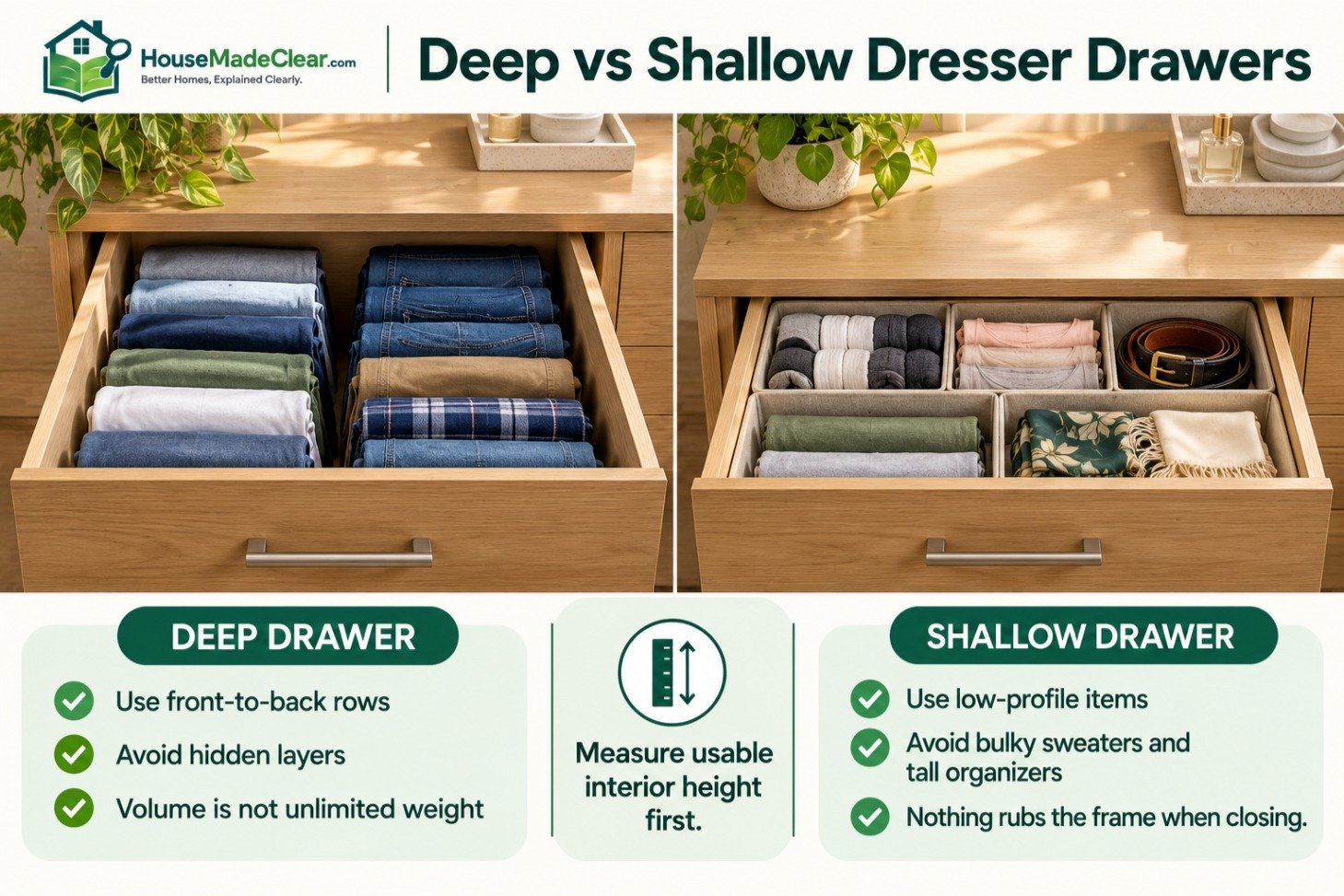
Deep drawers can hold more clothing, but they also make it easy to bury things.
The challenge is using the depth without creating layers of forgotten items.
Use the Full Front-to-Back Space
Arrange file-folded clothing in rows that extend toward the back.
Keep the categories distinct.
For example, use one row for casual T-shirts and another for workout tops.
Avoid Stacking Multiple Layers of Small Items
If you place socks beneath shirts, you may forget the socks are there.
Deep drawers are better used for appropriately sized bundles, thicker clothing, or organizers designed for the extra depth.
Keep Heavy Clothing Manageable
Deep drawers may accommodate jeans, sweatshirts, or thick pajamas.
But more storage volume does not mean unlimited weight capacity.
Avoid filling drawers until they are difficult to move or the drawer bottoms begin to sag.
How to Organize Shallow Dresser Drawers
Shallow drawers need a different strategy.
If the drawer is only a few inches high, vertically folded clothing may sit too tall.
Best Items for Shallow Drawers
- Underwear
- Socks
- Scarves
- Belts
- Lightweight accessories
- Thin shirts, folded flat
- Small personal items
What Should You Avoid?
Bulky sweaters, heavy sweatshirts, and oversized dividers often waste the available space.
Measure the internal height before deciding on file folding.
A garment should fit without touching or rubbing the underside of the dresser frame as the drawer closes.
How to Organize a Small Three-Drawer Dresser
A three-drawer dresser requires more thoughtful category grouping because each drawer has to serve multiple purposes.
Here’s one practical arrangement.
| Drawer | Suggested Contents |
|---|---|
| Top | Underwear, socks, and accessories |
| Middle | Everyday tops and lightweight clothing |
| Bottom | Pants, sleepwear, and workout clothes |
Divide wider drawers into two or three zones instead of mixing everything together.
If you have more clothes than the dresser comfortably holds, use closet hanging space or secondary storage rather than overstuffing each drawer.
Our standard closet rod height guide explains how to make use of hanging storage for shirts, jackets, and other garments that don’t need to occupy drawers.
How to Organize a Small Bedroom Without a Large Dresser
Sometimes drawer organization reveals a more basic issue: the dresser genuinely isn’t large enough for the wardrobe.
If you’ve removed unused items and improved folding but the drawers still won’t close comfortably, don’t keep compressing clothes.
Consider distributing clothing based on how often you use it.
Everyday Clothes
Keep your most frequently worn clothes in the dresser.
These should be easy to reach without moving other items.
Occasional Clothing
Move less frequently used clothing to shelves, a wardrobe, or a suitable storage container.
Seasonal Clothing
Consider under-bed storage or another dry, accessible location for items that won’t be used for several months.
Avoid placing clothes in damp, poorly ventilated spaces.
For more options, see our guide to small bedroom storage ideas without a closet.
Should You Add Another Dresser?
Not automatically.
A second dresser may provide storage but eliminate valuable walking space.
Before adding furniture, consider whether a wardrobe, shelf, or more efficient existing layout would solve the problem with less floor-space impact.
If you’re choosing a new storage cabinet, our standard wardrobe dimensions guide can help compare hanging and folded-clothing capacity.
How Much Clothing Can Fit in a Dresser Drawer?
There is no reliable universal number.
Capacity depends on:
- Usable drawer dimensions
- Fabric thickness
- Clothing size
- Folding method
- Organizer thickness
- Drawer weight rating
A drawer may hold many lightweight T-shirts but far fewer thick sweaters.
Example: Organizing a 28-Inch-Wide Drawer
Suppose a drawer has these usable dimensions:
- Width: 28 inches
- Depth: 15 inches
- Height: 6 inches
You file-fold your T-shirts into bundles measuring approximately:
- 7 inches across
- 2 inches thick
- 5 inches high
Across the width, four 7-inch sections would fit mathematically:
28 ÷ 7 = 4 sections
Along the 15-inch drawer depth, approximately seven 2-inch-thick bundles could fit per section, allowing a little space:
7 × 4 = 28 T-shirts
That is a theoretical packing example, not a recommended target.
Real fabrics vary in compression, and tightly packing 28 shirts may make the drawer difficult to use.
The important test is whether the drawer closes smoothly and you can remove one shirt without upsetting the others.
Don’t Fill Every Inch
Leave a little room for clothing to shift.
If pulling out one garment causes several others to unfold, the drawer is too crowded or the folding arrangement needs adjusting.
How to Organize Dresser Drawers for Two People
Sharing a dresser can work in a small bedroom when there is a clear separation between belongings.
You don’t necessarily need matching drawer space for each person.
Instead, divide the storage according to actual clothing volume and frequency of use.
Option 1: Separate Drawers
Assign dedicated drawers to each person.
This is straightforward but may not work if one person has significantly more folded clothing.
Option 2: Separate Sections
Use dividers within wide drawers.
For example, one person uses the left section and the other uses the right.
Option 3: Organize by Function
Keep categories such as sleepwear or workout clothing together while maintaining clear divisions between individuals.
Whichever system you choose, both people should be able to find and return their clothing without reorganizing the drawer every time.
Where Should You Put a Dresser in a Small Bedroom?
Drawer organization won’t help much if the dresser is blocked by the bed or positioned where its drawers cannot open fully.
A dresser needs both floor space and operating clearance.
Good Locations to Consider
- Along a wall opposite the bed
- Beside the bed as a combined dresser and nightstand
- On an unobstructed short wall
- Inside a sufficiently large closet, if dimensions and accessibility allow
The correct placement depends on the bedroom layout.
Our guide to where to put a dresser in a small bedroom explains practical placement options and how to avoid interfering with doorways and circulation.
Use a Dresser as a Nightstand
A low dresser beside the bed can replace a separate nightstand.
This reduces the number of furniture pieces in the room.
However, the top should remain easy to reach, and drawers need adequate opening space.
Compare the dresser with our standard nightstand dimensions guide before combining these functions.
Test the Overall Room Layout
If you are rearranging several furniture pieces, use the Bedroom Furniture Fit Calculator to check whether the proposed layout physically fits and whether preferred clearances can be maintained.
A dresser that fits inside the room isn’t necessarily convenient if its drawers open directly into a narrow walkway.
Dresser Safety: Don’t Overlook Tip-Over Risks
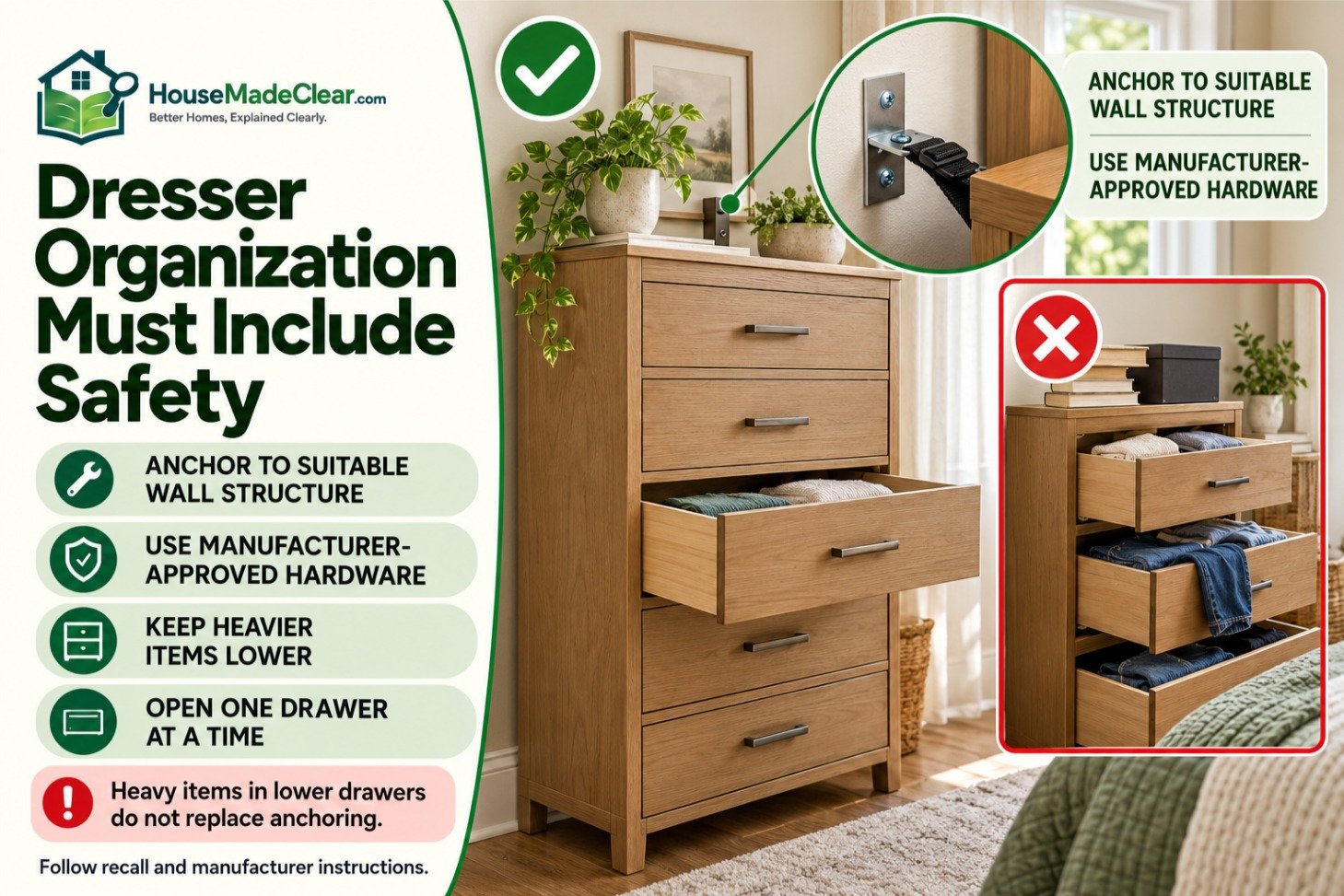
Organizing a dresser isn’t only about saving space.
Tall or unstable dressers can tip forward, particularly when drawers are opened or children climb on them.
The U.S. Consumer Product Safety Commission’s Anchor It! furniture safety campaign emphasizes securing furniture to help prevent tip-over injuries.
Essential Safety Practices
- Secure dressers using manufacturer-approved anti-tip hardware.
- Attach restraints to suitable wall structure according to the instructions.
- Keep heavy items in lower drawers where practical.
- Don’t allow children to climb on drawers.
- Avoid placing tempting toys or objects on top of furniture that could encourage climbing.
- Never exceed the dresser’s rated load.
- Check drawers and slides for damage.
Placing heavy clothing in the bottom drawer is not a substitute for anchoring the furniture.
If your dresser has been recalled, follow the official recall instructions rather than assuming an anchor makes it safe.
Common Dresser Drawer Organization Mistakes
Buying Organizers Before Measuring
An organizer that looks useful online may not fit the drawer.
Measure the usable interior first.
Folding Every Item the Same Way
T-shirts, jeans, socks, and sweaters don’t all need identical folding methods.
Use the method that fits the garment and drawer.
Creating Too Many Categories
Highly detailed categories can become difficult to maintain.
For most households, a few clearly defined sections work better.
Keeping Clothes You Never Wear in Prime Space
Frequently used drawers should hold frequently used clothing.
Move occasional-use items elsewhere.
Overstuffing Drawers
If drawers catch on clothing or require force to close, reduce the contents.
Using Too Many Dividers
Organizers can consume substantial drawer space.
Use them only when they solve a real problem.
Ignoring Drawer Safety
Check the furniture’s stability and anchor it appropriately.
Forgetting to Maintain the System
A drawer layout needs to be simple enough that you can put clothes away without spending several minutes arranging them.
How to Keep Dresser Drawers Organized
An organization system only works if it’s easy to maintain.
You don’t need to reorganize the entire dresser every week.
A short routine is enough.
| When | What to Do |
|---|---|
| While putting away laundry | Return items to their assigned sections |
| Weekly | Straighten loose rows and remove misplaced items |
| Monthly | Check for overcrowding and damaged clothing |
| Seasonally | Move out-of-season garments and reassess storage |
| When buying new clothing | Decide where the new item belongs |
| When a drawer becomes difficult to close | Remove excess items and check the arrangement |
The system should adapt when your wardrobe changes.
If your drawers regularly become messy after laundry day, simplify the categories rather than adding more storage accessories.
Dresser Drawer Organization Checklist
| Check | What to Aim For |
|---|---|
| Drawer contents | One or a few related categories |
| Clothing visibility | Most items visible when opened |
| Folding method | Suits the garment and drawer height |
| Dividers | Used only where helpful |
| Drawer capacity | No forced closing |
| Everyday access | Frequent-use items easy to reach |
| Seasonal clothing | Stored separately when practical |
| Drawer opening | No furniture obstruction |
| Structural condition | Slides and bottoms in good condition |
| Safety | Dresser properly anchored |
| Maintenance | Simple enough to follow consistently |
Final Thoughts
Organizing dresser drawers in a small bedroom doesn’t require a complete storage makeover.
Start by removing what you don’t use, grouping similar clothes, and choosing folding methods that make everything easy to see.
For T-shirts, leggings, and other lightweight clothing, file folding can make drawers more accessible. Small dividers help keep socks and underwear separated, while thicker clothes may be better stored in short stacks or on closet shelves.
Most importantly, don’t try to solve every storage problem by filling the drawers more tightly.
A useful dresser is one where clothes fit comfortably, drawers open smoothly, and everyday items are easy to find.
If your dresser remains overcrowded after reorganizing, consider whether some clothing belongs in hanging storage, under-bed containers, or a wardrobe.
The goal isn’t to fit the greatest possible number of garments into each drawer. It’s to make a small bedroom easier to use every day.
Frequently Asked Questions
What is the best way to organize dresser drawers?
Group similar clothing together, remove unused items, and use file folding for garments such as T-shirts and leggings. Add dividers where necessary so you can see and remove items without disturbing the rest.
How do you organize dresser drawers without buying organizers?
Fold clothing into uniform rows, assign each drawer a purpose, and reuse suitable clean boxes as temporary dividers. Many T-shirt and jeans drawers can remain organized without separate accessories.
Is rolling or folding clothes better for drawers?
File folding is often better for visibility and accessibility, while rolling may work for small or flexible items. The best choice depends on fabric thickness, available drawer space, and how easily the clothing can be removed.
What should go in the top dresser drawer?
The top drawer is commonly used for small, frequently needed items such as socks, underwear, undershirts, and accessories. However, the ideal contents depend on the user’s routine and drawer dimensions.
How do you organize a small three-drawer dresser?
Use the top drawer for smaller essentials, the middle drawer for everyday tops, and the bottom drawer for pants, sleepwear, or workout clothing. Divide shared drawers into sections and move bulky seasonal items elsewhere.
How do you keep clothes from getting messy in drawers?
Use a consistent folding method, avoid overfilling, keep similar items together, and return laundry to the same sections. If the arrangement is difficult to maintain, reduce the number of categories or dividers.
Should jeans be folded or hung?
Both methods can work. Folded jeans fit in suitably sized drawers or shelves, while hanging may be convenient when drawer space is limited. Choose based on the available storage and how often you wear them.