
















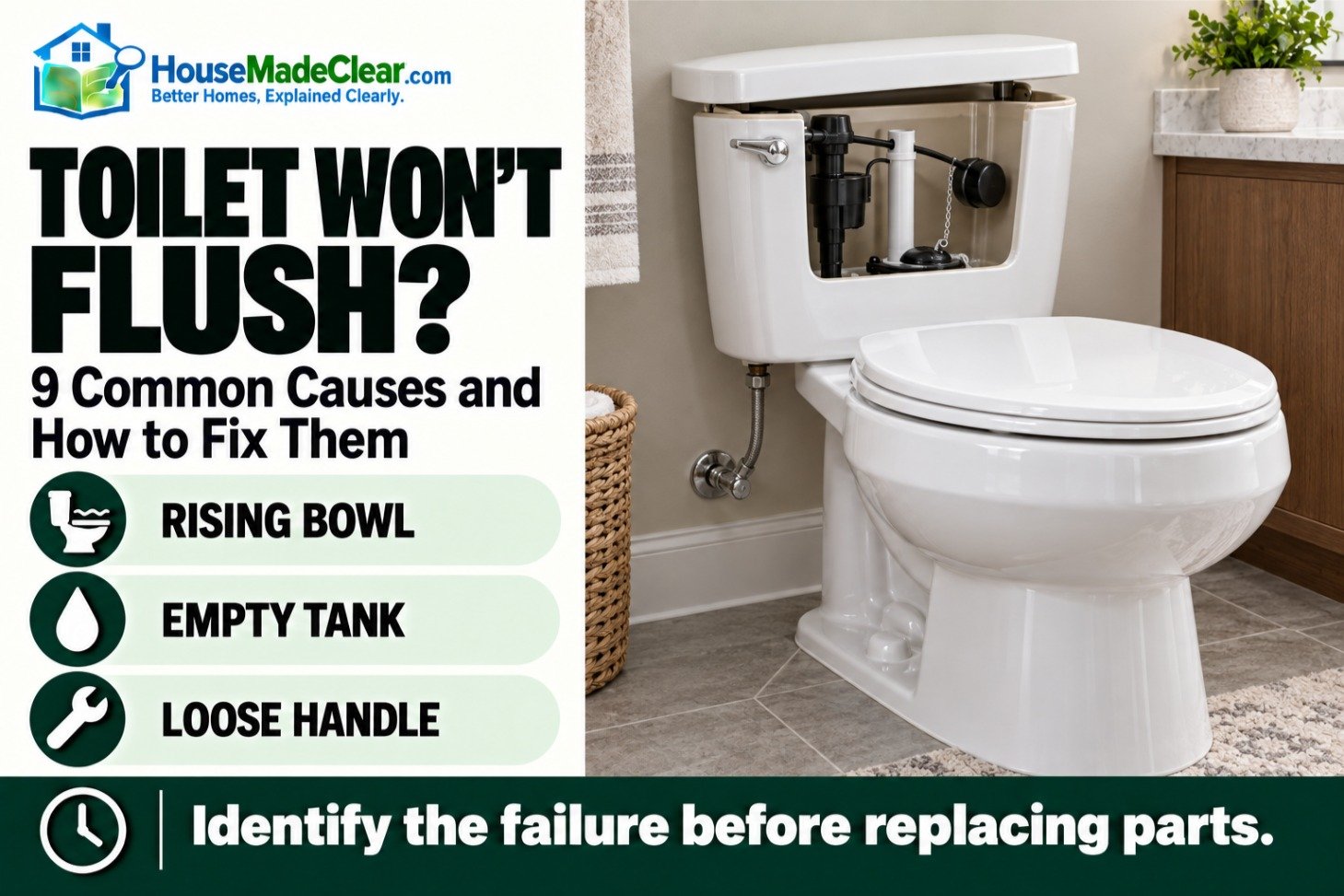
You press the toilet handle, expecting the bowl to empty, but nothing happens. Maybe the handle feels loose, the water barely moves, or the bowl fills dangerously close to the rim.
A toilet that won’t flush can be frustrating, especially when it’s the only toilet in the house.
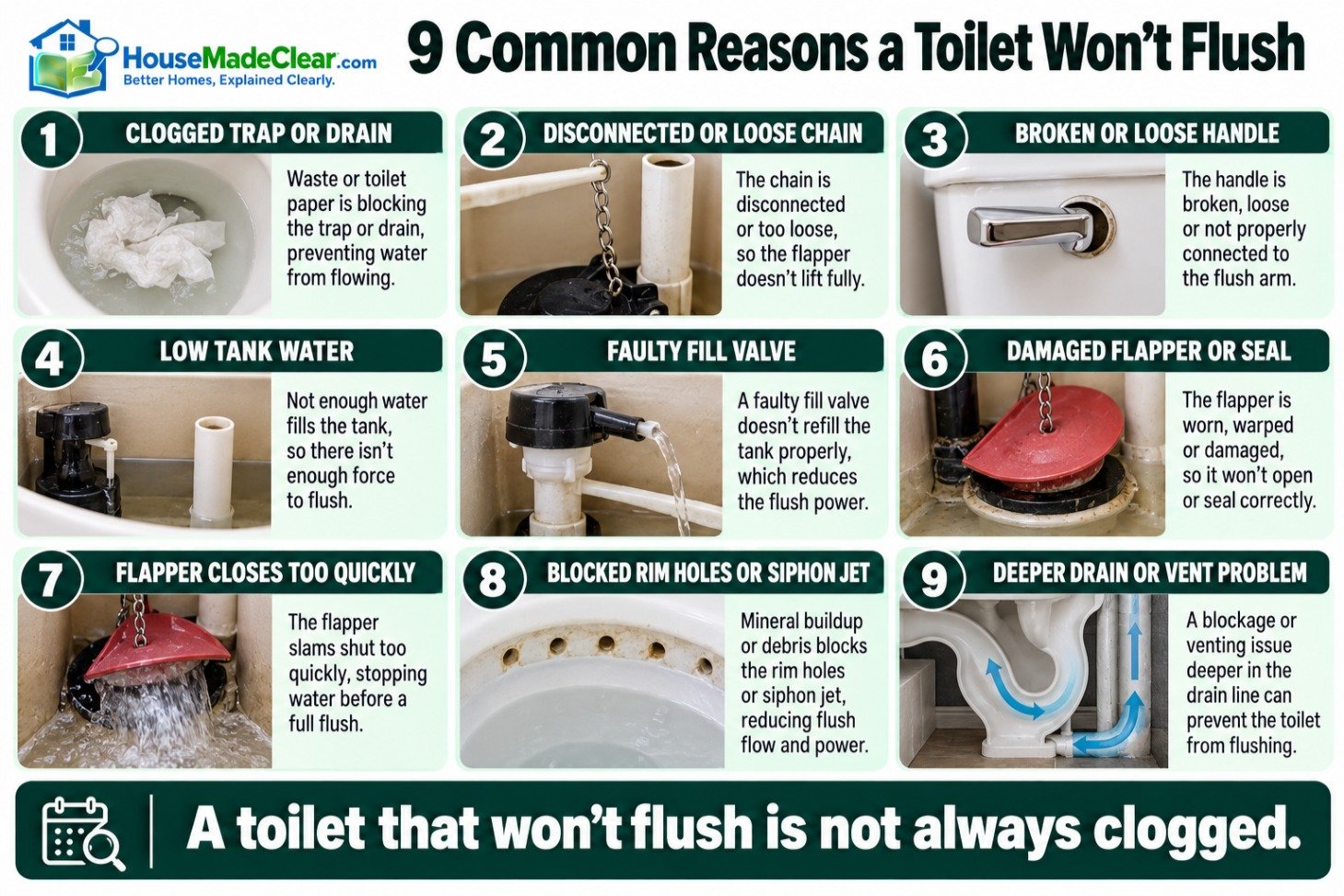
Fortunately, many flushing problems have relatively simple causes, including a disconnected lift chain, low tank water, a worn flapper, or a partial clog.
However, a toilet that won’t flush is not always clogged. Sometimes the bowl and drain are clear, but the tank isn’t releasing enough water to create a proper flush.
The first step is to identify which type of failure you’re dealing with.
This guide explains nine common reasons a toilet won’t flush, how to diagnose each one, which repairs homeowners can safely attempt, and when to call a plumber.
Quick Answer
If your toilet won’t flush, check the water level inside the tank, the flush handle or button, and the chain or cable connected to the flush valve.
The most common causes include:
- A clogged toilet trap or drain
- A disconnected or incorrectly adjusted lift chain
- A broken or loose flush handle
- Low water in the toilet tank
- A faulty fill valve
- A damaged flapper or flush valve seal
- A flapper that closes too quickly
- Blocked rim holes, siphon jet, or poor bowl refill
- A deeper drain-line or venting problem
Start here: If the bowl is already full or rising, do not flush again. Shut off the water supply if needed and investigate the blockage before adding more water.
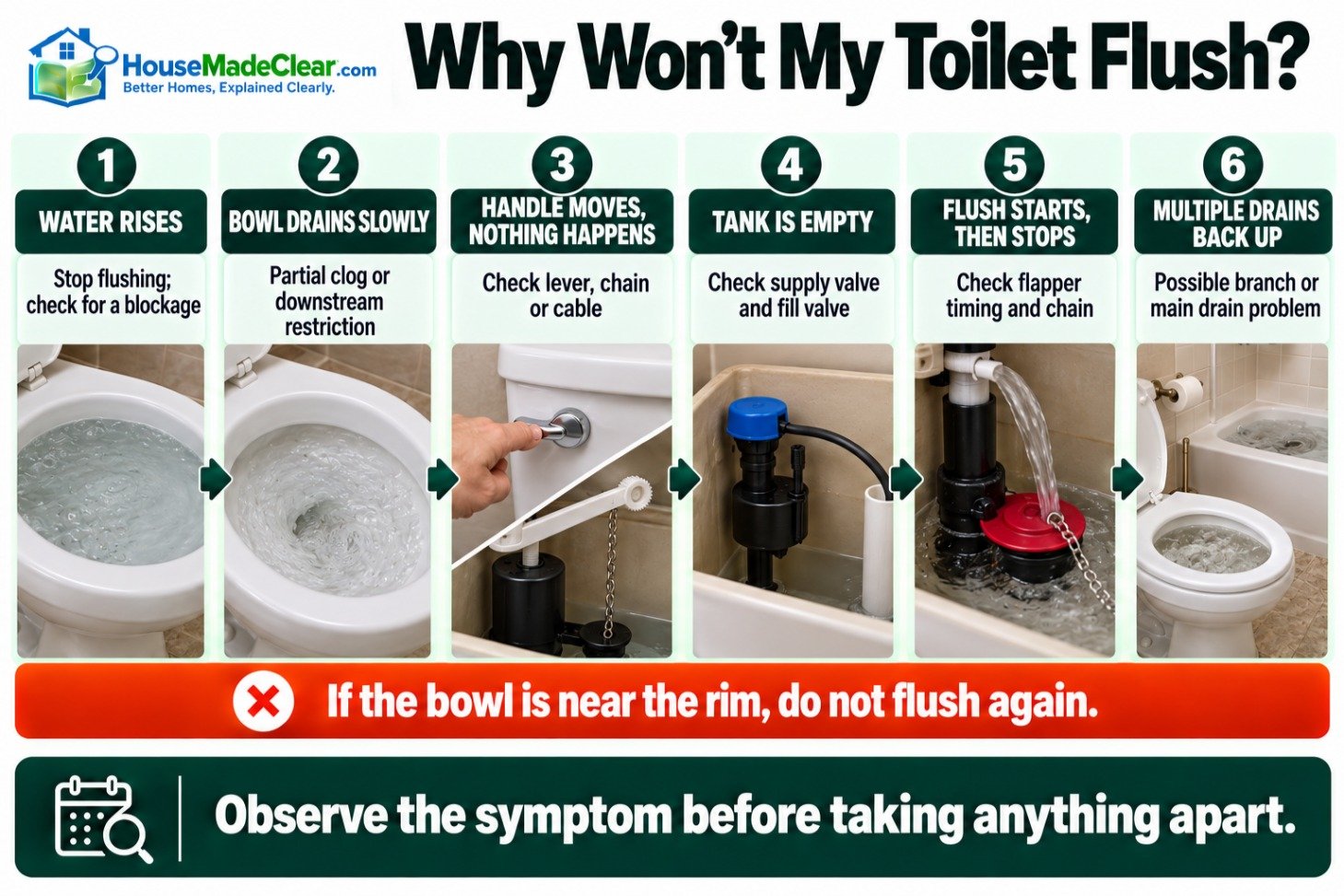
Why Won’t My Toilet Flush? Quick Troubleshooting Chart
Before taking anything apart, observe what happens when you press the handle or button.
| What Happens | Likely Cause | First Thing to Check |
|---|---|---|
| Handle moves but nothing happens | Loose chain or broken handle | Lift chain and flush lever |
| Tank is empty | Closed supply valve or fill valve issue | Shutoff valve and tank refill |
| Tank has very little water | Incorrect float setting or leak | Tank waterline |
| Bowl fills but drains slowly | Partial clog | Toilet trap |
| Water rises toward the rim | Significant blockage | Stop flushing and use a plunger |
| Flush starts but stops too soon | Flapper closes early | Chain and flapper |
| Toilet flushes weakly | Low tank water or restricted passages | Tank level and rim holes |
| Flush button does nothing | Misadjusted button rods or cable | Flush mechanism |
| Multiple drains are backing up | Main drain or sewer problem | Other fixtures and professional diagnosis |
| Toilet runs and eventually won’t flush properly | Tank water loss or fill issue | Flapper, seal, and fill valve |
If the bowl is near overflowing, deal with that first. Otherwise, begin with the tank components because they are often easy to inspect.
How Does a Toilet Flush?
Understanding the basic mechanism makes troubleshooting much easier.
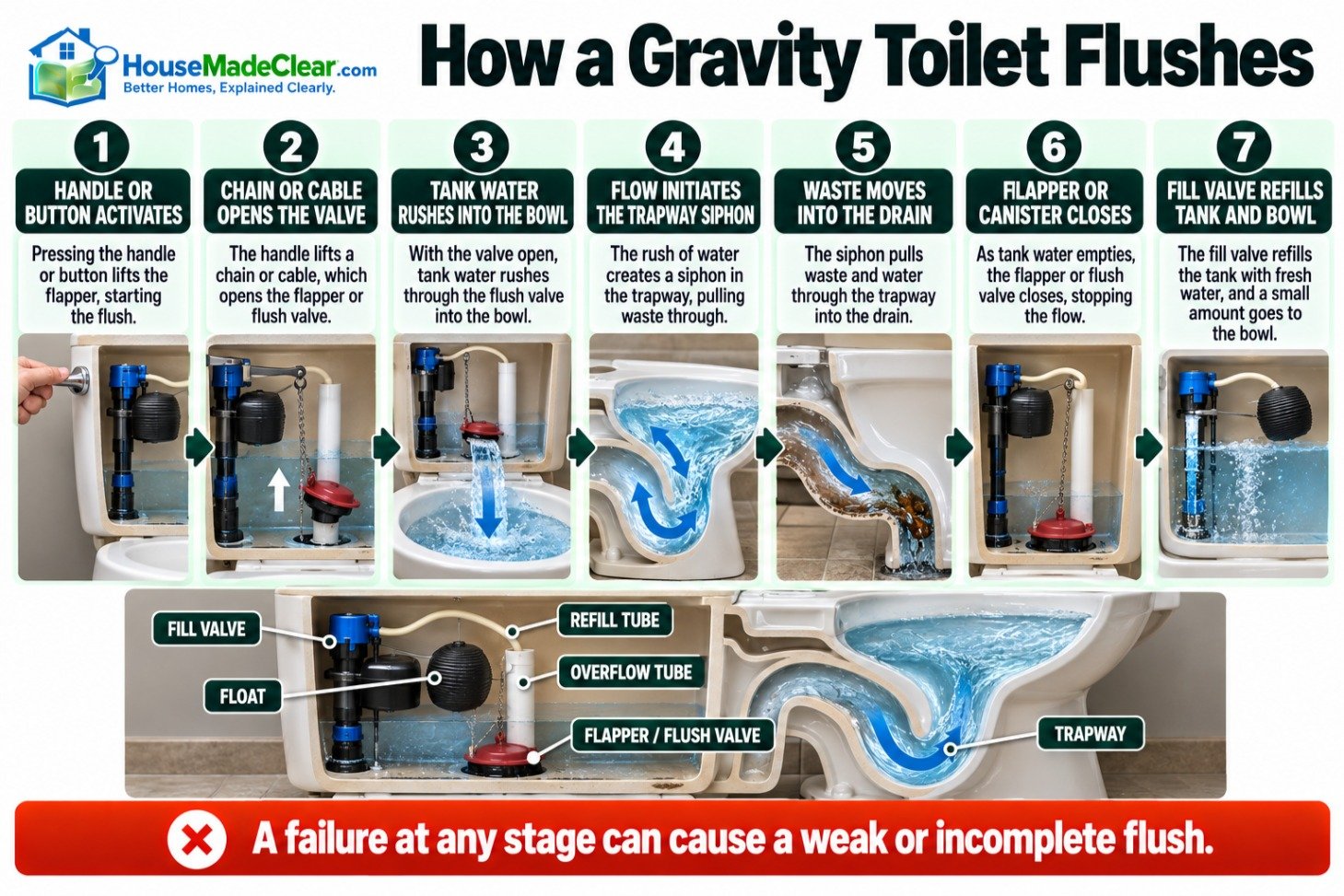
Most conventional residential gravity-flush toilets have two main functions: storing water in the tank and releasing it rapidly into the bowl.
The Flush Cycle
- You press the handle or flush button.
- The mechanism lifts a flapper or opens a flush valve.
- Water flows rapidly from the tank into the bowl.
- The water movement initiates the flushing action through the toilet trapway.
- Wastewater moves into the drain.
- The flush valve closes.
- The fill valve refills the tank and restores the required bowl water level.
A failure at any stage can cause weak or incomplete flushing.
Main Toilet Tank Components
| Component | Purpose |
|---|---|
| Flush handle or button | Activates the flushing mechanism |
| Trip lever | Transfers movement from the handle |
| Lift chain or cable | Connects the lever to the flush valve |
| Flapper | Releases and then seals tank water |
| Canister flush valve | Alternative mechanism used in some toilets |
| Fill valve | Controls tank refilling |
| Float | Regulates the tank water level |
| Overflow tube | Directs excess tank water into the bowl |
| Refill tube | Restores water to the bowl after flushing |
| Shutoff valve | Controls incoming water |
| Trapway | Carries waste from the bowl into the drain |
Some modern toilets use concealed tanks, pressure-assisted flushing, or electronic systems. Their troubleshooting procedures may differ.
1. The Toilet Is Clogged
A clog is one of the most familiar causes of flushing failure.
A blockage may develop in the toilet trapway or farther into the drain.
Common causes include excessive toilet paper, nonflushable wipes, hygiene products, small objects, and accumulated debris.
Signs of a Clogged Toilet
- Water rises when you flush.
- The bowl drains unusually slowly.
- Waste remains in the bowl.
- You hear gurgling during draining.
- The water level rises and then gradually falls.
- A plunger temporarily improves flushing.
How to Fix a Clogged Toilet
Step 1: Stop flushing.
If the water is already high, another flush could cause an overflow.
Step 2: Shut off the toilet’s water supply if necessary.
Most conventional toilets have a shutoff valve near the wall or floor.
Turn it clockwise gently to close it. Do not force a stuck or deteriorated valve.
Step 3: Use a flange-style toilet plunger.
A flange plunger is shaped to form a seal inside the toilet outlet.
Step 4: Plunge carefully.
Position the plunger over the outlet and begin with gentle pressure to avoid splashing. Then use controlled push-and-pull movements while maintaining the seal.
Step 5: Check whether the water drains.
Once the level returns to normal, test cautiously.
What if a Plunger Doesn’t Work?
A closet auger, also called a toilet auger, may help remove or reach a blockage inside the toilet trapway.
Use a tool designed for toilets, following its instructions, to reduce the risk of scratching the porcelain.
If a solid object is stuck, professional removal may be necessary.
Avoid chemical drain cleaners in the toilet. Many drain-cleaning chemicals are unsuitable for toilets and can create splash hazards, especially if you later use a plunger.
If multiple fixtures are backing up, stop using the affected drains and contact a plumber.
2. The Toilet Lift Chain Is Disconnected or Too Loose
If you press the handle and nothing happens, the chain connecting the flush lever to the flapper may be disconnected.
This is a common mechanical problem in traditional flapper-style toilets.
How to Identify the Problem
Remove the tank lid carefully and place it on a stable, padded surface.
Press the handle while watching the internal mechanism.
If the lever moves but the flapper remains closed, inspect the chain.
How to Fix a Toilet Chain
- Locate the chain between the trip lever and flapper.
- Check whether it has become detached.
- Reattach it to the appropriate lever hole.
- Adjust the length according to the toilet or replacement-part instructions.
- Verify that the flapper lifts sufficiently and closes completely.
- Test the flush.
The chain should have a little slack rather than being stretched tight.
Fluidmaster’s guidance for certain flapper-style systems recommends approximately 1/2 inch of chain slack. However, adjustment requirements differ by mechanism.
What if the Chain Is Too Long?
The flapper may not lift far enough.
Shortening an excessively loose chain can help, provided it does not prevent the flapper from sealing.
What if the Chain Is Too Tight?
A tight chain may hold the flapper slightly open, allowing tank water to leak into the bowl.
Our guide to why a toilet makes a hissing sound explains how tank-water loss and repeated filling can create persistent toilet noises.
3. The Flush Handle Is Broken or Loose
A toilet handle can loosen, corrode, crack, or disconnect from the internal lever.
This may prevent the flushing mechanism from operating even when the tank is full.
Symptoms of a Faulty Handle
- The handle feels unusually loose.
- It moves without resistance.
- It doesn’t return to its normal position.
- The internal lever does not move.
- The handle sticks or binds.
How to Fix a Loose Toilet Handle
Turn off the water if necessary for the repair.
Remove the tank lid and inspect the handle assembly.
Check whether the mounting nut has loosened.
Some toilet handle nuts have reverse threads, so verify the manufacturer’s directions before tightening or removing them.
Do not overtighten hardware against porcelain because excessive force can damage the tank.
How to Replace a Broken Handle
- Identify the toilet model or compatible replacement handle.
- Disconnect the chain.
- Remove the old handle assembly as instructed.
- Install the replacement lever.
- Reconnect and adjust the chain.
- Confirm the flapper opens and closes properly.
Dual-flush toilets may use button rods or cables instead of a traditional handle.
For these models, inspect the actuator mechanism according to the manufacturer’s instructions.
4. The Toilet Tank Doesn’t Have Enough Water
A gravity-flush toilet needs the correct amount of stored water to produce its intended flush.
If the tank water level is too low, the toilet may flush weakly or fail to clear waste.
How to Check the Water Level
Remove the tank lid.
Look for the manufacturer’s waterline mark inside the tank.
The water should reach the recommended level when filling is complete.
Do not assume the tank should be filled to the top.
Why Is the Water Level Low?
Possible causes include:
- A float adjusted too low
- A partially closed shutoff valve
- A fill valve problem
- A leaking flapper or seal
- Insufficient incoming water
- A malfunctioning refill mechanism
How to Adjust the Tank Water Level
Identify the fill valve type.
Many modern fill valves have an adjustment screw, rod, or clip.
Follow the manufacturer’s instructions and raise the setting only to the designated waterline.
The water level must remain below the overflow opening according to the toilet’s design.
For certain Fluidmaster installations, the instructions specify a water level approximately 1/2 inch below the overflow tube opening, but the proper setting for your toilet is the manufacturer’s marked level.
Can Adding More Water Improve the Flush?
Correcting a tank that is underfilled may restore normal performance.
However, overfilling the tank is not a safe or reliable way to increase flushing power.
Low-flow toilets are engineered to function at specified water volumes.
5. The Fill Valve Is Not Working Properly
The fill valve is responsible for refilling the toilet tank after each flush.
If it becomes blocked, worn, stuck, or incorrectly adjusted, the tank may fill slowly or remain empty.
Signs of a Fill Valve Problem
- The tank does not refill.
- Refilling takes unusually long.
- The fill valve makes abnormal sounds.
- Water enters intermittently.
- The float does not move freely.
- The toilet has weak flushes because the tank never fills properly.
First Checks
Inspect the shutoff valve and visible supply line.
Make sure the valve is appropriately open and the hose isn’t kinked.
If other fixtures also have weak water flow, the issue may involve the home’s water supply rather than the toilet itself.
Can You Clean a Fill Valve?
Some fill valves have serviceable caps or screens that can be cleaned.
However, the procedure varies.
Consult the manufacturer’s exact model instructions before disassembly.
Water pressure can cause splashing if a valve is opened improperly.
If you’re not comfortable working on the supply connection, use a plumber.
When Should You Replace the Fill Valve?
Replacement may be appropriate if:
- The valve remains stuck.
- The internal seal is worn.
- Cleaning doesn’t restore normal refill.
- The part is damaged.
- Compatible repair parts aren’t available.
6. The Flapper or Flush Valve Seal Is Damaged
The flapper is the rubber component that seals the opening at the bottom of many toilet tanks.
If the flapper is warped, deteriorated, dirty, or poorly seated, water may leak from the tank into the bowl.
That can leave insufficient stored water for an effective flush.
Other toilets use canister seals or different flush-valve mechanisms.
Signs of Flapper Problems
- The toilet refills unexpectedly.
- The tank loses water between flushes.
- You hear periodic filling sounds.
- The toilet hisses or runs.
- The rubber flapper is visibly damaged.
- The flush is weak after the tank partially empties.
How to Check the Flapper
Turn off the water supply if needed.
Inspect the flapper and its seating surface.
Look for:
- Cracks
- Warping
- Mineral deposits
- Debris
- Misalignment
- Incorrect chain tension
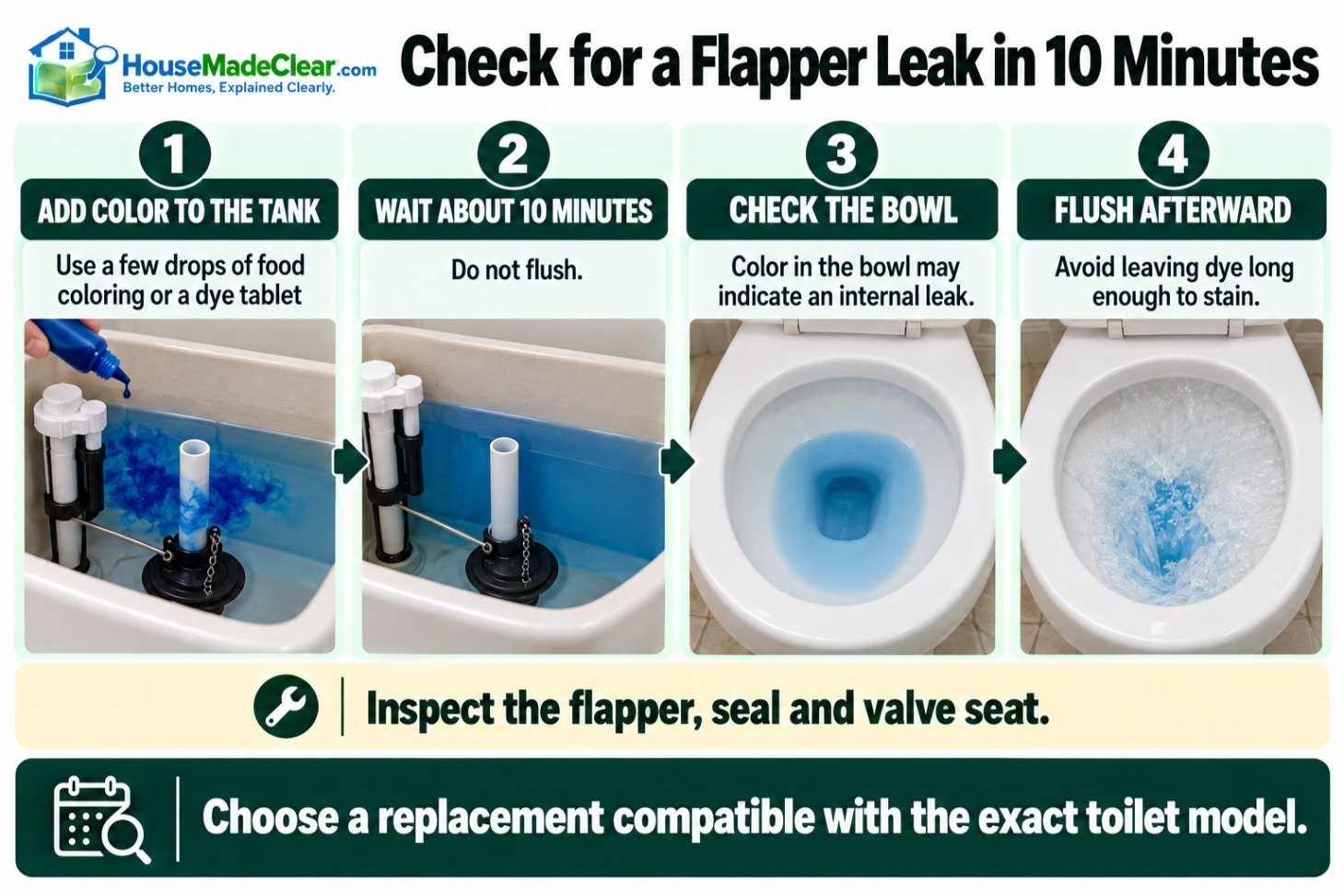
How to Test for a Leak
The EPA WaterSense home-maintenance guide recommends placing a few drops of food coloring or a dye tablet in the tank, waiting approximately 10 minutes without flushing, and checking whether color appears in the bowl.
If it does, the toilet may be leaking internally.
Flush afterward to avoid staining.
How to Fix the Problem
Sometimes cleaning debris from the seal and valve seat is enough.
If the flapper or seal is damaged, choose a compatible replacement designed for the toilet.
Different flush valves use different shapes and dimensions, so check the model rather than assuming every flapper is universal.
7. The Flapper Closes Too Quickly
A toilet can begin flushing normally but stop before enough water leaves the tank.
One possible cause is a flapper that closes prematurely.
Why Does This Happen?
Possible reasons include:
- Incorrect chain adjustment
- An incompatible replacement flapper
- Improper flapper positioning
- Mechanical interference
- A flush valve designed or adjusted incorrectly for the model
How to Diagnose It
With the lid removed, observe a flush.
The flapper should lift as designed, release the intended amount of water, and close.
If it immediately falls shut, inspect the chain and mechanism.
How to Fix It
- Confirm that the chain is connected correctly.
- Adjust its slack to the manufacturer’s specification.
- Check for tangling or interference.
- Verify that the installed flapper is compatible with the toilet.
- Test the flush again.
Some modern toilets use adjustable flush-volume controls or canister valves.
Do not alter these without consulting the model instructions.
Why Not Just Hold the Handle Down?
Holding the handle can sometimes release additional water, but it is not a permanent repair.
If the toilet requires this every time, the mechanism should be diagnosed.
8. The Bowl’s Rim Holes or Siphon Jet Are Restricted
Even if the tank contains enough water, the toilet may still flush weakly if the water cannot enter the bowl in the intended pattern.
Mineral buildup or debris can restrict the bowl’s water passages.
Depending on the toilet design, these may include rim channels or a siphon jet.
Signs of Restricted Water Passages
- Water enters the bowl unevenly.
- The flush is weak despite a full tank.
- Mineral deposits are visible under the rim.
- The bowl doesn’t develop its normal flushing action.
- Waste frequently remains after flushing.
How to Inspect the Rim
Use a flashlight to look under the bowl rim.
Check for visible deposits or obstructions.
Do not confuse the small openings with damage; their design varies by toilet model.
How to Clean the Openings
Use a cleaner approved by the toilet manufacturer and a nonabrasive brush suitable for porcelain.
Avoid aggressive metal tools that may scratch or chip the finish.
Do not pour corrosive drain chemicals into the bowl.
What About the Siphon Jet?
Some toilets have a larger water passage near the bottom of the bowl.
If restricted, flushing performance may decrease.
Follow the manufacturer’s cleaning instructions. If the blockage is inaccessible or persistent, a plumber can investigate.
Can a Low Bowl Water Level Cause Weak Flushing?
Yes.
Some toilets may flush poorly when the bowl does not refill to its designed water level.
Check that the refill tube is correctly connected and positioned.
A disconnected or incorrectly positioned refill tube can affect the amount of water restored to the bowl.
9. There Is a Deeper Drain or Venting Problem
Not every flushing problem occurs inside the toilet.
If the bowl drains slowly despite normal tank operation, the restriction may be farther down the plumbing system.
Possible causes include:
- A partial branch-drain blockage
- A blocked or damaged sewer line
- A foreign object lodged beyond the toilet trap
- Improper drainage installation
- A venting problem
- Tree-root intrusion in an underground sewer line
Signs of a Drain-Line Problem
- Several fixtures drain slowly.
- A shower or bathtub backs up when the toilet is flushed.
- Gurgling occurs in nearby drains.
- Sewage appears in a lower-level fixture.
- The toilet clogs repeatedly despite appropriate use.
- Plunging provides only temporary relief.
Can a Blocked Plumbing Vent Stop a Toilet From Flushing?
A venting issue can contribute to drainage problems, but it should not be assumed from gurgling alone.
Partial clogs and other drain restrictions can produce similar symptoms.
A plumber may need to inspect the drain and vent arrangement.
What Should You Do?
Stop using affected plumbing fixtures if wastewater is backing up.
Do not climb onto a roof to inspect a vent unless you are qualified and equipped to do so safely.
Call a licensed plumber for drain or vent diagnosis.
If sewage has overflowed, avoid contact, keep children and pets away, and arrange appropriate cleanup.
Toilet Won’t Flush but Isn’t Clogged: What Does That Mean?
If you are confident the bowl and trapway are clear, focus on whether the tank is releasing enough water.
The following checks can help narrow the issue.
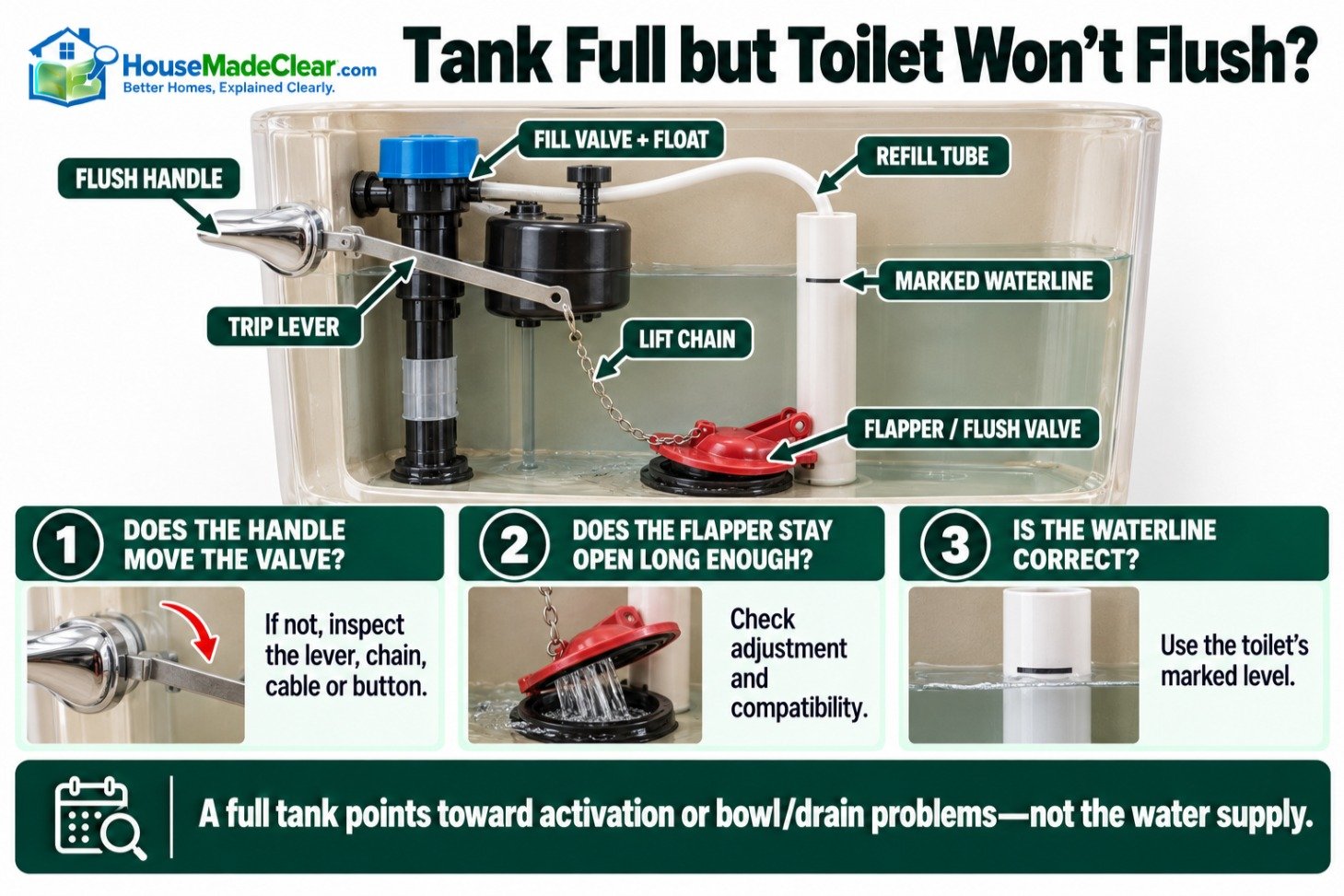
Check 1: Is the Tank Full?
If the tank is nearly empty, investigate the water supply or fill valve.
Check 2: Does the Handle Move the Flush Valve?
If not, inspect the lever, chain, cable, or button assembly.
Check 3: Does the Flapper Stay Open Long Enough?
If it closes immediately, check its compatibility and chain adjustment.
Check 4: Does the Water Enter the Bowl Normally?
If the tank empties but flushing is weak, inspect the bowl refill level and water passages.
Check 5: Does the Bowl Drain Slowly Anyway?
A partial blockage or downstream plumbing problem may still exist.
An apparently clear bowl doesn’t prove the entire drain is unobstructed.
Toilet Won’t Flush and the Water Keeps Rising
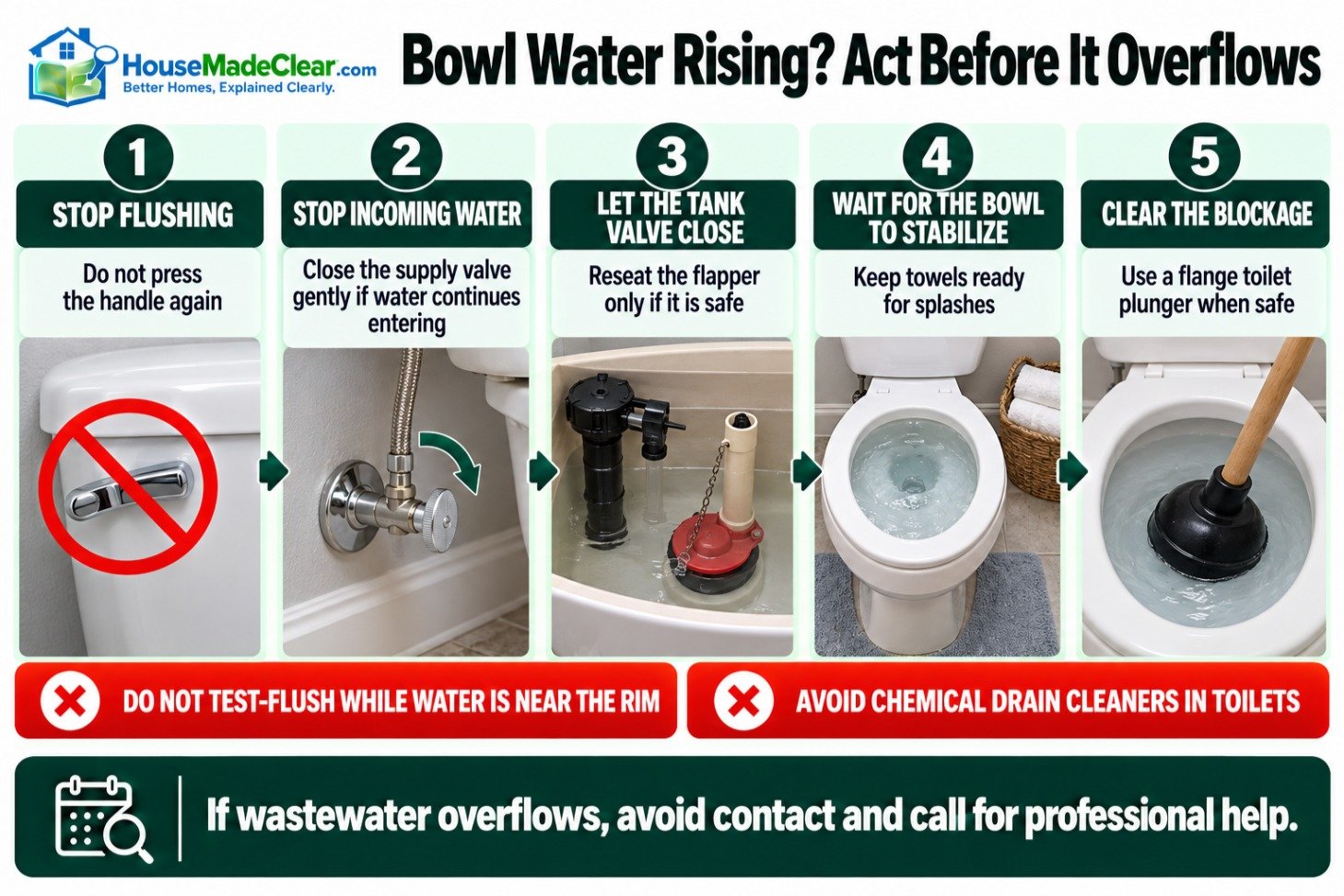
This situation requires immediate attention because another flush could cause an overflow.
What to Do Immediately
- Stop pressing the flush handle.
- Remove the tank lid only if it is safe to do so.
- If the flush valve remains open, allow it to close or gently reseat it without forcing components.
- Shut off the toilet’s supply valve if water continues entering.
- Keep towels or other protective materials available to contain accidental splashes.
- Wait for the bowl water level to stabilize before attempting to clear a blockage.
If the toilet is overflowing with sewage, avoid contact and obtain professional help.
Should You Flush Again to Test It?
Not while the bowl is close to the rim.
Clear the blockage and confirm the water level has returned to a safe position before conducting a controlled test.
Toilet Won’t Flush but the Tank Is Full
A full tank combined with no flushing action often suggests a problem in the flush activation mechanism.
Possible causes include:
- Disconnected chain
- Broken handle
- Jammed trip lever
- Faulty push-button rods
- Misaligned flush cable
- Obstructed flush valve
Quick Test
Carefully remove the lid and watch what happens when you operate the handle.
If nothing inside the tank moves, focus on the handle or button connection.
If the valve lifts and the tank empties normally, the problem is more likely to involve the bowl or drain system.
Toilet Won’t Flush but Water Is Running
Running water and poor flushing can happen together.
For example, a leaking flapper may continuously allow tank water into the bowl.
The fill valve may repeatedly refill lost water without maintaining the correct level.
A faulty fill valve can also prevent the tank from reaching its intended waterline.
How to Identify the Source
Observe whether:
- Water flows into the overflow tube.
- The flapper is fully seated.
- The tank water level gradually falls.
- The fill valve runs intermittently.
- The float moves properly.
Kohler’s running-toilet troubleshooting guidance identifies flapper seals, fill valves, floats, and chain adjustment as key areas to inspect.
If the main symptom is persistent noise rather than flushing failure, our toilet hissing sound troubleshooting guide provides a more focused diagnosis.
How to Fix a Toilet That Won’t Flush Without a Plumber
Some problems are suitable for basic homeowner troubleshooting.
Others require professional intervention.
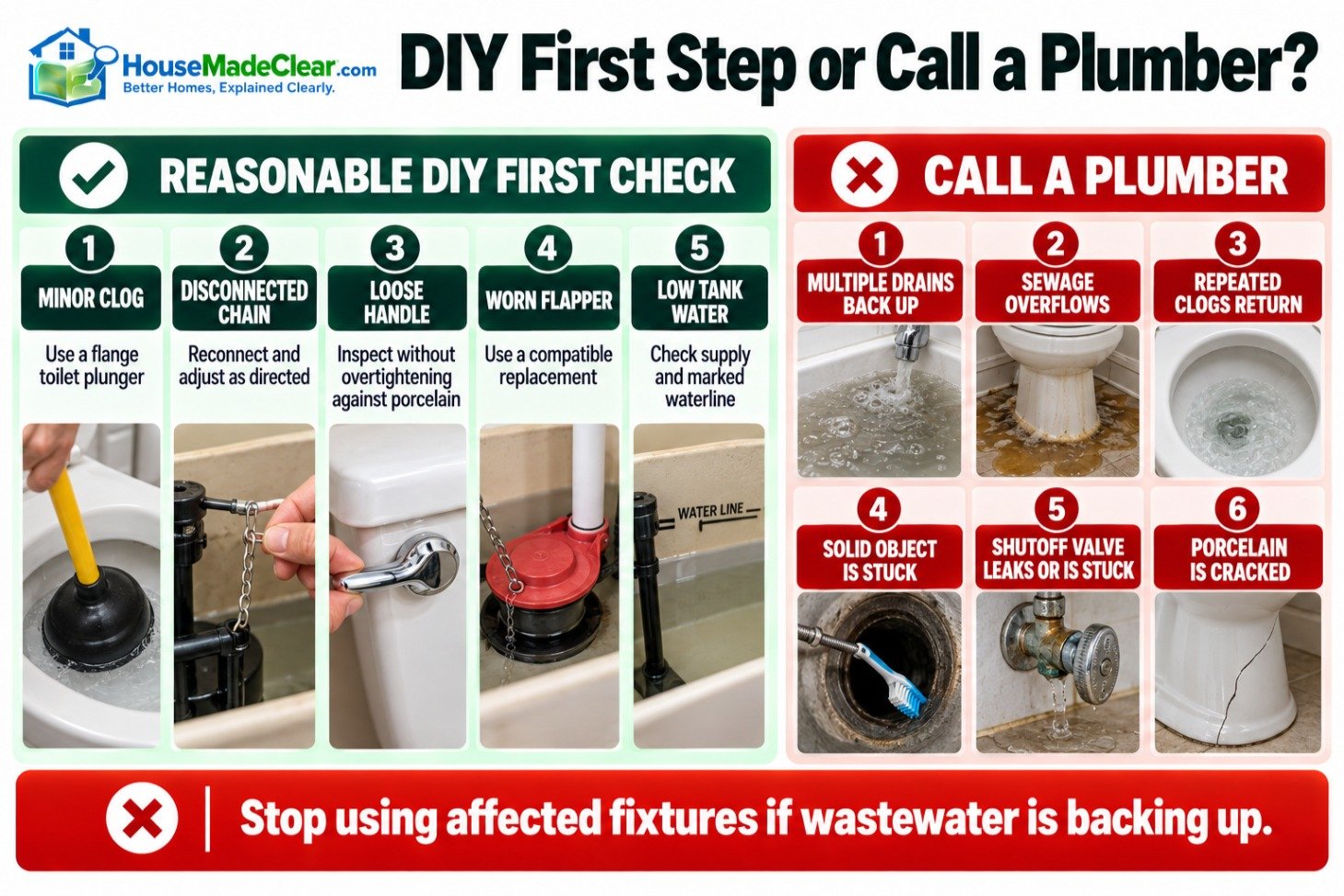
| Problem | Reasonable DIY First Step | When to Call a Plumber |
|---|---|---|
| Disconnected chain | Reattach and adjust | Mechanism damaged or incompatible |
| Loose handle | Inspect and tighten correctly | Porcelain damage or inaccessible hardware |
| Low tank water | Check supply and float setting | Valve or supply problem persists |
| Worn flapper | Replace compatible part | Flush-valve seat damaged |
| Minor toilet clog | Use a flange plunger | Clog persists or solid object stuck |
| Slow tank refill | Inspect visible supply and manufacturer-approved valve parts | Supply connection or shutoff valve problem |
| Blocked rim openings | Gentle approved cleaning | Performance doesn’t improve |
| Repeated drain backups | Stop using affected fixtures | Prompt professional diagnosis |
| Sewage backup | Avoid contact and isolate area | Professional plumbing and cleanup assistance |
Basic Tools for Toilet Troubleshooting
You may need:
- A flashlight
- Rubber or waterproof gloves
- A flange toilet plunger
- A toilet auger
- An adjustable wrench where appropriate
- A sponge or small container
- A compatible replacement flapper or handle
- Towels to protect surrounding surfaces
Avoid dismantling plumbing connections unnecessarily.
If a shutoff valve is corroded, stuck, or leaking, professional repair is safer than forcing it.
How to Flush a Toilet Temporarily if the Handle Is Broken
If the only problem is a broken handle, the tank may still contain enough water for a flush.
Some conventional flapper-style toilets can be flushed by carefully lifting the flapper mechanism inside the tank.
However, this is only a temporary workaround.
Before Trying It
- Confirm that the bowl is not clogged or already full.
- Check that the tank is filled to its intended water level.
- Keep electrical devices away from the tank.
- Avoid sharp or broken components.
- Do not force canister, push-button, or specialized systems.
Wear gloves and use the manufacturer’s procedure where available.
Replace the damaged handle or actuator as soon as practical.
Can You Flush With a Bucket of Water?
In a conventional gravity toilet, carefully pouring an appropriate amount of water into the bowl may initiate siphoning.
However, this can cause an overflow if the toilet is clogged.
Only consider this when the drain is known to be clear, and do not pour water into a bowl that is already unusually full.
This technique does not repair the underlying flush mechanism.
Why Does My Toilet Flush Only When I Hold the Handle Down?
If you must hold the handle down to complete a flush, the flapper may be closing too early.
Other possible explanations include:
- Incorrect chain length
- Wrong replacement flapper
- A malfunctioning flush-volume adjustment
- A worn or misaligned trip mechanism
What to Check
Remove the tank lid and observe whether the flush valve remains open for the intended portion of the flush.
Compare the installed mechanism with the manufacturer’s specifications.
Do not attempt to increase the flush volume beyond the toilet’s design without approved instructions.
Why Does My Toilet Have a Weak Flush?
A weak flush differs from a complete failure.
The toilet may still move water, but it doesn’t clear the bowl effectively.
Common Causes
- Low tank water
- Improper bowl refill
- Flapper closing early
- Partial trapway blockage
- Restricted rim or jet passages
- Incompatible internal parts
- Downstream drain problems
Does a Weak Flush Mean the Toilet Needs Replacing?
Not always.
Many weak-flush problems can be corrected through maintenance or appropriate part replacement.
However, an aging or damaged toilet may eventually need replacement if it repeatedly fails despite proper repairs.
For bathrooms being remodeled, our toilet clearance guide explains space requirements when considering a new fixture.
Why Does My Dual-Flush Toilet Stop Working?
Dual-flush toilets use different activation arrangements from many conventional handle-operated models.
Some have separate full- and reduced-volume flush buttons, adjustable rods, or cables.
Possible Causes
- Misadjusted push-button rods
- Disconnected cable
- Stuck actuator
- Low tank water
- Obstructed flush valve
- Damaged seals
- Incorrect installation of the tank lid
What Can You Check?
Remove the lid carefully if the design allows.
Inspect the button-to-valve connection according to the manufacturer’s instructions.
Some dual-flush mechanisms stop functioning properly if the actuator rods are too short, too long, or misaligned.
Consult the specific toilet model’s manual rather than applying conventional flapper-chain adjustments to an incompatible system.
Can Low Water Pressure Stop a Toilet From Flushing?
For most conventional gravity toilets, incoming water pressure primarily affects tank refilling.
The actual flush uses water already stored in the tank.
Therefore, low supply pressure may cause slow refilling or an incompletely filled tank, but it is not usually the direct source of flushing force during a properly filled gravity-tank flush.
What About Pressure-Assisted Toilets?
Pressure-assisted toilets operate differently.
They rely on a pressurized flushing system and have specific supply-pressure and maintenance requirements.
Do not dismantle a pressure vessel or pressurized flushing assembly as a basic DIY repair.
Use the manufacturer’s service guidance or a qualified technician.
How Do You Know if the Problem Is House-Wide?
Check whether other fixtures experience unusually low flow.
If the problem affects multiple taps or fixtures, the issue may involve:
- A partially closed supply valve
- Municipal or well-system conditions
- A pressure-reducing valve
- Plumbing restrictions
- A leak
Our upcoming whole-house guide on improving water pressure will address these broader conditions separately.
How to Prevent Toilet Flushing Problems
Routine maintenance can reduce unexpected failures.
1. Avoid Flushing Nonflushable Items
Dispose of wipes, paper towels, sanitary products, and other unsuitable items in the trash.
Even products marketed as flushable can contribute to blockages under some plumbing conditions.
2. Check for Tank Leaks
Use an appropriate dye test to identify internal leaks.
The EPA recommends periodic leak checks as part of household water maintenance.
3. Inspect the Flapper and Chain
Look for damage, tangling, or incorrect movement.
4. Keep the Tank at the Correct Water Level
Use the toilet’s marked waterline.
5. Investigate Unusual Sounds Early
Frequent refilling or persistent hissing can indicate a problem before flushing performance noticeably declines.
6. Maintain Accessible Shutoff Valves
Make sure household members know where the toilet’s supply valve is located.
Do not force stuck valves.
7. Use Compatible Replacement Parts
A flapper or flush-valve component that fits physically may still perform incorrectly if it is not designed for the toilet.
8. Address Repeated Clogs
Repeated blockages may indicate a deeper problem rather than a need for more aggressive plunging.
9. Avoid Harsh In-Tank Cleaning Products
Some in-tank chemicals can deteriorate rubber seals and other components.
Follow the toilet manufacturer’s cleaning recommendations.
10. Investigate Persistent Water Leaks
An internal toilet leak may waste water and interfere with normal operation.
According to the EPA WaterSense home-maintenance recommendations, toilet flappers should be inspected for leaks and replaced periodically to help maintain proper sealing.
Toilet Repair vs. Replacement: Which Makes More Sense?
A toilet that won’t flush does not automatically require a new fixture.
Many repairs involve replaceable components.
| Condition | Usually Repair First? | Replacement Consideration |
|---|---|---|
| Broken handle | Yes | Rarely necessary |
| Disconnected chain | Yes | Not typically |
| Faulty fill valve | Yes | If widespread damage exists |
| Worn flapper | Yes | Not typically |
| Ordinary toilet clog | Yes | Not typically |
| Cracked porcelain tank | No | Replacement commonly necessary |
| Damaged bowl or trapway | Depends on damage | Professional evaluation |
| Repeated performance failures | Diagnose first | May justify replacement |
| Outdated, inefficient toilet | Evaluate repairs and efficiency | WaterSense replacement may be worthwhile |
When Should You Replace the Entire Toilet?
Consider replacement when:
- The porcelain tank or bowl is cracked.
- A significant structural component is damaged.
- Necessary parts are unavailable.
- The toilet repeatedly performs poorly despite appropriate repairs.
- Repairs are disproportionate to replacement costs.
- A bathroom renovation includes a planned fixture upgrade.
EPA WaterSense-labeled toilets are independently certified to meet water-efficiency and performance criteria.
You can review EPA’s WaterSense home-maintenance information when considering repairs or efficiency improvements.
When to Call a Plumber for a Toilet That Won’t Flush
Some symptoms justify prompt professional help.
Call a plumber if:
- Multiple drains back up at the same time.
- Wastewater emerges from a bathtub or shower drain.
- The toilet repeatedly clogs after plunging.
- A solid object is trapped in the toilet.
- The supply shutoff valve is leaking or cannot be operated safely.
- The porcelain tank or bowl is cracked.
- The toilet is loose or leaking at the floor.
- The main sewer line may be obstructed.
- You have a pressure-assisted or specialized system requiring qualified service.
A sewer backup is more than a simple flushing inconvenience. Stop using affected fixtures and arrange professional assessment.
Toilet Won’t Flush: Step-by-Step Diagnostic Checklist
Follow this order to avoid unnecessary repairs.
| Step | Question | Next Action |
|---|---|---|
| 1 | Is the bowl water rising? | Stop flushing; investigate blockage |
| 2 | Is the tank full? | If not, investigate water supply |
| 3 | Does the handle or button operate the flush valve? | Inspect connection |
| 4 | Does the flapper or canister lift? | Check chain, cable, or actuator |
| 5 | Does the valve stay open properly? | Check adjustment and compatibility |
| 6 | Is the tank waterline correct? | Adjust per manufacturer |
| 7 | Does water enter the bowl correctly? | Check refill and water passages |
| 8 | Does the bowl drain slowly? | Investigate partial clog |
| 9 | Are other drains affected? | Consider branch or main drain issue |
| 10 | Does the toilet lose water between flushes? | Inspect seals and fill valve |
| 11 | Is there visible porcelain damage or leakage? | Stop use and obtain professional help |
Common Mistakes When Fixing a Toilet That Won’t Flush
Mistake 1: Flushing Repeatedly When the Bowl Is Full
This can cause an overflow.
Mistake 2: Assuming Every Flushing Problem Is a Clog
A broken handle or disconnected chain can cause the same overall symptom.
Mistake 3: Using Chemical Drain Cleaner in the Toilet
Some products are not suitable for toilets and can create hazards.
Mistake 4: Overadjusting the Tank Water Level
Too much water may flow into the overflow tube and waste water.
Mistake 5: Installing an Incompatible Flapper
An incorrect part can interfere with flush timing.
Mistake 6: Tightening Porcelain Hardware Excessively
Porcelain can crack under excessive force.
Mistake 7: Ignoring Repeated Tank Refilling
The tank may be losing water through a leaking seal.
Mistake 8: Using a Standard Drain Snake Incorrectly
Unprotected tools can scratch toilet porcelain.
Mistake 9: Treating a Sewer Backup as an Ordinary Toilet Clog
Multiple affected fixtures call for a different level of investigation.
Mistake 10: Replacing the Entire Toilet Before Checking Simple Parts
Many flushing failures are caused by affordable, replaceable components.
Final Thoughts
If your toilet won’t flush, the best solution depends on what happens when you operate the handle or button.
A rising bowl usually points toward a blockage. An empty tank suggests a water-supply or fill-valve problem. A handle that moves without lifting the flush valve may indicate a disconnected chain or damaged activation mechanism.
Many common toilet flushing problems can be resolved by inspecting the tank, adjusting the chain, replacing a compatible flapper, correcting the water level, or clearing a minor clog.
However, repeated backups, sewage overflow, damaged porcelain, and deeper drain problems require professional attention.
Start with the safest and simplest observations before replacing parts.
A careful diagnosis can save time, prevent water damage, and help restore reliable flushing without unnecessary repairs.
Frequently Asked Questions
Why won’t my toilet flush even though it’s not clogged?
Possible causes include a disconnected lift chain, broken flush handle, low tank water, faulty fill valve, or flapper that closes too quickly. Check the tank components before assuming the drain is blocked.
Why does my toilet handle move but not flush?
The handle may be disconnected from the chain, the trip lever may be damaged, or the chain may be too loose to lift the flapper. Remove the tank lid and inspect the mechanism.
Why won’t my toilet flush when the tank is full?
A full tank with no flushing action often indicates a problem with the flush handle, chain, button assembly, cable, or flush valve. Check whether the mechanism opens when activated.
Why is my toilet flushing weakly?
Weak flushing can result from low tank water, a partially clogged trapway, restricted bowl passages, inadequate bowl refill, or a flapper that closes prematurely.
Can a toilet stop flushing because of low water pressure?
Low water pressure can prevent a gravity toilet tank from refilling properly. However, a conventional gravity flush primarily uses stored tank water. Pressure-assisted toilets have different requirements.
How do you fix a toilet that won’t flush without a plumber?
First, check whether the bowl is clogged or close to overflowing. Then inspect the tank water level, handle, chain, flapper, and water supply. Minor clogs and simple mechanism adjustments may be manageable without professional help.
Why does my toilet bowl fill up but not flush?
A clog or drain restriction may prevent water from leaving the bowl normally. Stop flushing to avoid an overflow, and investigate the blockage using an appropriate toilet plunger or auger.
What should I do if my toilet won’t flush and water is rising?
Stop flushing immediately. Shut off the supply if needed and allow the water level to stabilize. Use a suitable toilet plunger if it is safe to do so, or contact a plumber if the blockage persists.
Why does my toilet only flush when I hold the handle down?
The flapper may close too early because of incorrect chain adjustment, an incompatible flapper, or a malfunctioning flush mechanism. Inspect the operation and follow the manufacturer’s adjustment instructions.
Why is my toilet tank not filling with water?
The shutoff valve may be closed, the supply line may be restricted, or the fill valve may be blocked or faulty. Check the accessible components and seek professional help for supply-line problems.
Can a bad flapper cause a toilet not to flush?
Yes. A leaking flapper can reduce the tank’s stored water, while an incompatible or incorrectly operating flapper can interfere with the amount of water released during flushing.
How do I know if my toilet is clogged or broken?
If the bowl fills and drains slowly, a clog is likely. If the handle does nothing or the tank is empty, a mechanical or refill problem is more likely. Both conditions can also occur together.
Can I flush a toilet manually if the handle is broken?
Some conventional flapper-style toilets can be temporarily flushed by carefully lifting the flapper mechanism inside a full tank. Only attempt this when the bowl and drain are clear, and replace the faulty handle.
Possible causes include misadjusted button rods, disconnected cables, damaged actuators, or internal valve problems. Check the specific toilet manufacturer’s instructions for adjustment.
Can a blocked vent cause a toilet not to flush?
A drainage vent problem can contribute to poor draining or gurgling, but similar symptoms may result from partial drain blockages. A plumber may need to assess the drain and vent system.
When should I call a plumber for a toilet that won’t flush?
Call a plumber when multiple fixtures back up, sewage overflows, repeated clogs persist, porcelain is cracked, the water-supply connection leaks, or basic troubleshooting does not identify the problem.
Should I replace my toilet if it won’t flush?
Not automatically. Many problems involve replaceable parts such as handles, chains, flappers, and fill valves. Replacement is more appropriate when the fixture is damaged or repairs are impractical.
How can I prevent my toilet from stopping flushing again?
Avoid flushing nonflushable items, inspect the flapper and chain, maintain the correct tank water level, investigate leaks and unusual sounds, and use compatible replacement parts.