















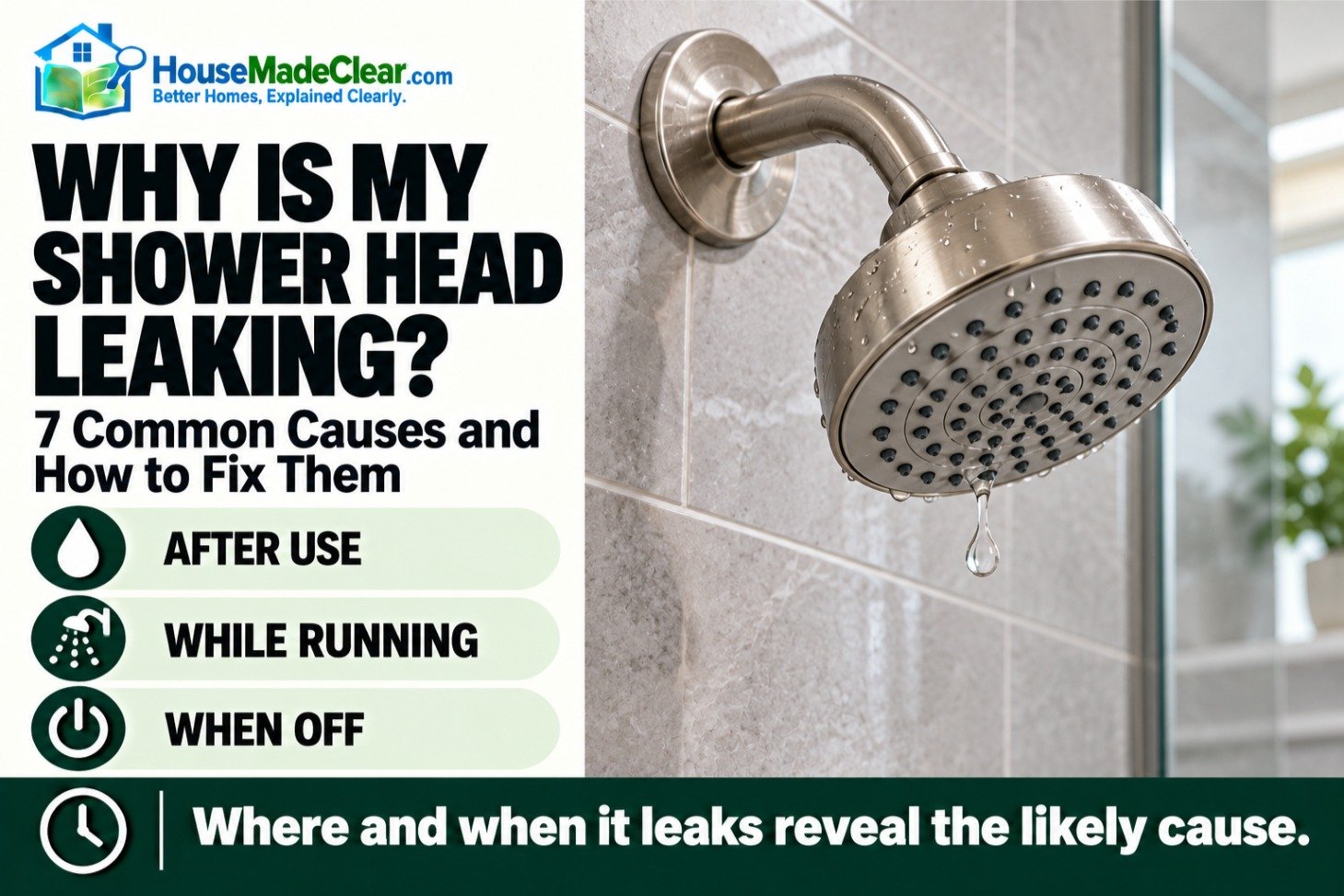
A showerhead that drips after you’ve turned off the water doesn’t always mean something is broken. Sometimes, it’s simply the remaining water draining out of the showerhead. Other times, a worn valve cartridge, loose connection, or damaged seal is allowing water to escape.
The key is knowing where the water is leaking and when it happens.
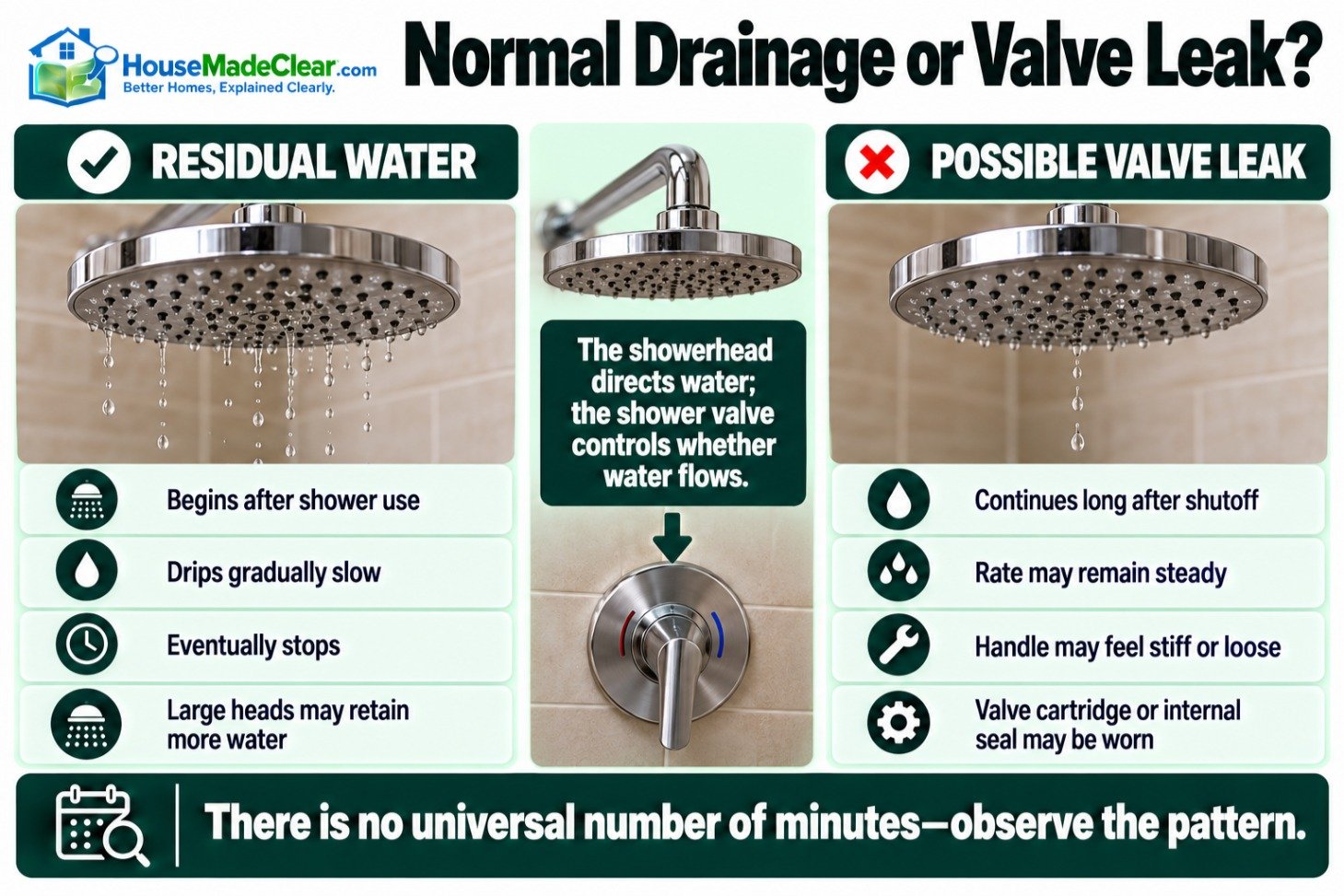
If water drips briefly from the spray nozzles after showering and then stops, the cause may be normal drainage. If the showerhead continues dripping long after the water is turned off, the problem may be inside the shower valve rather than the showerhead itself.
A leak around the connection to the shower arm is different again—and is often much easier to repair.
This guide walks you through seven common causes of a leaking showerhead, how to identify the problem, which fixes you can try yourself, and when it’s time to call a plumber.
Quick Answer
Why is my shower head leaking? The most likely cause depends on where and when the leak occurs:
- Drips briefly after showering: Water remaining inside the showerhead is draining out.
- Drips continuously when turned off: The shower valve cartridge, washer, or internal seal may be worn.
- Leaks where the head connects to the pipe: A loose threaded joint, incorrect sealing, or damaged connection may be responsible.
- Leaks from a handheld shower hose: Check the hose washers and connectors.
- Leaks from multiple nozzles or sprays unevenly: Mineral buildup or a damaged spray assembly may be involved.
- Leaks behind the wall: A concealed plumbing connection may have failed and needs prompt attention.
First step: Dry the showerhead, turn off the water, and watch where the first new drop appears. This often tells you which component to inspect.
Shower Head Leaking: Find the Cause First
Before removing any parts, use this troubleshooting table.
| What You Notice | Likely Cause | Recommended Action |
|---|---|---|
| A few drops after turning off shower | Residual water draining | Observe whether it stops |
| Dripping continues long after shower is off | Worn valve cartridge or seal | Investigate shower control valve |
| Water leaks where showerhead screws onto arm | Poorly sealed threaded connection | Check installation and seal |
| Water sprays from swivel connection | Worn internal gasket or damaged joint | Inspect connection and parts |
| Handheld hose leaks at connector | Damaged or missing washer | Replace compatible washer |
| Handheld hose leaks along its length | Cracked or split hose | Replace hose |
| Uneven spray and water collecting near nozzles | Mineral buildup or nozzle damage | Clean as instructed |
| Water appears behind trim plate or wall | Concealed valve or pipe leak | Stop use and call plumber |
| Showerhead and tub spout both leak during shower | Diverter issue | Inspect diverter mechanism |
Not every symptom confirms a particular failure. Use the observations to narrow your diagnosis before replacing parts.
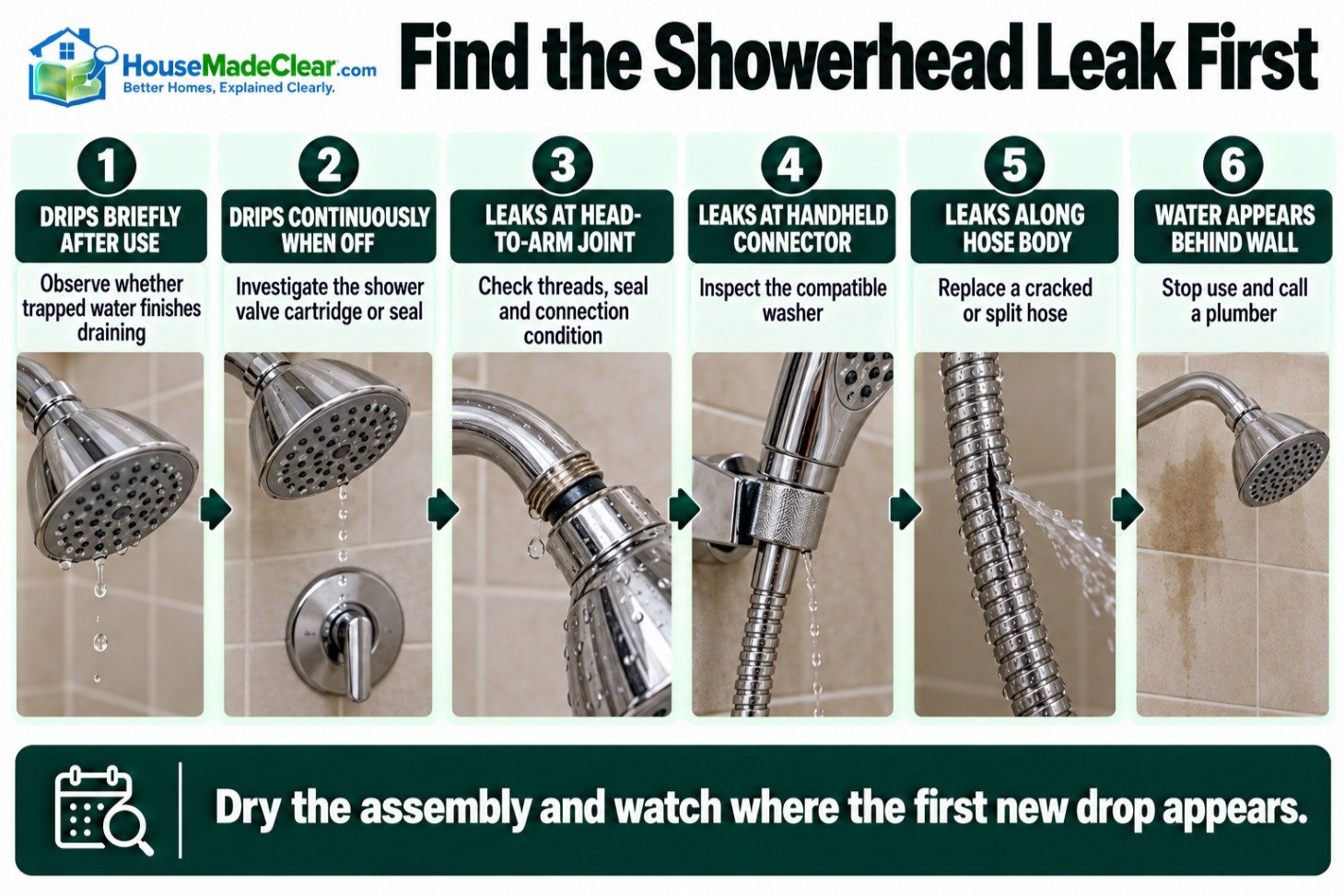
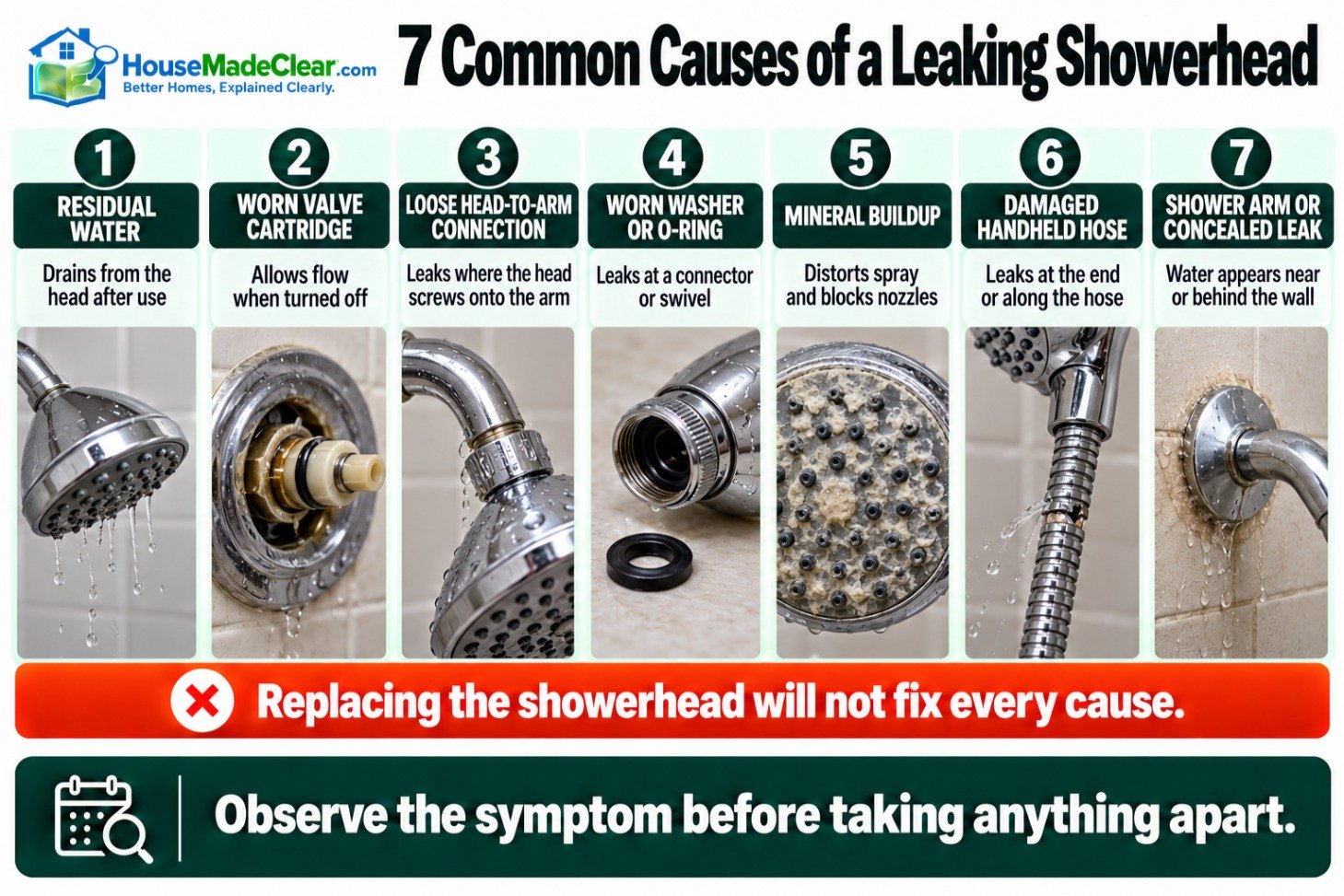
1. Water Is Draining From the Showerhead After Use
One of the most common reasons a showerhead drips is that water remains trapped inside the head or shower arm after the valve is closed.
When the water supply stops, some of that remaining water drains through the spray openings under gravity.
This is particularly noticeable with:
- Large rainfall showerheads
- Multi-function showerheads
- Handheld showerheads
- Showerheads mounted at unusual angles
- Designs that retain water in internal chambers
How Long Should a Showerhead Drip After Turning It Off?
There is no universal time limit because designs vary.
Some showerheads release their remaining water quickly. Others drip intermittently as air enters and water escapes from internal passages.
The most useful distinction is whether the dripping eventually stops.
How to Check
- Turn off the shower completely.
- Dry the outside of the head and its connections.
- Observe the spray openings.
- Note whether the drips gradually slow and stop.
- Check again after the shower has been unused for a longer period.
If the dripping stops and doesn’t restart, trapped water is a plausible explanation.
If fresh water continues appearing for an extended period, especially at a steady rate, investigate the shower valve.
Does This Need Repair?
Not necessarily.
A few drops of residual water do not automatically mean the showerhead is defective.
However, recurring water discharge onto sensitive surfaces should still be managed. Proper shower drainage and enclosure design matter.
2. The Shower Valve Cartridge Is Worn or Damaged
If water continues dripping from the showerhead while the shower is turned off, the problem may be in the valve that controls the water supply.
This is an important distinction: a showerhead usually directs water; the shower valve controls whether water flows to it.
Replacing the showerhead will not necessarily stop a leak caused by a valve that fails to close completely.
What Does a Shower Cartridge Do?
Many modern single-handle showers use a replaceable cartridge inside the valve body.
Depending on the design, the cartridge helps control:
- Water flow
- Hot and cold water mixing
- Temperature
- Pressure balancing or other safety functions
Seals and internal components can wear over time.
Mineral deposits or debris may also interfere with proper operation.
Signs the Valve May Be Responsible
- Dripping continues when the shower is completely turned off.
- The drip rate remains relatively steady.
- The shower handle feels unusually stiff or loose.
- Water flow is difficult to shut off fully.
- The leak persists after the showerhead has been removed and the outlet safely observed by a qualified person.
Can You Replace a Shower Cartridge Yourself?
Some homeowners can replace a cartridge, but the procedure is more involved than changing a showerhead.
It usually requires shutting off the water, removing the handle and trim, identifying the valve model, and installing a compatible replacement.
Important: Incorrect work on a pressure-balancing or thermostatic valve can affect temperature control and scald protection.
If you’re unsure of the valve model, cannot isolate the water reliably, or encounter a seized cartridge, hire a licensed plumber.
How Much Does Shower Valve Repair Depend on the Brand?
Considerably.
Moen, Delta, Kohler, and other manufacturers use different cartridge systems. Even products from one brand may use incompatible cartridges.
Identify the valve model before buying parts.
3. The Showerhead Connection Is Loose or Improperly Sealed
Water leaking where the showerhead attaches to the shower arm is often a straightforward installation issue.
The threaded connection may not be sealed correctly, or the parts may be loose or damaged.
How to Identify This Leak
Turn on the shower briefly and observe the joint between the showerhead and the curved pipe extending from the wall.
If water appears at that connection while the shower runs, inspect the threaded fitting.
How to Fix a Leaking Threaded Showerhead Connection
<list>
</list>
Step 1: Turn off the shower.
Allow the parts to cool if hot water was used.
Step 2: Protect the showerhead finish.
Use a soft cloth to prevent scratches.
Step 3: Remove the showerhead.
Unscrew the head following its manufacturer instructions. Support the shower arm so you don’t twist piping inside the wall.
Step 4: Inspect the threads and connection.
Look for cracked fittings, damaged threads, old sealing tape, or an improperly seated washer.
Step 5: Clean the connection.
Remove old thread-sealing tape and debris without damaging the threads.
Step 6: Apply the correct seal.
For tapered shower-arm connections designed to use thread-sealing tape, apply suitable PTFE plumber’s tape in the direction specified by the manufacturer.
Not every shower connection requires tape. Some hand-tightened swivel or hose connections seal with a rubber washer or O-ring instead.
Step 7: Reinstall the showerhead.
Tighten according to the product instructions. Avoid excessive force.
Step 8: Test for leaks.
Turn the water on and check the connection.
Manufacturer guidance from Kohler on changing a showerhead describes cleaning the shower-arm threads, applying tape where specified, and avoiding overtightening.
What If the Leak Continues?
Possible reasons include:
- Damaged threads
- Cracked showerhead fitting
- Missing internal washer
- Wrong connection type
- Misaligned installation
- Damaged shower arm
Replacing an incorrectly installed or damaged fitting may be necessary.
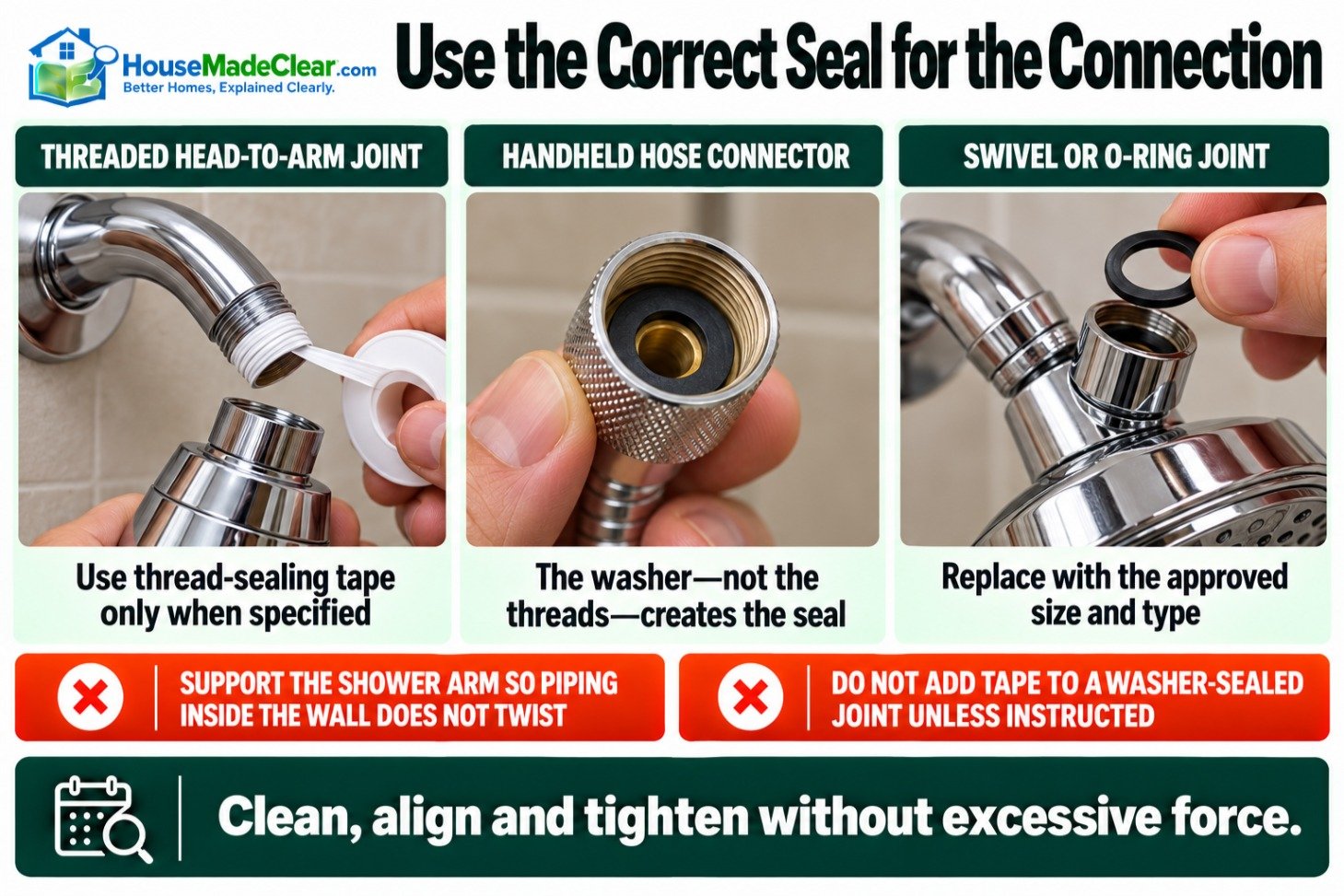
4. A Rubber Washer or O-Ring Has Worn Out
Many showerheads, handheld attachments, and swivel joints rely on rubber washers or O-rings to create watertight seals.
Over time, these parts can deteriorate, become distorted, or shift out of position.
Signs of Washer or O-Ring Problems
- Water escaping from a connector
- Drips around a swivel joint
- Water leaking after reinstalling a handheld showerhead
- A washer that looks flattened, cracked, or split
How to Fix It
Turn off the water.
Disconnect the appropriate fitting as directed by the manufacturer.
Inspect the washer or O-ring and replace it with an identical or manufacturer-approved size.
Make sure the replacement sits correctly before reconnecting the parts.
Do not assume that adding thread-sealing tape will fix a joint designed to seal using a washer.
Using the wrong sealing method can leave the leak unresolved.
5. Mineral Buildup Is Affecting the Spray Nozzles
Minerals in water can collect around showerhead openings over time.
This is particularly common where hard water leaves visible deposits.
The buildup can interfere with spray patterns and cause water to emerge irregularly.
However, mineral deposits at the nozzles do not normally explain a continuous water supply when the shower valve is fully closed.
If the showerhead drips indefinitely while turned off, investigate the valve rather than assuming descaling will solve it.
Signs of Mineral Buildup
- White or chalky deposits
- Uneven water jets
- Reduced spray performance
- Water spraying sideways
- Individual nozzles appearing blocked
How to Clean the Showerhead
Use the cleaning method recommended for your product.
Some showerheads have flexible spray nozzles that can be gently rubbed to loosen deposits.
Others have removable components or specific cleaning procedures.
Do not automatically soak every showerhead in vinegar or acid-based cleaners. Some finishes, seals, and internal parts can be damaged by incompatible cleaning products.
What If Cleaning Doesn’t Work?
The spray plate or internal passages may be damaged.
If compatible replacement parts aren’t available, changing the showerhead may be more practical.
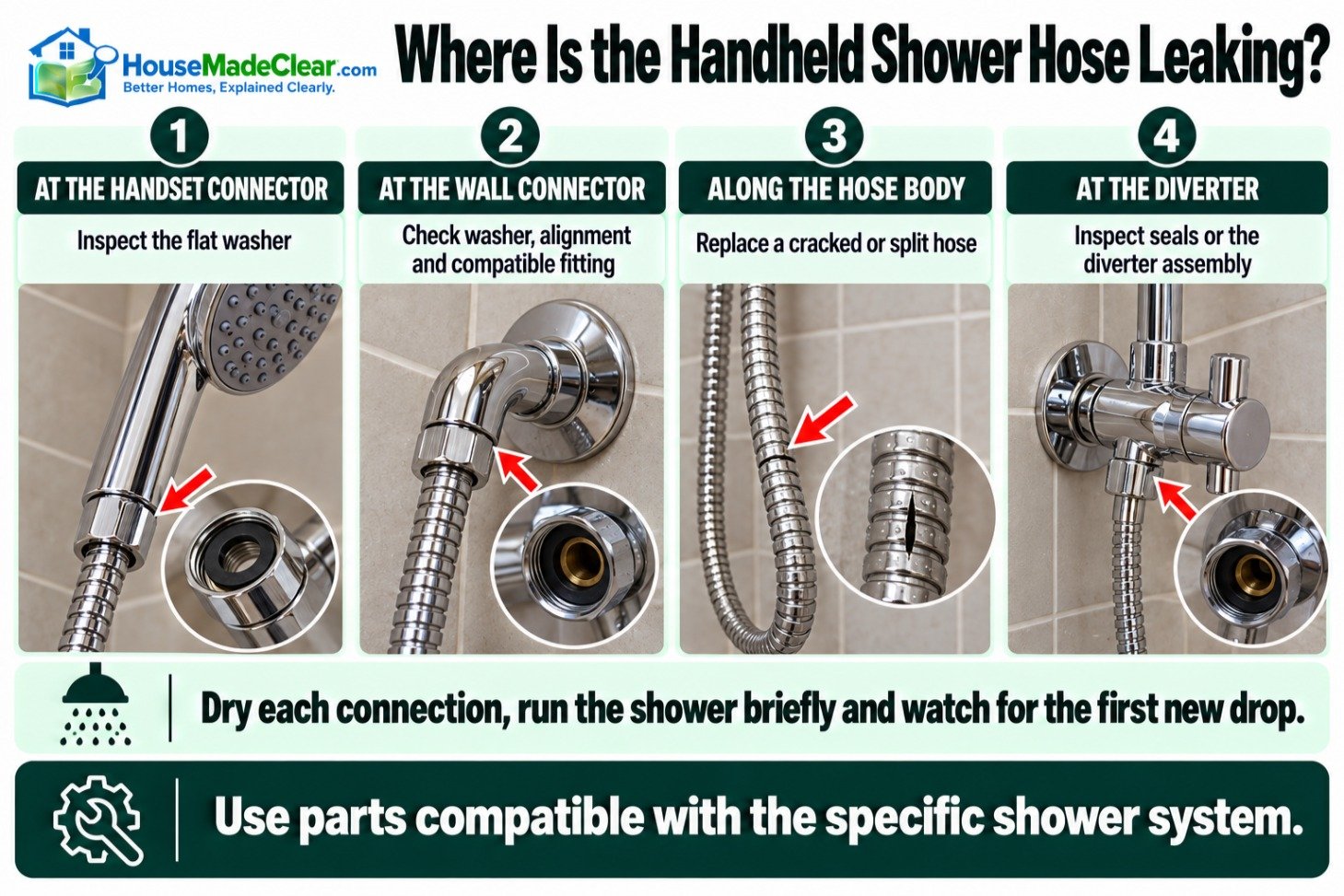
6. The Handheld Shower Hose Is Leaking
Handheld showerheads introduce additional connections that fixed showerheads don’t have.
A leak may develop at either end of the flexible hose or along its body.
If Water Leaks at a Hose Connector
Inspect the washer inside the connector.
A missing, flattened, or damaged washer can allow water to escape while the shower is running.
Replace it with a compatible part.
If Water Leaks From the Middle of the Hose
A split outer covering or damaged inner hose may be responsible.
Usually, replacing the entire hose is the more dependable solution.
If Water Leaks at the Diverter
A diverter directs water between outlets, such as a fixed showerhead and a handheld unit.
A leaking diverter may require cleaning, seal replacement, or replacement of the diverter assembly.
Use compatible parts for the specific shower system.
7. The Shower Arm or Concealed Plumbing Is Leaking
A leak near the wall deserves more attention than a few drips from the spray face.
Water may escape from the shower arm’s threaded connection inside the wall, a damaged pipe, or the shower valve body.
Unlike a visible showerhead leak, concealed leakage can damage materials before it becomes obvious.
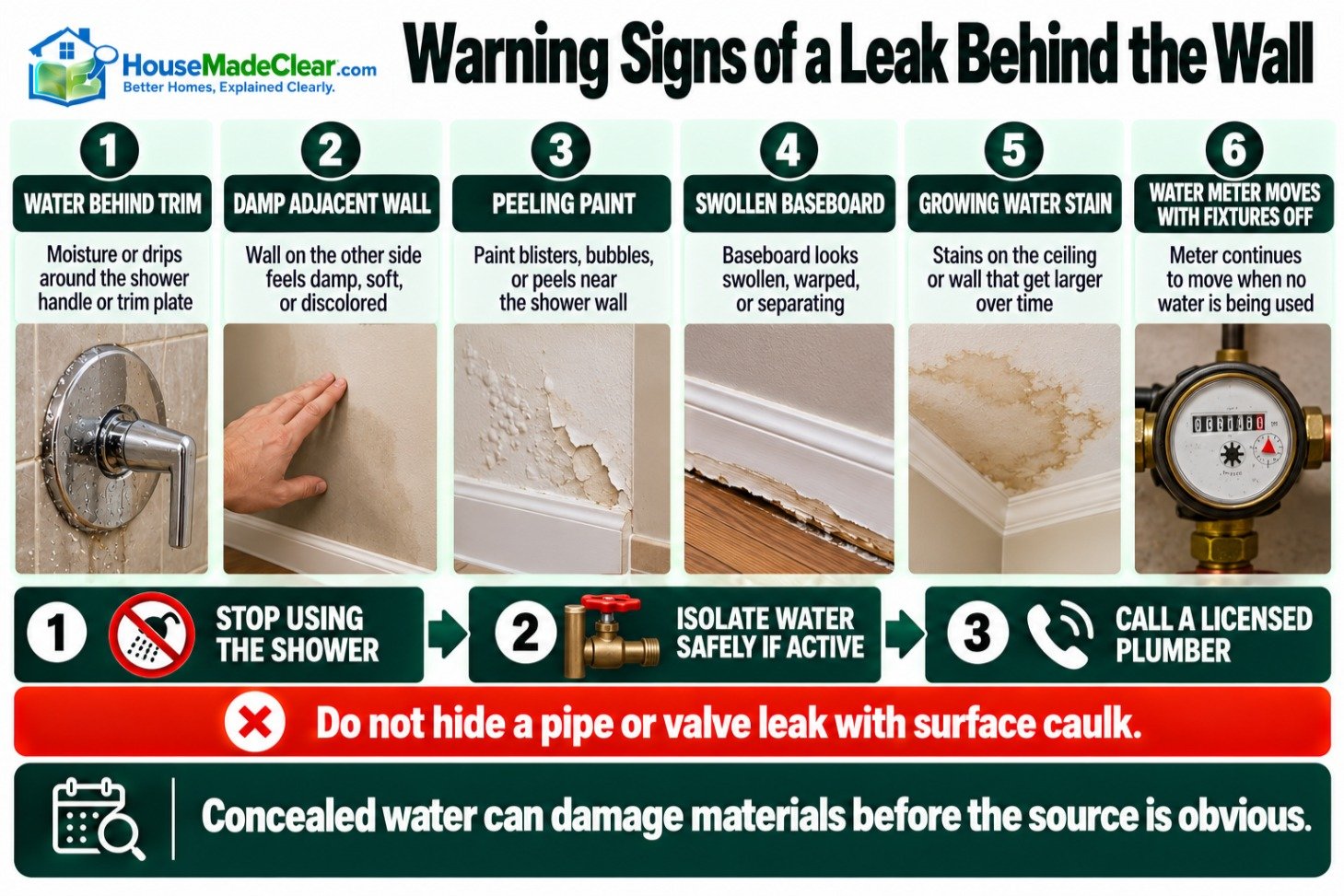
Warning Signs
- Water emerging from behind the shower trim
- Dampness on the other side of the wall
- Peeling paint near the shower
- Swollen baseboards
- Persistent moisture in an adjacent room
- A water stain that grows after shower use
- Unexpected water-meter movement when all fixtures are off
What Should You Do?
Stop using the shower if you suspect water is escaping into the wall.
Shut off the appropriate water supply if an active leak is present and it can be done safely.
Have a licensed plumber identify and repair the source.
Do not try to hide the leak with silicone caulk around the trim.
Surface sealant cannot repair a leaking pipe or failed valve connection.
For related wet-area maintenance, our guide to how long caulk takes to dry explains proper sealant use and curing around bathroom fixtures.
Why Is My Shower Head Dripping When the Water Is Off?
This is one of the most useful questions to answer before purchasing replacement parts.
The cause depends on the dripping pattern.
If It Stops After a Short Period
Residual water is likely.
Rainfall showerheads and large internal water chambers may drain slowly.
If It Continues for a Long Time
A shower valve that isn’t shutting off completely becomes a stronger possibility.
If It Stops but Starts Again Later
Some showerheads release small amounts of trapped water intermittently as air enters the assembly.
However, recurring dripping after long periods without use can also indicate valve leakage.
Observe the pattern rather than assuming it is normal.
If the Shower Drips Overnight
A persistent overnight drip warrants checking the shutoff valve and cartridge.
If you cannot identify the cause, a plumber can determine whether water is passing through the closed valve.
Why Does My Showerhead Leak Only When the Shower Is Running?
If water leaks only while the shower is on, the location often points to a connection or component exposed to flowing water.
Check these locations:
| Leak Location | Component to Inspect |
|---|---|
| Showerhead-to-arm joint | Threads and sealing method |
| Swivel ball joint | Internal seal |
| Handheld hose connector | Washer |
| Hose body | Hose material |
| Shower arm near wall | Arm and wall connection |
| Tub spout while shower runs | Diverter |
A fitting that is sealed correctly when the water is off may still leak under operating pressure if the connection is damaged.
Why Does Water Come Out of the Showerhead and Tub Spout Together?
For bathtub-shower combinations, a diverter directs water toward the showerhead or the tub spout.
When the diverter is worn or doesn’t seat correctly, water may continue escaping from the tub spout while the shower is running.
Is This a Showerhead Problem?
Usually not.
The showerhead may function normally while the diverter fails to direct the entire intended flow.
Can You Fix It?
Depending on the installation, the diverter may be incorporated into:
- The tub spout
- The shower valve
- A separate diverter control
The repair depends on the design.
Some tub-spout diverters can be replaced relatively simply. Others involve internal plumbing components.
Don’t replace the showerhead until the diverter has been checked.
How to Fix a Leaking Showerhead: A Simple Diagnostic Process
If you’re not sure what is causing the leak, follow this order.
Step 1: Identify When the Leak Happens
Does it leak only while showering, immediately after shutting off, or continuously?
Step 2: Find the Exact Location
Dry the assembly and observe the first new drop.
Check the spray nozzles, hose, swivel joint, threaded connection, and wall outlet.
Step 3: Check for Normal Drainage
If the dripping gradually stops after showering, residual water may be the explanation.
Step 4: Inspect Accessible Connections
If water escapes from a visible fitting while running, check the seal and installation.
Step 5: Clean Compatible Spray Nozzles
If the main symptom is irregular spray, follow the manufacturer’s cleaning instructions.
Step 6: Check the Shower Valve
If water keeps dripping when off, investigate the valve rather than repeatedly replacing the showerhead.
Step 7: Watch for Hidden Leakage
If water appears from behind the wall or in another room, stop using the shower and seek professional help.
How Much Water Does a Leaking Showerhead Waste?
Even a relatively slow leak can add up.
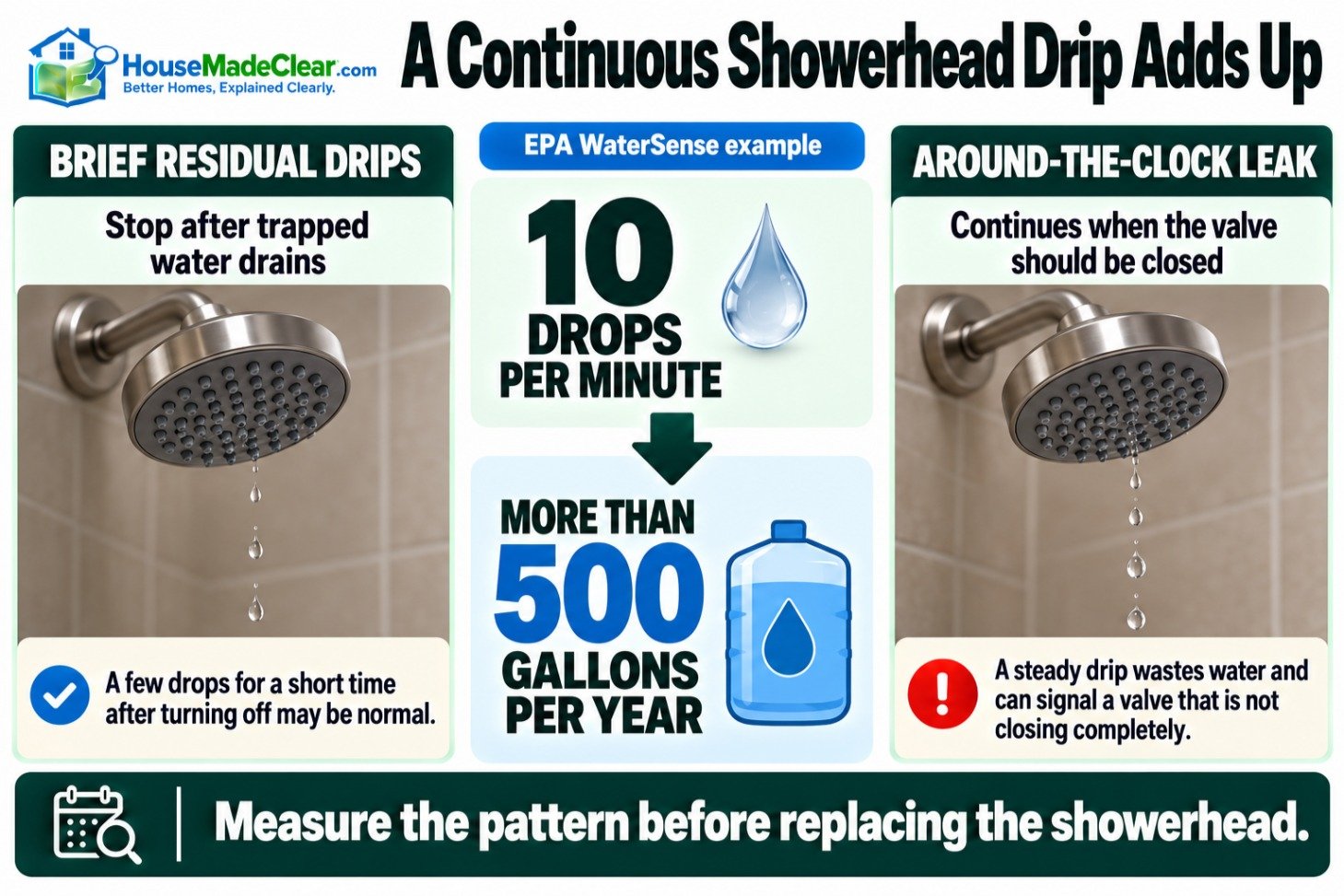
According to the EPA’s WaterSense Fix a Leak Week guidance, a showerhead dripping at 10 drops per minute can waste more than 500 gallons in a year.
That’s why a continuous drip deserves attention even if it doesn’t immediately cause visible damage.
A few drops of residual water after each shower are different from a leak that continues around the clock.
Does a Leaking Showerhead Increase Your Water Bill?
A persistent leak can increase metered water consumption.
The financial effect depends on the drip rate, local utility charges, and how long the leak continues.
Repairing a continuous leak also reduces unnecessary water use.
When Should You Replace the Showerhead Instead of Repairing It?
You don’t always need a new showerhead.
A leaking threaded joint or worn hose washer may be repairable without replacing the fixture.
But replacement may make sense in certain situations.
| Condition | Best Approach |
|---|---|
| Loose connection | Reseat and seal correctly |
| Damaged washer | Replace washer |
| Mineral buildup | Clean as instructed |
| Cracked showerhead housing | Replace showerhead |
| Damaged integrated swivel joint | Replace part or showerhead |
| Split handheld hose | Replace hose |
| Continuous drip when shower is off | Diagnose valve first |
| Hidden plumbing leak | Professional repair |
If you are replacing a showerhead, check compatibility with your shower arm and consider a WaterSense-labeled model for water efficiency.
Also confirm that the fixture’s size and position suit your bathroom. Our guide to standard showerhead height covers mounting-height considerations for different shower layouts.
Can Caulk Stop a Showerhead Leak?
Caulk is useful for certain bathroom finishing joints, but it is not a universal plumbing repair material.
Where Caulk May Be Appropriate
Manufacturer-approved sealant may be used at selected wall penetrations or trim locations.
Where Caulk Is Not the Solution
Do not rely on caulk to repair:
- A defective shower valve cartridge
- Leaking pipe threads
- A damaged rubber washer
- A cracked hose
- A broken shower arm
- A split pipe inside the wall
A plumbing connection must be repaired using its intended seal or fitting.
If caulk is applied during an appropriate bathroom repair, follow the product’s water-ready instructions before returning the shower to use.
How to Prevent Showerhead Leaks
You cannot prevent every component from wearing out, but a few habits help keep the shower working properly.
- Inspect connections periodically. Look for moisture around the shower arm, hose, and swivel joints.
- Clean spray nozzles as directed. Removing mineral buildup can maintain spray performance.
- Avoid overtightening. Excessive force can damage threads, washers, and showerhead housings.
- Use compatible replacement parts. Incorrect washers or cartridges can create new leaks.
- Investigate ongoing dripping. Don’t ignore a shower that continues to drip when turned off.
- Check for hidden dampness. Water stains or persistent wet spots near the shower should be investigated promptly.
If you notice unpleasant odors from the shower drain, that’s usually a separate issue. Our guide to why a shower drain smells explains causes involving the drain, trap, and buildup rather than the showerhead.
Likewise, a leak that keeps the bathroom damp can contribute to broader moisture problems. See our guide to bathroom humidity after a shower for practical ways to assess lingering moisture.
When to Call a Plumber
Some showerhead repairs are straightforward, but these symptoms justify professional assessment:
- Water leaks continuously when the shower is turned off.
- The shower valve cartridge is difficult to remove or identify.
- Water appears behind the shower wall.
- The shower arm moves unexpectedly or appears damaged inside the wall.
- You suspect a leak in concealed supply piping.
- The shutoff valve cannot isolate the water safely.
- The shower temperature control behaves unpredictably after repair.
- The leak continues after accessible connections and seals have been checked.
If water is actively damaging walls, ceilings, or adjacent rooms, stop using the shower and arrange prompt repairs. You may also read about Why Does My Shower Curtain Turn Orange?
Frequently Asked Questions
Why is my shower head leaking when turned off?
A continuous drip when the shower is turned off may indicate a worn valve cartridge or internal seal. However, water trapped inside the showerhead can also drain out temporarily after use. If the dripping doesn’t stop, have the shower valve checked.
Is it normal for a showerhead to drip after use?
Yes, a small amount of water may drain from the showerhead after the valve is closed. This is especially common with large rainfall showerheads. The dripping should eventually stop.
How do I stop water leaking from the showerhead connection?
Turn off the shower, remove the head if the manufacturer permits it, and inspect the connection. Clean the threads and use the specified sealing method. Some fittings need thread-sealing tape, while others use a washer or O-ring.
Why does my showerhead leak only when the water is on?
A leak that occurs only while water is flowing often points to a damaged or improperly sealed connection, hose, swivel joint, or shower arm. Check where the water first escapes.
Can a shower cartridge cause a leaking showerhead?
Yes. A worn or damaged cartridge may allow water to pass through the shower valve even when the handle is in the off position. The correct replacement depends on the valve model.
Can I fix a leaking showerhead without calling a plumber?
Sometimes. Replacing an accessible washer, resealing a compatible threaded connection, or cleaning mineral deposits may be manageable DIY tasks. Continuous valve leakage or concealed plumbing problems may require a plumber.
Why does my rainfall showerhead drip after I turn it off?
Rainfall showerheads can retain water in their larger internal chambers. The remaining water may drip out gradually after the supply is shut off. Persistent dripping well after the head has drained may indicate a separate valve problem.
Should I replace my showerhead if it keeps dripping?
Not before identifying the cause. If the showerhead itself is cracked or its connection is damaged, replacement may help. If water continues leaking through a closed shower valve, replacing the head alone is unlikely to solve the problem.