















Curtains should almost always be wider than the window itself.
If you buy curtain panels that equal the exact width of the window, they may technically cover the glass, but they often look flat, stretched and undersized when closed. The additional fabric is what creates the folds, softness and fullness that make curtains look properly finished.
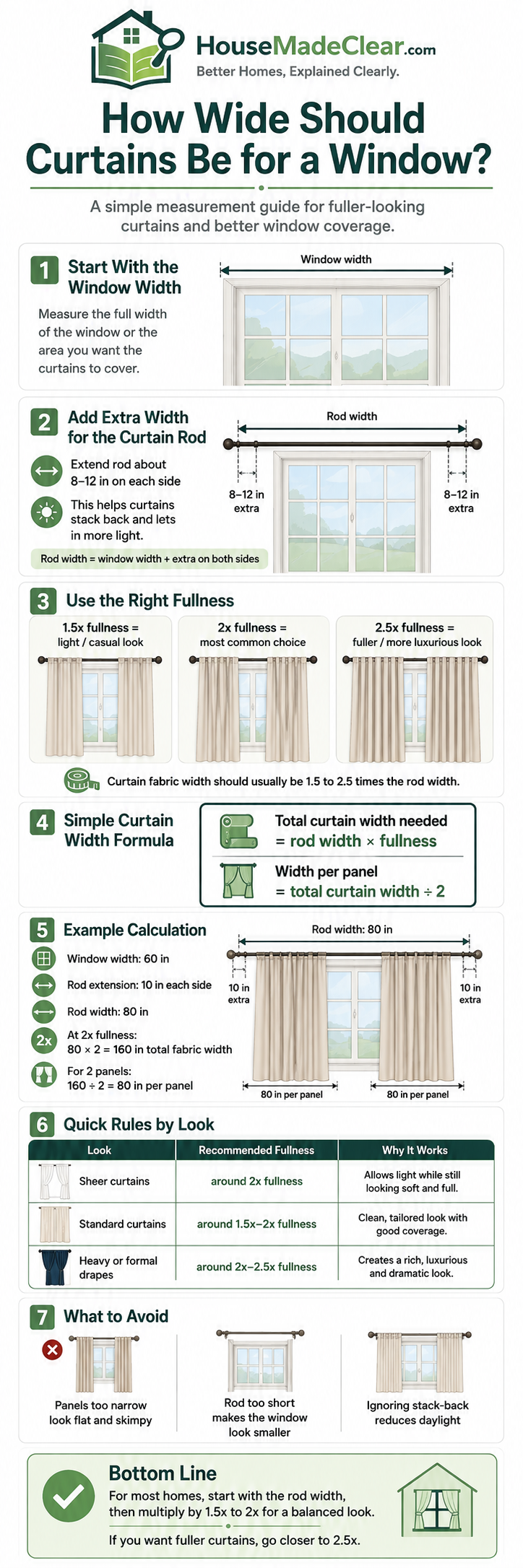
The easiest way to work out how wide your curtains should be is to measure the final curtain rod width and multiply that measurement by approximately 1.5 to 2.
Quick Answer
For most ready-made curtains, aim for a combined curtain width of about 1.5 to 2 times the final curtain rod width.
Example:
72-inch curtain rod × 1.5 = 108 inches total curtain width
72-inch curtain rod × 2 = 144 inches total curtain width
If you are using two equal curtain panels:
108 ÷ 2 = 54 inches per panel
144 ÷ 2 = 72 inches per panel
So for a 72-inch rod, two panels around 54–72 inches wide each are a useful starting range.
Before calculating width, decide where the curtain rod will actually sit. If the rod position is not finalized yet, read House Made Clear’s guide to how high to hang curtains, which explains rod height, curtain length and how far the rod can extend beyond the window.
Why Curtain Width Matters
Curtain width affects both appearance and function.
Properly sized curtains should:
- Close without being pulled completely flat
- Form natural folds when closed
- Provide sufficient privacy
- Cover the edges of the window
- Look proportional to the room
- Stack neatly beside the window when open
Curtains that are too narrow can make even an expensive fabric look unfinished.
Curtains that are excessively wide can create a different set of problems, including:
- Large bulky stacks beside the window
- Too much fabric covering the glass when open
- Additional weight on the rod
- Difficult opening and closing
- An overly heavy appearance in a small room
The objective is not to use as much fabric as possible.
It is to create appropriate fullness for the curtain style, window size and fabric weight.
What Is Curtain Fullness?
Curtain fullness describes how much wider the flat curtain fabric is compared with the area it needs to cover.
For example:
A 72-inch curtain rod with 144 inches of curtain fabric has:
144 ÷ 72 = 2
That is 2× fullness.
A 72-inch rod with 108 inches of fabric has:
108 ÷ 72 = 1.5
That is 1.5× fullness.
The higher the fullness number, the more folds and gathering you generally see when the curtain is closed.
Curtain Width vs Window Width vs Rod Width
One of the most common curtain-buying mistakes is confusing these measurements.
Window Width
This is the width of the actual window or outer frame.
Example:
Window width = 60 inches
Curtain Rod Width
The rod normally extends beyond the window frame.
If your rod extends 6 inches past each side:
60 + 6 + 6 = 72 inches
That 72-inch span is now the relevant measurement for your curtain calculation.
Curtain Panel Width
This is the flat width of one curtain panel.
If each panel is 52 inches wide and you use two:
52 + 52 = 104 inches total curtain width
You then compare that 104 inches with your 72-inch rod:
104 ÷ 72 = approximately 1.44× fullness
That will create a more tailored look than 2× fullness.
The Simple Curtain Width Formula
For many standard ready-made curtains:
Curtain rod width × 1.5 to 2 = recommended combined curtain width
Example With a 60-Inch Rod
1.5× fullness:
60 × 1.5 = 90 inches
2× fullness:
60 × 2 = 120 inches
If using two panels:
45–60 inches per panel
Example With an 80-Inch Rod
1.5×:
80 × 1.5 = 120 inches
2×:
80 × 2 = 160 inches
Two panels:
60–80 inches per panel
Example With a 100-Inch Rod
1.5×:
100 × 1.5 = 150 inches
2×:
100 × 2 = 200 inches
Two panels:
75–100 inches per panel
or four panels:
37.5–50 inches each
Should Curtains Be 1.5×, 2× or 2.5× the Rod Width?
There is no single fullness ratio that works for every curtain.
1.5× Fullness
This creates a relatively tailored appearance.
It is often useful for:
- Thick blackout curtains
- Heavy lined fabric
- Smaller rooms
- Contemporary interiors
- Windows with limited stack-back space
2× Fullness
This is a strong all-purpose starting point for many ready-made curtains.
It provides:
- Noticeable folds
- Comfortable closure
- Balanced appearance
- Good privacy
2.5× Fullness
This creates more generous gathering.
It may suit:
- Lightweight sheers
- Decorative curtains
- Large formal rooms
- Fabrics designed to gather heavily
But 2.5× is not automatically better.
With a thick fabric, that much material can become bulky and difficult to stack.
Practical Rule
Heavy fabric: start closer to 1.5×
Medium-weight fabric: around 1.5–2×
Lightweight/sheers: often around 2× or more, depending on the heading and desired look
Curtain Width Calculator
Use this four-step method whenever you measure a window.
Step 1: Measure the Final Rod Width
Suppose:
Rod width = 76 inches
Step 2: Choose Your Fullness
Moderate fullness:
76 × 1.5 = 114 inches
Fuller appearance:
76 × 2 = 152 inches
Step 3: Choose the Number of Panels
If using two panels:
114 ÷ 2 = 57 inches
152 ÷ 2 = 76 inches
So each panel should ideally be around:
57–76 inches wide
Step 4: Compare With Available Ready-Made Sizes
If the curtain you like is available only in 52-inch panels:
Two panels:
52 × 2 = 104 inches
104 ÷ 76 = 1.37× fullness
Four panels:
52 × 4 = 208 inches
208 ÷ 76 = 2.74× fullness
Two panels would create a relatively flat, tailored appearance.
Four would create much more gathering.
That calculation lets you choose intentionally rather than simply guessing.
Curtain Width Chart
The following table gives a quick reference using the final rod width.
| Rod Width | 1.5× Fullness | 2× Fullness | 2.5× Fullness |
|---|---|---|---|
| 36 in | 54 in | 72 in | 90 in |
| 48 in | 72 in | 96 in | 120 in |
| 60 in | 90 in | 120 in | 150 in |
| 72 in | 108 in | 144 in | 180 in |
| 80 in | 120 in | 160 in | 200 in |
| 84 in | 126 in | 168 in | 210 in |
| 96 in | 144 in | 192 in | 240 in |
| 108 in | 162 in | 216 in | 270 in |
| 120 in | 180 in | 240 in | 300 in |
These figures refer to total combined curtain width.
If you are using two panels, divide the total by two.
What Size Curtains Do I Need?
This quick decision table can help when shopping for ready-made panels.
| Rod Width | Two 52-in Panels | Approx. Fullness | General Result |
|---|---|---|---|
| 48 in | 104 in total | 2.17× | Very full |
| 60 in | 104 in total | 1.73× | Good moderate fullness |
| 72 in | 104 in total | 1.44× | Tailored |
| 80 in | 104 in total | 1.30× | Fairly flat |
| 84 in | 104 in total | 1.24× | Flat |
| 96 in | 104 in total | 1.08× | Usually too narrow |
This illustrates why two standard panels are not automatically enough for every window.
How Wide Should Curtains Be for a 36-Inch Window?
Suppose the curtain rod extends 4 inches beyond each side.
36 + 4 + 4 = 44-inch rod
At 1.5×:
44 × 1.5 = 66 inches total
At 2×:
44 × 2 = 88 inches total
Two panels would therefore need to be around:
33–44 inches each
A standard pair of 42-inch or 44-inch panels may work well depending on the heading and fabric.
How Wide Should Curtains Be for a 48-Inch Window?
Assume the rod extends 5 inches beyond each side.
48 + 10 = 58-inch rod
1.5×:
58 × 1.5 = 87 inches
2×:
58 × 2 = 116 inches
Two panels:
approximately 44–58 inches each
Two standard 52-inch panels would provide 104 inches total, which sits comfortably within this range.
How Wide Should Curtains Be for a 60-Inch Window?
Suppose the finished rod width is 72 inches.
1.5×:
72 × 1.5 = 108 inches
2×:
72 × 2 = 144 inches
Two panels:
54–72 inches each
Two 52-inch panels give 104 inches total, which is slightly below 1.5× but may still suit a tailored look.
For fuller curtains, choose wider panels.
How Wide Should Curtains Be for a 72-Inch Window?
If the rod extends 6 inches on each side:
72 + 12 = 84 inches
1.5×:
84 × 1.5 = 126 inches
2×:
84 × 2 = 168 inches
Two panels:
63–84 inches each
At this size, two standard 52-inch panels total only 104 inches, giving about:
104 ÷ 84 = 1.24× fullness
That may look noticeably flat.
How Wide Should Curtains Be for an 84-Inch Window?
Suppose the rod width is 96 inches.
1.5×:
96 × 1.5 = 144 inches
2×:
96 × 2 = 192 inches
Two panels:
72–96 inches each
Four standard 52-inch panels would provide:
208 inches total
208 ÷ 96 = 2.17× fullness
That can be a practical option if wider ready-made panels are difficult to find.
How Wide Should Curtains Be for a 96-Inch Window?
Suppose your final rod width is 108 inches.
1.5×:
108 × 1.5 = 162 inches
2×:
108 × 2 = 216 inches
Two panels:
81–108 inches each
Four 52-inch panels:
208 inches total
208 ÷ 108 = 1.93× fullness
That is very close to the common 2× target.
How Wide Should Curtains Be for a 108-Inch Window?
Suppose the rod spans 120 inches.
1.5×:
120 × 1.5 = 180 inches
2×:
120 × 2 = 240 inches
Two panels:
90–120 inches each
Four 52-inch panels:
208 inches total
208 ÷ 120 = 1.73× fullness
That may create a useful moderate look.
How Wide Should Curtains Be for a 120-Inch Window?
A very wide 120-inch opening may use a rod approximately 132 inches or more, depending on available wall space.
Using 132 inches:
1.5×:
132 × 1.5 = 198 inches
2×:
132 × 2 = 264 inches
Four 52-inch panels provide:
208 inches
208 ÷ 132 = 1.58× fullness
For a fuller look, you may need:
- Wider panels
- Additional panels
- Custom drapery
Are Two 52-Inch Curtain Panels Wide Enough?
This is one of the most practical questions because 52-inch panels are common.
Two panels provide:
104 inches total
They work differently depending on the rod.
48-Inch Rod
104 ÷ 48 = 2.17×
Very full.
60-Inch Rod
104 ÷ 60 = 1.73×
Good moderate fullness.
72-Inch Rod
104 ÷ 72 = 1.44×
Tailored.
84-Inch Rod
104 ÷ 84 = 1.24×
Quite flat.
96-Inch Rod
104 ÷ 96 = 1.08×
Usually not enough if you want visible folds when closed.
So do not ask only:
“Are two 52-inch panels enough?”
Ask:
How does 104 inches compare with my actual rod width?
Can You Use Four Curtain Panels on One Window?
Yes.
Four panels can be one of the easiest ways to achieve adequate fullness on a large window without ordering custom curtains.
For example:
52 × 4 = 208 inches total
That can work well for:
- Wide living-room windows
- Sliding doors
- Large bedroom windows
- Extra-wide rods
When closed, arrange the panels so they visually read as two fuller curtain sides.
Make sure:
- All panels are the same length
- Dye/color variation is minimal
- Headings match
- Patterns align reasonably where relevant
Should Curtains Be Wider Than the Rod?
Yes, the combined curtain fabric width normally needs to be wider than the rod.
If:
Rod = 72 inches
Curtain fabric = 72 inches
you have:
1× fullness
The curtains will need to stretch almost flat to cover the span.
If:
Rod = 72 inches
Fabric = 144 inches
you have:
2× fullness
That creates substantially more folds.
Should You Measure the Window or Curtain Rod?
If the rod is already installed, use the usable rod width.
If it has not been installed:
- Measure the window.
- Decide how far the rod will extend beyond each side.
- Add those extensions.
- Calculate your curtain width from the final rod span.
Example
Window = 60 inches
Extension = 6 inches on each side
60 + 12 = 72-inch rod
Then:
72 × 1.5 = 108 inches
or
72 × 2 = 144 inches
This is more accurate than calculating from the 60-inch window itself.
How Far Should a Curtain Rod Extend Past the Window?
The exact amount depends on:
- Wall space
- Window size
- Fabric thickness
- Stack-back requirements
- Nearby corners
- Furniture
- Radiators or vents
As a practical starting point, House Made Clear’s curtain hanging guide uses approximately 4–8 inches beyond each side where space permits.
A wider rod can allow more of the open curtain to sit against the wall instead of covering the glass.
That can improve:
- Daylight
- Visual width
- Side coverage
- Curtain proportions
What Is Curtain Stack Back?
Stack back is the width of fabric gathered beside the window when the curtains are fully open.
A lightweight sheer has a relatively small stack.
A thick blackout or velvet curtain may require considerably more room.
If the rod does not extend far enough past the window, the open curtain stack can permanently cover part of the glass.
That matters particularly in rooms with limited natural light.
House Made Clear’s guide to making a dark room brighter without adding windows explains why keeping existing window glass as unobstructed as practical can help maximize available daylight.
Does Fabric Weight Change Curtain Width?
Yes.
Sheer and Lightweight Curtains
Examples include:
- Voile
- Sheer polyester
- Lightweight linen
- Thin cotton
These usually benefit from greater fullness.
Around 2× or sometimes more can create attractive folds.
Medium-Weight Curtains
These include many standard ready-made living-room curtains.
A range of:
1.5–2×
is usually practical.
Heavy Curtains
Examples:
- Velvet
- Thermal curtains
- Thick blackout fabric
- Heavily lined drapes
These already have physical volume.
Too much fullness can create:
- Large stack back
- Excess weight
- Difficulty moving
- Heavy visual appearance
For these fabrics, around 1.5× may be enough depending on the product.
How Wide Should Sheer Curtains Be?
Sheers usually look better when generously gathered.
If:
Rod = 72 inches
2× fullness means:
144 inches total
You might use:
Two 72-inch sheer panels
or
Several narrower panels totaling approximately 144 inches.
Some curtain headings are designed for greater fullness, so follow manufacturer guidance where available.
How Wide Should Blackout Curtains Be?
Blackout curtains need enough fabric for:
- Privacy
- Center closure
- Side coverage
A useful starting range remains:
1.5–2× the rod width
However, blackout performance depends on more than width.
Light can also enter:
- Above the rod
- Around the side edges
- Through the center gap
- Beneath the curtain
So if light control is important, plan:
- Wider rod
- Adequate overlap
- Correct curtain length
- Suitable heading
- Appropriate return/side coverage where needed
How Wide Should Living Room Curtains Be?
For living rooms, 1.5–2× fullness is a strong starting range.
Choose closer to 1.5× if:
- Fabric is thick
- Style is modern
- Room is small
- Stack space is limited
Choose closer to 2× if:
- Fabric is lightweight
- Curtains are a major decorative feature
- You want softer folds
Also check how the curtain interacts with furniture.
The stack should not interfere with:
- Sofa arms
- Side tables
- Floor lamps
- Radiators
- Walking routes
If the room still needs planning, House Made Clear’s functional living-room layout guide can help with window, furniture and circulation placement.
How Wide Should Bedroom Curtains Be?
Bedrooms usually need more reliable privacy and often better light control.
That makes adequate curtain width especially important.
Start around:
1.5–2× rod width
The curtains should:
- Meet comfortably at center
- Retain folds when closed
- Cover the edges of the glass
- Avoid obvious side gaps
For layered window treatments, calculate each layer separately.
Example:
Sheer layer: around 2×
Blackout layer: around 1.5–2×
How Wide Should Curtains Be in a Small Bedroom?
Do not reduce curtain width simply because the room is small.
Curtains still need enough fullness.
Instead, reduce visual heaviness through:
- Lighter fabric
- Plain colors
- Smaller patterns
- Slimmer rods
- Better stack placement
If wardrobe or dresser placement competes with the window wall, House Made Clear’s guide to small bedroom storage when you have no closet can help you plan both storage and curtain space.
How Wide Should Home Office Curtains Be?
Home-office curtains should balance:
- Daylight
- Privacy
- Screen glare
You may not want a very heavy curtain permanently covering part of the window.
A practical layered setup could be:
- Light-filtering shade or sheer
- Main curtain for privacy
Make sure the curtain can stack far enough away from the glass to preserve useful daylight when open.
If the desk is near the window, House Made Clear’s guide to where a home-office desk should face explains how daylight and screen glare affect desk placement.
How Wide Should Curtains Be for a Sliding Glass Door?
Measure the full track or rod width, not just one door panel.
Suppose:
Track = 120 inches
At 1.5×:
120 × 1.5 = 180 inches
At 2×:
120 × 2 = 240 inches
Possible arrangements include:
- Two extra-wide panels
- Four standard panels
- One-way draw curtains
Pay special attention to stack back.
If the door opens on the right, for example, avoid creating a large stack that obstructs the primary access side.
How Wide Should Curtains Be for French Doors?
If one rod spans the complete set of French doors, calculate width exactly as you would for a wide window:
Final rod width × fullness factor
If the curtain is mounted directly onto each individual door, the measurement method can differ depending on:
- Door-mounted rods
- Sash curtains
- Top-and-bottom rods
Follow the hardware or curtain manufacturer’s sizing guidance for those installations.
How Wide Should Curtains Be for a Bay Window?
Bay windows need more careful measurement because the rod or track changes direction.
Do not simply measure straight across the front of the bay.
Instead:
- Measure each rod or track section.
- Determine where curtains will stack.
- Decide whether each section closes independently.
- Calculate fabric for each section.
A continuous custom track may require different planning from several individual rods.
How Wide Should Curtains Be for Corner Windows?
Corner windows can become crowded because two curtain stacks may meet near the corner.
Measure:
- Each window independently
- Available wall space
- Corner clearance
Full 2× fullness may be visually attractive, but if both curtains create large stacks in the same corner, a lighter fabric or reduced fullness may work better.
Do Grommet Curtains Need Different Fullness?
Grommet curtains form folds as the fabric moves around the large rings.
They generally still need extra width.
Too little fabric can make the curtain look flat and pull the grommets into an unnatural line.
Many ready-made grommet curtains provide a recommended rod coverage range.
Use that product-specific guidance whenever possible.
How Wide Should Rod-Pocket Curtains Be?
Rod-pocket curtains are gathered directly onto the rod.
Their appearance depends heavily on the amount of fabric used.
Less fabric creates gentle gathering.
More fabric creates denser gathering.
A practical range can still fall around 1.5–2×, but lightweight rod-pocket curtains may look better with more fullness.
How Wide Should Eyelet Curtains Be?
Eyelet curtains function similarly to grommet curtains.
The eyelets naturally create wave-like folds.
A common practical approach is to provide enough width that those waves remain visible when the curtains are closed.
Again, around 1.5–2× can work, but follow the curtain manufacturer’s stated coverage recommendation.
How Wide Should Pinch-Pleat Curtains Be?
Pinch-pleat curtains are an important exception.
Their fullness is generally built into the finished curtain construction.
If a pinch-pleat curtain is sold as:
72-inch finished width
that may already mean it is designed to cover approximately 72 inches of rod or track.
Do not automatically multiply that finished width by two.
For pleated curtains, use:
- Finished curtain width
- Track width
- Manufacturer or workroom guidance
rather than the simple flat-panel fullness formula.
One Curtain Panel or Two?
Most conventional windows use two panels because they:
- Open from the center
- Look balanced
- Allow furniture flexibility
A single panel may work for:
- Narrow window
- Door
- Asymmetrical design
- One-way draw treatment
If using one panel, the same fullness principle still applies.
For a 60-inch rod at 2× fullness:
You would need one panel approximately:
120 inches wide
if you want full 2× gathering.
Should Curtains Meet in the Middle?
Yes, if they are intended to close.
They should meet naturally without needing to be pulled tight.
If the curtains barely touch while stretched flat, there is not enough fabric.
Properly sized curtains should maintain visible folds even when fully closed.
How Much Should Curtains Overlap in the Middle?
Standard decorative curtains do not always require a large overlap.
But for privacy and light control, you want enough fabric that ordinary movement does not produce a center gap.
Specialized blackout systems may include:
- Overlapping carriers
- Return tracks
- Magnetic closures
For ordinary curtain rods, adequate fullness usually provides enough flexibility for the two panels to meet comfortably.
Curtain Width for Privacy
If privacy is important, do not size curtains to the minimum possible width.
Allow enough fabric so that:
- Panels meet comfortably
- Folds remain when closed
- Small shifts do not create gaps
- Side coverage remains adequate
This matters especially for:
- Bedrooms
- Ground-floor windows
- Street-facing rooms
- Apartments
Curtain Width and Daylight
Wider curtains create more fabric.
More fabric creates a larger stack.
If the rod is too narrow, this stack may cover part of the window even when the curtains are open.
That can reduce daylight.
If your room is naturally dark, use:
- Wider rod where space allows
- Appropriate fabric
- Adequate stack-back area
so more of the glass remains exposed during the day.
House Made Clear’s dark room brightening guide covers curtain placement, mirrors and lighting as part of a wider daylight strategy.
Curtain Width and Interior Proportion
Curtains can visually change how large a window appears.
A rod that extends beyond the window combined with sufficiently wide curtains can make the overall treatment appear:
- Wider
- Taller
- More substantial
This is especially useful where the actual window is small relative to a large wall.
However, do not make the treatment dramatically wider without considering:
- Furniture placement
- Wall artwork
- Adjacent doors
- Heating vents
- Available wall space
What Happens If Curtains Are Too Narrow?
Signs include:
- Curtains look flat when closed
- Center gap appears
- Fabric pulls tightly
- Side gaps remain
- Window treatment looks undersized
How to Fix It
Possible solutions:
- Add another matching panel
- Replace panels with wider ones
- Reduce rod width if appropriate
- Use curtains mainly as decorative side panels with a separate blind for privacy
What Happens If Curtains Are Too Wide?
Very wide curtains can cause:
- Excessive stacking
- Heavy appearance
- Blocked daylight
- Harder opening
- Extra rod load
How to Fix It
Possible solutions:
- Remove one panel
- Use lighter fabric
- Reduce fullness
- Increase rod extension if wall space permits
Standard Curtain Panel Widths
Ready-made curtain sizes vary by brand, but common panel widths often include dimensions around:
- 42 inches
- 50 inches
- 52 inches
- 54 inches
Wider panels are also available.
Do not assume that a product labelled:
52 × 84
means a pair.
It often means one panel that is 52 inches wide and 84 inches long.
Always check:
- Number of panels included
- Width per panel
- Length per panel
before calculating how many packs you need.
Do Not Confuse Curtain Width With Curtain Length
Curtain dimensions are normally listed:
Width × Length
For example:
52 × 96 inches
means:
- 52 inches wide
- 96 inches long
Curtain width determines fullness.
Curtain length determines how the curtain relates to:
- Rod
- Floor
- Sill
- Ceiling
If you have not chosen the correct curtain length yet, use House Made Clear’s how high to hang curtains guide before ordering.
How to Measure Curtain Width Step by Step
Step 1: Measure the Window
Measure the outer width of the window frame.
Step 2: Determine Rod Extension
Choose how far the rod will extend beyond the window.
Step 3: Calculate Final Rod Width
Example:
Window = 64 inches
Rod extension = 6 inches each side
64 + 12 = 76 inches
Step 4: Choose Fullness
For 1.5×:
76 × 1.5 = 114 inches
For 2×:
76 × 2 = 152 inches
Step 5: Decide Number of Panels
If using two:
114 ÷ 2 = 57 inches
152 ÷ 2 = 76 inches
Step 6: Compare Available Sizes
If available panels are 52 inches:
Two = 104 inches total
Four = 208 inches total
Calculate which finished fullness suits the room.
Step 7: Check Stack Space
Make sure the chosen amount of fabric has somewhere to sit when open.
Step 8: Check Rod Capacity
Heavy, wide curtains can place significant weight on the rod and brackets.
Follow the hardware manufacturer’s installation instructions.
Common Curtain Width Mistakes
1. Buying Curtains Equal to Window Width
Problem:
They become flat when closed.
Better approach:
Use additional fabric for fullness.
2. Ignoring Rod Extension
Problem:
The real coverage area is larger than expected.
Better approach:
Calculate from final rod width.
3. Assuming Two Panels Are Always Enough
Problem:
Large windows may need more fabric.
Better approach:
Calculate combined panel width mathematically.
4. Confusing One Panel With a Pair
Problem:
You may receive half the fabric expected.
Better approach:
Check package quantity.
5. Automatically Choosing 2× for Heavy Curtains
Problem:
Thick fabric can become excessively bulky.
Better approach:
Consider fabric weight.
6. Forgetting Curtain Stack Back
Problem:
Open curtains cover the window.
Better approach:
Plan wall space beside the glass.
7. Buying Curtains Before Choosing a Rod
Problem:
You end up designing the rod around the panels.
Better approach:
Plan the rod first.
8. Ignoring the Heading Style
Problem:
Different headings create fullness differently.
Better approach:
Follow manufacturer guidance for pleated or specialized curtains.
9. Measuring Only the Glass
Problem:
The frame and rod extension are ignored.
Better approach:
Measure the actual treatment span.
10. Ignoring Hardware Weight Limits
Problem:
Heavy wide curtains may strain the rod.
Better approach:
Check bracket and rod specifications.
Quick Curtain Measurement Box
Curtain Width Formula
Step 1: Measure the final curtain rod width.
Step 2: Multiply by 1.5 for moderate fullness.
Step 3: Multiply by 2 for a fuller look.
Step 4: Divide by the number of panels.
Example
72-inch rod × 2 = 144 inches total curtain width
144 ÷ 2 panels = 72 inches per panel
Curtain Width Checklist
Before ordering, confirm:
- Window width measured
- Rod width planned
- Rod extension included
- Desired fullness selected
- Combined curtain width calculated
- Individual panel width checked
- Number of panels confirmed
- Packaging quantity checked
- Fabric weight considered
- Curtain heading identified
- Stack-back space checked
- Furniture placement reviewed
- Privacy needs considered
- Blackout requirements considered
- Curtain length calculated separately
- Rod weight capacity checked
- Window can still open properly
- Curtains will not interfere with vents or radiators
Final Thoughts
The easiest curtain-width rule to remember is:
For many ready-made curtains, aim for approximately 1.5–2 times the final curtain rod width.
For example:
72-inch rod
At 1.5× fullness:
108 inches total curtain width
At 2× fullness:
144 inches total curtain width
Then divide that number by the number of panels you want to use.
The biggest mistake is buying curtains that equal the exact width of the window.
Curtains need additional fabric to:
- Create folds
- Close comfortably
- Provide privacy
- Look proportional
Also remember that rod width should generally be decided before curtain width.
A rod that extends beyond the window gives the curtain somewhere to stack when open and can help preserve more useful daylight.
For a complete curtain installation plan, pair this article with House Made Clear’s How High Should You Hang Curtains?.
Together, the two guides cover the three measurements that matter most:
Rod height + rod width + curtain length.
Frequently Asked Questions
How wide should curtains be compared with the window?
For most ready-made curtains, aim for a combined width of about 1.5–2 times the final curtain rod width. This provides enough material for the curtains to retain folds when closed.
How wide should curtains be for a 60-inch window?
If the final rod measures around 72 inches after extending beyond the window, approximately 108–144 inches of combined curtain fabric provides about 1.5–2× fullness.
Are two 52-inch curtain panels wide enough?
Two 52-inch panels provide 104 inches of combined fabric. They work well for some smaller rods but may look relatively flat on rods wider than about 72–84 inches.
Should curtains be twice the width of the window?
Around 2× fullness creates a fuller appearance for many curtain styles, but it is not mandatory. Around 1.5× can work well for heavy fabrics or a more tailored look.
What does 2× curtain fullness mean?
It means the flat fabric width is twice the width of the curtain rod. A 72-inch rod would therefore use approximately 144 inches of total curtain fabric.
Should I measure the window or curtain rod for curtain width?
Use the final curtain rod width whenever possible because the curtains need to cover the entire rod span, including any extension beyond the window frame.
How wide should each curtain panel be?
Calculate the total curtain width needed and divide it by the number of panels. For example, 144 inches of total fabric divided between two panels means approximately 72 inches per panel.
Can I use four curtain panels on one window?
Yes. Four panels are often useful for wide windows where two standard ready-made panels do not provide enough fullness.
How wide should sheer curtains be?
Sheers generally benefit from generous fullness. Around 2× the rod width is a practical starting point for many lightweight sheer curtains.
How wide should blackout curtains be?
Around 1.5–2× the rod width is a useful starting range. Heavy blackout fabrics may work well closer to the lower end because they create more bulk.
How wide should curtains be for a 72-inch window?
If the final rod is approximately 84 inches wide, about 126–168 inches of combined curtain fabric provides approximately 1.5–2× fullness.
How wide should curtains be for a 96-inch window?
If the curtain rod spans around 108 inches, approximately 162–216 inches of combined fabric provides around 1.5–2× fullness.