















Curtains can technically fit a window and still make the whole wall look wrong.
The rod may sit too close to the window frame. The panels may stop several inches above the floor. The curtain stack may cover too much glass when opened, or the fabric may puddle excessively and collect dust.
Most of these problems come from deciding on the curtain first and the rod position second.
A better approach is to determine the correct rod height, rod width and floor clearance before buying or altering the curtain panels.
Quick answer:
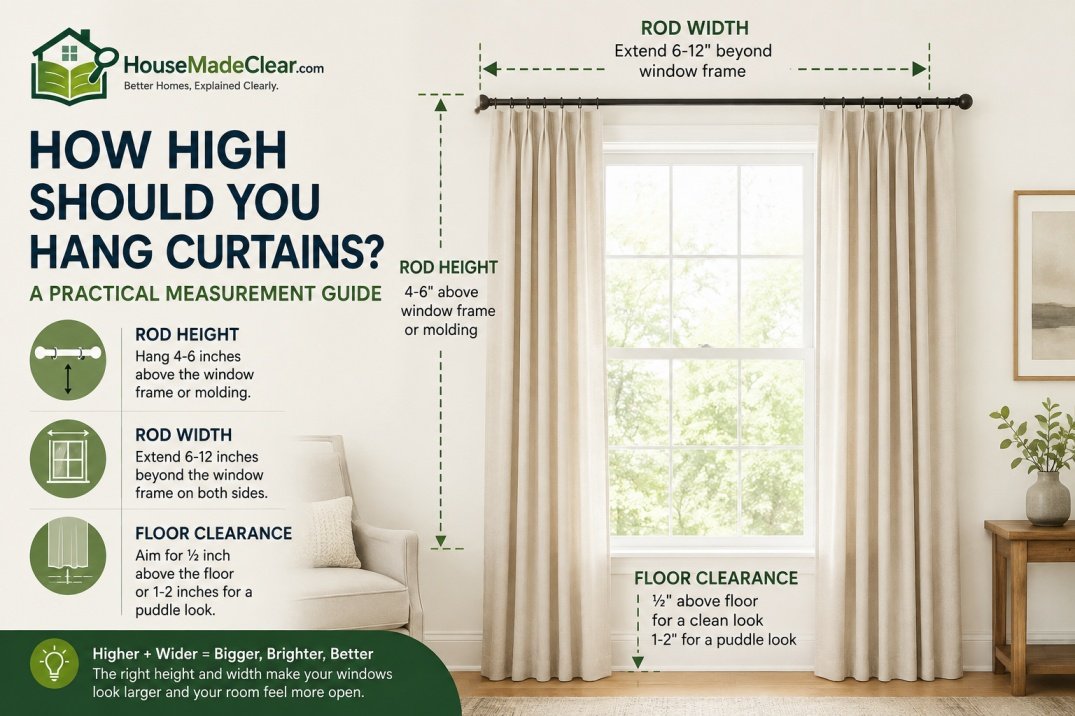
A practical starting point is to position the curtain rod around 4–6 inches above the top of the window frame and extend it several inches beyond each side of the window. Floor-length curtains usually look best when they touch or nearly touch the floor. These are design guidelines rather than fixed rules, so ceiling height, molding, furniture and curtain style can change the ideal position. Interior designers commonly recommend mounting rods above the window frame rather than directly on it because the extra height can make windows and ceilings appear taller.
Why Curtain Height Changes the Look of a Room
Curtains are not only pieces of fabric covering a window.
They create strong vertical lines across the wall, which means their placement affects how people perceive:
- Ceiling height
- Window size
- Wall proportions
- Natural light
- Furniture scale
- Overall room balance
A rod mounted directly above the window frame visually emphasizes the actual height of the window.
Moving the rod higher can allow the eye to follow the curtain from near the ceiling toward the floor, making the window treatment appear taller and more substantial.
This is one reason designers often use higher curtain placement in rooms with lower ceilings. Recent interior-design guidance continues to recommend positioning curtains closer to the ceiling as a way of emphasizing vertical height.
However, higher is not automatically better.
Curtain placement should still relate to:
- Ceiling height
- Crown molding
- Window dimensions
- Wall space
- Curtain heading
- Furniture
- Heating equipment
- The overall proportions of the room
The goal is not to mount the curtain as high as physically possible. The goal is to make the window treatment look intentional and function properly.
How High Above a Window Should a Curtain Rod Be?
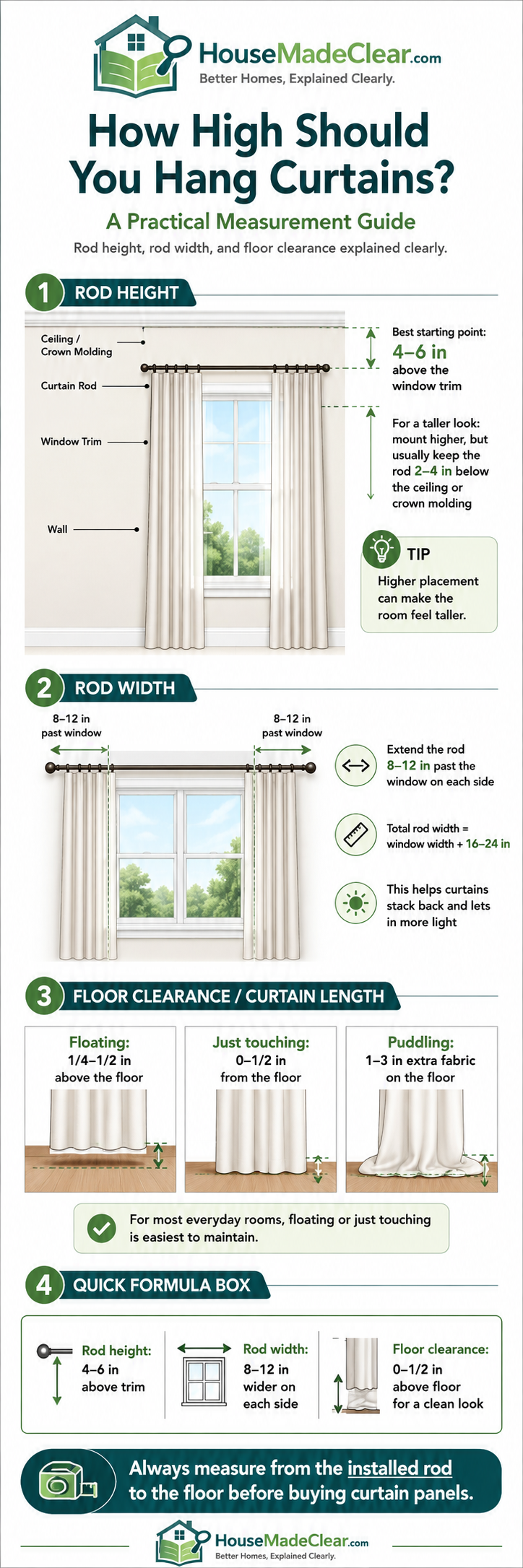
For many standard rooms, 4–6 inches above the top of the window frame is a useful starting point.
This distance gives the window treatment some breathing room while helping the wall appear taller. It is also a frequently cited interior-design guideline for curtain-rod placement.
You can then adjust the position according to the room.
Consider mounting the rod higher when:
- The ceiling is relatively tall
- There is substantial wall space above the window
- The window looks visually short
- You want a stronger floor-to-ceiling effect
- The curtain length supports the higher position
- Crown molding does not interfere
Consider mounting it slightly lower when:
- Crown molding occupies much of the upper wall
- The ceiling is very low
- Architectural details limit the available space
- The curtain heading needs additional clearance
- A ceiling-mounted treatment would look awkward in the room
Avoid mounting the rod directly on top of the window trim unless the architecture or installation requires it.
That placement tends to make the window treatment feel compressed.
Should Curtains Be Hung Close to the Ceiling?
They can be.
Mounting curtains close to the ceiling can create a stronger vertical effect and may make a room feel taller.
This approach often works particularly well when:
- The curtains extend fully to the floor
- The window has enough width
- The wall above the window is relatively plain
- Ceiling height is around 8–10 feet
- The room has a clean or contemporary design
But ceiling-level placement is not mandatory.
Hanging curtains close to the ceiling works best when:
The curtain length is appropriate.
The wall proportions support the effect.
The curtain does not interfere with crown molding.
The window is not so narrow that the tall treatment looks disproportionately thin.
It may look awkward when:
The curtain is mounted extremely high above a very small window.
The panels are too narrow.
The fabric stops well above the floor.
The rod competes with decorative molding.
There is little relationship between the curtain and the rest of the room.
Interior designers differ somewhat in their preferred placement. Some recommend several inches above the window, while others take curtain rods almost to the ceiling. Both approaches can work when the proportions are considered carefully.
How High Should You Hang Curtains With an 8-Foot Ceiling?
Eight-foot ceilings are common in American homes.
With an 8-foot ceiling, start by testing a rod position around 4–6 inches above the window frame.
Then look at the remaining wall space.
If there is relatively little space between the top of the window and the ceiling, mounting the rod closer to the ceiling may create a cleaner line.
If there is considerable space, you have more flexibility.
A practical approach for an 8-foot ceiling
- Measure from the floor to the ceiling.
- Measure from the top of the window frame to the ceiling.
- Mark a position 4–6 inches above the window.
- Mark a second position closer to the ceiling.
- Stand across the room and compare the proportions.
Painter’s tape is useful because you can test the placement before drilling.
Do not choose the rod position simply because you already own 84-inch curtains.
That often leads to the rod being mounted too low.
Determine the correct height first, then buy or alter curtains to fit.
How High Should You Hang Curtains With a 9-Foot Ceiling?
A 9-foot ceiling provides more vertical space.
In these rooms, higher-mounted curtains often look balanced because there is enough wall height to support longer panels.
Possible placements include:
- Several inches above the window frame
- Roughly halfway between the frame and ceiling
- Close to the ceiling
- Directly below crown molding
The right position depends partly on the size of the window.
A tall window may need only a modest amount of extra height.
A relatively short window may benefit visually from a higher rod.
Ready-made curtain lengths around 96 inches are common, but curtain length should still be chosen after the rod position is determined.
How High Should Curtains Be With a 10-Foot Ceiling?
With a 10-foot ceiling, there is more opportunity to create a dramatic full-height treatment.
Possible options include:
Rod several inches above the window
This keeps the treatment visually connected to the actual window.
Rod close to the ceiling
This creates a stronger floor-to-ceiling effect.
Ceiling-mounted curtain track
This can create a clean architectural appearance, particularly with large windows or sliding doors.
Very tall installations may require:
- Longer ready-made curtains
- Custom curtain lengths
- Professional alteration
- Stronger rods or tracks
- Additional brackets
- Safe access for installation
The taller the curtain, the more noticeable problems with measurement become.
Always measure the floor-to-rod distance at several points because floors and ceilings are not necessarily perfectly level.
How Far Should Curtains Be From the Floor?
For most modern interiors, the most practical curtain finish is either:
- Touching the floor
- Just slightly above the floor
Interior-design guidance commonly favors curtains that barely touch the floor rather than ending noticeably above it or forming excessive puddles.
There are several possible finishes.
Curtains That Just Touch the Floor
This produces a tailored appearance.
It works well in:
- Living rooms
- Bedrooms
- Home offices
- Dining rooms
The fabric appears full length without collecting excessive dust.
Curtains Slightly Above the Floor
A very small clearance can make everyday maintenance easier.
This can be useful when you have:
- Robotic vacuum cleaners
- Pets
- High-traffic rooms
- Uneven flooring
- Curtains that open and close frequently
The clearance should be subtle.
Curtains stopping several inches above the floor usually look unintentionally short when the design is supposed to be floor length.
Curtains That Break Slightly on the Floor
A small amount of extra fabric creates a soft fold where the curtain meets the floor.
This can suit:
- Traditional interiors
- Bedrooms
- Formal rooms
It requires slightly more maintenance.
Puddled Curtains
Puddling means allowing several extra inches of fabric to rest on the floor.
It can create a dramatic, formal look, but there are practical disadvantages:
- Dust accumulation
- Pet hair
- Difficult vacuuming
- Fabric wear
- Increased maintenance
- Greater chance of the curtain being stepped on
For most everyday homes, touching or almost touching the floor is a more practical choice.
How Wide Should a Curtain Rod Be?
Curtain height gets most of the attention, but rod width is just as important.
A rod should normally extend beyond the sides of the window frame.
A practical starting point is approximately 4–8 inches beyond each side, depending on:
- Window size
- Available wall space
- Curtain fullness
- Panel width
- Hardware
- Furniture position
Architectural Digest’s curtain-installation guidance recommends positioning brackets several inches beyond the sides of the window so the curtains can open more fully.
Extending the rod beyond the window can:
- Expose more glass when curtains are open
- Let more daylight enter
- Make the window look wider
- Give the curtains space to stack
- Prevent fabric from crowding the glass
For very large windows, the extension may need to be greater.
For windows close to corners or walls, it may need to be smaller.
Why Curtain Width Matters as Much as Height
Even correctly hung curtains can look wrong when there is not enough fabric.
When the curtains are closed, they should normally retain visible folds rather than appearing completely stretched flat.
The required amount of fabric depends on:
- Curtain heading
- Fabric thickness
- Window width
- Rod width
- Desired fullness
Different curtain manufacturers use different fullness recommendations.
Therefore, rather than following one universal formula, check the measurement guidance for the specific curtain style.
The principle is simple:
The curtain should still look like a curtain when closed—not like a flat sheet stretched across the window.
Should Curtains Cover the Window Frame When Open?
Ideally, most of the curtain stack should sit beside the glass rather than directly over it when wall space allows.
This helps maximize:
- Daylight
- Outside view
- Window appearance
This is why extending the curtain rod beyond the actual frame matters.
If the rod stops exactly at the edges of the window, the fabric has nowhere to go except over the glass.
However, the amount of extension may be limited by:
- Adjacent walls
- Furniture
- Another nearby window
- Built-in cabinets
- Wall sconces
- Heating equipment
Always check the entire wall rather than treating the window as an isolated feature.
Measure Before Buying Curtains
The most important rule in curtain planning is:
Do not buy the curtains first and then force the rod to fit them.
Measure the room and decide the rod position first.
Record:
- Ceiling height
- Window-frame height
- Window width
- Distance from window to ceiling
- Distance from window to nearby wall
- Distance from the proposed rod to the floor
- Furniture below the window
- Heating vents or radiators
- Electrical outlets
- Window handles
The Three Most Important Curtain Measurements
You need to determine:
- Rod height
- Rod width
- Rod-to-floor distance
Once those three measurements are established, choosing the curtain size becomes much easier.
How to Measure Curtain Height Properly
Start by deciding where the rod or track will actually sit.
Then measure vertically from the curtain’s hanging point to the floor.
The hanging point differs depending on the heading style.
For example:
- Grommet curtains hang differently from ring clips
- Pinch-pleat curtains may attach below the rod
- Track curtains may begin directly beneath the ceiling
- Rod-pocket curtains sit directly around the rod
Do not measure only from the rod itself unless you understand how the curtain attaches.
Measure the completed hanging system.
84-Inch vs 96-Inch vs 108-Inch Curtains
Ready-made curtains in the US are commonly sold in several standard lengths.
Among the more familiar options are:
- 84 inches
- 95 or 96 inches
- 108 inches
The exact lengths vary by manufacturer.
When 84-Inch Curtains Work
An 84-inch curtain may work when:
- The window is relatively low
- The rod naturally sits at the correct position
- The floor-to-rod measurement is compatible
The problem occurs when homeowners mount the rod too low simply because an 84-inch panel would otherwise be too short.
If the rod looks better higher, use longer curtains instead.
When 96-Inch Curtains Work
Around 95–96 inches is useful in many rooms with higher-mounted rods.
This length often provides more flexibility than 84-inch panels in rooms with standard or moderately tall ceilings.
Again, measure first.
When 108-Inch Curtains Work
Longer curtains can suit:
- 9-foot ceilings
- 10-foot ceilings
- Higher curtain rods
- Full-height treatments
They can also be altered if the exact finished length is shorter.
The important rule
Choose curtain length after determining the correct rod position.
Not the other way around.
How High Should Curtains Be in a Living Room?
Living rooms often benefit from full-length curtains because they create a strong vertical line and soften larger wall areas.
Before installing curtains, consider:
- Sofa location
- Window position
- TV glare
- Walking routes
- Heating vents
- Side tables
- Radiators
- Available wall space
If you are arranging the entire room, not just the window, House Made Clear’s guide to planning a functional living room layout explains how furniture placement, circulation and fixed architectural features should work together.
Living-room curtain tips
Use floor-length panels where practical.
Allow enough rod width for the curtains to move away from the glass.
Avoid trapping the curtains behind the sofa.
Check whether the fabric blocks HVAC vents.
Make sure the curtain does not interfere with nearby doors.
Curtains in a Small Living Room
Curtains can significantly affect how large or small a room feels.
In a compact living room, consider:
- Mounting the rod higher
- Extending the rod beyond the window
- Allowing the curtains to expose more glass when open
- Using less visually bulky fabric
- Keeping the panel length close to the floor
High curtains can strengthen the vertical lines of the room, while wider rod placement can help expose more daylight.
If the room needs a broader refresh, our guide to affordable ways to update a living room covers layout, lighting, curtains and other changes that can improve the room without a full renovation.
How High Should Curtains Be in a Bedroom?
Bedrooms often have additional functional requirements.
Curtains may need to provide:
- Privacy
- Light control
- Blackout capability
- Visual softness
Floor-length curtains generally work well, but consider what is located below the window.
Check for:
- Bed
- Nightstand
- Radiator
- HVAC register
- Desk
- Dresser
For blackout curtains
The position of the rod matters because light can enter around:
- Top
- Sides
- Bottom
A wider and higher installation may reduce some light leakage by extending the fabric farther beyond the window opening.
However, curtain placement alone does not guarantee complete blackout.
Fabric type and installation method also matter.
Curtains in a Home Office
Home offices need adjustable daylight.
Curtains or blinds can help manage:
- Monitor glare
- Video-call backlighting
- Privacy
- Direct sun
- Heat gain
If you work beside a window, the curtain should open far enough to expose useful daylight while still being easy to close when glare becomes a problem.
House Made Clear’s guide to designing a functional home office explains how window position and daylight affect desk and screen placement.
Avoid installing a wide curtain stack exactly where it interferes with:
- Desk
- Monitor
- Chair
- Shelving
- Power outlets
What If There Is a Radiator Under the Window?
This requires extra consideration.
Long curtains should not automatically be allowed to sit against heating equipment.
The correct arrangement depends on:
- Type of radiator
- Manufacturer instructions
- Heat output
- Curtain material
- Distance from the window
- Room configuration
Possible solutions include:
- Shorter curtains
- Blinds
- Roman shades
- Repositioned curtain panels
- Alternative heating layout during renovation
Do not use generic clearance measurements for heating equipment.
Follow the instructions for the actual radiator or heating system.
What If Furniture Sits Under the Window?
Furniture can interfere with curtain movement.
Common examples include:
- Sofa
- Desk
- Console
- Bed
- Dresser
Check whether the curtain will:
- Fall behind the furniture
- Become trapped
- Prevent drawers opening
- Interfere with chair movement
- Block a vent
- Collect dust behind furniture
If possible, leave enough space for the fabric to hang naturally.
Should Curtains Touch the Ceiling?
The fabric itself does not normally need to physically touch the ceiling.
Usually, people asking this question mean:
Should the curtain rod or track be mounted at ceiling level?
It can be.
Ceiling-mounted tracks are often used when:
- A minimalist appearance is desired
- Windows are very wide
- Glass doors occupy much of the wall
- Curtains are being used as room dividers
- A full-height treatment is desired
The curtain then begins close to the ceiling and extends toward the floor.
Curtain Rod vs Ceiling Track
Both systems can work.
The best option depends on the design and how frequently the curtains will be used.
Curtain Rod
A visible rod is suitable when you want the hardware to contribute to the design.
It works well with:
- Decorative finials
- Ring curtains
- Grommet panels
- Traditional or transitional interiors
Ceiling Track
A ceiling track can create a cleaner appearance.
It works particularly well with:
- Minimal interiors
- Large windows
- Sliding doors
- Full-height curtains
- Wide wall treatments
The track should be strong enough for the curtain weight and installed into an appropriate fixing surface.
Hanging Curtains Over Wide Windows
Wide windows require stronger hardware and more planning.
Consider:
- Total curtain weight
- Number of support brackets
- Rod diameter
- Track capacity
- Curtain stack
- Window or door operation
A long curtain rod may sag without a center bracket.
Before drilling, verify the manufacturer’s maximum recommended span and weight capacity.
Curtains Over Sliding Glass Doors
Curtains around sliding doors need to remain functional.
Check:
- Which side the door opens from
- Curtain stacking location
- Door handle clearance
- Walking path
- Furniture
- Access to locks
Do not place the curtain stack where it repeatedly blocks the active doorway.
Hanging Curtains Over Two Windows
Two nearby windows can sometimes be treated as one architectural feature.
Possible arrangements include:
One continuous rod
This can work when:
- Windows are relatively close together
- Wall space between them is small
- You want a unified appearance
Two separate rods
This may be better when:
- Windows are far apart
- There is meaningful wall space between them
- Furniture sits between the windows
- Architectural trim separates them
Use the proportions of the entire wall to decide.
Curtain Heading Style Changes the Measurement
Different curtain headings sit differently on the rod.
That means two 96-inch curtains can hang at different finished heights depending on how they attach.
Common curtain headings include:
- Grommet
- Rod pocket
- Back tab
- Pinch pleat
- Pencil pleat
- Ring clip
- Track hook
Grommet Curtains
The rod passes through metal rings near the top of the curtain.
Some fabric sits above the rod.
Rod-Pocket Curtains
The rod passes directly through a fabric channel.
These generally have less precise stacking and may be better for curtains that are not opened frequently.
Pleated Curtains
Pleated styles often hang from hooks or rings.
They can create a more tailored appearance and may require more accurate measurement.
Better Homes & Gardens notes that heading styles vary substantially in both appearance and operation, which is one reason curtain attachment method should be considered before installation.
Common Curtain-Hanging Mistakes
Curtain installation problems are usually easy to see once the curtains are hanging—but much harder to correct after holes have already been drilled.
Here are the most common mistakes.
1. Mounting the Rod Directly Above the Window
Why it can look wrong:
The window appears shorter and the upper wall space is wasted.
Better approach:
Test a position several inches higher.
2. Choosing the Curtain Length Before Rod Height
Why it fails:
You may end up placing the rod too low just because the curtain is too short.
Better approach:
Choose rod position first, then curtain length.
3. Using a Rod That Is Too Narrow
Why it fails:
The curtain stack remains over the glass.
Better approach:
Extend the rod beyond the frame when wall space permits.
4. Curtains Stop Several Inches Above the Floor
Why it fails:
Floor-length curtains can appear accidentally short.
Better approach:
Aim for the floor or very slight clearance.
5. Excessive Puddling
Why it fails:
The curtain collects dust and becomes difficult to clean.
Better approach:
Use puddling only when the visual effect is worth the maintenance.
6. Ignoring Furniture
Why it fails:
The curtain becomes trapped behind the sofa, desk or bed.
Better approach:
Plan furniture and window treatments together.
7. Measuring Only One Side
Floors and ceilings can be slightly uneven.
Measure:
- Left
- Center
- Right
Especially for wide windows.
8. Forgetting Curtain Heading Style
A 96-inch curtain does not necessarily hang exactly 96 inches below the rod.
The attachment method affects the finished length.
9. Using Weak Curtain Hardware
Heavy curtains can pull brackets from the wall or cause long rods to sag.
Use hardware appropriate for:
- Curtain weight
- Wall construction
- Rod span
10. Drilling Before Testing the Position
This is one of the easiest mistakes to avoid.
Use painter’s tape to mark:
- Rod height
- Rod width
- Curtain edges
Then view the arrangement from across the room.
How to Decide Curtain Height Step by Step
Use this process before purchasing curtains or drilling holes.
Step 1: Measure the Ceiling
Record the finished floor-to-ceiling height.
Step 2: Measure the Window
Measure:
- Width
- Height
- Distance from frame to ceiling
Step 3: Check the Wall Around the Window
Look for:
- Crown molding
- Adjacent walls
- Furniture
- Sconces
- Radiators
- Vents
Step 4: Mark the First Rod Position
Start around 4–6 inches above the window.
Step 5: Test a Higher Position
If there is enough space, mark a second position closer to the ceiling.
Step 6: Compare From Across the Room
Do not judge the curtain position while standing directly beside the window.
Stand at the main entrance or seating area and look at the entire wall.
Step 7: Determine Rod Width
Extend the rod beyond both sides of the window where possible.
Step 8: Measure to the Floor
Measure from the actual curtain attachment point—not simply the top of the rod.
Step 9: Select Curtain Heading
Choose:
- Grommet
- Pleated
- Rod pocket
- Ring
- Track
Step 10: Choose Curtain Length
Select the closest ready-made length or have the curtains altered.
Step 11: Install Appropriate Hardware
Follow the curtain-rod manufacturer’s installation instructions.
Step 12: Check the Finished Floor Clearance
After hanging, verify that the panels:
- Do not drag excessively
- Do not appear too short
- Open and close properly
Quick Curtain Measurement Guide
| Measurement | Practical Starting Point |
|---|---|
| Rod above window | About 4–6 inches |
| Rod beyond window | About 4–8 inches on each side where space allows |
| Curtain bottom | Touching or very close to floor |
| Higher-placement option | Closer to ceiling when room proportions support it |
These measurements are design starting points, not mandatory rules.
Adjust them for:
- Ceiling height
- Crown molding
- Furniture
- Curtain heading
- Window shape
- Heating equipment
- Available wall space
When Custom Curtains Are Worth Considering
Ready-made curtains work well in many homes.
Custom or altered curtains become more useful when:
- Ceilings are unusually tall
- Windows are oversized
- Floors are uneven
- Several windows need identical heights
- Exact blackout coverage matters
- Ready-made curtain lengths force the rod into an awkward position
- Fabric width needs to match a very large opening
Even if you buy ready-made curtains, simple hemming can often produce a much more intentional result.
Final Curtain-Installation Checklist
Before drilling the final holes, check:
- Ceiling height measured
- Window width measured
- Window height measured
- Distance above window checked
- Rod height marked with tape
- Side extension checked
- Furniture considered
- Radiator or vent considered
- Curtain heading chosen
- Rod-to-floor distance measured
- Curtain length confirmed
- Fabric fullness checked
- Hardware supports curtain weight
- Rod position viewed from across the room
- Curtains can open fully
- Curtains do not block too much glass
- Floor clearance looks intentional
Final Thoughts
The biggest curtain-hanging mistake is allowing the curtain length you already own to decide where the rod goes.
Reverse that process.
First determine where the curtain rod should sit based on:
- Window proportions
- Ceiling height
- Wall space
- Furniture
- Natural light
Then measure from that position to the floor and choose the appropriate curtain length.
For many rooms, positioning the rod around 4–6 inches above the window frame, extending it several inches beyond each side and allowing floor-length curtains to finish at or near the floor creates a strong starting point.
But the best curtain installation is the one that fits the actual room rather than blindly following a single formula.
If you are working on the rest of the space as well, explore House Made Clear’s Interior Design guides for more practical room-planning ideas.
You can also learn more about the practical interior-design perspective behind these guides on the Meet Charu page.
Frequently Asked Questions
How high should a curtain rod be above a window?
Around 4–6 inches above the top of the window frame is a useful starting point for many rooms. You can mount the rod higher if the ceiling height and wall proportions support it.
Should curtains be hung all the way to the ceiling?
They do not have to be. Mounting the rod or track close to the ceiling can make the room appear taller, but the best placement depends on the window size, molding and overall wall proportions.
How far should curtains hang from the floor?
Floor-length curtains usually look best when they touch the floor or sit only slightly above it. Large gaps between the bottom of the curtain and floor can make full-length curtains appear too short.
How high should curtains be with an 8-foot ceiling?
Start by testing the rod about 4–6 inches above the window frame. If there is limited space above the window, positioning the rod closer to the ceiling can also work well.
How high should curtains be with a 9-foot ceiling?
With a 9-foot ceiling, you generally have more flexibility. The rod can sit several inches above the window or closer to the ceiling depending on the window proportions and curtain length.
How far should a curtain rod extend past the window?
Around 4–8 inches on each side is a useful starting point where wall space allows. Extending the rod helps the curtain stack away from the glass and can make the window appear wider.
Is it okay if curtains do not touch the floor?
Yes, particularly when a small clearance makes cleaning or everyday use easier. However, curtains designed to look floor length usually look more intentional when they finish very close to the floor.
Should I buy 84-inch or 96-inch curtains?
Measure from your planned curtain-rod position to the floor before choosing. Do not mount the rod lower simply to accommodate an 84-inch curtain if a higher position looks better.
Do high curtains make a room look bigger?
Higher curtain placement can make walls and windows appear taller by emphasizing vertical lines. It can help a room feel more open, although the overall effect also depends on furniture, color, window size and other design elements.