
















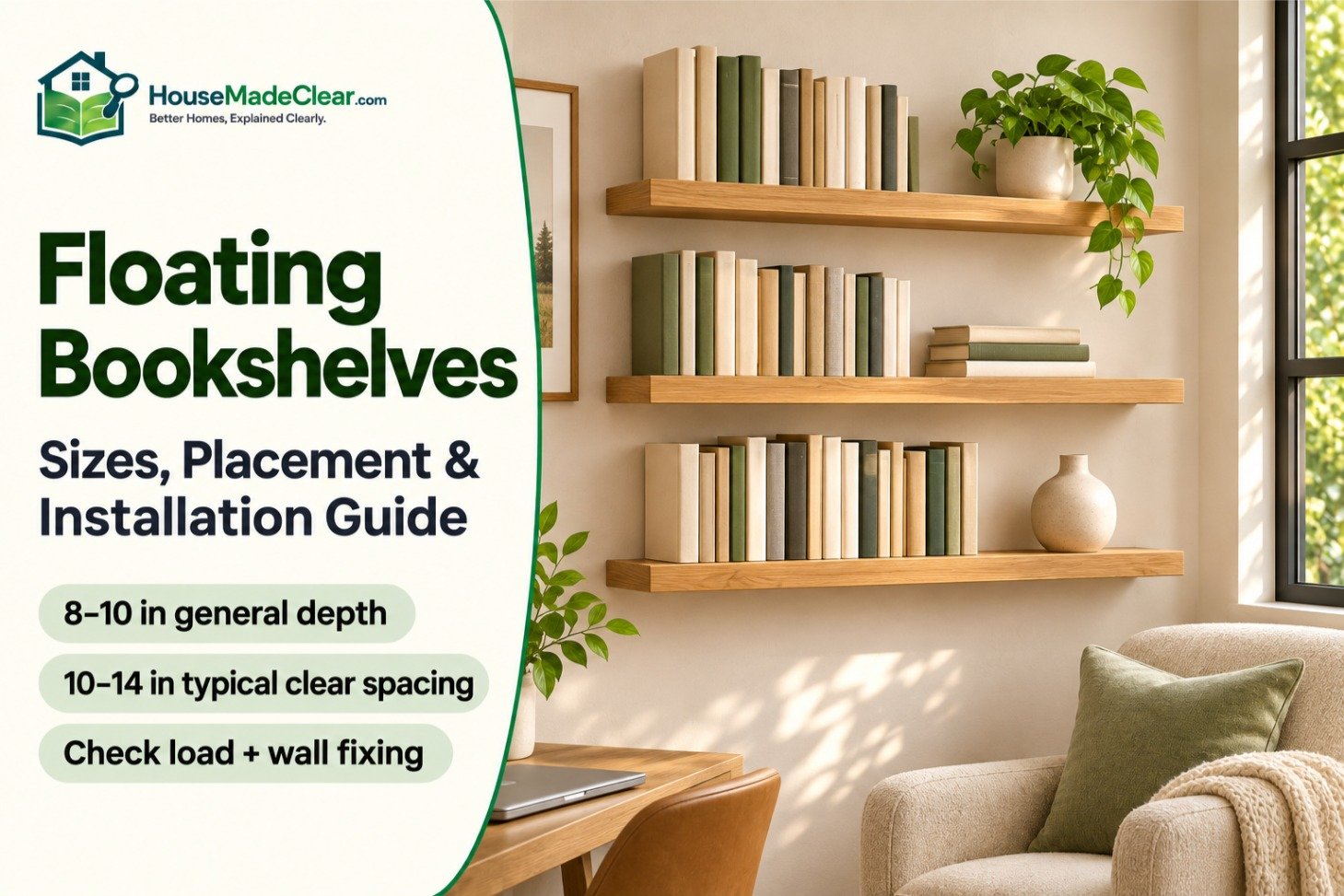
Floating bookshelves provide book storage without taking up floor space or adding the visual bulk of a traditional bookcase. Their concealed brackets create a clean wall-mounted appearance that works particularly well in small living rooms, bedrooms, reading corners and home offices.
However, books can create a substantial load. A floating shelf suitable for photographs and small decorations may not be strong enough for a row of hardcovers. The shelf construction, concealed bracket, wall type, fasteners and installation method must all be suitable for the intended load.
This guide explains how to choose floating bookshelves, determine the correct size and spacing, select a suitable location, install them properly and arrange books without making the wall look crowded.
Quick Answer
Floating bookshelves can hold books when the shelf, bracket and wall fixings are rated for the complete load.
For ordinary books, start with shelves approximately 8–10 inches deep. Oversized books may require 10–12 inches, while front-facing picture-book ledges may only need 4–6 inches.
Approximately 10–14 inches of clear vertical space works for many average books. Increase the spacing for tall hardcovers, binders, artwork or decorative objects.
Secure the mounting bracket to wall studs where possible. When studs are unavailable, use anchors designed for the wall material and expected load. Always follow the shelf manufacturer’s installation instructions and stated capacity.
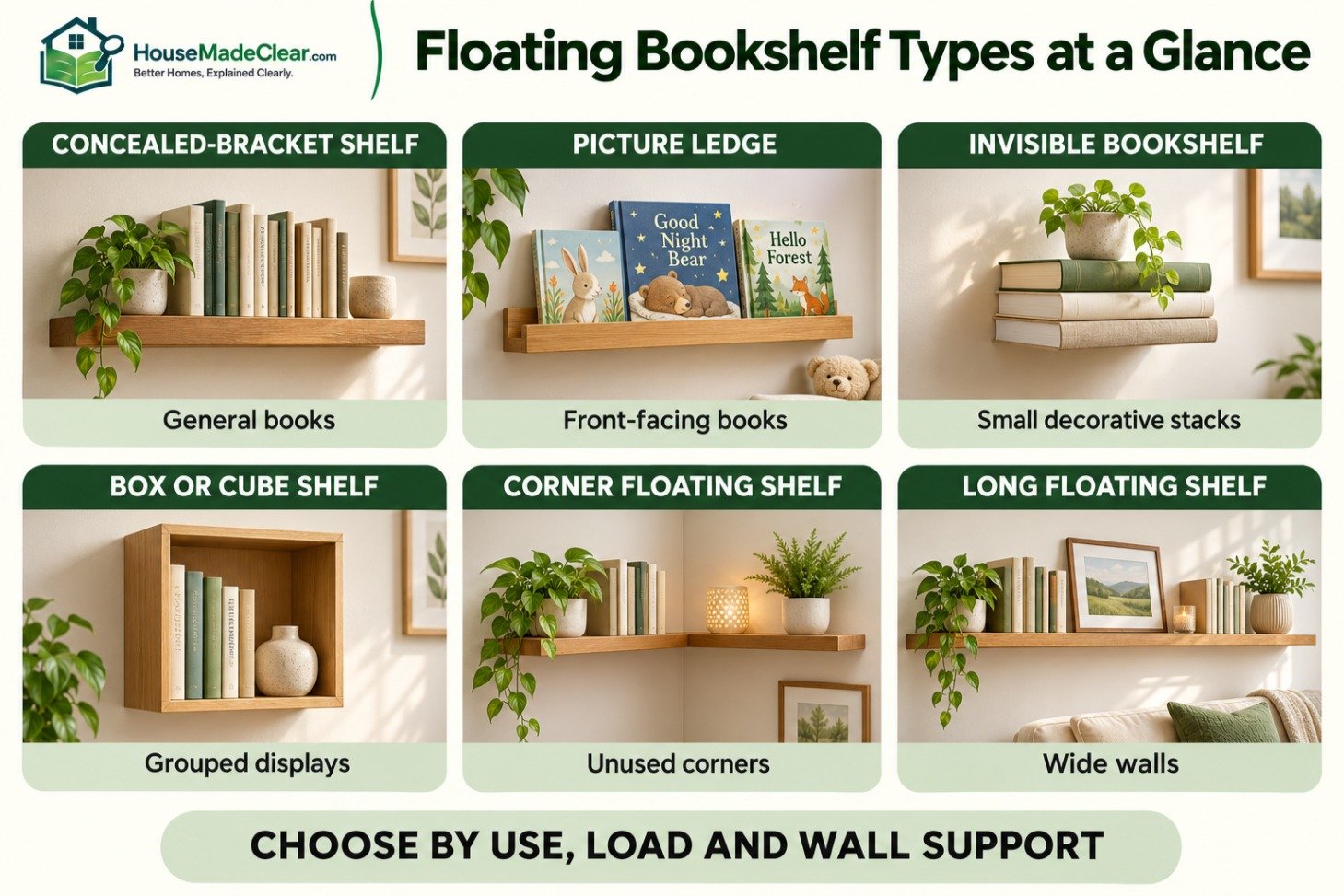
Floating Bookshelf Options at a Glance
| Floating bookshelf type | Best use | Typical depth | Main limitation |
|---|---|---|---|
| Concealed-bracket shelf | General books and mixed displays | 8–12 inches | Needs a strong mounting system |
| Picture ledge | Front-facing and children’s books | 4–6 inches | Limited capacity |
| Invisible bookshelf | Small decorative book stacks | Approximately book depth | Lower books are difficult to access |
| Floating box shelf | Books mixed with decorative objects | 8–12 inches | Several boxes can look visually busy |
| Corner floating shelf | Small unused corners | Varies | Holds fewer books |
| Long floating shelf | Larger collections or wide walls | 8–12 inches | Needs support across its full length |
| Floating cube shelf | Small grouped displays | 6–12 inches | Less efficient for large collections |
These are planning ranges rather than universal product specifications. Measure the books and check the actual shelf dimensions before purchasing.
What Are Floating Bookshelves?
Floating bookshelves are wall-mounted shelves with concealed or visually minimized supports. Instead of sitting on visible L-shaped brackets, the shelf normally slides over metal rods, a wall-mounted backplate or an internal wooden frame.
The hidden support makes the shelf appear to extend directly from the wall.
Floating bookshelves can hold:
- Upright books
- Small horizontal book stacks
- Front-facing children’s books
- Cookbooks
- Reference books
- Books mixed with framed artwork
- A small rotating collection
The term can also refer to an invisible bookshelf. This design uses a small metal support hidden by the bottom book, making the complete stack appear to float.
Are Floating Shelves Strong Enough for Books?
Some floating shelves are designed for books, but lightweight decorative shelves may not be.
The complete capacity depends on:
- Shelf length and depth
- Shelf material
- Bracket construction
- Number of mounting points
- Wall construction
- Fastener type
- Number of studs used
- Quality of installation
- Distribution of the load
A deeper shelf creates more leverage on the mounting system because the load extends farther from the wall. A long shelf can also sag in the middle when it lacks adequate internal support.
Do not judge strength by shelf thickness alone. A thick-looking hollow shelf may have a lighter internal structure than a thinner solid shelf.
Include the Shelf in the Total Load
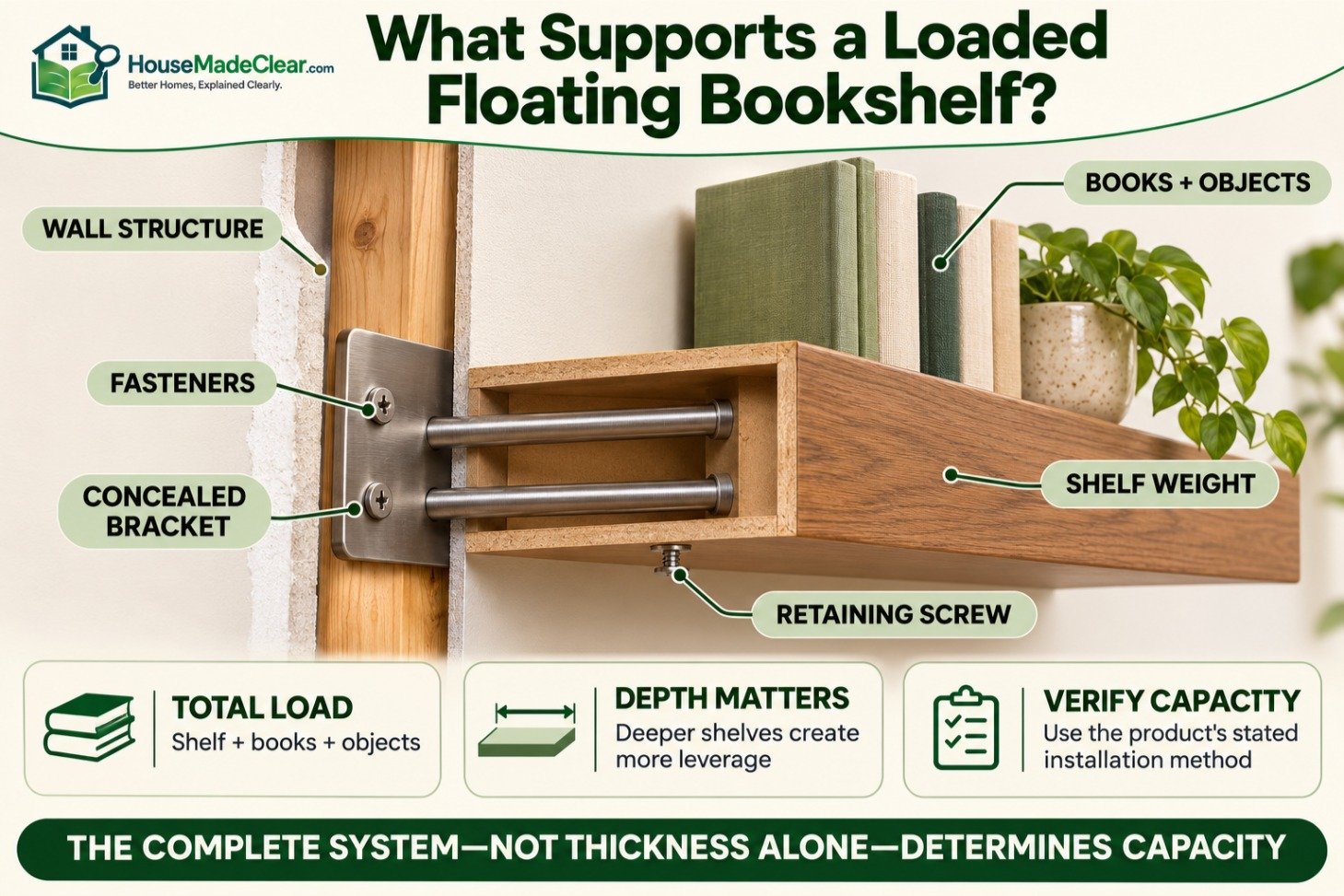
The mounting system supports more than the books. The total load includes:
- The shelf
- Books
- Bookends
- Frames
- Plants
- Decorative objects
If you are unsure how much the collection weighs, place the intended books and objects in a box and weigh them together.
Compare the result with the shelf manufacturer’s stated capacity. Check whether that capacity requires the bracket to be attached to studs, masonry or another specific structural surface.
Types of Floating Bookshelves
The right design depends on how many books you own, how frequently you use them and how much wall space is available.
Concealed-Bracket Floating Shelves
This is the most common design. A metal backplate or internal supporting frame attaches to the wall, and the shelf slides over it.
It works well for:
- Upright books
- Home-office reference material
- Living-room displays
- Shelves above a dresser
- Books combined with framed artwork
- Small and medium collections
For book storage, choose a system with a clearly stated load capacity and complete installation instructions.
A product described primarily as a decorative ledge may not be intended for a full row of books.
Picture Ledges
Picture ledges are shallow shelves with a raised front edge. They are useful for displaying books with their covers facing forward.
They work particularly well in:
- Children’s bedrooms
- Nurseries
- Playrooms
- Reading corners
- Narrow study spaces
Front-facing covers make books easier for children to identify. The raised lip also helps prevent them from sliding forward.
Picture ledges provide limited capacity, so they are better for a selected or rotating collection than complete book storage.
Invisible Bookshelves
An invisible bookshelf uses a thin metal bracket concealed by the bottom book. Additional books are stacked above it.
This design works best when you want:
- A visually playful display
- One or two small stacks
- A narrow vertical arrangement
- A decorative feature
It is less convenient for frequently read books because removing a book from the lower part of the stack requires moving the books above it.
Floating Box and Cube Shelves
Box and cube shelves create separate compartments for books, plants, photographs and collectibles.
They can help divide a wall into small display zones, but several unrelated shapes may look cluttered. Use repeated sizes or a clear alignment to keep the composition controlled.
A continuous shelf normally provides more efficient book storage than several small cubes.
Corner Floating Shelves
Corner shelves use wall space that may otherwise remain empty.
Possible locations include:
- Beside a reading chair
- Near a compact desk
- Next to a bed
- In a small dining nook
- Beside a sofa
Their shape usually provides less usable book space than a straight shelf, so they work better for a small selection.
Long Wall-to-Wall Shelves
A long shelf can create a built-in appearance above a desk, low cabinet or recessed wall.
Long shelves require adequate support across their complete span. Without suitable bracket placement or internal reinforcement, the center may sag.
For a large collection of heavy books, visible bracketed shelving or a traditional bookcase may be more practical.
What Size Should Floating Bookshelves Be?
The books should determine the shelf dimensions.
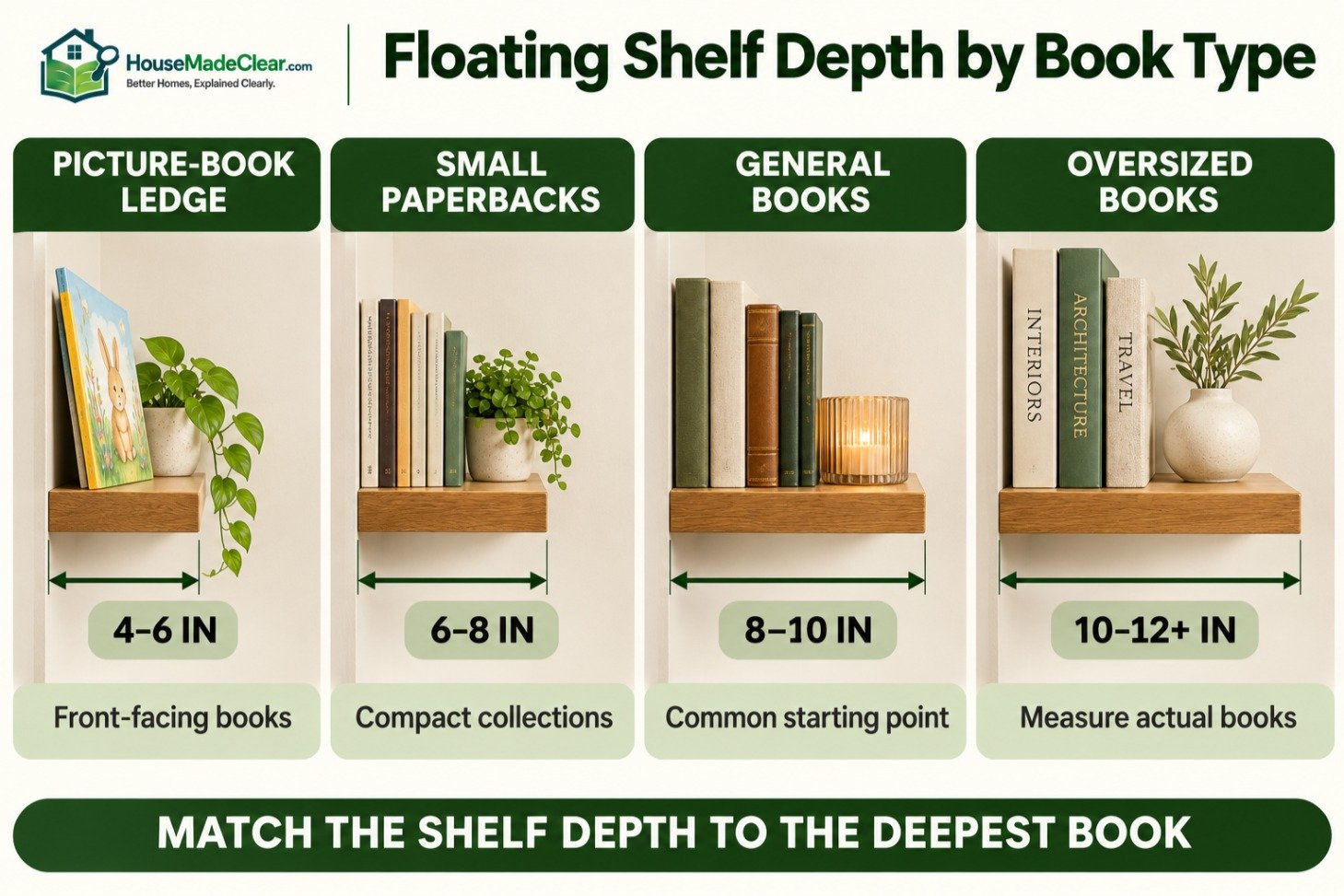
Measure the tallest and deepest books you plan to store. Add enough clearance to place and remove them comfortably.
Floating Bookshelf Depth
| Intended use | Suggested planning depth |
|---|---|
| Front-facing children’s books | 4–6 inches |
| Small paperbacks | 6–8 inches |
| General books and novels | 8–10 inches |
| Hardcovers and mixed books | 9–11 inches |
| Large art or cookbooks | 10–12 inches or more |
| Books mixed with decorative objects | 8–12 inches |
Avoid choosing a shelf much deeper than the books. Excessive depth makes the shelf appear heavier and projects the load farther from the wall.
Oversized art, photography and recipe books may require more depth than ordinary novels. Measure the actual collection rather than relying on an average.
Floating Bookshelf Length
Ready-made floating shelves are commonly available in lengths such as:
- 12 inches
- 18 inches
- 24 inches
- 30 inches
- 36 inches
- 48 inches
- 60 inches or longer
Several shorter shelves may be easier to support and position than one long shelf. They can also fit around windows, doorways and existing furniture more easily.
Long shelves need a mounting system specifically designed for their full length and expected load.
Floating Bookshelf Thickness
Floating shelves often appear thicker than ordinary shelf boards because the shelf must accommodate the concealed bracket.
A visual thickness of approximately 1.5–3 inches is common, although products vary.
Thicker shelves generally suit:
- Wide walls
- Large living rooms
- Rustic interiors
- Substantial furniture
- Long shelf arrangements
Thinner shelves can feel less imposing in:
- Small bedrooms
- Compact offices
- Narrow hallways
- Minimal interiors
- Walls with several shelf rows
Thickness is an aesthetic consideration, not proof of capacity. Check the internal support and weight rating.
How Much Space Should Be Between Floating Bookshelves?

The correct spacing depends on the tallest item placed on each shelf.
Measure the book or object, then add enough clearance to lift and remove it without hitting the shelf above.
| Shelf contents | Suggested clear vertical spacing |
|---|---|
| Small paperbacks | 9–11 inches |
| Average books | 10–14 inches |
| Hardcovers | 12–15 inches |
| Tall books and binders | 14–18 inches |
| Books with framed artwork | 14–20 inches |
| Mixed books, plants and objects | 14–20 inches |
Clear spacing is measured from the top surface of one shelf to the underside of the shelf above.
If your books vary substantially in height, organize similar sizes together instead of using unnecessarily large gaps throughout the arrangement.
The same measure-first approach is explained in our guide to closet shelf height and spacing.
How Many Floating Bookshelves Do You Need?
Place the books you want to display in a straight row and measure their combined width.
Then account for:
- Bookends
- Small gaps
- Decorative objects
- Space for removing books
- Limited future additions
Suppose the selected books occupy approximately 70 inches. Possible arrangements include:
- Two 36-inch shelves
- Three 24-inch shelves
- One 48-inch and one 24-inch shelf
- Four 18-inch shelves
The final choice should reflect the available wall, stud locations, shelf rating and intended layout.
Avoid planning shelves at full capacity. Leaving some open space makes books easier to remove and prevents new purchases from immediately creating unstable stacks.
If your collection is expected to grow substantially, use floating shelves for selected books and keep the rest in a bookcase or cabinet.
Where Should You Put Floating Bookshelves?
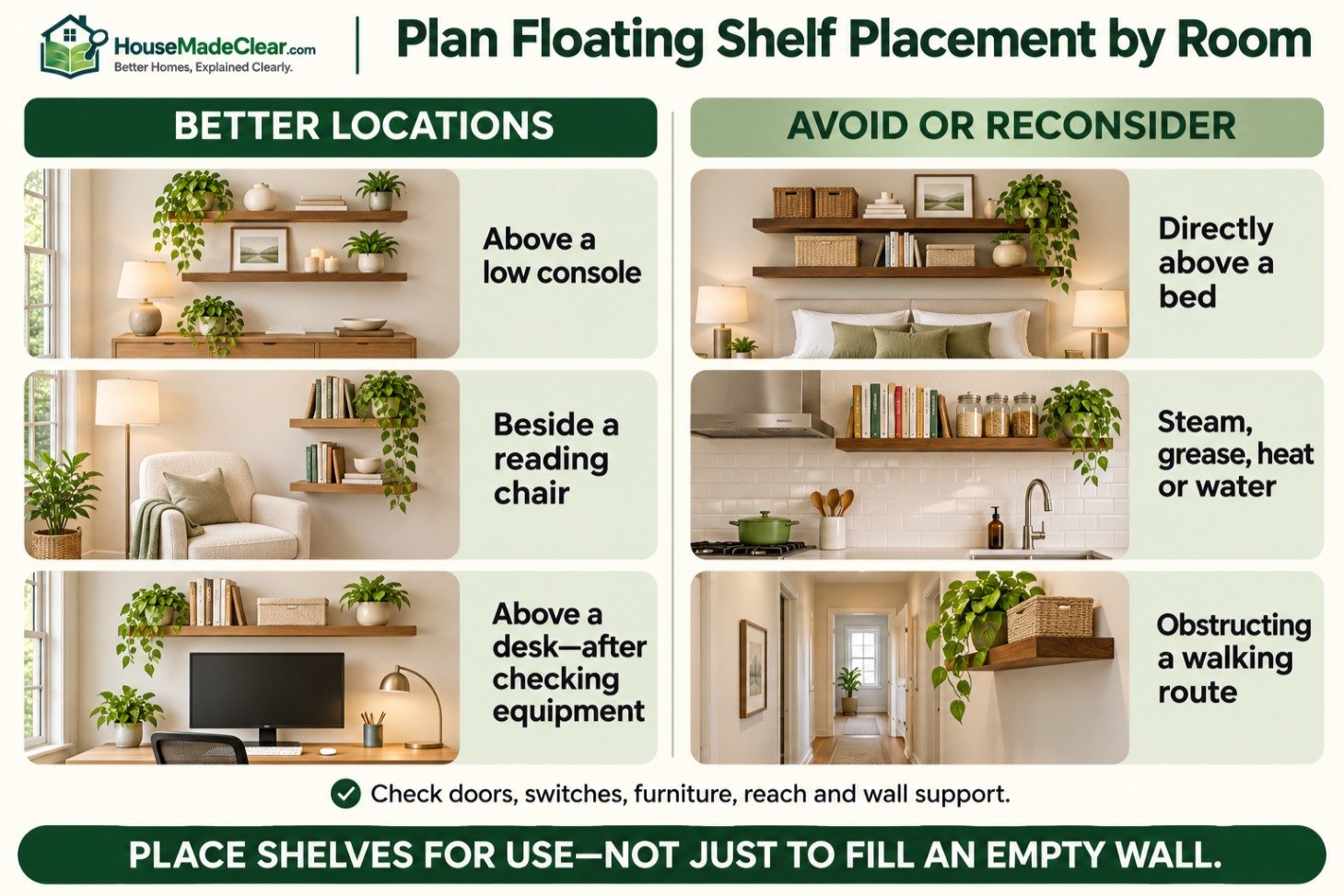
Shelf placement should support how the room is used rather than simply filling an empty wall.
Living Room
Floating bookshelves can create storage without adding another floor-standing unit.
Suitable locations include:
- Above a low console
- Beside a television
- Near a reading chair
- On either side of a doorway
- Across a recessed wall
- Above the non-seating end of a sectional
Relate the shelf arrangement to the furniture below it. A short shelf may look undersized above a wide sofa, while an oversized arrangement can dominate a small seating area.
Establish the main furniture and traffic routes first. Our guide to planning a functional living-room layout explains how to position seating, storage and walkways before decorating the walls.
Avoid placing heavy books or breakable objects directly above frequently occupied seating.
Home Office
Floating bookshelves can keep reference material accessible without consuming desk or floor space.
They can hold:
- Reference books
- Project folders
- Notebooks
- Manuals
- Small office supplies
- Limited decorative objects
Keep daily-use books within comfortable reach. Archive material can sit higher, but it should not occupy the easiest storage positions.
Our home-office organization guide explains how to separate daily-use supplies, occasional items and archived material.
Shelves Above a Monitor
When installing a shelf above a computer, account for:
- Monitor height
- Monitor-arm movement
- Webcam position
- Desk-lamp height
- Standing-desk movement
- Ability to remove books safely
Do not lower the monitor merely to create room for a shelf. Check the screen position against our ideal monitor height guide.
A shelf bottom approximately 18–24 inches above the desktop can be an initial planning range, but the monitor and user should determine the final position.
Bedroom
Floating shelves can add book storage without occupying bedside floor space.
Suitable positions include:
- Beside the bed
- Above a dresser
- Near a reading chair
- Above a compact desk
- On a narrow unused wall
A small bedside shelf may replace a nightstand when you only need space for a phone, glasses and one or two books. It will not provide the concealed storage of a drawer unit.
Our article on small-bedroom storage ideas without a closet includes other vertical and wall-mounted options for limited spaces.
Avoid placing a heavy book collection or breakable objects directly over the bed.
Children’s Room
Front-facing picture ledges can make children’s books easier to see and select.
Install them:
- At an accessible height
- Away from the crib or bed
- Outside active play routes
- Without sharp projecting corners
- With suitable wall fasteners
- Without creating a climbable ladder pattern
The U.S. Consumer Product Safety Commission advises households to secure shelves and other furniture that children may pull or climb on.
Keep heavier books lower and inspect the shelves periodically for movement or damage.
Kitchen
Floating shelves can hold cookbooks, but they should not be placed where steam, grease, water or heat will damage them.
Avoid installing books:
- Directly over a stove
- Close to an open flame
- Immediately above a sink
- Where cabinet doors will strike them
- Where they obstruct a working area
Cookbooks are often deeper and heavier than novels. Measure them before selecting the shelf.
Hallway
A shallow picture ledge can display a small rotating book collection without using floor space.
Avoid deep shelves that project into the walking route, particularly near:
- Doorways
- Corners
- Stairs
- Narrow passages
- Frequently used switches
Floating Bookshelf Layout Ideas

A clear layout looks more intentional and is easier to install than a collection of unrelated shelves added over time.
One Long Shelf
A long horizontal shelf creates a simple continuous line.
It works well above:
- A low cabinet
- A desk
- A dining-room sideboard
- A recessed wall
Confirm that the mounting system supports both the span and intended load.
Two or Three Stacked Shelves
Stacked shelves provide efficient storage with a controlled appearance.
Keep:
- Shelf lengths aligned
- Vertical spacing consistent
- Side edges aligned
- Heavier books on lower shelves
- Similar visual weight across the arrangement
This is usually the most practical option for a home office or reading corner.
Staggered Shelves
Staggered shelves suit informal and contemporary interiors.
They work best when:
- Shelf lengths repeat
- At least one edge or centerline aligns
- Gaps appear deliberate
- Books are distributed across the arrangement
Random placement without any alignment can look unfinished.
Symmetrical Shelves
Matching shelves on both sides of a television, window, artwork or doorway can create balance.
Before installing, verify that each side provides:
- Similar usable wall width
- Suitable mounting points
- Equal furniture clearance
- No switches or outlets in the way
Do not force symmetry when one side contains a doorway or circulation route.
Floor-to-Ceiling Arrangement
Several rows can use a tall wall efficiently, but upper shelves are best reserved for occasional books and lightweight objects.
Frequently used books should remain within comfortable reach.
Reading-Corner Arrangement
A practical reading corner can combine:
- Comfortable chair
- Task light
- Small side table
- One to three shelves
- Frequently read books
Position shelves close enough to access after standing, but not directly behind the reader’s head.
How to Install Floating Bookshelves
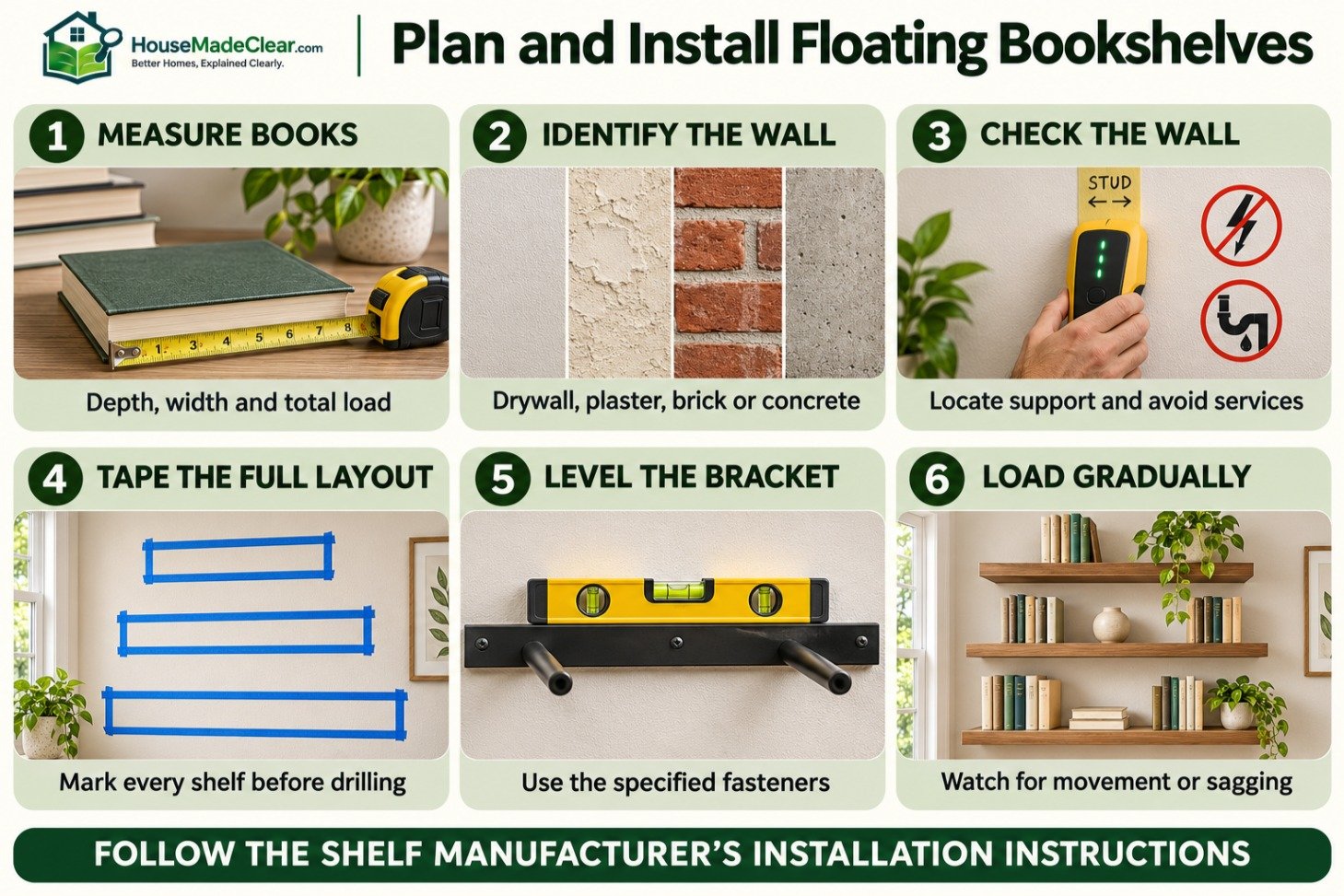
Installation differs by shelf and wall type. Follow the instructions supplied with the product.
1. Decide What the Shelf Will Hold
Select the books before choosing the shelf.
Determine:
- Required depth
- Combined book width
- Approximate total weight
- Number of shelves
- Desired vertical spacing
This prevents you from buying a lightweight shelf that does not suit the collection.
2. Identify the Wall Type
Common wall constructions include:
- Drywall over wood studs
- Drywall over metal studs
- Plaster and lath
- Brick
- Concrete
- Concrete block
- Tile over another wall material
Each construction requires compatible drill bits, screws and anchors.
If the wall cannot be identified confidently, consult an experienced installer.
3. Check Behind the Wall
Before drilling, consider whether the area may contain:
- Electrical wiring
- Plumbing
- Ductwork
- Drains
- Heating pipes
Exercise additional care near outlets, switches, sinks, bathrooms, kitchens and vents.
Lowe’s floating-shelf installation guide recommends checking for wiring, pipes and ducts and using appropriate detection equipment before drilling.
4. Locate Suitable Structural Support
Use a stud finder or suitable detection method to locate available studs and mark their centers.
Compare their positions with the mounting holes in the shelf bracket.
Stud positions may influence the final shelf width and location. It is better to adjust the arrangement during planning than compromise the mounting method afterward.
5. Mark the Complete Arrangement
Use painter’s tape to mark:
- Shelf width
- Bottom edge
- Side edges
- Vertical spacing
- Furniture clearance
Mark every shelf before drilling the first hole.
View the outlines from the doorway, primary seating position and desk. Check that the arrangement is proportionate to the furniture and does not obstruct movement.
6. Mark a Level Bracket Line
Use a spirit level or laser level rather than measuring only from the floor or ceiling.
Hold the mounting plate in its final position and mark every required fixing point.
Recheck the shelf height, alignment and surrounding clearance before drilling.
7. Attach the Bracket
Use the fasteners specified for the shelf system, wall construction and expected load.
The Home Depot’s floating-shelf installation instructions recommend securing the mounting bracket to a stud where possible and using appropriate anchors when a suitable stud is unavailable.
Tighten the fixings evenly and check that the bracket remains level.
8. Attach and Secure the Shelf
Slide the shelf onto its mounting rods or supporting frame.
Install all retaining or set screws supplied with the system. These prevent the shelf from shifting or lifting away from the bracket.
Confirm that the shelf:
- Sits against the wall
- Does not rock
- Does not slide
- Remains level
- Shows no bracket movement
9. Add Books Gradually
Start with a small number of books and distribute them across the shelf.
Watch for:
- Sagging
- Bracket movement
- Gaps between the shelf and wall
- Cracking around fasteners
- A change in level
If the shelf or wall moves, remove the load and inspect the installation.
How to Arrange Books on Floating Shelves
The shelves should remain practical rather than becoming purely decorative.
Keep Frequently Used Books Upright
Upright books are easier to identify and remove. Use stable bookends when a row does not fill the shelf.
Use Horizontal Stacks Sparingly
A small horizontal stack can separate categories or support one decorative object.
Avoid tall stacks because books at the bottom become difficult to access and the arrangement can become unstable.
Place Heavier Books Near Support Points
Distribute large hardcovers rather than concentrating them at one end. Keep heavier books closer to the wall and near the strongest bracket areas.
Leave Open Space
Do not pack every shelf from edge to edge.
Some open space:
- Makes books easier to remove
- Reduces visual heaviness
- Separates categories
- Allows limited collection growth
- Prevents the arrangement from appearing cluttered
Limit Decorative Objects
Bookshelves do not need an ornament in every gap.
A controlled arrangement may include:
- One framed photograph
- One suitable plant
- One meaningful object
- One small container
- Several grouped books
Too many unrelated objects make even an organized shelf look untidy.
Organize for Use
Arrange books by the system that helps you find them:
- Subject
- Author
- Reading status
- Room function
- Adult and children’s collections
- Work and personal reading
- Size
Color organization may look attractive, but it is less practical if you normally search by author or topic.
Common Floating Bookshelf Mistakes
Choosing by Appearance Alone
A product photograph does not establish its strength, capacity or wall compatibility.
Review the technical details before choosing the finish.
Underestimating Book Weight
A complete row of books can be much heavier than expected. Calculate the intended load instead of treating the shelf as a general decoration.
Buying a Shelf That Is Too Shallow
Books projecting substantially beyond the front edge can look unstable and may be easier to knock.
Measure the deepest books first.
Installing One Shelf at a Time
Planning shelves individually can produce uneven spacing, misaligned edges and insufficient clearance for taller books.
Mark the complete arrangement before drilling.
Ignoring Wall Construction
Drywall, plaster, brick, concrete and tile require different fixings. Hardware should be selected for the actual wall material and expected load.
Using Too Many Small Shelves
Numerous short shelves can create visual clutter while storing fewer books than two or three adequately sized shelves.
Installing Shelves Too High
High shelves are inconvenient for everyday reading. Reserve them for occasional books or lightweight display pieces.
Filling Every Shelf Immediately
A completely full arrangement provides no room for removing books or adding new ones. Preserve a small amount of usable space.
When Floating Bookshelves Are the Wrong Choice
Consider a traditional bookcase, built-in unit or visible bracketed shelving when:
- You own a large book collection
- Most books are heavy or oversized
- The wall cannot accept suitable fasteners
- The collection is growing quickly
- Shelves must remain adjustable
- Your rental agreement prevents appropriate installation
- Maximum capacity matters more than concealed hardware
- The wall contains difficult-to-avoid services
Visible brackets are not necessarily a design compromise. For substantial book storage, they can provide a practical structure and become part of the room’s style.
Floating Bookshelf Planning Checklist
Before buying:
- Measure the books.
- Measure the available wall.
- Calculate the required shelf width.
- Estimate the complete load.
- Identify the wall material.
- Check the product’s capacity.
- Confirm shelf depth.
- Review installation requirements.
- Plan all shelf positions.
- Mark the arrangement with painter’s tape.
- Check furniture and walking clearance.
- Decide whether floating shelves suit the collection.
Before loading:
- Confirm all required fasteners are installed.
- Check that the shelf is level.
- Install retaining screws.
- Test for movement.
- Add books gradually.
- Distribute the load.
- Recheck the installation after loading.
Frequently Asked Questions
Can floating bookshelves hold heavy books?
They can hold heavy books when the shelf, bracket, fasteners and wall are rated for the combined load. Check the manufacturer’s capacity and installation requirements rather than judging strength by appearance.
How deep should floating shelves be for books?
Approximately 8–10 inches works for many general books. Large hardcovers, art books and cookbooks may need 10–12 inches or more. Front-facing picture-book ledges can be approximately 4–6 inches deep.
How much space should be left between floating bookshelves?
Approximately 10–14 inches of clear vertical space works for many books. Tall books, binders, artwork and plants may need 14–20 inches.
Can floating bookshelves be installed without studs?
Some systems can use anchors when studs are unavailable, but the anchors must be compatible with the wall and expected load. The capacity may be lower than a stud-mounted installation.
Are floating bookshelves safe above a bed?
A heavy shelf above a bed creates an unnecessary risk if a fixing or object fails. A wall beside the bed is generally a better location.
Are floating bookshelves suitable for renters?
Only when the rental agreement permits the required installation. Adhesive picture-hanging strips should not be treated as replacements for structural shelf fasteners unless the complete shelf system is specifically designed and rated for them.
How do you prevent books from falling?
Use stable bookends, keep the shelf level and avoid placing books close to an unprotected edge. A raised front lip or side panels can help in children’s rooms.
Why do floating bookshelves sag?
Sagging can result from excessive weight, a long unsupported span, weak shelf material or an inadequate internal bracket. Choose a system rated for the shelf length and intended load.
Are invisible bookshelves practical?
They work well as decorative displays for small stacks. They are less practical for frequently used books because accessing the bottom books requires moving the stack.
Should floating bookshelves match the wall?
Matching the shelf to the wall creates a subtle appearance. Contrasting wood or color makes the shelving a stronger visual feature. Choose the dimensions and structural system before deciding on the finish.
Final Thoughts
Floating bookshelves work best for a selected collection rather than an entire home library.
Measure the books, calculate the expected load and choose a shelf with a suitable depth and clearly stated capacity. Plan the complete arrangement before drilling, use the correct wall fixings and keep frequently used books within comfortable reach.
A few properly sized and securely installed shelves will provide more useful storage than a wall filled with small decorative ledges.