












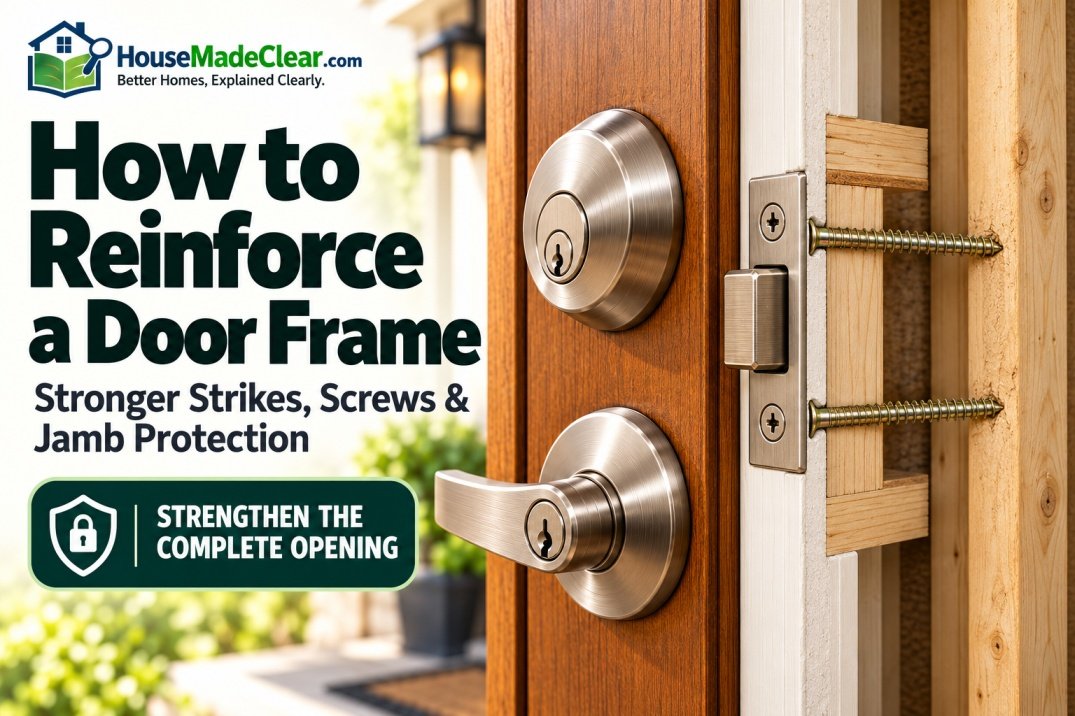
A strong deadbolt cannot provide its full benefit when the surrounding door frame is cracked, loosely attached, misaligned, or held together with short screws. During a forceful impact, the lock may remain intact while the wood around the strike plate splits or the jamb separates from the structural framing.
For a conventional wood-framed exterior door, reinforcement usually involves installing a heavy-duty strike plate, anchoring it to the framing with appropriate long screws, strengthening the hinge side, and repairing any damaged wood. A full door-jamb reinforcement kit can spread force across a larger section of the frame.
Reinforcement must match the door construction. Wood framing, masonry walls, metal frames, sidelights, fire-rated openings, and apartment doors require different fasteners and installation methods.
Quick Answer
To reinforce a conventional wood-framed exterior door:
- Confirm that the door closes squarely and the deadbolt extends fully.
- Repair rot, cracks, stripped holes, or loose sections of jamb.
- Replace the small deadbolt strike with a heavy-duty or extended security strike.
- Use the manufacturer-supplied security screws or suitable 3- to 4-inch screws that reach the structural framing.
- Reinforce the latch strike instead of protecting only the deadbolt.
- Install at least one appropriate long screw through each hinge into structural framing.
- Consider a full-length jamb shield when greater protection is needed.
- Test the latch, deadbolt, hinges, weather seal, and emergency exit operation.
Do not use ordinary drywall screws as structural security fasteners. Do not drill long screws into an opening until you have considered concealed wiring, alarm contacts, plumbing, wall construction, and the location of structural framing.
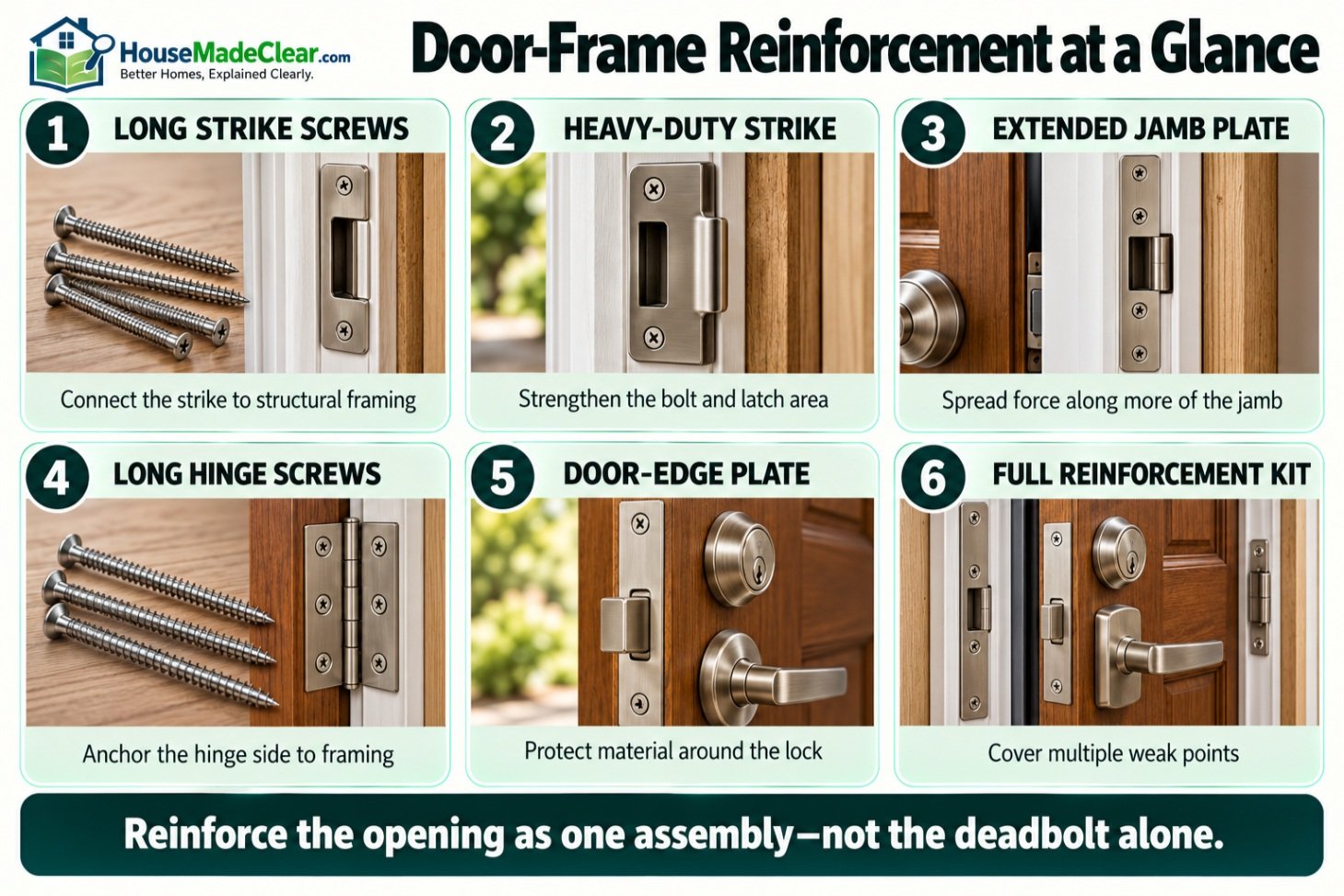
Door-Frame Reinforcement at a Glance
| Upgrade | What It Strengthens | Relative Cost | Installation Difficulty | Best Use |
|---|---|---|---|---|
| Longer strike screws | Connection between strike, jamb, and framing | Low | Easy to moderate | Sound wood frames with short existing screws |
| Heavy-duty security strike | Wood surrounding the latch or deadbolt | Low to moderate | Moderate | Most conventional exterior doors |
| Extended strike plate | Larger area of the lock-side jamb | Moderate | Moderate | Soft wood or localized jamb weakness |
| Full jamb reinforcement kit | Much of the lock and hinge sides | Moderate | Moderate to difficult | Greater forced-entry resistance |
| Long hinge screws | Hinge-to-framing connection | Low | Easy to moderate | Inward-swinging wood-framed doors |
| Security hinges or hinge studs | Exposed hinge side | Moderate | Moderate | Outward-swinging doors |
| Door-edge reinforcement plate | Door material surrounding the lock | Low to moderate | Moderate | Cracked or vulnerable wood near the lock |
| Jamb repair or replacement | Structurally damaged frame | Moderate to high | Difficult | Split, rotten, loose, or severely misaligned jambs |
| Professional reframing | Entire door opening | High | Professional | Serious damage or unsuitable construction |
No reinforcement makes a door impossible to breach. The objective is to remove obvious weaknesses, increase the time and noise required to force entry, and make the entire opening work as one coordinated assembly.
Why Door Frames Are a Common Weak Point
A residential entry door is more than the visible door slab and lock. Its security depends on several connected components:
- Door slab
- Deadbolt and latch
- Door edge
- Strike plates
- Lock-side jamb
- Hinge-side jamb
- Hinges
- Fasteners
- Shims or blocking
- Structural wall framing
- Sidelights or adjacent glass
- Wall and trim surrounding the opening
The strike plate receives the latch or deadbolt when the door is locked. If that plate is attached only to a thin section of jamb with short screws, a forceful impact can split the wood or pull the screws out.
Seattle Police recommends anchoring exterior-door strikes and frames to the home’s main construction, using heavy-duty strike plates, three-inch screws, and tamper-resistant hinges where appropriate.
The problem cannot always be corrected by buying a stronger lock. Our guide to improving home security with better locks explains why the lock, strike, jamb, door, and fasteners must function as a complete system.
Door Frame, Door Jamb and Trim: What Is the Difference?
These terms are often used interchangeably, but they describe different parts of the opening.
Door Frame
The door frame is the assembled structure around the door. It normally includes two vertical jambs and a horizontal head jamb.
Door Jamb
The jamb is the finished vertical surface beside the door. The hinges attach to one jamb, while the latch and deadbolt extend into strikes mounted on the opposite jamb.
Rough Framing
In conventional wood construction, structural studs form the rough opening behind the finished jamb. There is often a gap containing shims between the jamb and the framing.
Door Casing
Casing is the decorative trim that covers the joint between the wall and door frame. It is not normally intended to resist forced entry.
A long screw is useful only when it passes through the strike and jamb and obtains adequate purchase in structural material. A screw that ends in trim, an empty gap, deteriorated wood, or unsuitable substrate provides limited reinforcement.

Inspect the Door Before Reinforcing It
Do not install reinforcement hardware over an unresolved alignment or structural problem.
Check Whether the Door Closes Correctly
Close the door slowly and observe the gap around its edges. The gap should be reasonably consistent, and the door should not scrape the threshold or bind against the frame.
Look for:
- A sagging latch-side corner
- Loose hinges
- A twisted or bowed jamb
- A strike plate that has been repeatedly moved
- A door that must be pushed or lifted to lock
- Excessive space between the door and frame
- Weather stripping preventing complete closure
Correct these problems before positioning new reinforcement hardware.
Test the Latch and Deadbolt
The latch should enter its strike without being forced. The deadbolt should extend fully when the door is closed.
Do not use the deadbolt to pull a misaligned door into position. Partial engagement reduces the effective depth of the bolt and places unnecessary pressure on the lock.
If you are uncertain which hardware is installed, compare it with the options in our guide to the different types of door locks.
Inspect the Wood
Remove the strike screws and examine the jamb closely. Watch for:
- Cracks radiating from the screw holes
- Split wood around the bolt pocket
- Enlarged or stripped holes
- Softness caused by moisture
- Decay or insect damage
- Previous filler-only repairs
- A frame that moves when pushed
- Damage from an earlier forced entry
Longer screws will not restore rotten or extensively split wood. Damaged material may need to be repaired or replaced first.
Identify the Opening Construction
Determine whether the door is installed in:
- Conventional wood framing
- Concrete or concrete block
- Brick or stone masonry
- Light-gauge metal framing
- A welded or formed steel frame
- A fire-rated wall or corridor
- An opening with glass sidelights
- A manufactured or modular wall system
The following installation steps are primarily intended for a conventional wood jamb surrounded by wood structural framing.
Check Ownership and Fire-Rating Restrictions
Renters, condominium owners, and homeowners subject to an HOA may need permission before changing exterior-door hardware.
Apartment and corridor doors may be part of a fire-rated assembly. Drilling, cutting, changing hinges, installing unlisted hardware, or modifying the door closer can affect the assembly’s approval and operation. Have the building manager or a qualified door professional review the proposed work.
Best Ways to Reinforce a Door Frame
The most effective method depends on the existing weakness. A door with a sound frame and short screws may need only targeted reinforcement. A damaged or poorly installed opening may require partial or complete rebuilding.
1. Install a Heavy-Duty Deadbolt Strike Plate
The deadbolt strike is the metal plate on the jamb that surrounds the bolt pocket.
A small decorative strike concentrates force in a narrow section of wood. A heavy-duty or extended security strike can provide:
- Thicker metal
- Additional fastener locations
- A deeper enclosed bolt pocket
- Wider spacing between screws
- Greater distribution of force along the jamb
Choose a strike that is compatible with the deadbolt, door handing, frame dimensions, and available jamb width. Before installing a larger strike plate or reinforcement kit, check the existing door and jamb measurements. Door slab thickness, frame construction, and available jamb width can affect which hardware fits correctly. Our guide to standard door dimensions, jamb sizes, and rough openings explains the measurements to verify before making permanent modifications.
Confirm Full Bolt Engagement
Before removing the existing strike:
- Close the door.
- Extend the deadbolt.
- Confirm that it reaches its full locked position.
- Mark the bolt’s position on the jamb if necessary.
- Measure the available depth behind the strike.
The bolt must enter the new strike and pocket without rubbing or stopping early.
Mortise the Strike Correctly
Most strike plates must sit flush with the jamb. A plate left above the wood surface can interfere with the door or weather seal.
If a larger strike requires a wider mortise:
- Mark its outline precisely.
- Remove only the wood required by the manufacturer.
- Keep the edges of the recess clean.
- Do not unnecessarily enlarge the bolt pocket.
- Test-fit the plate before drilling permanent holes.
Removing too much wood around the deadbolt can weaken the area you are trying to reinforce.
2. Anchor the Strike to Structural Framing
Many standard strike plates are supplied with short screws that secure them only to the finished jamb. For conventional wood-framed openings, police security guidance commonly recommends 3- to 4-inch screws that pass through the jamb and into the framing.
The correct fastener depends on the actual wall assembly.
Choose Appropriate Screws
Use:
- Fasteners supplied or specified by the reinforcement manufacturer
- Structural or suitable heavy-duty wood screws
- A head shape that sits correctly in the strike plate
- A diameter compatible with the strike holes
- Corrosion-resistant fasteners where moisture exposure requires them
Do not substitute brittle drywall screws. They are designed for attaching drywall, not for structural door reinforcement.
Determine the Necessary Length
A three-inch screw is common, but it is not automatically correct for every door.
The screw must account for:
- Strike-plate thickness
- Jamb thickness
- The gap between the jamb and framing
- Shims or blocking
- Required penetration into sound structural wood
If the gap is unusually wide, the screw may need to be longer. If wiring, alarm contacts, masonry, metal framing, or another obstruction is present, a standard long wood screw may be inappropriate.
Drill Pilot Holes
Pilot holes help keep the screws aligned and reduce the risk of splitting the jamb.
Use a bit sized for the screw and wood species according to the fastener manufacturer’s instructions. Keep the drill aligned so the screw enters the structural framing rather than drifting toward the drywall or exterior surface.
Avoid Bowing the Jamb
Long screws can pull the jamb toward the framing if there is an unsupported gap behind it. This may change the reveal around the door and cause binding.
Where necessary, solid shimming or blocking should support the jamb near the strike. Installing that support may require removing part of the casing.
Drive the screws firmly, but do not overtighten them.

3. Reinforce the Latch Strike
The spring latch operated by the doorknob or lever normally has a separate strike. Although the deadbolt provides the primary locking resistance, leaving the latch strike attached with short screws creates another weak point.
Upgrade the latch strike when practical by:
- Using a stronger compatible plate
- Anchoring it into structural framing
- Confirming that the latch enters completely
- Maintaining smooth door operation
Never depend on a spring latch as a substitute for a properly installed exterior deadbolt.
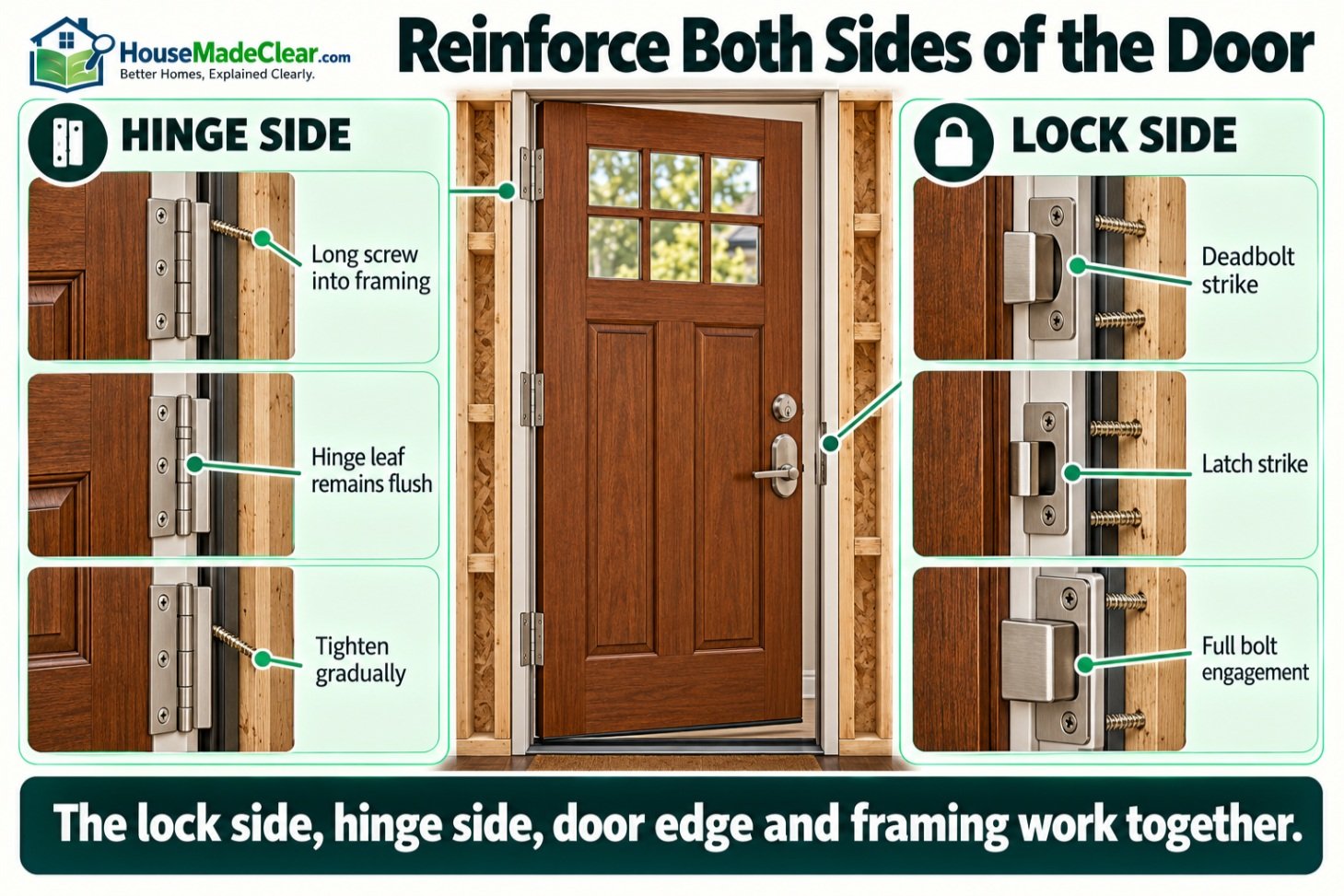
4. Reinforce the Hinge Side
The hinge side connects the door to the frame and carries the door’s weight.
On a conventional wood-framed opening, replace at least one jamb-side screw in each hinge with an appropriate long screw that reaches structural framing. Some reinforcement systems include separate hinge shields or steel plates.
Use the Correct Screw Head
A hinge screw must sit flush in the countersunk hinge hole. A raised or oversized head can prevent the hinge from closing completely and cause the door to bind.
Do Not Distort the Door Alignment
Long hinge screws can pull the jamb toward the stud. Tighten gradually while checking the gap around the door.
If installing one screw causes the door to shift significantly, the jamb may not be properly shimmed or attached. Correct the frame rather than forcing it into position with the screw.
Protect Exposed Hinges
Outward-swinging exterior doors may have hinges accessible from outside. Depending on the hinge design, protection may include:
- Non-removable hinge pins
- Security studs
- Set screws
- Continuous hinges
- Hinges specifically designed for exterior security
Do not assume that replacing the visible hinge pins alone will secure an outward-opening door.
5. Install an Extended Jamb Reinforcement Plate
An extended strike plate covers a larger vertical section of the lock-side jamb than separate compact strikes. It may include openings for both the latch and deadbolt.
Its main advantage is force distribution. Instead of concentrating stress around two small screw holes, the plate uses multiple attachment points across a longer section of the frame.
This approach can be useful when:
- The jamb wood is relatively soft
- Several old screw holes weaken the strike area
- The door has separate latch and deadbolt strikes
- More reinforcement is desired without installing a full-frame system
The plate must fit the door’s exact lock spacing. Do not enlarge or modify its openings unless permitted by the manufacturer.
6. Consider a Full Door-Jamb Reinforcement Kit
A full reinforcement kit may include:
- A long lock-side jamb shield
- Separate hinge shields
- A door-edge plate
- Long security screws
- Spacers or installation templates
This system reinforces a larger portion of the opening than a single strike plate.
A full kit may be appropriate for:
- A vulnerable ground-level entrance
- A jamb that has previously started to split
- A door with several weak attachment points
- Homeowners seeking more complete kick-in resistance
- An opening where the product has been verified as compatible
A kit is not automatically suitable for metal frames, sidelights, masonry construction, unusually thick trim, multipoint locks, or fire-rated doors.
Follow the product instructions for plate placement, fastener type, pilot-hole size, and screw sequence.
7. Reinforce the Door Edge
The door itself can split around the deadbolt or latch even when the frame remains intact.
A door-edge reinforcement plate wraps around or covers the lock area and spreads force across a wider section of the door. This can be useful for solid-wood and some wood-composite doors when the product matches:
- Door thickness
- Backset
- Bore diameter
- Lock spacing
- Edge preparation
- Lock type
A steel or fiberglass door requires compatible hardware and fasteners. Do not drill additional holes into an insulated or fire-rated door without verifying the manufacturer’s requirements.
8. Upgrade the Lock if Necessary
Frame reinforcement does not correct a worn, loose, incompatible, or poorly installed lock.
Replace or service the lock when:
- The bolt does not extend fully
- The cylinder or thumb turn is loose
- The lock binds even after alignment is corrected
- The lock has visible damage
- The hardware does not fit the door preparation
- The product is unsuitable for exterior use
- A stronger certified product is desired
The BHMA Certified Products Directory can be used to confirm whether a specific product has been independently certified to an applicable ANSI/BHMA standard. Our explanation of ANSI lock grades covers what Grade 1, Grade 2, Grade 3, and residential letter ratings do—and do not—indicate.
Door-Frame Reinforcement by Construction Type
Wood-Framed Exterior Door
A typical wood-framed opening can often be improved with:
- A heavy-duty strike
- Appropriate long screws
- Solid shimming near the strike
- Long hinge screws
- An extended jamb plate
- Door-edge reinforcement
This is the construction assumed by most homeowner reinforcement kits.
Masonry Opening
A wood door frame installed in brick, block, or concrete may not have a wood stud behind the jamb.
Wood screws intended for stud framing should not simply be driven toward masonry. Reinforcement may require:
- Masonry-specific anchors
- Correct pilot-hole diameter
- Minimum embedment
- Adequate edge distance
- Frame-compatible fasteners
- Verification that the masonry is sound
Hollow concrete block, solid concrete, brick, and stone require different anchoring methods. A qualified installer should specify the hardware where the construction is uncertain.
Metal Door Frame
Formed or welded steel frames cannot normally be reinforced with a wood-frame kit.
A metal frame may require:
- Frame-specific reinforcement
- Rivnuts or threaded inserts
- Through-bolting
- Welding
- Replacement of damaged frame components
- Coordination with fire-label requirements
Have a commercial-door technician or locksmith assess a loose, bent, or damaged steel frame.
Door With Sidelights
A sidelight can leave limited framing material beside the lock. Driving long screws through the strike does not guarantee that a substantial stud is located behind it.
Sidelight assemblies may require:
- Purpose-built strike reinforcement
- Through-bolted hardware
- Reinforcement within the mullion
- Laminated or impact-resistant glazing
- Security film installed as part of a tested system
- Professional evaluation of the complete assembly
Do not assume that glass film alone will prevent someone from reaching an interior thumb turn.
French or Double Doors
A pair of doors depends on the security of the active leaf, passive leaf, meeting stile, flush bolts, threshold, and header.
Strengthening only the active-door strike may provide little benefit if the passive leaf moves. See our guide to securing French doors for guidance specific to paired-door assemblies.
Fire-Rated and Multifamily Doors
Do not independently drill, cut, wrap, or replace components on a labeled fire-door assembly.
Contact the property manager or a qualified door professional when the entrance has:
- A fire-rating label
- A self-closing device
- Smoke seals or gasketing
- Electrified access control
- An interconnected lock
- A corridor or stairwell location
- Building-wide keying
Unauthorized changes can interfere with fire performance, accessibility, emergency access, and building rules.

How Much Do You Need to Reinforce?
Use the existing condition and exposure of the entrance to choose the appropriate level.
| Existing Condition | Recommended Starting Point |
|---|---|
| Sound jamb with short strike screws | Upgrade fasteners and inspect alignment |
| Small strike plate in sound wood | Add heavy-duty or extended strike |
| Weak latch and deadbolt areas | Reinforce both strikes |
| Loose hinges or short hinge screws | Anchor hinges to structural framing |
| Soft wood or multiple old strike holes | Use an extended jamb plate |
| Minor localized splitting | Repair wood and add compatible reinforcement |
| Extensive splitting or previous forced entry | Replace damaged material before reinforcing |
| Rot, movement, or severe misalignment | Repair or replace the frame |
| Sidelight, metal frame, masonry, or fire-rated door | Obtain construction-specific professional advice |
More hardware is not always better. Poorly positioned plates, excessive cutting, inappropriate screws, and over-tightened fasteners can damage the frame or prevent the door from closing properly.

Can You Reinforce a Damaged Door Frame?
Minor cosmetic damage is different from structural damage.
Minor Damage
Small unused screw holes may sometimes be repaired before installing a larger strike in fresh material. The repair method must be appropriate for the wood, hole size, and new fastener location.
Do not rely on toothpicks, lightweight filler, or surface putty as the primary structural support for a security strike.
Split Jamb
A split near the strike must be stabilized or replaced. Simply closing the crack with screws may not restore the original strength of the wood.
An extended reinforcement plate can protect a properly repaired jamb, but it should not be used to conceal unresolved damage.
Rot or Moisture Damage
Rotten wood must be removed and the moisture source corrected. Possible causes include:
- Failed exterior caulking
- Improper flashing
- Roof or siding leaks
- Water entering at the threshold
- Condensation
- Insect damage
Security hardware cannot compensate for decayed framing.
Major Forced-Entry Damage
After an attempted or completed break-in, inspect:
- Door slab
- Lock bores
- Door edge
- Strike-side jamb
- Hinge-side jamb
- Rough framing
- Sidelights
- Threshold
- Wall damage
- Lock and cylinder operation
Replacement may be safer than attempting to reinforce fragmented material.
If keys may also have been taken or compromised, our guide comparing rekeying and replacing locks explains how to address key control separately from physical frame damage.

Door-Frame Reinforcement and Emergency Egress
Security improvements must not create an emergency-exit hazard.
The International Residential Code states that the required egress door must be readily openable from inside without a key or special knowledge or effort. Local codes and adopted editions vary, so verify the rules that apply to the property.
Use caution with:
- Double-cylinder deadbolts
- Key-operated interior locks
- Surface bolts
- Door braces
- Floor-mounted barriers
- Security chains
- Removable crossbars
- Devices placed beyond a child’s reach
- Hardware that requires several unfamiliar actions
- Reinforcement that prevents the door from opening fully
Our single-cylinder versus double-cylinder deadbolt guide explains why a key-operated interior cylinder can create an evacuation problem.
Everyone in the household must be able to unlock and open the required exit quickly in darkness, smoke, or an emergency.
Common Door-Frame Reinforcement Mistakes
Assuming Every Door Has a Wood Stud Behind the Jamb
Some openings use masonry, metal framing, narrow mullions, or nonstandard construction. Confirm the substrate before selecting fasteners.
Using Drywall Screws
Drywall screws are not intended to serve as structural security fasteners. Use product-specified security screws or suitable structural fasteners.
Driving Long Screws Without Pilot Holes
This can split the jamb, deflect the screw away from the framing, or make accurate placement difficult.
Overtightening the Screws
Excessive tightening can bow the jamb and cause the door or deadbolt to bind.
Reinforcing Only the Deadbolt Side
The latch, hinges, door edge, and surrounding structure may remain weak.
Installing Hardware Over Rotten Wood
Long screws and steel plates do not restore decayed material.
Enlarging the Bolt Pocket Too Much
Removing unnecessary wood reduces the amount of material supporting the strike.
Ignoring Deadbolt Alignment
A deadbolt that enters only partially cannot provide its intended performance.
Installing a Strong Lock on a Weak Door
A lightweight, damaged, or poorly prepared door slab may fail around the lock. Evaluate the door and frame together.
Assuming a Smart Lock Strengthens the Frame
A smart lock changes how access is controlled. Its electronics do not automatically strengthen the strike, jamb, hinges, or door edge.
Blocking the Required Exit
A security device that delays emergency evacuation creates a different and potentially more serious hazard.

DIY Installation vs. Professional Reinforcement
A careful homeowner may be able to reinforce a sound, conventional wood-framed door when the new hardware fits the existing preparation.
Professional help is advisable when:
- The door is severely misaligned
- The jamb is split, loose, or rotten
- The opening contains a sidelight
- The frame is steel or aluminum
- The wall is masonry
- The door or frame is fire-rated
- The lock uses a multipoint system
- The hardware spacing is nonstandard
- New mortises or bore holes are required
- Alarm wiring or access-control components are present
- The door has already been forced open
- Structural framing cannot be identified
- The property is rented or part of a condominium
- You are uncertain whether the alteration affects egress
A locksmith can evaluate the lock and keying. A carpenter or door specialist may be required for structural jamb repair, alignment, or complete frame replacement.
Door-frame reinforcement kits often require screws and permanent modifications, making them unsuitable for renters without permission. For apartments where drilling is prohibited, our guide to securing an apartment door without drilling explains temporary security options and when to request repairs from the property manager.
Final Door-Reinforcement Checklist
Before considering the project complete, verify the following:
| Check | What to Confirm |
|---|---|
| Door alignment | Door closes without lifting, forcing, or scraping |
| Latch engagement | Latch enters its strike completely |
| Deadbolt engagement | Bolt extends to its full locked position |
| Strike condition | Plate is strong, flat, and compatible |
| Strike fasteners | Screws engage suitable structural material |
| Jamb support | Long screws have not pulled the jamb out of alignment |
| Jamb condition | No unresolved cracks, rot, or movement |
| Hinges | Screws are tight and hinge leaves sit flush |
| Door edge | Wood or composite material around the lock is sound |
| Sidelights | Mullions and adjacent glass have been evaluated |
| Fire rating | Listed components and labels remain intact |
| Egress | Required exit opens quickly without a key |
| Rental approval | Required owner or building approval has been obtained |
| Final operation | Door locks and unlocks smoothly several times |
| Household use | Every resident can operate the door in an emergency |
Frequently Asked Questions
What is the best way to reinforce a door frame?
For a conventional wood-framed exterior door, start with a heavy-duty strike plate anchored into structural framing using appropriate long screws. Reinforce the latch strike and hinges as well. A full jamb-reinforcement kit provides broader protection when greater resistance is needed.
Do three-inch screws make a door more secure?
They can significantly improve a wood-framed door when they pass through the jamb and obtain adequate purchase in structural framing. They provide limited benefit if they miss the stud, enter damaged wood, bow an unsupported jamb, or are used in an incompatible opening.
Should door-frame screws be three or four inches long?
Three- and four-inch screws are commonly recommended for conventional wood-framed exterior doors, but the correct length depends on the jamb thickness, gap, shims, and location of the structural framing. Use the reinforcement manufacturer’s specified fasteners whenever possible.
Can I use drywall screws to reinforce a door frame?
No. Drywall screws are not designed as structural security fasteners and can be brittle. Use suitable structural or heavy-duty wood screws with the correct diameter, length, head style, and corrosion resistance.
What type of strike plate is best for security?
Look for a compatible heavy-duty security strike or extended strike with multiple attachment points and provision for anchoring into structural framing. The plate must allow the latch or deadbolt to engage completely.
Is a door-jamb reinforcement kit worth installing?
It can be worthwhile for an exposed entrance, a soft wood jamb, or a frame with several localized weak points. The kit must fit the door, lock spacing, frame material, and construction. It cannot correct rot or major structural damage.
Can you reinforce a cracked door frame?
Minor damage may be repairable, followed by compatible reinforcement. A deeply split, loose, rotten, or force-damaged jamb may require partial or complete replacement before reinforcement hardware is installed.
Should I reinforce the hinges as well as the strike plate?
Yes. On a conventional wood-framed door, installing an appropriate long screw through each hinge into structural framing can strengthen the hinge side. Avoid overtightening the screws or pulling the jamb out of alignment.
How do you reinforce an outward-swinging door?
Use hinges with non-removable pins, security studs, set screws, or another exterior-security design. The strike, frame, lock, and door edge must also be reinforced. Have a professional evaluate commercial, metal, or fire-rated outward-swinging doors.
Can a smart lock prevent a door from being kicked in?
Not by itself. A smart lock controls access electronically, but kick-in resistance still depends on the bolt, strike, jamb, fasteners, hinges, door edge, and structural framing.
Can renters reinforce a door frame?
Only with the property owner’s permission when permanent changes are required. Renters should not drill into a frame, replace building-controlled locks, or modify a fire-rated apartment door without authorization.
Can I install a reinforcement kit on a metal frame?
Most kits intended for residential wood jambs are not suitable for steel or aluminum frames. Metal frames require compatible reinforcement and attachment methods selected for the exact construction.
Will reinforcing the door frame damage the wall?
A correct installation should not damage the wall, but long screws can encounter wiring, alarm contacts, metal framing, masonry, or other concealed components. Excessive tightening can also move the jamb or crack surrounding finishes.
Is replacing the door frame better than reinforcing it?
Replacement is usually better when the frame is rotten, extensively split, loose, severely misaligned, incorrectly installed, or damaged by forced entry. Reinforcement is appropriate when the existing frame is structurally sound or has been properly repaired.




[…] How to Reinforce a Door Frame for Better Home Security […]
[…] How to Reinforce a Door Frame for Better Home Security […]
[…] How to Reinforce a Door Frame for Better Home Security […]