









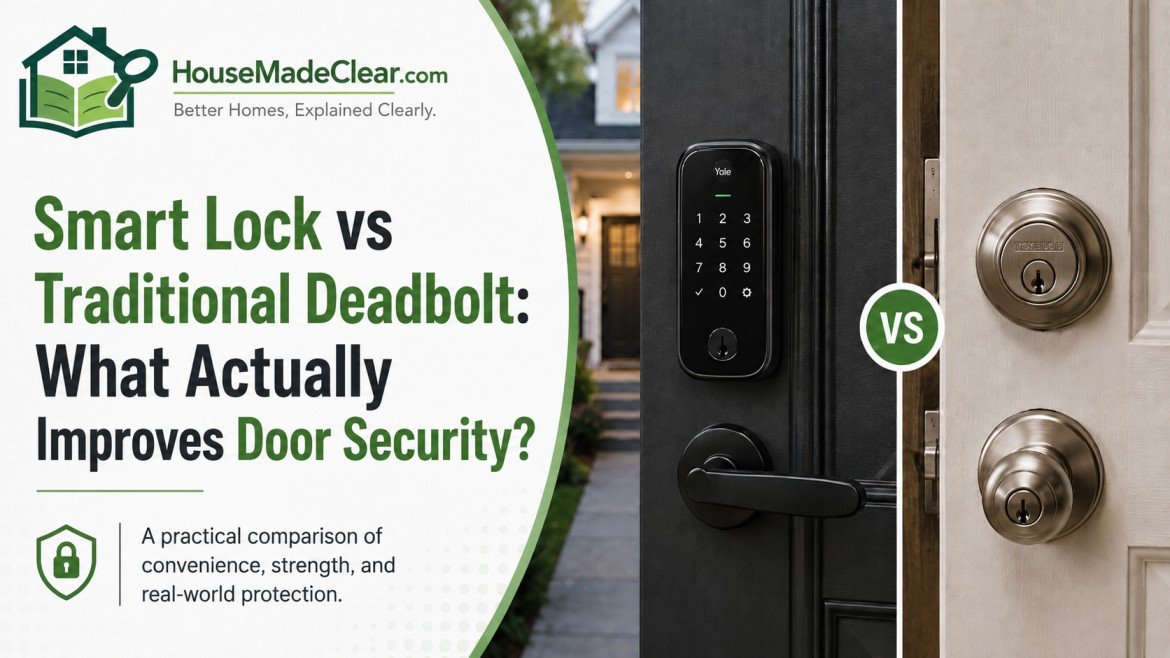
A smart lock is not automatically stronger than a traditional deadbolt.
Many smart locks use an ordinary deadbolt or cylinder as the physical locking mechanism and simply change how the user unlocks it. Instead of relying only on a key, the lock may accept a PIN, fingerprint, phone application, key fob or temporary digital credential.
That can make access easier to manage. It does not necessarily make the door harder to force open.
A properly installed conventional deadbolt on a strong door and frame may provide better physical resistance than an expensive smart lock fitted incorrectly. At the same time, a well-chosen smart lock may solve problems that a traditional lock cannot, such as lost keys, temporary contractor access and uncertainty about whether the door was locked.
The better choice depends on five things:
- The physical strength of the lock
- The condition of the door and frame
- Compatibility with the existing door
- How the household manages access
- Whether connected features are genuinely useful
This comparison builds on the wider entry-point guidance covered in HouseMadeClear’s common home security mistakes guide.
Quick answer: Choose a traditional deadbolt when simplicity, low maintenance and mechanical reliability matter most. Consider a smart lock when temporary access, keyless entry, activity records or remote status would solve a real household problem. Neither option will secure a damaged door, weak frame or badly installed strike plate.
Smart Locks and Deadbolts Are Not Always Opposite Categories
The phrase “smart lock vs deadbolt” is slightly misleading because many smart locks are deadbolts.
The real difference is usually between:
- A conventional key-operated locking system
- An electronically controlled or connected locking system
A traditional deadbolt normally uses a physical key outside and a thumb turn inside. It does not usually require batteries, software, an application or an internet connection.
A smart lock may add one or more electronic access methods, including:
- Keypad entry
- Smartphone control
- Fingerprint recognition
- Temporary digital codes
- NFC or key-fob access
- Remote locking
- Automatic locking
- Activity notifications
Some smart locks replace the complete exterior and interior lock assembly. Others are retrofit products that attach to the inside of an existing deadbolt while leaving the exterior key cylinder unchanged.
This distinction matters because two products marketed as smart locks may have completely different mechanical designs, compatibility requirements and backup methods.
The Three Parts That Must Be Evaluated
A useful lock comparison should separate three components.
1. The Mechanical Lock
This is the physical mechanism that secures the door.
Its strength may depend on:
- The bolt
- Cylinder
- Internal components
- Housing
- Strike plate
- Resistance to impact or manipulation
- Relevant testing and certification
2. The Access Method
This determines how an authorised user opens the lock.
Possible access methods include:
- Physical key
- PIN
- Fingerprint
- Application
- Fob
- Temporary credential
- Voice-assistant command
The access method affects convenience and access control. It does not automatically determine mechanical strength.
3. The Complete Door Assembly
This includes:
- The door
- Frame
- Hinges
- Glazing
- Lock
- Strike plate
- Fasteners
- Installation
A strong lock cannot compensate for a badly damaged frame or an unsuitable exterior door.
Smart Lock vs Traditional Deadbolt Comparison
| Factor | Smart lock | Traditional deadbolt |
|---|---|---|
| Forced-entry resistance | Depends on the mechanical lock, certification, door and installation | Depends on the lock, certification, door and installation |
| Keyless access | Usually available | Usually unavailable |
| Temporary access | Often supported | Requires lending or copying a key |
| Remote status | Available on some models | Not normally available |
| Remote locking | Model and connection dependent | Not normally available |
| Activity records | Available on some models | Not available |
| Battery required | Usually | No |
| Internet required | Not always; depends on the model | No |
| Cybersecurity exposure | Present on connected products | Minimal |
| Maintenance | Batteries, software, permissions and mechanical parts | Primarily mechanical maintenance |
| Installation difficulty | Low to high | Usually low to moderate |
| Door compatibility | Highly model dependent | Also requires correct dimensions and door preparation |
| Best suited to | Households needing flexible access management | Households prioritising simplicity and low maintenance |
These are category-level differences. The quality and suitability of a particular product matter more than the label “smart” or “traditional.”
What Actually Determines Forced-Entry Resistance?
Forced-entry resistance is primarily a physical-security question.
A keypad, application or fingerprint reader may control who is authorised to unlock the door. It does not strengthen the surrounding timber, reinforce a loose hinge or correct a bolt that barely enters the frame.
The physical resistance of an entrance may depend on:
- Lock construction
- Bolt projection
- Cylinder protection
- Strike-plate strength
- Door material
- Frame condition
- Hinge security
- Nearby glazing
- Installation quality
- Product certification
- Complete doorset performance
A Strong Lock Cannot Repair a Weak Door
Before replacing a lock, inspect the complete entrance.
Warning signs include:
- A split or deteriorated frame
- A door that must be pushed or lifted before it locks
- A bolt that does not enter the frame fully
- Loose hinges
- Movement around the strike plate
- Large gaps around the door
- Weak glazing close to an accessible interior thumb turn
- A lightweight interior-style door used as an exterior entrance
Installing a motorised smart lock on a misaligned door may create an additional problem. The motor may struggle to move the bolt, drain batteries faster or report that the door is locked when the mechanism has not engaged correctly.
The first purchase should sometimes be a door or frame repair—not a new lock.
Smart Features Do Not Equal Mechanical Strength
These features can improve convenience:
- Fingerprint access
- Remote locking
- Activity logs
- Automatic locking
- Temporary codes
They do not prove that the product resists physical attack.
A smart lock can have excellent software and mediocre mechanical hardware. A traditional deadbolt can have strong mechanical construction but weak key control because too many copies are in circulation.
Both sides of the comparison must therefore be evaluated separately.
Understanding US Lock Standards
US buyers frequently see terms such as ANSI, BHMA and Grade 1 in lock marketing. Those labels should not be accepted without checking which standard applies to the exact product.
ANSI/BHMA A156.40 for Residential Deadbolts
ANSI/BHMA A156.40-2025 establishes requirements for residential deadbolts and deadlatches. Its testing framework includes operation, durability, security or strength, and finish performance. BHMA also maintains a Certified Products Directory for products independently tested against applicable ANSI/BHMA standards.
A certification claim should identify:
- The exact standard
- The specific lock model
- The applicable performance classification
- Whether the product appears in the certification directory
Do not assume that a generic “ANSI approved” or “Grade 1 security” statement tells the full story. Different ANSI/BHMA standards use classifications appropriate to their own product categories.
Standards for Electrified Locking Systems
ANSI/BHMA A156.25-2023 covers electrified locking systems. Importantly, BHMA explains that the mechanical aspects of an electrified lock are still governed by the applicable mechanical product standard. Where the input or controlling device forms part of the lock, it is also tested with the locking device.
That reinforces a critical point:
Electronic testing does not replace mechanical testing.
A buyer should evaluate both the connected features and the underlying physical lock.
Certification Is More Useful Than Marketing Language
Be cautious with phrases such as:
- Military-grade
- Bank-level protection
- Unbreakable
- Pick-proof
- Burglar-proof
- Maximum security
- Advanced encryption
Some may describe a real feature. Others are vague advertising claims.
A better approach is to check:
- Which recognised standard applies?
- Is the exact model certified?
- What part of the product was tested?
- Does the certification cover the complete lock or only one component?
- Is the lock suitable for the door on which it will be installed?
BHMA states that its certified directory lists products tested against performance-oriented standards covering areas such as operation, strength, security, durability and finish.
UK and European Lock Standards Require a Different Approach
A smart lock designed for a standard US deadbolt-prepared door may not fit a UK or European entrance.
The hardware commonly found across the UK and Europe may include:
- Euro-profile cylinders
- Mortise locks
- Multipoint locking systems
- Handle-operated mechanisms
- uPVC doors
- Composite doors
- Different backsets and spindle arrangements
The relevant certification language is also different.
EN 1303 Applies to Lock Cylinders
BS EN 1303:2015 covers cylinders for locks and their keys, including performance and test requirements. It evaluates the cylinder and associated protective measures—not the complete door, frame, smart application or entire locking system.
A cylinder that meets a recognised standard is useful, but it should not be presented as proof that the whole entrance is secure.
Mechatronic Cylinders Have Separate Requirements
BS EN 15684:2020 covers mechatronic cylinders and their electronic or mechanical credentials. BSI describes requirements relating to performance, operational stability, environmental resistance and credential-related security.
This may be relevant when the electronic access-control function is built into the cylinder rather than added through a conventional smart-deadbolt design.
Complete Doorset Security Matters
PAS 24 addresses enhanced security performance for complete doorsets and windows. Secured by Design currently identifies PAS 24:2022+A1:2024 in its guidance for complete doorsets.
This is important because a secure entrance is more than its cylinder.
A highly rated cylinder installed in a weak door, damaged frame or unsuitable doorset does not automatically produce a secure entrance.
Will a US Smart Lock Fit a UK or European Door?
Often, it will not.
Many US smart deadbolts are designed for doors prepared around a single deadbolt bore and latch arrangement. A UK uPVC or composite door may instead use a multipoint system that secures the door at several positions when the handle is lifted or the mechanism is operated.
Compatibility problems may involve:
- Cylinder profile
- Backset
- Door thickness
- Existing boreholes
- Spindle dimensions
- Handle arrangement
- Multipoint gearbox
- Required handle movement
- Lock handing
- Fire-door status
- Cylinder projection
Dedicated smart products exist for multipoint locking doors, which illustrates why buyers should not assume that a standard US smart deadbolt will fit. Secured by Design, for example, has documented accredited smart-lock products designed specifically for multipoint door systems.
Door Compatibility Checklist
Before ordering a smart or conventional lock, identify:
- The door material
- The existing lock type
- The cylinder profile
- The backset
- The door thickness
- Whether a multipoint mechanism is present
- Whether the handle must be lifted to lock
- Whether the door is fire-rated
- Whether the product requires drilling
- Whether landlord or building approval is required
Do not identify compatibility from an exterior photograph alone. The internal lock mechanism and measurements matter.
Advantages of a Smart Lock
A smart lock is most useful when it solves an access-management problem rather than simply adding technology to the door.
Temporary and Individual Access
Many models allow the owner to create separate credentials for:
- Household members
- Cleaners
- Contractors
- Carers
- Dog walkers
- Guests
- Short-term tenants
A temporary code can often be restricted by date or time and revoked without recovering a physical key.
This can be more manageable than lending the same key to several people and later wondering whether copies were made.
Remote Status and Locking
Some smart locks can show whether the door is locked and may allow remote control.
This normally depends on the product’s design and may require:
- Wi-Fi
- A bridge or hub
- An internet connection
- A cloud account
- Correct application permissions
- A paid subscription in some cases
Do not assume remote access is included simply because a lock uses Bluetooth or an application.
Activity Records
Some products record events such as:
- A code being used
- The door being locked
- The door being unlocked
- A failed access attempt
- A low-battery warning
- A user being added or removed
These records can help households manage access, but they should not be treated as perfect evidence. Their accuracy may depend on connectivity, account status, timestamps and the way the lock detects door position.
Convenience and Accessibility
Potential benefits include:
- Entering without searching for a key
- Automatic locking
- Giving access without travelling to the property
- Avoiding hidden spare keys
- Easier access for some people with limited hand movement
- Integration with selected home-automation routines
The reverse can also be true. A lock that depends heavily on a smartphone may be less convenient for children, visitors, older users or anyone who does not use the connected platform.
The correct product must work for everyone who regularly enters the home.
Disadvantages and Risks of Smart Locks
A smart lock introduces electronic components, credentials and support dependencies that a conventional deadbolt does not have.
Batteries Can Fail
Most residential smart locks rely on batteries.
Buyers should check:
- Expected battery type
- Low-battery warning method
- Whether warning messages require internet access
- Whether a mechanical key override exists
- Whether emergency external power is available
- What happens when the battery is completely depleted
- Whether the lock remains operable from inside
Battery life estimates are not guarantees. Door misalignment, temperature, communication frequency and motor resistance may affect actual performance.
Accounts and Applications Need Protection
A connected lock may be exposed through the household’s account security, phone security and connected integrations.
NIST advises smart-home users to avoid password reuse, enable multi-factor authentication, disable unused features, review privacy settings and keep devices updated. NIST also notes that no internet-connected device is completely secure.
For a smart lock:
- Use a unique account password.
- Enable multi-factor authentication.
- Protect the connected phone with a secure screen lock.
- Do not share the main administrator account unnecessarily.
- Create separate users or codes.
- Remove people who no longer need access.
- Review connected services and voice-assistant integrations.
- Enable automatic security updates where available.
- Check access records for unexplained activity.
Software Support May End
Connected products depend partly on the manufacturer continuing to support them.
Potential problems include:
- The application being discontinued
- Firmware updates ending
- A cloud service closing
- Integrations being removed
- Subscription terms changing
- New phone operating systems losing compatibility
- Security vulnerabilities no longer being patched
NIST recommends considering replacement or retirement when an older connected product can no longer receive updates.
Before buying, review the manufacturer’s:
- Update policy
- Support period
- Security-reporting process
- Warranty
- History of maintaining older products
Connectivity May Limit Features
A smart lock may communicate through:
- Bluetooth
- Wi-Fi
- Thread
- Z-Wave
- Zigbee
- A proprietary bridge
- Another home-automation hub
A local Bluetooth function may continue during an internet outage while remote cloud control stops. Another model may rely heavily on a hub or manufacturer service.
The relevant question is not merely, “Does it have Wi-Fi?”
Ask:
- Which functions work locally?
- Which functions require internet access?
- What happens if the hub fails?
- Does the physical key still work?
- Can the lock be operated from inside?
- Will existing access codes continue to function?
Connected Locks Can Collect Household Data
Depending on the product, data may include:
- Access times
- User names
- Device identifiers
- Lock status
- Household routines
- Application activity
- Location-related information
- Connected-service data
Review the current privacy policy rather than assuming all smart locks collect or retain the same information.
NIST recommends reviewing device privacy settings, including controls related to retained audio, video or information sent to the manufacturer.
Advantages of a Traditional Deadbolt
A conventional deadbolt remains a strong option for many households because it is simple.
No Application or Account
A mechanical deadbolt does not normally require:
- An online account
- Smartphone access
- Firmware
- Cloud service
- Wi-Fi
- Software permissions
- Electronic credentials
This removes several potential failure points.
No Batteries
A traditional deadbolt does not stop operating because a battery is depleted.
Mechanical problems can still occur, including wear, corrosion and misalignment, but the maintenance requirements are generally easier to understand.
Straightforward Physical Inspection
A homeowner can usually check whether:
- The key turns smoothly
- The bolt extends
- The door aligns
- The strike plate is secure
- The cylinder is loose
- The lock requires maintenance
That does not mean every conventional deadbolt is secure. It means its operation is easier to evaluate without software.
Lower Technical Burden
A traditional lock may suit households that:
- Do not need temporary credentials
- Prefer physical keys
- Do not want connected access
- Are unlikely to maintain applications and updates
- Have unreliable internet access
- Want fewer systems to manage
Simplicity is a security benefit when it leads to consistent use and maintenance.
Disadvantages of a Traditional Deadbolt
A traditional deadbolt does not provide flexible access management.
Common limitations include:
- Lost keys
- Unauthorised key copies
- No access history
- No remote status
- No automatic locking
- No temporary credential
- Rekeying after household changes
- Keys being hidden outside
- Difficulty giving limited access to service providers
These are access-control limitations, not proof that the mechanical lock is weak.
A high-quality conventional deadbolt may provide strong physical security while still requiring disciplined key management.
Which Is More Reliable During an Emergency?
Neither category is immune to failure.
| Situation | Smart lock | Traditional deadbolt |
|---|---|---|
| Internet outage | Local access may continue; remote features may stop | Unaffected |
| Power outage | Battery-operated lock may continue; hubs and Wi-Fi may fail | Unaffected |
| Dead battery | Requires backup key, emergency power or battery replacement | Not applicable |
| Lost phone | Other credentials or key may still work | Not applicable |
| Forgotten PIN | Application, administrator or key backup may be needed | Not applicable |
| Lost key | Keyless credentials may still work | Rekeying or replacement may be needed |
| Mechanical jam | Electronic access will not solve the jam | Key may also fail |
| Manufacturer outage | Cloud-dependent functions may stop | Unaffected |
| Compromised account | Digital access must be revoked and secured | Not applicable |
Check the Manual Override Before Buying
A smart lock should be evaluated for:
- Interior manual operation
- Mechanical key override
- Emergency external power
- Low-battery alerts
- Local operation without the internet
- Safe exit from inside
- Recovery after account or phone loss
A connected feature should never compromise required emergency egress.
Where a door is fire-rated, part of a shared building or subject to specific safety requirements, seek appropriate professional approval before changing the hardware.
Installation Quality Matters More Than Most Buyers Expect
Poor installation can undermine either type of lock.
Common problems include:
- Bolt rubbing against the strike plate
- Insufficient bolt engagement
- Incorrect tailpiece length
- Screws being over-tightened
- Loose hardware
- Wrong cylinder length
- Incorrect backset
- Failed calibration
- Smart-lock motor strain
- Multipoint incompatibility
- Fire-door hardware being changed without approval
DIY Installation May Be Reasonable When
- The door is in good condition.
- The existing lock works smoothly.
- The replacement uses the same preparation.
- No structural modification is needed.
- The manufacturer provides clear instructions.
- The user can measure accurately.
- Calibration and account setup are understood.
- The installation does not conflict with rental or building rules.
Professional Installation Is Safer When
- The door is warped or misaligned.
- The frame is damaged.
- The lock is mortised into the door.
- A multipoint mechanism is involved.
- The door is fire-rated.
- Drilling or wiring is required.
- Insurance requirements may apply.
- Product compatibility is uncertain.
- The existing entrance has already been attacked or damaged.
A future HouseMadeClear guide will compare DIY and professional home security installation in more detail.
Smart Lock vs Traditional Deadbolt for Renters
Renters should not assume that changing a lock is permitted.
A tenancy agreement, building policy or local law may restrict:
- Replacing the exterior cylinder
- Drilling the door
- Changing shared-building hardware
- Removing a landlord-controlled key
- Installing devices on a fire door
- Altering a communal entrance
A Smart Lock May Suit a Renter When
- It attaches to the interior side of compatible existing hardware.
- The exterior key remains usable.
- It can be removed without permanent damage.
- The landlord has approved it.
- Building and fire-safety rules permit it.
- The renter can restore the original hardware when leaving.
A Traditional Lock May Remain More Suitable When
- Permanent changes are prohibited.
- The landlord controls the cylinder.
- The door is part of a managed access system.
- Shared-building access is the main vulnerability.
- The door is incompatible with a retrofit smart lock.
Renters should report defective doors, frames and locks in writing rather than covering up a serious problem with a removable device.
Which Lock Is Better for Different Households?
| Situation | Better starting point | Reason |
|---|---|---|
| Budget-conscious homeowner | Certified conventional deadbolt | Lower complexity and maintenance |
| Household needing temporary access | Smart lock | Credentials can often be issued and revoked |
| Door with a damaged frame | Repair the door first | Neither lock corrects structural weakness |
| Standard US deadbolt-prepared door | Either after compatibility and certification checks | Both categories are widely available |
| UK multipoint door | A compatible multipoint solution | A US-style deadbolt may not fit |
| Renter | Removable retrofit or landlord-approved upgrade | Limits permanent alteration |
| Short-term rental | Smart lock with controlled codes | Easier credential turnover |
| Privacy-focused household | Traditional or locally controlled smart lock | Reduces cloud dependence |
| Household that frequently loses keys | Smart lock with reliable backup access | Keyless entry may solve a recurring problem |
| Unreliable internet connection | Traditional or offline-capable smart lock | Reduces dependence on remote services |
| Household unlikely to manage updates | Traditional deadbolt | Fewer digital maintenance requirements |
| Household with carers or regular contractors | Smart lock | Separate, time-limited credentials may help |
Decision Framework: Which Lock Should You Choose?
Use these five questions before comparing brands.
1. Is the Door and Frame Already Secure?
Do not buy a new lock until the entrance closes, aligns and supports the locking mechanism properly.
2. Which Products Physically Fit the Door?
Identify the exact lock type, dimensions, cylinder, backset, door thickness and multipoint arrangement.
3. Do You Need Flexible Access?
A smart lock becomes easier to justify when the household regularly needs:
- Temporary codes
- Remote status
- Individual users
- Access revocation
- Activity notifications
Without those needs, the extra complexity may provide little value.
4. Will the Household Maintain It?
Smart-lock ownership may require:
- Battery replacement
- Application updates
- Account security
- Permission reviews
- Firmware support
- Backup-access planning
A neglected smart lock is not an upgrade.
5. What Independent Certification Covers the Product?
Check the exact model against the relevant recognised standard or certification directory.
Do not rely only on a retailer description or manufacturer headline.
Choose a Traditional Deadbolt When
- Simplicity is the priority.
- Remote access is unnecessary.
- Physical keys are managed carefully.
- Low maintenance is preferred.
- Connected access would add unwanted complexity.
- The household is unlikely to maintain accounts and updates.
Choose a Smart Lock When
- Temporary access is frequently needed.
- Lost or copied keys are a recurring problem.
- Remote status has genuine value.
- Separate credentials would improve control.
- The household will maintain batteries and software.
- The product is mechanically suitable and properly installed.
Choose Neither Until the Door Is Repaired When
- The frame is cracked.
- The door is warped.
- The bolt does not engage fully.
- Hinges are loose.
- The entrance has major gaps.
- Nearby glazing creates an obvious access weakness.
- The existing hardware has been damaged during an attempted entry.
Smart Lock and Deadbolt Buying Checklist
Before purchasing, confirm:
- The exact door type
- The existing lock type
- Backset and dimensions
- Door thickness
- Left- or right-hand operation
- Multipoint compatibility
- Fire-door status
- Applicable certification
- Exact certified model
- Mechanical key or manual override
- Emergency power method
- Local operation during an internet outage
- Battery type and warning system
- Multi-factor authentication
- Software-update policy
- Privacy policy
- Subscription requirements
- Landlord or building permission
- Installation method
- Warranty terms
- Return eligibility after opening or installation
Do not discard the original hardware until the replacement has been installed, calibrated and tested successfully.
Final Verdict
A smart lock is generally better at managing access.
A traditional deadbolt is generally simpler to operate, inspect and maintain.
Neither is automatically more resistant to forced entry.
The strongest choice is the lock that:
- Fits the exact door
- Meets an appropriate recognised standard
- Works with a sound door and frame
- Is installed correctly
- Provides a reliable backup method
- Matches the household’s access needs
- Will be maintained consistently
Choose a smart lock because its access features solve a real problem—not because the word “smart” implies stronger security.
Choose a traditional deadbolt when straightforward mechanical security is enough—not because connected locks are automatically unsafe.
Most importantly, repair the entrance before upgrading the technology.
Learn more about the professional design-and-security perspective behind HouseMadeClear on the Meet Charu page. You can also explore more home security guidance and review the House Made Clear Disclaimer before making substantial installation or security decisions.
Frequently Asked Questions
Are smart locks safer than traditional deadbolts?
Smart locks are not automatically safer. Physical security depends on the mechanical lock, door, frame, strike plate, certification and installation. Smart locks may provide better access control, while a well-installed conventional deadbolt may offer equal or better mechanical reliability.
Can a smart lock be hacked?
A connected smart lock can have cybersecurity risks because it may rely on an application, account, wireless connection or cloud service. Risk can be reduced by choosing a supported product, using a unique password, enabling multi-factor authentication, installing updates and removing unused users or integrations.
Do smart locks work when the internet is down?
Many smart locks continue to support local access through a keypad, fingerprint reader, Bluetooth connection or physical key when the internet is unavailable. Remote control and cloud-dependent features may stop working. The exact behaviour depends on the model.
What happens when a smart-lock battery dies?
The outcome depends on the product. Some locks provide a physical key override, emergency external power connection or low-battery warnings. Buyers should confirm the backup method before installation and should not rely only on application notifications.
Can a smart lock fit any door?
No. Compatibility depends on the door, existing lock, backset, thickness, cylinder profile, handing and locking mechanism. Many US smart deadbolts will not directly fit UK or European multipoint doors.
Are smart locks suitable for renters?
They may be suitable when the product is removable, compatible with the existing hardware and approved by the landlord or building manager. Renters should not drill, replace permanent hardware or alter a fire-rated or shared entrance without permission.
What lock certification should US homeowners check?
For residential deadbolts, buyers can look for certification to the applicable ANSI/BHMA standard, such as ANSI/BHMA A156.40, and verify the exact model in the BHMA Certified Products Directory. The certification should match the actual product rather than only the brand.
Will a US smart lock fit a UK multipoint door?
Usually not without a specifically compatible mechanism or additional approved hardware. UK multipoint doors may use a euro-profile cylinder and handle-operated locking system that differs significantly from a standard US single deadbolt.