










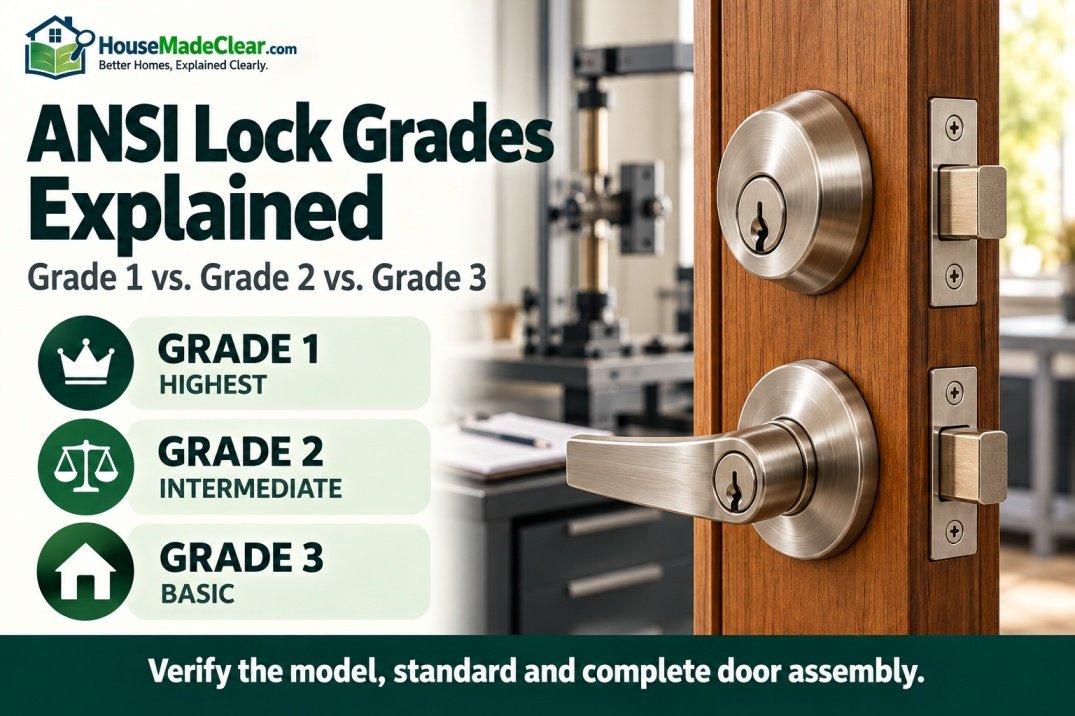
Door-lock packaging often uses terms such as ANSI Grade 1, ANSI Grade 2, ANSI Grade 3, BHMA Certified, or commercial grade. These labels can help compare hardware, but they are frequently misunderstood.
An ANSI/BHMA grade evaluates the performance of a particular hardware product under an applicable testing standard. It does not measure the security of the entire door, and it does not mean that a lock is impossible to pick, drill, bypass, or defeat.
For many homeowners, a certified Grade 2 lock provides a practical balance of security, durability, availability, and cost. Grade 1 provides the highest performance level in the traditional three-grade system and may be appropriate for heavily used entrances or homeowners seeking stronger hardware. Grade 3 represents the basic performance level and is more commonly associated with lighter-duty residential applications.
Modern residential hardware may instead carry separate Security, Durability, and Finish ratings of A, B, or C. These ratings should not be confused with traditional Grade 1, Grade 2, and Grade 3 classifications.
Quick Answer
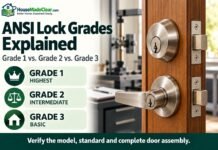
ANSI/BHMA lock grades rank tested hardware performance:
- Grade 1: Highest performance level
- Grade 2: Intermediate performance level
- Grade 3: Basic performance level
For residential exterior doors, certified Grade 1 or Grade 2 hardware is generally the strongest starting point under the traditional grading system. Modern BHMA Certified residential locks may display separate A, B, or C ratings for Security, Durability, and Finish instead.
Always verify the exact model in the BHMA Certified Products Directory. A strong lock must also be installed in a sound door, strike, jamb, frame, and wall assembly.
ANSI Lock Grades at a Glance
| Lock Grade | Relative Performance | Common Applications | Main Consideration |
|---|---|---|---|
| Grade 1 | Highest | High-use entrances, commercial buildings, selected residential exterior doors | Strongest tested performance, but may cost more and require compatible door preparation |
| Grade 2 | Intermediate | Residential exterior doors and light-commercial applications | Practical balance for many homes |
| Grade 3 | Basic | Lower-use residential applications and selected interior hardware | Meets a lower performance threshold than Grades 1 and 2 |
| Residential Security A | Best residential security rating | Exterior residential locksets and deadbolts | Part of the newer category-specific residential label |
| Residential Security B | Better residential security rating | Many standard residential entrances | Evaluate durability and finish ratings separately |
| Residential Security C | Good residential security rating | Applications with lower security demands | Still requires correct installation and compatible door construction |
These categories are not directly interchangeable. A residential Security A rating should not automatically be described as “the same as Grade 1” unless the manufacturer or certification listing makes that relationship clear.

What Are ANSI Lock Grades?
ANSI lock grades are commonly used performance classifications for door locks and related builders hardware.
ANSI stands for the American National Standards Institute. ANSI coordinates and accredits the development of voluntary consensus standards in the United States.
BHMA stands for the Builders Hardware Manufacturers Association. BHMA develops and maintains numerous standards covering locks, latches, hinges, door closers, exit devices, cylinders, multipoint locks, and other door hardware.
The phrase “ANSI lock grade” is common, but ANSI/BHMA grade is more precise. ANSI does not personally inspect every lock sold in a store. The applicable ANSI/BHMA standard defines the test methods and performance requirements.
According to ANSI’s explanation of BHMA grade levels, many hardware standards use three progressive performance levels, with Grade 1 representing the highest level, followed by Grades 2 and 3.
The grade applies to the tested hardware—not automatically to the complete doorway.
Grade 1 vs. Grade 2 vs. Grade 3 Locks
The three grades help buyers and building professionals match hardware performance to the demands of a particular opening.
ANSI Grade 1 Locks
Grade 1 is the highest performance level in the traditional ANSI/BHMA grading system.
Grade 1 hardware is commonly associated with:
- High-frequency use
- Commercial and institutional buildings
- Public entrances
- Multifamily common areas
- Heavily used residential doors
- Applications requiring higher strength and durability
A Grade 1 lock must meet the most demanding performance thresholds specified by its applicable standard. Those requirements may cover operational force, cycle testing, impact resistance, torque, bolt strength, security, materials, and finish.
Grade 1 does not mean that the product is indestructible. It also does not guarantee that every Grade 1 lock offers identical resistance to picking, drilling, key duplication, electronic compromise, or attacks against the door frame.
Two Grade 1 products may differ in:
- Lock type
- Key cylinder
- Deadbolt construction
- Strike hardware
- Electronic features
- Finish
- Fire listing
- Accessibility
- Door compatibility
- Warranty
- Installation requirements
Grade 1 can be a sensible residential choice for a main entrance that receives heavy use. However, installing a Grade 1 deadbolt in a cracked jamb or weak hollow-core door will not create a Grade 1 doorway.
ANSI Grade 2 Locks
Grade 2 represents an intermediate performance level.
It is commonly used for:
- Residential exterior doors
- Apartment entrances
- Small offices
- Light-commercial buildings
- Interior commercial doors
- Moderate-traffic openings
For many detached homes, a certified Grade 2 deadbolt or lockset is a practical starting point. It normally offers stronger tested performance than Grade 3 hardware without requiring the expense or commercial styling sometimes associated with Grade 1 products.
Grade 2 is not automatically appropriate for every entrance. The selected lock still needs to match:
- The door’s thickness
- The existing bore holes
- The backset
- The handing, where applicable
- The required locking function
- The strike preparation
- The door and frame material
- Emergency-egress requirements
- The expected amount of use
A properly installed Grade 2 lock in a strong door and frame can be a better security decision than a poorly fitted Grade 1 lock.
ANSI Grade 3 Locks
Grade 3 represents the basic performance level within the traditional three-grade system.
Grade 3 hardware is commonly found in residential applications with lower performance demands. Depending on the product and function, it may be used for:
- Lower-use residential doors
- Interior rooms
- Closets
- Bedrooms
- Bathrooms
- Utility spaces
A certified Grade 3 product has met the applicable Grade 3 requirements. It should not be treated as untested simply because it is the lowest of the three grades.
However, Grade 3 hardware has lower performance thresholds than Grade 1 and Grade 2 hardware under the same grading system. For a primary exterior entrance, many homeowners will prefer Grade 1 or Grade 2 when the door, budget, and installation support it.
The function also matters. A Grade 3 privacy lever may be entirely appropriate for a bathroom, while a basic spring-latch lock should not be expected to provide the same exterior-door protection as a certified deadbolt.
Our guide to the different types of door locks explains how deadbolts, locksets, mortise locks, multipoint locks, smart locks, and privacy hardware serve different purposes.
ANSI Lock Grade Comparison
| Feature | Grade 1 | Grade 2 | Grade 3 |
|---|---|---|---|
| Relative performance level | Highest | Intermediate | Basic |
| Expected use | Heavy | Moderate | Light to moderate |
| Common setting | Commercial, institutional, high-use residential | Residential exterior and light commercial | General residential and selected interior use |
| Strength thresholds | Highest within applicable standard | Intermediate | Basic |
| Cycle requirements | Usually highest or tied for highest, depending on standard | Varies by product standard | Varies by product standard |
| Security resistance | Highest applicable grade threshold | Intermediate threshold | Basic threshold |
| Typical residential role | Main entrance or heavily used exterior door | Common exterior-door choice | Lower-demand or interior applications |
| Cost tendency | Usually highest | Moderate | Usually lowest |
| Does it secure the whole door? | No | No | No |
The precise test thresholds are not universal across every type of lock. A mortise lock, bored lock, deadbolt, auxiliary lock, and multipoint lock may be covered by different standards.
That is why broad statements such as “every Grade 1 lock survives the same number of cycles” are unreliable. Test methods and thresholds must be read in the context of the product’s applicable ANSI/BHMA standard.
What Do ANSI/BHMA Lock Tests Evaluate?
Lock grading involves more than operating the hardware a few times or applying one impact.
Depending on the product standard, evaluation may include several performance areas.
Operational Performance
Operational testing examines whether the lock performs its intended function correctly.
Tests may consider:
- The force required to operate the handle
- The force required to retract the latch
- Latching performance
- Bolt movement
- Key operation
- Thumbturn operation
- Alignment tolerance
- Operation after other tests
A strong lock that is too difficult to operate may create accessibility or everyday-use problems. Performance standards therefore consider both resistance and usable operation.
Cycle Testing
Cycle testing repeatedly operates the hardware to simulate long-term use.
A lock installed on a frequently used entrance may be locked, unlocked, latched, and unlatched thousands of times over its service life. Laboratory cycling helps determine whether the mechanism continues to function after repeated operation.
Higher grades generally face more demanding durability requirements, although the exact number of cycles depends on the hardware type and applicable standard.
Cycle testing does not predict the exact number of years a lock will last in a particular home. Weather exposure, door alignment, installation quality, lubrication, contamination, user behavior, and maintenance all affect real-world service life.
Strength Testing
Strength testing evaluates whether parts of the hardware tolerate specified loads and forces.
Depending on the lock type, testing may address:
- Lever loading
- Knob loading
- Pulling force
- Torque
- Latch strength
- Deadbolt strength
- Cylinder resistance
- Trim resistance
- Fastener performance
These tests help distinguish light-duty hardware from products designed for heavier demands.
Security Testing
Security tests simulate certain attempts to force or manipulate the hardware.
Depending on the standard, these may include:
- Impact against the cylinder or trim
- Force applied to the bolt
- Torque applied to the mechanism
- Attempts to separate components
- Pressure against a lever or knob
- Other specified forced-entry simulations
These are controlled laboratory tests. They cannot represent every tool, technique, door condition, installation error, or attack scenario.
A grade therefore indicates performance against the requirements of a defined standard. It is not a universal guarantee against burglary.
Material and Construction Evaluation
Hardware may also be evaluated for construction and material-related requirements.
The standard may examine:
- Component thickness
- Material characteristics
- Exposed trim
- Fasteners
- Mechanical assembly
- Product function
- Manufacturing consistency
The relevant requirements differ by hardware category.
Finish Testing
Finish testing examines how the hardware’s visible surface responds to environmental exposure.
Testing may address conditions involving:
- Corrosion
- Humidity
- Salt exposure
- Ultraviolet light
- Condensation
- Perspiration
- Chemicals
- Wear
Finish performance matters especially for coastal homes, uncovered exterior doors, humid climates, and entrances exposed to direct sunlight.
A mechanically strong lock can still become difficult to operate if corrosion, contamination, or finish deterioration is ignored.

Traditional Grades vs. Residential A, B, and C Ratings
One of the biggest sources of confusion is that homeowners may encounter two different rating formats:
- Traditional product grades of 1, 2, and 3
- Residential ratings of A, B, and C for separate performance categories
They are related to ANSI/BHMA standards but should not be treated as identical labels.
Traditional Grade 1, Grade 2, and Grade 3
Many ANSI/BHMA standards assign one overall product grade:
- Grade 1: highest
- Grade 2: intermediate
- Grade 3: basic
The precise requirements depend on the particular hardware standard.
The BHMA product-grade guidance explains that these grades are defined by progressively demanding performance benchmarks within each applicable standard.
Residential Security, Durability, and Finish Ratings
BHMA also maintains a residential certification system for locksets and deadbolts.
Residential hardware covered by this program may receive three separate ratings:
- Security
- Durability
- Finish
Each category can receive:
- A: Best
- B: Better
- C: Good
For example, one lock could receive:
- Security: A
- Durability: B
- Finish: A
Another could receive:
- Security: B
- Durability: A
- Finish: C
The first lock may be preferable where forced-entry resistance and weather exposure are the priorities. The second may be suitable for a frequently used but sheltered entrance.
BHMA’s Secure Home residential-label guide explains what the three categories represent.
Numeric Grades and Letter Ratings Compared
| Rating System | What It Shows | Highest Rating | Important Limitation |
|---|---|---|---|
| Grade 1, 2, or 3 | Product performance under the applicable graded standard | Grade 1 | Requirements differ among hardware standards |
| Security A, B, or C | Residential resistance to specified security tests | A | Does not represent durability or finish |
| Durability A, B, or C | Residential long-term operational performance | A | Does not represent forced-entry resistance |
| Finish A, B, or C | Residential resistance to specified environmental and surface conditions | A | Does not represent mechanical security |
Do not convert the letters into numbers without product-specific evidence. Security A is not automatically equivalent to Grade 1, and Security C should not automatically be called Grade 3.

Which Standards Apply to Door Locks?
There is no single ANSI/BHMA standard covering every type of lock.
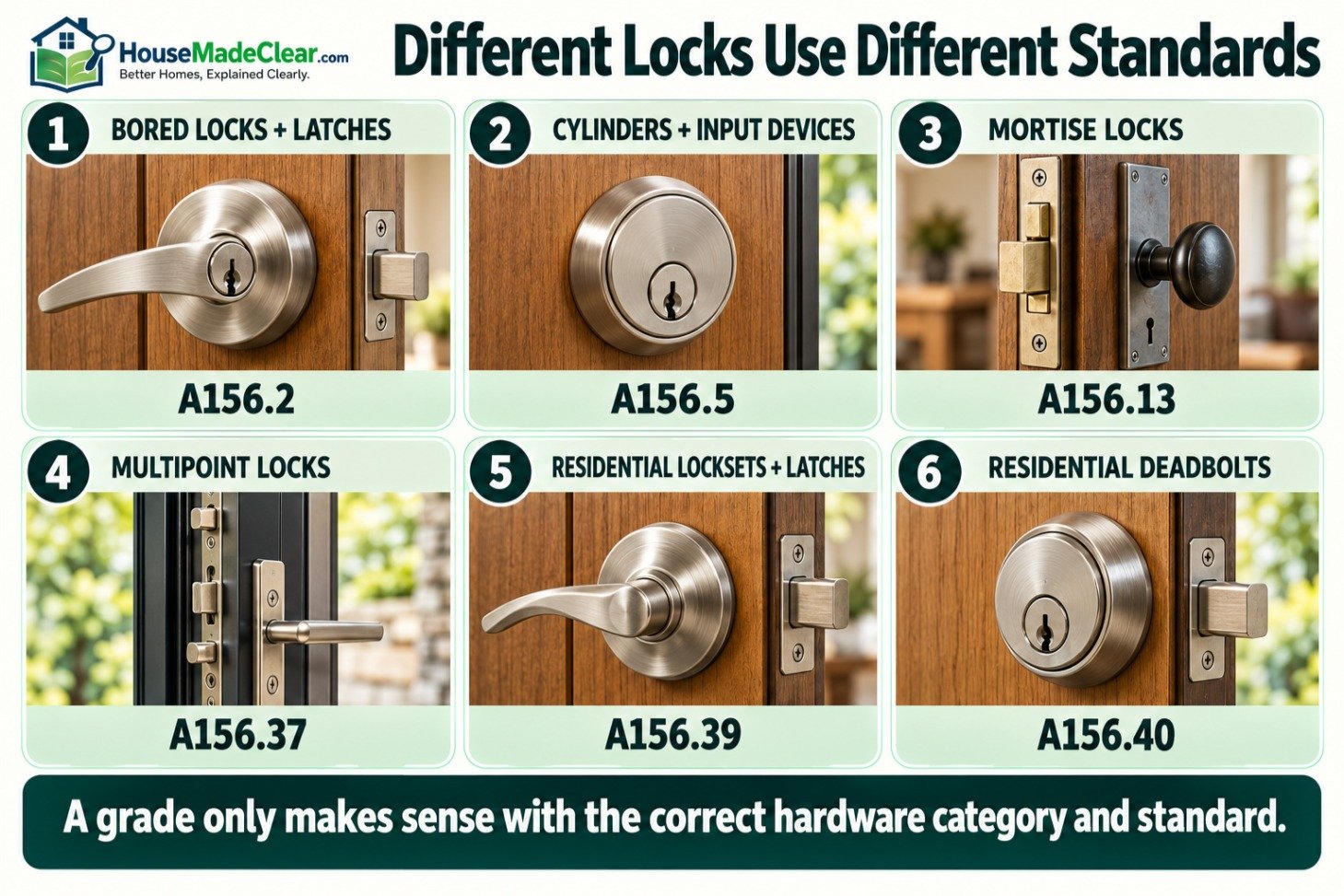
BHMA maintains separate standards for different hardware categories. Examples include:
| Hardware Category | Example ANSI/BHMA Standard |
|---|---|
| Locks and latches | A156.2 |
| Cylinders and input devices | A156.5 |
| Interconnected locks | A156.12 |
| Mortise locks | A156.13 |
| Electromagnetic locks | A156.23 |
| Electrified locking devices | A156.25 |
| High-security cylinders | A156.30 |
| Auxiliary locks | A156.36 |
| Multipoint locks | A156.37 |
| Residential locksets and latches | A156.39 |
| Residential deadbolts | A156.40 |
Standards and editions are revised over time. The BHMA Hardware Highlights directory provides current summaries for the different standards.
A lock’s grade only makes sense when connected to the correct hardware category and standard.
What Lock Grade Is Best for a Front Door?
For a conventional residential front door, a certified Grade 1 or Grade 2 lock is a practical starting point under the traditional grading system.
If the lock uses the residential Secure Home label, examine its individual ratings. An exterior entrance normally places particular importance on:
- Security rating
- Durability rating
- Finish rating
- Correct lock function
- Door compatibility
- Emergency egress
- Installation quality
When Grade 1 May Be Worth Choosing
Grade 1 may be appropriate when:
- The front door receives heavy use
- The opening serves multiple occupants
- The home has higher security requirements
- The entrance is part of a multifamily property
- A compatible Grade 1 product is readily available
- The existing door and frame can support the hardware
- The homeowner wants the highest traditional performance level
A Grade 1 product is not automatically the right choice if it requires extensive modification, does not fit the door, conflicts with the required function, or creates an egress problem.
When Grade 2 Is a Practical Choice
Grade 2 may be appropriate when:
- The opening is a conventional residential entrance
- Use is moderate
- The door and frame are in good condition
- The lock is correctly installed
- The product is independently certified
- The strike and fasteners are appropriate for the assembly
For many homes, Grade 2 provides a reasonable balance between performance and cost.
When Grade 3 May Be Sufficient
Grade 3 may be sufficient for:
- Lower-use residential doors
- Interior locking functions
- Storage rooms
- Bedrooms
- Bathrooms
- Applications where the lock is not the primary exterior-security device
For a primary exterior entrance, compare Grade 3 with certified Grade 2 alternatives before making the decision.
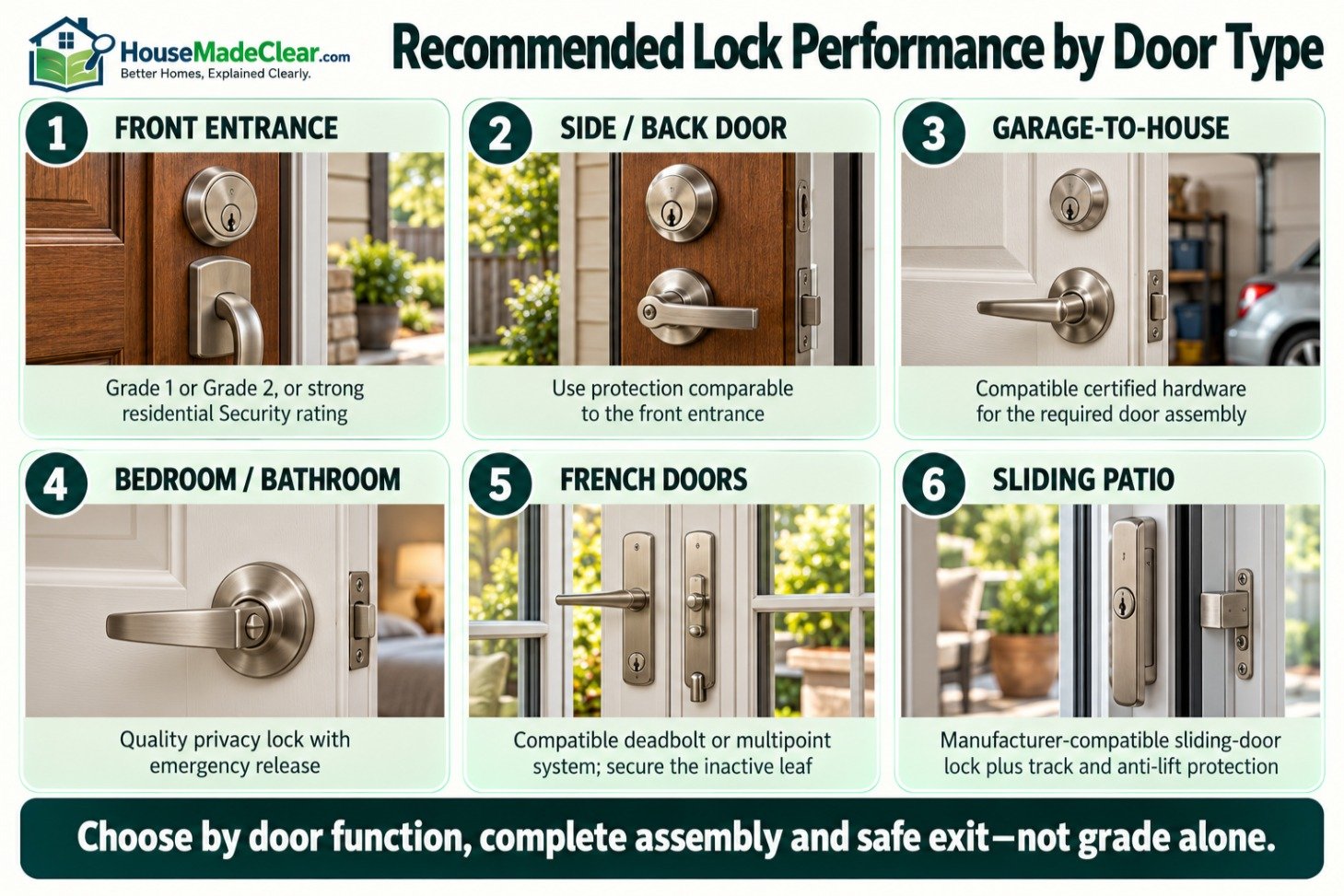
Recommended Lock Performance by Door Type
| Door Location | Practical Starting Point | Other Factors to Check |
|---|---|---|
| Main front entrance | Grade 1 or Grade 2, or strong residential Security rating | Door, frame, strike, cylinder, glass and egress |
| Side or back exterior door | Similar protection to the front entrance | These doors may be less visible and should not receive weaker hardware by default |
| Garage-to-house door | Certified exterior-door hardware appropriate to the required door assembly | Fire-separation and local requirements may apply |
| Apartment entry | Hardware specified or approved by the property owner | Lease, building system, fire rating and egress |
| Bedroom | Privacy lock of appropriate quality | Exterior emergency release and household needs |
| Bathroom | Privacy lock with emergency release | Avoid exterior-style keyed confinement |
| Closet | Passage latch or non-locking hardware | A security grade may be unnecessary |
| French doors | Compatible deadbolt or multipoint system | Active leaf, inactive leaf, astragal and flush bolts |
| Sliding glass door | Manufacturer-compatible sliding-door lock | Track, latch, anti-lift protection and fixed panel |
| Exterior door with smart lock | Certified mechanical hardware plus evaluated electronic features | Battery, account security, updates and manual backup |
For paired doors, the lock grade is only one consideration. Our guide to securing French doors explains why the inactive leaf and astragal can control the security of the opening.
Similarly, a conventional deadbolt grade does not describe the complete security of a patio door. Review the latch, track, anti-lift protection, fixed panel, and glass using our sliding-glass-door security guide.
Does a Higher Lock Grade Make the Entire Door More Secure?
A higher-grade lock can improve one part of the opening, but the complete door is only as strong as its weakest important component.
The security assembly includes:
- Lock
- Deadbolt
- Latch
- Cylinder
- Strike
- Fasteners
- Door edge
- Door slab
- Jamb
- Frame
- Hinges
- Sidelights or nearby glass
- Wall connection
- Installation
A Grade 1 deadbolt cannot compensate for:
- A split jamb
- Loose strike screws
- A hollow interior door used outside
- A bolt that does not extend completely
- Severe door misalignment
- A damaged frame
- Weak inactive-leaf hardware
- An unsecured sliding panel
- Incorrectly drilled door preparation
Before replacing hardware, close the door and operate the lock several times. The latch and deadbolt should enter their openings without forcing, lifting, pushing, or pulling the door.
If the bolt rubs against the strike, correct the alignment rather than repeatedly forcing the lock. Persistent misalignment increases wear and may prevent full engagement.
Our guide on improving home security with better locks explains how locks, strikes, doors, frames, and key control work together.

Does an ANSI Grade Measure Lock-Picking Resistance?
Not completely.
ANSI/BHMA standards may include security tests relevant to the product category, but an overall grade should not be interpreted as a universal lock-picking score.
A lock grade does not necessarily tell you everything about:
- Pick resistance
- Bump-key resistance
- Drill resistance
- Key duplication control
- Cylinder manipulation
- Electronic-account security
- Wireless communication
- Mobile-app security
- Cloud-service reliability
- Credential management
If those features matter, review the cylinder specifications, applicable additional certifications, key-control system, manufacturer documentation, and complete product listing.
Do not assume that “Grade 1” means “pick-proof.” No residential lock should be marketed or treated as impossible to defeat.
Do Smart Locks Have ANSI Grades?
Some smart locks and electronic deadbolts are evaluated under applicable ANSI/BHMA standards, but the grade does not describe every digital feature.
A smart lock may combine:
- Mechanical deadbolt
- Motor
- Key cylinder
- Keypad
- Fingerprint reader
- Bluetooth
- Wi-Fi
- Mobile application
- Cloud account
- Temporary access codes
- Physical override
- Battery system
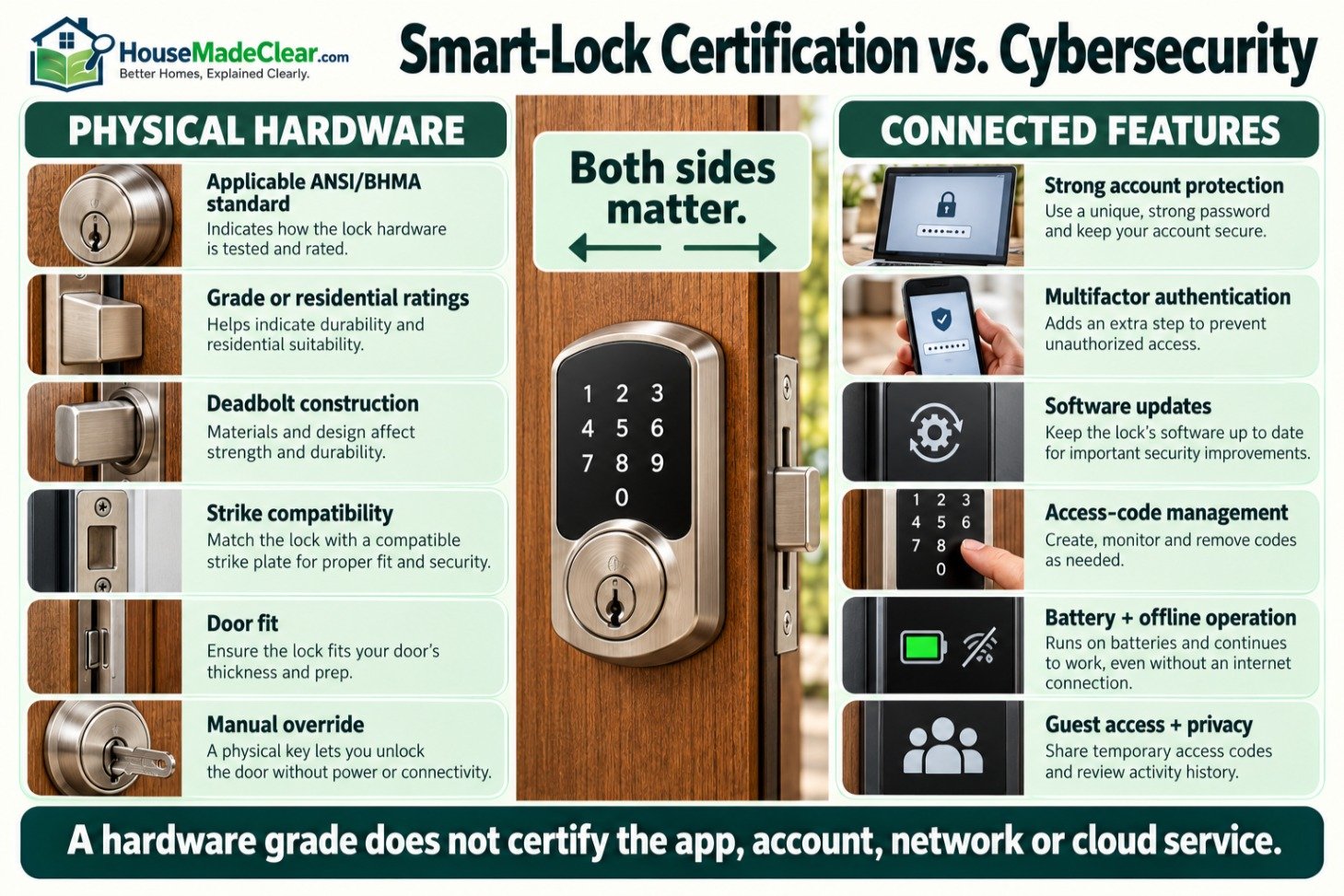
The hardware’s certification can provide useful information about physical and operational performance. It does not automatically evaluate the complete cybersecurity of the app, phone, wireless connection, user account, or cloud service.
When comparing smart locks, check both:
Physical Hardware
- Applicable ANSI/BHMA standard
- Grade or residential ratings
- Deadbolt construction
- Strike compatibility
- Door fit
- Manual override
- Installation requirements
Connected Features
- Account protection
- Multifactor authentication
- Software-update policy
- Access-code management
- Lost-phone procedure
- Battery warnings
- Offline operation
- Event history
- Guest access
- Privacy policy
- Length of product support
A physically strong smart lock can still be managed poorly if users reuse passwords, share one code with everyone, ignore updates, or fail to remove former occupants.
Single-Cylinder vs. Double-Cylinder Lock Grades
Both single-cylinder and double-cylinder deadbolts may be sold with performance claims or certifications, but cylinder configuration and grade answer different questions.
The grade describes tested product performance. The cylinder configuration describes how the deadbolt is operated.
- A single-cylinder deadbolt uses a key outside and a thumbturn inside.
- A double-cylinder deadbolt requires a key on both sides.
Double-cylinder deadbolts can reduce reach-through risk where glass is close to the lock, but they can also delay emergency exit if an interior key is unavailable.
Do not choose a double-cylinder lock solely because it has a high grade. Confirm that the configuration is permitted and appropriate for the door, occupancy, and locally adopted requirements.
Our single-cylinder vs. double-cylinder deadbolt guide compares the security and emergency-egress tradeoffs.
How to Verify a Lock’s ANSI/BHMA Certification
Packaging language is often vague. Terms such as “professional grade,” “premium security,” “heavy duty,” and “commercial quality” are marketing descriptions unless supported by a recognized certification or specification.
Use the following verification process.
1. Record the Exact Model Number
Do not verify only the brand or product family. A manufacturer may sell several visually similar models with different grades, functions, cylinders, finishes, and included strikes.
Record:
- Complete model number
- Function
- Finish code
- Lock type
- Product series
- Package variation
2. Identify the Claimed Standard
Look for a reference such as:
- ANSI/BHMA A156.2
- ANSI/BHMA A156.13
- ANSI/BHMA A156.39
- ANSI/BHMA A156.40
A grade without an applicable standard provides less useful information.
3. Look for the BHMA Certified Mark
“Tested to” and “designed to meet” are not necessarily the same as certification.
BHMA states that products in its certification program undergo independent third-party laboratory verification and periodic recertification.
4. Search the Certified Products Directory
Use the official BHMA Certified Products Directory to check whether the exact product or series appears under the applicable standard.
The directory is more reliable than depending only on a retailer’s filter, marketplace title, or copied product description.
5. Confirm the Grade or Ratings
Verify whether the product uses:
- Grade 1, 2, or 3
- Security A, B, or C
- Durability A, B, or C
- Finish A, B, or C
Do not assume one rating applies to every category.
6. Check the Function
A certified passage lock, privacy lock, entry lock, storeroom lock, deadbolt, and interconnected lock serve different purposes.
Certification does not make the wrong function appropriate for a door.
7. Confirm Door Compatibility
Check:
- Door thickness
- Bore diameter
- Edge-bore size
- Backset
- Handing
- Cross-bore position
- Strike dimensions
- Bolt projection
- Trim clearance
- Existing door damage
- Manufacturer instructions
A certified product can perform poorly if installed in an incompatible or damaged opening.

Common Lock-Grade Shopping Mistakes
Assuming Grade 3 Is the Strongest
In the ANSI/BHMA numeric system, the order may seem backward:
- Grade 1 is highest
- Grade 2 is intermediate
- Grade 3 is basic
Do not assume that the largest number represents the best performance.
Treating “Commercial Grade” as Certification
A retailer or manufacturer may use “commercial grade” as marketing language. Check for a specific standard, grade, certification mark, and directory listing.
Comparing Grades From Different Standards as If They Are Identical
A Grade 1 mortise lock and a Grade 1 auxiliary lock are not necessarily subjected to identical tests. Each grade belongs to its applicable product standard.
Confusing A, B, and C With Grades 1, 2, and 3
The residential letters evaluate Security, Durability, and Finish separately. They should not be converted casually into numeric grades.
Buying the Highest Grade Without Checking Fit
A lock that does not match the door preparation may require drilling, reinforcement, adapters, or professional installation.
Incorrect modification can damage the door or reduce the performance of the hardware.
Ignoring the Strike and Frame
The bolt transfers force into the strike and jamb. Loose, damaged, or poorly aligned strike hardware can undermine the lock.
Ignoring Emergency Egress
A lock must not create an unacceptable delay when occupants need to leave.
Pay particular attention to:
- Double-cylinder deadbolts
- Interior-keyed devices
- Aftermarket surface bolts
- Key-removable thumbturns
- Security bars
- Devices unfamiliar to guests or children
Check locally adopted requirements before installing hardware that needs a key, tool, or special procedure from the inside.
Assuming a Smart Lock’s Grade Covers Cybersecurity
A hardware grade does not replace secure passwords, account protection, timely updates, battery maintenance, or access-code management.
Failing to Verify the Exact Model
The product shown online may differ from the model delivered, especially when a listing combines several lock functions or finishes.
Check the model number on the product, box, instructions, and certification listing.
Lock Grade Buying Checklist
Before purchasing a lock, record the following:
| Item | What to Verify |
|---|---|
| Door location | Exterior, interior, apartment entry, garage connection, French door or other opening |
| Lock function | Entry, deadbolt, privacy, passage, storeroom or interconnected |
| Rating system | Grade 1–3 or residential A–C categories |
| Applicable standard | Match the standard to the hardware type |
| Certification | Verify the exact model in the BHMA directory |
| Security requirement | Consider visibility, glass, occupancy and surrounding construction |
| Use frequency | Low, moderate or heavy |
| Environment | Covered, exposed, coastal, humid or high-UV |
| Door thickness | Confirm against manufacturer specifications |
| Backset | Measure from the door edge to the center of the bore |
| Existing preparation | Check all holes and strike dimensions |
| Door and frame condition | Repair splits, looseness, rot, corrosion or misalignment |
| Egress | Confirm easy operation from inside |
| Smart features | Check account, update, battery and backup requirements |
| Installation | Follow the manufacturer’s complete instructions |
| Local requirements | Verify building, fire, rental and property rules where applicable |
Frequently Asked Questions
What is the best ANSI lock grade?
Grade 1 is the highest performance level in the traditional ANSI/BHMA grading system. However, the best lock for a particular door must also have the correct function, fit, installation, strike, cylinder, egress characteristics, and door compatibility.
Is ANSI Grade 1 better than Grade 2?
Yes. Grade 1 represents a higher performance level than Grade 2 under the applicable ANSI/BHMA standard. Grade 2 is still a practical choice for many residential exterior doors.
Is an ANSI Grade 3 lock secure?
A certified Grade 3 lock meets the applicable Grade 3 requirements, but it has lower performance thresholds than Grades 1 and 2. It may suit lower-demand residential or interior applications. Many homeowners prefer Grade 1 or Grade 2 for a main exterior entrance.
What does ANSI Grade 2 mean?
ANSI Grade 2 indicates that the product meets the intermediate performance level defined by its applicable ANSI/BHMA standard. It is commonly associated with residential exterior doors and light-commercial applications.
Does Grade 1 mean a lock cannot be picked?
No. Grade 1 is the highest traditional performance grade, but it does not mean the lock is pick-proof or immune to every bypass or forced-entry technique.
Are all Grade 1 locks equally secure?
No. Grade 1 locks can use different mechanisms, cylinders, strikes, materials, functions, and product standards. The grade should be considered with the complete product specification and installation.
What is the difference between ANSI and BHMA?
ANSI accredits standards-development processes in the United States. BHMA develops and maintains standards for builders hardware and operates a certification program for qualifying products. “ANSI/BHMA grade” is more precise than treating ANSI as the product-testing organization.
What does BHMA Certified mean?
BHMA Certified indicates that the product has been independently tested and verified against the applicable ANSI/BHMA standard and listed through the BHMA certification program. Certified products also undergo periodic recertification.
What do A, B, and C mean on a residential lock label?
The BHMA residential label separately rates Security, Durability, and Finish. A means Best, B means Better, and C means Good within each category.
Is Security A the same as ANSI Grade 1?
Not automatically. Security A belongs to the residential category-rating system, while Grade 1 is part of the traditional numeric grading system. Do not treat them as equivalent unless supported by the product’s certification information.
Do smart locks have ANSI grades?
Some smart locks and electronic deadbolts are tested under applicable ANSI/BHMA standards. Their hardware rating does not automatically evaluate app security, account protection, wireless communication, software support, or cloud reliability.
What lock grade should I use for my front door?
A certified Grade 1 or Grade 2 lock is a practical starting point under the traditional system. For residential letter-rated products, prioritize an appropriate Security rating while also checking Durability and Finish. The complete door, strike, frame, cylinder, and installation must also be secure.
How can I check whether a lock is really certified?
Find the exact model number, identify the applicable ANSI/BHMA standard, and search for the product in the BHMA Certified Products Directory. Do not rely only on retailer filters or general marketing terms.
Final Recommendation
Do not buy a lock based on the grade number alone.
For most residential exterior doors, start with a properly certified Grade 1 or Grade 2 lock, or a BHMA Certified residential product with Security, Durability, and Finish ratings appropriate to the entrance.
Then evaluate the complete opening:
- Is the door suitable for exterior security?
- Is the frame sound?
- Does the bolt extend fully?
- Is the strike secure and aligned?
- Is nearby glass addressed?
- Can occupants exit quickly?
- Is the exact model independently certified?
- Can the hardware be installed without damaging the door?
A verified lock installed correctly in a strong, compatible opening is more valuable than a higher-grade product installed poorly.





[…] ANSI Lock Grades Explained: Grade 1 vs. Grade 2 vs. Grade… […]
[…] ANSI Lock Grades Explained: Grade 1 vs. Grade 2 vs. Grade… […]