















Curtains usually look best when they extend all the way to the floor, but that does not mean every curtain needs to physically rest on it.
For most modern living rooms and bedrooms, the cleanest look is either:
- Just touching the floor
- Hovering about ½ to 1 inch above the floor
- Breaking very slightly at the floor
Longer curtains can also intentionally puddle onto the floor for a more traditional or dramatic look.
The right choice depends on the room, fabric, curtain style, flooring, pets, cleaning habits and whether the curtains are opened and closed every day.
Quick Answer
For most rooms, curtains should either just touch the floor or stop about ½ to 1 inch above it.
This creates a clean floor-length appearance without excessive fabric dragging on the floor.
A small “break,” where the fabric bends slightly as it reaches the floor, can create a softer look.
Puddled curtains that extend several inches onto the floor are mostly a decorative choice and work better where the curtains are not frequently opened.
Avoid curtains that accidentally stop several inches above the floor unless you intentionally want sill-length or apron-length curtains.
Curtain length should also be planned together with rod height. If you have not decided where the curtain rod will sit yet, start with House Made Clear’s guide to how high to hang curtains.
Should Curtains Touch the Floor?
In most living rooms, bedrooms and other primary spaces, floor-length curtains are usually the safest design choice.
They make the window treatment look:
- Taller
- More complete
- More intentional
- Better connected to the architecture of the room
However, “floor-length” does not always mean the fabric must physically rest on the floor.
There are several legitimate ways curtains can meet the floor.
The four most common are:
- Floating slightly above the floor
- Just touching or “kissing” the floor
- Breaking slightly at the floor
- Puddling onto the floor
Each creates a different look and requires slightly different measurements.
The 4 Main Curtain Length Styles
1. Floating Curtains
Floating curtains stop slightly above the floor.
A practical target is usually around:
½ inch to 1 inch above the floor
This is one of the easiest options for everyday homes.
It works well because the curtains:
- Do not drag
- Stay cleaner
- Open and close easily
- Are more forgiving if the floor is slightly uneven
Floating curtains are especially practical for:
- Bedrooms
- Living rooms
- Home offices
- Homes with pets
- Frequently used curtains
2. Curtains That Just Touch the Floor
This is often called the kiss-the-floor look.
The bottom edge appears to meet the floor almost exactly.
This creates a tailored finish with very little visible gap.
It works especially well in:
- Formal living rooms
- Bedrooms
- Dining rooms
- Minimal interiors
The downside is that measuring needs to be accurate.
If the floor is uneven by even a small amount, one side may touch while another appears slightly short.
3. Curtains With a Slight Break
A slight break means the fabric is a little longer than the exact floor measurement.
The curtain reaches the floor and bends gently before stopping.
This creates a softer appearance than a perfectly straight hem.
It may suit:
- Linen curtains
- Relaxed interiors
- Traditional rooms
- Transitional design
The extra fabric should be modest.
You want a controlled break, not a large pile of fabric.
4. Puddled Curtains
Puddled curtains deliberately extend several inches onto the floor.
The excess fabric gathers or spreads at the bottom.
This creates a dramatic, luxurious appearance.
It works best in:
- Formal rooms
- Traditional interiors
- Decorative window treatments
It is less practical where curtains are opened every day because the fabric may need to be rearranged.
Puddled curtains can also collect:
- Dust
- Pet hair
- Floor debris
more easily than floating curtains.
How Far Should Curtains Be Off the Floor?
For a clean modern look, around:
½ inch to 1 inch above the floor
is a useful starting point.
This gives the visual effect of floor-length curtains while reducing the chance of:
- Fabric dragging
- Hem collecting dust
- Curtain catching under furniture
- Small measurement errors
Some people prefer an even tighter gap.
Others intentionally leave around one inch for practicality.
The key is consistency.
A small intentional gap looks much better than one curtain sitting ½ inch above the floor while the other sits 2 inches higher.
Is 1 Inch Above the Floor Too Short?
No.
Curtains sitting approximately 1 inch above the floor can still look properly floor-length.
This is especially practical when:
- Curtains are opened daily
- Floor is slightly uneven
- Robotic vacuum passes underneath
- Pets shed heavily
- You want easy cleaning
Visually, the curtain will still appear to extend all the way down the wall.
The problem usually begins when the gap becomes noticeably larger.
Are Curtains 2 Inches Above the Floor Too Short?
Not necessarily, but the gap becomes more visible.
For highly practical rooms, 1–2 inches can sometimes work.
However, if your goal is an elegant floor-length look, closer to:
½–1 inch
usually looks more deliberate.
A two-inch gap may begin to look like the curtain was ordered slightly too short rather than intentionally floated.
Are Curtains 3 Inches Above the Floor Too Short?
For conventional floor-length curtains, a three-inch gap will usually look noticeably short.
There are exceptions, but if the curtain is supposed to reach the floor, this much space often appears accidental.
Possible fixes include:
- Lowering curtain rod slightly
- Adding curtain rings
- Using ring clips
- Lengthening hem
- Replacing curtain with longer size
Before moving the rod, however, make sure the new rod height still works visually with the window.
House Made Clear’s guide to how high to hang curtains can help you balance both measurements.
Should Curtains Drag on the Floor?
Only if you intentionally want a puddled style.
For most everyday rooms, curtains that drag unnecessarily can become inconvenient.
They may:
- Collect dust
- Catch under shoes
- Interfere with vacuuming
- Require frequent arranging
If the curtains are opened and closed every day, floating or just touching the floor is usually easier.
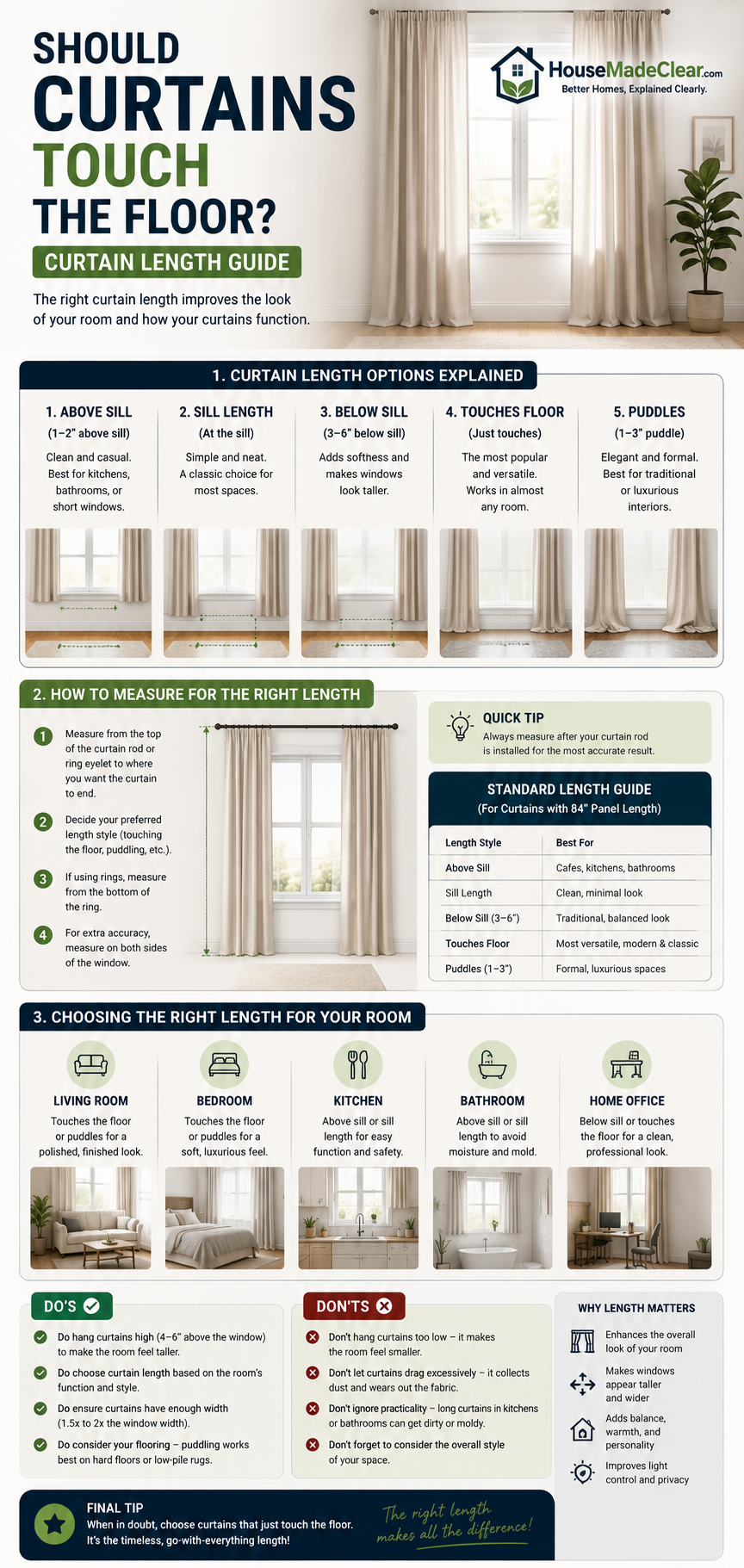
Should Living Room Curtains Touch the Floor?
Usually, yes—or come very close.
Floor-length curtains generally work better in living rooms than short curtains because they visually connect the window with the entire wall.
A good living-room choice is often:
- ½–1 inch above floor for a practical modern room
- Just touching floor for a tailored room
- Slight break for a softer room
- Puddle for formal decorative spaces
Consider Furniture Placement
The curtain may need to sit behind:
- Sofa
- Side table
- Console
- Floor lamp
If furniture blocks the curtain completely, make sure the fabric still has room to fall naturally.
For broader furniture planning, see House Made Clear’s guide to how to plan a functional living room layout.
Should Bedroom Curtains Touch the Floor?
Floor-length curtains are also a strong choice for bedrooms.
They can help the room feel:
- Taller
- Softer
- More finished
For everyday use, floating slightly above the floor is often the easiest option.
This is especially true if the bedroom has:
- Carpet
- Pets
- Small floor area
- Storage furniture close to window
If the bedroom is already tight, curtain placement should also be coordinated with furniture. House Made Clear’s guide to where to put a dresser in a small bedroom can help if the dresser and curtain stack compete for the same wall space.
Should Blackout Curtains Touch the Floor?
Blackout curtains can benefit from extending very close to the floor because larger gaps may allow more light to enter.
For better light control, consider:
- Curtain near the floor
- Adequate width
- Good side coverage
- Proper rod height
But the curtains do not necessarily need to drag.
A blackout panel sitting:
½ inch above the floor
can still work well while remaining easier to clean.
Remember that blackout performance depends on more than curtain length.
Light can also enter:
- Above rod
- At sides
- Through center gap
If you are planning blackout curtains, also check House Made Clear’s guide to how wide curtains should be so the panels have sufficient fullness.
Should Dining Room Curtains Touch the Floor?
Floor-length curtains generally work well in dining rooms.
They create a more formal and complete appearance than short curtains.
A good choice is often:
Just touching the floor
or
Floating slightly above it
Puddling can work in a formal dining room where the curtains are mostly decorative, but it may be inconvenient where chairs or cleaning equipment regularly contact the fabric.
Should Home Office Curtains Touch the Floor?
They can, but function matters.
In a home office, curtains may sit close to:
- Desk
- Chair
- Power cables
- Equipment
A clean float above the floor is usually practical.
Make sure the curtains can:
- Open fully
- Avoid desk legs
- Avoid cable clutter
- Control screen glare
If the window is part of your workstation, House Made Clear’s guide to how to reduce screen glare in a home office explains how curtains and blinds can help control daylight around the monitor.
Should Kitchen Curtains Touch the Floor?
Usually not near active kitchen work zones.
Long curtains beside:
- Sink
- Cooking area
- Counters
may be less practical.
Kitchen windows frequently use:
- Café curtains
- Sill-length curtains
- Shades
because the window sits above cabinetry or a counter.
If a kitchen has a full-height window or patio door away from cooking areas, floor-length curtains can still work.
Should Bathroom Curtains Touch the Floor?
For a standard bathroom window, full-length fabric curtains are less common because of:
- Moisture
- Limited floor space
- Fixtures
A short window treatment or moisture-appropriate shade may be more practical.
This is separate from shower curtains, which have different sizing requirements.
Should Curtains Touch the Floor on Carpet?
They can.
But carpet introduces more resistance than a hard floor.
If the curtains drag heavily over thick carpet, they may:
- Catch
- Fold
- Become difficult to open
A slight float can work particularly well over carpet.
For example:
½–1 inch above the carpet surface
creates a clean look while reducing friction.
Measure from the curtain rod to the top surface of the carpet, not to the hard subfloor underneath.
Should Curtains Touch Hardwood Floors?
They can either touch or float slightly above hardwood.
If curtains are used frequently, a slight gap is often practical.
This helps keep the hem away from:
- Dust
- Cleaning products
- Moisture from mopping
It also reduces fabric dragging.
Should Curtains Touch Tile Floors?
The same general rule applies.
A slight float is practical because tile floors are often:
- Cleaned with water
- Used with robotic vacuums
- Slightly uneven at grout lines
A small floor gap protects the fabric from regular contact with the surface.
Curtains With Pets: Should They Touch the Floor?
If you have pets, floating curtains may be easier.
Fabric resting on the floor can attract:
- Hair
- Dust
- Paw contact
A small gap also reduces the chance that pets step on the hem when running past the window.
You do not need to shorten curtains dramatically.
A small intentional float is often enough.
Curtains in Homes With Children
Floor-length curtains can still work in family spaces.
However, make sure the window treatment and hardware are installed securely.
Avoid making the curtain unnecessarily long where it creates loose fabric on the floor.
Puddled curtains may be less practical in rooms where children regularly play around the window.
What About Curtains Near a Radiator?
This requires more caution.
Curtains should not interfere with heating equipment or block required airflow.
Different:
- Radiators
- Baseboard heaters
- Electric heaters
have different clearance requirements.
Follow the heater manufacturer’s instructions rather than assuming one universal curtain distance is safe.
If the window sits directly above a heating unit, a shorter curtain or another type of window treatment may be more appropriate.
Curtains Near HVAC Vents
Avoid blocking important supply or return vents with heavy curtain fabric.
If floor-length curtains sit directly over a floor vent, they may:
- Restrict airflow
- Move when HVAC operates
- Reduce room comfort
Possible alternatives include:
- Slightly shorter curtains
- Wider rod placement
- Redirected vent where appropriate
- Shade instead of full curtain
Should Curtains Sit Behind Furniture?
They can, but furniture should not crush the fabric.
Common examples include:
- Sofa below window
- Console table
- Bedside dresser
Leave enough room for the curtain to:
- Hang straight
- Open
- Close
If furniture is pressed directly against the curtain, the fabric may bunch or become difficult to operate.
Can Curtains Stop at the Window Sill?
Yes.
Floor-length is not the only correct curtain style.
Short curtains can work where they are functionally necessary.
Common short styles include:
Sill Length
Curtain ends near the sill.
Useful for:
- Kitchen
- Bathroom
- Small utility rooms
Apron Length
Curtain ends slightly below the sill.
Useful where:
- Furniture sits beneath window
- Long curtains would interfere with fixtures
The important distinction is that a deliberately short curtain should look intentionally designed.
A curtain stopping randomly 8 inches above the floor often looks less finished.
Standard Curtain Lengths
Ready-made curtain lengths vary by manufacturer, but common options often include approximately:
| Curtain Length | Common Use |
|---|---|
| 63 inches | Shorter windows / sill-area treatments |
| 84 inches | Standard rooms with lower rod placement |
| 95 or 96 inches | Taller floor-length installations |
| 108 inches | High ceilings / high rod placement |
| 120 inches | Very tall rooms |
| 144 inches | Extra-tall or custom-style spaces |
Do not choose curtain length solely from ceiling height.
Measure the actual distance from:
Rod or hanging point → desired bottom position
before ordering.
Is 84-Inch Curtain Length Too Short?
It depends on rod height.
An 84-inch curtain may work perfectly if the rod-to-floor distance is around 84 inches.
But if you mount the rod high on a 9-foot wall, 84 inches will likely be too short.
This is why rod placement and curtain length must be planned together.
When Should You Use 95- or 96-Inch Curtains?
These lengths work well when the rod sits higher above a standard window.
They are common choices for:
- 8-foot ceilings with high rod placement
- Some 9-foot ceiling installations
But measure first.
Do not assume 96 inches works simply because it is a popular size.
When Should You Use 108-Inch Curtains?
108-inch curtains often work well for taller rooms or rods mounted close to a higher ceiling.
Possible uses include:
- 9-foot ceilings
- Some 10-foot ceiling rooms
Again, actual rod-to-floor distance matters more than ceiling height alone.
When Should You Use 120-Inch Curtains?
120-inch curtains are generally intended for high ceilings and tall window treatments.
They may suit:
- 10-foot ceilings
- 11-foot ceilings
- Large formal rooms
depending on rod location.
How to Measure Curtain Length Correctly
Step 1: Decide Rod Position
Do this before ordering curtains.
If you already installed the rod, move to the next step.
Step 2: Identify the Hanging Point
Curtain length can depend on heading.
For example:
- Grommet curtain
- Rod pocket
- Curtain rings
- Pleated drapery
may hang differently from the rod.
Measure from the point where the fabric actually begins.
Step 3: Measure to the Floor
Use a metal tape measure if possible.
Measure straight down.
Step 4: Decide the Finish
Choose:
- Float
- Touch
- Break
- Puddle
Step 5: Adjust the Measurement
For example:
Rod-to-floor = 96 inches
For a 1-inch float:
95-inch finished curtain length
For exact touch:
96 inches
For small break:
Slightly longer than 96 inches
For puddle:
Add several inches depending on desired effect.
Curtain Length Calculation Example
Suppose the hanging point to floor measures:
94½ inches
You want the curtains ½ inch above the floor.
94½ – ½ = 94 inches
A ready-made 95-inch curtain may therefore be slightly too long unless:
- Rod can move
- Heading changes effective length
- Hem can be adjusted
This is why exact measurement matters.
Measure Each Side of the Window
Do not assume the floor is perfectly level.
Measure:
- Left side
- Center
- Right side
You may discover:
Left = 95 inches
Center = 94¾ inches
Right = 94½ inches
Small differences are common.
A slight float can hide these inconsistencies better than exact floor contact.
Uneven Floors and Curtain Length
Older homes frequently have floors that are not perfectly level.
If you try to make the curtain kiss the floor exactly, one side may drag while the other floats.
A practical solution is:
½–1 inch floor clearance
This creates enough tolerance to hide minor floor differences.
Should You Measure From the Ceiling or Curtain Rod?
Measure from the actual curtain hanging point, not merely the ceiling.
If the rod sits:
4 inches below ceiling
then measuring from ceiling creates an incorrect curtain length.
The curtain’s effective length depends on:
- Rod height
- Rings
- Hooks
- Heading
Does the Curtain Heading Affect Length?
Yes.
Different curtain styles hang differently.
Grommet Curtains
The rod passes through grommets near the top.
A small amount of fabric usually extends above the rod.
Rod-Pocket Curtains
The rod passes through a fabric pocket.
Ring-Clip Curtains
Clips add extra hanging length.
Pinch-Pleat Curtains
Hooks and rings determine where the finished curtain begins.
Always check how the specific curtain is measured by the manufacturer.
Should Curtains Be the Same Length in Every Room?
No.
Consistency is useful within a room, but different rooms can have different functional needs.
For example:
Living room: floor length
Bedroom: floor length
Kitchen: sill length
Bathroom: short treatment
Dining room: floor length
What matters is that each treatment looks intentional.
Should All Curtains in the Same Room Touch the Floor?
Generally, yes.
If multiple windows are in one room, the curtain lengths should usually align visually.
For example, avoid:
Window 1: curtains 1 inch above floor
Window 2: curtains touching floor
Window 3: curtains 3 inches short
unless architecture requires a different treatment.
Consistency creates a more intentional look.
Curtain Width Still Matters
Length alone will not make curtains look correct.
Suppose your curtain reaches the floor perfectly but is barely wide enough to close.
It can still look:
- Flat
- Stretched
- Undersized
For many ready-made curtains, total curtain width around 1.5–2 times the finished rod width is a practical starting point.
House Made Clear’s curtain width guide includes calculation tables for common window and rod sizes.
What If Curtains Are Too Short?
There are several possible solutions.
1. Lower the Curtain Rod
This may work if the rod was mounted too high.
However, do not lower it so much that the window treatment looks compressed.
2. Add Curtain Rings
Ring clips or hanging rings can sometimes add effective length.
3. Release the Hem
Some curtains have enough fabric folded into the bottom hem to gain extra length.
A tailor may be able to modify them.
4. Add a Fabric Border
A contrasting lower panel can extend the curtain.
This works best when intentionally designed.
5. Replace the Curtains
If the curtains are several inches too short and cannot be altered cleanly, replacing them may produce the best result.
What If Curtains Are Too Long?
Again, you have options.
1. Raise the Curtain Rod
If the rod is lower than ideal, moving it upward may solve both:
- Length
- Visual proportion
2. Hem the Curtains
This is usually the cleanest solution.
3. Use Hemming Tape
For lightweight curtains, iron-on hemming tape can provide a no-sew option.
Follow the product and fabric-care instructions.
4. Create a Small Break
If the curtains are only slightly long, allowing them to break gently at the floor may work.
5. Puddle Intentionally
For decorative rooms, extra length can become part of the design.
Do not let accidental excess fabric look like an unfinished measurement mistake.
Can You Raise the Rod Instead of Hemming Curtains?
Sometimes.
Suppose curtains are:
2 inches too long
and the rod also looks slightly low.
Moving the rod up 2 inches may solve the problem.
But before drilling new holes, check:
- Distance from window
- Distance from ceiling
- Curtain heading
- Overall wall proportion
For rod placement guidance, use House Made Clear’s How High Should You Hang Curtains? guide.
Should Curtains Be Longer Than the Window?
For floor-length styles, yes.
Curtain length is based on the distance from the rod to the floor—not simply the height of the window itself.
A window may be only:
60 inches tall
while the curtain is:
96 inches long
because the rod is mounted above the frame and the curtain extends to the floor.
That is completely normal.
Do Floor-Length Curtains Make a Room Look Taller?
They often can.
Long vertical fabric lines visually connect:
- Upper wall
- Window
- Floor
This can make the window treatment feel taller and more substantial.
Mounting the rod above the frame can strengthen this effect.
However, there is no need to place the rod directly against the ceiling in every room.
The proportions should suit the architecture.
Do Long Curtains Make Windows Look Bigger?
They can.
A curtain rod mounted:
- Above window
- Wider than window
combined with floor-length panels can make the overall treatment appear larger than the actual glass area.
That is one reason rod height, rod width and curtain length should be planned as one system.
Floor-Length Curtains and Dark Rooms
If your room lacks daylight, make sure long curtains can stack mostly away from the window when open.
Otherwise, wide heavy panels may cover a significant part of the glass.
A longer curtain does not necessarily make the room darker—the more important issue is how much fabric remains over the window.
For more ideas, see House Made Clear’s guide to how to make a dark room brighter without adding windows.
How Long Should Sheer Curtains Be?
Sheers can use the same floor-length styles.
Common options include:
- ½ inch above floor
- Just touching
- Slight puddle
Because sheer fabric is lightweight, a small puddle can look softer and less bulky than with thick blackout fabric.
However, sheers used daily are often easier to operate with a slight float.
How Long Should Linen Curtains Be?
Linen works especially well with:
- Small float
- Floor touch
- Gentle break
Its relaxed texture suits less rigid styling.
Remember that natural fabrics may behave differently after washing.
Follow manufacturer care instructions and consider possible shrinkage before making permanent alterations.
How Long Should Velvet Curtains Be?
Velvet is visually heavy.
A tailored floor touch or slight break can work well.
Large puddles may create substantial bulk.
Because velvet panels can also be heavy, make sure the curtain rod and brackets are suitable for the load.
How Long Should Grommet Curtains Be?
Measure from the effective top of the fabric to the desired floor position.
Because the rod runs through the grommets, part of the fabric usually extends above the rod.
Do not assume rod-to-floor distance equals the curtain’s listed length exactly.
Check the manufacturer’s measurement diagram.
How Long Should Pinch-Pleat Curtains Be?
Pinch-pleat curtains often hang from hooks and rings.
The exact hook position affects finished length.
If you want a precise floor touch, install or plan:
- Track
- Rod
- Rings
before finalizing curtain length.
Should Curtains Puddle on the Floor?
Puddling is entirely optional.
It can look elegant in:
- Formal dining rooms
- Traditional bedrooms
- Decorative sitting rooms
But it requires more maintenance.
Advantages
- Dramatic appearance
- Soft luxurious effect
Disadvantages
- Collects dust
- Harder to vacuum around
- Fabric needs arranging
- Less practical with pets
- Not ideal for frequently opened curtains
How Much Extra Fabric for Puddled Curtains?
There is no single rule.
A subtle puddle may add only a few inches.
A dramatic puddle may use significantly more fabric.
The more extra length you add, the more fabric accumulates on the floor.
Start conservatively unless you specifically want a formal theatrical look.
Curtain Length Comparison
| Style | Position at Floor | Best For |
|---|---|---|
| Float | ½–1 in above | Everyday rooms |
| Kiss | Just touches | Tailored interiors |
| Break | Slight bend | Relaxed/traditional rooms |
| Puddle | Several inches extra | Formal decorative rooms |
| Sill | At/near sill | Kitchens, utility spaces |
| Apron | Slightly below sill | Windows over furniture |
Which Curtain Length Is Most Practical?
For most households:
½–1 inch above the floor
is probably the most forgiving option.
It looks nearly floor-touching but avoids many practical problems.
It works especially well for:
- Families
- Pets
- Carpet
- Robot vacuums
- Frequently opened curtains
- Uneven floors
Which Curtain Length Looks Most Custom?
A curtain that just kisses the floor can create a highly tailored look.
However, the measurements must be accurate.
Professional-looking curtains depend on:
- Correct rod placement
- Accurate length
- Proper fullness
- Consistent panel alignment
If any of those are wrong, even expensive curtains may look poorly fitted.
Common Curtain-Length Mistakes
1. Buying Curtains Before Installing or Planning the Rod
Problem:
Length does not match final placement.
Better approach:
Plan rod first.
2. Measuring Only the Window Height
Problem:
Floor-length curtains depend on rod-to-floor distance.
Better approach:
Measure actual hanging point.
3. Curtains Stop Several Inches Above Floor
Problem:
They may look accidentally short.
Better approach:
Choose longer panels or adjust rod.
4. Fabric Drags Without Intention
Problem:
Looks like incorrect measurement.
Better approach:
Hem or deliberately style a puddle.
5. Measuring Only One Side
Problem:
Uneven floor causes inconsistent hem.
Better approach:
Measure left, center and right.
6. Ignoring Carpet Thickness
Problem:
Curtains drag after flooring changes.
Better approach:
Measure to finished floor surface.
7. Forgetting Curtain Heading
Problem:
Actual hanging length changes.
Better approach:
Measure based on specific heading system.
8. Using 84-Inch Curtains Because They Are “Standard”
Problem:
They may be too short for high rod placement.
Better approach:
Measure first.
9. Letting Curtains Block HVAC
Problem:
Fabric may interfere with airflow or heating equipment.
Better approach:
Check fixtures and manufacturer clearances.
10. Choosing Puddling Without Considering Cleaning
Problem:
Fabric constantly collects dust.
Better approach:
Choose a slight float for everyday rooms.
Step-by-Step: Find the Right Curtain Length
Step 1: Choose the Rod Height
Decide how high above the window the rod will sit.
Step 2: Install the Rod If Possible
This gives you the most accurate measurement.
Step 3: Determine Hanging Point
Account for:
- Grommets
- Rings
- Hooks
- Rod pocket
Step 4: Measure to Floor
Take measurements at:
- Left
- Center
- Right
Step 5: Choose Your Floor Style
Decide between:
- Float
- Touch
- Break
- Puddle
Step 6: Calculate Final Length
For a float, subtract the desired floor gap.
Step 7: Compare With Available Curtain Sizes
Check:
63
84
95/96
108
120
or other available sizes.
Step 8: Choose the Closest Workable Option
If exact size is unavailable, consider:
- Rod adjustment
- Hemming
- Custom panels
Step 9: Confirm Width Separately
Length does not determine fullness.
Step 10: Test Before Permanent Alteration
Hang curtains before cutting or hemming whenever possible.
Quick Curtain-Length Measurement Box
For a practical modern look
Measure from the curtain’s actual hanging point to the floor.
Then subtract about:
½–1 inch
Example:
Hanging point to floor = 96 inches
Desired float = ½ inch
Finished curtain length ≈ 95½ inches
If using ready-made curtains, choose the closest suitable size and adjust the rod or hem if necessary.
Curtains Too Short or Too Long: Quick Fix Chart
| Problem | Possible Fix |
|---|---|
| ½ inch too short | May still look fine |
| 1 inch too short | Often acceptable float |
| 2–3 inches too short | Lower rod or lengthen |
| Several inches too short | Replace or add fabric |
| ½–1 inch too long | Small break may work |
| 2–3 inches too long | Hem or raise rod |
| Much too long | Hem or intentionally puddle |
Curtain Measurement Checklist
Before ordering curtains, confirm:
- Rod position decided
- Rod installed if possible
- Hanging point identified
- Floor surface included
- Left side measured
- Center measured
- Right side measured
- Floor level checked
- Desired finish selected
- Float amount chosen
- Carpet thickness considered
- Furniture clearance checked
- HVAC or heater clearance checked
- Curtain heading considered
- Standard panel size verified
- Width calculated separately
- Number of panels confirmed
How Curtain Height, Width and Length Work Together
A curtain treatment really has three main dimensions.
Rod Height
Determines where the curtain starts vertically.
Read: How High Should You Hang Curtains?
Curtain Width
Determines fullness and side coverage.
Read: How Wide Should Curtains Be?
Curtain Length
Determines how the fabric meets the floor.
This article completes that measurement sequence.
A curtain can have the perfect length and still look wrong if:
- Rod is too low
- Panels are too narrow
Likewise, perfectly wide curtains can still look awkward if they stop several inches above the floor.
The measurements work as a system.
Quick Answer: Should Curtains Touch the Floor?
Yes, in most living rooms and bedrooms, curtains should visually reach the floor.
But they do not have to physically drag on it.
For most homes:
½–1 inch above floor = practical and clean
Just touching = tailored
Slight break = softer
Puddle = formal and decorative
If you are unsure, choose a slight float. It is the easiest style to maintain and the most forgiving of uneven floors and measurement variations.
Final Thoughts
Curtains usually look best when they visually extend all the way to the floor.
For most homes, the most practical choice is:
½ to 1 inch above the floor
This gives you a floor-length appearance without fabric:
- Dragging
- Collecting excessive dust
- Interfering with vacuuming
- Catching on the floor
If you want a more tailored look, let the curtain just kiss the floor.
If you prefer something softer, allow a very slight break.
And if the room is formal and the curtains are mainly decorative, puddling can create a more dramatic effect.
The most important thing is to make the length look intentional.
Avoid choosing curtains only because:
“84 inches is standard”
or
“96 inches seems close enough.”
Instead:
- Decide rod placement
- Measure from actual hanging point
- Decide how the curtain should meet the floor
- Choose the correct finished length
For the complete window-treatment measurement process, continue with House Made Clear’s guides to how high to hang curtains and how wide curtains should be.
Frequently Asked Questions
Should curtains touch the floor?
For most living rooms and bedrooms, curtains should visually reach the floor. They can either just touch it or stop about ½ to 1 inch above it for a cleaner, more practical finish.
How far should curtains be off the floor?
Around ½ to 1 inch above the floor is a practical starting point for most everyday rooms. It keeps the curtains looking floor-length while reducing dragging and dust collection.
Is it okay for curtains to be 1 inch off the floor?
Yes. A one-inch gap can look intentional and is especially practical for frequently used curtains, homes with pets and rooms with slightly uneven floors.
Are curtains 2 inches off the floor too short?
A two-inch gap can still work, but it becomes more noticeable. If you want a tailored floor-length appearance, around ½ to 1 inch above the floor generally looks more deliberate.
Should bedroom curtains touch the floor?
Floor-length curtains usually work well in bedrooms. They may just touch the floor or float slightly above it depending on the desired look and how often they are opened.
Should living room curtains touch the floor?
Yes, floor-length curtains are usually a strong choice for living rooms. A small float or exact floor touch creates a clean appearance, while a slight break can create a softer style.
Should blackout curtains touch the floor?
Blackout curtains should extend close to the floor for better light coverage, but they do not need to drag. A small gap of around ½ inch can provide a good balance between light control and practicality.
Is it okay for curtains to puddle on the floor?
Yes. Puddled curtains are an intentional decorative style in which several inches of extra fabric rest on the floor. They work best in formal rooms or where the curtains are not opened frequently.
What should I do if my curtains are too short?
Possible solutions include lowering the rod slightly, adding curtain rings, releasing the hem, adding a fabric border or replacing the curtains with longer panels.
What should I do if my curtains are too long?
You can hem them, raise the curtain rod if appropriate, allow a slight break or intentionally style them as puddled curtains.
Are 84-inch curtains floor length?
They can be, but only if your actual hanging point to floor measurement is around 84 inches. Measure your installed or planned curtain rod before choosing a standard curtain length.
What is the best curtain length for most rooms?
For most living rooms and bedrooms, floor-length curtains that stop approximately ½ to 1 inch above the floor provide a practical, clean and versatile look.