













Securing an apartment door can be frustrating when your lease does not allow drilling, lock replacement, or permanent modifications.
You may want a stronger entrance lock, additional protection at night, or better security while traveling. However, many popular door-security upgrades involve installing screws, replacing strike plates, or modifying the door frame.
For renters, those changes are not always permitted.
Fortunately, several security improvements do not require drilling. Portable door locks, door-security bars, wireless sensors, and better key-management practices can all contribute to apartment security.
But there is an important distinction: a device that helps resist someone pushing open a door while you are inside may provide no security when you leave the apartment.
Some additional locking devices can also violate fire-safety requirements or prevent emergency access.
The right approach depends on your door’s construction, opening direction, existing lock, building rules, and the security problem you want to solve.
Quick Answer
To secure an apartment door without drilling, start by checking that the existing deadbolt and latch work correctly. Ask your landlord to repair loose hardware, damaged frames, or poorly aligned locks.
Depending on the door and applicable rules, additional options include:
- A compatible portable door lock for use while occupied
- A removable door-security bar or jammer
- A wireless door-contact alarm
- A freestanding security camera
- A peel-and-stick door sensor or vibration alarm
- Permission-based rekeying or lock replacement
- Improved lighting and entryway visibility
- Better control of physical keys and access codes
Important: Do not install any device that prevents safe emergency exit, interferes with a fire-rated door, or blocks authorized emergency access. Check lease terms and applicable building requirements before adding security hardware.
Why Apartment Doors Need a Different Security Approach
Apartment entrance doors are different from many doors in single-family homes.
Homeowners can often replace a lock, reinforce the strike plate, or install a jamb-reinforcement kit without requesting permission from another property owner.
Renters usually have less control.
Depending on the building, an apartment entrance may include:
- A solid-core wood door
- A steel door
- A labeled fire-rated door assembly
- A metal frame attached to masonry
- A wood frame with structural backing
- A conventional deadbolt and latch
- An electronic access-control system
- Building-controlled master-key hardware
Each configuration creates different limitations.
For example, a portable lock designed for a standard inward-swinging residential door may not fit a metal apartment door with a commercial strike plate.
Similarly, replacing a deadbolt may interfere with a building’s emergency-access or master-key arrangement.
Start With the Existing Door
Before purchasing additional hardware, inspect the entrance.
Check whether:
- The door closes completely without being pushed or lifted.
- The deadbolt extends and retracts smoothly.
- The latch engages the strike.
- The door frame is securely attached.
- The hinges are tight and undamaged.
- The strike plate is loose or visibly bent.
- The door has excessive movement when closed.
- The weatherstripping prevents proper latching.
- The lock shows signs of damage or tampering.
- The building provides an appropriate emergency-access arrangement.
A new portable security device will not repair a damaged frame or misaligned deadbolt.
For a broader explanation of how locks and door assemblies work together, see our guide to improving home security with better locks.
Best Ways to Secure an Apartment Door Without Drilling
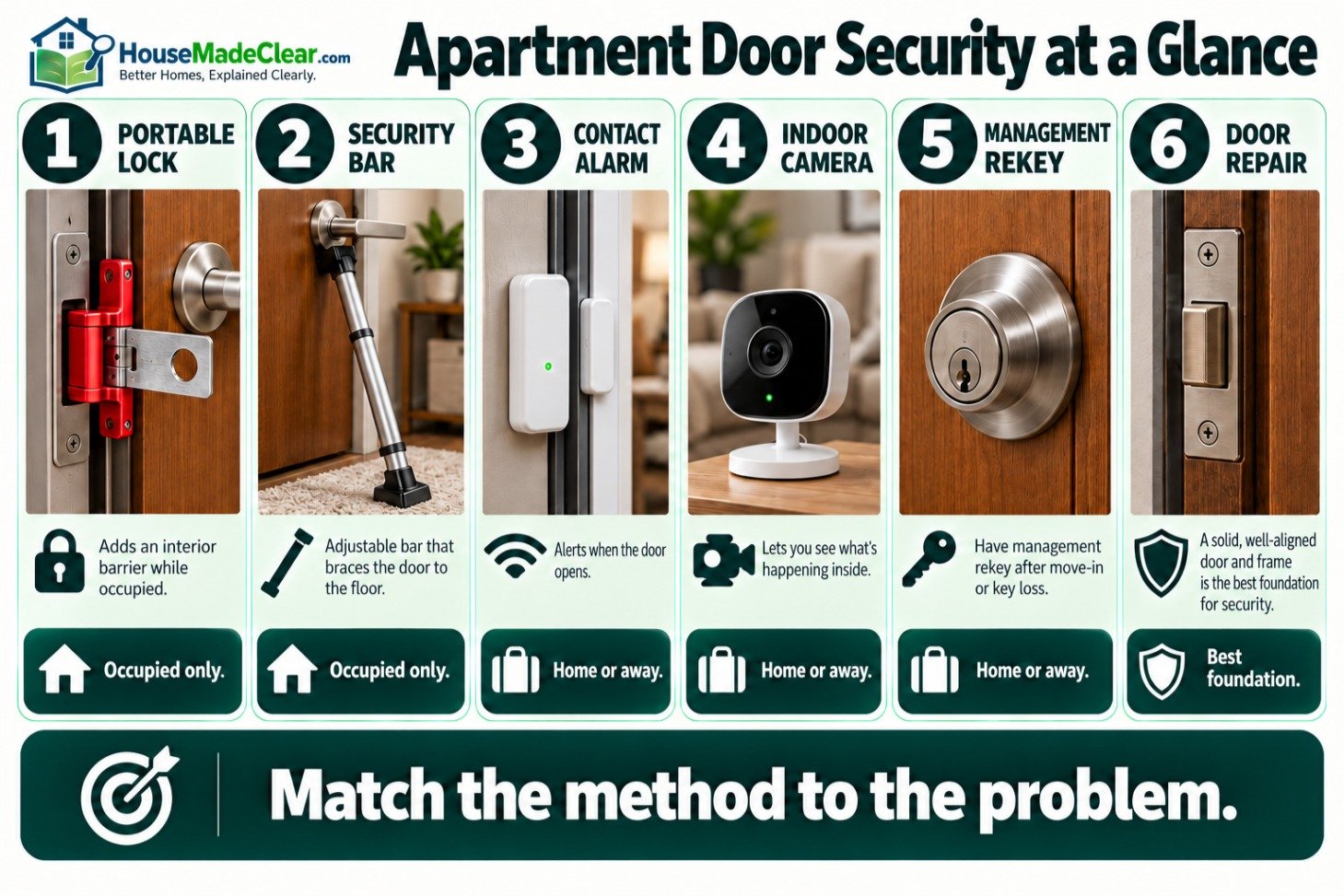
The following methods address different security needs.
Some provide additional resistance to opening, while others improve detection, monitoring, or access control.
1. Use a Portable Door Lock Where Permitted
A portable door lock is a removable device designed to provide an additional physical barrier against an inward-opening door.
Many models use a metal component positioned at the existing strike opening and a removable locking piece that helps prevent the door from opening.
These devices are commonly marketed to renters, travelers, and hotel guests because they do not require permanent installation.
Potential advantages:
- No drilling required
- Can be removed when no longer needed
- Typically compact
- Does not necessarily require replacing the existing lock
- May provide additional resistance while someone is inside
Limitations:
Portable locks are not universally compatible.
Their operation depends on:
- The door opening inward
- The strike plate configuration
- The gap between the door and frame
- The door’s thickness and alignment
- The strength of the existing frame
- The device’s specific installation requirements
Some products do not fit recessed strikes, unusually shaped frames, or commercial-grade hardware.
A portable lock may also damage finishes or interfere with the door’s operation if forced into an incompatible opening.
Safety consideration: A portable lock can introduce an additional release step during an emergency. It may also prevent emergency entry by building staff or responders. Do not use one unless permitted by the applicable fire and building requirements and approved where necessary.
Best suited for: An approved, compatible inward-opening door when an occupant wants temporary additional security while inside.
2. Consider a Door-Security Bar or Jammer
A door-security bar generally provides resistance by bracing an inward-opening door against the floor.
Many products are adjustable and positioned beneath the door handle or against another designated contact point.
Some use rubberized feet to increase friction on the floor.
Unlike a portable strike-mounted lock, a security bar usually does not attach directly to the strike plate.
How Door-Security Bars Work
When someone attempts to push the door inward, the device transfers some of that force toward the floor.
Its effectiveness depends on the bar’s design, contact angle, floor traction, and the strength of the surrounding door assembly.
On a smooth tile floor, a poorly designed or incorrectly positioned jammer may slide.
On carpet, the contact foot may behave differently.
A device can also lose its intended bracing angle if the door handle or contact point moves.
Advantages
- Generally does not require screws
- Can be stored when not needed
- May fit certain inward-opening doors
- Does not require replacing the existing lock
Disadvantages
- Usually cannot be used to secure the door from outside
- Depends on proper floor contact
- May slip on unsuitable surfaces
- May be incompatible with some door handles
- Can obstruct emergency exit or entry
- Does not repair weak locks or frames
A door-security bar should never be considered a substitute for a functioning deadbolt.
Best suited for: Temporary occupied-use security only where the specific device is compatible, allowed, and does not violate emergency-egress requirements.
3. Install a Wireless Door-Contact Alarm
A wireless door-contact alarm is one of the more practical no-drill improvements for many renters.
These devices generally use two components:
- A sensor attached to the door or frame
- A magnet installed on the corresponding moving or stationary surface
When the door opens and the magnet moves away from the sensor, the system detects a change.
Depending on the product, it may:
- Sound a local alarm
- Send a smartphone notification
- Trigger a connected security system
- Record the event in an application
- Activate other connected devices
Many sensors use removable adhesive mounting, although adhesive can still damage paint or finishes.
Why Contact Alarms Are Useful
A door sensor provides information about when the entrance opens.
Unlike a security bar, it may continue monitoring while the apartment is unoccupied.
That makes it useful for renters who want to know whether their entrance has been opened while they are away.
However, a contact alarm does not physically prevent entry.
It only detects a condition and responds according to its design.
For connected sensors, remote notifications may also depend on working batteries, power, internet connectivity, and the associated service.
Best suited for: Renters who want entry detection without permanent modifications.
4. Use a Removable Vibration or Door-Impact Alarm
A vibration alarm monitors movement or impacts against a surface.
Depending on the design, it may detect:
- Repeated knocking
- Significant vibration
- An attempted forced opening
- Impact against the door
- Other movements above a selected sensitivity level
Some devices attach using adhesive pads.
Others are incorporated into a larger home-security system.
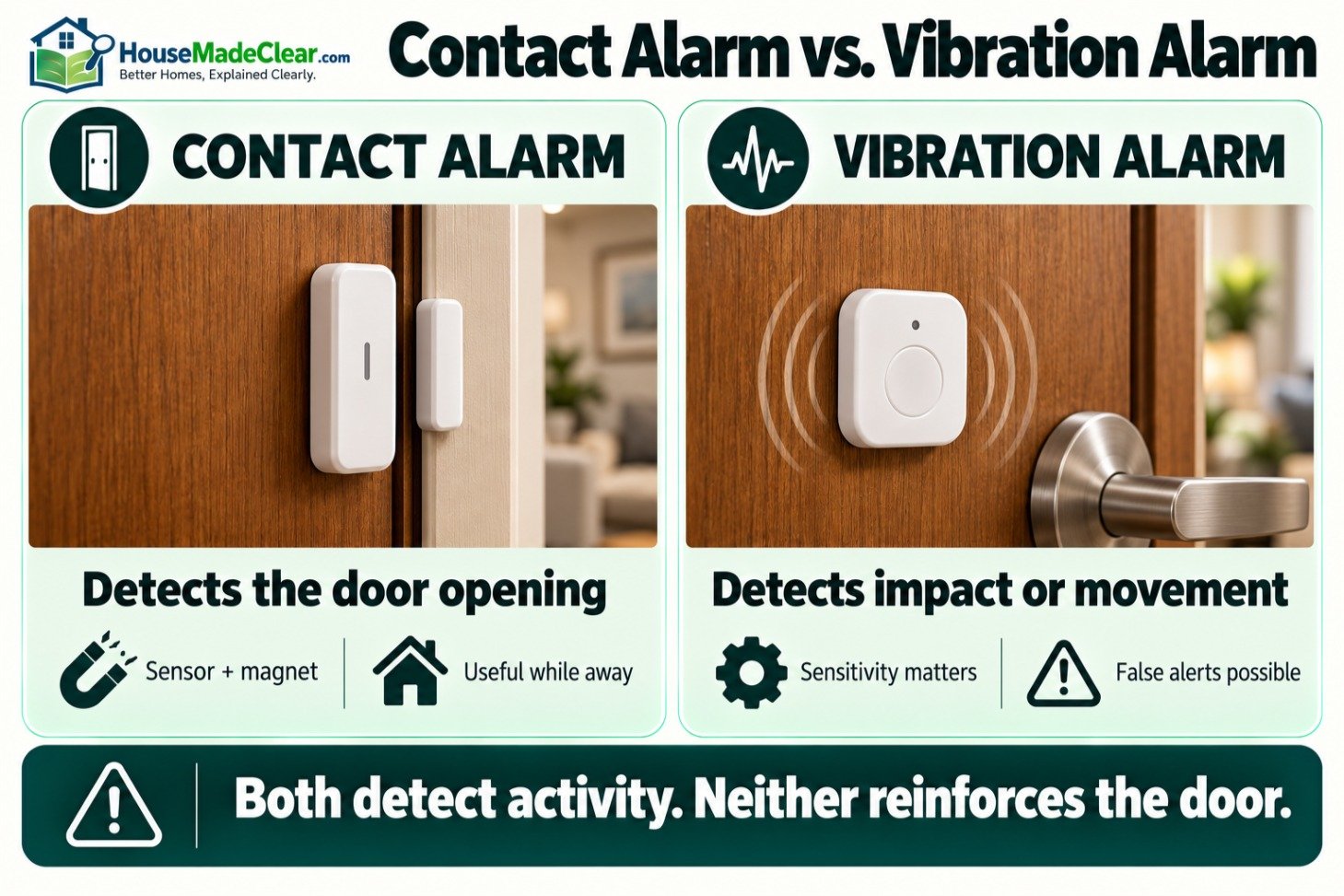
Contact Alarm vs. Vibration Alarm
The two technologies detect different events.
A contact sensor generally detects when the door changes from closed to open.
A vibration sensor may respond to movement or impact before the door opens.
However, vibration sensing can produce false alerts.
For example, a sensor may react to a door slamming nearby, building vibrations, or strong repeated knocks.
Its effectiveness depends on proper placement, calibration, and the sensor’s design.
Best suited for: Additional monitoring where early impact detection is useful and nuisance alarms can be managed.
5. Ask Your Landlord to Rekey or Replace the Existing Lock
One of the most important apartment-security questions has nothing to do with portable devices.
Who currently has a key to your apartment?
If you recently moved in, consider whether the property manager changed or rekeyed the lock between occupants.
A functioning deadbolt may still present an access-control concern if old keys remain in circulation.
This may involve:
- Former tenants
- Previous occupants
- Former contractors
- Lost or unaccounted-for keys
- People who previously received authorized copies
Rekeying changes the keying of a compatible lock so previously issued keys no longer operate it.
Replacing the lock may be necessary when the existing hardware is worn, damaged, incompatible, or unsuitable.
Can You Rekey an Apartment Lock Yourself?
Do not assume you can.
Apartment buildings may use:
- Master-key systems
- Restricted keyways
- Electronic credential management
- Fire-rated hardware
- Property-managed access systems
Unauthorized replacement could interfere with emergency access, violate your lease, or create a building-security problem.
Instead, request confirmation of the property’s lock-change policy.
Where permitted, the landlord or an authorized locksmith can rekey or replace the hardware.
This is particularly important after losing keys or discovering that an unauthorized person may have access.
Best suited for: Restoring access control after moving in, losing keys, or identifying an existing key-security problem.

6. Use a Peephole or Existing Door Viewer
Knowing who is outside your door helps prevent unnecessary opening.
Many apartment doors already have a peephole or door viewer.
Before adding equipment, check whether the existing viewer is:
- Clear
- Properly positioned
- Undamaged
- Suitable for the occupant’s height
- Free from paint or obstruction
If the apartment already has a suitable viewer, using it consistently provides a simple additional security measure.
What About a Digital Peephole Camera?
Some digital viewers are designed to use an existing door-viewer opening.
However, replacing even a small part of a fire-rated door may be a regulated modification.
Do not remove or enlarge a viewer opening without authorization.
If your apartment lacks a peephole, ask building management whether an approved viewer can be installed.
Best suited for: Identifying visitors before opening the apartment entrance.
7. Add a No-Drill Security Camera
A security camera does not make the door mechanically stronger.
Instead, it can provide visibility, recording, and notifications.
Depending on the apartment layout, possible options include:
- A freestanding indoor camera
- A shelf-mounted camera
- A camera aimed at the interior entrance area
- A removable door-mounted camera approved by management
- A building-approved video doorbell
An indoor camera may record someone entering after the door is opened.
However, it generally cannot identify visitors standing outside a closed, opaque entrance door.
What About No-Drill Video Doorbells?
Some video doorbells have removable mounting accessories.
Nevertheless, exterior installation may create problems involving:
- Building rules
- Shared hallway privacy
- Neighboring apartment doors
- Wireless connectivity
- Theft or tampering
- Fire-door hardware
- Adhesive damage
Shared hallways are not automatically unrestricted recording areas.
Check building policies and applicable local privacy requirements before installing a camera that records communal spaces.
Choose Cameras Carefully
For connected cameras, review:
- Video storage arrangements
- Subscription requirements
- Battery life
- Local versus cloud recording
- Motion detection
- Account security
- Multi-factor authentication
- Software-update support
Best suited for: Monitoring and documenting activity, not physically preventing forced entry.

8. Improve Entryway Lighting and Visibility
Not every useful security improvement requires attaching hardware to the door.
Visibility can help occupants identify visitors and notice unusual activity.
For an apartment with a private entrance, practical improvements may include:
- Motion-activated lighting
- Battery-powered entryway lights
- Better illumination near the lock
- Keeping the entrance unobstructed
- Reporting failed hallway lighting
- Asking management to repair dark common areas
For indoor apartments, common hallways and stairwells are usually controlled by building management.
Do not independently install devices in shared areas or alter electrical fixtures without authorization.
Does Lighting Prevent Break-Ins?
Lighting can improve visibility and may discourage some unwanted activity, but it does not guarantee prevention.
Its main contribution is supporting observation, safe movement, and the ability to identify people near an entrance.
Best suited for: Apartments with poorly illuminated entrances or shared access areas.
9. Improve Key, Access-Code, and Visitor Management
Door security is not only about resisting forced entry.
It also involves controlling authorized access.
Consider these questions:
- How many copies of your apartment key exist?
- Have any keys been lost?
- Who has temporary access?
- Does the building use electronic fobs?
- Are inactive access credentials removed?
- Is your apartment number attached to a spare key?
- Do visitors regularly enter through an unsecured common entrance?
Small access-management mistakes can undermine an otherwise reliable door lock.
Apartment Key-Security Practices
Avoid leaving spare keys in obvious shared locations.
Report missing building-access fobs promptly.
Do not share permanent access codes with people who need only temporary entry.
If your building offers temporary credentials, ask whether those can be used for approved visitors or service providers.
For electronic locks, follow the manufacturer’s security guidance and use unique passwords and multi-factor authentication where supported.
Best suited for: Every apartment, regardless of door type.
10. Request Professional Door and Frame Repairs
A poorly fitting door should not be treated as a problem that can always be solved with a portable accessory.
The existing assembly may need maintenance or repair.
Common warning signs include:
- A deadbolt that does not extend completely
- Loose strike hardware
- A cracked wooden jamb
- A door that sags
- A visibly bent metal frame
- Loose or missing hinge fasteners
- Excessive gaps around the door
- Damage after an attempted forced entry
- A door that does not close or latch reliably
Report these problems to the landlord or property manager.
Depending on the construction, repairs may involve realignment, replacement hardware, structural repairs, or professional frame reinforcement.
For conventional wood-framed doors, see our detailed guide on how to reinforce a door frame for better security.
However, apartment entrance doors with steel frames, rated assemblies, or building-controlled hardware need methods appropriate to their specific construction.
Best suited for: Any apartment with a damaged or malfunctioning entrance assembly.
Comparison: Best No-Drill Apartment Door Security Options
Not every product solves the same problem.
The table below compares the most common options.
| Security Method | Physical Resistance | Works While Away? | Main Limitation |
|---|---|---|---|
| Portable door lock | Additional resistance on compatible doors | No | Egress, emergency access, compatibility |
| Door-security bar | Additional resistance on compatible inward-swinging doors | No | Floor grip, egress, emergency access |
| Wireless contact alarm | None | Yes, if configured | Detects opening rather than preventing it |
| Vibration alarm | None | Yes, if configured | False alerts and sensitivity |
| No-drill camera | None | Yes, if configured | Privacy, power, connectivity |
| Landlord-approved rekeying | Controls key access | Yes | Requires authorization |
| Entryway lighting | None | Yes | Visibility, not physical protection |
| Frame or lock repair | Restores intended door performance | Yes | May require professional work |
Important: “No drilling” does not automatically mean “safe,” “code-compliant,” or “permitted by your lease.” A device must satisfy all three considerations independently.
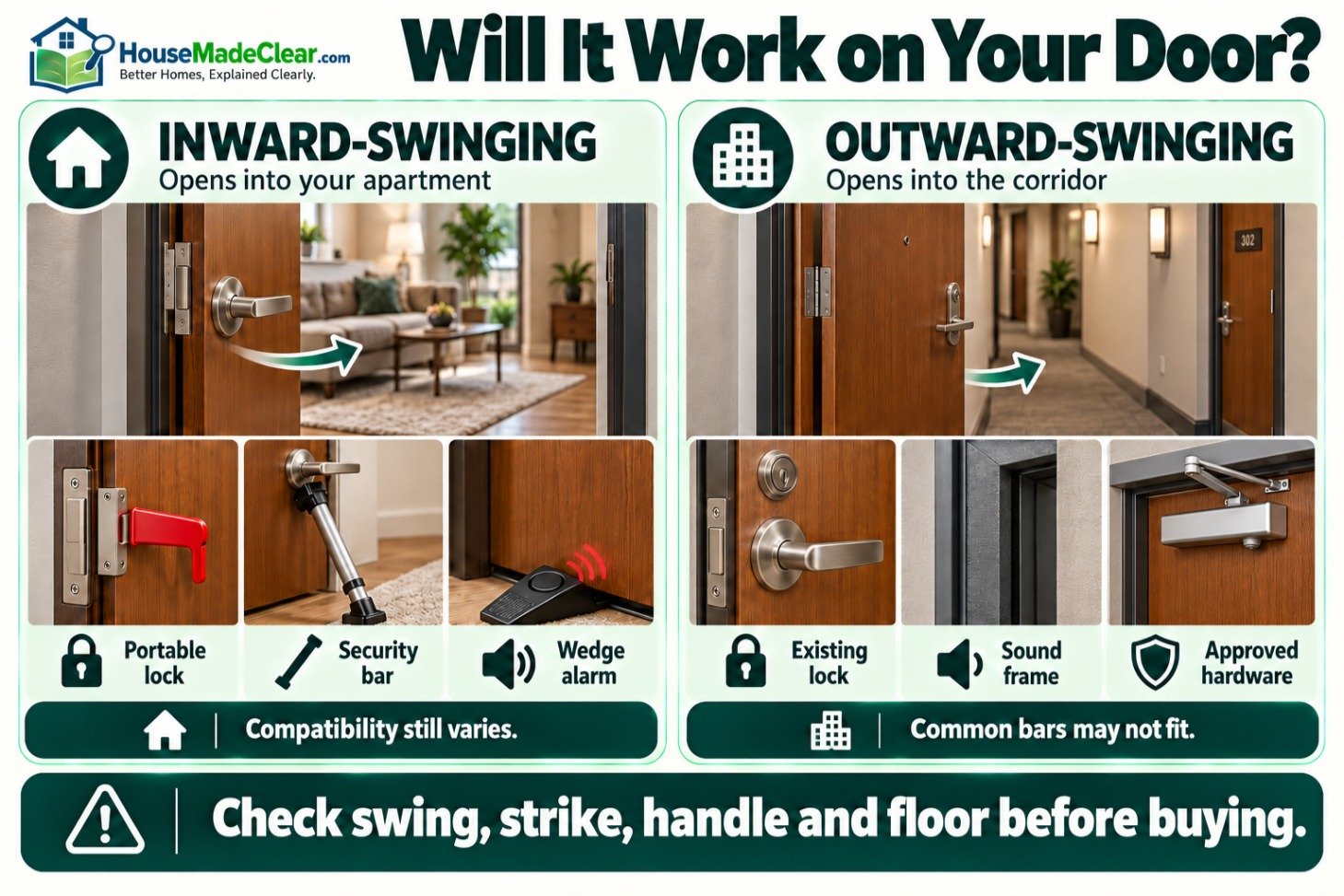
Inward-Swinging vs. Outward-Swinging Apartment Doors
Before choosing an additional door-security device, determine how the entrance opens.
This is one of the most important compatibility checks.
Inward-Swinging Apartment Doors
An inward-swinging door opens toward the apartment interior.
Some portable locks and bracing products are designed specifically for this arrangement.
However, compatibility also depends on the frame, handle, strike, and clearances.
Outward-Swinging Apartment Doors
An outward-swinging door opens away from the apartment interior.
Conventional floor-braced security bars intended to oppose inward movement generally are not suitable for these doors.
Similarly, many portable strike-mounted locks are incompatible.
An outward-swinging entrance may instead rely on:
- Existing deadbolt or multipoint hardware
- Approved hinge-security features
- Properly fitted strike hardware
- A sound door and frame
- Building-approved access-control arrangements
If hinges are externally accessible, their design matters.
Some outward-swinging door assemblies use non-removable hinge pins or security studs to address hinge-related vulnerabilities.
These components should be selected and maintained by authorized personnel where required.
Do not attempt to modify hinges on a fire-rated or commercial apartment door without approval.
How to Secure an Apartment Door While You Are Away
Many no-drill security products provide protection only when someone is physically inside the apartment.
This limitation is frequently overlooked.
A floor-mounted security bar cannot ordinarily be placed in its working position from outside and then removed when you return.
A portable interior lock has similar limitations.
Therefore, renters who are regularly away from home should prioritize different improvements.
Focus on Permanent Security That Is Already Authorized
The most useful measures often involve:
- A properly functioning existing deadbolt.
- A securely fitted door and frame.
- Effective key or credential control.
- Landlord-approved lock maintenance.
- Reliable door-contact monitoring.
- Building entrance security.
- Optional indoor monitoring.
An alarm can notify you of an opening event, but it cannot replace a sound lock.
If your apartment door has a damaged frame, request repair rather than attempting to compensate with more electronics.
Avoid Creating an Obvious Vacancy Pattern
When traveling, avoid unnecessarily advertising that the apartment is empty.
Consider asking an authorized person to collect deliveries or checking whether the building offers a package-holding service.
Follow building rules for visitors and temporary access.
Do not distribute apartment keys widely in the name of convenience.

Can You Install a Smart Lock Without Drilling?
Some smart-lock products are designed to fit over or replace portions of an existing lock without requiring new holes in the door.
However, this does not mean every retrofit smart lock is suitable for an apartment.
Compatibility depends on:
- The existing deadbolt mechanism
- Door thickness
- Interior thumb-turn design
- Available mounting clearance
- Lock alignment
- Building access requirements
- Manufacturer specifications
A retrofit device may preserve the existing key cylinder, but it can still change the operation of the building-controlled lock.
For that reason, renters should obtain permission before installing one.
Does a Smart Lock Make the Door Stronger?
Not necessarily.
A smart lock primarily changes how access is managed.
It may provide:
- App-based control
- Temporary credentials
- Activity notifications
- Automatic locking
- Remote status reporting
These are useful access-management features.
They do not automatically strengthen the door slab, strike plate, frame, or hinges.
A poorly aligned deadbolt remains a mechanical weakness even when controlled by advanced electronics.
Apartment Door Security for Different Situations
The best approach changes depending on your living arrangement.
First-Floor Apartments
Ground-level apartments may have multiple accessible entry points.
Check:
- Main entrance
- Patio door
- Balcony or terrace access
- Nearby accessible windows
- Outdoor lighting
- Landscaping or visual obstructions
A secured front door provides limited protection if another accessible entrance is poorly secured.
Where a sliding glass door is present, our guide to securing a sliding glass door explains the importance of the latch, keeper, frame, and panel alignment.
Upper-Floor Apartments
Upper-floor apartments often depend heavily on shared building access.
Consider:
- Main lobby entry controls
- Stairwell access
- Elevator access
- Visitor management
- Corridor lighting
- Apartment-door hardware
Do not assume that a controlled lobby eliminates the need for a reliable apartment entrance lock.
Studio Apartments
In a studio, the main entrance may be close to sleeping and living areas.
A wireless entry sensor with a suitable notification or alarm setting may be more useful than adding multiple mechanical accessories.
Avoid devices that interfere with your ability to reach and open the entrance quickly.
Apartments With Children or Older Adults
Additional security hardware must be evaluated for ease of operation.
A complex device can create problems for someone who has limited mobility, reduced hand strength, or difficulty operating unfamiliar hardware.
Children may also struggle with devices that adults find simple.
Prioritize clear, accessible exits and avoid creating additional obstacles.
Where accessibility requirements apply, security hardware must remain compatible with them.
Fire Safety: What Renters Must Know Before Adding Door Locks
An apartment entrance is often more than a security barrier.
It may also serve as part of the building’s fire and smoke protection system and as a required emergency exit.
This creates requirements that cannot be ignored.
1. Do Not Block Emergency Exit
Building and fire codes generally regulate how doors used for emergency egress must operate.
The International Building Code establishes requirements intended to ensure that applicable exit doors can be opened from the egress side without a key, special knowledge, or excessive effort.
Specific exceptions and requirements vary by occupancy, adopted code edition, and jurisdiction.
A portable device that requires additional removal steps may be incompatible with these requirements.
2. Do Not Modify a Fire-Rated Door Without Approval
A fire-rated entrance assembly may include:
- Rated door slab
- Rated frame
- Approved latch
- Door closer
- Hinges
- Seals
- Compatible listed hardware
These components are intended to work together.
Unauthorized drilling, hardware substitution, or interference with door-closing and latching functions can affect the assembly’s compliance.
3. Emergency Access Matters
Some apartment buildings have approved emergency-access procedures.
An interior-only barrier may prevent authorized entry even when responders possess the correct building key.
This can delay emergency assistance.
4. Never Disable Automatic Closing or Latching
If your entrance has a door closer, do not disconnect it or routinely wedge the door open.
A fire door that cannot close and latch as designed may fail to perform its protective function.
The International Code Council provides building-code resources, while UL Solutions’ fire-rated door guidance explains important requirements for certified door assemblies and compatible hardware.
Always follow the requirements applicable to your building.

Apartment Door Security Mistakes to Avoid
A security improvement can introduce new problems when the underlying assumptions are wrong.
Mistake 1: Assuming Every Portable Lock Fits Every Door
Strike-plate geometry, frame shape, and swing direction vary.
A product labeled “universal” may still be incompatible with your entrance.
Mistake 2: Using a Door Bar on an Unsuitable Surface
Door jammers rely partly on their contact with the floor.
Incorrect positioning or insufficient traction can reduce their effectiveness.
Mistake 3: Adding Multiple Interior Barriers Without Considering Egress
A complicated arrangement may delay your exit during a fire or another emergency.
Additional hardware is not automatically safer.
Mistake 4: Replacing the Apartment Lock Without Permission
Unauthorized changes can interfere with master-key systems or emergency access.
Ask management before changing building-controlled hardware.
Mistake 5: Ignoring a Damaged Door Frame
No amount of electronic monitoring will restore the structural strength of a deteriorated frame.
Report damage and arrange appropriate repairs.
Mistake 6: Treating Cameras as Physical Security
A camera may record an event, but it does not stop the door from opening.
Use monitoring as a separate security layer.
Mistake 7: Relying Entirely on Adhesive Mounting
Adhesive-mounted sensors may detach because of poor surface preparation, temperature changes, or deteriorated adhesive.
Check them periodically.
Do not assume adhesive mounting can safely support a device intended to resist forced entry unless the product has been specifically designed and evaluated for that purpose.
Mistake 8: Ignoring Building Security
An apartment entrance is only one component of a larger access-control system.
Broken lobby doors, disabled entrance latches, and poor visitor management deserve attention.
Step-by-Step: How to Improve Apartment Door Security Without Drilling
A practical approach starts with identifying the actual weakness before purchasing accessories.
Step 1: Identify the Door Type
Determine whether your entrance is:
- Inward-opening
- Outward-opening
- Wood
- Steel
- Fire-rated
- Equipped with building-controlled hardware
Check visible labels and ask the building manager when construction details are unclear.
Step 2: Test the Existing Lock
Close the door and operate the lock normally.
Check that the latch and deadbolt engage completely without forcing the handle or lifting the door.
If something is wrong, request maintenance.
Step 3: Review Lease and Building Rules
Confirm whether the building allows:
- Removable supplemental locks
- Temporary security bars
- Adhesive-mounted sensors
- Video doorbells
- Smart-lock retrofits
- Additional alarms
Written approval is preferable when a change involves building-controlled hardware.
Step 4: Correct Existing Security Problems
Request repair of damaged frames, loose hardware, or malfunctioning locks.
Address missing or unaccounted-for keys through authorized rekeying procedures.
Step 5: Choose Monitoring Based on Your Needs
If you frequently leave the apartment unattended, consider a wireless contact sensor.
If you want event recordings, consider an appropriately positioned camera.
If you are concerned about door impacts, a suitable vibration sensor may provide additional awareness.
Step 6: Evaluate Physical Accessories Carefully
If you want a portable lock or security bar, confirm that it is compatible with the door and permitted by the applicable building and fire-safety requirements.
Do not assume that a removable product is automatically an acceptable apartment-door modification.
Step 7: Test Approved Equipment
Follow the manufacturer’s instructions.
For sensors, verify:
- Accurate closed/open status
- Alarm operation
- Battery status
- Notification delivery
- Device connectivity
For mechanical accessories, confirm compatibility and safe operation without forcing or damaging the door.
Step 8: Maintain a Clear Emergency Exit
Make sure residents can open the door as required by applicable regulations.
Do not leave objects in the exit path or obstruct required hardware.
Step 9: Review the Entire Entrance Area
Inspect lighting, visibility, common-area access, and visitor procedures.
Report building-level deficiencies to management.
Step 10: Recheck Security Periodically
Batteries weaken, adhesive mounts loosen, doors shift, and locks wear.
A periodic inspection helps reveal problems before they become serious.

Apartment Door Security Checklist for Renters
Use this checklist before deciding whether your entrance needs additional protection.
| Security Check | What to Verify |
|---|---|
| Existing deadbolt | Operates smoothly and engages fully |
| Door latch | Closes and latches reliably |
| Door frame | No cracks, serious damage, or looseness |
| Hinges | Secure and operating correctly |
| Door alignment | No dragging or excessive movement |
| Key control | Unaccounted-for keys addressed |
| Building rules | Additional devices permitted |
| Fire rating | Existing rated assembly not improperly modified |
| Emergency exit | Required egress remains unobstructed |
| Door sensor | Opening events detected reliably |
| Alarm batteries | Adequate power and maintenance |
| Camera | Placement and privacy requirements reviewed |
| Hallway lighting | Adequate illumination |
| Common entrance | Locks and latches function correctly |
| Visitor access | Approved procedures followed |
| Maintenance | Existing deficiencies reported |
A renter does not necessarily need every security device in this article.
The goal is to correct specific weaknesses rather than accumulate accessories.
What Is the Best No-Drill Door Security Setup for an Apartment?
There is no single combination that suits every apartment.
For many renters, the best starting point is:
A sound existing door + functioning deadbolt + controlled keys + basic entry monitoring.
This combination addresses three different security needs.
Physical Security
A working deadbolt, properly fitted door, and sound frame provide the foundation.
Access Control
Appropriate key management reduces the risk associated with lost, old, or unauthorized keys.
Monitoring
A contact alarm or approved camera can provide awareness when the entrance opens.
Additional interior barriers should be considered only when compatible and permitted.
A door-security bar may provide temporary resistance under suitable conditions, but it should not be installed at the expense of emergency escape.
Similarly, a smart lock can improve convenience without necessarily improving resistance to forced entry.
Final Thoughts
Securing an apartment door without drilling is possible, but the most effective strategy is not always the one involving the most security gadgets.
Start with the basics.
Confirm that your existing deadbolt works correctly, the frame is sound, and old or missing keys have been addressed.
Then consider no-drill monitoring tools that fit your needs.
A wireless door-contact alarm can be useful when you are away. A camera can improve visibility. Better lighting can make the entrance easier to monitor.
Portable locks and security bars may add resistance while occupied, but their limitations are significant. They must be compatible with the door and must not interfere with required emergency escape or authorized emergency access.
For renters, the best security upgrade is one that strengthens the apartment without creating a fire-safety problem, damaging the building, or violating the lease.
When the door itself is defective, request professional repair rather than trying to compensate with temporary accessories.
A reliable entrance, properly managed access, and sensible monitoring provide a stronger foundation for everyday apartment security.
Frequently Asked Questions
How can I secure my apartment door without drilling?
Start by ensuring the existing deadbolt, latch, hinges, and frame are functioning correctly. Additional options include wireless door-contact alarms, vibration sensors, freestanding cameras, and better key management. Portable locks or security bars may be considered only when compatible and permitted by building and fire-safety requirements.
What is the best portable lock for an apartment door?
The best portable lock is one specifically compatible with the door’s swing direction, strike plate, frame, and clearances. However, compatibility alone is not enough. Any additional locking device must comply with emergency-egress requirements and building rules. Many portable locks are inappropriate for apartment entrances.
Do door-security bars actually work?
A properly designed and positioned security bar may provide additional resistance against an inward-opening door. Its effectiveness depends on floor traction, device construction, and door geometry. It does not replace a deadbolt and may create emergency-exit or emergency-access problems.
Can I use a portable door lock when renting?
Only when permitted by your lease, building management, and applicable safety requirements. Some portable locks can interfere with emergency exit or authorized access. Removable hardware is not automatically allowed simply because it does not require drilling.
How do I secure an apartment door that opens outward?
Start with the existing locking hardware, door alignment, frame condition, and hinge security. Most conventional floor-braced door bars are designed for inward-opening doors. Ask management about compatible, code-compliant improvements for an outward-swinging apartment entrance.
How can I secure my apartment door while I am away?
Prioritize a working deadbolt, a sound door and frame, controlled keys, and landlord-approved repairs or rekeying. Wireless contact alarms and cameras can provide monitoring while the apartment is unoccupied. Most portable interior locks and security bars cannot secure the entrance while you are away.
Can I put a smart lock on my apartment door without drilling?
Some retrofit smart locks do not require additional holes, but installation still depends on the existing lock and building rules. Obtain permission before modifying apartment hardware, particularly when the property uses master keys, electronic access systems, or fire-rated assemblies.
Are adhesive door alarms reliable?
A suitable adhesive-mounted door sensor can provide useful opening alerts when installed and maintained correctly. Reliability depends on alignment, battery condition, adhesion, and device connectivity. These alarms detect activity but do not physically prevent entry.
Can I change my apartment deadbolt without landlord permission?
Do not assume you can. Lease terms, local laws, master-key arrangements, and emergency-access requirements may restrict lock changes. Ask your landlord or property manager before replacing or modifying the existing deadbolt.
Is a door jammer better than a portable door lock?
Neither is universally better. A jammer typically depends on bracing against the floor, while some portable locks engage with existing strike hardware. Their performance and compatibility vary. Both can introduce emergency-egress concerns and generally work only while someone is inside.
Can a renter reinforce a door frame without drilling?
Some monitoring and security accessories require no drilling, but meaningful structural frame reinforcement typically involves suitable fasteners or repairs. Renters should report loose, cracked, or damaged frames to management and request an appropriate professional repair.
Are no-drill apartment security devices safe for fire doors?
Not necessarily. A no-drill device can still interfere with door closing, latching, emergency escape, or authorized emergency access. Fire-rated door assemblies require compatible hardware and proper operation. Obtain approval before adding supplemental locking equipment.
Do apartment door cameras prevent break-ins?
Cameras may provide notifications, visibility, and recordings, but they do not physically stop forced entry. Their effectiveness also depends on placement, connectivity, and power. Cameras should complement functioning locks and sound door construction rather than replace them.






[…] How to Secure an Apartment Door Without Drilling: 10 Renter-Friendly Security… […]
[…] How to Secure an Apartment Door Without Drilling: 10 Renter-Friendly Security… […]
[…] How to Secure an Apartment Door Without Drilling: 10 Renter-Friendly Security… […]