















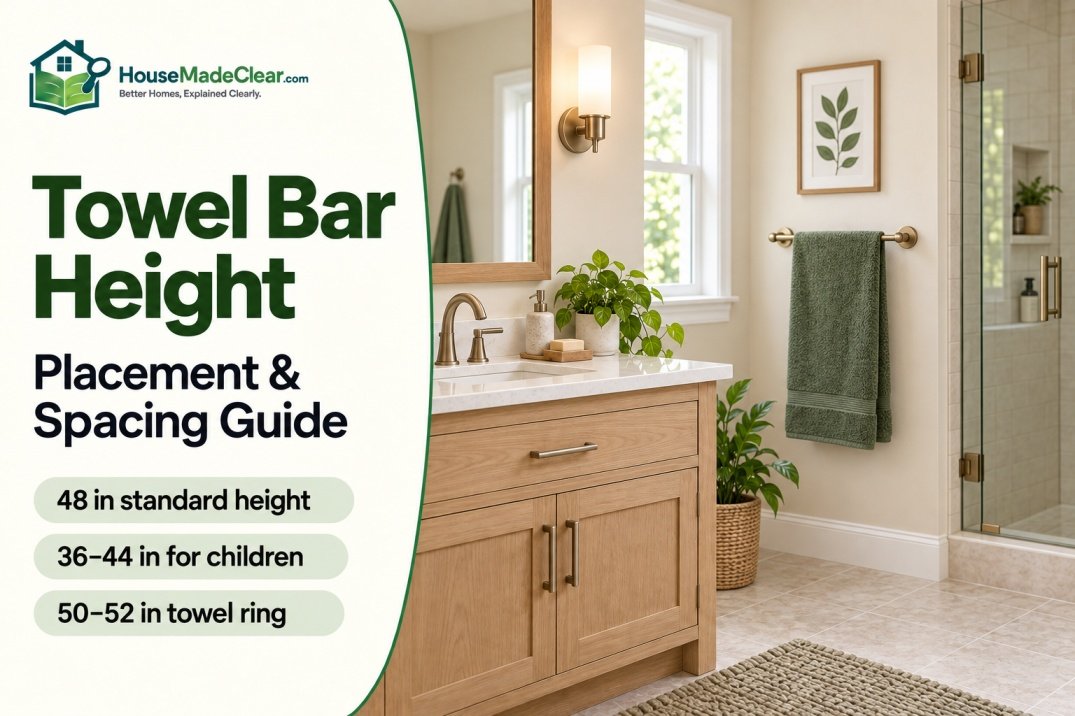
The standard towel bar height for many adult bathrooms is approximately 48 inches above the finished floor, measured to the center of the bar. This height keeps a conventional bath towel within comfortable reach while providing enough clearance for the towel to hang without touching the floor.
However, 48 inches is a planning convention rather than a universal building-code requirement. The best height can change according to the towel size, users, wall location, vanity, toilet, bathtub, shower enclosure and accessibility goals.
A children’s bathroom may work better with the towel bar approximately 36 to 44 inches high. A hand-towel ring beside a vanity is often mounted around 50 to 52 inches above the floor, while stacked towel bars need enough vertical separation to keep the upper and lower towels from overlapping.
Quick Answer
Common bathroom towel-hardware heights include:
- Standard bath-towel bar: approximately 48 inches to the bar center
- Children’s towel bar: approximately 36–44 inches
- Hand-towel bar: commonly 42–48 inches, depending on the sink and users
- Towel ring: approximately 50–52 inches to the ring or mounting point
- Robe hook: approximately 65–70 inches for adults
- Stacked towel bars: commonly 30–36 inches apart vertically
- Towel bar near a shower: close enough to reach without crossing the wet floor or interfering with the shower door
Measure from the finished floor to the centerline of the towel bar unless the product’s installation instructions specify another reference point. Always test the complete towel length before drilling.
Towel Bar Heights at a Glance
| Towel Hardware | Common Adult Height | Alternative Height or Consideration |
|---|---|---|
| Standard bath-towel bar | About 48 inches | Adjust for towel length and user reach |
| Children’s towel bar | 36–44 inches | Select according to the child’s height |
| Hand-towel bar near vanity | 42–48 inches | Coordinate with countertop and backsplash |
| Towel ring | 50–52 inches | Check how far the towel hangs below |
| Double towel bar | About 48 inches | Product height and rear-bar access matter |
| Upper stacked towel bar | 64–72 inches | Depends on the lower bar and towel length |
| Lower stacked towel bar | 32–42 inches | Keep the towel above the floor |
| Robe hook | 65–70 inches | Lower for children or seated users |
| Towel bar above toilet | Layout dependent | Clear tank, lid and user space |
| Accessible planning | Project dependent | Evaluate reach range and clear approach |
These figures are starting points rather than mandatory dimensions. The correct position is the one that keeps the towel reachable, dry, clear of surrounding fixtures and appropriate for the people using the bathroom.
What Is the Standard Towel Bar Height?
The most commonly used towel bar height is:
48 inches above the finished floor
This measurement is usually taken to the center of the horizontal bar.
At 48 inches, a bath towel folded over the bar typically hangs with its lower edge well above the floor. The bar is also within a comfortable reach range for many standing adults.
This height works well in:
- Primary bathrooms
- Guest bathrooms
- Full family bathrooms
- Bathrooms used mainly by adults
- Walls without cabinets or fixtures below
- Conventional tub and shower layouts
It may not be the best choice when:
- Children are the primary users
- A wheelchair user needs the towel
- The towel bar sits over a vanity or toilet
- Extra-long bath sheets are used
- Two bars are stacked vertically
- A cabinet or radiator occupies the wall
- The towel bar is built into a shower door
- The installation is a heated towel rail
- The manufacturer specifies another mounting arrangement
The word “standard” therefore describes common residential practice rather than one compulsory measurement.
How Is Towel Bar Height Measured?
Measure vertically from the finished floor to the centerline of the towel bar.
The finished floor includes:
- Tile
- Stone
- Vinyl
- Wood or engineered flooring
- Other completed floor covering
Do not measure from the subfloor before tile, underlayment or another finish has been installed. Even a small difference can affect the relationship between the towel, vanity and nearby fixtures.
Measure to the Bar Centerline
For a conventional horizontal towel bar:
- Determine the desired height.
- Mark that height on the wall.
- Use it as the centerline of the bar.
- Position the mounting brackets according to the template.
- Confirm the bar is level before drilling.
Some products have mounting plates that sit above or below the actual bar. Do not assume the bracket center is identical to the bar center.
Use the manufacturer’s paper template or specification drawing when supplied.
Measure the Complete Towel Drop
A towel folded over a bar hangs by approximately half its total length, although the exact drop depends on how it is folded.
For example, if a bath towel is 56 inches long and is folded evenly over the bar:
56 inches ÷ 2 = 28 inches
If the bar center is 48 inches above the floor, the approximate bottom of the towel will be:
48 inches − 28 inches = 20 inches above the floor
That provides substantial floor clearance.
If a long 70-inch bath sheet is folded evenly:
70 inches ÷ 2 = 35 inches
At the same 48-inch bar height, its bottom would sit approximately:
48 inches − 35 inches = 13 inches above the floor
The bar still works, but the longer towel occupies more wall area and may interfere with furniture or fixtures beneath it.
Why 48 Inches Works in Many Bathrooms
A 48-inch towel bar height balances three needs:
- Comfortable adult reach
- Clearance below the towel
- Space above the bar for lifting and replacing the towel
It also works with many common towel sizes and standard-height bathroom fixtures.
However, copying 48 inches without checking the room can create problems. A bar at that height may intersect with:
- A light switch
- Electrical receptacle
- Vanity mirror
- Cabinet door
- Shower-door handle
- Window trim
- Thermostat
- Wall molding
- Decorative tile border
- Towel warmer
- Toilet storage cabinet
Mark the towel itself on the wall, not only the metal bar. The fabric occupies much more space than the hardware.
Standard Towel Bar Height for Adults
For a bathroom primarily used by standing adults, a bar center approximately 46 to 50 inches above the finished floor is generally practical.
The familiar 48-inch height sits in the middle of this range.
Adjust the height when:
- Regular users are considerably taller or shorter
- The bar is behind a door
- The towel is unusually long
- The wall has wainscoting or a tile border
- The bar must align with nearby hardware
- A shelf is installed above it
- The towel must clear a bathtub ledge or vanity
Do not raise a towel bar solely to align it with another decorative feature if that makes it uncomfortable to use.
Towel Bar Height for Children
A towel bar intended for children should be lower than an adult installation.
A practical starting range is approximately:
36 to 44 inches above the finished floor
The correct height depends more on the child than on age alone.
Ask whether the child can:
- Reach the towel without climbing
- Remove it without pulling sideways
- Replace it on the bar
- Use it without standing on a toilet or tub edge
- Keep it from dragging on the floor
For younger children, a height around 36 inches may work. Older children may be comfortable with approximately 40 to 44 inches.
A lower towel bar can later be moved or supplemented with a higher bar as the child grows. Another option is installing hooks at different heights, although hooks generally allow less airflow through folded towels.
Do not place the towel where a child must climb onto a wet bathtub edge, toilet or vanity to reach it.
A shared bathroom should not be designed exclusively around the tallest adult.
Possible arrangements include:
- One towel bar at approximately 44–48 inches
- One adult-height bar and one lower hook
- Two staggered hooks
- A lower bar for children
- Individual towel hooks for each user
- A wall-mounted towel rack with several levels
- An over-door arrangement where appropriate
The solution should preserve space for damp towels to dry without overlapping heavily.
If several people use the room, allocate enough hanging width. One 18-inch bar may physically hold multiple towels, but tightly layered towels dry slowly and are difficult to identify.
Towel Bar Length and Capacity
Towel bars are commonly available in lengths such as:
- 18 inches
- 24 inches
- 30 inches
- 36 inches
The published length may refer to the usable bar or the distance between mounting centers. Confirm the product drawing before marking the wall.
18-Inch Towel Bar
An 18-inch bar can work for:
- One folded bath towel
- One hand towel
- A compact powder room
- A narrow wall beside a vanity
It is usually too short for two bath towels to hang with useful separation.
24-Inch Towel Bar
A 24-inch bar is a common choice for one bath towel.
It provides more drying width than an 18-inch bar without requiring an unusually large wall.
30-Inch Towel Bar
A 30-inch bar can accommodate:
- One bath towel with generous width
- Two narrower folded towels
- A larger bath sheet
- A shared bathroom with limited wall space
Check that the mounting points align with suitable support or approved anchors.
36-Inch Towel Bar
A 36-inch bar can provide space for two folded bath towels, depending on their width.
Long bars need secure attachment because users may pull on one end, creating leverage at the opposite mounting bracket.
Where Should a Towel Bar Be Placed?
The best towel bar location is close to the fixture where the towel will be used, without requiring a person to cross a wet floor or interfere with doors and cabinets.
Practical locations include:
- Beside the shower entrance
- Near the bathtub
- On a wall beside the vanity
- Behind the bathroom door
- On an unobstructed side wall
- On a manufacturer-approved shower door
- On the side of a vanity where appropriate
A convenient location is more important than visually aligning every accessory.
Towel Bar Placement Near a Shower
Place the bath towel close enough that a person can reach it immediately after opening the shower door or curtain.
The user should not need to:
- Walk across wet tile
- Reach over a toilet
- Lean around an open glass door
- Step back into the shower
- Stretch across the bathtub
- Pull the towel from behind a swinging door
A location approximately 1 to 2 feet from the shower entrance can work in many layouts, but this is only a planning range. Door movement, wall configuration and user reach are more important than a fixed distance.
If the shower uses a hinged glass door, draw its complete swing before selecting the towel-bar location. The door, handle and towel must not collide.
Our guide to standard shower door sizes explains why finished opening dimensions and door movement must be checked together.
Towel Bar Inside the Shower
A standard towel bar inside the wet shower area is usually impractical because the towel can become wet from spray and remain exposed to high moisture.
A bar inside a large walk-in shower may work only when:
- It is outside the direct spray path
- The enclosure is large enough to keep towels dry
- The hardware is suitable for the location
- The wall can support it
- It does not reduce shower space
- It cannot be mistaken for a grab bar
For most bathrooms, place the bath towel outside the shower within easy reach.
Towel Bar on a Glass Shower Door
Do not attach a generic towel bar to tempered shower glass.
Use only:
- A towel bar designed for the specific enclosure
- Factory-prepared mounting holes
- Manufacturer-approved hardware
- Installation methods permitted by the shower-door manufacturer
Tempered glass cannot be safely drilled or modified after tempering. Improvised clamps and adhesive hardware can damage finishes, interfere with door movement or create unsafe loading.
Bathroom accessories should be planned as a group rather than mounted independently. Along with the towel bar, confirm the toilet paper holder placement before marking holes in finished tile or cabinetry.
Towel Bar Placement Near a Bathtub
Position the towel where it can be reached from beside the tub without leaning dangerously across the wet floor.
Suitable locations may include:
- Side wall near the tub exit
- Wall at the dry end of the bathtub
- Adjacent vanity side
- Wall outside the shower-curtain path
- Manufacturer-designed tub enclosure hardware
Avoid placing the towel:
- Directly above the center of the tub
- Where it will contact shower spray
- Behind the user when exiting
- Where the shower curtain covers it
- Where it obstructs a grab bar
- Where it requires standing on the tub edge
Before selecting the wall, confirm the complete tub footprint using the standard bathtub dimensions guide.
Hand-Towel Bar Height Near a Vanity
A hand-towel bar near a vanity is commonly installed approximately:
42 to 48 inches above the floor
The exact height depends on the countertop, sink, users and towel length.
A lower bar may align better with a compact or child-height vanity. A higher bar may work beside a 36-inch-high countertop, provided the towel remains easy to reach.
Check that the towel does not:
- Touch the countertop
- Hang into the sink
- Cover a receptacle
- Interfere with a drawer
- Drag across a cabinet handle
- Contact the toilet
- Block a light switch
Where wall space is limited, a towel ring or small hook may work better than a horizontal bar. Beside a vanity, towel-ring placement should account for the faucet, backsplash and splash zone. Check the sink’s complete width and projection before drilling into the wall.
Towel Ring Height
A towel ring is commonly mounted approximately:
50 to 52 inches above the finished floor
This may be measured to the center of the ring or mounting point, depending on the product.
The hanging towel usually extends well below the ring. Test the complete towel before installation.
When installing a towel ring beside a vanity:
- Keep it within comfortable reach of the sink
- Leave clearance from the mirror frame
- Avoid covering switches and outlets
- Keep the towel above the countertop
- Check nearby cabinet doors
- Confirm the ring can move without striking the wall
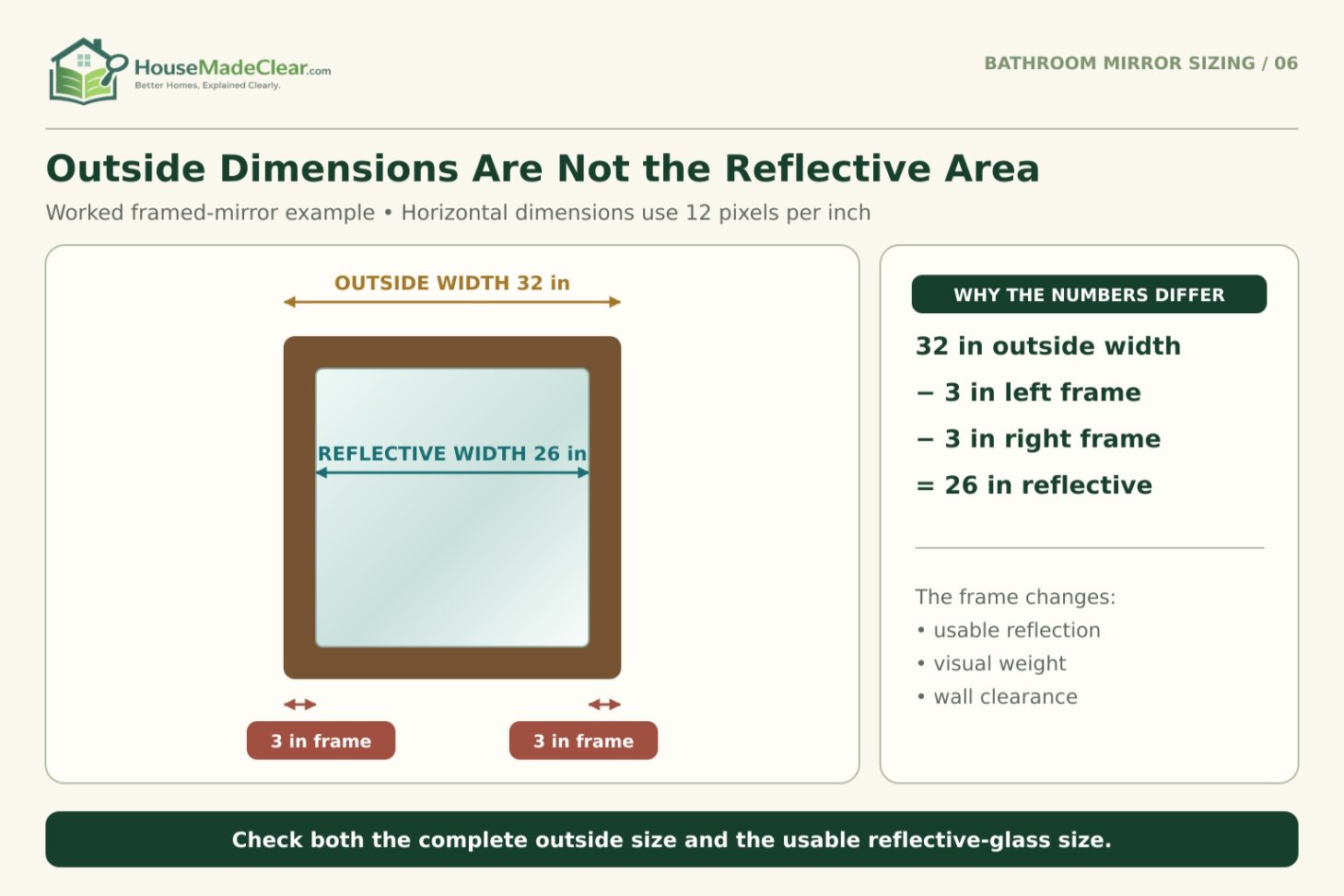
Coordinate its position with the standard bathroom mirror size and height guide so the ring, mirror and vanity do not compete for the same wall area.
Towel Bar Above a Vanity
A towel bar can be mounted above a vanity when the wall is sufficiently wide and the towel does not interfere with the sink, faucet or mirror.
Possible locations include:
- On a side wall above the counter
- Below a wall cabinet
- Beside the mirror
- Across an unused section of backsplash wall
Avoid placing a damp towel where it will:
- Rest on the countertop
- Cover an electrical receptacle
- Touch the faucet
- Block a cabinet door
- Overlap the mirror
- Drip into a drawer joint
- Contact moisture-sensitive trim
Bathroom cabinets vary substantially in height and projection. Check the standard bathroom cabinet sizes before positioning towel hardware beside a vanity or wall cabinet.
Towel Bar Above a Toilet
A towel bar can be installed above a toilet, but it is often a compromise rather than the best location.
Potential problems include:
- Towels hanging against the tank
- Difficulty removing the tank lid
- Items falling into the toilet
- Awkward reach
- Visual crowding
- Conflict with over-toilet storage
- Reduced hygiene
- Contact with the user’s head or shoulders
If this is the only available location:
- Measure the toilet’s actual tank height.
- Hang the towel on the proposed bar.
- Make sure the towel clears the tank.
- Confirm that the tank lid can be removed.
- Check user headroom.
- Keep the towel clear of the open toilet bowl.
- Verify that wall storage remains usable.
Do not position a deep shelf or cabinet in a way that reduces the toilet’s required usable space. Review the toilet-clearance guide when planning storage or accessories in a compact toilet zone.
Towel Bar Behind a Bathroom Door
The wall behind an open bathroom door can provide useful towel storage, but it must be tested carefully.
Check:
- Door thickness
- Handle projection
- Door stop
- Towel-bar projection
- Towel thickness
- Wall clearance
- Hook or hinge movement
- Whether the towel prevents the door from opening fully
- Whether the door crushes the towel against the wall
A towel bar may require 2 to 4 inches of total projection once the towel is added.
If the door opens nearly flat against the wall, a conventional bar may not fit. Hooks or an approved over-door rack may be more practical.
Towel Bar Beside a Bathroom Cabinet
Cabinet doors and drawers can collide with towel bars or hanging fabric.
Before installation, open every nearby component fully.
Include:
- Drawer pulls
- Cabinet knobs
- Medicine-cabinet doors
- Linen-cabinet doors
- Vanity doors
- Laundry pullouts
- Wall-cabinet doors
The metal bar may clear the cabinet while the towel catches on a handle. Test with the actual towel thickness.
Double Towel Bar Height
A double towel bar uses two parallel bars projecting from the same mounting brackets.
It is commonly installed at approximately the same 48-inch center height as a standard bar.
The important difference is depth. The rear towel may be more difficult to access, and two damp towels can restrict airflow if they touch.
Before buying a double bar, check:
- Total projection from the wall
- Space between the front and rear bars
- Door clearance
- Cabinet clearance
- Towel thickness
- User reach
- Manufacturer mounting requirements
Do not mount a deep double bar behind a door without checking the complete door swing.
Stacked Towel Bar Height and Spacing
Stacked towel bars are mounted one above the other.
A common vertical separation is approximately:
30 to 36 inches
Measure the spacing between bar centerlines, then test it with the actual towels.
The correct spacing depends on towel length.
Stacked-Bar Calculation
Suppose the lower towel hangs 28 inches below its bar.
To keep the upper towel from heavily overlapping it, the upper bar should generally be at least slightly more than 28 inches above the lower bar.
A 32-inch center-to-center separation would leave approximately 4 inches between the upper bar and the lower towel’s hanging edge.
Possible layout:
- Lower bar: 36 inches above the floor
- Upper bar: 68 inches above the floor
- Vertical separation: 32 inches
This can work for two standard bath towels, but the upper bar may be too high for shorter users.
Another layout might use:
- Lower bar: 32 inches
- Upper bar: 64 inches
This keeps both bars lower but reduces floor clearance for the lower towel.
Mock up both towels before installing the bars.
Towel Bar Height Above Wainscoting or Tile
A decorative tile border or wainscot line should not automatically determine towel-bar height.
Possible approaches include:
- Mounting the bar entirely within the tiled area
- Positioning it above the decorative border
- Aligning it with a horizontal grout joint
- Centering it within a wall panel
- Using blocking behind the finish during construction
Avoid installing a bar partly across two surfaces of different thicknesses. Uneven mounting plates can loosen or distort.
If drilling through tile:
- Use the correct bit for the tile
- Confirm the fastener location
- Avoid concealed plumbing and wiring
- Follow the hardware manufacturer’s instructions
- Do not overtighten and crack the tile
- Use appropriate anchors or structural support
Towel Bar Height in a Small Bathroom
Small bathrooms require careful location planning because every wall may already be occupied by a fixture.
Useful alternatives include:
- Short 18-inch towel bar
- Towel ring beside the sink
- Hooks behind the door
- Vanity-mounted bar
- Approved shower-door bar
- Freestanding towel ladder
- Wall rack with shelf
- Over-door towel rack
- Multiple staggered hooks
Do not place a towel bar where it narrows the walking path, catches clothing or blocks a cabinet.
In a tight room, projection may matter more than width. A hook can occupy less horizontal wall space, but several layered towels may dry more slowly than towels spread across a bar.
Towel Bar Height for Accessible Bathrooms
Calling 48 inches the “ADA towel bar height” is misleading.
The ADA Standards do not establish one universal residential towel-bar mounting height. The frequently quoted 48-inch dimension comes from general unobstructed reach guidance for covered operable elements.
The U.S. Access Board’s guidance on operable parts describes an unobstructed forward or side reach range extending up to 48 inches. Where a reach extends over an obstruction, the permitted maximum can be lower.
Accessible placement therefore depends on:
- Whether the project is covered
- Whether the element is subject to the applicable standard
- Forward or side approach
- Clear floor space
- Obstruction depth
- User reach
- Other bathroom fixtures
- State and local requirements
A conventional owner-occupied private home is not automatically subject to the ADA Standards, although other accessibility or housing requirements may apply.
For aging-in-place or accessible residential planning, consider positioning the towel:
- Within easy seated and standing reach
- Near the shower or tub exit
- Away from floor-level obstacles
- Where a wheelchair can approach
- Without requiring a reach over the toilet
- Without interfering with grab bars
- Where a caregiver can assist
A Towel Bar Is Not a Grab Bar
Never assume a towel bar can support body weight.
A conventional towel bar may pull out of the wall if someone uses it for balance. This can cause a fall and damage the wall or tile.
A grab bar is designed, tested and installed for a different purpose. It requires appropriate structural support and must follow applicable product instructions and accessibility requirements.
If a bathroom user may reach for the towel bar during a transfer or while stepping out of a shower, install a properly rated grab bar in the necessary support location. Some products combine grab-bar performance with towel storage, but they must be specifically designed and installed for that use.
Robe Hook Height
A robe hook is commonly installed approximately:
65 to 70 inches above the finished floor
This position keeps robes and long towels off the floor.
For children, shorter users or seated users, a lower hook may be more appropriate.
Check:
- Robe length
- Door swing
- User reach
- Hook projection
- Whether the garment touches a wet surface
- Whether the hook can catch clothing as someone walks past
Hooks should not project dangerously into narrow circulation paths.
Heated Towel Rail Height
A heated towel rail does not necessarily follow the standard 48-inch towel-bar height.
Its correct position depends on:
- Product height and width
- Number of rails
- Electrical connection
- Manufacturer clearances
- Cord or hardwired entry point
- Towel size
- User reach
- Wall construction
- Local electrical requirements
- Distance from wet areas
Follow the exact manufacturer installation instructions.
A hardwired towel warmer may require a qualified electrician, suitable electrical protection and a location permitted by locally adopted electrical rules. Do not place it solely according to decorative alignment.
How Much Space Should Be Around a Towel Bar?
Leave enough clearance for the towel to hang freely and for a hand to place or remove it.
Check four directions:
Below the Bar
The towel should not touch:
- Floor
- Countertop
- Toilet tank
- Bathtub ledge
- Radiator
- Baseboard heater
- Cabinet hardware
Above the Bar
Leave room to lift the towel over the bar without hitting:
- Shelf
- Cabinet
- Window sill
- Sconce
- Decorative molding
Beside the Bar
Check for:
- Door casing
- Cabinet doors
- Switches
- Outlets
- Mirror frames
- Shower-glass hardware
In Front of the Bar
Check the combined projection of:
- Mounting bracket
- Bar
- Folded towel
- Door swing
- User circulation
The towel may project farther than the hardware itself.
How to Choose the Right Towel-Bar Location
Step 1: Identify the Towel’s Use
Determine whether the bar will hold:
- Bath towel
- Bath sheet
- Hand towel
- Washcloth
- Decorative towel
- Robe
- Multiple family towels
Step 2: Select the Actual Towel
Measure its length and width.
Do not plan around a generic towel if the household regularly uses oversized bath sheets.
Step 3: Find the Nearest Practical Wall
The towel should be close to the sink, shower or bathtub where it will be used.
Step 4: Mark Nearby Fixtures
Mark:
- Doors and swings
- Cabinets
- Toilet
- Tub
- Shower glass
- Mirror
- Lighting
- Outlets
- Switches
- Windows
Step 5: Mark the Proposed Bar
Use painter’s tape to represent the bar’s complete width and mounting plates.
Step 6: Hang a Sample Towel
Tape or temporarily support the actual towel in position.
Check its bottom edge, width and projection.
Step 7: Test User Reach
Have regular users approach the towel from the position where they will need it.
Step 8: Locate Support
Determine whether mounting points align with:
- Wall studs
- Installed blocking
- Masonry
- Manufacturer-approved anchors
- A suitable cabinet side
Step 9: Check for Concealed Services
Avoid drilling into:
- Supply lines
- Drain or vent pipes
- Electrical wiring
- Shower plumbing
- Heated-wall systems
Step 10: Follow the Product Instructions
Use the supplied mounting template, hardware and installation sequence.
Installing a Towel Bar Securely
Towel bars are repeatedly pulled, twisted and loaded with wet fabric. Weak installation can loosen even when the bar holds little weight.
Mounting Into Studs or Blocking
Fastening into wall studs or purpose-installed blocking generally provides strong support.
Blocking is particularly useful during a remodel because it allows the bar to be positioned independently of stud spacing.
Mounting on Drywall
If studs do not align with the mounting plates, use anchors suitable for:
- The wall material
- The towel bar
- The fastener size
- The anticipated load
- The manufacturer’s instructions
Do not assume every plastic anchor has the same capacity.
Mounting Through Tile
Tile installation requires care because the visible finish can crack and the wall may contain waterproofing.
Before drilling:
- Confirm the final location
- Identify the tile material
- Use an appropriate bit
- Avoid hammer mode unless the tile and method permit it
- Drill without excessive force
- Protect the waterproofing system
- Use suitable anchors and sealants where required
- Follow the accessory and wall-system instructions
Professional installation may be appropriate where tile is expensive, plumbing locations are uncertain or the hardware is unusually heavy.
Helping Towels Dry Properly
A towel bar should allow fabric to spread rather than remain tightly bundled.
Better drying generally comes from:
- A bar wide enough for the towel
- Separation between multiple towels
- Air movement
- Effective bathroom ventilation
- Keeping towels out of direct shower spray
- Avoiding persistent contact with a wall or cabinet
- Washing towels appropriately
- Correcting plumbing leaks and condensation problems
Hooks are compact, but towels tend to bunch around them. Bars usually expose more fabric surface to the air.
A towel bar cannot compensate for a bathroom that remains damp for extended periods. The EPA’s guide to mold and moisture in the home emphasizes controlling moisture as the key to controlling mold.
Common Towel-Bar Placement Mistakes
Measuring to the Mounting Plate Instead of the Bar
The bracket may not share the same centerline as the actual bar. Use the installation template.
Ignoring the Towel Length
The metal hardware may clear the toilet or vanity while the towel hangs directly against it.
Installing Too Far From the Shower
A user should not have to cross a wet floor to reach the towel.
Blocking a Door
Check both the hardware projection and the folded towel.
Using a Towel Bar as a Grab Bar
A standard towel bar is not designed to support a person.
Placing Towels in Direct Spray
Repeated wetting prevents towels from drying properly.
Installing Above an Outlet
A wet towel should not hang over or rest against an electrical receptacle.
Mounting Into Drywall Without Suitable Support
Repeated use can loosen inadequate anchors.
Installing Two Bars Too Close Together
Overlapping towels restrict airflow and make the lower towel difficult to use.
Assuming 48 Inches Is Mandatory
Forty-eight inches is a common adult planning height, not a universal code for every bathroom.
Treating 48 Inches as Automatic ADA Compliance
Accessibility depends on more than one height measurement. Approach, reach, obstructions and project scope all matter.
Drilling Before Testing the Layout
Painter’s tape and an actual towel can reveal problems before holes are made.
Towel-Bar Planning Examples
Example 1: Standard Adult Bathroom
Assume:
- Bar center: 48 inches
- Towel length: 56 inches
- Folded drop: 28 inches
Bottom of towel:
48 − 28 = 20 inches above the floor
This provides comfortable floor clearance.
Example 2: Children’s Bathroom
Assume:
- Bar center: 38 inches
- Towel length: 48 inches
- Folded drop: 24 inches
Bottom of towel:
38 − 24 = 14 inches above the floor
The towel remains clear of the floor while being easier for a child to reach.
Example 3: Bar Above a Toilet
Assume:
- Toilet-tank height: 30 inches
- Desired clearance above tank: 6 inches
- Towel drop: 26 inches
Minimum bar height based on the hanging towel:
30 + 6 + 26 = 62 inches
A bar at 62 inches may be too high for some users. This calculation shows why the wall above a toilet is often a poor location for a bath towel.
Example 4: Two Stacked Bars
Assume:
- Lower bar: 36 inches
- Upper bar: 68 inches
Vertical separation:
68 − 36 = 32 inches
If each towel drops 28 inches, approximately 4 inches remains between the upper bar and lower towel.
Towel-Bar Measurement Checklist
| Item | What to Check |
|---|---|
| User height | Adults, children and seated users |
| Towel type | Bath towel, bath sheet or hand towel |
| Towel length | Calculate the folded drop |
| Bar height | Measure from finished floor to bar center |
| Bar length | Confirm usable width and mounting centers |
| Wall width | Include mounting plates |
| Floor clearance | Keep towel off the floor |
| Fixture clearance | Check vanity, toilet and tub |
| Door swing | Include towel thickness |
| Shower door | Check handle and glass movement |
| Cabinet movement | Open every door and drawer |
| Electrical items | Avoid outlets, switches and wiring |
| Plumbing | Check for concealed pipes |
| Wall support | Stud, blocking, masonry or approved anchor |
| Tile | Use appropriate drilling and sealing methods |
| Accessibility | Evaluate approach and reach |
| Grab-bar needs | Never substitute an ordinary towel bar |
| Product instructions | Follow manufacturer requirements |
Frequently Asked Questions
What is the standard height for a bathroom towel bar?
The standard towel bar height is approximately 48 inches above the finished floor, measured to the center of the bar. This is a common residential planning height rather than a universal code requirement.
Is 48 inches too high for a towel bar?
Forty-eight inches works for many standing adults. It may be too high for children, shorter users or some wheelchair users. Test the proposed position with the people who will use the bathroom.
How high should a towel bar be for children?
A towel bar for children is commonly positioned approximately 36 to 44 inches above the finished floor. The child should be able to remove and replace the towel without climbing.
How high should a hand-towel bar be?
A hand-towel bar near a vanity is commonly installed approximately 42 to 48 inches above the floor. The final height should keep the towel clear of the countertop, sink, outlets and cabinet hardware.
What is the standard towel-ring height?
A towel ring is commonly mounted approximately 50 to 52 inches above the finished floor. Check whether the product measures height to the ring center or mounting plate.
How far should a towel bar be from a shower?
Place it close enough to reach without crossing the wet floor. A position approximately 1 to 2 feet from the shower entrance may work, but door movement and the user’s reach should determine the final location.
How high should a towel bar be above a bathtub?
There is no universal height above a bathtub. Position the bar so the towel clears the tub, remains outside direct spray and can be reached safely from beside the tub.
Can a towel bar be installed above a toilet?
It can, but the towel must clear the toilet tank, tank lid and user space. Because this often requires a high mounting position, another wall is usually more practical.
How far apart should stacked towel bars be?
Stacked towel bars are commonly positioned approximately 30 to 36 inches apart vertically. Use the actual towel length to prevent the upper and lower towels from overlapping.
How high should a double towel bar be?
A double towel bar is commonly installed around 48 inches above the floor. Confirm how the manufacturer defines the mounting height and check the unit’s greater wall projection.
What height should a robe hook be?
A robe hook is commonly mounted approximately 65 to 70 inches above the finished floor for adults. Lower heights may be better for children, shorter users or seated users.
Is there an ADA height for towel bars?
The ADA Standards do not establish one universal residential towel-bar height. The frequently quoted 48-inch measurement relates to general unobstructed reach guidance for covered elements. Accessible placement also depends on approach, obstructions, clear floor space and project requirements.
Can a towel bar be used as a grab bar?
No. A standard towel bar is not designed to support body weight. Use a properly rated grab bar installed with the structural support required by its manufacturer and applicable regulations.
Should a towel bar be mounted into studs?
Mounting into studs or installed blocking provides strong support. Where that is not possible, use anchors suitable for the wall construction, product and anticipated load, following the manufacturer’s instructions.
What size towel bar is best for one bath towel?
A 24-inch towel bar is a practical choice for one bath towel. An 18-inch bar may work for a folded towel, while 30- or 36-inch bars provide more space for larger or multiple towels.
Is a towel bar or towel hook better?
A towel bar spreads the fabric for better airflow, while a hook uses less wall space. Hooks can work well in small or shared bathrooms, but thick towels may dry more slowly when bunched together.







[…] Towel Bar Height: Standard Bathroom Placement & Spacing Guide […]
[…] Towel Bar Height: Standard Bathroom Placement & Spacing Guide […]
[…] Towel Bar Height: Standard Bathroom Placement & Spacing Guide […]
[…] Towel Bar Height: Standard Bathroom Placement & Spacing Guide […]