















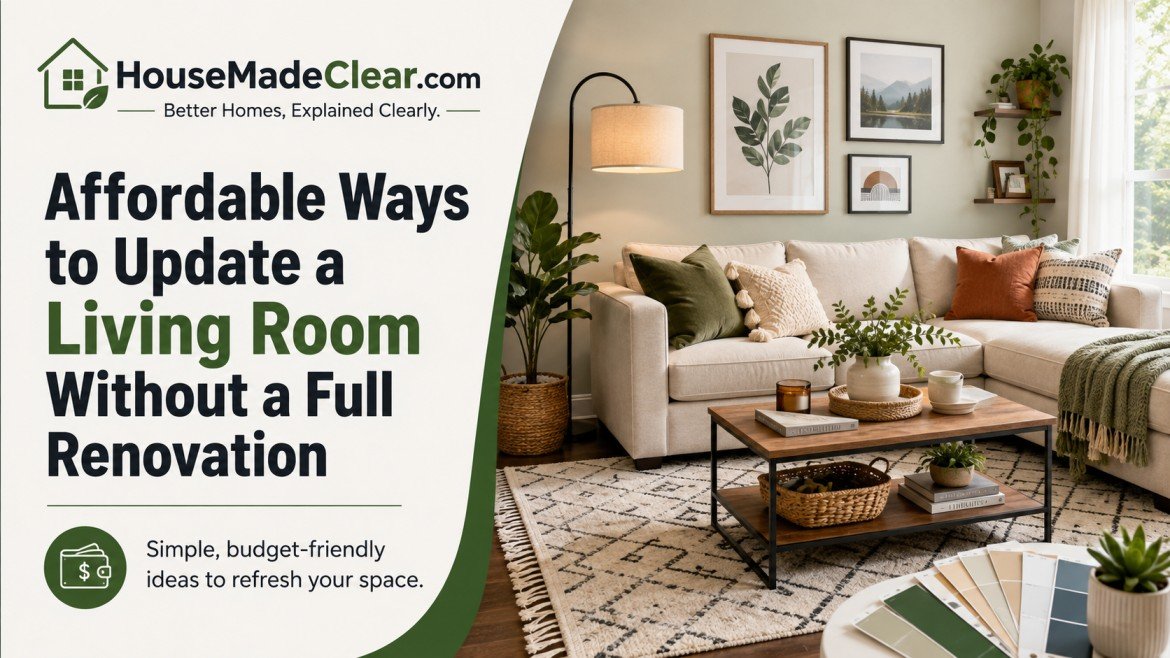
A living room can feel dated even when the furniture is still usable and the room does not need structural renovation.
The problem may be an awkward layout, weak lighting, visual clutter, heavy curtains, an undersized rug or too many unrelated decorative items. Replacing the sofa will not necessarily solve any of those issues.
In many cases, the most effective living room updates begin with rearranging, editing and improving what is already there. Once the room functions properly, a limited budget can be directed toward one or two changes that create a noticeable visual difference.
Quick answer:
Start by improving the furniture arrangement, removing visual clutter and making better use of natural light. Then focus your budget on high-impact changes such as paint, curtains, lighting, textiles or a correctly sized rug. Avoid buying small decorative items until the room’s layout and main visual problems have been addressed.
Before purchasing new furniture, review whether the existing arrangement is working properly. Housemadeclear’s guide to planning a functional living room layout explains how to assess traffic flow, furniture scale, seating positions and practical clearances.
Start by Identifying What Makes the Room Feel Outdated
Do not begin with a shopping list.
First, identify why the room does not feel right. A living room may appear dated or unfinished because:
- The furniture blocks natural movement
- The room is darker than necessary
- The colours do not relate to one another
- The rug is too small for the seating group
- Surfaces are crowded with small objects
- Curtains block too much daylight
- The television dominates the room
- Furniture is pushed against every wall
- Open storage looks disorganised
- Accessories reflect several unrelated styles
- There is no clear focal point
Trying to solve every issue at once usually leads to unnecessary spending. Choose the problem that has the greatest effect on the room.
Photograph the Room From Different Angles
Take photographs from:
- The entrance
- Each corner
- The main seating position
- The window side
- The television wall
- Any adjoining open-plan area
A photograph can reveal problems that become difficult to notice when you see the room every day.
Look for:
- Empty areas that serve no purpose
- Furniture crowding doorways
- Objects grouped unevenly
- Cables and electronics
- Too many small decorative pieces
- Artwork placed too high or too far apart
- Curtains that visually shorten the wall
- A rug that does not connect the furniture
Choose One Main Improvement Goal
Examples include:
- Make the room feel brighter
- Improve the furniture layout
- Reduce visual clutter
- Create a more coordinated colour scheme
- Improve storage
- Make the television area less dominant
- Create a stronger focal point
- Make the room feel more spacious
A clear objective will help you decide which changes are worth paying for.
1. Rearrange the Furniture Before Buying Anything
Furniture arrangement is one of the highest-impact changes available, and it may cost nothing.
Begin by reviewing:
- The main walking route
- The position of the largest sofa
- The distance between seating
- The relationship between the television and windows
- Access to doors, storage and switches
- Whether unnecessary furniture can be removed
Protect the Main Walkway
People should not have to squeeze between the sofa and coffee table to reach another room.
Where possible, route movement:
- Behind the sofa
- Beside the seating group
- Between separate functional zones
If the living room connects the hallway, kitchen and balcony, those routes should remain clear.
Move Seating Closer for Conversation
Furniture placed around the perimeter can make even a modest room feel disconnected.
In larger rooms, bring selected seating closer together. In small rooms, avoid adding extra chairs simply to fill corners.
The goal is not to create perfect symmetry. It is to make conversation and everyday use feel natural.
Remove One Unnecessary Piece
A room can improve significantly after removing:
- An unused side chair
- A second coffee table
- An oversized floor lamp
- A cabinet that blocks daylight
- A console with no clear purpose
- A decorative stool that interrupts movement
Removing furniture is often more effective than adding storage to accommodate it.
2. Remove Visual Clutter
Clutter is not limited to untidy belongings. A room can be organised and still look visually crowded.
Common sources include:
- Too many cushions
- Several small framed photographs
- Multiple ornaments on each surface
- Visible charging cables
- Magazines and remote controls
- Toys without defined storage
- Crowded open shelves
- Decorative objects in every corner
Use the Remove, Relocate and Retain Method
Review each visible object and place it into one of three categories.
Remove: Items that are damaged, unused or no longer suitable.
Relocate: Items that belong in another room or storage area.
Retain: Items that are useful, meaningful or visually support the room.
Do not automatically purchase baskets for everything. First decide whether all the items need to remain.
Leave Some Surfaces Partly Empty
A coffee table does not need:
- A tray
- Several books
- A candle
- A vase
- A plant
- Multiple ornaments
One or two well-chosen objects can create more impact than a crowded arrangement.
The same principle applies to:
- Shelves
- Side tables
- Window sills
- Fireplace mantels
- Media units
Empty space helps the remaining objects look more intentional.
3. Restyle Existing Shelves and Surfaces
You may be able to update the room by reorganising what you already own.
Try:
- Stacking some books horizontally
- Placing other books vertically
- Grouping objects instead of spreading them evenly
- Mixing different heights
- Leaving open space between groups
- Using one plant rather than several small plants
- Displaying fewer framed photographs
- Choosing one meaningful object as a focal piece
Avoid applying a rigid formula to every shelf. The arrangement should reflect the size and shape of the storage unit.
Reduce Repetition
Five small ornaments of similar size can look more cluttered than:
- One taller object
- Two books
- One framed image
- One small plant
Changing the scale of displayed objects can make the shelving look more balanced without buying anything new.
4. Refresh the Walls With Paint
Paint can create a significant change without structural renovation.
Possible approaches include:
- Repainting the entire room
- Refreshing only damaged or marked walls
- Updating trim and skirting boards
- Painting an alcove
- Repainting built-in storage
- Using one consistent wall colour to reduce visual fragmentation
- Creating a restrained focal wall
Test Paint in the Actual Room
Do not choose a colour based only on a small card or online image.
Paint can look different because of:
- Window direction
- Morning and evening light
- Flooring
- Sofa colour
- Artificial lighting
- Nearby wall colours
- Large furniture
Apply samples in more than one part of the room and review them during the day and at night.
Work With Existing Expensive Elements
It is usually more affordable to choose paint that works with the existing:
- Sofa
- Flooring
- Curtains
- Large rug
- Cabinetry
rather than selecting a fashionable colour that requires several other items to be replaced.
Avoid Trend-Only Decisions
A highly distinctive colour may look current for a short time but become difficult to coordinate later.
Choose a colour based on:
- The room’s light
- Existing furniture
- The atmosphere you want
- Your long-term preference
The goal is not to make the room look fashionable for one season. It is to create a more coherent background for the furniture you already own.
5. Use Removable Wall Treatments in Rental Homes
Renters may not be permitted to repaint or drill into walls.
Possible temporary options include:
- Removable wallpaper
- Large framed artwork
- Freestanding screens
- Picture ledges where permitted
- Fabric panels
- Removable hooks
- Peel-and-stick treatments approved for the surface
Always check the lease or tenancy agreement before:
- Painting
- Drilling
- Applying adhesive products
- Replacing fixtures
- Attaching heavy objects
Test removable products in a concealed area. Some adhesives can damage paint or leave marks even when described as temporary.
6. Improve Curtains and Window Styling
Curtains influence the room’s height, width, light and overall finish.
A window may look smaller or heavier because:
- The curtain rod ends at the window frame
- Curtains cannot open fully
- Panels are too short
- Fabric is unnecessarily thick
- The colour strongly conflicts with the walls
- The heading style looks dated
- The curtains block a radiator or vent
Let Curtains Clear the Window
Where the wall and installation allow, extending the curtain rod beyond the window can let the panels sit beside the glass when open.
This may:
- Allow more daylight into the room
- Make the window appear wider
- Reduce fabric bunching in front of the glass
Consider Full-Length Panels
Full-length curtains often create a more finished appearance than panels ending at an arbitrary point on the wall.
However, curtains should not:
- Obstruct heating equipment
- Drag through high-traffic areas
- Block doors
- Create a trip hazard
- Prevent furniture from sitting safely
Do Not Automatically Replace Heavy Curtains
Heavy or lined curtains may be useful for:
- Privacy
- Insulation
- Light control
- Street-facing rooms
The goal is to choose a treatment suited to the room, not simply the lightest available fabric.
7. Improve the Rug Before Replacing Furniture
A rug can influence whether the seating looks connected or scattered.
An undersized rug often makes the room appear less balanced, even when the furniture is suitable.
Common arrangements include:
All Furniture Legs on the Rug
This works best in larger rooms with a generously sized rug.
Front Legs on the Rug
This can connect a sofa and chairs without requiring the rug to extend beneath every piece.
Furniture Clearly Grouped Around the Rug
A smaller rug can work in a compact room if it still relates visually to the whole seating arrangement.
The weakest arrangement is usually a small rug placed only beneath the coffee table, with no meaningful connection to the seating.
Test Rug Size Before Buying
Use painter’s tape to mark the proposed rug dimensions.
Check:
- Whether the sofa and chairs relate to it
- Whether doors can open
- Whether the rug blocks floor vents
- Whether it creates an awkward edge in a walkway
- Whether it reaches the front legs of the main seating
A correctly sized rug may create more visual improvement than replacing a side table or buying several accessories.
8. Update Cushions and Throws Carefully
Cushions and throws can refresh a room affordably, but adding more is not always the answer.
Improve the arrangement by:
- Replacing covers instead of complete cushions
- Reusing good-quality inserts
- Removing excess cushions
- Mixing related textures
- Limiting unrelated patterns
- Choosing colours already present in the room
- Matching cushion size to the scale of the sofa
Use a Simple Colour Structure
A practical starting point is:
- One dominant neutral
- One supporting colour
- One smaller accent colour
This is not a fixed design rule. It is a way to prevent the room from becoming visually fragmented.
For example, a room might use:
- Warm beige as the dominant neutral
- Muted blue as the supporting colour
- Green as a smaller accent
The accent can appear through cushions, artwork or plants without being repeated everywhere.
Check the Number of Cushions
Too many cushions can make the sofa difficult to use.
Ask whether occupants must move several cushions every time they sit down. If so, the arrangement is working against the room’s function.
9. Layer the Lighting
Lighting can change the atmosphere more than many decorative purchases.
A living room usually benefits from more than one source.
Ambient Lighting
Ambient lighting provides general illumination.
Examples include:
- Ceiling fixtures
- Recessed lighting
- Wall lights
- Large floor lamps
Task Lighting
Task lighting supports specific activities.
Examples include:
- Reading lamps
- Desk lamps
- Adjustable floor lamps
- Table lamps beside seating
Accent Lighting
Accent lighting highlights:
- Artwork
- Shelves
- Architectural details
- Plants
- Textured walls
Replace the Lampshade Before the Lamp
A new lampshade may improve:
- Scale
- Light diffusion
- Colour
- Style
- Visual balance
Check that the shade is suitable for the lamp and bulb.
Keep Bulb Colours Consistent
A room can look visually uneven when one lamp produces cool white light and another produces very warm light.
You do not need one universal bulb temperature for every home. Choose a consistent lighting atmosphere suited to:
- Reading
- Television viewing
- Evening relaxation
- Daytime use
Protect Walking Routes
Do not allow lamp bases or cables to interrupt the main walkway.
Electrical work and changes to fixed fixtures should be handled by an appropriately qualified professional where required.
10. Refresh Existing Furniture Instead of Replacing It
Furniture that looks dated may still be structurally sound.
Possible updates include:
- Replacing handles
- Refinishing suitable wood
- Repainting suitable furniture
- Replacing damaged legs
- Repairing loose joints
- Reupholstering one chair
- Using a fitted slipcover
- Polishing appropriate materials
- Replacing damaged hardware
Identify the Material First
Do not sand, paint or apply chemicals without knowing whether the item is:
- Solid wood
- Veneer
- Laminate
- Metal
- Upholstered
- Antique
- Previously treated
Incorrect preparation can permanently damage the surface.
Valuable, antique or specialist furniture may need professional assessment.
Update One Important Piece
Reupholstering one chair or refinishing one cabinet may provide more visual impact than buying several inexpensive accessories.
Prioritise pieces that:
- Are prominently visible
- Are used regularly
- Are structurally sound
- Fit the room correctly
- Have long-term value
11. Improve the Television and Media Area
A cluttered media area can make the entire room appear unfinished.
Review:
- Visible cables
- Unused electronics
- Several remote controls
- Small decorative items
- Oversized speakers
- An undersized television console
- Misaligned equipment
- Open storage filled with devices
Reduce Visual Noise
Try:
- Removing unused equipment
- Grouping cables safely
- Using closed storage
- Limiting decorative items
- Aligning the television and media unit
- Moving unrelated objects elsewhere
- Using one tray or container for controls
Check the Scale of the Media Unit
A very small console beneath a large television can look visually unstable.
The unit does not need to match the television exactly, but the two should feel proportionate.
Do not conceal cables in unsafe ways or alter fixed electrical systems without suitable expertise.
12. Update Artwork Without Filling Every Wall
Artwork can refresh a room without requiring new furniture.
Affordable options include:
- Reframing existing art
- Rearranging existing pieces
- Enlarging personal photography
- Using legally purchased printable art
- Creating a restrained gallery wall
- Displaying one larger piece instead of several small ones
Use Paper Templates Before Drilling
Create paper shapes matching the artwork and attach them temporarily to the wall.
This helps test:
- Height
- Spacing
- Grouping
- Alignment with furniture
- Relationship with the wall
Relate Artwork to the Furniture
Artwork placed above a sofa or console should visually connect with the furniture beneath it.
A very small picture centred above a large sofa may look isolated. Several small pieces can work when treated as one clear arrangement.
13. Add Plants Without Creating More Clutter
Plants can introduce colour, softness and natural texture, but they should suit the room.
Consider:
- Available daylight
- Maintenance requirements
- Floor space
- Children
- Pets
- Indoor temperature
- Existing furniture
- The plant’s mature size
Possible arrangements include:
- One floor plant in a suitable corner
- One small plant on a side table
- A grouped arrangement where space permits
- A hanging plant where safely installed
Avoid placing plants where they:
- Block windows
- Obstruct walkways
- Crowd furniture
- Interfere with curtains
- Sit close to electronics
- Receive unsuitable light
Some plants can be unsafe for pets or children, so check the specific plant before bringing it into the home.
14. Make Storage Look More Intentional
Storage should give regular items a clear place.
Affordable options include:
- Matching baskets
- Closed boxes
- Storage ottoman
- Console with drawers
- Media cabinet
- Tray for remote controls
- Toy storage
- Cable-management box
- Side table with storage
- Labelled containers inside cabinets
Do Not Buy Storage Before Decluttering
Buying more baskets without reviewing the contents often creates organised clutter rather than reducing it.
Decide:
- What needs to remain in the room
- How often it is used
- Where it should be stored
- Whether it needs to be visible
Items used daily should be easy to access. Occasional items can be stored in less prominent areas.
15. Reuse Items From Other Rooms
Before purchasing new accessories, check whether another room contains a suitable:
- Lamp
- Side table
- Chair
- Mirror
- Artwork
- Basket
- Throw
- Plant pot
- Tray
- Stack of books
Moving one object can refresh two spaces.
However, do not relocate items simply because they are available. The item should support the living room’s:
- Scale
- Colour direction
- Function
- Layout
16. Use Mirrors Strategically
A mirror may:
- Reflect daylight
- Add depth
- Balance a blank wall
- Support a focal point
- Make a narrow area feel less enclosed
Before installing it, check what the mirror will reflect.
Avoid positioning it where it mainly reflects:
- Clutter
- Harsh lighting
- Television glare
- An unattractive doorway
- Excessive movement
- A private area
A mirror improves the room only when the reflected view is worth seeing.
17. Replace Small Hardware and Details
Small details can update furniture and window treatments affordably.
Examples include:
- Cabinet handles
- Drawer pulls
- Curtain hardware
- Furniture legs
- Frame finishes
- Lamp finials
- Trays
- Cushion covers
Choose finishes that relate to the existing room.
Mixing metals can work, but several unrelated finishes may make the room feel less coordinated.
Do not alter electrical fittings without appropriate knowledge or professional help.
18. Create One Strong Focal Point
A room often looks more polished when one feature receives clear visual priority.
Possible focal points include:
- Artwork
- Fireplace
- Window
- Bookshelves
- Television wall
- Statement chair
- Large plant
- Textured wall
- Painted alcove
Once the focal point is selected, reduce visual competition around it.
For example, if a large artwork is the main focal point, it may not need:
- Several smaller frames nearby
- A crowded console underneath
- Strong patterns on the adjacent wall
- Multiple large decorative objects
A focal point works best when the surrounding elements support it.
19. Use Renter-Friendly Living Room Updates
Rental homes can still be updated without permanent renovation.
Consider:
- Furniture rearrangement
- Rugs
- Cushion covers
- Throws
- Floor lamps
- Table lamps
- Freestanding shelves
- Removable artwork
- Temporary wall treatments
- Storage baskets
- Cable management
- Curtains where permitted
Check the lease before:
- Painting
- Drilling
- Replacing fixtures
- Applying adhesives
- Mounting a television
- Modifying electrical items
Keep original hardware and fixtures where appropriate so they can be restored before moving.
Affordable Living Room Updates by Budget Level
The best update is not always the most expensive one. It is the change that solves the room’s main problem.
Little or No Additional Spending
Start with:
- Rearranging furniture
- Removing clutter
- Restyling shelves
- Moving artwork
- Reusing items from another room
- Improving cable organisation
- Rotating cushions and throws
- Cleaning windows
- Cleaning light fixtures
- Removing unnecessary furniture
These changes may be enough when the room’s main issue is organisation rather than condition.
Modest Update Budget
Consider:
- Paint
- Cushion covers
- A new lampshade
- Storage baskets
- Framed artwork
- Curtains
- A small side table
- A mirror
- One suitable plant
- Replacement cabinet handles
Choose a few related updates rather than buying one item from every category.
Higher-Impact Affordable Update
Possible investments include:
- A correctly sized rug
- Improved lighting
- Furniture refinishing
- Reupholstering one chair
- Replacing an unsuitable media unit
- Better curtains
- Professional furniture repair
- Closed storage for a cluttered area
Direct the larger share of the budget toward the problem that has the strongest effect on the room.
Living Room Updates That Often Waste Money
Buying Many Small Decorative Items
Several inexpensive accessories can cost as much as one useful improvement while creating more clutter.
Better approach: Save the budget for paint, lighting, curtains, a rug or storage that solves a visible problem.
Choosing an Undersized Rug
A small rug may be cheaper, but it can make the seating feel disconnected.
Better approach: Mark the proposed dimensions before buying and wait until the correct size is affordable.
Buying Furniture Without Measuring
A discounted sofa is not a good purchase if it blocks the walkway.
Better approach: Measure the room, furniture and delivery route first. If the update includes replacing the main seating, use the couch dimensions and measuring guide to compare overall sofa size, usable seat dimensions, room clearances and doorway access before ordering.
Following a Trend That Conflicts With Existing Furniture
A fashionable colour or style may require several other items to be replaced.
Better approach: Work with the expensive elements already in the room.
Replacing Furniture When the Layout Is the Real Problem
New furniture will not correct an awkward traffic route automatically.
Better approach: Test alternative arrangements before purchasing.
Random colour additions can make the room appear less organised.
Better approach: Choose one dominant neutral, one supporting colour and a limited accent.
Starting Several Unfinished DIY Projects
Multiple incomplete pieces can leave the room looking worse for longer.
Better approach: Complete one project before beginning another.
Buying Storage Without Decluttering
More containers do not necessarily create less clutter.
Better approach: Remove unnecessary items before deciding what storage is required.
Step-by-Step Living Room Refresh Plan
Use the following order to avoid unnecessary purchases.
Step 1: Photograph the Room
Capture the room from several angles.
Step 2: Identify the Main Problem
Choose the issue with the greatest impact.
Step 3: Remove Unnecessary Items
Clear furniture, surfaces and storage before buying anything.
Step 4: Review the Furniture Layout
Protect walking routes and check whether seating supports conversation.
Step 5: Select a Focal Point
Decide which feature should receive visual priority.
Step 6: Choose a Colour Direction
Work with existing flooring and major furniture.
Step 7: Improve Natural Light
Review curtains, furniture placement and window access.
Step 8: Improve Artificial Lighting
Add or reposition ambient and task lighting.
Step 9: Review the Rug
Check whether its size and position connect the seating.
Step 10: Restyle Textiles
Edit cushions and throws rather than automatically adding more.
Step 11: Improve Storage
Give regular items a defined place.
Step 12: Reposition Artwork
Use templates before drilling.
Step 13: Add Finishing Details Selectively
Add only items that support the room’s function or visual direction.
Step 14: Photograph the Room Again
Compare the updated room with the original photographs.
Step 15: Wait Before Buying More
Use the refreshed room for several days. The remaining problem may be different from what you initially expected.
Affordable Living Room Update Checklist
Before considering the refresh complete, confirm that:
- The main problem has been identified
- The room has been photographed
- The furniture layout has been reviewed
- Walking routes are clear
- Unnecessary furniture has been removed
- Surfaces have been decluttered
- A focal point has been selected
- Paint has been assessed
- Curtains allow suitable light
- Rug size has been checked
- Lighting is layered
- Bulb colours are reasonably consistent
- Cushions and throws are coordinated
- Artwork has been repositioned
- Media cables are organised safely
- Storage has a clear purpose
- Plants are used selectively
- Rental restrictions have been checked
- The room has been tested before further purchases
Final Thoughts
An affordable living room update should not begin with buying more decoration.
Start with the layout, because a room that is difficult to use will still feel unsatisfactory after new cushions or artwork are added. Remove visual clutter, improve the lighting and decide which existing elements are worth keeping.
Then spend selectively.
A correctly sized rug may create more impact than several small accessories. Better curtains may improve both the light and the room’s proportions. Refinishing one suitable piece of furniture may be more valuable than replacing several items with lower-quality alternatives.
Work in stages and test each change before moving to the next one.
A room often feels refreshed not because everything is new, but because each element has a clearer purpose and a better relationship with the space around it.
For more ideas on improving living spaces without unnecessary renovation, explore the House Made Clear Interior Design section.
Frequently Asked Questions
What is the cheapest way to update a living room?
Begin by rearranging the furniture, removing unnecessary items, restyling shelves and improving natural light. These changes may cost nothing and can reveal whether paint, lighting, curtains or a rug are genuinely needed.
How can I make my living room look better without buying new furniture?
Improve the layout, remove visual clutter, reposition artwork, restyle cushions, reorganise shelves and move suitable items from other rooms. Cleaning windows, lamps and furniture can also noticeably improve the room.
How can I update an outdated living room?
Identify the main feature making it feel dated. It may be the wall colour, lighting, curtains, media area, rug or accessories. Update the most visible problem first instead of replacing everything.
What should I change first in a living room?
Start with the furniture layout and clutter. If the room does not function properly, decorative updates will have limited impact. Once the arrangement works, review lighting, walls, curtains, rug and textiles.
How can renters update a living room affordably?
Renters can use rugs, cushion covers, throws, floor lamps, freestanding storage, artwork and removable wall treatments. Always review the lease before painting, drilling or applying adhesives.
Can rearranging furniture make a living room look bigger?
Yes. Removing unnecessary pieces, opening the main walkway and moving furniture away from windows can make the room feel more spacious. The best arrangement depends on the room’s dimensions and door positions.
How do I choose affordable living room colours?
Begin with the expensive items that will remain, such as the sofa, flooring and rug. Choose a dominant neutral, a supporting colour and a smaller accent that relate to those elements.
Which living room update makes the biggest difference?
The answer depends on the room. For some homes, correcting the layout creates the greatest improvement. In others, better lighting, paint, curtains or a correctly sized rug may have the strongest effect.