














The most common standard shower curtain in the United States measures approximately 72 inches wide by 72 inches long.
That size is designed to cover many standard bathtub-and-shower combinations, but 72 × 72 inches is not the correct choice for every bathroom.
Walk-in showers, shower stalls, extra-wide tubs, curved shower rods and high-mounted rods may require curtains that are:
- Narrower
- Wider
- Longer
- Extra-long
The best way to choose a shower curtain is therefore to measure the actual shower opening and rod height instead of relying only on the word “standard.”
Quick Answer
The most common standard shower curtain size is:
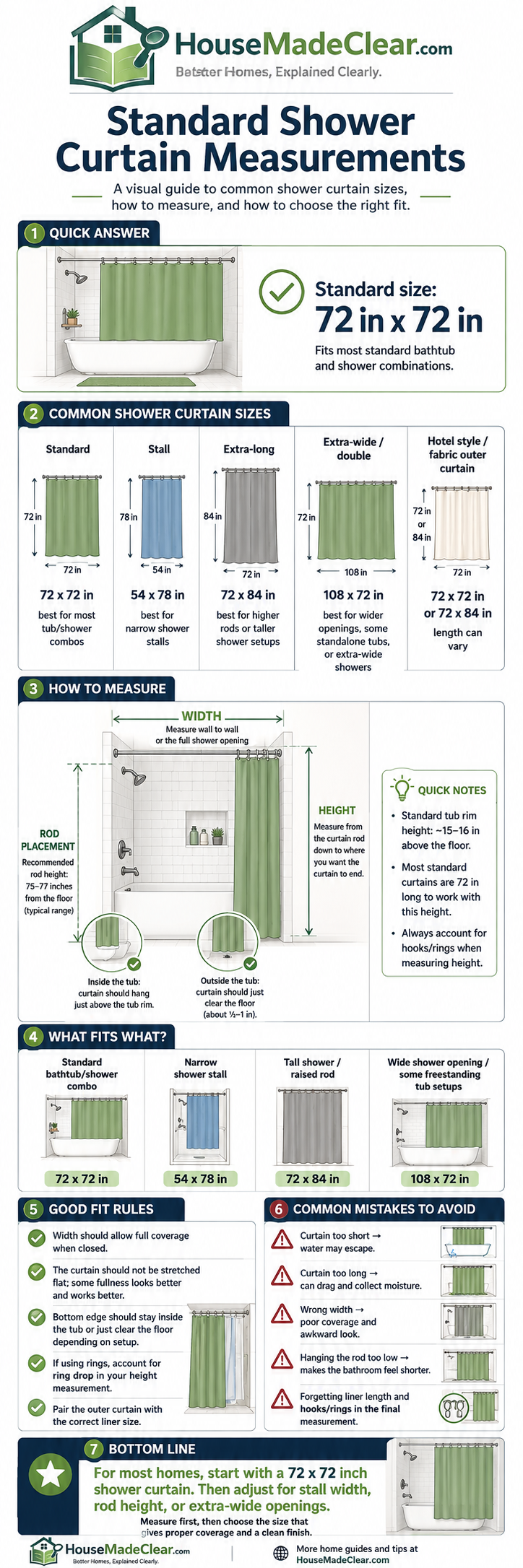
72 inches wide × 72 inches long
Other commonly available sizes include approximately:
- 54 × 78 inches – narrow shower stall
- 70 × 72 inches – common standard variation
- 72 × 72 inches – standard bathtub/shower
- 72 × 78 inches – longer curtain
- 72 × 84 inches – extra-long curtain
- 72 × 96 inches – very tall installation
- 108 × 72 inches – extra-wide shower
These are common retail sizes rather than mandatory building dimensions. Measure the width of your shower area and the distance from the curtain rod to the desired bottom position before buying.
Unlike regular window curtains, a shower curtain has a functional job: keeping shower water inside the wet area while remaining far enough above the floor or tub surface to dry properly.
What Is the Standard Shower Curtain Size?
For a typical bathtub-and-shower combination, the most familiar shower curtain measurement is:
72 inches wide × 72 inches long
That equals approximately:
6 feet wide × 6 feet long
This size works with many residential tubs because the curtain is wider than the actual opening.
That additional width allows the curtain to:
- Form folds
- Extend past both ends of the tub
- Reduce water escaping from the shower
- Close comfortably
Some manufacturers instead sell standard curtains around:
70 × 72 inches
or
71 × 72 inches
These small differences are normal.
You should therefore treat roughly 70–72 inches wide and 72 inches long as the typical standard category rather than expecting every brand to use identical dimensions.
Standard Shower Curtain Size Chart
| Shower Curtain Type | Common Approximate Size | Typical Use |
|---|---|---|
| Standard | 72 × 72 in | Tub/shower combination |
| Standard variation | 70 × 72 in | Tub/shower combination |
| Narrow stall | 54 × 78 in | Shower stall |
| Long | 72 × 78 in | Higher rod |
| Extra long | 72 × 84 in | Tall shower setup |
| Very extra long | 72 × 96 in | High ceilings/high rod |
| Extra wide | 108 × 72 in | Wide shower/large opening |
| Extra-wide long | 108 × 84 in | Large custom shower |
Availability varies by manufacturer, so always check the exact product measurements.
Is a 72 × 72 Shower Curtain Really Standard?
Yes, 72 × 72 inches is the most widely recognized standard shower curtain size for conventional bathtub-and-shower arrangements in the U.S.
However, the word “standard” can be misleading.
Your bathroom may have:
- Taller ceiling
- Curved shower rod
- Walk-in shower
- Freestanding tub
- Narrow stall
and still be perfectly normal.
Those configurations may need a different curtain size.
So the standard size is best understood as a common starting point, not a universal rule.
Why Is a Shower Curtain Wider Than the Tub?
A shower curtain should not normally equal the exact width of the shower opening.
It needs extra width to create folds and cover the ends properly.
Suppose the shower opening measures:
60 inches
A 72-inch curtain gives:
72 – 60 = 12 extra inches
That allows the curtain to extend and gather instead of becoming stretched completely flat.
A curtain that is exactly 60 inches wide on a 60-inch opening may leave very little flexibility at the edges.
How Wide Should a Shower Curtain Be?
A practical starting point is:
Shower opening width + approximately 12 inches
for many conventional installations.
Example 1
Shower opening:
60 inches
Add:
12 inches
Recommended curtain width:
approximately 72 inches
Example 2
Shower opening:
48 inches
Add approximately:
12 inches
Curtain width:
approximately 60 inches
You may then select the closest commercially available size.
This is not a rigid formula for every shower, but it is a useful starting point.
Should a Shower Curtain Be Twice the Width of the Shower?
Usually not.
That fullness rule is more applicable to decorative window curtains.
For example, House Made Clear’s guide to how wide curtains should be discusses approximately 1.5–2× fullness for many window treatments.
A shower curtain serves a different function.
You generally need enough additional fabric to:
- Close comfortably
- Create some folds
- Cover both edges
without creating an excessive amount of wet fabric inside the shower.
How Long Is a Standard Shower Curtain?
The typical standard length is approximately:
72 inches
or:
6 feet
But the finished position depends on where the shower curtain rod is mounted.
A 72-inch curtain can hang quite differently depending on whether the rod sits:
- 74 inches above tub floor
- 78 inches above tub floor
- 84 inches above tub floor
That is why you should measure the rod-to-bottom distance, not simply buy a 72-inch curtain because it is labeled standard.
How Far Down Should a Shower Curtain Hang?
The curtain should extend far enough into or alongside the tub/shower area to keep water contained.
But it should generally not bunch heavily on the floor.
For a tub/shower combination, the curtain usually hangs inside the tub while showering.
You want enough overlap below the tub rim to help contain water.
At the same time, leaving excessive fabric resting on the tub floor can:
- Slow drying
- Collect soap residue
- Encourage mildew
- Make cleaning harder
The correct bottom position depends on the tub and curtain design.
Should a Shower Curtain Touch the Floor?
Usually, no.
A shower curtain should generally not drag across the bathroom floor.
That can cause the bottom edge to:
- Stay wet
- Pick up dirt
- Become difficult to dry
- Create a tripping or cleaning issue
A shower curtain around a bathtub usually finishes inside the tub, not on the bathroom floor.
For a walk-in shower, the curtain should come close enough to the floor or shower base to contain water without unnecessarily pooling on the surface.
Shower Curtain vs Regular Curtain Length
Regular window curtains are often designed to:
- Touch the floor
- Float slightly above it
- Puddle
Shower curtains are different.
Their priority is:
water containment + drainage + drying
rather than purely visual floor placement.
That is why the sizing rules used for ordinary curtains should not automatically be applied to shower curtains.
How to Measure for a Shower Curtain
You need two basic measurements:
- Width
- Length
Step 1: Measure the Shower Opening
Measure horizontally from one side of the area the curtain needs to cover to the other.
For a tub:
Measure the open length along the tub.
For a shower stall:
Measure the entrance width.
Step 2: Add Extra Width
Add enough material for the curtain to close comfortably.
For many conventional tubs, around:
12 additional inches
provides a practical starting point.
Step 3: Measure From the Rod Down
Measure from the shower-curtain rod to where you want the curtain to end.
Do not measure from the ceiling.
Step 4: Account for Curtain Rings
Curtain rings or hooks add some distance between:
- Rod
- Top edge of curtain
This can affect the finished length.
Step 5: Choose the Closest Available Size
If your calculated dimension is not a standard retail size, choose the nearest option that provides adequate coverage.
Shower Curtain Measurement Example
Suppose your bathtub opening measures:
60 inches wide
Your rod-to-desired-bottom measurement is:
70 inches
For width:
60 + 12 = 72 inches
For length:
Approximately 72 inches may work depending on curtain rings and where you want the bottom edge to sit.
In this situation, a standard:
72 × 72-inch shower curtain
is likely a reasonable starting point.
What Size Shower Curtain for a 60-Inch Tub?
A 72-inch-wide curtain is commonly used with a 60-inch bathtub.
That provides approximately:
12 extra inches
for folds and side coverage.
A standard:
72 × 72-inch
curtain is therefore commonly suitable for a traditional 60-inch tub/shower arrangement.
However, verify rod height before assuming the 72-inch length will work.
What Size Shower Curtain for a 54-Inch Tub?
For a 54-inch opening, something around:
66–72 inches wide
may provide useful extra coverage.
A standard 72-inch-wide curtain can often work.
The additional fabric simply creates somewhat more gathering.
What Size Shower Curtain for a 48-Inch Shower?
A 48-inch shower may not require a full 72-inch curtain.
A narrower stall curtain may fit better.
Possible sizes include approximately:
54–60 inches wide
depending on:
- Actual opening
- Curtain design
- Amount of overlap desired
Measure before buying.
What Size Shower Curtain for a Shower Stall?
Shower stalls are often:
- Narrower
- Taller
than bathtub/shower combinations.
That is why stall curtains frequently come in sizes such as:
54 × 78 inches
rather than 72 × 72.
The narrower width fits the stall opening while the extra length works with a higher rod or taller enclosure.
Why Are Shower Stall Curtains Longer?
A stall often lacks the raised outer bathtub wall found in a tub/shower combination.
The curtain therefore needs to extend closer to the shower base.
This often makes a longer curtain useful.
Standard Shower Curtain for a Walk-In Shower
Walk-in showers vary far more than standard bathtubs.
The opening may be:
- 36 inches
- 48 inches
- 60 inches
- Much wider
A walk-in shower may also have:
- Curb
- Curbless floor
- Partial glass panel
Measure the specific opening rather than buying a 72 × 72 curtain automatically.
What Is an Extra-Long Shower Curtain?
An extra-long shower curtain is usually longer than the standard 72 inches.
Common examples include:
- 72 × 78 inches
- 72 × 84 inches
- 72 × 96 inches
These may be useful when:
- Ceiling is high
- Rod is mounted higher
- Shower opening is taller
- You want more vertical coverage
When Should You Use a 72 × 78 Shower Curtain?
A 78-inch-long curtain gives:
6 extra inches
compared with a standard 72-inch curtain.
This can help when the rod is mounted somewhat higher than a conventional installation.
It can also work well for certain shower stalls.
When Should You Use a 72 × 84 Shower Curtain?
An 84-inch curtain is useful for taller shower installations.
It may suit:
- High-mounted rods
- Tall ceilings
- Walk-in showers
- Some clawfoot-tub systems
Before buying one, measure the exact rod-to-bottom distance.
An 84-inch curtain on a conventional low rod may simply create too much fabric.
When Should You Use a 72 × 96 Shower Curtain?
A 96-inch shower curtain is intended for very tall setups.
It may be useful when:
- Rod sits unusually high
- Ceiling is tall
- Shower is custom
It is generally unnecessary for a normal tub/shower combination.
What Is an Extra-Wide Shower Curtain?
Extra-wide curtains may measure approximately:
108 inches wide
or more.
They can be useful for:
- Large walk-in showers
- Freestanding tubs
- Clawfoot tubs
- Curved enclosures
- Unusually wide shower openings
A standard 72-inch curtain may not provide enough coverage in those situations.
What Size Shower Curtain for a Clawfoot Tub?
Clawfoot tubs often require significantly different shower-curtain setups.
Many use:
- Oval shower rod
- Ceiling-mounted enclosure
- Curtain surrounding multiple sides
A standard single 72-inch curtain may not provide enough circumference.
Some clawfoot systems use:
- Extra-wide curtain
- Multiple curtains
Measure the full rod perimeter and follow the rod manufacturer’s sizing recommendations.
What Size Shower Curtain for a Freestanding Tub?
This depends on how the shower is enclosed.
If the curtain must surround several sides of the tub, calculate the total rod length, not just the length of one side.
You may need:
- Extra-wide curtain
- Multiple panels
Do not assume one standard 72-inch curtain will wrap around the entire tub.
Does a Curved Shower Rod Need a Wider Curtain?
Possibly.
A curved rod projects outward, creating more interior elbow room.
Depending on its shape and mounting points, the path between the curtain ends may also be slightly different from a straight rod.
Many curved rods still work with standard curtains.
But if the curtain appears overly stretched, measure the actual rod span and consider a wider option.
Does a Curved Shower Rod Need a Longer Curtain?
Not simply because it is curved.
Length is controlled mainly by:
- Rod height
- Hooks/rings
- Desired bottom position
Width and projection are separate measurements.
How High Should a Shower Curtain Rod Be?
Unlike standard window curtain rods, there is no single visual placement rule for shower rods.
The rod height should be based primarily on:
- Curtain length
- Tub/shower base
- User height
- Showerhead
- Water containment
A practical method is to work backward from the curtain.
For example:
Curtain = 72 inches long
Hooks add approximately 1–2 inches of drop.
Then decide how far below the rod the finished curtain needs to extend.
Measure before drilling.
Should the Shower Curtain Rod Be Near the Ceiling?
Usually not necessary.
Placing a rod extremely high can create a gap between:
- Bottom of curtain
- Tub/shower base
unless you use an extra-long curtain.
A very high rod can also make the curtain harder to:
- Remove
- Clean
- Replace
Higher placement can work aesthetically, but curtain length must be coordinated with it.
How Much Should a Shower Curtain Overlap the Tub?
The curtain should extend far enough inside the bathtub to prevent ordinary shower spray from escaping.
There is no universal overlap for every tub because:
- Tub wall heights vary
- Rod locations vary
- Curtain lengths vary
The important point is that the bottom edge should remain inside the wet area while showering.
Should a Shower Curtain Go Inside or Outside the Tub?
During showering, the liner should normally remain inside the bathtub to contain water.
A decorative outer curtain may remain outside depending on the setup.
This is one reason many bathrooms use:
decorative shower curtain + waterproof liner
rather than one fabric layer alone.
What Is the Standard Shower Curtain Liner Size?
A common liner is also approximately:
70–72 inches wide × 72 inches long
because it is designed to pair with a standard shower curtain.
Liners are also available in:
- Stall sizes
- Extra-long sizes
- Extra-wide sizes
The liner should be compatible with both:
- Curtain
- Shower dimensions
Should the Shower Curtain and Liner Be the Same Size?
Often, yes or very close.
They should generally have similar:
- Width
- Length
so that the liner provides water coverage behind the decorative curtain.
However, depending on your setup, the liner may be slightly smaller or differently sized.
The key requirement is that it adequately covers the wet area.
Can the Liner Be Longer Than the Shower Curtain?
It can, but the difference should be intentional.
A liner hanging substantially below the decorative curtain may be visually noticeable.
More importantly, it should not be so long that it:
- Pools on tub floor
- Stays permanently wet
- Becomes difficult to clean
Shower Curtain Width vs Shower Curtain Length
These two measurements solve different problems.
Width Controls
- Side coverage
- Gathering
- Ability to close
Length Controls
- Water containment
- Distance from tub/floor
- Rod mounting height
You need both measurements to choose the correct curtain.
Shower Curtain Size for an 8-Foot Ceiling
Ceiling height alone does not determine shower-curtain length.
An 8-foot ceiling equals:
96 inches
but your rod may sit much lower.
A standard 72-inch curtain can still work perfectly in a bathroom with an 8-foot ceiling.
Measure from:
rod → desired curtain bottom
instead.
Shower Curtain Size for a 9-Foot Ceiling
A 9-foot ceiling does not automatically require an 84- or 96-inch shower curtain.
If the rod sits at conventional shower height, a standard curtain may still fit.
An extra-long curtain is needed only if the rod is intentionally mounted higher.
Shower Curtain Size for a 10-Foot Ceiling
The same principle applies.
High ceilings give you more design flexibility but do not force you to use a ceiling-height curtain.
Your measurements should be based on the functional shower enclosure.
Should You Use a Floor-to-Ceiling Shower Curtain?
Some modern bathrooms use extra-long curtains mounted close to the ceiling for a dramatic look.
This can make the room feel:
- Taller
- More finished
- More hotel-like
But it requires:
- Correct extra-long curtain
- Adequate ventilation
- Accessible curtain hardware
Do not use a standard 72-inch curtain on a near-ceiling rod.
Shower Curtain Size and Bathroom Humidity
Shower curtains affect how air moves around the wet area.
After showering, spreading the curtain out instead of leaving it bunched can help it dry more evenly.
Bathroom humidity should also fall after the shower rather than remain elevated for hours.
House Made Clear’s guide to what bathroom humidity should be after a shower explains how to monitor this using relative humidity.
Spread the Shower Curtain After Use
Once the shower is finished:
- Pull curtain across rod
- Avoid leaving it heavily bunched
- Allow liner to dry
A bunched curtain creates folds where moisture remains trapped longer.
Ventilation also matters.
Use the Exhaust Fan While Showering
A correctly sized shower curtain controls splash, but it does not remove humidity from the bathroom.
Run the exhaust fan during showering and continue it afterward.
House Made Clear’s guide to how long to run a bathroom fan after a shower explains why continued ventilation is important after the water stops.
Shower Curtain Length and Mold or Mildew
A curtain that remains:
- Bunched
- Dragging
- Constantly wet
can be harder to keep clean.
Choose a length that allows the curtain or liner to contain water without unnecessarily pooling.
Also:
- Ventilate bathroom
- Spread curtain to dry
- Clean according to manufacturer instructions
Persistent moisture problems should be addressed rather than simply replacing the curtain repeatedly.
Fabric Shower Curtain vs Plastic Shower Curtain
Sizing principles are similar, but materials behave differently.
Fabric Curtain
Often used for decorative appearance.
May require:
- Separate liner
- More drying time
Vinyl/PEVA-Type Curtain or Liner
Often used as the water-resistant layer.
May be:
- Easier to wipe
- Lighter
Always check manufacturer care instructions.
How Many Shower Curtain Rings Do You Need?
Many standard shower curtains use approximately 12 holes, and therefore 12 rings or hooks are common.
However, do not assume every product uses exactly 12.
Check:
- Curtain hole count
- Rod system
before buying rings separately.
Standard Shower Curtain Measurements in Feet
A standard:
72 × 72-inch curtain
equals:
6 feet × 6 feet
This can be useful when visualizing the size.
Common Conversions
| Inches | Feet |
|---|---|
| 54 in | 4.5 ft |
| 60 in | 5 ft |
| 72 in | 6 ft |
| 78 in | 6.5 ft |
| 84 in | 7 ft |
| 96 in | 8 ft |
| 108 in | 9 ft |
Standard Shower Curtain Measurements in Centimeters
For approximate metric reference:
72 inches ≈ 183 cm
So a 72 × 72-inch curtain is approximately:
183 × 183 cm
Other approximate conversions:
| Inches | Approx. Centimeters |
|---|---|
| 54 in | 137 cm |
| 60 in | 152 cm |
| 72 in | 183 cm |
| 78 in | 198 cm |
| 84 in | 213 cm |
| 96 in | 244 cm |
| 108 in | 274 cm |
Actual product dimensions may be rounded differently by manufacturers.
Common Shower Curtain Measurement Mistakes
1. Assuming Every Shower Uses 72 × 72
Problem:
Stall or custom shower may be different.
Better approach:
Measure first.
2. Measuring Only the Tub Length
Problem:
No extra fabric for coverage.
Better approach:
Add suitable width for overlap and folds.
3. Measuring From the Ceiling
Problem:
Curtain does not start at ceiling.
Better approach:
Measure from rod.
4. Forgetting Shower Rings
Problem:
Finished curtain hangs lower than expected.
Better approach:
Account for hooks or rings.
5. Curtain Is Too Short
Problem:
Water escapes beneath it.
Better approach:
Choose longer curtain or adjust rod.
6. Curtain Is Too Long
Problem:
Fabric pools and dries slowly.
Better approach:
Choose shorter size or raise rod appropriately.
7. Ignoring Curved Rod Geometry
Problem:
Curtain may not cover as expected.
Better approach:
Measure actual installation.
8. Buying a Stall Curtain for a Tub
Problem:
Curtain may be too narrow.
Better approach:
Match size to opening.
9. Using Standard Window-Curtain Fullness Rules
Problem:
Too much fabric.
Better approach:
Size shower curtains for water coverage.
10. Ignoring the Liner
Problem:
Decorative curtain gets unnecessarily wet.
Better approach:
Use a properly sized liner when required.
Step-by-Step: Choose the Right Shower Curtain Size
Step 1: Identify Shower Type
Is it:
- Tub/shower
- Stall
- Walk-in
- Clawfoot tub
- Freestanding tub?
Step 2: Measure Opening Width
Measure the area the curtain must cover.
Step 3: Add Extra Width
Allow room for:
- Folds
- Side coverage
Around 12 extra inches is a useful starting point for many conventional tubs.
Step 4: Measure Rod-to-Bottom Distance
Measure vertically.
Step 5: Account for Rings
Estimate how far the curtain begins below the rod.
Step 6: Decide Bottom Position
Avoid unnecessary floor contact or pooling.
Step 7: Compare Available Sizes
Typical options include:
- 54 × 78
- 70 × 72
- 72 × 72
- 72 × 78
- 72 × 84
- 72 × 96
- 108 × 72
Step 8: Check Liner Size
Make sure it provides similar water coverage.
Step 9: Check Rod Type
Straight or curved?
Step 10: Confirm Before Ordering
Measure twice.
Quick Shower Curtain Size Guide
Standard tub/shower
Start with:
72 × 72 inches
Narrow shower stall
Consider approximately:
54 × 78 inches
Higher rod
Consider:
72 × 78 or 72 × 84 inches
Very tall shower
Consider:
72 × 96 inches
Wide/custom opening
Consider:
108-inch-wide curtain or multiple panels
Always measure the actual shower before purchasing.
Shower Curtain Size Checklist
Before ordering, confirm:
- Shower type identified
- Opening width measured
- Extra width included
- Rod height measured
- Curtain rings considered
- Desired bottom position measured
- Straight/curved rod checked
- Curtain width selected
- Curtain length selected
- Liner size selected
- Tub rim considered
- Shower base considered
- Curtain will not drag unnecessarily
- Curtain can close fully
- Curtain can dry after use
Standard Shower Curtain vs Stall Curtain
| Feature | Standard Curtain | Stall Curtain |
|---|---|---|
| Typical width | Around 70–72 in | Around 54 in |
| Typical length | Around 72 in | Around 78 in |
| Main use | Tub/shower | Narrow shower stall |
| Shape | Wider/square-ish | Narrower/taller |
This is one of the easiest distinctions to remember when shopping.
What Size Shower Curtain Should You Buy?
For a conventional bathtub/shower, start by checking whether:
72 × 72 inches
fits your measurements.
If not, do not try to force it.
Choose based on the actual space.
For example:
Narrow stall → narrower, longer curtain
High rod → extra-long curtain
Wide shower → extra-wide curtain
Clawfoot enclosure → extra-wide or multiple curtains
The label “standard” matters much less than the measurements.
Final Thoughts
The most common answer to “What are the measurements of a standard shower curtain?” is:
Approximately 72 inches wide by 72 inches long.
That is roughly:
6 feet × 6 feet
and is commonly used for standard bathtub-and-shower combinations.
But before buying, measure:
- Shower opening width
- Rod-to-bottom height
- Curtain-ring drop
- Required side coverage
A standard curtain works well for many bathrooms, but not all.
You may instead need:
- 54 × 78 inches for a stall
- 72 × 84 inches for a higher rod
- 72 × 96 inches for a very tall setup
- 108-inch-wide curtain for a large opening
The key is to size the curtain for water containment and drying, not simply aesthetics.
And because shower curtains deal with moisture every day, curtain size is only one part of a functional bathroom.
If the room stays damp for a long time after showering, see House Made Clear’s guides to bathroom humidity after a shower, how to clean a shower curtain and how long to run the bathroom exhaust fan.
Frequently Asked Questions
What are the measurements of a standard shower curtain?
The most common standard shower curtain measures approximately 72 inches wide by 72 inches long, or about 6 feet by 6 feet. Some brands use slightly different dimensions such as 70 × 72 inches.
Is 72 × 72 a standard shower curtain size?
Yes. A 72 × 72-inch shower curtain is one of the most common sizes for a standard bathtub-and-shower combination in the United States.
What size shower curtain do I need for a 60-inch tub?
A 72-inch-wide curtain is commonly used for a 60-inch tub because the additional width provides room for folds and side coverage.
What size shower curtain do I need for a shower stall?
Many narrow shower stalls use curtains around 54 inches wide by 78 inches long, although the correct size depends on the actual stall dimensions.
How wide should a shower curtain be?
The curtain should be wider than the shower opening. For many standard bathtub installations, adding approximately 12 inches to the opening width is a practical starting point.
How long should a shower curtain be?
Standard curtains are commonly about 72 inches long, while extra-long versions may measure 78, 84 or 96 inches. Measure from the shower rod to the desired bottom position before buying.
Should a shower curtain touch the floor?
Usually not. A shower curtain should contain water without unnecessarily dragging or pooling on the bathroom floor or shower base.
What is an extra-long shower curtain size?
Common extra-long sizes include approximately 72 × 78 inches, 72 × 84 inches and 72 × 96 inches.
What is an extra-wide shower curtain size?
Extra-wide curtains may measure approximately 108 inches wide or more and can be useful for large showers, clawfoot tubs or wide enclosures.
Should the shower curtain liner be the same size as the curtain?
The liner is usually similar in width and length so that it provides adequate water coverage behind the decorative curtain. Standard liners are commonly around 70–72 inches wide and 72 inches long.
How many shower curtain rings do I need?
Many standard shower curtains have 12 holes and use 12 rings or hooks, but check the curtain before purchasing hardware because designs can vary.
What are standard shower curtain measurements in centimeters?
A standard 72 × 72-inch shower curtain measures approximately 183 × 183 centimeters.