














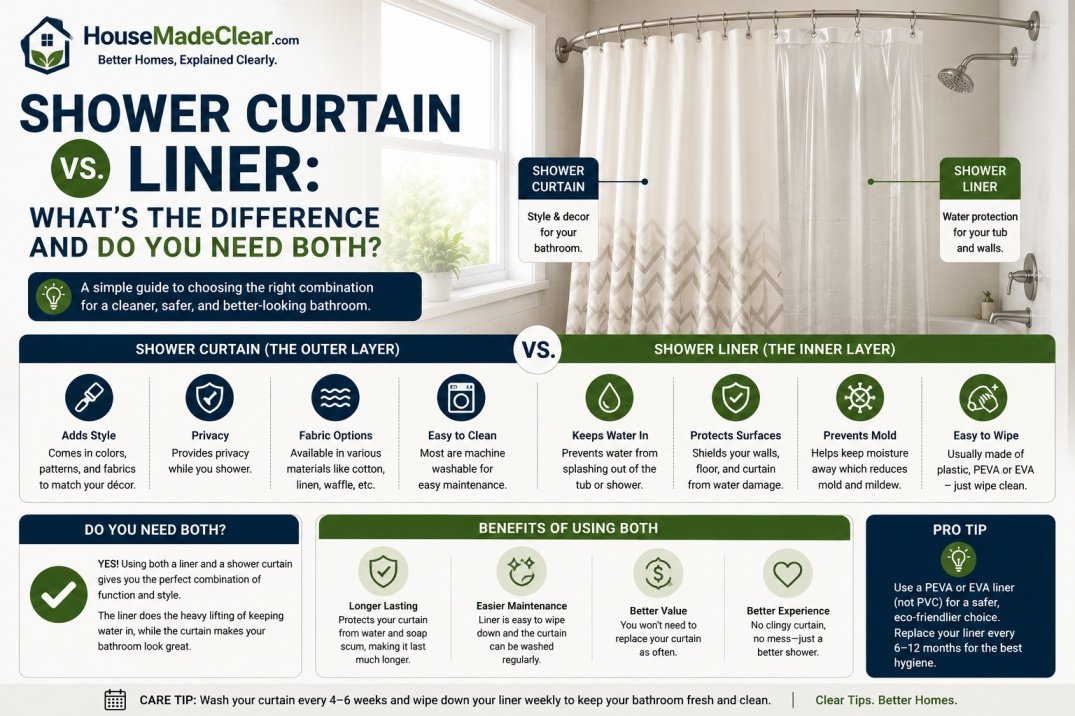
Shower Curtain vs Liner: A shower curtain and a shower curtain liner may hang from the same rod, but they do not necessarily perform the same job.
The shower curtain is usually the visible outer layer. It provides privacy and contributes to the bathroom’s appearance.
The shower liner is usually the water-managing inner layer. It hangs inside the bathtub or shower area and helps direct water back toward the drain.
In many bathrooms, using both gives you the best combination of:
- Water control
- Privacy
- Easier cleaning
- Decorative flexibility
However, you do not always need both.
Some waterproof or water-resistant shower curtains are designed to be used without a separate liner. Whether that works well depends on the curtain material, manufacturer instructions and your particular shower setup.
Quick Answer
The main difference between a shower curtain and liner is their function:
Shower curtain: primarily provides privacy and decoration.
Shower curtain liner: primarily helps keep shower water inside the tub or shower.
If your decorative curtain is made from absorbent fabric such as cotton or linen, using a liner is usually the practical choice. If you have a waterproof or appropriately water-resistant polyester, PEVA or similar curtain specifically designed for direct shower use, a separate liner may not always be necessary.
When both are used, the liner normally hangs inside the tub while the decorative curtain stays outside.
Shower Liner vs Curtain: What Is the Main Difference?
The simplest way to understand shower liner vs curtain is to think about where each layer sits and what it is intended to do.
A typical two-layer setup looks like this:
Bathroom → decorative shower curtain → bathtub edge → shower liner → shower water
The outer curtain improves the appearance of the bathroom.
The liner deals directly with water.
Shower Curtain
A shower curtain may provide:
- Privacy
- Color
- Pattern
- Texture
- Decorative style
- Partial splash protection
Shower Liner
A shower liner generally provides:
- A water-resistant or waterproof inner barrier
- Better control of shower spray
- Protection for the decorative curtain
- Easier replacement or cleaning
The two products complement each other rather than competing for exactly the same purpose.
Shower Liner vs Shower Curtain Comparison
Here is the basic shower liner vs shower curtain comparison:
| Feature | Shower Curtain | Shower Liner |
|---|---|---|
| Main role | Privacy and appearance | Water containment |
| Typical position | Outside bathtub | Inside bathtub |
| Decorative | Usually | Usually minimal |
| Directly exposed to shower water | Less when liner is used | Yes |
| Common materials | Polyester, cotton, linen, blends | PEVA, EVA, vinyl, polyester |
| Requires separate liner | Depends on material | No |
| Easy to replace | Yes | Yes |
| Can be used alone | Sometimes | Often, if privacy is adequate |
The exact material matters more than the product name alone.
Some products marketed as shower curtains are designed to perform both jobs.
What Are Shower Liners?
If you are wondering what are shower liners, they are the inner protective layer used with many shower-curtain systems.
A liner hangs on the shower side of the setup and is intended to come into contact with:
- Water droplets
- Shower spray
- Condensation
During a bath or shower, the liner normally sits inside the bathtub or shower base.
This helps water travel down the liner and return to the wet area instead of dripping onto the bathroom floor.
What Does a Shower Curtain Liner Do?
A liner has several practical functions.
Helps Contain Water
This is its primary role.
The liner creates a barrier between shower spray and the rest of the bathroom.
Protects the Outer Curtain
If your decorative curtain is fabric, the liner prevents it from receiving the full force of the shower spray every day.
Makes Cleaning Easier
Instead of repeatedly washing a large decorative curtain, you can clean or replace the liner independently when appropriate.
Helps Decorative Curtains Last Longer
Reducing repeated soaking can help preserve:
- Fabric
- Printing
- Decorative details
although care requirements vary by product.
Shower Curtain Liner vs Curtain: Which One Goes Inside?
In a typical shower curtain liner vs curtain arrangement:
Liner = inside the bathtub
Decorative curtain = outside the bathtub
This setup lets the liner catch shower water while keeping the decorative layer visible from the bathroom.
If both layers are placed outside the bathtub while someone showers, water running down the liner can drip onto the bathroom floor.
Difference Between Shower Curtain and Liner
The difference between shower curtain and liner becomes clearer when you look at three factors:
1. Function
Curtain:
privacy + design
Liner:
water management
2. Material
Decorative curtains can be made from softer fabrics.
Liners tend to use materials intended to handle frequent moisture.
3. Position
Curtain:
usually outside tub.
Liner:
usually inside tub while showering.
That is the traditional arrangement, although one-piece waterproof curtains can combine both functions.
Difference Between Shower Curtain and Shower Liner
Another way to explain the difference between shower curtain and shower liner is to ask:
Which layer would you want directly exposed to shower spray?
If your decorative curtain is made from:
- Cotton
- Linen
- Decorative woven fabric
the answer is usually:
not that one.
A liner provides the sacrificial, easier-to-maintain wet layer.
If your curtain itself is specifically designed as a waterproof or quick-drying shower curtain, however, it may be capable of serving both purposes.
Difference Between Shower Curtain and Shower Curtain Liner
The difference between shower curtain and shower curtain liner is therefore not simply that one is thicker or more expensive.
It is about intended use.
A curtain can focus on:
- Appearance
- Texture
- Privacy
while a liner focuses on:
- Direct water exposure
- Splash containment
- Keeping water inside the bathing area
Some manufacturers combine these properties in a single product.
That is why the product’s care and use instructions should take priority over assumptions based only on material.
Do You Need Shower Curtain Liner?
The answer to do you need shower curtain liner is:
It depends on the curtain you have.
You probably benefit from a liner if your outer curtain is:
- Cotton
- Linen
- Decorative fabric
- Not designed for direct water exposure
- Difficult to wash frequently
You may not need a separate liner if the curtain is:
- Designed specifically for liner-free use
- Waterproof or sufficiently water-resistant for direct shower exposure
- Easy to wash and dry
- Installed so it keeps water inside the shower properly
Does a Shower Curtain Need a Liner?
So, does a shower curtain need a liner?
Not every shower curtain does.
The important distinction is the material and construction.
Decorative Fabric Curtain
A liner is generally a sensible addition.
Waterproof Curtain
A separate liner may be unnecessary.
Water-Resistant Polyester Curtain
It depends on the exact product.
Some polyester curtains are specifically intended to work without a liner.
Others are primarily decorative and perform better with one.
Check the manufacturer’s instructions rather than relying solely on the word polyester.
Do Shower Curtains Need Liners?
If you’re asking broadly do shower curtains need liners, think of the answer as three categories.
Category 1: Definitely Better With a Liner
Examples:
- Cotton
- Linen
- Absorbent decorative fabric
Category 2: Often Can Work Without One
Examples:
- Waterproof PEVA-style curtain
- Waterproof plastic curtain
- Products explicitly marketed for liner-free use
Category 3: Depends on the Product
Examples:
- Polyester
- Fabric blends
- Treated textiles
The third category is where most confusion occurs.
Do I Need a Liner With a Polyester Shower Curtain?
The question do I need a liner with a polyester shower curtain does not have one universal yes-or-no answer.
Polyester is commonly used for shower curtains because it can be:
- Lightweight
- Washable
- Quick drying
- More water resistant than many natural fabrics
But polyester curtains vary.
One product may be designed to function as:
curtain + water barrier
while another may be intended mainly as:
decorative outer curtain
If the manufacturer describes your polyester curtain as:
- Waterproof
- Water-repellent
- Liner-free
- Suitable for direct shower use
you may be able to use it without a second layer.
If not, adding a liner provides a simple additional barrier.
Does Polyester Shower Curtain Need Liner?
Similarly, does polyester shower curtain need liner depends primarily on how that particular curtain was manufactured.
Do not decide based only on fiber content.
Check:
- Manufacturer instructions
- Waterproof/water-resistant description
- Washing instructions
- Whether water beads and runs off
- Whether fabric becomes heavily saturated
If your curtain becomes soaked during every shower and takes a long time to dry, a liner may make the setup easier to maintain.
Can You Use a Shower Curtain Without a Liner?
Yes, if the curtain itself is suitable.
A single-curtain setup can be attractive because it means:
- Less material
- Fewer items to wash
- Simpler appearance
- Easier opening and closing
But make sure the curtain:
- Handles direct water exposure
- Hangs inside the tub while showering
- Dries reasonably quickly
- Is long and wide enough to contain splash
A decorative fabric curtain that remains outside the bathtub cannot effectively replace an inner liner.
Can You Use a Shower Liner Without a Curtain?
Yes.
A liner can often function by itself if you do not need the decorative outer layer.
This is common in:
- Rental bathrooms
- Guest bathrooms
- Minimalist spaces
- Temporary setups
The liner can provide:
- Privacy
- Water containment
as long as it is sufficiently opaque for your needs.
The main thing you lose is the decorative appearance of a conventional outer curtain.
Shower Curtain Liner vs Shower Curtain Materials
Material selection influences whether you need one or two layers.
PEVA or EVA-Type Liners
These are commonly used as dedicated shower liners.
They are designed to manage water directly.
Vinyl Liners
Another traditional liner option.
Always follow the manufacturer’s care instructions.
Polyester
Polyester can appear as either:
- Decorative shower curtain
- Washable liner
- Liner-free curtain
Read the product specifications carefully.
Cotton
Cotton can create a softer decorative appearance but generally absorbs more water than purpose-made liner materials.
It is commonly paired with a liner.
Linen
Linen curtains are primarily chosen for appearance and texture.
A separate water-managing liner is normally the practical setup.
Fabric Shower Curtain vs Liner
A fabric shower curtain and a shower liner work particularly well together because each layer can focus on a different job.
Fabric Outer Layer
Provides:
- Texture
- Color
- Pattern
- Privacy
Liner
Provides:
- Water barrier
- Splash management
This arrangement is particularly useful if your bathroom design uses the shower curtain as an important decorative element.
Waterproof vs Water-Resistant: Why the Difference Matters
The words:
waterproof
and:
water-resistant
do not necessarily mean the same thing.
A waterproof curtain is designed to resist water penetration more completely.
A water-resistant curtain may repel ordinary shower droplets but can still become wet during prolonged exposure.
If you want to eliminate the liner, look for a product specifically intended to serve as the primary shower-water barrier.
Do not assume every fabric marketed as water resistant will perform exactly like a dedicated liner.
Why Use Both a Shower Curtain and Liner?
For many bathrooms, the two-layer system remains practical.
Better Decorative Choices
You can choose an outer curtain based on:
- Color
- Pattern
- Texture
without worrying as much about direct water exposure.
Easier Water Management
The liner remains inside the tub.
Easier Replacement
If the inner layer becomes worn, you can replace it without changing the decorative curtain.
Easier Seasonal Changes
You can change the appearance of the bathroom while keeping the same functional liner.
Shower Curtain and Liner Size
When using both layers, they should generally be compatible in width and length.
A common shower curtain size is approximately:
72 inches wide × 72 inches long
although sizes vary substantially.
If you are unsure what your tub or shower requires, House Made Clear’s guide to standard shower curtain measurements explains common sizes for:
- Standard tubs
- Shower stalls
- Walk-in showers
- Extra-long installations
Should the Liner Be the Same Size as the Shower Curtain?
Usually, a liner should be approximately similar in overall dimensions so it covers the same wet area.
However, exact matching is not mandatory.
For example:
Decorative curtain:
72 × 72 inches
Liner:
70 × 72 inches
can still be perfectly functional if it adequately covers the tub opening.
What matters most is that the liner:
- Covers the shower opening
- Reaches far enough inside the tub
- Is not excessively long
- Closes properly
Can a Shower Liner Be Longer Than the Curtain?
Yes, but a large mismatch can look awkward.
A slightly longer liner can provide additional tub overlap.
However, if the liner extends so far that it piles heavily on the tub floor, it may:
- Stay wet longer
- Collect residue
- Be harder to dry
Choose length according to actual rod height and tub geometry.
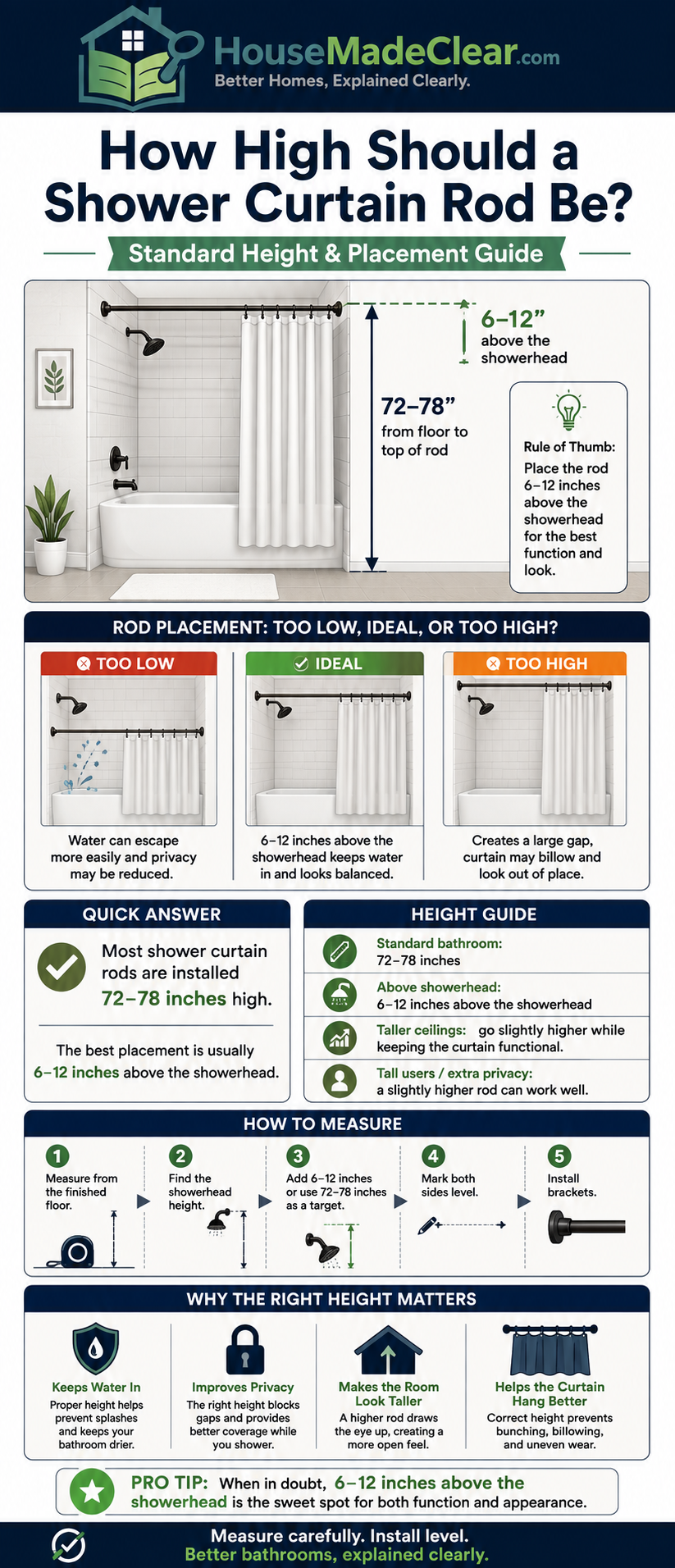
House Made Clear’s guide to how high a shower curtain rod should be explains how curtain length, hooks and bottom clearance work together.
Can the Decorative Curtain Be Longer Than the Liner?
Yes, especially if the curtain is being used for a particular visual effect.
But the liner still needs enough length to contain shower spray.
Do not let aesthetics create a situation where the decorative curtain reaches the correct point but the liner barely overlaps the tub.
Water management comes first.
Where Should the Shower Curtain and Liner Hang?
For a conventional bathtub:
Decorative curtain → outside tub
Liner → inside tub
That arrangement keeps most direct moisture away from the decorative layer.
When the shower is finished, spreading the curtain and liner across the rod can help both layers dry more evenly.
Should Both Shower Curtain and Liner Go Inside the Tub?
Usually not.
The liner belongs inside while showering because that is where it can direct water.
The decorative curtain is generally left outside.
Putting both inside can:
- Reduce shower space
- Wet decorative fabric unnecessarily
- Make drying slower
There can be exceptions for a one-piece curtain specifically designed for direct water exposure.
Why Does the Shower Liner Sometimes Blow Inward?
A liner may move inward because of air movement created around the shower.
The effect can be more noticeable with:
- Lightweight liners
- Powerful shower spray
- Small tub spaces
Many liners include:
- Magnets
- Weighted hems
that help keep the bottom closer to the tub wall.
Correct rod positioning and proper liner length can also help.
Is a Heavier Shower Liner Better?
Not automatically.
Heavier liners may:
- Move less
- Hang more smoothly
- Feel more substantial
but they can also:
- Take more effort to handle
- Dry differently
- Cost more
Choose based on:
- Material
- Bathroom ventilation
- Ease of cleaning
- Personal preference
rather than thickness alone.
Clear vs Frosted vs Fabric Shower Liner
Clear Liner
Advantages:
- Lets more light into the shower
- Minimal visual obstruction
Frosted Liner
Advantages:
- More privacy
- Still allows some light through
Fabric Liner
Advantages:
- Softer appearance
- Can often be machine washed depending on product
The ideal choice depends on whether the liner is used:
- Alone
- Behind a decorative curtain
Does a Shower Liner Need to Be Waterproof?
The liner’s main purpose is water management, so it should be specifically designed to handle direct shower exposure.
Some liner materials are described as:
- Waterproof
- Water resistant
- Water repellent
What matters is that the product is specifically intended for shower-liner use and installed according to its instructions.
How Often Should You Replace a Shower Liner?
There is no universal replacement schedule.
Replacement depends on:
- Material
- Cleaning
- Ventilation
- Visible wear
- Staining
- Tears
- Damaged grommets
A liner that remains in good condition and can be cleaned successfully does not need to be discarded simply because a fixed number of months has passed.
Replace it when it is:
- Damaged
- Difficult to clean
- No longer functioning properly
How Often Should You Wash a Shower Curtain?
Again, there is no one schedule for every bathroom.
Bathrooms differ in:
- Humidity
- Shower frequency
- Ventilation
- Household size
Inspect the curtain regularly.
If you see:
- Soap residue
- Discoloration
- Mildew
- Dirt
clean it using the manufacturer’s care instructions.
Never assume every curtain or liner can be:
- Machine washed
- Tumble dried
- Bleached
because materials vary.
Ventilation Matters More Than the Curtain Type Alone
Even the best curtain-and-liner setup exists in a humid environment.
After showering:
- Spread curtain and liner instead of leaving them tightly bunched
- Run the exhaust fan
- Allow bathroom moisture to fall
House Made Clear’s guide to how long to run the bathroom fan after a shower explains why ventilation should normally continue after the shower ends.
If the room remains damp for hours, see what bathroom humidity should be after a shower.
Why Spreading the Liner Helps It Dry
When a liner is pushed into a tight bundle, many wet surfaces touch one another.
That reduces air exposure.
Spreading it across the rod allows:
- More air around the surface
- Water to drain
- Faster drying
You can still leave a small opening to encourage air movement where appropriate.
Shower Curtain vs Liner in a Small Bathroom
In a small bathroom, a liner-free curtain may create a cleaner visual appearance because there is only one layer.
However, practicality matters.
If the curtain:
- Soaks through
- Stays wet
- Drips outside
then the simplified look is not helping.
A lightweight decorative curtain paired with an effective liner may still be the better choice.
Shower Curtain vs Liner for a Guest Bathroom
Guest bathrooms may not be used every day.
A simple system can work well:
Option 1
Waterproof curtain used alone.
Option 2
Decorative curtain plus washable liner.
Choose based on:
- Appearance
- Ease of cleaning
- Frequency of use
If guests are unfamiliar with the bathroom, make sure it is obvious where the liner should sit while showering.
Shower Curtain vs Liner for a Kids’ Bathroom
A liner can be especially useful where water containment is important.
Choose a setup that:
- Covers the full tub opening
- Is easy to clean
- Remains inside the tub
- Does not create excessive material on the floor
Avoid relying on appearance alone.
Shower Curtain vs Liner for a Rental
For renters, a simple liner can be one of the easiest bathroom upgrades.
It does not normally require permanent modification.
You can also add a decorative curtain without changing:
- Tile
- Plumbing
- Walls
If the rental already has a correctly positioned rod, measure from the rod to the desired curtain bottom before buying.
Shower Curtain vs Liner for a Walk-In Shower
Walk-in showers vary significantly.
A liner may still be useful if the shower uses a curtain instead of a glass enclosure.
The important factors become:
- Opening width
- Shower curb
- Floor slope
- Splash pattern
- Rod position
- Curtain length
A standard 72 × 72 setup should not automatically be assumed.
Measure the actual opening.
Shower Curtain vs Liner for a Shower Stall
Shower stalls often use curtains that are:
- Narrower
- Longer
than standard bathtub curtains.
A typical stall might use a curtain around:
54 × 78 inches
although actual products and openings vary.
If you use two layers, choose a liner sized for the stall rather than forcing a wide standard tub liner into a narrow enclosure.
Shower Curtain vs Liner for a Clawfoot Tub
Clawfoot tubs may use curtains surrounding multiple sides of the tub.
That can require:
- Extra-wide curtain
- Multiple curtain panels
- Specialty liner
- Oval or ceiling-mounted rod
A single standard liner may not provide enough coverage.
Measure the complete enclosure perimeter before selecting materials.
Can You Use Two Shower Curtains Instead of a Liner?
You can hang two fabric layers, but if neither is designed to manage direct shower water, you have not solved the main problem.
The inner layer should be appropriate for wet-area use.
A decorative curtain is not automatically a liner simply because it is placed on the inside.
Can a Fabric Shower Curtain Be Used as a Liner?
Some fabric products are specifically sold and designed as washable shower liners.
Those can be appropriate.
A generic decorative fabric curtain should not automatically be assumed to work as a liner.
Check its intended use.
Shower Curtain Liner With Magnets: Do You Need Them?
Some liners include small weighted magnets along the bottom.
These may help:
- Reduce inward movement
- Keep liner positioned against suitable tubs
However, magnets are not required for every installation.
Their usefulness depends partly on the bathtub material and liner design.
Do You Need Separate Hooks for Curtain and Liner?
Not necessarily.
Many standard shower hooks can hold:
curtain + liner
together.
There are also double-sided hooks designed to make it easier to:
- Remove liner
- Change curtain
independently.
Choose hardware that fits your rod and curtain holes.
Should the Curtain and Liner Have the Same Number of Holes?
Ideally, compatible layers should align reasonably well.
Many standard curtains and liners use approximately:
12 attachment holes
but designs can vary.
Check before buying if you plan to hang both layers on the same hooks.
Can You Use One Hook for Both Curtain and Liner?
Yes, commonly.
Place both attachment holes over each hook.
However, this makes removing one layer separately slightly more cumbersome.
Double-sided hooks can make cleaning easier if you frequently remove the liner.
When a Liner Is Definitely Worth Using
A liner is particularly useful when:
- Outer curtain absorbs water
- Curtain is expensive or decorative
- Water regularly escapes the tub
- You want easier maintenance
- Curtain fabric takes a long time to dry
It creates a dedicated wet layer so the decorative curtain does not need to do everything.
When You May Be Better Without a Separate Liner
One-layer use may make sense when:
- Curtain is specifically designed to be liner-free
- Material handles shower water well
- Curtain is easy to wash
- You prefer a minimal setup
- Water containment is already effective
Using fewer layers can also simplify cleaning.
Do You Need Both a Curtain and Liner for Privacy?
No.
Either layer can potentially provide privacy if it is sufficiently opaque.
A decorative curtain usually provides more privacy than a clear liner.
If you want to use only a liner, consider:
- Frosted
- Opaque
- Fabric
options depending on your preferences.
Common Shower Curtain and Liner Mistakes
1. Leaving the Liner Outside the Tub
Problem:
Water travels down the liner onto the bathroom floor.
Better approach:
Move liner inside while showering.
2. Putting an Absorbent Curtain Directly in the Shower
Problem:
Decorative fabric becomes repeatedly saturated.
Better approach:
Add an appropriate liner.
3. Assuming Every Polyester Curtain Is Liner-Free
Problem:
Polyester products have different finishes and intended uses.
Better approach:
Check manufacturer specifications.
4. Buying the Wrong Liner Size
Problem:
Edges do not cover the shower opening.
Better approach:
Measure the rod and shower.
5. Choosing a Liner That Is Too Long
Problem:
Material piles on tub floor.
Better approach:
Coordinate liner length with rod height.
6. Leaving Wet Layers Bunched Together
Problem:
Drying becomes slower.
Better approach:
Spread them after showering.
7. Ignoring Bathroom Ventilation
Problem:
Humidity remains elevated.
Better approach:
Use exhaust ventilation appropriately.
8. Using the Decorative Curtain as the Only Water Barrier Without Checking Its Material
Problem:
Curtain may not be designed for continuous direct water exposure.
Better approach:
Check product instructions first.
How to Decide Whether You Need a Shower Curtain Liner
Use this simple test.
Question 1: What Is Your Curtain Made From?
Cotton/linen?
Use a liner in most cases.
Polyester?
Check product specifications.
PEVA/waterproof curtain?
A separate liner may not be necessary.
Question 2: Does the Curtain Soak Through?
If yes, add a liner.
Question 3: Does Water Escape the Shower?
If yes, check:
- Width
- Length
- Rod placement
- Liner use
Question 4: Is the Curtain Difficult to Clean?
A replaceable or washable liner can simplify maintenance.
Question 5: Do You Want a Decorative Fabric Curtain?
Use the liner for water control and choose the outer curtain for appearance.
Shower Curtain vs Liner Decision Table
| Situation | Liner Recommended? |
|---|---|
| Cotton decorative curtain | Yes |
| Linen decorative curtain | Yes |
| Polyester curtain designed as decorative only | Usually |
| Waterproof polyester curtain | Maybe not |
| PEVA shower curtain | Often not necessary |
| Fabric curtain marketed as liner-free | Usually optional |
| Curtain repeatedly becomes soaked | Yes |
| Minimal single-layer setup | Choose suitable waterproof/water-resistant product |
| Shower liner used alone | No outer curtain required |
| Decorative curtain used outside tub | Liner strongly useful |
How to Set Up a Shower Curtain and Liner Correctly
Step 1: Measure the Shower
Confirm:
- Width
- Rod height
Step 2: Choose Curtain Size
For many standard tubs:
72 × 72 inches
is a common starting point.
Step 3: Choose Compatible Liner
Match the general:
- Width
- Length
to the curtain and opening.
Step 4: Install Hooks
Attach both curtain and liner.
Step 5: Position the Layers
Outer curtain:
outside tub
Liner:
inside tub
Step 6: Test With Shower Running
Check whether:
- Water remains inside
- Liner moves excessively
- Curtain drags
- Edges leave gaps
Step 7: Adjust Rod Height if Necessary
If the liner is:
too short → longer liner or lower rod
pooling → shorter liner or higher rod
Our shower curtain rod height guide provides detailed measurements for 72-, 78-, 84- and 96-inch curtains.
Quick Answer: Do You Need Both?
Use both a shower curtain and liner when the outer curtain is primarily decorative or absorbent.
Use one layer when the curtain itself is specifically designed to handle direct shower water.
If you use two layers:
Curtain → outside tub
Liner → inside tub
If you use only one:
make sure it is appropriate for wet-area use and position it inside the tub during showering.
Final Thoughts
The shower curtain vs liner question sounds simple, but the best answer depends on what your curtain is made from and how your shower is configured.
A traditional two-layer system separates the jobs:
Shower curtain = privacy and decoration
Shower liner = water management
That makes a liner especially useful with:
- Cotton
- Linen
- Decorative fabrics
A separate liner may be unnecessary when you have a curtain specifically designed for direct shower use, such as certain:
- Waterproof polyester curtains
- PEVA products
- Liner-free shower curtains
The most important thing is not whether your bathroom has one layer or two.
It is whether the setup:
- Keeps water inside the shower
- Dries effectively
- Fits the opening
- Is easy to maintain
- Works with the rod height
Before buying either layer, check our guide to standard shower curtain measurements so you choose the correct width and length.
Then use the shower curtain rod height guide to make sure the bottom finishes in the right place.
Finally, remember that curtains and liners are only one part of bathroom moisture control. Running the bathroom fan for the right amount of time after a shower and keeping bathroom humidity under control will help the entire bathroom dry more effectively.
Frequently Asked Questions
What is the difference between a shower curtain and liner?
A shower curtain primarily provides privacy and decoration, while a shower liner is designed to handle direct shower water and help keep it inside the tub or shower. When both are used, the liner normally hangs inside the tub and the curtain stays outside.
Do you need a shower curtain liner?
You generally benefit from a liner when your shower curtain is absorbent, decorative or not designed for direct water exposure. A waterproof or suitably water-resistant curtain designed for liner-free use may not require a separate liner.
Does a shower curtain need a liner?
Not every shower curtain needs a liner. Cotton, linen and many decorative fabric curtains normally benefit from one, while certain waterproof polyester, PEVA and liner-free curtains can be used alone.
Do shower curtains need liners?
Some do and some do not. The decision depends on the material and intended use of the curtain. Check the manufacturer’s instructions to determine whether the product is designed for direct water exposure.
Do I need a liner with a polyester shower curtain?
It depends on the polyester curtain. Some polyester curtains are designed to be water resistant or waterproof enough for direct shower use, while others are intended as decorative outer curtains and work better with a liner.
Does a polyester shower curtain need a liner?
Not necessarily. If the polyester curtain is specifically designed for liner-free use or direct shower exposure, a liner may be optional. If it becomes saturated or is primarily decorative, using a liner is sensible.
Can you use a shower curtain without a liner?
Yes, provided the curtain itself is designed to handle shower water. It should be water resistant or waterproof, adequately cover the shower opening and hang inside the tub or wet area while showering.
Can you use a shower liner without a curtain?
Yes. A shower liner can be used by itself if it provides adequate water containment and enough privacy for your needs. The outer curtain is primarily useful for decoration and additional privacy.
Does the shower liner go inside or outside the tub?
The shower liner normally hangs inside the bathtub while showering so water running down the liner drains back into the tub. The decorative curtain usually remains outside.
Should the shower curtain and liner be the same size?
They should usually be similar enough in width and length to cover the same shower opening. They do not have to be exactly identical as long as the liner provides adequate water coverage.
Can a fabric shower curtain be used without a liner?
Some fabric curtains are specifically designed for liner-free use, but ordinary cotton, linen or decorative fabric curtains generally benefit from a separate liner to reduce direct water exposure.
Which is better: a shower curtain with a liner or a liner-free curtain?
Neither is always better. A curtain plus liner offers more decorative flexibility and separates water management from appearance. A liner-free curtain creates a simpler one-layer setup and can be easier to manage when the material is designed for direct shower use.