














A shower curtain can look perfectly clean at eye level while the bottom few inches tell a completely different story.
Soap residue, body oils, mineral deposits and constant moisture can gradually leave a shower curtain or liner looking:
- Cloudy
- Pink or orange
- Gray
- Mildewed
- Spotted with mold
- Slimy around the lower edge
Fortunately, many shower curtains and liners can be cleaned instead of immediately replaced.
The correct method depends primarily on the material.
A washable polyester or fabric shower curtain can often go into a washing machine if the care label permits it. A plastic, PEVA, EVA or vinyl liner may need gentler cleaning and should not automatically be placed in a dryer.
Quick Answer
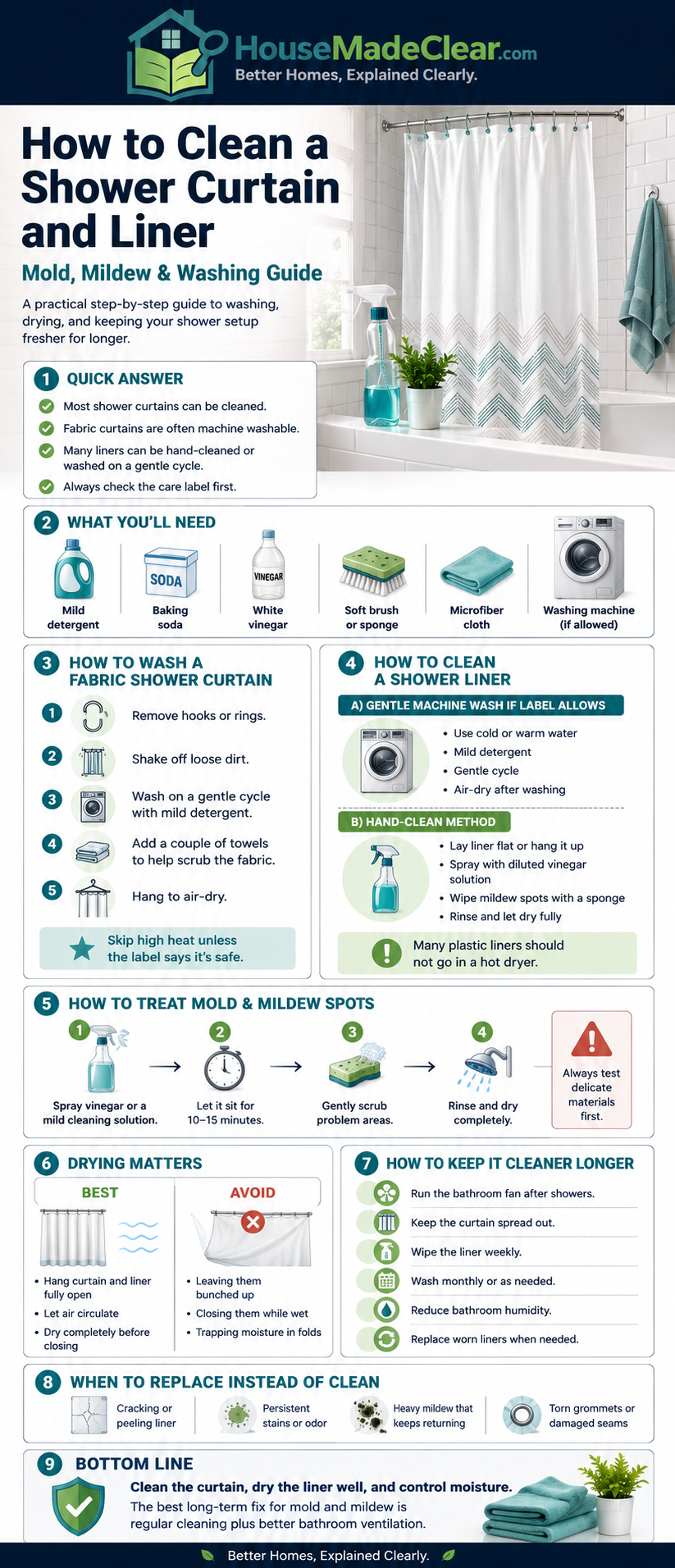
To clean a shower curtain:
- Check the care label and identify the material.
- Remove the curtain and liner from the rod.
- Wash machine-safe fabric curtains using the care instructions and a mild detergent.
- Clean plastic, PEVA, EVA or vinyl liners gently by hand unless the manufacturer specifically allows machine washing.
- Treat visible mold or mildew using a cleaning method appropriate for the material.
- Never mix bleach with ammonia or other household cleaners.
- Rinse thoroughly where required.
- Rehang the curtain or liner and allow it to dry fully.
The most important long-term step is controlling moisture. Spread the curtain after every shower and ventilate the bathroom so the material does not remain damp for hours.
How to Clean a Shower Curtain: Start With the Material
Before deciding how to clean a shower curtain, identify what it is made from.
Common materials include:
- Polyester
- Cotton
- Linen
- Fabric blends
- PEVA
- EVA
- Vinyl
- Other plastic-like materials
The same cleaning method should not automatically be used for all of them.
A machine-washable polyester curtain can tolerate very different treatment from a thin plastic liner.
Look for the care label attached to the curtain.
It may tell you:
- Machine wash or hand wash
- Recommended water temperature
- Whether bleach is permitted
- Whether tumble drying is permitted
- Whether ironing is permitted
When manufacturer instructions conflict with generic cleaning advice, follow the manufacturer.
Shower Curtain Cleaning Methods at a Glance
| Curtain or Liner Type | Typical Cleaning Approach | Machine Wash? | Dryer? |
|---|---|---|---|
| Polyester curtain | Mild detergent, wash according to label | Often | Label dependent |
| Cotton curtain | Wash according to care label | Often | Label dependent |
| Linen curtain | Gentle care according to label | Sometimes | Label dependent |
| Fabric liner | Mild detergent | Often if labeled washable | Label dependent |
| PEVA liner | Gentle hand cleaning | Product dependent | Usually avoid unless approved |
| EVA liner | Gentle hand cleaning | Product dependent | Usually avoid unless approved |
| Vinyl liner | Gentle cleaning | Product dependent | Avoid unless manufacturer allows |
| Decorative printed curtain | Gentle cleaning | Label dependent | Label dependent |
The table is only a starting point. Always check your curtain’s care label.
Can You Wash a Shower Curtain in the Washing Machine?
Many fabric shower curtains can be washed in a washing machine.
This is especially common with:
- Polyester
- Cotton
- Washable fabric blends
But can you wash a shower curtain in the washing machine if it is plastic?
Sometimes manufacturers allow certain liners to be machine washed on a gentle setting, but you should not assume that every:
- PEVA
- EVA
- Vinyl
- Plastic
liner is machine washable.
Thin materials can:
- Crease
- Tear
- Stretch
- Become damaged by heat
Check the label first.
How to Wash a Shower Curtain in a Washing Machine
If the curtain is labeled machine washable, the process is straightforward.
Step 1: Remove the Curtain
Take the curtain down from the rod.
Remove:
- Hooks
- Rings
- Clips
unless the care instructions explicitly say they can remain attached.
Step 2: Inspect the Curtain
Look for:
- Heavy mold
- Tears
- Loose grommets
- Stains
- Damaged hems
Address obvious trouble spots before washing.
Step 3: Follow the Care Label
Choose the:
- Cycle
- Water temperature
- Detergent
recommended by the manufacturer.
When no special cleaning product is required, a mild laundry detergent is generally the simplest approach.
Step 4: Wash
Avoid overloading the machine.
The curtain needs enough room to move.
Step 5: Dry According to the Label
Some fabric curtains can be tumble dried.
Others should be:
- Air dried
- Rehung while damp
Do not put a plastic liner into a hot dryer unless the manufacturer specifically says it is safe.
How to Wash a Polyester Shower Curtain
Polyester is one of the most common shower-curtain materials because it combines a fabric-like appearance with relatively easy maintenance.
When considering how to wash a polyester shower curtain, begin with the label.
Many polyester curtains are machine washable.
A typical process is:
- Remove curtain from hooks.
- Inspect for stains or mold.
- Wash using a gentle or normal cycle as directed.
- Use mild detergent.
- Avoid excessive heat.
- Rehang or dry according to the label.
Do not assume every polyester curtain can be:
- Bleached
- Dried on high heat
- Ironed
Printed or coated polyester curtains may have different requirements.
How to Clean a Fabric Shower Curtain
A fabric shower curtain can include:
- Polyester
- Cotton
- Linen
- Blends
The biggest advantage of fabric curtains is that many are washable.
For Machine-Washable Fabric
Use the manufacturer’s recommended:
- Water temperature
- Cycle
- Detergent
For Hand-Wash-Only Fabric
Use a clean tub or basin and a detergent compatible with the material.
Rinse carefully.
Avoid leaving detergent residue in the fabric because the curtain will be exposed to moisture repeatedly.
How to Clean a Shower Curtain Liner
The answer to how to clean a shower curtain liner depends even more heavily on the material.
A liner is exposed directly to:
- Shower spray
- Soap
- Shampoo
- Conditioner
- Body oils
- Minerals in water
so the lower section often becomes dirty first.
Start by removing the liner from the rod and spreading it out where you can inspect the entire surface.
Pay particular attention to:
- Bottom hem
- Fold lines
- Magnets
- Weighted areas
- Corners
These are common places for residue to accumulate.
How to Clean a Plastic Shower Curtain Liner
For a plastic-type liner, gentle cleaning is usually preferable.
If the care label does not permit machine washing, clean it by hand.
You can:
- Remove the liner.
- Place it on a clean surface or in the bathtub.
- Wet the affected areas.
- Apply an appropriate mild cleaner according to its directions.
- Wipe gently with a soft cloth or non-abrasive sponge.
- Rinse thoroughly.
- Rehang to dry.
Avoid aggressive scrubbing that scratches or weakens the material.
How to Clean a PEVA Shower Curtain Liner
PEVA liners are commonly used as an alternative to traditional vinyl-style liners.
For routine cleaning:
- Use gentle methods
- Avoid unnecessary heat
- Avoid abrasive brushes
- Follow manufacturer instructions
If the liner is machine washable, the label should say so.
If not, hand cleaning gives you more control.
Pay special attention to the bottom edge because that area spends the most time:
- Wet
- Touching the tub
- Exposed to soap residue
How to Clean an EVA Shower Curtain Liner
EVA liners should similarly be treated according to the product instructions.
A gentle wipe-down is often sufficient for normal residue.
For stubborn buildup, repeated gentle cleaning is usually preferable to using:
- Harsh abrasives
- Very hot water
- Aggressive scrubbing
that may damage the liner.
How to Clean a Vinyl Shower Curtain
Vinyl liners can usually be wiped clean, but exact care varies.
Avoid assuming that a vinyl curtain can tolerate:
- High heat
- Strong solvents
- Machine drying
If the liner becomes:
- Brittle
- Cracked
- Torn
- Permanently discolored
replacement may make more sense than aggressive cleaning.
How to Clean Mold Off a Shower Curtain
Visible mold is one of the main reasons people search for how to clean mold off a shower curtain.
The first step is determining whether the curtain can realistically be cleaned.
A washable fabric curtain with a few surface spots may be recoverable.
A heavily deteriorated liner covered with extensive growth may be better replaced.
For light contamination:
- Remove the curtain carefully.
- Follow the manufacturer’s cleaning instructions.
- Use a product suitable for both the material and the contamination.
- Rinse where required.
- Dry completely.
- Correct the moisture conditions that allowed the mold to develop.
The CDC advises following product directions and warns never to mix bleach with ammonia or other cleaners because dangerous fumes can result.
Mold vs Mildew on a Shower Curtain
People often use mold and mildew interchangeably when discussing shower curtains.
From a cleaning perspective, the more important point is this:
If you see visible growth or persistent spotting associated with dampness, clean the curtain safely and address the moisture.
Repeatedly cleaning the same curtain without fixing the damp environment usually leads to the same problem returning.
EPA emphasizes that moisture control is the key to mold control.
How to Remove Mildew From a Shower Curtain
For mildew-like spotting:
- Check the material.
- Check the care label.
- Wash or clean using an approved method.
- Pay special attention to the bottom hem and folds.
- Rinse when required.
- Dry the curtain fully.
Do not leave the cleaned curtain tightly folded while it is wet.
Spread it across the rod.
That allows more surface area to dry.
How to Clean Mold From a Fabric Shower Curtain
If the fabric is machine washable:
- Follow the wash instructions
- Use an appropriate detergent
- Treat stains only with products approved for the fabric
- Dry thoroughly
If the label allows a bleach-containing product, follow its directions exactly.
But do not assume bleach is appropriate for:
- Colored curtains
- Printed fabric
- Coated fabric
- Every polyester product
Using the wrong chemical can permanently damage:
- Color
- Finish
- Pattern
How to Clean Mold From a Plastic Shower Curtain
A plastic liner should generally be cleaned more cautiously because vigorous scrubbing can damage the surface.
Use a compatible cleaning product and a soft cloth or sponge.
If mold is extensive and the liner is inexpensive, old or deteriorated, replacement can be more practical than trying increasingly harsh cleaning treatments.
Can You Use Bleach on a Shower Curtain?
Possibly, but only when:
- The material permits it
- The care label allows it
- The product directions are followed
Bleach should not be treated as the default cleaner for every shower curtain.
It can affect:
- Colored fabric
- Prints
- Coatings
- Some liner materials
Most importantly:
Never mix bleach with ammonia or other cleaning products.
CDC explicitly warns against mixing bleach with ammonia or other household cleansers.
Use adequate ventilation when using cleaning products.
Can You Use Vinegar to Clean a Shower Curtain?
Diluted household vinegar is commonly used by homeowners for mineral residue and general bathroom cleaning, but whether it is appropriate depends on the curtain material and manufacturer instructions.
If you choose a vinegar-based cleaning approach:
- Test an inconspicuous area first
- Do not combine it with bleach
- Do not combine multiple cleaners
- Rinse the curtain appropriately
A simple cleaning method is usually better than mixing several household chemicals together.
Cleaning a Shower Curtain With Vinegar
If the curtain’s care instructions allow it, a vinegar-based approach can be useful for some types of surface residue.
For hand cleaning:
- Remove the curtain.
- Wet the affected area.
- Apply the cleaning solution appropriate for the material.
- Allow only the contact time recommended for that surface.
- Wipe gently.
- Rinse.
- Rehang to dry.
Avoid assuming that “natural” automatically means safe for every material.
Acidic cleaners can affect certain surfaces and finishes.
Can You Clean a Shower Curtain With Baking Soda?
Baking soda is mildly abrasive and is sometimes used for surface cleaning.
It may help remove:
- Soap residue
- Light grime
from compatible materials.
However, avoid aggressive scrubbing on:
- Thin plastic
- Coated fabric
- Printed curtains
because abrasive action can damage the finish.
As with any cleaner, test first and follow manufacturer guidance.
Should You Mix Vinegar and Baking Soda?
There is usually little reason to mix multiple household cleaners simply because separate cleaning tips mention both.
For shower curtains, a safer and more predictable strategy is:
Choose one appropriate cleaning method at a time.
Do not create homemade chemical mixtures without knowing how the ingredients interact.
Most importantly, never mix bleach with other household cleaners.
How to Clean the Bottom of a Shower Curtain
The bottom edge is often the dirtiest part.
Why?
Because it:
- Stays wet longest
- Contacts the tub
- Collects shampoo and soap runoff
- Sits in folds
- Has less airflow
For routine cleaning:
- Spread the curtain flat.
- Inspect the lower 6–12 inches.
- Clean both sides.
- Pay attention to seams and hems.
- Rinse thoroughly.
- Hang fully extended to dry.
Regular attention to the lower edge can prevent heavy buildup.
How to Clean Shower Curtain Magnets
Some liners contain magnets along the bottom edge.
Soap residue can accumulate around them.
Use:
- Soft cloth
- Mild compatible cleaner
and wipe around the enclosed magnet areas.
Avoid:
- Sharp tools
- Abrasive pads
that could puncture the material surrounding the magnet.
How to Clean a Weighted Shower Curtain Hem
Weighted hems help the curtain hang more steadily.
However, they can trap water around folds.
When washing or cleaning:
- Straighten the hem
- Clean both sides
- Rinse well
- Make sure it dries completely
If the weighted portion becomes damaged or exposed, replacement may be appropriate.
How to Remove Soap Scum From a Shower Curtain
Not every cloudy shower curtain has mold.
Sometimes the problem is soap residue.
Soap and personal-care products can create:
- White film
- Cloudiness
- Sticky buildup
especially around the lower portion.
Routine cleaning with a material-compatible detergent can often remove this without using aggressive chemicals.
If the curtain remains cloudy after cleaning, hard-water minerals may also be involved.
How to Remove Hard-Water Deposits From a Shower Curtain
Hard water can leave:
- White spots
- Chalky film
- Mineral residue
on liners.
The correct cleaner depends on the liner material.
Do not automatically use strong acidic descalers designed for:
- Tile
- Glass
- Metal
on a plastic curtain.
Use only a product that is compatible with the liner.
How to Clean Pink Residue From a Shower Curtain
Pink or reddish-orange residue can appear in damp shower environments.
Rather than trying to identify it visually, treat it as a cleaning and moisture-control problem.
Clean the affected material thoroughly using an appropriate method, then improve drying conditions.
If the residue quickly returns, inspect:
- Curtain folds
- Tub edges
- Caulk
- Grout
- Shower corners
because the curtain may not be the only damp surface.
How Often Should You Clean a Shower Curtain?
There is no universal schedule.
A household with:
- Four daily showers
- Weak ventilation
- Hard water
may need more frequent cleaning than a lightly used guest bathroom.
A practical approach is to inspect the curtain every week or two.
Clean it when you notice:
- Soap buildup
- Discoloration
- Odor
- Mold-like spots
- Slimy residue
Do not wait until the curtain becomes heavily contaminated.
How Often Should You Wash a Shower Curtain Liner?
Again, condition matters more than a fixed calendar.
The liner gets the most direct water exposure, so check it regularly.
Clean it before:
- Buildup becomes thick
- Mold spreads
- Bottom edge stays visibly dirty
A quick routine cleaning is easier than trying to restore a badly neglected liner.
Should You Clean the Shower Curtain Every Week?
Usually, a full wash every week is unnecessary for many households.
Instead, make weekly prevention simple:
- Spread the curtain
- Check the bottom edge
- Wipe obvious residue
- Ventilate bathroom
Then perform a deeper clean when needed.
The best cleaning schedule is the one that prevents buildup without unnecessarily wearing out the material.
How to Prevent Mold on a Shower Curtain
Cleaning is useful.
Preventing the curtain from staying wet is even more useful.
EPA identifies moisture control as central to mold prevention and recommends keeping indoor relative humidity below 60%, ideally around 30–50% where practical.
For the shower curtain specifically:
Spread It Out
Do not leave the curtain bundled at one end after showering.
Run the Exhaust Fan
Ventilation helps remove water vapor from the bathroom.
Keep the Liner Inside During Showering
This helps prevent water from wetting:
- Flooring
- Walls
- Bath mats
unnecessarily.
Let It Drain
The bottom should not sit in a large pool of water.
Clean Early
Remove residue before it becomes heavy.
Spread the Curtain After Every Shower
This small habit makes a meaningful difference.
When a wet liner is bunched up:
- Wet surfaces touch
- Airflow decreases
- Folded areas dry more slowly
Instead:
- Pull the curtain mostly closed.
- Straighten folds.
- Let water drain downward.
- Allow ventilation to move around it.
You do not need to stretch it perfectly flat.
The goal is simply to avoid a tightly packed wet bundle.
Run the Bathroom Fan
Showering releases substantial moisture into the room.
EPA specifically recommends using the bathroom exhaust fan or opening a window when showering to help manage excess moisture.
If you are unsure when to turn the fan off, House Made Clear’s guide to how long to run a bathroom fan after a shower explains what to look for.
Check Bathroom Humidity
If your shower curtain repeatedly develops mold despite regular cleaning, the broader bathroom may be staying damp too long.
A simple hygrometer can help you see how quickly relative humidity falls after a shower.
House Made Clear’s guide to bathroom humidity after a shower explains normal moisture spikes and when slow recovery may indicate a ventilation problem.
EPA recommends indoor relative humidity below 60%, ideally between 30% and 50% where possible.
What if Your Bathroom Has No Exhaust Fan?
If there is no mechanical exhaust fan, moisture control becomes more important.
Depending on the bathroom design, you may be able to:
- Open a window when conditions allow
- Leave the bathroom door open after showering when appropriate
- Use a dehumidifier in a suitable location
If you use a portable dehumidifier, do not place it where it can be splashed or exposed to water contrary to the manufacturer’s requirements.
Our guide to where to put a dehumidifier in a bathroom covers placement considerations.
Does Shower Curtain Rod Height Affect Cleaning?
Indirectly, yes.
A curtain mounted too low may:
- Drag
- Pool
- Stay wet at bottom
A rod mounted too high may:
- Leave inadequate tub overlap
- Allow more water to escape
A correctly positioned curtain should hang freely enough to drain.
If yours continuously bunches at the bottom, check our guide to how high a shower curtain rod should be and How to Hang Curtain Rods.
Does Shower Curtain Size Affect Mold?
It can affect drying conditions.
A curtain that is:
too long
may pool.
A curtain that is:
far too wide
may create excessive folds.
A curtain that is:
too short
may fail to contain water.
If you are replacing an old curtain, verify your measurements with our standard shower curtain size guide.
Curtain and Liner Should Perform Different Jobs
If you use a two-layer system, the outer curtain should not need to absorb all the shower water.
The liner takes the wet-side position while the decorative curtain stays outside the tub.
Our comparison of shower curtain vs liner explains when you need both and when a liner-free curtain may work.
Keeping the roles separate can also make cleaning easier.
How to Clean Shower Curtain Hooks and Rings
The curtain itself is not the only part that gets dirty.
Hooks and rings collect:
- Dust
- Soap
- Mineral residue
- Moisture
Remove them when you wash the curtain.
Depending on material, clean them with:
- Warm water
- Mild detergent
- Soft cloth
Dry metal hardware thoroughly before reinstalling.
If the hooks are:
- Rusted
- Cracked
- Difficult to slide
replacement may be easier.
How to Clean a Shower Curtain Rod
A rod can collect:
- Dust
- Water spots
- Soap film
Wipe it with a cleaner compatible with its finish.
Be careful with:
- Painted rods
- Plated finishes
- Specialty coatings
Harsh abrasive cleaners can scratch the surface.
Dry the rod before rehanging the curtain.
How to Clean Shower Curtain Grommets
Metal or plastic grommets can trap grime around their edges.
Use:
- Soft cloth
- Cotton swab where appropriate
- Mild detergent
Avoid pulling or twisting them because loose grommets can tear fabric.
Should You Remove the Curtain to Clean It?
For a thorough cleaning, yes.
Removing it makes it easier to:
- Inspect both sides
- Reach the bottom hem
- Clean folds
- Check hardware
- Wash evenly
For light weekly maintenance, however, you can wipe the curtain while it hangs.
Can You Clean a Shower Curtain While It Is Hanging?
Yes, for routine surface cleaning.
Spread the curtain out and wipe areas with:
- Soap buildup
- Light residue
using a material-compatible cleaner.
Be careful not to spray cleaning chemicals into:
- Eyes
- Face
- Towels
- Personal-care items
Ventilate the bathroom and follow product directions.
For heavier cleaning, remove the curtain.
Should You Soak a Shower Curtain?
Only if the material and care instructions permit it.
Long soaking can affect:
- Coatings
- Prints
- Adhesives
- Metal hardware
A soak that is harmless for one fabric may damage another.
Do not assume soaking overnight is universally safe.
Can You Put a Shower Curtain in the Dryer?
Only if the care label says you can.
Many fabric curtains may permit drying at a specified setting.
Plastic-type liners can be vulnerable to heat.
When uncertain, rehanging the curtain to air dry is generally safer than exposing an unknown plastic material to dryer heat.
Can You Iron a Shower Curtain?
Again, check the label.
Some fabric curtains may allow:
- Low-temperature ironing
while plastic liners absolutely should not be treated like ordinary fabric.
If wrinkles are only cosmetic, hanging the curtain in the humid bathroom often allows them to relax naturally over time.
Should You Wash a New Shower Curtain Before Using It?
It is optional unless the manufacturer recommends it.
Some people prefer to wash new fabric curtains to:
- Remove packaging creases
- Freshen the material
If you do, follow the care label from the first wash.
Do not wash a product unnecessarily if its instructions advise otherwise.
What if the Shower Curtain Smells?
First determine whether the odor is:
- New-product smell
- Damp smell
- Mildew
- Detergent residue
If the curtain is washable, clean it according to the manufacturer instructions.
Persistent damp odor can be a sign that the material is not drying well.
In that situation, improve:
- Airflow
- Ventilation
- Curtain positioning
rather than masking the odor with fragrance.
When Should You Replace a Shower Curtain or Liner?
Cleaning is not always the best answer.
Replace the curtain or liner when it has:
- Tears
- Cracks
- Brittle areas
- Damaged grommets
- Exposed weights
- Permanent staining
- Persistent contamination that does not clean successfully
A low-cost liner that has physically deteriorated is rarely worth aggressive restoration.
Can You Save a Moldy Shower Curtain?
Sometimes.
A machine-washable curtain with limited surface mold may clean successfully.
But replacement may be better if:
- Growth is extensive
- Material is deteriorating
- Spots remain after proper cleaning
- Odor persists
- Curtain repeatedly becomes moldy immediately after cleaning
Also investigate why it happened.
Otherwise, the replacement may develop the same problem.
Why Does Mold Keep Coming Back?
Recurring mold usually means the moisture problem remains.
Possible causes include:
- Curtain left bunched
- Weak exhaust fan
- Fan turned off too early
- High indoor humidity
- Wet bath mats
- Plumbing leaks
- Poor airflow
- Curtain pooling in tub
EPA’s central message for mold prevention is that controlling moisture is essential.
Cleaning addresses the visible result.
Moisture control addresses the cause.
What if the Bathroom Mirror Stays Fogged for a Long Time?
Persistent mirror condensation can be another sign that moisture is leaving the bathroom slowly.
House Made Clear’s guide to how to stop a bathroom mirror from fogging explains practical ways to reduce condensation.
If the curtain, mirror, walls and ceiling all remain wet for long periods, the issue is bigger than the curtain.
Shower Curtain Cleaning by Material
Polyester
Usually one of the easier materials to maintain.
Check label for machine-washing instructions.
Cotton
Often washable, but may shrink depending on construction.
Follow care label.
Linen
May require gentler washing.
Avoid assumptions about machine drying.
PEVA
Gentle cleaning is appropriate unless manufacturer specifies otherwise.
EVA
Treat similarly according to label.
Vinyl
Avoid excessive heat and abrasive cleaning.
Fabric Liner
Many are washable, but follow the label.
Quick Cleaning Decision Table
| Problem | First Step |
|---|---|
| Light soap residue | Wipe with mild compatible cleaner |
| Dirty fabric curtain | Wash according to care label |
| Dirty PEVA liner | Gentle hand clean unless machine washing approved |
| Mold spots | Clean using material-approved method and improve drying |
| Hard-water film | Use material-compatible mineral-residue cleaner |
| Bottom hem dirty | Clean both sides and dry fully |
| Curtain pools on tub floor | Check curtain length and rod height |
| Mold keeps returning | Investigate ventilation/humidity |
| Liner cracked or brittle | Replace |
A Simple Shower Curtain Cleaning Routine
You do not need a complicated weekly process.
After Every Shower
- Keep liner inside tub while showering
- Spread curtain afterward
- Run exhaust fan
Every Week or Two
Inspect:
- Lower hem
- Folds
- Magnets
- Hooks
Wipe light buildup before it becomes heavy.
When Visible Buildup Appears
Remove and clean the curtain according to its care instructions.
Periodically
Clean:
- Hooks
- Rod
- Tub edge
This keeps the entire curtain system cleaner rather than focusing only on the fabric.
Step-by-Step Deep Cleaning Checklist
Step 1: Read the Care Label
Determine:
- Material
- Washing method
- Drying method
- Chemical restrictions
Step 2: Remove the Curtain and Liner
Take off hooks.
Step 3: Inspect Both Sides
Look for:
- Mold
- Soap residue
- Damage
- Mineral buildup
Step 4: Separate Materials
Do not assume curtain and liner require the same wash method.
Step 5: Clean the Curtain
Machine wash or hand wash as directed.
Step 6: Clean the Liner
Use the method appropriate for:
- PEVA
- EVA
- Vinyl
- Fabric
Step 7: Clean Hooks
Remove residue.
Step 8: Wipe the Rod
Use a finish-compatible cleaner.
Step 9: Rinse Where Required
Remove cleaning residue.
Step 10: Dry Everything Fully
Rehang curtain and liner in an open position.
Shower Curtain Cleaning Safety Checklist
Before cleaning:
- Read product label
- Read curtain care label
- Ventilate bathroom
- Wear appropriate gloves when using cleaning products
- Keep cleaners away from children and pets
- Never mix household cleaning products unless the manufacturer explicitly instructs you to
- Never mix bleach with ammonia or other cleaners
- Avoid abrasive tools on delicate liners
- Avoid heat on materials that do not permit it
CDC specifically advises against mixing bleach with ammonia or other cleansers because dangerous fumes can form.
How to Keep a Shower Curtain Cleaner for Longer
The easiest curtain to clean is one that never develops heavy buildup.
Focus on five habits.
1. Keep the Liner Positioned Correctly
Inside the tub during use.
2. Spread It Afterward
Do not leave it packed in one wet bundle.
3. Ventilate the Bathroom
Run the exhaust fan during and after showering.
4. Clean Small Spots Early
Do not wait for widespread staining.
5. Use the Correct Curtain Size
A properly sized curtain hangs more freely and is easier to dry.
Quick Answer: Best Way to Clean a Shower Curtain
Fabric or polyester curtain:
Follow the care label and machine wash if permitted.Plastic, PEVA, EVA or vinyl liner:
Clean gently by hand unless its label specifically permits machine washing.Mold or mildew:
Use a material-compatible cleaning method, dry the curtain fully and address bathroom moisture.After cleaning:
Rehang the curtain fully extended and ventilate the bathroom.Safety:
Never mix bleach with ammonia or other household cleaners.
Final Thoughts
Knowing how to clean a shower curtain and liner is mostly about matching the cleaning method to the material.
For a washable:
- Polyester
- Cotton
- Fabric curtain
the washing machine may be the easiest solution when the label allows it.
For:
- PEVA
- EVA
- Vinyl
- Plastic-type liners
gentle hand cleaning may be safer unless the manufacturer specifically approves machine washing.
If mold or mildew appears, cleaning the curtain is only half the solution.
You also need to reduce the amount of time the curtain remains wet.
EPA recommends controlling indoor moisture and keeping relative humidity below 60%, ideally between 30% and 50% where practical.
After each shower:
- Spread the curtain
- Keep the liner from pooling
- Run the exhaust fan
- Let the bathroom dry
If the curtain repeatedly becomes moldy, investigate the broader moisture problem instead of continually replacing liners.
For more bathroom-specific guidance, see House Made Clear’s guides to shower curtain vs liner, standard shower curtain measurements, shower curtain rod height, and bathroom humidity after a shower.
A clean curtain is useful.
A curtain that dries properly between showers is even better.
Frequently Asked Questions
How do you clean a shower curtain?
Check the care label first. Machine-wash fabric or polyester curtains if the manufacturer permits it. Clean plastic, PEVA, EVA or vinyl liners gently by hand unless their instructions specifically allow machine washing. Rinse where required and let the curtain dry fully.
Can you wash a shower curtain in the washing machine?
Many fabric and polyester shower curtains can be machine washed, but the care label should always determine the cycle, water temperature and drying method. Do not assume plastic liners are machine washable.
How do you clean a shower curtain liner?
Remove the liner, inspect the bottom and folds, and clean it according to its material. Fabric liners may be washable, while PEVA, EVA and vinyl liners often benefit from gentle hand cleaning unless machine washing is approved by the manufacturer.
How do you clean mold off a shower curtain?
Use a cleaning method compatible with the curtain material, follow the product and care-label instructions, rinse where required and dry the curtain completely. Never mix bleach with ammonia or other household cleaners.
Can you clean a shower curtain with vinegar?
Vinegar is commonly used for some bathroom-cleaning tasks, but whether it is appropriate depends on the curtain material. Check the care instructions, test an inconspicuous area and never combine vinegar with bleach.
Can you put a shower curtain in the dryer?
Only if the care label permits it. Some fabric curtains can be tumble dried at an approved setting, while plastic-type liners can be damaged by heat and are generally safer to air dry unless their manufacturer states otherwise.
How often should you clean a shower curtain?
There is no universal schedule. Inspect the curtain regularly and clean it when you notice soap buildup, discoloration, odor, slime, mildew or mold. Bathrooms with heavy use or high humidity may require more frequent cleaning.
How do you prevent mold on a shower curtain?
Spread the curtain after each shower, keep the liner from pooling, run the bathroom exhaust fan and control indoor humidity. Cleaning small areas of buildup early can also help prevent heavier contamination.
Should the shower curtain liner stay inside the tub?
Yes. During showering, the liner should normally hang inside the bathtub so water running down it drains back into the tub. The decorative outer curtain usually stays outside.
Why does my shower curtain keep getting moldy?
Recurring mold usually indicates that the curtain remains damp too long. Poor ventilation, high bathroom humidity, a bunched liner, incorrect curtain length or other moisture problems can contribute.
When should a shower curtain liner be replaced?
Replace it when it becomes torn, brittle, cracked, permanently stained, difficult to clean or otherwise unable to perform its water-containment function properly.
Can a polyester shower curtain be machine washed?
Many polyester curtains are machine washable, but not all have identical coatings, prints or construction. Follow the care label for the correct washing cycle, water temperature and drying method.