















A foggy bathroom mirror is usually a condensation problem, not a mirror problem.
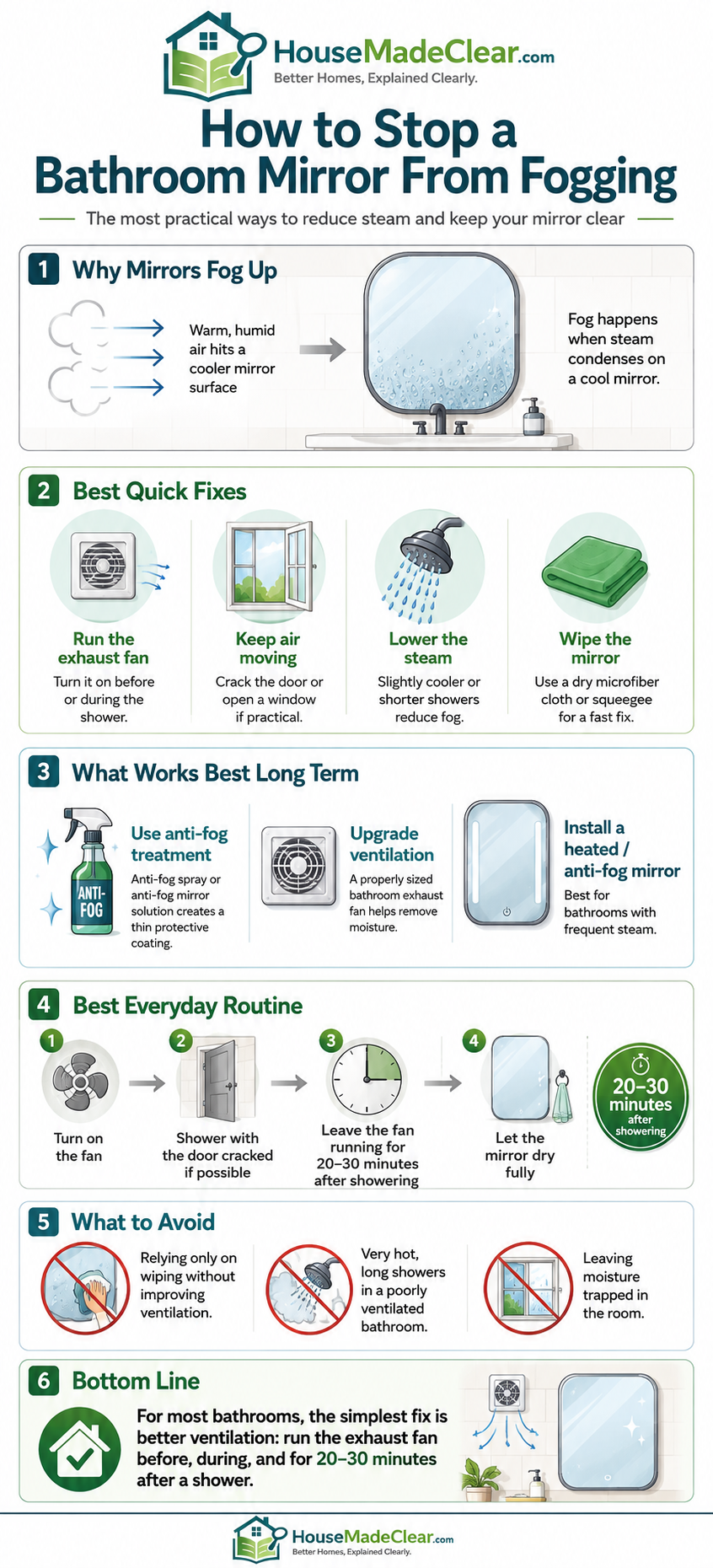
Warm, moisture-filled air from a shower reaches the cooler mirror surface. When that air cools at the glass, water vapor condenses into tiny droplets that create the familiar fogged appearance.
The fastest way to reduce mirror fog is therefore to control the bathroom moisture and the mirror surface temperature, not simply wipe the glass repeatedly.
Quick answer:
Run the bathroom exhaust fan during the shower and for about 20 minutes afterward, keep excess steam from spreading through the room, use suitable window ventilation when conditions allow, and consider a heated or anti-fog mirror if you need the glass to remain clear during showers. If the mirror stays fogged for a long time after every shower, check whether the bathroom ventilation is actually removing moisture effectively.
A fogged mirror by itself is common after a hot shower. But persistent condensation on mirrors, windows and walls can be a sign that excess moisture is remaining in the bathroom too long. The EPA emphasizes moisture control as an important part of preventing mold growth in homes.
Why Does a Bathroom Mirror Fog Up?
Mirror fog is condensation.
During a shower, warm water increases the amount of moisture in the bathroom air.
The mirror is often cooler than the humid air around it.
When that warm moist air contacts the cooler glass, some of the water vapor changes into tiny liquid droplets.
Those droplets scatter light and make the mirror look cloudy.
The amount of fog depends on several factors:
- Shower temperature
- Shower duration
- Bathroom size
- Mirror temperature
- Exhaust-fan performance
- Outdoor weather
- Whole-home humidity
- Window position
- Number of consecutive showers
This is why the same mirror may fog heavily one day and only slightly another.
The Best First Step: Run the Bathroom Exhaust Fan
If your bathroom has a functioning exhaust fan, use it during the shower, not only afterward.
A properly installed bathroom exhaust fan is designed to remove excess moisture and water vapor from the room. The Home Ventilating Institute specifically notes that bathroom exhaust fans help remove moisture from mirrors and walls.
A simple routine is:
- Turn the fan on when the shower begins.
- Keep it running throughout the shower.
- Leave it running after you finish.
- Check whether the mirror and room begin clearing.
House Made Clear’s guide to how long you should run a bathroom fan after a shower explains why around 20 minutes afterward is a useful starting point and what to check when the bathroom remains damp.
Why Running the Fan Only After the Shower Is Less Effective
If the fan stays off during the shower, moisture accumulates before ventilation begins.
By the time you switch it on, water vapor may already have condensed on:
- Mirror
- Window
- Wall
- Ceiling
- Tile
- Cabinet surfaces
Starting the fan earlier gives it more time to remove humid air while moisture is being produced.
That does not guarantee the mirror will remain completely clear during a long hot shower, but it can reduce how heavily the bathroom fogs and how long condensation remains afterward.
What If the Fan Is Running but the Mirror Still Fogs?
This does not automatically mean the fan is broken.
A normal bathroom fan may not remove shower-generated moisture fast enough to prevent all condensation while the shower is actively producing steam.
Mirror fogging can still occur because:
- The shower is very hot
- The mirror is cold
- The bathroom is small
- The room already has high humidity
- The fan is farther from the shower
- The fan airflow is limited
- Several people have showered consecutively
The more useful question is:
How quickly does the bathroom recover after the shower?
If the mirror begins clearing and the room dries reasonably after ventilation continues, the fan may still be doing useful work.
If the mirror, walls and windows stay wet for a long time, investigate the ventilation system.
Check Whether the Exhaust Fan Is Actually Working Well
A noisy fan is not necessarily an effective fan.
Possible reasons for poor moisture removal include:
- Fan too small
- Dirty grille
- Blocked duct
- Long duct run
- Excessive duct bends
- Crushed flexible duct
- Poor exterior termination
- Fan venting into an attic instead of outdoors
- Insufficient replacement air entering the bathroom
The fan should remove moist air from the building rather than simply move it into another enclosed area.
If persistent mirror fog is accompanied by:
- Peeling paint
- Musty odor
- Recurring mildew
- Wet walls
- Window condensation
the ventilation deserves more attention.
Use a Simple Airflow Check
A basic homeowner check is to hold a lightweight piece of tissue close to the operating fan grille.
The fan should pull it toward the grille.
This only confirms that some air is moving.
It does not tell you:
- Actual airflow
- Whether the fan is correctly sized
- Whether the duct is restricted
- Whether the fan exhausts outdoors
Persistent moisture problems require a more complete assessment.
Clean the Exhaust Fan Grille
Dust can accumulate on the fan grille and inside the housing.
This may reduce airflow.
Check the manufacturer’s cleaning instructions and disconnect power appropriately before doing any maintenance that requires access beyond the grille.
If the fan is old, noisy and weak even after cleaning, replacement may be worth considering.
Keep the Bathroom Door Closed During the Shower
Closing the bathroom door during the shower can help contain moisture in the room where the exhaust fan is working.
Otherwise, humid air can spread into:
- Hallway
- Bedroom
- Closet
- Adjacent rooms
This does not directly stop the mirror from fogging, but it can prevent the moisture problem from becoming a whole-house problem.
The key is that the bathroom must still have an appropriate path for replacement air so the exhaust system can operate properly.
Should You Open the Bathroom Door After the Shower?
Possibly, but use it as a supporting step rather than the main moisture-control method.
After the shower, opening the door slightly may improve airflow in some bathrooms while the exhaust fan continues running.
However, opening the door wide while the room is still full of steam may allow humid air to spread into the rest of the home.
A better sequence is usually:
- Keep the door mostly closed during the shower.
- Keep the exhaust fan operating.
- After the shower, continue ventilation.
- Open the door slightly if additional airflow helps the fan.
Open a Window When Outdoor Conditions Make Sense
A bathroom window can provide additional ventilation.
It may help when outdoor air is:
- Drier
- Comfortable in temperature
- Free from heavy rain or excessive humidity
But opening a window is not equally useful in every climate.
During hot, humid weather, outdoor air may already contain substantial moisture.
In that situation, opening the window may not clear the bathroom quickly.
Treat window ventilation as a supplement rather than a guaranteed solution.
Reduce the Shower Temperature Slightly
Hotter showers create more water vapor.
If mirror fog is excessive, lowering the water temperature slightly can reduce the moisture load.
You do not need to take a cold shower.
Even a modest reduction in temperature may reduce the amount of visible steam.
This is one of the simplest changes because it does not require installing anything.
Shorten Very Long Showers
A long hot shower gives moisture more time to accumulate.
If the bathroom is already difficult to ventilate, long showers can overwhelm the available exhaust capacity.
Reducing shower duration can therefore help with:
- Mirror fog
- Wall condensation
- Window condensation
- Overall bathroom humidity
Again, this is a supporting measure.
A properly designed bathroom should still have adequate ventilation for normal use.
Wipe Down Wet Shower Surfaces
After the shower, a significant amount of water remains on:
- Glass
- Tile
- Tub
- Walls
That water continues evaporating into the room.
Using a shower squeegee can reduce the amount of moisture left to evaporate.
Focus particularly on:
- Shower glass
- Large tile walls
- Tub surrounds
This will not instantly clear the mirror, but it can help the bathroom dry faster afterward.
Dry the Mirror With a Microfiber Cloth
If you need the mirror immediately, wiping it is still the fastest short-term fix.
Use a clean microfiber cloth rather than:
- Rough paper
- Dirty towel
- Abrasive pad
The limitation is obvious:
If the room remains extremely humid, the mirror may fog again.
That is why wiping solves the symptom rather than the moisture problem.
Use a Heated or Anti-Fog Mirror
A heated mirror attacks the problem differently.
Instead of trying to remove all humidity instantly, it warms part of the mirror surface.
When the glass stays warmer, condensation is less likely to form on that heated area.
This can be very useful if you need the mirror immediately after showering for:
- Shaving
- Skincare
- Hair styling
- Makeup
Some illuminated bathroom mirrors include integrated demisters or anti-fog pads.
Are Heated Mirrors Worth It?
They can be worthwhile when:
- The mirror fogs daily
- The bathroom is used by several people
- You regularly need the mirror immediately after showering
- You are already renovating the vanity area
Potential advantages include:
- Clearer mirror during or after showering
- No repeated wiping
- Cleaner integrated appearance
Potential disadvantages include:
- Electrical installation
- Added cost
- Energy use
- Only part of the mirror may be heated
Most importantly, a heated mirror does not remove bathroom humidity.
It keeps the mirror clearer while the exhaust system deals with the moisture.
If you are replacing the mirror, also consider how it works with vanity lighting. House Made Clear’s guide to planning bathroom lighting covers illuminated mirrors, side lighting and how mirror position interacts with windows and glare.
Can You Add an Anti-Fog Pad to an Existing Mirror?
In some installations, an electric demister pad can be fitted behind a compatible mirror.
However, this should not be treated as a casual DIY electrical modification.
The suitability depends on:
- Mirror type
- Wall construction
- Electrical supply
- Product instructions
- Bathroom electrical requirements
If fixed wiring is involved, use an appropriately qualified professional and follow applicable local codes.
Do Anti-Fog Sprays Work?
Commercial anti-fog products can reduce the tendency of water droplets to form visible fog.
They generally work by changing how condensation spreads across the surface.
Their effectiveness varies by:
- Product
- Mirror coating
- Cleaning routine
- Bathroom humidity
If you use one:
- Confirm it is intended for mirrors or glass
- Follow the manufacturer’s instructions
- Test on a small area first if recommended
- Avoid mixing cleaning chemicals
Do not assume every automotive anti-fog product is appropriate for a bathroom mirror.
What About Shaving Cream on the Mirror?
You may see household tips suggesting:
- Shaving cream
- Soap
- Dishwashing liquid
These methods can leave a thin film that temporarily changes how condensation behaves on the glass.
They may work to some degree, but they come with drawbacks:
- Smearing
- Residue
- Frequent reapplication
- Possible incompatibility with mirror coatings
For an occasional emergency trick, a small amount of an appropriate product may appear to help.
For regular use, better ventilation or a purpose-designed anti-fog solution is cleaner and more predictable.
Should You Use Dish Soap to Stop Mirror Fog?
The principle is similar to other DIY anti-fog films.
A very thin residue can alter the way condensation forms.
But bathroom mirrors are available with different surface coatings and integrated features.
For that reason, follow the mirror manufacturer’s cleaning guidance before applying household products.
If you have:
- Anti-glare coating
- Decorative finish
- Integrated lighting
- Demister
- Special edge treatment
use extra caution.
Does Vinegar Stop a Mirror From Fogging?
Vinegar is often suggested as a glass-cleaning solution, but using it specifically to prevent fog is not a reliable long-term moisture-control strategy.
It may clean residue from some glass surfaces, but it does not address the underlying cause:
humid air reaching cooler glass.
Cleaning the mirror can improve clarity, but ventilation remains the more important fix.
Also check manufacturer cleaning instructions before applying acidic cleaners to mirrors with special coatings or decorative finishes.
Use a Hair Dryer Only as a Temporary Fix
Warm air from a hair dryer can clear fog from the mirror quickly because it warms and dries the glass.
But it is not an efficient everyday moisture-control strategy.
It also introduces an electrical appliance into a bathroom environment.
Never use electrical appliances close to:
- Bathtub
- Shower
- Sink water
- Wet floor
Follow the product’s electrical-safety instructions.
A properly ventilated bathroom or heated mirror is a better routine solution.
Does a Dehumidifier Help With Mirror Fog?
It can help reduce overall room humidity, particularly in homes with persistently high indoor moisture.
However, a portable dehumidifier does not replace local exhaust ventilation.
A dehumidifier:
- Removes moisture from indoor air
- Collects or drains the water
- Recirculates the air
An exhaust fan:
- Removes humid bathroom air
- Discharges it outdoors
These systems solve different parts of the problem.
Portable electrical equipment should also be used only in locations permitted by its manufacturer and applicable bathroom electrical-safety requirements.
When a Dehumidifier May Be Useful
It may help when:
- The entire home is humid
- The bathroom has limited ventilation
- Towels dry slowly
- Window condensation occurs in several rooms
- Basement or coastal humidity affects the whole house
If only the bathroom mirror fogs during a hot shower and clears quickly afterward, a dehumidifier is probably unnecessary.
Does Keeping the Bathroom Warmer Help?
A warmer mirror surface is less likely to reach the point where moisture condenses on it.
This is part of why heated mirrors work.
A very cold bathroom can experience heavier condensation on:
- Mirror
- Windows
- Exterior walls
Maintaining reasonable room temperature may help, but heating should not replace ventilation.
The bathroom still needs a way to remove moisture.
Why Does the Mirror Fog More in Winter?
Winter often creates a larger temperature difference between:
- Warm humid bathroom air
- Cooler mirror and exterior surfaces
That can increase condensation.
Homes may also remain more closed during colder months, reducing natural air exchange.
As a result, the same shower may produce more visible fog in winter than summer.
Why Does My Mirror Fog Even With the Window Open?
Several possibilities exist:
- Outdoor humidity is high
- Window opening is small
- Air is not moving effectively through the room
- Shower produces moisture faster than the window removes it
- Mirror remains significantly cooler than the air
A window alone is not always enough for effective bathroom ventilation.
Why Does One Mirror Fog More Than Another?
Different mirrors can have different:
- Surface temperatures
- Positions
- Sizes
- Proximity to shower
- Exposure to airflow
A mirror near an exterior wall may remain colder than one on an interior wall.
A mirror farther from the shower may receive less warm humid air.
A heated mirror may remain partly clear while another mirror fogs completely.
Why Does Only the Bottom or Top of the Mirror Fog?
Uneven fogging usually reflects differences in:
- Surface temperature
- Airflow
- Heat from nearby lighting
- Integrated demister coverage
For example, an anti-fog pad behind the center of a mirror may leave the edges fogged.
This is normal for some products.
Is a Foggy Mirror a Sign of Poor Ventilation?
Not necessarily.
A mirror can fog temporarily even in a bathroom with effective ventilation because a shower produces moisture very quickly.
The more important warning signs are:
- Mirror stays fogged for a long time
- Walls remain wet
- Windows stay condensed
- Musty smell develops
- Paint peels
- Mildew repeatedly returns
If those problems occur, the bathroom may not be clearing moisture adequately.
Check the Whole Bathroom, Not Just the Mirror
A clear mirror can actually be misleading if you have a heated mirror.
The room may still contain excessive humidity even though the glass remains clear.
Look at:
- Windows
- Wall surfaces
- Ceiling
- Grout
- Shower glass
- Cabinet edges
- Towels
The EPA emphasizes that controlling moisture is fundamental to controlling mold.
The real goal is therefore a bathroom that dries properly, not merely a mirror that looks clear.
What If the Bathroom Has No Exhaust Fan?
If there is no mechanical exhaust, moisture control becomes more dependent on:
- Window ventilation
- Existing whole-home ventilation
- Shower habits
- Surface drying
- Indoor humidity
For a bathroom that repeatedly remains damp, installation of appropriate mechanical exhaust may be worth discussing with a qualified contractor.
Do not simply use a portable fan to blow humid air into a hallway or bedroom.
That moves the moisture rather than removing it from the home.
Windowless Bathrooms Need Extra Attention
A windowless bathroom relies heavily on mechanical ventilation.
If the mirror stays fogged for a long time, check:
- Fan operation
- Fan capacity
- Duct condition
- Timer settings
- Humidity sensor
- Door airflow
Current bathroom-ventilation guidance consistently treats an effective extractor or exhaust fan as the primary tool for controlling condensation in windowless bathrooms.
Should You Leave the Shower Door Open Afterward?
After the shower, leaving the shower enclosure partially open can help wet surfaces dry by improving airflow.
This is especially relevant for:
- Glass shower enclosures
- Shower curtains
- Tiled shower stalls
Do this while the room itself continues to ventilate.
Avoid trapping wet surfaces inside a completely closed enclosure for long periods if the manufacturer’s design does not require it.
Spread the Shower Curtain Out to Dry
If you use a fabric or vinyl shower curtain, leaving it bunched up creates folds that dry slowly.
After the shower:
- Spread it across the rod
- Leave enough airflow around it
- Keep the exhaust fan running
This helps the curtain dry more evenly.
Improve Airflow Around the Mirror
If the mirror sits in a deeply recessed vanity or between large cabinets, moist air may remain around the glass.
Possible improvements include:
- Better room ventilation
- Less obstruction around the mirror
- More suitable exhaust placement
- Heated mirror
Do not add a small fan directly beside the sink unless it is specifically designed and rated for that bathroom location.
Mirror Fog and Vanity Lighting
Lighting can affect how obvious fog appears, but it usually does not solve the moisture problem.
A light fixture may warm the area slightly, while integrated illuminated mirrors sometimes include anti-fog heating.
If you are remodeling, coordinate:
- Mirror
- Vanity lights
- Exhaust controls
- Electrical outlets
- Window position
rather than selecting each independently.
Our bathroom lighting guide explains how vanity, ceiling and shower lighting should be planned around the actual room rather than relying on one central fixture.
Common Bathroom Mirror Fogging Mistakes
1. Turning the Exhaust Fan On Too Late
Problem:
The room is already full of moisture.
Better approach:
Turn the fan on when the shower starts.
2. Turning the Fan Off Immediately
Problem:
Moisture remains after showering.
Better approach:
Continue ventilation for around 20 minutes afterward as a practical starting point.
3. Assuming the Mirror Is the Main Problem
Problem:
You keep treating the glass while ignoring high bathroom humidity.
Better approach:
Check ventilation and overall condensation.
4. Using Anti-Fog Products Instead of Ventilation
Problem:
The mirror looks clear while moisture remains elsewhere.
Better approach:
Use anti-fog treatment as a convenience, not a substitute for moisture removal.
5. Ignoring a Dirty Exhaust Fan
Problem:
Restricted airflow can reduce moisture removal.
Better approach:
Inspect and clean according to manufacturer instructions.
6. Opening the Door and Sending Steam Into the House
Problem:
Bathroom moisture spreads to adjacent rooms.
Better approach:
Vent outdoors whenever possible.
7. Using an Extremely Hot Shower
Problem:
More steam is generated.
Better approach:
Reduce temperature slightly if practical.
8. Leaving Shower Glass Saturated
Problem:
Water continues evaporating after the shower.
Better approach:
Use a squeegee.
9. Applying Random Household Chemicals to a Special Mirror
Problem:
Coatings or finishes may be damaged.
Better approach:
Follow mirror manufacturer instructions.
10. Assuming a Heated Mirror Fixes Bathroom Humidity
Problem:
The mirror stays clear, but the room remains damp.
Better approach:
Continue using adequate ventilation.
Step-by-Step: How to Reduce Bathroom Mirror Fog
Step 1: Turn the Fan On Before or When Showering Begins
Do not wait until the room is already steamy.
Step 2: Keep the Bathroom Door Mostly Closed
Contain moisture while the exhaust system operates.
Step 3: Lower Excessively Hot Shower Temperature
Even a modest reduction may help.
Step 4: Keep the Fan Running Throughout the Shower
Continuous ventilation is more effective than delayed operation.
Step 5: Continue the Fan Afterward
Use around 20 minutes as a practical starting point.
Step 6: Squeegee Shower Glass and Tile
Remove water that would otherwise evaporate.
Step 7: Open the Shower Enclosure
Allow wet surfaces to dry.
Step 8: Check Whether the Mirror Clears
Observe how long it takes.
Step 9: Check Other Surfaces
Look at:
- Windows
- Walls
- Ceiling
Step 10: Investigate Persistent Humidity
If the bathroom remains wet, check the fan and ventilation system.
Step 11: Add an Anti-Fog Mirror Solution if Needed
Consider a heated mirror or suitable anti-fog treatment for convenience.
Step 12: Review the Setup Seasonally
Ventilation performance and condensation can change with weather.
Quick Comparison: Ways to Stop Mirror Fogging
| Method | Helps Mirror Immediately? | Reduces Bathroom Humidity? |
|---|---|---|
| Exhaust fan | Sometimes | Yes |
| Open window | Sometimes | Can |
| Lower shower temperature | Helps | Yes |
| Heated mirror | Yes | No |
| Anti-fog spray | Yes | No |
| Wiping mirror | Yes | No |
| Shower squeegee | Indirectly | Helps drying |
| Dehumidifier | Gradually | Yes |
| Hair dryer | Yes | No |
This distinction matters.
Some methods keep the mirror clear.
Others improve the bathroom.
The best long-term setup addresses both.
Bathroom Mirror Fog Checklist
Check the following:
- Exhaust fan runs during shower
- Fan continues afterward
- Fan grille is clean
- Fan appears to pull air
- Exhaust terminates outdoors
- Window ventilation used when appropriate
- Shower is not unnecessarily hot
- Shower glass is squeegeed
- Curtain or enclosure is allowed to dry
- Mirror clears within a reasonable period
- Walls are not remaining wet
- Windows are not staying heavily condensed
- No recurring mildew is appearing
- Anti-fog product is compatible with mirror
- Heated mirror is installed correctly if used
- Electrical work follows local requirements
When Should You Investigate Further?
Consider a more thorough ventilation check if:
- Mirror stays wet for a long time after every shower
- Ceiling develops spots
- Paint begins peeling
- Cabinet edges swell
- Windows drip regularly
- Musty odors persist
- Mildew repeatedly returns
- Fan barely moves air
- Water drips from the exhaust fan
These symptoms suggest the problem may be larger than mirror fog.
Final Thoughts
To stop a bathroom mirror from fogging, start with the cause:
warm humid air meeting cooler glass.
For most homes, the best first steps are simple:
- Run the exhaust fan during the shower
- Keep it running afterward
- Reduce excess steam
- Dry wet shower surfaces
- Use window ventilation when appropriate
If you need the mirror to remain clear immediately, a heated or purpose-designed anti-fog mirror can be a useful upgrade.
But remember the distinction:
A clear mirror does not automatically mean a dry bathroom.
The long-term goal is to remove excess moisture from the room so mirrors, windows, walls and finishes can dry normally.
If your bathroom remains humid long after showering, review House Made Clear’s detailed guide to how long to run a bathroom exhaust fan after a shower and check whether the ventilation system is performing properly.
For broader renovation planning, the bathroom lighting guide also explains how mirrors, windows, vanity lighting and electrical fixtures should work together.
Frequently Asked Questions
How do I stop my bathroom mirror from fogging after a shower?
Run the bathroom exhaust fan during the shower and continue it afterward, reduce excess steam, and dry wet shower surfaces. A heated or anti-fog mirror can keep the glass clear when you need to use it immediately.
Why does my bathroom mirror fog even when the exhaust fan is on?
A shower may produce moisture faster than the fan can remove it, especially during long or very hot showers. If the mirror clears reasonably after the shower, the fan may still be functioning. Persistent humidity can indicate inadequate ventilation.
Does opening a window stop a bathroom mirror from fogging?
It can help when outdoor air is suitable for ventilation, but results depend on temperature, humidity and airflow. During very humid weather, opening a window may provide less benefit.
Do anti-fog bathroom mirrors really work?
Heated anti-fog mirrors can work well because they warm the glass surface and reduce condensation on the heated area. They keep the mirror clearer but do not remove moisture from the bathroom.
Can shaving cream stop a bathroom mirror from fogging?
A thin film from products such as shaving cream may temporarily alter how condensation forms on glass, but it can leave residue and requires reapplication. Purpose-designed anti-fog products or a heated mirror are more predictable options.
Does a bathroom exhaust fan prevent all mirror fog?
Not necessarily. A properly functioning fan reduces moisture, but a hot shower can still cause temporary condensation on a cooler mirror. The more important measure is how quickly the bathroom clears afterward.
How long should I run the bathroom fan after a shower?
Around 20 minutes after showering is a useful starting point for many bathrooms. Run the fan during the shower as well and continue longer if excess moisture remains.
Will a dehumidifier stop a bathroom mirror from fogging?
A dehumidifier can reduce overall indoor humidity, but it may not prevent immediate mirror fog during a hot shower. It is usually a supplement to proper bathroom exhaust ventilation rather than a replacement.
Why does my bathroom mirror fog more in winter?
The mirror and other surfaces may be colder in winter, increasing the temperature difference between the glass and warm humid shower air. This can make condensation more noticeable.
Is a foggy bathroom mirror a sign of mold?
Mirror fog itself is not mold. However, persistent high bathroom moisture can support mold growth on suitable surfaces. If condensation remains for long periods or mildew repeatedly appears, investigate ventilation and moisture control.