














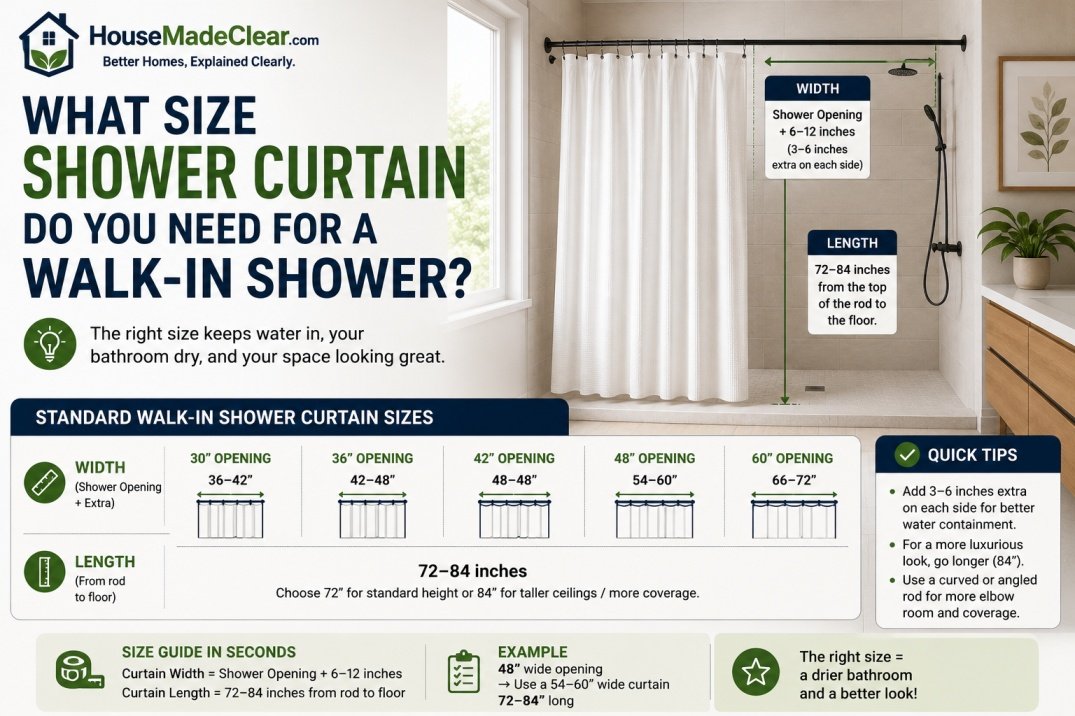
Choosing a shower curtain for a walk-in shower is different from buying one for a standard bathtub.
A bathtub gives the curtain a raised wall to hang inside. A walk-in shower may instead have:
- A low curb
- A shallow threshold
- No curb at all
- A wide open entrance
- A partial glass panel
- A ceiling-mounted track
- An unusually tall opening
Because of that, there is no single “standard” walk-in shower curtain size that works for every bathroom.
The right curtain should be wide enough to cover the opening with some overlap and long enough to keep shower spray inside without dragging excessively on the shower floor.
Quick Answer
For a walk-in shower, measure the actual opening width and the distance from the curtain rod to the desired bottom position before buying.
As a practical starting point:
- 36-inch shower opening: consider roughly 48–54 inches of curtain width
- 48-inch opening: consider roughly 54–60 inches or more
- 60-inch opening: a 72-inch-wide curtain is often a useful starting point
- Wide walk-in shower: consider an 84-, 108-inch or other extra-wide curtain
For length, common options include:
- 72 inches — standard length
- 78 inches — longer stall/walk-in setup
- 84 inches — extra-long
- 96 inches — very tall installation
The curtain should hang close enough to the shower floor or curb to contain water but should not pile heavily on the floor.
The best fit comes from measuring your own shower rather than choosing a curtain simply because it is labeled “standard.”
What Size Shower Curtain Do You Need for a Walk-In Shower?
The ideal size depends on two measurements:
- Shower opening width
- Rod-to-bottom height
For width, you want enough material to:
- Cover the entire opening
- Overlap the sides
- Form gentle folds
- Stay closed while showering
For length, you want the curtain to:
- Reach low enough to contain splash
- Stay inside the shower area
- Avoid excessive pooling
- Dry reasonably well after use
This is why a walk-in shower curtain should be sized for the actual shower geometry, not for a bathtub standard.
Standard Shower Curtain vs Walk-In Shower Curtain
A common standard shower curtain measures approximately:
72 inches wide × 72 inches long
That size works well for many traditional bathtub/shower combinations.
But a walk-in shower may need something different.
| Shower Type | Common Starting Curtain Size |
|---|---|
| Standard tub/shower | Around 72 × 72 in |
| Narrow shower stall | Around 54 × 78 in |
| Small walk-in shower | Around 54–72 in wide |
| Tall walk-in shower | 72 × 78 or 72 × 84 in |
| Wide walk-in shower | 84–108+ in wide |
| Very tall custom shower | 84–96 in long |
These are starting points, not universal requirements.
If you need a broader overview of common curtain dimensions first, see House Made Clear’s guide to standard shower curtain measurements.
How to Measure a Walk-In Shower for a Curtain
You need three measurements:
1. Opening Width
Measure horizontally across the area the curtain needs to cover.
For example:
Opening = 48 inches
Do not automatically buy a 48-inch curtain.
You usually want additional width so the curtain is not pulled completely flat.
2. Rod Height
Measure vertically from the planned curtain rod or track to the shower floor or curb.
3. Desired Bottom Clearance
Decide where you want the curtain or liner to finish.
For a curbless shower, you may want the curtain close to the floor while still avoiding excessive contact.
For a shower with a curb, the liner may hang inside the curb.
How Much Wider Should the Curtain Be Than the Shower Opening?
A useful starting point is to add roughly:
10–20% or around 8–12 inches
to the shower opening width for many simple installations.
This gives the curtain enough material for:
- Side overlap
- Folds
- Movement
without creating excessive bulk.
Example
Opening:
60 inches
Curtain:
72 inches
Extra material:
72 − 60 = 12 inches
That is often enough for a conventional opening.
Do Walk-In Shower Curtains Need 2x Fullness?
Usually not.
The 1.5–2× fullness rule often used for decorative window curtains is not normally necessary for a shower curtain.
Too much fullness can create:
- Excess wet fabric
- More folds
- Slower drying
- More opportunity for mildew
For a shower, the goal is functional coverage rather than decorative drapery fullness.
What Size Shower Curtain for a 36-Inch Walk-In Shower?
For a 36-inch opening, a curtain around:
48–54 inches wide
may be a practical starting point.
This gives:
- 12–18 inches of extra material
- Side coverage
- Gentle folds
A full 72-inch-wide curtain can still work, but it may create more fabric than necessary in a very narrow shower.
Length
Length depends on:
- Rod height
- Shower curb
- Floor clearance
A narrow stall often uses a longer curtain such as:
54 × 78 inches
which can work particularly well in taller shower enclosures.
What Size Shower Curtain for a 42-Inch Walk-In Shower?
For a 42-inch opening, consider approximately:
54–60 inches wide
depending on how much side overlap you want.
If the curtain is very light, slightly more width can help maintain coverage.
For a heavier curtain, too much extra material may be unnecessary.
What Size Shower Curtain for a 48-Inch Walk-In Shower?
For a 48-inch opening, a useful starting curtain width is:
54–60 inches
A 72-inch curtain can also work if:
- The opening is deep
- More overlap is useful
- You do not mind additional folds
But it may be wider than necessary.
The best approach is to test how the curtain will gather.
What Size Shower Curtain for a 54-Inch Walk-In Shower?
For a 54-inch opening:
60–72 inches wide
is a reasonable range.
A standard 72-inch-wide curtain gives:
72 − 54 = 18 inches of extra width
That allows good side overlap.
For many homeowners, this is an easy size because 72-inch curtains are widely available.
What Size Shower Curtain for a 60-Inch Walk-In Shower?
A 72-inch-wide shower curtain is commonly a strong starting point for a 60-inch opening.
That gives approximately:
12 inches of extra width
which is enough for gentle folds and edge coverage.
This is one reason the standard 72-inch curtain remains useful even outside a bathtub installation.
What Size Shower Curtain for a 72-Inch Walk-In Shower?
For a 72-inch opening, a standard 72-inch curtain would generally be too tight.
The curtain would have little or no extra fabric.
A better choice may be:
84–96 inches wide
or more.
For a large shower, an extra-wide shower curtain can provide:
- Better closure
- Side overlap
- More comfortable movement
What Size Shower Curtain for an Extra-Wide Walk-In Shower?
If your shower opening is wider than 72 inches, you may need:
- 84-inch-wide curtain
- 96-inch-wide curtain
- 108-inch-wide curtain
- Multiple panels
An 108-inch-wide shower curtain is commonly used for large openings and specialty setups.
Measure carefully before buying because extra-wide curtains can create a lot of fabric if the opening is not truly large.
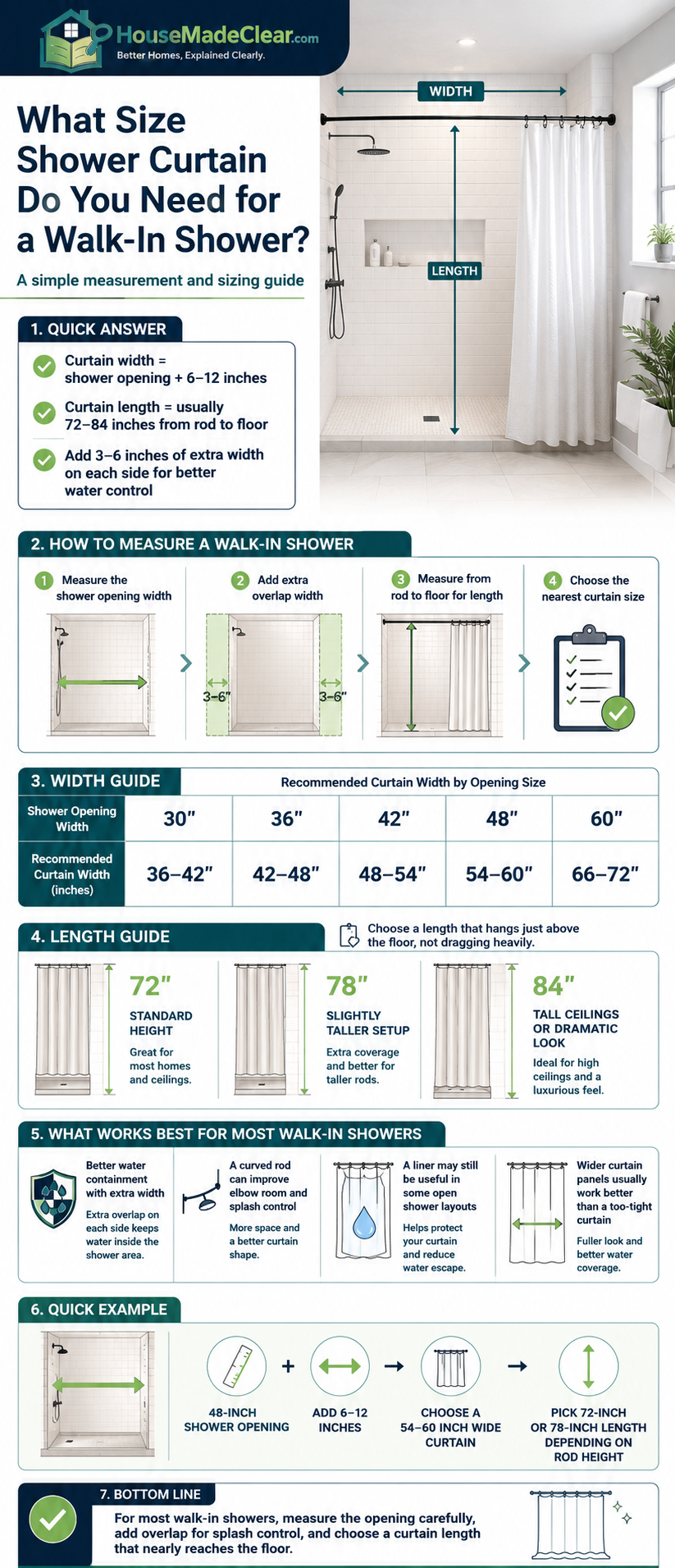
Shower Curtain for Walk-In Shower: Width Chart
| Walk-In Shower Opening | Suggested Curtain Width Starting Point |
|---|---|
| 30 in | 42–48 in |
| 36 in | 48–54 in |
| 42 in | 54–60 in |
| 48 in | 54–60+ in |
| 54 in | 60–72 in |
| 60 in | Around 72 in |
| 66 in | 78–84 in |
| 72 in | 84–96 in |
| 84 in | 96–108 in |
| 96 in | 108+ in |
These are practical starting ranges.
Shower design and splash pattern may require more or less coverage.
How Long Should a Walk-In Shower Curtain Be?
Walk-in shower curtain length depends mainly on rod height and the shower base.
Common lengths include:
- 72 inches
- 74 inches
- 78 inches
- 84 inches
- 96 inches
A walk-in shower often benefits from a longer curtain than a bathtub setup because there is no tall tub wall to provide additional water containment.
Is 72 Inches Long Enough for a Walk-In Shower?
Sometimes.
A 72-inch curtain can work when:
- Rod is mounted at an appropriate height
- Shower has a curb
- Curtain reaches sufficiently low
- Water spray is well contained
If the rod is mounted high or the shower is curbless, 72 inches may be too short.
Measure before ordering.
When Should You Use a 78-Inch Shower Curtain?
A 78-inch curtain gives you:
6 more inches
than the standard 72-inch length.
It can be useful for:
- Shower stalls
- Walk-in showers
- Higher rods
- Low-curb showers
A 78-inch curtain often offers a good middle ground between standard and extra-long lengths.
When Should You Use an 84-Inch Shower Curtain?
A 72 × 84-inch curtain can work well in a taller walk-in shower.
It may be useful when:
- Rod is mounted higher
- Ceiling is tall
- You want more vertical coverage
- A 72-inch curtain leaves too much space below
Before buying, calculate rod height carefully.
House Made Clear’s guide to how high a shower curtain rod should be explains how curtain length, hook drop and floor clearance work together.
When Should You Use a 96-Inch Shower Curtain?
A 96-inch shower curtain is designed for unusually tall installations.
It may suit:
- High ceilings
- Near-ceiling rods
- Custom walk-in showers
- Ceiling tracks
But extra-long does not automatically mean better.
If too much curtain pools on the shower floor, it can:
- Stay wet longer
- Collect soap residue
- Be harder to clean
Should a Walk-In Shower Curtain Touch the Floor?
Usually, the curtain should come close to the shower floor without unnecessarily pooling on it.
A small gap may work in some showers.
In others, especially curbless showers, the curtain may need to hang closer to the floor to contain splash.
The correct bottom position depends on:
- Showerhead direction
- Floor slope
- Drain location
- Curb height
- Water pressure
How Far Off the Floor Should a Walk-In Shower Curtain Be?
There is no single universal gap.
A practical range might be:
around 1–2 inches above the shower floor
in many installations.
However, a very splash-prone shower may need the liner slightly lower.
The best test is simple:
Run the shower.
If water is escaping under the curtain, the curtain may be:
- Too short
- Too high
- Too far outside the shower
Should the Shower Liner Touch the Floor?
The shower liner for a walk-in shower should generally extend low enough to keep water inside but does not need to pile on the floor.
If it is too long:
- It stays wet
- It may cling to feet
- It collects residue
If it is too short:
- Water can escape underneath
Aim for functional containment rather than a decorative floor-length appearance.
Curbed vs Curbless Walk-In Shower Curtains
The presence of a curb changes the sizing strategy.
Walk-In Shower With a Curb
The liner can hang:
inside the curb
This gives you a physical barrier to help contain water.
You usually have slightly more tolerance for bottom clearance.
Curbless Walk-In Shower
A curbless shower has no raised edge.
That means curtain:
- Length
- Position
- Floor slope
become more important.
You may need the liner closer to the floor.
The shower’s drainage design also matters.
Best Curtain Length for a Curbless Shower
For a curbless shower, measure from the rod to:
roughly 1 inch above the shower floor
as a starting point.
Then account for:
- Hook drop
- Actual splash
- Floor slope
Do not leave a large bottom opening if water regularly reaches the curtain.
Should a Walk-In Shower Use a Curtain or Liner?
You can use:
Shower Curtain Only
If the curtain is designed for direct water exposure.
Liner Only
If you prefer a simple functional setup.
Curtain + Liner
Best when the outer curtain is:
- Decorative
- Fabric
- Absorbent
If you are unsure whether you need both, see House Made Clear’s detailed comparison of shower curtain vs liner.
Shower Curtain Ideas for Walk-In Showers
The best shower curtain ideas for walk-in showers should balance style with water control.
Here are several useful options.
1. Extra-Long Curtain
Creates a taller appearance and provides more coverage.
2. Neutral Fabric Curtain + Waterproof Liner
Good when you want a softer decorative look.
3. Clear or Frosted Liner
Keeps the shower visually open.
4. Extra-Wide Curtain
Best for larger openings.
5. Ceiling-Mounted Curtain Track
Useful for:
- Open showers
- L-shaped enclosures
- Custom layouts
6. Curved Rod
Creates more elbow room.
7. Double Curtain Panels
Useful for wide openings where a single curtain becomes difficult to manage.
Walk-In Shower Curtain Ideas for Small Bathrooms
For a small bathroom, visually light materials can help the room feel less enclosed.
Consider:
- White
- Light neutral
- Frosted
- Simple patterns
A curtain that is too heavy or dark can visually reduce the space.
However, privacy and personal preference still matter.
Walk-In Shower Curtain Ideas for Large Bathrooms
A large bathroom gives you more freedom.
You can consider:
- Extra-wide fabric curtains
- Taller installations
- Ceiling-mounted tracks
- Two-panel systems
- Bold patterns
But keep the wet-side liner functional.
A beautiful curtain that does not contain water is not a successful shower solution.
Should You Use One Curtain or Two Panels?
For a normal walk-in shower, one curtain is usually easiest.
Two panels can make sense when:
- Opening is very wide
- Curtain opens from center
- You want a symmetrical look
But two panels introduce a center seam.
Make sure:
- Panels overlap adequately
- Water does not escape through the middle
Can You Use Regular Curtains for a Walk-In Shower?
Ordinary window curtains are generally not designed for constant exposure to shower moisture.
Even if they are the correct size, they may:
- Absorb water
- Dry slowly
- Lack appropriate grommets
- Develop mildew
If you want a fabric appearance, choose a shower curtain made for bathroom use and pair it with a waterproof liner where appropriate.
Best Material for a Walk-In Shower Curtain
The best material depends on whether you are using a separate liner.
Polyester
Popular because it can be:
- Washable
- Lightweight
- Decorative
- Quick drying
Some polyester curtains can work without a liner depending on their design.
Cotton
Attractive and soft but more absorbent.
Usually better with a liner.
Linen
Decorative and textured.
Generally best with a liner.
PEVA/EVA
Common for water-resistant or waterproof liners.
Vinyl
Traditional liner material.
Follow product-specific care instructions.
Is Polyester Good for Walk-In Showers?
Yes, polyester is a practical choice.
It can work particularly well because many polyester shower curtains are:
- Easy to wash
- Relatively quick drying
- Available in many sizes
But not every polyester curtain is intended to be liner-free.
Check manufacturer instructions.
What About a Waterproof Shower Curtain?
A waterproof curtain can simplify the system.
If designed for direct shower use, you may not need:
- Decorative curtain
- Separate liner
This can be particularly useful in:
- Small bathrooms
- Guest bathrooms
- Minimalist setups
The curtain still needs the correct width and length.
Do Walk-In Shower Curtains Need Weights?
Not always, but weighted hems can help reduce movement.
A lightweight liner may:
- Blow inward
- Move away from curb
- Allow water to escape
Weights or magnets can help keep the bottom in position.
However, magnets only work as intended with compatible surfaces or curtain designs.
Should a Walk-In Shower Curtain Be Inside the Shower?
Yes, the water-managing layer should hang inside the wet area while the shower is running.
If using two layers:
Liner → inside shower
Decorative curtain → outside
This allows water to run down into the shower rather than onto the bathroom floor.
Where Should the Curtain Rod Be Placed?
The rod should position the curtain so it falls naturally inside or along the shower threshold.
For a straight walk-in shower:
- Align the rod with the opening
- Avoid placing it too far outward
- Keep liner within the wet zone
If the rod is too far outside:
Water running down the curtain may reach the bathroom floor.
How High Should the Rod Be?
The correct height depends on curtain length.
Use:
Curtain length + hook drop + desired bottom clearance = approximate rod height
For example:
84-inch curtain
- 1-inch hook drop
- 1-inch floor clearance
= 86-inch rod height
Do not automatically use the same 75–77-inch rod height commonly used with 72-inch bathtub curtains.
Tension Rod vs Fixed Rod for a Walk-In Shower
Tension Rod
Advantages:
- Easy to install
- Adjustable
- Useful for rentals
- Easy to test placement
Limitations:
- Requires two opposing walls
- May not suit wide openings
Fixed Rod
Advantages:
- More secure
- Better for permanent installations
- Works well with curved rods
Limitations:
- Requires drilling
- Harder to move after installation
Can You Use a Curved Rod for a Walk-In Shower?
Yes, in suitable layouts.
A curved rod can increase shoulder and elbow space.
But the curve changes where the curtain hangs.
Make sure:
- Center stays over wet area
- Ends remain positioned correctly
- Curtain width is sufficient
A curved rod may require slightly more curtain width than a straight rod.
Ceiling-Mounted Curtain Tracks for Walk-In Showers
A ceiling track is useful when:
- There are no opposing walls
- Shower is open on multiple sides
- You need an L-shaped or U-shaped enclosure
These systems can use:
- One large curtain
- Several panels
Measure the complete track length rather than just the front opening.
L-Shaped Walk-In Shower Curtain
An L-shaped curtain arrangement may be useful for corner showers.
For example:
Front side:
60 inches
Open side:
36 inches
Total track:
96 inches
You may therefore need:
108 inches or more
of total curtain width depending on overlap.
U-Shaped Shower Curtain
A U-shaped track may surround three sides of the shower.
In that case, measure:
Side A + front + Side B
Then add extra width for folds and overlap.
A standard 72-inch curtain will rarely be enough for this type of setup.
How to Measure a Ceiling Shower Track
Measure along the entire path of the track.
Do not measure:
- Straight across
- Wall to wall
if the track curves.
For a curved or U-shaped track, use a flexible measuring tape along the approximate path of the curtain.
How Much Overlap Should a Walk-In Shower Curtain Have?
At the side edges, aim for enough overlap that shower spray cannot easily escape.
A few inches on each side is often useful.
For a center-opening two-panel system, allow the panels to overlap in the center as well.
Avoid creating an exact edge-to-edge fit.
What if the Shower Curtain Is Too Narrow?
Signs include:
- Gaps at sides
- Curtain pulled completely flat
- Water escaping
- Curtain opening during shower
Solutions:
- Wider curtain
- Two panels
- Reposition rod
What if the Shower Curtain Is Too Wide?
A curtain can also be excessively wide.
Signs include:
- Large amount of bunching
- Slow drying
- Bulky folds
- Fabric gathering on floor
A little fullness is good.
Excessive fullness is unnecessary.
What if the Shower Curtain Is Too Short?
Signs:
- Water escapes under curtain
- Liner barely reaches curb
- Large visible bottom gap
Solutions:
- Lower rod if appropriate
- Longer curtain
- Longer liner
What if the Shower Curtain Is Too Long?
Signs:
- Curtain pools on floor
- Liner stays wet
- Bottom collects residue
Solutions:
- Raise rod
- Use shorter curtain
- Hem suitable fabric curtains
Do not cut plastic liners unless the product is designed for modification.
Walk-In Shower Curtain and Bathroom Humidity
A walk-in shower often releases significant moisture into the bathroom.
The curtain does not remove humidity.
After showering:
- Spread the curtain
- Run the exhaust fan
- Allow liner to dry
- Keep bathroom ventilated
House Made Clear’s guide to how long to run a bathroom fan after a shower explains why ventilation should continue after the water stops.
Why Curtain Drying Matters
A wet curtain left bunched together dries slowly.
This can contribute to:
- Odor
- Soap buildup
- Mildew
Spread it across the rod after use.
If buildup does appear, our guide to how to clean a shower curtain and liner explains cleaning methods for fabric, polyester, PEVA and other liner materials.
Walk-In Shower Curtain and Mold Prevention
Mold prevention is largely a moisture-control issue.
To reduce persistent dampness:
- Spread curtain
- Run fan
- Keep liner from pooling
- Check bathroom humidity
- Clean residue regularly
If your bathroom remains humid for hours after showering, see House Made Clear’s guide to bathroom humidity after a shower.
How to Choose the Right Walk-In Shower Curtain
Use this process.
Step 1: Measure Opening Width
Record the exact width.
Step 2: Decide How Much Extra Width You Need
Add enough for:
- Overlap
- Gentle folds
Step 3: Measure Rod-to-Floor Height
Or measure to the desired bottom position.
Step 4: Choose Curtain Length
Select the closest available size that reaches the correct point.
Step 5: Decide Whether You Need a Liner
Fabric curtains usually benefit from one.
Step 6: Check Rod Type
Straight?
Curved?
Track?
Step 7: Test Water Containment
Run the shower.
Check for:
- Side leakage
- Bottom leakage
- Excess movement
Walk-In Shower Curtain Size Examples
Example 1: Small Curbed Shower
Opening:
36 inches
Rod height:
80 inches
Possible curtain:
54 × 78 inches
depending on hook drop and curb position.
Example 2: Standard 60-Inch Walk-In Shower
Opening:
60 inches
Rod height:
76 inches
Possible curtain:
72 × 72 inches
if bottom position works.
Example 3: Tall Walk-In Shower
Opening:
60 inches
Rod height:
88 inches
Possible curtain:
72 × 84 inches
depending on hook drop.
Example 4: Wide Shower
Opening:
84 inches
Rod height:
76 inches
Possible curtain:
108 × 72 inches
for additional width.
Example 5: Curbless Shower
Opening:
60 inches
Rod-to-floor:
85 inches
Possible curtain:
72 × 84 inches
depending on hardware and desired floor clearance.
Walk-In Shower Curtain Size Checklist
Before ordering:
- Opening width measured
- Rod height measured
- Curb height checked
- Curbless design considered
- Extra width added
- Desired floor clearance chosen
- Hook drop measured
- Liner requirement decided
- Curtain material chosen
- Rod type considered
- Curved-rod projection checked
- Floor slope considered
- Showerhead direction considered
- Side overlap planned
- Curtain can dry freely
Common Walk-In Shower Curtain Mistakes
1. Buying 72 × 72 Automatically
Problem:
Walk-in shower may be wider, taller or narrower.
Better approach:
Measure.
2. Buying a Curtain Exactly as Wide as the Opening
Problem:
No overlap.
Better approach:
Add useful extra width.
3. Leaving Too Much Gap at Bottom
Problem:
Water escapes.
Better approach:
Use longer curtain or adjust rod.
4. Letting Curtain Pool on Floor
Problem:
Slow drying.
Better approach:
Raise rod or shorten curtain.
5. Ignoring Curbless Design
Problem:
No barrier to stop water.
Better approach:
Size liner carefully.
6. Using Decorative Fabric Without a Liner
Problem:
Fabric repeatedly becomes soaked.
Better approach:
Use appropriate wet-side liner.
7. Buying Too Much Width
Problem:
Curtain bunches excessively.
Better approach:
Use moderate fullness.
8. Forgetting Hook Drop
Problem:
Curtain hangs lower than expected.
Better approach:
Include rings in height calculation.
9. Mounting Rod Too Far Outside
Problem:
Water drains outside shower.
Better approach:
Keep water-managing layer over wet area.
10. Ignoring Ventilation
Problem:
Curtain stays damp.
Better approach:
Use exhaust ventilation and spread curtain.
Walk-In Shower Curtain vs Glass Door
Some homeowners choose curtains instead of glass because they can be:
- Less expensive
- Easier to replace
- Easier to clean in some setups
- More flexible
- Better for unusual openings
Glass may provide:
- More permanent appearance
- Better fixed water barrier
- Less moving fabric
Neither is universally better.
A shower curtain is especially useful when you want:
- Flexibility
- Lower installation complexity
- Easy style changes
Can a Curtain Make a Walk-In Shower Look Good?
Absolutely.
A walk-in shower curtain can look intentional rather than temporary.
Good design choices include:
- Correct length
- Proper rod height
- Neutral colors
- Coordinated hardware
- Full-width coverage
One of the biggest visual mistakes is simply using a curtain that is obviously too short.
A properly sized curtain usually looks more finished.
Should a Walk-In Shower Curtain Be Floor Length?
Visually, near-floor length can work well.
Functionally, it should stop just before excessive floor contact.
Think of the ideal result as:
long enough to contain water, short enough to dry
rather than treating it like a bedroom window curtain.
Extra-Long Walk-In Shower Curtains
Extra-long curtains can be especially useful with:
- Tall ceilings
- Ceiling tracks
- High rods
- Modern bathrooms
Common lengths include:
- 78 inches
- 84 inches
- 96 inches
Before choosing one, check your rod height.
Do not buy extra-long simply because the ceiling is tall.
Extra-Wide Walk-In Shower Curtains
Extra-wide curtains can be useful for:
- Wide entrances
- Curved tracks
- L-shaped tracks
- Freestanding shower areas
Common widths may include:
- 84 inches
- 96 inches
- 108 inches
- 120 inches
Availability varies by manufacturer.
What Size Shower Curtain Do You Need for a Walk-In Shower?
The short answer is:
Measure the opening and add enough width for overlap. Then measure from the rod to the desired bottom position to select the length.
A useful starting point is:
36-Inch Opening
48–54 inches wide
48-Inch Opening
54–60+ inches wide
60-Inch Opening
around 72 inches wide
72-Inch Opening
84–96 inches wide
84-Inch Opening
96–108 inches wide
For height:
- 72 inches = standard
- 78 inches = long
- 84 inches = extra long
- 96 inches = very tall
The exact size should always follow the actual shower.
Final Thoughts
Choosing a shower curtain for a walk-in shower requires a little more planning than buying one for a standard bathtub.
There is no universal walk-in shower curtain size because walk-in showers vary in:
- Width
- Height
- Curb design
- Floor slope
- Rod placement
Start by measuring the opening.
Then add enough width for:
- Side coverage
- Overlap
- Gentle folds
For many showers:
60-inch opening → approximately 72-inch-wide curtain
is a useful starting point.
For narrow stalls:
54 × 78 inches
may work well.
For larger openings:
84-, 96- or 108-inch-wide curtains
may provide better coverage.
Length should be chosen from the rod downward, not simply from ceiling height.
If you are comparing basic curtain sizes, see our standard shower curtain measurements guide.
Once you know the curtain length, use the shower curtain rod height guide to position it correctly.
And if you are deciding whether your walk-in setup needs one or two layers, our shower curtain vs liner guide explains the difference.
The best walk-in shower curtain is ultimately the one that:
covers the opening, contains water, dries properly and fits the bathroom without unnecessary bulk.
Frequently Asked Questions
What size shower curtain do I need for a walk-in shower?
Measure the shower opening and choose a curtain that is wider than the opening so it has enough overlap and gentle folds. For example, a 60-inch opening commonly works well with a curtain around 72 inches wide. Measure rod-to-floor distance separately to determine length.
What size shower curtain should I use for a 60-inch walk-in shower?
A 72-inch-wide shower curtain is a useful starting point for a 60-inch opening because it provides about 12 extra inches for side coverage and folds.
What size shower curtain should I use for a 48-inch walk-in shower?
A curtain around 54–60 inches wide may work well for a 48-inch opening. A 72-inch curtain can also work if you prefer more fullness or need additional overlap.
What size shower curtain should I use for a 36-inch shower?
For a 36-inch shower opening, approximately 48–54 inches of curtain width is a practical starting range. Many narrow shower stalls use curtains around 54 × 78 inches.
How long should a walk-in shower curtain be?
Common lengths include 72, 78, 84 and 96 inches. Measure from the curtain rod to the desired bottom position and choose the closest suitable length rather than assuming every walk-in shower uses a 72-inch curtain.
Should a walk-in shower curtain touch the floor?
It should usually hang close enough to the shower floor to contain splash without excessive material pooling on the surface. A small clearance of around 1–2 inches can work in many installations, but the exact position depends on the shower design.
Do I need a liner for a walk-in shower curtain?
If the decorative curtain is absorbent fabric or not designed for direct water exposure, using a liner is recommended. A waterproof or suitable liner-free curtain may be used by itself.
What size shower curtain do I need for a curbless shower?
Measure the opening width and the distance from the rod to approximately the desired floor clearance. Curbless showers often need the curtain or liner to hang closer to the floor because there is no raised tub wall or curb to contain water.
Can you use a standard 72 × 72 shower curtain for a walk-in shower?
Yes, if the opening and rod height suit that size. A 72 × 72-inch curtain often works well for openings around 60 inches wide, but taller, narrower or wider walk-in showers may need a different size.
What is an extra-wide shower curtain size?
Extra-wide shower curtains commonly start around 84–108 inches wide, with even wider options available for custom openings, curved tracks and specialty shower layouts.
Is a 78-inch shower curtain better for a walk-in shower?
A 78-inch curtain can be useful when the rod is higher or when the shower has a lower curb than a bathtub. Whether it is better depends on the actual rod-to-floor measurement.
Can I use two shower curtain panels for a walk-in shower?
Yes. Two panels can work well for very wide openings or center-opening layouts. Make sure the panels overlap sufficiently in the center so water cannot easily escape through the gap.