










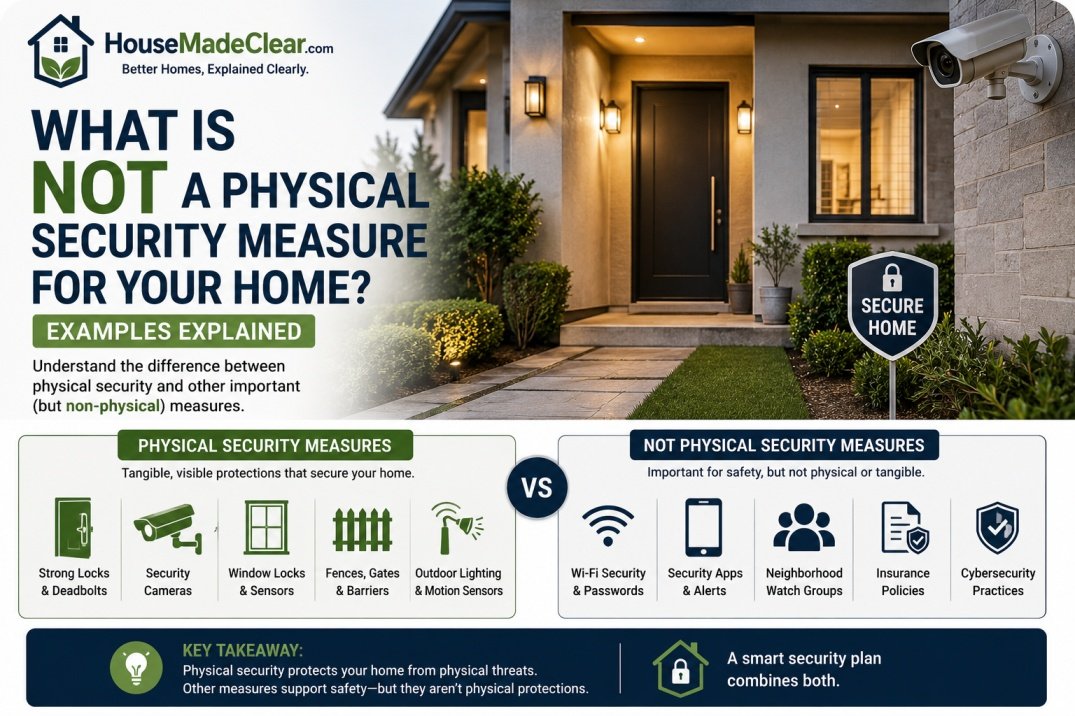
Home security includes much more than locks, cameras and alarm sensors.
Passwords, insurance, neighborhood communication, monitoring services and everyday security habits can all help protect a household—but they do not necessarily perform the same job as a physical security measure.
That distinction is important if you are trying to understand how different layers of home security work together.
It is also particularly relevant because the exact question “What is not a physical security measure for your home?” appears in versions of Level I Antiterrorism Awareness Training.
Quick Answer
If you are looking for the answer to the Level I Antiterrorism residential-security question, the official training material identifies:
“Hiding a key outside to ensure family members can get in if they lose their keys”
as the choice that is not a physical security consideration for your home.
For homeowners asking the broader question, physical security generally refers to measures that physically protect, control access to, deter activity around, or help detect activity at the property. Examples include locks, secured doors and windows, alarms, exterior lighting and cameras. CISA includes these types of measures in its home physical-security guidance.
Measures such as cybersecurity passwords, insurance policies and some monitoring or administrative services can still be valuable—but they serve different security functions.
The key takeaway is that “not physical” does not mean “not useful.”
A strong home-security strategy normally combines several layers rather than relying entirely on one category.
What Does Physical Security Mean for a Home?
Physical security is concerned with protecting:
- People
- Property
- Buildings
- Entry points
- Physical assets
against unauthorized access, theft, damage or other unwanted activity.
At home, this generally includes measures associated with the property itself.
CISA’s home physical-security guidance recommends measures such as securing doors and windows with locks, using alarms and lighting, considering surveillance cameras, maintaining fences and other property structures, and controlling keys or entry codes.
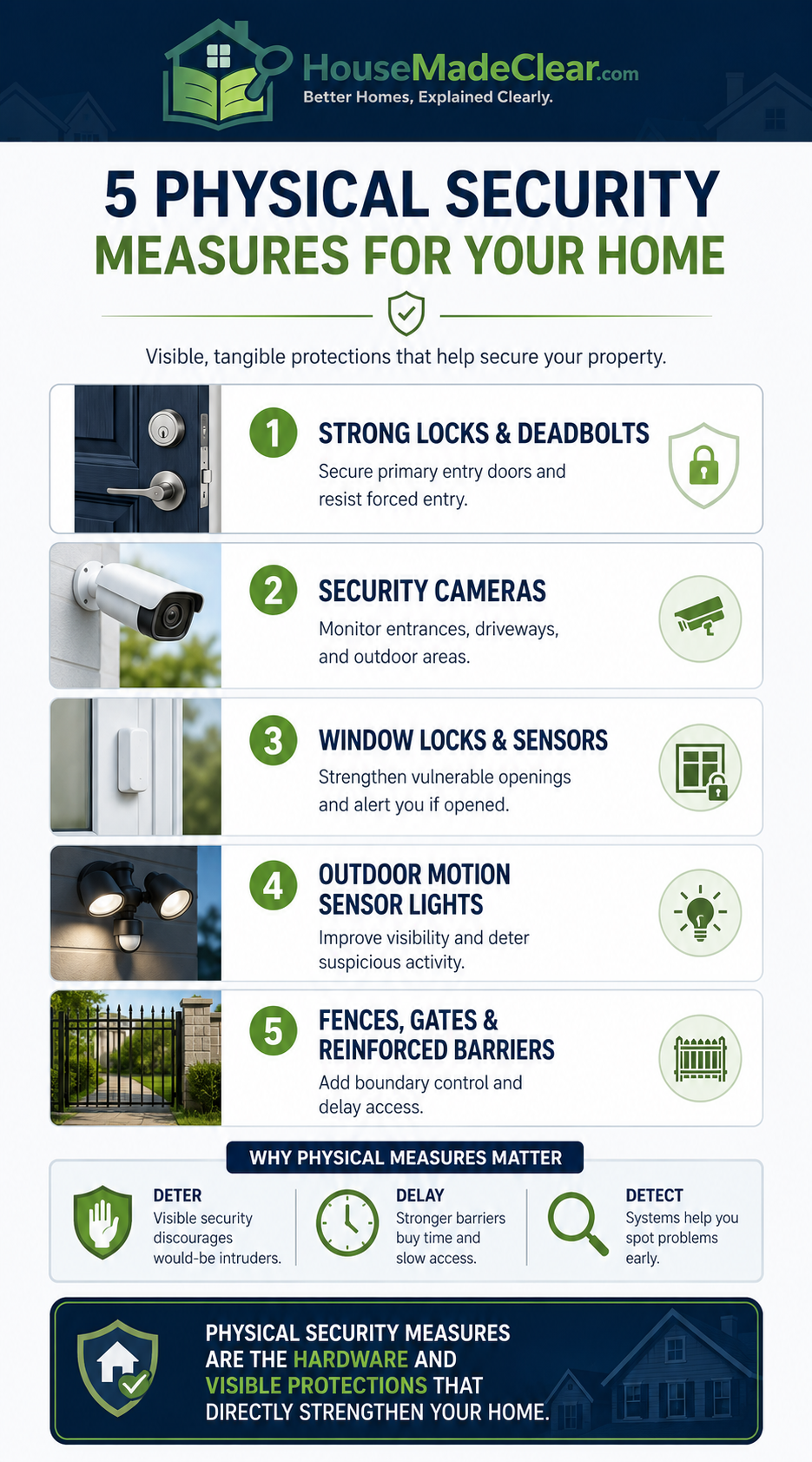
Common examples therefore include:
- Deadbolts
- Exterior-door locks
- Window locks
- Door reinforcement
- Gates and fences
- Alarm sensors
- Security cameras
- Outdoor security lighting
These measures perform different functions, but they all interact directly with the home’s physical environment.
What Is Not a Physical Security Measure for Your Home?
The answer depends somewhat on the context in which the question is being asked.
If You Mean the Antiterrorism Training Question
The official Level I Antiterrorism training material asks:
“What is not a physical security consideration for your home?”
Among the listed choices, the training identifies hiding a key outside so family members can get inside if they lose their keys as the incorrect security practice.
That makes sense from a practical security perspective.
Hiding a working key outside can undermine the access control provided by the lock because anyone who finds the key may be able to use it.
If You Mean Physical Security as a General Home-Security Category
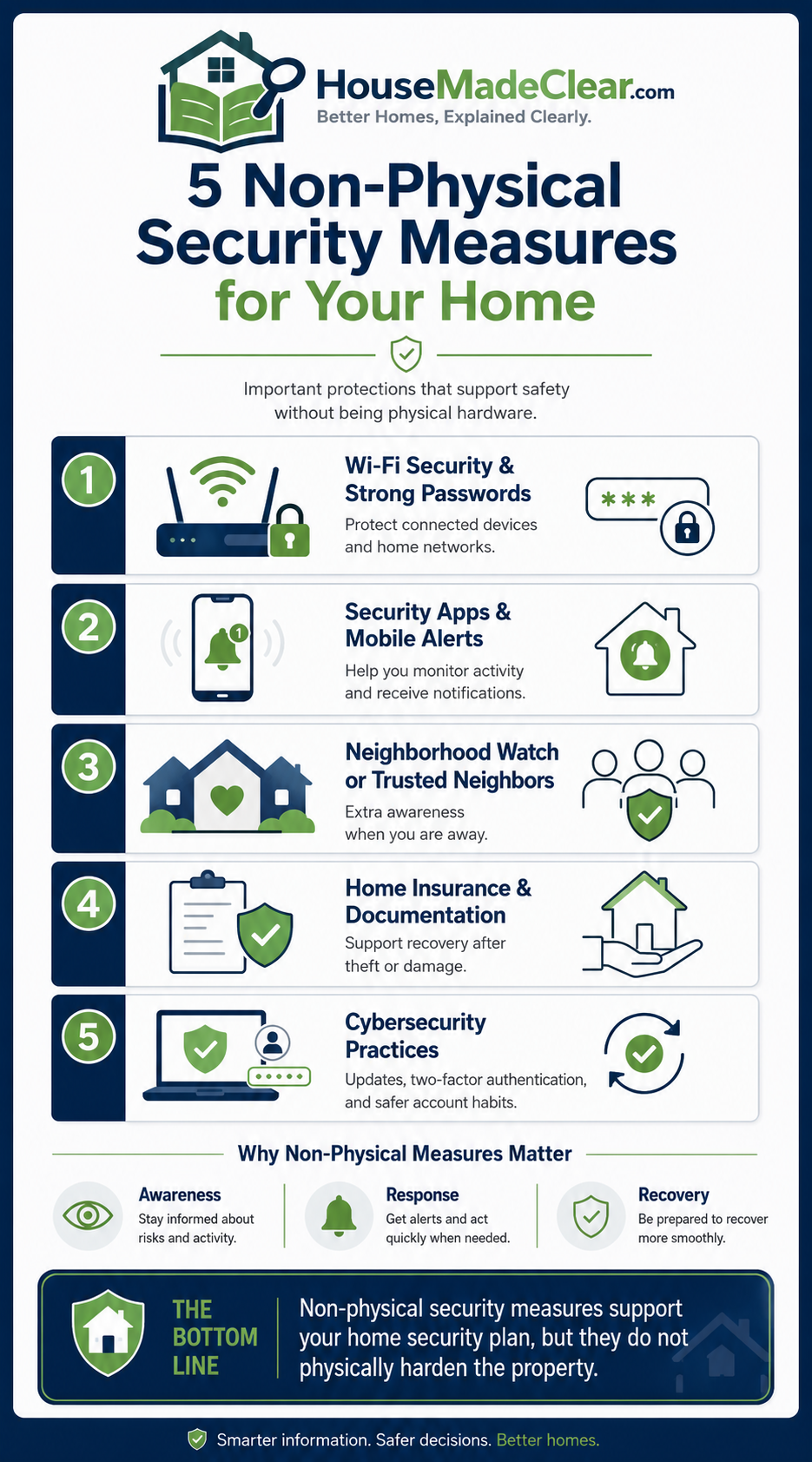
Several useful precautions are not themselves physical barriers or physical security hardware.
Examples may include:
- Online account passwords
- Multifactor authentication
- Homeowners or renters insurance
- Monitoring-service subscriptions
- Security education
- Emergency planning
- Some neighborhood communication systems
These measures can reduce other forms of risk or improve the response to an incident, but they do not replace the physical protection provided by doors, locks, windows and other security hardware.
Why the Exact Training Question Causes Confusion
The wording of the training question can be confusing because some of the listed answers do not sound like pieces of physical hardware either.
The official training choices include activities such as:
- Changing locks to maintain key control
- Checking whether a cleaning company is reliable and licensed
- Monitoring internet acquaintances
- Maintaining good relationships with neighbors
- Hiding a spare key outdoors
Yet the highlighted answer is the hidden-key practice.
The lesson is broader than simply categorizing objects.
The training is discussing residential physical-security considerations, including behaviors that affect control of and access to the residence.
That is why it is important not to rewrite the official quiz question into a different question and then give a different answer.
Why Hiding a Spare Key Outside Is Poor Security Practice
A lock controls access only when the key is controlled.
If you hide a spare key:
- Under a doormat
- Beneath a planter
- Inside a fake rock
- Above the door
- Near the porch
you have effectively placed an access credential outside the secured area.
The problem is not that the key itself stops being physical security.
The problem is that poor key control weakens the lock’s security function.
CISA similarly advises securing spare keys or entry codes and considering changing the locking system when keys are lost or entry codes are compromised.
What Should You Do With a Spare Key Instead?
Depending on your situation, alternatives can include:
- Giving a spare to a trusted household member
- Giving one to a trusted nearby person
- Using an appropriately secured lockbox
- Using temporary smart-lock access
- Keeping an emergency spare in another controlled location
The best option depends on:
- Who needs access
- How often they need it
- Whether you use traditional or electronic locks
House Made Clear’s guide to improving home security with better locks explains key control, rekeying and smart-lock access in more detail.
Physical vs Non-Physical Home Security
A useful way to understand the distinction is to look at what each measure actually does.
| Security Measure | Physical Security? | Main Function |
|---|---|---|
| Deadbolt | Yes | Controls physical entry |
| Window lock | Yes | Secures window access |
| Reinforced door/frame | Yes | Strengthens entry point |
| Security camera | Yes, as security hardware | Detects/records activity |
| Motion sensor | Yes, as security hardware | Detects movement |
| Exterior security light | Yes | Improves visibility/deterrence |
| Fence/gate | Yes | Creates physical boundary |
| Password | No | Protects digital access |
| MFA | No | Strengthens digital account access |
| Insurance policy | No | Transfers/reimburses financial risk |
| Monitoring subscription | Service layer | Supports alarm response |
| Emergency plan | No | Guides household response |
| Neighborhood communication | Generally non-hardware support | Improves awareness |
The categories can overlap.
Modern home security increasingly combines:
physical equipment + digital controls + monitoring services + human behavior.
Locks Are a Clear Example of Physical Security
A door lock physically controls entry through an access point.
Examples include:
- Deadbolts
- Mortise locks
- Multipoint locks
- Smart deadbolts
Even a smart lock still has a physical locking mechanism.
Its electronics simply add another method of controlling it.
If you are strengthening exterior doors, start with how to improve home security with better locks.
Door Frames Are Part of Physical Security Too
A quality lock is only one component of the entrance.
Physical door security also depends on:
- Door slab
- Frame
- Strike
- Hinges
- Fasteners
- Proper alignment
Installing an expensive deadbolt on a damaged frame does not correct the damaged frame.
That is why House Made Clear treats the complete entry assembly as a security system rather than evaluating the lock alone.
Window Locks Are Physical Security Measures
Windows are also access points.
Depending on the window design, physical security can include:
- Working factory locks
- Appropriate supplementary hardware
- Properly maintained frames
The objective is to prevent easy unauthorized opening while preserving any required emergency-egress function.
Do not permanently block designated emergency-exit windows.
Security Cameras Are Physical Devices, but Their Accounts Are Digital
This is where the classification becomes more interesting.
The Camera
A camera installed on the property is physical security hardware.
It may:
- Observe
- Detect
- Record
- Notify
activity around the home.
CISA specifically includes cameras among the measures homeowners can consider when protecting doors and windows.
The Camera Account
The account used to manage a connected camera is digital.
Protecting that account involves:
- Password
- MFA
- Software updates
- Network security
These are cybersecurity measures rather than physical barriers.
One system therefore contains both physical and digital security layers.
Security Camera Placement Still Matters
Owning a camera does not automatically provide useful coverage.
Placement determines whether the camera can actually see:
- Front entrance
- Driveway
- Side passage
- Rear door
Poor positioning can leave important areas outside the field of view.
For practical placement guidance, see how to position home security cameras without creating blind spots.
Are Security Alarms Physical Security Measures?
The physical components can be.
Examples include:
- Door sensor
- Window sensor
- Motion detector
- Alarm panel
- Siren
These are installed physical devices.
The monitoring service connected to the alarm is somewhat different.
It is a service and response layer built around the physical detection system.
That distinction is useful when thinking about what your security system actually does.
Alarm Sensor vs Monitoring Subscription
Imagine a door opens unexpectedly.
Door Sensor
Detects that the physical door changed state.
Alarm Panel
Processes the event.
Siren
Creates an audible warning.
Monitoring Service
May receive the alarm signal and follow its response procedure.
The monitoring subscription did not physically stop the door from opening.
It supports the response layer.
Both can be useful without being the same type of control.
Exterior Lighting Is a Physical Security Measure
CISA recommends external lighting around doors, parking areas and walkways and suggests positioning lights and cameras to reduce blind spots.
Exterior lighting can improve:
- Visibility
- Camera usefulness
- Safe access
- Awareness around entrances
However, lighting should not be treated as a guarantee against burglary.
It supports the broader security system.
House Made Clear covers this distinction in Should You Leave Your Porch Light On at Night?.
Motion-Sensor Lights Are Physical Security Hardware
A motion-activated exterior light combines:
- Sensor
- Fixture
- Physical placement
Its value depends heavily on where it is installed.
Useful locations may include:
- Driveway
- Side path
- Garage
- Back entrance
- Gate
For placement strategy, see House Made Clear’s guide to outdoor motion sensor light placement.
Are Passwords Physical Security Measures?
No.
Passwords are digital or logical access controls.
They help protect:
- Smart-lock account
- Security-camera account
- Wi-Fi network
- Alarm application
but they do not physically reinforce:
- Door
- Window
- Fence
CISA’s digital-home guidance recommends protecting connected devices and home networks by changing default credentials and using MFA.
These are important security measures—just not the same type as a deadbolt.
Is Multifactor Authentication a Physical Security Measure?
Generally, no.
MFA is an account-security measure.
It makes access to a digital account dependent on more than a password alone.
For example, a smart-lock application may require:
- Password
- Additional verification
That helps protect the digital control system.
But the deadbolt inside the door remains the physical component.
Smart Locks Combine Physical and Digital Security
Smart locks are an excellent example of why modern home security does not fit neatly into only one category.
Physical Components
- Lock body
- Deadbolt
- Cylinder
- Strike
Digital Components
- Application
- Password
- Access codes
- Cloud account
- Firmware
So asking whether a smart lock is physical or digital produces an incomplete answer.
It is a physical lock with electronic and potentially networked access controls.
House Made Clear’s smart lock vs traditional deadbolt comparison covers those tradeoffs in more detail.
Is Homeowners Insurance a Physical Security Measure?
No.
Insurance is primarily a financial risk-management tool.
Depending on the policy, insurance may help cover certain losses after an eligible event.
But an insurance policy does not physically:
- Lock door
- Stop window opening
- Detect movement
- Illuminate driveway
That does not make insurance unimportant.
It simply performs a different function.
Insurance Does Not Replace Prevention
A household may need both:
Physical Security
Helps reduce or detect unauthorized access.
Insurance
Helps manage financial consequences if a covered loss occurs.
They should not be treated as interchangeable.
Is a Neighborhood Watch a Physical Security Measure?
Generally, the communication and observation activity itself is not a physical barrier.
However, it can support:
- Awareness
- Observation
- Reporting
- Community communication
The official Level I residential-security training even includes maintaining good relationships with neighbors and watching out for one another among its security considerations.
This illustrates an important point:
Good security involves people as well as hardware.
Is Checking a Cleaning Company a Physical Security Measure?
This is another useful example from the Level I training.
The official quiz includes confirming that a cleaning company is reliable and licensed among the residential-security considerations.
In ordinary security terminology, this is better understood as:
- Personnel screening
- Vendor management
- Access control practice
rather than a physical barrier like a deadbolt.
But it directly affects who may legitimately enter your home.
If a cleaner, contractor or service provider receives:
- Key
- Garage code
- Smart-lock code
then controlling that access becomes part of the household’s overall security strategy.
Security Habits Are Not Hardware, but They Matter
Consider two identical homes.
Both have:
- Good locks
- Cameras
- Lights
Home A
Residents consistently:
- Lock doors
- Manage keys
- Remove temporary codes
- Check alerts
Home B
Residents routinely:
- Leave doors unlocked
- Hide spare keys outside
- Share one access code with everyone
- Ignore low-battery warnings
The hardware may be identical.
The effective security is not.
Physical security depends on how people use it.
What Are Administrative Security Measures?
Administrative measures are rules, routines and procedures that help people use security systems correctly.
At home, examples can include:
- Keeping track of keys
- Removing old access codes
- Checking doors before leaving
- Deciding who receives temporary access
- Creating emergency procedures
These measures do not necessarily create physical barriers, but they can determine whether those barriers work as intended.
What Are Digital Security Measures?
Digital security protects connected systems and information.
Examples include:
- Strong unique passwords
- MFA
- Secure Wi-Fi
- Firmware updates
- Account monitoring
These have become increasingly relevant because homes now contain connected:
- Locks
- Cameras
- Doorbells
- Alarm systems
- Garage-door controllers
CISA recommends changing factory-default passwords and usernames on connected devices and enabling MFA where available.
Physical Security, Cybersecurity and Personal Security
A useful way to think about home protection is as three overlapping layers.
Physical Security
Protects physical property and entry points.
Examples:
- Locks
- Doors
- Windows
- Cameras
- Lighting
Cybersecurity
Protects connected technology.
Examples:
- Passwords
- MFA
- Network security
- Updates
Personal Security
Protects household members through:
- Awareness
- Planning
- Safe routines
- Communication
A modern security plan may use all three.
Physical Security Does Not Mean Crime Prevention Is Guaranteed
No physical security measure guarantees that an incident will never happen.
Instead, different controls can:
- Deter
- Delay
- Detect
- Document
- Control access
That distinction matters when evaluating products.
Avoid thinking:
“If I buy this lock, my home cannot be broken into.”
A better question is:
“What weakness does this measure address, and what layers are still missing?”
The Layered Home-Security Approach
Instead of expecting one device to solve everything, divide security into layers.
Layer 1: Property Boundary
Examples:
- Fence
- Gate
- Landscaping
- Lighting
Layer 2: Exterior Approach
Examples:
- Motion lighting
- Cameras
- Visible entrance
Layer 3: Entry Points
Examples:
- Locks
- Doors
- Windows
Layer 4: Detection
Examples:
- Door sensors
- Window sensors
- Motion detectors
Layer 5: Digital Controls
Examples:
- Smart-lock credentials
- MFA
- Camera account security
Layer 6: Household Procedures
Examples:
- Key control
- Guest-code removal
- Locking routine
- Emergency planning
Security becomes stronger when the layers complement one another.
Why One Expensive Security Device Is Not Enough
A common mistake is concentrating the entire budget on one product.
For example:
Expensive camera + weak back-door lock
or:
Premium smart lock + shared weak password
or:
Strong deadbolt + spare key under planter
Each system contains an obvious gap.
This is why House Made Clear’s guide to common home security mistakes emphasizes reviewing the whole property rather than focusing on a single gadget.
Physical Security Measures for the Front Door
Start with the main entrance.
Check:
- Door closes correctly
- Deadbolt operates smoothly
- Strike is secure
- Frame is undamaged
- Hinges are secure
- Keys are controlled
Then consider:
- Doorbell camera
- Entry lighting
- Smart access
The technology should come after the basic physical assembly works properly.
Physical Security Measures for the Back Door
Do not give the rear entrance less attention simply because guests rarely use it.
Check:
- Lock
- Frame
- Glass
- Lighting
- Visibility
A security plan should not have a strong front entrance and a neglected secondary entrance.
Physical Security Measures for Windows
Review:
- Existing locks
- Frames
- Accessibility from outside
- Vegetation
- Nearby climbing opportunities
CISA recommends maintaining vegetation so that it does not create hiding areas or help someone gain access to the residence.
Security improvements should preserve any required emergency exit.
Physical Security Measures Around the Yard
The property surrounding the house can also affect security.
Possible measures include:
- Fences
- Gates
- Exterior lighting
- Cameras
- Maintained landscaping
CISA advises securing tools and ladders that could potentially be used to access a residence and keeping vegetation maintained so it does not provide concealment or access assistance.
Is Landscaping a Physical Security Measure?
Landscaping itself is not necessarily a security device.
But landscaping decisions can support physical security.
For example:
A large shrub directly beside an entrance may create an area that is difficult to see.
Keeping sightlines clearer can improve:
- Visibility
- Camera coverage
- Awareness
This is an example of environmental design supporting physical security.
Are Security Signs Physical Security Measures?
A sign does not physically prevent entry.
It may communicate:
- Alarm presence
- Camera presence
- Property boundary
but it does not provide the same function as:
- Lock
- Gate
- Sensor
Think of signs primarily as communication or deterrence rather than a substitute for real security hardware.
Is a Dog a Physical Security Measure?
A dog may:
- Make noise
- Alert household
- Affect how an unfamiliar person approaches
but a pet should not be treated as a replacement for appropriate:
- Locks
- Doors
- Gates
- Alarms
Animal behavior varies and should not be the foundation of a residential-security system.
Is an Emergency Plan a Physical Security Measure?
No.
An emergency plan is a preparedness measure.
It tells household members:
- What to do
- Where to go
- Who to contact
if something happens.
It does not physically prevent an incident, but it can improve the household response.
CISA’s personal-security guidance also recommends developing a family emergency action plan.
Does DIY vs Professional Installation Change the Security Category?
No.
A lock remains a physical security measure whether:
- Homeowner installs it
- Locksmith installs it
What changes is the installation process and potentially the installation quality.
The same applies to:
- Cameras
- Sensors
- Lighting
For help deciding when DIY makes sense, see House Made Clear’s guide to DIY vs professional home security installation.
Common Misunderstandings About Physical Home Security
1. “Anything Related to Security Is Physical Security”
Not necessarily.
Passwords and insurance relate to security but perform different functions.
2. “Only Barriers Count”
Too narrow.
Detection devices such as cameras and sensors can also be components of a physical-security system.
3. “Smart Devices Are Only Cybersecurity”
Incorrect.
A smart lock has physical and digital components.
4. “A Camera Physically Stops Intruders”
Usually not.
Its primary functions are monitoring, detection and recording.
5. “Insurance Makes Physical Security Unnecessary”
No.
Insurance and physical protection solve different problems.
6. “A Hidden Spare Key Is Safe Because Nobody Knows About It”
That relies entirely on the assumption that the hiding place stays unknown.
The official Level I training specifically identifies hiding a spare key outside as the answer to its residential-security quiz question.
7. “Expensive Hardware Automatically Means Strong Security”
Installation and surrounding construction matter.
8. “The Front Door Is the Only Important Entrance”
Back, side, garage-connected and patio entrances should also be reviewed.
Physical vs Non-Physical Security Examples
| Example | Category | What It Does |
|---|---|---|
| Deadbolt | Physical | Controls door access |
| Reinforced frame | Physical | Strengthens entry assembly |
| Window lock | Physical | Controls window access |
| CCTV/security camera | Physical/security hardware | Observes and records |
| Motion light | Physical | Improves visibility |
| Alarm sensor | Physical/security hardware | Detects activity |
| Smart-lock password | Digital | Protects account access |
| MFA | Digital | Adds account verification |
| Insurance | Financial | Helps manage covered losses |
| Emergency plan | Administrative/preparedness | Guides response |
| Key inventory | Administrative | Maintains access control |
| Alarm monitoring | Service/response | Responds to system signals |
| Neighborhood communication | Community/awareness | Supports observation |
How to Audit Your Own Home Security
Step 1: List Every Entrance
Include:
- Front
- Back
- Side
- Garage
- Patio
Step 2: Check Physical Barriers
Inspect:
- Locks
- Doors
- Windows
- Frames
Step 3: Review Detection
Check:
- Cameras
- Sensors
- Alarms
Step 4: Review Visibility
Inspect nighttime:
- Porch
- Driveway
- Side path
- Rear entrance
Step 5: Review Key Control
Ask:
- Who has keys?
- Are any missing?
- Are spares hidden outdoors?
Step 6: Review Digital Security
For smart devices:
- Unique passwords?
- MFA?
- Current firmware?
Step 7: Review Service Access
Who has:
- Cleaner key
- Contractor code
- Pet-sitter access?
Remove access when it is no longer needed.
Step 8: Review Preparedness
Does the household know what to do if:
- Alarm activates
- Key is lost
- Smart lock fails
- Suspicious activity occurs?
Quick Physical-Security Test
Ask this question about any security measure:
Does this directly secure, control, reinforce, detect, monitor or illuminate the physical property?
If yes, it probably belongs somewhere within physical security.
Examples:
Deadbolt → yes
Window lock → yes
Camera → yes, as physical monitoring hardware
Motion light → yes
Now ask:
Does it primarily protect an online account, transfer financial risk or guide behavior?
If yes, it probably belongs primarily to another security layer.
Examples:
Password → digital
Insurance → financial
Emergency plan → preparedness
Some measures overlap, which is completely normal.
Home Physical-Security Checklist
Check whether your home has:
- Working exterior-door locks
- Properly functioning deadbolts
- Sound door frames
- Secure exterior-door hinges
- Working window locks
- Controlled spare keys
- No unnecessary hidden keys outdoors
- Appropriate exterior lighting
- Clear entrance visibility
- Camera coverage where useful
- Proper camera placement
- Working alarm sensors where installed
- Secure patio/sliding doors
- Secure garage-to-house entrance
- Maintained gates/fences where present
- Clear landscaping around important entrances
Then check the non-physical layers:
- Smart-device passwords
- MFA
- Firmware updates
- Household security routines
- Temporary access codes
- Emergency plan
- Insurance coverage
What Should You Improve First?
Start with weaknesses that directly allow unauthorized access.
A practical order is:
Priority 1: Doors That Do Not Lock Properly
Repair these first.
Priority 2: Weak or Uncontrolled Locks
Upgrade or rekey as appropriate.
Priority 3: Windows and Secondary Entrances
Make sure every obvious access point is reviewed.
Priority 4: Visibility and Detection
Add appropriate:
- Lighting
- Cameras
- Sensors
Priority 5: Digital Controls
Secure smart-device accounts.
Priority 6: Administrative Security
Improve:
- Key management
- Guest access
- Household routines
Do not buy technology before addressing basic physical weaknesses.
Quick Answer for the Antiterrorism Training Question
Question: What is not a physical security consideration for your home?
Answer identified in the official Level I training material:
Hiding a key outside to ensure family members can get in if they lose their keys.
The practical lesson is simple:
Good locks require good key control.
Hiding a working key outside can undermine the very access control the lock is intended to provide.
Final Thoughts
Understanding what is not a physical security measure for your home is useful because home security consists of several different layers.
Physical security includes measures associated directly with protecting the property and its entry points, such as:
- Locks
- Secured doors
- Secured windows
- Alarms
- Cameras
- Exterior lighting
- Gates and fences
CISA includes these kinds of measures in its current home physical-security guidance.
Other protections perform different jobs.
For example:
Password → protects digital access
MFA → protects online accounts
Insurance → manages financial risk
Emergency plan → improves preparedness
Monitoring service → supports response
None of those are useless simply because they are not primarily physical barriers.
The strongest approach is to combine them.
And if you came here specifically for the Level I Antiterrorism question, the important distinction is that the official training material identifies hiding a spare key outside as the answer to the residential-security question.
For homeowners building a stronger physical-security foundation, continue with House Made Clear’s guides to improving home security with better locks, smart locks vs traditional deadbolts, common home security mistakes and home security camera placement.
Together, these topics cover the essential layers:
access control → physical barriers → detection → visibility → digital protection → household habits.
Frequently Asked Questions
What is not a physical security measure for your home?
In the Level I Antiterrorism residential-security quiz, the official training material identifies hiding a key outside so family members can get in if they lose their keys as the choice that is not a physical security consideration for the home.
What are examples of physical security measures for a home?
Examples include door locks, deadbolts, window locks, secured doors and frames, alarms, security cameras, exterior lighting, fences and gates.
Is hiding a spare key outside a good physical security measure?
No. Hiding a working key outside can weaken key control because anyone who finds the key may be able to use it to enter the home.
Is a password a physical security measure?
No. A password is a digital or logical access-control measure. It can protect smart locks, cameras and other connected security accounts but does not physically secure a door or window.
Is a security camera a physical security measure?
A security camera is physical security hardware used for monitoring, detection and recording. A connected camera may also have a digital-security layer involving passwords, MFA and software updates.
Is homeowners insurance a physical security measure?
No. Insurance is primarily a financial risk-management tool. It may help with eligible losses, but it does not physically secure or monitor the home.
Is an alarm system a physical security measure?
Physical alarm components such as sensors, sirens and control panels can form part of a physical-security system. A remote monitoring subscription is better viewed as a service and response layer.
Is a smart lock a physical security measure?
Yes, the lock mechanism itself is a physical security measure. However, connected smart locks also contain digital-security elements such as access codes, app passwords and account security.
Is exterior lighting a physical security measure?
Yes. Exterior security lighting is part of the physical property setup and can improve visibility around doors, walkways and other areas. It should be used as one layer rather than as a guarantee against crime.
Is multifactor authentication a physical security measure?
No. MFA is a digital account-security measure. It can improve protection for connected home-security accounts but does not physically reinforce an entry point.
Why are physical and non-physical security measures both important?
They address different risks. Locks and doors control physical access, cameras and sensors support detection, passwords protect connected accounts, monitoring supports response, and insurance helps manage financial consequences.
What physical security measure should I improve first?
Start with any exterior door or window that does not secure properly. After correcting basic access-control weaknesses, review locks, frames, secondary entrances, lighting, cameras and other layers.







[…] What Is Not a Physical Security Measure for Your Home? Examples… […]