














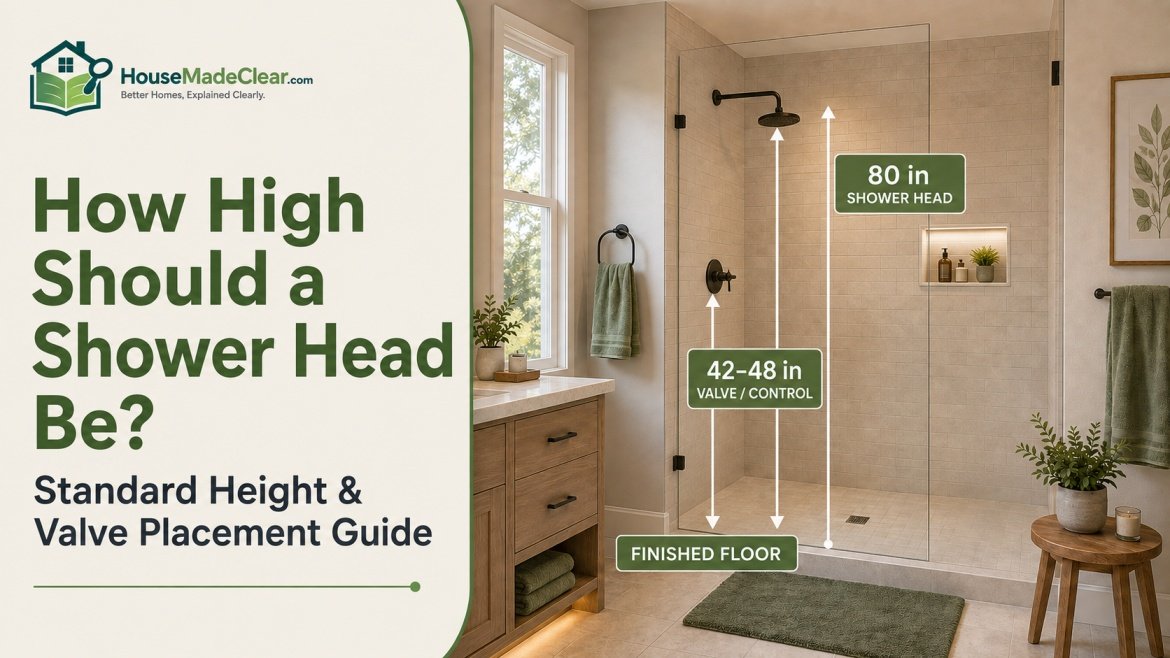
For a typical residential shower, 80 inches above the finished shower floor is a practical starting point for a fixed wall-mounted shower head.
That equals:
6 feet 8 inches, or approximately 203 cm.
But 80 inches is not a universal plumbing-code requirement for every residential shower.
The best shower head height depends on:
- The height of the people using the shower
- Whether the shower head is fixed or adjustable
- Whether it is a rain shower head
- Ceiling height
- Shower size
- Shower arm design
- Whether the bathroom needs accessible features
The shower valve also needs separate planning. In many residential shower-only installations, controls fall somewhere around 40–48 inches above the finished shower floor, although manufacturer recommendations vary. Some systems place them higher, and tub/shower combinations typically require different positioning.
Quick Answer
A common standard shower head height is about 80 inches from the finished shower floor to the shower-arm outlet or approximately the installed shower-head position.
A useful residential starting point is:
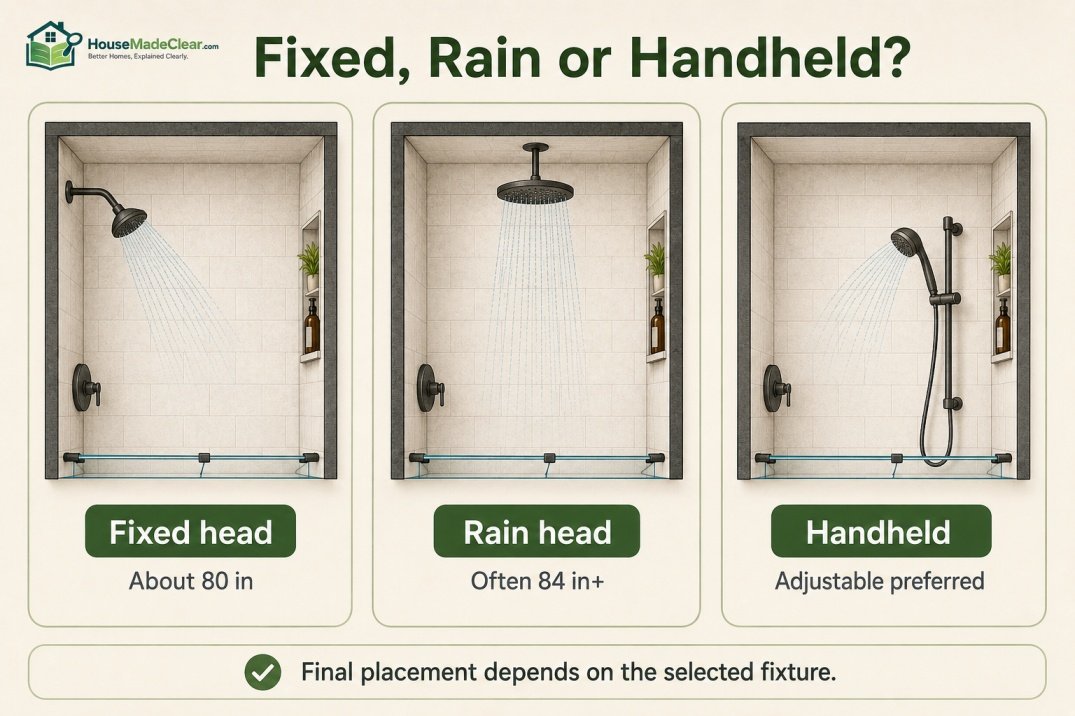
- Fixed shower head: about 80 inches
- Taller household: around 82–86 inches may be more comfortable
- Rain shower head: often higher, depending on the shower head and arm
- Shower valve/control: commonly around 40–48 inches in shower-only installations
- Tub/shower valve: often positioned lower than a shower-only control
These are planning ranges—not universal requirements. Always check the installation instructions for the specific valve, shower head and trim system before rough-in.
Manufacturer recommendations demonstrate why a single universal number is inappropriate. SharkBite, for example, uses an 80-inch shower-head reference and a 40-inch valve reference in one installation guide, while a Kohler shower-valve specification recommends approximately 1000–1200 mm, or roughly 39–47 inches, depending on user preference and layout. Other manufacturer rough-in diagrams can specify different ranges.
Standard Shower Head Height at a Glance
| Shower Setup | Practical Starting Height |
|---|---|
| Standard fixed shower head | About 80 in |
| Fixed head for taller users | 82–86 in |
| Lower fixed head for shorter household | Around 76–80 in |
| Rain shower head | Often 84 in+ depending on design |
| Hand shower | Adjustable whenever possible |
| Shower-only valve/control | Often around 40–48 in |
| Tub/shower valve | Usually lower than shower-only control |
| Accessible shower | Follow applicable accessibility requirements |
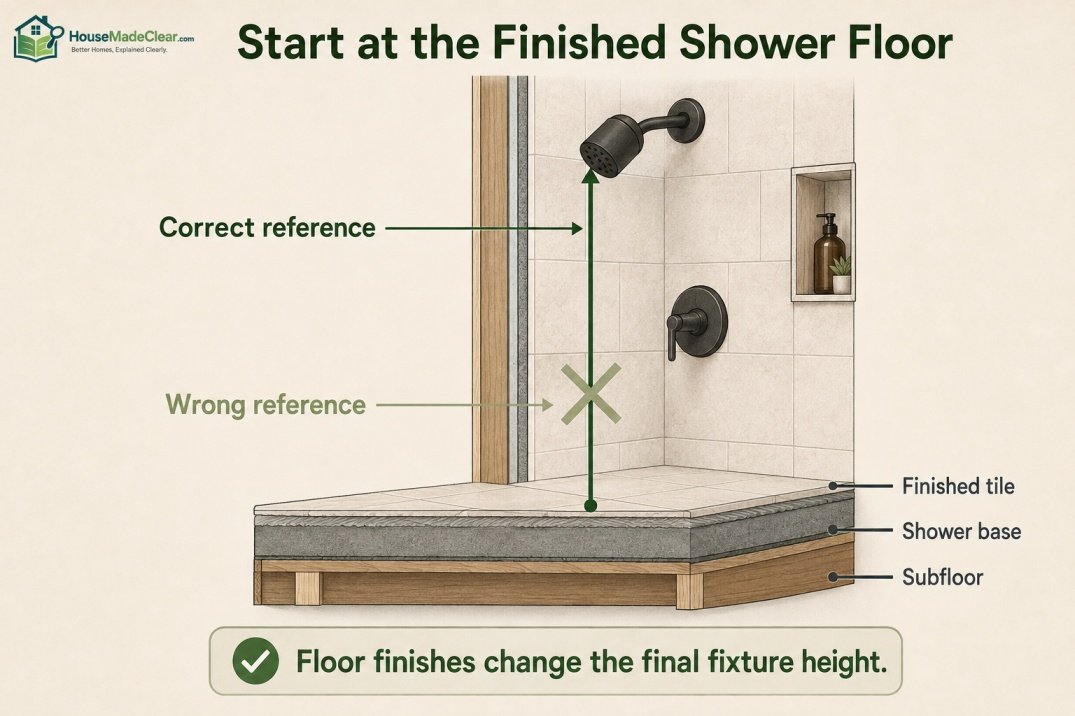
These measurements should be taken from the finished shower floor, not the subfloor before tile, shower pan or other finishes are installed.
What Is the Standard Shower Head Height?
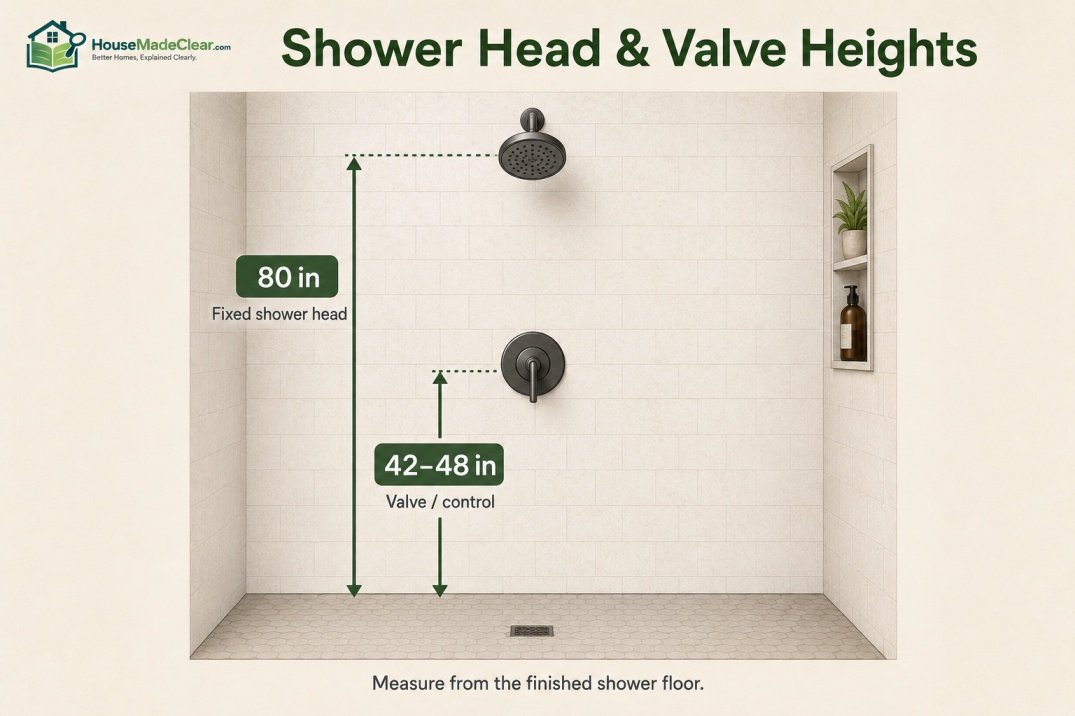
The most commonly referenced standard shower head height is approximately:
80 inches above the finished shower floor.
This provides about:
6 feet 8 inches
of height.
For many adults, that gives enough clearance for the shower head to sit above the user’s head while allowing the spray to fall downward comfortably.
However, “standard” should be understood as a common residential planning convention, not a mandatory height for every bathroom.
Several manufacturer and installation references use around 80 inches as a baseline. Some manufacturer rough-in documentation even allows shower-head positions in approximately the 80–86-inch range depending on the fixture and installation.
How High Should a Shower Head Be?
If you are asking how high should a shower head be, the best answer is:
High enough to comfortably clear the tallest regular user, while still allowing the spray pattern to work properly.
For many households:
80 inches
is sufficient.
If the tallest person in your home is:
- 5’6″
- 5’9″
- 6’0″
- 6’2″
an 80-inch shower head will often provide reasonable clearance.
If someone is:
6’4″ or taller, raising the shower head may be more comfortable.
You could consider:
- 82 inches
- 84 inches
- 86 inches
depending on the fixture and ceiling height.
Proper Shower Head Height
The proper shower head height is not necessarily the height used in another person’s bathroom.
A good installation considers:
User Height
The head should not feel as if it is spraying directly into the user’s face or upper chest.
Spray Pattern
A wide rain head behaves differently from a small angled wall-mounted head.
Shower Arm
The arm can raise, lower or extend the actual shower head relative to the rough-in outlet.
Ceiling
A very high placement may not be possible in a low-ceiling bathroom.
Shower Dimensions
In a compact shower, excessive height can change where the spray lands.
If you’re still determining the overall enclosure footprint, see our guide to walk-in shower dimensions.
Shower Head Height From Floor
When discussing shower head height from floor, use the:
finished shower floor
as the measurement reference.
That means after installation of:
- Shower pan
- Tile
- Stone
- Mortar
- Other finished flooring
Measuring 80 inches from the subfloor before the finished shower base is installed can result in a lower final height than intended.
Correct Measurement
Finished shower floor → centerline of shower arm outlet / planned fixture reference
Always confirm exactly what the fixture manufacturer uses as the reference point.
Showerhead Height vs Shower Arm Rough-In Height
The terms are often used interchangeably, but they are not always identical.
The showerhead height may refer to the final installed spray head.
The rough-in measurement may refer to:
the center of the water outlet inside or at the finished wall.
A shower arm can:
- Angle upward
- Angle downward
- Extend horizontally
- Form an S-shape
which changes the final shower-head position.
This means:
80-inch outlet height does not guarantee that every shower-head spray face ends exactly at 80 inches.
Always evaluate the complete fixture.
Shower Head Mounting Height
For a typical fixed fixture, a shower head mounting height around 80 inches is a useful starting point.
Before finalizing it, temporarily visualize where the actual head will sit.
Ask:
- Can the tallest user stand comfortably beneath it?
- Is it too close to the ceiling?
- Will the arm angle the head downward?
- Is a large shower head going to feel too close?
- Does the spray remain within the shower area?
This is especially important with oversized heads.
Shower Head Rough-In Height
The shower head rough in height is one of the measurements that should be decided before the wall is closed.
Once plumbing, backer board, waterproofing and tile are installed, relocating the shower outlet becomes significantly more difficult.
A common rough-in starting point is:
around 80 inches above the finished floor
for a standard fixed shower.
But check the manufacturer’s rough-in diagram.
Some fixtures intentionally call for a different position.
Typical Shower Head Height
A typical shower head height in an ordinary U.S. residential shower is therefore around:
80 inches
from the finished floor.
Think of 80 inches as:
a practical baseline that can be adjusted for the household
rather than an inflexible rule.
A family with several tall adults might prefer:
84 inches
while a shorter household might be perfectly comfortable at:
78–80 inches.
Average Shower Head Height
The phrase average shower head height generally points to the same practical range.
Approximately:
80 inches
is the figure most frequently used as a residential reference.
However, calculating an “average” is less useful than choosing a height for the people who actually use the bathroom.
A custom installation gives you the opportunity to get this measurement right before the wall is finished.
Normal Shower Head Height
A normal shower head height for a fixed wall-mounted head is around:
80 inches or 6 feet 8 inches.
You may see installations lower than this in:
- Older homes
- Tub/shower combinations
- Low-ceiling bathrooms
and higher installations in:
- Newer primary bathrooms
- Custom showers
- Tall households
- Rain-shower systems
All can be appropriate if the fixture operates correctly.
How Tall Should a Shower Head Be?
If you’re asking how tall should a shower head be relative to the person using it, allow enough clearance that the tallest regular user is not forced to:
- Bend
- Duck
- Stand away from the normal spray zone
A useful personal method is:
- Measure the tallest regular user.
- Add comfortable head clearance.
- Check the shower-head dimensions.
- Check ceiling clearance.
- Confirm the manufacturer’s installation limits.
For a 6’2″ user, for example, an 80-inch fixture provides only about six inches above overall height before accounting for the actual shower-head body and spray angle.
Moving to:
82–84 inches
may feel more natural.
Shower Nozzle Height
People sometimes search for shower nozzle height when they mean the shower head or water outlet.
For a normal fixed wall shower:
around 80 inches
remains the practical starting point.
But body sprays and side jets are completely different fixtures.
Their position should follow:
- Manufacturer recommendations
- User body height
- Number of sprays
- Shower layout
Do not apply the 80-inch shower-head number to body sprays.
Standard Shower Height
The phrase standard shower height can mean several things:
- Shower head height
- Shower enclosure height
- Tile height
- Ceiling height
If you mean the shower head:
about 80 inches
is the common residential reference.
If you mean the overall shower enclosure, there is no single comparable standard because shower walls and ceilings vary substantially.
Typical Shower Height
A typical shower height should therefore be considered in context.
For a conventional bathroom with an 8-foot ceiling:
Ceiling: 96 inches
Shower head: about 80 inches
That leaves approximately:
16 inches
between the rough shower-head elevation and ceiling.
This provides plenty of room for many standard shower arms and heads.
Shower Head Height for an 8-Foot Ceiling
With a standard 8-foot ceiling:
80 inches works well for many installations.
You may also have room to move the fixture to:
- 82 inches
- 84 inches
depending on the head.
However, avoid placing a large fixture unnecessarily close to the ceiling.
You still need room for:
- Installation
- Maintenance
- Shower arm
- Escutcheon
- Spray pattern
Shower Head Height for a 9-Foot Ceiling
A 9-foot ceiling provides:
108 inches
of total height.
That does not mean the shower head should automatically move to 96 or 100 inches.
If regular users are average height, the spray may feel too distant.
A wall-mounted fixture around:
80–84 inches
can still be ideal.
Ceiling height provides flexibility—it does not determine shower-head height by itself.
Shower Head Height for Tall People
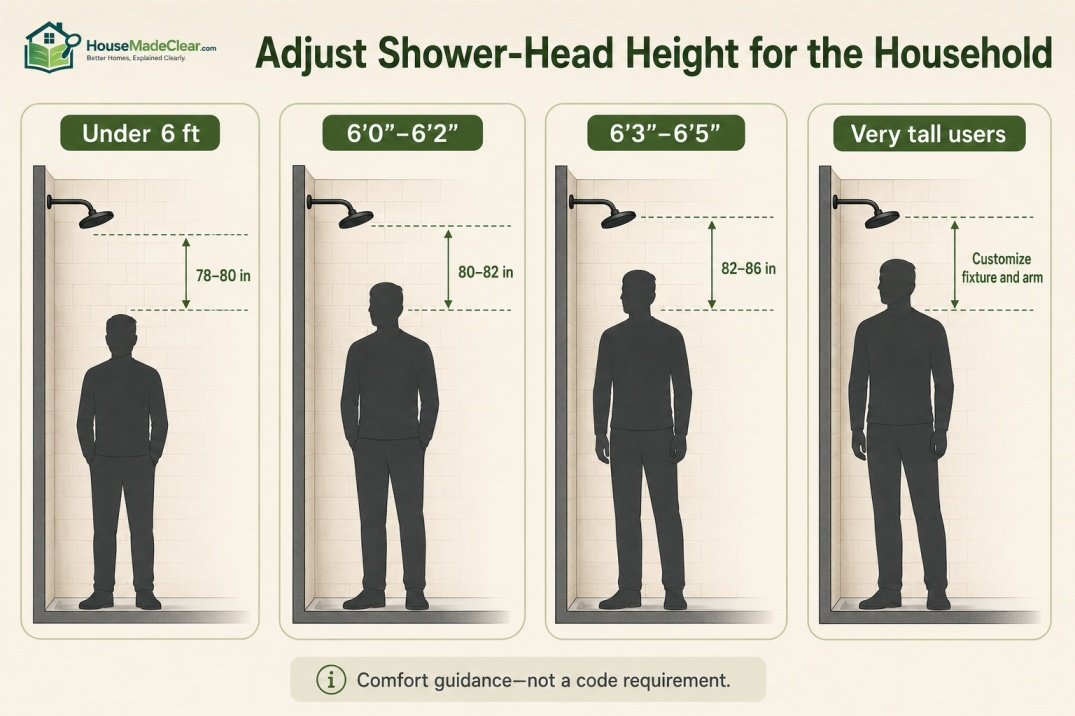
For households with tall users, consider increasing the installation.
Possible planning ranges include:
| Tallest Regular User | Possible Starting Range |
|---|---|
| Under 6 ft | 78–80 in |
| Around 6’0″–6’2″ | 80–82 in |
| Around 6’3″–6’5″ | 82–86 in |
| Very tall users | Customize fixture and arm |
These are comfort suggestions, not code requirements.
The shower head should remain suitable for shorter household members too.
What About Shorter Users?
A high shower head does not necessarily make a shower unusable for shorter adults because they do not need to physically reach the fixed head during normal operation.
But height can affect:
- Spray intensity
- Spray spread
- Ability to adjust the head
If the head needs frequent manual adjustment, consider:
- Adjustable arm
- Handheld shower
- Slide-bar system
rather than placing a fixed head unusually low.
Rain Shower Head Height
A rain shower head height deserves separate consideration.
Rain heads often:
- Point vertically downward
- Have a wider diameter
- Need space for the spray to spread
For that reason, they are commonly installed somewhat higher than conventional angled shower heads.
A practical range may start around:
84 inches or more
depending on the specific head.
But the correct height is product-specific.
How High Should a Rain Shower Head Be?
If you’re asking how high should a rain shower head be, start with the manufacturer’s instructions rather than applying one universal measurement.
The goals are:
- Enough clearance above the tallest user
- Enough drop for the rain effect
- Not so high that the water cools excessively before reaching the user
- Appropriate ceiling clearance
- Spray contained within shower
Some large rain heads are installed from the ceiling rather than the wall.
Those should be planned according to:
- Ceiling height
- Drop tube
- Shower footprint
- User height
Wall-Mounted Rain Head vs Ceiling Rain Head
Wall-Mounted Rain Head
Mounted on an extended horizontal arm.
Height can often be adjusted during rough-in.
Ceiling-Mounted Rain Head
Position depends heavily on ceiling height.
An 8-foot ceiling may place the fixture naturally around:
94–96 inches, depending on mounting hardware.
That can work because rain heads spray downward rather than toward the body from an angle.
Do not assume a ceiling-mounted rain head needs to be lowered to the conventional 80-inch wall-shower position.
Hand Shower Height
A hand shower height should prioritize adjustability.
A handheld shower is most useful when it can accommodate:
- Tall users
- Short users
- Children
- Seated users
- Cleaning the shower
A slide bar allows the holder to move vertically rather than forcing everyone to use one fixed height.
The exact rail position depends on the product.
Standard Hand Shower Height From Floor
There is no single standard hand shower height from floor for every residential installation.
For ordinary residential use, install the slide bar so the handheld can reach a comfortable range for the people using it.
If accessibility is required, different rules apply.
Under the 2010 ADA Standards, accessible shower spray units generally require a hose at least 59 inches long, and control/spray-unit placement varies by the type of accessible shower.
Shower Valve Height: The Other Important Measurement
The shower head is only half of the vertical layout.
You also need to choose:
shower valve height
before plumbing rough-in.
The control should be easy to reach without:
- Bending excessively
- Reaching overhead
- Standing directly beneath cold water while turning it on
For many shower-only residential installations, a practical control range is approximately:
40–48 inches above the finished shower floor.
Manufacturer recommendations can vary substantially. For example, SharkBite demonstrates a 40-inch valve reference, while Kohler documentation for one valve recommends approximately 1000–1200 mm, around 39–47 inches, with adjustment based on user preference and layout.
Standard Shower Valve Height
A useful standard shower valve height starting point is:
around 42–48 inches above the finished shower floor
for many shower-only installations.
You will also see:
- 40 inches
- 42 inches
- 44 inches
- 48 inches
depending on the installer, fixture and household.
Some manufacturer rough-in drawings use even higher positions.
There is no reason to force every shower into exactly the same height.
Typical Shower Valve Height
A typical shower valve height is one that places the main control near:
waist-to-lower-chest level
for adult users.
Approximately:
40–48 inches
works for many installations.
If multiple people use the shower, choose a position that all regular users can comfortably reach.
Shower Valve Height From Floor
Always calculate shower valve height from floor using the:
finished shower floor
rather than unfinished framing.
For example:
Desired finished control height:
44 inches
If the final shower floor assembly raises the surface by two inches compared with the rough subfloor, measuring from the wrong reference could leave the finished control lower than intended.
Coordinate with:
- Plumber
- Tile installer
- Shower-pan installer
before rough-in.
Shower Control Height
The shower control height should make it easy to:
- Turn water on
- Change temperature
- Adjust flow
- Use diverter controls
without entering the direct spray unnecessarily.
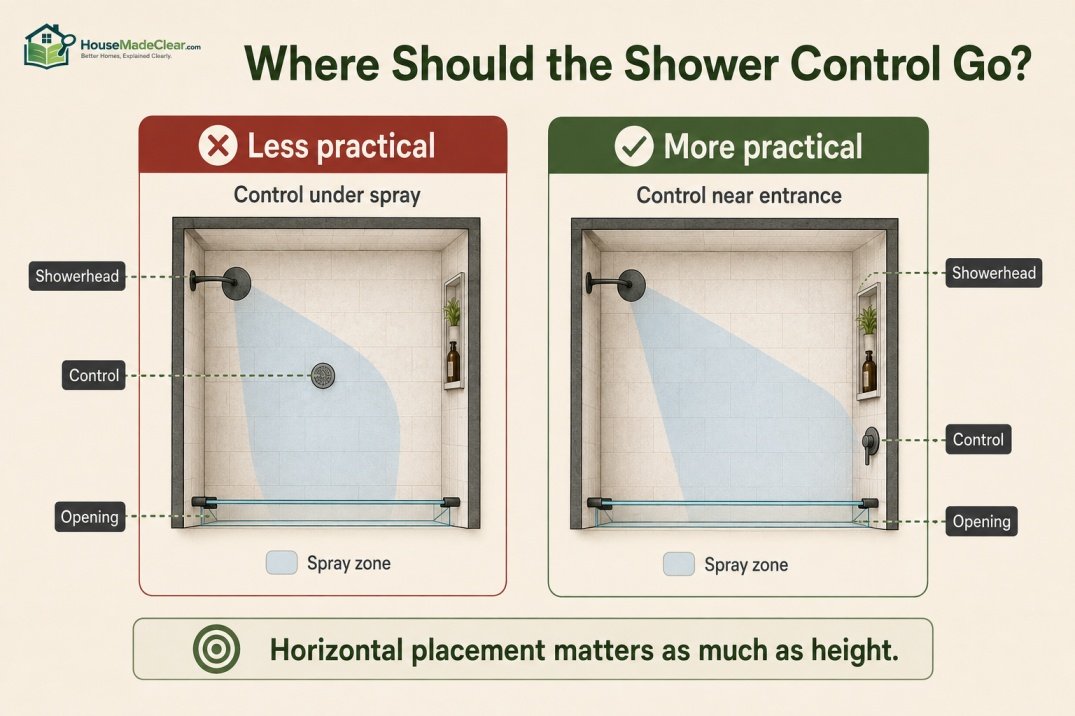
In a walk-in shower, horizontal placement can be just as important as height.
If possible, controls can sometimes be positioned near the entrance so you can start the shower before stepping fully under the head.
Standard Shower Control Height
A standard shower control height is commonly around:
40–48 inches
in residential shower-only installations.
But the final location depends on:
- Trim size
- Valve body
- User height
- Shower bench
- Accessibility
- Multiple controls
- Diverter configuration
A thermostatic shower system with several separate controls may use a different layout from a single-handle pressure-balance valve.
Height of Shower Handle
The height of shower handle usually follows the centerline of the main valve.
For a typical shower-only installation:
around 40–48 inches
is a practical planning range.
Before finalizing the rough-in, hold a mock control or mark the wall with painter’s tape.
Stand inside the shower.
Ask:
Does this feel natural to reach?
A five-minute mock-up can prevent an awkward permanent installation.
Standard Shower Handle Height
The standard shower handle height is therefore not an independent measurement from the valve.
The visible handle is attached to the valve and trim.
If the valve center is:
44 inches
the handle will generally be centered around that level, subject to the trim design.
Large thermostatic trims may extend considerably above and below the centerline.
Standard Height of Shower Faucet
People often use the term standard height of shower faucet when they mean:
- Shower valve
- Mixer
- Control handle
For a shower-only setup, approximately:
40–48 inches from the finished shower floor
is a useful starting range.
For a tub/shower combination, the control is often lower.
Standard Shower Mixer Height From Floor
The standard shower mixer height from floor follows the same principle.
A mixer in a shower-only enclosure can commonly be placed around:
40–48 inches
above the finished shower floor.
Manufacturer guidance is important because certain valve assemblies require:
- Specific depth
- Specific orientation
- Minimum spacing from diverters
- Access clearances
Vertical location should never be considered separately from the manufacturer’s rough-in requirements.
How High Should a Shower Valve Be?
If you’re asking how high should a shower valve be, a good planning approach is:
Start around 42–48 inches in a shower-only enclosure, then adjust for the household and specific fixture.
Consider:
- Tallest user
- Shortest user
- Children
- Bench
- Handheld shower
- Entry position
A valve that looks visually centered may not be the most ergonomic.
Walk-In Shower Valve Height
A walk in shower valve height around:
42–48 inches
works well in many ordinary residential installations.
But walk-in showers offer another opportunity:
You may be able to position the control horizontally near the entrance.
That allows a user to:
- Reach in.
- Turn on the water.
- Wait for temperature.
- Enter after it is comfortable.
This can be more useful than simply placing the valve directly beneath the shower head because that is traditional.
Standard Height for Shower Head and Valve
For a simple residential shower, this is a useful reference:
| Component | Practical Starting Height |
|---|---|
| Shower head | About 80 in |
| Shower valve | About 42–48 in |
| Handheld holder | Adjustable |
| Rain head | Often 84 in+ depending on design |
So if you’re searching for a standard height for shower head and valve, think:
Head around 80 inches; valve around 42–48 inches
as an initial layout—not as a universal rule.
Height of Shower Valve in a Tub
The height of shower valve in a tub is different because the fixture must work for both:
- Bathing
- Showering
Tub/shower controls are commonly installed lower than controls in a shower-only enclosure.
A current residential planning guide places tub/shower controls at roughly 28 inches above the tub floor, which typically translates to around the low-40-inch range above the bathroom floor depending on the tub.
The exact location should follow:
- Tub height
- Spout location
- Valve manufacturer
- User comfort
Tub/Shower Valve vs Walk-In Shower Valve
| Setup | Typical Design Approach |
|---|---|
| Walk-in shower | Control around 40–48 in from shower floor |
| Shower stall | Similar 40–48 in planning range |
| Tub/shower combination | Usually lower relative to standing shower |
| Accessible shower | Follow accessibility requirements |
A valve height that works perfectly in a walk-in shower may be inconvenient in a bathtub.
Shower Head Height in a Tub/Shower Combo
A tub/shower head may still be installed around:
78–80 inches above the bathroom floor
in many homes.
But remember:
the user stands on the tub floor, which is several inches above the bathroom floor.
This reduces actual clearance.
That is one reason tub/shower heads in older bathrooms can feel lower than heads in walk-in showers.
For tall users, this is worth checking carefully during renovation.
Should Shower Head Height Be Measured From Tub Floor?
For a tub/shower combination, be clear about the reference point.
If an installation guide says:
80 inches from finished floor
determine whether it means:
- Bathroom finished floor
- Tub floor
- Shower base
Manufacturer diagrams should make this clear.
Do not assume measurements from unrelated bathrooms use the same reference.
Shower Head Height Code: Is 80 Inches Required?
People frequently search shower head height code expecting a universal residential requirement of 80 inches.
That is misleading.
The common 80-inch measurement is primarily an installation convention for standard residential fixed heads, not a universal rule that applies to every shower everywhere.
Local requirements can differ.
Accessibility standards are a major exception because they can specify control and shower-spray locations.
For example, in an ADA transfer-type shower, controls, faucets and the shower spray unit are located 38–48 inches above the shower floor in the specified control area. Standard and alternate roll-in configurations generally limit these components to 48 inches maximum above the shower floor.
ADA Shower Head Height
The phrase ADA shower head height needs careful explanation because an accessible shower commonly uses a handheld shower spray rather than simply placing an ordinary fixed head at a conventional height.
The 2010 ADA Standards require a shower spray unit with:
a hose at least 59 inches long
that can be used as both:
- Fixed-position spray
- Handheld spray
for covered accessible showers, subject to the detailed requirements and exceptions.
In certain permitted circumstances, a fixed shower head no higher than 48 inches may be allowed instead of the handheld unit, but those provisions depend on the facility and shower type.
Do not use ordinary 80-inch residential guidance when designing a shower that must satisfy accessibility standards.
Accessible Shower Control Height
Accessible shower controls can also have precise placement requirements.
For transfer-type showers under the ADA Standards, the controls, faucets and shower spray unit must generally be:
38–48 inches above the shower floor
and positioned within a specified horizontal control area relative to the seat.
Accessible design should be planned from the applicable standard from the beginning rather than retrofitted after tile installation.
Shower Head Height for Children
If children use the shower, don’t permanently lower the main head solely for them if adults will also use it.
A better solution is often:
- Handheld shower
- Adjustable slide bar
- Dual shower system
This allows the fixture to adapt as the child grows.
Shower Head Height for a Seated User
A seated shower user needs controls and spray that can be reached safely.
A fixed 80-inch head by itself is generally not ideal for that purpose.
Consider:
- Hand shower
- Long hose
- Accessible control placement
- Appropriate seating
- Grab-bar coordination
If the bathroom is required to meet ADA or another accessibility standard, follow the exact applicable requirements.
Does Shower Head Height Affect Water Pressure?
Raising a shower head several inches within a normal residential range generally does not create the sort of dramatic pressure change homeowners sometimes expect.
Perceived performance depends more on:
- Supply pressure
- Flow restriction
- Shower-head design
- Plumbing
- Mineral buildup
However, a very high rain head can change the feel of the water because droplets travel farther before reaching the user.
Does Shower Head Height Affect Splash?
Yes.
A higher fixture can produce a wider or different spray footprint depending on:
- Head angle
- Spray pattern
- Shower size
In a compact walk-in shower, raising the head substantially may increase the chance of spray reaching:
- Opening
- Curtain
- Door
This is why shower-head placement should be coordinated with walk-in shower dimensions, not decided in isolation.
Shower Head Position and the Shower Door
Avoid aiming the shower head directly toward:
- Door opening
- Curtain opening
when possible.
Ideally, spray should travel toward:
- Shower interior
- Opposite wall
- Drainage area
A correctly positioned head helps reduce water escaping when the door opens or curtain moves.
Shower Head Position and Curtain Placement
If your shower uses a curtain, ensure the water does not continuously hit the opening at high velocity.
For walk-in showers, our guide to shower curtain size for a walk-in shower explains how width and length affect water containment.
If you are working with a traditional tub, also make sure the shower liner is positioned inside the tub during use.
Rain Head Placement in a Walk-In Shower
For a rain head, horizontal placement matters as much as height.
It should generally be placed where a person can comfortably stand beneath it without being:
- Too close to wall
- Too close to bench
- Directly over opening
In a large walk-in shower, centering the rain head within the actual standing zone often works better than centering it mathematically within the entire room.
Shower Valve and Shower Head Should Not Be Planned Separately
Think of the shower wall vertically:
Shower head
↓
Optional diverter
↓
Main valve/control
The components need enough visual and physical separation.
Before rough-in, mark all of them on the wall with tape.
This gives you a chance to see whether the layout feels:
- Balanced
- Reachable
- Logical
before tile makes changes expensive.
Where Should a Diverter Go?
If the system includes:
- Fixed shower head
- Handheld shower
- Rain head
- Body sprays
you may have a separate diverter or transfer valve.
The most convenient location is usually near the main shower controls.
Avoid placing it so high that shorter users struggle to reach it.
Some systems combine:
- Temperature
- Volume
- Diverter
inside one trim assembly, eliminating the need for several vertically stacked controls.
Shower Head and Valve Height for a Small Shower
In a small enclosure:
Shower Head
Around 80 inches is still a useful starting point.
Valve
Around 40–48 inches.
But pay special attention to horizontal location.
A valve that projects into a narrow standing area can feel intrusive.
For compact shower planning, check the dimensions before selecting fixtures.
Shower Head and Valve Height for a Large Shower
Large showers provide more flexibility.
You may have:
- Rain head
- Wall head
- Hand shower
- Bench
Instead of placing every fixture on one wall, organize the shower into functional zones.
For example:
Entry zone: controls
Standing zone: main shower head
Bench zone: handheld
The overall shower may then be easier and more comfortable to use.
Should You Raise the Shower Head During Renovation?
If you are already opening the shower wall, evaluate the existing fixture height.
Raising it may be worthwhile if:
- Tall users regularly duck
- Existing head sits at face level
- New shower arm requires more room
- You are converting from tub to walk-in shower
But don’t move plumbing simply because 80 inches is considered “standard” if the current fixture already works comfortably.
Common Shower Head Height Mistakes
1. Measuring From the Subfloor
Problem: Finished fixture ends too low.
Better approach: Measure from finished shower floor.
2. Assuming 80 Inches Is a Legal Requirement
Problem: You design around a convention rather than actual needs.
Better approach: Treat it as a starting point.
3. Ignoring Tall Users
Problem: Shower head feels too low.
Better approach: Customize while wall is open.
4. Mounting a Rain Head Like a Standard Angled Head
Problem: Spray does not develop properly.
Better approach: Follow rain-head specifications.
5. Forgetting Shower Arm Geometry
Problem: Final head height differs from rough-in expectation.
Better approach: Measure complete assembly.
6. Mounting Valve Based Only on Appearance
Problem: Control becomes awkward to reach.
Better approach: Test reach before rough-in.
7. Using Walk-In Shower Valve Height for a Bathtub
Problem: Control may be inconvenient for bath use.
Better approach: Plan tub/shower systems separately.
8. Ignoring Accessibility
Problem: Conventional layout may not meet required standards.
Better approach: Follow the applicable accessibility requirements.
9. Putting Controls Under the Main Spray Without Thinking
Problem: User gets wet while starting cold shower.
Better approach: Consider entry-side control placement.
10. Finishing the Wall Before Testing Layout
Problem: Changes become expensive.
Better approach: Mock up every fixture position first.
Shower Head and Valve Height Planning Checklist
Before plumbing rough-in, confirm:
- Finished floor elevation
- Tallest user
- Shortest user
- Fixed head type
- Shower arm shape
- Rain head if applicable
- Handheld shower
- Shower-head height
- Valve height
- Diverter height
- Bench location
- Niche location
- Door opening
- Curtain if used
- Ceiling height
- Spray direction
- Accessibility requirements
- Manufacturer rough-in instructions
- Local code requirements
Then mark the fixture positions directly on the framing or wall.
Quick Measurement Chart
| Component | Useful Residential Starting Point |
|---|---|
| Fixed shower head | About 80 in |
| Shower head for tall users | 82–86 in |
| Rain head | Often 84 in+ |
| Shower-only control | Around 40–48 in |
| Walk-in shower valve | Around 42–48 in |
| Tub/shower valve | Lower; product/tub dependent |
| Hand shower | Adjustable preferred |
| Accessible controls | Follow applicable accessibility standard |
Final Answer: How High Should a Shower Head Be?
For most conventional residential showers:
Start at approximately 80 inches above the finished shower floor.
Then adjust for:
- User height
- Shower-head design
- Shower arm
- Ceiling
- Shower dimensions
For the main shower valve:
Around 40–48 inches above the finished shower floor is a useful residential planning range for many shower-only installations.
For a simple layout, you can therefore think:
Shower head: ~80 inches
Valve/control: ~42–48 inches
But the final rough-in should always follow the selected fixture’s specifications.
Frequently Asked Questions
What is the standard shower head height?
A common standard shower head height is approximately 80 inches, or 6 feet 8 inches, above the finished shower floor. This is a practical residential starting point rather than a universal code requirement.
How high should a shower head be?
For many homes, about 80 inches above the finished shower floor works well. Taller households may prefer approximately 82–86 inches, depending on the shower head, arm and ceiling.
What is the proper shower head height?
The proper shower head height should comfortably clear the tallest regular user while allowing the fixture’s spray pattern to work properly. Approximately 80 inches is a common starting point.
How is shower head height measured from the floor?
Measure vertically from the finished shower floor to the fixture reference specified by the manufacturer, usually the shower-arm outlet or another defined rough-in point.
What is the typical shower head height?
Around 80 inches above the finished shower floor is a typical residential reference for a fixed wall-mounted shower head.
What is the standard shower valve height?
For many shower-only installations, approximately 40–48 inches above the finished shower floor is a practical planning range. Manufacturer recommendations and user preferences vary.
How high should a shower valve be?
A shower-only valve is often placed around 42–48 inches above the finished shower floor. Choose the final position based on comfortable reach, the selected valve and the manufacturer’s installation requirements.
What is the standard shower control height?
A shower control is commonly positioned around 40–48 inches above the finished shower floor in ordinary residential showers, although there is no single universal height for every fixture.
How high should a rain shower head be?
Rain shower heads are commonly positioned higher than conventional wall-mounted heads, often around 84 inches or more. The appropriate height depends on the fixture, user height, arm and ceiling.
What is the standard hand shower height from the floor?
There is no universal residential height. A slide-bar hand shower is generally best positioned to provide an adjustable range for the people who use the bathroom. Accessible showers have specific requirements.
Is there a shower head height code?
There is not a universal residential code requiring every shower head to be exactly 80 inches high. Local rules and accessibility requirements can apply, while 80 inches is primarily a common residential installation convention.
What is the standard height for a shower head and valve?
A useful residential starting layout is approximately 80 inches for the fixed shower head and around 42–48 inches for the shower valve or control, measured from the finished shower floor.








[…] How High Should a Shower Head Be? Standard Height & Valve… […]
[…] How High Should a Shower Head Be? Standard Height & Valve… […]
[…] How High Should a Shower Head Be? Standard Height & Valve… […]