
















Storing a mattress may seem simple: remove it from the bed, cover it, and place it somewhere until you need it again. However, incorrect storage can cause permanent indentations, moisture damage, unpleasant odors, and changes to the mattress’s internal structure.
Whether you are moving, renovating a bedroom, storing an extra mattress, or renting a storage unit, the preparation and storage position matter.
A mattress contains layers of foam, springs, latex, fibers, or a combination of materials. These components are designed to support the body across a broad surface, not necessarily to withstand months of pressure concentrated along one edge.
Moisture is another concern. A mattress stored in a damp basement, garage, or poorly maintained storage unit can absorb humidity and develop mold.
The safest general approach is to clean and dry the mattress, use suitable protective packaging, and store it horizontally on a clean, flat, supportive surface.
This guide explains how to store a mattress properly, including the best storage position, how to protect different mattress types, what to avoid in a storage unit, and how to prepare a stored mattress for use again.
Quick Answer
To store a mattress without damaging it:
- Remove all sheets, bedding, and mattress protectors.
- Vacuum the mattress and clean stains according to the manufacturer’s instructions.
- Allow it to dry completely before covering it.
- Use a clean, appropriately sized mattress storage bag or protective cover.
- Choose a clean, dry storage area, preferably with climate control.
- Store the mattress flat on a firm, level, supportive surface, unless its manufacturer specifies otherwise.
- Keep heavy boxes and furniture off the mattress.
- Inspect it periodically for moisture, pests, and packaging damage.
Avoid folding, tightly rolling, or storing a mattress upright for extended periods unless the manufacturer specifically permits it.
For long-term storage, controlling humidity and preventing uneven support are especially important.
What Is the Best Way to Store a Mattress?
The best way to store a mattress is to keep it clean, completely dry, protected from dust, and supported evenly in a suitable indoor environment.
For most conventional mattresses, horizontal storage is preferable to leaving the mattress standing on its side.
A flat position helps distribute the mattress’s weight across its construction rather than concentrating pressure along one edge.
The storage surface should be:
- Flat and level
- Clean and dry
- Strong enough to support the mattress
- Free of sharp objects
- Suitable for the mattress’s construction
- Protected from water intrusion and pests
A rigid platform or manufacturer-approved foundation can provide consistent support.
If a mattress is stored above the floor, the platform must provide support appropriate to the mattress rather than leaving large unsupported gaps.
Placing a mattress across two widely separated pieces of furniture can cause sagging and should be avoided.
The mattress should also be kept away from known roof leaks, wet walls, standing water, and other sources of moisture.
According to Tempur-Pedic’s official product-care guidance, its mattresses should be transported and stored flat rather than on their sides or folded. This is a manufacturer-specific requirement and a useful example of why mattress care instructions should take precedence over generic storage advice.
Other manufacturers may have different instructions, especially for adjustable air mattresses and specialty constructions. Always check the guidance for your particular model.

Mattress Storage Methods Compared
Not every mattress storage method offers the same protection.
| Storage Method | Suitable for Long-Term Storage? | Main Concern |
|---|---|---|
| Flat on a supported platform | Generally yes | Requires adequate space and support |
| Flat on a suitable bed foundation | Often, if manufacturer-approved | Foundation compatibility |
| Flat on a clean, protected floor | Sometimes | Floor moisture, contamination, limited airflow |
| Upright against a wall | Generally not preferred | Edge compression and internal shifting |
| Folded in half | Usually no | Foam damage, spring distortion, cover stress |
| Tightly rolled | Usually no | Compression and material damage |
| Beneath heavy storage boxes | No | Permanent impressions and uneven loading |
| In a dry climate-controlled unit | Generally preferred | Cost, cleanliness, and correct positioning |
| In a damp garage or basement | Not recommended | Humidity and mold |
The correct method depends on the mattress construction, the duration of storage, and the manufacturer’s requirements.
A temporary position used during moving should not automatically become the mattress’s long-term storage position.
How to Store a Mattress: Step-by-Step Instructions
Proper preparation reduces the chance of dust accumulation, moisture problems, and unnecessary damage.
Step 1: Remove All Bedding and Accessories
Start by removing everything from the mattress.
This includes:
- Bedsheets
- Blankets
- Pillows
- Mattress protectors
- Mattress pads
- Removable toppers
- Decorative bedding
Wash and dry washable bedding according to its care label.
Store bedding separately in clean, dry containers.
Do not leave a thick comforter, folded blanket, or removable topper compressed against the mattress during storage.
These items can retain moisture or place uneven pressure on its surface.
If the mattress has a removable cover, check the manufacturer’s instructions before removing or washing it.
Not every mattress cover is designed to be removed, even when it has a zipper.
Step 2: Clean the Mattress Before Storage
Dust, skin particles, and existing stains should be addressed before the mattress is packed away.
Begin by inspecting the entire surface.
Look for:
- Dust and debris
- Visible stains
- Damp areas
- Unusual odors
- Signs of insects
- Tears in the cover
- Evidence of mold
For routine cleaning, use a vacuum with a suitable upholstery attachment.
Vacuum the sleeping surface, sides, seams, and accessible edges.
If the mattress has stains, follow the manufacturer’s cleaning instructions.
Avoid soaking foam or saturating the internal layers with water.
Some foam materials are particularly sensitive to moisture.
For instance, Tempur-Pedic’s product-care instructions advise against washing or soaking TEMPUR material because moisture can damage it.
Should You Use Baking Soda Before Storage?
Baking soda is sometimes used to absorb surface odors, but it is not essential for every mattress.
If the manufacturer permits it, a light application may be used as part of surface freshening.
Remove all residue thoroughly afterward.
Baking soda does not disinfect a mattress or correct internal moisture problems.
If the mattress has a persistent musty odor, investigate the cause rather than covering the smell.
Step 3: Let the Mattress Dry Completely
Never seal a damp mattress inside a storage bag.
Moisture trapped around or inside the mattress can create conditions suitable for mold growth.
After cleaning, allow the mattress to dry in a clean, well-ventilated indoor area.
A fan may help improve airflow.
Drying time depends on how much moisture entered the mattress, its thickness, construction, room humidity, and temperature.
A mattress that feels dry on the surface may still contain moisture internally if it was heavily saturated.
Avoid storing it until you are confident it is dry throughout.
If a mattress has experienced flooding, substantial water exposure, or persistent dampness, replacement may be safer than attempting to store it.
Step 4: Choose the Right Mattress Storage Bag
A mattress storage bag helps protect against dust, dirt, scuffs, and contamination during moving and storage.
Choose a bag that fits the mattress’s actual dimensions.
The bag should cover the mattress without requiring it to be folded or compressed.
Check:
- Mattress width
- Mattress length
- Mattress thickness
- Bag dimensions
- Material durability
- Closure design
- Manufacturer compatibility
A mattress bag should not be confused with vacuum-compression packaging.
Most mattresses should not be compressed again after unpacking unless the manufacturer specifically allows it.
Should You Use Plastic or a Breathable Cover?
The right covering depends on storage conditions and the manufacturer’s instructions.
A durable plastic moving bag can protect against dirt and accidental contact during transportation.
However, plastic does not solve a damp-storage problem. If moisture is trapped inside the bag or condensation develops, the mattress may be damaged.
A breathable protective cover may be appropriate in a clean, dry environment, while a manufacturer-approved storage bag may offer better protection against certain contaminants.
Regardless of the material, the mattress must be completely dry before covering.
Do not assume that ventilation holes or breathable fabric can compensate for excessive humidity.

Step 5: Choose a Suitable Storage Location
The storage environment is as important as the mattress’s position.
A suitable space should be:
- Dry
- Clean
- Protected from leaks
- Free of visible mold
- Reasonably temperature-stable
- Protected from rodents and insects
- Large enough for flat storage
- Accessible for periodic inspection
A climate-controlled storage unit is often a practical choice for long-term storage.
A clean indoor spare room may also work if the mattress can be stored correctly without obstructing exits or damaging other furniture.
Avoid storing a mattress directly against a damp exterior wall.
Before moving it into a storage unit, inspect the area for leaks, condensation, standing water, and pest activity.
Step 6: Store the Mattress Flat
Position the mattress horizontally on a flat, supportive surface.
The storage surface should support its length and width sufficiently to prevent sagging or distortion.
For example, a queen mattress measuring approximately 60 × 80 inches needs a storage area large enough to accommodate that footprint without folding it.
If using a platform, verify that it is stable and suitable for the mattress.
Avoid unsupported makeshift platforms.
Do not place the mattress on sharp objects, exposed fasteners, or unstable furniture.
If the only available option is to stand the mattress upright, check whether the manufacturer permits that position and for how long.
Step 7: Keep Heavy Objects Off the Mattress
Do not use a stored mattress as a shelf for heavy boxes, furniture, or household appliances.
Continuous pressure can create indentations or damage internal components.
This is particularly important for memory foam, latex, and mattresses with thick comfort layers.
Even if the weight is distributed over a relatively large box, prolonged compression may affect the mattress.
Keep the sleeping surface clear.
Lightweight, soft items should also be stored separately whenever possible.
Step 8: Inspect the Mattress During Storage
Long-term storage should not be treated as completely maintenance-free.
Check the mattress and storage area periodically.
Look for:
- Condensation inside the covering
- Dampness near the floor
- Musty odors
- Pest activity
- Tears in the bag
- Water leaks
- Sagging or distortion
- Objects leaning against the mattress
If the unit develops a moisture problem, address the source promptly.
Do not leave a potentially damp mattress tightly wrapped for months.
Should You Store a Mattress Flat or Upright?
For most full-size mattresses, flat storage is the safer default.
Storing a mattress upright concentrates its weight along one edge.
Over time, this can place stress on the internal layers or spring structure.
Some mattresses may also bend or slump when left leaning against a wall.
The risk depends on the mattress’s construction, weight, firmness, and storage duration.
Mattress manufacturer Casper’s mattress-storage guidance similarly recommends storing mattresses flat, avoiding weight stacked on top, and considering climate-controlled storage. It also distinguishes brief upright transportation from long-term vertical storage.
Is It OK to Store a Mattress on Its Side?
Temporarily positioning a mattress on its side during moving may be acceptable for some models.
However, short-term handling and long-term storage are different situations.
A mattress that can safely stand upright for a brief move may still require flat storage for several months.
Check the manufacturer’s instructions before leaving it upright.
Can a Mattress Be Stored Vertically to Save Space?
Vertical storage may save floor space, but it is not generally the preferred long-term method.
Potential problems include:
- Uneven compression
- Edge deformation
- Foam-layer shifting
- Sagging
- Internal component stress
- Accidental tipping
If you do not have enough space to store the mattress flat, consider a different storage location rather than assuming vertical storage is harmless.

How to Store Different Types of Mattresses
Mattresses use different materials, which can affect their handling and storage requirements.
| Mattress Type | Preferred Storage Position | Main Precaution |
|---|---|---|
| Memory foam | Flat | Avoid folding, prolonged compression, and moisture |
| Hybrid | Flat | Protect springs and foam layers |
| Traditional innerspring | Flat | Avoid prolonged edge loading |
| Latex | Flat | Avoid distortion and unsupported bending |
| Pillow-top | Flat | Keep weight off comfort layers |
| Adjustable air mattress | Manufacturer-specific | Protect chambers, valves, and electronic components |
| Mattress topper | Manufacturer-specific | Some may be rolled; others must remain flat |
How to Store a Memory Foam Mattress
Memory foam mattresses are designed to respond to body weight and pressure.
However, that does not mean they can safely remain folded or compressed for extended periods.
For long-term storage:
- Keep the mattress flat.
- Use suitable support beneath it.
- Avoid heavy objects on top.
- Do not fold it unless explicitly permitted.
- Protect it from moisture.
- Avoid forcing it into undersized packaging.
Some memory foam mattresses arrive compressed in a box, but this does not mean they can be recompressed at home without risk.
Factory packaging uses specialized equipment and materials.
Once expanded, the manufacturer’s storage instructions should be followed.
How to Store a Hybrid Mattress
A hybrid mattress generally combines a spring support system with foam, latex, or other comfort materials.
Both the springs and comfort layers need protection.
Store the mattress horizontally.
Do not leave it bent around a corner or folded over furniture.
Avoid prolonged upright storage unless the manufacturer allows it.
A hybrid mattress may be heavier than a simple foam mattress, so arrange enough help for safe handling.
How to Store an Innerspring Mattress
Traditional innerspring mattresses contain metal spring systems, often surrounded by cushioning materials.
Storing one on its side for an extended period can place uneven stress on its construction.
A flat, supportive surface is the safer general choice.
Keep heavy boxes off the mattress and protect it from moisture.
How to Store a Latex Mattress
Latex mattresses can be particularly heavy and flexible.
Improper handling may cause bending, sagging, or material distortion.
For storage:
- Keep the mattress flat.
- Support it evenly.
- Avoid folding.
- Use sufficient help when moving it.
- Follow manufacturer instructions regarding temperature and covering.
Do not assume that a flexible latex mattress is designed to be rolled for long-term storage.
How to Store a Pillow-Top Mattress
Pillow-top mattresses contain additional cushioning near the sleeping surface.
Store them flat and avoid placing heavy items on top.
Continuous compression can affect the comfort layers.
If the mattress is one-sided, do not flip it simply to change its storage position.
How to Store an Adjustable Air Mattress
Adjustable air mattresses require model-specific handling.
Some contain:
- Air chambers
- Hoses
- Valves
- Pumps
- Electrical components
- Foam comfort layers
Follow the manufacturer’s instructions for deflation, disassembly, and storage.
Protect the electronic components from moisture.
Do not assume that every adjustable air mattress should be stored fully inflated or completely deflated.

How to Store a Mattress in a Storage Unit
A storage unit can be useful when moving between homes, renovating, or keeping an extra mattress for future use.
However, not every storage unit provides suitable conditions.
Choose a Unit With Enough Floor Space
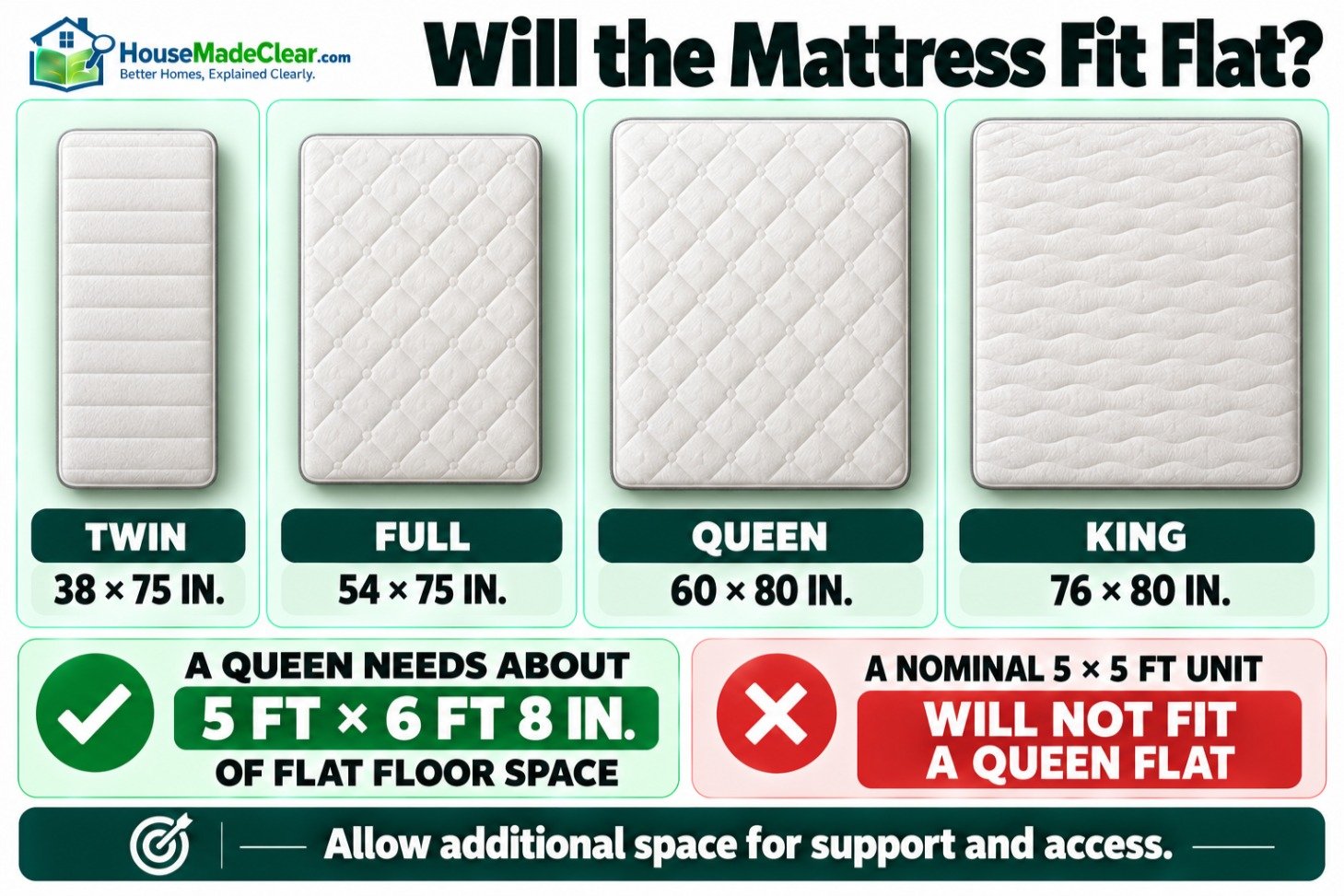
Start with the mattress dimensions.
| Mattress Size | Approximate Dimensions |
|---|---|
| Twin | 38 × 75 inches |
| Twin XL | 38 × 80 inches |
| Full | 54 × 75 inches |
| Queen | 60 × 80 inches |
| King | 76 × 80 inches |
| California King | 72 × 84 inches |
Dimensions can vary slightly by manufacturer.
The unit must accommodate the entire mattress while allowing practical access.
For example, a queen mattress requires approximately 5 feet by 6 feet 8 inches of flat space.
A nominal 5 × 5-foot storage unit cannot accommodate a standard queen mattress lying completely flat within those floor dimensions.
A larger unit may be required.
Also account for any platform used to support the mattress.
Is a Climate-Controlled Storage Unit Necessary?
Climate control is especially useful when storing a mattress for several months or longer.
A climate-controlled unit can help reduce exposure to temperature extremes and humidity fluctuations.
However, climate control does not guarantee that a unit will always remain dry.
Ask the facility what environmental conditions it maintains.
Inspect the space for signs of leaks, condensation, and pest activity.
What Humidity Is Best for Mattress Storage?
For general indoor moisture prevention, the U.S. Environmental Protection Agency’s guide to mold and moisture recommends keeping relative humidity below 60%, ideally between 30% and 50%.
This is indoor mold-prevention guidance, not a mattress-specific warranty requirement.
For mattress storage, maintaining a dry environment within a suitable manufacturer-approved range is a sensible goal.
A small humidity meter can help you identify excessive moisture if the storage facility permits its use.

Should a Mattress Be Kept Off a Concrete Floor?
Keeping a mattress off bare concrete is generally preferable, particularly where floor moisture is a concern.
Concrete can be exposed to moisture migration, condensation, or water intrusion.
Use a clean, suitable platform or manufacturer-approved support where possible.
Do not assume that a thin plastic sheet underneath the mattress eliminates every moisture risk.
If using a protective floor barrier, inspect for trapped moisture and ensure the mattress remains properly supported.
Organize the Unit Around the Mattress
Place the mattress where it can remain flat without becoming a storage shelf.
Keep heavy furniture and boxes beside it rather than on top.
Avoid storing sharp tools, chemicals, leaking containers, or other hazardous materials near the mattress.
Leave enough access to inspect the covering and surrounding area.
Can You Store a Mattress in a Garage?
A garage is convenient, but it may not be a suitable location for long-term mattress storage.
Common problems include:
- High humidity
- Condensation
- Temperature fluctuations
- Water intrusion
- Dust
- Rodents and insects
- Vehicle-related contaminants
An attached, insulated, conditioned garage may provide more stable conditions than an unfinished detached garage.
However, the actual environment matters more than the garage type.
When Garage Storage May Be Reasonable
Short-term garage storage may be workable when the space is clean, dry, protected from leaks, and maintains suitable conditions.
Keep the mattress covered and off potentially damp flooring.
Avoid storing it near gasoline, solvents, pesticides, vehicle exhaust, or equipment that produces contamination.
When Garage Storage Is a Bad Idea
Avoid storing a mattress in a garage with visible moisture, recurring condensation, pest activity, or major temperature extremes.
Long-term storage in an uncontrolled garage may increase the risk of deterioration.
If you cannot maintain suitable conditions, a climate-controlled indoor location is preferable.
Can You Store a Mattress in a Basement?
A basement may offer more space and relatively stable temperatures, but humidity is a major concern.
Before using basement storage, check for:
- Water stains
- Foundation seepage
- Damp concrete
- Musty odors
- Condensation
- Visible mold
- Flood history
- Plumbing leaks
A finished, dry basement may be suitable when the mattress is stored correctly.
An unfinished or chronically damp basement is a poor choice.
Should You Use a Dehumidifier?
A dehumidifier may help control indoor humidity when the space is suitable for one.
However, the machine must be appropriately sized, maintained, and safely drained.
Do not use a dehumidifier as a substitute for repairing leaks or water intrusion.
Monitor the humidity rather than assuming the space is dry because a machine is operating.
How Long Can You Store a Mattress?
There is no universal maximum storage duration for every mattress.
A mattress may remain usable after several months or longer when stored correctly.
However, the outcome depends on:
- Mattress age
- Existing condition
- Construction materials
- Storage position
- Humidity and temperature
- Packaging
- Pest exposure
- Manufacturer requirements
A mattress does not stop aging simply because it is not being used.
Foam, fabric, adhesives, and other components may continue to change over time.
Mattress Storage Duration Guide
| Storage Duration | Recommended Approach |
|---|---|
| A few days | Protect from dirt and moisture; support properly |
| Several weeks | Clean, dry, cover, and store flat |
| 1–3 months | Prefer a stable, dry environment and periodic checks |
| 3–6 months | Climate-controlled storage is particularly useful |
| 6–12 months | Review manufacturer guidance and inspect regularly |
| More than one year | Evaluate condition, storage costs, and whether keeping it remains worthwhile |
These periods are practical planning intervals, not scientifically established damage thresholds.
A mattress can deteriorate quickly in wet conditions, while another may remain in acceptable condition after extended storage in a clean, controlled environment.
The storage environment and mattress condition are more important than a specific number of months.
Can You Store a Mattress Rolled Up or Vacuum-Sealed?
Usually, you should not recompress an expanded mattress without manufacturer approval.
Many mattresses arrive rolled and compressed in packaging, particularly foam and hybrid models.
However, commercial compression equipment is not the same as ordinary household vacuum bags.
Attempting to compress an expanded mattress can damage its materials or internal structure.
Can You Fold a Memory Foam Mattress?
Some thin foam products may be designed for folding or rolling.
A full-size memory foam mattress generally should not be folded for long-term storage unless the manufacturer specifically permits it.
What About Mattress Toppers?
Mattress toppers have different storage requirements from full mattresses.
Some can be rolled, while others should remain flat.
Check the care instructions for your exact product.
How to Move a Mattress Into Storage Safely
Transporting a mattress creates different risks from storing it.
A mattress may need to pass through hallways, staircases, elevators, and doorways.
Before moving it, measure:
- Mattress width and length
- Mattress thickness
- Door openings
- Hallway turns
- Stairwell clearances
- Vehicle cargo area
Use an appropriate protective cover during transport.
For a large or heavy mattress, arrange enough people to prevent dropping, twisting, or dragging it.
Do not use the mattress handles for lifting unless the manufacturer specifically says they are designed for that purpose.
Some handles are intended only for positioning the mattress.
Can You Transport a Mattress Upright?
Some mattress manufacturers permit short periods of upright positioning during transportation.
However, others specify that the mattress must remain flat.
Follow the instructions for the exact model.
Secure the mattress so that it cannot fall or shift during transit.
Never transport a mattress in a way that obstructs the driver’s view or creates an unsafe load.
Should You Tie a Mattress to a Car Roof?
Transporting a large mattress on a passenger-car roof can be dangerous if the load is not properly supported and secured.
Airflow may lift or shift the mattress during driving.
Use a suitable enclosed vehicle or professional moving service when possible.
Follow applicable vehicle-loading rules and equipment limitations.
How to Store a Mattress in a Small Home
Not everyone has a dedicated storage room.
In a small apartment or home, a spare mattress can occupy valuable floor area.
Before trying to store it upright behind furniture, consider safer alternatives.
Use a Spare Bedroom
If a spare bedroom is available, the mattress may be stored flat on a suitable bed foundation.
This allows the mattress to remain supported and can keep it ready for occasional guests.
Use a Suitable Platform
A stable, flat platform may be appropriate if it provides the support required by the manufacturer.
Do not construct a temporary platform from unstable boxes or widely separated furniture.
Consider Whether Storage Is Worthwhile
A large mattress can be difficult to store efficiently.
If it is old, damaged, or unlikely to be used again, keeping it may not be worthwhile.
For homes with limited closet space, our guide to small bedroom storage ideas without a closet explains practical ways to organize other belongings without overcrowding the room.
If you are rearranging an entire bedroom, our functional bedroom layout guide can help you plan circulation and furniture placement around the bed.
How to Protect a Mattress From Mold and Moisture
Moisture is one of the biggest risks during storage.
Mold may develop when susceptible materials remain damp under suitable conditions.
Mattresses can be particularly difficult to dry thoroughly after extensive water exposure because moisture may penetrate multiple internal layers.
Keep Humidity Under Control
Maintain a dry storage environment and address leaks promptly.
A humidity meter can help identify conditions that require attention.
Inspect for Condensation
Check the inside of the mattress covering when practical.
Visible moisture droplets indicate a problem that should be addressed.
Do not simply reseal the mattress without investigating the cause.
Prevent Water Exposure
Avoid placing the mattress near:
- Leaking pipes
- Exterior walls with condensation problems
- Basement seepage
- Wet concrete floors
- Unprotected windows
- Roof leaks
Repair moisture problems before using the storage area.
Do Not Store a Mattress That Is Already Moldy
Visible mold or a persistent musty odor can indicate contamination.
For porous materials such as mattresses, mold may be difficult to remove completely.
A visibly moldy mattress should not simply be covered and placed into storage.
Professional assessment or replacement may be necessary, particularly after extensive water damage.
How to Protect a Stored Mattress From Bed Bugs and Pests
A storage facility may contain belongings from multiple households, making inspection and cleanliness important.
Before storing your mattress, check its seams, edges, and surrounding bedding for signs of pests.
Potential warning signs include:
- Live insects
- Dark spotting along seams
- Shed insect skins
- Unexplained insect activity
- Damage to the mattress cover
A mattress bag can reduce exposure to some contaminants, but ordinary moving plastic should not be assumed to be a certified bed-bug-proof encasement.
If you suspect bed bugs, address the infestation before transporting the mattress to another location.
Do not move a potentially infested mattress into shared storage without appropriate pest-control guidance.
Also inspect storage units for rodent droppings, gnaw marks, and damaged packaging.
Common Mattress Storage Mistakes to Avoid
Mistake 1: Storing the Mattress Upright for Months
Long-term vertical storage can place uneven pressure on the mattress and may cause deformation.
Store it flat unless the manufacturer says otherwise.
Mistake 2: Wrapping a Damp Mattress
Sealing moisture inside protective packaging can create conditions suitable for mold.
Always allow the mattress to dry fully before covering it.
Mistake 3: Placing Heavy Boxes on Top
Heavy objects can create lasting impressions or damage comfort layers.
Keep the mattress surface clear.
Mistake 4: Leaving the Mattress on Damp Concrete
Bare concrete can expose stored belongings to moisture.
Use suitable protection and support in a dry environment.
Mistake 5: Folding or Vacuum-Compressing the Mattress
An expanded mattress may not tolerate being folded or recompressed.
Follow manufacturer instructions.
Mistake 6: Using an Uncontrolled Garage for Long-Term Storage
Temperature swings, pests, and humidity can create unfavorable conditions.
Choose a more stable environment when possible.
Mistake 7: Ignoring Manufacturer Instructions
Mattress construction varies.
Advice suitable for an ordinary innerspring mattress may not apply to a specialty foam or adjustable air mattress.
Mistake 8: Skipping Storage Inspections
Leaks and moisture problems can develop after the mattress is placed in storage.
Periodic checks help identify issues earlier.
Mistake 9: Using an Undersized Bag
A tight bag may require bending the mattress or leave portions exposed.
Choose packaging based on actual dimensions and thickness.
Mistake 10: Reusing a Damaged Mattress Without Inspection
A mattress can look acceptable from a distance while containing moisture damage, pest contamination, or structural deformation.
Inspect it carefully before bringing it back into use.
How to Take a Mattress Out of Storage
When you are ready to use the mattress again, do not immediately place sheets on it.
First, inspect its condition.
Step 1: Remove the Storage Cover
Carefully remove the bag or protective wrapping.
Check for moisture or condensation.
Step 2: Inspect All Surfaces
Look at the top, bottom, sides, and seams.
Check for:
- Visible mold
- Unusual odors
- Pest activity
- Stains
- Cover damage
- Sagging
- Deformation
If there are signs of mold or infestation, do not use the mattress until the situation has been appropriately assessed.
Step 3: Allow the Mattress to Air Out
If the mattress is clean and dry but has a mild enclosed-storage odor, allow it to air in a dry, ventilated room.
Do not use fragrances to cover a persistent musty smell.
Step 4: Check Its Shape
Place the mattress on a suitable foundation.
Inspect for uneven areas, visible sagging, or permanently compressed edges.
Some foam mattresses may need time to return to their normal feel after exposure to colder temperatures.
However, do not assume that significant deformation will automatically disappear.
Step 5: Clean the Surface if Needed
Vacuum the surface if appropriate.
Follow manufacturer instructions for any additional cleaning.
Step 6: Confirm the Mattress Is Ready for Use
Before adding bedding, make sure the mattress is dry, free of concerning odors or contamination, and properly supported.
If its condition has deteriorated significantly, replacement may be the better option.

When Should You Replace a Mattress Instead of Storing It?
Not every mattress is worth the cost and effort of storage.
Consider replacing or responsibly disposing of it when:
- It has visible mold.
- It has been substantially contaminated by flooding.
- The support system is damaged.
- It has pronounced permanent sagging.
- Internal components are broken.
- It has a persistent unexplained musty odor.
- Pest contamination cannot be appropriately resolved.
- It is already uncomfortable or structurally worn.
The cost of storage also matters.
A mattress that is inexpensive to replace may not justify many months of paid storage.
Conversely, a newer, high-quality mattress may be worth protecting in a suitable unit.
Evaluate its condition, replacement cost, anticipated reuse, and storage expenses together.
Mattress Storage Checklist
Use the following checklist before placing a mattress into storage.
| Storage Check | What to Verify |
|---|---|
| Bedding removed | Sheets, pillows, and toppers stored separately |
| Surface cleaned | Dust and visible debris removed |
| Mattress dry | No remaining cleaning moisture |
| Mattress condition | No visible mold or pest activity |
| Storage bag | Correct size and suitable material |
| Storage environment | Clean, dry, and protected from leaks |
| Humidity | Suitable for the mattress and preferably controlled |
| Storage position | Flat unless manufacturer permits otherwise |
| Support | Level and sufficiently supportive |
| Floor conditions | No dampness or standing water |
| Heavy objects | Nothing stacked on mattress |
| Pest prevention | Storage area inspected |
| Access | Room for periodic checks |
| Manufacturer guidance | Product-specific instructions followed |
| Reuse plan | Mattress inspected before sleeping on it |
A few minutes spent checking these details can help prevent avoidable damage during storage.
Final Thoughts
The best way to store a mattress is to keep it clean, dry, protected, and properly supported.
For most conventional foam, hybrid, latex, and innerspring mattresses, flat storage is the safest general approach. Long-term upright storage, folding, and heavy objects placed on top can create unnecessary stress.
A climate-controlled storage unit is often preferable when storing a mattress for several months, particularly in regions with high humidity or large seasonal temperature changes.
However, the specific storage environment matters more than the label on the unit.
Before storing a mattress, follow the manufacturer’s instructions, remove bedding, clean and dry it, and protect it with an appropriate cover.
When taking it out of storage, inspect it carefully before returning it to the bed.
Proper storage cannot reverse existing wear, but it can help preserve a mattress that is still in good condition.
Frequently Asked Questions
What is the best way to store a mattress?
The best general method is to clean and dry the mattress, cover it with suitable protective packaging, and store it flat on a firm, level, supportive surface in a clean, dry environment. Follow the manufacturer’s instructions for the specific mattress.
Can you store a mattress upright?
Some mattresses may tolerate short periods of upright positioning during moving, but long-term vertical storage is generally not recommended. It can place uneven stress on the mattress and potentially cause deformation. Check the manufacturer’s guidance.
How long can a mattress stay in storage?
There is no universal maximum storage period. A mattress may remain usable after several months or longer if properly stored in a clean, dry, stable environment. Mattress age, construction, moisture exposure, and support affect the outcome.
Should you store a mattress flat or on its side?
Flat storage is generally preferable. It provides more even support and avoids concentrating weight along one edge. Some manufacturers specifically require flat storage for their mattresses.
Can you store a mattress in a garage?
A mattress can sometimes be stored temporarily in a clean, dry garage, but uncontrolled humidity, temperature changes, pests, and contamination make garages less suitable for long-term storage. A climate-controlled indoor location is generally preferable.
Can you store a mattress on concrete?
Storing a mattress directly on bare concrete is not ideal, particularly where moisture migration or condensation may occur. A suitable raised platform or foundation in a dry environment can help protect the mattress and provide proper support.
Do you need a mattress bag for storage?
A properly sized mattress bag or protective cover is recommended to reduce exposure to dust, dirt, and damage. The mattress must be completely dry before wrapping, and the covering should be suitable for the storage environment.
Can a mattress get moldy in storage?
Yes. A mattress can develop mold if it is stored while damp or exposed to excessive humidity, leaks, or condensation. Keeping the mattress dry and controlling storage-area moisture are essential precautions.
Is climate-controlled storage necessary for a mattress?
It is not universally required, but climate-controlled storage is often the safer choice for long-term storage, particularly in humid regions. The facility should still be checked for leaks, pests, and actual environmental conditions.
Can you fold a mattress for storage?
Most full-size mattresses should not be folded for long-term storage unless the manufacturer specifically permits it. Folding can damage foam layers, springs, or other internal components.
Can you vacuum-seal a memory foam mattress?
Do not attempt to recompress an expanded memory foam mattress unless its manufacturer explicitly allows it. Factory compression does not mean household vacuum packaging is safe for reuse.
How do you store a mattress in a storage unit?
Clean and dry the mattress, place it in an appropriate protective cover, select a clean and dry unit with enough floor space, and store it flat on a suitable supportive surface. Avoid stacking other belongings on top.
How do you store a mattress without a bed frame?
Use a firm, flat, stable platform or another support approved by the mattress manufacturer. Avoid narrow supports, uneven surfaces, damp floors, and makeshift arrangements that allow the mattress to sag.
How do you store a memory foam mattress?
Keep the mattress flat, supported, clean, and completely dry. Avoid folding, long-term upright storage, heavy compression, and moisture exposure. Follow the manufacturer’s model-specific instructions.
Can you use a mattress immediately after storage?
Inspect it first for moisture, odors, pests, mold, and deformation. If it is clean, dry, undamaged, and correctly supported, it may be ready for use. A mattress that is damp, contaminated, or structurally damaged should not be used without appropriate assessment.