















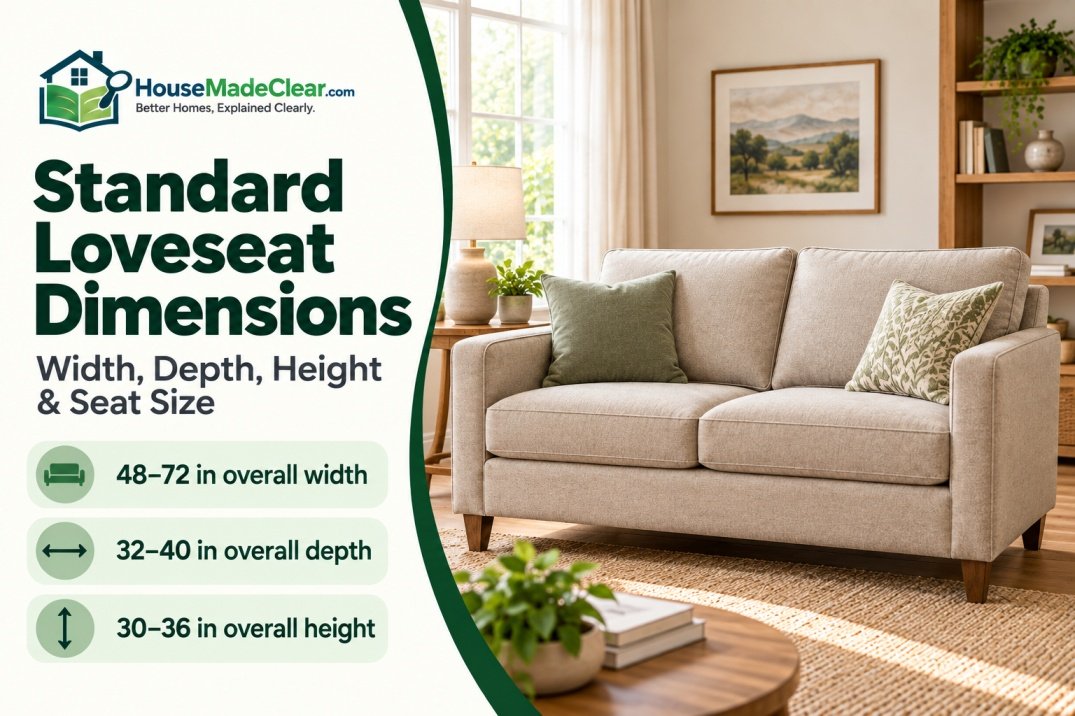
A loveseat is designed to seat two people while occupying less floor space than a conventional three-seat sofa. However, the word “loveseat” does not describe one regulated size. Compact apartment models can be less than 55 inches wide, while oversized loveseats may approach the width of a small sofa.
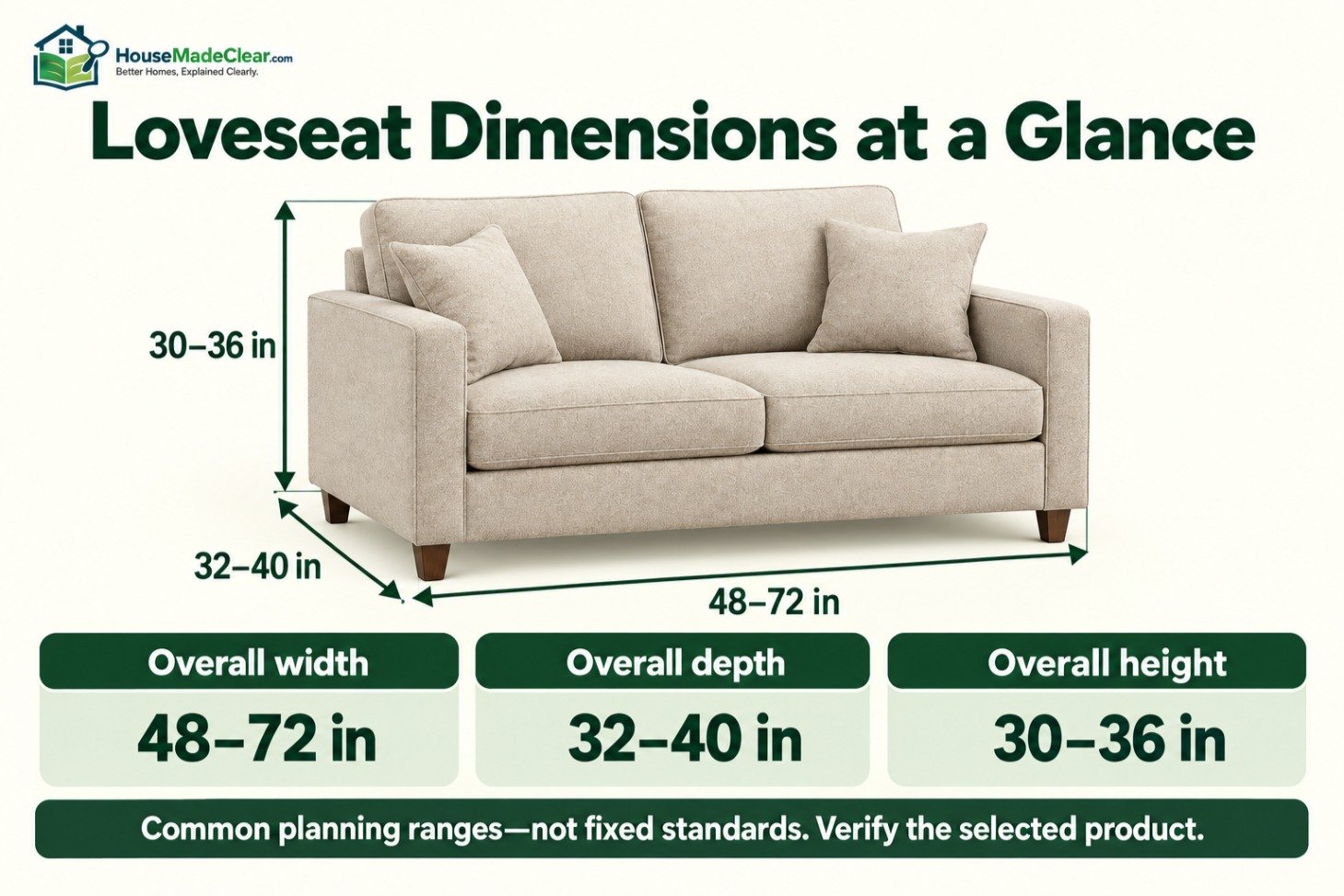
Most loveseats measure approximately 48 to 72 inches wide, 32 to 40 inches deep, and 30 to 36 inches high. Conventional two-seat models commonly fall between 52 and 66 inches wide.
The outside dimensions are only part of the decision. Arm thickness, cushion depth, back angle, reclining mechanisms and sleeper components can substantially change usable seating space and the amount of room the loveseat requires.
Quick Answer
Standard loveseat dimensions are commonly:
- Overall width: 48–72 inches
- Common two-seat width: 52–66 inches
- Overall depth: 32–40 inches
- Overall height: 30–36 inches
- Seat depth: 20–24 inches
- Seat height: 16–20 inches
- Usable seat width: approximately 40–60 inches
A loveseat around 55 to 65 inches wide and 34 to 38 inches deep works in many living rooms. Always compare the complete exterior dimensions, usable seat width, required operating space and delivery-route measurements before buying.
Standard Loveseat Dimensions at a Glance
The following figures are practical planning ranges rather than mandatory manufacturing standards.
| Loveseat measurement | Common range | What it affects |
|---|---|---|
| Overall width | 48–72 inches | Wall space, room proportion and seating capacity |
| Conventional loveseat width | 52–66 inches | Fit for two adults in many designs |
| Overall depth | 32–40 inches | Floor-space requirement and circulation |
| Deep loveseat depth | 40–44 inches or more | Lounging comfort and room depth |
| Overall height | 30–36 inches | Sightlines, window clearance and visual scale |
| Seat width | 40–60 inches | Actual room available for occupants |
| Seat depth | 20–24 inches | Upright versus relaxed seating posture |
| Deep seat depth | 24–28 inches or more | Lounging space and support requirements |
| Seat height | 16–20 inches | Ease of sitting down and standing up |
| Arm height | 22–27 inches | Side-table relationship and lounging support |
| Typical seating capacity | Two people | Depends on usable width and occupant size |
Individual products can fall outside these ranges. A small armless loveseat may be narrower than 48 inches, while an oversized reclining or sleeper loveseat can exceed 72 inches.
What Is Considered a Loveseat?
A loveseat is an upholstered seating piece intended primarily for two people. It is normally wider than an armchair or chair-and-a-half but narrower than a conventional three-seat sofa.
A furniture label alone does not establish the size. Retailers may describe similar products as:
- Loveseats
- Two-seat sofas
- Apartment sofas
- Small sofas
- Settees
- Couches for two
- Modular two-seat units
Some 70- to 72-inch products are marketed as loveseats, while another manufacturer may call a similarly sized product an apartment sofa. Use the actual dimensions and seating configuration rather than relying on the product name.
Our complete couch dimensions guide explains how loveseats compare with standard sofas, apartment sofas and larger seating configurations.
Loveseat vs. Small Sofa
The distinction between a wide loveseat and a small sofa is often unclear.
A loveseat normally has two defined seating positions. A small sofa may provide two broad cushions or three compact seating positions. Both can occupy approximately the same amount of floor space.
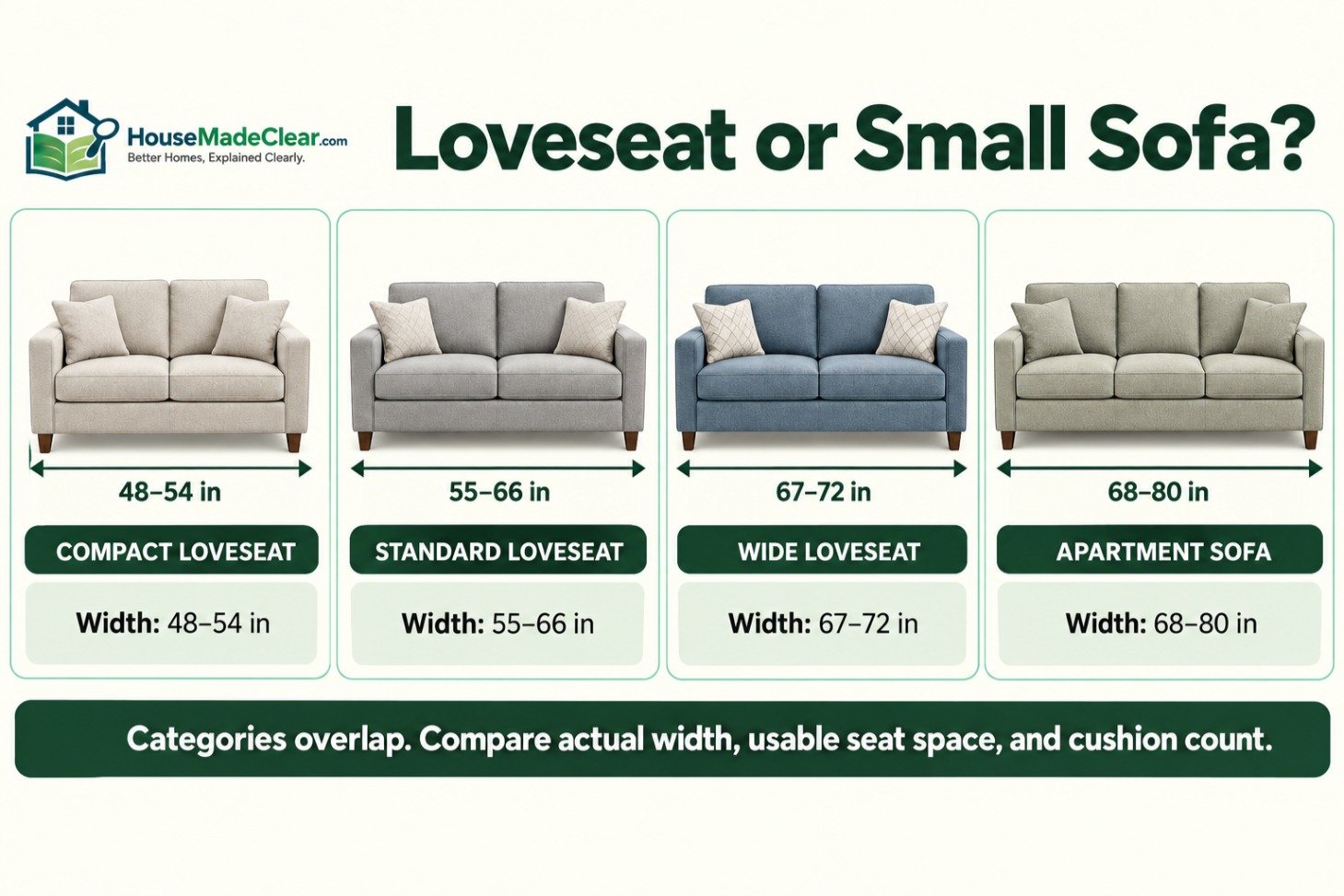
| Furniture type | Common width | Typical capacity |
|---|---|---|
| Chair-and-a-half | 40–55 inches | One person or compact shared seating |
| Compact loveseat | 48–54 inches | Two people with limited room |
| Standard loveseat | 55–66 inches | Two people |
| Wide loveseat | 67–72 inches | Two people with additional space |
| Apartment sofa | 68–80 inches | Two or three people |
| Standard sofa | 72–96 inches | Usually three people |
These categories overlap. The most useful measurements are the exterior width, interior seat width and number of distinct seat cushions.
Standard Loveseat Width
Loveseat width is measured horizontally across the widest part of the furniture, usually from the outside of one arm to the outside of the other.
Most loveseats are approximately 48 to 72 inches wide, although models between 52 and 66 inches represent a useful conventional range.
Compact Loveseats: 48 to 54 Inches Wide
Compact loveseats are designed for small rooms, apartments, bedrooms and reading areas.
A narrow model can save wall space, but the reduced overall width may come from:
- Narrower individual seats
- Slim arms
- An armless design
- A shallow frame
- A single bench cushion
- A more upright back
Two adults may find a 48-inch loveseat restrictive when the arms are thick. Check the usable width between the arms rather than assuming that every compact loveseat comfortably seats two people.
Standard Loveseats: 55 to 66 Inches Wide
A width of approximately 55 to 66 inches works for many conventional two-seat loveseats.
This range generally provides enough room for two seating positions without approaching the footprint of a full sofa. It is suitable for many:
- Small and medium living rooms
- Apartments
- Home offices
- Bedrooms
- Conversation areas
- Secondary seating arrangements
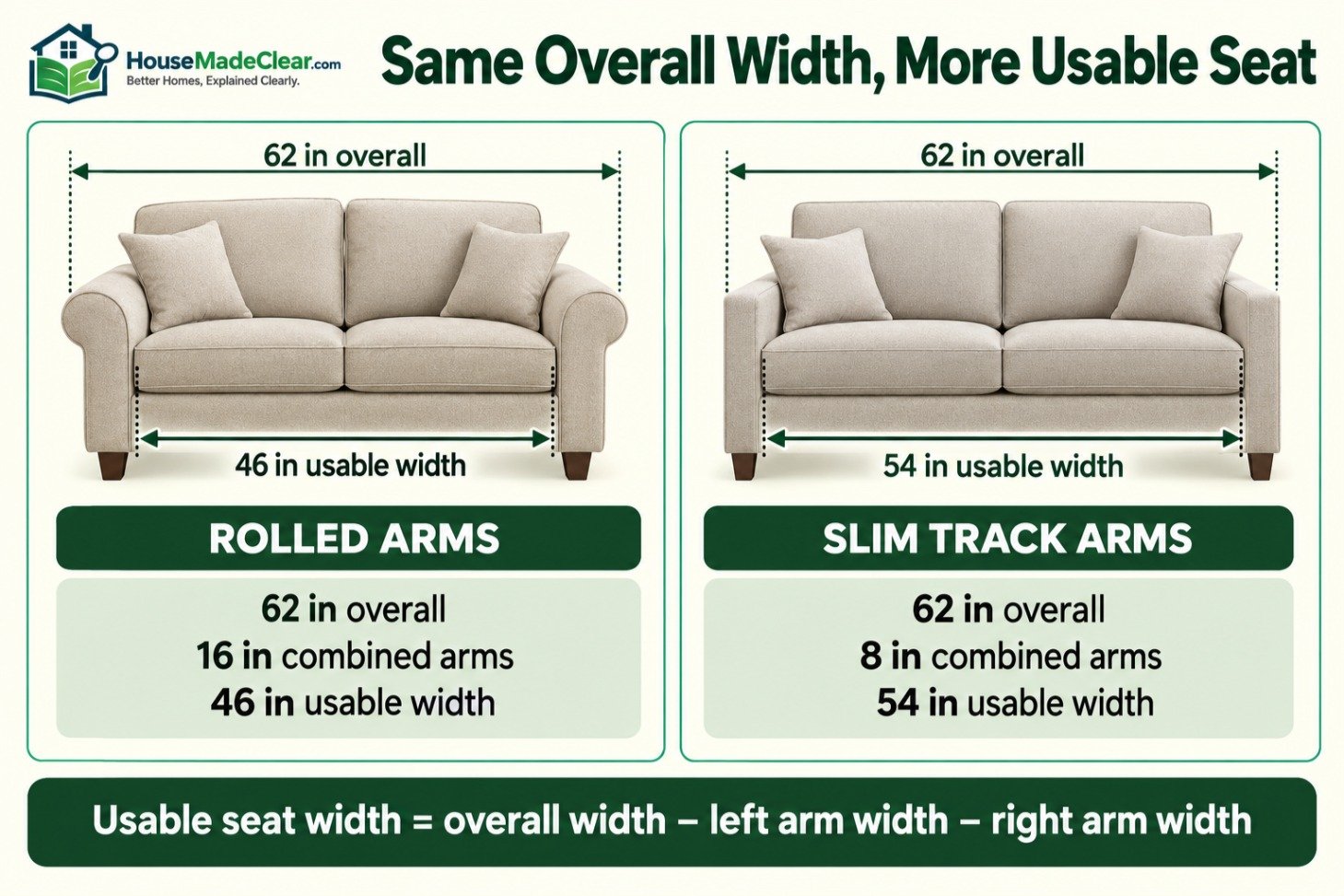
The arm design remains important. A 60-inch loveseat with two 7-inch arms provides only about 46 inches of interior width. A 60-inch model with 3-inch arms may provide approximately 54 inches.
Wide Loveseats: 67 to 72 Inches Wide
A wide loveseat provides more space for two adults and may feel less confined. It can also accommodate a child or pet between two occupants in some households.
However, a loveseat near 72 inches wide overlaps with the small-sofa category. Before choosing one, compare it with a compact sofa that may provide:
- An additional seating position
- Similar overall dimensions
- More flexible cushion arrangements
- Better proportional fit in a larger room
A wide loveseat still makes sense when two generous seats are more important than fitting three people.
Overall Width vs. Usable Seat Width
Overall width includes both arms and the complete frame. Usable seat width measures the actual sitting area between the inside edges of the arms.
Use this basic calculation:
Usable seat width = overall width − left arm width − right arm width
For example, consider two loveseats that are both 62 inches wide:
| Design | Overall width | Combined arm width | Approximate usable width |
|---|---|---|---|
| Rolled-arm loveseat | 62 inches | 16 inches | 46 inches |
| Slim track-arm loveseat | 62 inches | 8 inches | 54 inches |
The slim-arm model provides 8 additional inches of seating without using more floor space.
This is why exterior width alone cannot determine whether a loveseat will comfortably seat two adults.
Standard Loveseat Depth
Overall loveseat depth is measured from the farthest point at the back to the farthest point at the front.
Most conventional loveseats measure approximately 32 to 40 inches deep. Deep lounge models, reclining loveseats and sleeper loveseats may reach 40 to 44 inches or more.
Compact Depth: 28 to 34 Inches
Compact loveseats use shallower frames, thinner backs or more upright cushions to reduce their footprint.
They can work well in:
- Narrow living rooms
- Small apartments
- Home offices
- Bedrooms
- Entry sitting areas
- Rooms with limited space opposite the loveseat
A shallow exterior depth does not automatically mean an uncomfortable seat. A loveseat with a thin back and slim frame may provide usable seating comparable to that of a deeper model with thick cushions.
Standard Depth: 35 to 40 Inches
A loveseat approximately 35 to 40 inches deep fits within the common range for residential upholstered seating.
This depth can provide a balance between:
- Everyday upright sitting
- Casual lounging
- Cushion support
- Floor-space efficiency
- Compatibility with standard living-room layouts
Check the manufacturer’s listed seat depth because two loveseats with identical exterior depths can feel completely different.
Deep Loveseats: 40 to 44 Inches or More
Deep loveseats are designed for relaxed sitting, curling up or lounging with the legs raised.
They require additional room between the wall and the opposite furniture. A deep loveseat can also create problems in:
- Narrow living rooms
- Rooms with a central coffee table
- Spaces with traffic passing in front
- Tight delivery routes
- Rooms with doors facing the seating area
The standard couch-depth guide explains how the exterior footprint differs from usable seat depth.
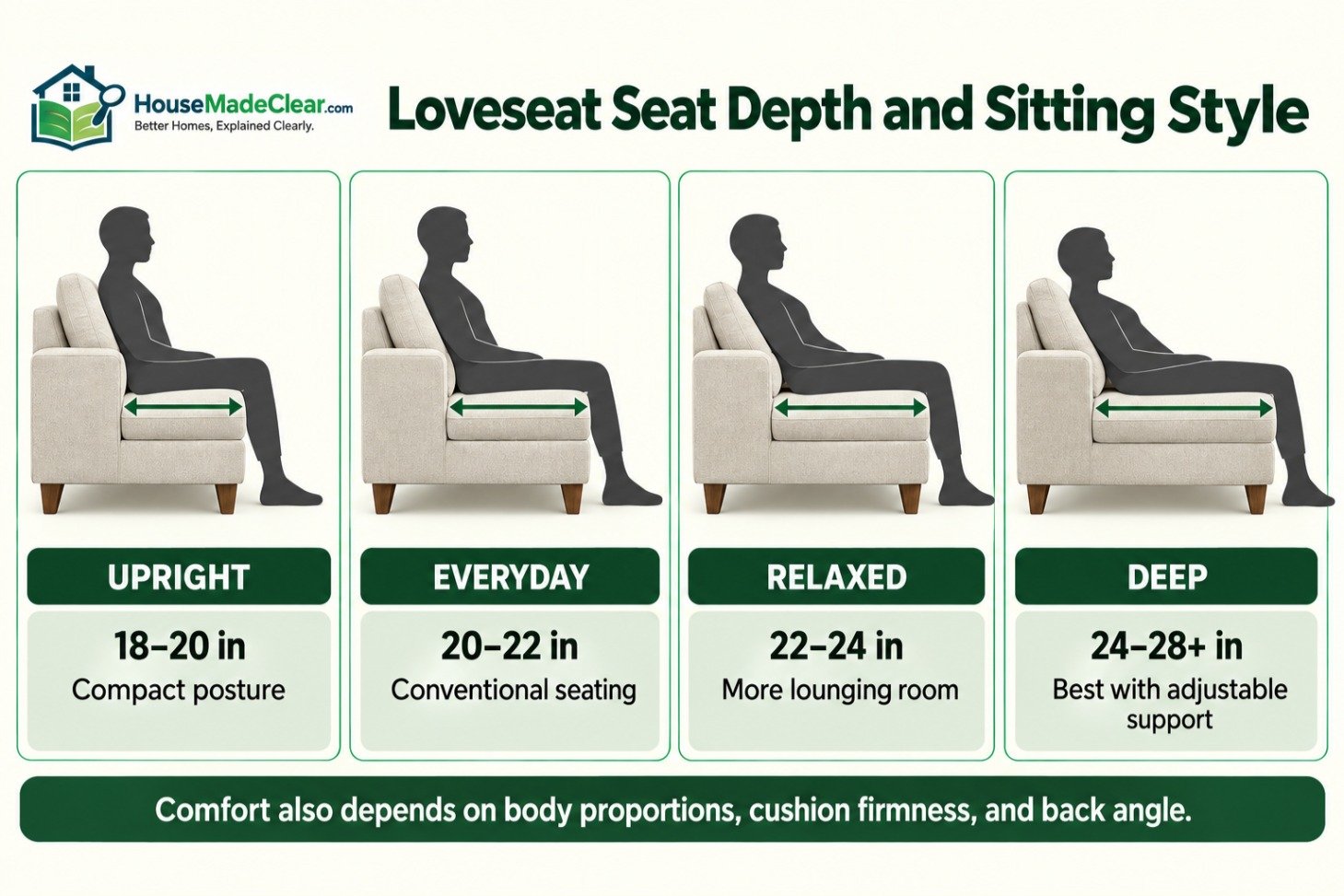
Standard Loveseat Seat Depth
Seat depth is measured from the front edge of the seat cushion to the point where a person’s back rests against the inside back cushion.
A common loveseat seat depth is approximately 20 to 24 inches.
| Seat depth | General seating feel |
|---|---|
| 18–20 inches | Upright and compact |
| 20–22 inches | Conventional everyday seating |
| 22–24 inches | Relaxed seating |
| 24–28 inches or more | Deep lounging |
These ranges describe general tendencies rather than guaranteed comfort. Cushion firmness, back angle, lumbar support and the user’s body proportions all affect how deep the seat feels.
Shallower Seats
A seat approximately 18 to 21 inches deep may suit people who:
- Prefer an upright posture
- Want their feet to rest on the floor
- Use the loveseat for conversation or reading
- Have shorter legs
- Find it difficult to rise from deep furniture
Deeper Seats
A seat approximately 23 to 28 inches deep may suit people who:
- Prefer lounging
- Sit with their legs folded
- Use throw pillows for adjustable support
- Are taller
- Want space to recline informally
A deep seat can be uncomfortable for a shorter person if the back cushion is too far away. Additional lumbar or throw pillows can reduce the functional depth, but they also reduce the remaining seating area.
Standard Loveseat Height
Overall loveseat height is measured from the floor to the highest point of the back or removable back cushions.
Most loveseats are approximately 30 to 36 inches high, although low-profile modern models may be shorter and traditional high-back designs may be taller.
Low-Profile Loveseats: 26 to 31 Inches High
Low-back loveseats create a visually open appearance and can preserve sightlines through a room.
They may work well:
- In front of a window
- In an open-plan room
- In a modern or minimalist interior
- Where the loveseat floats away from the wall
- Where a tall back would divide the space visually
A low overall height does not necessarily mean a low seat. Check overall height and seat height separately.
Standard-Height Loveseats: 30 to 36 Inches High
This is a common range for many residential designs. It generally provides visible back support without creating the visual weight of a high-back sofa.
Before placing the loveseat under a window, measure from the floor to:
- The bottom of the window casing
- The projecting sill
- Window handles
- Radiators
- HVAC registers
- Curtains or shades
Do not compare the loveseat height only with the glass portion of the window.
High-Back Loveseats: 36 to 42 Inches or More
Traditional, wingback and motion-furniture designs can be taller than 36 inches.
A high back may provide more upper-body support, but it can:
- Block windows
- Interrupt room sightlines
- Make a compact room feel more enclosed
- Increase the delivery height
- Conflict with artwork or wall shelves
Standard Loveseat Seat Height
Seat height is measured vertically from the floor to the top of the seat cushion where a person sits.
A common loveseat seat height is approximately 16 to 20 inches.
| Seat height | General effect |
|---|---|
| 15–17 inches | Low, relaxed profile |
| 17–19 inches | Common residential range |
| 19–21 inches | Higher seating and easier rise for some users |
Soft cushions compress under body weight, so the occupied seat height can be lower than the listed dimension.
A very low loveseat may look streamlined but can be difficult for some older adults or people with limited leg strength. A higher seat can make standing easier, although it may leave a shorter user’s feet unsupported.
Whenever possible, test the furniture with the intended users before purchasing.
Loveseat Dimensions by Type
Different mechanisms and frame styles create different space requirements.
| Loveseat type | Typical width | Typical depth | Typical height | Additional planning concern |
|---|---|---|---|---|
| Compact apartment loveseat | 48–58 in. | 30–36 in. | 28–35 in. | Confirm usable width |
| Standard two-seat loveseat | 55–66 in. | 32–40 in. | 30–36 in. | Check arm thickness |
| Wide loveseat | 67–72 in. | 34–40 in. | 30–38 in. | May overlap with small-sofa sizes |
| Deep-seat loveseat | 55–72 in. | 40–44+ in. | 28–36 in. | Requires greater room depth |
| Reclining loveseat | 58–75+ in. | 36–42 in. closed | 38–44 in. | Measure fully reclined footprint |
| Sleeper loveseat | 54–75+ in. | 35–42 in. closed | 30–38 in. | Measure open-bed footprint |
| Loveseat with chaise | 60–80+ in. | 35–65+ in. | 28–38 in. | Measure longest projection |
| Armless loveseat | 45–65 in. | 30–40 in. | 28–36 in. | Verify exposed-edge comfort |
| Settee | 45–65 in. | 25–35 in. | 30–40 in. | Often shallower and more upright |
The ranges overlap because “loveseat” describes a seating category rather than one standardized construction.
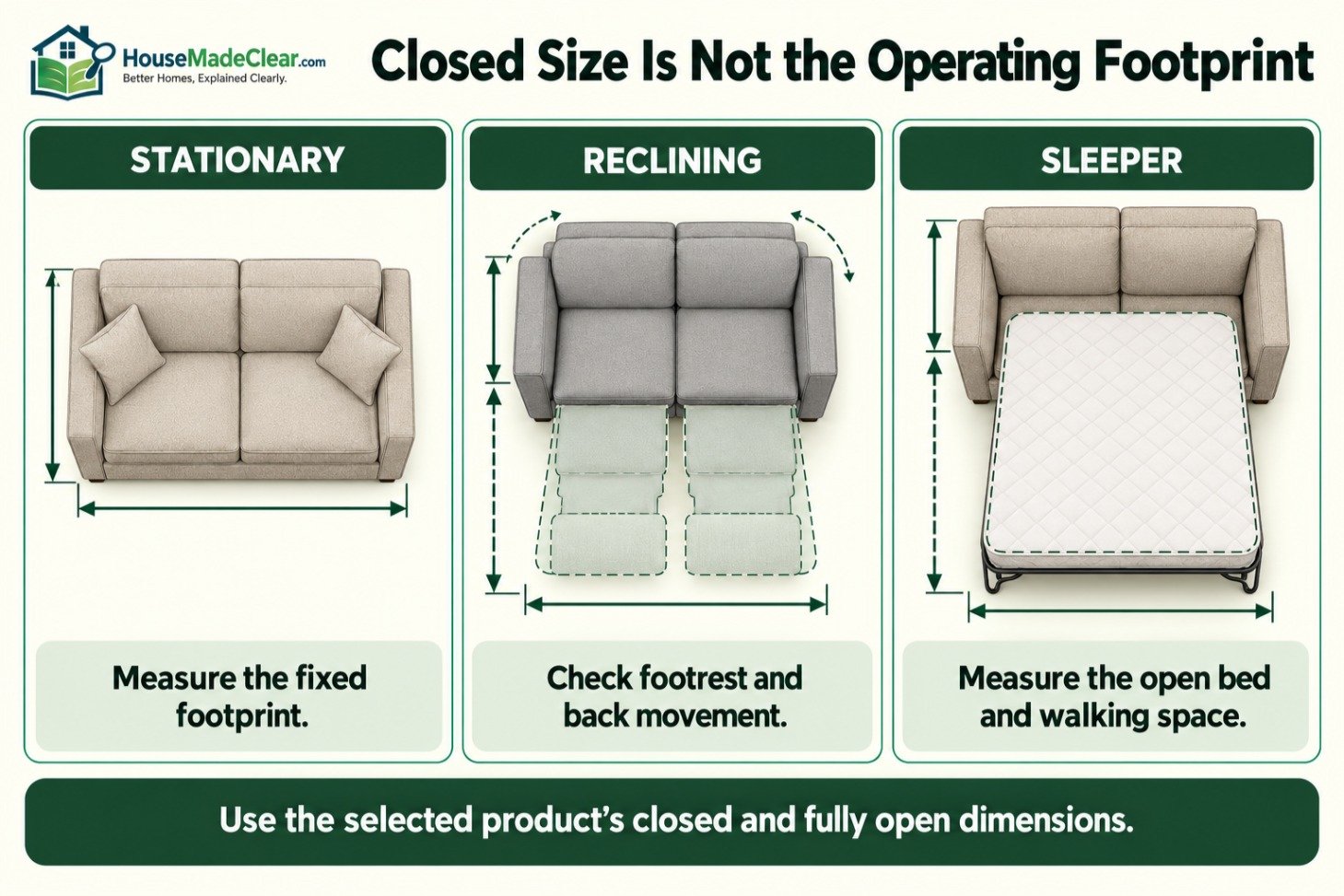
Reclining Loveseat Dimensions
A reclining loveseat must be measured in both its closed and fully extended positions.
Record:
- Closed width
- Closed depth
- Fully reclined depth
- Required wall clearance
- Footrest projection
- Console width
- Handle or power-control clearance
- Power-cord location
Some wall-hugger recliners need relatively little room behind them, but the footrest still requires clear floor space in front. Follow the exact product specifications rather than applying a generic recliner clearance.
A center console can add several inches to the loveseat width while separating the occupants.
Sleeper Loveseat Dimensions
A sleeper loveseat can function as compact seating by day and a bed at night, but its operating footprint is much larger than its closed footprint.
Measure:
- Closed loveseat width and depth
- Open mattress width and length
- Space needed to pull out the mechanism
- Walking clearance around the open bed
- Clearance for nearby doors and drawers
- Bedding-storage requirements
Do not place a coffee table where it becomes difficult to move whenever the sleeper is opened.
Loveseat With Chaise Dimensions
A loveseat with a chaise has an asymmetrical footprint. The main seating portion may have a conventional loveseat depth, while the chaise can extend 55 to 70 inches or more into the room.
Record the depth of each section separately.
Confirm whether the chaise is:
- Left-facing
- Right-facing
- Reversible
- Removable
- Permanently attached
“Left-facing” and “right-facing” terminology can vary by retailer. Verify the orientation using the product diagram rather than the name alone.
Armless Loveseat Dimensions
An armless loveseat can provide more usable seat width within a compact exterior footprint. It may also connect with modular pieces.
However, it offers no side support and can feel unfinished when used as a freestanding piece. Check whether the design is intended to stand alone or form part of a sectional.
What Size Loveseat Fits Two People?
The number of people a loveseat accommodates depends more on usable seat width than exterior width.
As a starting point:
- 40–44 inches of usable width: compact seating for two
- 45–50 inches: workable for many two-person arrangements
- 51–60 inches: more generous seating for two
These are planning ranges, not body-size guarantees.
A loveseat with two separate cushions makes the intended seating positions obvious. A single bench cushion can be visually flexible but does not create additional physical room.
Before buying, compare:
- Overall width
- Usable width between the arms
- Width of each seat cushion
- Armrest thickness
- Center-console width, if present
- Cushion firmness
- Intended occupants
A 58-inch slim-arm loveseat may offer more usable seating than a 66-inch model with large rolled arms.
How Much Room Does a Loveseat Need?
The loveseat footprint is only one component of the room plan. You also need space for circulation, tables, doors and normal use.
Space Between a Loveseat and Coffee Table
Approximately 14 to 18 inches between the front of the loveseat and the coffee table works for many residential layouts.
This distance keeps the table within reach while leaving room for legs and basic movement.
The correct gap depends on:
- Seat height
- Table height
- Occupant mobility
- Table shape
- Reclining mechanisms
- Main circulation routes
Our guide to the distance between a sofa and coffee table covers these clearances in detail.
Coffee-Table Size for a Loveseat
A coffee table approximately one-half to two-thirds of the loveseat’s overall width is a useful proportional starting point.
| Loveseat width | Suggested coffee-table length |
|---|---|
| 48 inches | 24–32 inches |
| 54 inches | 27–36 inches |
| 60 inches | 30–40 inches |
| 66 inches | 33–44 inches |
| 72 inches | 36–48 inches |
These proportions must still fit the available floor space.
For a 60-inch loveseat, a 36-inch coffee table is proportionate because it equals three-fifths of the loveseat width. However, the table may still be too wide if it eliminates the walkway on the opposite side.
Use the standard coffee-table size guide to compare rectangular, square, round and oval options.
Coffee-Table Height
A coffee table is commonly selected near the height of the loveseat seat or slightly lower. The relationship matters more than choosing a table according to an isolated “standard” height.
Measure the loveseat’s seat height with the cushions in their normal position, then compare it with the table height. Our standard coffee-table height guide explains the relationship.
Walkway Behind or Beside a Loveseat
For a frequently used household walkway, approximately 30 to 36 inches is a practical planning target. A secondary passage may function with less space, but it can feel restrictive.
These are residential planning recommendations, not universal building-code requirements.
Allow more room where:
- Two people pass each other
- Someone uses a mobility aid
- The loveseat reclines
- A door opens into the path
- Furniture drawers open into the aisle
- The route connects major rooms
Clearance From a Wall
A stationary loveseat does not always need a large space behind it. However, leaving a small gap can protect the wall and prevent upholstery from rubbing against baseboards.
More rear clearance may be needed for:
- Reclining backs
- Electrical cords
- Floor outlets
- Curtains
- Heating equipment
- Wall vents
- Thick baseboards
- Cleaning access
Use the manufacturer’s required wall clearance for reclining or powered models.
Loveseat Room-Size Examples
Room dimensions alone do not determine whether a loveseat fits. Door locations, windows, radiators and other furniture affect the usable area.
Loveseat in an 8 × 10-Foot Room
An 8 × 10-foot room contains 80 square feet.
A compact loveseat approximately 48 to 58 inches wide and 30 to 35 inches deep may work against the longer wall. Use a narrow, round or nesting table if a conventional coffee table restricts circulation.
Avoid assuming that the entire 8-foot wall is available. Subtract:
- Door width and swing
- Window trim
- Baseboard heaters
- Floor vents
- Electrical equipment
- Adjacent furniture
Loveseat in a 10 × 10-Foot Room
A 10 × 10-foot room usually offers greater flexibility.
A loveseat approximately 55 to 66 inches wide can work with one or two compact chairs. The final arrangement depends on whether the room also needs:
- A television stand
- A desk
- Bookcases
- A central coffee table
- A clear route between doors
Loveseat in a 10 × 12-Foot Room
A 10 × 12-foot room can often accommodate a conventional loveseat, a pair of chairs or a compact sofa-and-loveseat arrangement.
Do not automatically fill the additional space with larger furniture. Preserve usable pathways and maintain a clear relationship between the seating and the room’s focal point.
The functional living-room layout guide explains how to plan seating around circulation, conversation and focal points.
Loveseat in a Bedroom
A compact loveseat can provide reading or dressing space in a bedroom, but it must not obstruct:
- The bedroom entrance
- Closet doors
- Dresser drawers
- The route around the bed
- Windows required for emergency escape
- Heating or cooling equipment
Measure the loveseat together with the bed and storage furniture instead of treating the remaining corner as isolated space.
How to Measure a Loveseat Correctly
Use a rigid or metal tape measure and record every dimension in inches.
1. Measure Overall Width
Measure from the farthest outside point of one arm to the farthest point of the opposite arm.
Include:
- Curved arms
- Projecting upholstery
- Decorative trim
- Controls
- Hinges
- Side-mounted hardware
Do not measure only the seat cushions.
2. Measure Overall Depth
Measure from the farthest point at the back to the farthest point at the front.
Keep removable back cushions in their normal position. Include any frame or cushion projection beyond the legs.
3. Measure Overall Height
Measure from the floor to the highest point of the loveseat.
If the feet are removable, record the height both with and without them. Removing legs may help during delivery, but only when the manufacturer permits it.
4. Measure Seat Width
Measure the horizontal distance between the inside edges of the arms.
For curved or angled arms, measure at the narrowest point that affects sitting space.
5. Measure Seat Depth
Measure from the front edge of the seat cushion to the point where a person’s back rests against the normal back cushion.
Do not remove the back cushions to create an artificially larger figure.
6. Measure Seat Height
Measure vertically from the floor to the top of the uncompressed seat cushion.
Remember that soft cushions will compress when occupied.
7. Measure Diagonal Depth
Diagonal depth can help determine whether the loveseat can be tilted through a doorway.
The exact method may differ by manufacturer. Use the product’s delivery diagram when provided rather than calculating from only the overall height and depth.
Measuring the Room Before Buying
Mark the proposed loveseat footprint on the floor with painter’s tape.
Include the complete exterior width and depth, not only the seating area. Then mark:
- Coffee-table footprint
- Side tables
- Recliner extension
- Sleeper-bed extension
- Door swings
- Drawer extensions
- Main walking paths
- Floor vents
- Electrical outlets
Walk through the taped layout. Sit in the approximate seating position and check whether the table, television and pathways feel usable.
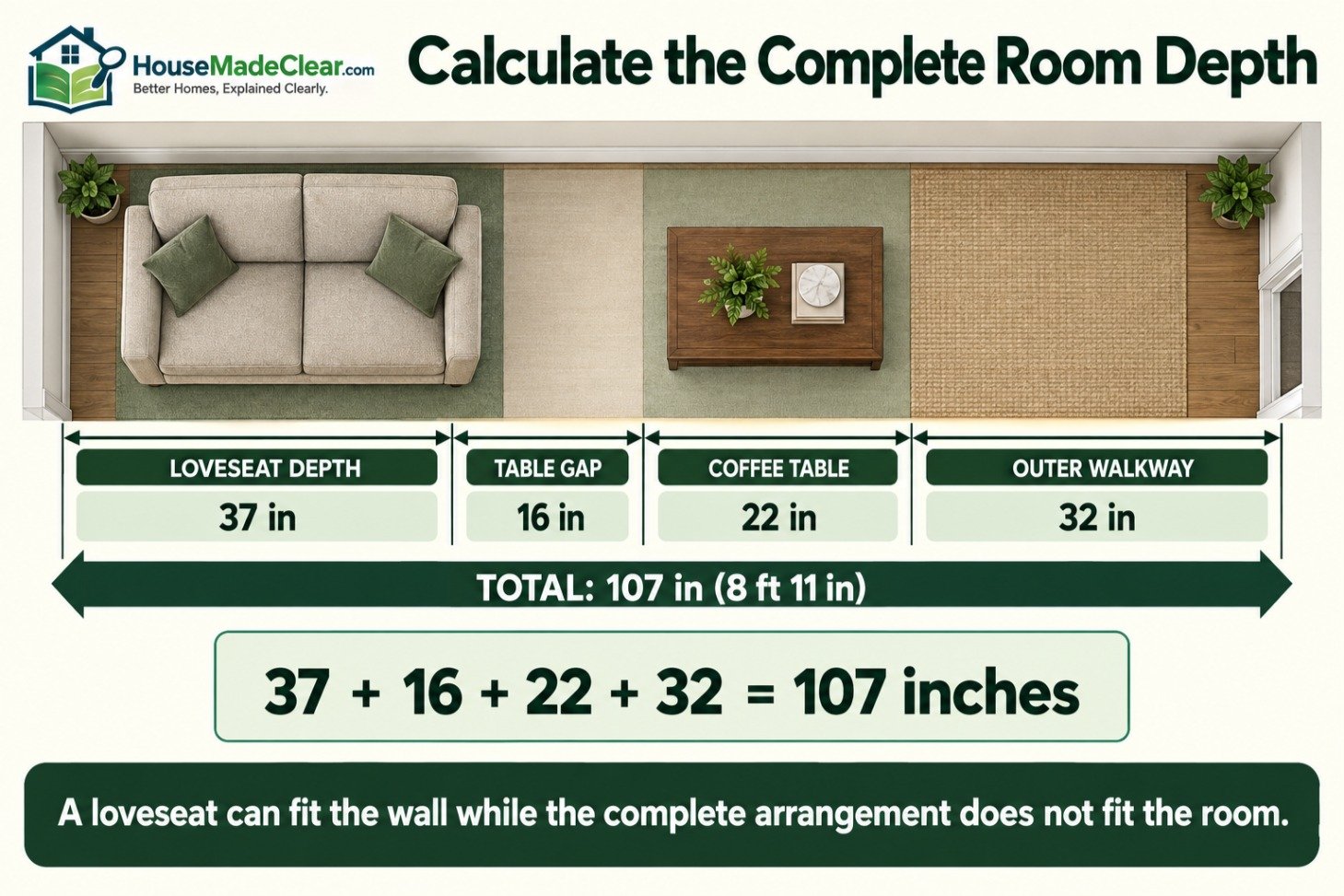
Calculate the Required Room Depth
For a loveseat facing a coffee table and walkway, use:
Required depth = loveseat depth + table gap + coffee-table width + outer walkway
Example:
- Loveseat depth: 37 inches
- Gap to coffee table: 16 inches
- Coffee-table width: 22 inches
- Walkway beyond table: 32 inches
37 + 16 + 22 + 32 = 107 inches
The complete arrangement requires approximately 107 inches, or 8 feet 11 inches, of room depth.
This calculation exposes a common mistake: a loveseat may fit against the wall but leave insufficient space for the rest of the furniture.
Measuring the Delivery Route
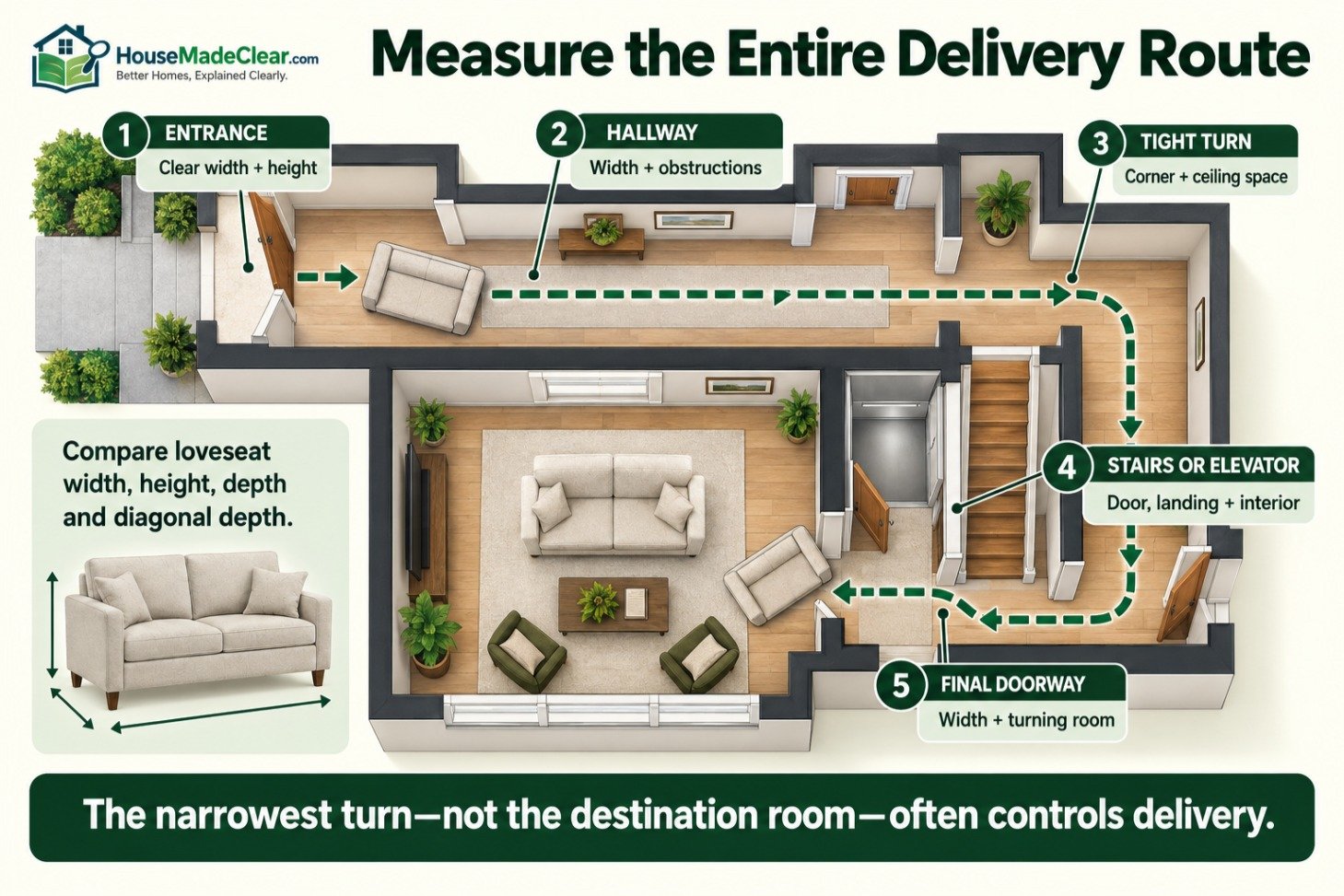
A loveseat that fits the room can still fail to reach it.
Measure the complete route from the delivery vehicle or building entrance to the final position. The Crate & Barrel furniture-measuring guide recommends checking entrances, doorways, hallways, elevators and turning points rather than measuring only the destination room.
Record:
- Exterior entrance width and height
- Interior doorway width and height
- Hallway width
- Stair width
- Stairwell height
- Landing dimensions
- Elevator-door dimensions
- Elevator interior dimensions
- Tight corner dimensions
- Ceiling height at turns
- Removable-door clearance
Also check for:
- Door handles
- Railings
- Light fixtures
- Radiators
- Wall-mounted shelves
- Low ceilings
- Security gates
- Apartment-building restrictions
Can the Loveseat Be Turned Through the Door?
A piece slightly wider than the doorway may still fit when turned, tilted or carried vertically. That does not guarantee success.
The result depends on:
- Loveseat height
- Overall and diagonal depth
- Doorway height
- Space on both sides of the doorway
- Ceiling height
- Arm shape
- Removable legs or cushions
- Tight hallway turns
Do not assume that delivery personnel will disassemble a fixed frame or remove a window. Confirm the delivery requirements and service limitations before purchase.
Choosing a Loveseat for a Small Room
A small room does not always require the narrowest available loveseat. Proportion, usable seating and circulation matter more than minimizing one dimension.
Look for:
- Slim track arms
- Raised legs
- Moderate overall depth
- Removable cushions
- A low visual profile
- A usable seat width of at least approximately 40 inches
- A compact exterior frame
- No unnecessary center console
Raised legs expose more floor and can make the room appear less crowded. Slim arms preserve seating width without enlarging the footprint.
Avoid selecting a model solely because it is described as “apartment size.” That term does not guarantee a particular width or depth.
Choosing a Loveseat for a Large Room
A small loveseat can look isolated in a large living room unless it is integrated into a larger seating arrangement.
Possible layouts include:
- Loveseat facing a sofa
- Loveseat perpendicular to a sofa
- Loveseat paired with two chairs
- Two loveseats facing each other
- Loveseat beside a fireplace
- Loveseat forming part of a conversation area
In a large open-plan room, use a rug, tables and lighting to visually connect the loveseat with the other seating.
Do not solve a large-room problem by buying an excessively deep loveseat. Width, height and furniture grouping usually affect visual scale more directly than depth alone.
Loveseat Dimensions and Rug Placement
The rug should relate to the entire seating group rather than only the loveseat.
Common approaches include:
Front Legs on the Rug
Place the loveseat’s front legs and the front legs of nearby chairs on the rug. This visually joins the seating without requiring a room-size rug.
All Legs on the Rug
A larger rug can hold the loveseat, chairs and table completely. Maintain a reasonably consistent border around the grouping.
Small Rug Under the Coffee Table
This can work in a compact room, but a rug that barely exceeds the coffee-table footprint may make the seating arrangement look disconnected.
Measure the loveseat and surrounding furniture before choosing a rug. Rug dimensions should be based on the complete seating arrangement rather than the loveseat alone. Compare common options in our guide to selecting the right rug size for a loveseat.
Common Loveseat-Measuring Mistakes
Treating “Loveseat” as One Standard Size
Loveseats vary widely. Always use the selected model’s specification sheet.
Measuring Only the Wall
A 60-inch empty wall does not necessarily accommodate a 60-inch loveseat. Baseboards, trim, outlets, curtains and nearby furniture may reduce usable space.
Ignoring Arm Width
Thick arms can consume a large portion of the total width. Compare usable seat width with exterior width.
Confusing Overall Depth With Seat Depth
Overall depth controls the room footprint. Seat depth affects the sitting position. They are not interchangeable.
Forgetting the Fully Open Footprint
Reclining, sleeper and convertible loveseats require more operating space than their closed dimensions suggest.
Ignoring Doors and Drawers
A loveseat may block a nearby cabinet, closet, room door or built-in storage unit even when the basic footprint fits.
Measuring Only the Front Door
The tightest point may be an interior doorway, stair landing, elevator or hallway turn.
Choosing Proportion Before Function
A loveseat may look proportionate but provide inadequate usable width, uncomfortable seat depth or insufficient circulation.
Assuming Removable Cushions Solve Delivery Problems
Removing cushions reduces bulk but does not change the dimensions of the fixed frame. Confirm whether the feet, arms or back are designed for removal.
Loveseat Measurement Checklist
Complete this checklist before ordering.
| Measurement or detail | What to record |
|---|---|
| Overall loveseat width | Widest exterior point |
| Usable seat width | Inside arm to inside arm |
| Overall depth | Backmost to frontmost point |
| Seat depth | Cushion front to normal back support |
| Overall height | Floor to highest point |
| Seat height | Floor to top of uncompressed cushion |
| Arm height | Floor to top of arm |
| Closed footprint | Normal stationary dimensions |
| Open footprint | Reclined, sleeper or chaise dimensions |
| Wall width | Finished available wall space |
| Room depth | Wall to opposite obstruction |
| Coffee-table gap | Planned distance from seat |
| Walking clearance | Space around the complete arrangement |
| Door swings | Full operating arc |
| Delivery doorways | Clear width and height |
| Hallway turns | Width and diagonal turning space |
| Stairs and landings | Width, height and corner clearance |
| Elevator | Door and interior dimensions |
| Removable components | Legs, cushions, back or arms |
| Power requirements | Outlet and cord location |
| Product orientation | Left-facing, right-facing or reversible |
Frequently Asked Questions
What are standard loveseat dimensions?
Most loveseats are approximately 48 to 72 inches wide, 32 to 40 inches deep, and 30 to 36 inches high. Conventional two-seat models commonly measure around 52 to 66 inches wide.
What is the average width of a loveseat?
A width of approximately 55 to 65 inches is common for many residential loveseats. Compact models may be narrower than 55 inches, while oversized loveseats can approach 72 inches.
How wide should a loveseat be for two people?
A loveseat should generally provide approximately 40 to 50 inches or more of usable seat width for two people. Exterior width may need to be greater when the loveseat has thick arms or a center console.
Is a 60-inch loveseat large enough for two adults?
A 60-inch loveseat can accommodate two adults when its arms are not excessively thick. Check the interior seat width because two loveseats with the same exterior width can provide different amounts of usable space.
What is the standard depth of a loveseat?
The overall depth of a conventional loveseat is commonly around 32 to 40 inches. Deep lounge, reclining and sleeper models may measure 40 to 44 inches or more.
What is the standard loveseat seat depth?
Loveseat seat depth is generally approximately 20 to 24 inches. A seat around 20 to 22 inches supports more upright sitting, while depths above 23 or 24 inches feel more relaxed.
What is the standard height of a loveseat?
Most loveseats are approximately 30 to 36 inches high overall, with seat heights commonly around 16 to 20 inches. Low-profile and high-back designs may fall outside these ranges.
What is the difference between a loveseat and a sofa?
A loveseat is generally designed for two people and commonly measures 48 to 72 inches wide. A conventional sofa is wider and usually provides three seating positions. The size categories overlap, so actual dimensions are more reliable than product labels.
How much space should be left in front of a loveseat?
Allow approximately 14 to 18 inches between a loveseat and coffee table. If the area serves as a primary walkway, approximately 30 to 36 inches of open passage is a more practical planning target.
Can a loveseat fit through a 30-inch doorway?
It may, but width alone does not determine delivery fit. Compare the loveseat’s height, depth and diagonal depth with the doorway, surrounding turning space and complete delivery route. Removable legs or cushions may help, but the fixed frame remains the controlling dimension.
What size loveseat works in a small apartment?
A loveseat approximately 48 to 60 inches wide and 30 to 36 inches deep works in many small apartments. The correct size depends on the room dimensions, usable seat width, other furniture, circulation and delivery access.
Is a 72-inch loveseat actually a sofa?
A 72-inch loveseat overlaps with the compact-sofa category. Manufacturers use different labels, so compare the seating configuration, usable width and exterior dimensions rather than relying on the product name.
Final Loveseat Sizing Checklist
Before purchasing a loveseat:
- Measure the complete room.
- Identify the available finished wall width.
- Mark the full loveseat footprint on the floor.
- Compare overall width with usable seat width.
- Check seat depth and seat height for the intended users.
- Add coffee-table and circulation clearances.
- Measure the fully open footprint of reclining or sleeper models.
- Check every doorway, hallway, stair and turn on the delivery route.
- Verify removable components with the manufacturer.
- Compare the final measurements with the exact product specification sheet.
A loveseat should be chosen as part of the complete room arrangement, not as an isolated furniture measurement. The right model provides adequate seating while preserving circulation, access and proportion throughout the room.






[…] Standard Loveseat Dimensions: Width, Depth, Height & Size Guide […]
[…] Standard Loveseat Dimensions: Width, Depth, Height & Size Guide […]
[…] Standard Loveseat Dimensions: Width, Depth, Height & Size Guide […]