
















French doors can provide natural light, wide access and a strong visual connection between indoor and outdoor spaces. Their two-door construction, however, creates security weaknesses that are different from those of a conventional single exterior door.
The problem is rarely just the lock. A secure French-door assembly depends on the active leaf, inactive leaf, astragal, flush bolts, hinges, glass, frame and installation working together.
A new deadbolt may add little protection if the inactive door can be pushed inward, the astragal flexes, the frame is damaged or the glass allows someone to reach the interior hardware.
Quick Answer
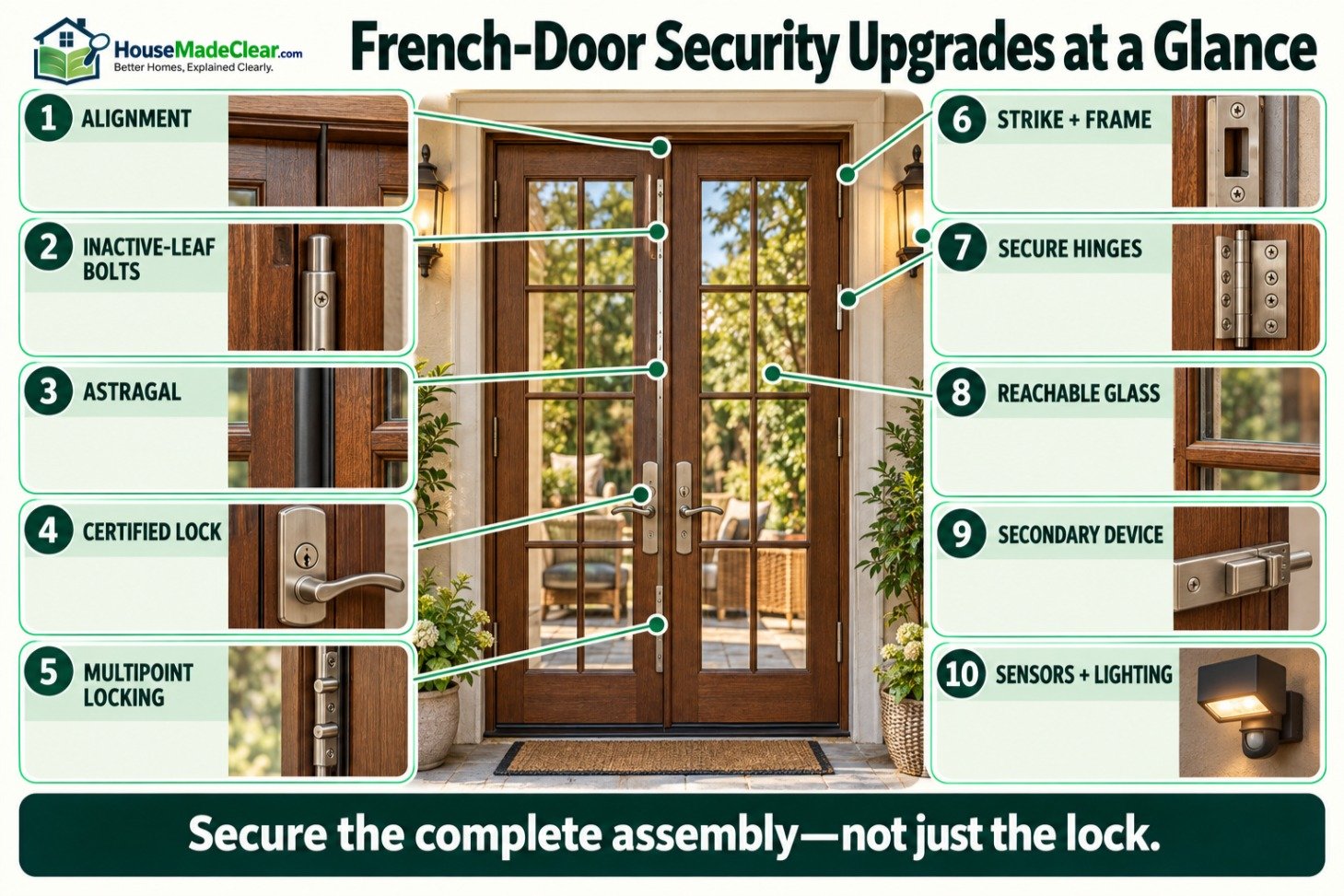
To secure French doors:
- Repair door and frame alignment.
- Strengthen the inactive door’s top and bottom bolts.
- Reinforce the astragal and meeting stile.
- Use certified deadbolt or multipoint locking hardware.
- Reinforce the strike and surrounding frame.
- Secure exposed hinges on outward-opening doors.
- Protect reachable glass.
- Add a compatible secondary locking device.
- Use door and glass-break sensors.
- Improve exterior lighting and visibility.
Start with the inactive leaf and center meeting point. These are often the parts that determine whether the entire assembly resists forced entry.
French-Door Security Upgrades at a Glance
| Upgrade | Security Problem Addressed | Typical Priority | Professional Help |
|---|---|---|---|
| Correct alignment | Bolts and locks do not engage fully | Essential | Sometimes |
| Stronger inactive-leaf bolts | Passive door moves under force | High | Often recommended |
| Reinforced astragal | Center joint flexes or separates | High | Often recommended |
| Certified deadbolt | Weak or unsuitable primary lock | High | Depends on door |
| Multipoint locking | Force concentrated at one location | High for replacement doors | Usually |
| Reinforced strike and frame | Jamb or fasteners fail | High | Sometimes |
| Secured exposed hinges | Pins accessible from outside | High for outswing doors | Depends on hinge |
| Laminated or reinforced glass | Reach-through and glass penetration | High when glass is reachable | Usually |
| Secondary security device | Adds resistance when doors are closed | Medium | Product-dependent |
| Sensors and lighting | Detection and deterrence | Supporting layer | Optional |
The correct combination depends on whether the doors swing inward or outward, which leaf is active, how the inactive leaf is secured and whether the doors form part of an emergency exit route.
Why French Doors Can Be Difficult to Secure
French doors have two side-hinged leaves that meet in the center. One door is normally used for everyday entry, while the second remains secured until a wider opening is needed.
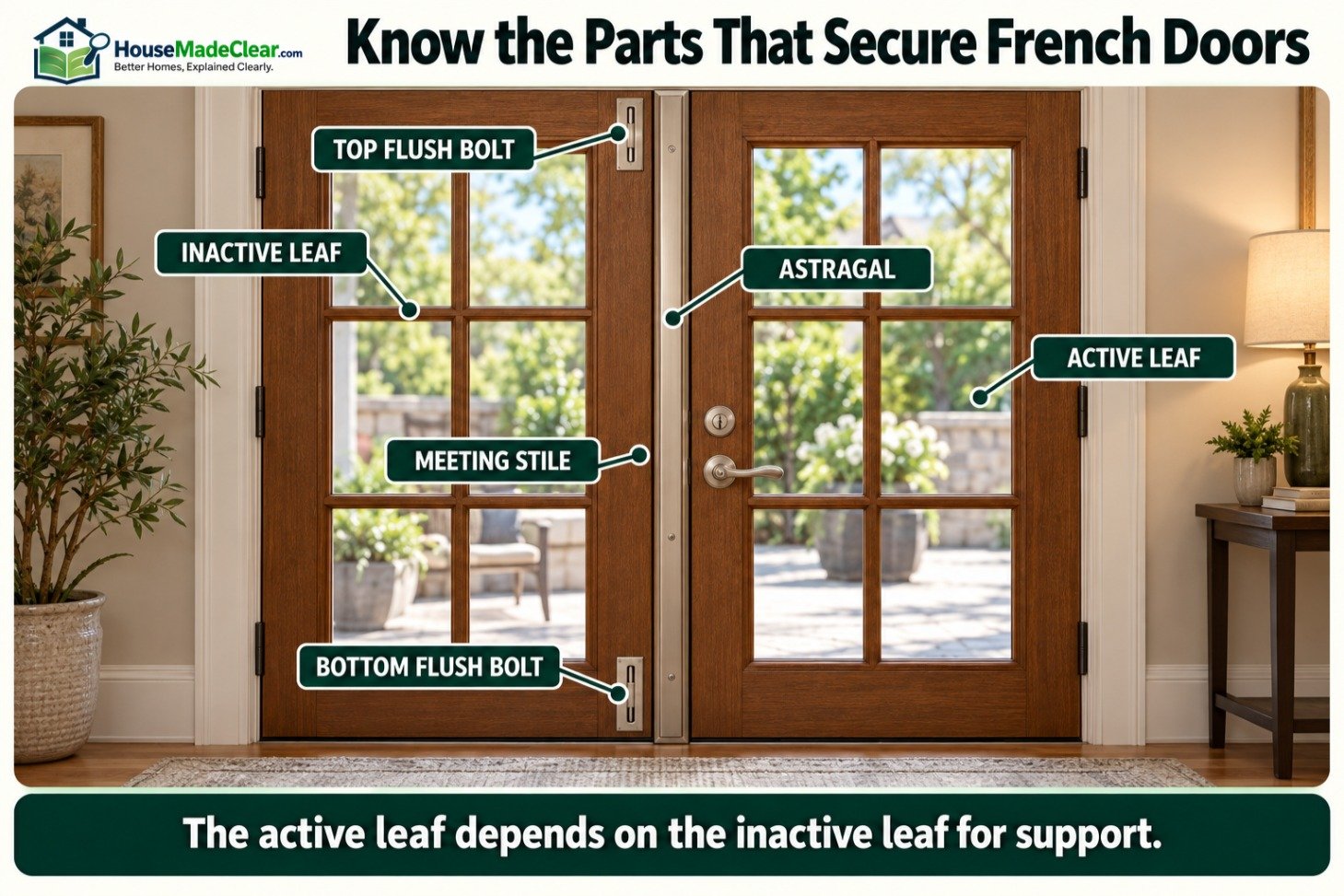
The two leaves are commonly described as:
- Active leaf: The door used for normal entry and fitted with the main handle or lock
- Inactive leaf: The secondary door, normally secured at the top and bottom
- Meeting stile: The vertical edges where the two doors meet
- Astragal: A vertical component attached to one leaf that covers or seals the gap between the doors
- Flush bolts: Bolts that secure the inactive leaf into the head and threshold
- Multipoint lock: A system that secures a door at more than one location when operated
On a conventional single door, the deadbolt enters a strike mounted in a fixed jamb. On many French doors, the active door locks into the inactive door or astragal instead.
That arrangement means the inactive leaf effectively becomes part of the active door’s strike-side support. If the inactive leaf moves, bends or releases, the primary lock may lose much of its effectiveness.
Inspect the Doors Before Adding Security Hardware
Do not begin by ordering reinforcement plates, bars or additional locks. First determine how the existing assembly works.
Identify the Active and Inactive Leaves
Open the doors and locate:
- The leaf with the main handle
- The leaf with top and bottom bolts
- The location of the strike or lock receiver
- The astragal
- The hinge positions
- Any multipoint locking components
Some modern French doors use a multipoint system on the active leaf and automatic bolts on the inactive leaf. Older doors may use manual surface bolts or recessed flush bolts.
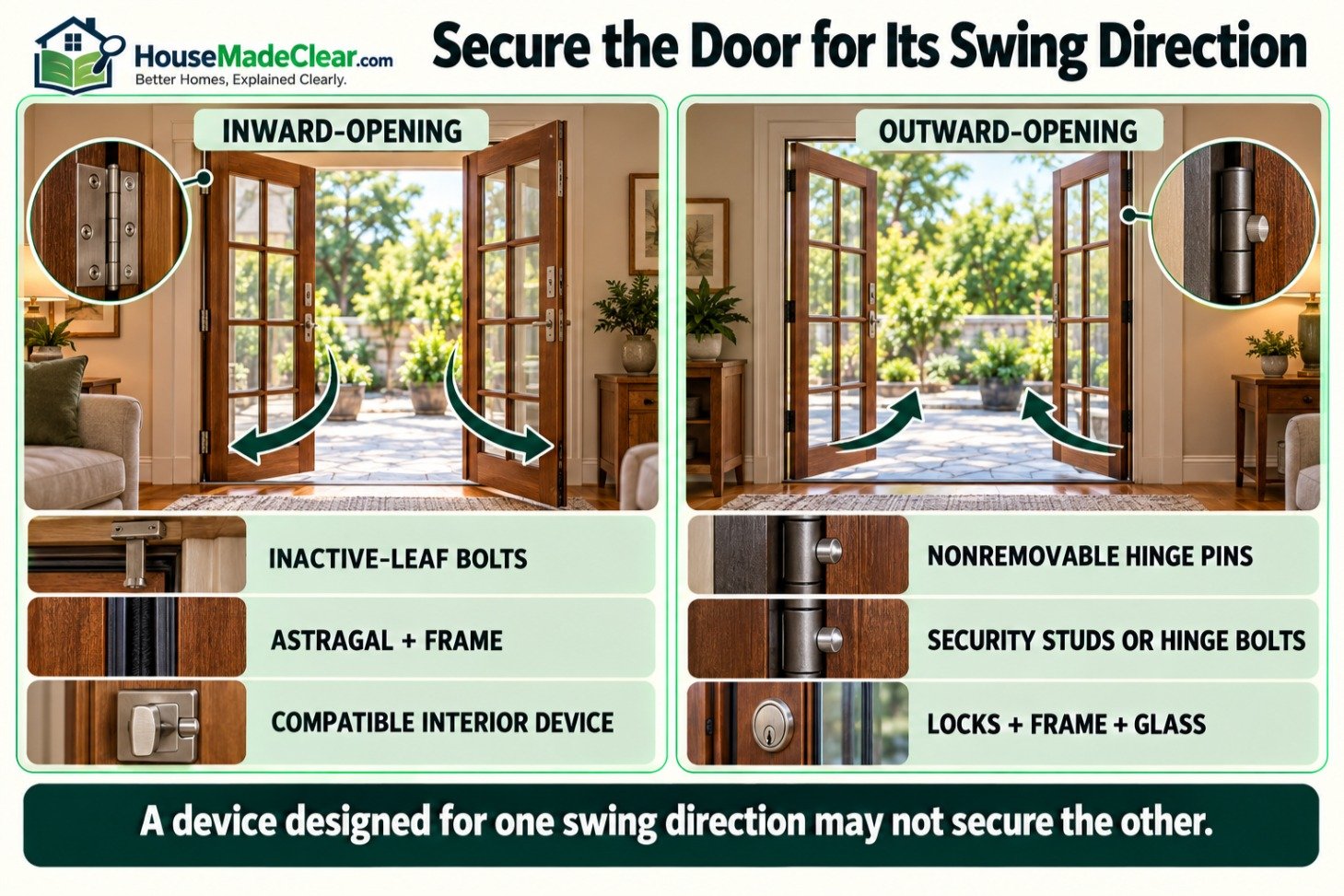
Determine the Swing Direction
Stand on the secure interior side and observe whether the doors swing:
- Inward into the home
- Outward toward the exterior
The swing direction affects hinge exposure, secondary-lock compatibility and emergency operation.
A device intended for an inward-opening door may not work on an outward-opening set. Similarly, outward-opening doors require specific attention to hinge security.
Check Door Alignment
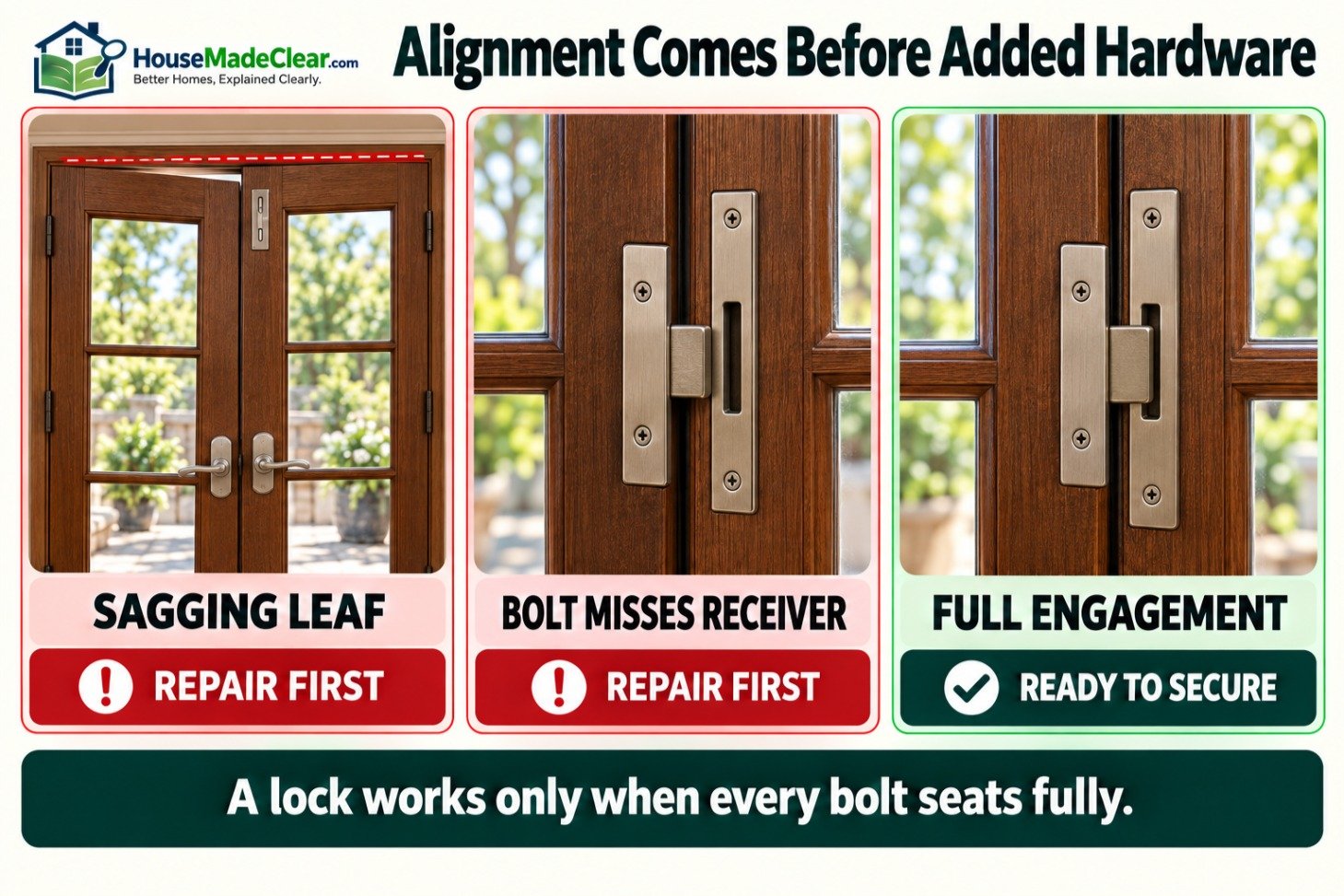
Close both leaves without lifting, pushing or pulling them into position.
Look for:
- Uneven gaps
- A sagging door
- Bolts that miss their receivers
- A deadbolt that rubs the strike
- A loose astragal
- Movement at the meeting point
- Light visible through the center seam
- Scraping at the threshold
- Weatherstripping that prevents full closing
- Water damage or rot
If a lock works only when the door is lifted or pulled, it is not operating correctly. Repair the alignment before installing additional security hardware.
Test the Inactive Leaf
Secure the inactive leaf and apply moderate hand pressure from inside.
The leaf should not:
- Rattle excessively
- Move away from the frame
- Pull the bolts out of their receivers
- Flex noticeably at the center
- Release without operating its hardware
Do not perform an aggressive impact test that could damage the door or glass. A locksmith or qualified door professional can evaluate more serious movement.
1. Repair the Door, Frame and Alignment
Security hardware cannot compensate for a door that does not close correctly.
Misalignment may prevent:
- The deadbolt from extending fully
- Flush bolts from entering their receivers
- Multipoint locks from engaging
- The astragal from seating correctly
- Weather seals from compressing
- Sensors from registering the door as closed
Common causes include:
- Loose or undersized hinge screws
- Worn hinges
- Door sag
- Seasonal wood movement
- Threshold movement
- Frame settlement
- Swollen or damaged door edges
- Improper installation
- Debris inside bolt receivers
Have the underlying cause corrected instead of enlarging every hole until the hardware appears to fit. Oversized receivers can leave the bolt with less material around it and increase movement.
Confirm Full Bolt Engagement
A bolt that enters only partway may look locked while providing limited resistance.
With the doors open, observe how far each bolt projects. Then close and lock the assembly to confirm that nothing prevents full operation.
Never grind, shorten or modify a bolt unless the lock manufacturer specifically authorizes the change.
2. Strengthen the Inactive Door’s Top and Bottom Bolts
The inactive leaf is one of the most important parts of a French-door assembly.
It is commonly secured by bolts extending into:
- The head jamb above
- The threshold or floor below
If those bolts are short, loose, misaligned or surrounded by weak material, the inactive leaf may move when force is applied to the active door.
Types of Inactive-Leaf Bolts
French doors may use:
- Manual flush bolts
- Surface-mounted bolts
- Automatic flush bolts
- Constant-latching flush bolts
- Multipoint inactive-leaf hardware
Manual flush bolts must be operated whenever the inactive leaf is opened or closed. Automatic systems engage when the doors close in the correct sequence.
What to Inspect
Check:
- Bolt length and condition
- Full engagement
- Mounting-screw tightness
- Receiver condition
- Alignment with the head and threshold
- Damage around the door-edge preparation
- Corrosion
- Debris in the lower receiver
- Whether the inactive leaf can be opened before the active leaf
The lower receiver frequently collects dirt and debris. A blocked receiver can prevent the bolt from extending completely.
Do Not Mix Incompatible Hardware
Changing flush bolts may require cutting or drilling the door edge. Incorrect preparation can weaken the stile, interfere with internal components or damage a fire-rated or manufacturer-listed assembly.
Use hardware designed for the door material and follow the door and hardware manufacturers’ instructions.

3. Reinforce the Astragal and Meeting Stile
The astragal covers or seals the gap where the two doors meet. Depending on the design, it may also contain the strike, flush bolts or weather seals.
A weak, loose or damaged astragal can allow:
- The center seam to spread
- The active leaf to move past the inactive leaf
- The deadbolt receiver to separate from its support
- Tools to reach the latch or bolt
- Air and water infiltration
- The inactive leaf to flex
Inspect the Astragal
Look for:
- Loose fasteners
- Cracks
- Distortion
- Separation from the door
- Corrosion
- A large center gap
- A damaged strike opening
- Missing components
- Movement when the active door is pushed
The astragal should match the door system, swing direction, handing and hardware arrangement.
Do not attach a generic metal strip without understanding how it affects closing order, weather sealing, latch engagement and emergency operation.
Overlapping Astragals
An overlapping astragal can help cover the center gap and make direct access to the latch more difficult. However, the doors must close in the correct order.
If the wrong leaf is closed first, the doors may not latch properly or the astragal may be damaged.
4. Install an Appropriate Certified Deadbolt
Where the door construction supports a deadbolt, choose hardware tested under an applicable ANSI/BHMA standard.
ANSI/BHMA lock grades are commonly described as:
- Grade 1: Highest performance level
- Grade 2: Intermediate performance level
- Grade 3: Basic performance level
Grades address tested product performance, but they do not make the surrounding door or frame stronger. Verify the exact product in the BHMA Certified Products Directory instead of relying only on marketplace descriptions.
Single-Cylinder or Double-Cylinder?
A single-cylinder deadbolt uses:
- A key outside
- A thumbturn inside
A double-cylinder deadbolt requires:
- A key outside
- A key inside
A double-cylinder deadbolt can reduce reach-through risk when breakable glass is near the lock, but it can also delay emergency exit and may be restricted by local code.
For most occupied homes, a single-cylinder deadbolt is the safer default because it allows immediate interior operation.
Read our detailed comparison of single-cylinder and double-cylinder deadbolts before selecting keyed interior hardware.
Check Door Compatibility
Not every French-door stile is wide enough for a standard deadbolt preparation. Drilling without verifying internal construction can damage:
- Glass
- Internal reinforcement
- Multipoint lock components
- Weather seals
- Wiring
- Door skins
- Manufacturer warranties
Use the lock manufacturer’s template and confirm compatibility with the door manufacturer. French doors may use standard or manufacturer-specific slab dimensions, and both the active and inactive leaves must fit the frame correctly. Before changing the locking hardware, verify door thickness, overall dimensions, and the existing preparation. Our standard door height, width, and thickness guide explains these measurements and how they differ from frame and rough-opening dimensions.
5. Consider a Multipoint Locking System
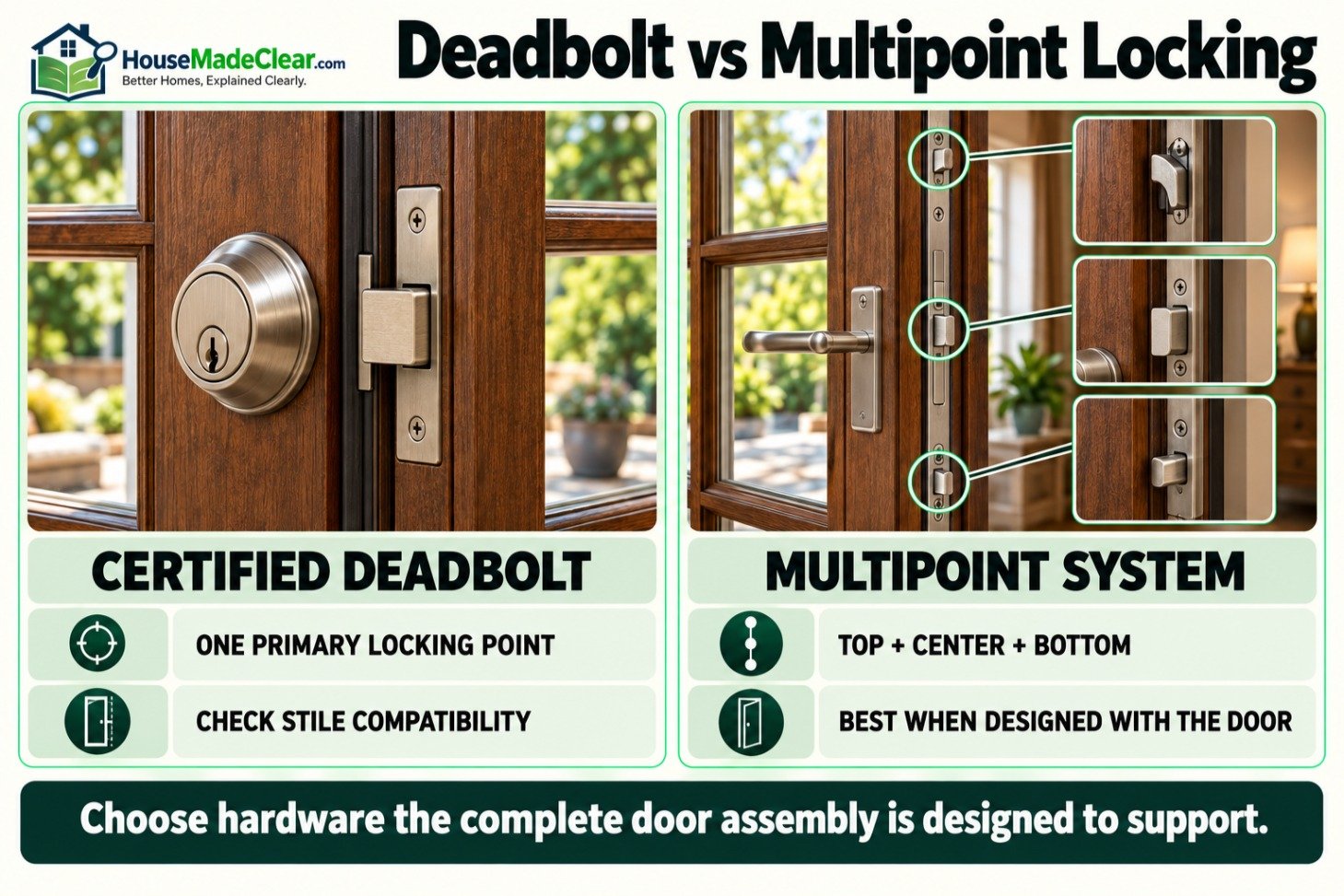
A multipoint lock secures the door at multiple locations—commonly near the top, center and bottom.
Depending on the product, operating the handle or key may engage:
- Hooks
- Bolts
- Rollers
- Shoot bolts
- A central latch or deadbolt
The advantage is not merely having more locks. It is distributing resistance across several parts of the door instead of concentrating it at one center strike.
When Multipoint Locking Makes Sense
Multipoint hardware is particularly useful when:
- Replacing the entire French-door assembly
- Installing tall exterior doors
- The existing doors already use a compatible multipoint system
- The door manufacturer offers an approved upgrade
- Better compression and weather sealing are also needed
Retrofitting Is Not Always Practical
A conventional door cannot necessarily be converted by cutting several new recesses into its edge.
Retrofitting may require:
- Compatible door construction
- Precise routing
- Manufacturer-approved hardware
- New keep plates
- Correct handle operation
- Door realignment
- Professional installation
In many cases, replacing the complete door set is more reliable than attempting to add a multipoint mechanism to an incompatible door.
6. Reinforce the Strike and Surrounding Frame
The lock receiver must transfer force into a sound supporting structure.
On French doors, the receiver may be located in:
- The astragal
- The inactive leaf
- A center mullion
- The head or threshold
- Several multipoint keeps
Inspect the receiver and surrounding material for:
- Loose screws
- Cracks
- Stripped holes
- Thin or bent metal
- Rot
- Excessive movement
- Previous forced-entry damage
- Enlarged openings
Longer Screws Are Not a Universal Fix
Longer screws can sometimes improve attachment by reaching framing behind the finished jamb. However, blindly replacing every fastener is poor practice.
An excessively long or misplaced screw may:
- Distort the frame
- Pull the strike out of alignment
- Penetrate wiring or other concealed materials
- Damage glass or internal door components
- Interfere with moving hardware
- Void a manufacturer’s instructions
Use fasteners appropriate for the particular frame, strike and wall construction.
Reinforce the Assembly, Not Just the Decorative Trim
A decorative plate attached only to thin surface material may provide limited improvement. Reinforcement should connect the locking load to structurally sound material.
For a broader explanation of locks, strikes and frames, see our guide to improving home security with better locks.
7. Secure Exposed Hinges on Outward-Opening French Doors
Outward-opening doors place their hinge barrels on the exterior side. That does not automatically make them insecure, but the hinge design must prevent the door from being removed after the pins are attacked.
Possible hinge-security features include:
- Nonremovable pins
- Security studs
- Setscrews
- Crimped hinge pins
- Concealed hinges
- Manufacturer-designed hinge bolts
Security Studs and Hinge Bolts
A security stud projects from one hinge leaf into a matching hole in the other leaf when the door closes.
Even if an exposed pin is removed, the stud helps prevent the door from being lifted directly out of the opening.
Do Not Improvise Near Glass
Random screws or bolts installed through the hinge area can damage the door, interfere with closing or contact nearby glazing.
Use hardware compatible with:
- Door weight
- Hinge type
- Door material
- Frame construction
- Fire rating
- Manufacturer requirements
Heavy or sagging French doors may need hinge repair before any security feature is added.
8. Protect Reachable Glass
A large glass area is not automatically the weakest part of a French door. The risk depends on:
- Glass type
- Pane construction
- Distance from the interior lock
- How the glass is retained
- Frame strength
- The size of the opening created after breakage
The immediate concern is often reach-through access. If someone can create an opening near the handle or thumbturn, the lock may be operated from outside.
Laminated Security Glazing
Laminated glass contains an interlayer that helps hold broken material together and makes rapid penetration more difficult than with ordinary annealed glass.
The glass-retention system matters as much as the pane. Strong glazing installed in a weak or removable frame may still be displaced.
Professionally Installed Security Film
Security film can help hold broken glass together. Its performance depends on:
- Film type and thickness
- Glass compatibility
- Installation quality
- Curing
- Edge attachment
- Frame condition
Film applied only to the visible center of the glass may hold fragments together without preventing the entire pane from being pushed out.
Ask whether a compatible attachment system is needed to connect the filmed glass to the surrounding frame.
Decorative Grilles
Decorative grilles may discourage casual contact with the glass, but many are not structural security products.
Do not assume a grille provides forced-entry resistance unless the product and installation are designed and tested for that purpose.
Avoid Keyed-Interior Locks as the Automatic Solution
Installing a double-cylinder deadbolt may prevent someone from turning an interior thumbturn through broken glass, but it introduces an emergency-exit problem.
Improve the glass and frame first where practical. Confirm local requirements before using any lock that needs an interior key.

9. Add a Compatible Secondary Security Device
A secondary device can add resistance when the doors are closed, but it should not replace correctly operating primary hardware.
Options may include:
- Floor-mounted bolts
- Surface bolts
- French-door security bars
- Door barricade devices
- Supplemental multipoint hardware
- Manufacturer-approved center reinforcement
Match the Device to the Swing Direction
Many interior security bars are intended only for inward-opening doors. They may be ineffective or impossible to use on outward-opening doors.
Confirm:
- Intended door type
- Maximum door width
- Required mounting surface
- Floor or threshold compatibility
- Product load limits
- Emergency-release method
- Whether drilling is required
Do Not Block Emergency Exit
Some barricade devices add strong resistance but are unsuitable for doors that occupants may need to open quickly.
Common code principles require egress doors to be readily openable from inside without a key, special knowledge or unusual effort, although exact requirements depend on the building and locally adopted code. Consult the International Residential Code provisions adopted in your jurisdiction and the local building or fire authority before adding restrictive hardware.
A device stored nearby is different from one permanently installed across an exit, but it still needs to be usable by every household member.
10. Add Detection, Lighting and Visibility
Physical reinforcement should be the priority, but electronic detection adds another layer.
Useful options include:
- Door-contact sensors on both leaves
- Glass-break sensors
- Vibration sensors
- Exterior motion lighting
- A visible doorbell or exterior camera
- Alarm notifications
- Open-door alerts
- Lighting timers
- Landscape maintenance that preserves visibility
Monitor Both Door Leaves
A sensor installed only on the active leaf may not detect movement of the inactive leaf.
Depending on the system, each leaf may need its own sensor or a configuration designed specifically for double doors.
Position Glass-Break Sensors Correctly
Glass-break detectors vary by:
- Detection method
- Coverage distance
- Glass compatibility
- Room acoustics
- Mounting requirements
Follow the manufacturer’s installation instructions and test the device using the approved procedure. Do not strike the glass to test it.
Use Cameras as Detection, Not Physical Reinforcement
A camera may document an attempt or send an alert, but it does not strengthen the doors.
Avoid obvious blind spots and place the camera where it can capture:
- The approach path
- Faces
- The full doorway
- The area immediately beside the doors
Lighting should support the camera without producing severe glare or backlighting.
How to Secure Inward-Opening French Doors
For inward-opening French doors, focus on:
- Inactive-leaf top and bottom bolts
- Astragal and meeting-stile strength
- Active-leaf deadbolt or multipoint lock
- Strike and frame reinforcement
- Glass protection
- Compatible interior secondary devices
- Door and glass sensors
A properly designed interior security bar may add resistance, but only if it does not create an unsafe exit condition.
Do not brace the doors with loose furniture. It may move unpredictably, damage flooring and prevent occupants from opening the doors during an emergency.
How to Secure Outward-Opening French Doors
For outward-opening doors, focus on:
- Nonremovable hinge pins or security hinges
- Hinge studs or bolts
- Inactive-leaf locking points
- Astragal construction
- Multipoint locking
- Frame attachment
- Glass protection
- Exterior hardware resistance
A conventional pressure bar designed for inward-opening doors will not provide the same function.
Outward-opening doors can resist some inward forces effectively, but they require hardware specifically designed for their swing direction.
How to Secure French Doors That Open Onto a Patio
Patio French doors frequently combine:
- Large glass areas
- Limited visibility from the street
- Landscaping
- Rear-yard access
- Occasional use
- Exposure to rain and temperature changes
Check these doors regularly for:
- Corrosion
- Swelling
- Water damage
- Dirty floor receivers
- Loose handles
- Weatherstripping that blocks closing
- Alarm sensors that have lost alignment
Trim vegetation that conceals the doorway while preserving reasonable household privacy.
Place exterior lighting so it illuminates a person approaching the doors without shining directly into the camera lens or neighboring property.
How to Secure French Doors From the Inside
The strongest inside security arrangement is not necessarily the one with the largest visible bar.
A balanced interior setup should provide:
- Fully engaged primary locks
- Secure inactive-leaf bolts
- A reinforced center meeting point
- Rapid emergency release
- Operation that every occupant understands
- No dependence on a hidden or removable key
- No loose device that can be displaced accidentally
Before choosing a secondary lock, ask whether it remains easy to operate in:
- Darkness
- Smoke
- A power failure
- A medical emergency
- A child-related emergency
- A situation involving an injured occupant
The U.S. Fire Administration advises households to plan two ways out where possible and warns that occupants may have less than two minutes to escape after a smoke alarm sounds. Security devices should not undermine that escape plan. Review the USFA home fire escape guidance.
French-Door Security by Weak Point
| Observed Problem | Likely Weak Point | Appropriate Response |
|---|---|---|
| Center seam moves when pushed | Astragal or inactive leaf | Inspect astragal and passive-leaf bolts |
| Deadbolt does not extend fully | Alignment or receiver | Correct hinges, frame or strike position |
| Inactive leaf rattles | Flush bolts or receivers | Repair or replace compatible hardware |
| Door can be lifted at hinges | Exposed hinge pins | Use security hinges, studs or approved bolts |
| Thumbturn is reachable through glass | Glazing and lock location | Improve glass retention and evaluate hardware |
| Frame flexes around the lock | Frame or attachment | Reinforce sound structural material |
| Only one leaf triggers the alarm | Sensor coverage | Monitor both leaves |
| Doors must be pulled to lock | Alignment or weather seals | Repair before adding locks |
| Surface bolt screws are loose | Weak mounting area | Repair material and use compatible hardware |
| Lower bolt will not engage | Dirty or misaligned floor receiver | Clean, align and inspect the threshold |
What Not to Do
Do Not Depend on a Slide Latch Alone
A small decorative latch may hold a door closed during normal use without providing meaningful forced-entry resistance.
Do Not Install Random Long Screws
Fasteners must suit the strike, frame and concealed construction. Longer does not automatically mean safer.
Do Not Add Multiple Locks to a Misaligned Door
Extra locks create more components that may fail to engage. Repair the door first.
Do Not Ignore the Inactive Leaf
The active leaf may have an excellent deadbolt while locking into a secondary door that moves under pressure.
Do Not Assume Security Film Makes Glass Unbreakable
Film may hold broken glass together. It does not make the entire assembly impenetrable, particularly when the edges are not retained.
Do Not Block the Door With Furniture
Furniture is an unreliable barricade and can prevent emergency exit.
Do Not Drill Without Checking the Door Construction
French doors may contain glass, steel reinforcement, multipoint components or wiring close to the lock area.
Do Not Replace Listed Hardware Casually
Modifying fire-rated or manufacturer-listed doors can affect their approval, operation or warranty.
When Should You Replace the French Doors?
Replacement may be more practical than repeated reinforcement when:
- The doors or frame are rotted
- The center stiles are badly damaged
- The glass is loosely retained
- The doors cannot be aligned
- The inactive leaf has inadequate internal structure
- Replacement parts are unavailable
- The existing system cannot accept appropriate locks
- Severe air or water leakage is present
- Previous alterations have weakened the assembly
- A tested multipoint system is desired
When comparing replacement sets, look beyond decorative appearance.
Ask about:
- Multipoint locking
- Inactive-leaf hardware
- Astragal design
- Glass construction
- Hinge security
- Product certification
- Weather resistance
- Installation requirements
- Emergency operation
- Replacement-part availability
Security claims should apply to the complete door assembly, not only one lock component.
DIY vs Professional Installation
Work That May Be Suitable for DIY
Depending on experience and the door system, a homeowner may be able to:
- Clean bolt receivers
- Tighten manufacturer-approved fasteners
- Replace compatible surface-mounted hardware
- Install compatible contact sensors
- Improve exterior lighting
- Test locks and document alignment problems
Work Better Left to a Professional
Use a qualified locksmith, glazier or door specialist for:
- Cutting new lock preparations
- Replacing an astragal
- Installing multipoint locks
- Modifying inactive-leaf flush bolts
- Repairing damaged frames
- Working close to glass
- Securing exposed commercial-style hinges
- Installing laminated security glazing
- Evaluating fire-rated doors
- Resolving code and egress concerns
A poor retrofit can weaken the door, break the glass or leave the assembly unable to close correctly.
French-Door Security Inspection Checklist
Use this checklist at least seasonally and whenever the doors begin operating differently.
| Item | What to Verify |
|---|---|
| Active leaf | Opens, closes and locks normally |
| Inactive leaf | Remains secure when pressure is applied |
| Top bolt | Extends fully into a sound receiver |
| Bottom bolt | Clean, aligned and fully engaged |
| Astragal | Secure, straight and undamaged |
| Center gap | Even and not excessively wide |
| Deadbolt | Extends without forcing the door |
| Multipoint lock | Every point engages correctly |
| Strike or keeps | Tight and supported |
| Frame | No cracks, rot or movement |
| Hinges | Tight, aligned and appropriate for swing |
| Exterior hinge pins | Nonremovable or otherwise secured |
| Glass | No cracks, loose trim or damaged seals |
| Glass-retention system | Secure around the complete pane |
| Secondary device | Compatible and quickly releasable |
| Alarm sensors | Monitor both leaves where required |
| Lighting | Covers the approach without glare |
| Emergency exit | Operable by all household members |
| Keys and codes | Access limited to authorized users |
| Manufacturer instructions | All hardware installed as specified |

Frequently Asked Questions
What is the best way to secure French doors?
Start by securing the inactive leaf with properly operating top and bottom bolts. Then reinforce the astragal or meeting stile, use an appropriate certified deadbolt or multipoint lock, repair the frame and protect any reachable glass. The complete assembly matters more than any single add-on device.
Why are French doors easier to force than some single doors?
Many French doors lock the active leaf into an inactive leaf rather than a fixed wall-side jamb. If the inactive leaf, flush bolts or astragal move under force, the main lock can lose support.
How do you secure the inactive side of French doors?
Use compatible top and bottom flush bolts, surface bolts or automatic locking hardware designed for the door. Both bolts must align and extend fully into sound receivers in the head and threshold.
Are multipoint locks better for French doors?
Multipoint locks can distribute resistance across several locations and may also improve door compression. They work best when designed as part of the original door system. Retrofitting them into an incompatible door can be difficult and may weaken the door.
Can you put a deadbolt on French doors?
Yes, if the door construction, stile width and receiving hardware support it. The lock may engage the inactive leaf or astragal rather than a fixed jamb. Check the door and lock manufacturers’ requirements before drilling.
Should French doors have a double-cylinder deadbolt?
Not automatically. A double-cylinder deadbolt can reduce reach-through risk near glass, but it requires a key for interior operation and may violate applicable egress requirements. Improving the glazing while retaining keyless interior operation is often safer.
How do you secure outward-opening French doors?
Use hinges with nonremovable pins, security studs or another approved anti-removal feature. Also strengthen the inactive leaf, astragal, frame, locking system and glazing. Devices intended only for inward-opening doors will not provide the same protection.
Does security film make French doors burglar-proof?
No. Security film can help hold broken glass together, but performance depends on the film, glass, frame and edge-attachment system. It should be treated as one layer rather than a guarantee against entry.
Can a security bar be used on French doors?
Some security bars are designed for inward-opening French doors, but compatibility varies. The device must fit the door width and mounting surfaces and must not prevent safe emergency exit.
Should both French doors have alarm sensors?
Often, yes. A sensor on only the active leaf may not detect movement of the inactive leaf. The correct arrangement depends on the alarm system and door configuration.
How can I secure French doors without drilling?
Non-drilling options may include compatible pressure-based security bars, some sensors, improved exterior lighting and freestanding monitoring devices. These additions do not repair weak flush bolts, astragals or frames, which may require physical installation.
How much does it cost to secure French doors?
Cost varies widely. Alignment repairs, sensor additions or compatible bolts may be relatively inexpensive, while astragal replacement, laminated glazing, frame reconstruction or a new multipoint door assembly can cost substantially more. Obtain itemized estimates based on the actual weak points instead of buying a generic upgrade package.
Final Recommendation
Do not begin with a door bar, camera or expensive smart lock.
Secure French doors in this order:
- Correct alignment and damage.
- Secure the inactive leaf.
- Reinforce the astragal and center meeting point.
- Install suitable certified locking hardware.
- Strengthen the strike and supporting frame.
- Protect exposed hinges.
- Improve reachable glass and glass retention.
- Add a safe secondary device where appropriate.
- Monitor both leaves and the glass.
- Maintain lighting and exterior visibility.
The inactive leaf is often the structural weak point. Fixing it provides a better foundation for every other security improvement.





[…] How to Secure French Doors: 10 Practical Security Upgrades […]
[…] How to Secure French Doors: 10 Practical Security Upgrades […]