
















The recommended humidity for a house is generally 30% to 50% relative humidity (RH). This range helps balance indoor comfort with moisture control and reduces the conditions that encourage mold growth and condensation.
However, the ideal humidity level is not necessarily the same throughout the year.
During summer, homeowners may need to remove moisture from the air because outdoor humidity, showers, cooking, and other activities can raise indoor humidity. During winter, indoor air may become dry when cold outdoor air enters the home and is heated.
In colder climates, excessively high indoor humidity during winter can also create condensation on windows, exterior walls, and other cold surfaces.
That means maintaining the right humidity is not simply about choosing one number and leaving the humidifier or dehumidifier running all year.
You need to consider temperature, season, ventilation, and the moisture conditions inside your home.
This guide explains what humidity level is best for a house, recommended humidity ranges by season and room, how to measure humidity accurately, and how to correct indoor air that is too humid or too dry.
Quick Answer
The recommended indoor humidity for most houses is 30% to 50% relative humidity.
- General indoor target: 30–50% RH
- Summer: Commonly aim for 40–50% RH
- Winter: Approximately 30–40% RH is often appropriate in colder climates, with lower levels sometimes necessary to prevent condensation
- Bedroom: Generally 30–50% RH
- Living room: Generally 30–50% RH
- Bathroom: Aim to return to the normal indoor range after showering
- Basement: Preferably 30–50% RH, with persistent excess moisture investigated
The U.S. Environmental Protection Agency recommends keeping indoor humidity below 60%, ideally between 30% and 50%. For mold prevention, the CDC recommends keeping indoor humidity no higher than 50% throughout the day.
If windows or walls develop condensation, reduce moisture even if the hygrometer reading appears to be within a normally acceptable range.
Recommended Humidity Levels for a House: Quick Reference Chart
Different rooms can have different humidity levels because of their activities, ventilation, and temperature.
The following chart provides useful planning targets for ordinary residential conditions.
| Location or Condition | Recommended Planning Range | Important Consideration |
|---|---|---|
| Whole house | 30–50% RH | General indoor target |
| Summer | 40–50% RH | Control excess moisture |
| Winter in colder climates | 30–40% RH, sometimes lower | Prevent condensation |
| Bedroom | 30–50% RH | Avoid excessive dryness or dampness |
| Living room | 30–50% RH | Maintain comfortable conditions |
| Bathroom after recovery | 30–50% RH | Temporary shower-related spikes are normal |
| Basement | 30–50% RH | Watch for leaks and damp surfaces |
| Home office | 30–50% RH | Avoid persistent moisture near equipment and materials |
| Indoor humidity over 60% | Too high for routine moisture control | Investigate moisture sources |
| Indoor humidity below 30% | Generally dry | Assess comfort and humidification needs |
These are practical planning ranges rather than independent requirements for each room.
A bathroom may temporarily exceed 50% RH during a hot shower, for example. The more important questions are how quickly humidity returns toward normal and whether condensation and persistent dampness remain.
The EPA’s indoor humidity guidance recommends keeping indoor relative humidity below 60%, ideally between 30% and 50%, because moisture can support mold growth.

What Is Relative Humidity?
Relative humidity measures the amount of water vapor in the air compared with the maximum amount the air could contain at the same temperature before becoming saturated.
It is expressed as a percentage.
For example:
- 30% RH indicates relatively dry air.
- 40% RH is within the commonly recommended indoor range.
- 50% RH represents a higher moisture level within the usual target range.
- 60% RH indicates increased moisture that warrants attention indoors.
- 70% RH suggests a substantial humidity problem if sustained.
Relative humidity is affected by both the amount of water vapor present and the air temperature.
Warm air can contain more water vapor before reaching saturation than cold air.
This explains why indoor relative humidity can fall when cold outdoor air enters a house and is heated, even if no dehumidifier is operating.
Relative Humidity vs. Actual Moisture Content
Relative humidity is not simply a measure of how much water exists in a room.
Two rooms with different temperatures can have the same relative humidity but different actual amounts of water vapor in the air.
Likewise, cooling air without removing moisture can increase relative humidity.
This becomes important near cold windows and exterior walls.
Air touching a sufficiently cold surface can reach saturation, producing condensation even when the room’s overall relative humidity appears reasonable.

Why Is 30% to 50% Humidity Recommended?
The 30–50% range provides a useful balance between limiting excess moisture and avoiding unnecessarily dry indoor air.
It is not a guarantee that mold or condensation cannot occur.
A home with plumbing leaks, cold surfaces, or hidden dampness may develop moisture problems even when its central hygrometer shows 45%.
Likewise, a brief reading above 50% does not automatically mean mold is growing.
The main concern is sustained moisture exposure.
Lower Humidity Helps Limit Mold Growth
Mold needs moisture to grow.
Controlling indoor moisture is therefore a central part of mold prevention.
The CDC’s guidance on mold in buildings and homes recommends keeping indoor humidity at or below 50% throughout the day, using air conditioning or dehumidification where needed.
It also emphasizes addressing leaks and other sources of dampness.
Moderate Humidity Supports Comfort
Very dry indoor air may cause discomfort for some occupants, including dry-feeling skin, eyes, or nasal passages.
However, individual comfort varies.
Increasing humidity should not create condensation or persistent dampness.
Humidity Affects Building Materials
Excess moisture can contribute to:
- Window condensation
- Damp walls
- Mold growth
- Swelling of some wood products
- Damage to susceptible finishes
- Musty odors
- Deterioration of moisture-sensitive materials
Very dry conditions may also contribute to movement or shrinkage in some wood furnishings and finishes.
The appropriate humidity range should consider both occupants and the home’s construction.
What Is the Recommended Humidity for a House in Summer?
For many homes, 40–50% RH is a useful summer target, provided that the building remains comfortable and free of condensation.
In humid regions, outdoor air can carry a large amount of moisture.
Air entering through leaks, open doors, and ventilation can increase the indoor moisture load.
Showering, cooking, laundry, and normal household activities add additional water vapor.
Why Does Humidity Increase During Summer?
Common contributors include:
- Humid outdoor air entering the house
- Showering and bathing
- Cooking
- Indoor clothes drying
- Plumbing leaks
- Damp basements or crawlspaces
- Poor bathroom ventilation
- Air-conditioning systems that are not removing enough moisture
Air conditioning often removes some moisture as it cools the air.
However, humidity problems can persist if the system is poorly maintained, incorrectly sized, or not operating long enough to provide adequate dehumidification.
Should You Set a Dehumidifier to 50% in Summer?
A 50% setting is often a reasonable starting point.
If the room remains musty or condensation appears, investigate moisture sources and consider a lower appropriate target.
Many homeowners choose settings around 45–50% RH.
However, a dehumidifier should not be used to compensate indefinitely for leaks or water intrusion.
Correct the underlying moisture problem first.
Is 55% Humidity Too High in Summer?
A brief reading of 55% RH is not necessarily an emergency.
However, if a room repeatedly stays between 55% and 60%, the home has less margin before reaching the EPA’s below-60% moisture-control recommendation.
For mold prevention, a target at or below 50% is preferable.
Evaluate the duration of the readings and whether there are signs of dampness.
What Is the Recommended Humidity for a House in Winter?
In colder climates, a practical winter target is often 30–40% RH, but the appropriate upper limit depends on how cold the windows and other surfaces become.
The goal is to maintain reasonable indoor comfort without creating condensation.
ENERGY STAR’s dehumidifier guidance describes 30–50% RH as a generally desirable indoor range and identifies approximately 30–40% RH during the heating season in colder climates to help avoid window condensation.
Why Is Indoor Air Drier in Winter?
Cold outdoor air typically contains less total water vapor than warm indoor air.
When that outdoor air enters a home and is heated, its relative humidity can become much lower.
The result may be indoor RH readings below 30%, particularly during very cold weather.
Can Winter Humidity Be Too High?
Yes.
A house may have comfortable-feeling air but still develop moisture damage when humid indoor air contacts cold surfaces.
Warning signs include:
- Water droplets on windows
- Wet window tracks
- Condensation on exterior walls
- Dampness around poorly insulated areas
- Frost on interior window surfaces during very cold weather
- Repeated mold growth around window frames
If condensation appears, lower the humidity and investigate insulation, airflow, and window performance.
Should You Keep Your House at 50% Humidity in Winter?
Not necessarily.
In a mild climate with well-insulated surfaces, 50% may not create obvious problems.
In a cold climate, 50% indoor RH can contribute to condensation on cold windows or building components.
The right winter setting depends on the home.
A lower target, such as 30–40%, may be more suitable. During extreme cold, even that level may need adjustment.
Ideal Indoor Humidity by Season
| Season | Useful Starting Target | Main Concern |
|---|---|---|
| Spring | 35–50% RH | Weather changes and indoor moisture |
| Summer | 40–50% RH | Excess humidity and cooling |
| Fall | 35–50% RH | Changing outdoor temperatures |
| Winter | 30–40% RH in colder climates | Window and wall condensation |
These seasonal targets are practical starting points, not strict environmental standards.
Check actual moisture conditions before raising or lowering humidity.

What Is the Best Humidity Level for a Bedroom?
For most bedrooms, 30–50% RH is an appropriate general target.
A bedroom can become too humid when airflow is restricted, moisture enters through exterior walls, or a humidifier produces excessive moisture.
Very dry conditions may also affect comfort.
Is 40% Humidity Good for Sleeping?
For many bedrooms, 40% RH falls comfortably within the commonly recommended range.
However, there is no single humidity percentage that guarantees better sleep for every person.
Temperature, bedding, ventilation, allergens, and personal preferences also matter.
Is 50% Humidity Too High for a Bedroom?
A reading of 50% is near the upper end of the EPA’s preferred indoor range.
It is not automatically excessive, but moisture near cold walls or windows can still cause condensation.
If a bedroom feels musty or has damp window frames, investigate the cause rather than relying only on the numerical reading.
Where Should You Put a Humidity Meter in a Bedroom?
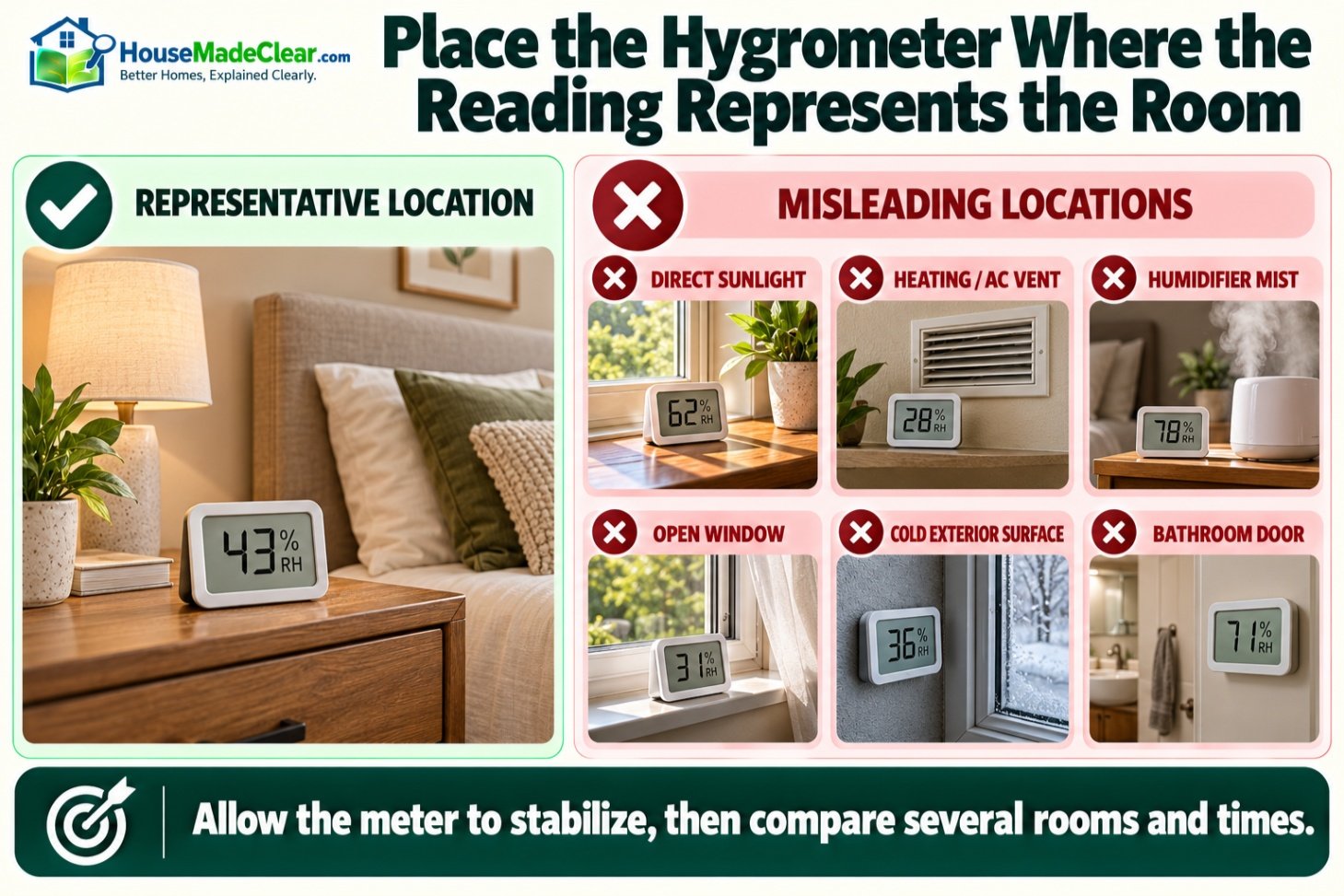
Place the meter away from:
- Direct sunlight
- Heating vents
- Air conditioner outlets
- Humidifier mist
- Open windows
- Bathroom doors
- Cold exterior surfaces
A bedside table or shelf in a representative part of the room may work.
Avoid enclosing it behind furniture or placing it directly against an exterior wall.
Bedroom furniture arrangement can influence airflow near walls. When planning a room, our guide to creating a functional bedroom layout explains practical furniture placement and circulation.
What Is the Recommended Humidity for a Living Room?
A living room should generally follow the whole-house target of 30–50% RH.
Living rooms may experience moisture variations caused by the number of occupants, open windows, cooking in nearby kitchens, or HVAC performance.
Large open-concept spaces may also have different conditions from enclosed bedrooms.
Does Furniture Placement Affect Humidity?
Furniture does not usually generate substantial humidity by itself.
However, large cabinets or upholstered furniture placed tightly against cold exterior walls may reduce airflow around those surfaces.
If moisture accumulates there, condensation and mold problems can be harder to notice.
Leave appropriate space for airflow and inspect areas with recurring dampness.
Our functional living room layout guide discusses furniture placement and circulation, which can also help keep vulnerable wall areas accessible for inspection.
What Is the Recommended Humidity for a Bathroom?
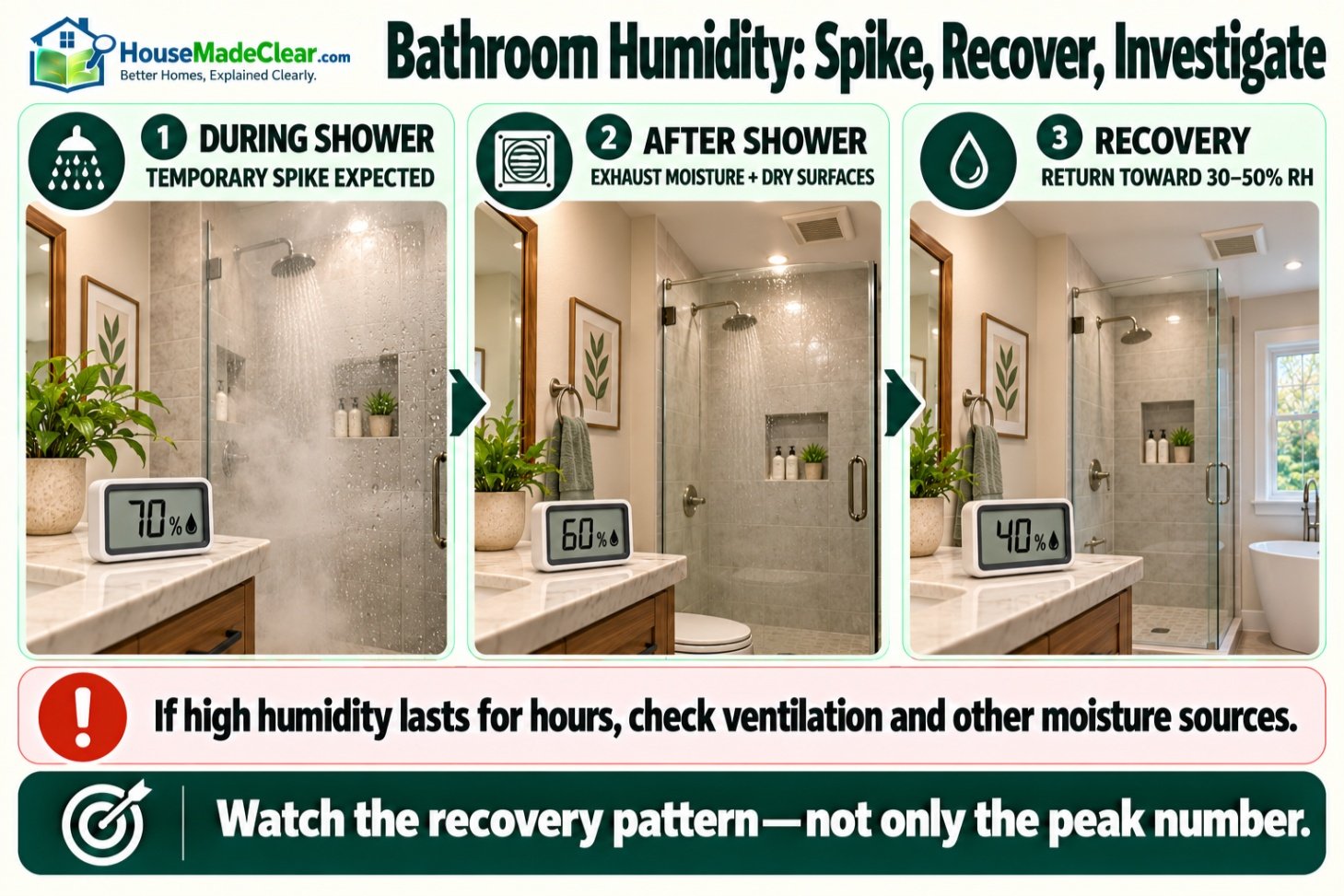
A bathroom should generally return toward the normal indoor target of 30–50% RH after showering, although temporary increases during shower use are expected.
Bathroom humidity requires special attention because hot water adds considerable moisture to the air.
A shower may raise local humidity well above 50% for a short period.
This does not mean the bathroom must remain at that level.
The important issue is whether the moisture is removed and wet surfaces dry.
Is 70% Humidity Normal After a Shower?
A reading around 70% immediately after a hot shower can occur.
However, 70% should not be treated as a suitable long-term bathroom humidity target.
If the bathroom remains very humid for hours, ventilation may be inadequate or another moisture source may be present.
Our guide to bathroom humidity after a shower explains what causes prolonged humidity and how to address it.
How Long Should Bathroom Humidity Take to Return to Normal?
There is no universally required recovery time suitable for every bathroom.
Recovery depends on:
- Room volume
- Shower duration
- Water temperature
- Exhaust fan capacity
- Air entering the bathroom
- Outdoor conditions
- Wet surface area
- Other moisture sources
Watch the readings rather than relying only on a fixed timer.
For practical fan-use recommendations, see our guide to how long to run a bathroom fan after a shower.
Can a Bathroom Dehumidifier Help?
Yes, in some bathrooms, a properly selected dehumidifier can help remove excess moisture.
However, it should be appropriate for the space and used according to electrical safety requirements.
Never place an ordinary dehumidifier where it could be splashed or fall into water.
Our guide to where to put a dehumidifier in a bathroom explains placement and practical safety considerations.
What Is the Best Humidity Level for a Basement?
A basement should generally be kept within the same 30–50% preferred indoor RH range.
Basements often have additional moisture concerns because they are partly or fully below ground.
Potential sources include:
- Foundation seepage
- Groundwater intrusion
- Damp concrete
- Plumbing leaks
- Condensation on cold surfaces
- Humid outdoor air entering a cooler basement
- Poor drainage around the foundation
Is 60% Humidity Too High for a Basement?
A sustained 60% RH reading deserves attention.
The EPA advises keeping indoor humidity below 60%, ideally between 30% and 50%.
A basement that remains around 60% may have ongoing moisture conditions that increase the risk of dampness and mold growth.
A dehumidifier may help, but it will not repair a wet foundation or plumbing leak.
Why Does a Basement Feel Damp Even at 50% Humidity?
Cold walls and floors can have higher local surface humidity than the air measured in the middle of the room.
As a result, moisture may accumulate on vulnerable surfaces even when the room’s overall RH appears acceptable.
Inspect walls, stored belongings, floor edges, and concealed areas.
Is 60% Humidity Too High for a House?
Sustained indoor humidity of 60% is generally higher than recommended for routine moisture control.
The EPA recommends staying below 60%, with 30–50% preferred.
A single reading of 60% after cooking or showering is less concerning than a room remaining at that level for days.
The pattern matters.
What Happens if Humidity Stays Above 60%?
Possible consequences include:
- Increased condensation risk
- Mold growth where sufficient moisture accumulates
- Musty odors
- Damage to moisture-sensitive materials
- Dampness in poorly ventilated spaces
Problems become more likely when high humidity combines with cold surfaces, leaks, or existing water damage.
Is 65% Humidity Too High Indoors?
For ordinary household conditions, 65% RH is above the preferred indoor moisture range.
If it persists, identify and correct the cause.
A dehumidifier, better ventilation, or repair of a moisture source may be needed.
Is 70% Humidity Dangerous?
Seventy percent RH is not automatically an immediate health emergency.
However, prolonged humidity at that level creates unfavorable conditions for moisture-sensitive materials and may support mold growth.
The more important question is whether the moisture is temporary, localized, or persistent.
If the home has visible mold, water damage, or unexplained dampness, address those conditions promptly.
Is 30% Humidity Too Low for a House?
Thirty percent RH is the lower end of the EPA’s preferred indoor range.
It is not automatically too dry for every person or building.
However, sustained humidity below 30% may cause discomfort for some occupants.
Possible complaints include:
- Dry-feeling skin
- Dry eyes
- Nasal dryness
- Increased static electricity
- Dry-feeling indoor air
These symptoms can have causes unrelated to humidity, so a hygrometer reading is important before adding moisture.
Is 20% Humidity Too Low?
Twenty percent RH is relatively dry for an occupied home.
If the reading is accurate and occupants are uncomfortable, controlled humidification may be appropriate.
However, humidifying a house during very cold weather requires caution.
Raising the RH too far can produce condensation on cold surfaces.
Should You Use a Humidifier?
A humidifier may help when indoor air is persistently dry.
Choose a suitable unit and use a hygrometer or built-in humidistat to avoid excessive moisture.
Keep the device clean according to its manufacturer’s instructions.
Poorly maintained humidifiers can introduce unwanted contaminants into the indoor environment.
The EPA’s guidance on humidifiers and indoor mold prevention emphasizes regular cleaning and avoiding excessive humidity.
How to Measure Humidity in Your House
The simplest way to measure indoor relative humidity is with a hygrometer.
A hygrometer is a device that displays the humidity level, usually as a percentage.
Many models also show temperature.
Step 1: Choose a Suitable Hygrometer
Select an indoor humidity meter with a readable display.
A device that records minimum and maximum readings or historical trends can help identify recurring problems.
Step 2: Place It in a Representative Location
Position it away from direct moisture sources and heating or cooling outlets.
Do not place it directly beside a humidifier or shower.
Step 3: Allow the Reading to Stabilize
Give the meter time to adjust to the room after moving it.
Follow the device manufacturer’s instructions.
Step 4: Check at Different Times
Measure humidity:
- In the morning
- In the afternoon
- After showering
- During HVAC operation
- During periods of humid outdoor weather
- During cold winter conditions
A single measurement may miss important fluctuations.
Step 5: Compare Rooms
Check bedrooms, bathrooms, living spaces, and basements separately when possible.
A central thermostat may not reflect conditions in every room.
Step 6: Investigate Persistent Differences
If one room consistently measures 65% while the rest of the house is near 45%, look for a local moisture source or ventilation problem.
Can Smart Home Devices Monitor Humidity?
Yes.
Some smart thermostats, environmental sensors, and home automation devices can measure humidity and record changes over time.
However, sensor accuracy and placement still matter.
Before choosing connected equipment, consider whether its basic monitoring features continue working during a network outage. Our guide to smart home devices that work without Wi-Fi explains common differences between local and internet-dependent functionality.
How to Lower Humidity in Your House
If indoor humidity remains above the preferred range, focus first on identifying the moisture source.
1. Fix Plumbing and Building Leaks
Repair leaking pipes, roofs, windows, and foundation problems.
A dehumidifier cannot permanently compensate for uncontrolled water intrusion.
2. Use a Dehumidifier
A properly sized dehumidifier can remove water vapor from indoor air.
Set an appropriate target using its humidistat.
If the goal is mold prevention, aiming around 45–50% RH is a reasonable starting point for many spaces.
3. Run Bathroom Exhaust Fans
Use an exhaust fan that vents outdoors when showering.
Leave it operating long enough to address residual moisture, according to the fan and bathroom conditions.
4. Vent Cooking Moisture
Use a suitable range hood or ventilation system that exhausts outdoors where practical.
Cooking can add substantial moisture to the house.
5. Avoid Drying Large Amounts of Laundry Indoors
Indoor clothes drying releases water vapor into the surrounding air.
If laundry must be dried inside, provide appropriate moisture removal.
6. Maintain Air Conditioning
Air-conditioning systems can help remove moisture.
Check filters, drainage, and system maintenance.
If a home remains humid despite cooling, ask a qualified HVAC professional to assess the equipment and moisture load.
7. Investigate Damp Basements and Crawlspaces
Check for foundation leaks, poor drainage, and persistent dampness.
8. Improve Airflow Near Cold Surfaces
Avoid trapping moist air against cold exterior walls and windows.
Address insulation and other building-envelope problems where necessary.
9. Ventilate Based on Outdoor Conditions
Opening windows may help when outside air is sufficiently dry.
However, opening windows during very humid weather can increase indoor moisture.
Ventilation needs to be evaluated in context.
The EPA’s guide to mold, moisture, and your home emphasizes fixing leaks, controlling condensation, using appropriate ventilation, and keeping indoor RH in the preferred range.

How to Increase Humidity When Your House Is Too Dry
If humidity is consistently below 30%, confirm the reading and consider whether occupants are experiencing discomfort.
Use a Humidifier Carefully
A room humidifier or properly managed whole-house humidifier may increase indoor moisture.
Use a humidistat rather than running it continuously without monitoring.
Avoid Over-Humidifying
More humidity is not always better.
If moisture collects on windows, walls, or other surfaces, reduce humidification.
Maintain the Equipment
Follow instructions for cleaning, water replacement, and filter care.
Do not allow water reservoirs to become dirty.
Check Heating and Airflow
Indoor relative humidity naturally changes with temperature.
If the air feels excessively dry, measure humidity rather than assuming the heating system needs adjustment.
Consider the Home’s Construction
Older windows, insufficient insulation, and cold exterior surfaces may limit how much humidity can be added safely during winter.

What Humidity Level Prevents Mold?
There is no humidity number that guarantees mold cannot grow.
Mold can develop when moisture is available on a suitable surface, even if average room humidity is relatively low.
For general prevention, the preferred approach is to maintain 30–50% RH, repair leaks, and prevent persistent condensation.
Can Mold Grow at 50% Humidity?
Yes, under some conditions.
A hygrometer reading of 50% does not rule out localized dampness behind furniture, inside wall cavities, or on cold surfaces.
A pipe leak can also provide enough moisture for mold growth regardless of the room’s average relative humidity.
Will a Dehumidifier Kill Mold?
No.
A dehumidifier reduces moisture in the air, but it does not reliably remove or kill existing mold growth.
Visible mold and the underlying moisture source must be addressed appropriately.
How Quickly Should Wet Materials Be Dried?
The EPA recommends acting quickly after leaks and drying wet materials within approximately 24–48 hours where possible to reduce the likelihood of mold growth.
Some porous materials may require professional assessment or replacement after substantial water exposure.
Humidity and Condensation: Why Your Windows Get Wet
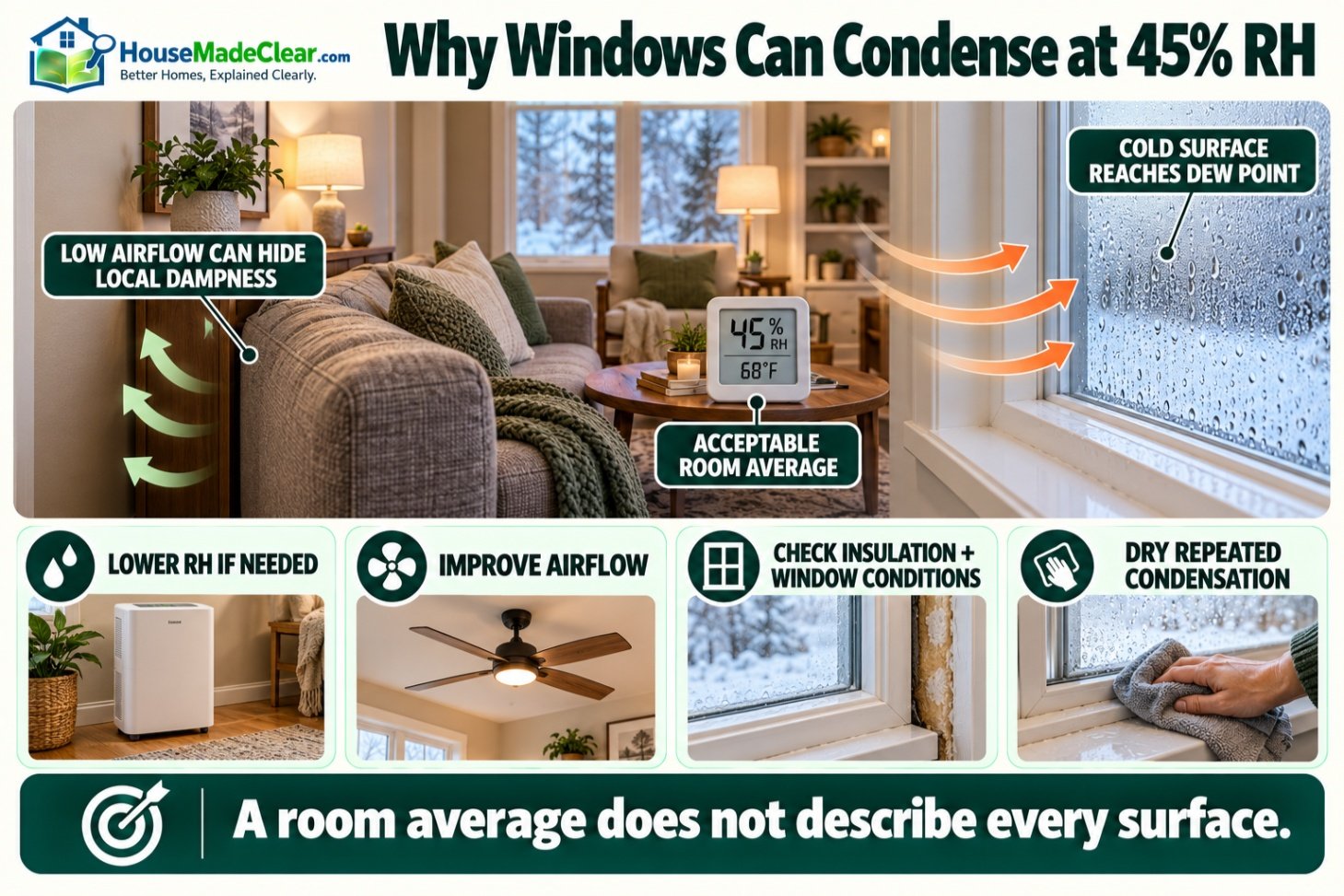
Condensation forms when humid air contacts a surface cold enough to reach its dew point.
This commonly occurs on windows during winter.
Why Windows Condense at Normal Humidity Levels
Suppose a room measures 45% RH.
That may be a generally acceptable indoor reading.
However, if the window glass is sufficiently cold, moisture can still condense on its surface.
Therefore, a room’s average humidity does not always reveal the conditions at every surface.
How to Reduce Window Condensation
- Lower indoor humidity if necessary.
- Avoid overusing humidifiers.
- Keep appropriate airflow near windows.
- Investigate cold spots and insulation problems.
- Check for water intrusion or defective windows.
- Dry condensation rather than allowing it to collect repeatedly.
Occasional condensation and persistent soaking are different problems.
Repeatedly wet window frames can damage finishes and surrounding materials.
Recommended Humidity vs. Indoor Temperature
Humidity and temperature influence how indoor air feels.
A home at 45% RH may feel different at 68°F than at 78°F.
This is partly because temperature changes human comfort and the relationship between air temperature and moisture.
However, humidity should not be used as a replacement for appropriate heating and cooling.
Indoor Temperature and Humidity Planning Chart
| Situation | Humidity Consideration |
|---|---|
| Warm indoor air in summer | Remove excess moisture for comfort and mold prevention |
| Cool indoor air in winter | Avoid condensation on cold surfaces |
| Humid bathroom after shower | Exhaust moisture and dry surfaces |
| Air-conditioned basement | Watch for condensation and damp materials |
| Heated bedroom in winter | Check for dryness before humidifying |
There is no single indoor humidity value that compensates for every temperature or building condition.
Common Indoor Humidity Mistakes
Mistake 1: Treating 50% as the Only Correct Number
The recommended range is broader, and winter condensation may require a lower target.
Mistake 2: Ignoring Persistent Humidity Above 60%
A sustained high reading should trigger investigation.
Mistake 3: Running a Humidifier Without a Hygrometer
Uncontrolled humidification may create condensation.
Mistake 4: Assuming Humidity Control Repairs Leaks
Dehumidifiers remove airborne moisture, but leaks require repairs.
Mistake 5: Measuring Humidity Only in One Room
Different rooms can have very different moisture conditions.
Mistake 6: Placing the Hygrometer Beside a Vent
Airflow from heating or cooling equipment may produce a reading that is not representative of the room.
Mistake 7: Opening Windows During Extremely Humid Weather
Ventilation with humid outdoor air can increase indoor moisture.
Mistake 8: Ignoring Condensation at 40–50% RH
Cold surfaces can accumulate water even within a generally recommended range.
Mistake 9: Assuming a Dehumidifier Eliminates Existing Mold
Moisture control is necessary, but existing contamination may require cleaning or remediation.
Mistake 10: Ignoring Bathroom Ventilation
Hot showers introduce moisture that must be removed.
Mistake 11: Keeping Humidifiers Dirty
Poor maintenance can contribute to indoor contamination.
Mistake 12: Focusing on a Single Humidity Reading
Trends over several days often reveal more than a momentary measurement.
Indoor Humidity Troubleshooting Chart
| Problem | Possible Explanation | First Step |
|---|---|---|
| RH stays above 60% | Excess moisture or insufficient removal | Find moisture source |
| Windows collect condensation | Cold surfaces and indoor moisture | Reduce RH and inspect windows |
| Bathroom remains humid | Ventilation or moisture issue | Check exhaust fan |
| Basement smells musty | Dampness or water intrusion | Inspect basement |
| RH drops below 25% in winter | Dry heated indoor air | Verify reading and assess comfort |
| Humidifier causes wet windows | Over-humidification | Reduce or stop humidification |
| One bedroom has higher RH | Local moisture or poor airflow | Compare rooms and inspect |
| Dehumidifier runs constantly | Heavy moisture load or equipment issue | Check leaks, sizing, and operation |
| Visible mold despite 45% RH | Localized moisture or previous damage | Find and fix moisture source |
| High RH only after showers | Temporary moisture generation | Monitor recovery and ventilation |
Home Humidity Maintenance Checklist
| Task | Recommended Approach |
|---|---|
| Measure indoor humidity | Use a hygrometer |
| General target | 30–50% RH |
| Summer target | Often 40–50% RH |
| Winter target | Often 30–40% RH in colder climates |
| Check bathrooms | Look for prolonged humidity after showers |
| Inspect windows | Investigate repeated condensation |
| Inspect basements | Look for water intrusion and musty odors |
| Maintain HVAC | Service as recommended |
| Clean humidifiers | Follow manufacturer instructions |
| Maintain dehumidifiers | Clean filter and drainage system |
| Repair leaks | Address promptly |
| Check hidden areas | Inspect behind furniture and near cold walls |
| Review readings | Compare several times and locations |
Final Thoughts
So, what is the recommended humidity for a house?
For most homes, 30% to 50% relative humidity is the preferred general range.
During summer, many homeowners aim around 40–50% RH to help manage excess moisture.
During winter, particularly in colder climates, approximately 30–40% RH may be more appropriate because higher moisture levels can cause condensation on cold windows and exterior surfaces.
Bathrooms may temporarily exceed these targets during showering, but the moisture should be removed rather than allowed to persist.
Bedrooms, living rooms, and basements generally benefit from the same overall humidity range, with adjustments based on actual conditions.
The most effective approach is to measure indoor humidity, investigate moisture problems early, maintain ventilation and HVAC equipment, and avoid both excessive humidification and sustained dampness.
A hygrometer provides the numbers, but condensation, leaks, and visible moisture damage are equally important indicators of whether a home is maintaining healthy moisture conditions.
Frequently Asked Questions
What is the recommended humidity for a house?
The recommended indoor humidity for most homes is approximately 30% to 50% relative humidity. The EPA recommends staying below 60%, ideally within the 30–50% range. Colder weather and condensation problems may require a lower target.
Is 50% humidity too high for a house?
Fifty percent RH is at the upper end of the EPA’s preferred indoor range and is not automatically too high. However, persistent condensation or dampness may indicate that humidity should be reduced, especially during cold weather.
Is 60% humidity too high indoors?
Sustained indoor humidity around 60% is higher than the preferred moisture-control range. The EPA recommends keeping RH below 60%, ideally 30–50%. Investigate recurring high readings and any signs of condensation or mold.
Is 40% humidity good for a house?
Yes. Forty percent relative humidity falls within the commonly recommended 30–50% indoor range and is a reasonable target for many homes. Actual suitability depends on temperature, comfort, and condensation conditions.
What should indoor humidity be in winter?
In colder climates, approximately 30–40% RH is often a useful winter target. If condensation forms on windows or other cold surfaces, the humidity may need to be reduced further.
What should indoor humidity be in summer?
A practical summer target for many homes is approximately 40–50% RH. Air conditioning, dehumidifiers, ventilation, and moisture-source control can help prevent persistent high humidity.
What is the best humidity level for sleeping?
For most bedrooms, the general indoor target of 30–50% RH is suitable. There is no single percentage that guarantees better sleep, and comfort also depends on temperature, ventilation, and individual needs.
Is 70% humidity too high for a house?
Seventy percent RH is above the recommended range for sustained indoor conditions. If it persists, investigate moisture sources, ventilation, and dehumidification. A short spike after showering is different from an entire house remaining at 70%.
Can mold grow at 50% humidity?
Yes. Even when average room humidity is 50%, mold may grow where localized moisture exists because of condensation, leaks, or damp materials. Maintaining the recommended range helps but does not eliminate every mold risk.
What is the recommended bathroom humidity?
A bathroom should generally return toward the normal 30–50% indoor range after showering. Temporary higher readings are expected during shower use, but prolonged humidity and persistent dampness should be addressed.
What is the ideal basement humidity?
A basement should preferably stay around 30–50% RH. Basements also need inspection for leaks, damp foundations, condensation, and other moisture sources that a dehumidifier alone cannot repair.
Is 30% humidity too low?
Thirty percent RH is the lower end of the commonly recommended indoor range. It is not necessarily too low, but some occupants may experience dryness at or below this level. Humidification should be balanced against condensation risk.
How can I measure humidity in my house?
Use a hygrometer or reliable humidity sensor. Place it away from direct sunlight, vents, and moisture sources, then compare readings at different times of day and in different rooms.
How do I lower humidity in my house naturally?
Repair leaks, use properly vented bathroom and kitchen exhaust fans, reduce unnecessary indoor moisture generation, and ventilate when outdoor air conditions are suitable. Air conditioning or a dehumidifier may be needed when these measures are insufficient.
Should I use a humidifier in winter?
A humidifier may be helpful if indoor RH is consistently below 30% and occupants experience discomfort. Monitor the reading, clean the device regularly, and reduce humidification if condensation appears on windows or other surfaces.
Can a dehumidifier prevent mold?
A dehumidifier can help reduce conditions favorable to mold growth by lowering indoor humidity. However, it does not eliminate existing mold or repair leaks, wet walls, or other sources of persistent moisture.





[…] What Is the Recommended Humidity for a House? Ideal Levels by… […]
[…] What Is the Recommended Humidity for a House? Ideal Levels by… […]
[…] What Is the Recommended Humidity for a House? Ideal Levels by… […]
[…] What Is the Recommended Humidity for a House? Ideal Levels by… […]