
















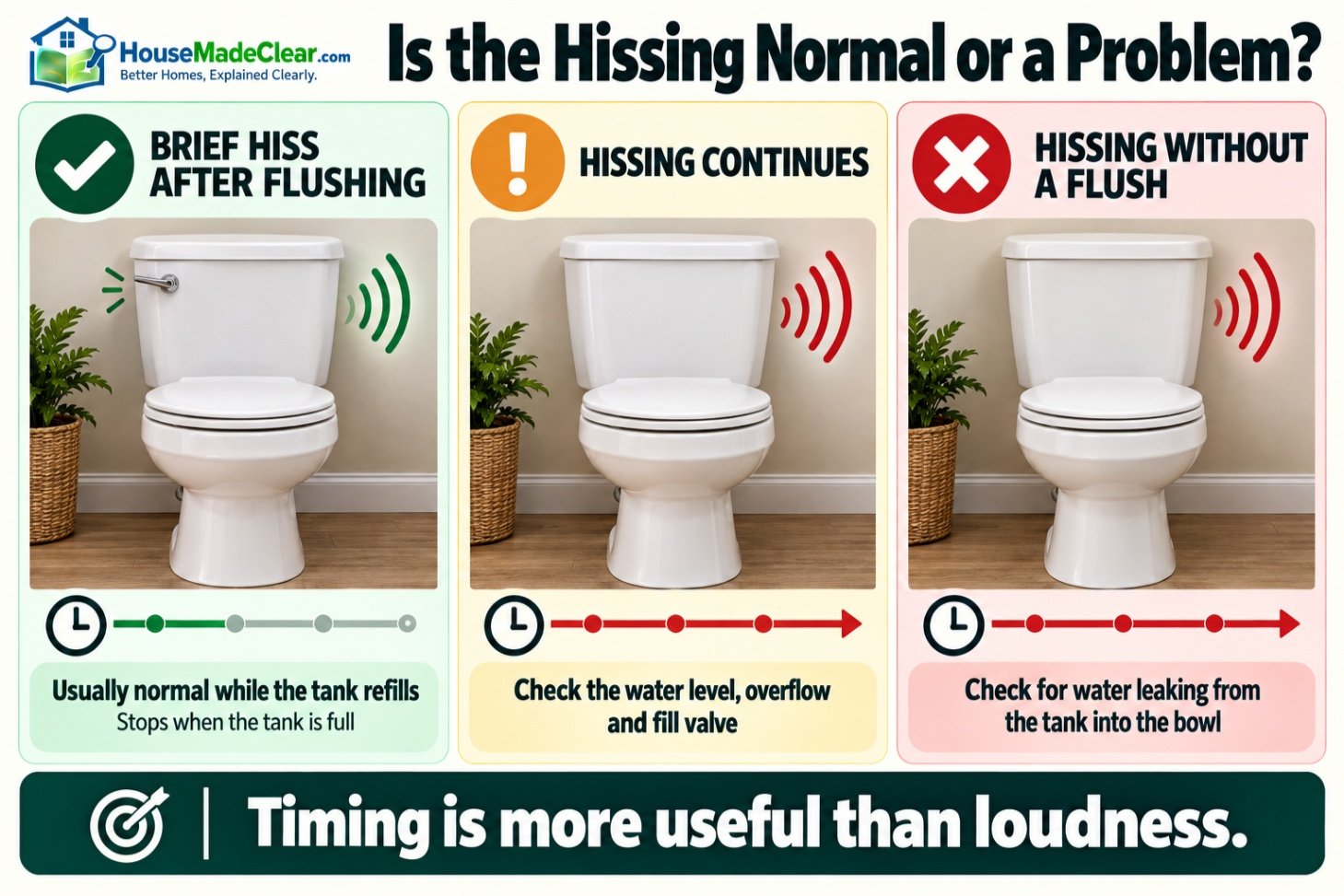
A toilet making a hissing sound can be perfectly normal for a short time after flushing. The sound often comes from water passing through the fill valve as the tank refills.
However, if the hissing continues long after the flush, starts when nobody has used the toilet, or returns every few minutes, something may be wrong inside the tank.
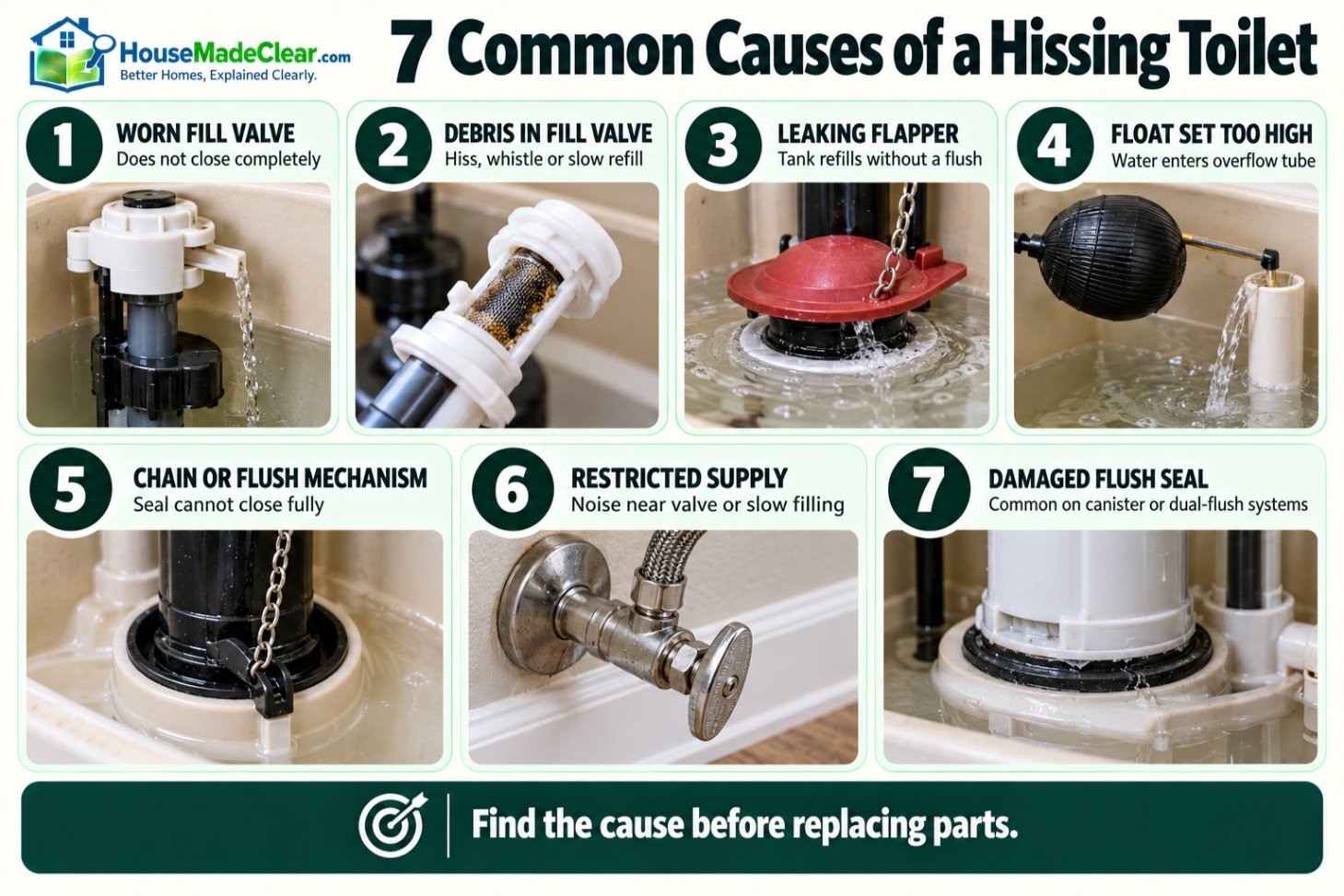
Common causes include a worn fill valve, debris trapped in the valve, an improperly adjusted float, or a leaking toilet flapper. These problems may allow water to keep entering the tank or escape unnoticed into the toilet bowl.
A toilet can waste water without leaving a puddle on the bathroom floor.
Fortunately, many hissing-toilet problems can be identified with a few straightforward checks. You usually do not need to remove the toilet or replace the entire fixture.
The key is to determine when the hissing occurs, whether water stops entering the tank, and whether water is leaking from the tank into the bowl.
This guide explains seven common causes of a hissing toilet, how to diagnose the problem safely, how to adjust or replace faulty components, and when a plumber should inspect the system.
Quick Answer
A toilet usually makes a hissing sound because water is moving through its fill valve.
A brief hiss immediately after flushing is generally normal. A continuous hiss or repeated hissing when the toilet is not being used may indicate a problem.
Start with these checks:
- Remove the tank lid carefully and place it somewhere secure.
- Flush the toilet and observe the tank refilling.
- Check whether the hissing stops when the tank reaches its normal water level.
- Look for water flowing continuously into the overflow tube.
- Check the float and fill valve for improper adjustment or debris.
- Perform a food-coloring test to check whether the flapper or flush-valve seal is leaking.
- Repair or replace the faulty component using the correct manufacturer-approved part.
If water is leaking externally, the shutoff valve does not work, or the noise persists after basic troubleshooting, contact a qualified plumber.
Why Is My Toilet Making a Hissing Sound?
The most common source of a toilet hissing noise is the fill valve.
The fill valve controls the water entering the toilet tank after each flush.
When you flush, the tank releases stored water into the bowl. The float lowers, allowing the fill valve to open and replace that water.
As the tank refills, water passes through a relatively small valve opening. This movement can create a soft rushing or hissing sound.
When the water reaches the correct level, the float should cause the fill valve to close.
The hissing should then stop.
If the sound continues, water may still be passing through the valve because it cannot close properly or because water is escaping from the tank.
The Kohler troubleshooting guide for a continuously running toilet identifies debris in the fill valve, incorrect tank water levels, and faulty flush mechanisms among the possible causes of continuous refilling.

Is a Hissing Toilet Normal?
It depends on when the sound occurs.
| Toilet Behavior | Usually Normal? | What It May Indicate |
|---|---|---|
| Brief hiss immediately after flushing | Yes | Tank refilling |
| Hissing stops when tank fills | Usually yes | Fill valve closing properly |
| Hissing continues several minutes after flushing | No | Fill valve or leak problem |
| Hissing starts randomly without flushing | No | Water loss and automatic refilling |
| Hissing with water entering overflow tube | No | Overfilling or faulty fill valve |
| High-pitched whistle during refill | Not necessarily | Valve restriction, debris, or supply issue |
| Hissing accompanied by external leaking | No | Connection or component failure |
Some toilet models refill more quietly than others.
A louder-than-usual refill may also indicate a developing problem, even when it eventually stops.
7 Common Causes of a Toilet Making a Hissing Sound
Understanding the cause makes it easier to choose the correct repair.
1. The Fill Valve Is Worn or Not Closing Properly
The fill valve is responsible for refilling the toilet tank and stopping the incoming water at the correct level.
Over time, internal seals, diaphragms, or moving parts may wear.
When the valve does not close fully, water can continue flowing into the tank.
This may create a persistent hiss.
Signs of a Faulty Fill Valve
- Hissing continues after the tank appears full.
- Water enters the overflow tube continuously.
- The fill valve turns on and off unpredictably.
- The tank takes unusually long to refill.
- Cleaning and water-level adjustment do not resolve the problem.
How to Fix It
First, check the water level and float setting.
If the valve is compatible with manufacturer-approved cleaning, inspect it for sediment.
If the fill valve remains unable to shut off correctly, replacement may be necessary.
Replacement fill valves must be compatible with the toilet model and its tank design.
2. Sediment or Mineral Deposits Are Trapped in the Fill Valve
Small particles can enter household plumbing through the water supply.
Sediment may become lodged inside the fill valve and interfere with normal flow or shutoff.
Mineral deposits may also accumulate over time.
This can cause hissing, whistling, slow filling, or continuous water movement.
Signs of Debris in the Fill Valve
- The toilet began hissing after plumbing maintenance.
- The noise started after the water supply was turned off and restored.
- The tank fills unusually slowly.
- The valve makes a high-pitched sound.
- The hiss remains even when the float appears correctly positioned.
How to Fix It
Some fill valves are designed to be opened and flushed to remove debris.
However, the procedure varies by model.
For example, Fluidmaster’s official toilet repair support provides model-specific instructions for diagnosing hissing fill valves and removing debris from compatible valve assemblies.
Do not pry open a sealed or unfamiliar fill valve.
If the manufacturer does not provide a service procedure, replacing the valve may be safer than attempting an improvised repair.
3. The Toilet Flapper Is Leaking
The flapper is a rubber or similar sealing component located near the bottom of many toilet tanks.
When you flush, the flapper lifts and allows water to leave the tank.
It should then return to its seat and create a watertight seal.
If it becomes worn, warped, dirty, or misaligned, water may slowly leak into the bowl.
The fill valve may reopen to replace the lost water, producing a hissing sound.
Signs of a Leaking Flapper
- The toilet hisses when nobody has flushed it.
- The tank refills intermittently.
- Water moves into the bowl without using the handle.
- The toilet appears to flush or refill by itself.
- The food-coloring test shows dye entering the bowl.
How to Fix It
Inspect the flapper and its sealing surface.
Look for deterioration, mineral deposits, improper alignment, or a chain that is too tight.
Clean the seating area if appropriate.
If the flapper is worn or damaged, install a compatible replacement.
Some toilets use canister-style seals rather than a conventional hinged flapper.
Always identify the actual flush mechanism before purchasing replacement parts.
4. The Float Is Set Too High
The float tells the fill valve when the tank has reached its intended water level.
If the float is adjusted too high, the tank may continue filling until water enters the overflow tube.
This can create continuous hissing.
The overflow tube provides a route for excess tank water to enter the bowl rather than spilling over the top of the tank.
However, a toilet that constantly sends water into the overflow tube is not operating correctly.
How to Check the Float
Remove the tank lid and allow the tank to refill.
Look at the water level in relation to the manufacturer’s designated waterline and the overflow tube.
If water continuously enters the overflow tube, check the float adjustment.
The EPA WaterSense toilet maintenance guidance recommends investigating a constantly running toilet or water continuously flowing into the overflow tube.
How to Fix It
Adjust the float according to the fill valve manufacturer’s instructions.
Different designs may use:
- An adjustment screw
- A sliding float cup
- A float rod
- Another manufacturer-specific mechanism
Do not force the adjustment mechanism.
Flush the toilet again and confirm that the water stops at the specified level.
5. The Flapper Chain or Flush Mechanism Is Preventing a Proper Seal
A toilet may hiss because the flush mechanism prevents the flapper from closing fully.
For example, a chain that is too short can hold the flapper slightly open.
Water then leaks into the bowl, and the fill valve continues replacing it.
A chain that is excessively long may also interfere with flushing if it becomes tangled.
Signs of a Chain Problem
- The toilet started hissing after a repair.
- The handle feels unusually tight.
- The flapper remains slightly raised.
- The chain appears trapped beneath the flapper.
- Adjusting the handle changes the water flow.
How to Fix It
With the tank accessible, inspect the chain and handle linkage.
The chain should have enough slack to allow the flapper to seat completely without becoming tangled.
Follow the toilet manufacturer’s instructions.
For canister-style flush systems, check their specific actuator and seal arrangement instead.
6. The Water Supply Valve or Supply Line Is Restricting Flow
Sometimes the noise does not originate from a defective tank fill valve.
Water moving through a partially restricted supply path can also create hissing or whistling.
Possible causes include:
- A partially closed supply shutoff valve
- Debris in the fill valve inlet
- A kinked flexible supply line
- A worn or defective shutoff valve
- Abnormal water pressure or supply conditions
How to Identify a Supply-Related Noise
Listen to where the sound is strongest.
A noise concentrated near the wall shutoff valve or supply line may suggest a supply-side issue.
Also note whether the tank fills more slowly than before.
Avoid repeatedly twisting an old or corroded shutoff valve.
If the connection begins leaking, stop and arrange professional assistance.
How to Fix It
Inspect the accessible supply line for visible kinks or damage.
Check whether the shutoff valve operates normally.
If a shutoff valve is defective or the water pressure appears abnormal, have the supply system evaluated by a plumber.
Do not attempt to solve a pressure problem by making repeated arbitrary adjustments to an unfamiliar valve.
7. A Flush-Valve Seal or Internal Tank Component Is Damaged
Not all toilets use conventional flappers.
Some use canister flush valves, tower mechanisms, or other proprietary designs.
A deteriorated seal in one of these systems can allow water to escape from the tank.
That causes the fill valve to refill the lost water, sometimes with an intermittent hiss.
Signs of an Internal Seal Problem
- Hissing occurs when the toilet is not being used.
- The tank water level gradually falls.
- The toilet refills unexpectedly.
- The conventional flapper is absent.
- The toilet uses a dual-flush or canister mechanism.
How to Fix It
Identify the toilet brand and model.
Inspect the flush-valve seal as directed by the manufacturer.
If the seal is damaged, replace it with the correct component.
Avoid installing a generic flapper in a toilet designed for a different flush mechanism.
Toilet Hissing Sound Troubleshooting Chart
| Symptom | Likely Cause | Recommended First Check |
|---|---|---|
| Hisses only after flushing | Normal refill | Confirm noise stops when tank fills |
| Hisses constantly | Fill valve not shutting off | Check water level and overflow |
| Hisses every few minutes | Slow internal leak | Perform dye test |
| Hisses and water enters overflow | High float setting or bad fill valve | Adjust water level |
| High-pitched whistle | Fill valve debris or supply restriction | Check manufacturer guidance |
| Hisses after recent plumbing work | Sediment in valve | Inspect valve for debris |
| Hisses after flapper replacement | Incorrect seal or chain adjustment | Check seating and compatibility |
| Hisses with water leaking onto floor | External plumbing leak | Shut off water if safe; call plumber |
| Hisses and refills very slowly | Restricted supply or valve | Inspect accessible supply components |
| Hisses on a dual-flush toilet | Flush seal or fill valve problem | Inspect model-specific mechanism |
The sound’s timing is often more useful than its loudness.
A short refill sound is different from a toilet that keeps drawing water after it should have stopped.
How to Diagnose a Hissing Toilet Step by Step
Before replacing parts, complete a few basic checks.
Step 1: Listen Before Flushing
Approach the toilet when it has not been used recently.
Check whether it is already hissing.
If the noise starts without a flush, water may be entering the tank unexpectedly.
This suggests a leak or fill-valve problem rather than normal refilling.
Step 2: Remove the Tank Lid
Lift the lid carefully using both hands.
Set it on a stable, padded surface away from the edge of the bathroom counter.
Porcelain tank lids are heavy and may crack if dropped.
Step 3: Flush and Observe
Flush the toilet while watching the tank components.
Observe:
- Whether the flapper opens and closes
- How the water level changes
- When the fill valve begins operating
- Whether the float rises
- Whether the sound stops when filling finishes
Do not place fingers into moving components while the mechanism operates.
Step 4: Check the Overflow Tube
Locate the vertical overflow tube inside the tank.
It is commonly part of the flush-valve assembly.
If water continues flowing into the tube after refilling should have stopped, the float adjustment or fill valve may be faulty.
Step 5: Inspect the Flapper or Flush Seal
Look at the seal at the bottom of the tank.
Check whether it sits properly and whether the chain or operating mechanism interferes.
Do not pull forcefully on unfamiliar components.
Step 6: Test for a Hidden Leak
If the tank refills intermittently, use a food-coloring dye test.
This is one of the simplest ways to detect water leaking from the tank into the bowl.
Step 7: Check for External Leaks
Inspect around:
- The supply shutoff valve
- Flexible supply connection
- Fill-valve connection beneath the tank
- Tank-to-bowl connections
- The base of the toilet
If you find active external leaking, stop using the toilet until the problem is addressed.
Step 8: Match the Symptom to the Repair
Use the observations to determine whether you should clean a compatible fill valve, adjust the float, replace a seal, or request professional repair.
Avoid replacing multiple components without identifying the likely source.

How to Test a Toilet Flapper for Leaks With Food Coloring
A dye test can reveal a silent leak from the toilet tank into the bowl.
It is especially helpful when the toilet periodically hisses without being flushed.
The U.S. EPA WaterSense Fix a Leak guidance recommends adding food coloring to the toilet tank and checking whether the color appears in the bowl after approximately 10 minutes without flushing.
Step 1: Wait Until the Tank Is Full
Allow the toilet to finish refilling.
Do not flush during the test.
Step 2: Add Food Coloring to the Tank
Add a few drops of ordinary food coloring or a toilet leak-detection dye tablet to the tank water.
Do not add dye directly to the bowl.
Step 3: Wait 10 Minutes
Do not flush or otherwise disturb the toilet.
Step 4: Inspect the Bowl
Look for colored water appearing in the bowl.
If the bowl water changes color without flushing, water is leaking from the tank into the bowl.
This commonly indicates a flapper or flush-valve seal problem.
Step 5: Flush After the Test
Flush promptly afterward to reduce the risk of staining.
What if the Dye Test Is Negative?
If no color appears in the bowl, that test did not reveal an internal leak during the observation period.
However, an intermittent leak may not occur during every test.
If the hissing continues, investigate the fill valve, overflow, and water-supply system.

How to Fix a Toilet That Hisses After Flushing
First, determine whether the noise is simply normal refilling.
A properly functioning toilet should allow water into the tank after flushing, then stop when the intended level is reached.
If the Hissing Stops Normally
No repair may be required.
However, if the sound becomes louder or the refill takes unusually long, inspect the system for debris or restrictions.
If the Hissing Continues
Remove the lid and look for water entering the overflow tube.
If that is happening, check the float and fill valve.
If the water level appears normal but the tank loses water over time, check the flapper or flush seal.
If the Toilet Hisses and Whistles
A high-pitched sound may be caused by a restriction in the water path or debris inside the fill valve.
Consult the manufacturer’s cleaning instructions.
If cleaning does not resolve the noise, the compatible fill valve may need replacement.
Why Is My Toilet Hissing When Nobody Has Flushed It?
Hissing that begins when the toilet has not been used often indicates that water is being lost from the tank.
As the tank level drops, the fill valve opens to replace the missing water.
This is sometimes called ghost flushing or phantom flushing.
The toilet may not perform a complete flush. Instead, you hear the fill valve activate unexpectedly.
Common Reasons
- Worn flapper
- Damaged flush-valve seal
- Misaligned sealing component
- Incorrect chain tension
- Fill valve not closing properly
- Water overflowing into the overflow tube
A dye test helps distinguish an internal tank-to-bowl leak from some other causes.
If the toilet refills repeatedly, do not assume the behavior is harmless merely because there is no water on the floor.
How to Clean a Toilet Fill Valve That Is Hissing
Some fill valves can be serviced by removing the upper cap and flushing out sediment.
Other models are not designed for the same procedure.
Before attempting cleaning:
- Identify the toilet and fill valve model.
- Locate its official service instructions.
- Shut off the toilet’s water supply if the valve operates safely.
- Flush to lower the tank water level.
- Follow the manufacturer’s approved disassembly procedure.
- Remove sediment only as directed.
- Reassemble the component correctly.
- Restore the water supply and check for leaks.
- Flush and verify that the tank refills and shuts off normally.
The Fluidmaster toilet repair guide identifies sediment and debris inside the fill valve as possible reasons for hissing and discusses cleaning the valve and inspecting its seal.
Do not assume the procedure for one Fluidmaster model is appropriate for every toilet.
Should You Use Vinegar to Clean the Fill Valve?
Do not soak or treat a fill valve with vinegar or another cleaning chemical unless its manufacturer permits that procedure.
Some cleaning agents can affect rubber seals or other internal components.
Follow product-specific maintenance guidance.
What if Cleaning Does Not Stop the Hissing?
If the valve remains noisy or fails to shut off, replacement may be necessary.
Use a compatible model and follow its installation instructions.
How to Adjust Toilet Tank Water Level
The correct tank water level depends on the toilet’s design.
Many tanks include a marked waterline.
Use that mark whenever available.
The overflow tube also provides a useful visual reference, but the exact adjustment should follow the toilet manufacturer’s instructions.
Step 1: Find the Float
Common styles include:
- Float cup mounted on the fill valve
- Ball float connected to a rod
- Proprietary integrated mechanisms
Step 2: Locate the Adjustment Mechanism
Look for an adjustment screw or another designated control.
Do not force components that are not intended to move.
Step 3: Adjust According to the Manufacturer
If the water level is too high, lower the float setting as instructed.
Make small adjustments.
Step 4: Flush and Recheck
Allow the tank to refill.
The water should stop at the specified level without continuously flowing into the overflow tube.
Step 5: Verify Normal Flushing
Changing the tank water level can affect flushing performance.
Make sure the adjustment does not leave the tank underfilled.
If the fill valve continues running despite correct adjustment, it may need servicing or replacement.
How to Replace a Toilet Flapper
Replacing a conventional toilet flapper is often a manageable maintenance task.
However, the exact procedure depends on the toilet model.
Step 1: Identify the Correct Replacement
Check the toilet brand, model, flush valve size, and existing flapper design.
Flappers are not universally interchangeable.
Step 2: Shut Off the Water Supply
Turn off the toilet supply valve if it operates safely.
If the valve is stuck, corroded, or leaking, do not force it.
Step 3: Flush to Empty Most of the Tank
This provides easier access to the flapper.
Step 4: Remove the Existing Flapper
Disconnect the chain and release the flapper from its mounting points according to the manufacturer’s directions.
Step 5: Inspect the Flush-Valve Seat
Check for debris or damage.
Clean the seating surface if appropriate.
Step 6: Install the New Flapper
Attach the compatible replacement and reconnect the chain.
Ensure it can close fully.
Step 7: Restore Water and Test
Allow the tank to fill.
Flush and check that the flapper opens and closes correctly.
Step 8: Repeat the Dye Test
Confirm that the replacement has stopped the internal leak.
If the toilet has a canister seal or another proprietary flush mechanism, follow the appropriate replacement procedure instead.
How to Replace a Hissing Toilet Fill Valve
A fill valve may need replacement when it cannot shut off properly, continues hissing after approved cleaning, or fails to refill the tank correctly.
For a conventional tank toilet, the work generally involves:
- Shutting off the water supply
- Draining the tank
- Disconnecting the supply connection
- Removing the old fill valve
- Installing a compatible replacement with correct seals
- Adjusting the fill height and refill tube
- Reconnecting the supply
- Testing for leaks and proper operation
Actual steps vary by model.
A poor installation can cause leaking beneath the tank or incorrect bowl refilling.
Do not overtighten plastic fittings or use thread sealant where the manufacturer prohibits it.
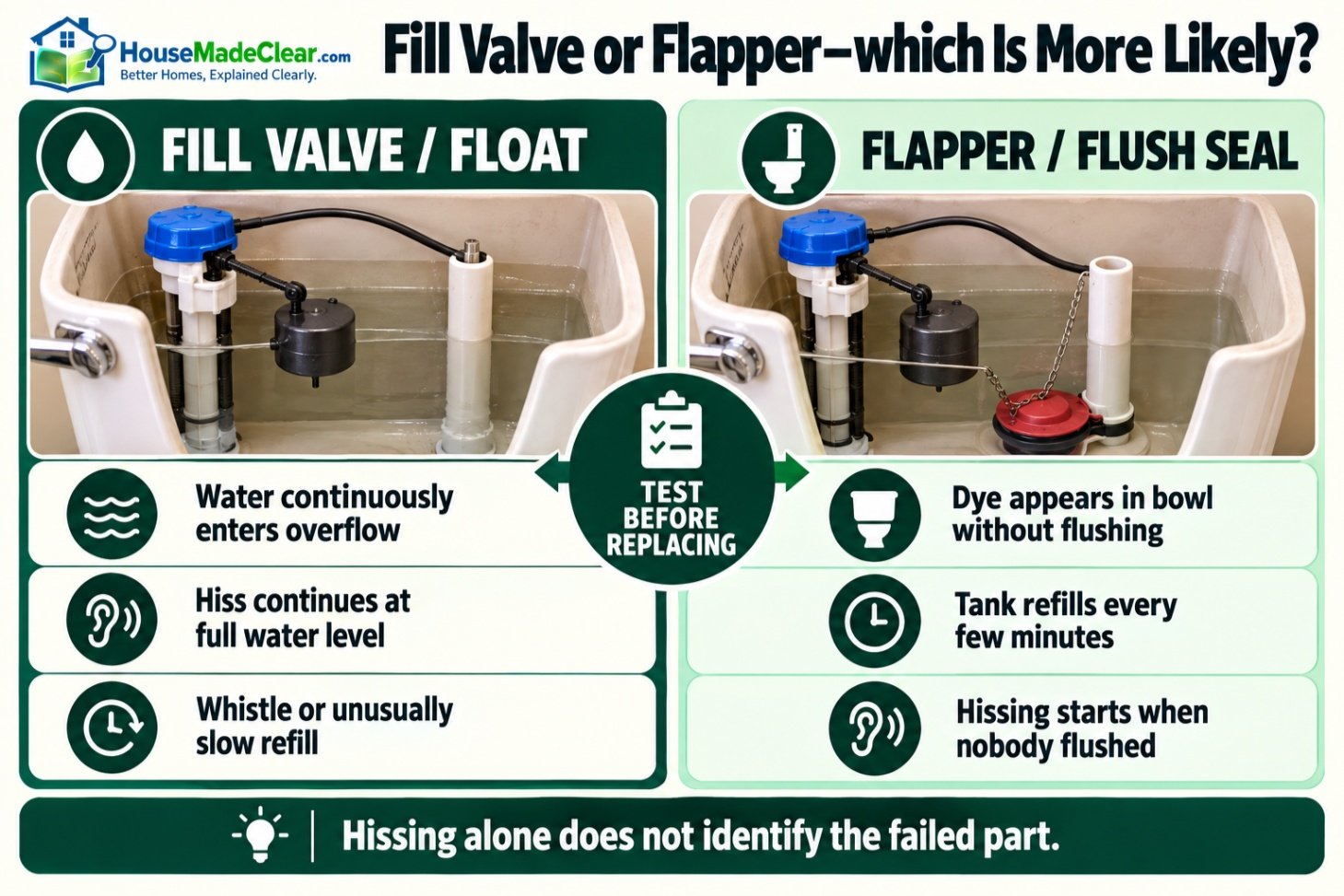
Fill Valve vs. Flapper: Which Should You Replace?
| Symptom | More Likely Component |
|---|---|
| Water continuously enters overflow tube | Fill valve or float adjustment |
| Dye appears in bowl without flushing | Flapper or flush-valve seal |
| Fill valve whistles during refill | Fill valve or supply restriction |
| Tank refills periodically | Often flapper or flush seal |
| Hissing persists despite normal water level | Further fill-valve and leak diagnosis needed |
| Water leaks at tank supply connection | Supply fitting or fill-valve connection |
A diagnosis is preferable to replacing both parts automatically.
Can a Hissing Toilet Waste Water?
Yes.
A toilet that continuously refills or repeatedly replaces water lost from the tank can waste substantial amounts of water.
The exact amount depends on the leak rate.
A faint hiss does not establish how many gallons are being lost.
However, even a relatively small ongoing leak can increase water consumption over time.
The EPA’s Fix a Leak Week guidance notes that worn toilet flappers are common household leak sources and that repairing readily correctable leaks can reduce water use and household water bills.
Can a Toilet Leak Without Water on the Floor?
Yes.
Water may leak internally from the tank into the bowl and then pass down the drain.
Because this happens inside the toilet, the floor can remain completely dry.
That is why a dye test is useful.
How Can You Estimate Water Waste?
If you can establish an actual leak rate, you can calculate water loss.
For illustration:
| Example Continuous Leak Rate | Approximate Water Wasted in 24 Hours |
|---|---|
| 0.01 gallon per minute | 14.4 gallons |
| 0.05 gallon per minute | 72 gallons |
| 0.1 gallon per minute | 144 gallons |
| 0.25 gallon per minute | 360 gallons |
These are mathematical examples, not measured values for a typical hissing toilet.
A toilet that hisses intermittently may have a different pattern.
To estimate your actual loss, a water meter or professional leak assessment may be needed.
Is a Hissing Toilet an Emergency?
Not every hissing toilet requires emergency service.
A short noise during normal refilling generally does not.
A continuing internal leak should be repaired, but it is not always an immediate safety emergency.
However, prompt action is important when water escapes outside the toilet.
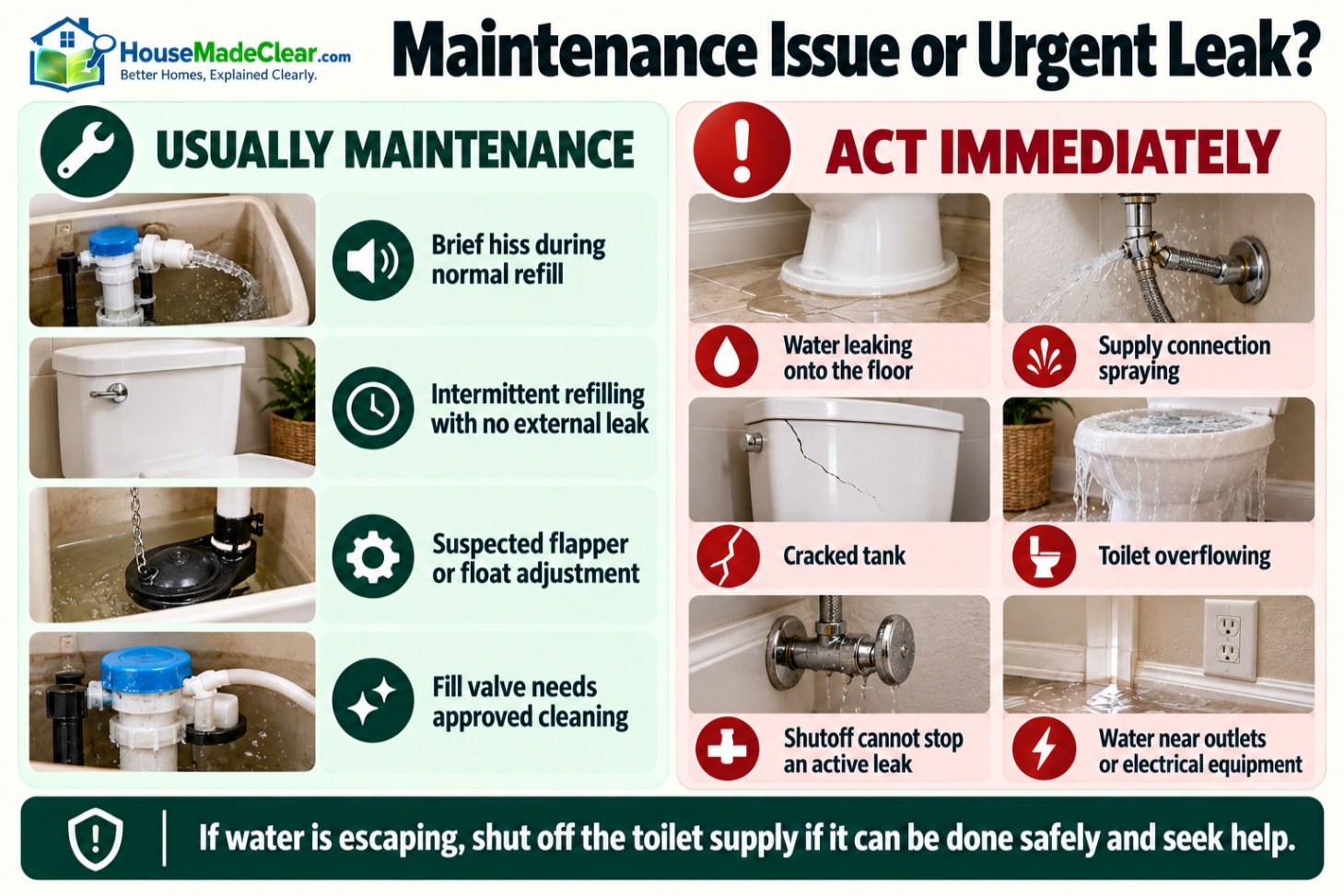
When the Problem Is Usually Non-Emergency Maintenance
- Brief hissing during a normal refill
- Intermittent refilling with no external leaks
- A suspected worn flapper
- A fill valve that needs cleaning or adjustment
These issues should still be investigated and repaired.
When to Act Immediately
- Water is leaking onto the bathroom floor.
- The supply connection is spraying or dripping rapidly.
- The tank appears cracked.
- The toilet is overflowing.
- The shutoff valve will not stop an active leak.
- Water is approaching electrical equipment or outlets.
If water is escaping, shut off the toilet’s supply if it can be done safely.
If the local valve cannot control the leak, shut off the home’s main water supply if you know how to do so safely, and seek urgent plumbing help.
Do not use a cracked tank.
How Much Does It Cost to Fix a Hissing Toilet?
The cost depends on the cause, replacement parts, labor, and accessibility.
Minor adjustments may require no replacement parts.
A worn flapper or fill valve may be relatively inexpensive compared with replacing an entire toilet.
Professional repair costs vary by location, minimum service charges, and the specific work.
| Repair | Typical Scope | Relative Cost |
|---|---|---|
| Adjust float | Small adjustment | Low |
| Adjust flapper chain | Minor mechanical correction | Low |
| Clean serviceable fill valve | Remove approved debris | Low |
| Replace flapper | Replace compatible seal | Low |
| Replace fill valve | Remove and install valve | Low to moderate |
| Repair supply connection | Replace or repair fittings | Variable |
| Diagnose hidden or unusual leak | Professional troubleshooting | Variable |
| Replace damaged toilet | Remove and install fixture | Higher |
These are relative cost comparisons, not price quotations.
Before buying parts, identify the toilet model and confirm compatibility.
When Should You Call a Plumber?
A qualified plumber is advisable when:
- You cannot identify the cause of the hissing.
- The fill valve still runs after safe troubleshooting.
- There is water leaking beneath or around the toilet.
- The shutoff valve does not operate correctly.
- The toilet has an unusual proprietary flushing system.
- Supply pressure or pipe noise appears abnormal.
- The tank is cracked.
- Parts are corroded or difficult to remove.
- The problem returns after replacement.
- You are uncomfortable disconnecting supply plumbing.
A professional can determine whether the issue is limited to tank components or involves the wider water-supply system.
How to Prevent a Toilet From Hissing Again
Regular observation and basic maintenance can help identify small problems before they lead to ongoing water waste.
Check for Internal Leaks Periodically
Perform a dye test periodically, particularly if you notice unexplained refilling or higher water use.
The EPA recommends checking toilets for silent leaks at least annually.
Inspect the Flapper
Look for cracking, distortion, mineral buildup, and poor seating.
Rubber components gradually deteriorate.
Check the Tank Water Level
Make sure the fill valve shuts off at the manufacturer’s recommended level.
Address Fill Valve Noise Early
An unusual change in the refill sound can be an indication that the valve needs attention.
Avoid In-Tank Chemicals That Damage Components
Some drop-in cleaning tablets can deteriorate rubber seals and other components.
Use cleaning products according to the toilet manufacturer’s instructions.
Check for External Leaks
Occasionally inspect the area around the tank, supply line, and floor.
Keep Maintenance Access Clear
You should be able to reach the tank lid and water shutoff valve without unsafe movement or excessive obstruction.
Bathroom layout can affect this access. When planning a replacement fixture, our guide to toilet clearance and space around a toilet explains the dimensions needed around the fixture.
Does Bathroom Size Affect Toilet Maintenance?
Bathroom size does not directly cause a toilet to hiss.
However, a very compact bathroom can make it harder to reach the tank and supply valve for diagnosis or repair.
For example, an oversized vanity placed very close to the toilet may obstruct access to the shutoff valve.
A wall or cabinet directly beside the toilet may also limit space for servicing the tank.
When renovating a small bathroom, consider maintenance access along with toilet positioning, door movement, and fixture clearance.
Our guide to standard bathroom sizes compares common room layouts and explains how fixture placement affects usable space.
If you are planning a compact bathroom with a sink, toilet, and shower, the guide to three-quarter bathroom layouts provides additional fixture-planning examples.
Common Mistakes When Fixing a Hissing Toilet
Mistake 1: Assuming Every Hiss Is a Problem
A brief refill sound after flushing is normal for many toilets.
Mistake 2: Ignoring Continuous Hissing
A valve that runs continuously may waste water.
Mistake 3: Replacing the Flapper Without Testing
The fill valve may be the actual source of the problem.
Mistake 4: Replacing the Fill Valve When the Flapper Leaks
A leaking flapper can repeatedly trigger a fully functional fill valve.
Mistake 5: Setting the Float Too High
This may allow water to flow continuously into the overflow tube.
Mistake 6: Buying Incompatible Parts
Different toilet models may use different flush valves, flappers, and fill-valve arrangements.
Mistake 7: Using Excessive Force
Old valves, plastic fittings, and porcelain components can be damaged by force.
Mistake 8: Ignoring External Leaks
Water on the bathroom floor requires prompt investigation.
Mistake 9: Using Harsh Cleaning Chemicals Inside the Tank
Some products can damage seals and create new leaks.
Mistake 10: Skipping the Final Test
Always verify that the tank fills normally, stops at the correct waterline, and does not leak after maintenance.
Hissing Toilet Repair Checklist
| Check | What to Look For |
|---|---|
| Timing | Hissing after flushing or without use |
| Duration | Stops normally or continues |
| Tank water level | Matches manufacturer mark |
| Overflow tube | No continuous overflow |
| Float | Moves and shuts off fill valve |
| Fill valve | No persistent leaking or debris |
| Flapper | Seats correctly |
| Chain | Allows proper closure |
| Dye test | No dye enters bowl without flushing |
| Supply line | No kinks or external leaks |
| Shutoff valve | Operates safely |
| Tank and bowl | No cracks or visible water leaks |
| Replacement part | Compatible with toilet model |
| Final flush | Normal refill and complete shutoff |
Final Thoughts
A toilet making a hissing sound is often caused by water passing through the fill valve.
If the sound occurs briefly after flushing and stops when the tank fills, it is usually part of normal operation.
However, continuous hissing or unexpected refilling may indicate a faulty fill valve, incorrect float setting, leaking flapper, or another internal plumbing problem.
Start by observing the tank during a complete flush cycle.
Check the water level and overflow tube, then use a food-coloring test to look for a hidden tank-to-bowl leak.
Repair the actual cause rather than replacing multiple parts without diagnosis.
If you discover external water leakage, damaged components, or a supply problem you cannot safely address, contact a qualified plumber.
Fixing a running or hissing toilet promptly can reduce unnecessary water waste and prevent a minor plumbing problem from becoming more disruptive.
Frequently Asked Questions
Why is my toilet making a hissing sound?
A toilet commonly hisses when water moves through the fill valve during tank refilling. If the sound continues after the tank fills, possible causes include a faulty fill valve, high float setting, leaking flapper, or damaged flush-valve seal.
Is it normal for a toilet to hiss after flushing?
Yes. A brief hissing or rushing sound during tank refilling is normal for many toilets. The noise should stop when the tank reaches its intended water level and the fill valve closes.
Why is my toilet hissing constantly?
Continuous hissing usually indicates that water is still flowing into the tank. Check whether water is entering the overflow tube, whether the float is adjusted correctly, and whether the fill valve closes properly.
Why does my toilet hiss when nobody has flushed it?
A toilet may hiss unexpectedly when water leaks from the tank into the bowl and the fill valve reopens to replace the lost water. A worn flapper or faulty flush-valve seal is a common cause.
Can a leaking flapper cause a hissing sound?
Yes. A worn or misaligned flapper can allow water to escape from the tank into the bowl. As the tank level falls, the fill valve refills it, which can produce intermittent hissing.
How do I stop my toilet from hissing?
Observe when the sound occurs, check the tank water level, inspect the fill valve, and test for a leaking flapper. Adjust, clean, or replace the faulty component according to the manufacturer’s instructions.
Why does my toilet hiss for a few seconds?
A short hiss after flushing may be part of normal tank refilling. If the sound occurs unexpectedly without flushing, it may indicate a small internal leak or an intermittently operating fill valve.
Can a hissing toilet increase my water bill?
Yes. If the hissing is caused by continuous or repeated refilling, the toilet may waste water. The amount depends on the leak rate and duration.
How do you test a toilet flapper for leaks?
Add a few drops of food coloring to the filled tank without flushing. Wait approximately 10 minutes. If color appears in the bowl, water is leaking from the tank through the flush-valve sealing system. Flush afterward to avoid staining.
Can I fix a hissing toilet myself?
Many straightforward issues, such as adjusting a float or replacing a compatible flapper, may be manageable for a homeowner. Problems involving active external leaks, defective supply valves, or unfamiliar plumbing should be handled by a plumber.
Does a hissing toilet mean the fill valve is bad?
Not always. A fill valve may hiss because it is responding to water lost through a leaking flapper. Check for internal tank leaks before assuming the fill valve needs replacement.
Why is my toilet hissing and filling slowly?
A slow refill accompanied by hissing may indicate debris in the fill valve, a restricted supply line, a partially closed shutoff valve, or another water-supply problem. Follow manufacturer-specific troubleshooting instructions.
Is a hissing toilet an emergency?
A brief refill hiss is usually not an emergency. Continuous internal leaking needs repair, while external water leakage, a cracked tank, or uncontrolled overflowing requires prompt action.
Should I replace the flapper or fill valve first?
Test the toilet before replacing parts. Dye entering the bowl without flushing suggests a leaking flapper or flush-valve seal. Continuous overflow or failure to shut off may point to the fill valve or float adjustment.
How long should a toilet hiss after flushing?
The sound should generally stop when the tank finishes refilling. The exact refill time varies by toilet model, supply conditions, and valve design. A hiss that continues indefinitely is not normal.
Can high water pressure cause a toilet to hiss?
Yes. Water-supply conditions, restrictions, and valve behavior can contribute to hissing or whistling sounds. If the noise seems related to abnormal pressure or supply plumbing, ask a qualified plumber to assess it.








[…] Toilet Making Hissing Sound? 7 Common Causes and How to Fix… […]