















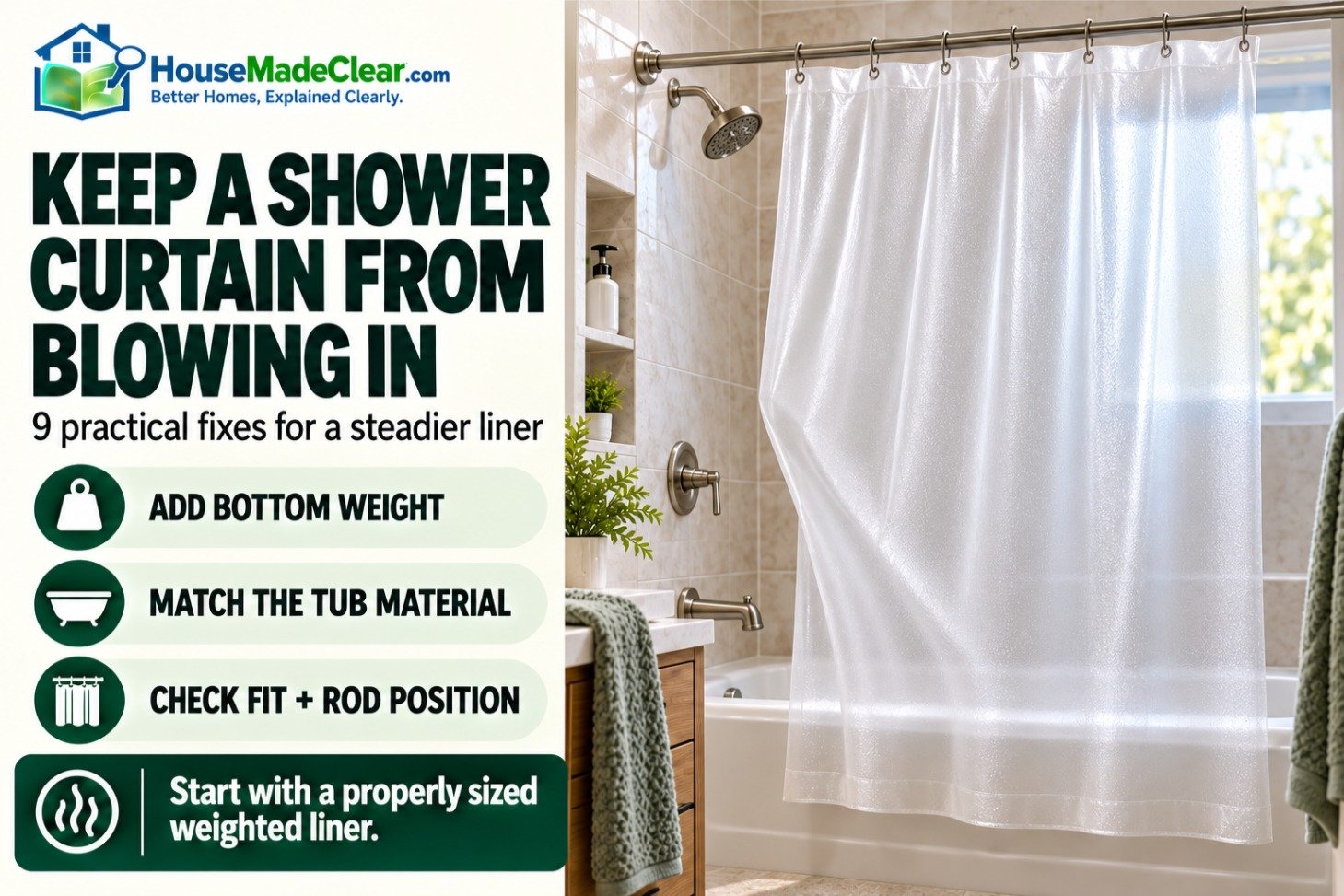
A shower curtain that keeps blowing inward can turn a relaxing shower into an annoying experience. One moment, the curtain is hanging normally. The next, it starts moving toward your legs, sticking to your skin, and reducing the space available inside the shower.
If this happens every time you turn on the water, you are not imagining it.
The movement is commonly called the shower curtain effect. It occurs when water spray creates airflow and pressure differences inside the shower, causing a lightweight curtain to move inward.
Fortunately, you usually do not need to replace your bathtub, install glass doors, or make expensive bathroom modifications to fix it.
Simple solutions such as a weighted shower curtain liner, compatible magnets, suction cups, or adjusting how the curtain hangs can help keep it in place.
This guide explains why shower curtains blow inward, nine practical ways to stop the problem, which solutions work with different bathtub materials, and how to choose a curtain that stays in place.
Quick Answer
The easiest way to keep a shower curtain from blowing inward is to add weight or secure the bottom edge so normal airflow cannot move it as easily.
Try these fixes:
- Choose a weighted shower curtain liner.
- Use magnetic weights if you have a compatible steel or iron bathtub.
- Attach removable suction-cup anchors to suitable smooth surfaces.
- Adjust the shower curtain rod and hanging position.
- Consider a curved shower curtain rod.
- Replace a very thin liner with a heavier one.
- Check whether bathroom airflow is increasing curtain movement.
- Make sure the curtain fits the shower opening correctly.
- Use suitable clip-on weights or curtain-stabilizing accessories.
Best starting point: A properly sized, weighted liner is often the simplest solution because it requires little installation and works with many bathtub materials.

Why Does My Shower Curtain Blow Inward?
A shower curtain commonly moves inward because falling water creates airflow inside the shower enclosure.
The shower spray transfers momentum to surrounding air, producing circulating air movement.
These air movements can create a region of lower pressure inside the shower than outside the curtain.
The pressure difference pushes the lightweight material toward the showering area.
Researchers have examined this behavior using fluid-dynamics models.
Mechanical engineer David Schmidt described a computer simulation in which the shower spray generated a rotating airflow pattern, or vortex, with a lower-pressure region capable of drawing a light curtain inward.
His explanation was published in Scientific American’s discussion of the shower curtain effect.
The effect helps explain why a thin plastic liner can move noticeably even when there is no obvious breeze in the bathroom.
What Is the Shower Curtain Effect?
The shower curtain effect describes the tendency of a flexible shower curtain to move inward while shower water is running.
Several mechanisms have been proposed, including:
- Air circulation caused by falling water droplets
- Local pressure differences
- Temperature-driven convection
- Interactions between the water spray and surrounding airflow
A spray-driven vortex is one well-known explanation.
The Museum of Science also discusses competing explanations, demonstrating that the phenomenon involves more than a simple draft.
Does Hot Water Cause the Curtain to Blow In?
Hot water can influence bathroom airflow because it warms nearby air.
However, the problem can also occur when the shower uses cold water.
This means rising warm air cannot be the only explanation.
Water spray itself is capable of producing airflow patterns that move a lightweight curtain.
Why Does a Thin Shower Curtain Move More?
A thin curtain typically requires less force to move than a heavier one.
Because the pressure differences involved can be relatively small, lightweight materials are often more noticeably affected.
A thicker liner or a weighted lower edge increases resistance to that movement.
This is why curtain weights are among the most practical solutions.
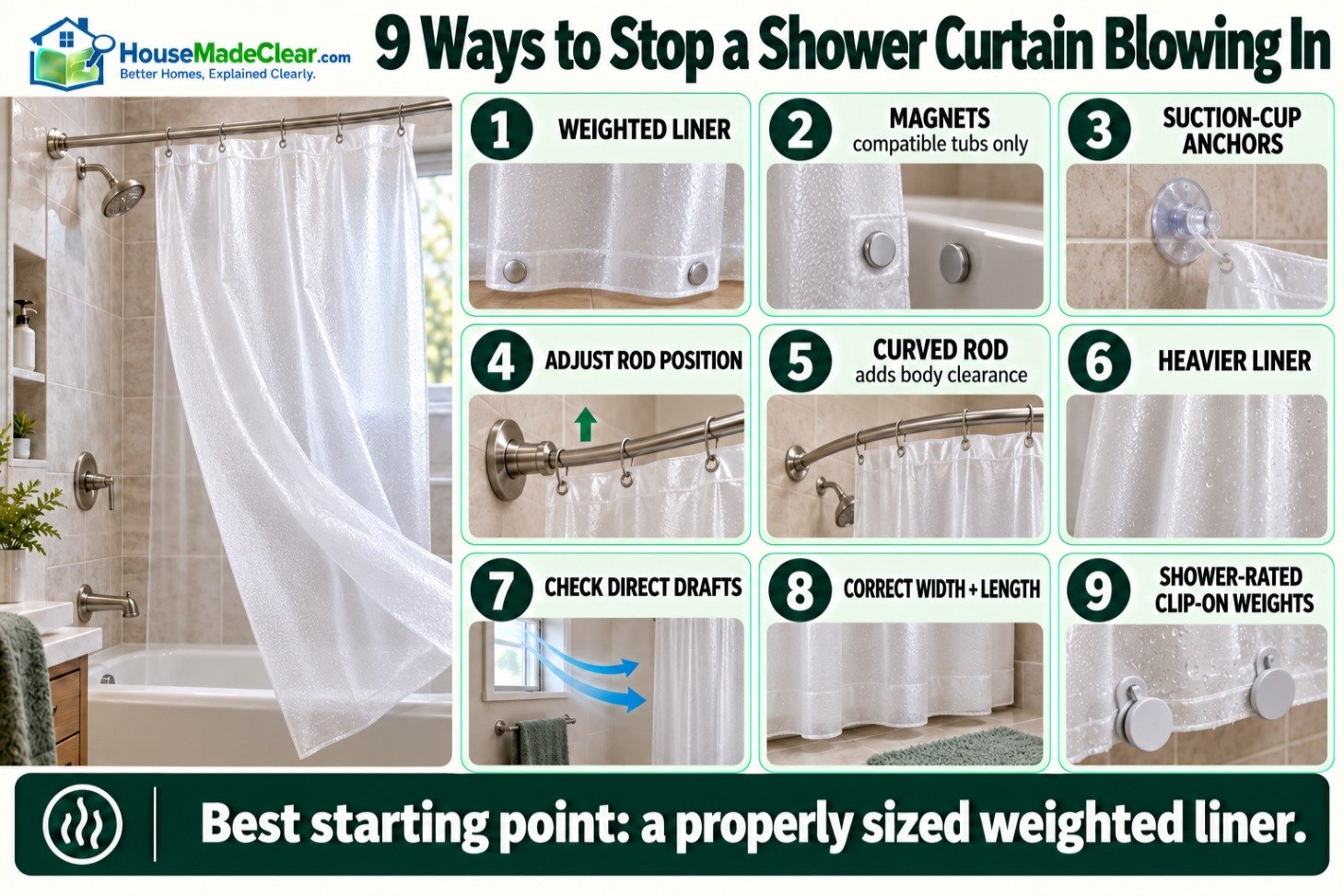
9 Ways to Keep a Shower Curtain From Blowing In
Different fixes work better for different bathrooms.
Start with the least complicated option before changing permanent hardware.
1. Use a Weighted Shower Curtain Liner
A weighted shower curtain liner is one of the easiest ways to reduce inward movement.
These liners contain added weight along the bottom edge, often through magnets, enclosed weights, or a weighted hem.
The extra weight helps the curtain hang vertically and resist movement caused by weak airflow.
Why It Works
A lightweight liner responds easily to small pressure differences.
Adding weight increases the force required to lift or move the lower edge.
The result is usually a more stable hanging curtain.
What to Look For
Choose a liner with:
- Reinforced hanging holes
- A weighted bottom edge
- Adequate width
- Suitable length
- Material appropriate for shower use
- Clearly stated care instructions
Avoid buying a liner solely because it is described as heavy-duty.
Actual construction and weight distribution matter.
Best For
- Standard bathtub-shower combinations
- Lightweight plastic liners that cling to the body
- Bathrooms where permanent modifications are undesirable
- Renters who need a removable solution
A weighted liner is my first recommendation for most households because it can improve stability without requiring a new rod or drilling.
2. Use Shower Curtain Magnets
Magnets can help hold a shower curtain against a compatible metal bathtub.
Many weighted liners include magnets near the lower corners or along the hem.
When the magnets attach to the tub, they reduce the curtain’s ability to move inward.
Do Magnets Work on Every Bathtub?
No.
Magnets require a magnetically responsive metal surface.
They can work on many steel or cast-iron tubs, including some enamel-coated models.
They generally do not attach magnetically to acrylic, fiberglass, or solid-surface tubs.
Some stainless-steel alloys are also weakly magnetic or nonmagnetic.
How to Check Compatibility
Before purchasing magnetic accessories:
- Use a small household magnet.
- Test an accessible area of the bathtub exterior.
- Confirm that it attaches securely without scratching the finish.
- Check that the shower curtain magnets can reach the intended surface.
Avoid dragging magnets across delicate coatings.
Where Should Shower Curtain Magnets Go?
Many products position them near the lower corners.
Some liners have additional magnets spaced along the bottom.
The goal is to hold the wet-side liner against an appropriate surface without obstructing drainage.
Best For
- Compatible steel bathtubs
- Enamel-coated magnetic cast-iron tubs
- Existing liners with suitable reinforced attachment areas
Important: Do not assume a magnetic curtain will stay fixed if the tub is nonmagnetic.

3. Use Suction Cups to Secure the Curtain
Suction-cup anchors provide an option when magnets are not suitable.
They may attach to smooth, nonporous surfaces such as certain glazed tiles or smooth bathtub walls.
Some shower curtains have integrated suction cups near the edges.
Others can be used with removable accessories specifically designed for shower curtains.
How Suction Cups Help
A suction cup creates a temporary attachment point.
When the curtain is anchored near an edge, it becomes harder for normal shower airflow to pull the material inward.
Installation Tips
- Clean and dry the intended mounting surface.
- Follow the accessory manufacturer’s instructions.
- Use only surfaces compatible with the suction cups.
- Check for a secure attachment before showering.
- Remove and clean the attachments periodically.
Do not attach them to loose tiles, damaged finishes, or surfaces where adhesion is unreliable.
Limitations
Suction cups may release over time, especially on textured or heavily grouted surfaces.
They should not be considered permanent fasteners.
Best For
- Acrylic or fiberglass bathtubs
- Smooth shower walls
- Rental bathrooms
- Households that prefer removable accessories
4. Adjust the Shower Curtain Rod Position
Sometimes the curtain moves excessively because it hangs too close to the showering area or does not cover the opening properly.
The position of the rod influences where the curtain hangs relative to the bathtub and water spray.
If the liner is crowded inward before you start showering, even a small amount of airflow may cause it to touch your body.
What to Check
Look at the curtain when the water is turned off.
Ask:
- Does the liner hang freely?
- Is the rod centered appropriately above the tub?
- Is the curtain pushed inward by the wall or nearby fixtures?
- Does the bottom edge sit correctly inside the bathing area?
- Is the curtain excessively long and bunched up?
If the rod was installed incorrectly, adjustment may improve the curtain’s position.
Can You Move a Tension Rod?
A tension-mounted rod may be repositioned according to the manufacturer’s instructions.
However, it must remain securely supported.
Never extend a tension rod beyond its rated installation range or place it on a surface that cannot support it.
For guidance on the proper relationship between the rod and liner, see our article about shower curtain rod height.
Best For
- Curtains hanging too close to the showering area
- Incorrectly positioned tension rods
- Recently installed shower curtains
- Curtains that bunch against the bathtub floor
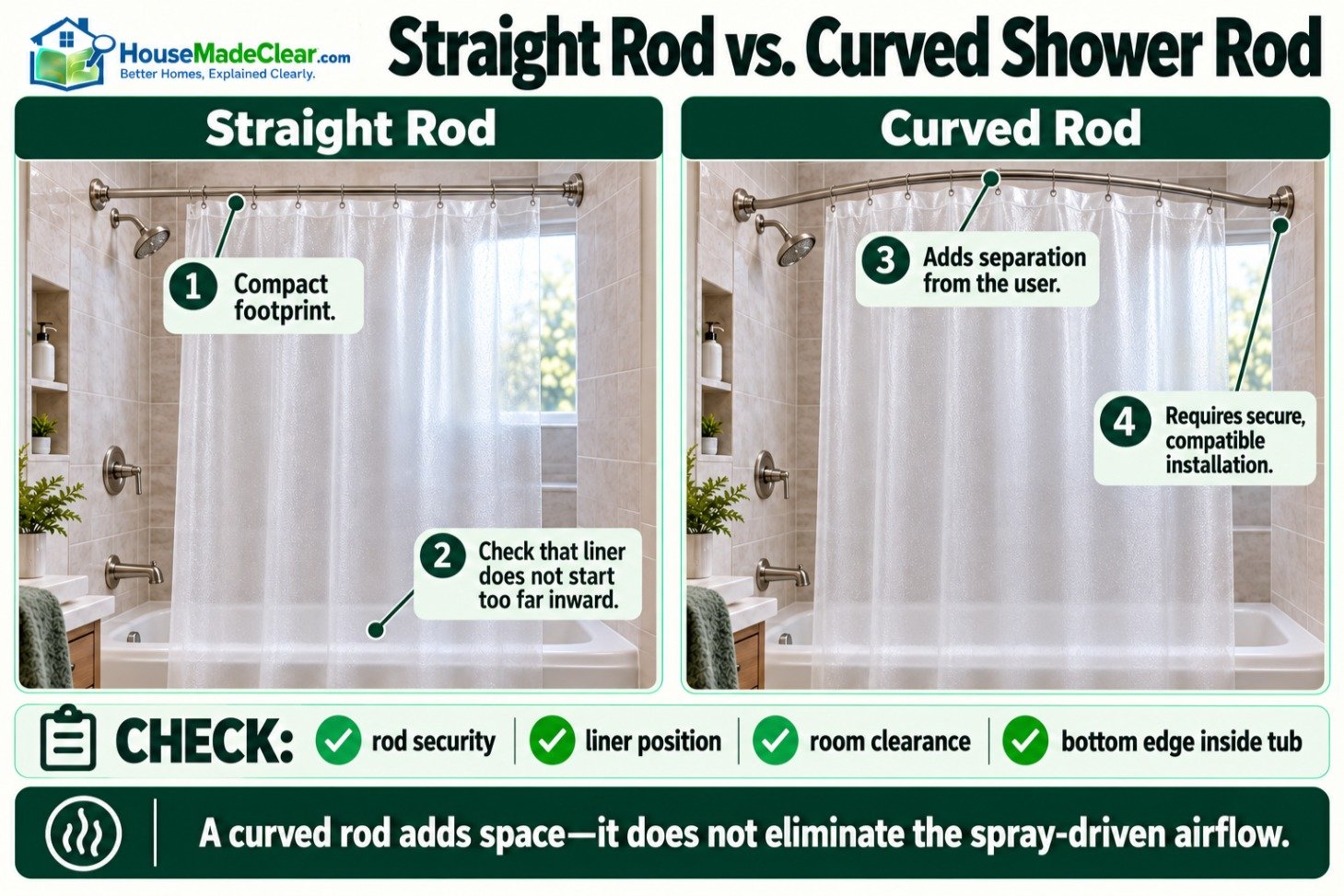
5. Install a Curved Shower Curtain Rod
A curved shower curtain rod projects outward from the bathtub, providing additional space between the curtain and the person showering.
This can make the shower feel more spacious.
It may also reduce how often a moving curtain touches your body.
However, it is important to understand what a curved rod actually does.
A curved rod does not eliminate the airflow forces responsible for the shower curtain effect.
Instead, it changes the curtain’s hanging position and can provide more separation from the showering area.
Advantages of a Curved Rod
- More perceived space inside the shower
- Greater separation between the curtain and the user
- Potential reduction in uncomfortable curtain contact
- Useful for some narrow bathtub-shower combinations
Possible Disadvantages
- Requires adequate bathroom space
- May project farther into the room
- Must be installed securely
- Can change how the liner meets the tub
- May not resolve movement if the curtain remains very light
Will a Curved Rod Stop the Curtain From Blowing In?
It may improve the situation, but it is not a guaranteed solution.
A weighted liner may still be necessary.
Best For
- Narrow bathtub-shower combinations
- Bathrooms where the curtain touches the user
- Homeowners willing to modify rod placement
- Renovations where the rod is already being replaced
If you are renting, confirm whether the selected rod requires drilling or other modifications.
6. Replace a Thin Liner With a Heavier Shower Curtain
Very thin shower curtain liners are more easily moved by airflow.
Replacing a lightweight liner with a more substantial one can improve stability.
However, not every thick-looking product is necessarily heavier.
Compare the actual material specifications rather than relying on appearance alone.
Which Materials Work?
Common shower liner materials include:
- PEVA
- EVA
- PVC
- Polyester
- Other shower-rated synthetic textiles
Each material is available in different constructions.
A thin PEVA liner may move more easily than a heavier polyester liner, but another PEVA product may have substantial weight.
The material label alone does not determine whether a curtain will blow inward.
Our guide to what a PEVA shower curtain is explains how PEVA differs from PVC and other common liner materials.
What About a Heavy Fabric Shower Curtain?
A heavier fabric curtain may move less.
However, make sure it is designed to manage shower water.
Some fabric curtains require a separate waterproof liner.
Do not remove the liner simply to make the curtain heavier if doing so allows water onto the bathroom floor.
Best For
- Very thin plastic liners
- Curtains that cling to the body
- Homeowners replacing a worn liner
- Bathrooms where magnets and suction cups are not desirable
7. Check Bathroom Airflow and Exhaust Fan Operation
Bathroom airflow can influence how a shower curtain moves.
An exhaust fan, open window, nearby HVAC supply register, or open doorway may change local air movement.
However, you should not disable necessary bathroom ventilation simply to stop the curtain from blowing inward.
Showering creates moisture that should be removed to reduce persistent dampness.
The U.S. EPA’s indoor-air-quality guidance recommends using a bathroom exhaust fan that vents outdoors, or opening a suitable window when conditions permit, during and after showering.
How to Check for Airflow Problems
Observe whether the curtain moves:
- Only when the shower is running
- When the exhaust fan is operating
- When a nearby window is open
- When an HVAC vent is supplying air
- When the bathroom door is open
If a direct air stream strikes the curtain, changing the direction of an adjustable HVAC grille may help, provided doing so does not compromise system performance.
Should You Turn Off the Bathroom Fan?
Do not treat shutting off ventilation as a routine solution.
A functioning exhaust fan serves an important moisture-control purpose.
If the fan creates unusual drafts or pressure problems, have the ventilation system evaluated.
For additional guidance, read our article about how long to run a bathroom fan after showering.
Best For
- Bathrooms with strong drafts
- Curtains that move even before showering
- Rooms with nearby HVAC supply registers
- Unusual ventilation conditions

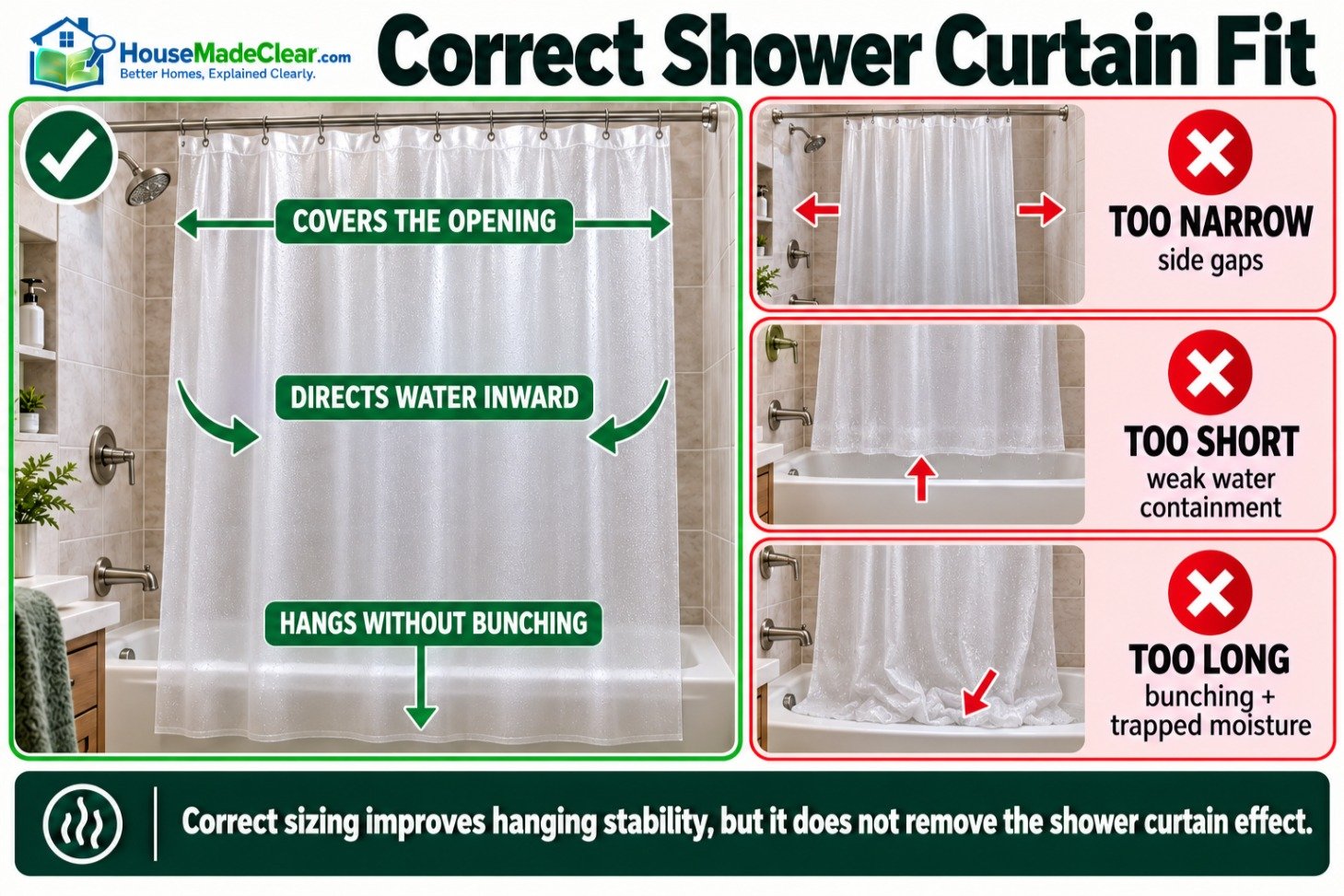
8. Make Sure the Shower Curtain Is the Correct Size
An incorrectly sized curtain can create movement and water-control problems.
A curtain that is too short may not stay in the intended position.
A curtain that is too long can bunch up, collect water, or become difficult to spread evenly.
A curtain that is too narrow may not cover the opening adequately.
What Width Should You Use?
For a typical bathtub-shower combination, common retail curtain widths include approximately 70 or 72 inches.
However, the best size depends on the opening and the desired overlap.
The curtain should cover the wet area without leaving large gaps.
What About Length?
Choose a length that lets the liner direct water into the tub without creating excessive bunching or prolonged contact with standing water.
The hanging height depends on the rod, rings, and tub configuration.
Why Does Size Affect Blowing In?
An oversized liner can fold and collect air movement unevenly.
An undersized or poorly positioned curtain may allow the edges to move excessively.
Correct sizing does not eliminate the shower curtain effect, but it can improve how the curtain hangs.
For measurement instructions, see our standard shower curtain size guide.
Best For
- Newly purchased curtains
- Liners that drag on the tub floor
- Curtains that fail to cover the opening
- Bathroom renovations with changed rod height
9. Add Removable Shower Curtain Weights or Stabilizing Clips
If you want to keep your existing curtain, removable weights may be an alternative to purchasing a replacement.
Shower-curtain weights and clip-on accessories are designed to add stability near the bottom of the material.
Some products attach to the hem.
Others connect to specific reinforced locations.
What Should You Look For?
Choose accessories that:
- Are intended for wet bathroom use
- Are compatible with your curtain material
- Have secure attachment mechanisms
- Resist corrosion
- Do not create sharp edges
- Will not damage the bathtub
- Can be removed for cleaning
Can You Use Ordinary Household Clips?
Improvised metal clips, loose objects, or sharp fasteners are not ideal.
They may rust, tear the curtain, scratch the bathtub, or detach unexpectedly.
Use accessories specifically designed for shower curtains.
Where Should Weights Be Installed?
Follow the product’s instructions.
Weights are commonly placed near the lower corners or distributed along the bottom edge.
Avoid concentrating excessive weight on a delicate or deteriorated liner.
Best For
- Existing curtains in otherwise good condition
- Lightweight liners needing modest stabilization
- Renters
- Homeowners seeking a low-cost removable solution

Which Shower Curtain Fix Works Best?
The best option depends on your bathtub material, curtain thickness, and how much movement occurs.
| Problem | Best First Fix | Additional Option |
|---|---|---|
| Thin liner sticks to your legs | Weighted liner | Clip-on weights |
| Curtain blows inward on a steel tub | Magnetic weighted liner | Heavier curtain |
| Curtain blows inward on an acrylic tub | Weighted liner | Compatible suction cups |
| Curtain hangs too close to your body | Check rod position | Curved rod |
| Curtain drags in the tub | Correct liner length | Adjust rod position |
| Strong drafts affect the curtain | Investigate airflow | Stabilize the lower edge |
| Curtain is too narrow | Replace with correct width | Adjust hanging arrangement |
| Existing curtain is in good condition | Removable weights | Suction-cup anchors |
| Curtain repeatedly touches your legs | Heavier liner | Curved rod |
For most households, a properly sized weighted liner is the most straightforward starting point.
Why Is My Shower Curtain Blowing In Even With Magnets?
Magnets are not guaranteed to eliminate the problem.
Several conditions can reduce their effectiveness.
The Tub Is Not Magnetic
Acrylic and fiberglass tubs do not provide a magnetic attachment surface.
The Magnets Are Too Weak
Small or poorly positioned magnets may not hold the curtain firmly.
The Curtain Is Too Light
A few magnets near the corners may not prevent the middle of a very thin liner from moving.
The Magnets Cannot Reach the Tub
If the curtain hangs incorrectly, the magnetic points may not make contact.
Water or Residue Interferes With Positioning
Soap buildup or material folds may prevent the liner from sitting flat.
The Curtain Is Too Narrow
Large gaps and poor hanging geometry can make the curtain move unpredictably.
Recommended solution: Confirm magnetic compatibility first, then check liner length, position, and weight distribution.
If the middle still moves excessively, a heavier liner may be more effective than adding more small magnets.
How to Stop a Shower Curtain From Sticking to Your Body
Sometimes the curtain does not travel far inward but still brushes against your legs.
This is especially common in narrow showers.
Try the following sequence.
Step 1: Observe the Curtain With the Water Off
Check whether the curtain naturally hangs too close to where you stand.
Step 2: Start the Shower
Watch whether the material moves inward only after the water starts.
This helps distinguish an initial positioning problem from airflow-driven movement.
Step 3: Secure the Lower Edge
Use suitable weights, magnets, or anchors.
Step 4: Check the Rod Position
A curtain positioned too far inward may need correction.
Step 5: Consider a Curved Rod
If available bathroom space allows, a curved rod can increase separation from the user.
Step 6: Replace an Excessively Thin Liner
A heavier liner may move less and feel more comfortable.
A combination of correct positioning and adequate weight is often more effective than either measure alone.
How to Keep a Shower Curtain From Blowing In on an Acrylic Tub
Acrylic bathtubs create a particular challenge because magnets typically cannot attach to them.
Fortunately, magnetic attachment is not essential.
Best Options for Acrylic Bathtubs
- A weighted shower curtain liner
- A heavier shower-rated curtain
- Compatible suction-cup anchors
- Appropriate removable stabilizing clips
- Corrected rod position
Avoid drilling into or permanently attaching hardware to the bathtub without manufacturer approval.
Acrylic surfaces can be damaged by incorrect tools, adhesives, or fasteners.
If using suction cups, make sure the surface is smooth, clean, and suitable for the product.
How to Keep a Shower Curtain From Blowing In on a Fiberglass Tub
Fiberglass shower enclosures are another common nonmagnetic installation.
The same general approach applies.
Use added weight or appropriate removable anchors rather than relying on magnets.
Check that the chosen accessories will not scratch the gelcoat or other finished surface.
For fiberglass tubs with textured surfaces, suction cups may not hold reliably.
In that situation, a weighted liner may be the simpler choice.
Can a Curved Shower Rod Prevent the Shower Curtain Effect?
A curved rod can reduce the nuisance of the curtain touching your body by creating additional space.
However, the effect itself can still occur.
The water spray continues to move air regardless of the rod shape.
Therefore, a curved rod is best considered a space and positioning improvement, rather than a direct way to eliminate the pressure difference.
A practical setup may combine:
- A curved rod
- A correctly sized liner
- A weighted bottom edge
This combination can be useful for narrow bathtubs.
Before purchasing a curved rod, verify that it will fit the room and can be installed securely.
Shower Curtain Blowing In: Common Fixes Ranked by Practicality
| Solution | Installation Effort | Permanent Modification? | Best Use |
|---|---|---|---|
| Weighted liner | Very low | No | Most bathrooms |
| Magnetic liner | Very low | No | Magnetic tubs |
| Clip-on weights | Low | No | Existing lightweight curtains |
| Suction cups | Low | No | Suitable smooth surfaces |
| Correct liner size | Low | No | Incorrectly sized curtains |
| Adjust tension rod | Low to moderate | Usually no | Poor rod placement |
| Heavier curtain | Low | No | Thin liners |
| Curved shower rod | Moderate | Depends on model | Extra shower space |
| HVAC airflow adjustment | Varies | Usually no | Direct air drafts |
This table compares practical installation characteristics, not independently measured effectiveness.
Results will vary with the bathtub, curtain, shower spray, and bathroom airflow.
Does Shower Curtain Material Affect How Much It Blows In?
Yes, but weight and construction are often more important than the material name alone.
PEVA Shower Curtains
PEVA is a flexible plastic material used in many shower liners.
Thin PEVA liners may move easily.
Heavier PEVA liners with weighted hems can be more stable.
EVA Shower Curtains
EVA products can also be manufactured in different thicknesses and weights.
Do not assume that all EVA curtains are heavier than PEVA.
PVC Shower Curtains
Flexible PVC liners vary in weight and construction.
Some heavier products may resist inward movement better than very thin alternatives.
Polyester Shower Curtains
Polyester curtains may have greater fabric weight, depending on construction.
However, some require a separate liner to prevent water from escaping.
Cotton Shower Curtains
Cotton curtains can be decorative, but untreated cotton typically absorbs water.
They often need a suitable liner.
If you’re deciding whether a separate liner is necessary, see our shower curtain vs. liner comparison.
Can You Fix a Blowing Shower Curtain Without Buying Anything?
Possibly.
Before replacing the liner, check its existing position and condition.
Check the Hanging Height
If the curtain is excessively long and bunches inside the tub, correct its position where possible.
Spread Out the Curtain
A curtain that is heavily gathered can move unpredictably.
Make sure it covers the opening evenly.
Inspect the Rings
Broken or unevenly positioned hooks can affect how the curtain hangs.
Check the Rod
A badly positioned tension rod may hold the curtain too far inward.
Look for Direct Drafts
Observe whether airflow from a nearby register or open window is contributing to the problem.
These adjustments may reduce movement, but a very lightweight liner may still benefit from added weight.
How to Keep Shower Water Inside the Tub While Fixing the Curtain
Preventing inward movement should not compromise water containment.
A curtain stabilized in the wrong position can allow water to escape onto the bathroom floor.
That creates a slip hazard and may damage nearby materials.
Keep the Liner on the Wet Side
For a typical bathtub-shower combination, the waterproof liner should direct water into the tub.
Avoid Large Side Gaps
The liner should cover the shower opening sufficiently.
Prevent Excessive Dragging
A liner that bunches in standing water may be harder to keep clean.
Check After Installation
Run the shower briefly and inspect whether water escapes beyond the curtain.
Maintain Adequate Ventilation
After showering, spread the liner to encourage drying and use suitable bathroom ventilation.
The EPA’s moisture-control recommendations emphasize controlling indoor dampness and using bathroom ventilation during moisture-producing activities.
Does Shower Pressure Affect Curtain Movement?
Shower spray characteristics can influence surrounding airflow.
A stronger or differently shaped spray may alter the movement of air inside the shower enclosure.
However, this does not mean that every high-pressure shower will cause more curtain movement in a predictable way.
Water direction, spray pattern, enclosure shape, and liner weight also matter.
Should You Lower Water Pressure to Stop the Curtain?
Not usually as the first solution.
Curtain stabilization is generally simpler than modifying a functioning plumbing system.
Do not change household plumbing pressure solely to address curtain movement without an appropriate assessment.
What About Changing the Showerhead?
A different showerhead may change airflow patterns, but its effect on the curtain is not guaranteed.
Replacing a working showerhead may be unnecessary when a weighted liner can address the issue more directly.
Common Mistakes When Trying to Stop Shower Curtain Movement
Mistake 1: Assuming Every Bathtub Works With Magnets
Acrylic and fiberglass tubs are generally nonmagnetic.
Mistake 2: Choosing the Thickest Curtain Without Checking Weight
Thickness and overall construction are not identical measures of performance.
Mistake 3: Turning Off Bathroom Ventilation Permanently
Poor moisture removal can contribute to condensation and mold problems.
Mistake 4: Installing the Curtain Outside the Tub During Showering
This can allow water to escape.
Mistake 5: Hanging the Curtain Too Low
Excessive bunching can trap moisture and interfere with proper positioning.
Mistake 6: Using Sharp Household Clips
Improvised fasteners can damage the liner or scratch surfaces.
Mistake 7: Relying on Weak Magnets
Magnets must be compatible with the tub and strong enough for the intended task.
Mistake 8: Assuming a Curved Rod Eliminates the Airflow Effect
It may create more room without completely stopping inward movement.
Mistake 9: Ignoring the Liner’s Width
A narrow curtain may leave gaps and behave poorly.
Mistake 10: Forgetting to Clean the Curtain
Soap residue, damp folds, and damaged hems can affect usability.
For maintenance instructions, read our guide to how to clean a shower curtain and liner.
Shower Curtain Stability Checklist
| Check | What to Look For |
|---|---|
| Curtain weight | Adequate to resist minor airflow |
| Liner width | Covers opening |
| Liner length | Directs water inward without excessive bunching |
| Rod position | Curtain hangs properly |
| Rod security | Secure mounting |
| Bottom hem | Weighted if needed |
| Magnets | Compatible tub material |
| Suction cups | Suitable smooth surface |
| Curtain rings | Complete and undamaged |
| Ventilation | Functioning moisture removal |
| Nearby drafts | No direct unwanted airflow |
| Water containment | No excessive spray reaching floor |
| Drying | Curtain spread after shower |
| Material condition | No major tears or deformation |
Final Thoughts
If your shower curtain keeps blowing inward, the underlying cause is usually normal airflow generated by the shower spray.
The moving water can create pressure differences inside the shower, causing lightweight curtain material to shift toward you.
For most homeowners, a properly sized weighted shower curtain liner is the simplest fix.
Magnetic liners can also work well on compatible metal bathtubs, while suction cups and removable weights may help with acrylic or fiberglass installations.
If the curtain hangs too close to your body, adjusting the rod or installing a suitable curved rod may provide additional room.
Whatever solution you choose, keep the liner positioned so shower water drains inside the tub, and maintain adequate bathroom ventilation.
You do not necessarily need an expensive remodel to solve the problem.
In many cases, a small change to the liner’s weight, position, or attachment can make the shower significantly more comfortable.
Frequently Asked Questions
Why does my shower curtain blow inward?
A shower curtain can blow inward because falling water creates circulating airflow and pressure differences inside the shower. These forces can pull a lightweight liner toward the showering area.
How do I keep my shower curtain from blowing in?
Use a weighted shower curtain liner, compatible magnets, suction-cup anchors, or removable curtain weights. Correct rod positioning and curtain sizing can also help reduce movement.
Do shower curtain magnets work?
Yes, magnets can help stabilize a curtain when the bathtub has a compatible magnetic metal surface. They generally do not attach magnetically to acrylic or fiberglass bathtubs.
How do you keep a shower curtain from sticking to your body?
Add weight to the bottom edge, verify the curtain’s hanging position, and consider a curved shower curtain rod for additional space. A heavier liner may also move less than a very thin one.
Does a curved shower rod stop the curtain from blowing in?
A curved rod can provide additional space between the curtain and the person showering. However, it does not eliminate the airflow that causes the shower curtain effect, so a weighted liner may still be useful.
Why does my shower curtain blow in even with cold water?
The shower curtain effect is not caused only by warm air. Water spray can create circulating airflow and pressure differences even when cold water is running.
Can I use magnets on an acrylic bathtub?
No, ordinary shower curtain magnets generally cannot attach directly to acrylic because it is not a magnetic material. Consider a weighted liner or suitable suction-cup anchors instead.
How do I stop a shower curtain from blowing in on a fiberglass tub?
Use a weighted liner, compatible suction cups on suitable smooth surfaces, or removable stabilizing weights. Magnets generally do not attach to fiberglass.
Are heavier shower curtains better?
Heavier curtains generally resist small airflow forces better than very lightweight ones. However, performance also depends on proper sizing, installation, and weight distribution.
Does shower curtain material affect blowing inward?
Yes. Very thin plastic liners often move more easily than heavier curtains. However, actual weight and construction usually matter more than whether the product is labeled PEVA, EVA, PVC, or polyester.
Does shower pressure cause the curtain to blow in?
Shower spray influences air movement, so pressure and spray pattern can affect the behavior. However, curtain movement also depends on enclosure geometry, airflow, and liner weight.
Should I turn off the bathroom fan to stop the curtain from blowing in?
Do not routinely disable necessary bathroom ventilation to address curtain movement. Exhaust fans help remove moisture. Use curtain weights or positioning adjustments instead, and investigate unusual drafts if needed.
Can suction cups hold a shower curtain in place?
Suitable suction-cup anchors can help stabilize a curtain on smooth, compatible surfaces. Their reliability depends on surface condition, product design, and correct installation.
How long should a shower curtain be to prevent blowing inward?
The curtain should be long enough to direct shower water into the tub without excessive bunching or dragging. The proper length depends on the rod height, hooks, and bathtub configuration.
Can I fix a blowing shower curtain without replacing it?
Yes. You may be able to add removable weights, correct the rod position, spread out the curtain, replace damaged hooks, or use suitable anchors.
Why does my shower curtain keep touching my legs?
The curtain may be moving inward because of airflow or hanging too close to the showering area. Stabilizing the lower edge and checking the rod position can reduce contact.