















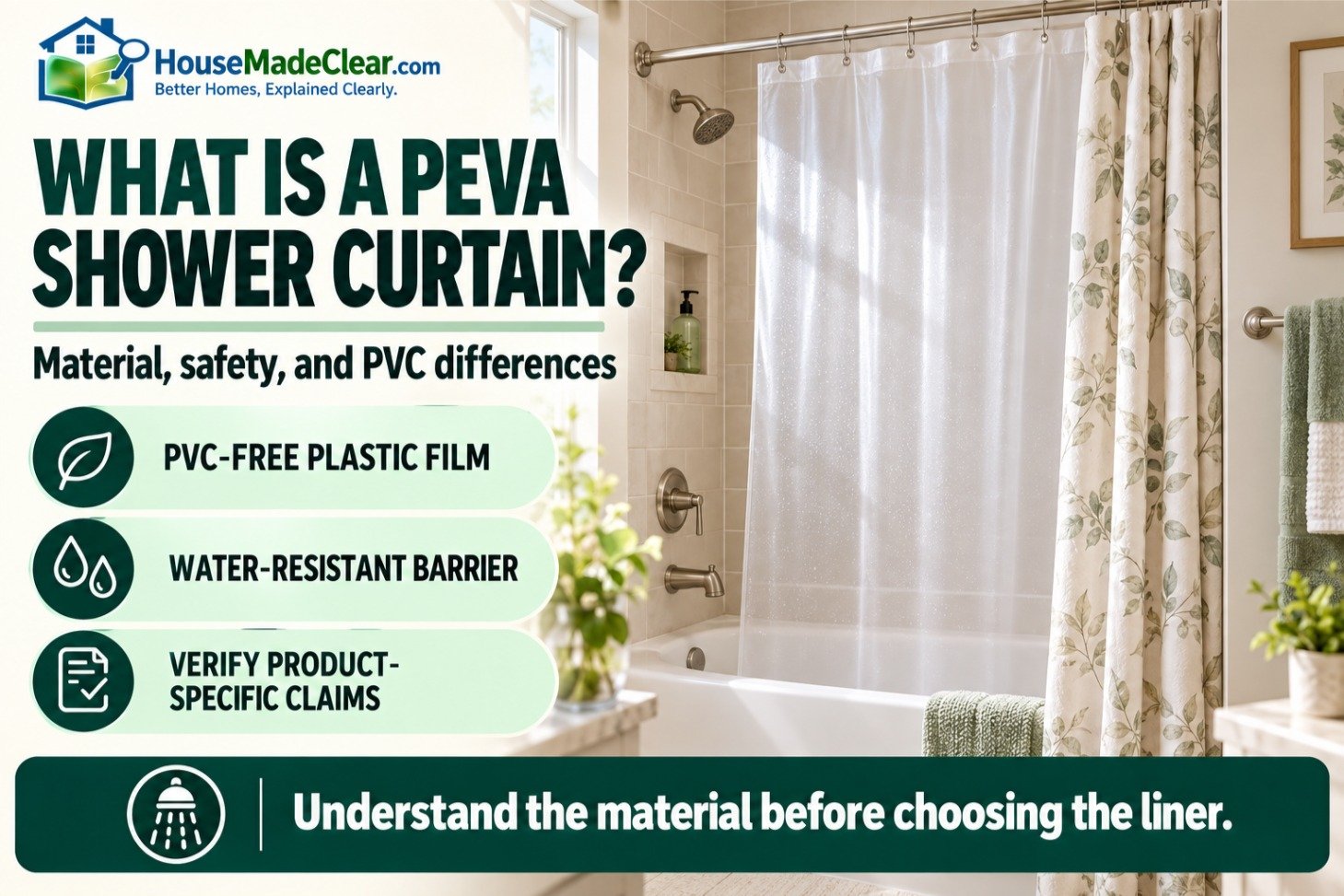
If you’ve been shopping for a shower curtain or liner, you’ve probably seen products labeled PEVA, EVA, PVC-free, or non-toxic. These terms frequently appear on plastic shower liners, but their meanings aren’t always explained clearly.
So, what is a PEVA shower curtain?
A PEVA shower curtain is a water-resistant plastic curtain or liner made from a material commonly described as polyethylene-vinyl acetate, more precisely a type of ethylene-vinyl acetate copolymer. It is widely marketed as an alternative to traditional PVC vinyl shower curtains.
PEVA curtains are generally flexible, lightweight, and designed to keep shower water inside the bathtub or shower enclosure.
Because the base polymer does not contain chlorine as part of its chemical structure, PEVA is often marketed as a PVC-free alternative.
However, a PVC-free label does not automatically mean a shower curtain contains no additives, produces no chemical emissions, or has been independently tested for every potential health concern.
The material’s composition, manufacturing process, product specifications, and recommended use all matter.
This guide explains what PEVA shower curtains are made from, how they compare with PVC and fabric liners, whether PEVA is safe, how to clean it, and what to check before buying one for your bathroom.
Quick Answer
A PEVA shower curtain is a flexible, water-resistant curtain or liner made from an ethylene-vinyl acetate-based plastic.
PEVA is commonly used as a PVC-free alternative to traditional vinyl shower liners.
Key characteristics:
- Material: Ethylene-vinyl acetate copolymer, commonly labeled PEVA
- Water resistance: Suitable for direct shower-water exposure when designed for that use
- PVC content: The PEVA polymer itself is not PVC
- Chlorine: The base polymer does not contain chemically bound chlorine
- Cleaning: Usually cleaned gently, according to the manufacturer’s instructions
- Liner needed? Often not, if the PEVA curtain is designed to serve as the waterproof barrier
- Safety: Material choice alone cannot guarantee that every finished product is free of potentially concerning substances
PEVA can be a practical choice for homeowners who want a lightweight, easy-to-wipe shower liner without using conventional PVC.
What Is PEVA Material?
PEVA is a common commercial designation for a material in the ethylene-vinyl acetate (EVA) copolymer family.
A copolymer is a plastic made by combining two different types of chemical building blocks.
In this case, the components are:
- Ethylene
- Vinyl acetate
The resulting material can be processed into flexible plastic films suitable for products such as shower liners.
The exact flexibility, appearance, and physical properties depend on the polymer composition and how the material is manufactured.
What Does PEVA Stand For?
PEVA commonly stands for polyethylene-vinyl acetate.
More formally, the material is described as poly(ethylene-co-vinyl acetate), or ethylene-vinyl acetate copolymer.
In retail listings, PEVA is frequently used to identify flexible plastic shower-curtain material.
Is PEVA the Same as Plastic?
Yes.
PEVA is a plastic material.
Although it may be marketed using terms such as eco-friendly, non-toxic, or safer alternative, it is still a synthetic polymer.
Being PVC-free does not make a PEVA curtain a natural-fiber product or a plastic-free product.
Is PEVA a Fabric?
No.
PEVA is a flexible polymer film, not a woven fabric like cotton or polyester.
Some shower-curtain products combine different materials, but a conventional PEVA liner is essentially a thin plastic sheet designed to resist water.
It may look translucent, frosted, colored, or transparent.

What Is a PEVA Shower Curtain Liner?
A PEVA shower curtain liner is a waterproof or water-resistant barrier designed to hang on the wet side of a shower-curtain arrangement.
Its main purpose is to prevent shower spray from soaking an outer decorative curtain or reaching the bathroom floor.
Many homeowners use a PEVA liner with a separate fabric curtain.
In that arrangement:
- The PEVA liner hangs inside the bathtub during showering.
- The decorative curtain hangs outside the tub.
- Water runs down the liner and drains into the bathing area.
Other PEVA products are sold as standalone shower curtains.
These can sometimes serve as both the visible curtain and the water barrier.
Is There a Difference Between a PEVA Curtain and a PEVA Liner?
The underlying material may be the same.
The main difference is the product’s intended function and design.
A PEVA liner may be thin, translucent, and designed primarily for water control.
A PEVA curtain may have printed patterns, heavier construction, or a decorative finish.
Both can serve as a barrier against shower spray if the manufacturer designed them for that use.
Do You Need a Separate Liner With a PEVA Shower Curtain?
Not always.
If a PEVA curtain is designed for direct water exposure and keeps shower spray inside the tub, a separate liner may be unnecessary.
However, check its construction and manufacturer’s instructions.
For a complete explanation of when a second layer is useful, see our guide to shower curtain vs. liner.

Is a PEVA Shower Curtain Safe?
PEVA is commonly marketed as an alternative to PVC shower curtains because its base polymer does not have the same chlorine-containing structure as PVC.
However, the word safe needs careful interpretation.
PEVA is not automatically free from every potentially concerning chemical, and its material label alone does not establish the safety of every finished product.
Manufacturers may use different additives, pigments, surface treatments, or other components.
The finished product also has to be considered in the context of how it is used.
Is PEVA Non-Toxic?
Many manufacturers describe PEVA shower curtains as non-toxic.
However, the term does not, by itself, establish that a specific product has undergone comprehensive independent chemical testing.
A more useful approach is to look for concrete information such as:
- Confirmed material composition
- PVC-free declaration
- Phthalate-free declaration where relevant
- Product-specific test reports
- Applicable chemical compliance information
- Clear manufacturer contact details
- Instructions for intended use
A broad marketing claim is less informative than verifiable product testing.
Is PEVA Safer Than PVC?
PEVA avoids certain material-specific concerns associated with traditional flexible PVC formulations.
PVC contains chlorine in its polymer structure, and some flexible PVC formulations have used phthalate plasticizers.
PEVA does not require PVC’s chlorine-containing polymer structure.
However, this does not prove that every PEVA product has lower exposure to all chemicals under every use condition.
For context, a 2008 study of five PVC shower curtains, indexed in the U.S. EPA’s Health and Environmental Research Online database, identified phthalates and other chemicals in the PVC products examined.
That study provides evidence about the tested PVC curtains. It does not establish that all present-day PVC curtains have identical formulations or that all PEVA curtains are free of emissions.
Does PEVA Contain Chlorine?
The ethylene-vinyl acetate copolymer itself does not contain chlorine in its chemical structure.
This is one of the main differences between PEVA and PVC.
However, a finished curtain may include components beyond its base polymer.
If avoiding specific substances is important, review actual product information rather than relying exclusively on the material name.
Are PEVA Shower Curtains Safe for Children?
A PEVA shower curtain can be used as an ordinary bathroom water barrier when it is suitable for the installation and used according to its manufacturer’s instructions.
However, PEVA labeling alone is not proof of comprehensive safety testing.
For a household with children, consider the complete product, including its construction, durability, cleaning requirements, and any supported chemical-compliance information.
A shower curtain should never be treated as a toy, and packaging materials should be kept away from young children.

PEVA vs. PVC Shower Curtains: What’s the Difference?
PEVA and PVC are both plastic materials, but they are chemically different.
PVC stands for polyvinyl chloride.
It contains chlorine as part of its polymer structure and is frequently used in flexible vinyl products.
PEVA is based on ethylene and vinyl acetate instead.
PEVA vs. PVC Comparison Chart
| Feature | PEVA Shower Curtain | PVC Shower Curtain |
|---|---|---|
| Base polymer | Ethylene-vinyl acetate copolymer | Polyvinyl chloride |
| Plastic material | Yes | Yes |
| Chlorine in base polymer | No | Yes |
| Water barrier | Usually, when made for shower use | Usually |
| Flexibility | Varies by formulation | Varies by formulation and plasticization |
| Phthalate content | Must verify finished product | Must verify finished product |
| Odor | Varies by product | Varies by product |
| Ease of cleaning | Generally wipe-clean | Generally wipe-clean |
| Heat sensitivity | Product dependent | Product dependent |
| Recyclability | Depends on material grade and facilities | Depends on material grade and facilities |
| Health or environmental claims | Require product-specific evidence | Require product-specific evidence |

Why Do People Choose PEVA Instead of PVC?
Common reasons include:
- Preference for PVC-free materials
- Interest in reducing exposure to certain PVC-associated additives
- Desire for a lightweight, flexible liner
- Easy surface cleaning
- Availability in common shower-curtain sizes
- Clear or translucent appearance
These are reasonable purchasing considerations.
However, the best product is not determined by material name alone.
Construction quality, warranty, manufacturing transparency, and longevity also matter.
Does PVC Always Have a Strong Smell?
No.
Odor varies by formulation, packaging, age, and storage conditions.
Some PVC products have noticeable new-product odors, while others may have little detectable smell.
Likewise, some PEVA curtains may have a noticeable odor when first unpacked.
Smell alone cannot identify a product’s chemical composition or establish whether exposure is harmful.
PEVA vs. EVA Shower Curtains
Many shopping websites list PEVA and EVA shower curtains as separate categories.
This can be confusing because PEVA and EVA are closely related terms.
Both are commonly used in connection with ethylene-vinyl acetate copolymer materials.
Differences between particular retail products may result from:
- Polymer composition
- Film thickness
- Manufacturing methods
- Additives
- Surface texture
- Weight
- Brand-specific specifications
Is PEVA Better Than EVA?
There is no universal material-based answer.
A curtain labeled EVA is not necessarily better or worse than one labeled PEVA.
The two labels may refer to closely related polymer materials rather than clearly distinct categories.
Compare the actual product specifications.
Why Are Some EVA Curtains Thicker?
A particular EVA liner may be manufactured as a heavier film than a competing PEVA liner.
But that does not mean EVA curtains are inherently thicker.
Thickness is a product-design choice, not something you can reliably determine from the label alone.
Which One Should You Buy?
Compare:
- Actual thickness or product weight
- Dimensions
- Grommet construction
- Hem reinforcement
- Transparency
- Cleaning instructions
- Material disclosures
- Warranty and return policy
These details are generally more useful than assuming PEVA and EVA are fundamentally different choices.
PEVA vs. Fabric Shower Curtains
A PEVA curtain and a fabric curtain may look similar from a distance, but they work differently.
PEVA is usually designed to resist the passage of shower water.
Fabric shower curtains vary considerably.
Some polyester curtains have water-resistant finishes.
Cotton and linen curtains may absorb more moisture and often work better with a separate liner.
PEVA vs. Polyester vs. Cotton
| Feature | PEVA | Polyester | Cotton |
|---|---|---|---|
| Material type | Plastic film | Synthetic textile | Natural-fiber textile |
| Typical appearance | Smooth, clear, frosted, or printed | Fabric-like | Fabric-like |
| Water performance | Commonly water-resistant or waterproof | Depends on coating or construction | Usually absorbs water |
| Separate liner | Often optional | Product dependent | Usually recommended |
| Machine washing | Product dependent | Often permitted | Often permitted |
| Drying | Usually air dry | Follow care label | Follow care label |
| Maintenance | Wipe-clean | Often washable | Often washable |
| Common advantage | Simple water barrier | Decorative options and washability | Natural-fiber appearance |
When Is PEVA a Better Choice?
PEVA may be especially convenient when:
- You want a simple inner liner.
- You prefer a wipe-clean material.
- You need a water barrier for a shower-tub combination.
- You want a transparent or frosted curtain.
- You do not want to rely on a fabric liner that absorbs moisture.
When Might Fabric Be Better?
A fabric curtain may be more suitable when:
- Decorative appearance is a priority.
- You want a soft textile finish.
- Machine washability is important.
- You prefer a reusable curtain intended for repeated laundering.
A fabric curtain combined with a properly fitted PEVA liner can provide both appearance and water control.

Is a PEVA Shower Curtain Waterproof?
PEVA film itself generally resists water penetration and is commonly used to create shower liners.
However, the performance of a finished product also depends on its construction.
Potential weak points include:
- Holes
- Tears
- Damaged seams
- Worn grommets
- Incorrect curtain positioning
- Poor length or width selection
Even a waterproof liner cannot prevent water from escaping if it is too short or hangs outside the bathtub while showering.
Does Water Pass Through PEVA?
An intact PEVA film designed for shower use typically acts as a water barrier.
However, water can pass around the edges of the curtain or through damaged areas.
Can You Use a PEVA Curtain Without Another Liner?
Often, yes.
If the product is intended as a shower barrier, hang it correctly so the water drains back into the bathtub or shower.
For a conventional bathtub, our guide to whether the shower curtain should go inside or outside the tub explains how liner placement affects water control.
Advantages of PEVA Shower Curtains
PEVA has several practical characteristics that make it a popular material for shower liners.
1. PVC-Free Base Material
PEVA offers a plastic shower barrier without using PVC as its base polymer.
This is useful for shoppers specifically seeking PVC-free products.
2. Good Water Resistance
PEVA film is commonly used to create water barriers for bathtubs and showers.
3. Lightweight Construction
Many PEVA liners are easy to remove, reposition, and clean.
4. Available in Clear or Frosted Designs
Transparent and translucent options can make a small bathroom feel less visually enclosed.
5. Simple Routine Cleaning
Many products can be cleaned using a soft cloth and compatible mild cleaner.
6. Compatible With Decorative Curtains
A PEVA liner can protect an outer fabric curtain from direct shower spray.
7. Available in Multiple Sizes
PEVA liners are sold in a range of common shower-curtain dimensions.
Disadvantages of PEVA Shower Curtains
PEVA is not necessarily the best choice for every bathroom.
1. Some Products Are Very Thin
Lightweight liners may tear more easily around hooks or grommets.
2. May Cling During Showering
Certain lightweight curtains can move inward because of airflow and pressure changes during a shower.
3. Heat Sensitivity
High temperatures can damage some thin plastic liners.
Do not place a PEVA curtain in a clothes dryer unless the manufacturer explicitly allows it.
4. Not Always Machine Washable
Some products require hand cleaning.
5. Can Develop Residue or Mold
PEVA is water-resistant, but soap residue and other deposits can accumulate on its surface.
Water-resistant material does not eliminate bathroom moisture problems.
6. Limited Repair Options
Once thin plastic film tears or becomes brittle, repair may not be practical.
7. Environmental Trade-Offs Remain
PEVA is a synthetic plastic, and its disposal and recycling depend on local facilities and product formulation.
PVC-free does not mean biodegradable.
Are PEVA Shower Curtains Environmentally Friendly?
PEVA is frequently marketed as eco-friendly because it does not use PVC as its base polymer.
However, the term environmentally friendly is too broad to establish environmental superiority without additional evidence.
Environmental impact can involve:
- Raw-material production
- Manufacturing energy
- Product additives
- Transportation
- Durability
- Cleaning needs
- Waste generation
- End-of-life management
A thin liner replaced frequently may create more waste than a longer-lasting alternative.
Meanwhile, a heavier product may require more material to manufacture.
Meaningful environmental comparisons require considering the product’s full life cycle rather than only one material characteristic.
Is PEVA Biodegradable?
Conventional PEVA is not generally considered biodegradable under normal household disposal conditions.
Do not assume a product will naturally break down because it is labeled PVC-free.
Can You Recycle a PEVA Shower Curtain?
Possibly in specialized systems, but acceptance varies.
Many curbside recycling programs do not accept flexible plastic shower-curtain liners.
Do not place a PEVA liner in your recycling bin unless the local program specifically accepts that material and product type.
Is PEVA Better for the Environment Than PVC?
PEVA avoids PVC’s chlorine-containing polymer chemistry, but that is only one part of the comparison.
Product longevity, additives, manufacturing, and disposal also matter.
Without a relevant life-cycle assessment, it would be misleading to declare that every PEVA curtain has a lower overall environmental impact than every PVC curtain.
Do PEVA Shower Curtains Have a Smell?
Some PEVA curtains have little noticeable odor when unpacked.
Others may have a temporary new-product smell.
Odor can depend on the formulation, packaging, storage, and manufacturing process.
Why Does a New PEVA Shower Curtain Smell?
Possible reasons include residual volatile substances or odors associated with packaging and production.
However, odor alone does not identify specific chemicals.
The U.S. EPA’s research on chemical ingredients in household products illustrates why product composition should not be reduced to simple labels. The presence of a chemical also does not, by itself, establish that a harmful exposure has occurred.
How Do You Reduce a New Shower Curtain Smell?
- Remove the liner from its packaging.
- Inspect it for damage.
- Follow any manufacturer’s preparation instructions.
- Allow it to air out in a suitably ventilated area.
- Avoid exposing it to excessive heat.
- Do not use chemical treatments that the manufacturer has not approved.
If the odor is strong, persistent, or causes irritation, stop using the product and contact the manufacturer or retailer.
Does No Smell Mean the Curtain Is Completely Safe?
No.
Some substances have little detectable odor, while noticeable smells do not always indicate harmful exposure.
Product-specific testing and clear material disclosures are more meaningful than smell alone.
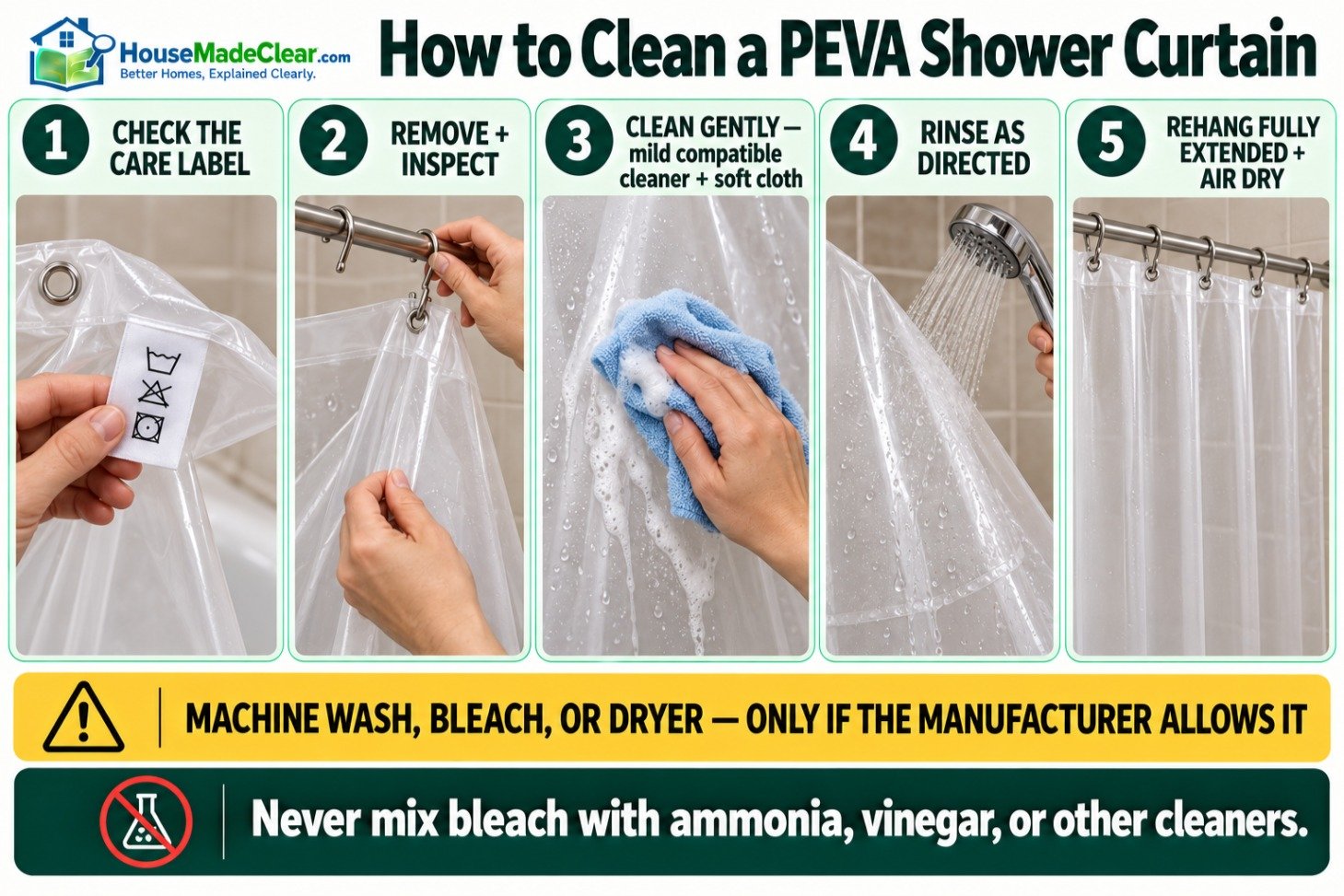
How to Clean a PEVA Shower Curtain
PEVA liners are generally easy to wipe clean, but always follow the care label.
A simple routine usually works best.
Step 1: Check the Label
Look for guidance covering:
- Hand washing
- Machine washing
- Water temperature
- Approved cleaners
- Drying instructions
Step 2: Remove the Curtain
Take it down carefully, especially if the plastic around the grommets is thin.
Step 3: Inspect for Buildup
Check the bottom edge, folds, and areas around magnets.
Common deposits include soap residue, body oils, and hard-water minerals.
Step 4: Clean Gently
If hand cleaning is permitted, use an appropriate mild cleaner and soft cloth or nonabrasive sponge.
Avoid sharp tools and aggressive scrubbing.
Step 5: Rinse as Directed
Remove cleaning-product residue according to the product instructions.
Step 6: Rehang and Dry
Allow the curtain to drain and dry in a fully extended position.
Avoid using high heat unless expressly permitted.
For detailed cleaning techniques covering PEVA, EVA, vinyl, polyester, and fabric materials, follow our complete shower curtain and liner cleaning guide.
Can You Machine Wash a PEVA Shower Curtain?
Some products may allow machine washing on a specified setting.
Others recommend hand cleaning only.
There is no universal machine-washing rule for every PEVA liner.
If the care label does not authorize machine washing, do not assume it is safe.
Can You Put PEVA in the Dryer?
Avoid machine drying unless the manufacturer explicitly permits it.
High heat can damage thin plastic films.
Air drying is generally the more cautious approach.
Can You Use Bleach on PEVA?
Only if the manufacturer approves its use.
Bleach is not the default cleaner for all PEVA products.
Never mix bleach with ammonia, vinegar, or other cleaning products.
For ordinary soap residue, gentle material-compatible cleaning may be sufficient.
Can PEVA Shower Curtains Get Moldy?
Yes.
Although PEVA is water-resistant, mold or other microbial growth can develop on accumulated dirt, soap residue, or damp deposits.
Mold prevention depends on controlling moisture, not just selecting a particular curtain material.
The EPA’s guidance on mold and moisture recommends keeping indoor relative humidity below 60%, ideally between 30% and 50% where practical.
Bathrooms may temporarily become more humid during showering, but that moisture should not remain trapped for prolonged periods.
Why Does Mold Develop on the Bottom Edge?
The bottom edge of a shower liner often:
- Collects soap runoff
- Remains wet longer
- Touches the tub surface
- Sits in folds
- Receives less airflow
This can create conditions favorable to buildup.
How Do You Prevent Mold on PEVA?
- Spread the curtain out after showering.
- Keep the liner inside the bathtub while showering.
- Run the bathroom exhaust fan.
- Avoid leaving the liner in standing water.
- Clean residue before it becomes heavy.
- Inspect the lower edge regularly.
- Correct persistent moisture problems.
If shower moisture remains elevated, our guide to bathroom humidity after a shower explains how ventilation and moisture recovery affect bathroom conditions.
Does PEVA Resist Mold Better Than Fabric?
The PEVA film itself does not absorb water in the same way many untreated fabrics do.
However, a PEVA liner can still collect residue and develop mold on contaminated surfaces.
It would be inaccurate to describe every PEVA product as completely mold-proof.
How Long Does a PEVA Shower Curtain Last?
There is no universally established lifespan for every PEVA shower curtain.
Longevity depends on:
- Film thickness
- Grommet quality
- Frequency of use
- Cleaning methods
- Heat exposure
- Handling
- Ventilation
- Product construction
A heavily used thin liner may deteriorate sooner than a well-made, properly maintained liner.
Signs You Should Replace a PEVA Curtain
Consider replacement when you notice:
- Tears around hooks
- Cracks or brittle areas
- Permanent deformation
- Damaged grommets
- Separation around magnets or weights
- Persistent contamination that cannot be cleaned appropriately
- Loss of the intended water-barrier function
Should You Replace PEVA Every Six Months?
Not automatically.
A fixed replacement schedule is less useful than evaluating the liner’s actual condition.
If it remains intact, clean, and functional, replacement may not be necessary.
If it has torn or deteriorated, replacing it sooner is sensible.
What Size PEVA Shower Curtain Should You Buy?
PEVA liners are available in common shower-curtain dimensions, including products intended for standard bathtubs, shower stalls, and taller enclosures.
Some common nominal retail dimensions include:
| Nominal Size | Common Application |
|---|---|
| 36 × 72 inches | Narrow shower stalls |
| 54 × 78 inches | Selected stall configurations |
| 70 × 72 inches | Standard-size shower curtain or liner |
| 72 × 72 inches | Common bathtub shower curtain |
| 72 × 78 inches | Longer shower applications |
| 72 × 84 inches | Extra-long applications |
These are retail size examples, not mandatory dimensions.
Measure the installation before choosing.
How Wide Should a PEVA Curtain Be?
It should cover the shower opening with enough overlap to help contain water.
An overly narrow liner may leave gaps near the wall.
An excessively wide liner may bunch up and dry slowly.
How Long Should It Be?
The length should allow the curtain to direct shower water into the tub or shower without creating unnecessary pooling.
The right length depends on the rod position, hanging hardware, and tub or shower configuration.
See our standard shower curtain measurements guide for selecting width and length.
How to Choose a Good PEVA Shower Curtain
Not every PEVA product offers the same construction or durability.
Use the following checklist before buying.
1. Verify the Material
Look for a clear PEVA or ethylene-vinyl acetate material declaration.
Avoid relying only on broad terms such as eco-friendly or green.
2. Check the Product Thickness
A thicker liner may offer more resistance to tearing, although thickness alone does not guarantee quality.
Look for clearly stated specifications.
3. Inspect Grommet Construction
Reinforced hanging holes may reduce tearing during use.
4. Look at the Bottom Hem
Some liners include weighted hems or magnets designed to help the curtain remain in position.
Check whether those components suit your tub.
5. Confirm Dimensions
Measure the shower opening and hanging height.
6. Check the Cleaning Instructions
Choose a liner you can maintain without excessive effort.
7. Evaluate Material Claims
If avoiding particular substances is important, request specific supporting information.
For example, a PVC-free claim is not identical to a phthalate-free claim, and neither is equivalent to proof that the product emits no volatile compounds.
8. Consider Durability and Replacement
A product that lasts longer may reduce the number of liners discarded over time.
9. Check Manufacturer Support
Prefer clear labeling, understandable care instructions, and accessible product information.
10. Match the Product to Your Bathroom
A small shower stall may require a narrower liner than a bathtub.
A taller shower enclosure may need a longer curtain.

Is PEVA the Best Material for a Shower Curtain?
There is no single material that is best for every household.
The right choice depends on what you want from the curtain.
| Your Main Priority | Material or Setup to Consider |
|---|---|
| Simple water barrier | PEVA or another shower-rated liner |
| PVC-free plastic liner | PEVA or suitable EVA product |
| Decorative textile appearance | Polyester, cotton, or linen curtain |
| Machine washability | Fabric product specifically labeled washable |
| Transparent appearance | Clear PEVA or another transparent liner |
| Easy wipe-down | Shower-rated plastic film liner |
| Natural-fiber decorative curtain | Cotton or linen, usually with a liner |
| Long-term durability | Compare construction, reinforcement, and warranty |
| Specific chemical avoidance | Product-specific material and testing information |
Instead of relying solely on broad marketing claims, evaluate the actual product and how it will be used.
Common PEVA Shower Curtain Buying Mistakes
Mistake 1: Assuming PEVA Is Not Plastic
PEVA is a synthetic polymer material.
Mistake 2: Treating PVC-Free as Completely Chemical-Free
A finished product may contain ingredients or components beyond the base polymer.
Mistake 3: Assuming PEVA and EVA Are Entirely Different Materials
They are closely related material designations.
Mistake 4: Assuming Every PEVA Curtain Is Odorless
Some products may have a noticeable new-product odor.
Mistake 5: Buying the Wrong Size
Even a waterproof curtain can allow water to escape if it is too short or too narrow.
Mistake 6: Leaving the Curtain Bunched Up
Wet folds can trap moisture and residue.
Mistake 7: Machine Washing Without Checking the Label
Some plastic liners require gentle hand cleaning.
Mistake 8: Using a Hot Dryer
Excessive heat may damage the film.
Mistake 9: Assuming PEVA Cannot Develop Mold
Surface residue and moisture can still support microbial growth.
Mistake 10: Ignoring Construction Quality
Weak grommets and thin film can shorten product life.
Mistake 11: Assuming All PVC Curtains Have Identical Formulations
Finished products vary.
Mistake 12: Calling a Product Eco-Friendly Without Supporting Evidence
Environmental claims should be specific and verifiable.
PEVA Shower Curtain Maintenance Checklist
| Task | Recommended Approach |
|---|---|
| After showering | Spread curtain to promote drying |
| During showering | Keep liner positioned to direct water inward |
| Cleaning | Follow care label |
| Routine surface care | Use gentle, compatible methods |
| Machine washing | Only if permitted |
| Dryer use | Only if specifically approved |
| Mold prevention | Improve drying and ventilation |
| Grommet inspection | Check for tearing |
| Bottom hem | Remove residue and check for damage |
| Material claims | Verify product-specific information |
| Replacement | Based on wear, damage, or persistent contamination |
| Recycling | Confirm local acceptance before disposal |
Final Thoughts
So, what is a PEVA shower curtain?
A PEVA shower curtain is a flexible plastic curtain or liner made from an ethylene-vinyl acetate-based material. It is commonly chosen as a PVC-free alternative to traditional vinyl shower liners.
Its main advantages are water resistance, lightweight construction, and relatively straightforward maintenance.
However, PEVA is still plastic, and a PVC-free label does not automatically establish that every product is free from all potentially concerning chemicals or environmental impacts.
If you’re choosing between PEVA, PVC, EVA, and fabric, focus on the actual material specifications, intended use, durability, cleaning instructions, and any credible product-specific testing.
For everyday bathroom use, a well-made PEVA liner can be a practical option, particularly when paired with a decorative fabric curtain.
Just remember that proper sizing, cleaning, and ventilation matter as much as the material itself.
A shower curtain that contains water effectively, dries between uses, and remains in good condition will generally serve the bathroom better than one chosen on marketing claims alone.
Frequently Asked Questions
What is a PEVA shower curtain?
A PEVA shower curtain is a flexible plastic curtain made from an ethylene-vinyl acetate-based material. It is commonly used as a water-resistant shower barrier and marketed as a PVC-free alternative to traditional vinyl liners.
What does PEVA stand for?
PEVA commonly stands for polyethylene-vinyl acetate. The material belongs to the ethylene-vinyl acetate copolymer family and is used in flexible plastic films, including shower-curtain liners.
Is a PEVA shower curtain safe?
PEVA is a PVC-free polymer material, but the material name alone cannot establish the safety of every finished product. Additives, manufacturing processes, product testing, and intended use should also be considered.
Is PEVA shower curtain material non-toxic?
Some products are marketed as non-toxic, but the term is not a substitute for specific chemical information or independent testing. Look for verifiable product claims rather than assuming every PEVA curtain has identical composition.
Is PEVA better than PVC for shower curtains?
PEVA avoids the chlorine-containing polymer structure of PVC and is often chosen as a PVC-free alternative. However, complete safety, durability, and environmental comparisons depend on the actual products and their formulations.
Is PEVA the same as EVA?
PEVA and EVA are closely related names associated with ethylene-vinyl acetate copolymer materials. Retail products may differ in composition, thickness, additives, and manufacturing even when their material labels are similar.
Does PEVA contain chlorine?
The ethylene-vinyl acetate copolymer itself does not contain chlorine in its chemical structure. However, a finished product may contain other components, so product-specific information matters.
Is PEVA waterproof?
PEVA film is generally water-resistant and is commonly used as a shower-water barrier. Actual performance depends on the construction, condition, dimensions, and installation of the finished curtain.
Do you need a shower curtain liner with PEVA?
Not always. A PEVA curtain designed for direct shower-water exposure can often serve as the water barrier without another liner. Check the product’s specifications and ensure it is positioned correctly.
Can you machine wash a PEVA shower curtain?
Only if the manufacturer permits it. Some PEVA liners may be machine washable, while others require gentle hand cleaning. Always check the care label.
Can you put a PEVA shower curtain in the dryer?
Avoid machine drying unless the manufacturer specifically allows it. Excessive heat can damage thin plastic film, so air drying is generally the more cautious option.
Do PEVA shower curtains smell?
Some PEVA curtains may have a noticeable odor when first unpacked, while others have little detectable smell. Odor varies by product and does not reliably establish its chemical composition or safety.
Can mold grow on a PEVA shower curtain?
Yes. Although PEVA resists water penetration, mold may develop on accumulated dirt or damp surface residue. Regular cleaning and allowing the curtain to dry can help prevent buildup.
Are PEVA shower curtains environmentally friendly?
PEVA is PVC-free but remains a synthetic plastic. Its overall environmental impact depends on production, additives, durability, and disposal. PVC-free alone does not prove that a curtain is environmentally superior in every respect.
Are PEVA shower curtains recyclable?
Recycling availability depends on the specific material and local program. Many curbside recycling services do not accept flexible plastic shower-curtain liners, so check local guidelines before recycling.
How long does a PEVA shower curtain last?
There is no universal lifespan. Durability depends on material thickness, construction, use, maintenance, and handling. Replace the curtain if it tears, becomes brittle, loses water resistance, or cannot be cleaned adequately.








[…] What Is a PEVA Shower Curtain? Material, Safety, and PVC Differences […]