














A hot shower can push bathroom humidity up very quickly.
For a short period, that is normal. The problem starts when the bathroom stays damp for a long time after the shower ends, with fogged mirrors, wet walls, condensation on windows or a persistent musty smell.
The goal is not to prevent bathroom humidity from rising at all. A shower will naturally add a large amount of water vapor to the air.
The more useful question is:
How quickly does the bathroom return to a normal indoor humidity level after the shower?
Quick Answer
After a shower, bathroom humidity should gradually return toward normal indoor levels rather than remain very high for hours.
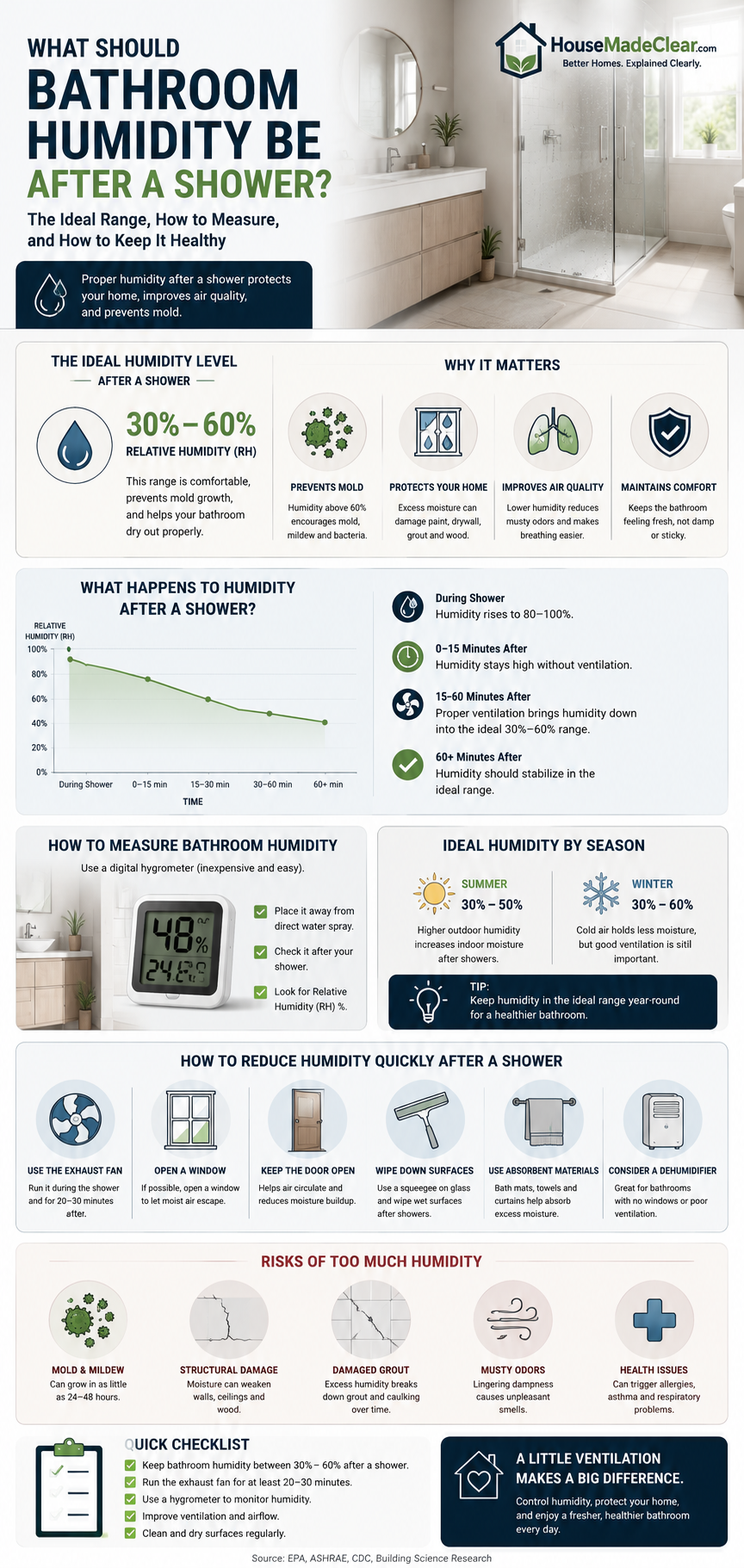
The U.S. Environmental Protection Agency recommends keeping indoor relative humidity below 60% and ideally between 30% and 50% when possible.
It is normal for the bathroom to temporarily rise above that range while someone is showering. What matters is that ventilation removes the excess moisture afterward.
If your bathroom remains around 60% relative humidity or higher for long periods, or surfaces stay visibly wet, investigate ventilation, exhaust-fan performance, air movement and possible moisture problems.
If your main question is how long the exhaust fan should continue running once the shower is finished, House Made Clear’s guide to how long to run a bathroom fan after a shower covers that in more detail.
What Is Relative Humidity?
Relative humidity, usually written as RH, describes how much water vapor is present in the air relative to the maximum amount the air could hold at that temperature.
It is expressed as a percentage.
For example:
- 40% RH
- 50% RH
- 70% RH
A reading of 70% does not mean that 70% of the bathroom is water.
It means the air contains a relatively high amount of moisture compared with what it could hold at that temperature.
Temperature matters because warmer air can contain more water vapor than cooler air.
That is one reason bathroom humidity readings can change as:
- Shower heats the room
- Steam spreads
- Surfaces cool
- Ventilation begins removing moist air
What Is a Good Humidity Level for a Bathroom?
For the home generally, the EPA recommends indoor relative humidity below 60%, with 30–50% considered ideal where possible.
A bathroom is different from a bedroom or living room because it experiences short bursts of extremely high moisture.
During a hot shower, humidity can temporarily rise well above the preferred household range.
That does not automatically mean there is a moisture problem.
The important distinction is between:
Temporary shower humidity
and
Persistently high bathroom humidity
A Healthy Pattern Might Look Like This
Before shower:
40–50% RH
During shower:
Humidity rises significantly.
Immediately after:
Still elevated.
Following ventilation:
Humidity steadily declines toward the rest of the home’s normal level.
A Problematic Pattern Might Look Like This
Before shower:
Already around 65–70%.
During shower:
Humidity rises very high.
One or two hours later:
Still above 60–70%.
Walls remain damp.
Mirror remains wet.
Musty odor develops.
That suggests the bathroom is not drying efficiently.
Is 60% Humidity Too High for a Bathroom?
During or immediately after a shower, a reading above 60% can be expected.
But 60% should not become the bathroom’s normal long-term condition.
EPA guidance says indoor humidity should remain below 60% when possible, ideally around 30–50%. Persistent humidity above that level can support conditions favorable to mold and other moisture-related problems.
Think of 60% less as an instant emergency threshold and more as a useful warning line.
If the room briefly reaches:
70%, 80% or even higher during a shower
but then dries efficiently, that is very different from a bathroom that stays at:
65–75% all day.
Is 70% Humidity Normal After a Shower?
Immediately after a hot shower, it can be.
Showering adds a large amount of moisture to the air, and the EPA specifically identifies showering as one of the activities that can raise indoor humidity.
The question is how long the 70% reading remains.
If your hygrometer shows:
- 70% immediately after showering
- 60% shortly afterward
- Around 50% later
the ventilation system may be doing its job.
If it stays around:
70% for hours
that deserves attention.
Is 80% Bathroom Humidity Too High?
During a steamy shower, an 80% reading is possible.
However, prolonged humidity around that level is not desirable.
At very high humidity:
- Condensation becomes more likely
- Towels dry slowly
- Grout remains damp
- Walls stay wet
- Mold-friendly conditions can persist
Again, the duration is critical.
A temporary spike is not the same as persistent moisture.
Should Bathroom Humidity Return to 50% After a Shower?
Not necessarily exactly 50%.
The appropriate baseline depends on:
- Climate
- Season
- HVAC operation
- Outdoor humidity
- Rest of home
- Bathroom ventilation
If the rest of the home sits around:
45% RH
you would expect the bathroom eventually to move back toward that range.
If your home’s normal indoor humidity is:
55%
then the bathroom may stabilize closer to 55%.
The goal is not to force every bathroom to exactly 50%.
The better target is:
Return toward the home’s normal humidity and remain below 60% where possible.
How Long Should Bathroom Humidity Stay High After a Shower?
There is no universal minute-by-minute rule because bathrooms vary significantly.
Factors include:
- Shower duration
- Water temperature
- Bathroom volume
- Exhaust-fan capacity
- Duct length
- Outdoor humidity
- HVAC operation
- Window availability
- Door position
However, humidity should generally be falling steadily after the shower ends.
If your bathroom remains obviously steamy and surfaces are still wet long after the shower, the moisture-removal system may need improvement.
Use the Trend, Not Just One Humidity Reading
A single reading tells you less than several readings over time.
For example:
| Time | Bathroom RH |
|---|---|
| Before shower | 45% |
| End of shower | 82% |
| 15 minutes later | 68% |
| 30 minutes later | 57% |
| 45 minutes later | 50% |
That pattern shows the room recovering.
Now compare it with:
| Time | Bathroom RH |
|---|---|
| Before shower | 58% |
| End of shower | 88% |
| 15 minutes later | 82% |
| 30 minutes later | 78% |
| 60 minutes later | 72% |
| 2 hours later | 67% |
The second bathroom is drying much more slowly.
The exact numbers will differ between homes, but the trend is the useful information.
How to Measure Bathroom Humidity
The easiest tool is a small digital hygrometer.
The EPA specifically recommends using a moisture or humidity gauge to determine whether indoor humidity is within a good range.
Many inexpensive digital models display:
- Relative humidity
- Temperature
- High/low readings
Some smart sensors can also record humidity over time.
That can be especially useful because you can see exactly how quickly humidity falls after each shower.
Where Should You Put a Hygrometer in a Bathroom?
Avoid putting the sensor:
- Directly inside shower
- Beside shower spray
- Immediately over sink
- Directly in exhaust-fan airflow
Instead, place it somewhere representative of the room.
For example:
- Shelf
- Counter away from sink
- Wall away from shower spray
You want to measure the bathroom air, not water hitting the sensor directly.
Also follow the device manufacturer’s placement instructions.
Why Does Bathroom Humidity Rise So Much During a Shower?
Hot water evaporates and adds moisture to the surrounding air.
That warm moist air spreads through the bathroom.
When it touches cooler surfaces such as:
- Mirror
- Window
- Exterior wall
- Metal fixture
the water vapor may condense.
EPA guidance explains that condensation forms when humid air comes into contact with a cooler surface.
That is why a bathroom mirror fogs even when there is no water physically sprayed onto it.
Why Does the Bathroom Mirror Fog?
The mirror is often cooler than the warm humid bathroom air.
When the moist air contacts the cooler glass, water vapor condenses into tiny droplets.
Those droplets create the familiar fogged appearance.
A fogged mirror immediately after a hot shower is common.
A mirror that remains wet for a long time can indicate slower moisture removal.
For more troubleshooting, see House Made Clear’s guide to how to stop a bathroom mirror from fogging after a shower.
Why Bathroom Humidity Matters
High humidity is not simply an inconvenience.
Persistent moisture can affect:
- Paint
- Drywall
- Grout
- Caulk
- Wood
- Cabinets
- Window frames
- Towels
It can also create conditions that support mold growth.
The EPA emphasizes that moisture control is the key to controlling indoor mold and recommends keeping indoor humidity below 60% where possible.
Does High Bathroom Humidity Cause Mold?
High humidity can contribute to conditions in which mold can grow.
The EPA explains that mold spores can begin growing when they land on damp indoor surfaces and that controlling moisture is the main way to control mold.
Bathroom areas that commonly stay damp include:
- Shower grout
- Ceiling
- Window trim
- Caulk
- Corners
- Behind toiletries
The issue is not merely humid air.
It is what that humid air does to surfaces over time.
How Long Does Mold Need Moisture?
EPA guidance recommends drying damp or wet materials within approximately 24–48 hours because prolonged moisture can support mold growth.
That does not mean one humid shower will suddenly cause mold.
The concern is repeated or continuous dampness.
For example:
Bathroom gets wet every morning
↓
Never fully dries
↓
Next shower adds more moisture
↓
Surfaces remain chronically damp
That pattern deserves correction.
Signs Your Bathroom Stays Too Humid
Watch for:
- Mirror stays foggy for a long time
- Water runs down walls
- Ceiling remains damp
- Window constantly condenses
- Towels stay wet for hours
- Grout stays dark
- Musty smell
- Paint peels
- Caulk develops dark spots
- Cabinet surfaces swell
- Hygrometer stays above 60%
One sign by itself does not prove a serious moisture issue, but multiple signs strongly suggest that the room needs better drying.
Why Does My Bathroom Stay Humid for Hours?
There are several common causes.
Weak Exhaust Fan
The fan may move too little air for the bathroom.
Fan Is Not Actually Exhausting Properly
A fan can make noise without moving much air.
Problems may include:
- Dust buildup
- Blocked duct
- Long duct run
- Excess bends
- Damaged damper
Fan Is Turned Off Too Soon
Stopping ventilation immediately after the shower leaves moisture behind.
Bathroom Door Stays Closed
The fan needs replacement air from somewhere.
A very tight bathroom may have poor airflow if there is little gap beneath the door or another supply path.
Outdoor Humidity Is High
Opening the window may not help if outdoor air is already extremely humid.
Shower Is Very Long or Hot
More steam means more moisture to remove.
Bathroom Is Windowless
A windowless bathroom depends heavily on mechanical exhaust.
Whole-Home Humidity Is Already High
If the entire house sits near 65%, the bathroom has nowhere near 40–50% to recover to.
Run the Bathroom Exhaust Fan During the Shower
The fan works best when it begins removing moisture while the moisture is being generated.
EPA guidance recommends using bathroom exhaust fans while showering, and its mold guidance emphasizes venting moisture-generating areas.
A practical routine is:
- Turn fan on before or when shower starts.
- Leave it running throughout shower.
- Continue running after shower.
- Turn it off once humidity and surfaces have largely recovered.
How Long Should the Bathroom Fan Run After a Shower?
Around 20 minutes after showering is commonly used as a practical starting point, but the correct time depends on how quickly your bathroom actually dries.
A humidity sensor provides a better answer than a timer alone.
For example:
If bathroom returns close to baseline after 15 minutes, extra runtime may not be necessary.
If it remains above 65% after 30 minutes, the issue may be:
- Fan capacity
- Ducting
- Air supply
- Shower moisture load
Rather than simply leaving the fan on indefinitely, investigate why moisture removal is slow.
For the full troubleshooting process, see How Long Should You Run a Bathroom Fan After a Shower?.
Should You Leave the Bathroom Door Open After a Shower?
Often, opening the bathroom door can help redistribute moist air into the rest of the home—provided the rest of the home’s humidity is lower.
However, the exhaust fan should still do the primary moisture-removal work where one is installed.
Opening the door may be helpful when:
- Shower is finished
- Rest of home is dry
- Fan is continuing to run
But if the entire home is already humid, simply opening the door may spread moisture rather than solve the underlying issue.
Should the Bathroom Door Be Open or Closed While the Fan Runs?
The fan needs replacement air.
If the bathroom is very airtight, insufficient makeup air can reduce exhaust performance.
Many bathrooms receive replacement air through the gap beneath the door.
If the fan seems weak:
- Test with door closed
- Test with door slightly open
- Compare airflow and humidity drop
If performance improves dramatically with the door open, the room may need better air transfer.
Do not modify doors or ventilation systems without considering applicable building requirements.
Should You Open a Bathroom Window After a Shower?
It depends on outdoor conditions.
EPA guidance notes that opening windows can help lower indoor humidity when outdoor air is not humid.
Opening a window may help in:
- Cool dry weather
- Mild dry climate
It may be less useful in:
- Hot humid summer
- Rainy weather
- Coastal humidity
If outdoor relative humidity is extremely high, opening the window may introduce additional moisture.
Bathroom Fan vs Open Window
When available, mechanical exhaust is often more predictable.
| Method | Advantage | Limitation |
|---|---|---|
| Exhaust fan | Directly removes bathroom air | Depends on fan/duct performance |
| Open window | Simple natural ventilation | Weather dependent |
| Open door | Improves air exchange | Can spread humidity |
| Dehumidifier | Actively removes moisture | Requires correct placement/use |
The best approach may combine several methods.
Should You Use a Dehumidifier in a Bathroom?
A dehumidifier can help when humidity remains high despite reasonable ventilation.
The EPA includes dehumidifiers among the tools that can help control indoor humidity.
However, bathrooms contain water and electrical equipment requires special caution.
Never assume that a portable dehumidifier can be placed beside the shower or bathtub.
Use it only according to:
- Manufacturer instructions
- Electrical safety requirements
- Location suitability
In many layouts, placing the unit outside the bathroom doorway may provide a safer and more practical location while still helping dry the adjacent bathroom air.
See House Made Clear’s guide to where to put a dehumidifier in a bathroom for detailed placement considerations.
Exhaust Fan or Dehumidifier: Which Should You Use First?
For shower-generated moisture, the exhaust fan is usually the first-line solution.
Why?
It removes humid air from the room while the shower is generating it.
A dehumidifier removes moisture from air after that moisture is already inside the indoor space.
A practical order is:
1. Proper exhaust ventilation
2. Air movement
3. Control whole-home humidity
4. Add dehumidification if needed
Do not use a dehumidifier to compensate permanently for a badly functioning bathroom exhaust system.
How Do You Know Whether the Bathroom Fan Is Working?
A fan can sound loud without moving much air.
Basic signs of useful airflow include:
- Steam clears progressively
- Humidity falls after shower
- Mirror clears
- Surfaces dry
If these do not happen, inspect:
- Grille
- Dust buildup
- Duct
- Exterior vent
- Backdraft damper
A professional may need to measure actual airflow if performance is unclear.
Bathroom Fan Size Matters
An undersized exhaust fan may struggle to remove moisture from:
- Large bathroom
- High ceiling
- Steam shower
- Long showers
Fan performance is generally rated in CFM, or cubic feet per minute.
The appropriate capacity depends on the bathroom and installation.
A larger fan is not automatically better because:
- Duct sizing matters
- Noise matters
- Makeup air matters
The entire ventilation system needs to work together.
Ducting Can Reduce Fan Performance
Even a good fan can perform poorly if the exhaust duct has:
- Too many bends
- Long run
- Incorrect diameter
- Blockage
- Crushed flexible duct
The fan must ultimately move bathroom air outside.
If steam seems to stay in the room despite a reasonably powerful fan, the duct path is worth checking.
Bathroom Exhaust Should Go Outdoors
Moist bathroom air should not simply be dumped into an enclosed attic or wall cavity.
Doing so transfers the moisture problem somewhere else.
The exhaust system should terminate outdoors according to applicable building requirements and manufacturer’s installation guidance.
Does Air Conditioning Reduce Bathroom Humidity?
Air conditioning can remove moisture from indoor air as it cools the home.
EPA guidance specifically lists air conditioning as one method that can help reduce indoor humidity.
However, the bathroom exhaust fan still serves a different role.
The fan captures a high-moisture event at its source.
The HVAC system manages overall indoor conditions.
Both can matter.
What If the Whole House Is Humid?
Suppose:
Living room = 65%
Bedroom = 66%
Bathroom before shower = 67%
Then the problem is not limited to the bathroom.
Possible contributors include:
- Humid climate
- HVAC performance
- Air leaks
- Basement/crawlspace moisture
- Oversized cooling system
- Poor whole-home ventilation
A portable bathroom solution may not solve a whole-house humidity problem.
Measure humidity in several rooms before assuming the bathroom is the only source.
Bathroom Humidity in Summer
Summer can be challenging because outdoor air may already contain significant moisture.
If outside air is hot and humid:
- Opening window may not help
- AC becomes more important
- Exhaust fan still removes shower moisture
- Whole-home dehumidification may matter
In humid climates, focus on controlled mechanical ventilation rather than assuming outside air is always drier.
Bathroom Humidity in Winter
Winter often produces a different problem.
Indoor air may be relatively dry overall, but hot shower air can still condense heavily on cold surfaces.
You may see condensation on:
- Windows
- Exterior walls
- Metal fixtures
This does not necessarily mean the entire home is too humid.
Cold surfaces can create local condensation even when average room humidity is moderate.
Why Windows Condense After a Shower
Windows are often among the coldest bathroom surfaces.
Warm humid air reaches the cold glass.
The air near the glass cools.
Water vapor condenses.
This can cause:
- Fog
- Droplets
- Water on sill
Persistent window condensation deserves attention because repeated wetting can affect:
- Paint
- Wood trim
- Caulk
EPA guidance recommends responding promptly when condensation or moisture collects on windows or walls.
Why Bathroom Walls Feel Wet
Very high humidity may cause condensation directly on walls, particularly:
- Exterior walls
- Painted ceilings
- Tile
- Corners
This is more likely when the surfaces are cool.
Water running down a wall after every shower suggests the room is receiving more moisture than the ventilation system can quickly remove.
Why the Bathroom Ceiling Gets Mold Spots
Ceilings can remain damp because warm humid air rises.
Potential contributing factors include:
- Weak exhaust
- Fan positioned poorly
- Cold ceiling
- Repeated condensation
If mold is visible, address both:
- The mold itself
- The moisture source
The EPA emphasizes that cleaning mold without correcting the underlying moisture problem will not provide a lasting solution.
Why Towels Take So Long to Dry
Towel drying depends on evaporation.
If the bathroom air is already humid, water evaporates more slowly.
That is why towels can remain damp in a poorly ventilated bathroom.
Helpful measures include:
- Spread towels instead of bunching them
- Improve airflow
- Run exhaust fan
- Move wet towels to a drier location when necessary
Persistent damp towels can be another clue that the room is not drying efficiently.
Windowless Bathroom Humidity
A windowless bathroom relies heavily on mechanical ventilation.
The exhaust fan becomes especially important because there is no option for direct natural ventilation.
For a windowless bathroom:
- Run fan while showering
- Continue afterward
- Monitor RH
- Keep fan and grille clean
- Verify exhaust duct works properly
If humidity remains high, the fan system may need evaluation.
Small Bathroom Humidity
Small bathrooms can humidify very quickly.
The room has less air volume, so one shower can create an intense moisture spike.
But a properly ventilated small bathroom may also dry relatively quickly.
A compact room that stays wet for hours should not simply be dismissed because it is small.
Large Bathroom Humidity
Large bathrooms contain more air volume.
They may also contain:
- Large shower
- Tub
- Multiple sinks
- Higher ceilings
That can change ventilation requirements.
One small exhaust fan located far from the shower may not capture moisture efficiently.
Apartment Bathroom Humidity
Apartments can be difficult because the occupant may have limited control over:
- Fan size
- Ducting
- Exterior vent
- HVAC
If you rent and notice persistent moisture, mold or water damage, notify the landlord or property manager.
The EPA specifically advises renters to inform their landlord promptly about indoor air-quality or water concerns.
Documenting:
- Humidity readings
- Photos
- Fan operation
can make the problem easier to explain.
How to Lower Bathroom Humidity Faster
1. Run the Fan Before or During Showering
Do not wait until the room is already saturated.
2. Keep Fan Running Afterward
Allow time for remaining moisture to leave.
3. Reduce Shower Duration
A shorter shower generally adds less moisture.
4. Lower Shower Temperature Slightly
Extremely hot showers generate more steam.
5. Squeegee Shower Walls
Removing liquid water reduces the amount available to evaporate later.
6. Spread Out Towels
Do not leave wet towels in a pile.
7. Open Door Afterward
Where appropriate, this can improve air exchange.
8. Open Window When Outdoor Air Is Dry
Weather matters.
9. Use a Dehumidifier if Necessary
Especially when the whole home is humid.
10. Fix Ventilation Problems
Do not rely on workarounds if the exhaust system itself is defective.
Does Squeegeeing the Shower Really Help Humidity?
It can.
After a shower, a large amount of water remains on:
- Glass
- Tile
- Walls
Some of that water will evaporate back into the bathroom air.
Using a squeegee sends more water toward the drain instead.
It will not replace ventilation, but it can reduce the moisture load that remains after the shower.
Should You Wipe Down Bathroom Walls?
If significant condensation regularly forms on walls, wiping them can help dry the surfaces faster.
But if you need to wipe the entire room after every shower, treat that as a symptom.
The better long-term question is:
Why is so much condensation forming?
Possible answer:
- Ventilation inadequate
- Surface unusually cold
- Shower moisture excessive
Can Plants Reduce Bathroom Humidity?
Do not rely on houseplants as a humidity-control system.
Plants can themselves release moisture through transpiration.
They may tolerate humid environments, but they are not a substitute for:
- Exhaust fan
- HVAC
- Dehumidifier
Use plants for décor, not bathroom moisture management.
Can an Air Purifier Reduce Bathroom Humidity?
Usually not.
A standard air purifier filters particles from the air.
It does not remove significant water vapor.
If your problem is high relative humidity, you need:
- Ventilation
- Air conditioning
- Dehumidification
rather than ordinary particulate filtration.
Can a Ceiling Fan Lower Bathroom Humidity?
A ceiling or circulation fan can move air but does not actually remove water vapor from the home.
Air movement may help surfaces dry faster, but moisture still needs somewhere to go.
That usually means:
- Exhaust outdoors
- Dehumidification
- HVAC moisture removal
Air circulation and moisture removal are different functions.
Common Bathroom Humidity Mistakes
1. Turning the Exhaust Fan On Only After Showering
Problem:
Moisture accumulates during the entire shower.
Better approach:
Run it while moisture is being generated.
2. Turning the Fan Off Immediately
Problem:
Residual moisture remains.
Better approach:
Continue ventilation after showering.
3. Assuming a Noisy Fan Is a Powerful Fan
Problem:
Sound does not prove airflow.
Better approach:
Judge actual humidity recovery and ventilation performance.
4. Opening the Window During Very Humid Weather
Problem:
Outdoor air may add moisture.
Better approach:
Check weather conditions.
5. Keeping Wet Towels Bunched Up
Problem:
They dry slowly and continue adding moisture.
Better approach:
Spread them out.
6. Putting a Dehumidifier Too Close to Water
Problem:
Electrical safety risk.
Better approach:
Follow manufacturer placement instructions carefully.
7. Ignoring Persistent Window Condensation
Problem:
Repeated water exposure can damage finishes.
Better approach:
Improve moisture control.
8. Cleaning Mold Without Fixing Humidity
Problem:
Mold may return.
Better approach:
Address both mold and moisture source.
9. Ignoring the Rest of the Home
Problem:
The entire house may be humid.
Better approach:
Measure several rooms.
10. Relying on Guesswork
Problem:
The bathroom may feel humid without knowing how long it remains elevated.
Better approach:
Use a hygrometer.
Step-by-Step Bathroom Humidity Test
This is a simple way to assess whether your bathroom is drying properly.
Step 1: Measure Before Showering
Record humidity.
Example:
46% RH
Step 2: Shower Normally
Do not deliberately change your routine.
Step 3: Record Immediately After
Example:
82% RH
Step 4: Leave Fan Running
Use your normal fan routine.
Step 5: Record Every 15 Minutes
Example:
15 min = 69%
30 min = 58%
45 min = 51%
Step 6: Compare With Baseline
Did the bathroom return close to its original level?
Step 7: Repeat
Test on several days.
One reading may be affected by weather or shower length.
Step 8: Compare Other Rooms
Measure bedroom or hallway humidity.
This helps determine whether the issue is bathroom-specific or whole-house.
Quick Bathroom Humidity Guide
| Situation | What It Usually Means |
|---|---|
| 30–50% before shower | Typical preferred indoor range |
| Above 60% during shower | Can be normal temporarily |
| 70–80% immediately after | Possible after hot shower |
| Humidity steadily falling | Good sign |
| Above 60% for hours | Investigate moisture control |
| Visible condensation long afterward | Ventilation may be inadequate |
| Whole home above 60% | Broader humidity issue |
| Musty smell/mold | Moisture problem needs attention |
These are practical interpretation ranges, not a diagnostic standard for every home.
Quick Answer: What Should Bathroom Humidity Be After a Shower?
Immediately after the shower:
Humidity may temporarily be well above 60%.During the drying period:
It should steadily decline.Once the bathroom has recovered:
Aim for below 60% RH, ideally moving back toward the home’s normal 30–50% indoor range where conditions allow.If it stays above 60% for hours:
Check the exhaust fan, ducting, air movement and whole-home humidity.
Bathroom Humidity Checklist
After showering, check whether:
- Exhaust fan was running
- Fan continues afterward
- Humidity is falling
- Mirror clears
- Walls are drying
- Ceiling is not dripping
- Window condensation clears
- Towels can dry
- No musty smell develops
- Grout dries
- Caulk does not stay wet
- Fan grille is clean
- Exhaust actually reaches outdoors
- Bathroom has replacement airflow
- Whole-home humidity is below 60%
- Dehumidifier is considered only when needed
When Should You Investigate Further?
Consider closer inspection if:
- Bathroom regularly stays above 60% for several hours
- Walls drip after ordinary showers
- Mold repeatedly returns
- Paint peels
- Ceiling stains appear
- Window trim remains wet
- Fan barely moves air
- Bathroom smells musty
- Humidity is high even before showering
You may need:
- Fan cleaning
- Duct inspection
- Larger or better-designed exhaust system
- HVAC evaluation
- Dehumidification
- Leak inspection
Persistent moisture should not automatically be blamed on the shower.
A plumbing or building-envelope problem may also be involved.
Final Thoughts
Bathroom humidity rising during a shower is normal.
Bathroom humidity remaining high for hours afterward is not something to ignore.
The EPA recommends keeping indoor relative humidity:
Below 60% and ideally around 30–50% where possible.
You do not need to panic if your bathroom briefly reaches 70% or 80% immediately after a hot shower.
Instead, watch what happens next.
A well-functioning bathroom should show a clear recovery pattern:
Humidity rises → shower ends → ventilation continues → humidity falls → surfaces dry.
If the bathroom is not following that pattern, start with the exhaust system.
Run it during the shower and continue afterward.
Then check:
- Fan airflow
- Ducting
- Door airflow
- Outdoor conditions
- Whole-home humidity
For related troubleshooting, continue with House Made Clear’s guides to how long to run a bathroom fan after a shower, how to stop a bathroom mirror from fogging and where to put a dehumidifier in a bathroom.
Together, those articles cover the three practical parts of bathroom moisture control:
Measure it → ventilate it → remove excess moisture when necessary.
Frequently Asked Questions
What should bathroom humidity be after a shower?
After the bathroom has had time to ventilate and dry, relative humidity should ideally return toward the home’s normal indoor level. The EPA recommends keeping indoor humidity below 60% and ideally between 30% and 50% where possible.
Is 70% humidity normal in a bathroom after a shower?
It can be normal immediately after a hot shower. The more important question is how quickly it falls. If the bathroom remains around 70% humidity for hours, ventilation or whole-home humidity may need attention.
Is 80% humidity too high after a shower?
A temporary reading around 80% can occur during or immediately after a steamy shower. It becomes more concerning if that level persists and surfaces remain damp for a long time.
How long should bathroom humidity stay high after a shower?
There is no universal time because bathroom size, shower duration, exhaust-fan performance and climate vary. However, humidity should steadily fall after showering rather than remaining very high for hours.
Is 60% humidity too high for a bathroom?
A short-term reading above 60% during showering is common. For long-term indoor conditions, the EPA recommends humidity below 60%, ideally around 30–50% where possible.
How do I lower bathroom humidity after a shower?
Run the exhaust fan during and after showering, improve airflow, spread wet towels, squeegee wet shower surfaces and open a window when outdoor air is dry. A dehumidifier may help if humidity remains high.
Should I leave the bathroom fan on after a shower?
Yes. Continuing to run the exhaust fan after the shower helps remove residual moisture. The required time depends on how quickly the room returns toward its normal humidity level.
Should I open the bathroom door after a shower?
Opening the door can improve air exchange if the rest of the home is drier. However, it should complement rather than replace a properly functioning exhaust fan.
Why does my bathroom stay humid for hours after showering?
Possible causes include a weak exhaust fan, blocked or inefficient ducting, insufficient replacement air, very humid outdoor conditions or high humidity throughout the home.
Can a dehumidifier help with bathroom humidity?
Yes. A dehumidifier can help lower indoor humidity when ventilation alone is not enough, but it should be positioned and operated according to the manufacturer’s electrical-safety instructions.