















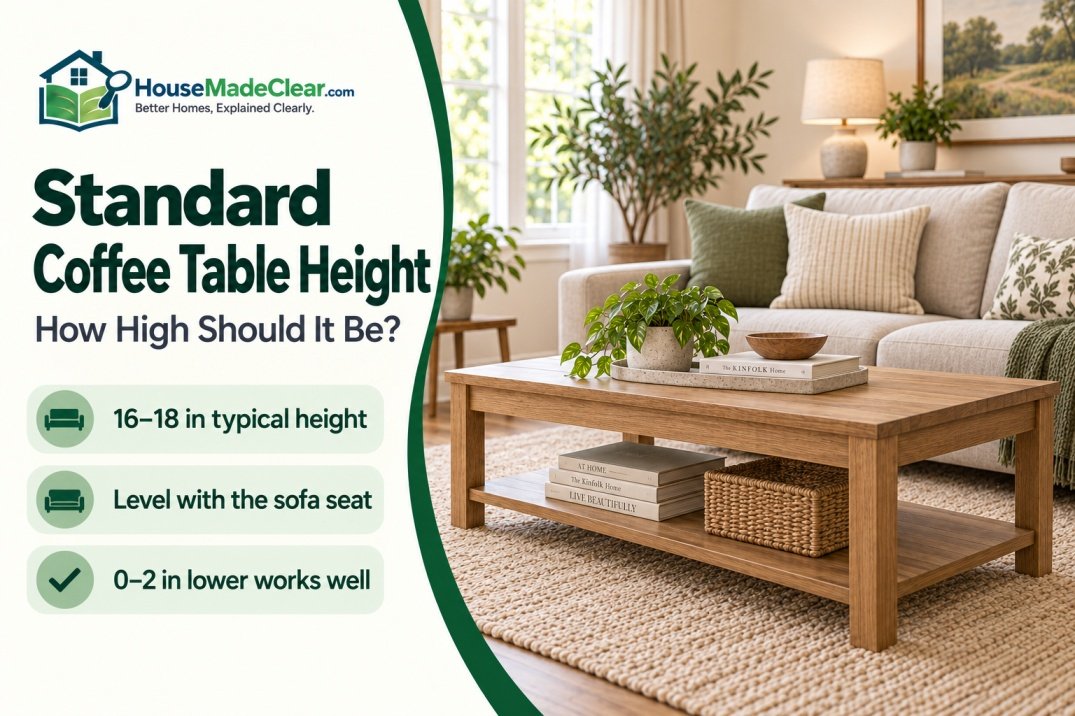
The standard coffee table height is approximately 16 to 18 inches, but the sofa’s seat height is a more reliable reference than the average measurement. In most living rooms, the coffee table should be approximately level with the sofa seat or up to 1 or 2 inches lower.
A 16-inch table can work perfectly with an 18-inch sofa seat but feel too tall beside a low-profile sofa with a 14-inch seat. Similarly, an 18-inch table may be too low for a sofa with a 21-inch seat or for someone who regularly uses the table for eating.
The correct height depends on the seating, the table’s purpose, the users’ mobility, and whether the tabletop moves or lifts during use.
Quick Answer
For most living rooms:
- Standard coffee table height: 16 to 18 inches
- Common broader range: approximately 14 to 20 inches
- Best height compared with sofa: level with the seat or 1 to 2 inches lower
- Example: pair an 18-inch sofa seat with a 16- to 18-inch coffee table
- Low-profile table: commonly below 14 to 15 inches
- Tall coffee table: commonly 20 inches or higher
- Lift-top table: measure both its closed height and raised working height
These are furniture-planning guidelines, not building-code requirements. Measure the actual sofa and table because product labels such as “standard,” “low,” and “counter height” are not consistently defined.
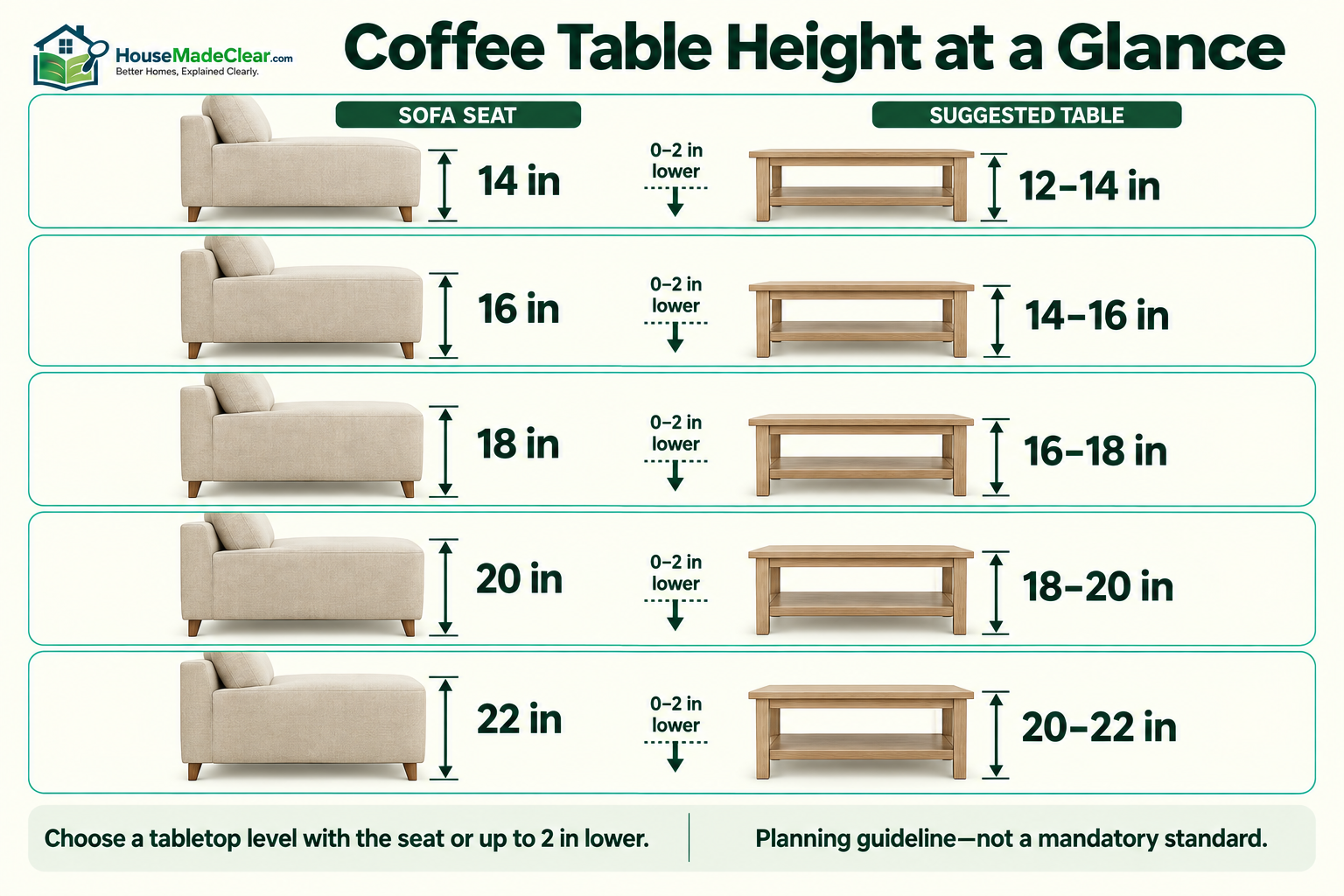
Standard Coffee Table Height at a Glance
| Sofa Seat Height | Suggested Coffee Table Height |
|---|---|
| 14 inches | 12–14 inches |
| 15 inches | 13–15 inches |
| 16 inches | 14–16 inches |
| 17 inches | 15–17 inches |
| 18 inches | 16–18 inches |
| 19 inches | 17–19 inches |
| 20 inches | 18–20 inches |
| 21 inches | 19–21 inches |
| 22 inches | 20–22 inches |
The suggested range follows a simple guideline: choose a tabletop that is level with the sofa seat or up to 2 inches lower.
A table slightly outside this range may still work, particularly when it has a lift top or serves a specialized purpose. The greater the difference, however, the more important it becomes to test reach, legroom, and appearance before buying.
Is There an Official Standard Coffee Table Height?
There is no single regulated height that applies to every residential coffee table. Unlike countertops, desks, and certain accessible work surfaces, coffee tables are produced in many styles and are not governed by one universal residential height.
The phrase “standard coffee table height” describes a common retail range rather than a legal standard.
Most conventional coffee tables are approximately:
- 16 to 18 inches high
- Close to the height of a typical sofa seat
- Lower than dining, console, and end tables
- Designed primarily for use from lounge seating
Retailers sometimes group coffee tables into low, standard, and tall categories, but those categories are inconsistent. A 20-inch table may be described as standard by one manufacturer and tall by another.
Use the listed product dimensions rather than relying on the category name.
What Is the Best Coffee Table Height?
The best coffee table height is normally determined by the sofa seat.
A practical target is:
Coffee table height = sofa seat height to 2 inches below the seat
For example:
- 16-inch sofa seat: choose a table approximately 14 to 16 inches high
- 17-inch sofa seat: choose a table approximately 15 to 17 inches high
- 18-inch sofa seat: choose a table approximately 16 to 18 inches high
- 19-inch sofa seat: choose a table approximately 17 to 19 inches high
- 20-inch sofa seat: choose a table approximately 18 to 20 inches high
Wayfair’s coffee-table sizing guidance similarly recommends a table approximately level with the sofa cushions or 1 to 2 inches lower. Pottery Barn’s coffee-table buying guide also advises using the sofa cushion height rather than selecting the table from a generic average.
The correct relationship improves more than appearance. It influences how far a seated person must bend and reach to pick up a drink, book, remote control, or other object.
Should a Coffee Table Be Lower Than the Sofa?
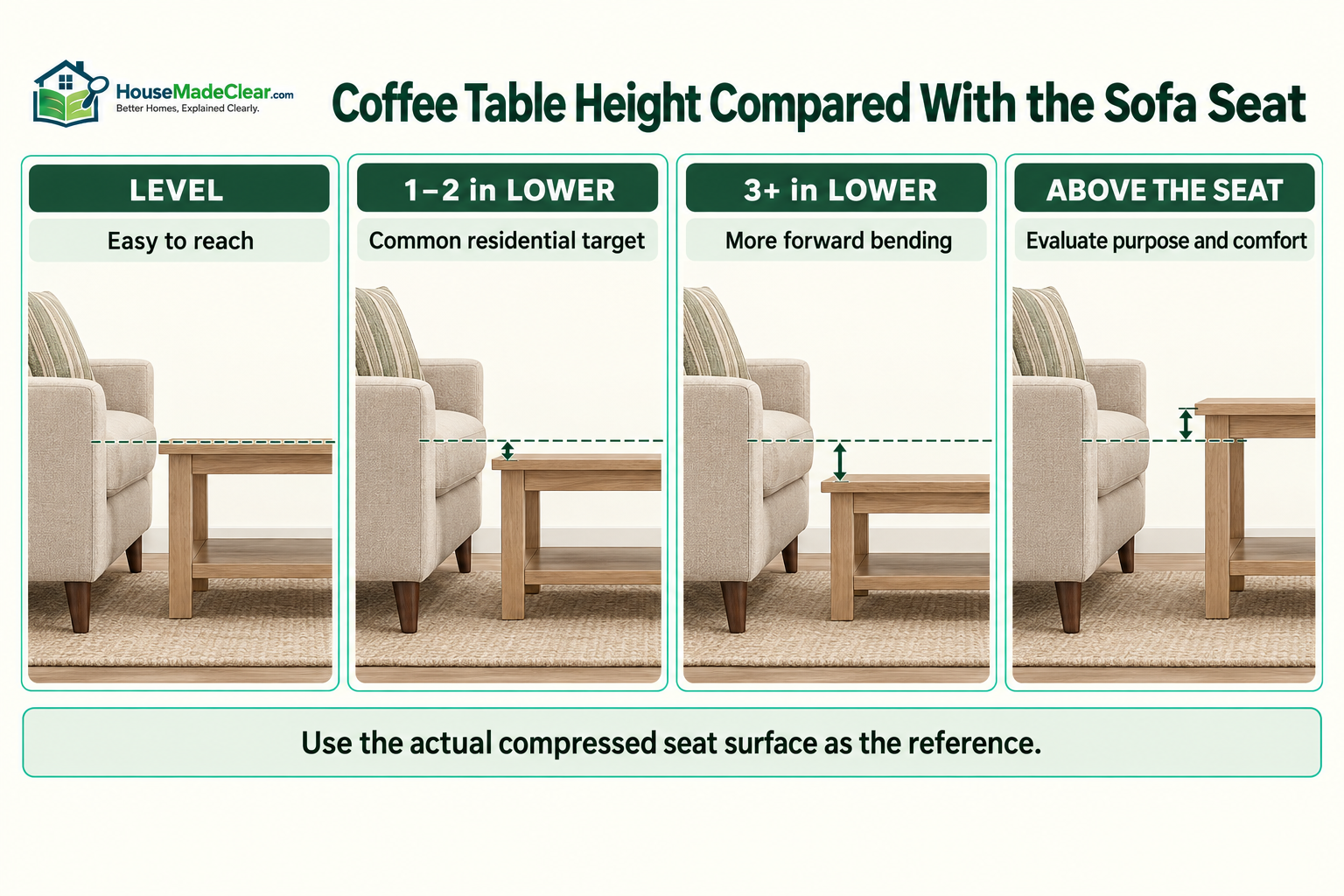
A coffee table can be level with the sofa seat or slightly lower. It does not always have to be lower.
Level With the Sofa Seat
A table level with the seat is usually easy to reach and creates a clear horizontal relationship between the two pieces.
This is useful when the table is frequently used for:
- Drinks
- Snacks
- Remote controls
- Books
- Board games
- Crafts
- Serving guests
A level tabletop may also suit older adults or users who find it uncomfortable to bend toward a lower surface.
One or Two Inches Lower
A tabletop 1 or 2 inches below the sofa seat is a widely used residential target.
This relationship:
- Keeps the table visually subordinate to the sofa
- Provides comfortable access from a seated position
- Works with many standard-height sofas
- Reduces the chance that the table will visually block the front of the seating
For an 18-inch seat, a 16- or 17-inch table is a common choice.
More Than Two Inches Lower
A table 3 or more inches below the sofa seat can still work, especially with low-profile modern furniture. However, it requires more forward bending.
Crate & Barrel’s coffee-table guidance recommends avoiding a table more than 3 inches below or more than 1 inch above the sofa seat as a general proportional guide.
That broader tolerance is useful, but it should not replace a physical comfort test. A healthy adult may comfortably reach a low table, while another user may find the same movement difficult.
Higher Than the Sofa Seat
A conventional coffee table can sit approximately 1 inch above the seat without necessarily looking or functioning incorrectly. Larger differences require more caution.
A higher table may be appropriate when:
- It is used for eating
- It serves a sofa with a very high seat
- The user has difficulty bending
- It is a lift-top design
- Its height is temporary rather than fixed
- The manufacturer designed it as a convertible surface
A fixed table several inches above the seat can dominate the seating area, restrict sightlines, and resemble a dining or work surface rather than a coffee table.
How to Measure Sofa Seat Height Correctly
Coffee-table selection often fails because the sofa height was taken from the frame or product description rather than the actual seat surface.
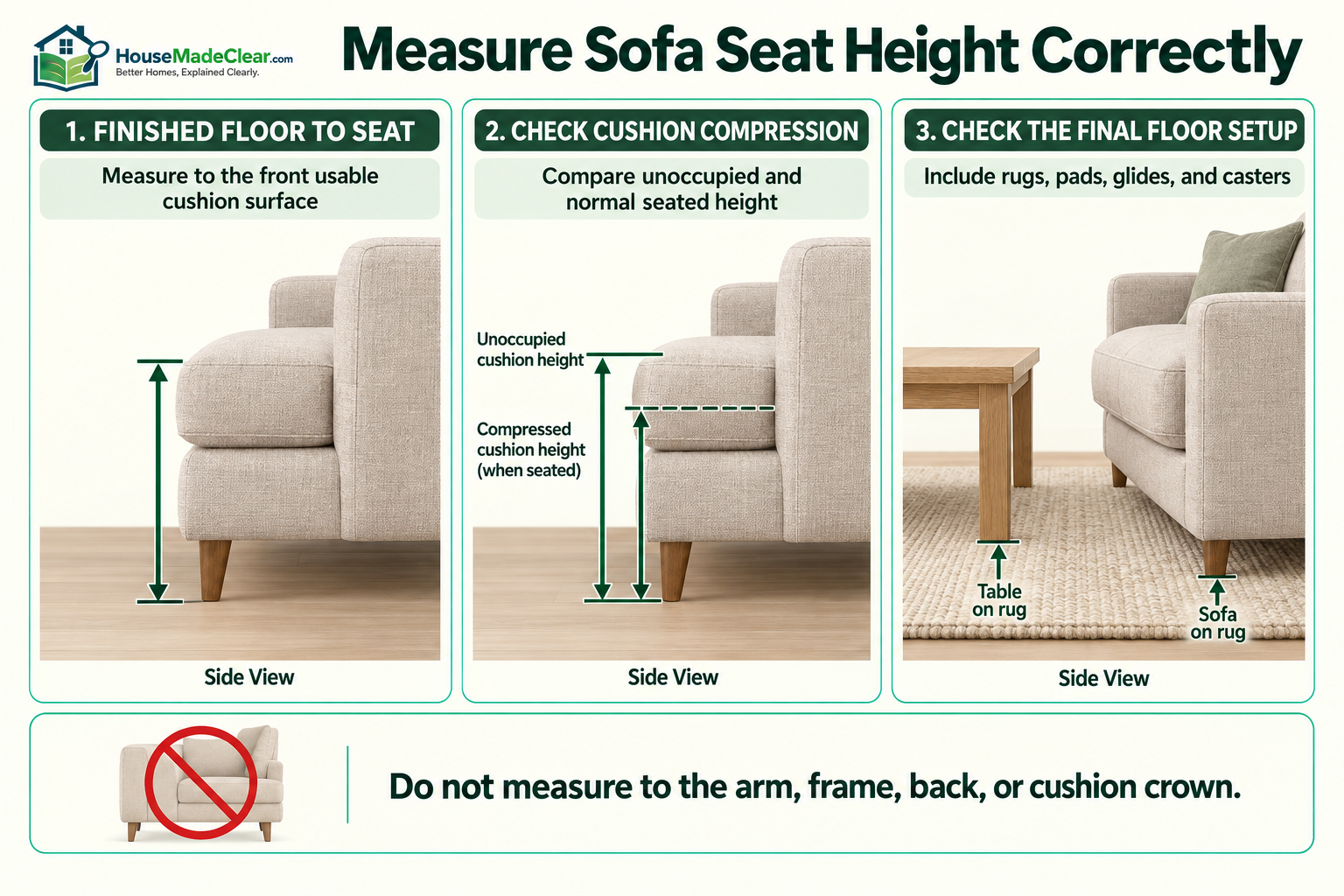
Measure From the Finished Floor
Place the end of the tape measure on the finished floor immediately beside the sofa.
Measure vertically to the top of the seat cushion at its front edge.
Do not measure to:
- The sofa arm
- The bottom of the cushion
- The wooden frame
- The cushion seam if it projects above the usable surface
- The back cushion
- The highest point of a crowned cushion
Use the area where a person’s thighs normally rest.
Measure the Sofa in Its Normal Condition
Arrange the cushions as they are normally used. Fluff or position removable cushions before measuring, but do not compress them unnaturally.
If the cushions are deeply padded, record two measurements:
- The unoccupied seat height
- The approximate compressed height during normal use
The manufacturer’s seat-height specification normally refers to the unoccupied seat. A soft cushion may compress noticeably under a seated person, making the functional seat height lower.
Check More Than One Seat
Cushion height can vary across an older sofa. The center cushion may sag more than the outside cushions, while a chaise may use a different cushion construction.
Measure:
- Left seat
- Center seat
- Right seat
- Chaise, if present
Use the seating position that will interact most often with the coffee table.
Include Rugs and Floor Coverings
The floor reference must reflect the final furniture arrangement.
If both the sofa and table stand on the same rug, their relative height normally changes very little. If only the coffee table sits on the rug, the rug can raise it slightly compared with the sofa.
Account for:
- Thick rug pile
- Rug pads
- Uneven floor transitions
- Furniture glides
- Casters
- Added protective pads
The rug may compress under the table legs, so check the final installed height rather than relying only on the rug’s advertised thickness.
How to Measure Coffee Table Height
Measure from the finished floor to the highest usable part of the tabletop.
For a simple flat table, this is straightforward. For other designs, additional measurements may be needed.
Thick or Raised-Edge Tops
Measure to the surface where objects will rest. If the table has a raised rim, record both:
- Usable surface height
- Maximum outside height
A raised edge can make the table appear taller and may affect how comfortably someone reaches over it.
Upholstered Ottomans
Measure to the top of the upholstery without a tray and then measure the height with the intended tray in place.
Soft upholstery may compress under weight. A thick tray can raise the usable surface by an inch or more.
Nesting Tables
Measure every table individually.
A nesting set may include surfaces at several heights. Determine which table will serve the primary sofa position and whether the smaller tables can be reached from nearby chairs.
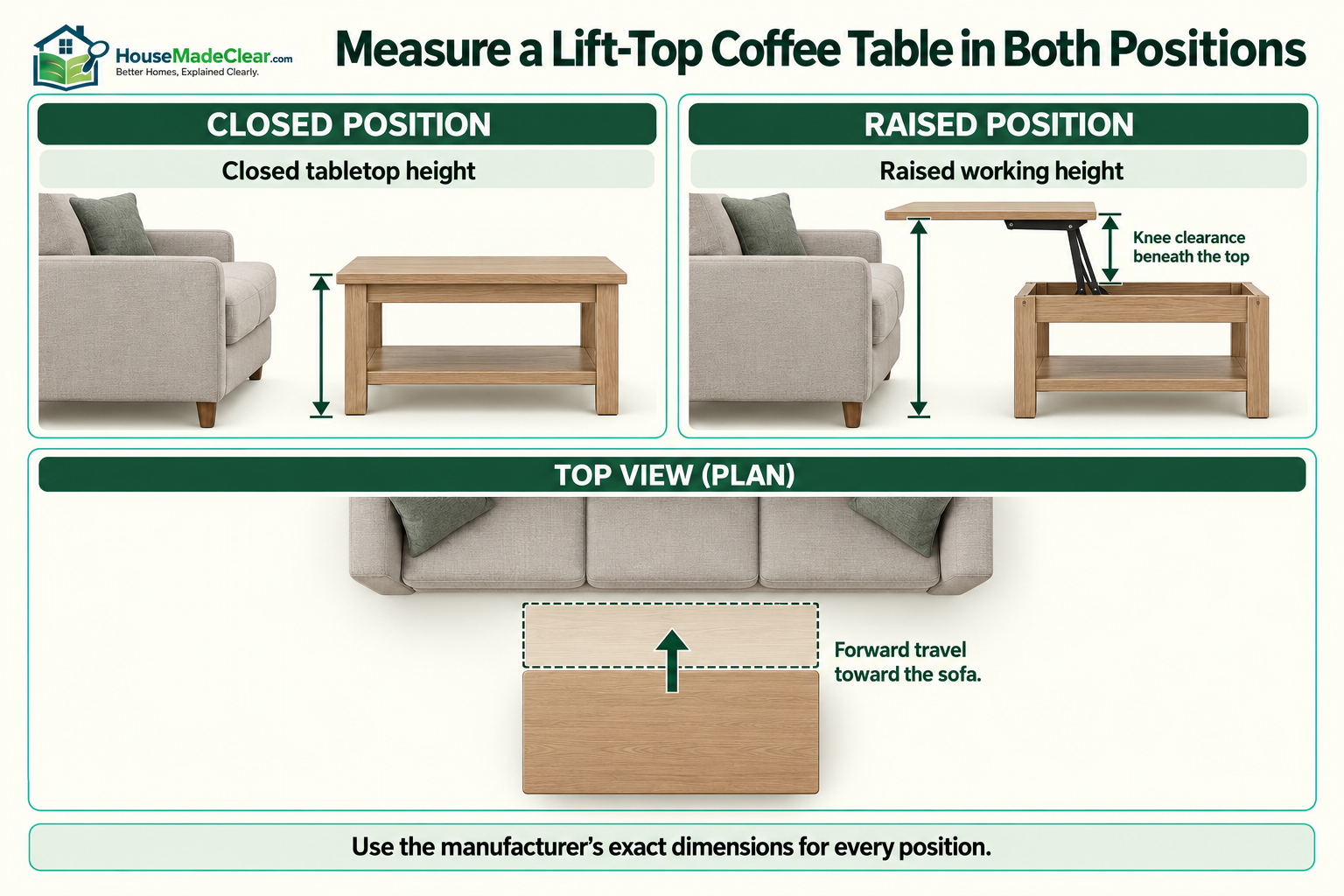
Lift-Top Tables
Record at least four measurements:
- Closed tabletop height
- Fully raised tabletop height
- Forward travel toward the sofa
- Knee clearance beneath the raised top
The closed height should relate to the sofa like a conventional coffee table. The raised height should be judged according to its intended working or dining function.
Tables With Casters or Adjustable Feet
Confirm that the listed product height includes:
- Casters
- Leveling feet
- Floor glides
- Removable legs
Adjustable feet can correct small floor irregularities but are rarely intended to change the table’s height substantially.
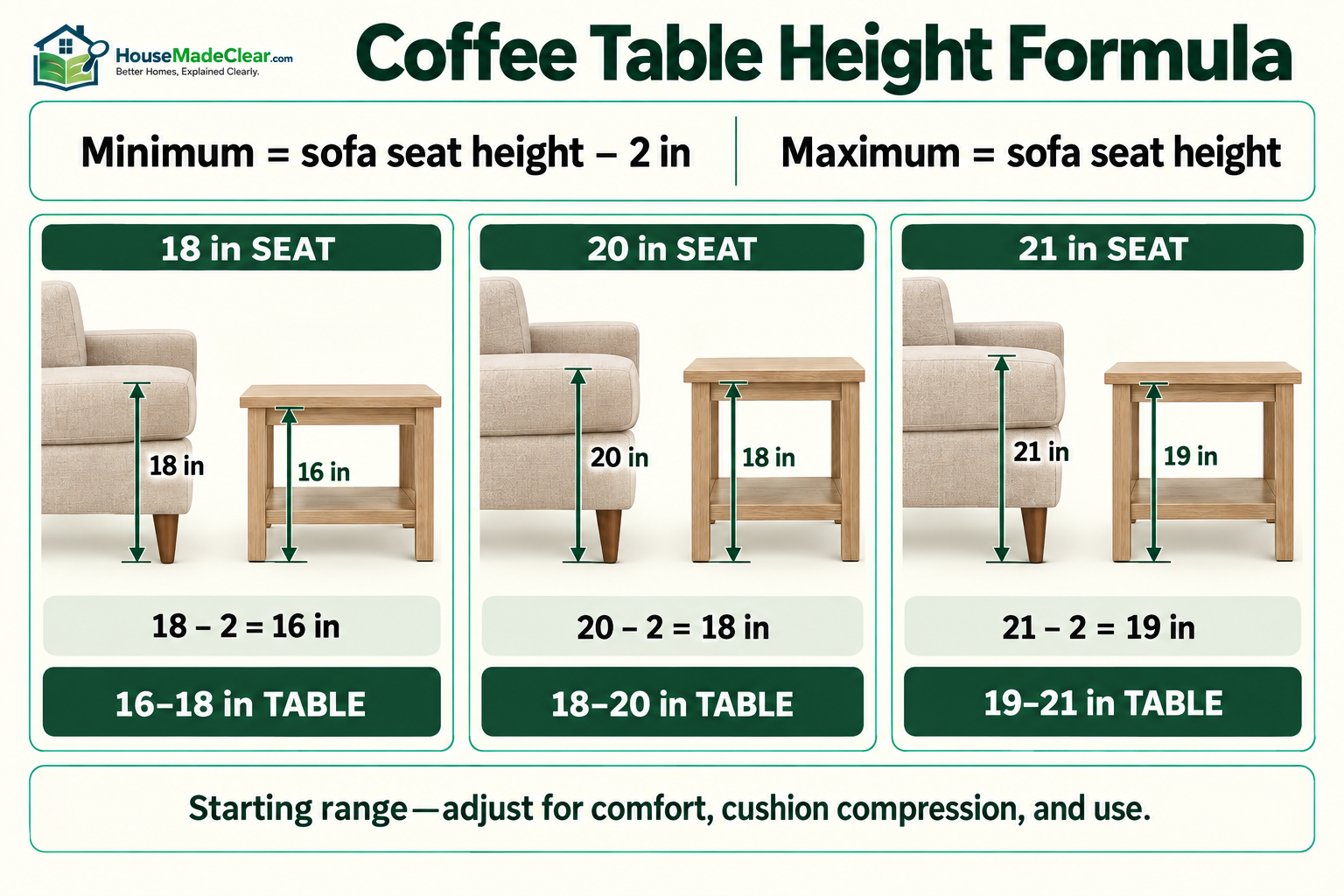
Coffee Table Height Formula
Use this simple calculation:
Suggested minimum table height = sofa seat height − 2 inches
Suggested maximum table height = sofa seat height
For an 18-inch sofa seat:
- Minimum: 18 − 2 = 16 inches
- Maximum: 18 inches
- Suggested range: 16 to 18 inches
For a 20-inch sofa seat:
- Minimum: 20 − 2 = 18 inches
- Maximum: 20 inches
- Suggested range: 18 to 20 inches
This formula provides a starting range, not an absolute restriction. Adjust it for mobility, table purpose, cushion compression, and the seating arrangement.
Coffee Table Height Compared With Different Sofa Types
Not every sofa has a conventional 17- to 19-inch seat. Match the table to the actual model.
If the sofa dimensions are unknown, first measure them using our couch dimensions guide.
Standard Sofa
Many residential sofas have seats that work comfortably with tables in the 16- to 18-inch range.
Measure the sofa rather than assuming it is standard. Cushion construction, legs, and frame style can change seat height even when the sofa’s overall dimensions look conventional.
Low-Profile Sofa
Low-profile sofas may have seat heights around 14 to 17 inches. They are common in modern, modular, platform, and lounge-style furniture.
A conventional 18-inch table can appear tall beside a 14-inch seat. A table approximately 12 to 15 inches high may create a better relationship.
Low tables work particularly well when the seating encourages reclining rather than upright sitting. The tradeoff is that users must bend farther to reach the surface.
High-Seat Sofa
Some traditional, overstuffed, reclining, and mobility-friendly sofas have seat heights of approximately 19 to 22 inches.
A 16-inch table can feel noticeably low beside this seating. A table around 18 to 21 inches may be more useful, depending on the actual seat height.
Do not automatically choose a tall table based on the sofa’s overall height. The back and arms do not determine the coffee-table relationship; the seat surface does.
Deep Sofa
Seat depth and seat height are different measurements, but depth affects reach.
A deep sofa places the user farther from the table when sitting against the back cushion. Even if the tabletop height is correct, the surface may remain difficult to reach.
Possible solutions include:
- Moving the table slightly closer while preserving legroom
- Choosing a narrower table
- Using nesting tables
- Adding C-shaped or pull-up tables
- Providing side tables for the outer seats
Reclining Sofa
A reclining footrest can occupy the space where a coffee table would normally sit.
Check the table with the recliner:
- Closed
- Partially extended
- Fully extended
- Occupied by a user
A lightweight movable table or small individual tables may work better than one fixed central table.
The table should never obstruct the footrest mechanism or trap the user’s feet.
Sofa Bed
Open the sleeper mechanism and measure the complete bed footprint.
The coffee table may need to be moved every time the sofa bed is used. Consider the table’s weight, floor glides, casters, and storage location in addition to its height.
Sectional Sofa
Sectional cushions may not all have identical heights. The chaise or corner seat can differ from the primary straight section.
Measure the seats surrounding the table and choose a height that works with the most frequently used positions.
When the sectional contains substantially different seat levels, nesting tables or a grouped-table arrangement can provide multiple usable heights.
Coffee Table Height With Chairs and Mixed Seating
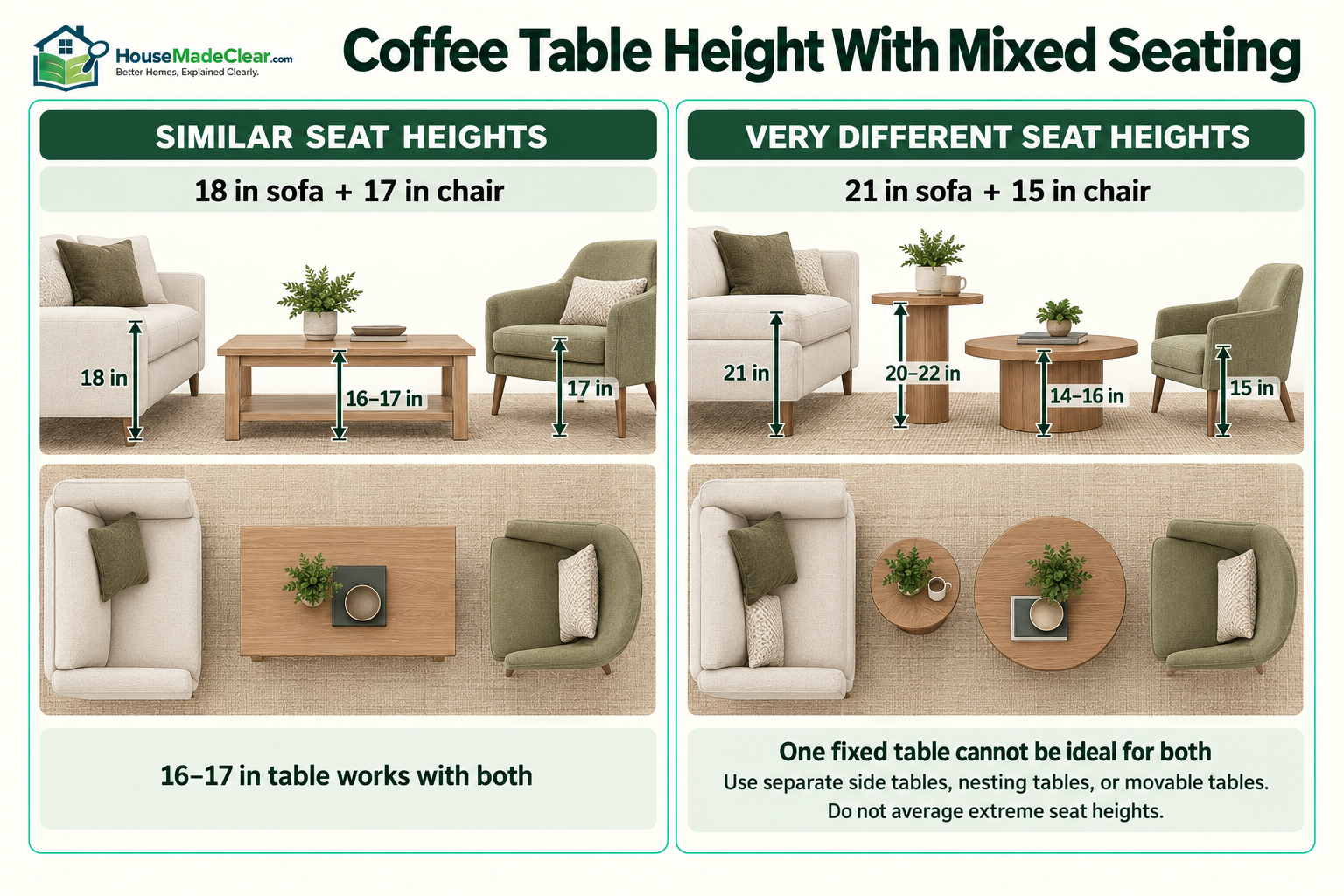
Many living rooms contain a sofa plus one or more accent chairs.
If all seats have similar heights, use the sofa as the main reference. If the chairs differ significantly, determine which users need the table most often.
For example:
- Sofa seat: 18 inches
- Chair seat: 17 inches
- Suggested table: approximately 16 to 17 inches
That height remains close to both seats.
If one chair is 15 inches high and the sofa is 21 inches high, one central fixed table cannot create the ideal relationship with both. Consider:
- Separate side tables
- Nesting tables at graduated heights
- Two smaller coffee tables
- A movable drink table
- Repositioning the chair outside the central table zone
Do not simply average extreme seat heights. An 18-inch table placed between a 15-inch chair and a 21-inch sofa may be too high for one and too low for the other.
Standard, Low and Tall Coffee Table Heights
Retail labels vary, but the following categories provide useful planning ranges.
| Table Type | Common Planning Range | Typical Application |
|---|---|---|
| Floor-level or very low table | Below 12 inches | Floor cushions or specialized low seating |
| Low coffee table | 12–15 inches | Low-profile sofas and lounge seating |
| Standard coffee table | 16–18 inches | Many conventional sofas |
| Moderately tall coffee table | 19–20 inches | High-seat sofas or easier reach |
| Tall or convertible table | 21 inches or more | Specialized seating, dining or convertible use |
| Lift-top table | Model-specific | Closed for coffee-table use; raised for work or dining |
These ranges overlap because manufacturers do not use one standardized classification.
When Does a Low Coffee Table Work Best?
A low coffee table can make a room appear more open because it preserves the sightline across the seating area.
It works well with:
- Low-slung sofas
- Platform furniture
- Floor cushions
- Modular lounge seating
- Minimalist interiors
- Rooms with low windows
- Seating designed for relaxed reclining
However, a low table is not automatically more comfortable. It requires greater forward and downward reach.
Before choosing one, test whether users can comfortably:
- Pick up a full cup
- Place down a plate
- Reach a remote control
- Use the table from the sofa’s back cushion
- Stand without striking the table
- See the table edge in normal lighting
Very low tables can be harder to notice while walking, particularly when their finish is similar to the floor or rug.
When Does a Taller Coffee Table Work Best?
A taller table can reduce bending and place objects within easier reach.
It may suit:
- Sofas with high seats
- Older adults
- Users with limited bending tolerance
- Frequent snack or meal use
- Games, puzzles, and crafts
- Convertible living spaces
- Lift-top designs
A fixed tall table also introduces disadvantages. It may:
- Visually overpower a low sofa
- Interfere with leg movement
- Block part of the seating
- Make the room feel crowded
- Encourage unsuitable full-time computer posture
If the primary reason for choosing a tall table is laptop work or dining, a lift-top model may be more practical than keeping the surface permanently high.
Coffee Table Height for Eating
A standard 16- to 18-inch coffee table is generally too low for upright dining from a typical sofa. The user must bend forward, lower the plate, and reach down repeatedly.
Occasional snacks may be manageable, but regular meals require closer attention to:
- Raised tabletop height
- Distance from the seat
- Knee clearance
- Stability
- Heat resistance
- Sofa cushion softness
- User posture
A lift-top table moves the surface upward and toward the user. Verify its raised dimensions from the manufacturer rather than assuming every lift-top table reaches the same height.
The surface should be stable when loaded and should not force the user to lean forward or hold their shoulders in a raised position.
Coffee Table Height for Laptop Work
A coffee table can support occasional laptop use, but a standard fixed table is rarely suitable for prolonged computer work.
A low tabletop encourages:
- Forward bending
- Rounded shoulders
- Downward neck angle
- Unsupported arms
- Poor screen positioning
A lift-top table may improve surface height, but it does not automatically create a complete ergonomic workstation. The sofa cushion can still be too soft, the back support inadequate, and the laptop screen too low.
For daily work, follow a dedicated desk, chair, and monitor setup rather than treating the coffee table as a permanent office. Our guide to creating a functional home office explains how those elements should work together.
Coffee Table Height for Older Adults and Limited Mobility
A table that looks visually proportional may still be difficult for a particular user.
Someone with limited hip, back, shoulder, or balance mobility may prefer a table closer to seat height rather than 2 or 3 inches below it.
Consider:
- Comfortable forward reach
- Ability to see the table edge
- Whether the table obstructs standing
- Stable access to frequently used items
- Rounded corners
- Adequate lighting
- Clear walking routes
- Table stability
Do not use a coffee table as a standing aid unless it is specifically designed and rated for that purpose. Many tables can slide, tip, rack, or fail when subjected to body weight.
Accessibility should be based on the actual user rather than a generic furniture formula.
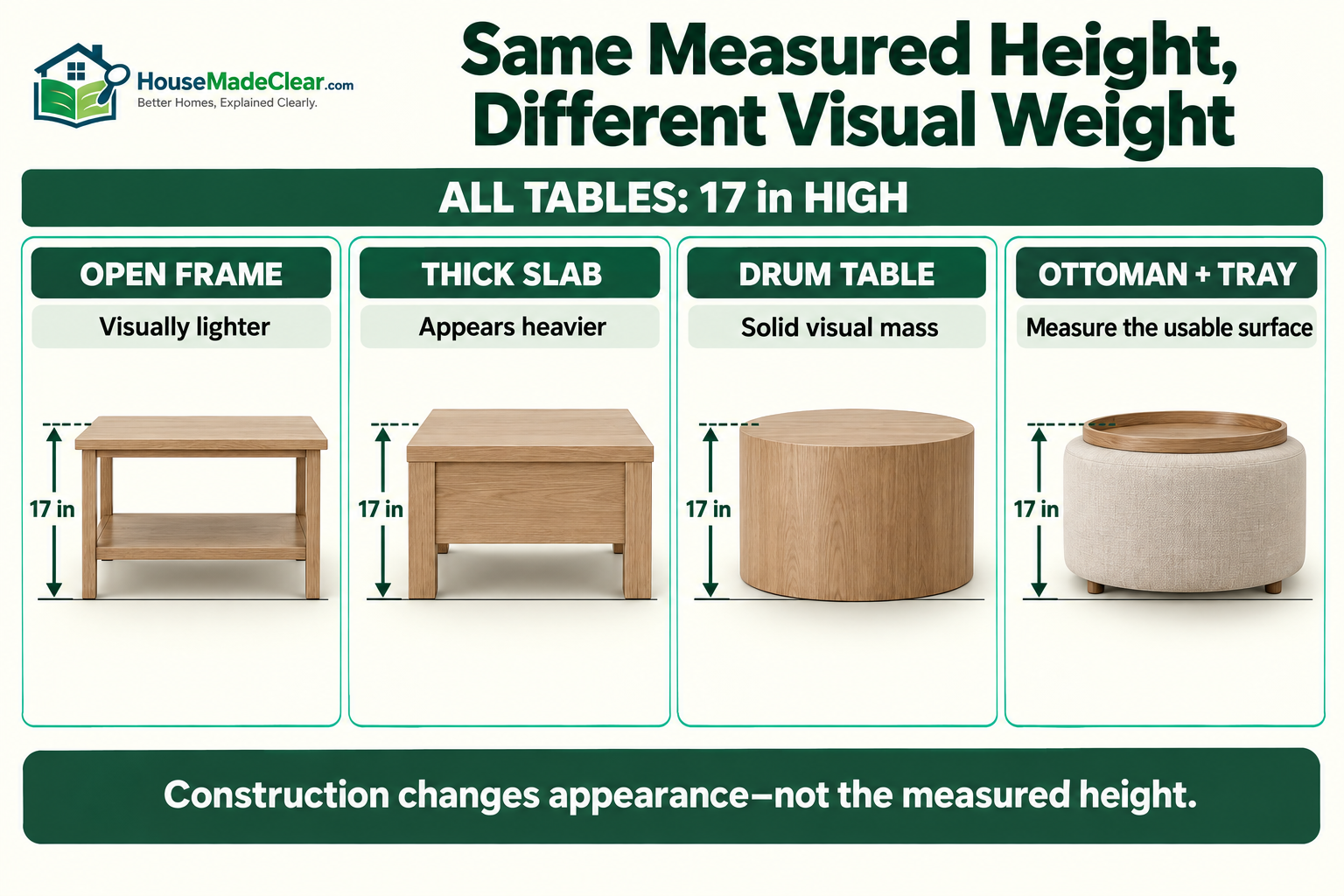
How Table Shape and Construction Affect Perceived Height
Two tables with the same measured height can look different because of their construction.
Thick Tabletops
A thick slab or storage body creates more visual mass below the surface. It can appear taller and heavier than an open-framed table at the same height.
Open Bases
Thin legs and an open base expose more floor, making the table appear lighter and sometimes lower.
Drum Tables
A solid drum table occupies the entire height from floor to top. It can appear more substantial than a legged table with the same measurements.
Glass Tables
A clear glass top can make a table less visually dominant. However, the edge should remain visible enough to avoid collisions.
Follow the manufacturer’s care, weight, and assembly instructions. Chipped or damaged glass should be evaluated rather than ignored.
Upholstered Ottomans
An ottoman can appear taller because its upholstery visually connects the top with the base. The surface may also compress, making its functional height different from its unloaded measurement.
Tables With Raised Rims
A tray-style top may have a usable interior surface below its outside rim. Compare the sofa with the height of the surface that will actually hold objects.
Does Coffee Table Height Affect Room Size?
Height does not change the table’s floor footprint, but it influences how open or crowded the room feels.
A lower table can:
- Preserve sightlines
- Emphasize room width
- Make low ceilings feel less restrictive
- Suit modern low-profile furniture
A taller table can:
- Add visual weight
- Divide the seating area more strongly
- Feel crowded in a compact room
- Balance a tall or heavily upholstered sofa
Height cannot compensate for incorrect length, width, or placement. Use our standard coffee table size guide to evaluate the complete footprint, including table shape and clearance.
Coffee Table Height and Sofa-to-Table Distance
Height and horizontal distance work together.
A perfectly matched table may still be uncomfortable if it is too far from the sofa. Conversely, a table that is slightly lower may remain easy to use if positioned closer.
A common planning range is approximately 14 to 18 inches between the sofa and coffee table.
This gap generally provides:
- Legroom
- Space to sit and stand
- Reasonable seated reach
- Access for cleaning
- A defined circulation zone
Measure from the sofa’s most forward fixed point to the nearest edge of the table.
For a recliner, also check the extended footrest. For a lift-top table, measure the gap after the top moves toward the user.
Coordinate these dimensions with the complete functional living room layout rather than sizing the table in isolation.
Coffee Table Height Calculation Examples
Example 1: Standard Sofa
Assume:
- Sofa seat height: 18 inches
- Intended use: drinks, books, and remote controls
Calculation:
18 inches − 2 inches = 16 inches
A table approximately 16 to 18 inches high is appropriate. A 17-inch table provides a useful middle option.
Example 2: Low-Profile Sofa
Assume:
- Sofa seat height: 15 inches
- Intended use: relaxed lounge seating
Calculation:
15 inches − 2 inches = 13 inches
A table approximately 13 to 15 inches high will relate more naturally to the sofa than a conventional 18-inch model.
Example 3: High-Seat Sofa
Assume:
- Sofa seat height: 21 inches
- Users prefer minimal bending
Calculation:
21 inches − 2 inches = 19 inches
A table approximately 19 to 21 inches high is a reasonable starting range. Testing the 20- and 21-inch options may reveal which is easier to reach.
Example 4: Mixed Sofa and Chair
Assume:
- Sofa seat height: 18 inches
- Chair seat height: 17 inches
A 16- or 17-inch table stays within 1 or 2 inches of both seating surfaces.
Example 5: Soft Sofa Cushion
Assume:
- Unoccupied seat height: 19 inches
- Approximate occupied seat height: 17½ inches
A 19-inch table may appear level when the sofa is empty but feel high when someone sits down.
A table around 16 to 18 inches may provide a better functional relationship. Test the sofa under normal use before ordering.
Example 6: Table Placed on a Thick Rug
Assume:
- Sofa seat height: 18 inches
- Coffee table height: 17 inches
- Table stands on a thick rug while the sofa remains on the bare floor
The rug can raise the table slightly, reducing the original 1-inch difference. Mark the final rug and furniture positions before deciding whether the relationship is acceptable.
How to Test Coffee Table Height Before Buying
Dimensions on a product page do not show how the table will feel beside your sofa.
Use a full-scale mockup.
Cardboard-Box Test
Stack stable cardboard boxes to the proposed tabletop height. Place a rigid piece of cardboard across the top to represent the surface.
Do not lean on the mockup or place hot or heavy items on it.
Sit normally and test whether you can comfortably reach:
- A mug
- A book
- A remote
- A plate
- A board game
Painter’s-Tape Test
Place painter’s tape on a nearby wall or temporary support at the proposed height. This helps compare the horizontal line with the sofa seat.
Tape can show visual alignment but does not test reach as effectively as a physical mockup.
Existing-Furniture Test
Use a sturdy bench, ottoman, or small table of known height. Add a firm board only when it can be supported safely.
Avoid balancing surfaces on books, loose blocks, or unstable objects.
Test Every Regular User
A table that is comfortable for a tall adult may be awkward for a child or someone with restricted mobility.
Ask regular users to sit, reach, stand, and move around the proposed table area.
How to Fix a Coffee Table That Is Too Low
A table that is only slightly low may still be usable. If it causes discomfort, consider these options.
Use Manufacturer-Compatible Legs
Some tables allow leg replacement. Confirm:
- Thread size
- Mounting plate
- Fastener length
- Load rating
- Structural compatibility
- Final stability
Do not assume universal replacement legs will fit safely.
Add Approved Furniture Feet
Small manufacturer-approved feet or glides may provide a minor increase. Recheck stability after installation.
Use a Removable Tray
A rigid tray can create a firmer and slightly higher surface on an upholstered ottoman, though the increase is usually small.
Convert to a Lift-Top Mechanism Only With Proper Design
Retrofitting a lift-top mechanism changes load paths and can create pinch and stability hazards. Use a compatible system installed according to its instructions or choose a purpose-built lift-top table.
Replace the Table
Replacement is often safer than placing the table on loose blocks or improvised risers.
Do not use unstable bed risers, stacked wood, unsecured bricks, or other makeshift supports. Coffee tables are frequently bumped from the side, and a raised table can become unstable.
How to Fix a Coffee Table That Is Too High
A slightly tall table may work if it remains comfortable and does not obstruct movement.
If the difference is excessive:
- Remove casters only if the manufacturer permits it
- Replace removable legs with compatible shorter legs
- Have solid wood legs shortened professionally
- Move the table to higher seating
- Repurpose it as a side or activity table
- Replace it with a better-proportioned model
Do not cut metal, structural, hollow, tapered, or folding legs without understanding how the modification affects strength and levelness.
Shortening the table may also reduce knee clearance, drawer clearance, and the operating space of lift mechanisms.
Common Coffee Table Height Mistakes
Buying From the Average Measurement Alone
“Standard height” is only a starting point. A 17-inch table is not automatically right for every sofa.
Measuring the Sofa Arm
Coffee-table height relates to the seat, not the arm or back.
Ignoring Cushion Compression
A soft sofa may become several inches lower when occupied, changing the functional relationship.
Assuming Lower Is Always Better
A low table may look modern but require uncomfortable bending.
Choosing a Tall Table for Laptop Work
A higher surface does not correct a soft seat, poor back support, or low laptop screen.
Measuring the Table Without the Rug
A thick rug or rug pad can alter the final relationship.
Forgetting Lift-Top Movement
A lift top moves vertically and horizontally. Measure both positions.
Averaging Very Different Seat Heights
A mathematical average may produce a table that works poorly for every seat. Multiple tables are often a better solution.
Using Unstable Risers
Improvised supports can make the table slide or tip.
Ignoring Tabletop Thickness
A thick table body can look visually high even when the top surface is technically within range.
Confusing Coffee Tables With End Tables
End tables are commonly related to the sofa arm height, while coffee tables relate primarily to seat height. Do not apply end-table measurements to a central coffee table.
Coffee Table Height Checklist
Before purchasing or modifying a table, verify the following:
| Item | What to Check |
|---|---|
| Sofa seat height | Measure from finished floor to top of seat cushion |
| Cushion compression | Compare occupied and unoccupied height if cushions are soft |
| Table height | Measure to the usable top surface |
| Recommended relationship | Level with seat or approximately 1–2 inches lower |
| Primary use | Drinks, décor, games, dining, work or storage |
| User reach | Test with regular household members |
| Sofa depth | Confirm the surface is reachable from a normal sitting position |
| Mixed seating | Compare sofa and chair seat heights |
| Rug thickness | Check the final furniture and rug arrangement |
| Lift-top position | Measure closed height, raised height and forward travel |
| Ottoman compression | Measure with and without the intended tray |
| Stability | Follow manufacturer assembly and load instructions |
| Table clearance | Preserve practical legroom and circulation |
| Moving furniture | Check recliners, sofa beds, drawers and nesting pieces |
| Full-size mockup | Test the proposed height before ordering |
Final Recommendation
For most living rooms, begin with a coffee table approximately 16 to 18 inches high.
Then measure the sofa seat and apply this rule:
Choose a table level with the sofa seat or up to 1 or 2 inches lower.
Use the actual seat height—not the sofa arm, frame, or overall height. Account for cushion compression, rugs, lift-top movement, and the needs of regular users.
A 16-inch table may be ideal beside an 18-inch sofa but too tall for a 14-inch lounge sofa. A 20-inch table may suit a high-seat sofa but overwhelm low-profile furniture.
The best coffee table height is therefore not the most common number. It is the height that remains easy to reach, visually proportionate, stable, and functional with the specific seating around it.
Frequently Asked Questions
What is the standard height of a coffee table?
Most standard coffee tables are approximately 16 to 18 inches high. Models outside this range are common, so compare the table with the actual sofa seat before purchasing.
Should a coffee table be higher or lower than the sofa?
A coffee table should generally be level with the sofa seat or approximately 1 to 2 inches lower. A table slightly higher may work for specialized use, but a large height difference can feel awkward.
What height coffee table works with an 18-inch sofa seat?
A coffee table approximately 16 to 18 inches high is a practical choice for an 18-inch seat. A 16- or 17-inch table creates the commonly recommended slightly lower relationship.
Is a 20-inch coffee table too high?
A 20-inch table may be too high for a low or standard sofa but suitable for a sofa with a seat around 20 to 22 inches high. Judge it against the seat height rather than the table measurement alone.
Is a 14-inch coffee table too low?
A 14-inch table can work well with a sofa seat approximately 14 to 16 inches high. It may require excessive bending when paired with a high-seat sofa.
Can a coffee table be the same height as the sofa seat?
Yes. A coffee table level with the seat is generally comfortable to reach and creates a balanced horizontal relationship with the sofa.
How do I measure sofa seat height for a coffee table?
Measure vertically from the finished floor to the top of the seat cushion at its front usable edge. If the cushion is very soft, also consider how far it compresses during normal use.
How high should a lift-top coffee table be?
The closed height should generally relate to the sofa seat like a conventional coffee table. The correct raised height depends on whether the surface is used for dining, activities, or occasional laptop work. Use the manufacturer’s exact closed, raised, and knee-clearance measurements.
What height should an ottoman coffee table be?
An ottoman used as a coffee table should generally be close to the sofa seat height or slightly lower. Measure the upholstered top, its compression, and the additional height created by any tray.
Can I raise a coffee table that is too low?
A table can sometimes be raised with compatible replacement legs or manufacturer-approved feet. Avoid loose blocks and improvised risers because they can make the table unstable.







[…] Standard Coffee Table Height: How High Should It Be? […]
[…] Standard Coffee Table Height: How High Should It Be? […]