
















Sliding glass patio doors create a security challenge because their locks, frames and operating mechanisms differ from those of conventional hinged doors. Many rely on a small factory latch, lightweight keeper and rollers that must remain correctly adjusted for the door to close and lock properly.
Installing a security bar can help, but it will not repair a damaged latch, prevent every door from being lifted or strengthen loosely retained glass. The most effective approach is to inspect the complete assembly and address each weakness in the correct order.
Quick Answer
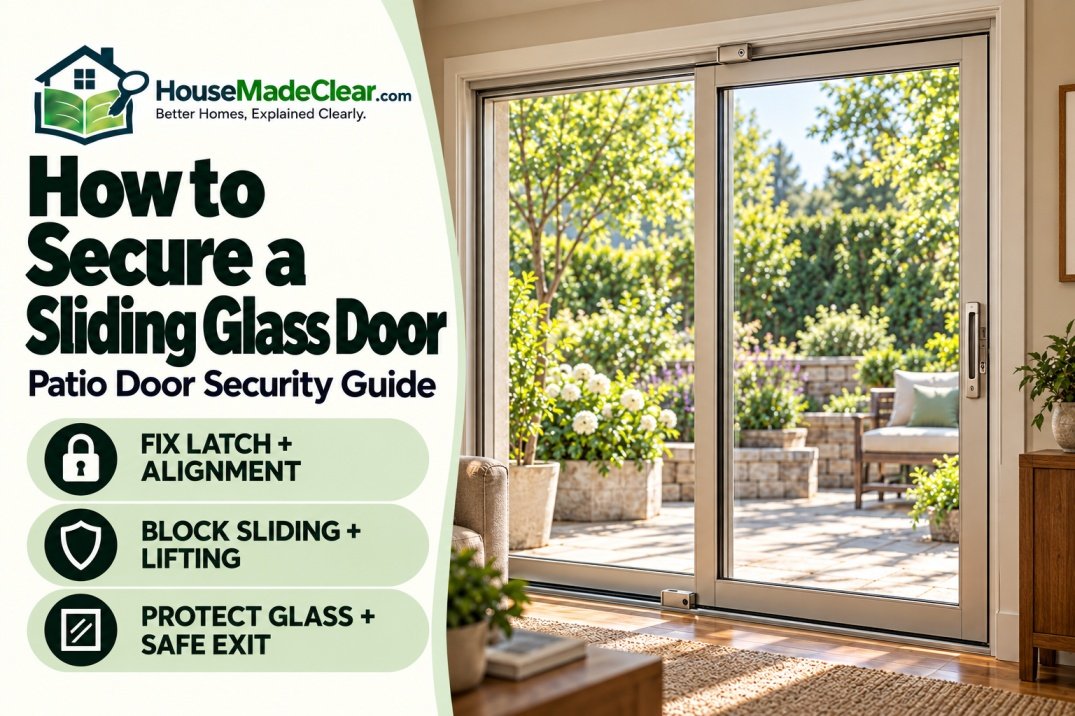
To secure a sliding glass door:
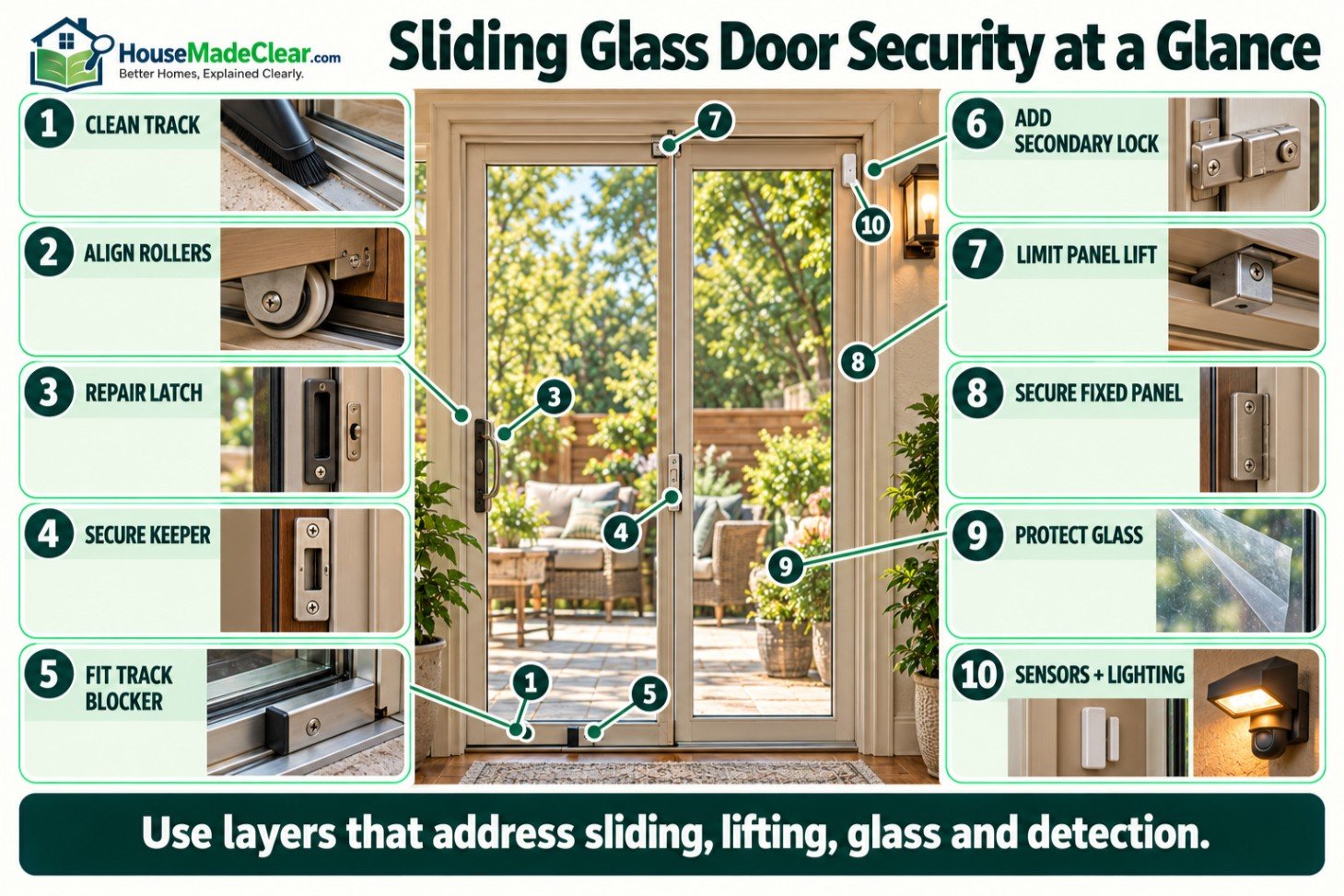
- Clean the track and correct roller alignment.
- Repair or replace a loose factory latch and keeper.
- Add a properly fitted track blocker or security bar.
- Install a compatible secondary sliding-door lock.
- Add manufacturer-approved anti-lift protection.
- Reinforce loose frame and keeper connections.
- Evaluate the glass and glazing-retention system.
- Install door-contact and glass-break sensors.
- Improve exterior lighting and camera coverage.
- Keep every security device easy to release during an emergency.
The best starting combination for many homes is a correctly operating factory lock, a well-fitted track bar and compatible anti-lift protection. Do not rely on a broom handle, loose dowel or alarm sensor as the only security measure.
Sliding Glass Door Security at a Glance
| Security Area | Common Weakness | Recommended Response |
|---|---|---|
| Factory latch | Small, loose or misaligned | Repair alignment and use compatible replacement hardware |
| Keeper | Loose screws or weak attachment | Repair the mounting area and use approved fasteners |
| Rollers | Worn or incorrectly adjusted | Clean, inspect and adjust or replace them |
| Bottom track | Allows horizontal sliding | Add a properly fitted track blocker |
| Upper track | Excessive lift clearance | Use compatible anti-lift hardware |
| Moving panel | Can be forced or lifted | Combine primary, secondary and anti-lift protection |
| Fixed panel | Loose retainers or frame connections | Inspect and secure according to the door design |
| Glass | Breakage or rapid penetration | Evaluate laminated glazing or a professionally attached film system |
| Alarm coverage | Only detects complete opening | Add contact, vibration or glass-break detection |
| Exterior area | Dark or concealed approach | Improve lighting, visibility and camera placement |
| Emergency operation | Too many locks or complex devices | Preserve quick interior release |
| Rental property | Drilling prohibited | Use reversible devices and obtain permission for permanent changes |
Why Sliding Glass Doors Need a Different Security Approach
A sliding patio door normally includes:
- One movable glass panel
- One fixed panel
- A lower track
- An upper guide or head track
- Rollers beneath the moving panel
- A handle and latch
- A keeper attached to the frame or adjacent panel
- Interlocking vertical stiles
- Glass-retention components
- Weather seals
Unlike a hinged door, the moving panel does not swing into a fixed jamb. It travels horizontally on rollers and must remain correctly positioned for the latch to align with its keeper.
A sliding door may therefore be vulnerable to several different actions:
- Horizontal movement along the track
- Vertical lifting
- Latch manipulation
- Keeper separation
- Frame flexing
- Glass breakage
- Removal or movement of the fixed panel
A lock upgrade that addresses only horizontal movement may not prevent lifting. An anti-lift device may not stop a weak latch from separating. The security plan must account for both directions of movement and the condition of the complete frame.
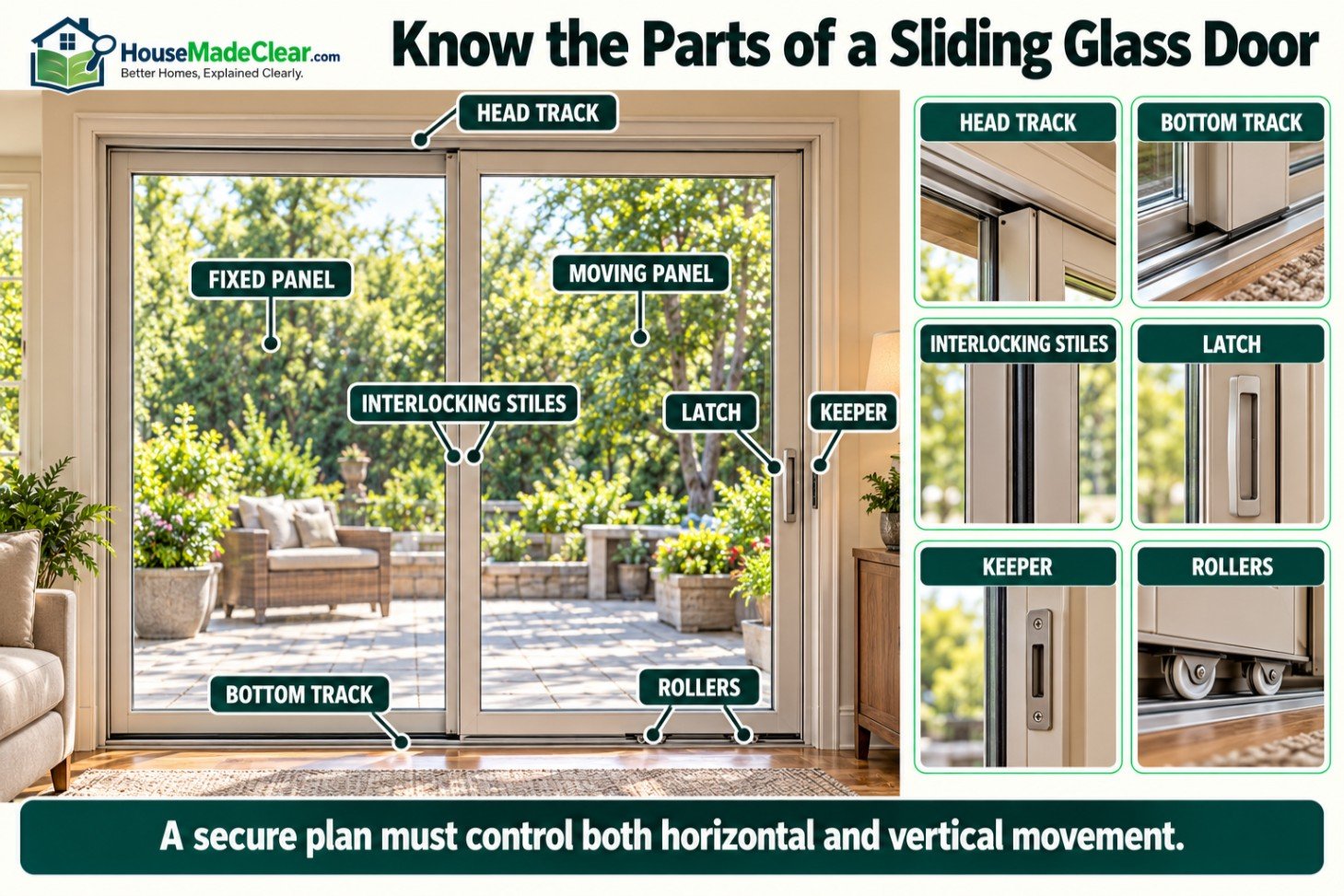
Sliding Glass Door Parts You Should Identify
Understanding the basic components makes it easier to diagnose the actual problem.
Moving Panel
The moving panel slides to open the doorway. Depending on the design, it may move on an interior or exterior track.
Fixed Panel
The fixed panel should remain secured to the frame. Do not assume that “fixed” means permanently attached. Inspect its retainers and fasteners.
Latch
The factory latch is operated by the interior thumb lever or handle. Common styles use a hook, clasp or mortise mechanism.
Keeper
The keeper is the component that receives the latch. It may be mounted on the jamb, frame or adjacent panel.
Rollers
Rollers support the moving panel and control its height. Incorrect adjustment can prevent the latch from aligning or can leave excessive space above the panel.
Bottom Track
The bottom track guides the moving panel. A security bar, dowel or track blocker limits movement along this track.
Head Track
The head track guides the top of the panel. Excessive clearance here may allow certain doors to be lifted.
Interlock
The vertical edges of the fixed and moving panels may overlap or interlock when closed. This joint helps resist separation and weather infiltration.
Start With a Complete Sliding-Door Inspection
Do not buy a security device until you know how the existing door fails.
Close the Door Normally
Slide the door closed without lifting or forcing the handle.
Check whether:
- The latch aligns with the keeper
- The latch engages completely
- The handle feels loose
- The door rebounds after closing
- The panel sits square in the frame
- The interlocking stiles meet correctly
- The weather seals prevent full closing
- The lock works only when the door is lifted or pushed
A door that must be lifted to lock usually has an alignment or roller problem.
Test the Locked Door From Inside
After locking the door, apply moderate hand pressure in several directions.
Check for:
- Horizontal movement
- Vertical movement
- Frame flexing
- Keeper movement
- Rattling
- Separation between the interlocking stiles
- Movement of the fixed panel
Do not perform an aggressive impact test. You could damage the glass, frame or lock.
Inspect the Track
Look for:
- Dirt
- Stones
- Pet hair
- Bent sections
- Corrosion
- Loose track caps
- Damaged rollers
- Water accumulation
- Objects preventing full closure
A dirty track is not only an operating problem. It can prevent the latch from reaching its intended position.
Locate the Safety-Glazing Mark
Sliding patio doors commonly use safety glazing because they are susceptible to human impact. Federal safety requirements cover glazing materials used in sliding glass patio doors, but safety glazing is designed primarily to reduce injury when glass breaks—not necessarily to resist deliberate forced entry.
A permanent marking may identify the glass as tempered, laminated or compliant with a particular safety standard. Do not remove or obscure this mark when applying coatings or film.
1. Clean the Track and Correct Roller Alignment
The first security upgrade may be basic maintenance.
If the moving panel does not reach the fully closed position, the latch and secondary locks cannot align correctly.
Clean the Bottom Track
Remove loose debris using a vacuum and soft brush. Use cleaning products compatible with the track finish and weather seals.
Avoid filling the track with heavy grease. Excess lubricant can collect dirt and may be unsuitable for certain roller or track materials.
Follow the door manufacturer’s maintenance instructions where available.
Check Roller Operation
Signs of roller problems include:
- The door is difficult to slide
- One side sits lower than the other
- The panel scrapes the track
- The latch misses the keeper
- The panel can be lifted excessively
- The interlock does not align
Roller-adjustment screws are commonly located near the lower corners of the moving panel, but their position and operating direction vary.
Make small adjustments and keep the panel level. Raising the panel too far may create another alignment problem or overload the rollers.
Replace Worn Rollers
Adjustment cannot repair a cracked, corroded or seized roller.
Replacing rollers may require removing the heavy glass panel. Because the panel can be large and difficult to control, professional assistance is safer when:
- The glass is oversized
- The door is on an upper floor
- The frame is damaged
- The panel is unusually heavy
- The removal procedure is unknown
- Replacement parts cannot be identified
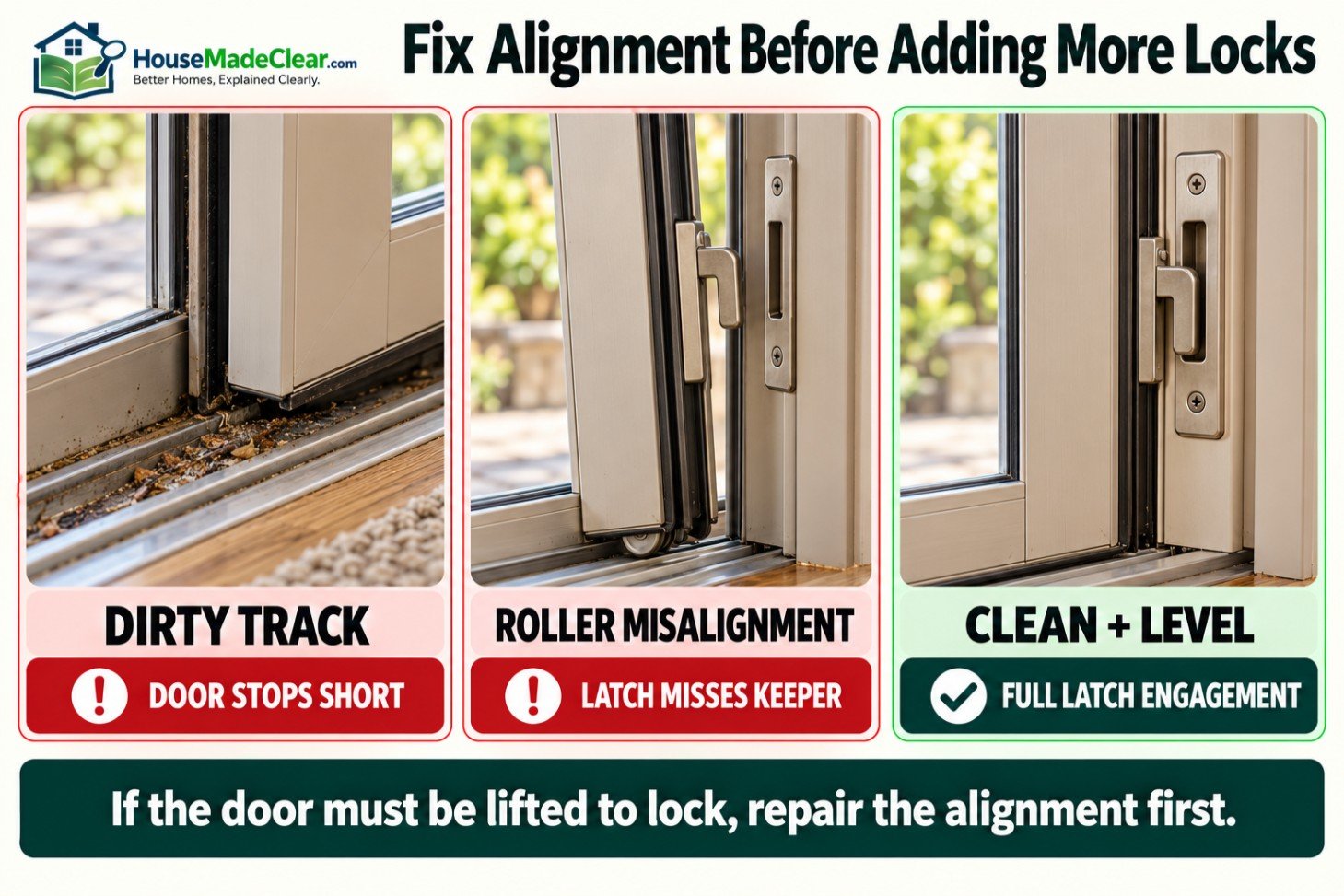
2. Repair or Replace the Factory Latch
A track bar is not an excuse to ignore a broken factory lock.
The factory latch should:
- Operate smoothly
- Engage fully
- Hold the door in its closed position
- Release without excessive force
- Align without lifting the panel
- Remain securely attached to the handle or mortise body
Tighten Loose Hardware Carefully
Loose handle screws may prevent the internal mechanism from operating correctly. Tighten them according to the manufacturer’s instructions.
Do not overtighten screws into aluminum, vinyl or composite components. Overtightening can strip the material, crack the handle or distort the lock case.
Inspect the Keeper
The keeper must remain rigid when the latch pulls against it.
Check for:
- Loose screws
- Stripped holes
- Cracked mounting material
- Corrosion
- Bent metal
- Incorrect positioning
- Excessively enlarged adjustment holes
- Missing parts
Moving the keeper may improve alignment, but it will not repair a damaged frame or worn latch.
Match Replacement Hardware Correctly
Sliding-door locks are not universally interchangeable. Before ordering, record:
- Manufacturer
- Door series, if known
- Lock type
- Screw-hole spacing
- Backset
- Faceplate dimensions
- Hook orientation
- Keeper shape
- Handle dimensions
- Door thickness
- Handing or operating direction
Do not select a replacement using appearance alone.
3. Add a Properly Fitted Track Blocker
A track blocker prevents or limits horizontal movement of the closed door.
Common options include:
- A wooden dowel
- A metal rod
- An adjustable security bar
- A hinged patio-door bar
- A manufacturer-designed track blocker
The Saint Petersburg Police Department recommends using a dowel or blocking device in the track and combining it with measures that prevent the door from being lifted.
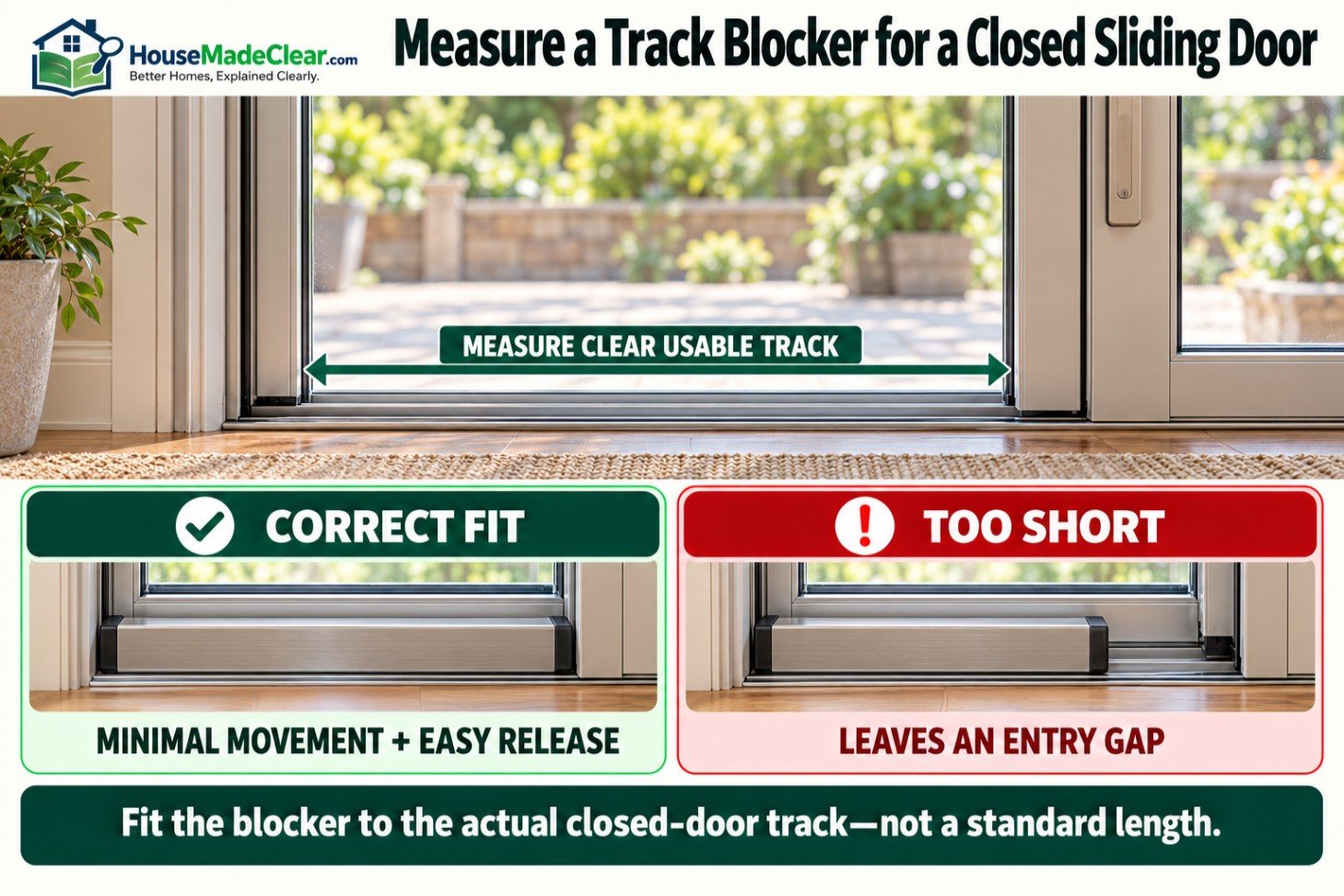
How to Measure a Track Blocker
Close and lock the door. Measure the clear distance between:
- The edge of the moving panel, and
- The opposite end of the usable interior track
The blocker should be long enough to prevent meaningful movement but still removable from inside.
A blocker that is several inches too short may allow enough movement to manipulate the latch or create an entry gap.
Wooden Dowel vs Security Bar
| Feature | Wooden Dowel or Rod | Adjustable Security Bar |
|---|---|---|
| Cost | Usually low | Low to moderate |
| Drilling | Normally unnecessary | Usually unnecessary |
| Visibility | Low | More visible |
| Adjustment | Must be cut accurately | Often adjustable |
| Emergency release | Must be lifted from track | Usually designed with a release |
| Durability | Depends on material | Depends on construction |
| Child accessibility | Usually near floor | Can sometimes be positioned higher |
A broom handle is a poor substitute when it is:
- Too short
- Tapered
- Cracked
- Easily displaced
- Positioned on an angled or uneven surface
Keep the Blocker in Its Intended Position
A loose rod may bounce or roll out of position when the door is shaken. The track and blocker geometry should prevent accidental displacement.
Do not wedge the bar so tightly that an occupant cannot remove it quickly.
4. Install a Compatible Secondary Lock
A secondary lock provides another locking point separate from the factory latch.
Possible options include:
- Pin locks
- Loop locks
- Foot-operated locks
- Surface-mounted patio locks
- Track locks
- Keyed patio-door locks
- Manufacturer-specific auxiliary locks
Pin Locks
A pin lock connects the moving panel to the adjacent frame or fixed panel.
The placement must avoid:
- Glass
- Insulated-glass seals
- Rollers
- Drainage paths
- Internal reinforcement
- Wiring or sensors
- Weather seals
Never drill through tempered glass. Tempered glass can fail suddenly if its surface or edge is damaged.
Foot-Operated Locks
Some secondary locks mount near the bottom of the door and are operated by foot.
They may be convenient, but verify that:
- The door closes fully before locking
- The receiving point is structurally suitable
- The lock does not interfere with drainage
- It can be released by all household members
- Children cannot operate it unexpectedly
- It does not become a trip hazard
Keyed Locks
A keyed exterior lock may be useful when the patio door is used as a regular entrance. It must be designed for the specific door system.
Adding a generic keyed lock can damage the stile or glass and may provide poor alignment.
Avoid any configuration that requires occupants to locate a key before they can exit.
Use Multiple Layers for Different Movements
A secondary lock and track bar may both resist horizontal movement, but neither automatically prevents vertical lifting.
Choose devices that address different failure modes rather than installing several products that all perform the same task.
5. Prevent the Door From Being Lifted
Some older sliding doors may have enough upper-track clearance for the moving panel to be lifted and shifted out of its normal position.
Whether this is possible depends on:
- Panel design
- Roller adjustment
- Head-track clearance
- Interlocking stiles
- Anti-lift blocks
- Fixed-panel position
- Existing retainers
Check for Excessive Vertical Movement
With the door closed, use moderate hand pressure to determine whether the panel moves upward noticeably.
A small amount of movement may be part of the design. Excessive movement requires further inspection.
Do not attempt to remove or partially dislodge the panel as a security test.
Use Manufacturer-Approved Anti-Lift Devices
Anti-lift protection may include:
- Head-track blocks
- Panel retainers
- Anti-lift clips
- Security pins
- Interlock components
- Manufacturer-designed stops
The device should limit upward travel without:
- Preventing normal sliding
- Scraping the panel
- Damaging the frame
- Interfering with drainage
- Contacting the glass
- Blocking emergency operation
Be Careful With the “Screw in the Upper Track” Method
Generic advice often recommends driving screws into the upper track and leaving the heads exposed.
This can damage the door or create new problems when:
- The screw contacts the moving panel
- The frame lacks suitable support
- The placement interferes with rollers or guides
- The fastener penetrates concealed components
- The screw corrodes
- The glass sits close to the drilling point
Use an approved device or have the door evaluated before drilling.
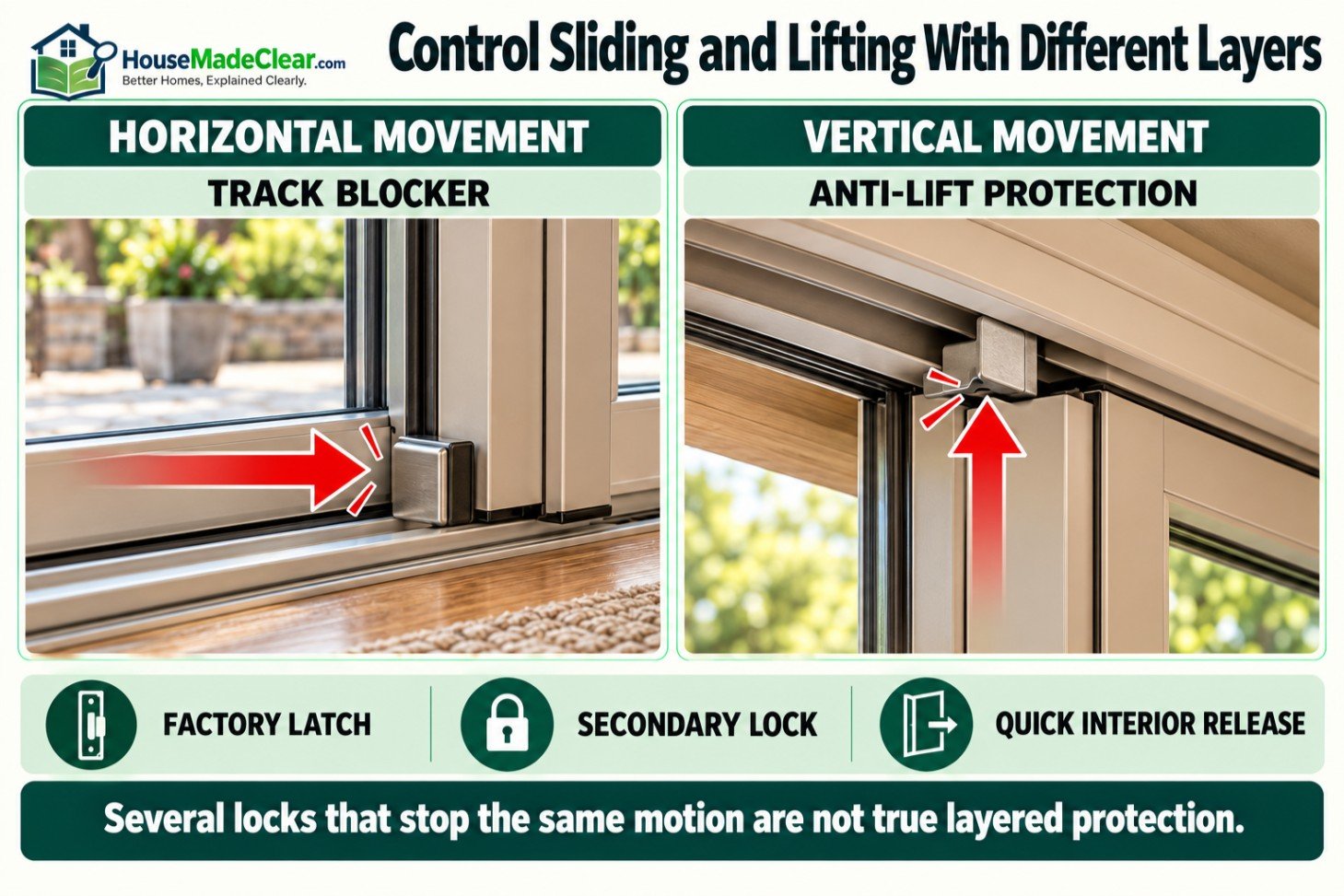
6. Reinforce the Frame and Keeper Area
The latch can remain locked while the keeper or frame separates.
Inspect the structural support around:
- The keeper
- The handle
- The lock case
- The fixed panel
- The frame corners
- The threshold
- The head track
Check for Frame Movement
Apply moderate pressure near the locked edge and watch whether the frame moves independently of the wall.
Movement may indicate:
- Loose installation fasteners
- Deteriorated framing
- Water damage
- Improper shimming
- A damaged door frame
- Separation between frame components
Do Not Add Long Screws Blindly
Longer fasteners are sometimes recommended for door reinforcement, but a sliding-door frame differs from a conventional wood jamb.
A misplaced fastener can:
- Distort an aluminum or vinyl frame
- Interfere with the panel
- Contact glass
- Damage a thermal break
- Block a drainage channel
- Penetrate concealed wiring
- Pull the frame out of square
Fasteners must match the door, frame and wall construction.
For a broader explanation of how locks, frames and strikes work together, see our guide to improving home security with better locks.
7. Inspect and Secure the Fixed Panel
The nonmoving panel should be treated as part of the security assembly.
Depending on the door design, the fixed panel may be held by:
- Retainer clips
- Brackets
- Screws
- Stops
- Frame channels
- Interlocking stiles
- Glazing components
Check whether the fixed panel:
- Moves when pushed
- Has missing retainers
- Separates from the frame
- Rattles excessively
- Has damaged seals
- Appears to have been removed previously
- Leaves an unusual gap at the interlock
Do not add random screws through the frame. Use the manufacturer’s intended retention method or have the panel evaluated professionally.
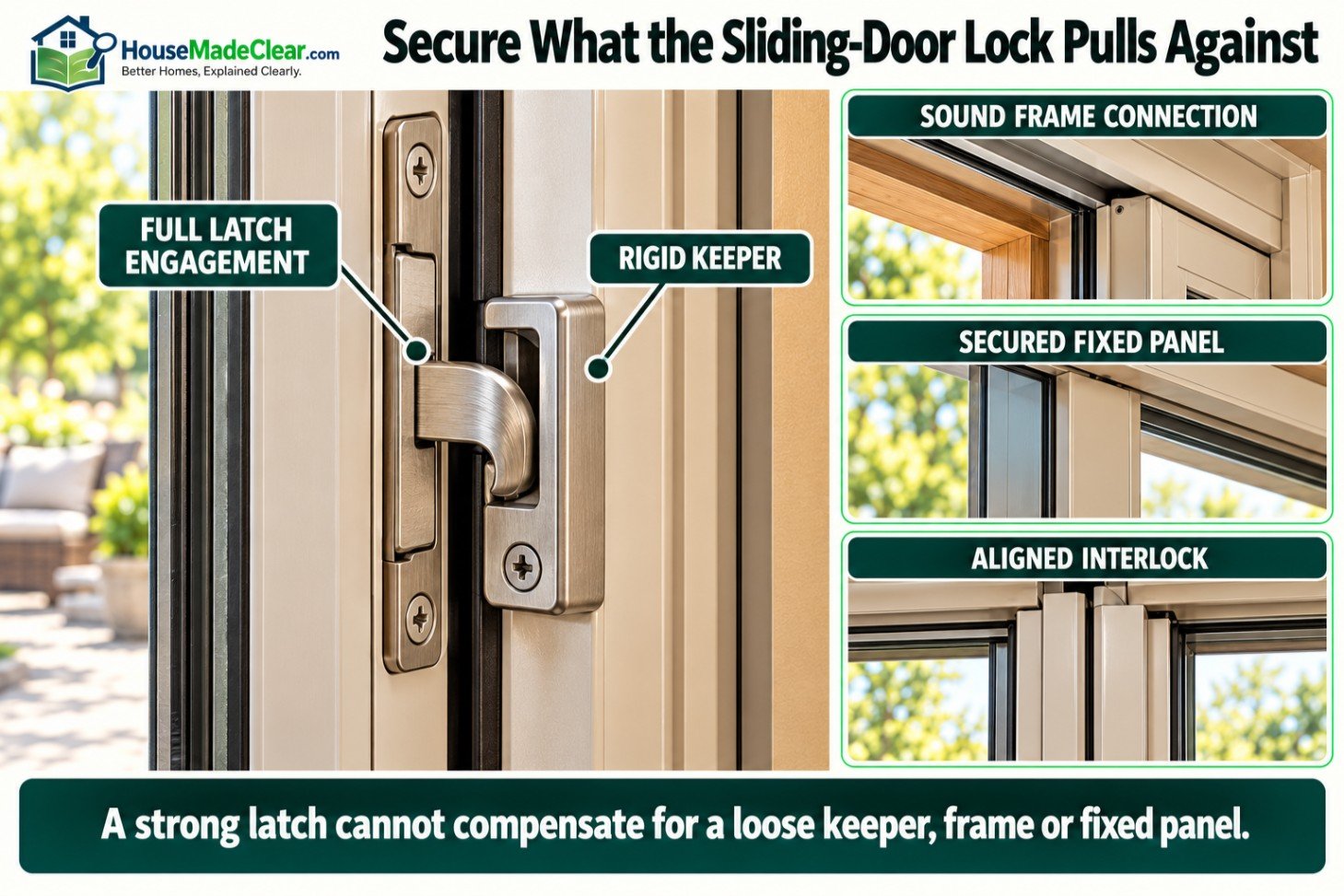
8. Protect the Glass and Glazing System
The glass occupies most of the door’s surface, but glass security is more complicated than simply applying a film.
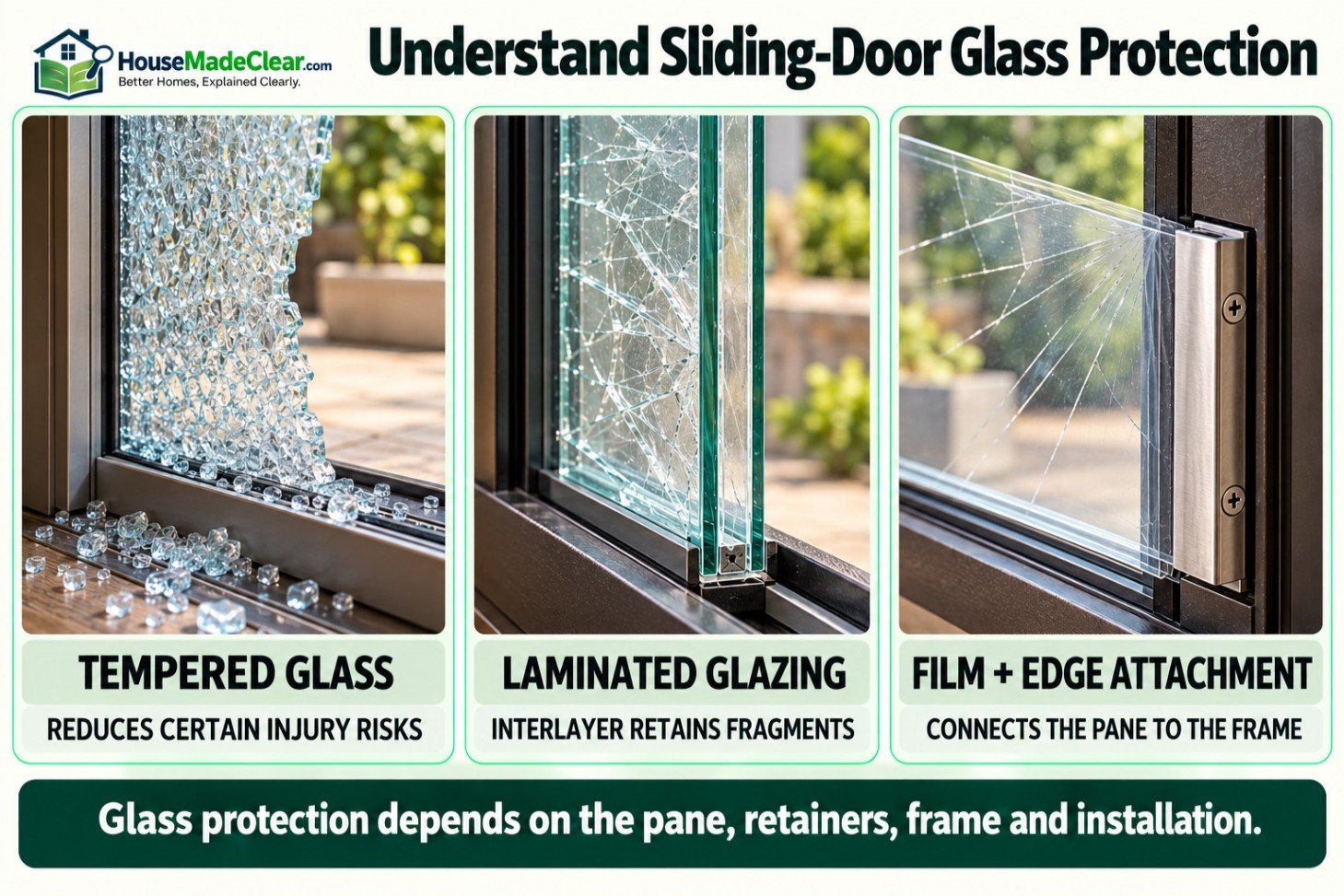
Tempered Glass Is Safety Glass, Not Automatically Security Glass
Tempered glass is designed to break into relatively small pieces rather than large sharp shards. This helps reduce certain injury risks.
It is not the same as laminated security glazing.
Laminated Glass
Laminated glass contains an interlayer that helps retain fragments after breakage. It generally makes rapid penetration more difficult than ordinary tempered glass.
Its performance still depends on:
- Laminate construction
- Glass thickness
- Frame strength
- Edge engagement
- Glazing retainers
- Installation quality
Replacing a patio-door glass unit must account for the door’s weight capacity, roller system and safety-glazing requirements.
Security Film
Professionally installed security film can help hold broken glass together. However, the result depends on the complete system.
Important factors include:
- Film type
- Film thickness
- Glass compatibility
- Application quality
- Curing
- Frame condition
- Edge attachment
- Existing glazing method
A film that holds the broken pane together may provide limited security if the entire filmed sheet can be pushed out of the frame.
Ask whether a compatible attachment system is needed to connect the film and glass to the surrounding frame.
Do Not Apply Unapproved Products
Some glass manufacturers restrict films, coatings or attachments because they can alter heat absorption, thermal stress or warranty coverage.
Confirm compatibility before applying film to:
- Insulated glass
- Low-emissivity glass
- Tinted glass
- Reflective glass
- Coated glass
- Impact-rated glass
9. Add Door, Vibration and Glass-Break Sensors
Electronic detection does not reinforce the door, but it can identify activity and trigger an alert.
Door-Contact Sensor
A contact sensor detects when the moving panel separates from its closed position.
Position it so that:
- Both components remain aligned when closed
- Normal frame movement does not trigger false alarms
- It does not interfere with the panel
- Adhesive is compatible with the frame
- The sensor cannot be easily knocked loose
Vibration or Shock Sensor
A vibration sensor may detect impacts before the door opens.
It requires careful sensitivity adjustment. Excessive sensitivity can produce false alarms from:
- Thunder
- Construction
- Pets
- Door use
- Heavy vehicles
- Wind
- Nearby impacts
Acoustic Glass-Break Sensor
An acoustic sensor listens for sound patterns associated with breaking glass.
Coverage depends on:
- Sensor model
- Room size
- Glass type
- Distance
- Curtains
- Furniture
- Ceiling height
- Room acoustics
Follow the manufacturer’s tested placement and testing procedure.
Alarmed Security Bars and Auxiliary Locks
Some track bars and locks include their own alarm.
Treat the alarm as a detection layer. The mechanical strength of the product still depends on its construction and installation.
10. Improve Lighting and Camera Coverage
A camera does not stop the door from sliding or lifting, but it can increase detection and document activity.
Cover the Approach Route
Position the camera to capture:
- The path leading to the patio
- The area directly in front of the door
- A person’s face
- Both sides of the doorway
- Nearby gates or stairs
Avoid aiming only at the glass. Reflections can make identification difficult.
Prevent Nighttime Glare
Problems can occur when:
- Interior lights reflect from the glass
- A camera’s infrared emitters reflect from the pane
- A bright wall dominates the image
- Exterior lighting shines directly into the lens
- The camera is installed behind the glass
Test the image during both day and night.
Maintain Visibility
Trim vegetation or stored objects that provide concealment around the door.
Do not remove all privacy indiscriminately. The goal is to preserve useful sightlines without exposing the household unnecessarily.
Best Security Options by Door Problem
| Door Problem | First Response | Additional Protection |
|---|---|---|
| Door does not close fully | Clean track and inspect rollers | Adjust or replace rollers |
| Latch misses keeper | Correct panel height and alignment | Reposition compatible keeper |
| Latch or handle is loose | Repair or replace hardware | Add a secondary lock |
| Door slides despite being locked | Repair factory lock | Add a track bar |
| Door lifts noticeably | Inspect rollers and head clearance | Add approved anti-lift protection |
| Fixed panel moves | Repair its retainers | Have frame inspected |
| Glass is easily accessible | Evaluate glazing and frame | Consider laminated glass or attached film |
| Door is in a dark location | Improve lighting | Add correctly positioned camera |
| Landlord prohibits drilling | Use reversible bar and sensors | Request an approved lock upgrade |
| Door is used as an exit | Preserve rapid interior release | Avoid key-dependent devices |
How to Secure a Sliding Glass Door From the Inside
For many homes, a practical interior arrangement includes:
- A correctly working factory latch
- A fitted track bar
- Compatible anti-lift protection
- A secondary lock
- Door and glass detection
Avoid adding so many devices that occupants cannot remember the release sequence.
Everyone who may need to use the door should know:
- Which devices are installed
- How to release each one
- Whether a device is engaged
- Where the clear walking path is
- Whether the door forms part of the emergency plan
How to Secure a Sliding Glass Door From the Outside
Exterior access requires compatible keyed hardware rather than an improvised padlock or hasp.
Before installing a keyed exterior lock, verify:
- Door make and model
- Stile width
- Lock compatibility
- Glass location
- Exterior handle preparation
- Interior emergency release
- Weather resistance
- Key control
- Manufacturer instructions
A locksmith or door specialist may be required because glass and internal lock components can occupy much of the panel.
Do not install a double-keyed arrangement that traps occupants or violates applicable requirements.
How to Secure a Sliding Glass Door Without Drilling
Renters and homeowners who want reversible options can consider:
- Adjustable track bars
- Correctly cut removable dowels
- Clamp-style track locks approved for the track
- Adhesive door-contact sensors
- Freestanding cameras
- Plug-in alarm components
- Improved exterior lighting
- Removable curtains or privacy treatments
Non-drilling devices have limits.
A clamp-style lock may not fit every track. Adhesive sensors can detach. A loose rod can move. None of these options repairs damaged rollers, frames or factory hardware.
Sliding Glass Door Security for Renters
Renters should document existing defects and request repairs in writing.
Report:
- A lock that does not engage
- A loose keeper
- A damaged handle
- Excessive panel movement
- Broken glass
- Missing fixed-panel retainers
- A door that cannot close
- A malfunctioning alarm sensor
- Water-damaged framing
Do not drill into the frame or replace permanent hardware without permission. The lease, building rules, fire requirements and door warranty may restrict modifications.
A renter-friendly setup may include:
- The repaired factory lock
- A removable adjustable bar
- A compatible no-drill track lock
- Adhesive contact sensor
- Interior camera
- Removable window covering
Patio-Door Security Bar Placement
A patio-door security bar may sit:
- In the bottom track
- Between the moving panel and opposite jamb
- At handle height
- On a hinged mounting bracket
The correct placement depends on the product.
A bar positioned above the floor may be easier for an adult to operate and more visible. A bar in the track directly blocks movement but can collect dirt or create a low obstruction.
Check:
- Bar length
- End-pad grip
- Mounting angle
- Release method
- Door-frame strength
- Whether a child can operate it
- Whether it remains stable when the door is shaken
Do not use a pressure bar against weak drywall, decorative trim or an unsupported panel.
Child Safety vs Security
A device intended to prevent a small child from opening the door is not necessarily designed to resist forced entry.
Likewise, a low track lock may improve security while remaining accessible to a child.
If child safety is also a concern, consider:
- A higher secondary lock
- An alarm or chime
- Supervision
- Pool-barrier requirements
- Door-closing behavior
- A product specifically designed for child safety
Where the patio leads to a pool, local barrier and alarm requirements may apply. General burglary-prevention advice is not a substitute for pool-safety compliance.
Sliding Glass Door Emergency-Egress Considerations
Security should not make the door dangerously difficult to open from inside.
The International Residential Code requires at least one qualifying egress door for each dwelling unit and states that the required door must be readily openable from inside without a key or special knowledge or effort. Local codes and amendments determine which requirements apply to a particular property.
Even when a patio door is not the required egress door, it may still be part of the household’s escape plan.
The U.S. Fire Administration advises households to identify two ways out of every room where possible and keep doors and windows unobstructed. It warns that residents may have less than two minutes to escape after a smoke alarm sounds. Review the USFA home fire escape guidance.
Avoid:
- Key-required interior locks
- Hidden release mechanisms
- Several complicated devices
- Heavy furniture blocking the door
- Bars that jam under pressure
- Locks inaccessible to household members
- Devices that require unusual strength
Test the release during a household fire drill without creating a dangerous or simulated emergency.
French Patio Doors Require a Different Approach
Not every patio door slides. Hinged French patio doors rely on an active leaf, inactive leaf, astragal, hinges and top-and-bottom bolts.
Do not apply sliding-door track advice to hinged doors.
See our guide to securing French doors for the correct reinforcement sequence.
When Should You Replace a Sliding Patio Door?
Replacement may be more practical when:
- The frame is badly corroded or distorted
- The door cannot be aligned
- The fixed panel is insecure
- Replacement locks are unavailable
- The rollers and track are severely damaged
- The glass or seals have failed
- The door has repeated water intrusion
- Previous modifications weakened the assembly
- The door cannot accept suitable security hardware
- The household needs improved accessibility
- Energy performance is also poor
Security Features to Compare on a New Door
Ask about:
- Multipoint locking
- Lock and keeper construction
- Anti-lift design
- Fixed-panel retention
- Laminated-glass options
- Frame construction
- Reinforcement
- Exterior keyed access
- Interior emergency operation
- Sensor compatibility
- Replacement-part availability
- Installation requirements
- Applicable testing or certification
Avoid vague claims such as “high security” when the manufacturer does not explain which component, test or performance level supports the claim.
Common Sliding-Door Security Mistakes
Relying Only on the Factory Latch
A factory latch should work correctly, but a secondary layer can limit movement if the primary mechanism is manipulated or fails.
Using an Undersized Dowel
A short dowel can allow the panel to open far enough to create access or disengage components.
Ignoring Vertical Movement
A track bar controls horizontal travel. It does not automatically stop lifting.
Drilling Close to the Glass
Tempered glass can fail after edge or surface damage. Internal components may also occupy the drilling area.
Applying Film Without Considering the Frame
Film may hold broken glass together while the complete pane remains poorly retained.
Installing Too Many Exit Devices
Several locks may delay occupants who are unfamiliar with the door.
Assuming the Screen Door Adds Security
A standard insect screen is not a security barrier. A security screen must be designed, installed and evaluated for that purpose.
Blocking the Door With Furniture
Furniture is an unreliable barricade and can obstruct emergency exit.
Ignoring the Fixed Panel
The fixed panel, retainers and interlock are part of the security assembly.
Replacing Hardware Without Identifying the Door
Similar-looking latches can have different dimensions, hook directions and mounting requirements.
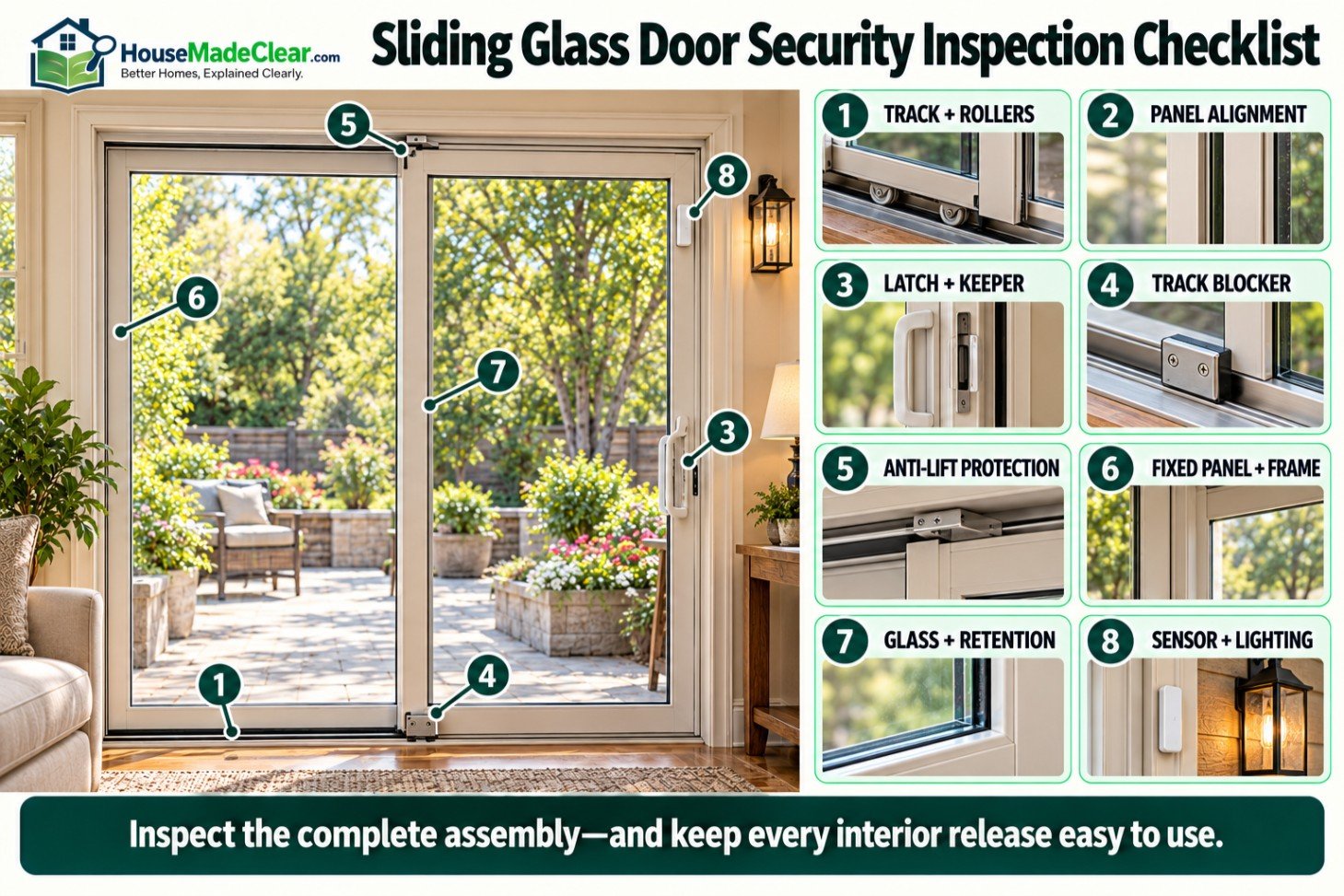
Sliding Glass Door Security Checklist
| Item | What to Verify |
|---|---|
| Track | Clean, straight and undamaged |
| Rollers | Smooth, level and correctly adjusted |
| Panel alignment | Door closes fully without lifting |
| Factory latch | Engages completely |
| Keeper | Secure and undamaged |
| Handle | Tight and operational |
| Track blocker | Correct length and stable |
| Secondary lock | Compatible with the door |
| Anti-lift protection | Limits excessive upward movement |
| Fixed panel | Properly retained |
| Frame | No cracks, corrosion or movement |
| Interlock | Panels overlap correctly |
| Glass | No cracks or damaged edges |
| Glazing retainers | Secure around the pane |
| Security film | Compatible and properly attached |
| Contact sensor | Aligned and tested |
| Glass-break sensor | Suitable for the glass and room |
| Camera | Captures approach and faces |
| Lighting | Covers the doorway without glare |
| Emergency release | Fast and understood by occupants |
| Rental permission | Obtained before permanent changes |
| Manufacturer instructions | Followed for all installed hardware |
Frequently Asked Questions
What is the best way to secure a sliding glass door?
Use several compatible layers: a correctly working factory latch, a fitted track blocker, a secondary lock and anti-lift protection. The frame, fixed panel, rollers and glass must also be in good condition.
Are sliding glass doors easy to break into?
A poorly maintained sliding door can be vulnerable when its latch is weak, the keeper is loose, the panel can be lifted or the track blocker is missing. A correctly installed modern door with layered protection can provide much better resistance.
What can I put in the track of a sliding glass door?
You can use a correctly sized wooden dowel, metal rod, adjustable security bar or purpose-built track blocker. It should prevent meaningful movement while remaining easy to remove from inside.
Does a security bar make a sliding glass door secure?
A security bar helps prevent horizontal sliding, but it does not necessarily prevent the panel from being lifted, the glass from being attacked or the frame from separating. It should be combined with a working lock and anti-lift protection.
How do I stop a sliding glass door from being lifted?
Maintain and correctly adjust the rollers, then use anti-lift blocks, clips, pins or retainers approved for the door. Do not drill into the upper frame without confirming the door’s construction and manufacturer requirements.
Can I put a deadbolt on a sliding glass door?
A conventional hinged-door deadbolt is normally unsuitable. Use a lock specifically designed for the sliding-door stile, frame and operating direction. Confirm that the glass and internal components leave enough room for installation.
Is tempered glass burglar-resistant?
Not necessarily. Tempered glass is primarily safety glazing designed to reduce certain injury risks when broken. Laminated security glazing is designed differently and can make rapid penetration more difficult.
Does security film stop someone from breaking a patio door?
Security film can help hold broken glass together, but it does not make the door impenetrable. Its effectiveness depends on the film, glass, frame and edge-attachment system.
How can I secure a sliding glass door in a rental?
Ask the landlord to repair the factory lock and door alignment. Reversible options can include an adjustable security bar, fitted dowel, approved no-drill track lock and adhesive contact sensor. Obtain permission before drilling or replacing permanent hardware.
Can you secure a sliding glass door from outside?
Yes, with a keyed lock designed for the specific door system. Installation may require professional work because the lock must fit the narrow stile without contacting the glass or internal components.
Should I install a sensor on my sliding patio door?
A door-contact sensor can detect opening, while vibration and glass-break sensors can detect other activity. Sensors add detection but do not replace physical locks, track blockers or frame repairs.
How short should a patio-door dowel be?
It should be only short enough to install and remove conveniently while preventing useful door movement. A large gap defeats its purpose. Measure the closed door’s available track instead of relying on a standard dowel length.
Can I use a broom handle to secure a sliding glass door?
A broom handle may be too short, tapered, cracked or easily displaced. A straight dowel, rod or adjustable security bar fitted to the track is more reliable.
Should a patio door be part of a home fire escape plan?
It can be. If household members may use it during an emergency, every security device must be quickly releasable from inside. Keep the approach clear and include the door in escape drills.
Final Recommendation
Secure a sliding glass door in this order:
- Clean the track.
- Repair roller and panel alignment.
- Restore the factory latch and keeper.
- Add a correctly fitted track blocker.
- Install a compatible secondary lock.
- Limit excessive vertical movement.
- Inspect the fixed panel and frame.
- Evaluate glass and glazing retention.
- Add sensors, lighting and camera coverage.
- Confirm rapid emergency release.
Do not begin with glass film, an alarm or a collection of inexpensive gadgets while the door itself fails to close and lock correctly.
A layered system works only when each component addresses a different weakness.






[…] How to Secure a Sliding Glass Door: Patio Door Security Guide […]