

















A rug that moves whenever you walk across it needs better support underneath. Straightening it repeatedly will not solve the problem.
For many rugs on hard floors, a compatible nonslip pad is the best starting point. Other situations need a different approach. A curling corner may need an edge gripper, while a rug that creeps across carpet needs a product designed for that surface.
The floor matters too. A backing that grips tile may be unsuitable for vinyl or a particular hardwood finish.
This guide explains how to identify the problem, choose a suitable method, and install it without creating raised edges or damaging the floor.
Quick Answer
To keep rugs from sliding:
- Clean the floor and allow it to dry completely.
- Check whether the whole rug moves, the corners curl, or the middle bunches.
- Use a nonslip pad approved for the rug and flooring.
- Choose carpet-specific support when placing a rug over carpet.
- Add compatible corner grippers if the edges still lift.
- Check the rug during normal walking and door movement.
Keep the pad inside the rug’s edges and follow its installation instructions.
Check floor compatibility before using rubber backing, rug tape, or adhesive grippers. If a loose rug continues to create a trip hazard, remove it from the walking route.
Best Ways to Keep Rugs From Sliding at a Glance
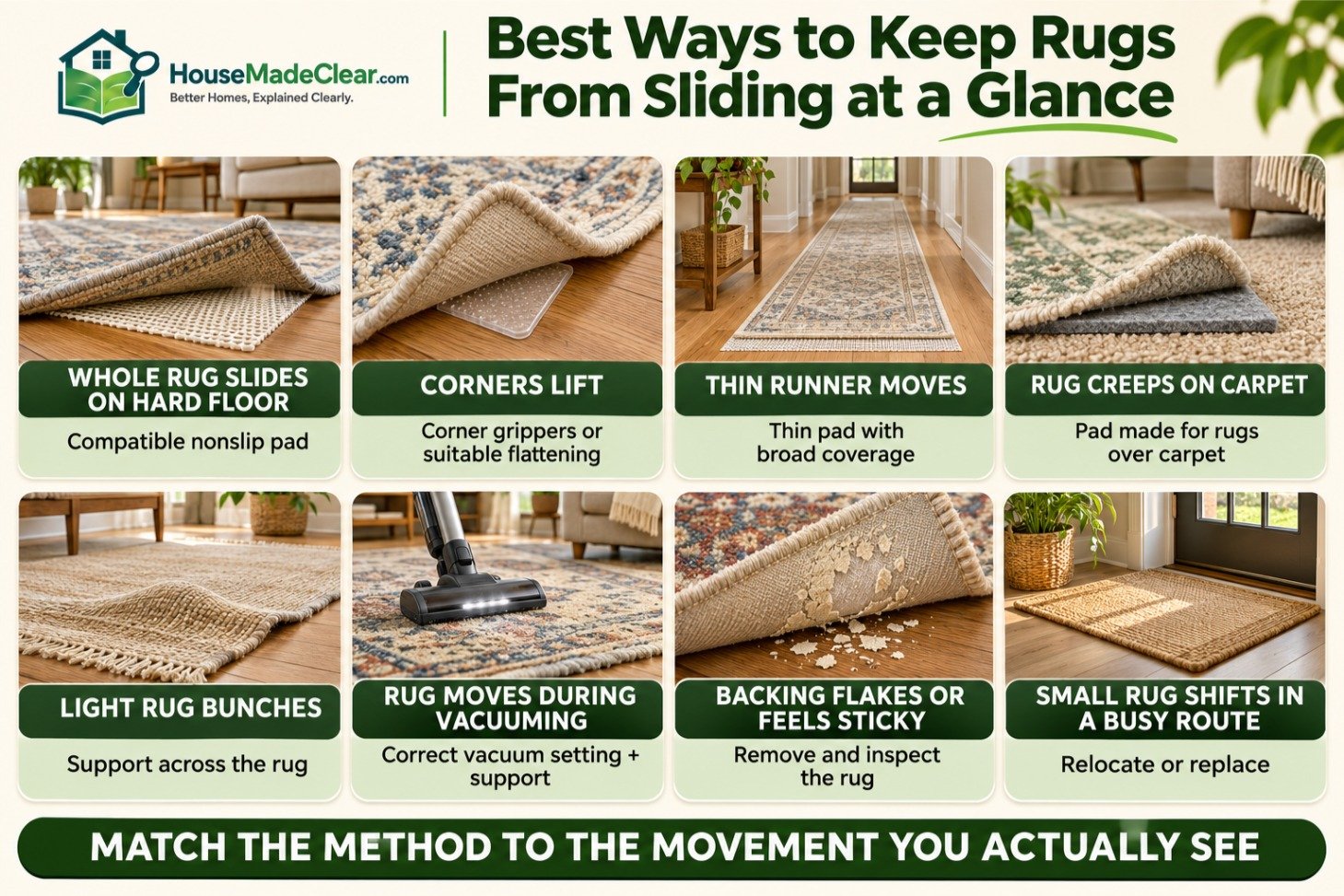
Choose the method that matches the movement you see.
| Rug Problem | First Method to Consider | Main Check |
|---|---|---|
| Entire rug slides across a hard floor | Nonslip rug pad | Compatibility with the floor finish |
| Rug stays mostly in place but corners lift | Corner grippers or an appropriate flattening method | Whether the backing can accept the product |
| Thin runner moves along a hallway | Thin nonslip pad with broad coverage | Door clearance and flat edges |
| Rug creeps across wall-to-wall carpet | Pad made for rugs over carpet | Compatibility with carpet type |
| Lightweight rug bunches in the middle | Better support across the rug | Whether the rug remains flat during use |
| Rug moves only during vacuuming | Adjusted vacuum setting and suitable support | Rug-care instructions |
| Old backing flakes or feels sticky | Remove the rug and inspect the backing | Whether the backing needs repair or replacement |
| Small rug repeatedly shifts in a busy route | Relocation or replacement | Whether the location needs a rug at all |
A small corner gripper can help an edge lie flat. A rug that moves across its full length usually needs support over a larger area.
Why Do Rugs Slide?
Rug movement usually comes from the surface underneath, the rug’s construction, or the way people use the area.
1. The Floor and Backing Have Too Little Grip
A lightweight rug with a smooth backing can move easily across polished flooring.
This is common with:
- Small accent rugs
- Thin cotton rugs
- Lightweight runners
- Rugs with worn backing
- Rugs placed directly on smooth tile
Check the underside before buying anything. A rug sold with an integrated nonslip backing may need cleaning or replacement if that backing has deteriorated.
2. Dust or Cleaning Residue Is Underneath
Dust, grit, and residue can interfere with contact between the floor and the pad.
Lift the rug and check for:
- Loose debris
- Pet hair
- Fine dust
- Damp patches
- Sticky residue
- Pieces of deteriorating backing
Clean according to the flooring instructions. Let the area dry fully before replacing the rug.
3. The Pad Provides Cushioning but Insufficient Grip
Some pads primarily add softness. Others provide grip, or combine both functions.
A plain felt pad may be useful beneath a large, furniture-supported rug. A small freestanding runner often needs a pad specifically designed to resist slipping.
Check the product’s intended use. Thickness alone tells you little about its grip.
4. Traffic Pushes the Rug in One Direction
Movement can be concentrated where people:
- Turn at a hallway corner
- Step through a doorway
- Pull out dining chairs
- Roll an office chair
- Walk around a kitchen island
Watch the rug during everyday use. Its movement may reveal a door catching the edge or a chair repeatedly pushing the same section.
1. Use a Compatible Nonslip Rug Pad
A pad that supports most of the rug is a useful first option when the whole rug moves on a hard floor.
It can help:
- Reduce sliding
- Support the rug beneath foot traffic
- Add cushioning where needed
- Separate rough backing from the floor
What Should You Check Before Buying?
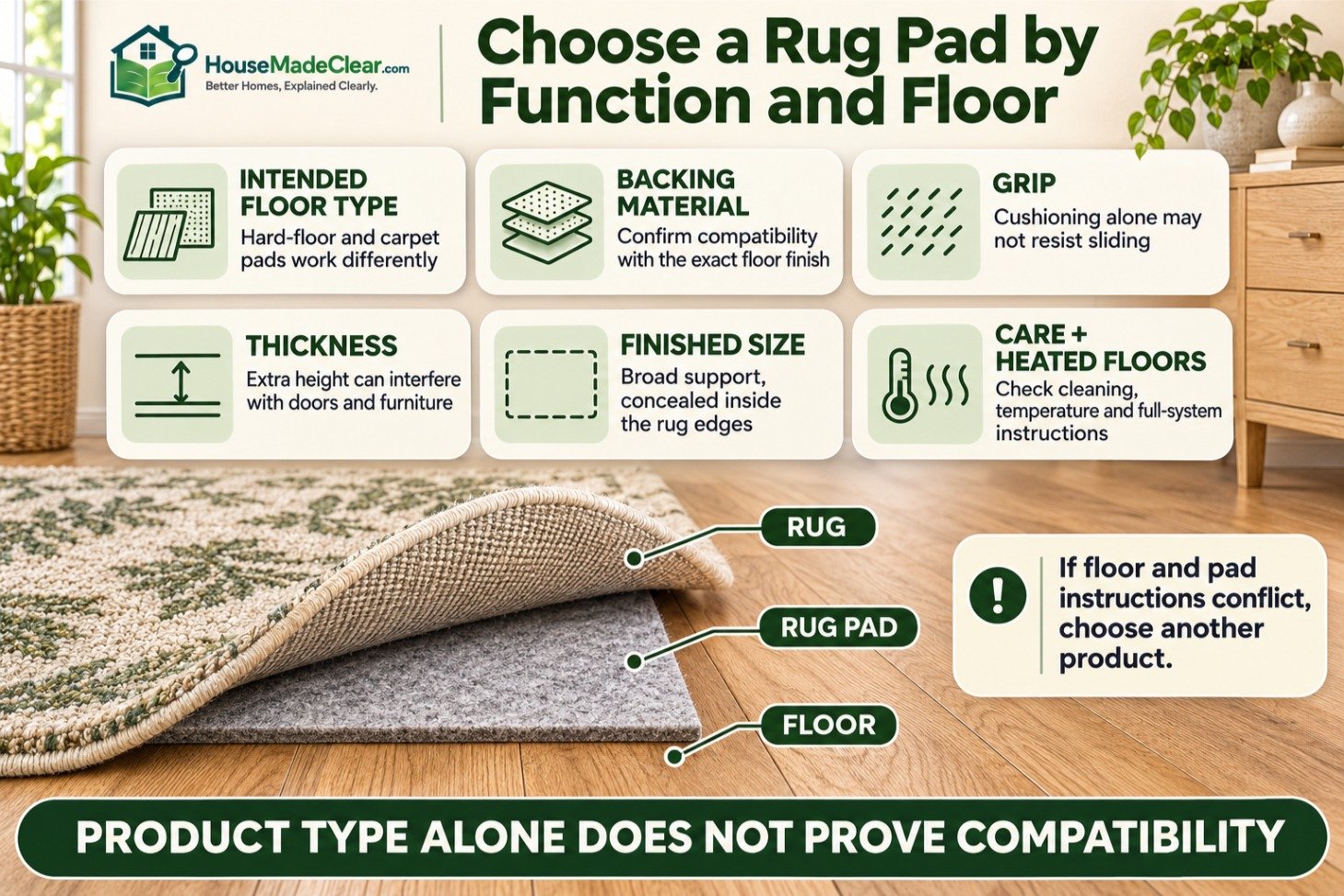
| Product Detail | Why It Matters |
|---|---|
| Intended floor type | Hard-floor and carpet products work differently |
| Backing material | Some materials can affect certain finishes |
| Grip description | A cushioning pad may provide limited slip resistance |
| Thickness | Added height can interfere with doors |
| Finished dimensions | The pad should remain concealed beneath the rug |
| Cleaning instructions | Some pads need washing, while others require different care |
| Heated-floor suitability | The complete floor, pad, and rug combination must be suitable |
Confirm compatibility with the flooring care guide and the pad manufacturer.
If those instructions conflict, choose another product or ask the flooring manufacturer which material is acceptable.
Should the Pad Cover the Entire Rug?
Follow the pad maker’s sizing guidance. The pad should provide broad support while remaining inside the rug’s edges.
A pad that is much too small may leave long stretches of lightweight rug unsupported. A pad that extends beyond the rug can become visible and create an exposed edge.
Measure the finished rug before ordering. Our standard rug sizes guide explains why actual dimensions can differ from the advertised size.
2. Use Corner Grippers for Lifting Edges
Corner grippers can help when the main body of the rug stays in place but a corner curls upward.
They are most useful for:
- Thin rugs with lifting corners
- Runners with raised ends
- Rugs that catch a shoe at one edge
- Corners that lift during vacuuming
Check How the Gripper Attaches
Products vary. A gripper may attach to:
- The rug only
- The floor and rug
- A separate reusable base
Check all surfaces the product contacts.
A gripper that works on one synthetic backing may fail on a loose weave. Adhesive may also damage delicate fibers or leave residue.
When Are Corner Grippers Insufficient?
Look for another solution if:
- The whole rug moves
- The center develops ripples
- The backing is breaking apart
- The gripper creates a raised lump
- The corner repeatedly lifts despite installation
Inspect both the rug and pad before adding more pieces.
3. Consider Rug Tape When Both Surfaces Allow It
Rug tape can be useful where a suitable product is approved for the floor and rug.
It requires more care than placing a removable pad.
Questions to Answer First
Check whether the tape is suitable for:
- The exact floor material
- The floor finish or sealer
- The rug backing
- Heated flooring, if present
- The intended period of use
- Removal without damage
A label saying “removable” does not establish compatibility with every finish.
Read the removal instructions before application. Some products require a particular removal direction or procedure.
Where Should the Tape Go?
Use the placement pattern specified by the manufacturer.
Avoid building up overlapping strips. Uneven layers can create bumps beneath a thin rug.
If the tape stops holding, remove it using the approved method. Clean the surfaces as directed before applying a replacement.
Should You Test It First?
Follow any testing instructions, but recognize the limits of a short test.
A brief application may reveal immediate adhesive problems. It cannot prove that prolonged contact will leave every floor unchanged.
For a delicate, unfamiliar, or recently refinished surface, get compatibility guidance before attaching tape.
4. Use a Carpet-Specific Pad Over Carpet
A rug over wall-to-wall carpet can creep even when the underlying carpet feels secure.
The pile beneath it compresses and changes direction as people walk. The upper rug can gradually shift or develop wrinkles.
What Should You Use?
Choose a product explicitly designed for:
- An area rug over carpet
- The underlying carpet’s pile and construction
- The rug’s backing
- The intended traffic level
Follow the instructions for which side faces down. The orientation may differ from a hard-floor pad.
What If the Rug Still Wrinkles?
Check whether:
- The underlying carpet has loose areas
- The rug is too flexible for the location
- A chair repeatedly pushes it
- The pad is undersized
- The product is unsuitable for the carpet pile
Loose or rippled wall-to-wall carpet may need professional attention.
If the upper rug continues to bunch during normal use, reconsider using it in that location.
5. Correct the Rug’s Position Within the Furniture Layout
Furniture weight can help stabilize parts of a larger rug.
This works best when the rug already fits the furniture arrangement.
Where Can Furniture Help?
Common examples include:
- Sofa front legs resting securely on the rug
- A bed positioned over part of a bedroom rug
- A stable coffee table fully supported by the rug
- Stationary seating on a sufficiently large area rug
Keep furniture level. Avoid placing a narrow leg directly on a thick, sloping rug edge.
Our functional living room layout guide explains how to position rugs within a seating group.
Check the Exposed Area Separately
A sofa may hold one end while the free edge still moves.
Inspect:
- Corners beside the sofa
- Sections extending into a walkway
- The area where people approach a chair
- Edges near the coffee table
Add compatible support where needed. Furniture placement alone may leave exposed parts unstable.
How to Keep Rugs From Sliding on Different Floors
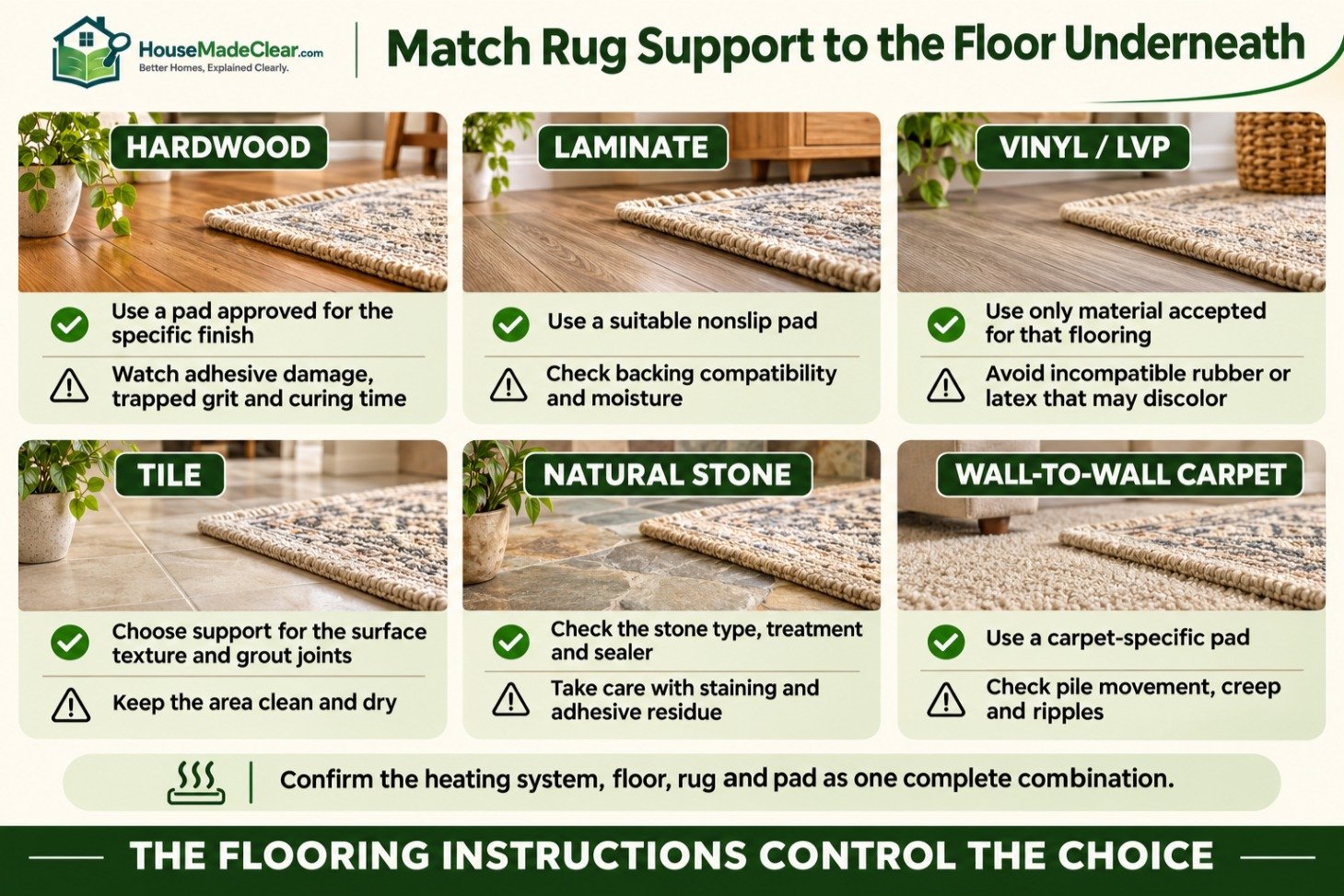
The flooring instructions should guide your choice of pad or gripper.
| Floor Type | Starting Approach | Particular Concern |
|---|---|---|
| Hardwood | Pad approved for the specific finish | Adhesive damage, trapped grit, finish compatibility |
| Laminate | Suitable nonslip pad | Backing compatibility and moisture underneath |
| Vinyl or LVP | Pad specifically accepted for that flooring | Possible discoloration from incompatible materials |
| Ceramic or porcelain tile | Compatible grippy pad | Surface texture, grout joints, and dampness |
| Natural stone | Product suitable for the stone and sealer | Staining and adhesive residue |
| Wall-to-wall carpet | Carpet-specific rug pad | Creep, pile movement, and ripples |
Hardwood Floors
Check the floor finish and its care instructions.
Particular care is needed with:
- Recently refinished floors
- Waxed surfaces
- Specialty coatings
- Floors with existing finish damage
Ask how long a new finish must cure before covering it. A floor may be ready for walking before it is ready for rugs.
Lift the rug periodically and remove trapped grit using the approved cleaning method.
Vinyl and Luxury Vinyl Plank
Vinyl compatibility needs close attention.
Shaw advises using mats without rubber or latex backing on its resilient vinyl floors because those materials can cause discoloration. Apply the instructions for your own flooring product when choosing a pad.
Check both layers:
- The rug’s existing backing
- The pad placed underneath it
A compatible pad does not automatically establish that the complete combination is suitable.
Tile Floors
Check whether the surface is smooth, textured, or uneven.
A thin pad may behave differently across deep grout joints than across a smooth tile surface.
In kitchens and entryways:
- Clean beneath the rug
- Dry spills promptly
- Keep the pad flat
- Check that moisture is not trapped underneath
Choose support for the actual surface and location.
Natural Stone
Stone type, surface treatment, and sealer can affect compatibility.
Ask for guidance specific to the stone before using adhesive products or unfamiliar backings.
Take particular care with porous or light-colored surfaces where marks may be difficult to remove.
Heated Floors
Check the heating system, flooring, rug, and pad instructions together.
Confirm any requirements covering:
- Suitable backing materials
- Temperature limits
- Total covering thickness
- Thermal resistance
- Areas that must remain uncovered
Choose a product only after the complete combination has been confirmed suitable.
How to Install a Rug Pad Step by Step
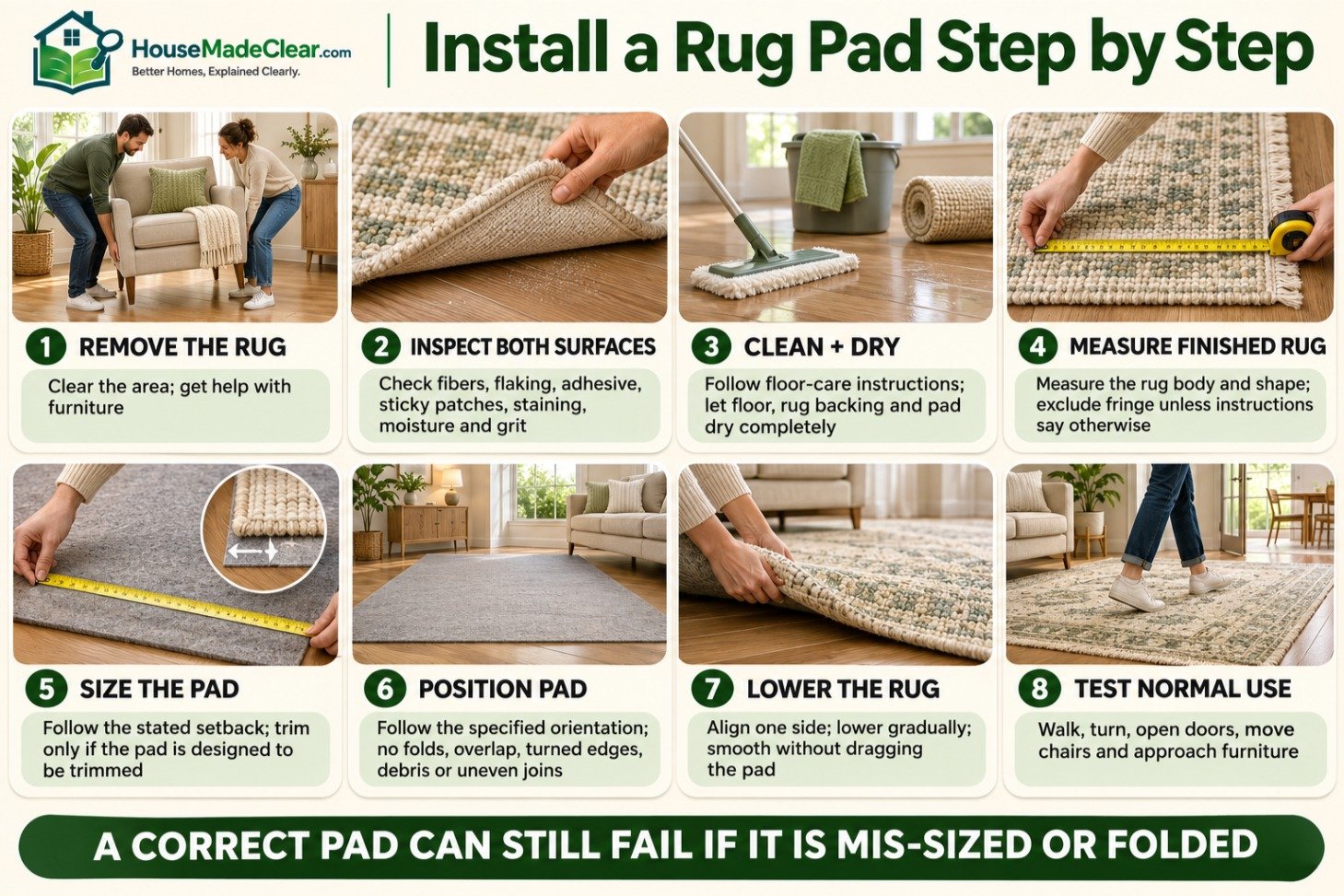
Correct installation helps you identify whether the problem comes from the product, its size, or its placement.
Step 1: Remove the Rug
Clear the nearby area so you can work without leaving a folded rug across the doorway.
Get help moving heavy furniture where necessary. Lift furniture using an appropriate method to protect the floor.
Step 2: Inspect Both Surfaces
Check the rug backing and floor for:
- Loose fibers
- Flaking material
- Old adhesive
- Sticky patches
- Staining
- Moisture
- Grit
If the backing is deteriorating, address that condition before installing a new pad.
Step 3: Clean and Dry
Follow the floor-care instructions.
Clean the pad separately if its instructions require it. Allow the floor, rug backing, and pad to dry fully before assembly.
Step 4: Measure the Finished Rug
Measure the rug body where the pad will sit.
Include any shape variations. Exclude fringe from the supported footprint unless the pad manufacturer says otherwise.
Step 5: Size the Pad
Follow the manufacturer’s specified setback from the rug edges.
Some pads arrive already reduced from the selected rug size. Check before cutting.
Trim only products designed to be trimmed.
Step 6: Position the Pad
Lay it flat in its specified orientation.
Check for:
- Folds
- Overlapping sections
- Turned-under edges
- Debris beneath it
- Uneven joins
Step 7: Lower the Rug Into Place
Align one side and gradually lower the rest.
Smooth the rug without dragging the pad into a fold. Get assistance with large rugs so the pad stays aligned.
Step 8: Check Normal Use
Inspect the setup while:
- Walking across it normally
- Turning at the edge
- Opening nearby doors
- Pulling out chairs
- Approaching furniture
If anything moves, catches, or wrinkles, adjust the setup before returning the area to normal use.
What Size Rug Pad Do You Need?
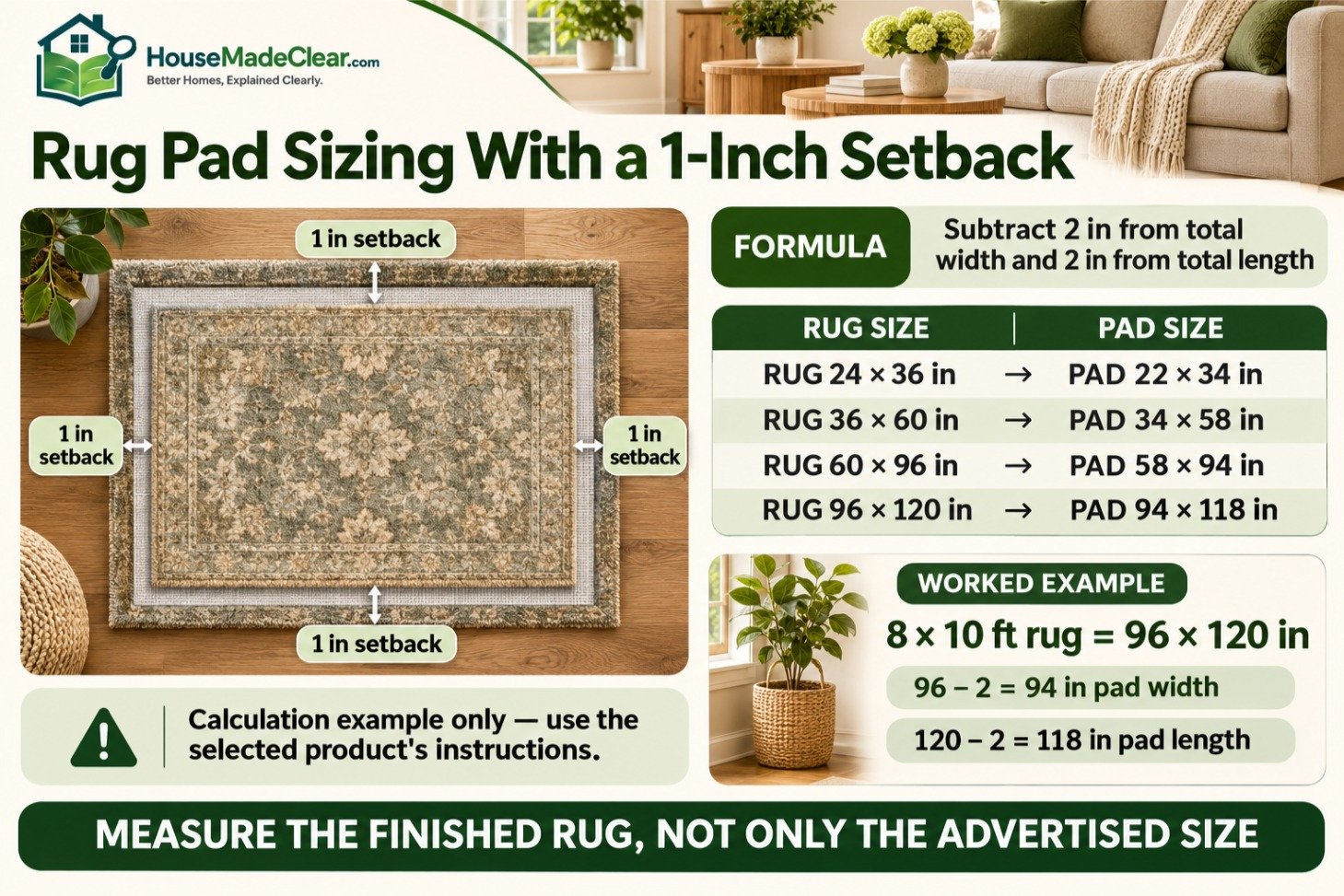
Use the finished rug measurement and the selected pad’s instructions.
The following example assumes a product that calls for a 1-inch setback on each edge.
That means subtracting 2 inches from the total width and 2 inches from the total length.
| Actual Rug Measurement | Example Pad Measurement | Setback |
|---|---|---|
| 24 × 36 inches | 22 × 34 inches | 1 inch on each edge |
| 36 × 60 inches | 34 × 58 inches | 1 inch on each edge |
| 60 × 96 inches | 58 × 94 inches | 1 inch on each edge |
| 96 × 120 inches | 94 × 118 inches | 1 inch on each edge |
These are calculation examples. Use a different setback if the product instructions specify one.
Example for an 8 × 10-Foot Rug
Suppose the finished rug measures exactly 96 × 120 inches.
For the example setback:
- Pad width is 96 − 2 = 94 inches
- Pad length is 120 − 2 = 118 inches
Centering the pad leaves the intended margin on all four sides.
Measure first. A rug sold as 8 × 10 feet may have different finished dimensions.
Does a Thicker Pad Prevent More Sliding?
Grip and thickness serve different purposes.
A thicker pad may add cushioning, but it can also:
- Increase the edge height
- Reduce door clearance
- Change how furniture sits
- Feel too soft beneath a thin rug
Choose the grip needed first, then the thickness appropriate for the location.
How to Keep Hallway Runners From Moving
Runners often shift because they receive repeated traffic along a narrow path.
Start with a thin, compatible nonslip pad that supports most of the runner.
Check Nearby Doors
Open every door beside the runner.
Watch for:
- A door sweeping the rug sideways
- The bottom edge catching a corner
- The runner folding near the threshold
- Insufficient clearance after adding a pad
If the door catches, choose a suitable thinner combination or change the placement.
Check Turning Points
A runner may stay straight along the hallway but shift where someone turns into a room.
Inspect that section during normal movement. Localized grippers may help if they are compatible, but broad movement still needs broader support.
Remove the runner from use if it continues to bunch across the route.
How to Stop Rugs From Bunching Under Chairs
A dining or office chair can push a flexible rug into folds even when other parts stay in place.
Dining Chairs
Check whether the chair stays on the rug when pulled out for sitting.
A chair repeatedly crossing the edge can catch and displace it.
The solution may involve changing the rug size or placement alongside adding suitable support.
Office Chairs
Roll the chair through the area you normally use.
Check whether:
- The wheels catch the binding
- The rug gathers behind the chair
- The pad shifts separately
- The rug becomes an obstacle when standing
Choose a surface intended to work with the chair and floor. If a chair mat is used, it also needs to suit the underlying surface.
Allow space for the chair’s full movement. Our desk-chair clearance guide explains how to check that area.
How to Keep Rugs From Moving During Vacuuming

A vacuum can pull up a lightweight rug even when ordinary walking causes little movement.
Check the rug-care instructions and the vacuum settings.
Possible adjustments include:
- Reducing suction
- Selecting the correct rug setting
- Disabling the rotating brush where appropriate
- Using a suitable attachment
- Keeping the vacuum clear of fringe
Follow the care instructions for the particular rug. Delicate, loose-weave, or handmade rugs may need a different cleaning approach.
After cleaning, check that the pad has stayed aligned.
If the rug also moves underfoot, review its support separately.
Can You Use DIY Methods to Stop a Rug From Sliding?
Household shortcuts can create problems with cleaning, removal, or floor compatibility.
| DIY Method | Main Concern | Better Starting Point |
|---|---|---|
| Hot glue on the backing | Alters the rug and creates uneven contact | Purpose-made compatible pad |
| Silicone caulk stripes | Adds a material with uncertain rug and floor compatibility | Support approved for both surfaces |
| Shelf liner | May have unsuitable backing or insufficient durability | Product designed for rug use |
| Duct tape | Residue and possible finish damage | Approved removable rug product |
| Several stacked pads | Extra height and movement between layers | One suitable pad system |
| Heavy objects placed on corners | Obstructs the walking area | Correct the corner or relocate the rug |
Avoid experimenting on a valuable rug or unfamiliar floor finish.
A purpose-made product still needs a compatibility check. Product category alone does not guarantee suitability.
Why Does a Rug Still Slide With a Pad?
Use the remaining movement to narrow down the cause.
| What Happens | Possible Cause | What to Check |
|---|---|---|
| Rug and pad move together | Insufficient floor grip | Product suitability, dirt, moisture, or pad wear |
| Rug moves while pad stays | Poor contact with the backing | Rug-side compatibility and pad orientation |
| Edges move while center stays | Limited support near the perimeter | Pad sizing and corner condition |
| Center wrinkles | Flexible rug, displaced pad, or chair pressure | Support and everyday use |
| Only one end moves | Door or repeated turning traffic | Door swing and route through the area |
| Movement returns after cleaning | Dampness, residue, or incorrect reassembly | Drying, cleaning method, and alignment |
| Backing leaves particles | Material deterioration | Rug repair or replacement |
| Rug feels bulky and unstable | Excessive thickness or layered products | A suitable thinner system |
Change one factor at a time.
For example, clean and dry the floor, then reinstall the existing pad correctly before deciding whether the product needs replacing.
When Should You Remove or Replace a Rug?
Remove the rug from use if it:
- Repeatedly bunches in a main walking route
- Has an edge that continues to catch feet
- Interferes with a mobility aid
- Has backing that is sticky or breaking apart
- Cannot stay flat with suitable support
- Is repeatedly caught by a door
In a household with someone at increased risk of falling, reconsider small loose rugs altogether. The National Institute on Aging recommends avoiding throw rugs and small area rugs in its room-by-room fall-prevention guidance. See its home fall-prevention advice.
Check Beneath the Rug Before Replacing It
A new rug will not resolve a raised cable or other obstruction beneath the old one.
Keep electrical cords out from under rugs. For surface-routing options, see our guide to hiding TV cords without cutting into the wall.
Common Rug-Gripping Mistakes
Choosing by Material Name Alone
“Rubber,” “felt,” or “vinyl” does not describe every ingredient or establish suitability for every floor.
Check the exact product and floor-care instructions.
Buying Extra Thickness to Solve Movement
Additional cushioning can leave the grip problem unresolved while increasing the edge height.
Choose support for the actual cause.
Applying More Tape Over Failed Tape
Old layers can create bumps and prevent even contact.
Remove failed material using the approved method before replacing it.
Covering a Damp Floor
Moisture underneath needs attention before the rug goes back.
Dry the area and find the source if dampness keeps returning.
Securing the Middle While Ignoring the Edges
Inspect every exposed corner, particularly beside doorways and turning points.
A stable center does not establish that the whole setup is usable.
Rug Stability Checklist
Before finishing, confirm:
- The floor and rug backing are clean and dry
- The backing is in good condition
- The support is suitable for the floor finish
- The pad is installed in the specified orientation
- The pad remains inside the rug perimeter
- No layers are folded or overlapping
- Doors open without catching
- Chairs move without gathering the rug
- Exposed corners lie flat
- Electrical cords are routed elsewhere
- The rug stays stable during normal use
- Everyone using the room can cross the area comfortably
Recheck after washing, furniture movement, or a change in how the room is used.
Frequently Asked Questions
What is the best way to keep a rug from sliding?
For many rugs on hard floors, start with a compatible nonslip pad that supports most of the rug. Use a carpet-specific product over carpet. If only the corners lift, suitable corner grippers may address that localized problem.
How can I keep a rug in place without tape?
Use a nonslip pad approved for the rug and flooring. Check the grip, thickness, orientation, and size. This also allows the rug to be lifted for cleaning.
Is rug tape safe for hardwood floors?
Suitability depends on the tape and the floor finish. Check both manufacturers’ instructions before application. Be especially careful with newly refinished, waxed, or damaged surfaces.
Can I use a rubber rug pad on vinyl plank flooring?
Check your flooring manufacturer’s instructions. Some manufacturers warn against rubber and latex backings because of possible discoloration. Choose a product specifically accepted for your vinyl flooring.
Why does my rug move on carpet?
The carpet pile can compress and change direction during use, allowing the upper rug to creep. Try a carpet-specific pad and check whether the underlying carpet is secure. Persistent rippling may mean the combination is unsuitable for that location.
Should a rug pad be the same size as the rug?
The pad should usually sit inside the rug’s edges. Follow the selected product’s sizing instructions and measure the finished rug before ordering or trimming.
Do corner grippers work for a large sliding rug?
They may help lifting corners, but broad movement often needs support across a larger area. Check pad suitability before adding localized products.
How often should I replace a rug pad?
Follow the product’s care and replacement guidance. Inspect it when cleaning underneath. Replace it if it deteriorates, becomes sticky, leaves residue, or loses grip despite correct cleaning and installation.
Final Thoughts
Start by identifying where the movement occurs. Choose compatible support for that problem and the floor underneath.
Clean, measure, and install carefully. Then check doors, chairs, corners, and normal walking before treating the job as finished.
If the rug continues to obstruct safe movement, relocate it or choose a more suitable floor covering.









[…] How to Keep Rugs From Sliding: Methods for Every Floor Type […]
[…] How to Keep Rugs From Sliding: Methods for Every Floor Type […]