
















Painting a room can take anywhere from a few hours to several days, depending on its size, wall condition, number of coats, and how much preparation is required.
For a typical 12 × 12-foot bedroom with standard ceilings, a homeowner working alone might spend approximately 6–10 hours actively preparing, painting, and cleaning up. The total project may extend across one or two days because the first coat needs time to dry before the second coat.
A professional painter or experienced crew may complete the same work faster, although drying and recoating requirements still apply.
The main mistake homeowners make when estimating painting time is counting only the time spent rolling paint onto walls.
Moving furniture, protecting floors, repairing holes, taping trim, cutting in edges, waiting between coats, and cleaning up can take as long as—or longer than—the painting itself.
This guide explains how long it takes to paint different room sizes, how much time to allow for two coats, what slows down the process, and how to plan a realistic one-day or weekend painting project.
Quick Answer
Painting the walls of an average-sized room generally takes about 4–10 hours of active DIY work, depending on preparation and experience.
- Small bathroom or compact room: Approximately 3–6 active hours
- 10 × 10-foot bedroom: Approximately 4–8 active hours
- 12 × 12-foot bedroom: Approximately 6–10 active hours
- 15 × 15-foot living room: Approximately 7–12 active hours
- Large or complicated room: 10–18 hours or more
These are practical planning estimates for two wall coats on generally sound surfaces, not guaranteed production rates.
Allow additional elapsed time for primer, paint recoating, ceilings, trim, repairs, and final curing. Check the paint manufacturer’s label or technical data sheet for the correct drying and recoating interval.
How Long Does It Take to Paint a Room? Size Comparison Chart
Room size is an important factor, but it does not tell the whole story.
The wall area, number of windows and doors, ceiling height, and amount of trim all affect the total work.
| Room Size | Example Room | Estimated Active DIY Time | Typical Project Window |
|---|---|---|---|
| 5 × 8 ft | Small bathroom | 3–6 hours | 1 day or longer |
| 10 × 10 ft | Small bedroom | 4–8 hours | 1–2 days |
| 12 × 12 ft | Standard bedroom | 6–10 hours | 1–2 days |
| 12 × 15 ft | Medium bedroom | 6–11 hours | 1–2 days |
| 15 × 15 ft | Living room | 7–12 hours | 1–2 days |
| 15 × 20 ft | Large living room | 9–15 hours | 1–3 days |
| 20 × 20 ft | Large open room | 10–18+ hours | 2–3 days or more |
These figures are illustrative planning estimates, assuming one homeowner, ordinary wall heights, two coats, straightforward surface preparation, and wall painting only.
Major drywall repairs, additional coats, painted ceilings, extensive trim, textured walls, or high ceilings can increase the timeline considerably.
Likewise, a skilled painter working in an empty room may finish much faster than a first-time DIY painter working around furniture.
If you are unsure which room measurements to use, our guide to standard bedroom sizes explains common bedroom dimensions and how room size affects furniture planning. Those measurements can also help you estimate wall area before painting.

How Long Does It Take to Paint a 12 × 12 Room?
A 12 × 12-foot bedroom is a useful example because it represents a common residential room size.
Assume:
- Room length: 12 feet
- Room width: 12 feet
- Ceiling height: 8 feet
- Four walls
- One door
- Two windows
- Generally sound painted drywall
- Two coats of interior wall paint
The total gross wall area is:
(12 + 12 + 12 + 12) × 8 = 384 square feet
The actual paintable area will be lower after accounting for windows and doors.
However, estimating labor time requires considering the edges around those openings.
Even though windows reduce the painted surface area, they add cutting-in work.
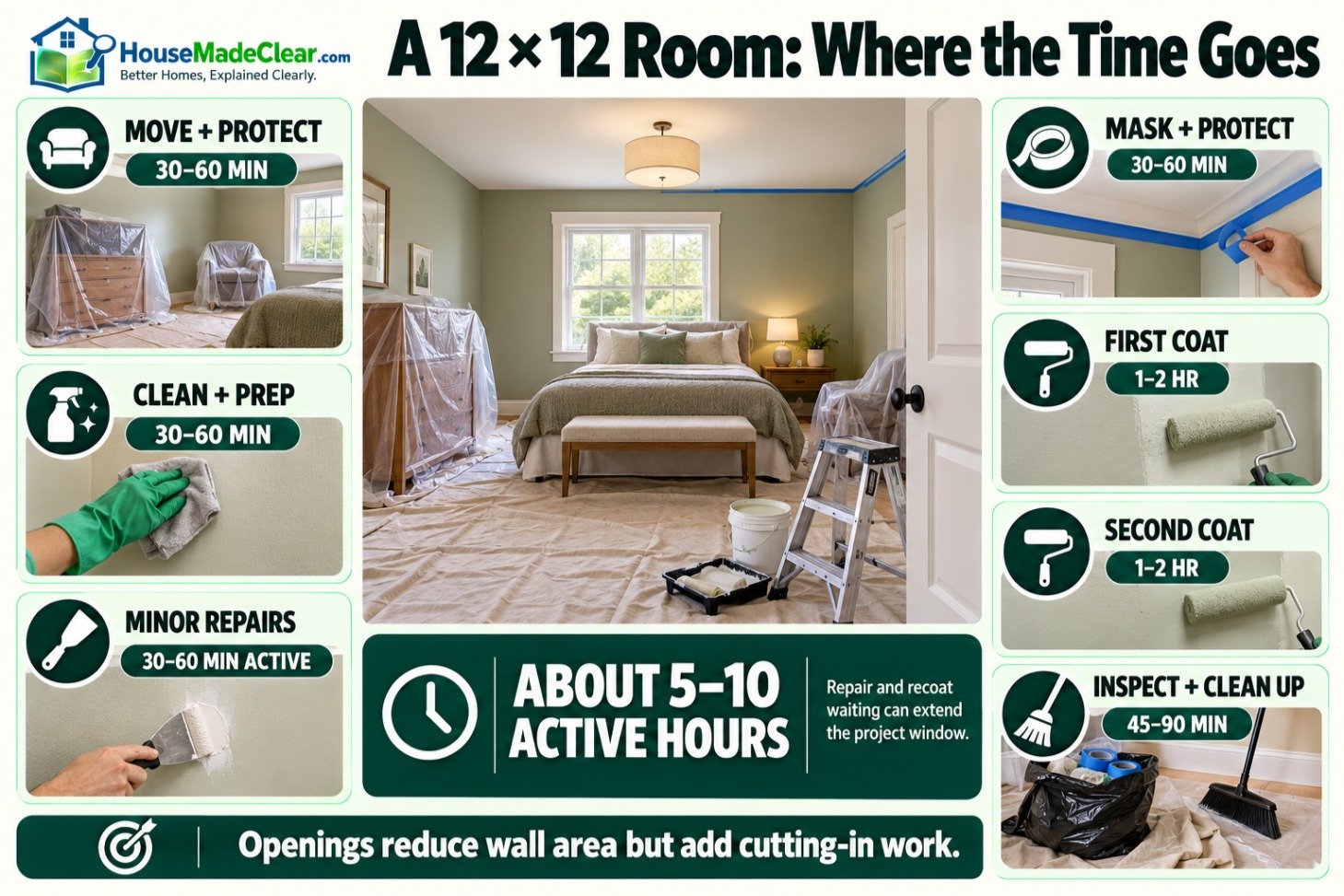
Example DIY Painting Timeline
| Task | Estimated Active Time |
|---|---|
| Move furniture and protect floors | 30–60 minutes |
| Clean walls and prepare surfaces | 30–60 minutes |
| Fill minor holes and spot-sand after drying | 30–60 minutes of work |
| Mask or protect trim and fixtures | 30–60 minutes |
| Cut in and roll first coat | 1–2 hours |
| Cut in and roll second coat | 1–2 hours |
| Remove masking, inspect, and clean up | 45–90 minutes |
| Total active work | Approximately 5–10 hours |
These are rounded estimates. Some tasks overlap, and wall repairs may require drying periods that add elapsed time.
The paint manufacturer determines how long you must wait between coats.
A homeowner may therefore spread five to ten hours of active work across a longer day or a weekend.
If you are painting an unfurnished room with sound walls and using a fast-recoating interior paint, a one-day project may be practical.
If the room contains heavy furniture or requires extensive repairs, plan more time.
How Long Does It Take to Paint a Bedroom?
The time needed to paint a bedroom depends on more than floor dimensions.
Bedrooms often contain beds, dressers, wardrobes, nightstands, and other furniture that must be moved or protected.
Small Bedroom
A 10 × 10-foot bedroom with an 8-foot ceiling has approximately 320 square feet of gross wall area.
Painting the walls may require 4–8 active hours under relatively straightforward conditions.
Average Bedroom
A 12 × 12-foot bedroom may require approximately 6–10 active hours.
This allows time for normal preparation and two coats.
Large Bedroom
A larger bedroom, such as 15 × 18 feet, may take 8–14 hours or more.
Additional windows, decorative trim, tall ceilings, and architectural features can increase the work.
Does Furniture Make Painting Take Longer?
Yes.
Furniture must be moved far enough from the walls to allow safe access.
A heavy bed, dresser, or wardrobe may restrict movement and require additional protection.
Before starting, identify where furniture can be temporarily placed without blocking doors or creating tripping hazards.
If your painting project also involves rearranging the room, our guide to planning a functional bedroom layout can help you organize furniture, maintain walking clearances, and decide where larger pieces should go after painting.
How Long Does It Take to Paint a Living Room?
A living room often takes longer to paint than a bedroom because it may contain more wall surface, larger windows, wider openings, or taller ceilings.
A conventional 15 × 15-foot living room may take approximately 7–12 hours of active DIY work for two coats on walls.
A larger 15 × 20-foot room may require 9–15 hours or more.
Open-concept living rooms introduce additional considerations.
The painting area may continue into a dining room, hallway, or kitchen without an obvious stopping point.
What Adds Time to Living Room Painting?
- Large sectional sofas
- Entertainment centers
- Fireplace surrounds
- Built-in shelves
- Crown molding
- Multiple doorways
- Accent walls
- Two-story ceilings
- Stairwell connections
- Extensive wall repairs
Furniture arrangement also affects access.
If your living room is crowded, reviewing your functional living room layout before painting can help you decide where to move furniture temporarily and how to arrange it when the walls are ready.
Should You Paint the Entire Living Room or Just an Accent Wall?
An accent wall generally requires less painting time because it covers a smaller area.
However, an accent wall with numerous windows, shelves, or architectural details may still involve substantial preparation.
Painting only one wall can also be a cost-effective way to change a room’s appearance.
For ideas beyond repainting every surface, our guide to affordable ways to update a living room covers additional improvements that can complement a new wall color.
How Long Does It Take to Paint a Small Bathroom?
A small bathroom may contain less paintable wall area than a bedroom, but it is not always faster.
Bathrooms have numerous obstacles, including:
- Vanities
- Toilets
- Mirrors
- Shower enclosures
- Towel bars
- Light fixtures
- Exhaust fans
- Small wall sections
Cutting in around these features takes time.
A compact bathroom may require 3–6 active hours to prepare and paint exposed walls.
However, surface moisture, peeling paint, or water damage can extend the project.
Should You Paint a Bathroom Immediately After Showering?
No.
The walls should be clean and dry before painting.
High humidity may slow paint drying and create application problems.
Avoid painting over damp surfaces or existing moisture damage.
If the room regularly stays humid after showering, address ventilation first.
Our guide to bathroom humidity after a shower explains why moisture remains in some bathrooms and how ventilation affects drying conditions.
Does Bathroom Lighting Affect the Paint Color?
Yes.
Bathroom wall colors can appear different under warm and cool lighting, particularly near mirrors and vanities.
Gloss level and reflected light can also make imperfections more noticeable.
Before committing to a color, examine a sample under the room’s actual lighting.
Our guide to planning bathroom lighting explains how task lighting, ambient lighting, and fixture placement influence the appearance and usability of the room.
How Long Does It Take to Paint a Room With Two Coats?
Two coats are commonly used to obtain consistent color and coverage, particularly when changing colors or painting over uneven surfaces.
However, two coats do not necessarily double the total project duration.
Furniture protection, wall cleaning, and much of the preparation are completed once.
The second coat usually requires another painting pass plus the manufacturer’s specified wait between coats.
Example Two-Coat Timeline
| Stage | Approximate Time |
|---|---|
| Setup and preparation | 1.5–3 hours |
| First coat | 1–2 hours |
| Recoat waiting time | Product-specific |
| Second coat | 1–2 hours |
| Cleanup and inspection | 45–90 minutes |
For a typical bedroom, the total may fit within one long day if preparation is straightforward and the paint has a suitable recoat interval.
Other products or conditions may require an overnight wait.
Some interior paints are dry to the touch after approximately one hour and ready for recoating after a few hours, while reaching their full cure can take much longer.
Those time estimates are product-specific, not universal for every paint.

How Long Should You Wait Between Paint Coats?
The time between coats depends on paint formulation, temperature, humidity, film thickness, and ventilation.
For many modern water-based interior wall paints, the recommended recoat interval may be a few hours.
Some specialty finishes require substantially longer.
Paint Drying and Recoating Comparison
| Paint or Coating | Dry-to-Touch Time | Recoat Time |
|---|---|---|
| Benjamin Moore ben Interior Eggshell | Approximately 1 hour | Approximately 2 hours |
| Benjamin Moore Regal Select Interior | Approximately 1 hour | Approximately 1–2 hours |
| Other acrylic/latex wall paints | Product-specific | Often several hours |
| Waterborne alkyd trim paint | Product-specific | May require longer |
| Oil-based paint | Product-specific | Often longer than water-based wall paint |
| Primer | Product-specific | Follow label before topcoating |
The manufacturer publishes its own drying and recoating requirements for each product.
For example, the Benjamin Moore ben Interior product information provides application and drying guidance for the product line.
Always check the current technical data sheet for the exact finish and formulation being used.
Is Paint Dry to the Touch Ready for Another Coat?
Not necessarily.
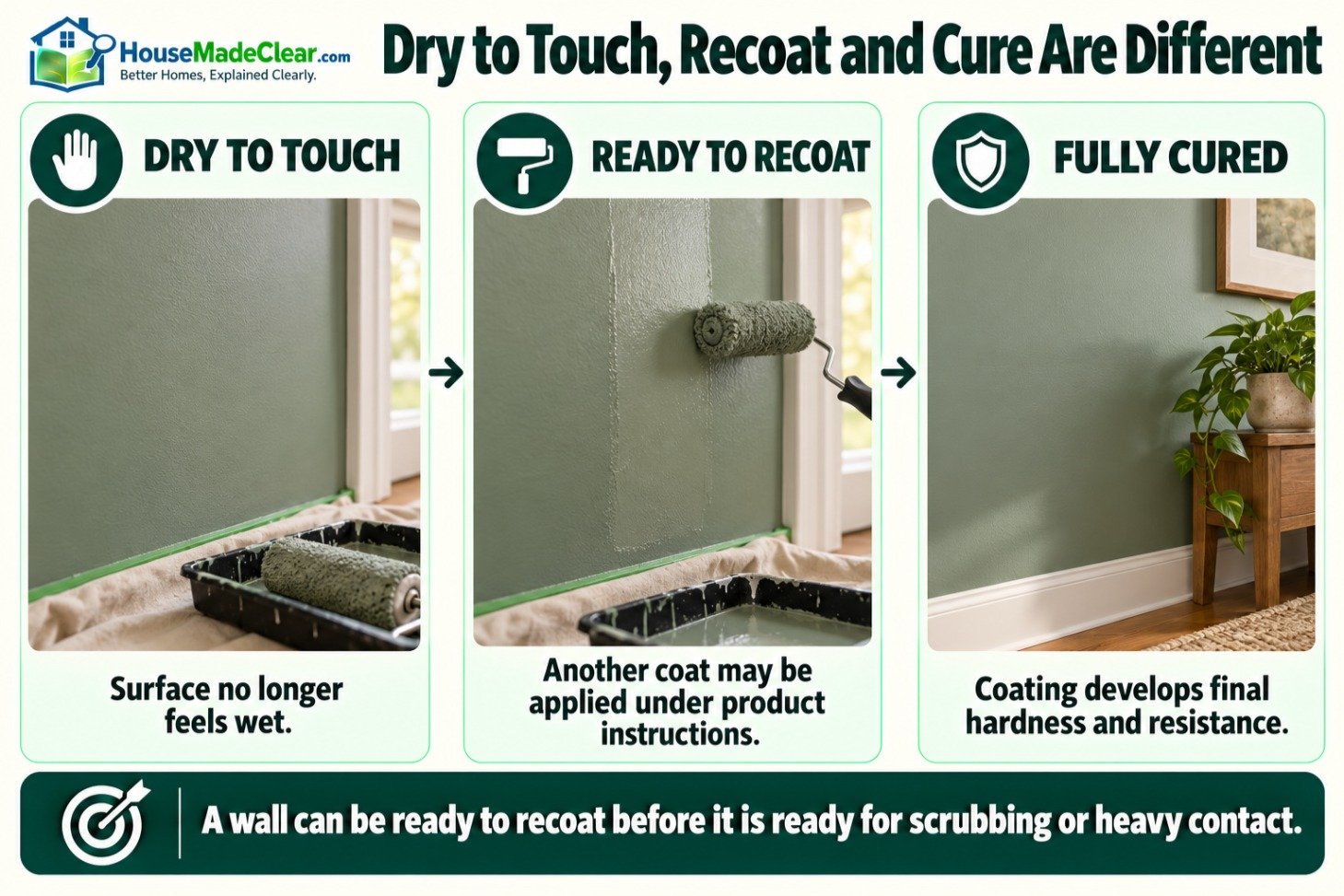
Dry-to-touch time describes when the surface no longer feels wet under specified conditions.
Recoat time describes when the manufacturer says another coat can be applied.
The paint may feel dry before it is ready for additional coating.
Applying the next coat too early can cause uneven sheen, poor appearance, or other finish problems.

Dry Time vs. Recoat Time vs. Cure Time
These three stages should not be confused.
Dry to the Touch
The surface no longer feels wet or tacky under ordinary light contact.
The coating is still developing its final properties.
Ready to Recoat
The paint can receive another coat under the manufacturer’s stated conditions.
This stage depends on the product and environment.
Fully Cured
The paint has developed the specified final film properties, including its intended hardness and resistance.
Full curing may take many days or longer.
A freshly painted wall can be ready for another coat without being ready for scrubbing, adhesive hooks, or heavy contact.
When Can You Move Furniture Back?
Furniture may often be returned after the paint has dried sufficiently and the room has been ventilated.
However, avoid pushing furniture directly against fresh painted surfaces until the product has developed enough resistance to pressure and abrasion.
Protective pads and some clearance from the wall can help reduce early scuffing.
Follow the paint manufacturer’s instructions for normal use, washing, and full cure.
How Long Does It Take to Paint Walls and Ceiling?
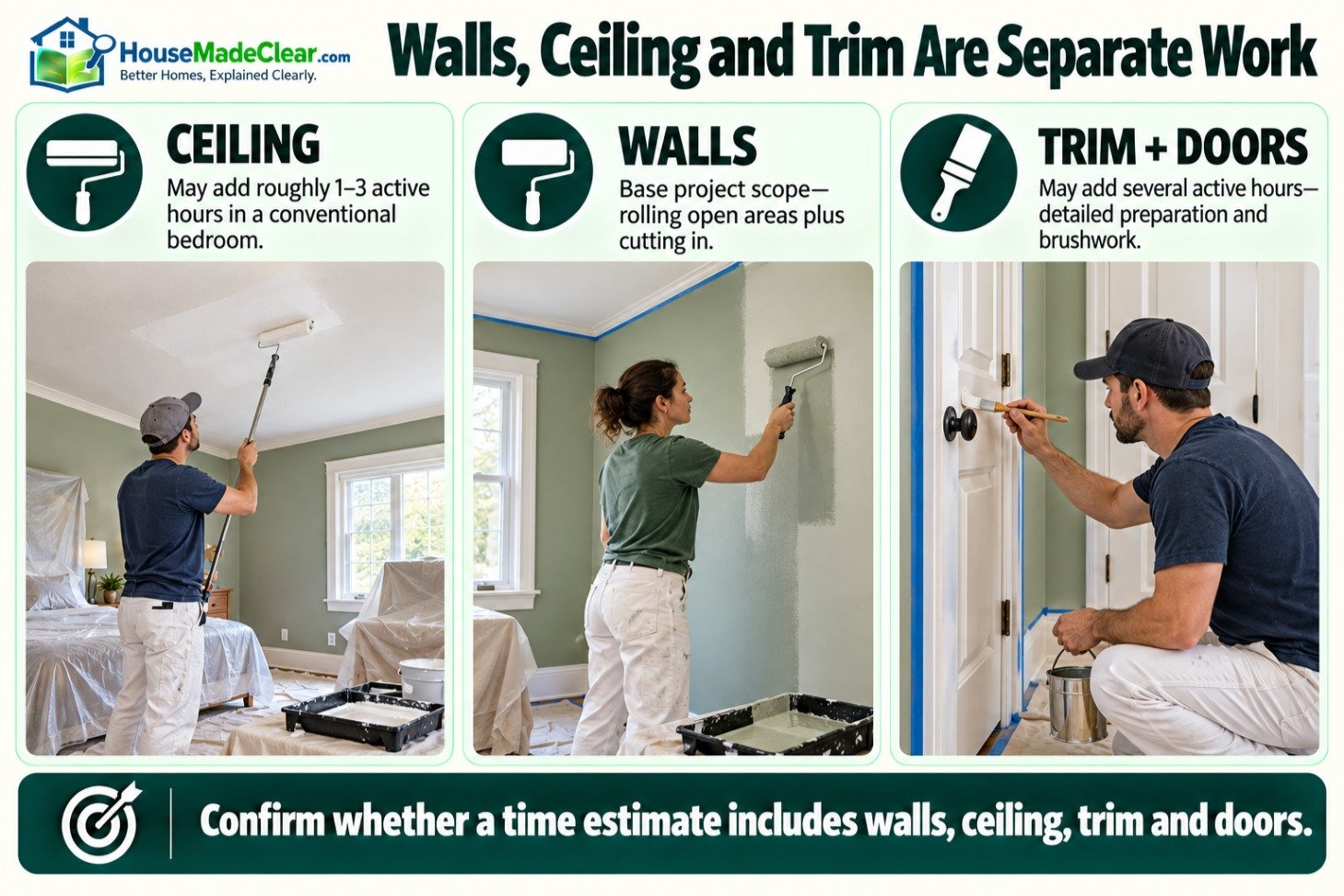
Painting the ceiling adds a separate task.
Ceiling work may require:
- Covering more of the room
- Moving or protecting light fixtures
- Cutting in at the ceiling perimeter
- Using an extension pole
- Applying additional coats
- Waiting for the ceiling coating to dry
For a conventional bedroom, painting the ceiling can add roughly 1–3 active hours, depending on the room and surface condition.
If the ceiling needs repairs or primer, the additional elapsed time can be considerably greater.
Should You Paint the Ceiling Before the Walls?
Usually, yes.
Painting the ceiling first allows you to correct incidental splashes or overlaps when painting the walls afterward.
A common work sequence is:
- Complete ceiling and wall repairs.
- Prime repaired areas as needed.
- Paint the ceiling.
- Allow the required drying time.
- Paint the walls.
- Finish trim as appropriate.
This sequence can reduce the need to protect freshly painted walls while working overhead.
How Long Does It Take to Paint Trim and Doors?
Painting baseboards, crown molding, door casing, and doors can add substantial time because detailed brushwork is slower than rolling open wall areas.
For a typical room, trim painting may add several active hours depending on how much trim is present.
Doors can require additional time for surface preparation, careful edge painting, and drying before closing.
Why Does Trim Take Longer?
Trim may need:
- Degreasing or cleaning
- Filling nail holes
- Sanding
- Caulking appropriate joints
- Bonding primer
- Careful brush application
- Longer drying and curing time
Glossy or previously coated trim may need more preparation than ordinary painted drywall.
Do not assume wall paint and trim enamel have the same recoat interval.
Also, a door that is dry to the touch may still stick to its frame if closed before the coating has developed adequate blocking resistance.
How Much Time Does Room Painting Preparation Take?
Preparation is one of the biggest variables in the project.
It can take a small fraction of the day in a clean, empty room—or several days when the walls need repairs.
Furniture and Floor Protection
Moving lightweight furniture and spreading floor coverings may take 30–60 minutes in an ordinary bedroom.
A heavily furnished room may take significantly longer.
Remove fragile decorations and protect electrical fixtures appropriately.
Wall Cleaning
Walls should be free from dust, grease, and contaminants that interfere with adhesion.
Cleaning time depends on their condition.
Kitchen walls and heavily used rooms may require more cleaning than recently maintained bedrooms.
Allow the surfaces to dry before applying primer or paint.
Filling Holes and Cracks
Small nail holes can often be repaired relatively quickly.
Larger repairs require additional materials, drying, sanding, and sometimes multiple applications.
The repair compound’s specified drying time must be followed before priming or painting.
Sanding and Surface Preparation
Light sanding may improve a suitable surface, but older coatings require special caution.
Before sanding, scraping, or disturbing paint in a home built before 1978, consider the possibility of lead-based paint.
The U.S. Environmental Protection Agency’s lead-safe renovation guidance warns that disturbing old lead-based paint can create hazardous dust.
Do not dry-sand unknown old coatings simply to save preparation time.
Should You Remove Wall Fixtures Before Painting?
Removing suitable wall-mounted accessories can make painting cleaner, but some fixtures require specialized tools or electrical work.
Small decorative items and removable wall hooks may be straightforward to remove.
Electrical equipment should not be dismantled casually.
If you are also reorganizing an entertainment wall, plan cable concealment before repainting rather than making unnecessary holes afterward. Our guide to hiding TV cords without cutting into the wall explains noninvasive cable-management approaches that can help preserve your newly painted finish.
Can You Paint a Room in One Day?
Yes, some rooms can be painted in one day.
But success depends on the job’s scope.
A one-day painting project is most realistic when:
- The room is relatively small.
- Furniture is already moved.
- Walls are clean and in good condition.
- Major repairs are unnecessary.
- Only walls need painting.
- The new color provides good coverage.
- The chosen paint has a short permitted recoat interval.
- Temperature and humidity are suitable.
- The painter has the required tools and experience.
Example One-Day Painting Schedule
| Time | Task |
|---|---|
| 8:00–9:00 a.m. | Move remaining items and protect floors |
| 9:00–10:00 a.m. | Final cleaning, masking, and minor preparation |
| 10:00 a.m.–noon | Cut in and apply first coat |
| Noon–2:00 p.m. | Allow the required recoat interval; complete other safe tasks |
| 2:00–4:00 p.m. | Apply second coat |
| After 4:00 p.m. | Clean tools, ventilate, and begin suitable cleanup |
This is an illustrative schedule for a product permitting the chosen recoat interval, with all wall repairs already dry.
It is not appropriate for every paint.
If the product requires four hours or longer between coats, the schedule must change.
Likewise, freshly repaired drywall may not be ready for painting the same morning.
Is It Better to Paint a Room Over Two Days?
For many first-time DIY painters, a two-day schedule is easier to manage.
It provides time for preparation, a first coat, inspection, and a second coat without rushing.
Day 1: Preparation and First Coat
- Move furniture.
- Protect floors.
- Clean surfaces.
- Complete prepared and fully dried repairs.
- Prime where required.
- Paint the first coat.
- Allow adequate drying and ventilation.
Day 2: Second Coat and Cleanup
- Inspect the first coat.
- Apply the second coat.
- Complete appropriate touch-ups.
- Clean tools.
- Remove protective materials at the suitable time.
- Allow further drying before replacing furniture.
This schedule reduces the temptation to recoat early simply to finish before bedtime.

DIY vs. Professional Painter: How Long Does It Take?
Professional painters usually work faster because they have more experience, efficient tools, and established preparation methods.
A crew can also divide tasks among multiple workers.
For example, one person may prepare walls while another protects trim or works in an adjacent space.
However, professional painting cannot eliminate mandatory drying intervals.
| Factor | DIY Painting | Professional Painting |
|---|---|---|
| Setup and protection | Often slower | Usually streamlined |
| Cutting in | Depends on experience | Often faster |
| Rolling | Moderate pace | Often faster |
| Wall repairs | May require additional learning time | Experience-based |
| Drying between coats | Product-specific | Same coating requirements |
| Cleanup | Homeowner-managed | Crew-managed |
| Scheduling | Flexible | Dependent on contractor availability |
For a straightforward bedroom, a professional painter may complete the active work in several hours.
A project involving ceilings, trim, multiple colors, extensive repairs, or several coats may require additional visits.
Ask the contractor whether the quoted timeline includes preparation, primer, ceilings, doors, trim, and cleanup.
How Much Paint Do You Need for a Room?
Estimating paint quantity helps avoid delays caused by running out midway through a coat.
Start with the room’s paintable wall area.
Example: 12 × 12-Foot Room
Assume:
- Room perimeter: 48 feet
- Ceiling height: 8 feet
- Gross wall area: 384 square feet
- Approximate window and door deduction: 45 square feet
Estimated paintable wall area:
384 − 45 = 339 square feet
For two coats:
339 × 2 = 678 square feet of coating coverage
If a specific paint is rated to cover 400 square feet per gallon per coat under suitable conditions:
678 ÷ 400 = approximately 1.7 gallons
In this example, two gallons may be sufficient before accounting for material loss, absorbency, texture, or other project-specific factors.
Some products advertise coverage ranges rather than a single value.
Actual usage depends on the substrate and application.
Paint Quantity Estimation Chart
| Approximate Paintable Wall Area | Two-Coat Coverage Needed | Gallons at 400 Sq. Ft./Gallon |
|---|---|---|
| 200 sq. ft. | 400 sq. ft. | 1.0 |
| 300 sq. ft. | 600 sq. ft. | 1.5 |
| 400 sq. ft. | 800 sq. ft. | 2.0 |
| 500 sq. ft. | 1,000 sq. ft. | 2.5 |
| 600 sq. ft. | 1,200 sq. ft. | 3.0 |
These are mathematical examples, not purchasing guarantees.
Choose quantities using the selected paint’s coverage rating, surface porosity, and expected number of coats.
Textured walls and substantial color changes may require more paint.

What Makes Painting a Room Take Longer?
Two rooms with identical floor dimensions can have very different painting timelines.
1. Wall Condition
Cracked, peeling, stained, or damaged walls require more preparation.
Repairs may need several drying stages.
2. Number of Paint Coats
One coat is faster than two or three, but it may not provide the finish needed.
Follow the product instructions and assess actual coverage.
3. Color Change
A dramatic shift from dark to light—or from light to a highly saturated color—may require appropriate primer or additional coats.
The need depends on both the existing color and the chosen product.
4. Ceiling Height
Tall walls require more access equipment and careful application.
Painting a two-story living room is a different project from painting an 8-foot bedroom.
5. Furniture and Obstacles
Large furniture, built-in cabinetry, shelving, and decorative details slow access.
6. Temperature and Humidity
Cool or humid conditions may delay drying.
High temperatures may also affect application and working time.
Always follow the manufacturer’s recommended temperature and humidity conditions.
7. Paint Formulation
Different paints have different working properties, dry times, and recoat intervals.
8. Painter Experience
A first-time homeowner will often need more time for cutting in, maintaining an even finish, and correcting mistakes.
9. Room Features
Windows, doors, alcoves, fireplaces, and trim increase detailed work.
10. Additional Surfaces
Ceilings, doors, and trim expand the project beyond wall painting.
How Do Temperature and Humidity Affect Painting Time?
Painting conditions influence both application and drying.
High humidity can slow the evaporation of water from water-based paint.
Lower temperatures may also delay film formation or drying.
Very warm conditions can sometimes cause paint to dry too quickly for proper leveling or blending.
The best range depends on the paint.
Check the product’s application temperature limits and recommended conditions.
Should You Use a Fan While Painting?
Ventilation is important, but avoid directing strong airflow across freshly painted surfaces in a way that creates application problems or spreads dust.
Where practical and safe, provide outdoor ventilation and follow the product’s instructions.
The EPA’s indoor air quality guidance for home remodeling recommends controlling exposure to odors and pollutants during renovation and using appropriate ventilation.
An ordinary fan moving air around a closed room is not necessarily equivalent to exhausting indoor pollutants outdoors.
How Long Should You Run a Bathroom Exhaust Fan After Painting?
There is no universal fan runtime that guarantees paint emissions or moisture have been removed.
Ventilation needs depend on the paint, room size, airflow, humidity, and whether the fan exhausts outdoors.
Continue following the coating manufacturer’s ventilation and reoccupation guidance.
For everyday bathroom moisture management, our guide to how long to run a bathroom exhaust fan after a shower explains the factors that affect ventilation time.
How Long Should You Wait Before Sleeping in a Freshly Painted Room?
There is no universal waiting period suitable for every paint, household, and ventilation condition.
The answer depends on:
- Paint formulation
- Volatile organic compound content
- Ventilation
- Room temperature
- Application amount
- Occupant sensitivities
- Manufacturer instructions
Paint being dry to the touch does not mean all emissions have stopped.
Can You Sleep in a Room the Same Night It Is Painted?
Do not assume that same-night use is appropriate simply because the wall feels dry.
Follow the manufacturer’s occupancy and ventilation recommendations.
Allow adequate outdoor ventilation where practical.
People with respiratory sensitivities, children, or other vulnerable occupants may warrant additional precautions.
If the room still has a strong paint odor or causes symptoms, continue ventilation and avoid using it until conditions are appropriate.
Low-VOC or zero-VOC labels do not eliminate the need for proper ventilation.
How Long After Painting Can You Put Furniture Against the Wall?
Paint may be ready for normal room use before it reaches full cure.
However, furniture pressed against fresh coatings can cause scuffs, sticking, or marks.
Wait until the product is sufficiently dry for the planned contact.
For heavy furniture and direct wall contact, follow the coating manufacturer’s recommendations.
If the product reaches full cure after several days or weeks, avoid treating freshly painted surfaces as though they have already achieved maximum durability.
When furniture is returned, leave practical clearance to avoid scraping the wall.
Can You Speed Up Room Painting Without Sacrificing Quality?
You can reduce wasted time without shortening required drying intervals.
Prepare the Room in Advance
Move furniture and remove wall decorations before painting day.
Gather All Supplies
Have rollers, brushes, coverings, painter’s tape, trays, and cleaning materials ready.
Use the Correct Tools
A suitable roller can cover open wall areas efficiently.
An appropriate angled brush helps with edges.
Plan the Painting Sequence
Work systematically rather than moving randomly between walls.
Repair Walls Early
Complete holes, cracks, and other repairs before the planned painting session.
Allow them to dry fully.
Choose an Appropriate Coating
Review the technical data sheet for coverage, application requirements, and recoat interval.
Avoid Unnecessary Interruptions
Prepare enough paint and supplies to finish each wall section consistently.
Do Not Rush Recoating
Applying a second coat too early may create finish problems that take longer to correct.
How to Choose a Paint Color That Makes the Room Feel Brighter
Painting time is not the only consideration when refreshing a room.
The chosen color can affect how spacious, bright, or comfortable a room feels.
Light-colored paint generally reflects more visible light than very dark paint, although the actual effect depends on the paint’s light reflectance value, finish, and room lighting.
For example, a pale neutral wall color may make a north-facing bedroom feel brighter than a deep charcoal shade under the same lighting conditions.
However, a bright-looking room also depends on windows, artificial lighting, and the colors of surrounding surfaces.
If your primary goal is to improve a dim interior, our guide to making a dark room brighter explains how wall colors, light placement, window treatments, and reflective surfaces work together.
A good approach is to test paint samples on more than one wall and observe them at different times of day.
Common Room Painting Mistakes That Waste Time
Mistake 1: Skipping Preparation
Paint applied to dirty, damaged, or poorly prepared walls may need correction later.
Mistake 2: Underestimating Drywall Repairs
A small-looking repair can add substantial elapsed time if several compound applications are required.
Mistake 3: Painting Without Enough Supplies
Running out of paint or rollers interrupts work and may make it harder to maintain a consistent finish.
Mistake 4: Applying the Second Coat Too Soon
The next coat should not be applied before the manufacturer’s minimum recoat interval.
Mistake 5: Ignoring Ceiling and Trim Time
A full-room painting project takes longer than wall-only painting.
Mistake 6: Moving Furniture Back Too Early
Fresh paint may be damaged by contact, pressure, or abrasion.
Mistake 7: Ignoring Humidity
High indoor humidity can increase drying time.
Mistake 8: Rushing Dark-to-Light Color Changes
Adequate hiding may require a suitable primer or additional coats.
Mistake 9: Disturbing Old Paint Unsafely
Sanding or scraping possible lead-based coatings can create hazardous dust.
Mistake 10: Confusing Drying With Curing
A dry surface may not yet have developed its final durability.
Room Painting Time Planning Checklist
| Task | What to Verify |
|---|---|
| Room measurements | Width, length, and ceiling height |
| Paintable wall area | Windows and doors considered |
| Wall condition | Repairs and cleaning needed |
| Lead-paint precautions | Older coatings assessed before disturbance |
| Number of coats | Product coverage and finish requirements |
| Primer | Required or unnecessary based on substrate |
| Paint dry time | Manufacturer specifications |
| Recoat time | Minimum interval followed |
| Ventilation | Safe and adequate outdoor air exchange |
| Furniture | Removed or protected |
| Ceiling | Included or excluded from project |
| Trim and doors | Included or excluded from project |
| Tools | Rollers, brushes, tape, coverings |
| Cleanup | Allow time after application |
| Reoccupation | Product guidance and indoor conditions |
| Furniture return | Paint sufficiently dry for contact |
Final Thoughts
So, how long does it take to paint a room?
For many conventional bedrooms and living rooms, a homeowner should plan approximately 4–12 hours of active work, with larger or more complicated spaces taking longer.
A typical 12 × 12-foot bedroom may require around 6–10 active hours when preparation, two coats, and cleanup are included.
However, the full project can extend across one or two days because repairs, primer, and paint need appropriate drying time.
The most reliable schedule starts with accurate wall measurements, an honest assessment of surface condition, and the specific paint manufacturer’s technical instructions.
Do not rush necessary preparation or recoating just to complete the project in a single day.
A well-planned painting job is more likely to deliver consistent coverage, a cleaner finish, and fewer problems after the furniture goes back.
Frequently Asked Questions
How long does it take to paint a room?
A typical room may take approximately 4–10 hours of active DIY work when preparation, two wall coats, and cleanup are included. The full project may last one or two days because of drying and recoating intervals.
How long does it take to paint a 12 × 12 room?
A 12 × 12-foot bedroom may take approximately 6–10 active hours for preparation, two wall coats, and cleanup. Extensive repairs, trim, ceiling painting, or slow-drying products may extend the timeline.
Can you paint a room in one day?
Yes. A small or medium room with sound walls and a suitable fast-recoating paint may be completed in one day. Major repairs, primer, additional surfaces, or longer recoat intervals may require more time.
How long does it take to paint a bedroom?
A small bedroom may take around 4–8 active hours, while an average 12 × 12-foot bedroom may require approximately 6–10 hours. Larger rooms and complex preparation can take longer.
How long does it take to paint a living room?
A 15 × 15-foot living room may take approximately 7–12 active DIY hours for two wall coats. Large openings, high ceilings, built-ins, and extensive trim increase the time needed.
How long does it take to paint a room with two coats?
Two coats can often be completed over one or two days, depending on preparation, room size, and the manufacturer’s required recoat time. The second coat adds painting labor but does not usually require repeating all preparation.
How long should you wait between coats of interior paint?
Many water-based interior wall paints allow recoating after a few hours, but the interval varies by product. Always follow the paint manufacturer’s label or technical data sheet rather than assuming a universal waiting period.
How long does it take interior paint to dry?
Some interior paints become dry to the touch in about one hour, while others take longer. Dry-to-touch time, recoat time, and full cure are different stages and should not be treated as interchangeable.
How long does it take paint to fully cure?
Full cure depends on the formulation and conditions. Some interior products specify approximately 14 days, while other coatings may require longer. Consult the manufacturer’s technical data sheet for the exact product.
How long does it take a professional painter to paint a room?
An experienced painter or crew may finish the active work in a typical room within several hours, depending on preparation and scope. Required drying and recoating intervals still apply.
How long does it take to paint a ceiling?
A conventional bedroom ceiling may add approximately 1–3 active hours for preparation and application. Repairs, primer, additional coats, or difficult access can add more time.
Does painting trim make the job take longer?
Yes. Baseboards, door casing, crown molding, and doors require detailed preparation and application. Trim coatings may also have different drying and curing requirements from wall paint.
Can you sleep in a freshly painted room?
Follow the paint manufacturer’s reoccupation and ventilation guidance. Dry-to-touch paint may still release odors or other emissions. If ventilation is poor, odors are strong, or occupants are sensitive, allow additional time before sleeping in the room.
Does humidity affect how long paint takes to dry?
Yes. Higher humidity can slow drying for many water-based paints. Temperature, airflow, film thickness, and the paint formulation also affect drying and recoating time.
How long should you wait to move furniture back after painting?
Wait until the paint is sufficiently dry for normal room use, and follow the manufacturer’s guidance. Avoid placing heavy furniture directly against fresh walls until the coating has developed adequate resistance to pressure and abrasion.








[…] How Long Does It Take to Paint a Room? Timeline by… […]
[…] How Long Does It Take to Paint a Room? Timeline by… […]