

















A refrigerator can fit perfectly within your kitchen’s measured width and still be the wrong size. The doors may hit a nearby wall, the top hinge may collide with an overhead cabinet, or the refrigerator may project farther into the walkway than expected.
That’s why choosing the right refrigerator involves more than checking its advertised width.
Most full-size refrigerators sold in the United States are approximately 24–40 inches wide, 61–72 inches tall, and 28–37 inches deep, although actual dimensions depend on the style and model.
French-door refrigerators are commonly wider than traditional top-freezer models, while counter-depth refrigerators are designed to sit closer to the surrounding cabinetry.
This guide covers standard refrigerator dimensions by type, common 30-, 33-, and 36-inch widths, countertop alignment, installation clearance, and how to measure your kitchen before buying.
Quick Answer
Standard refrigerator dimensions commonly fall within these ranges:
- Width: 24–40 inches
- Height: 61–72 inches
- Depth: 28–37 inches
- Common full-size widths: 30, 33, and 36 inches
- Counter-depth models: Often approximately 24–30 inches deep without handles, depending on what the manufacturer includes in the measurement
For a typical full-size French-door refrigerator, approximately 36 inches wide and 69–70 inches tall is a useful starting point.
However, the refrigerator must also have enough clearance for ventilation, hinges, door swing, and access to drawers. Always use the selected model’s installation specifications rather than relying on average dimensions.
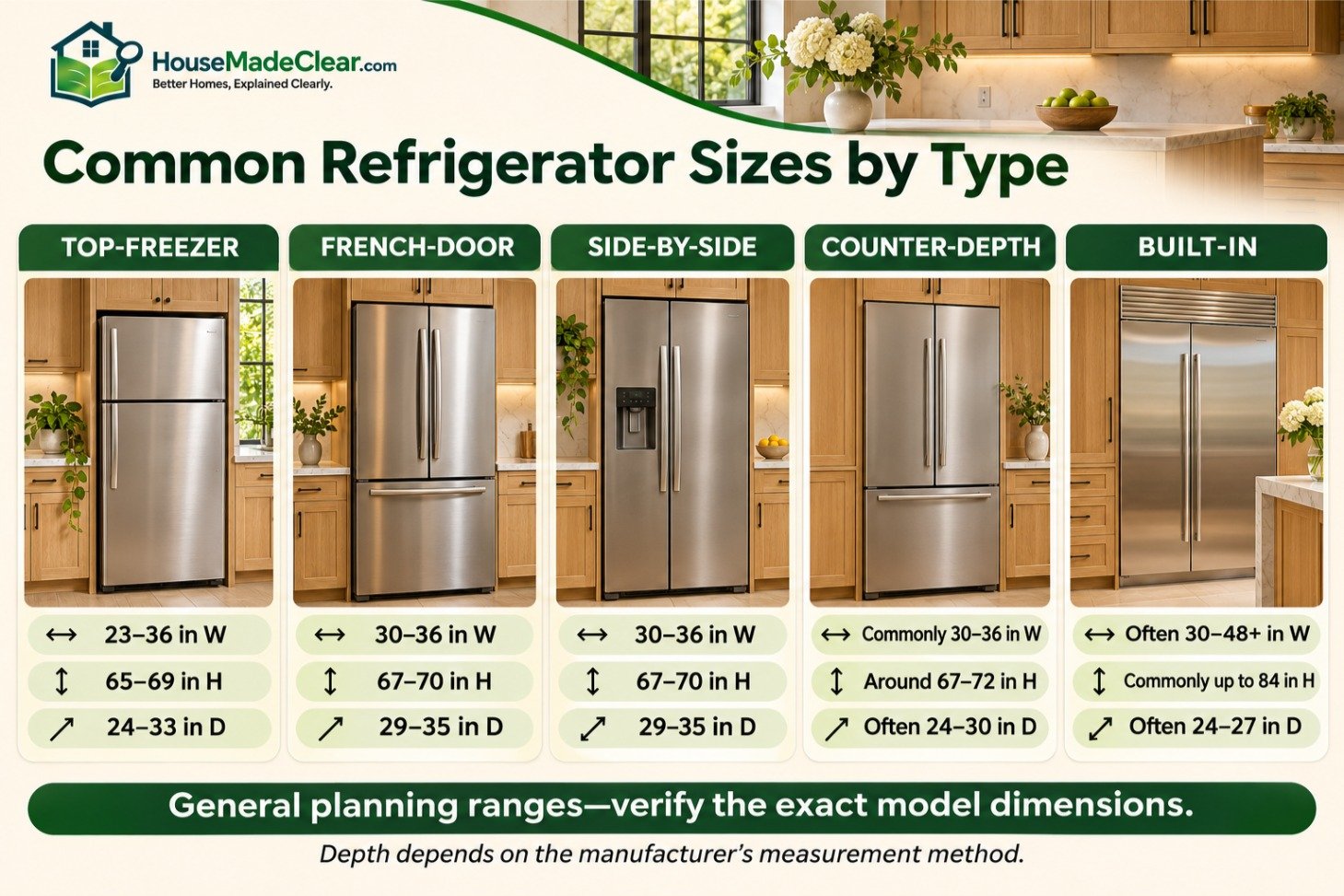
Standard Refrigerator Dimensions Chart
Refrigerator dimensions vary significantly by configuration.
The ranges below are general planning references for common residential models.
| Refrigerator Type | Typical Width | Typical Height | Typical Depth |
|---|---|---|---|
| Top-freezer | 23–36 in. | 65–69 in. | 24–33 in. |
| Bottom-freezer | 23–36 in. | 65–69 in. | 24–33 in. |
| French-door | 30–36 in. | 67–70 in. | 29–35 in. |
| Side-by-side | 30–36 in. | 67–70 in. | 29–35 in. |
| Counter-depth | Commonly 30–36 in. | Around 67–72 in. | Varies by measurement method; often 24–30 in. |
| Built-in | Often 30–48 in. or wider | Commonly up to 84 in. | Often approximately 24–27 in. |
| Compact or mini | Often 17–24 in. | Varies widely | Often 18–26 in. |
The top-freezer, bottom-freezer, French-door, and side-by-side figures reflect broad manufacturer planning ranges. Counter-depth, built-in, and compact models require separate product-specific measurements.
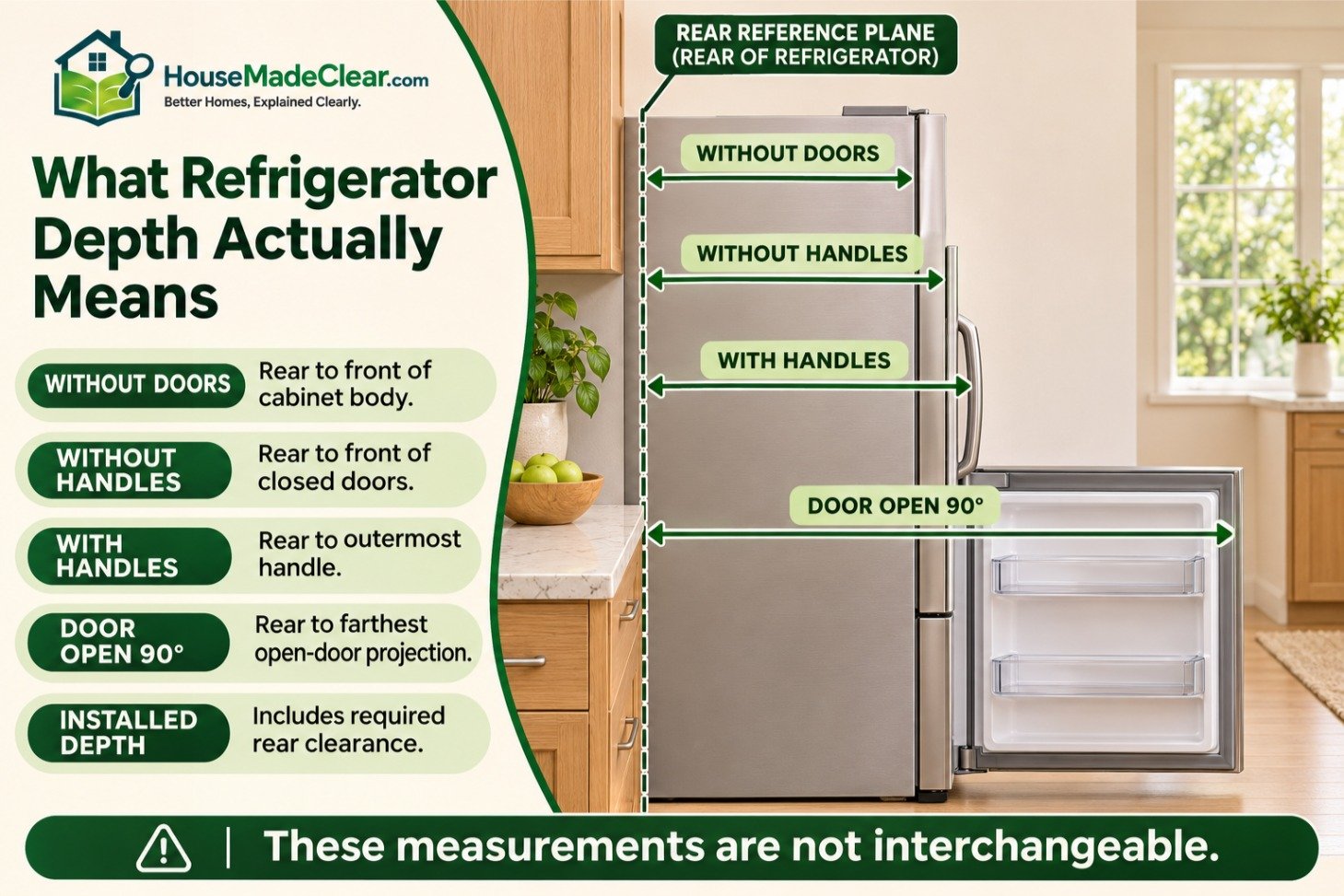
Importantly, refrigerator depth may be listed with handles, without handles, without doors, or with the door open.
These measurements are not interchangeable.
The Maytag refrigerator size guide provides manufacturer-based dimensional ranges and explains why individual model specifications must be checked before installation.
What Are the Standard Refrigerator Widths?
Common refrigerator widths include 30, 33, and 36 inches.
However, smaller and larger models are available.
| Refrigerator Width | Common Application |
|---|---|
| 24 inches | Compact kitchens and some apartment layouts |
| 28 inches | Narrower top-freezer refrigerators |
| 30 inches | Smaller and medium-size residential kitchens |
| 33 inches | Mid-size refrigerator openings |
| 36 inches | Many French-door and side-by-side refrigerators |
| 39–40 inches | Certain large-capacity freestanding models |
| 42–48 inches | Some premium built-in configurations |
Is a 30-Inch Refrigerator Big Enough?
A 30-inch-wide refrigerator can work well for a smaller household or a kitchen with limited cabinet space.
However, the internal capacity varies with refrigerator height, depth, insulation, and freezer arrangement.
Two refrigerators with the same width can offer different storage capacities.
Check the listed cubic-foot capacity and interior layout rather than using width alone.
Is 33 Inches a Standard Refrigerator Width?
Yes. Many manufacturers offer 33-inch-wide refrigerators.
This width can provide more options than a narrow 30-inch opening without requiring the space used by many 36-inch French-door models.
However, a refrigerator advertised as 33 inches wide may have slightly different actual dimensions.
Always compare the precise cabinet width against your available opening.
How Wide Is a Standard French-Door Refrigerator?
Many full-size French-door refrigerators are approximately 33–36 inches wide, with 36-inch models particularly common.
Narrower French-door designs are also available.
French doors can be useful in kitchens where one large refrigerator door would interfere with nearby cabinets or circulation.
However, both doors still need adequate clearance to open fully.
What Is the Standard Refrigerator Height?
Many full-size refrigerators stand approximately 65–72 inches high.
Height depends on refrigerator style, capacity, hinges, and leveling adjustments.
A common French-door refrigerator may be around 69–70 inches tall.
Refrigerator Height by Type
| Refrigerator Type | Typical Height |
|---|---|
| Top-freezer | 65–69 inches |
| Bottom-freezer | 65–69 inches |
| French-door | 67–70 inches |
| Side-by-side | 67–70 inches |
| Tall built-in refrigerator | Often around 80–84 inches |
These measurements are general ranges, not maximum limits.
Does Refrigerator Height Include the Hinges?
Not always.
Some specifications distinguish between:
- Height to the top of the cabinet case
- Height to the top of the door hinge
- Overall installed height
The top hinge may be taller than the refrigerator’s main cabinet.
This difference matters when the refrigerator sits beneath an overhead kitchen cabinet.
How Much Space Is Needed Above a Refrigerator?
The required gap varies by model.
Some freestanding refrigerators call for approximately 1 inch of top clearance, while others use different ventilation arrangements.
Measure to the highest applicable point, including hinges where relevant.
Don’t assume an opening that measures exactly 70 inches will accommodate every refrigerator advertised as 70 inches tall.
What Is the Standard Refrigerator Depth?
Refrigerator depth is often the most confusing measurement.
A full-size standard-depth refrigerator may be approximately 29–37 inches deep, depending on its configuration and what the measurement includes.
Unlike width, refrigerator depth is commonly advertised in several forms.
Understanding Refrigerator Depth Measurements
| Measurement | What It Means |
|---|---|
| Depth without doors | Main cabinet body only |
| Depth without handles | Cabinet and doors, excluding projecting handles |
| Depth with handles | Full closed refrigerator depth including handles |
| Depth with door open 90° | Front-to-back space with the door opened |
| Installed depth | Total projection after positioning and required rear clearance |
A refrigerator measuring 34 inches deep with its handles may project several inches beyond a typical kitchen countertop.
That isn’t necessarily an installation defect.
Standard-depth models are often designed to extend beyond surrounding cabinetry.
Why Does Depth Matter So Much?
A refrigerator that’s too deep can:
- Narrow the kitchen walkway
- Interfere with an island
- Prevent adjacent drawers from opening
- Make the kitchen look visually crowded
- Create difficulties at a nearby doorway
For tight kitchens, the difference between a 30-inch-deep and a 36-inch-deep refrigerator can materially affect circulation.
Standard-Depth vs. Counter-Depth Refrigerators
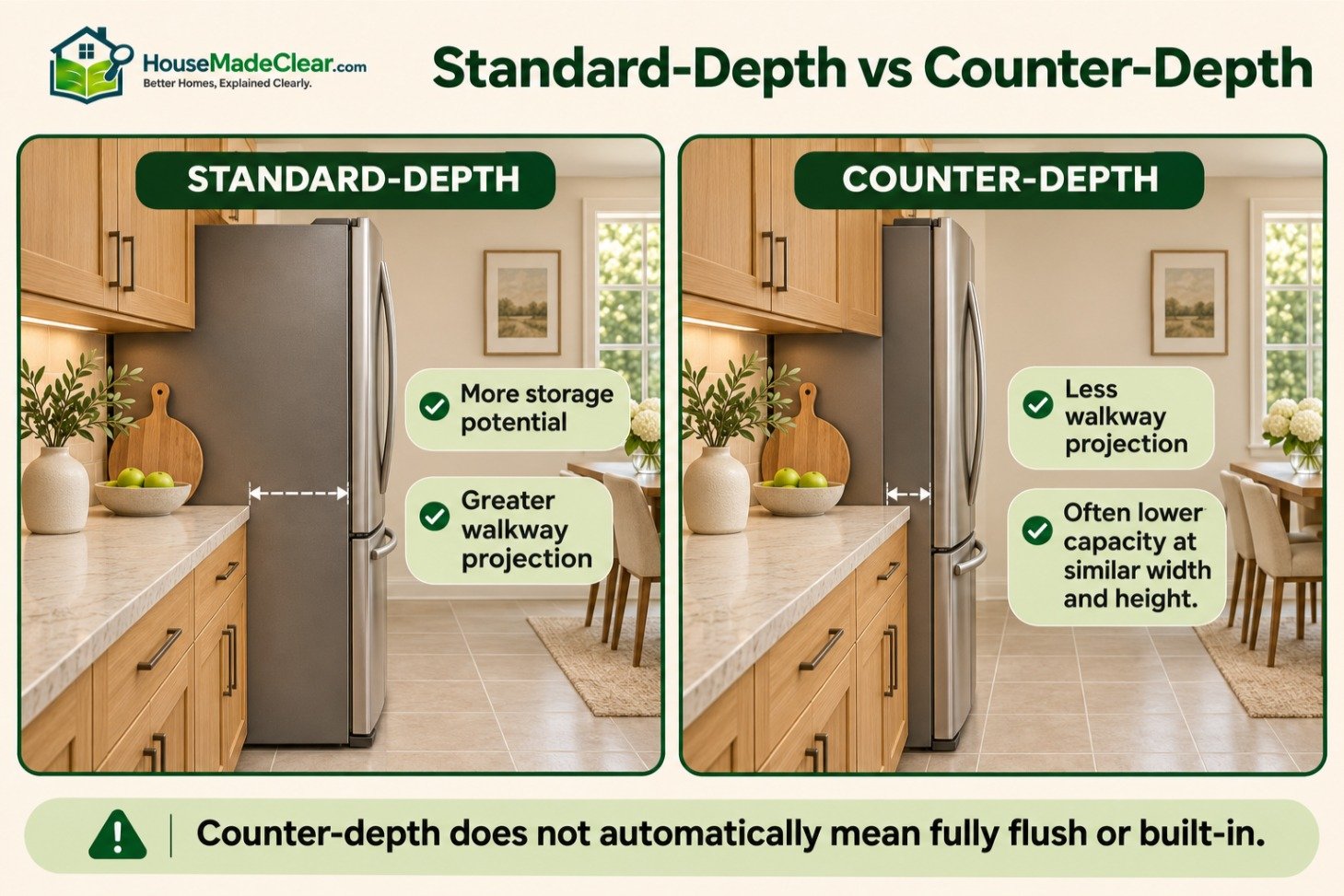
Counter-depth refrigerators are intended to align more closely with kitchen countertops and base cabinets.
A standard-depth refrigerator generally offers more storage depth, while a counter-depth refrigerator projects less into the room.
| Feature | Standard-Depth Refrigerator | Counter-Depth Refrigerator |
|---|---|---|
| Main benefit | Greater internal storage potential | Less projection into walkway |
| Overall depth | Generally deeper | Generally shallower |
| Alignment with cabinets | Often extends noticeably beyond counter | Sits closer to surrounding cabinetry |
| Internal capacity | Often greater at similar width and height | Often lower |
| Door and handle projection | Usually visible | May still extend past countertop |
| Best suited for | Storage-focused households | Kitchens where space and alignment matter |
Is Counter-Depth the Same as Built-In?
No.
A freestanding counter-depth refrigerator is not necessarily designed to sit completely flush with cabinetry.
Its doors, hinges, or handles may still extend beyond the countertop so the doors can open properly.
A true built-in refrigerator uses a different installation design and may require cabinetry specifically constructed for it.
Are All Counter-Depth Refrigerators 24 Inches Deep?
No.
Some manufacturers use approximately 24-inch cabinet bodies, while the doors and handles increase the overall depth.
Others have different dimensions.
For fit calculations, compare the depth including the doors and handles, not just the refrigerator body.
Refrigerator Clearance Requirements: Sides, Top, and Back
The physical refrigerator size is only part of the installation footprint.
Manufacturers specify additional space for air circulation, plumbing, electrical connections, and door operation.
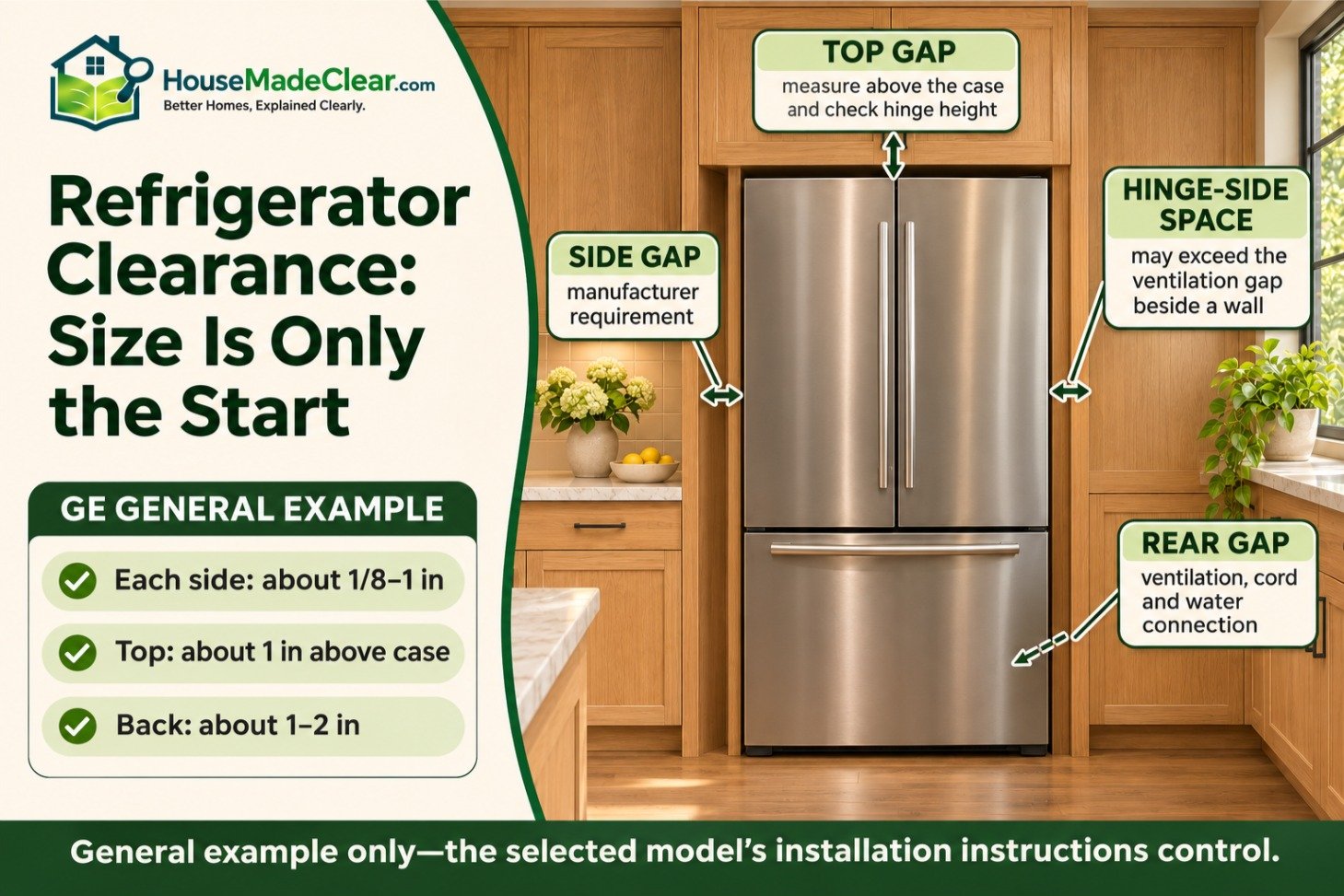
For example, GE Appliances provides these general refrigerator clearance ranges:
| Location | GE General Guidance |
|---|---|
| Each side | Approximately 1/8–1 inch |
| Top | Approximately 1 inch above the case |
| Back | Approximately 1–2 inches |
These are general examples, not universal installation requirements.
The selected refrigerator may require different clearance, and some built-in models use specialized ventilation arrangements.
See GE Appliances’ refrigerator air-clearance guidance for the manufacturer’s explanation.
Why Does Ventilation Clearance Matter?
A refrigerator must release heat produced during its cooling process.
Insufficient ventilation can reduce operating efficiency and interfere with proper performance.
The exact airflow path depends on the design.
How Much Side Clearance Is Needed?
Side clearance includes two separate considerations:
- Space required by the manufacturer for installation and ventilation.
- Extra space needed for door and hinge movement.
A refrigerator beside a fixed wall may need substantially more room on the hinge side than the minimum ventilation gap.
How Much Rear Clearance Is Needed?
Rear clearance varies according to the appliance.
It may also need to accommodate:
- Water supply connections
- Electrical cord routing
- Manufacturer-provided spacers
- Access for maintenance
Never push a refrigerator farther against the wall than its installation instructions permit.
How Much Space Does a Refrigerator Door Need to Open?
A refrigerator can fit inside the kitchen opening but still be difficult to use if its doors cannot open far enough.
This is particularly important when the refrigerator sits:
- Beside a wall
- Next to tall pantry cabinets
- Across from a kitchen island
- Near a doorway
- At the end of a cabinet run
French-Door Refrigerator Clearance
French-door refrigerators use two narrower upper doors, which can reduce the space needed for each individual door swing compared with one large door.
However, opening both doors may still require space beyond the refrigerator body.
Some designs also need additional clearance to remove internal bins and drawers.
Side-by-Side Refrigerator Clearance
Side-by-side refrigerators have relatively narrow doors, but both compartments need usable opening space.
A wall directly beside the refrigerator may prevent the door from opening sufficiently for certain internal components.
What About a Refrigerator Next to a Wall?
Check the installation diagram for the exact model.
Some manufacturers specify additional clearance on the hinge side.
If the wall prevents a 90-degree opening or interferes with drawer removal, you may need a filler panel, a different refrigerator, or a revised installation position.

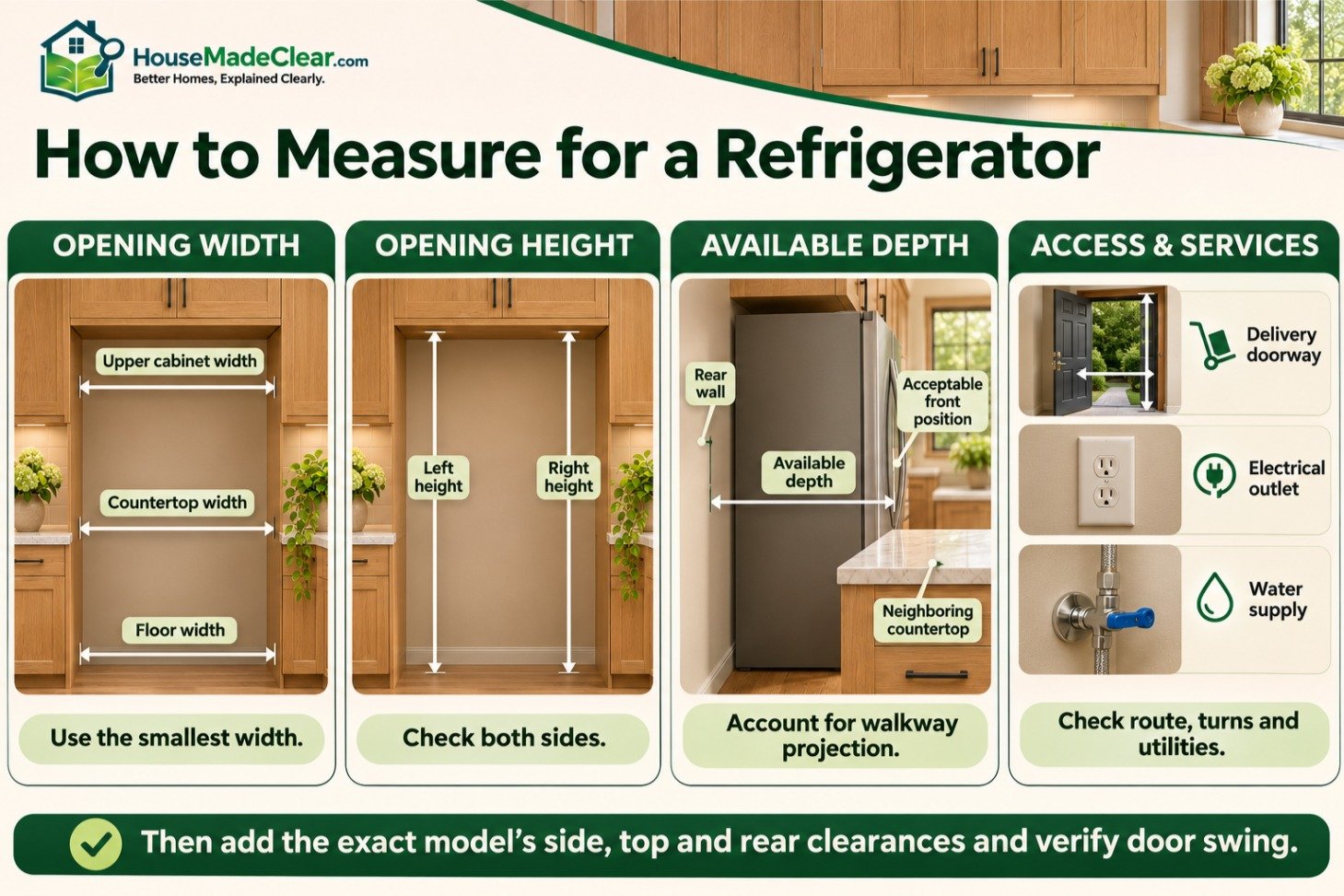
How to Measure for a Refrigerator: Step-by-Step
Measure the actual finished kitchen opening before comparing models.
Step 1: Measure the Opening Width
Measure the clear width:
- Near the floor
- At countertop height
- Near the upper cabinet
Use the smallest available measurement.
Walls and cabinets are not always perfectly straight.
Step 2: Measure the Opening Height
Measure from the finished floor to the lowest obstruction above the refrigerator.
This may be an overhead cabinet, trim, or another fixed element.
Check the height on both sides if the floor is uneven.
Step 3: Measure the Available Depth
Measure from the rear wall to the intended front position.
Also note the depth of neighboring countertops.
Don’t assume the refrigerator must end at the same depth as the cabinets; determine how far it can project without obstructing circulation.
Step 4: Check Manufacturer Clearances
Add the required side, top, and rear gaps from the selected model’s installation instructions.
Step 5: Check Door Swing
Verify that doors can open far enough for normal access, drawer removal, and cleaning.
Step 6: Inspect the Delivery Route
Measure doorways, hallways, staircases, and tight turns.
Consider packaging dimensions and whether the manufacturer permits door removal during delivery.
Step 7: Confirm Utility Requirements
Check the location and accessibility of the electrical outlet.
For refrigerators with water dispensers or ice makers, confirm the required water supply connection.
Step 8: Compare the Exact Model Specifications
Before ordering, verify:
- Width
- Height to case
- Height to hinge
- Depth without doors
- Depth with handles
- Depth with doors open
- Required installation clearances
Use the model’s dimension drawing instead of relying on a product listing’s short description.
What Size Refrigerator Fits a 36-Inch Opening?
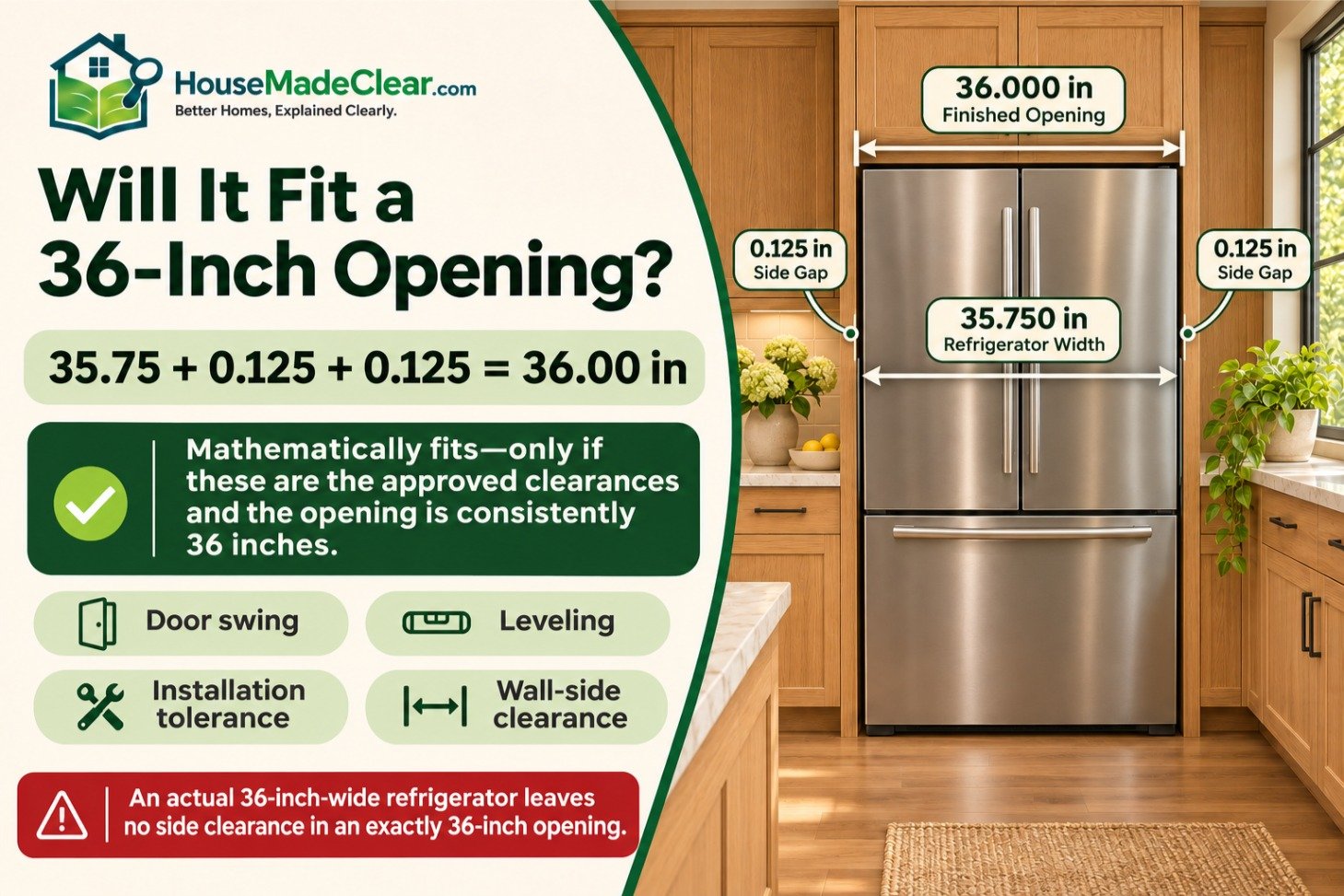
A refrigerator opening measuring exactly 36 inches wide does not automatically accommodate a refrigerator with an actual 36-inch width.
You must include the manufacturer’s required side clearances.
Example: Refrigerator Opening Calculation
Suppose you have:
- Available opening width: 36 inches
- Refrigerator width: 35.75 inches
- Required side clearance: 0.125 inch on each side
Total required width:
35.75 + 0.125 + 0.125 = 36 inches
The appliance mathematically fits the width, assuming those are the exact approved clearances and the opening is consistently 36 inches wide.
However, you still need to verify door swing, floor leveling, installation tolerance, and any additional space beside walls.
What if the Refrigerator Is Exactly 36 Inches Wide?
If the actual appliance width is 36 inches, then an exactly 36-inch opening generally provides no side clearance.
That may violate the manufacturer’s installation requirements.
Choose a narrower model or modify the opening where appropriate.
Refrigerator Size vs. Kitchen Cabinet Dimensions
Kitchen cabinetry determines where a refrigerator can fit and how it looks once installed.
Conventional U.S. kitchen base cabinets are commonly 24 inches deep, with finished countertops often around 25–26 inches deep.
Standard-depth refrigerators frequently extend farther into the kitchen.
Counter-depth refrigerators are designed to reduce that difference.
If you’re planning a new kitchen or replacing cabinets, our guide to standard kitchen cabinet sizes explains base, wall, and tall cabinet dimensions, including the measurements that affect appliance openings.
What About the Cabinet Above the Refrigerator?
Over-refrigerator cabinets must be planned around the refrigerator’s:
- Overall height
- Hinge projection
- Required top ventilation
- Door-swing geometry
- Finished-floor level
Don’t choose an overhead cabinet using only the refrigerator’s nominal height.
Should You Install Cabinets Before Buying the Refrigerator?
If you’re designing a kitchen from scratch, select the appliance or establish precise appliance specifications before finalizing surrounding cabinetry.
Otherwise, you may end up with an opening that fits only a narrow range of models.
What Refrigerator Capacity Do You Need?
Refrigerator capacity is measured in cubic feet.
The advertised cubic-foot figure describes internal storage volume, not the exterior dimensions.
Two refrigerators with similar outside measurements can have different capacities.
Refrigerator Capacity Planning
| Household or Storage Pattern | Possible Starting Capacity |
|---|---|
| One person with limited groceries | Around 10–14 cu. ft. |
| One or two people | Around 14–18 cu. ft. |
| Three or four people | Around 18–24 cu. ft. |
| Larger household or bulk shopping | Around 24–30+ cu. ft. |
These are broad planning examples, not manufacturer standards.
Actual needs depend on food-shopping frequency, meal preparation, freezer use, and whether you have secondary refrigeration.
Is a Bigger Refrigerator Always Better?
No.
A larger refrigerator occupies more kitchen space and may create access problems.
Look at how you use the interior:
- Are shelves adjustable?
- Can you store wide trays?
- Are the freezer drawers practical?
- Is there enough usable door storage?
- Can you access food without moving multiple items?
Usable organization matters alongside total capacity.
Which Refrigerator Type Is Best for a Small Kitchen?
The right choice depends on the opening dimensions and how the doors operate.
Top-Freezer Refrigerator
Often useful for narrower kitchens and conventional layouts.
Many models are available in smaller widths.
Bottom-Freezer Refrigerator
Places refrigerated food at a convenient height while keeping the freezer below.
Check drawer extension and front clearance.
French-Door Refrigerator
Can offer good access to wide refrigerator shelves while using two narrower upper doors.
But many models require substantial width.
Side-by-Side Refrigerator
Narrower doors can be helpful in some tight layouts, although the compartments themselves may limit storage of very wide items.
Counter-Depth Refrigerator
A useful option when a deeper refrigerator would reduce circulation space.
However, compare its internal capacity and exact door-clearance requirements before choosing it.
Common Refrigerator Measurement Mistakes
Measuring Only the Refrigerator Width
Height, depth, and clearance can cause installation problems even when the width fits.
Ignoring the Door Hinges
The highest hinge may extend above the refrigerator case.
Forgetting Handle Depth
Handles can project farther into the kitchen than expected.
Assuming Counter-Depth Means Fully Flush
Many counter-depth refrigerators still extend beyond the countertop at the doors.
Ignoring the Wall Beside the Refrigerator
A door may not open fully when installed against a fixed wall.
Forgetting the Delivery Route
A refrigerator that fits its kitchen opening may not pass through a narrow hallway.
Choosing the Appliance After Cabinet Installation
Without a specified refrigerator model, the finished opening may be unsuitable.
Using Generic Ventilation Clearances
Different refrigerators have different air circulation requirements.
Always follow the product’s installation instructions.
Refrigerator Measurement Checklist
Before buying, confirm the following:
| Measurement | What to Record |
|---|---|
| Kitchen opening width | Narrowest clear width |
| Kitchen opening height | Floor to lowest obstruction |
| Available depth | Wall to allowable projection |
| Refrigerator actual width | From model specifications |
| Height to case | Excluding higher hinges |
| Height to hinge | Overall high point |
| Depth with handles | Full closed depth |
| Depth with door open | Required operating space |
| Side ventilation | Model-specific requirement |
| Top ventilation | Model-specific requirement |
| Rear clearance | Model-specific requirement |
| Hinge-side clearance | Especially near walls |
| Delivery route | Narrow doors, stairs, and turns |
| Electrical supply | Suitable accessible outlet |
| Water connection | If required |
| Cabinet compatibility | Overhead and adjacent cabinets |
Frequently Asked Questions
What are the standard dimensions of a refrigerator?
Full-size refrigerators commonly range from approximately 24–40 inches wide, 61–72 inches tall, and 28–37 inches deep. Actual dimensions depend on the style, capacity, and manufacturer.
What is the most common refrigerator width?
Common full-size refrigerator widths include 30, 33, and 36 inches. Many French-door and side-by-side models are approximately 36 inches wide.
How tall is a standard refrigerator?
Many full-size refrigerators are approximately 65–72 inches tall, depending on the type. Check both the cabinet height and hinge height before installing one beneath an overhead cabinet.
Will a 36-inch refrigerator fit in a 36-inch opening?
Not necessarily. A refrigerator with an actual width of 36 inches may require extra side clearance. Compare its precise dimensions and installation requirements with the finished opening.
How much clearance should you leave around a refrigerator?
Clearance varies by model. Some GE refrigerators use general guidance of approximately 1/8–1 inch at each side, 1 inch above, and 1–2 inches behind. Always follow the selected refrigerator’s installation instructions.
What is the difference between counter-depth and standard-depth refrigerators?
Counter-depth refrigerators are designed to project less beyond surrounding cabinetry. Standard-depth models are generally deeper and may offer greater internal capacity at similar widths and heights.
Does refrigerator depth include the handles?
It depends on the specification. Manufacturers may separately list depth without doors, without handles, with handles, and with doors open. Use the measurement that matches your installation concern.
What size refrigerator is best for a small kitchen?
A narrower top-freezer or bottom-freezer refrigerator may suit a limited-width opening, while a counter-depth model can reduce projection into a walkway. Compare the exact dimensions and door movement before choosing.
Final Thoughts
Standard refrigerator sizes provide useful planning ranges, but the correct appliance must fit your kitchen in three dimensions—and still have room to operate.
Many full-size refrigerators are roughly 24–40 inches wide, 61–72 inches tall, and 28–37 inches deep. Popular widths include 30, 33, and 36 inches.
Before buying, measure the actual kitchen opening, compare the refrigerator’s full dimensions, and check the manufacturer’s ventilation and door-swing requirements.
Pay particular attention to hinge height, handle projection, and adjacent walls.
A refrigerator that fits correctly should not only slide into its designated space. Its doors should open properly, its drawers should remain accessible, and its installation should meet the manufacturer’s specifications.






[…] Standard Refrigerator Sizes: Width, Height, Depth, and Clearance Guide […]