

















You’ve just finished grouting a bathroom shower, kitchen backsplash, or freshly tiled floor. The tile looks finished, the joints are filled, and you’re ready to use the space again.
But before turning on the shower, walking across the new floor, or applying grout sealer, there’s an important question: How long does grout take to dry?
The answer depends on whether you’re using cement-based grout, premixed grout, or epoxy grout. Temperature, humidity, joint depth, and the manufacturer’s instructions also affect the waiting period.
Many conventional cement-based grouts need approximately 24 to 72 hours of protected curing before certain next steps. However, some installations need more time, while specific rapid-setting products allow earlier use.
For example, a grout that can tolerate light foot traffic after 24 hours may still need 72 hours before water exposure. An epoxy grout may be suitable for shower use before it reaches its maximum stain resistance.
Understanding these differences is essential because grout that looks dry is not necessarily ready for water, heavy traffic, sealing, or cleaning chemicals.
This guide explains grout drying and curing times by type, when you can use a freshly grouted shower, how long to wait before sealing, and the common mistakes that can weaken new grout.
Quick Answer
How long does grout take to dry? Many cement-based grouts require approximately 24–72 hours of protected curing for common residential applications, although the exact schedule depends on the product and intended use.
- Cement-based grout: Often requires 24–72 hours before various next steps; sealing may require at least 72 hours.
- Premixed or ready-to-use grout: Some manufacturers require 72 hours before intermittent water exposure.
- Epoxy grout: Cure times vary; certain products allow showers after 48–72 hours under specified conditions.
- Freshly grouted floors: Some products permit light foot traffic after approximately 24 hours, but others have different requirements.
- Before sealing: Many conventional cement grouts require around 72 hours, depending on the grout and sealer.
Most important: Follow the grout manufacturer’s technical data sheet. Dry-to-touch time, traffic readiness, shower readiness, and full cure are different milestones.
Grout Drying Time Chart by Type
Not every grout uses the same ingredients or hardening process.
This means the correct waiting time depends on the product.
| Grout Type | Typical Planning Consideration | Water Exposure | Sealing |
|---|---|---|---|
| Sanded cement grout | Allow manufacturer-specified curing, often over several days | Follow wet-area instructions | Often requires sealing only when recommended |
| Unsanded cement grout | Similar cement-curing considerations | Follow specific product guidance | Check grout and sealer labels |
| High-performance cement grout | May have accelerated curing | Product dependent | Some products have built-in stain resistance |
| Premixed acrylic or other ready-to-use grout | Often dries through evaporation or another product-specific process | Some require 72 hours before intermittent exposure | Product dependent |
| Epoxy grout | Chemical curing process | Some allow showers after 48–72 hours | Usually does not need conventional grout sealer |
| Rapid-setting grout | Designed for faster return to service | Follow exact fast-cure schedule | Product dependent |
| Specialty industrial grout | Varies by formulation | Special exposure rules may apply | Product dependent |
These are planning categories, not guaranteed time ranges for every brand.
For example, MAPEI’s grout troubleshooting guidance discusses the importance of moisture conditions and protecting ready-to-use grout from premature water exposure.
Meanwhile, LATICRETE’s cement grout guidance recommends allowing certain cement-based grouts to cure for at least 72 hours at 70°F before applying specified sealers.
The best approach is to identify the grout before deciding when to use the surface.

Grout Drying vs. Curing: What’s the Difference?
The terms drying and curing are often used interchangeably, but they do not mean the same thing.
What Does Drying Mean?
Drying generally refers to moisture leaving a material.
Ready-to-use grout products may depend heavily on drying conditions, depending on their formulation.
Some products can become firm at the surface while moisture remains deeper in the joint.
What Does Curing Mean?
Curing refers to the physical or chemical processes through which a material develops its intended properties.
Cement-based grout hardens through cement hydration.
Epoxy grout cures through a chemical reaction between its components.
Because the mechanisms differ, trying to accelerate every grout with the same method can cause problems.
Is Dry Grout Fully Cured?
Not necessarily.
A grout joint may feel hard while it is still developing strength, resistance to water, or stain resistance.
This is especially important in showers and floors.
Important Grout Timing Terms
| Term | Meaning |
|---|---|
| Working time | Period during which mixed grout can be applied |
| Initial set | Grout begins hardening |
| Cleaning window | Time when installation residue should be removed |
| Light traffic time | When limited walking may be permitted |
| Heavy traffic time | When greater loads may be permitted |
| Water-ready time | When specified water exposure may begin |
| Seal-ready time | When compatible sealer may be applied |
| Full cure | When the product reaches its specified cured state |
For planning purposes, use the timing corresponding to your next activity rather than relying on a generic drying claim.

How Long Does Cement-Based Grout Take to Dry?
Cement-based grout is widely used in residential tile installations.
It is available in sanded, unsanded, and various high-performance formulations.
Many cement grouts require protection from traffic, water, and harsh cleaning products while curing.
However, there is no universally correct 24-hour or 72-hour rule.
Does Cement Grout Cure in 24 Hours?
A cement-based grout may become firm within 24 hours.
Some products may also permit light traffic by then.
But that does not automatically establish readiness for a wet shower, sealing, or aggressive cleaning.
Why Is 72 Hours Often Recommended?
A 72-hour waiting period appears in instructions for several cement grout and grout-sealer combinations.
For example, LATICRETE recommends a minimum of 72 hours at 70°F before applying certain STONETECH sealers to its cement-based grout products.
Other manufacturers and specialty grout formulations may specify different times.
Does Sanded Grout Dry Faster Than Unsanded Grout?
Not necessarily.
Sanded and unsanded grout differ in composition and typical joint applications, but drying and curing time cannot be reliably predicted from the presence of sand alone.
The formulation, joint dimensions, environmental conditions, and water content also matter.
Should You Keep Cement Grout Wet While It Cures?
Do not assume that either continuous wetting or aggressive drying is appropriate.
Some traditional cement products have specific curing or misting requirements. Other modern modified grouts explicitly prohibit additional water or require different treatment.
Follow the manufacturer’s curing instructions rather than applying a generic rule.
How Long Does Premixed Grout Take to Dry?
Premixed grout is sold ready to use, without the mixing procedure required by conventional bagged cement grout.
However, premixed does not identify one universal grout chemistry.
Different ready-to-use products may rely on different binders and drying or curing processes.
Why Can Premixed Grout Take Longer to Dry?
Some formulations need moisture to evaporate from the installed material.
Deep joints, low temperatures, high humidity, or limited evaporation can delay hardening.
How Long Before Premixed Grout Gets Wet?
Some ready-to-use grouts require approximately 72 hours before intermittent water exposure.
That period should not be applied to every product.
The exact wait depends on the manufacturer’s instructions and conditions.
Why Does Humidity Matter?
For grouts that depend on drying, high relative humidity slows moisture evaporation.
A bathroom with limited ventilation may therefore require more time.
Use the manufacturer’s temperature and humidity recommendations to determine whether normal drying conditions have been met.
How Long Does Epoxy Grout Take to Cure?
Epoxy grout differs from conventional cement grout.
It normally consists of reactive components that chemically cure after mixing.
Epoxy products are commonly selected for stain resistance and demanding applications.
However, their working time, water readiness, and full cure time vary.
Is Epoxy Grout Ready in 24 Hours?
Some epoxy products may tolerate certain types of traffic within a day, but that does not mean every epoxy grout is ready for shower use after 24 hours.
How Long Before You Can Shower With Epoxy Grout?
LATICRETE’s SPECTRALOCK PRO Premium Grout FAQ states that showers using that product may typically return to service after 48–72 hours at 70°F.
The same guidance explains that full stain resistance takes longer—approximately seven days under those stated conditions.
This distinction matters because a shower can be water-ready before the grout reaches all its final performance characteristics.
Does Epoxy Grout Need Sealing?
Many epoxy grouts do not require a conventional penetrating grout sealer.
For example, LATICRETE identifies its SPECTRALOCK PRO Premium epoxy grout as a product that does not need grout sealing.
However, some adjacent natural-stone tile surfaces may still require treatment.
Do not apply grout sealer to epoxy simply because cement grout is often sealed.
How Long Before You Can Use a Shower After Grouting?
This is one of the most important questions when repairing or remodeling a bathroom.
The answer depends on the grout’s stated water-ready or return-to-service time.
A shower exposes grout joints to direct water, splashes, warm temperatures, and repeated moisture.
Using the shower prematurely may damage grout that has not developed sufficient resistance.
Shower Waiting-Time Examples
| Situation | General Planning Guidance |
|---|---|
| Standard cement grout in shower | Follow manufacturer’s wet-area curing period |
| Ready-to-use grout | Some products require 72 hours before intermittent water |
| Certain epoxy grouts | Some allow showers after 48–72 hours |
| Rapid-setting grout | May permit earlier use when explicitly labeled |
| Shower with multiple new products | Follow the longest applicable waiting period |
| Steam shower | Often has different or longer requirements |
| Submerged installation | Must meet product-specific immersion requirements |
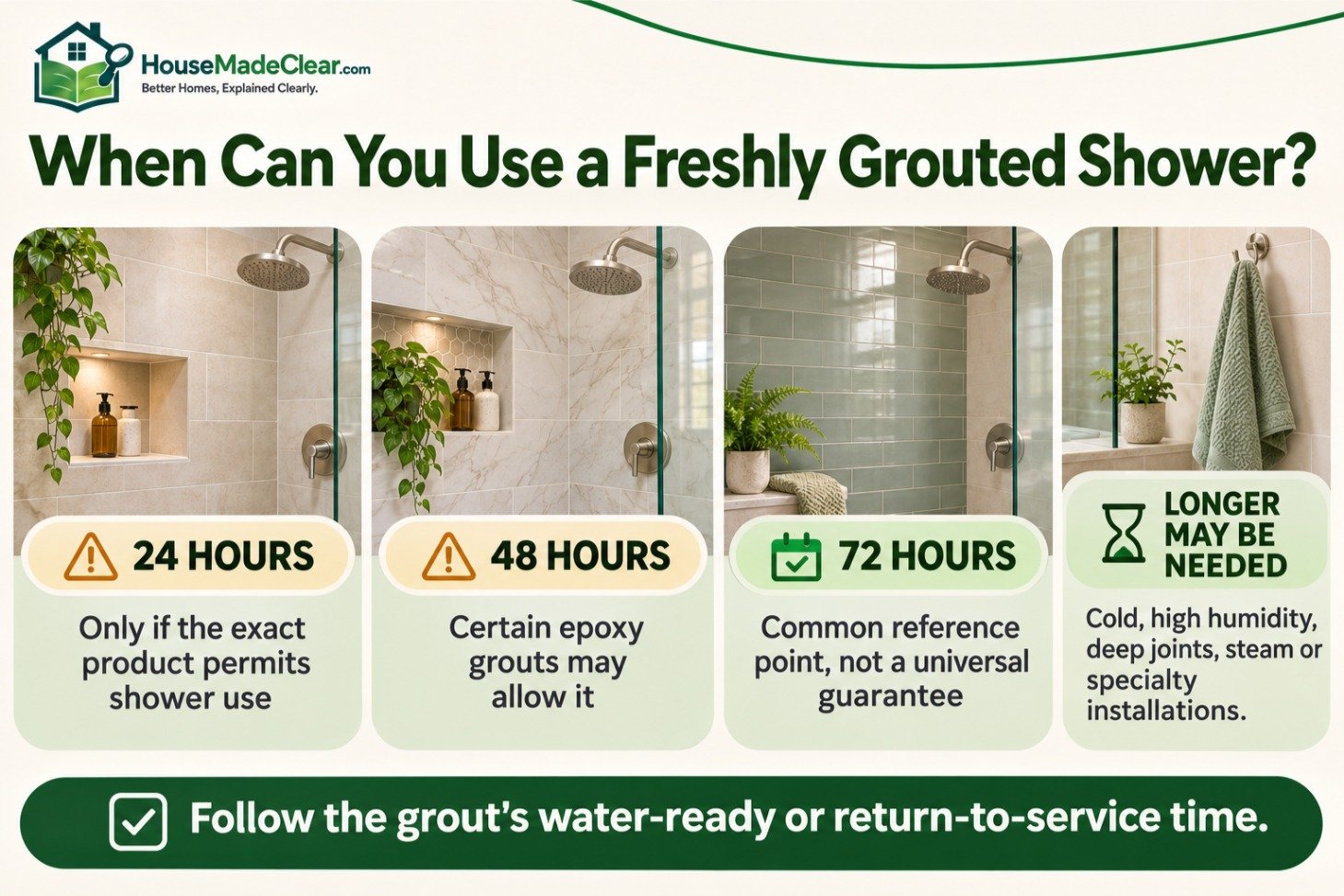
Can You Shower 24 Hours After Grouting?
Only if the exact grout product permits shower use after 24 hours under the actual conditions.
Some products may allow it.
Others require 48 or 72 hours or longer.
Do not use a general online recommendation to override the technical data sheet.
Can You Shower 48 Hours After Grouting?
Possibly.
Certain epoxy grouts may permit it, but some premixed products and other formulations require more time.
Verify the product’s specific water-exposure instructions.
Is 72 Hours Always Enough?
No.
Although 72 hours is a common reference point, it is not a universal guarantee.
Low temperatures, high humidity, specialty installations, oversized joints, and particular grout formulations can require longer.
What Happens If You Shower Too Early?
Possible consequences include:
- Softening or washing out incompletely hardened grout
- Discoloration
- Weak or powdery joints
- Uneven grout appearance
- Surface damage
- Reduced durability
- Additional repair work
The specific result depends on the grout chemistry and degree of curing.
How Long Does Floor Grout Take to Dry Before Walking?
Floor installations introduce a different concern: foot traffic.
A grout may be suitable for light walking before it is ready for heavy furniture, wet cleaning, or normal household use.
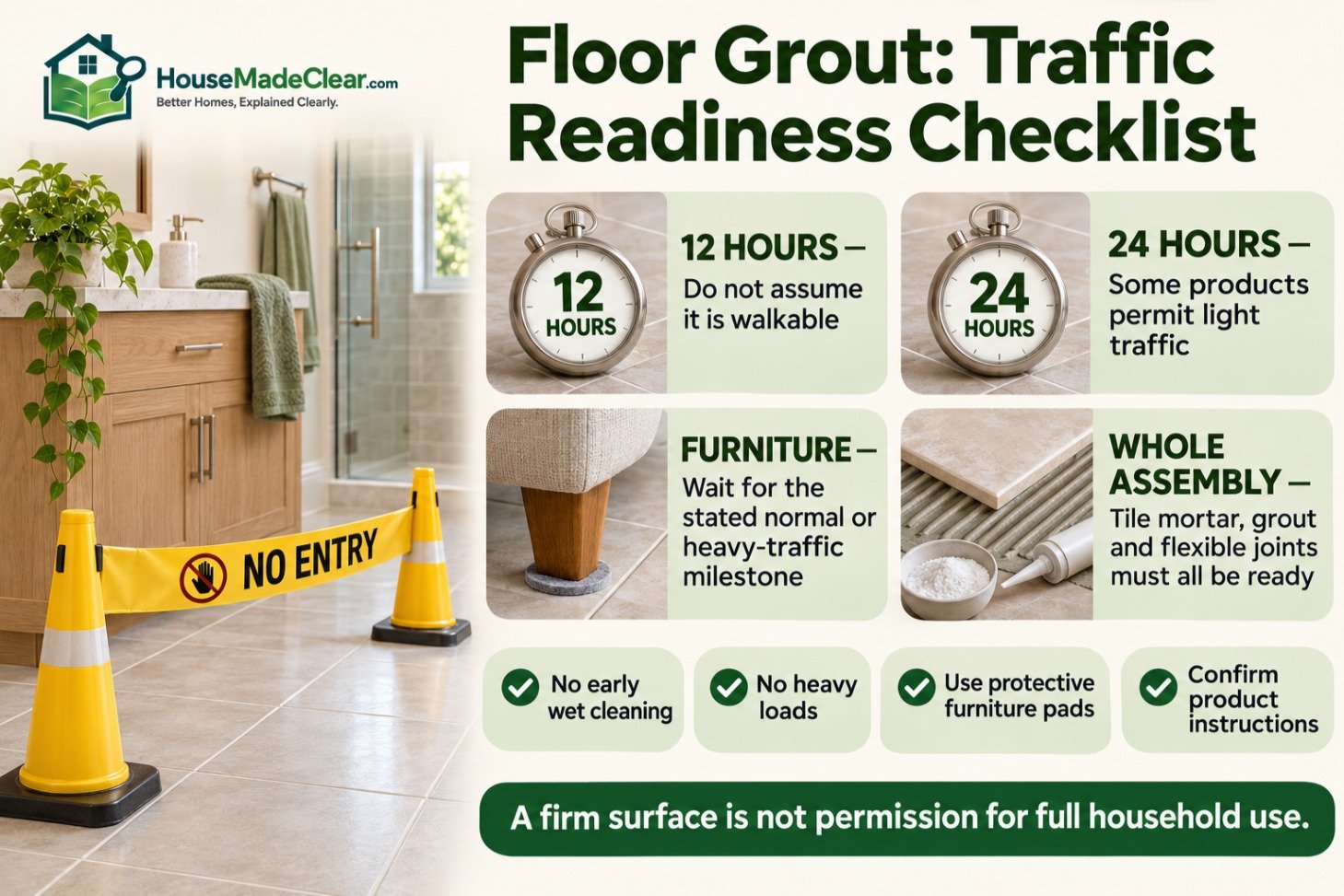
Can You Walk on Grout After 12 Hours?
Some specially formulated products permit relatively early light traffic under specified conditions.
However, many products require longer.
Do not use a freshly grouted floor without confirming its traffic-readiness period.
Can You Walk on Grout After 24 Hours?
Some grouts permit light foot traffic after approximately 24 hours.
This is not an automatic rule for every installation.
Check both the grout instructions and the underlying tile-setting mortar’s cure requirements.
When Can You Move Furniture Back?
Furniture can create concentrated loads, scuffs, and stress on a new floor.
Wait for the manufacturer-specified normal or heavy traffic period.
Use suitable protective pads when moving furniture.
Floor Readiness Checklist
Before returning a tiled room to service, verify:
- Tile-setting mortar has cured sufficiently.
- Grout has reached its light-traffic or heavy-traffic milestone.
- No water or cleaning chemicals will be applied too early.
- The surface is clean and free of installation residue.
- Adjacent flexible movement joints are also ready.
The entire tile assembly, not just the grout, determines when the floor can be used.
How Long Does Grout Take to Dry Before Sealing?
Many homeowners assume grout must be sealed immediately after installation.
That is not always correct.
Some grout types benefit from a compatible sealer, while others are specifically formulated without a separate sealing requirement.
How Long Should You Wait Before Sealing Cement Grout?
For some conventional cement grout and sealer systems, a minimum wait of approximately 72 hours is recommended.
For example, LATICRETE specifies a minimum of 72 hours at 70°F for certain cement grouts before applying specified STONETECH sealers.
However, the sealer manufacturer may require a longer wait.
What Happens If You Seal Grout Too Early?
Potential problems include:
- Trapped moisture
- Uneven sealer penetration
- Hazy appearance
- Discoloration
- Poor sealer performance
Does All Grout Need Sealing?
No.
Some high-performance cement products and epoxy grouts are designed with stain resistance or do not require conventional sealing.
The correct approach depends on the material.
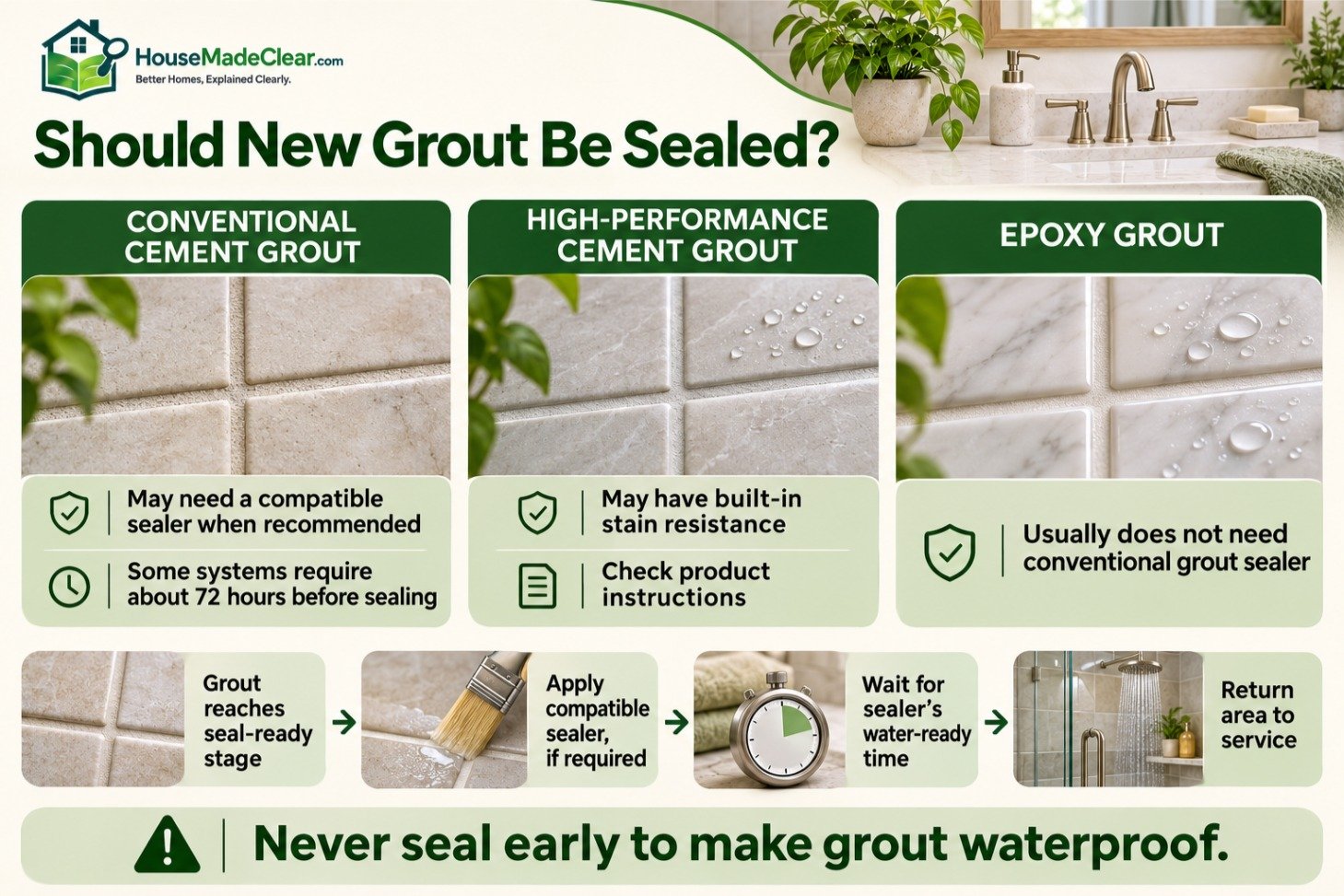
Can You Use the Shower Immediately After Sealing?
Not necessarily.
The sealer has its own drying and curing instructions.
A shower cannot return to use until the grout and any applied sealer have both reached their required water-ready stages.
Does Grout Need to Be Completely Dry Before Sealing?
Usually, the substrate and grout must meet the sealer manufacturer’s moisture requirements.
A grout joint can look dry without meeting those requirements.
Applying a sealer to moisture-laden joints may prevent proper penetration or create an uneven finish.
Should You Perform a Water Test?
Do not test fresh grout with water before the manufacturer’s approved exposure time.
After appropriate curing, some sealer manufacturers recommend specific water-drop evaluations to assess absorption.
Follow the instructions for the sealer you’re using.
Is a Second Coat of Sealer Necessary?
It depends on product instructions, grout porosity, and the type of sealer.
Do not apply additional coats automatically.
Excess sealer can leave residue on tile surfaces.
How Long Does Grout Take to Dry in a Bathroom?
Bathroom grout is often installed around:
- Bathtubs
- Shower walls
- Shower floors
- Bathroom floors
- Vanity backsplashes
- Bathroom niches
- Tiled benches
These surfaces do not all experience the same conditions.
A dry vanity backsplash may have a different return-to-service requirement than a shower floor exposed to direct water.
Shower Wall Grout
Shower walls require grout suitable for frequent water exposure.
Wait until the product is approved for shower use.
Shower Floor Grout
Shower floors often receive substantial water exposure and foot traffic.
Both requirements must be satisfied.
Bathroom Floor Grout
If the floor is outside the shower, its traffic schedule may be more important than its direct-water-exposure schedule.
Still, avoid wet cleaning until permitted.
Tile Around a Bathtub
Follow the grout and adjacent sealant instructions.
If you have also recaulked the tub perimeter, review our guide to how long caulk takes to dry.
Do not use the area until both products are sufficiently ready.
For planning shower dimensions and installation details, see our guide to walk-in shower dimensions.
Does Grout Dry Faster in Heat or Cold?
Temperature strongly influences many grout products.
Cold conditions can slow cement hydration, chemical reactions, and evaporation.
Warm temperatures may accelerate certain processes but can also shorten working time.
Very high temperatures or rapid moisture loss can contribute to poor installation results.
What Is the Ideal Temperature for Grout?
There is no single temperature suitable for every grout.
Many products are tested or documented around 70°F to 73°F, but the permitted application range depends on the specific material.
Follow the technical data sheet.
Can You Use a Space Heater?
Maintaining a suitable ambient temperature may help when the room is too cold.
However, avoid blasting new grout with concentrated heat.
Use heaters safely and follow the grout manufacturer’s guidance.
Can Cold Weather Delay Grout Curing?
Yes.
Low ambient and substrate temperatures may extend the time needed before foot traffic, sealing, or water exposure.
Does Humidity Affect Grout Drying Time?
Yes, but the impact varies with grout chemistry.
For ready-to-use grout that depends on evaporation, high humidity can significantly delay drying.
For cement grout, moisture is part of the hydration process, so excessive forced drying may be harmful.
For epoxy grout, the curing mechanism is different again.
This is why universal advice to use a fan or dehumidifier should be treated cautiously.
Can You Run a Bathroom Exhaust Fan?
Appropriate ventilation is useful for managing bathroom moisture.
However, avoid directing strong airflow onto fresh grout if the manufacturer prohibits accelerated surface drying.
If humidity is unusually high, follow the grout’s environmental requirements.
Our guide to bathroom humidity after a shower explains why bathrooms can retain moisture and how to assess drying conditions.
Will a Dehumidifier Help?
A dehumidifier may help some ready-to-use grouts dry in humid conditions, provided the manufacturer allows that approach.
It is not automatically the right method for cement-based grout.
Consult the product guidance before trying to accelerate curing.
For broader indoor conditions, see our guide to recommended humidity levels for a house.
Does Grout Joint Thickness Affect Drying Time?
Yes.
Wide or deep joints contain more material, and certain grout types take longer to dry or cure under those conditions.
For evaporation-dependent products, deeper joints may retain moisture longer.
The tile itself can also affect drying.
For example, a dense, low-absorption porcelain tile may limit evaporation through the tile body.
Should You Apply Less Grout to Make It Dry Faster?
No.
Grout joints should be properly filled in accordance with the product and tile manufacturer’s instructions.
Intentionally underfilling joints to reduce drying time can compromise the installation.
Can You Put Grout Over Old Grout?
Applying a thin new layer over deteriorated grout is not a dependable general repair method.
New grout needs a suitable, adequately prepared joint and sufficient depth for the selected product.
Follow the grout manufacturer’s repair requirements.

How to Tell if Grout Is Dry
The grout’s appearance can offer clues, but it cannot reliably confirm full cure.
Signs the Grout Has Set
You may observe:
- Firmer joints
- More uniform color
- Reduced surface moisture
- Resistance to gentle incidental contact
- No visible wet residue
However, these signs are not enough to establish that the grout is ready for showering or sealing.
Is the Touch Test Accurate?
Not for proving full cure.
Touching or pressing fresh grout can disturb the joint.
A grout surface may be hard while deeper material remains incompletely cured.
How Can You Know When Grout Is Ready?
Use three pieces of information:
- The exact grout product.
- Its technical data sheet.
- The actual installation conditions.
Record the time grouting was completed, then follow the waiting period associated with your next activity.
Why Is My Grout Still Wet or Soft After 24 Hours?
Several conditions may explain slow hardening.
| Symptom | Possible Cause | What to Do |
|---|---|---|
| Grout still soft | Normal longer cure or drying period | Review label |
| Dark, damp-looking joints | Moisture or uneven drying | Allow approved curing conditions |
| Premixed grout remains soft | High humidity or deep joints | Check manufacturer’s drying guidance |
| Crumbling cement grout | Mixing, curing, or installation problem | Investigate before use |
| Uneven color | Excess cleaning water or uneven conditions | Consult product instructions |
| Epoxy remains sticky | Incorrect mixing or cure conditions | Contact manufacturer |
| Grout appears washed out | Premature water exposure | Assess and repair as directed |
| Persistent softness well beyond expected cure | Possible installation or product failure | Seek technical support |
Do not attempt to repair grout simply by coating soft material with sealer.
If the grout itself has failed, the defective sections may need removal and replacement.
What Happens if Grout Gets Wet Too Soon?
Water exposure before the appropriate time can affect the surface and strength of some grout products.
Possible problems include:
- Washed-out joints
- Color inconsistency
- Softening
- Reduced strength
- Surface residue
- Loss of stain resistance
- Extended drying time
The result depends on the grout chemistry and timing.
What Should You Do if You Accidentally Wet Fresh Grout?
- Stop further water exposure.
- Avoid scrubbing or disturbing the joints.
- Allow the installation to stabilize under appropriate conditions.
- Inspect for visible damage.
- Check the grout manufacturer’s repair instructions.
- Replace damaged grout where necessary.
If substantial grout has washed out, do not assume the remaining material can be repaired with a superficial coating.
Can You Speed Up Grout Drying?
Sometimes environmental conditions can be improved, but excessive acceleration can damage the installation.
For Ready-to-Use Grout
The manufacturer may recommend:
- Suitable room temperature
- Controlled humidity
- Appropriate ventilation
- Longer drying periods for deep joints
For Cement-Based Grout
Avoid uncontrolled rapid drying.
Cement requires appropriate curing conditions to develop its properties.
Follow the product’s instructions on moisture protection and curing.
For Epoxy Grout
Maintain the approved temperature range and observe the manufacturer’s cure schedule.
Do not add extra hardener or change the mixing ratio to speed curing.
Should You Use a Hair Dryer?
Generally, no.
Concentrated heat may create uneven drying, surface defects, or other problems.
It is safer to maintain appropriate room conditions and allow the product to cure as designed.
Grout vs. Caulk: Which Takes Longer to Dry?
Grout and caulk often appear together in bathrooms, but they serve different functions.
Grout fills joints between tiles.
Caulk or another appropriate flexible sealant is commonly used at movement joints and changes of plane, such as wall-to-tub connections.
Grout vs. Caulk Drying Comparison
| Feature | Grout | Caulk |
|---|---|---|
| Main function | Fills tile joints | Seals designated joints and accommodates movement |
| Common materials | Cement, epoxy, ready-to-use formulations | Silicone, acrylic, hybrids |
| Hardening process | Varies by grout type | Varies by sealant type |
| Typical shower waiting time | Product dependent, often multiple days | Product dependent, sometimes hours |
| Sealing | Some cement grouts may need it | Usually not a separate grout-sealing step |
| Used at movement joints | Generally not recommended | Suitable flexible sealant often required |
| Full cure | Product dependent | Product dependent |
This is an important installation distinction.
Grout should not automatically replace flexible sealant at a shower corner simply because both materials can fill gaps.
Do You Need to Seal Shower Grout After It Dries?
Not every shower grout needs sealing.
Some cement-based grouts are suitable for a penetrating sealer.
Certain high-performance and epoxy grouts are designed without that requirement.
What Does Grout Sealer Do?
A suitable sealer may help reduce absorption of water and staining substances into certain porous grout materials.
However, a grout sealer does not turn an improperly constructed shower into a waterproof installation.
Is Grout Waterproof?
Conventional cement grout is not generally considered a substitute for waterproofing.
In tiled showers, the waterproofing system must be properly designed and installed behind or beneath the tile assembly.
Even well-maintained grout cannot compensate for a failed waterproof membrane.
What if the Shower Has Leaks?
Do not assume applying sealer will solve a leak.
Investigate plumbing, movement joints, shower pan construction, waterproofing, and other possible sources.
Our guides to shower curb height and width and standard shower pan sizes cover related shower-construction planning considerations.
How to Grout Tile So It Cures Properly
Good curing begins with proper preparation and installation.
Step 1: Confirm the Tile Mortar Is Ready
Grouting too early may trap moisture or disturb a tile installation.
Follow the tile-setting mortar manufacturer’s required waiting period.
Step 2: Clean the Joints
Remove loose debris and excess setting material.
Make sure the joint depth and condition meet the grout instructions.
Step 3: Choose the Correct Grout
Consider:
- Tile type
- Joint width
- Wet or dry location
- Expected movement
- Stain resistance
- Manufacturer compatibility
- Required return-to-service time
Step 4: Follow Mixing Instructions
For products requiring mixing, use the specified ratios.
Do not add extra water to make grout easier to spread.
Incorrect mixing can weaken the finished material or cause color inconsistency.
Step 5: Fill Joints Properly
Use the recommended grout float and application method.
Avoid leaving voids or underfilled joints.
Step 6: Clean at the Correct Time
Follow the manufacturer’s initial-cleaning and final-cleaning windows.
Cleaning too early or using excessive water can damage certain grouts.
Step 7: Protect the Surface
Keep traffic, water, and cleaning products off the installation until permitted.
Step 8: Maintain Approved Conditions
Observe the recommended temperature, moisture, and ventilation conditions.
Step 9: Seal if Required
If sealing is appropriate, allow the stated cure period and follow the sealer instructions.
Step 10: Return the Area to Service
Use the shower or floor only after every applicable product in the tile assembly is ready.
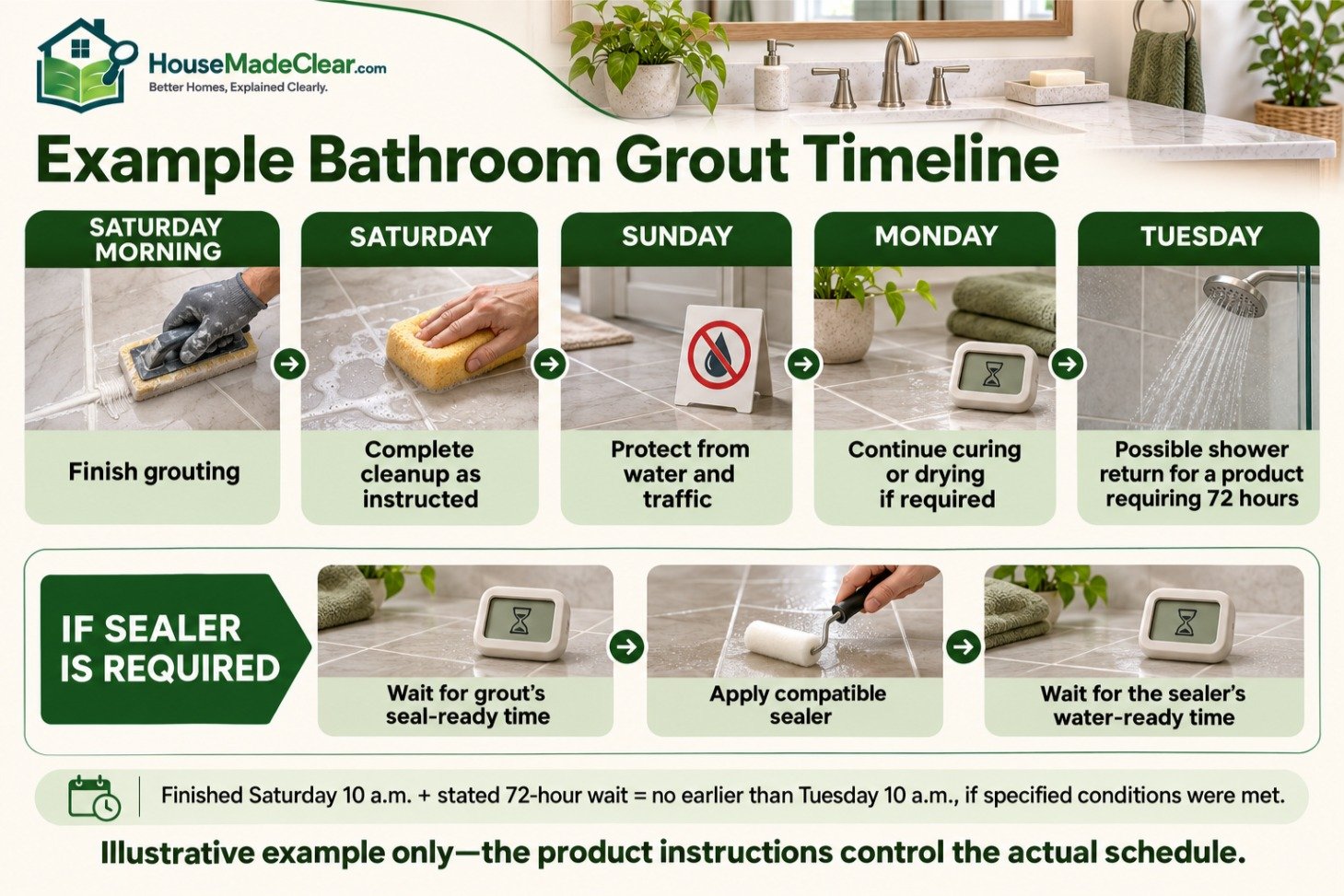
Grout Drying Timeline: Example Bathroom Project
Suppose you grout a bathroom shower on Saturday morning.
The appropriate schedule depends on the product.
| Project Stage | Example |
|---|---|
| Saturday morning | Finish applying grout |
| Saturday | Complete initial and final cleanup as instructed |
| Sunday | Continue protecting grout from water |
| Monday | Continue curing or drying if required |
| Tuesday | Potential return to shower use for a product requiring 72 hours |
| After grout cure | Apply compatible sealer if required |
| After sealer readiness | Resume shower use according to sealer instructions |
This timeline is illustrative, not a universal requirement.
Example 1: Ready-to-Use Grout
If the product requires 72 hours before water exposure and grouting finishes Saturday at 10 a.m., the earliest permitted water exposure would generally be Tuesday at 10 a.m., assuming specified conditions were met.
Example 2: Epoxy Grout
If the selected epoxy grout allows showers after 48–72 hours at 70°F, follow its exact return-to-service instructions and consider whether the actual room temperature affects that schedule.
Example 3: Grout That Requires Sealing
If the grout must cure for 72 hours before sealing, do not assume shower use can resume immediately after the sealer is applied.
The sealer’s own water-ready period must also pass.
Common Mistakes That Delay Grout Drying or Cause Failure
Mistake 1: Using the Shower Too Soon
Premature water exposure can damage incompletely cured grout.
Mistake 2: Confusing Surface Hardness With Full Cure
A hard surface does not confirm that the entire joint is ready.
Mistake 3: Mixing Grout With Too Much Water
Excess water can affect strength, color, and final performance.
Mistake 4: Cleaning With an Overly Wet Sponge
Too much water during cleanup may damage or discolor some formulations.
Mistake 5: Sealing Too Early
Moisture and incomplete curing can interfere with sealer performance.
Mistake 6: Assuming All Epoxy Grouts Have the Same Cure Time
Cure schedules vary significantly by product and temperature.
Mistake 7: Ignoring Humidity
High humidity can substantially slow some ready-to-use grouts.
Mistake 8: Applying Direct Heat
Forced drying may create problems, especially with cement grout.
Mistake 9: Grouting Before the Mortar Is Ready
Incomplete tile-mortar curing can affect the broader installation.
Mistake 10: Filling Movement Joints With Rigid Grout
Movement joints often require appropriate flexible sealants.
Mistake 11: Using Grout Sealer as Waterproofing
Grout sealer does not replace a proper shower waterproofing system.
Mistake 12: Ignoring Temperature Restrictions
Low or excessive temperatures can change working and curing conditions.
Grout Drying and Curing Checklist
| Check | Why It Matters |
|---|---|
| Correct grout identified | Establishes applicable cure schedule |
| Tile mortar ready | Protects overall tile installation |
| Mixing ratio followed | Supports proper performance |
| Joint depth appropriate | Prevents installation defects |
| Cleaning completed correctly | Reduces haze and damage |
| Room temperature suitable | Supports curing |
| Humidity controlled as required | Important for some ready-to-use grouts |
| Grout protected from water | Prevents premature exposure |
| Floor traffic limits followed | Avoids damage |
| Sealing requirements checked | Prevents unnecessary or early sealing |
| Sealer cure period observed | Supports finished performance |
| Movement joints treated appropriately | Allows necessary flexibility |
| Final surface inspected | Identifies incomplete or defective joints |
Final Thoughts
So, how long does grout take to dry?
Many conventional cement-based grouts require approximately 24–72 hours or more for important curing and return-to-service milestones. Some ready-to-use grouts require 72 hours before intermittent water exposure, while certain epoxy products permit shower use after 48–72 hours under specified conditions.
However, there is no universal grout drying time.
The right schedule depends on the product, tile installation, environmental conditions, and what you plan to do next.
A grout joint that feels hard may still require more curing before sealing, heavy traffic, cleaning, or direct water exposure.
For bathrooms, the safest approach is to check the manufacturer’s water-ready instructions, protect the joints during curing, and allow additional time when conditions are unfavorable.
If the project also involves new caulk, waterproofing products, or sealer, follow the longest applicable return-to-service requirement.
A correctly cured grout installation is more likely to maintain its appearance and performance than one put into service too early.
Frequently Asked Questions
How long does grout take to dry?
Many cement-based grouts require approximately 24–72 hours or longer for various curing and return-to-service milestones. Actual drying and curing times depend on grout type, joint dimensions, temperature, humidity, and manufacturer instructions.
How long does grout take to dry in a shower?
Shower grout must reach its manufacturer’s specified water-ready stage before use. Some ready-to-use grouts require 72 hours, while certain epoxy grouts allow shower use after approximately 48–72 hours under specified conditions.
Can you shower 24 hours after grouting?
Only if the grout manufacturer’s instructions permit shower use after 24 hours under the actual installation conditions. Many products require longer, so do not assume the grout is ready simply because it feels hard.
Can you shower 48 hours after grouting?
Possibly. Some epoxy grout products allow shower use after 48–72 hours, while other grout formulations require different waiting periods. Follow the exact product instructions.
Is 72 hours enough for grout to dry?
Seventy-two hours is a common reference period for some grout products, but it is not universal. Cold temperatures, high humidity, deep joints, and particular formulations may require longer curing or drying.
How long does floor grout take to dry before walking?
Some floor grouts permit light foot traffic after approximately 24 hours, while others allow earlier or later access. Check the grout and tile-setting mortar instructions before walking on the finished installation.
How long should grout dry before sealing?
Certain cement grout and sealer systems require a minimum of 72 hours at approximately 70°F before sealing. The exact waiting period depends on both the grout and sealer manufacturers’ instructions.
Does epoxy grout need to be sealed?
Many epoxy grouts do not require conventional penetrating grout sealer. However, surrounding porous stone or other materials may have separate sealing requirements.
How long does premixed grout take to dry?
Premixed grout drying times vary by formulation. Some products require approximately 72 hours before intermittent water exposure. High humidity, low temperatures, and deep joints may extend the drying period.
Does grout dry faster in heat or cold?
Cold conditions often slow grout drying or curing. Suitable warmer temperatures may support normal curing, but excessive heat or rapid drying can damage certain products. Follow the manufacturer’s temperature requirements.
Does humidity affect grout drying?
Yes. High humidity can slow ready-to-use grouts that depend on evaporation. Cement and epoxy grouts use different curing mechanisms, so humidity affects them differently.
Can you use a fan to dry grout faster?
Only when the grout manufacturer permits increased airflow. Some ready-to-use products benefit from appropriate ventilation, while forced drying can be unsuitable for certain cement-based grouts.
How do you know when grout is dry?
A grout surface may appear firm and uniform before it is fully cured. The reliable method is to follow the manufacturer’s specified curing and return-to-service times under the actual installation conditions.
What happens if grout gets wet too soon?
Premature water exposure may cause discoloration, softening, washed-out joints, or reduced durability, depending on the grout. Stop further exposure and follow the manufacturer’s guidance for inspection and repair.
Why is my grout still soft after 24 hours?
Possible causes include normal longer curing, low temperature, high humidity, deep joints, incorrect mixing, or a product-specific installation problem. Check the technical data before assuming the grout has failed.
Is grout waterproof after it dries?
Conventional cement grout is not a substitute for a proper waterproofing system. Even cured grout and grout sealer cannot replace correctly installed shower waterproofing.
Can you seal grout the next day?
Only if the grout and sealer manufacturers permit it. Many conventional cement grout systems require longer, sometimes a minimum of 72 hours, before sealing.
What takes longer to dry, grout or caulk?
It depends on the specific products. Some caulks are water-ready within hours, while certain grouts require several days. However, both materials have product-specific curing requirements, so a universal comparison is not reliable.






[…] How Long Does Grout Take to Dry? Shower, Floor, and Sealing… […]
[…] How Long Does Grout Take to Dry? Shower, Floor, and Sealing… […]
[…] How Long Does Grout Take to Dry? Shower, Floor, and Sealing… […]
[…] How Long Does Grout Take to Dry? Shower, Floor, and Sealing… […]
[…] How Long Does Grout Take to Dry? Shower, Floor, and Sealing… […]