

















Discovering a crack across your basement floor can be unsettling. You might notice a thin line running between two walls, a widening gap near the basement stairs, or several cracks appearing in the concrete after heavy rain.
The first concern is usually the same: Does a crack in the basement floor mean there’s a foundation problem?
Not necessarily.
Many basement floors develop cracks because concrete shrinks as it cures or because of minor movement in the material beneath the slab. Small, stable cracks with no vertical displacement or moisture intrusion are often less concerning than cracks that continue widening, leak water, or leave one side of the floor higher than the other.
However, crack width alone cannot determine whether a floor is safe.
The location, pattern, movement, and condition of the surrounding walls all matter.
This guide explains common basement floor cracks, how to identify warning signs, when a repair may be appropriate, and when to ask a structural engineer or foundation specialist to investigate.
Quick Answer
Are cracks in a basement floor normal? Yes. Hairline and narrow cracks are common in concrete basement slabs and may result from normal shrinkage or minor movement.
A crack is generally less concerning when it is narrow, stable, dry, and has no noticeable height difference between its sides.
Have the floor professionally evaluated if you notice:
- A crack that is getting wider or longer
- One side of the floor rising or sinking
- Water entering through the crack
- Multiple new cracks appearing within a short period
- Cracking accompanied by bowed foundation walls or sticking doors
- A floor that is visibly sinking, heaving, or becoming uneven
Important: There is no single crack width that proves a basement floor is structurally safe. Monitor changes and investigate the underlying cause before covering or repairing the crack.
Basement Floor Cracks: Normal vs. Concerning
The following comparison can help you decide what to investigate first.
| What You See | Possible Explanation | Recommended Action |
|---|---|---|
| Thin, stable hairline crack | Concrete shrinkage | Document and monitor |
| Narrow crack with no height difference | Shrinkage or minor movement | Monitor; repair if appropriate |
| Crack following a straight saw-cut line | Designed control joint | Usually expected; inspect joint condition |
| Widening crack | Ongoing slab or soil movement | Arrange professional evaluation |
| Crack with raised or sunken edge | Heaving or settlement | Have the slab assessed |
| Crack allowing water inside | Drainage or groundwater problem | Investigate water source promptly |
| Several new cracks appearing together | Changing support or environmental conditions | Professional inspection recommended |
| Floor cracks plus bowed basement walls | Possible broader foundation movement | Structural engineer recommended |
| Crack near a sump pit or plumbing trench | Movement around a slab opening or patched area | Inspect for settlement and leakage |
A hairline crack is not automatically harmless, and a wider crack is not automatically a structural emergency. The behavior of the crack is often more informative than its appearance on one particular day.

Why Do Basement Floors Crack?
Concrete is strong under compression, but it can crack when shrinkage, bending, soil movement, or other stresses create tension beyond what it can resist.
Most residential basement slabs are supported by the ground beneath them. Their performance depends partly on the condition and stability of that supporting soil.
The American Concrete Institute’s Guide to Design of Slabs-on-Ground explains that some cracking and curling can occur even with appropriate design and construction.
The most common causes fall into several categories.
1. Concrete Shrinkage
Concrete changes volume as it cures and loses moisture.
When that movement is restrained, cracks may form.
Shrinkage cracks can appear during the early life of a slab, although changes in an older floor can have other causes.
Typical characteristics include narrow cracks without substantial vertical displacement.
2. Settlement Beneath the Slab
The soil or fill beneath a basement floor may settle.
If one area loses support, the concrete can bend or crack.
Settlement is more concerning when the slab becomes uneven or the movement continues.
Possible contributing factors include poorly compacted fill, washout, and changes in subsurface conditions.
3. Soil Expansion or Heaving
Some soils expand when moisture levels increase.
Frost-related movement can also affect certain ground conditions.
Pressure beneath a slab may lift part of the floor and create cracks or ridges.
A heaved slab should not be treated as a simple cosmetic problem.
4. Water and Drainage Problems
Water around or beneath a foundation can contribute to soil movement and basement moisture.
Poor exterior grading, overflowing gutters, short downspouts, or inadequate drainage systems may worsen these conditions.
The crack itself may also become a path for water to enter the basement.
5. Improper Concrete Placement or Curing
Construction factors can influence cracking, including:
- Inadequate preparation of the supporting base
- Unsuitable concrete mixture
- Excess water added during placement
- Inadequate curing
- Improperly located or missing control joints
However, the presence of a crack alone does not establish that the original installation was defective.
6. Changes in Loads or Floor Support
Heavy equipment, added partitions, or modifications to the basement can change how loads are transferred through a slab.
Most ordinary residential basement floors are not engineered to support unlimited concentrated loads.
If a crack appears near a heavily loaded area or after structural work, professional assessment is appropriate.
Types of Cracks in Basement Concrete Floors
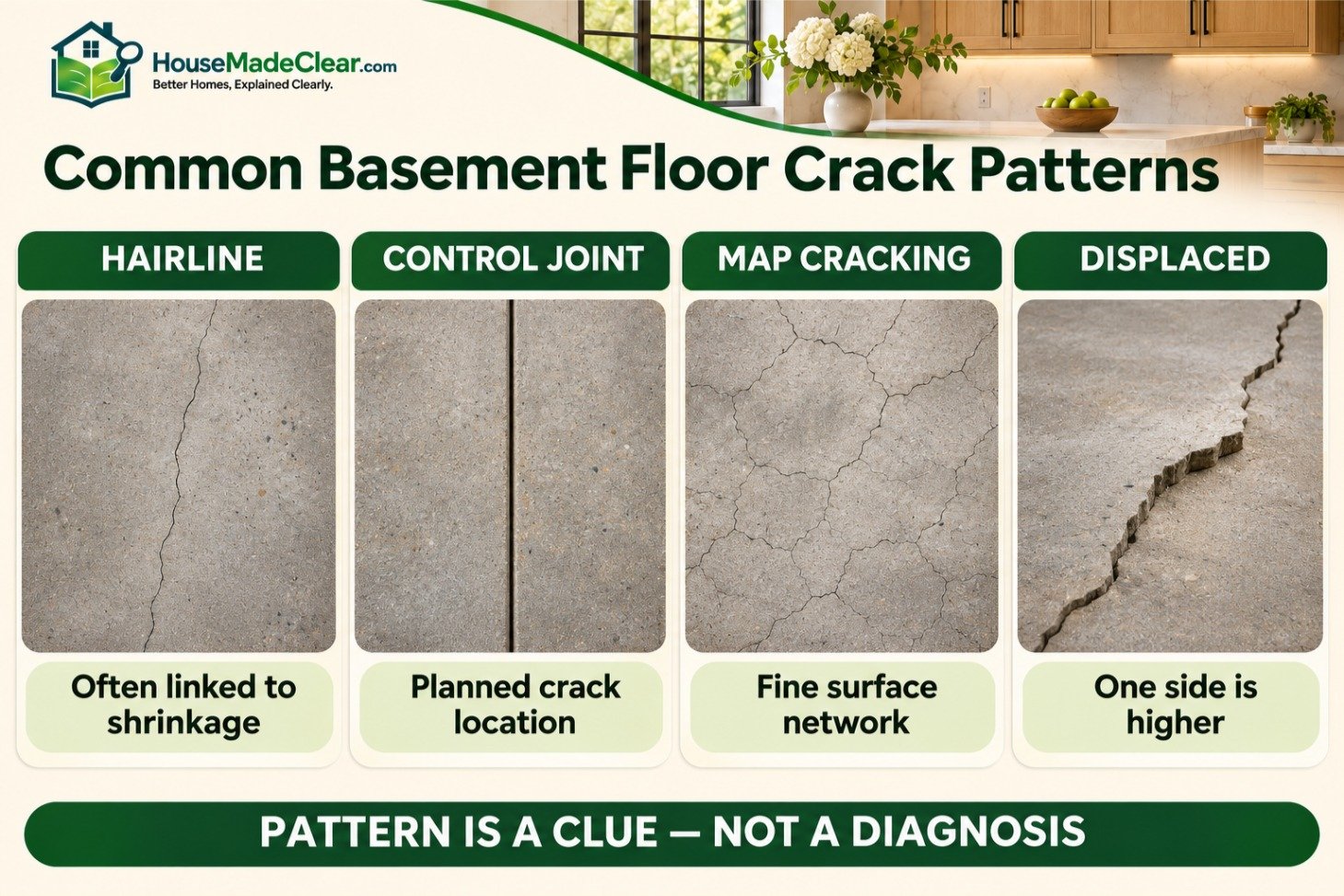
Identifying the crack pattern helps narrow the possible cause.
Hairline Cracks
Hairline cracks are very narrow fractures that may be difficult to see from a standing position.
They often result from shrinkage and may remain stable for years.
If a hairline crack is dry, level, and unchanged, monitoring may be sufficient.
Straight Cracks
Straight cracks may follow a control joint or reflect restrained shrinkage.
A deliberately saw-cut control joint is not the same thing as an accidental fracture.
Control joints are intended to encourage cracking in planned locations as concrete contracts.
Random or Diagonal Cracks
Random cracks can form when shrinkage stresses are not relieved at a suitable joint.
Diagonal cracking may also occur when a slab moves over uneven support.
The direction alone does not establish the cause.
Spiderweb or Map Cracking
A network of fine surface cracks is sometimes called crazing or map cracking.
This may involve the concrete surface rather than a full-depth slab fracture.
However, widespread surface deterioration, scaling, or crumbling deserves further assessment.
Cracks With Vertical Displacement
This means one side of the crack is higher than the other.
Vertical displacement is an important warning sign because it may indicate differential settlement, heaving, or other movement.
It can also create a tripping hazard.
Do not simply fill the crack and ignore the height difference.
How Wide Is Too Wide for a Basement Floor Crack?
Homeowners often look for a specific measurement that separates normal cracks from dangerous ones.
In practice, crack width is only one part of the assessment.
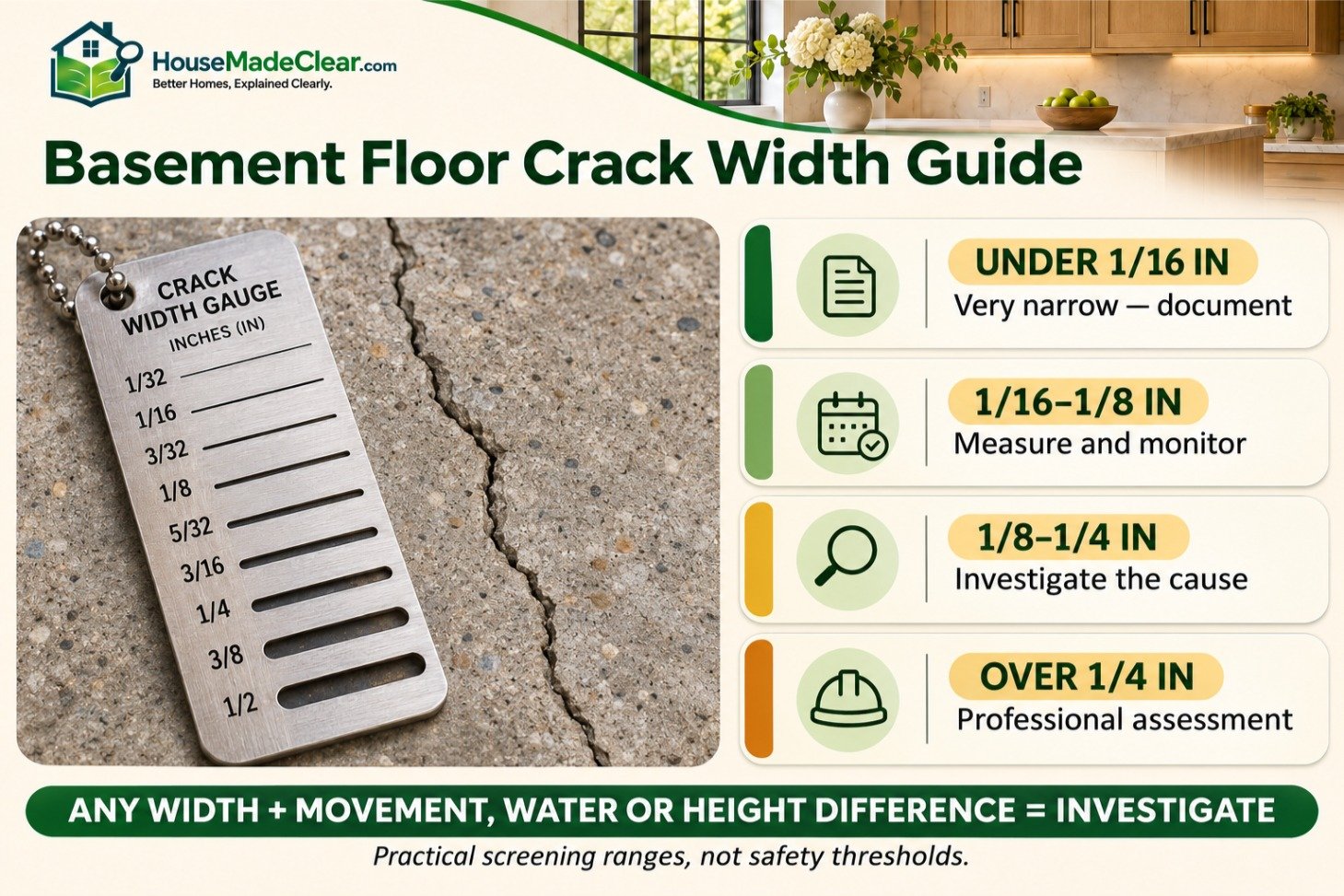
For tracking purposes, these size categories are useful:
| Crack Width | How to Interpret It |
|---|---|
| Less than 1/16 inch | Very narrow; often associated with shrinkage |
| 1/16–1/8 inch | Measure and monitor for movement |
| 1/8–1/4 inch | More noticeable; investigate cause and related symptoms |
| Greater than 1/4 inch | Professional assessment is advisable, particularly if new or changing |
| Any width with vertical movement, water intrusion, or rapid growth | Investigate regardless of measurement |
These are practical screening ranges, not engineering safety thresholds or building-code limits.
A stable 1/8-inch crack in a nonstructural slab may be less concerning than a much narrower crack associated with active foundation movement.
Is a 1/8-Inch Crack Serious?
Not necessarily.
Check whether the crack is stable, dry, and level.
A crack of this size deserves documentation and monitoring, especially if it recently appeared.
Is a 1/4-Inch Crack in a Basement Floor Normal?
A crack this wide should not be dismissed without considering its cause.
Look for displacement, moisture, recent movement, or related problems in nearby walls.
If the cause is uncertain, arrange an inspection.
Are Basement Floor Cracks a Foundation Problem?
Not always.
This is one of the most important distinctions in basement maintenance.
In many houses, the basement concrete floor is a slab-on-ground that is separate from the main foundation footings and load-bearing walls.
A crack in that slab does not automatically mean the footings have failed.
However, some buildings use different foundation arrangements, including structural slabs or specialized foundation systems.
You should not assume every basement floor is nonstructural without understanding the building’s construction.
Signs That Suggest a Broader Foundation Problem
Investigate more carefully when floor cracks appear alongside:
- Bowed or bulging foundation walls
- Significant wall cracks
- Doors or windows becoming difficult to operate
- Gaps developing around structural connections
- Floors noticeably sloping or moving
- Repeated new cracking
- Water intrusion associated with movement
These observations don’t independently prove foundation failure, but they justify a professional structural evaluation.
Cracks in Basement Floor With Water Seeping Through
Water entering through a basement floor crack is a different problem from a dry shrinkage crack.
A leaking crack may indicate that water is collecting beneath the slab or finding a path into the basement through an opening.
Possible causes include poor surface drainage, elevated groundwater, foundation drainage problems, or a plumbing leak.
How to Identify the Moisture Source
Observe when the crack becomes wet.
| When Water Appears | Possible Cause |
|---|---|
| After heavy rain | Exterior drainage or groundwater |
| During snowmelt | Increased water around foundation |
| Continuously | Persistent groundwater or plumbing issue |
| Around a specific pipe | Plumbing or penetration leak |
| During humid summer weather | Condensation may also be involved |
Don’t assume all dampness comes through the crack.
Water can also condense on a cool basement floor.

What Should You Check Outside?
Inspect:
- Gutters and downspouts
- Ground slope near the foundation
- Areas where water collects beside the house
- Disconnected drainage pipes
- Changes in landscaping that redirect runoff
The University of Minnesota Extension’s basement moisture guide explains why identifying the water source is essential before choosing a repair.
Can You Just Seal the Crack?
Sealing may reduce water entry at a particular opening, but it does not automatically solve the underlying drainage or groundwater problem.
If water pressure is forcing moisture through the floor, a surface patch alone may fail.
Persistent seepage deserves a proper waterproofing and drainage assessment.
How to Tell if a Basement Floor Crack Is Getting Worse
A crack that changes over time deserves more attention than one that remains stable.
You can monitor a dry, nonhazardous crack without immediately repairing it.
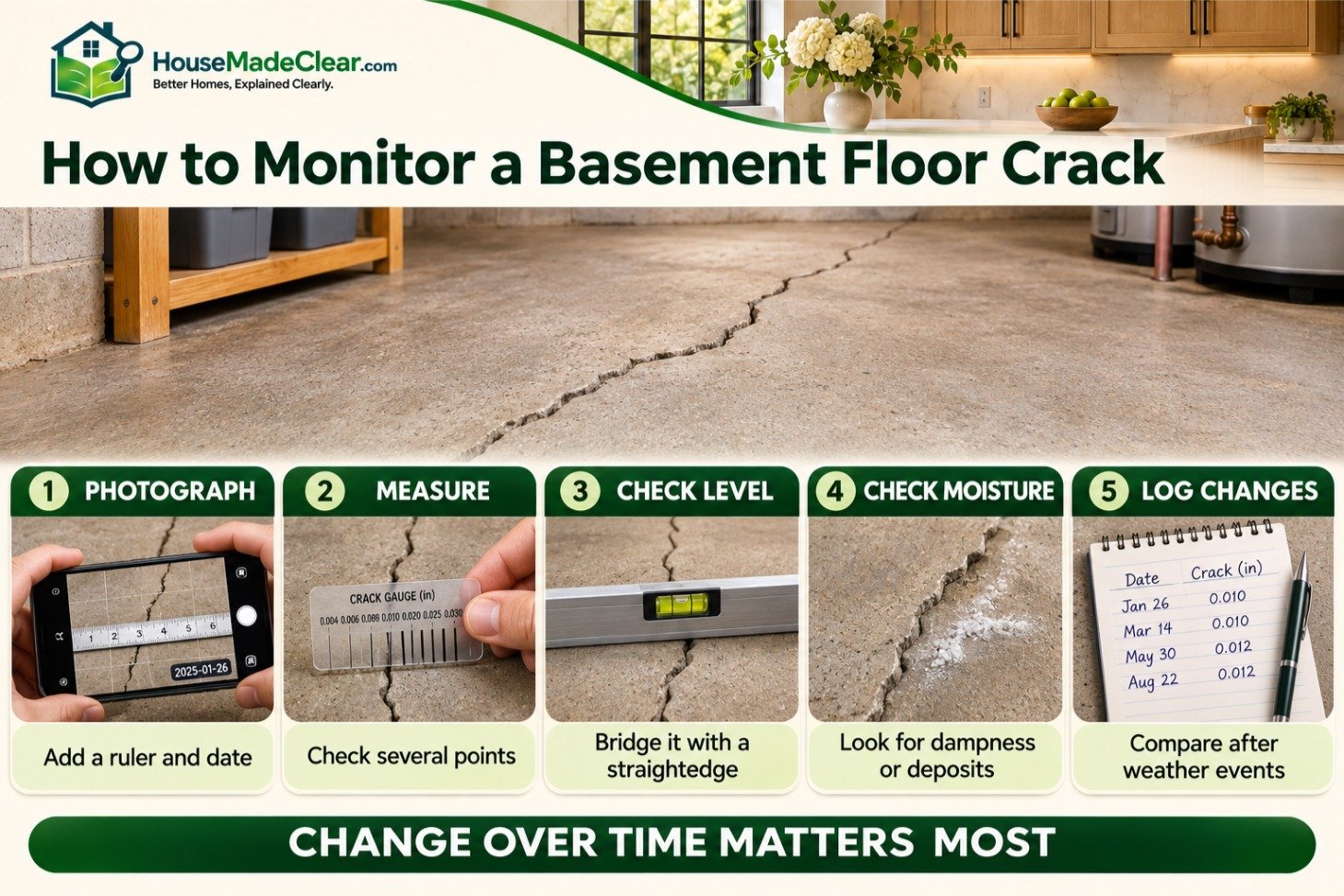
Step 1: Photograph the Crack
Take clear pictures with a ruler beside the crack for scale.
Record the date.
Step 2: Measure Its Width
Measure the width at several points using a suitable crack gauge or measuring tool.
Record the widest section and its location.
Step 3: Check for Uneven Edges
Place a straightedge across the crack to identify any noticeable height difference.
Do not attempt to level or grind displaced concrete before the cause is understood.
Step 4: Check for Moisture
Look for damp patches, water stains, mineral deposits, or recurring wetness.
Step 5: Monitor Changes
Compare measurements after significant weather events and periodically over time.
If the crack expands, develops displacement, or begins leaking, seek professional evaluation.
Example Crack Monitoring Record
| Date | Widest Measurement | Moisture | Vertical Difference |
|---|---|---|---|
| Initial inspection | 1/16 inch | None | None visible |
| Later inspection | 1/16 inch | None | None visible |
| Following heavy rain | 1/8 inch | Damp | None visible |
In this example, the increase in width and new moisture are more important than the absolute width alone.
How to Repair Cracks in a Basement Floor
The appropriate repair depends on whether the crack is stable, moving, or allowing water inside.
A cosmetic crack repair should not be used to conceal ongoing foundation or soil movement.
Repairing a Stable, Dry Hairline Crack
For a stable, nonstructural crack, a compatible concrete crack filler may be appropriate.
A typical process involves:
- Confirming the crack is not actively moving or leaking
- Cleaning away loose debris
- Preparing the surface according to the repair product
- Applying the specified filler
- Allowing the material to cure before foot traffic or coating
Some products require different preparation methods or minimum crack widths.
Follow the repair material’s technical instructions.
Repairing a Wider, Stable Crack
Depending on the crack and the slab, repair may involve a suitable concrete patching compound, flexible crack filler, or another engineered repair material.
The correct choice depends on whether movement is expected and whether moisture is present.
A rigid patch placed over a moving crack may fracture again.
Repairing an Uneven or Sunken Floor
If one slab section is sinking or lifting, filling the visible crack does not correct the underlying condition.
A qualified contractor or engineer should evaluate the support and determine whether stabilization, slab lifting, or replacement is appropriate.
Repairing a Leaking Crack
Address the water source before selecting a sealing method.
A basement waterproofing professional may recommend a compatible crack-sealing treatment, drainage repair, or another moisture-control solution.
Not every leaking crack is suitable for the same injection or surface-sealing product.

Epoxy vs. Polyurethane for Basement Floor Cracks
Epoxy and polyurethane-based repair products are both used in concrete work, but they serve different purposes.
| Repair Material | General Use | Important Limitation |
|---|---|---|
| Epoxy-based repair | Certain stable cracks or specified structural repairs | Not appropriate for every moving or wet crack |
| Flexible polyurethane sealant | Some nonstructural joints and cracks that require flexibility | Does not stabilize moving soil or damaged structure |
| Polyurethane injection | Certain crack-sealing applications | Product and application requirements vary |
| Cementitious patch | Selected surface defects and stable repairs | Can crack again if movement continues |
Avoid choosing a material solely because it is advertised as waterproof or heavy-duty.
The condition of the concrete and the objective of the repair matter more.
If you’re working with a sealant, our guide to how long caulk takes to dry explains the distinction between drying, curing, and return-to-service times. Always use the specific concrete repair product’s instructions for the actual repair.
Should You Repair or Replace a Cracked Basement Floor?
Not every cracked slab needs replacement.
| Floor Condition | Typical Next Step |
|---|---|
| Stable hairline cracks | Monitor or make a cosmetic repair |
| Stable localized crack | Assess suitable filling method |
| Crack with water intrusion | Diagnose and correct moisture source |
| Crack with vertical displacement | Professional evaluation |
| Extensive settlement or heaving | Assess stabilization or replacement |
| Repeated cracking after repair | Investigate ongoing movement |
| Severe deterioration across large areas | Evaluate repair feasibility and replacement |
Replacement may be necessary where damage is widespread or the slab no longer provides a suitable floor surface.
However, removing and replacing concrete without correcting unstable soil or water conditions can result in repeated problems.
Can You Install Flooring Over a Cracked Basement Slab?
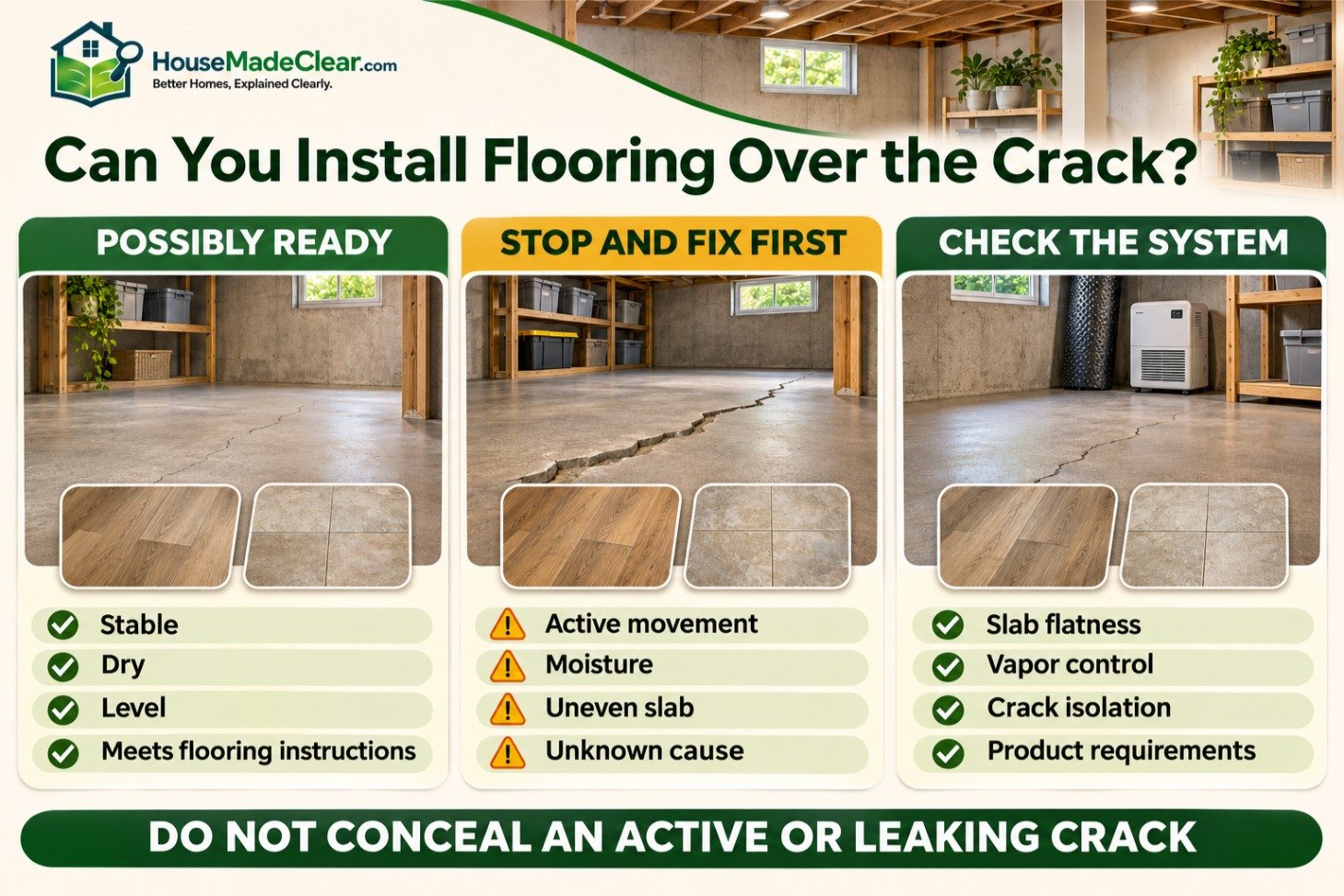
It depends on the condition of the concrete and the flooring system.
A stable hairline crack is different from a moving, damp, or uneven floor.
Before installing vinyl plank, tile, carpet, or another finish, check:
- Whether the crack is active
- Slab flatness
- Moisture conditions
- Flooring manufacturer’s substrate requirements
- Applicable vapor-control requirements
- Any required crack-isolation system
Can Vinyl Plank Cover Basement Floor Cracks?
Some vinyl flooring systems can be installed over properly prepared concrete with minor stable imperfections.
However, significant cracks, moisture, or unevenness must be addressed according to the flooring manufacturer’s instructions.
Can You Tile Over a Basement Floor Crack?
Cracks in the concrete substrate can affect tile finishes.
A suitable crack-isolation membrane may be specified for certain stable cracks, but it is not a solution for every kind of structural movement.
Do not tile over an actively moving or vertically displaced slab without professional evaluation.
Can Basement Floor Cracks Let Radon Into the House?
Yes. Openings in below-grade concrete, including floor cracks and slab joints, can provide pathways for soil gases such as radon.
However, the appearance or size of a crack cannot tell you your home’s radon concentration.
Testing is the way to determine whether radon is present at a level requiring action.
The U.S. Environmental Protection Agency advises homeowners to test for radon and explains that sealing cracks alone is not a reliable substitute for a properly designed mitigation system when elevated radon levels are detected.
If you are finishing a basement or changing how the space is used, consider radon testing as part of your planning.
How to Prevent Basement Floor Cracks From Getting Worse
You cannot prevent every concrete crack, but you can reduce some conditions that contribute to ongoing damage.
Control Water Around the Foundation
Keep gutters and downspouts functioning and direct surface water away from the house.
Investigate areas where rainwater repeatedly collects beside basement walls.
Fix Plumbing Leaks
Hidden leaks may affect the slab, stored belongings, and moisture-sensitive finishes.
Monitor Existing Cracks
Take photographs and measurements so changes are easier to recognize.
Avoid Unplanned Heavy Loads
Consult a qualified professional before placing unusually heavy equipment or modifying structural supports.
Maintain Basement Moisture Control
Basement humidity is related to comfort and moisture management, but a dehumidifier cannot correct unstable soil or a leaking foundation.
Our guide to recommended humidity levels for a house explains how to monitor basement air moisture and identify persistent dampness.
Address Problems Before Finishing the Basement
Don’t hide active water intrusion or unexplained slab movement beneath flooring, drywall, or storage systems.
Investigate and correct the problem first.
When Should You Call a Structural Engineer?
Contact a qualified structural engineer when the condition suggests possible foundation movement or uncertainty about the structural role of the slab.
Examples include:
- Cracks that continue widening
- Noticeable vertical displacement
- Significant floor heaving or settlement
- Bowed or cracked foundation walls
- Movement near columns or structural supports
- Cracking after major excavation or foundation work
- Repeated repair failures
- Uncertainty about whether the floor is structurally supported
For persistent water intrusion without clear structural movement, a qualified basement waterproofing or drainage specialist may be an appropriate first contact.
If structural movement and moisture problems occur together, both areas of expertise may be needed.
Is It Safe to Ignore a Basement Floor Crack?
A small, stable, dry crack may simply need monitoring.
However, ignoring changes in width, displacement, moisture, or surrounding structural conditions can allow a more serious problem to develop unnoticed.
Document the crack and respond to changes rather than relying only on its initial appearance.
Basement Floor Crack Inspection Checklist
| What to Inspect | What to Look For |
|---|---|
| Crack width | Very narrow, wide, or increasing |
| Crack length | Stable or extending |
| Vertical displacement | One side higher than the other |
| Moisture | Seepage, stains, or dampness |
| Surrounding walls | Bowing, shifting, or new cracks |
| Floor surface | Heaving, sinking, or uneven sections |
| Drainage outside | Standing water or poor runoff |
| Plumbing | Leaks or nearby pipe problems |
| Recent changes | Excavation, remodeling, or heavy loads |
| Crack history | Photos and measurements over time |
Frequently Asked Questions
Are cracks in a basement floor normal?
Yes. Narrow cracks can develop from concrete shrinkage and minor movement. They are generally less concerning when they remain stable, dry, and level. Cracks that widen, leak, or show vertical displacement need further investigation.
When should I worry about cracks in my basement floor?
Be concerned if a crack is growing, one side of the slab is rising or sinking, water is entering, or nearby foundation walls show movement. These conditions justify professional assessment.
Is a 1/8-inch crack in a basement floor bad?
Not necessarily. A stable 1/8-inch crack without water intrusion or displacement may be nonstructural. However, the width alone cannot establish safety, so monitor it and investigate other symptoms.
Why is my basement floor cracking in several places?
Possible causes include concrete shrinkage, inadequate control joints, settlement, heaving, or changes in support beneath the slab. Several new cracks appearing in a short period warrant professional evaluation.
Can water come up through basement floor cracks?
Yes. Water can enter through cracks when moisture collects beneath the slab or when groundwater conditions allow seepage. Investigate the source before attempting to seal the opening.
Do basement floor cracks mean foundation failure?
No. Many basement floors are slabs supported by the ground and are separate from the main load-bearing foundation. However, cracks associated with wall movement or significant slab displacement require structural evaluation.
Can I fill basement floor cracks myself?
Some stable, dry, nonstructural cracks can be repaired using compatible concrete repair materials. Active movement, significant displacement, or persistent water intrusion should be evaluated before repair.
Should I seal basement floor cracks before installing vinyl flooring?
Only after assessing the crack, floor flatness, and moisture conditions. The flooring manufacturer’s substrate and vapor-control requirements must also be satisfied. Don’t conceal an active or leaking crack beneath new flooring.
Final Thoughts
Cracks in a basement floor are common, but their significance depends on what caused them and whether the concrete is still moving.
Small, stable, dry cracks without vertical displacement are often less concerning than widening cracks, uneven slab sections, or cracks that allow water into the basement.
The most useful first step is to document what you see.
Measure the crack, check for uneven edges, inspect for moisture, and compare its condition over time.
For a stable cosmetic crack, a suitable concrete repair may be enough. But ongoing movement, water intrusion, or signs of broader foundation damage require investigation before repairs are attempted.
A crack’s width tells you how large the opening is. Its movement, moisture, and surrounding conditions tell you much more about how seriously to take it.






[…] Cracks in Basement Floor: What’s Normal and When to Worry […]
[…] Cracks in Basement Floor: What’s Normal and When to Worry […]