















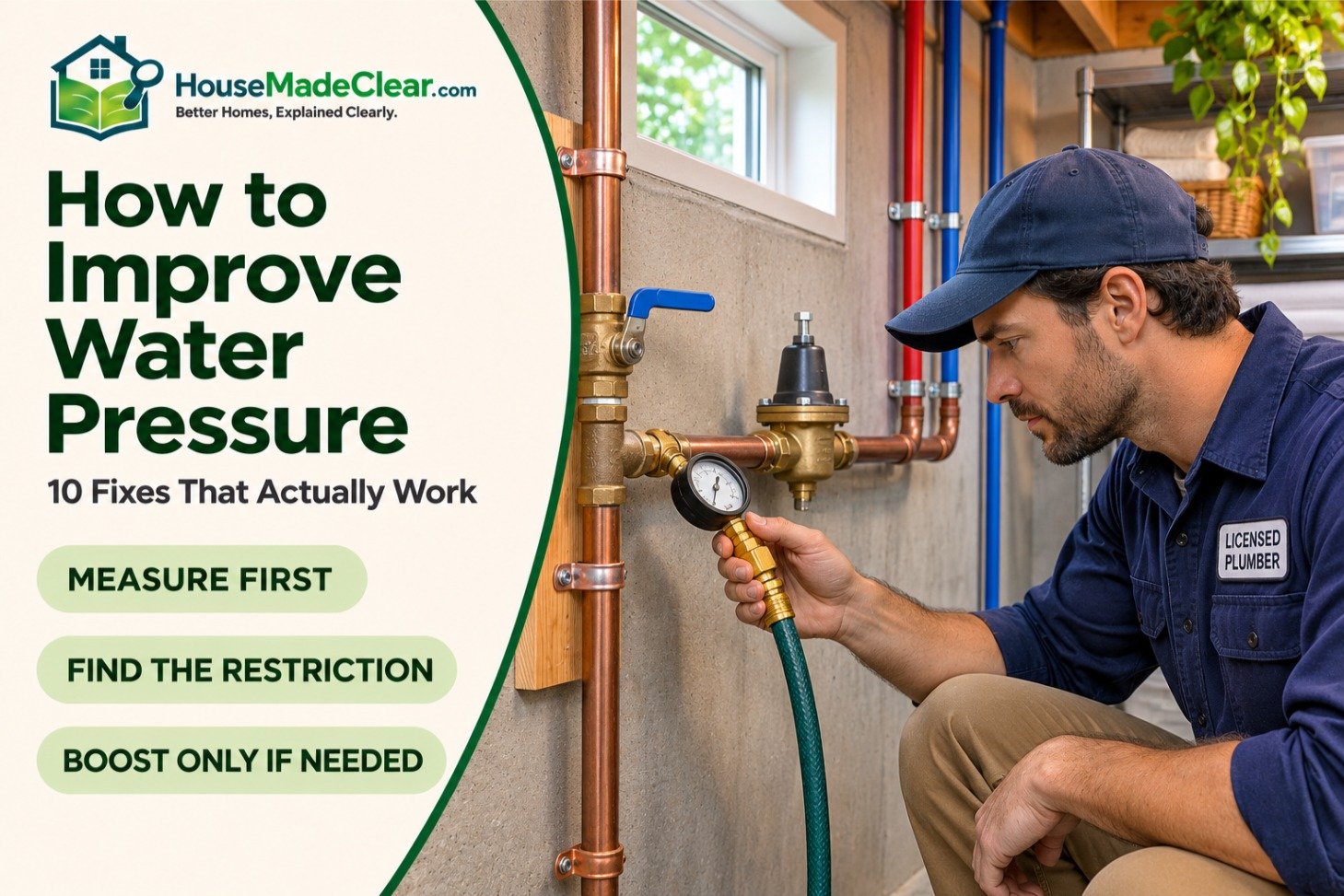
Weak water pressure can make simple household tasks frustrating. Your shower barely rinses shampoo, the kitchen faucet takes too long to fill a pot, or water slows to a trickle whenever someone starts the washing machine.
Before replacing pipes or installing an expensive pressure booster, find out whether the problem affects one fixture or your entire home.
Low water pressure can result from a partially closed supply valve, clogged faucet aerator, leaking pipe, failing pressure regulator, or inadequate municipal supply pressure. Homes with private wells may also have problems with the pressure tank or pump.
Some causes are easy to fix. Others require a licensed plumber.
This guide explains how to improve water pressure in your house, how to measure it accurately, and which repairs are worth trying before spending money on major plumbing work.
Quick Answer
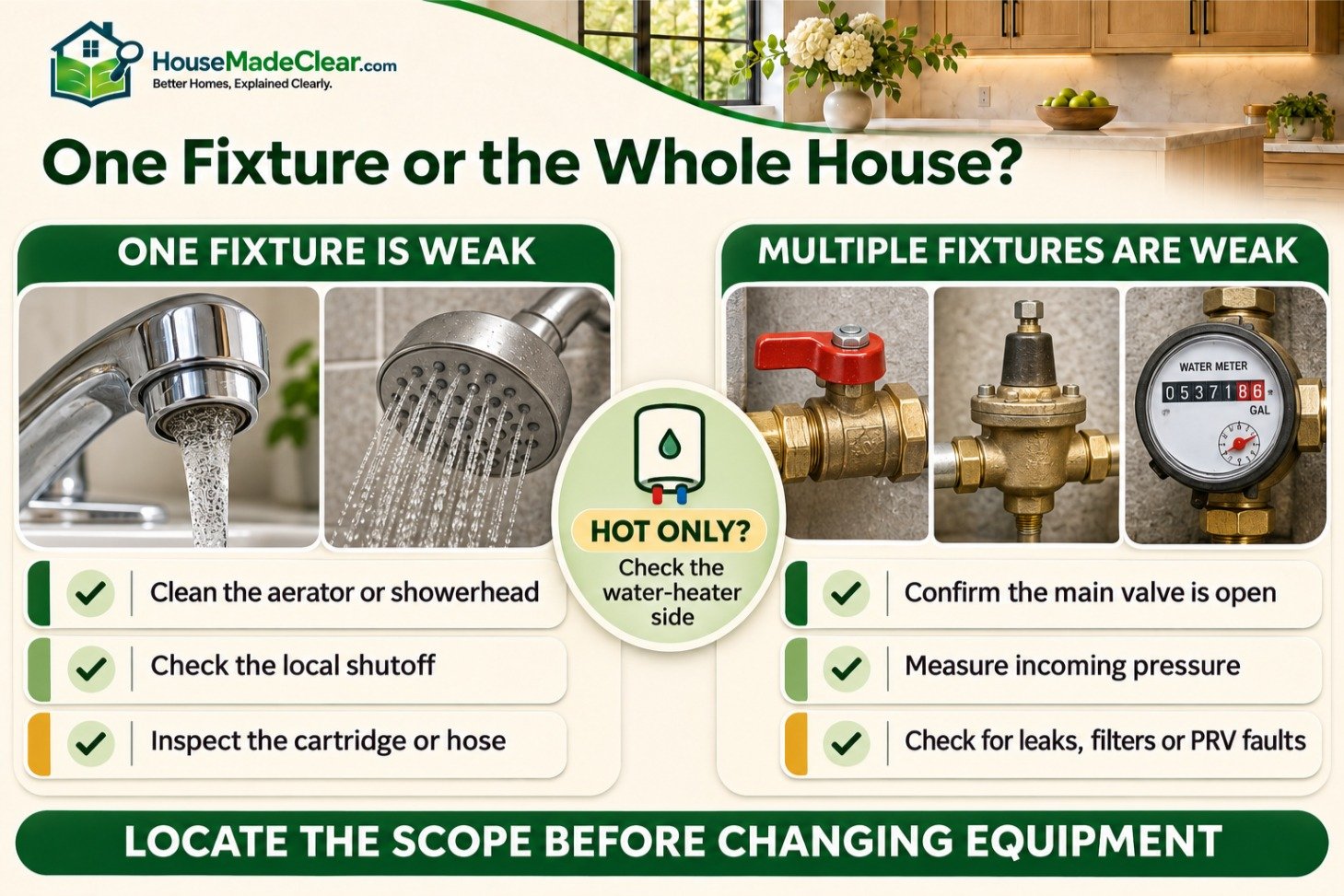
To improve water pressure in your house, first check whether the problem affects one faucet or every fixture.
If only one faucet or shower is weak, clean its aerator or showerhead and check the local shutoff valve. If the entire house has low pressure, check the main shutoff valve, measure the incoming pressure, and investigate the pressure-reducing valve, leaks, or water supply.
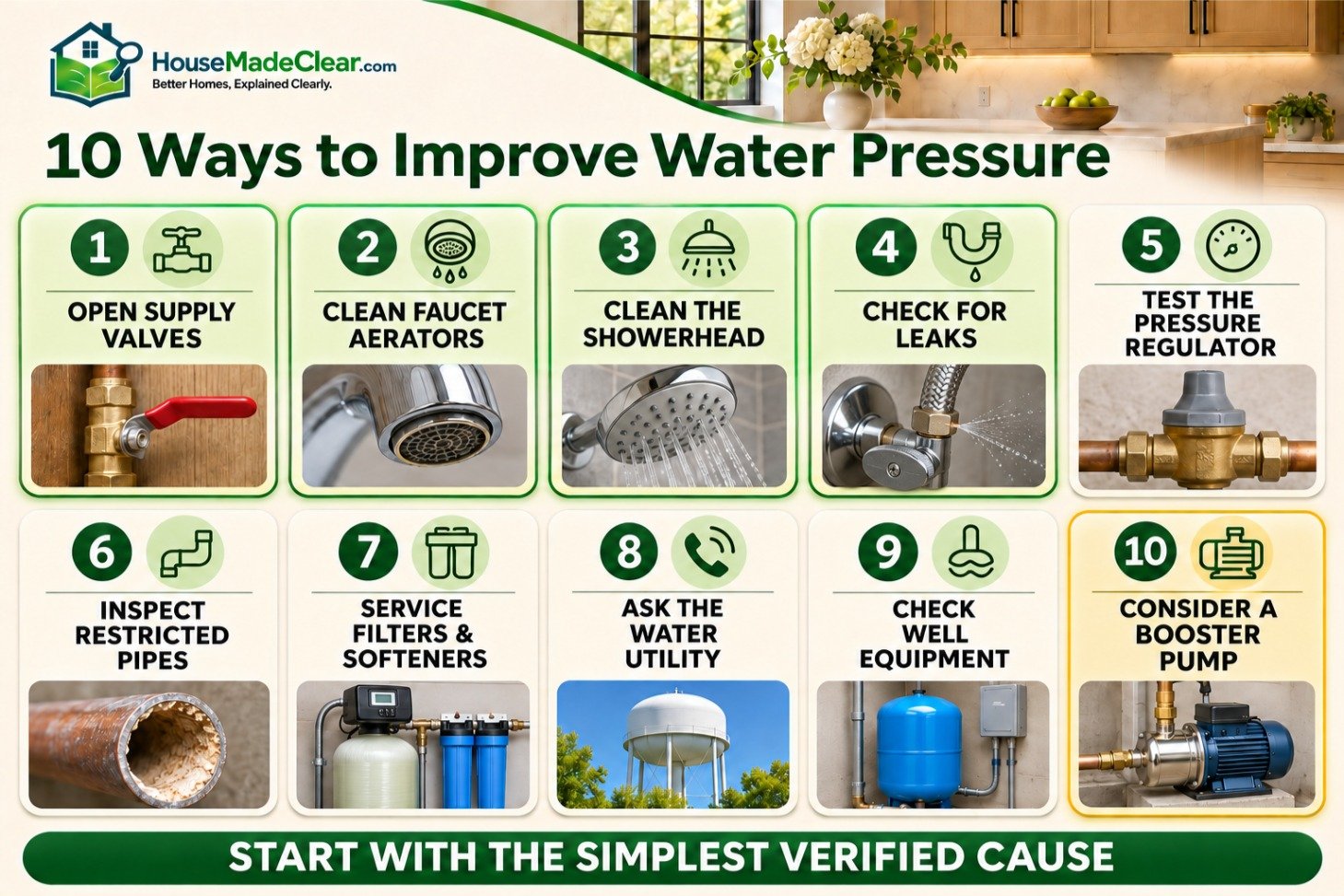
10 practical solutions:
- Open partially closed water supply valves.
- Clean clogged faucet aerators.
- Remove mineral buildup from showerheads.
- Check for hidden plumbing leaks.
- Inspect the pressure-reducing valve.
- Identify corroded or restricted pipes.
- Check water filters and softeners.
- Ask your water utility about supply pressure.
- Inspect well-pump and pressure-tank equipment.
- Consider a professionally designed booster pump if the supply is genuinely inadequate.
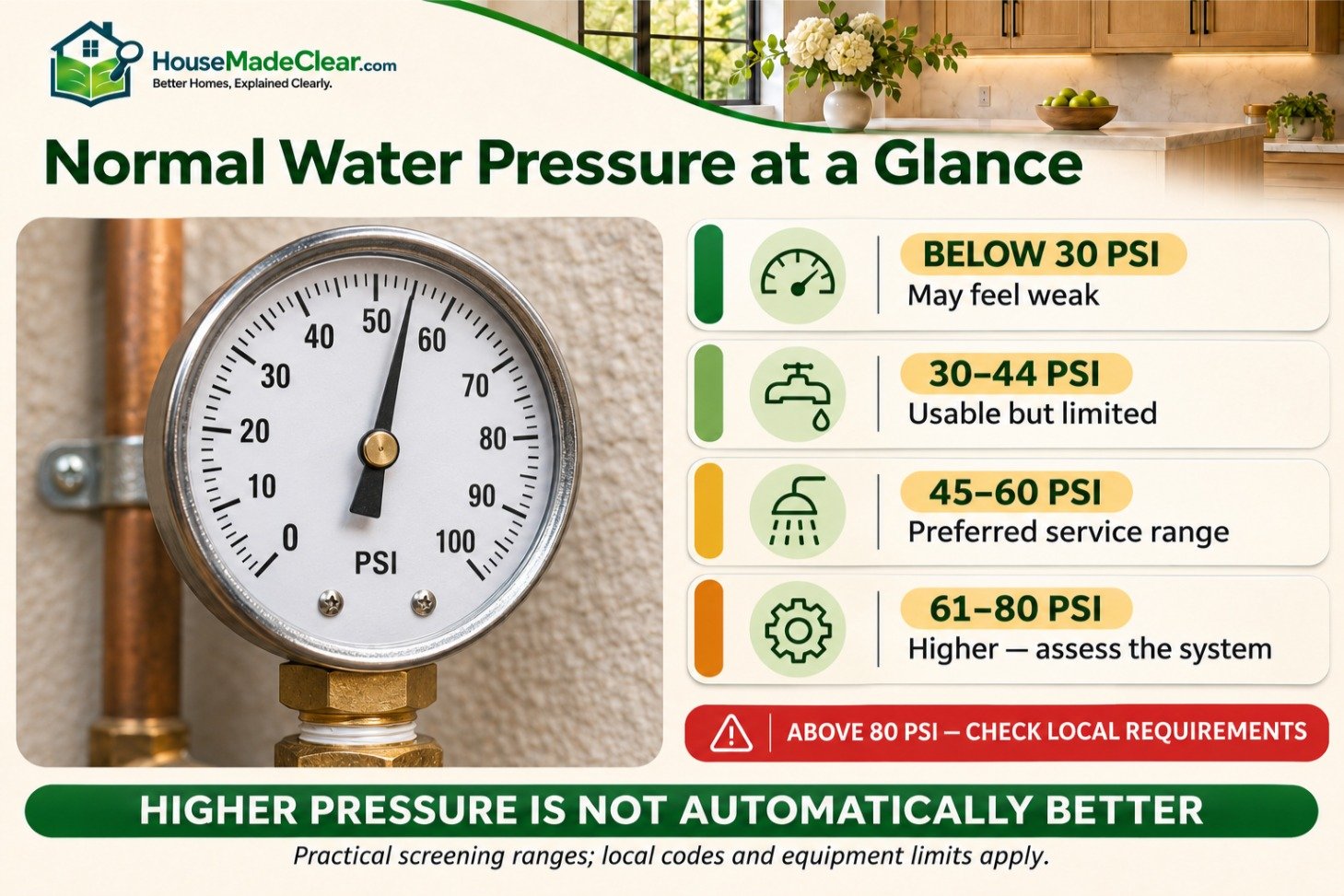
Recommended pressure: The EPA WaterSense program identifies approximately 45–60 pounds per square inch (psi) as a desirable residential service-pressure range. Increasing pressure beyond the appropriate level can damage plumbing and waste water.
What Is Normal Water Pressure for a House?
Residential water pressure is measured in pounds per square inch, or psi.
According to the EPA WaterSense home maintenance guidance, incoming service pressure between 45 and 60 psi supports efficient water use and normal fixture operation.
That doesn’t mean every home with pressure below 45 psi has defective plumbing. Actual performance depends on the water supply, elevation, pipe sizing, and fixtures.
| Water Pressure | General Interpretation |
|---|---|
| Below 30 psi | May feel weak at several fixtures |
| 30–44 psi | May be usable, but performance can be limited |
| 45–60 psi | EPA WaterSense recommended service range |
| 61–80 psi | Higher than the EPA’s preferred range; assess the installation |
| Above 80 psi | Exceeds a common U.S. plumbing-code maximum for static building pressure |
These are practical screening ranges, not universal pass/fail limits. Local plumbing codes and manufacturer specifications still apply.
Higher pressure isn’t automatically better. Excessive pressure can increase water consumption, stress fittings, and shorten the life of appliances.
Water Pressure vs. Water Flow: What’s the Difference?
Before troubleshooting, it’s useful to understand two related measurements.
Water pressure is the force pushing water through the plumbing system, measured in psi.
Water flow is the volume delivered over time, commonly measured in gallons per minute (GPM).
A faucet can have normal supply pressure but low flow because its aerator is clogged.
Likewise, a house can have acceptable pressure when no water is running but experience poor flow when several fixtures operate simultaneously.
How to Recognize the Difference
| Symptom | What It May Suggest |
|---|---|
| One faucet produces a weak stream | Clogged aerator or local valve problem |
| All fixtures have weak flow | Supply, regulator, leak, or pipe restriction |
| Water is strong initially, then slows | Possible restriction or inadequate delivery capacity |
| Pressure drops when two showers run | Supply flow, pipe sizing, or pressure-loss problem |
| Only hot water is weak | Water heater, hot-side valve, or hot-water piping |
| Flow gradually worsens over months | Mineral accumulation, corrosion, or failing equipment |
These symptoms help narrow the possibilities; they don’t establish a diagnosis by themselves.

How to Check Water Pressure in Your House
A simple pressure gauge can help determine whether your water pressure is genuinely low.
You can find gauges designed for outdoor hose connections at hardware stores.
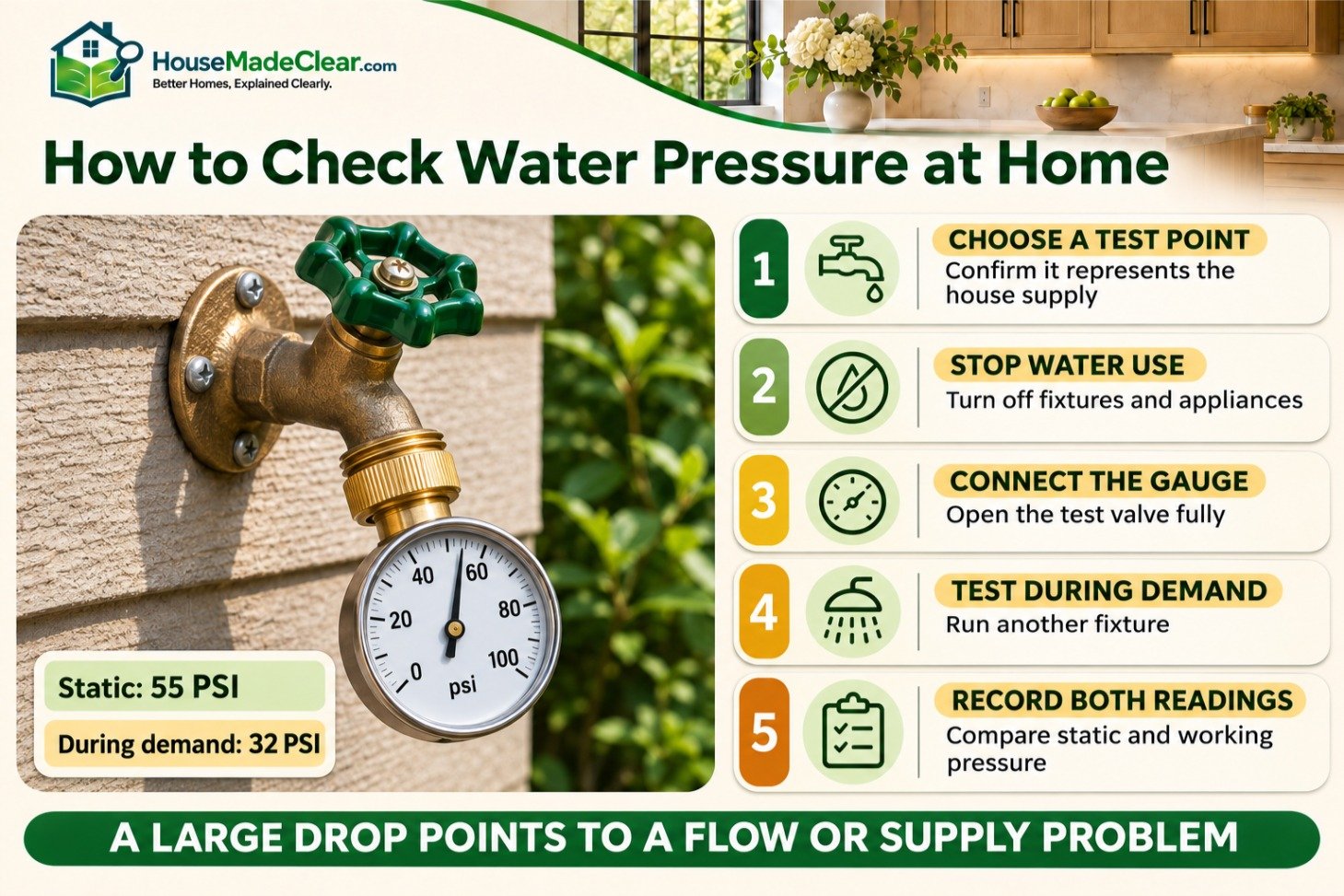
Step 1: Find a Suitable Test Connection
An outdoor hose bibb or an appropriate cold-water laundry connection may work.
Choose a connection that represents the household supply.
Be aware that some outdoor taps are upstream of the pressure regulator, so their readings may not represent the regulated pressure inside the house.
Step 2: Turn Off Water-Using Fixtures
Make sure faucets, showers, washing machines, and irrigation systems aren’t running.
Step 3: Connect the Pressure Gauge
Attach the gauge securely according to its instructions.
Open the test valve fully and read the pressure.
This is the static pressure reading because water isn’t flowing through other fixtures.
Step 4: Repeat the Test During Water Use
Where the testing setup permits it, observe the pressure while another fixture is operating.
A substantial pressure drop during normal demand can indicate a flow restriction or inadequate supply capacity.
Step 5: Record the Results
| Test | Example Reading |
|---|---|
| Static pressure, no fixtures running | 55 psi |
| While one faucet runs | 49 psi |
| While multiple fixtures run | 32 psi |
These are illustrative numbers.
A house with 55 psi static pressure but much lower pressure during ordinary demand may need a different investigation from a home measuring only 25 psi even when no water is running.
If you’re unsure where to connect the gauge or whether the reading is representative, ask a plumber.
10 Ways to Improve Water Pressure in Your House
Start with the least invasive checks. There’s no reason to replace plumbing before confirming that an accessible valve isn’t partly closed.
1. Check the Main Water Shutoff Valve
A partially closed main shutoff valve can restrict the flow entering the house.
This sometimes happens after plumbing repairs, renovations, or emergency water shutoffs.
What to Check
Locate the home’s main water shutoff valve, usually near the point where the water service enters the property.
Depending on the installation, it may be in a basement, utility room, garage, or another accessible location.
For a typical ball valve, a handle aligned with the pipe generally indicates an open position.
Other valve types operate differently.
What to Do
If you are certain the valve is the household shutoff and it operates freely, confirm that it is in its intended fully open position.
Do not force an old, corroded, or leaking valve.
A damaged main shutoff valve should be repaired professionally.
Also check whether a recent plumbing repair left a local fixture valve partly closed.
Best for: Low flow affecting multiple fixtures after plumbing work.
2. Clean Clogged Faucet Aerators
If one sink faucet has weak flow while the rest of the house operates normally, the aerator is a good place to start.
The aerator is the small fitting at the faucet outlet that helps shape the water stream.
Minerals and debris can accumulate in its screen.
How to Clean a Faucet Aerator
- Turn off the faucet.
- Remove the aerator according to the faucet manufacturer’s instructions.
- Inspect the screen for sediment or scale.
- Clean it using the recommended method.
- Reassemble the parts correctly.
- Run the faucet and compare the flow.
Some faucets have concealed aerators that require a special removal key.
Do not use pliers directly on a decorative finish without appropriate protection.
What if Cleaning Doesn’t Help?
Check the local shutoff valves and faucet cartridge.
If the restriction is inside the faucet, replacing the aerator alone won’t solve it.
This repair relates to water coming out of a faucet, not water draining away. If your sink fills because the drain is slow, see our guide to how to unclog a bathroom sink.
Best for: One weak bathroom or kitchen faucet.
3. Remove Mineral Buildup From the Showerhead
A shower that feels weak doesn’t always have a household water-pressure problem.
Mineral deposits can restrict the showerhead’s spray openings and alter the flow pattern.
Signs of a Clogged Showerhead
- Uneven spray
- Water shooting sideways
- Some nozzles producing very little water
- Visible white or chalky deposits
- Normal flow from other fixtures
How to Restore the Spray
Follow the showerhead manufacturer’s cleaning instructions.
Some models have flexible nozzles that can be rubbed gently to release deposits.
Other showerheads have removable spray plates or components.
Avoid soaking decorative finishes in vinegar or strong cleaners unless the manufacturer approves it.
If the showerhead is cracked, leaking at its connection, or dripping continuously when turned off, the issue may be different. Our guide to why a showerhead leaks explains how to distinguish connection leaks from shower-valve problems.
Best for: Weak or irregular flow at one showerhead.
4. Check for Hidden Plumbing Leaks
A significant leak can reduce the amount of water reaching fixtures.
It may also cause property damage and increase utility bills.
Warning Signs
- Unexpectedly high water usage
- Damp walls or flooring
- Water stains
- Unexplained sounds of running water
- A water meter registering use when fixtures are off
- Sudden changes in water delivery
How to Check for a Possible Leak
Turn off all water-using fixtures and appliances.
Check whether your water meter indicates ongoing flow, following your utility’s meter-reading instructions.
If the meter continues recording usage, investigate further.
Some systems contain equipment that automatically consumes water, such as water softeners or irrigation controls, so account for those before drawing conclusions.
What if You Suspect a Hidden Leak?
Have a plumber locate the problem.
Do not increase the pressure-regulator setting to compensate for a suspected leak.
Best for: Sudden whole-house pressure problems accompanied by signs of water loss.
5. Inspect the Pressure-Reducing Valve
Many homes have a pressure-reducing valve, commonly called a PRV or pressure regulator.
This valve reduces incoming municipal pressure to a suitable level for household plumbing.
Over time, regulators can wear out or develop faults.
Signs of a Failing PRV
- Pressure becomes inconsistent.
- Water flow is weak throughout the house.
- Pressure changes unpredictably.
- The measured pressure is outside the intended range.
- The pressure problem began after regulator adjustment or replacement.
Where Is the PRV Located?
It is often installed near the main water service entry, downstream of the water meter or main shutoff arrangement.
Not every house has one.
Can You Adjust It Yourself?
Some regulators have an adjustable setting.
However, changing it without checking actual pressure and the manufacturer’s instructions can create excessive pressure or worsen an existing fault.
For whole-house PRV problems, have a licensed plumber test the regulator and determine whether adjustment, servicing, or replacement is appropriate.
Best for: Whole-house pressure problems when municipal supply pressure is adequate.
6. Replace Corroded or Restricted Water Pipes
Older plumbing may develop internal restrictions.
Galvanized steel pipes, in particular, can accumulate corrosion and deposits over time.
As the usable pipe opening becomes smaller, available water flow may decrease.
Signs of Restricted Plumbing
- Gradual loss of flow over several years
- Multiple fixtures affected
- Discolored water
- Older galvanized pipes
- Poor performance when several fixtures run
Does Replacing a Pipe Increase Water Pressure?
Replacing a severely restricted pipe can improve available flow and reduce pressure loss during use.
However, it cannot raise the pressure supplied by the utility.
If the water entering the property is already low pressure, replacing otherwise adequate pipes may not solve the problem.
A plumber can evaluate pipe condition and sizing before recommending replacement.
Best for: Older homes with persistent flow restrictions.
7. Check Water Filters and Softeners
Whole-house filters, sediment cartridges, and water softeners can introduce resistance into the water supply.
If a filter becomes clogged or a valve malfunctions, water flow may decrease.
What to Check
- Filter replacement schedule
- Pressure indicators, if present
- Water-softener error messages
- Bypass-valve positions
- Whether the problem began after equipment servicing
What Should You Do?
Follow the equipment manufacturer’s maintenance instructions.
Replace clogged cartridges when required.
If testing a bypass is appropriate, use the manufacturer-approved procedure and account for water-treatment needs.
Do not bypass equipment necessary to make water safe for consumption.
Best for: Pressure or flow problems appearing after filtration equipment becomes overdue for maintenance.
8. Contact Your Municipal Water Supplier
Sometimes the problem starts before water enters your house.
Municipal water pressure can vary because of:
- Water-main repairs
- Temporary supply interruptions
- Changes in demand
- Distribution-system conditions
- Elevation
- Utility equipment problems
How to Identify a Supply Problem
Check whether your neighbors are experiencing similar symptoms.
Note whether the issue appeared suddenly or occurs at particular times of day.
Ask your water utility whether there is known maintenance or a pressure problem in the area.
Portland Water Bureau’s water-pressure troubleshooting guide recommends comparing flow throughout the house and checking hot and cold water separately before determining where the problem originates.
If municipal pressure is adequate at the service connection, a private-side plumbing problem is more likely.
Best for: Sudden or neighborhood-wide pressure changes.
9. Inspect the Well Pump and Pressure Tank
Homes using private wells depend on a pump and pressure system rather than a municipal connection.
A malfunctioning pump, pressure switch, pressure tank, or other component can affect household pressure.
Common Warning Signs
- Pressure repeatedly rises and falls
- The pump switches on and off unusually often
- Pressure falls sharply during water use
- The system cannot reach its normal operating pressure
- Water supply becomes intermittent
Can You Increase a Well’s Pressure Setting?
Pressure switches and tanks must be compatible with the pump, plumbing, and system design.
Changing the switch settings without evaluating the pressure tank and pump can damage equipment or create unsafe operating conditions.
Do not open pressurized components or work on electrical pump equipment unless qualified.
Have a well-service professional assess the system.
Best for: Homes with private wells and inconsistent water pressure.
10. Consider a Water Pressure Booster Pump
A booster pump can increase pressure when the supply is genuinely inadequate and the system is designed for boosting.
However, it should not be your first purchase.
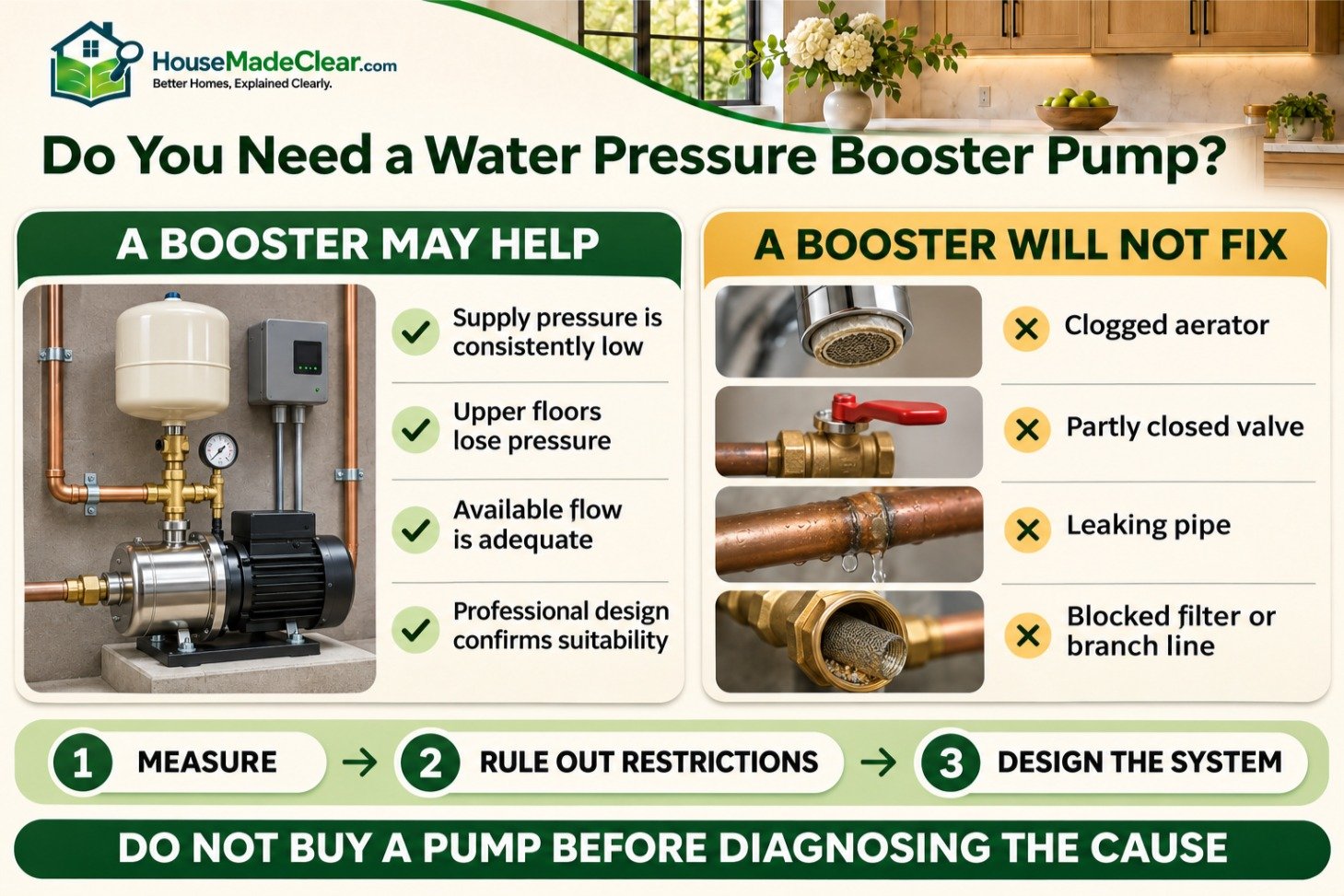
When a Booster Pump May Help
A properly designed booster system may be appropriate when:
- Municipal pressure is consistently inadequate.
- The home has significant elevation-related pressure loss.
- Upper floors receive insufficient pressure.
- The available supply can support the required flow.
- A plumbing professional determines boosting is suitable.
When a Booster Pump Won’t Solve the Problem
A pump is not a substitute for repairing:
- A clogged aerator
- A partially closed valve
- A leaking pipe
- A blocked filter
- A badly restricted branch line
What About Installation Requirements?
Booster pumps may require controls, backflow protection, pressure regulation, and other safeguards.
Local codes and water utilities may restrict how pumps connect to a municipal main.
Use a licensed professional to determine the correct design.
Best for: Confirmed low supply pressure after simpler causes have been ruled out.
Why Is Water Pressure Low in Only One Faucet?
If every other fixture works normally, investigate that faucet and its immediate supply connections.
Most likely causes include:
- Clogged aerator
- Partially closed angle-stop valve
- Blocked faucet cartridge
- Kinked or restricted supply hose
- Debris introduced during plumbing work
For bathroom vanity installations, our guide to standard bathroom sink dimensions explains the layout of faucet supply lines and shutoff valves beneath common sink configurations.
If both hot and cold water are weak at one faucet, start with the aerator.
If only one temperature is affected, inspect the corresponding hot or cold supply path.
Why Is Water Pressure Low in the Shower but Fine Everywhere Else?
A weak shower can result from the showerhead, shower valve, or the supply serving that fixture.
Troubleshooting Order
- Compare other faucets in the bathroom.
- Check whether both hot and cold shower performance are affected.
- Inspect and clean the showerhead.
- Check for a kinked handheld shower hose.
- Determine whether the shower valve or cartridge is restricting flow.
- Have the plumbing assessed if accessible maintenance doesn’t help.
A pressure-balancing shower valve may also react to changes in hot or cold supply conditions.
Do not modify or remove safety components to increase shower flow.
If you’re planning a replacement shower system, our shower valve height guide covers valve placement and installation considerations.
Why Is Hot Water Pressure Lower Than Cold?
If cold water flows normally but hot water is weak at several fixtures, focus on the hot-water distribution system.
Potential causes include:
- A partially closed water-heater valve
- Sediment or restrictions in the heater or connected piping
- A malfunctioning mixing valve
- Corroded hot-water pipes
- Problems with a recirculation system
Should You Flush the Water Heater?
Flushing may be part of routine maintenance for some water heaters, but it is not a guaranteed solution for low hot-water flow.
Follow the heater manufacturer’s instructions.
Water heaters involve hot water, pressure, gas or electricity, and potentially scalding temperatures. If you are unsure of the procedure, hire a plumber.
Important: Do not raise the water heater’s temperature to compensate for low flow. That does not correct the underlying plumbing problem and can increase scalding risk.
Why Does Water Pressure Drop When Two Faucets Run?
This symptom often indicates a problem with available flow rather than static pressure alone.
For example, a home may show an acceptable pressure reading when no water is running but experience a substantial drop when a shower and washing machine operate simultaneously.
Possible explanations include:
- Undersized supply piping
- Internal pipe restrictions
- A clogged whole-house filter
- A faulty pressure regulator
- Insufficient water service capacity
- Low supply pressure during demand
What Is the Right Fix?
Measure pressure under different operating conditions and have the system evaluated.
Installing a higher-pressure regulator or booster pump without checking flow capacity may not correct the restriction.
Can You Increase Water Pressure in an Upstairs Bathroom?
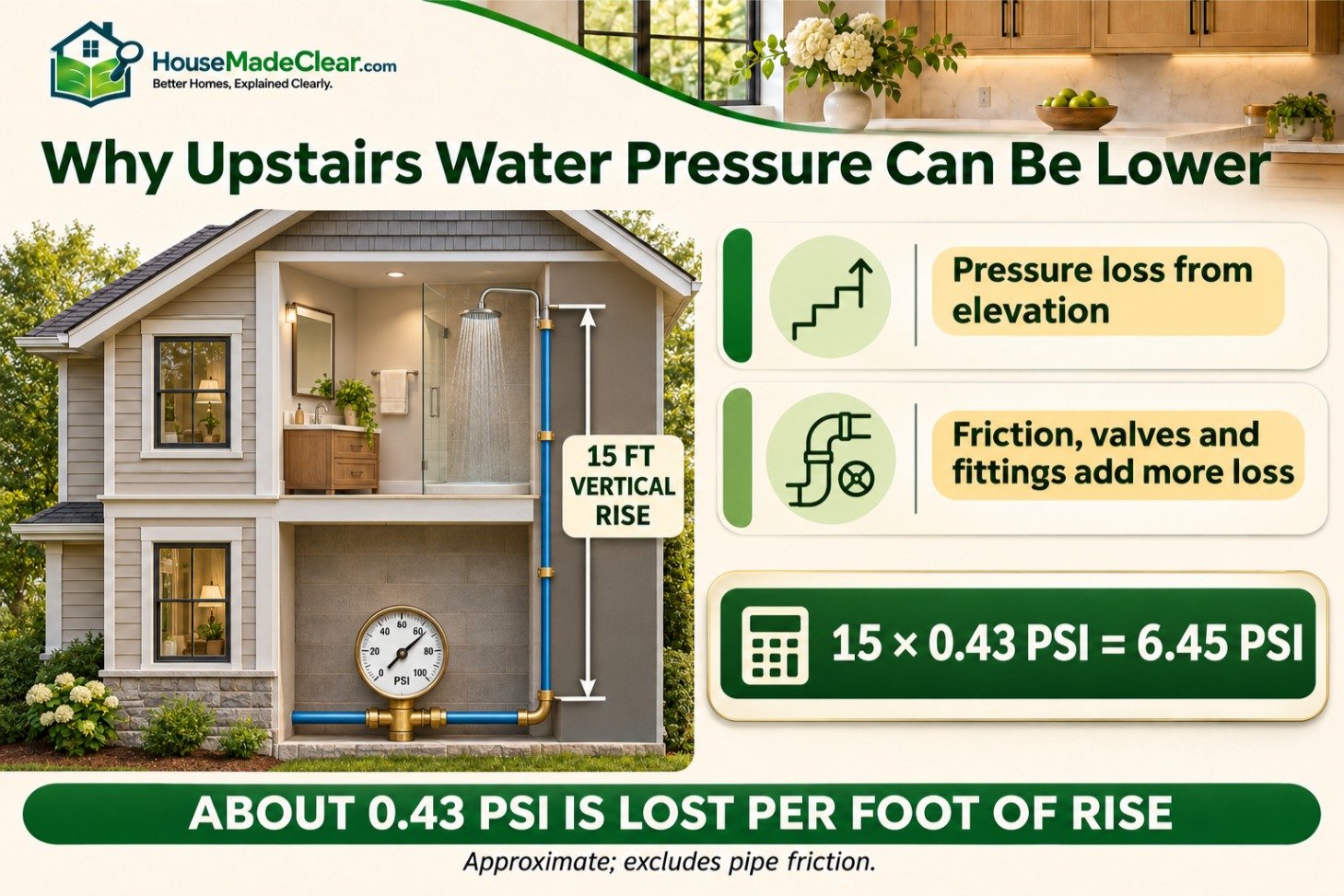
Upper-floor fixtures may receive less pressure because water must be lifted to a higher elevation.
A useful approximate relationship is that pressure decreases by 0.43 psi for every foot of vertical rise.
For example, an upstairs fixture 15 feet higher than the service-level measurement point experiences an approximate elevation-related reduction of:
15 × 0.43 = 6.45 psi
This estimate excludes additional pressure loss caused by pipe friction, valves, and fittings.
What Should You Check?
- Is the downstairs pressure normal?
- Is the problem limited to one upstairs fixture?
- Does pressure worsen during simultaneous water use?
- Is the supply adequate at the entry point?
- Are the upstairs pipes appropriately sized and unobstructed?
A plumbing professional can determine whether pipe improvements, equipment servicing, or a correctly designed booster system is warranted.
How to Improve Water Pressure Without a Pump
In many homes, a pump isn’t necessary.
Use this checklist before considering one:
| Check | Why It Matters |
|---|---|
| Main valve fully open | Prevents unnecessary restriction |
| Local fixture valves open | Restores flow to individual fixtures |
| Faucet aerators clean | Removes common outlet blockages |
| Showerhead cleaned | Improves restricted spray |
| No hidden leaks | Prevents water loss |
| Pressure regulator operating | Maintains appropriate service pressure |
| Filters maintained | Reduces flow restriction |
| Pipes in good condition | Limits excessive pressure loss |
| Utility supply adequate | Confirms the pressure available to the home |
If a simple repair restores normal performance, there’s no reason to install additional pressure equipment.
Is It Safe to Increase Household Water Pressure?
Only within the limits appropriate for the plumbing system.
Excessively high pressure can damage:
- Flexible supply hoses
- Appliance valves
- Faucet cartridges
- Toilet fill valves
- Pipe joints
- Other plumbing components
Many U.S. plumbing codes require a pressure-reducing valve when static building pressure exceeds 80 psi, although local requirements vary.
For example, if you experience a hissing or repeatedly refilling toilet, the problem may be a worn fill valve or leaking flapper rather than inadequate household pressure. Our guide to why a toilet makes a hissing sound explains how to identify those causes.
Similarly, a toilet that won’t flush may have a clog or mechanical fault. See our toilet flushing troubleshooting guide before assuming the house needs greater water pressure.
When Should You Call a Plumber?
Professional help is appropriate when:
- The entire house has persistently low pressure.
- Pressure drops substantially during ordinary water use.
- You suspect a concealed pipe leak.
- Your pressure regulator appears faulty.
- Plumbing is heavily corroded.
- Hot-water flow is weak across multiple fixtures.
- A private well system is malfunctioning.
- You are considering a booster pump.
- Pressure readings exceed applicable safe limits.
- Sudden pressure loss is accompanied by visible water damage.
If water pressure drops abruptly and you notice flooding, a burst pipe, or rapidly developing water damage, shut off the water supply if safe and arrange urgent repair.
Frequently Asked Questions
How can I increase water pressure in my whole house?
Check that the main shutoff valve is fully open, test the incoming pressure, and inspect for leaks, filter restrictions, or pressure-regulator problems. If the supply itself is inadequate, a plumber may recommend a properly designed booster system.
What is a good water pressure for a house?
The EPA WaterSense program recommends approximately 45–60 psi for residential service pressure. The appropriate operating pressure also depends on local plumbing requirements and the home’s equipment.
Why is my water pressure suddenly low?
Possible causes include a partially closed valve, water-main issue, plumbing leak, blocked filter, or faulty pressure regulator. Compare several fixtures and contact your water utility if the problem appears to affect the neighborhood.
Why is my water pressure low in only one faucet?
A clogged aerator, partially closed local shutoff valve, or restricted faucet cartridge is often responsible. If other fixtures operate normally, investigate the affected faucet before changing whole-house equipment.
Can a showerhead increase water pressure?
A different showerhead may improve the feel or pattern of the spray, but it cannot increase the pressure supplied to the house. Cleaning a clogged showerhead can restore flow that has been restricted by mineral buildup.
Will a larger water pipe increase pressure?
Larger or less restrictive piping may reduce pressure loss during water use and improve available flow. It does not increase the static pressure supplied by the water utility.
Can low water pressure damage a washing machine?
Low supply pressure may interfere with a washing machine’s filling performance or trigger appliance errors, depending on its design. Follow the manufacturer’s minimum water-pressure requirements.
Do I need a booster pump for low water pressure?
Not necessarily. First rule out clogged fixtures, leaks, partially closed valves, filters, and regulator problems. A booster pump is worth considering only when inadequate supply pressure has been confirmed and the installation is appropriate.
Final Thoughts
Improving water pressure starts with identifying where the problem occurs.
If only one faucet or shower is weak, cleaning a clogged aerator or showerhead may solve it. If the entire house has low pressure, testing the supply and inspecting the main valve, pressure regulator, filters, and plumbing are more useful first steps.
Don’t assume that every weak stream requires a booster pump or new pipes.
Measure the water pressure, compare fixtures, and correct the underlying restriction before increasing the system’s pressure.
For most homeowners, the best result is consistent, adequate water flow at a safe operating pressure, not the highest pressure the plumbing can produce.






[…] How to Improve Water Pressure in Your House: 10 Fixes That… […]
[…] How to Improve Water Pressure in Your House: 10 Fixes That… […]
[…] How to Improve Water Pressure in Your House: 10 Fixes That… […]
[…] How to Improve Water Pressure in Your House: 10 Fixes That… […]