














A dehumidifier can help reduce excess bathroom humidity, but placing a portable electrical appliance inside a wet room requires more care than simply choosing the dampest corner.
The best position is usually a dry, open area with good airflow, away from the shower, bathtub, sink splashes and other places where the unit could come into contact with water. The exact location must also comply with the dehumidifier manufacturer’s instructions and applicable electrical requirements.
For many bathrooms, the better setup may be to place the dehumidifier just outside the bathroom door rather than close to wet fixtures—especially if the room is small and safe clearance is difficult to achieve.
Quick answer:
Put a bathroom dehumidifier in a dry location where air can circulate freely around it and where it cannot be splashed, touched with wet hands or exposed to standing water. Do not place it beside the bathtub or shower. If the bathroom is too small to provide a clearly dry, manufacturer-approved location, use the dehumidifier immediately outside the bathroom while continuing to use the bathroom exhaust fan.The U.S. EPA recommends dehumidifiers as one tool for controlling indoor moisture and advises keeping indoor relative humidity below 60%, ideally around 30–50% where practical. Bathroom exhaust ventilation should still be used when showering.
Does a Bathroom Actually Need a Dehumidifier?
Not every bathroom does.
A properly functioning bathroom may control shower moisture through:
- Exhaust ventilation
- Suitable heating and cooling
- Window ventilation when conditions allow
- Normal drying between showers
A dehumidifier becomes more relevant when humidity remains high despite normal ventilation or when the rest of the home is also humid.
You might consider one if you repeatedly notice:
- Mirror condensation that lasts a long time
- Wet windows
- Damp walls
- Towels that dry slowly
- Musty odor
- Persistent high humidity readings
- Condensation in adjoining rooms
The EPA identifies moisture control as the central strategy for preventing mold and specifically lists dehumidifiers and air conditioners as useful tools when indoor humidity is too high.
However, a dehumidifier should not automatically become the first fix for a bathroom with poor ventilation.
First Check the Bathroom Exhaust Fan
Before buying another appliance, check whether the exhaust fan is doing its job.
For most bathrooms, local exhaust is the first line of defense against shower-generated moisture because it removes humid air from the room and sends it outdoors.
If your bathroom stays damp for a long time after every shower, investigate:
- Whether the fan actually runs
- Whether the grille is dirty
- Whether airflow feels weak
- Whether the duct is restricted
- Whether the fan exhausts outdoors
- Whether the fan continues running after showering
House Made Clear’s guide to how long to run a bathroom fan after a shower explains why running the fan during the shower and continuing it afterward is more effective than switching it on only once the room is already full of moisture.
A dehumidifier can supplement that system, but it should not hide an underlying ventilation problem.
The Best Place for a Dehumidifier in a Bathroom
There is no universal position because dehumidifier designs differ.
Your first reference should always be the appliance manual.
In general, look for a location that is:
- Dry
- Stable
- Level
- Away from direct water
- Away from shower spray
- Away from bathtub edges
- Clear of towels and curtains
- Open enough for airflow
- Close enough to a suitable outlet without improvised extension-cord routing
ENERGY STAR advises positioning portable dehumidifiers so airflow is not obstructed by walls or furniture. Units with certain discharge designs may require additional clearance, so manufacturer-specific instructions remain important.
Keep the Dehumidifier Away From the Shower
The shower is usually the worst place to position a portable dehumidifier.
Although that is where moisture originates, placing electrical equipment close to:
- Shower spray
- Wet flooring
- Shower doors
- Towels
- People with wet hands
creates unnecessary electrical risk.
The objective is not to put the appliance as close to steam as possible.
The objective is to draw humid room air through it while keeping the unit in a clearly dry, appropriate location.
If your bathroom does not provide such a location, move the dehumidifier outside the room.
Keep It Away From the Bathtub
The same principle applies around the bathtub.
Avoid placing a portable dehumidifier where:
- Someone in the bath could reach it
- Splashing could reach it
- Water could collect around its base
- Its cord crosses a wet route
Do not improvise a “safe distance” based on a generic number.
Bathroom electrical requirements and appliance instructions vary, so the actual installation must follow the product documentation and applicable local rules.
Avoid Positioning It Beside the Sink
A bathroom sink may look like a dry enough area, but consider how the space is actually used.
Water can splash when:
- Washing hands
- Washing the face
- Cleaning the basin
- Children use the bathroom
The countertop may also contain:
- Hair appliances
- Cosmetics
- Towels
- Cleaning products
A floor location beside the vanity or immediately beneath the basin can therefore be less suitable than it first appears.
Choose a location with minimal routine exposure to water.
Can You Put a Dehumidifier Outside the Bathroom?
Yes, and for a small bathroom this may be the more practical arrangement.
Place the unit:
- Just outside the bathroom
- In the hallway
- In an adjoining dressing area
provided that the manufacturer’s placement instructions allow the location and airflow is not blocked.
After showering, keeping the bathroom exhaust fan running and allowing some airflow toward the dehumidifier may help reduce residual moisture in the wider area.
This is especially useful when:
- The bathroom is very small
- There is no safe dry floor area
- The only outlet is close to wet fixtures
- Humidity affects the adjoining bedroom or hallway as well
Should the Bathroom Door Be Open When Using a Dehumidifier?
It depends on what you are trying to dry.
During the shower
Keep the main focus on extracting moisture outdoors with the exhaust fan.
Opening the bathroom door during a steamy shower can spread humid air into other parts of the home.
After the shower
Once showering has finished, opening the door can allow the dehumidifier outside the room to process some of the remaining humid air.
A practical routine could be:
- Run exhaust fan during shower.
- Continue fan after shower.
- Squeegee wet shower surfaces.
- Open the bathroom door when appropriate.
- Allow an externally positioned dehumidifier to reduce remaining room or hallway humidity.
This is usually better than operating a portable electrical appliance near the wettest part of the bathroom.
Do Not Block the Dehumidifier’s Airflow
A dehumidifier needs to move air through the appliance.
Avoid placing it:
- Tight against furniture
- Between towels
- Behind the bathroom door
- Under hanging robes
- Inside a vanity cabinet
- Beneath a shelf that blocks discharge
- In a tiny enclosed corner unless the manufacturer permits it
ENERGY STAR specifically advises keeping airflow unobstructed and notes that placement requirements differ depending on whether the unit uses top-mounted or other air discharge.
A dehumidifier hidden completely behind furniture may look better but work worse.
Do Not Cover the Dehumidifier
Never cover an operating dehumidifier with:
- Towel
- Fabric
- Decorative basket
- Cabinet door
- Curtain
unless the product is specifically designed for an enclosed installation.
The appliance needs ventilation.
Covering it can interfere with:
- Air intake
- Air discharge
- Heat dissipation
- Moisture removal
Keep It on a Stable, Level Surface
Most portable dehumidifiers should operate upright on a stable surface.
Avoid:
- Unstable stools
- Narrow shelves
- Soft surfaces
- Sloping shower floors
- Places where the unit can be knocked over
A floor location is often simplest if the manufacturer’s instructions permit it and the area remains dry.
Should a Bathroom Dehumidifier Sit on the Floor?
Many portable dehumidifiers are designed as floor-standing appliances.
If so, floor placement can be appropriate.
But the floor itself must remain:
- Dry
- Stable
- Clear
- Outside splash zones
A bathroom floor that routinely becomes wet after showering is not a good location merely because the dehumidifier was designed to stand on the floor.
In that situation, an adjacent room may be better.
Can You Put the Dehumidifier on a Counter?
Only if the manufacturer’s instructions allow it and the counter provides a stable, dry and safe surface.
Potential problems include:
- Splash from sink
- Unit falling
- Restricted airflow
- Cord hanging across the vanity
- Reduced usable counter space
Large compressor dehumidifiers are generally better suited to stable floor placement.
Small units may have different placement requirements, but size does not eliminate the need for electrical caution.
How Far Should a Dehumidifier Be From the Wall?
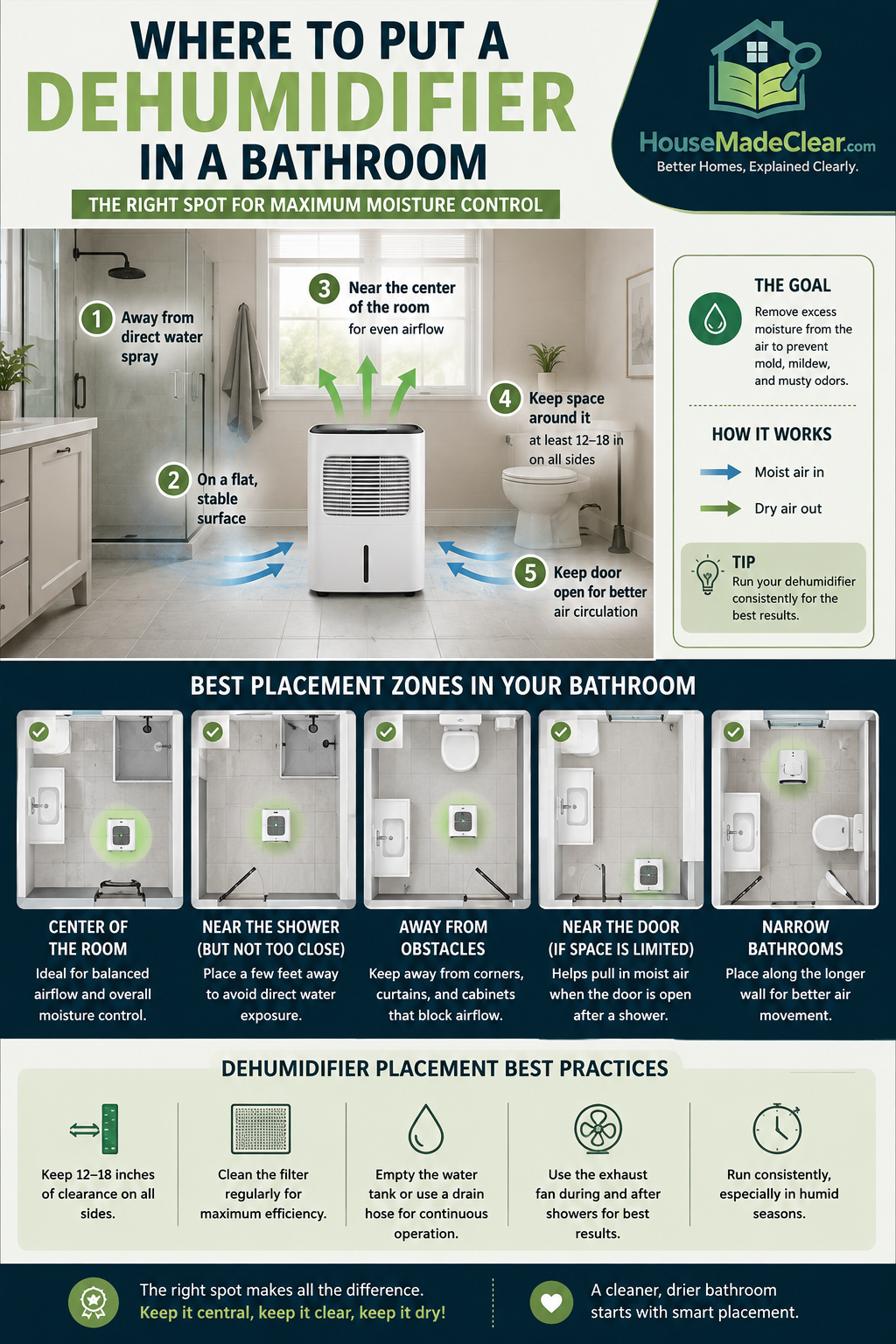
Do not apply one universal clearance.
Different products have different:
- Intake locations
- Exhaust directions
- Cooling systems
ENERGY STAR notes that many portable dehumidifiers with top-mounted discharge can be placed near walls, while units with other discharge arrangements require more open space for circulation.
Use the clearance stated in the appliance manual.
Where Should the Air Intake Face?
Do not point the intake directly into:
- Wall
- Cabinet
- Laundry basket
- Shower curtain
- Hanging towel
It needs access to room air.
Likewise, do not aim the discharge where it simply blows into another obstruction.
Efficient dehumidification depends on circulating room air through the appliance.
Should the Dehumidifier Be Near the Bathroom Door?
This can be a useful location.
A position near—but not obstructing—the bathroom doorway may provide access to humid air while remaining farther from wet fixtures.
Check that:
- Door opens fully
- Appliance does not become a trip hazard
- Cord does not cross the doorway
- Airflow remains clear
Do not sacrifice safe circulation for slightly better humidity control.
Should You Close Windows While a Dehumidifier Is Running?
Generally, if outdoor air is humid, repeatedly bringing that air inside makes the dehumidifier work harder.
When using a portable dehumidifier for indoor humidity control, it usually makes sense to avoid unnecessary introduction of humid outdoor air.
However, if outdoor air is significantly drier and conditions are comfortable, natural ventilation may itself help dry the room.
The EPA recommends using bathroom exhaust ventilation or opening windows when showering, depending on conditions.
Choose the moisture-control method that makes sense for the weather.
What Humidity Should a Bathroom Be?
Bathroom humidity temporarily rises during a shower, so the peak reading is less important than whether the room returns toward normal afterward.
The EPA advises keeping indoor relative humidity below 60%, ideally around 30–50% where possible, as part of moisture and mold control.
A useful approach is therefore to monitor:
- Humidity before shower
- Peak humidity
- Humidity 20–30 minutes afterward
- Humidity later in the day
A bathroom that briefly reaches a high humidity level during showering and then recovers is different from one that remains damp for hours.
Use a Hygrometer Before Buying a Dehumidifier
A simple humidity meter can tell you whether the bathroom actually has a persistent humidity problem.
Measure over several days.
Look for patterns such as:
- Humidity remains elevated long after showers
- Several showers keep the bathroom humid all morning
- The entire house is humid
- Bathroom humidity is normal except during showering
If humidity recovers quickly, improving ventilation habits may be enough.
If humidity stays high throughout the house, the bathroom may not be the main problem.
A Dehumidifier Is Not a Substitute for Fixing Leaks
If moisture is coming from:
- Plumbing leak
- Roof leak
- Damaged seal
- Window leak
- Pipe condensation
a dehumidifier only treats part of the symptom.
The EPA’s mold guidance emphasizes fixing water or moisture sources rather than relying solely on drying equipment.
Investigate persistent wet areas rather than simply increasing dehumidifier runtime.
Does a Dehumidifier Help Prevent Mold?
A dehumidifier can help lower humidity, and controlling moisture is an important part of reducing conditions that support mold growth.
EPA guidance recommends keeping relative humidity below 60%, ideally around 30–50%, and specifically includes dehumidifiers among the tools that can be used when necessary.
However, a dehumidifier does not:
- Remove existing mold automatically
- Fix leaks
- Repair ventilation
- Dry hidden wall cavities reliably
- Replace cleaning/remediation where needed
Think of it as one moisture-control tool.
Does a Dehumidifier Stop Bathroom Mirrors From Fogging?
It may reduce overall humidity, but it may not prevent immediate mirror fog during a hot shower.
The shower can generate moisture faster than a portable dehumidifier can remove it.
If the main problem is only the mirror, start with:
- Exhaust ventilation
- Lower shower steam
- Heated/anti-fog mirror where appropriate
House Made Clear’s guide to stopping a bathroom mirror from fogging explains the difference between keeping the glass clear and actually reducing room humidity.
A heated mirror can stay clear even when the bathroom is still humid, while a dehumidifier works on the air itself.
Does a Dehumidifier Replace the Bathroom Exhaust Fan?
Usually, no.
The two appliances perform different jobs.
Bathroom exhaust fan
- Pulls humid air from bathroom
- Exhausts it outdoors
Dehumidifier
- Pulls room air through appliance
- Removes moisture
- Returns drier air indoors
EPA guidance recommends using bathroom fans or window ventilation during showering and dehumidifiers when additional humidity control is needed.
For a typical bathroom, use exhaust ventilation first.
Add a dehumidifier when there is a persistent humidity problem that ventilation alone does not solve.
How Large a Dehumidifier Does a Bathroom Need?
Do not choose solely according to bathroom floor area.
Consider:
- Bathroom size
- Humidity level
- Amount of moisture generated
- Whether adjacent rooms are also being dehumidified
ENERGY STAR recommends selecting dehumidifier capacity according to the size and dampness of the space rather than assuming that bigger is always better.
A unit positioned outside the bathroom may effectively be treating:
- Bathroom
- Hallway
- Bedroom
rather than only the bathroom itself.
Size it for the actual area being controlled.
Bigger Is Not Automatically Better
An oversized dehumidifier can:
- Cost more
- Take more floor space
- Be noisier
- Cycle differently
Choose a model appropriate to the moisture load.
More capacity is useful only when it matches the problem.
Dehumidifier With a Water Tank
Most portable units collect water in a removable bucket.
That can be convenient in a bathroom because plumbing is nearby—but do not improvise drainage.
If using the tank:
- Empty it before overflow
- Keep bucket clean
- Reinstall it correctly
- Check that the unit’s auto-shutoff works
ENERGY STAR notes that portable dehumidifiers commonly include a water collection container or provision for continuous drainage.
Continuous Drainage Can Be Convenient
Some dehumidifiers support continuous drainage through a hose.
This may reduce the need to empty a bucket.
However, proper drainage depends on:
- Manufacturer instructions
- Hose route
- Drain location
- Gravity or pump design
- Avoiding trip hazards
Do not run a drain hose across the bathroom floor where someone can trip over it.
Do Not Drain Into the Shower Unless the Setup Is Appropriate
The fact that a shower contains a drain does not automatically make it the ideal dehumidifier drain point.
Consider:
- Hose routing
- Door operation
- Trip risk
- Manufacturer instructions
- Whether water can back up
- Whether the unit requires gravity drainage
A permanent drainage setup should look and function like part of the room rather than a hose stretched across a walkway.
Dehumidifier Noise in a Bathroom
Portable dehumidifiers use fans, and many use compressors.
That means some noise is normal.
If noise matters, compare:
- Published sound level
- Fan speed options
- Location
A unit outside the bathroom may reduce noise inside while still helping with adjacent humidity.
Do not hide it inside a cabinet simply to make it quieter unless the product is designed for that enclosure.
Should You Run the Dehumidifier During the Shower?
That depends on whether the unit’s approved placement keeps it safely away from water.
For many small bathrooms, it may be more sensible to:
- Run the exhaust fan during shower
- Use the dehumidifier afterward or from outside the room
This reduces the need for a portable electrical appliance to operate in the wettest conditions.
If the manufacturer specifically permits bathroom operation in the proposed location, follow those instructions.
How Long Should a Dehumidifier Run After a Shower?
There is no universal number.
The correct runtime depends on:
- Starting humidity
- Bathroom size
- Dehumidifier capacity
- Ventilation
- Number of showers
- Outdoor humidity
Use a humidity reading or automatic humidistat rather than an arbitrary timer where possible.
The goal is to return the room toward a reasonable indoor humidity range, not to keep the machine running continuously without need.
Use the Built-In Humidistat
Many dehumidifiers allow you to set a target humidity.
This can be more practical than manually switching the unit on and off.
For example, the unit can:
- Run while humidity is elevated
- Cycle off when target humidity is reached
EPA guidance suggests keeping indoor humidity below 60%, ideally 30–50% where practical.
Choose settings in accordance with the dehumidifier instructions and actual home conditions.
Should You Run a Bathroom Dehumidifier All Day?
Usually not unless the wider home has an ongoing humidity problem that requires continuous control.
If the bathroom humidity issue occurs only after showers, running the appliance for the rest of the day may be unnecessary.
Instead, investigate:
- Exhaust ventilation
- Shower routine
- Drying time
- Whole-home humidity
If the unit seems to run constantly without reaching the target, the space may have:
- Too much moisture
- A leak
- Poor sizing
- Open windows/doors
- Another underlying problem
Clean and Maintain the Dehumidifier
A dehumidifier handles both air and collected water, so maintenance matters.
Follow the manufacturer’s instructions for:
- Air filter
- Water bucket
- Drain hose
- Intake grille
- Storage
EPA warns that moisture-control appliances themselves should not become sources of biological pollutants.
Do not leave stagnant collected water sitting in a dirty bucket for long periods.
Check Dehumidifier Recalls
Dehumidifiers have been involved in major fire-related recalls in the United States.
Before buying a used unit—or continuing to use an older model—check the CPSC recall database for the exact brand and model.
This is particularly important for second-hand appliances where product history may be unclear.
Where NOT to Put a Bathroom Dehumidifier
Avoid these locations unless the specific appliance documentation clearly permits them:
Directly beside the shower
Risk of splash and wet contact.
Next to the bathtub
Unnecessary electrical proximity to water.
On a wet bathroom floor
Poor location for portable electrical equipment.
Under dripping towels
Water can reach the appliance.
Inside a closed vanity cabinet
Airflow may be restricted.
Behind the bathroom door
Door may strike the unit.
Across the doorway
Creates a trip hazard.
Where the cord crosses a wet walkway
Choose a different location.
Directly against airflow-obstructing furniture
Can reduce dehumidifier performance.
Bathroom Dehumidifier for Renters
Renters often cannot change:
- Exhaust duct
- Electrical wiring
- Window
- Building ventilation
A portable dehumidifier can therefore be useful.
A renter-friendly setup might be:
- Dehumidifier outside bathroom
- Existing exhaust fan running during showers
- Door opened after showering
- Shower surfaces squeegeed
- Humidity monitored
If the bathroom repeatedly develops mold, leaks or severe condensation, notify the landlord/property manager rather than assuming the problem should be solved entirely with your own appliance.
Bathroom Dehumidifier in an Apartment
Apartment bathrooms can be particularly small.
If the only possible floor space is:
- Beside shower
- Beside bathtub
- Directly in walkway
do not force a dehumidifier into the room.
Use an adjacent dry area if practical.
The unit can still help manage humidity spreading into:
- Bedroom
- Hallway
- Dressing area
while the bathroom exhaust fan handles moisture at the source.
Bathroom Dehumidifier in a Basement
Basement bathrooms can be affected by broader basement humidity.
In that situation, placing one dehumidifier solely inside the bathroom may be less effective than controlling the larger basement zone.
Ask:
- Is the whole basement humid?
- Are walls or floors damp elsewhere?
- Does the bathroom remain humid even when unused?
If yes, treat the broader moisture problem.
Windowless Bathrooms
A windowless bathroom does not automatically require a dehumidifier.
A well-designed exhaust system may be enough.
But if humidity remains high, check:
- Fan performance
- Ducting
- Fan runtime
- Door air path
before adding another appliance.
A dehumidifier is most useful when ventilation is functioning but indoor humidity still remains elevated.
Pair It With Better Bathroom Habits
A dehumidifier works more effectively if less water is left to evaporate.
After showering:
- Squeegee shower glass
- Wipe large wet surfaces if necessary
- Spread shower curtain to dry
- Hang towels properly
- Keep exhaust fan running
These habits reduce the moisture load the dehumidifier has to process.
Coordinate With Bathroom Lighting and Electrical Planning
If you are renovating the bathroom, plan:
- Ventilation
- Lighting
- Outlets
- Mirrors
- Dehumidification
together.
Do not finish the renovation and then discover that the only practical dehumidifier location requires a cord across the walkway.
House Made Clear’s bathroom lighting guide explains why electrical fixtures and controls should be planned around the actual vanity, shower and room layout rather than selected separately.
For fixed electrical work, use an appropriately qualified professional and follow local requirements.
Common Bathroom Dehumidifier Mistakes
1. Putting It Beside the Shower
Why it is a problem:
The unit is unnecessarily close to water.
Better approach:
Choose a dry part of the room or position it outside.
2. Using It Instead of the Exhaust Fan
Why it fails:
The fan removes moisture directly outdoors, while the dehumidifier recirculates indoor air.
Better approach:
Use exhaust ventilation first and dehumidification as additional control.
3. Blocking the Air Intake
Why it fails:
Reduced airflow reduces performance.
Better approach:
Follow placement clearances from the manufacturer and keep the airflow path open.
4. Running the Cord Across the Bathroom
Why it is a problem:
It creates an avoidable electrical and trip concern.
Better approach:
Choose a location near an appropriate outlet.
5. Assuming Bigger Is Better
Why it fails:
Oversizing can add cost and take unnecessary space.
Better approach:
Choose capacity based on actual dampness and area.
6. Ignoring a Plumbing Leak
Why it fails:
The appliance is treating moisture without removing its source.
Better approach:
Repair the underlying leak.
7. Forgetting the Water Bucket
Why it fails:
The appliance may stop when full or become unpleasant if dirty water remains.
Better approach:
Empty and clean according to manufacturer instructions.
8. Hiding the Unit in a Cabinet
Why it fails:
Airflow can be obstructed.
Better approach:
Keep the appliance in an open approved location.
9. Running It Constantly Without Measuring Humidity
Why it fails:
You cannot tell whether the problem is actually being solved.
Better approach:
Use a hygrometer or built-in humidistat.
10. Treating Mirror Fog as the Only Measurement
Why it fails:
Mirror temperature affects condensation.
Better approach:
Check room humidity, walls, windows and drying time.
Step-by-Step: Find the Best Bathroom Dehumidifier Location
Step 1: Measure Humidity
Use a hygrometer for several days.
Step 2: Check the Exhaust Fan
Make sure ventilation is working.
Step 3: Read the Dehumidifier Manual
Check:
- Allowed locations
- Clearance
- Electrical requirements
- Drainage
- Temperature range
Step 4: Identify Wet Zones
Mark:
- Shower
- Tub
- Sink splash area
- Frequently wet floor
Keep the portable appliance away from them.
Step 5: Identify Dry Locations
Look for:
- Dry wall section
- Dry open floor area
- Adjacent hallway
- Dressing area
Step 6: Check the Outlet
Avoid improvised cord routing.
Step 7: Check Airflow
Keep intake and discharge unobstructed.
Step 8: Check Walking Routes
The unit should not become a trip hazard.
Step 9: Test Humidity Recovery
Run the normal shower routine and observe how quickly humidity falls.
Step 10: Adjust the Position
A small change in airflow can sometimes improve performance.
Quick Placement Comparison
| Location | Suitability | Main Consideration |
|---|---|---|
| Dry bathroom corner | Potentially good | Keep away from splash and allow airflow |
| Near bathroom door | Good option | Protect door and walkway clearance |
| Outside bathroom | Often excellent | Useful for small bathrooms |
| Beside shower | Poor | Too close to water |
| Beside bathtub | Poor | Electrical proximity to water |
| Under sink | Usually poor | Splash/leak and airflow concerns |
| Closed cabinet | Poor | Restricted airflow |
| Hallway outside bathroom | Useful | Door/airflow arrangement matters |
Bathroom Dehumidifier Checklist
Before operating the unit, confirm:
- Bathroom actually has persistent humidity problem
- Exhaust fan has been checked
- Dehumidifier manual reviewed
- Unit is away from shower
- Unit is away from bathtub
- Unit is protected from sink splash
- Floor stays dry
- Appliance is stable
- Air intake is clear
- Air outlet is clear
- Door cannot hit unit
- Unit does not block walkway
- Cord does not cross wet area
- Outlet is appropriate
- Drain hose does not create trip hazard
- Humidity is being measured
- Water bucket is cleaned
- Filter maintenance is up to date
- Model has been checked for recalls if older/used
When a Dehumidifier Is Probably Not the Real Solution
Investigate further when:
- Water leaks from wall or ceiling
- Mold repeatedly returns
- Paint peels
- Window frames stay wet
- Bathroom remains humid all day
- Exhaust fan barely moves air
- Dehumidifier never reaches target humidity
- Adjoining rooms are also damp
- Flooring remains wet
These symptoms can indicate:
- Ventilation problem
- Plumbing problem
- Building-envelope moisture
- Whole-home humidity problem
The EPA’s overarching guidance is straightforward: successful mold control depends on controlling the source of moisture.
Final Thoughts
If you want to use a dehumidifier for bathroom moisture, prioritize safe placement before maximum moisture removal.
The best location is generally:
- Dry
- Stable
- Well ventilated
- Away from shower and bathtub
- Away from routine splashing
- Clear of furniture
- Close to an appropriate outlet
For many small bathrooms, that may mean placing the unit just outside the bathroom rather than inside it.
Also remember that a dehumidifier should normally support—not replace—the bathroom’s main moisture-control system.
Start with:
- Effective exhaust ventilation
- Appropriate fan runtime
- Drying shower surfaces
- Monitoring humidity
- Adding a dehumidifier when humidity remains excessive
The EPA recommends controlling indoor humidity below 60%, ideally around 30–50% where practical, using ventilation and dehumidification as appropriate.
If your bathroom stays humid after every shower, begin with House Made Clear’s guide to how long to run a bathroom fan after a shower. If mirror condensation is the main concern, our guide to stopping bathroom mirror fog explains why a clear mirror and a properly dried bathroom are not always the same thing.
Frequently Asked Questions
Where is the best place to put a dehumidifier in a bathroom?
Choose a dry, stable location away from the shower, bathtub, sink splashes and wet flooring, with enough open space for proper airflow. Follow the dehumidifier manufacturer’s placement requirements.
Can I put a dehumidifier next to the shower?
A portable electrical appliance should not be placed where shower spray or wet users can easily reach it. Choose a clearly dry location or place the unit outside the bathroom instead.
Can I leave a dehumidifier outside the bathroom?
Yes. For small bathrooms, placing the dehumidifier immediately outside the bathroom can be a practical way to control residual humidity while keeping the appliance farther from wet fixtures.
Should the bathroom door be open when using a dehumidifier?
During showering, exhaust ventilation should remove moisture at the source. After showering, opening the door may help an externally positioned dehumidifier process residual humid air, provided doing so does not simply spread excessive moisture through the home.
Does a bathroom dehumidifier replace an exhaust fan?
Usually not. An exhaust fan removes humid bathroom air outdoors, whereas a dehumidifier removes moisture from indoor air and recirculates the drier air. They perform different functions.
What humidity should I set my bathroom dehumidifier to?
The EPA recommends keeping indoor relative humidity below 60%, ideally around 30–50% where practical. Choose a setting appropriate to your home and follow the dehumidifier manufacturer’s guidance.
How long should a dehumidifier run after a shower?
There is no universal runtime. Use the room’s humidity level or the appliance’s humidistat rather than relying only on a fixed timer. The goal is to return humidity toward normal indoor levels.
Can a dehumidifier stop bathroom mold?
Lowering excess humidity can reduce conditions that support mold growth, but a dehumidifier does not remove existing mold or repair leaks. Persistent moisture sources must also be corrected.
Can a dehumidifier stop a bathroom mirror from fogging?
It may reduce room humidity but may not prevent immediate condensation during a hot shower. Exhaust ventilation or a heated anti-fog mirror may address mirror fog more directly.
Should I run a dehumidifier all day in the bathroom?
Not necessarily. If humidity rises only after showers and returns to normal afterward, continuous operation may be unnecessary. Persistent all-day humidity should prompt investigation of ventilation, leaks or wider indoor humidity.