













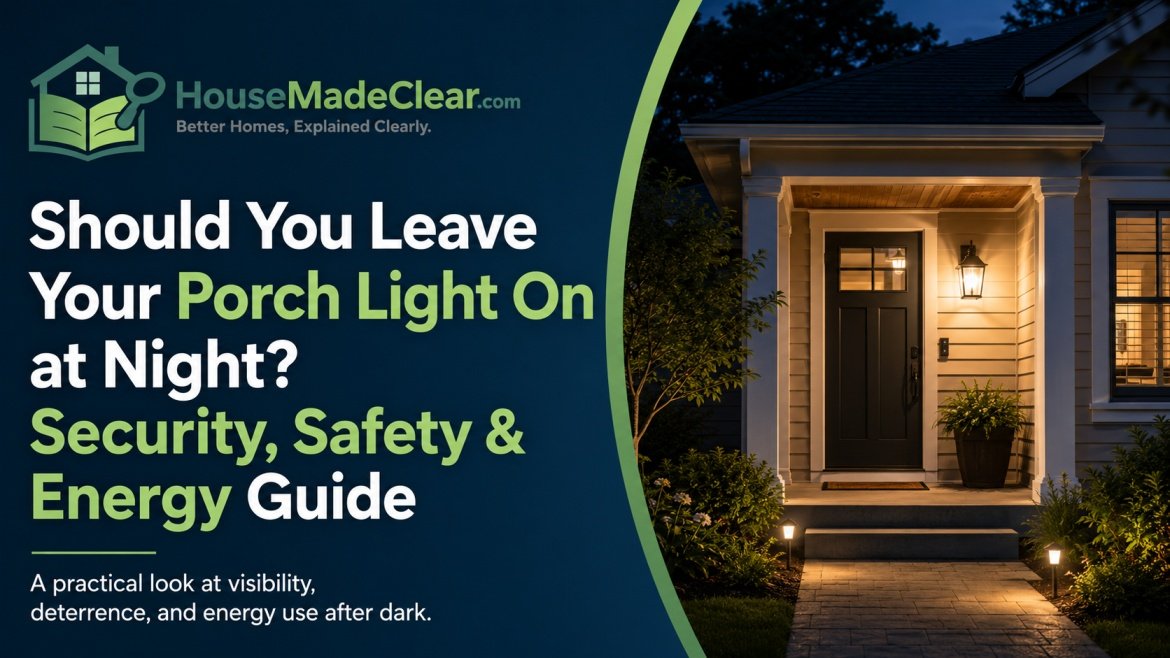
Leaving your porch light on at night can improve visibility around the front door, help visitors find the entrance and make it easier to see activity near the home.
But leaving it on all night, every night is not automatically the best security strategy.
The better approach is usually to use porch lighting intentionally: enough light to improve visibility and support cameras or safe entry, while avoiding unnecessary glare, excessive brightness and wasted energy.
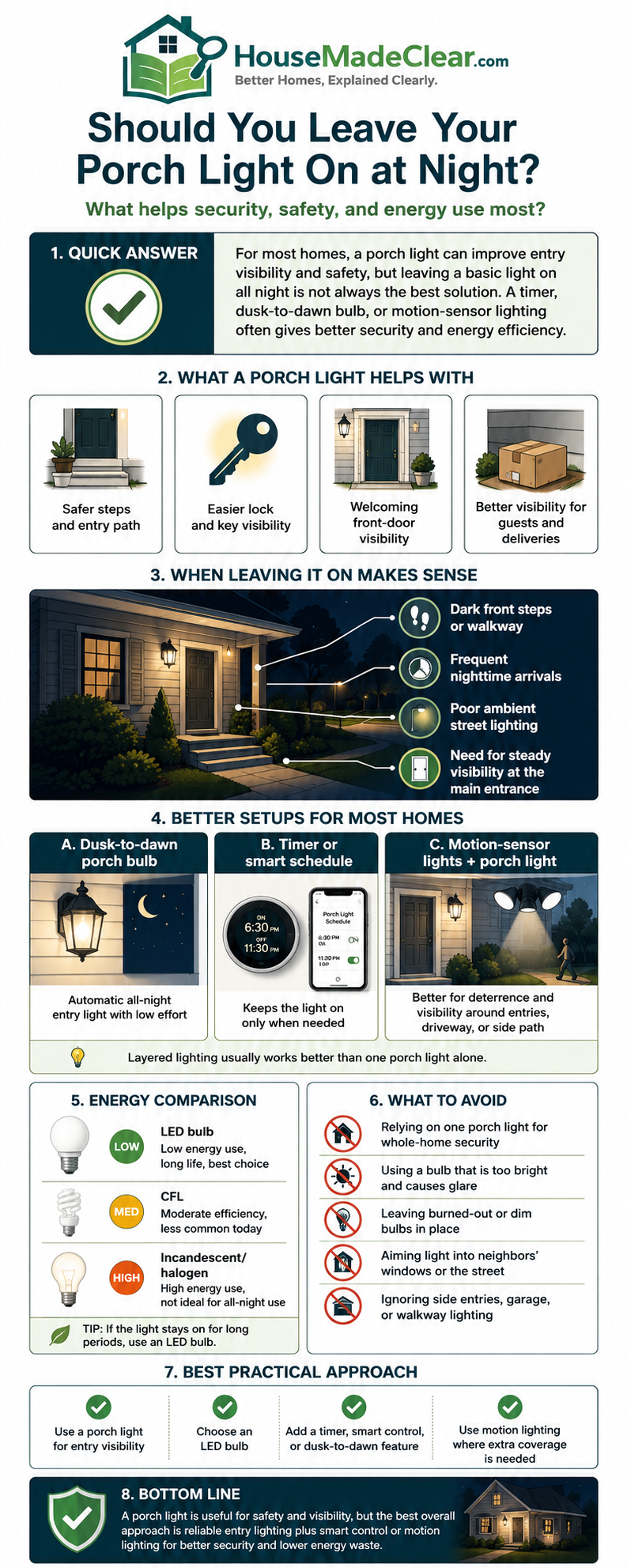
Quick Answer
Leaving a porch light on during the evening can be useful for visibility and convenience, but it is not a guaranteed way to prevent burglary.
A practical setup is often:
- Low or moderate porch lighting during normal evening hours
- A dusk-to-dawn sensor or schedule where constant nighttime visibility is useful
- Motion-activated lighting for approach areas such as driveways or side paths
- Warm, downward-directed light that does not shine into neighboring windows
Police security guidance commonly recommends well-maintained exterior lighting because it can increase the chance that activity is seen, while modern outdoor-lighting guidance also emphasizes controlling glare and using light only where and when it is needed.
The key is to think of a porch light as one layer of home security, not as a substitute for good locks, doors, cameras or sensible routines.
House Made Clear’s guide to common home security mistakes covers this broader layered approach.
Should You Leave Your Porch Light On at Night?
Sometimes, yes.
Leaving the porch light on makes the most sense when:
- Someone is expected home after dark
- Visitors or deliveries are arriving
- The front entrance would otherwise be difficult to see
- You want a camera or doorbell camera to have better visible-light conditions
- Steps, changes in level or obstacles near the entrance need illumination
It is less useful to think in terms of:
“Porch light on = secure”
and more useful to ask:
“What does this light help me see, and when do I actually need it?”
That distinction prevents outdoor lighting from becoming excessively bright or permanently switched on without a clear purpose.
Does Leaving a Porch Light On Deter Burglars?
Outdoor lighting can increase visibility, and police crime-prevention guidance often recommends lighting entrances and exterior areas because increased lighting can make activity easier to observe. For example, Greater Manchester Police includes working dusk-to-dawn lighting at front and rear doors in its home-security checklist, while West Yorkshire Police recommends keeping property well lit during darkness and maintaining outdoor security lights.
However, lighting should not be treated as a guaranteed burglary deterrent.
Research into the relationship between lighting and crime is more complicated than the simple idea that “brighter always means safer.” DarkSky cites a U.S. National Institute of Justice review that found little confidence that improved lighting alone prevents crime, while also noting that excessive glare can actually make dark areas harder to see.
So the better conclusion is:
Porch lighting can improve visibility and support security, but it should not be relied on by itself to prevent break-ins.
Locks, doors, windows, cameras, alarms and household routines remain important.
When Leaving the Porch Light On Makes Sense
There are several situations where leaving it on is genuinely useful.
When You Are Expecting Someone Home
If a family member will return after dark, porch lighting can help them:
- See the steps
- Find the lock
- Avoid obstacles
- Enter the home more comfortably
This is one of the simplest and strongest reasons to use porch lighting.
When You Are Expecting Visitors
A lit entrance helps visitors identify:
- House number
- Door
- Walkway
- Steps
Greater Manchester Police specifically notes that a clearly visible house number helps emergency services identify a property quickly.
So lighting the entrance area can support both everyday convenience and emergency access.
When You Are Expecting a Delivery
An illuminated porch can make it easier for a delivery driver to:
- Find the correct entrance
- See the path
- Place a package safely
It can also make nighttime footage from a doorbell camera easier to interpret if the light is positioned correctly.
When the Entrance Has Steps
If the front porch has:
- Steps
- Uneven paving
- Raised threshold
lighting is particularly useful.
The objective should be to illuminate the route without shining directly into the eyes of someone approaching the door.
Is It Better to Leave the Porch Light On All Night?
Not always.
Constant lighting can work well in some locations, but it is not automatically superior to controlled lighting.
ProtectUK security-lighting guidance notes that exterior lights may be activated by motion sensors or left on through the night, and says a lower level of continual illumination can be effective compared with sudden high-brightness lighting. It also describes dusk-to-dawn low-energy lighting as a practical compromise.
For a typical home, the options are better considered individually.
Option 1: Porch Light On All Night
Useful when:
- The front entrance needs continuous visibility
- The fixture is low-energy
- Light is well shielded
- It does not disturb neighbors
Option 2: Dusk-to-Dawn Porch Light
Turns on automatically when it gets dark.
Useful when:
- You frequently forget the light
- Entrance visibility is needed every night
- You want simple automation
Option 3: Scheduled Porch Light
For example:
On at sunset → off at 11:30 p.m.
Useful when:
- Most activity occurs in the evening
- You do not need full-night illumination
Option 4: Motion-Activated Light
Useful when:
- You want brighter illumination only when movement occurs
- The area does not require constant light
There is no universal winner.
Porch Light On All Night vs Motion Sensor Light
These two strategies solve slightly different problems.
| Lighting Type | Best For | Main Limitation |
|---|---|---|
| Constant porch light | Continuous entrance visibility | Uses energy throughout night |
| Dusk-to-dawn light | Automatic all-night lighting | May be unnecessary after late hours |
| Motion light | Activity-based illumination | Can false-trigger |
| Timer/schedule | Predictable evening routine | Needs correct schedule |
| Smart lighting | Flexible automation | Adds technology dependency |
For many homes, a combination works better than choosing only one system.
For example:
Low-level porch light + brighter motion light on driveway
This keeps the entrance visible without keeping the entire front yard brightly illuminated.
Is a Motion Sensor Better for Security?
Motion lighting can be useful because it activates when movement enters the detection area.
The U.S. Department of Energy has long described motion sensors and photosensors as effective controls for exterior lighting, particularly where lights are needed only when it is dark and people are present.
Motion lighting is especially practical for:
- Driveway
- Side passage
- Garage approach
- Rear entrance
- Gate
But a motion sensor is not automatically better for the front porch.
If visitors frequently approach the door, you may prefer:
- Constant low-level porch light
- Motion light covering the approach
rather than forcing the entrance itself to switch from complete darkness to very bright light.
House Made Clear’s guide to outdoor motion sensor light placement explains how to position sensors around doors, driveways and walkways without creating excessive false activations.
Dusk-to-Dawn Lights Can Be a Good Middle Ground
A dusk-to-dawn light uses a photosensor to detect ambient light.
It switches on when daylight falls and switches off again after sunrise.
This can be useful because you do not have to remember the switch.
Police crime-prevention resources commonly recommend dusk-to-dawn lighting at entrances.
Advantages
- Simple
- Automatic
- Predictable
- Maintains visible entrance
Disadvantages
- Runs through entire night
- May be unnecessary after household activity ends
- Can create light spill if fixture is poorly designed
For some homes, combining a photosensor with a timer gives better control.
Use a Timer to Avoid Leaving the Light On Needlessly
A schedule can be one of the simplest improvements.
For example:
Sunset → light on
Midnight → light off
This keeps the entrance illuminated during the period when residents and visitors are most likely to use it.
DOE guidance on exterior lighting notes that timers can be effective when combined with other controls, such as a photosensor that turns lights on in the evening and a timer that switches them off later at night.
This reduces unnecessary runtime without leaving the porch dark during normal evening use.
Smart Porch Lights Can Make Scheduling Easier
A smart bulb, smart switch or compatible outdoor lighting system may allow:
- Sunset schedules
- Vacation routines
- Remote control
- Timers
- Integration with sensors
For example:
Normal Evening
On at sunset
Off at 11:30 p.m.
Late Arrival
Temporarily extend until 1 a.m.
Vacation
Use a varied schedule rather than a perfectly identical pattern every night.
If you are new to basic automation, House Made Clear’s guide to where smart plugs are actually useful explains how schedules and timers can improve everyday routines without overcomplicating the home.
For fixed porch lighting, however, an appropriate outdoor-rated smart switch or smart bulb is usually more suitable than attempting to control permanent exterior wiring with a generic plug-in device.
Should You Leave the Porch Light On While on Vacation?
This needs more thought than simply leaving one light on continuously for a week.
A porch light that remains:
On day and night without changing
may look less natural than the normal activity pattern of an occupied home.
A more practical strategy can include:
- Dusk-to-dawn exterior lighting
- Interior lights on schedules
- Smart lighting routines
- Motion lighting on approaches
The idea is not to create a fake “occupied” pattern with dozens of complicated automations.
It is to avoid an obviously unusual pattern.
For example, if the porch light is normally off during daylight but suddenly remains on 24 hours a day throughout a trip, that is not especially convincing.
Should You Leave Interior Lights On While Away?
Leaving all interior lights continuously on is also unnecessary.
Timers or smart schedules allow selected lamps to operate during normal evening hours.
A simple pattern might be:
Living-room lamp: 6:30–10:30 p.m.
Bedroom lamp: 9:00–11:00 p.m.
Do not make the system so complicated that it becomes unreliable.
For most households, a few predictable routines are enough.
Porch Lighting and Security Cameras
Lighting can improve security-camera performance, but it can also make it worse.
A bright porch light pointed directly into a camera may create:
- Lens flare
- Overexposure
- Washed-out faces
- Harsh shadows
The goal is to illuminate the subject area, not the camera.
For a doorbell camera:
- Light the visitor
- Avoid direct glare into lens
- Check the image after dark
For a wall-mounted security camera:
- Keep fixture outside direct lens line
- Test motion-light activation
- Check reflections from walls or siding
House Made Clear’s home security camera placement guide explains why nighttime testing matters just as much as daytime positioning.
Can Leaving the Porch Light On Make Security Cameras Better?
Potentially.
A camera may capture more useful visible detail if:
- The visitor’s face is illuminated
- The entry path is evenly lit
- Brightness is not excessive
But more light is not always better.
An extremely bright fixture may cause the camera to adjust exposure for the brightest area, leaving everything else dark.
So after installing or changing porch lighting:
- Wait until full darkness.
- Stand where a visitor would stand.
- Review live camera image.
- Walk toward the door.
- Check facial detail.
- Adjust the fixture if needed.
Avoid Extremely Bright Porch Lighting
A brighter bulb does not automatically mean a more secure home.
Excessive brightness can create:
- Glare
- Deep shadows
- Neighbor complaints
- Light pollution
- Poor camera exposure
DarkSky recommends using only the amount of light actually needed, choosing shielded fixtures and using timers or motion sensors so outdoor lighting operates only when useful.
A useful porch light should help someone see:
- Door
- Lock
- Steps
- Visitor
- Immediate walkway
It does not need to illuminate the entire neighborhood.
Aim Porch Lights Downward
Direction matters.
A well-designed fixture directs most light:
- Toward the ground
- Toward the entrance
- Toward the walkway
rather than:
- Into the sky
- Across the street
- Into neighboring windows
DarkSky’s home-lighting assessment recommends fully shielded fixtures that direct light downward and emphasizes minimizing glare and light trespass.
This can also improve visibility because light stays where it is useful.
What Color Temperature Is Best for a Porch Light?
For residential outdoor lighting, very cool blue-white light is not necessarily better.
DarkSky recommends warmer outdoor lighting, typically around 2700K or lower where practical, particularly when fixtures are used for extended nighttime periods.
A warm porch light can provide:
- Comfortable appearance
- Good entrance visibility
- Less harsh nighttime contrast
You do not need an extremely blue 5000K light simply because it looks “brighter.”
How Bright Should a Porch Light Be?
There is no universal lumen number for every porch because the correct output depends on:
- Fixture design
- Porch size
- Mounting height
- Ambient street lighting
- Distance to steps
- Number of fixtures
DarkSky’s residential guidance suggests using only as much light as the task requires and provides relatively modest output recommendations for pathways and outdoor work areas.
The practical rule is:
Use enough light to clearly see the entrance without producing glare.
If the bulb is visible from the street and painfully bright to look at, the fixture or output may need adjustment.
Porch Light Placement Matters More Than Raw Brightness
A moderate light in the correct position can outperform a very bright light in the wrong position.
Good placement should illuminate:
- Door handle
- House number
- Steps
- Visitor’s face
- Immediate landing
Poor placement may illuminate:
- Upper wall
- Roof
- Camera lens
- Neighbor’s window
without helping much at ground level.
One Porch Light vs Two
Some entrances have one fixture beside the door.
Others use two fixtures.
One Fixture
Can work well for:
- Small porch
- Narrow entrance
Two Fixtures
May provide more even illumination around:
- Wide door
- Double doors
- Large porch
Two moderate fixtures can sometimes create better visibility than one extremely bright fixture.
The right arrangement depends on the architecture.
Should the Back Door Light Stay On Too?
The back entrance deserves the same functional consideration as the front.
Leave it on when:
- Someone will use the door
- Steps or patio require visibility
- Camera needs illumination
Otherwise, motion or dusk-to-dawn lighting may be more suitable.
Do not assume every exterior light needs to stay on simply because it exists.
What About Side Doors?
Side entrances can be especially dark.
Possible options include:
- Small constant entry light
- Motion-activated fixture
- Combined low-level and motion lighting
The correct setup depends on how frequently the door is used.
A side door used every evening deserves more consistent lighting than a rarely used utility entrance.
Should Garage Lights Stay On All Night?
Garage-area lighting often benefits from motion control.
This is because the primary need occurs when:
- Vehicle arrives
- Someone walks across driveway
- Garage is accessed
DOE guidance supports using motion sensors where exterior lighting is needed mainly when people are present.
A motion light can therefore be more efficient than illuminating the entire driveway continuously.
Porch Light vs Driveway Light
These should perform different jobs.
Porch Light
Illuminates:
- Door
- Lock
- Steps
- Visitor
Driveway Light
Illuminates:
- Vehicle area
- Garage approach
- Walking route
Trying to make one powerful porch fixture illuminate both areas can create:
- Glare
- Shadows
- Uneven coverage
Separate the lighting zones where practical.
Porch Lighting for Apartments and Townhouses
Attached homes often have:
- Close neighbors
- Shared walkways
- Narrow frontages
This means light spill deserves extra attention.
Avoid:
- Very high-output floodlights
- Fixtures aimed sideways
- Bright light entering adjacent windows
A smaller well-shielded fixture is often more appropriate.
Porch Lighting for Rural Homes
Rural properties may have very little ambient light.
That makes even a modest fixture appear extremely bright.
Instead of installing one enormous floodlight, consider:
- Porch light
- Motion light at driveway
- Path lighting where needed
This creates several controlled zones.
It also helps preserve visibility beyond the brightly lit area.
Porch Lighting for Suburban Homes
Suburban homes may already receive light from:
- Streetlights
- Neighboring homes
- Driveways
In that case, you may need less porch-light output than a rural property.
Assess the actual nighttime environment rather than selecting brightness based only on packaging.
Porch Light and House Numbers
Your house number should remain visible enough for:
- Visitors
- Deliveries
- Emergency services
Greater Manchester Police specifically highlights visible house numbers as useful for emergency identification.
If the number is mounted near the door, position lighting so it can be seen without producing reflective glare.
Does Leaving the Porch Light On Waste Electricity?
Any light that remains on consumes electricity, but LED lighting can make the cost relatively small compared with older incandescent bulbs.
The more important question is:
Does the light need to be on during those hours?
DOE exterior-lighting guidance recommends efficient LED luminaires and controls such as motion detectors so lighting can adapt to actual activity.
For a porch light, energy use can often be reduced through:
- LED bulb
- Timer
- Dusk-to-dawn sensor
- Motion sensor
- Lower appropriate output
Simple Energy Example
Suppose you use a:
10-watt LED bulb
for:
12 hours each night
Daily energy:
10 watts × 12 hours = 120 watt-hours
That equals:
0.12 kWh per day
Over 30 days:
0.12 × 30 = 3.6 kWh
Your actual electricity cost depends on your local rate.
The point is not that porch-light energy use is necessarily huge.
It is that unnecessary runtime can usually be avoided easily.
Is LED the Best Choice for Porch Lighting?
For most modern residential applications, LED is usually the practical choice because it offers:
- High efficiency
- Long operating life
- Many color-temperature choices
- Compatibility with many sensors and smart controls
Check that the bulb or fixture is:
- Suitable for outdoor use
- Compatible with enclosed fixtures if relevant
- Compatible with dimmers or sensors where used
Light Pollution Matters Too
Outdoor lighting affects more than the house.
Poorly designed fixtures can create:
- Sky glow
- Neighbor light trespass
- Glare
- Unnecessary nighttime illumination
DarkSky recommends five broad principles for responsible outdoor lighting: use light only when needed, only where needed, at the lowest useful level, with appropriate controls and warmer color where practical.
That framework works well for porch lights.
Should You Turn Porch Lights Off Late at Night?
If the entrance no longer needs continuous illumination, switching it off later can be reasonable.
For example:
Sunset → porch light on
11:30 p.m. → porch light off
Motion lighting remains active
This gives you:
- Evening visibility
- Reduced overnight energy use
- Less light pollution
A timer or smart schedule makes this automatic.
Is a Porch Light With a Motion Sensor Better Than a Timer?
They solve different problems.
Timer
Best for predictable routines.
Example:
On every evening from sunset to 11 p.m.
Motion Sensor
Best for unpredictable activity.
Example:
Driveway lights activate whenever someone approaches.
Photosensor
Best for automatically detecting darkness.
Smart Control
Best for combining:
- Time
- Sunset
- Motion
- Manual overrides
A hybrid system can often deliver the best result.
Recommended Porch-Light Routine for Most Homes
A simple routine might be:
Sunset to Late Evening
Low/moderate porch light on.
Overnight
Porch light off or dimmed, depending on property needs.
Approach Areas
Motion lights remain available.
Late Arrival
Extend porch schedule temporarily.
This is usually more practical than either:
- Complete darkness all night
- Maximum-brightness lighting all night
Recommended Setup for a Home With Cameras
Try:
Front Door
Low/moderate constant light.
Driveway
Motion light.
Side Yard
Motion light.
Camera
Position outside direct glare.
Then test everything after dark.
This creates several layers rather than relying on one fixture.
Recommended Setup for a Home Without Cameras
Prioritize:
- Front door visibility
- Steps
- Walkway
- Side/rear entrances
You do not need cameras for outdoor lighting to be useful.
Good visibility is valuable on its own.
Common Porch-Light Mistakes
1. Assuming More Light Always Means More Security
Problem:
Excessive glare can reduce visibility.
Better approach:
Use controlled, well-directed light.
2. Leaving the Light On 24/7
Problem:
It wastes energy and creates an unusual pattern.
Better approach:
Use dusk-to-dawn or scheduled control.
3. Pointing the Light at the Street
Problem:
Creates glare without improving the entrance.
Better approach:
Aim downward toward your property.
4. Shining Into Neighboring Windows
Problem:
Creates light trespass.
Better approach:
Use shielded fixtures.
5. Aiming the Light Into a Camera
Problem:
Can wash out footage.
Better approach:
Illuminate the subject area, not the lens.
6. Using One Huge Floodlight for Everything
Problem:
Creates bright and dark extremes.
Better approach:
Use separate lighting zones.
7. Forgetting Steps
Problem:
Door is bright but approach remains dark.
Better approach:
Light the route as well as the doorway.
8. Using Indoor-Rated Equipment Outside
Problem:
Fixture may not be designed for weather exposure.
Better approach:
Use equipment rated for the location.
9. Ignoring Motion-Sensor False Triggers
Problem:
Vehicles and pedestrians activate lights constantly.
Better approach:
Aim and adjust sensor appropriately.
10. Treating Lighting as the Entire Security Plan
Problem:
Doors or windows may remain weak.
Better approach:
Combine lighting with physical security.
Step-by-Step: Decide Whether Your Porch Light Should Stay On
Step 1: Look at the Entrance After Dark
Turn the porch light off.
Can you clearly see:
- Steps
- Door
- House number
- Walkway?
Step 2: Turn the Light On
Does visibility improve without excessive glare?
Step 3: Check From the Street
Make sure the fixture is not painfully bright.
Step 4: Check Neighbor Windows
Confirm light remains on your property as much as practical.
Step 5: Check Cameras
If installed, review footage.
Step 6: Identify Active Hours
When do people normally:
- Arrive
- Leave
- Receive deliveries?
Step 7: Choose the Control
Pick:
- Manual
- Timer
- Dusk-to-dawn
- Motion
- Smart schedule
Step 8: Test for One Week
Observe whether:
- Light is useful
- It runs unnecessarily
- Neighbors are affected
- Motion triggers properly
Step 9: Adjust
Outdoor lighting works best when tuned to the actual property.
Quick Porch-Light Decision Box
Leave the porch light on when:
- Someone is arriving after dark
- Visitors or deliveries are expected
- Steps or entrance need visibility
- Your camera benefits from it
Consider turning it off or scheduling it later when:
- The entrance is no longer being used
- Motion lighting covers overnight activity
- The fixture creates unnecessary glare
Best general strategy:
Use appropriate low/moderate entrance lighting plus timers, photosensors or motion controls rather than assuming maximum brightness all night is always best.
Porch Lighting Checklist
Before finalizing the setup, check:
- Door is visible
- House number is visible
- Steps are illuminated
- Walkway is clear
- Fixture does not glare into eyes
- Fixture does not shine into camera lens
- Neighboring windows are not directly illuminated
- Bulb/fixture is outdoor-rated
- Light output is appropriate
- Warm color temperature considered
- Timer or sensor considered
- Motion detector is aimed properly
- Camera tested after dark
- Driveway has separate lighting if needed
- Back/side entrances assessed
- Light is not treated as substitute for locks
- Schedule matches actual household routine
Final Thoughts
Leaving your porch light on at night can be useful, but the answer is not simply:
“Always leave it on.”
The better question is:
When does the light improve visibility, and how can it do that without creating unnecessary glare or waste?
For many homes, a practical setup is:
Low or moderate porch lighting during normal evening hours
Motion lighting on driveways and side approaches
Dusk-to-dawn or scheduled controls where useful
Warm, shielded light directed toward the entrance
Police security guidance supports the use of well-maintained exterior and dusk-to-dawn lighting around entrances, while modern responsible-lighting guidance emphasizes using only the amount of light needed and controlling it with timers or sensors.
And remember: porch lighting is only one layer.
Pair it with:
- Good exterior doors
- Appropriate locks
- Window security
- Cameras where useful
- Sensible household routines
For the next step, read House Made Clear’s guide to outdoor motion sensor light placement and home security camera placement to coordinate lighting and camera coverage around the property.
Frequently Asked Questions
Should you leave your porch light on at night?
It can be useful during evening hours for entrance visibility, visitors and safe access. However, leaving it on all night is not automatically necessary. Timers, dusk-to-dawn controls and motion lighting can provide more targeted illumination.
Does leaving a porch light on deter burglars?
Exterior lighting can make activity easier to see and is commonly recommended as part of home-security planning, but lighting alone is not proven to prevent burglary. It works best alongside secure doors, windows and other security measures.
Is it better to leave a porch light on or use a motion sensor?
A constant low-level porch light is useful for continuous entrance visibility, while motion lights are well suited to driveways, side paths and other approach areas. Many homes benefit from using both.
Should I leave my porch light on while on vacation?
Rather than leaving one light continuously on day and night, consider dusk-to-dawn lighting or scheduled lighting that more closely matches normal household use.
Should outdoor lights stay on all night?
Not necessarily. Some areas benefit from continuous low-level illumination, while others are better served by timers, photosensors or motion controls.
Are dusk-to-dawn porch lights good for security?
They can be useful because they automatically maintain nighttime entrance lighting. Police crime-prevention guidance commonly recommends dusk-to-dawn lighting as one exterior-security option.
Can a porch light interfere with a security camera?
Yes. A fixture shining directly into a camera can cause glare or overexposure. Aim the light toward the visitor or entrance area rather than directly at the camera lens.
What color temperature is best for a porch light?
Warm outdoor lighting is generally a good residential choice. DarkSky recommends warmer color temperatures around 2700K or lower where practical for night-friendly exterior lighting.
Does leaving a porch light on use a lot of electricity?
It depends on bulb wattage and runtime. Modern LED porch lights use considerably less electricity than older incandescent bulbs, and timers or sensors can reduce unnecessary operating hours.
What is the best porch-light schedule?
A practical schedule for many homes is to switch the light on around sunset and turn it off later in the evening, while motion lighting remains available for overnight activity. Adjust the schedule to match your household routine.