
















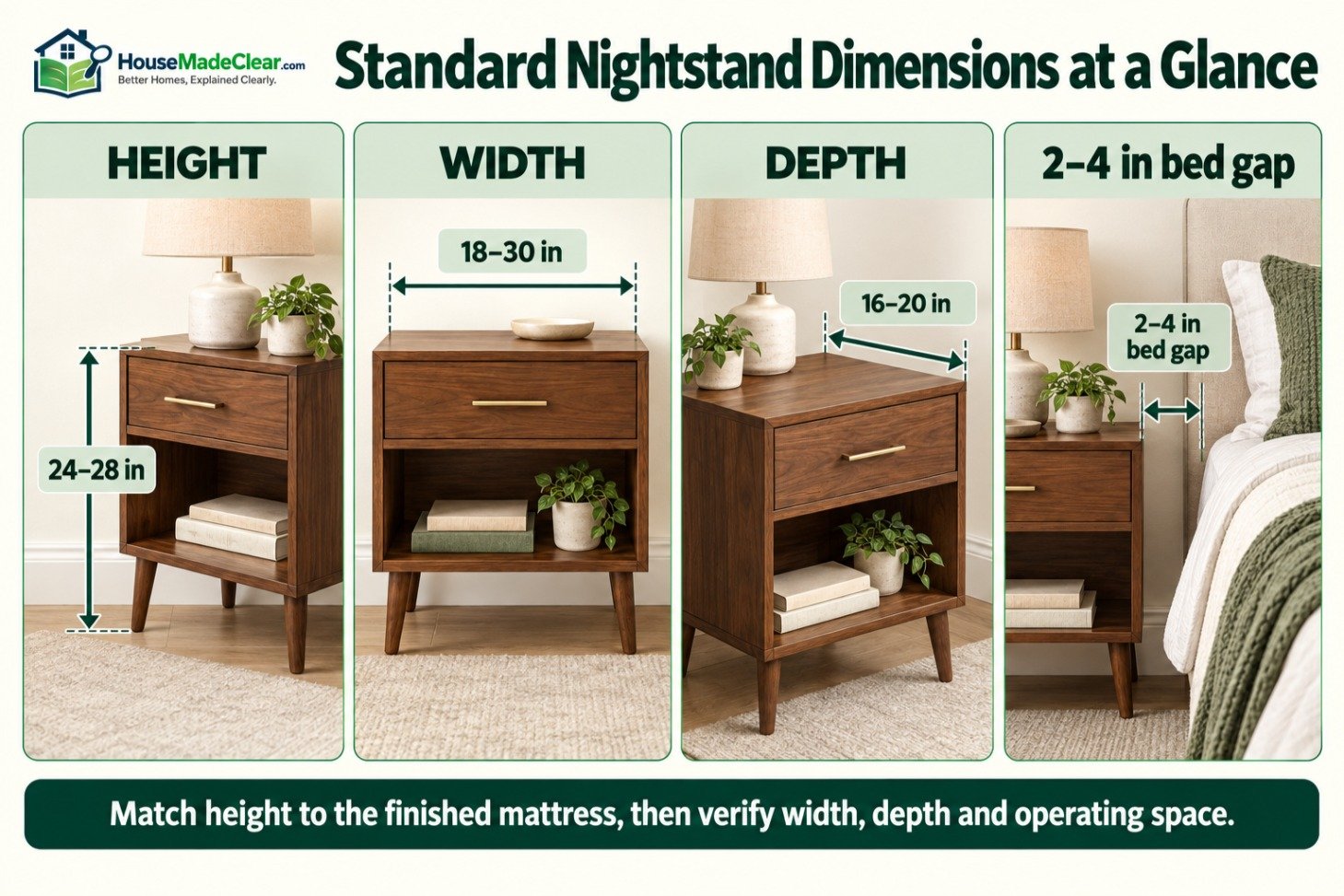
A nightstand should be easy to reach from bed without taking up more floor space than the room can support. Although bedside tables are not manufactured to one universal size, most standard nightstands are approximately 24 to 28 inches high, 18 to 30 inches wide and 16 to 20 inches deep.
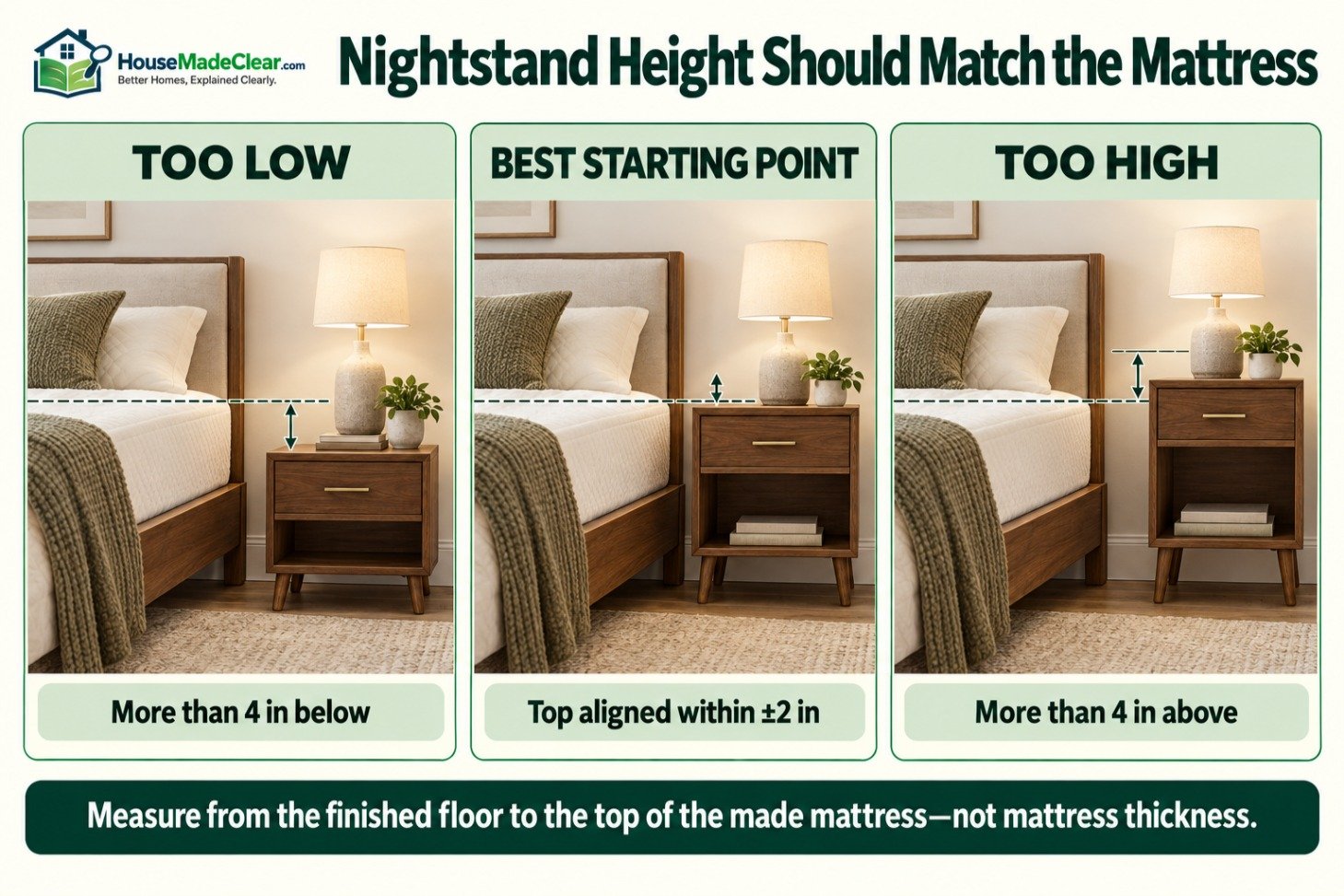
Height is usually the most important measurement. The top of the nightstand should generally be level with the top of the mattress or within approximately 2 to 4 inches of it. A table that is significantly higher or lower can be awkward to reach and may make lamps, drinks, medications and phones more difficult to use safely.
Quick Answer
Standard nightstand dimensions are commonly:
- Height: 24–28 inchesx
- Width: 18–30 inches
- Depth: 16–20 inches
- Space between the bed and nightstand: approximately 2–4 inches
- Best nightstand height: level with the top of the mattress or within about 2–4 inches
Compact nightstands may be only 12 to 18 inches wide, while large bedside chests can exceed 30 inches. Measure the bed’s finished mattress height, available wall width and drawer-opening space before choosing a nightstand.
Standard Nightstand Dimensions at a Glance
The following measurements provide useful starting ranges for common nightstand styles.
| Nightstand Type | Typical Width | Typical Depth | Typical Height |
|---|---|---|---|
| Compact nightstand | 12–18 inches | 12–16 inches | 20–26 inches |
| Standard nightstand | 18–30 inches | 16–20 inches | 24–28 inches |
| Wide nightstand | 28–36 inches | 18–22 inches | 24–30 inches |
| Tall nightstand | 18–30 inches | 16–20 inches | 28–34 inches |
| Bedside chest | 24–36 inches | 18–22 inches | 28–36 inches |
| Floating nightstand | 12–24 inches | 10–16 inches | Installed to match mattress height |
| Open-shelf nightstand | 16–28 inches | 14–20 inches | 22–30 inches |
| One-drawer nightstand | 16–26 inches | 14–20 inches | 22–28 inches |
| Two-drawer nightstand | 18–30 inches | 16–20 inches | 24–30 inches |
| Three-drawer nightstand | 22–36 inches | 18–22 inches | 28–34 inches |
These measurements are common furniture-planning ranges rather than regulated standards. Product names are inconsistent, so two “standard nightstands” can have substantially different dimensions.
Always verify the complete product specifications, including handles, top overhang, legs, drawer extension and assembled weight.
What Is the Standard Size of a Nightstand?
A typical residential nightstand measures approximately 24 to 28 inches high, 18 to 30 inches wide and 16 to 20 inches deep.
A useful average reference is:
- 26 inches high
- 24 inches wide
- 18 inches deep
This reference works beside many conventional beds, but the correct nightstand size depends on the mattress height, bed-frame design, available wall space and intended storage.
Low platform beds may need nightstands only 18 to 24 inches high. Tall mattresses on foundations or elevated bed frames may work better with tables measuring 28 to 32 inches high.
There is no benefit in choosing an “average” nightstand if its top is difficult to reach or its drawers collide with the bed.
How Tall Should a Nightstand Be?
A nightstand should generally be approximately level with the top of the mattress.
A difference of 2 to 4 inches is acceptable for many users:
- Same height as the mattress: easiest general-purpose arrangement
- Up to 2 inches higher: useful for taller beds and may make objects easier to locate
- Up to 2 inches lower: can work with low beds and minimalist furniture
- More than 4 inches higher or lower: may become awkward to reach
The ideal relationship depends on arm length, sleep position, mobility and how the nightstand will be used.
Someone who frequently reaches for medication, water, glasses or a phone may benefit from a closer height match than someone who uses the table only for a lamp.
Measure the Finished Mattress Height
Measure vertically from the finished floor to the top surface of the mattress.
Include:
- Bed-frame height
- Foundation or box spring
- Mattress
- Permanent mattress topper
- Thick mattress pad, if normally used
Do not measure only the mattress thickness. A 12-inch mattress on a 14-inch frame produces a finished mattress height of approximately 26 inches.
Nightstand Height Formula
Use this simple starting formula:
Target nightstand height = floor-to-mattress height ± 2 inches
For example, if the top of the mattress is 27 inches above the floor, look for a nightstand approximately 25 to 29 inches high.
A broader range of 23 to 31 inches might physically work, but the closer 25-to-29-inch range will usually be easier to use.
Is It Better for a Nightstand to Be Higher or Lower?
If an exact match is unavailable, a nightstand that is slightly higher is often easier to reach and see than one that is substantially lower.
However, a tall table can:
- Obstruct the edge of the bed
- Crowd pillows
- Place a lamp shade near the user’s face
- Create a hard projection beside the sleeping surface
- Make the room feel visually unbalanced
A low nightstand may:
- Require bending or twisting
- Make drinks easier to knock over
- Place medications or alarms out of comfortable reach
- Reduce useful drawer capacity
- Make a lamp too low for reading
Choose according to the actual user rather than following a decorative rule alone.
Nightstand Height by Bed Type
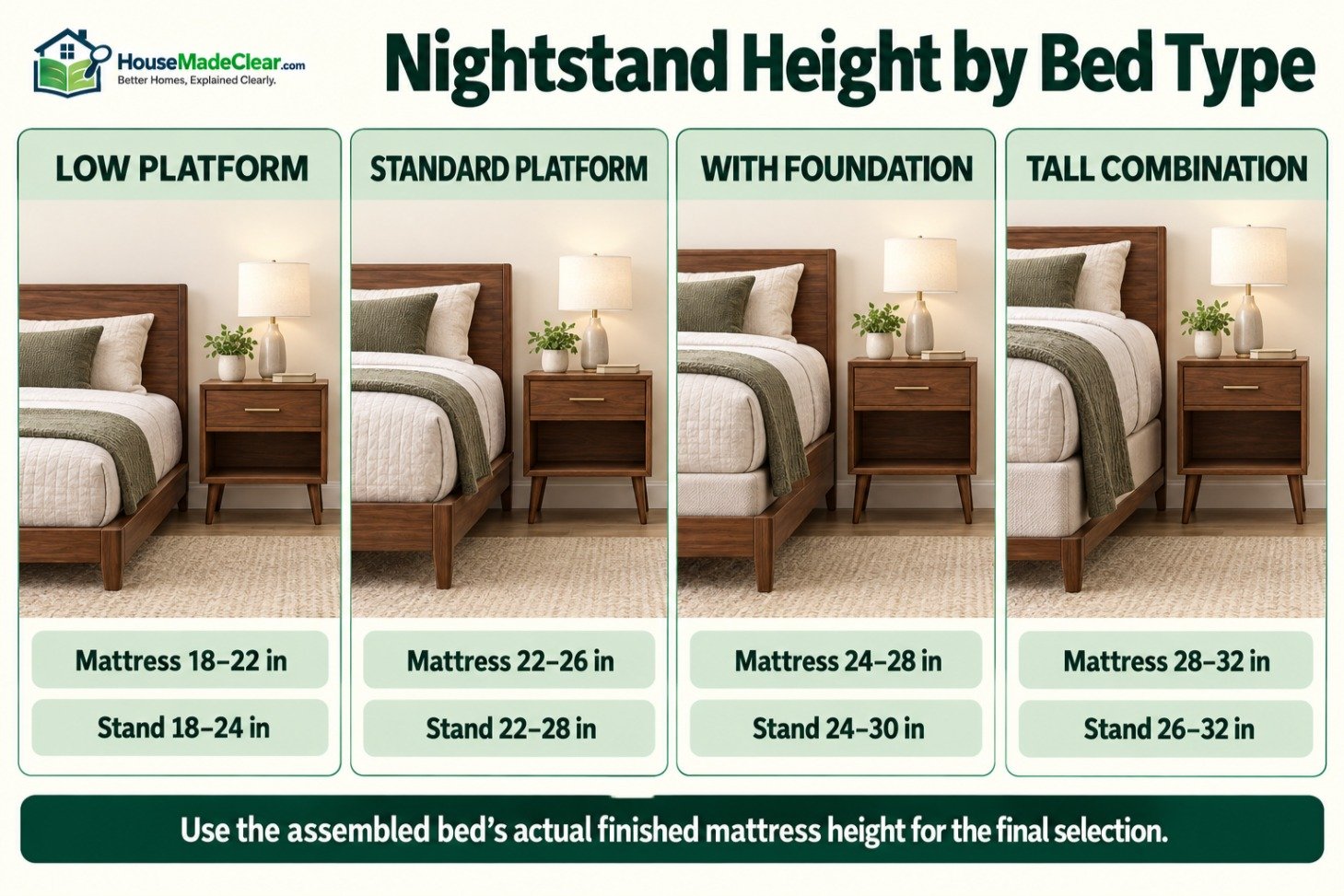
Bed construction strongly affects the required nightstand height.
| Bed Type | Common Finished Mattress Height | Suggested Nightstand Height |
|---|---|---|
| Low platform bed | 18–22 inches | 18–24 inches |
| Standard platform bed | 22–26 inches | 22–28 inches |
| Bed with foundation | 24–28 inches | 24–30 inches |
| Tall mattress and foundation | 28–32 inches | 26–32 inches |
| Extra-high bed | More than 32 inches | Measure individually |
These are planning ranges, not standardized requirements. Mattress, foundation and frame combinations vary widely.
The correct measurement comes from the assembled bed in the room. If the bed has not arrived, add the manufacturer’s frame, foundation and mattress dimensions while accounting for any overlap between components.
Standard Nightstand Width
Most nightstands are approximately 18 to 30 inches wide.
Width determines how much storage and usable top space the table provides, but it also affects the bed’s total wall requirement.
Compact Nightstand Width
A compact nightstand is commonly 12 to 18 inches wide.
It can hold a small lamp, phone and a few personal items, but may not have enough surface area for larger lamps, books, water and charging equipment at the same time.
Compact nightstands work well:
- Beside twin beds
- In narrow guest rooms
- Between a bed and wall
- In apartment bedrooms
- Where only one bedside surface is needed
Standard Nightstand Width
A standard nightstand is commonly 18 to 30 inches wide.
This range usually provides space for:
- A bedside lamp
- Phone or alarm
- Water
- Small book
- One or two drawers
- Charging accessories
Wide Nightstand Width
A wide nightstand may measure 28 to 36 inches or more.
It can provide useful storage beside a king bed, but it requires substantial wall space and can become visually heavy beside a narrow bed.
A wide nightstand may also function as a small bedside chest. Check that its drawers can open without hitting the bed, wall or adjacent furniture.
Standard Nightstand Depth
Most nightstands measure approximately 16 to 20 inches deep.
Depth should provide enough usable surface without projecting excessively beyond the bed.
Shallow Nightstands
Shallow models are usually 10 to 16 inches deep.
They are useful in tight bedrooms, but shallow drawers and shelves may hold less than expected. Lamps with broad bases can also become unstable if the top is too narrow.
Standard-Depth Nightstands
A depth of 16 to 20 inches works beside most conventional beds.
It normally provides enough top space for a lamp and essential items while remaining close to the depth of many headboards and bed frames.
Deep Nightstands
Nightstands more than 20 inches deep may provide additional storage, but they can project beyond the mattress or obstruct circulation.
Deep bedside chests should be evaluated like small dressers. Account for drawer extension, handles and the user’s standing position.
How Deep Should a Nightstand Be Compared With the Bed?
A nightstand should generally remain within the bed’s overall front-to-back zone rather than projecting far beyond the mattress or headboard.
Its front edge does not need to align perfectly with the mattress. Beds, pillows and headboards have different profiles.
A practical arrangement usually places the nightstand front:
- Approximately level with the mattress edge
- Slightly behind the mattress edge
- No more than a few inches ahead of the mattress unless the room has ample clearance
A nightstand projecting too far forward can narrow the bedside route and create a collision point when someone gets out of bed.
Nightstand Dimensions by Bed Size
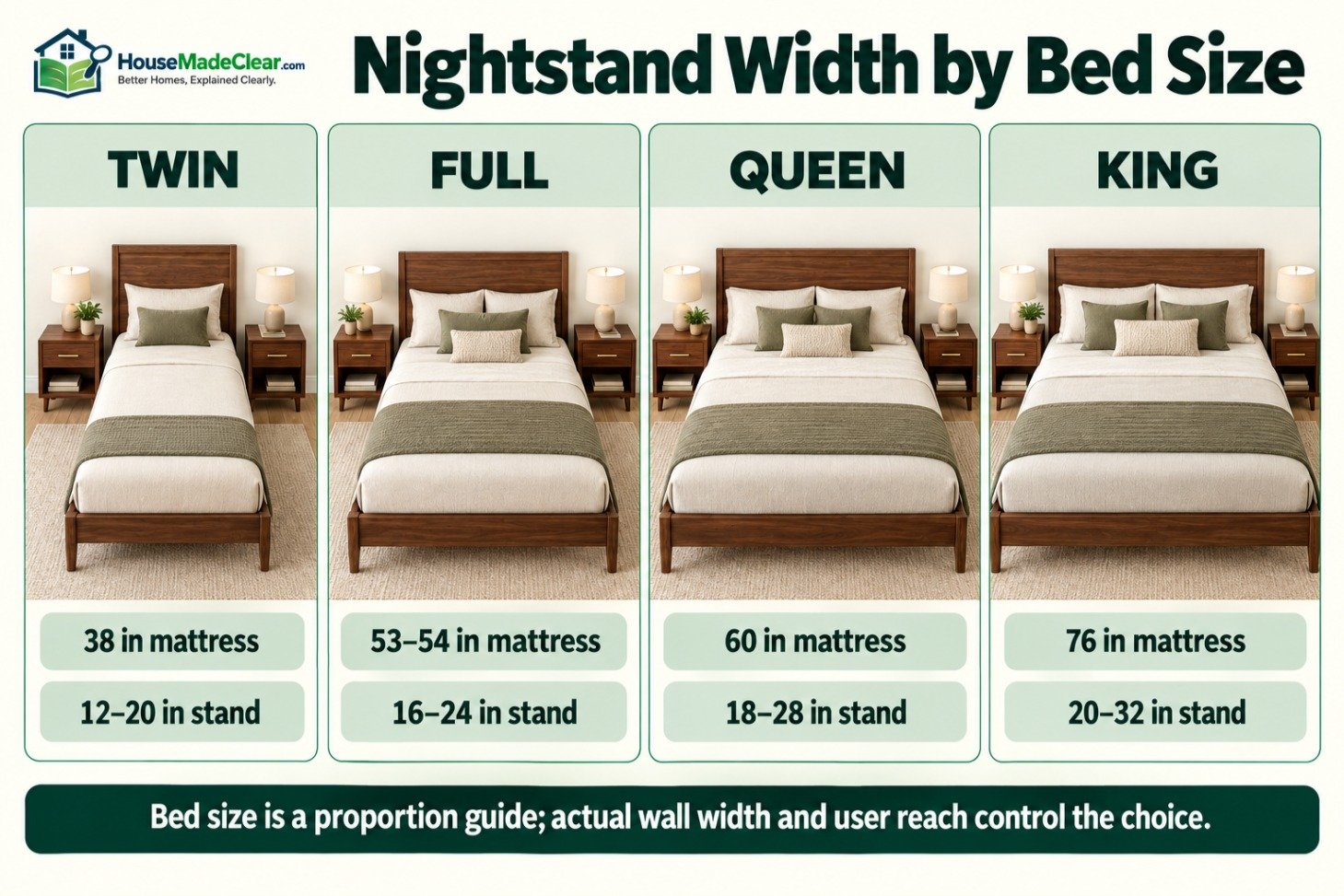
Bed size does not establish one required nightstand size, but it provides a useful scale reference.
The Better Sleep Council’s mattress-size guide lists common U.S. mattress dimensions. Bed frames and headboards usually extend beyond the mattress, so use the assembled bed dimensions for final planning.
| Bed Size | Mattress Width | Suggested Nightstand Width | Typical Nightstand Height |
|---|---|---|---|
| Twin | 38 inches | 12–20 inches | Match finished mattress height |
| Twin XL | 38 inches | 12–20 inches | Match finished mattress height |
| Full | 53–54 inches | 16–24 inches | Match finished mattress height |
| Queen | 60 inches | 18–28 inches | Match finished mattress height |
| King | 76 inches | 20–32 inches | Match finished mattress height |
| California king | 72 inches | 20–32 inches | Match finished mattress height |
These are proportional recommendations rather than fixed rules. Available wall width and the user’s needs take priority.
Nightstand Size for a Twin Bed
A compact nightstand approximately 12 to 20 inches wide usually suits a twin bed.
A wider table may work in a large children’s room or guest bedroom, but it can make a narrow twin bed look visually undersized.
Useful dimensions include:
- Width: 12–20 inches
- Depth: 12–18 inches
- Height: based on the finished mattress height
For bunk beds, loft beds and daybeds, a floor-standing nightstand may not align with the sleeping surface. A wall-mounted shelf or manufacturer-approved accessory may work better.
Nightstand Size for a Full Bed
A nightstand approximately 16 to 24 inches wide works beside many full beds.
In a compact room, one nightstand may be more practical than two. Place it on the side used most often while preserving a clear route to the door and closet.
If two people use the bed, providing a surface on both sides improves convenience, but the room must still support safe circulation.
Nightstand Size for a Queen Bed
A nightstand approximately 18 to 28 inches wide is proportionate to most queen beds.
Two 24-inch nightstands plus a 60-inch queen mattress require at least:
24 + 60 + 24 = 108 inches
After adding two 3-inch gaps between the bed and nightstands:
108 + 3 + 3 = 114 inches
That arrangement requires approximately 9 feet 6 inches of wall width before accounting for the bed frame, headboard overhang, baseboards or side clearance.
This calculation explains why two conventional nightstands may not fit comfortably in a 10-foot-wide room once the complete bed frame is included.
Nightstand Size for a King Bed
A king bed can visually support nightstands approximately 20 to 32 inches wide.
Two 30-inch nightstands beside a 76-inch mattress require:
30 + 76 + 30 = 136 inches
Adding two 3-inch gaps produces:
136 + 6 = 142 inches
That is approximately 11 feet 10 inches of wall width before adding any bed-frame projection or outside clearance.
For a 12-foot wall, this arrangement leaves almost no tolerance for oversized frames, trim or imperfect corners. Twenty-four-inch nightstands may provide a more practical fit.
Nightstand Size for a California King Bed
California king mattresses are narrower but longer than standard kings. Nightstand width is therefore usually similar, while room depth becomes more important.
A useful starting range is:
- Width: 20–32 inches
- Depth: 16–20 inches
- Height: matched to the finished mattress
Because the bed is 84 inches long, verify clearance at the foot before selecting deep nightstands or other bedroom furniture.
How Much Space Should Be Between a Bed and Nightstand?
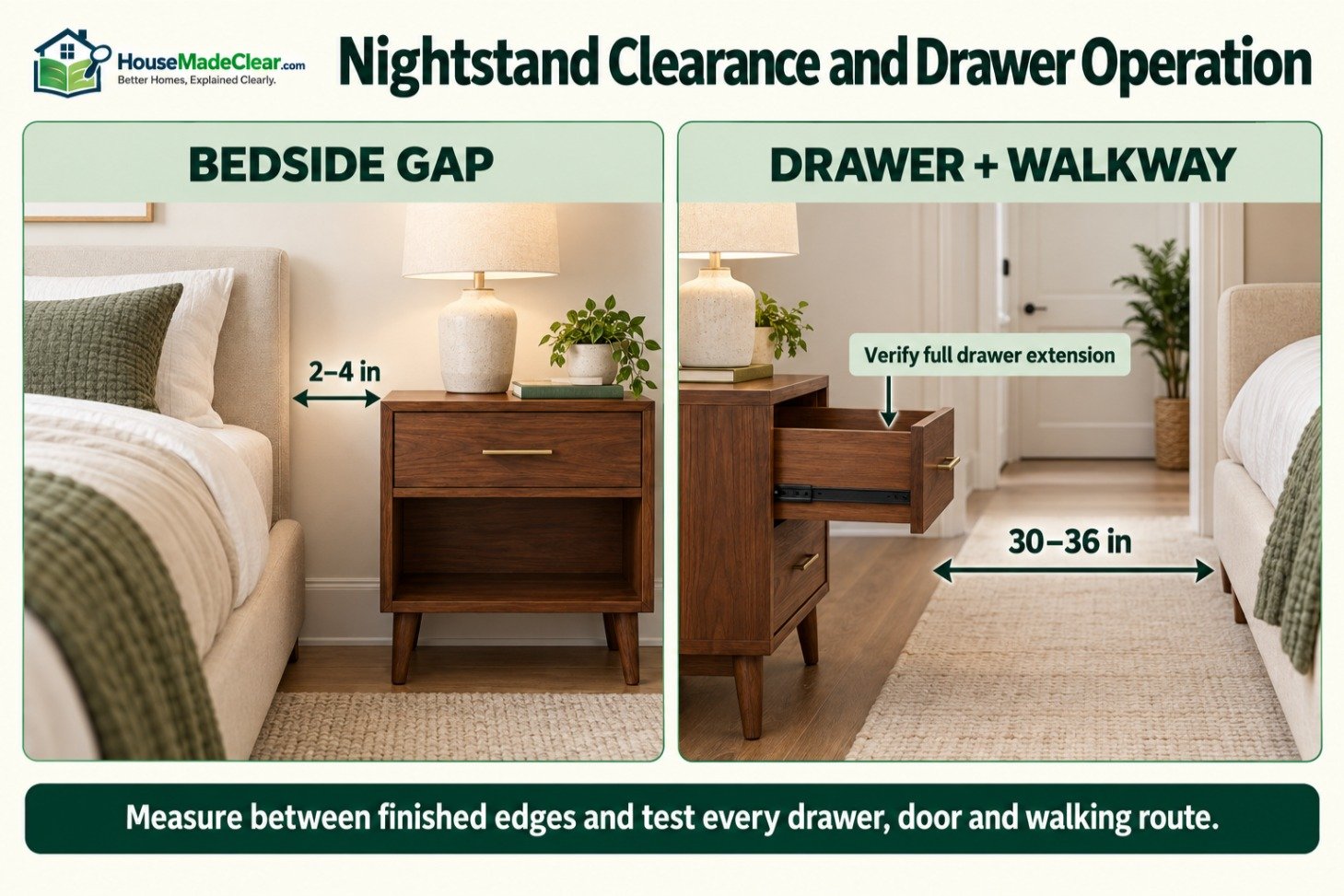
Leave approximately 2 to 4 inches between the bed and nightstand.
This gap:
- Allows room for bedding
- Reduces rubbing between furniture
- Makes bed-making easier
- Keeps the nightstand within comfortable reach
- Allows minor furniture movement
- May provide space for charging cords
A gap larger than 6 inches can make the table difficult to reach from bed. A gap smaller than 1 or 2 inches may trap bedding or cause the furniture to rub.
Adjust the distance for:
- Projecting bed-frame rails
- Headboard wings
- Adjustable-bed movement
- Drawer pulls
- Baseboards
- Electrical outlets
- User reach
Measure between the closest finished points, not only between the mattress and cabinet body.
How Much Room Do Two Nightstands Need?
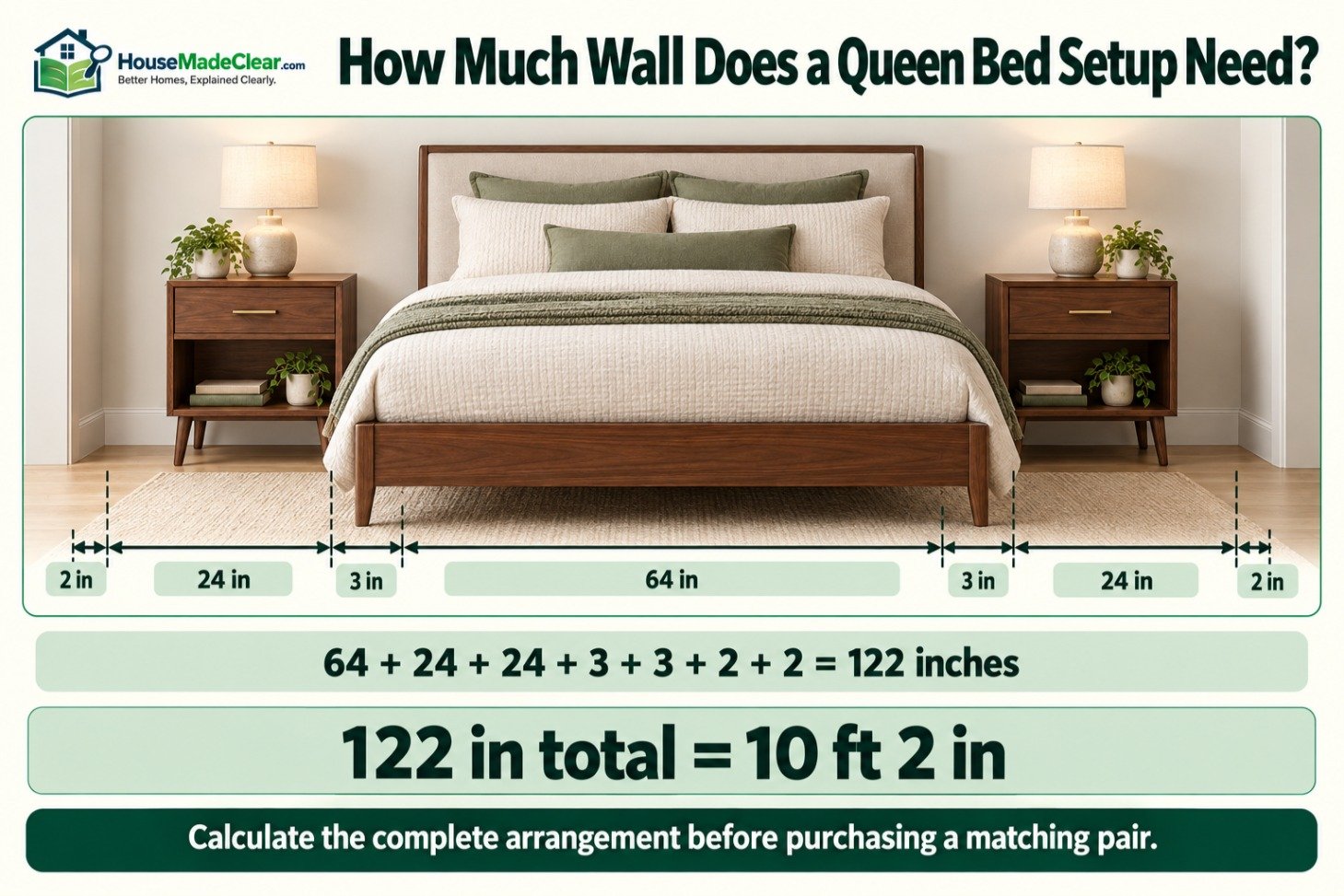
Calculate the combined arrangement before purchasing a matching pair.
Use this formula:
Total wall width = bed-frame width + nightstand widths + bed-to-nightstand gaps + outside clearances
For example:
- Queen bed frame: 64 inches
- Two nightstands: 24 inches each
- Two bed-to-nightstand gaps: 3 inches each
- Outside clearance: 2 inches at each end
Calculation:
64 + 24 + 24 + 3 + 3 + 2 + 2 = 122 inches
The complete arrangement requires approximately 10 feet 2 inches of wall width.
A nominally 10-foot wall would be too narrow unless the nightstands, gaps or frame width were reduced.
Should Both Nightstands Be the Same Size?
Matching nightstands create symmetry, but they are not required.
Different nightstand sizes can work when:
- One side has less wall space
- A door or closet affects one side
- One person needs more storage
- One side requires accessible controls
- The room has an asymmetrical layout
Keep the top surfaces close to the same height if both people need similar bedside access. Matching lamps or finishes can create visual continuity even when the table widths differ.
Do not force a matching pair into a room if one nightstand blocks circulation or a doorway.
Nightstand Dimensions for Small Bedrooms
In a small bedroom, the nightstand should provide essential function without consuming the remaining walking space.
Good options include:
- A 12- to 18-inch-wide compact table
- A shallow wall-mounted nightstand
- A narrow open shelf
- A headboard with integrated storage
- One shared nightstand
- A small stool with a stable surface
- A bedside caddy for lightweight items
- A dresser that safely doubles as one bedside surface
Our guide to small-bedroom storage without a closet explains how to combine vertical storage, under-bed space and compact furniture without overcrowding the room.
Nightstand for an 8 × 10 Bedroom
An 8-by-10-foot bedroom may only support one compact nightstand, particularly with a full or queen bed.
A useful starting size is:
- Width: 12–18 inches
- Depth: 12–16 inches
- Height: matched to the mattress
A floating nightstand can preserve visible floor area, but it must be attached to suitable wall structure according to the manufacturer’s instructions.
Nightstand for a 10 × 10 Bedroom
A 10-by-10-foot room may support two compact nightstands with a twin or full bed. A queen bed often requires narrower tables.
Before choosing, calculate the complete arrangement using the actual bed-frame width.
The standard bedroom size guide provides additional examples of how bed dimensions affect usable room space.
Nightstand for a 10 × 12 Bedroom
A 10-by-12-foot bedroom usually offers more flexibility. Nightstands approximately 18 to 24 inches wide often work with a queen bed if the headboard wall is unobstructed.
Door, closet and dresser placement can still limit one side.
Nightstand for a 12 × 12 Bedroom
A 12-by-12-foot bedroom can accommodate many standard nightstands, but a king bed and wide tables may use nearly the entire headboard wall.
Calculate the arrangement instead of assuming a 12-foot room will fit every king-bedroom set.
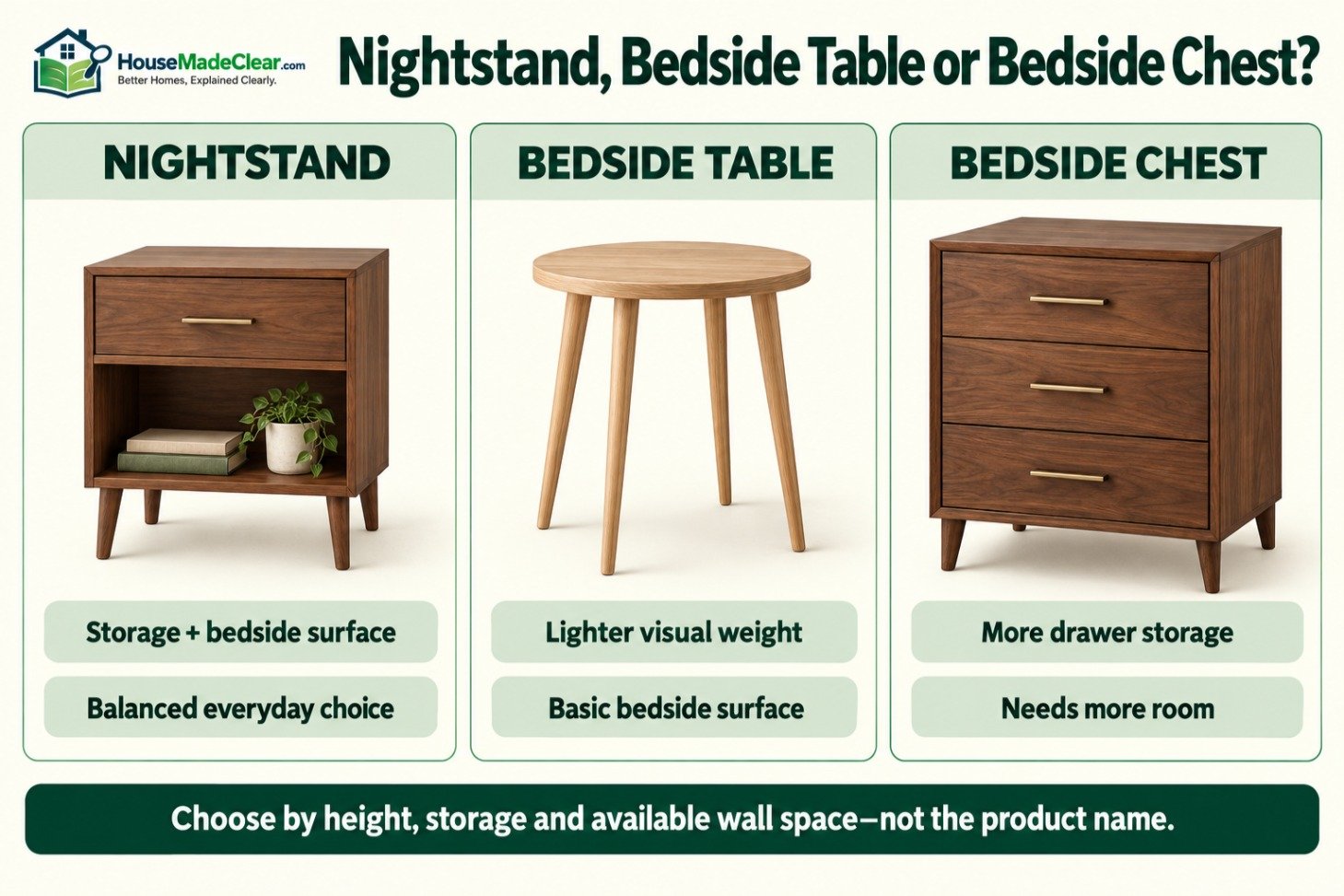
Nightstand vs. Bedside Table
“Nightstand” and “bedside table” are often used interchangeably, but the furniture may differ in construction.
| Feature | Nightstand | Bedside Table |
|---|---|---|
| Storage | Usually includes drawers or shelves | May have little or no storage |
| Typical width | 18–30 inches | 12–28 inches |
| Typical depth | 16–20 inches | 12–20 inches |
| Typical height | 24–28 inches | Varies widely |
| Visual weight | Usually heavier | Often lighter |
| Best use | Storage and bedside surface | Basic bedside surface |
A small side table can function as a nightstand if it is stable, correctly sized and capable of supporting the intended objects.
Round tables need additional planning because their usable surface is smaller than the rectangular bounding dimensions suggest.
Nightstand vs. Bedside Chest
A bedside chest is larger and provides more storage than a conventional nightstand.
Typical bedside-chest dimensions are:
- Width: 24–36 inches
- Depth: 18–22 inches
- Height: 28–36 inches
A bedside chest works best in a larger bedroom with a tall bed. Its drawers require additional operating clearance, and its top may be too high for a low platform bed.
A bedside chest can overlap with the smallest dresser sizes. Our dresser-dimensions guide explains the typical measurements and clearance needs of larger drawer-storage furniture.
Floating Nightstand Dimensions
Floating nightstands are mounted to the wall and leave the floor beneath them open.
Typical floating-nightstand dimensions are:
- Width: 12–24 inches
- Depth: 10–16 inches
- Cabinet height: 5–14 inches
- Installed top height: aligned with the mattress
How High Should a Floating Nightstand Be?
Determine the installation height from the top surface, not the bottom of the cabinet.
If the mattress top is 26 inches above the floor and the floating nightstand is 8 inches high, installing its top at 26 inches places the bottom approximately 18 inches above the floor.
Check the manufacturer’s mounting instructions and weight rating. Installation requirements depend on the wall construction, bracket design and expected load.
Do not mount a floating nightstand using improvised hardware or assume a standard drywall anchor can support every design.
Nightstand Dimensions With Drawers
Drawer count affects height, depth and operating space.
One-Drawer Nightstand
A one-drawer model is commonly:
- Width: 16–26 inches
- Depth: 14–20 inches
- Height: 22–28 inches
It provides concealed storage while keeping the furniture relatively light.
Two-Drawer Nightstand
A two-drawer model is commonly:
- Width: 18–30 inches
- Depth: 16–20 inches
- Height: 24–30 inches
This is one of the most common bedroom configurations.
Three-Drawer Nightstand
A three-drawer nightstand or bedside chest is commonly:
- Width: 22–36 inches
- Depth: 18–22 inches
- Height: 28–34 inches
It suits tall beds and larger rooms but can overwhelm a compact bed or narrow headboard wall.
Drawer-Opening Clearance
Measure how far the drawer extends toward the user.
A nightstand can fit beside the bed while its lower drawer collides with:
- A projecting bed-frame rail
- Bedding
- A rug edge
- Another piece of furniture
- A bedroom door
- The user’s legs when seated
Open every drawer fully during a showroom test whenever possible.
Nightstand Clearance and Circulation
Nightstands affect both bedside access and room circulation.
Clearance Beside the Nightstand
Where the nightstand borders a wall rather than a walkway, a small gap may be sufficient for cleaning, trim and outlet access.
Where people walk beside the nightstand, approximately 30 to 36 inches of clear passage is more comfortable.
These are planning recommendations, not universal code requirements.
Clearance in Front of Drawers
There should be enough space to:
- Open the drawer fully
- Stand in front of it
- Bend or reach safely
- Pass without striking an open drawer
A compact bedroom may provide less than 30 inches, but the nightstand must still function without forcing the user into the bed or doorway.
Clearance From Doors
Check the complete swing of:
- Bedroom doors
- Closet doors
- Cabinet doors
- Adjacent furniture doors
A door should not repeatedly strike the nightstand, lamp, handles or objects placed on top.
Clearance From Curtains
Keep the nightstand and lamp from interfering with curtains, blinds and window operation.
Fabric should not rest against a hot lightbulb, shade or charging device. Follow all lighting and electrical-product instructions.
How to Measure for a Nightstand
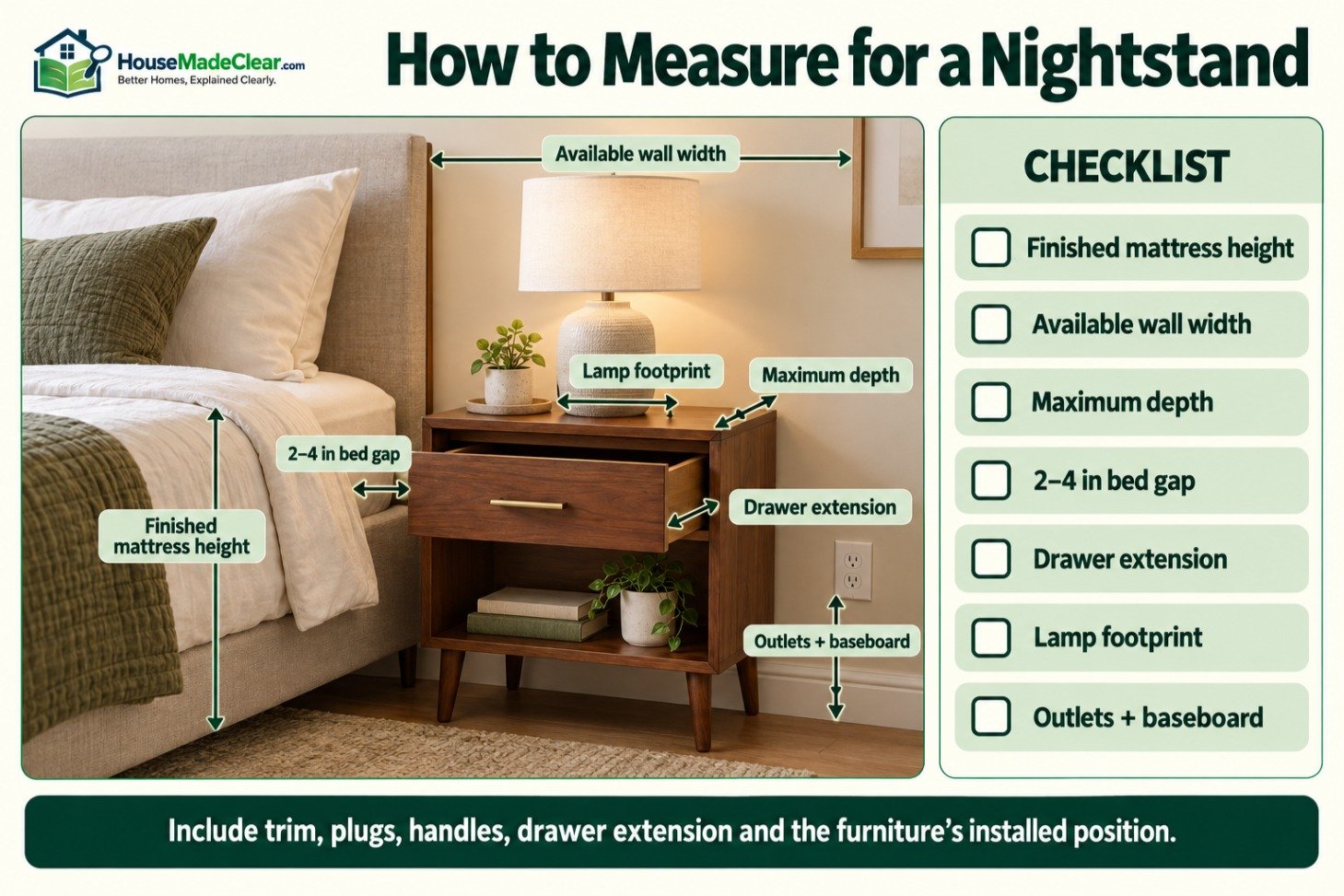
1. Measure the Finished Mattress Height
Measure from the floor to the top of the made mattress.
Record the height instead of relying on a generic description such as “standard bed.”
2. Measure the Available Wall Width
Measure from the outer bed-frame edge to the nearest:
- Wall
- Door casing
- Window trim
- Closet
- Built-in furniture
- Heating equipment
- Floor vent
Subtract the desired 2- to 4-inch bed gap and any outside clearance.
3. Measure the Maximum Depth
Measure from the wall toward the room.
Confirm that the nightstand will not project excessively beyond the bed or narrow the walkway.
4. Include Baseboards and Outlets
A baseboard can prevent the nightstand from sitting against the wall. Plugs and chargers may require additional space.
Avoid crushing electrical cords behind furniture.
5. Check Drawer and Door Operation
Measure the complete operating footprint with every drawer or cabinet door open.
6. Account for the Lamp
Record the lamp’s:
- Base width
- Base depth
- Total height
- Shade diameter
- Cord location
- Switch position
A small nightstand with an oversized lamp may leave no useful surface for other items.
7. Mark the Footprint
Use painter’s tape or cardboard to mark the nightstand’s width and depth.
Place typical items inside the outline to see whether the surface is genuinely large enough.
How to Select a Nightstand for a Bedside Lamp
The nightstand must safely support the lamp base while leaving room for essential items.
A lamp should not:
- Overhang the edge
- Block drawer access
- Tip easily when the switch is used
- Force cords across a walking route
- Place the shade against bedding or curtains
- Create direct glare at the user’s eye level
The combined height of the nightstand and lamp matters more than either measurement alone.
Use this formula:
Lamp-top height = nightstand height + lamp height
For example:
- Nightstand height: 26 inches
- Lamp height: 28 inches
Combined lamp-top height:
26 + 28 = 54 inches
Shade shape and bulb position determine whether this height works for reading. Test the lamp from the user’s normal sitting and reclining positions.
Planning Outlets and Charging Access
A nightstand often supports multiple electrical devices:
- Lamp
- Phone charger
- Alarm clock
- Medical device
- Smart speaker
- Watch charger
- Adjustable-bed control
Before selecting furniture, check:
- Outlet position
- Plug depth
- Cord length
- Cable route
- USB or power-strip placement
- Access to switches
- Ventilation around devices
Do not trap plugs between the furniture and wall or run cords where they can be pinched by drawers.
A built-in charging nightstand may require clearance for its power cord and ventilation. Follow the product’s electrical and installation instructions.
Nightstand Safety Considerations
A small nightstand can still create tip-over, impact, entrapment or electrical hazards.
The U.S. Consumer Product Safety Commission’s childproofing guidance advises anchoring furniture to reduce tip-over hazards. The CPSC’s Anchor It campaign provides additional furniture-safety information.
Use these precautions:
- Follow the manufacturer’s assembly instructions.
- Install supplied anti-tip hardware.
- Use fasteners appropriate for the wall construction.
- Place the nightstand on a level, stable surface.
- Do not overload drawers or the top.
- Store heavier objects in lower compartments.
- Keep drawers closed when not in use.
- Do not allow children to climb on drawers or shelves.
- Keep medications, cords and small objects away from children.
- Use stable lamps with bases that fit completely on the top.
- Avoid sharp corners near the user’s head where possible.
- Check the CPSC recall database for secondhand or unfamiliar products.
Not every nightstand falls under the same requirements as a clothing-storage unit. Product construction, dimensions and intended use matter. Follow the specific instructions supplied with the furniture.
Choosing a Nightstand for Accessibility and Limited Mobility
A person with limited strength, reach or mobility may need a more individualized arrangement.
Consider:
- A top level with the mattress
- Minimal gap between bed and table
- Rounded corners
- Easy-to-operate drawer pulls
- Open storage within reach
- Stable construction
- Adequate clearance for mobility equipment
- Accessible lighting controls
- Secure charging cables
- Frequently used items positioned at the front
- Space for medications or medical devices
Do not assume that a conventional matching bedroom set will work for every user.
If transfers occur beside the bed, the nightstand must not occupy required transfer or caregiver space. An occupational therapist or accessibility professional can help plan around individual needs.
Common Nightstand-Sizing Mistakes
Choosing the Nightstand Before Measuring the Bed
The mattress and frame determine the correct height relationship. Buying the table first can result in an awkward mismatch.
Measuring Only the Mattress Thickness
The finished mattress height includes the frame, foundation and mattress.
Assuming All Nightstands Are the Same Height
Products labeled “standard” can vary by several inches.
Ignoring the Bed Frame
Rails, headboard wings and upholstered edges can reduce the available space or interfere with drawers.
Selecting Tables That Are Too Wide
Two wide nightstands can exceed the available wall even when each looks proportionate to the bed.
Choosing a Surface That Is Too Small
A compact table may fit the floor plan but become cluttered or unsafe once a lamp, water and charger are added.
Ignoring Drawer Extension
A lower drawer can strike the bed frame even when the nightstand body fits.
Blocking an Outlet
The nightstand may cover the only practical charging outlet or leave insufficient space for a plug.
Positioning the Table Too Far From the Bed
A wide gap forces the user to stretch or twist to reach essential items.
Making the Nightstand Much Taller Than the Mattress
A high edge can feel intrusive beside the head and place lamps at an uncomfortable level.
Forgetting the Walkway
A deep nightstand can narrow the route between the bed and doorway.
Prioritizing Symmetry Over Function
Matching nightstands are not worth blocking a closet, door or usable path.
Nightstand Size Calculation Examples
Example 1: Nightstand Height for a 27-Inch Mattress
Assume the top of the mattress is 27 inches above the floor.
Recommended target:
27 inches ± 2 inches
Useful nightstand range:
25 to 29 inches high
A 26- or 28-inch nightstand would provide a close match.
Example 2: Two Nightstands Beside a Queen Bed
Assume:
- Wall width: 120 inches
- Bed-frame width: 64 inches
- Two 22-inch nightstands: 44 inches total
- Two 3-inch bed gaps: 6 inches
Required width:
64 + 44 + 6 = 114 inches
Remaining width:
120 − 114 = 6 inches
This leaves approximately 3 inches outside each nightstand if the arrangement is centered.
Example 3: Nightstands Too Wide for a King Bed
Assume:
- Wall width: 144 inches
- King bed frame: 80 inches
- Two 30-inch nightstands: 60 inches
- Two 3-inch gaps: 6 inches
Required width:
80 + 60 + 6 = 146 inches
The arrangement exceeds the wall by 2 inches before accounting for outside clearance.
Replacing the nightstands with 26-inch models reduces the required width to:
80 + 52 + 6 = 138 inches
That leaves 6 inches of total outside clearance.
Example 4: Compact Nightstand Beside a Full Bed
Assume the space from the bed frame to the wall is 20 inches.
Reserve:
- Bed gap: 3 inches
- Wall clearance: 1 inch
Maximum nightstand width:
20 − 3 − 1 = 16 inches
A nightstand up to approximately 16 inches wide will fit the measured space.
Example 5: Checking Nightstand Depth
Assume the available walking zone between the wall and bed is 48 inches.
A 20-inch-deep nightstand leaves:
48 − 20 = 28 inches
A 16-inch-deep nightstand leaves:
48 − 16 = 32 inches
The shallower option provides a more practical passage.
Nightstand Measurement Checklist
| Measurement or Detail | What to Verify |
|---|---|
| Finished mattress height | Floor to top of mattress |
| Bed-frame width | Include upholstery, rails and headboard wings |
| Available wall width | Bed edge to nearest finished obstruction |
| Nightstand height | Ideally close to mattress height |
| Nightstand width | Include top overhang and trim |
| Nightstand depth | Include handles and wall gap |
| Bedside gap | Approximately 2–4 inches |
| Drawer extension | Test every drawer fully open |
| Door swing | Check bedroom and closet doors |
| Walking clearance | Preserve the main circulation route |
| Outlet position | Keep plugs and controls accessible |
| Lamp footprint | Confirm base and shade fit safely |
| Top-load rating | Verify intended objects are supported |
| Wall construction | Check mounting or anchoring requirements |
| Floor condition | Confirm a level, stable surface |
| Delivery route | Measure doors, stairs and hallways |
| Recall status | Check secondhand furniture |
| User reach | Test from normal sleeping and sitting positions |
Frequently Asked Questions
What are standard nightstand dimensions?
A standard nightstand is commonly approximately 24 to 28 inches high, 18 to 30 inches wide and 16 to 20 inches deep. Compact and oversized models can fall outside these ranges.
What is the average nightstand size?
A useful average reference size is approximately 26 inches high, 24 inches wide and 18 inches deep. There is no single regulated average, so exact dimensions vary by design.
How tall should a nightstand be?
The top of a nightstand should generally be level with the top of the mattress or within approximately 2 inches above or below it. A difference of up to 4 inches may still work depending on the user and intended purpose.
Should a nightstand be higher or lower than the bed?
Matching the mattress height is the best starting point. If an exact match is unavailable, a nightstand slightly higher than the mattress is often easier to reach than one positioned substantially lower.
How wide should a nightstand be?
Most nightstands are approximately 18 to 30 inches wide. Compact models may be 12 to 18 inches wide, while bedside chests can exceed 30 inches.
How deep should a nightstand be?
Most nightstands are approximately 16 to 20 inches deep. A depth of 12 to 16 inches can work in a small bedroom, while deeper models require more circulation space.
How much space should be between a bed and nightstand?
Leave approximately 2 to 4 inches between the bed and nightstand. This provides space for bedding and minor movement while keeping the table within comfortable reach.
What size nightstand works with a queen bed?
A nightstand approximately 18 to 28 inches wide works with many queen beds. Its height should be selected according to the finished mattress height rather than the mattress width.
What size nightstand works with a king bed?
A nightstand approximately 20 to 32 inches wide is proportionate to many king beds. Calculate the bed frame, two nightstands and gaps against the complete wall width before purchasing.
Can a nightstand be wider than the bed?
A nightstand can technically be wide, but a table that appears disproportionately large may overwhelm a twin or full bed. Available wall space, storage needs and safe circulation are more important than a strict proportion rule.
Do both sides of a bed need a nightstand?
No. One nightstand may be sufficient for a single user or compact bedroom. Two tables improve individual access for two users when the room provides enough space.
Can a dresser be used as a nightstand?
A small or low dresser can function as a nightstand if its top is close to mattress height, its drawers open safely and it does not obstruct circulation. A large dresser may be too deep or difficult to reach from bed.








[…] Standard Nightstand Dimensions: Height, Width & Depth Guide […]