

















A closet can have plenty of shelves and still feel difficult to organize. Sometimes the shelves are too far apart, leaving wasted space above folded clothes. Other times, they’re packed so closely together that you can barely remove a storage basket without disturbing everything around it.
Getting closet shelf height and spacing right makes a noticeable difference.
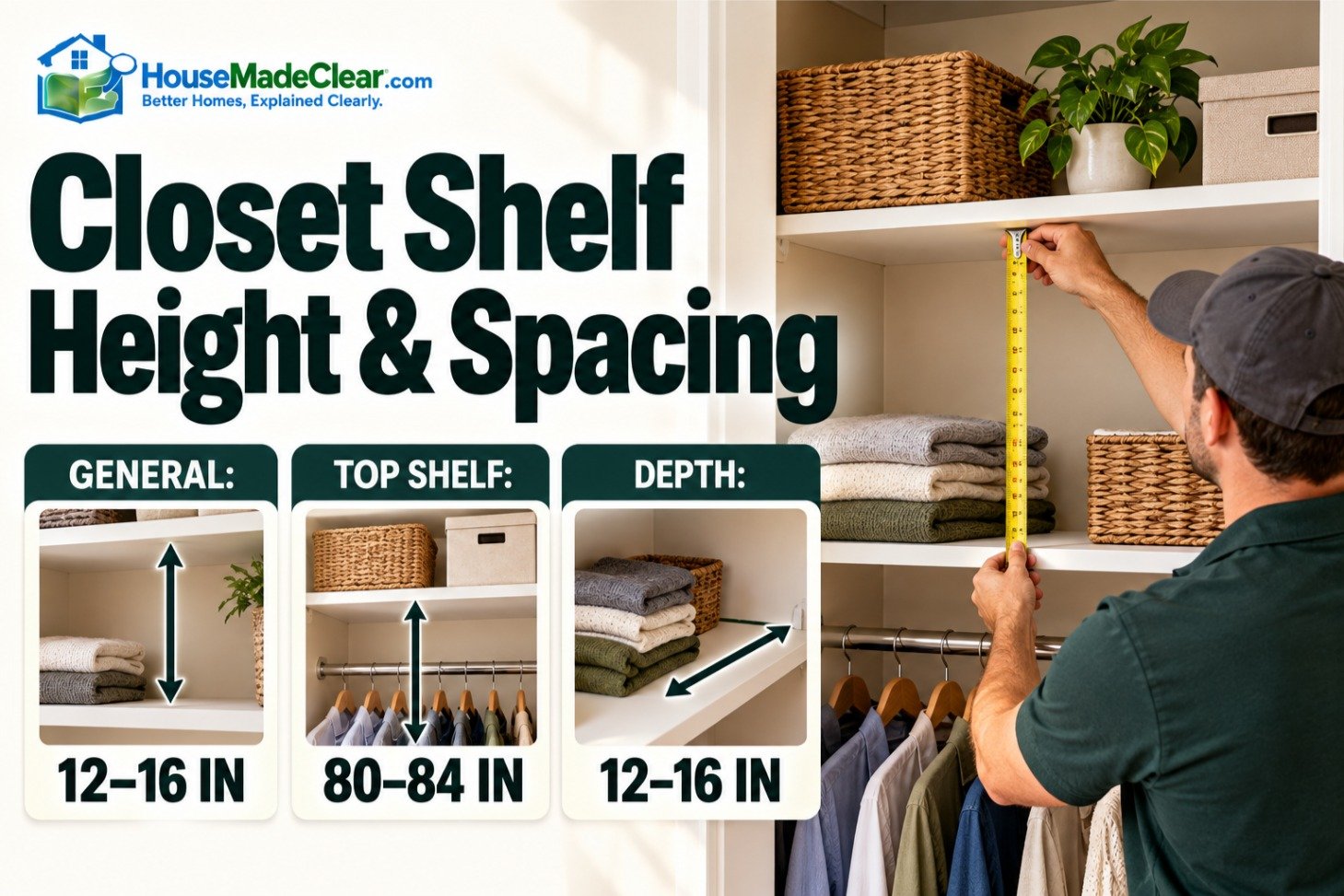
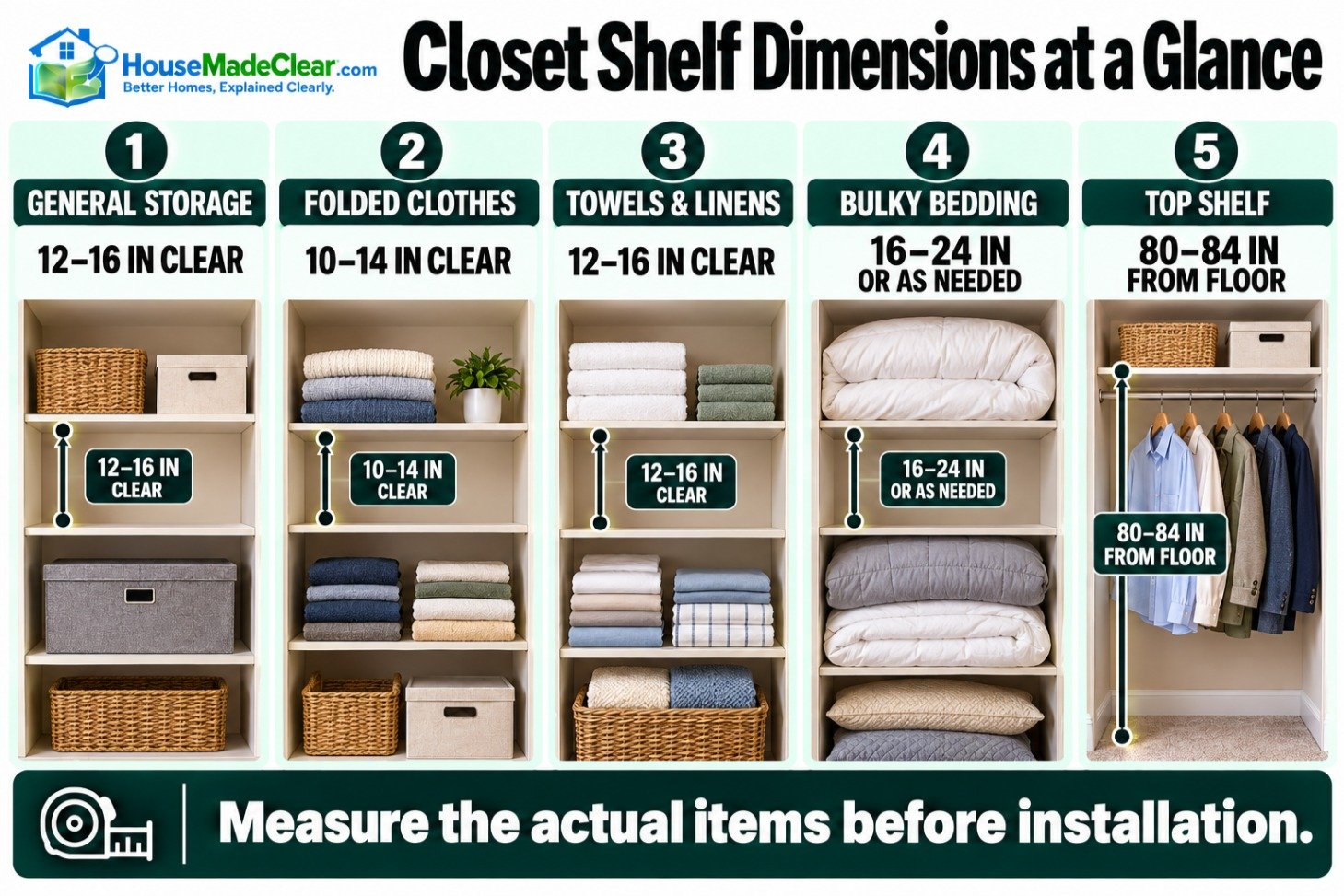
For most residential closets, 12–16 inches of vertical shelf spacing is a useful starting point for folded clothes, towels, and everyday storage. Top shelves are often positioned around 80–84 inches above the floor, while lower shelves can be arranged according to what you need to store.
However, there isn’t one universal shelf height that works for every closet.
A bedroom closet storing sweaters requires different spacing from a linen closet holding comforters or a narrow reach-in closet used for shoes and accessories.
The most practical approach is to measure the items you plan to store, allow enough clearance to remove them comfortably, and position frequently used belongings within easy reach.
This guide explains standard closet shelf heights, spacing between shelves, ideal shelf depths, and how to plan layouts for bedroom, walk-in, reach-in, and linen closets.
Quick Answer
Standard closet shelf spacing is commonly 12–16 inches, measured as the vertical opening between shelves for everyday folded clothing and general storage.
Useful starting dimensions include:
- Top closet shelf height: Approximately 80–84 inches above the finished floor
- Folded clothes shelf spacing: 10–14 inches of clear vertical space
- General storage shelf spacing: 12–16 inches
- Towels and linens: 12–16 inches, depending on stack height
- Bulky bedding: 16–24 inches or more when needed
- Shoe shelf spacing: Commonly 7–10 inches for low shoes, more for boots
- Shelf depth: Often 12–16 inches for folded clothes and general storage
These are planning recommendations, not mandatory residential building-code dimensions. Measure your stored items and account for shelf thickness, brackets, and actual usable clearance.
Standard Closet Shelf Height and Spacing Chart
The ideal dimensions depend on what each shelf will hold.
| Shelf Location or Purpose | Suggested Height or Clear Spacing | Best Use |
|---|---|---|
| Top closet shelf | 80–84 inches from floor | Seasonal storage, storage boxes |
| General closet shelves | 12–16 inches apart | Baskets, folded clothes |
| Folded T-shirt shelves | 10–12 inches clear | Small clothing stacks |
| Sweater shelves | 12–14 inches clear | Bulkier folded garments |
| Towel shelves | 12–16 inches clear | Bath towels and linens |
| Large bedding shelves | 16–24 inches clear | Comforters, bulky blankets |
| Low shoe shelves | 7–10 inches clear | Flats, sneakers |
| Ankle-boot shelves | 10–14 inches clear | Taller footwear |
| Tall-boot storage | Based on actual boot height | High boots |
| Lower everyday storage | Within comfortable reach | Frequently used items |
Measurement note: Shelf height and shelf spacing are different.
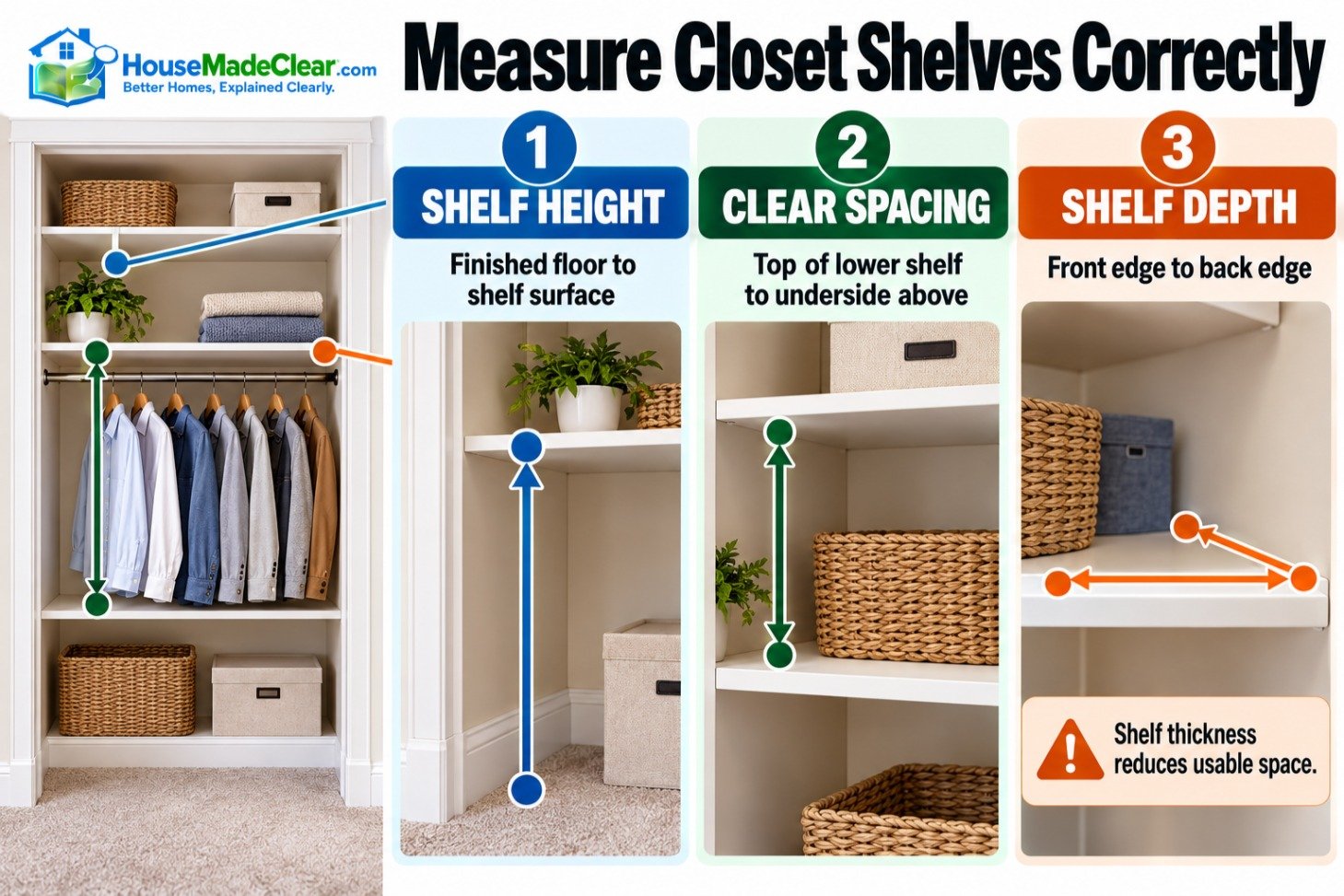
Shelf height is usually measured from the finished floor to a specified part of the shelf, such as its upper surface.
Clear shelf spacing is the usable vertical opening between the top of one shelf and the underside of the shelf above it.
That distinction matters when selecting baskets and calculating the number of shelves that will fit.
What Is the Standard Height for a Closet Shelf?
A common top-shelf height in a closet with an eight-foot ceiling is approximately 80–84 inches above the finished floor.
This leaves room above the shelf for storage, depending on shelf thickness, ceiling height, and the size of the items.
However, an 84-inch shelf isn’t necessarily comfortable for everyday access.
For many adults, a shelf positioned above eye level is better suited to seasonal items than belongings used daily.
Where Should the Top Shelf Go?
The appropriate position depends on:
- Ceiling height
- Closet rod location
- Shelf depth
- Storage-box dimensions
- Hanger clearance
- User reach
- Closet-door height
For example, a shelf positioned above a single hanging rod must leave enough room to insert and remove hangers.
If you’re combining shelves with hanging space, see our guide to standard closet rod height for single- and double-hanging measurements.
Does Every Closet Need an 84-Inch Top Shelf?
No.
An 84-inch shelf may work well in an eight-foot-high closet, but it could be inconvenient in a room with lower ceilings or an opening that restricts access.
A shelf at 72–78 inches might be more useful in some reach-in closets.
The important question is whether you can comfortably access the items without hitting the door header or other obstacles.
How Far Apart Should Closet Shelves Be?
For general storage, 12–16 inches of clear vertical spacing is a practical starting range.
But the best spacing changes with the contents.
A shelf holding neatly folded T-shirts may need only 10–12 inches of clearance.
A shelf holding tall baskets might require 16–18 inches.
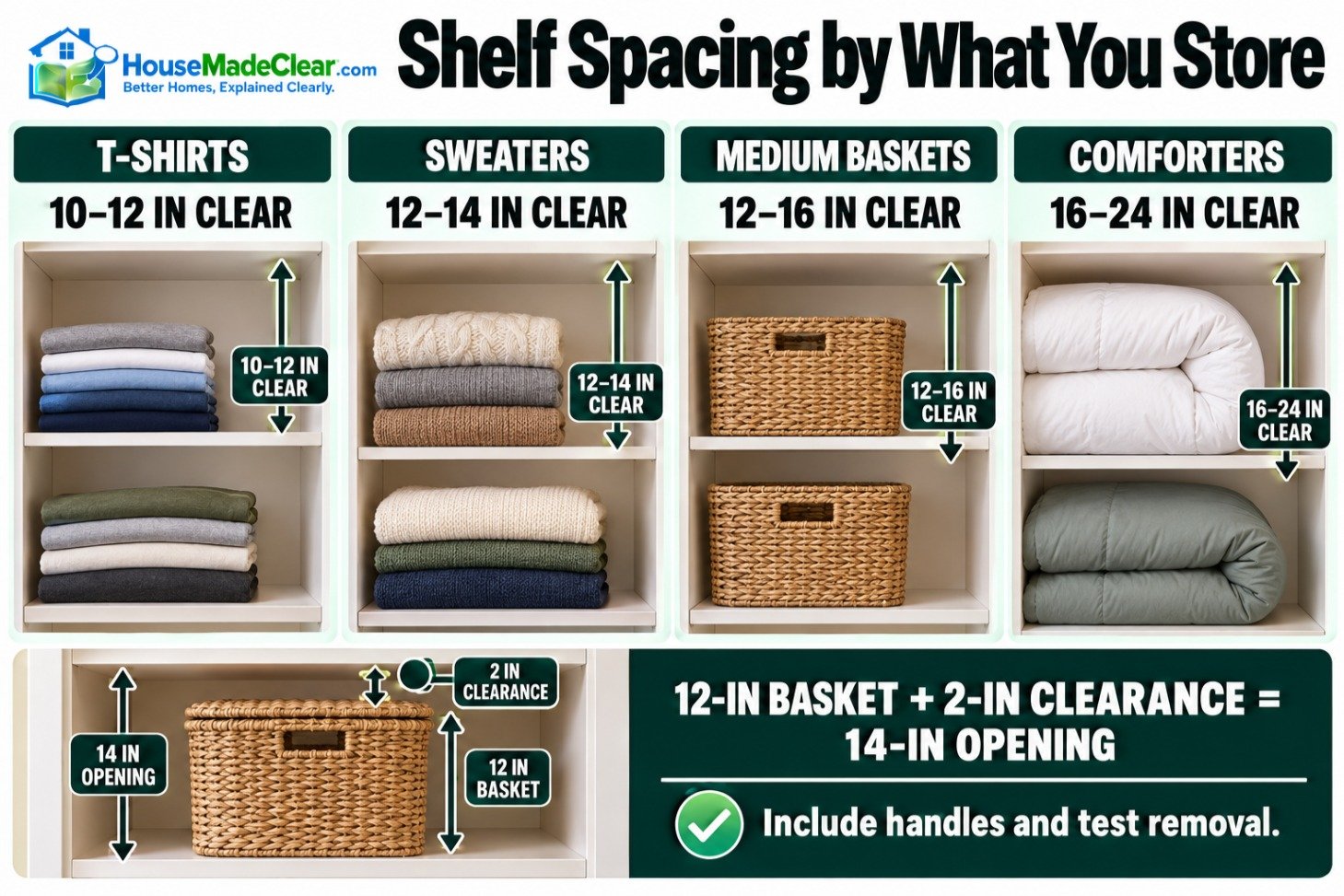
Recommended Spacing by Storage Item
| Item | Suggested Clear Vertical Space |
|---|---|
| Folded T-shirts | 10–12 inches |
| Folded jeans | 10–14 inches |
| Sweaters | 12–14 inches |
| Small accessory baskets | 8–12 inches |
| Medium storage baskets | 12–16 inches |
| Bath towels | 12–16 inches |
| Bedding sets | 14–18 inches |
| Bulky comforters | 16–24 inches |
| Small handbags | 10–14 inches |
| Larger handbags | 14–18 inches |
These dimensions are examples for planning, not standardized product requirements.
How Much Extra Clearance Should You Leave?
Start by measuring the tallest object or stack.
Then add enough space to lift it out without scraping the underside of the shelf above.
For many ordinary baskets or folded clothing stacks, 1–2 inches of additional clearance can be a useful starting point.
Larger bins with lids or handles may need more.
Example: Storage Basket Spacing
Suppose your storage basket measures:
- Height: 12 inches
- Width: 14 inches
- Depth: 11 inches
If you provide 14 inches of clear shelf spacing, the basket has approximately 2 inches of space above it.
That may be enough for straightforward removal, depending on the shelf depth and basket handle.
If the basket has an upward-projecting handle, measure that too.
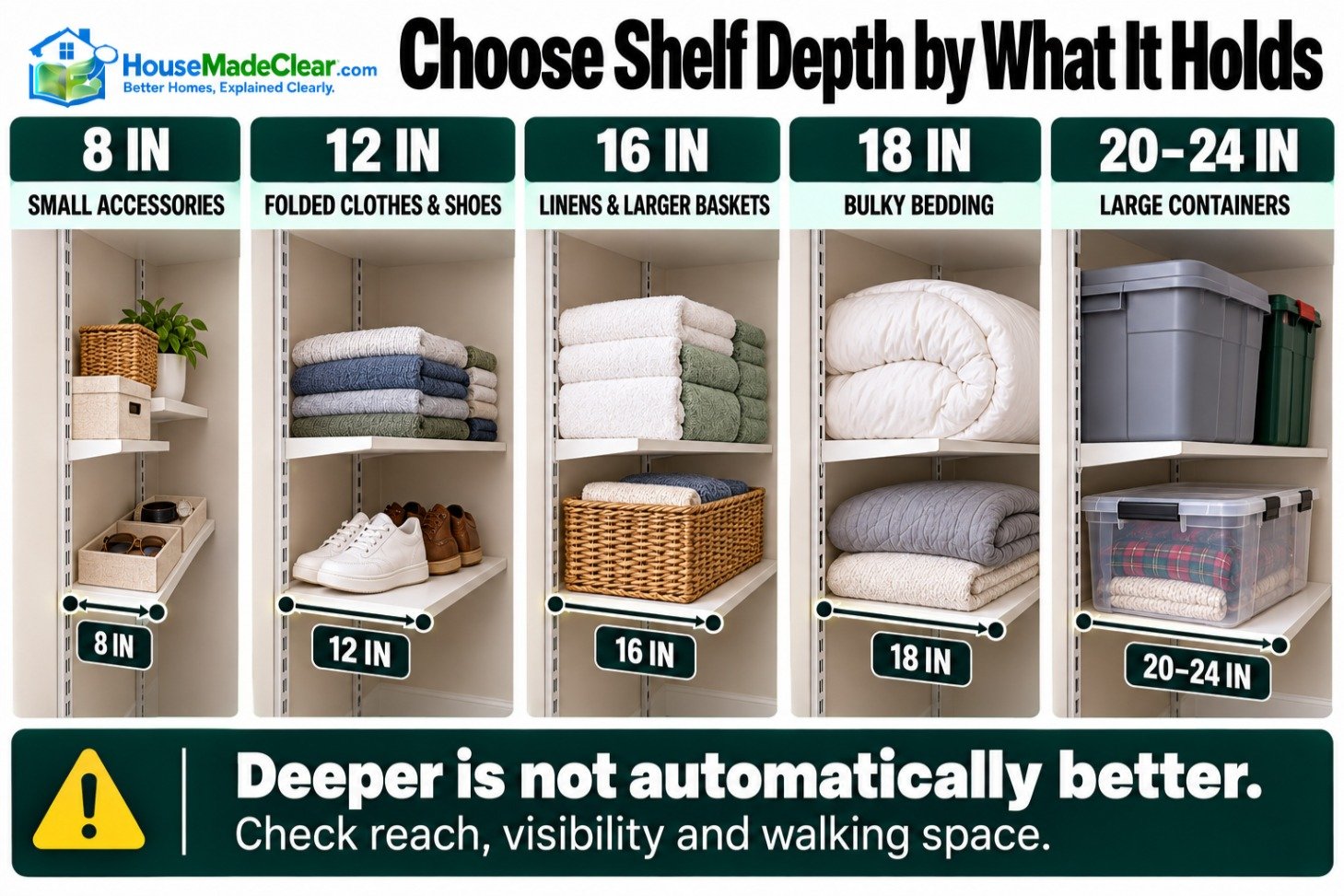
Standard Closet Shelf Depth
Shelf depth determines how much you can store from front to back.
For many residential closets, 12–16 inches is a useful range for folded clothes and general storage.
Deeper shelves can accommodate large containers, but they may make items at the back difficult to see or reach.
Closet Shelf Depth Chart
| Shelf Depth | Suitable Uses |
|---|---|
| 8 inches | Small accessories, narrow storage |
| 10 inches | Small baskets, lightweight items |
| 12 inches | Folded clothes, shoes, everyday baskets |
| 14 inches | Towels, clothing stacks, medium containers |
| 16 inches | Linens, larger baskets, general storage |
| 18 inches | Bulkier bedding or deep storage |
| 20–24 inches | Large containers and seasonal storage, where access permits |
Is 12 Inches Deep Enough for Closet Shelves?
Often, yes.
A 12-inch-deep shelf is useful for folded shirts, accessories, shoes, and many storage bins.
It can also help reduce wasted space caused by items being pushed too far back.
However, large bedding sets and certain oversized baskets may require greater depth.
Are 16-Inch Shelves Better?
A 16-inch shelf can provide more storage capacity.
But greater depth is only useful when the stored items can be accessed comfortably.
In narrow walk-in closets, deeper shelves may reduce walking space.
In reach-in closets, deep shelves near side walls can create hard-to-reach corners.
If storage is being added inside a freestanding wardrobe, our standard wardrobe dimensions guide helps explain how the cabinet’s internal depth affects usable shelving space.
Closet Shelf Height for Folded Clothes
Folded clothes generally don’t require tall shelves.
In fact, placing a small stack of shirts inside a 20-inch-high opening can waste space and encourage unstable piles.
Recommended Arrangement
For a closet holding folded clothes:
- Use approximately 10–12 inches of clear spacing for T-shirts.
- Allow around 12–14 inches for bulkier sweaters.
- Adjust spacing to the actual folded stack height.
- Avoid stacking clothes so high that removing one item disturbs the entire pile.
Should You Use Adjustable Shelves?
Adjustable shelving is especially useful for clothing storage.
Seasonal changes may affect what you store:
- Summer: lighter shirts and small stacks
- Winter: sweaters and thicker clothing
- Transitional seasons: mixed clothing and storage bins
Adjustable brackets or shelf-pin systems let you change the openings rather than rebuilding the closet.
For bedrooms with limited storage, our small bedroom storage ideas without a closet guide offers alternatives such as freestanding shelving, wardrobes, and vertical storage.
Standard Linen Closet Shelf Spacing
A linen closet typically holds a combination of towels, pillowcases, sheets, blankets, and sometimes cleaning supplies.
Because these items differ significantly in size, uniform shelf spacing isn’t always ideal.
Recommended Linen Closet Layout
| Storage Item | Suggested Clear Spacing | Suggested Shelf Depth |
|---|---|---|
| Washcloths | 8–10 inches | 10–12 inches |
| Hand towels | 10–12 inches | 12–14 inches |
| Bath towels | 12–16 inches | 12–16 inches |
| Folded sheet sets | 10–14 inches | 12–16 inches |
| Blankets | 14–18 inches | 14–18 inches |
| Comforters | 18–24 inches | 16–24 inches |
Measure bulky items in their actual folded or bagged condition.
Where Should Everyday Towels Go?
Place frequently used towels at a comfortable reaching height.
Reserve the highest shelves for spare blankets, guest bedding, or items used less frequently.
Heavy or awkward items are often easier to handle on lower shelves.
Should Every Linen Closet Have Deep Shelves?
No.
Very deep shelves can make smaller linens difficult to find.
If your linen closet is deep, use appropriately sized pull-out bins or baskets to keep items from disappearing toward the back.
For bathroom storage planning, our guide to standard bathroom cabinet sizes explains common cabinet dimensions and useful storage considerations.
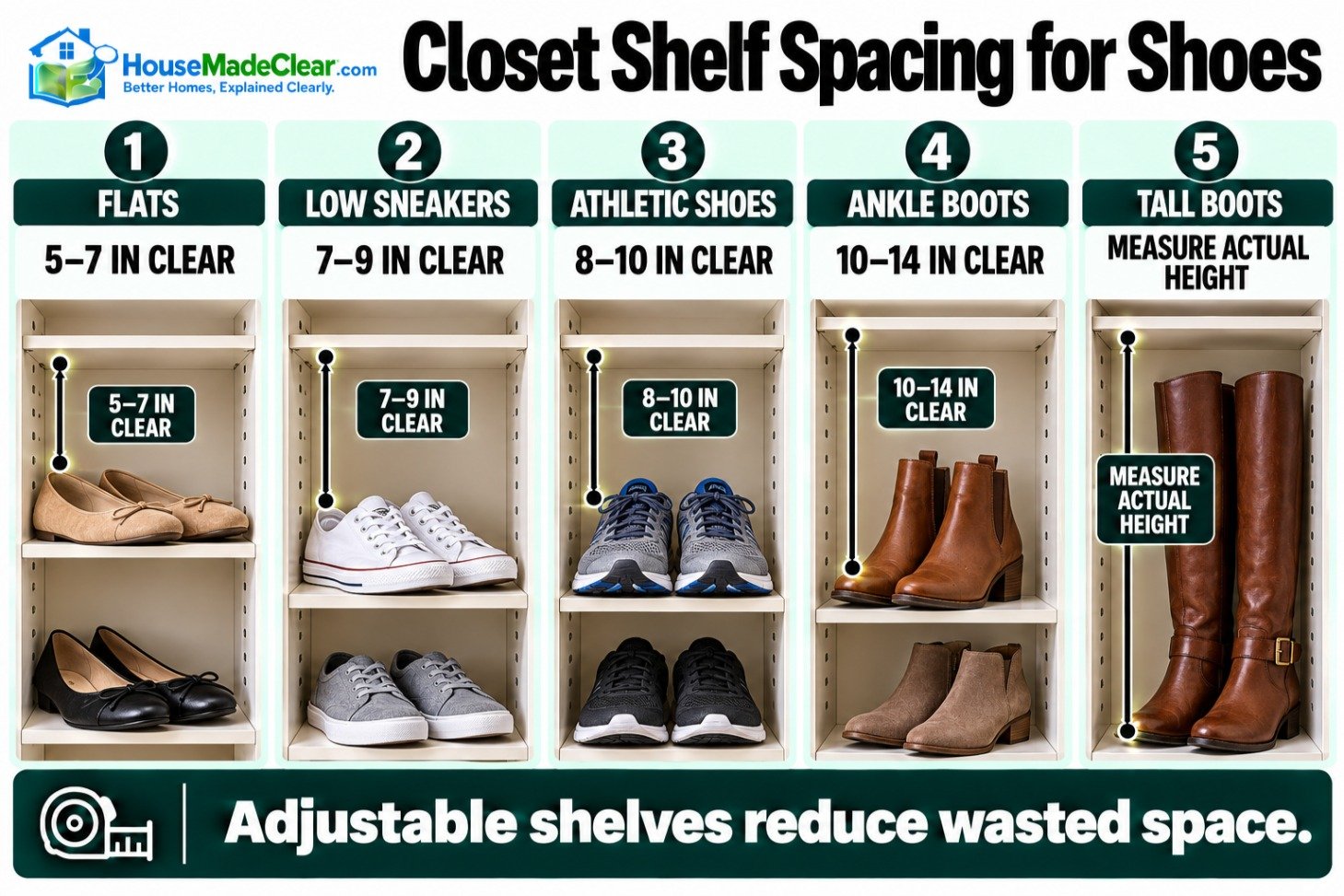
Closet Shelf Height for Shoes
Shoes require less vertical space than many other closet items, but footwear varies widely.
A shelf designed for flats and sneakers may not accommodate ankle boots or taller footwear.
Shoe Shelf Spacing Chart
| Footwear | Suggested Clear Spacing |
|---|---|
| Flats | 5–7 inches |
| Low sneakers | 7–9 inches |
| Athletic shoes | 8–10 inches |
| Ankle boots | 10–14 inches |
| Mid-calf boots | Measure actual boot height |
| Tall boots | Measure actual boot height |
These are approximate starting points. Shoe sizes, storage angle, and footwear construction vary.
How High Should the Bottom Shoe Shelf Be?
A lower shelf positioned approximately 6–12 inches above the floor is common in some closet arrangements.
However, this depends on the shelf system and whether you’re storing shoes directly on the floor below it.
Should Shoe Shelves Be Adjustable?
Yes, especially when several footwear types share the closet.
Adjustability can prevent wasting a large opening on small shoes.
Reach-In Closet Shelf Dimensions
Reach-in closets require careful planning because the doorway limits access.
A shelf may fit physically but still be difficult to use if it extends beyond the accessible opening.
Recommended Planning Priorities
- Keep everyday items within the visible and reachable opening.
- Check how far the shelves extend behind side walls.
- Avoid excessive depth where the closet is narrow.
- Leave enough room for hangers if shelving shares the closet with rods.
- Consider adjustable storage to accommodate changing needs.
What About Shelves Above the Closet Rod?
A top shelf above the hanging rod is common.
However, its exact position depends on the rod mounting hardware and hanger clearance.
A shelf that blocks the movement of hangers can make the closet frustrating to use, even if its measurements look reasonable on paper.
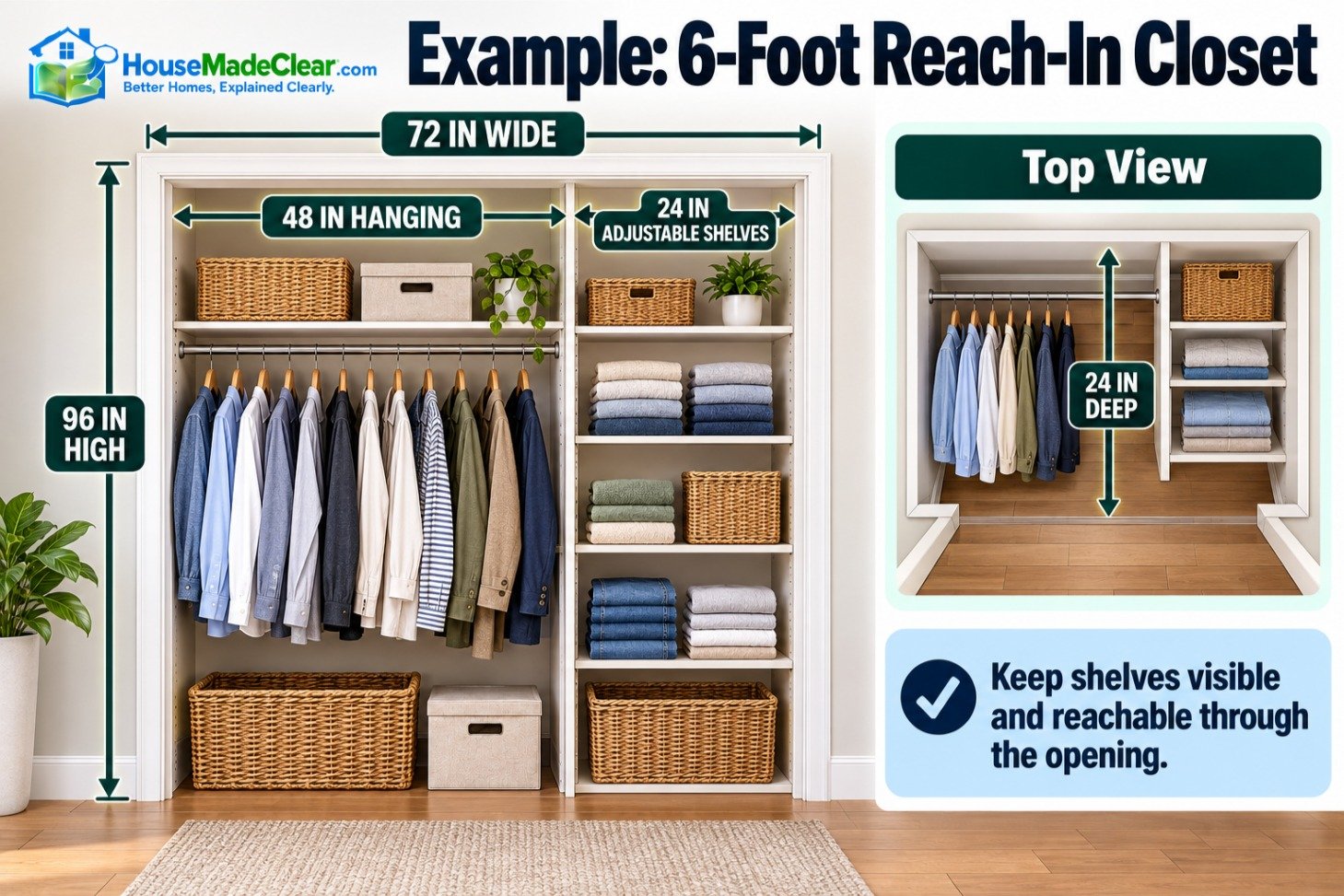
Example: A 6-Foot-Wide Reach-In Closet
Suppose the closet is:
- 72 inches wide
- 24 inches deep
- 96 inches high
You could divide the width into a hanging section and a shelving section.
For example:
- 48 inches for hanging clothes
- 24 inches for adjustable shelves
This creates dedicated space for folded clothes and baskets without putting shelves behind hanging garments.
If your bedroom is compact, see our guide to planning a functional bedroom layout to balance closet access with dressers, beds, and walking clearance.
 Example: Adjustable Folded-Clothing Shelves
Walk-In Closet Shelf Height and Spacing
Walk-in closets offer more flexibility, but shelves should still be planned around reach, visibility, and circulation.
What Changes in a Walk-In Closet?
Unlike a reach-in closet, you may have shelving on multiple walls.
That creates opportunities for:
- Adjustable folded-clothing shelves
- Shoe storage
- Bags and accessory shelves
- Seasonal storage above hanging sections
- Drawers and pull-out baskets
However, deeper shelves reduce available walking space.
Should Walk-In Closets Use Deeper Shelves?
Not automatically.
A 12–16-inch-deep shelf may be sufficient for folded clothing.
Using 20–24-inch-deep shelving for every wall could create a cramped walkway, especially in a smaller walk-in closet.
How Should Corners Be Handled?
Closet corners can become difficult to access when two deep shelf runs meet.
Possible solutions include:
- Shallower shelves near corners
- Open corner shelving
- Pull-out storage accessories
- Separate shelf runs with an accessible gap
Choose the arrangement based on actual access rather than maximizing shelf surface area alone.
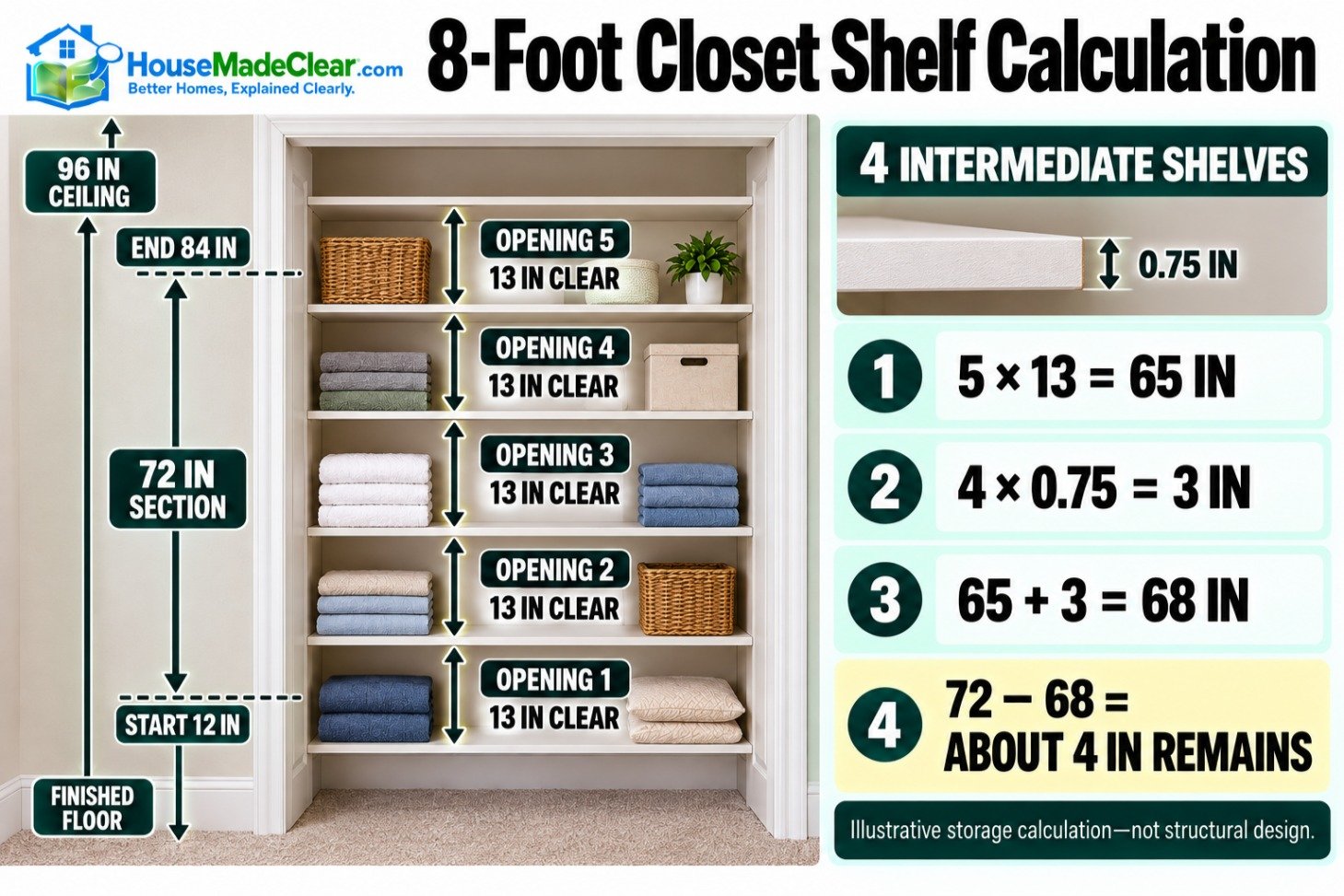
Closet Shelf Layout for an 8-Foot Ceiling
An eight-foot ceiling provides 96 inches of total room height.
You can use that height for several shelves, but the number that fits depends on shelf thickness and spacing.
Example: Adjustable Folded-Clothing Shelves
Suppose you have an open shelving section 72 inches tall, beginning 12 inches above the finished floor and ending at 84 inches.
You want five storage openings.
A sample layout could provide:
- Five clear openings of 13 inches each
- Four intermediate shelves, each 3/4 inch thick
- Remaining allowance for the top and bottom arrangement
The openings use:
5 × 13 = 65 inches
The four intermediate shelves use:
4 × 0.75 = 3 inches
Total:
65 + 3 = 68 inches
That leaves approximately 4 inches for additional clearances or layout adjustment within the 72-inch section.
This is an illustrative storage calculation, not a structural design.
Why Shelf Thickness Matters
If you install multiple shelves, their thickness consumes vertical space.
For example, five 3/4-inch-thick shelf boards occupy a combined 3.75 inches.
Ignoring that thickness can cause storage bins to fit on paper but not inside the finished closet.
How to Measure Closet Shelf Spacing Correctly
Accurate measurements help avoid shelves that are technically installed correctly but difficult to use.
Step 1: Measure the Closet Interior
Record the usable width, height, and depth.
Include any obstructions such as:
- Door trim
- Existing rods
- Wall projections
- Electrical fixtures
- Baseboards
- Uneven walls
Step 2: Group Items by Size
Organize the items into categories such as:
- Small folded clothes
- Sweaters
- Shoes
- Storage baskets
- Bedding
- Seasonal items
Step 3: Measure the Tallest Item in Each Group
Measure the actual height of the item, folded stack, or container.
If a basket has handles or a lid, include those.
Step 4: Add Removal Clearance
Provide enough space to lift the item out comfortably.
For many everyday items, 1–2 inches of extra clearance is a useful starting point.
Step 5: Account for Shelf Thickness
If you’re calculating vertical positions, subtract the thickness of each intermediate shelf.
Step 6: Mark Shelf Locations
Mark the proposed positions on the wall or cabinet sides.
Check them before drilling.
Step 7: Test With Actual Items
Hold a basket or folded-clothing stack in the planned opening.
Confirm it can be placed and removed without awkward tilting.
Step 8: Check Accessibility
The shelf should not simply fit the item. The intended user should also be able to reach and retrieve it safely.
Adjustable vs. Fixed Closet Shelves
Both options can work well, but they serve different purposes.
| Feature | Adjustable Shelves | Fixed Shelves |
|---|---|---|
| Spacing changes | Easy with compatible hardware | Usually difficult |
| Seasonal storage changes | Flexible | Limited |
| Installation | Track or shelf-pin system | Fixed brackets or joinery |
| Appearance | Depends on system | Can look more integrated |
| Structural capacity | Depends on hardware | Depends on construction |
| Future reorganization | Easier | Less flexible |
| Best use | Mixed clothing and containers | Established storage layouts |
Which Is Better?
For most general closet storage, adjustable shelves offer flexibility.
For a custom built-in where dimensions are already known, fixed shelves may create a more seamless appearance.
Whatever system you choose, its support and fastener requirements matter more than whether the shelves are adjustable.
How Much Weight Can Closet Shelves Hold?
There is no universal weight capacity for every closet shelf.
Capacity depends on:
- Shelf material
- Board thickness
- Unsupported span
- Bracket type
- Bracket spacing
- Wall construction
- Fastener selection
- Weight distribution
- Manufacturer specifications
A long unsupported particleboard shelf may sag under loads that a properly reinforced system could accommodate.
How Far Apart Should Shelf Brackets Be?
Follow the selected system’s installation instructions.
For example, ClosetMaid’s ShelfTrack installation guidance specifies standards no more than 24 inches apart and no more than 4 inches from shelf ends for that particular system.
Those measurements should not be treated as universal rules for every wooden, metal, or wire shelf.
Can You Install Closet Shelves Into Drywall?
Yes, some shelf systems are designed for appropriate drywall anchors.
However, fasteners must be selected for the wall construction and expected loads.
Mounting into suitable structural framing is often preferable when the system allows it.
Do not assume an ordinary plastic drywall anchor can support heavily loaded closet shelves.
Accessible Closet Shelf Height
An accessible closet should place frequently used items within the user’s functional reach range.
A shelf can be technically reachable for one person but difficult or unsafe for another.
What Does the ADA Say About Reach Height?
The 2010 ADA Standards for Accessible Design establish a range of 15–48 inches above the finished floor for certain unobstructed forward and side reaches.
Additional limits apply where an obstruction affects reach.
However, that does not mean every shelf in a private residential closet must be installed between 15 and 48 inches.
Applicability depends on the building and the specific accessible feature being designed.
Practical Accessible Storage Recommendations
- Place frequently used belongings within comfortable reach.
- Avoid storing heavy items on high shelves.
- Consider adjustable shelving.
- Allow clear access to the closet opening.
- Check wheelchair approach and turning requirements where relevant.
- Consider pull-down or pull-out storage systems where appropriate.
For a customized accessible closet, design around the actual user’s needs and any applicable housing or accessibility standards.
How to Organize Closet Shelves for Maximum Storage
Good shelf dimensions solve only part of the problem.
The arrangement of items also affects how efficiently the space works.
Keep Everyday Items at Comfortable Heights
Place frequently used clothes, baskets, and accessories where they can be reached without unnecessary stretching.
Store Seasonal Items Higher
Holiday items, spare blankets, and seasonal clothing can occupy upper shelves if they can be retrieved safely.
Avoid Oversized Stacks
Large stacks of folded clothing can collapse or become difficult to manage.
Use smaller sections or dividers where useful.
Choose Baskets That Fit the Opening
Don’t buy storage bins based only on the shelf width.
Measure their height and depth too.
Keep Heavy Items Lower
Heavy boxes and awkward containers are generally safer and easier to handle near the floor.
Use Open Shelves for Frequently Accessed Items
Open shelving can improve visibility.
Closed bins can help organize smaller items, but label them if contents aren’t visible.
Leave Some Flexibility
Storage needs change.
An adjustable shelf section can accommodate larger bags, new clothing, or different organizational systems without major reconstruction.
If you’re also deciding whether to use a dresser instead of additional shelving, our standard dresser dimensions guide can help compare furniture sizes and available space.
Common Closet Shelf Installation Mistakes
1. Using the Same Spacing for Every Shelf
Shoes, shirts, towels, and comforters have different height requirements.
2. Installing Shelves Too Deep
Deep shelves can make items at the back difficult to retrieve.
3. Ignoring Shelf Thickness
The material itself consumes vertical space.
4. Placing Heavy Items Too High
Heavy boxes can be difficult to remove safely from elevated shelves.
5. Installing Shelves Behind Inaccessible Closet Corners
A shelf isn’t useful if the doorway prevents access.
6. Choosing Baskets After Installing Shelves
Measure your storage containers before finalizing shelf spacing.
7. Ignoring Rod and Hanger Clearance
Shelves should not interfere with hanging clothes.
8. Using Inadequate Wall Anchors
Incorrect fasteners can cause shelf failure.
9. Maximizing Shelf Count Instead of Usable Space
More shelves don’t automatically create better storage.
10. Forgetting Future Adjustments
A closet designed for today’s belongings may need changes later.
Closet Shelf Planning Checklist
| What to Check | Recommended Approach |
|---|---|
| Top shelf height | Commonly around 80–84 inches |
| General shelf spacing | Start with 12–16 inches clear |
| Folded clothing spacing | Often 10–14 inches |
| Linen spacing | Adjust to towel and bedding size |
| Shoe shelf spacing | Match footwear height |
| General shelf depth | Often 12–16 inches |
| Storage baskets | Measure height, width, and depth |
| Shelf thickness | Include in layout calculations |
| Closet rods | Verify hanger clearance |
| Door opening | Check access to side and upper shelves |
| Bracket spacing | Follow system instructions |
| Weight capacity | Follow complete system rating |
| Everyday access | Keep frequent-use items reachable |
| Future flexibility | Consider adjustable hardware |
Final Thoughts
For most residential closets, 12–16 inches of clear vertical shelf spacing is a useful starting point, while top shelves are commonly installed approximately 80–84 inches above the finished floor.
However, the best closet shelf layout isn’t determined by one standard dimension.
Folded shirts, shoes, towels, storage baskets, and bulky bedding all require different amounts of space.
Measure what you’re storing, provide enough clearance to remove items comfortably, and avoid making every shelf deeper or taller than necessary.
For many bedrooms, combining appropriately spaced shelves with a well-positioned hanging rod creates a more practical arrangement than relying on either storage method alone.
The goal is a closet where items fit, remain visible, and are easy to reach—not simply the maximum number of shelves.
Frequently Asked Questions
What is the standard height for a closet shelf?
A top closet shelf is commonly positioned approximately 80–84 inches above the finished floor in an eight-foot-high closet. Other shelves should be positioned according to the stored items and the user’s reach.
How far apart should closet shelves be?
For everyday folded clothing and general storage, 12–16 inches of clear vertical spacing is a practical starting point. Smaller items may need less space, while bulky bedding can require significantly more.
What is the standard depth of a closet shelf?
Many residential closet shelves are approximately 12–16 inches deep. Narrow shelves may work for accessories and shoes, while deeper shelves may be useful for bulky storage containers.
How much space should be between closet shelves for folded clothes?
Approximately 10–14 inches of clear vertical spacing works for many folded clothing stacks. Measure the actual height of the stacks and allow extra clearance for removing them.
How deep should linen closet shelves be?
A depth of approximately 12–16 inches works for many towels, sheets, and everyday linens. Bulky blankets or comforters may require deeper shelves or different storage arrangements.
How high should closet shoe shelves be?
Low shoes and sneakers often fit in openings around 7–10 inches high, while ankle boots and taller footwear need more space. Measure the tallest shoes before installing fixed shelves.
Can closet shelves be installed directly into drywall?
Some systems support installation with properly selected drywall anchors, but the fasteners must be suitable for the expected loads and wall construction. Follow the shelving manufacturer’s instructions.
Is adjustable closet shelving better than fixed shelving?
Adjustable shelving is often more flexible because you can change the spacing as your storage needs evolve. Fixed shelving can work well when the intended items and dimensions are unlikely to change.











[…] Closet Shelf Height and Spacing: Standard Dimensions for Storage […]