






Improving home security does not always require adding more cameras, alarms or smart devices.
One of the most important places to start is much simpler:
the locks on your exterior doors.
A good lock helps control who can enter the home, but the lock itself is only one part of the system. The deadbolt, strike area, door, frame, hinges and key-management habits all need to work together.
Replacing an old or poorly fitted lock can improve security, but installing an expensive deadbolt on a weak or damaged door frame will not solve every problem.
Quick Answer
To improve home security with better locks:
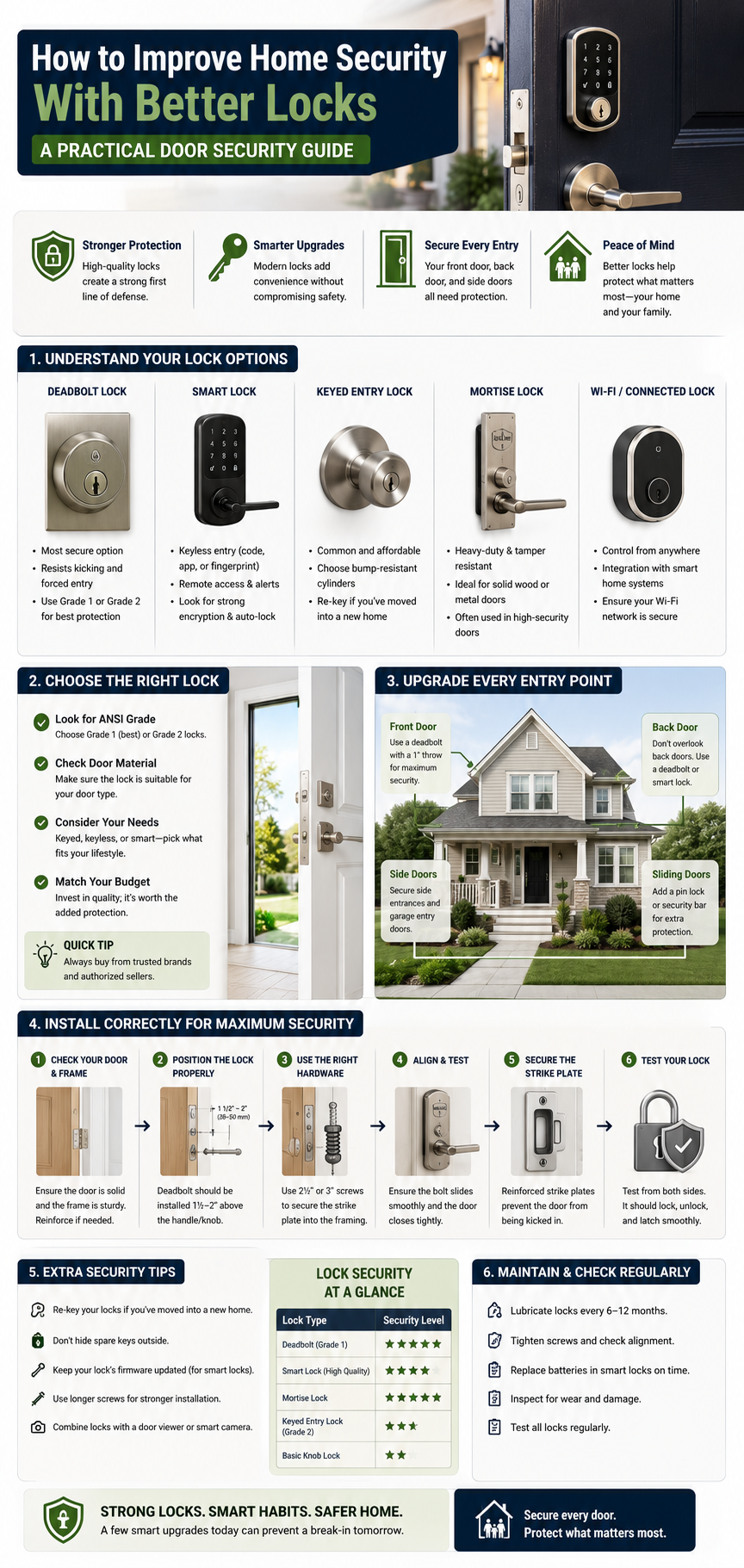
- Use a properly installed deadbolt on primary exterior doors where appropriate.
- Choose lock hardware certified to recognized standards rather than relying only on marketing claims.
- Make sure the lock aligns correctly with the strike and door frame.
- Replace or rekey locks when keys are lost, stolen or unaccounted for.
- Review doors between the garage and living area as carefully as the front door.
- Use additional appropriate security for sliding and double doors.
- If you choose a smart lock, secure its connected account with strong unique credentials, software updates and MFA where available.
- Do not ignore the condition of the door and frame.
In the U.S., current ANSI/BHMA standards include A156.40-2025 for residential deadbolts and A156.39-2025 for residential locksets and latches. BHMA-certified products are independently tested against the relevant performance requirements.
Think of locks as one layer in a larger security plan.
House Made Clear’s guide to common home security mistakes explains why relying on any single device—whether a lock, camera or alarm—is rarely the best approach.
Why Better Locks Matter for Home Security
Exterior doors are one of the main controlled entry points into a house.
Every time you leave home, the lock becomes part of the physical barrier between:
public space → private interior space
A better lock can improve:
- Resistance to forced entry
- Reliability
- Key control
- Everyday convenience
- Confidence that the door is actually secured
But “better” does not simply mean:
- More expensive
- Smart
- Larger
- More complicated
A better lock is one that is:
- Appropriate for the door
- Properly installed
- Tested to recognized standards
- Used consistently
- Supported by a sound door and frame
Start With a Home Lock Audit
Before buying anything, walk through your home and identify every door that provides access to the interior.
Check:
- Front door
- Back door
- Side door
- Garage-to-house door
- Basement entrance
- Patio door
- Balcony or deck door
- Secondary exterior doors
For each one, ask:
- What type of lock is installed?
- Does it operate smoothly?
- Does the door close fully?
- Does the lock engage without lifting or pushing the door?
- Is the hardware loose?
- Is the frame damaged?
- Who currently has keys or codes?
- Is this door regularly left unlocked?
This exercise often reveals problems before you spend money.
A Strong Lock Is Only as Good as the Door Around It
It is easy to focus entirely on the deadbolt.
But the complete door assembly includes:
- Door slab
- Lock
- Latch
- Strike
- Frame
- Hinges
- Fasteners
If one component is weak or badly installed, simply upgrading the lock cylinder may provide less improvement than expected.
For example:
A quality deadbolt may not perform properly if:
- Door is warped
- Strike does not align
- Frame is damaged
- Lock barely engages
That is why security upgrades should begin with the entire door rather than the lock in isolation.
Deadbolt vs Doorknob Lock
Many exterior doors have two pieces of hardware:
Doorknob or Lever Lock
This normally uses a spring latch.
It is convenient for everyday operation.
Deadbolt
A deadbolt provides a separate locking bolt that extends into the frame.
For many residential exterior doors, a deadbolt provides an important additional layer beyond relying solely on the knob or lever latch.
If your primary entrance currently has only a basic knob lock, reviewing whether an appropriate deadbolt can be installed is a sensible first step.
Do You Need Both a Deadbolt and a Knob Lock?
You do not necessarily need both components to be keyed.
Some households use:
- Passage lever
- Separate deadbolt
Others use:
- Locking knob
- Deadbolt
The deadbolt is usually the more important component for security on a conventional exterior door.
What matters is that:
- Hardware suits the door
- Door can be secured properly
- Everyone in household knows how to lock it
What Makes a Better Deadbolt?
When comparing deadbolts, look beyond appearance.
Important considerations include:
- Recognized certification
- Durability
- Strength/security testing
- Correct door preparation
- Appropriate backset
- Proper strike alignment
- Reliable key or electronic operation
The current ANSI/BHMA A156.40-2025 standard establishes performance requirements for residential deadbolts and deadlatches, including durability, security and finish testing.
That makes certification more meaningful than vague product terms such as:
- Heavy duty
- Premium
- Maximum security
unless those claims are backed by a recognized testing standard.
Look for ANSI/BHMA-Certified Hardware
BHMA is accredited by ANSI to develop and maintain performance standards for builders hardware.
Its certified-products directory includes products independently evaluated against relevant standards.
For residential locks, two relevant current standards are:
- ANSI/BHMA A156.39-2025 — Residential Locksets and Latches
- ANSI/BHMA A156.40-2025 — Residential Deadbolts
The standards include performance testing rather than relying purely on manufacturer advertising.
What Do Lock Grades Mean?
ANSI/BHMA standards use product grading systems for hardware categories.
You may encounter:
- Grade 1
- Grade 2
- Grade 3
when comparing locks.
In general, the grade reflects how the hardware performed against requirements within the applicable standard.
However, do not compare grades from different product categories as though they are identical measurements.
A better buying process is:
- Identify the appropriate type of lock.
- Confirm it is certified to the relevant ANSI/BHMA standard.
- Review its performance grade.
- Make sure it suits your door and usage.
Do You Need a Grade 1 Lock at Home?
Not every residential door requires the most demanding hardware available.
A high-performance lock may make sense for:
- Frequently used entrance
- Large household
- Rental property
- Door exposed to harsh weather
- Homeowner who wants stronger hardware
But installation quality remains important.
An expensive certified deadbolt on a damaged frame is not automatically a complete security solution.
Check the Deadbolt Alignment
A lock should operate smoothly.
You should not need to:
- Lift door
- Pull hard
- Push door inward
just to turn the deadbolt.
If you do, the bolt and strike may be misaligned.
Possible causes include:
- Door settling
- Loose hinges
- Seasonal wood movement
- Poor installation
- Damaged frame
A lock that is difficult to operate may eventually encourage household members to stop using it consistently.
The Deadbolt Should Engage Fully
When the door is closed and locked, the bolt should engage the strike as designed.
If it only partially enters because the strike is misaligned, the assembly may not perform as intended.
Do not enlarge or modify openings randomly.
Follow:
- Lock manufacturer’s installation instructions
- Door manufacturer’s requirements
or use a qualified installer.
Do Not Ignore the Strike Area
The strike is the hardware attached to the door frame that receives the latch or deadbolt.
When evaluating an exterior door, check whether:
- Strike is loose
- Screws are missing
- Frame is split
- Wood is damaged
- Deadbolt aligns correctly
If the strike area is damaged, replacing only the lock may leave a significant weakness.
Appropriate reinforcement hardware may be available for some door systems, but it should be compatible with:
- Door
- Frame
- Lock
- Local code requirements
Better Locks Cannot Fix a Damaged Door Frame
Inspect the frame for:
- Cracks
- Loose trim
- Rot
- Previous forced-entry damage
- Loose hardware
If the frame is badly compromised, repair may be more important than buying a more expensive lock.
The same applies to the door itself.
A lock should be treated as one component of the full entry assembly.
Check Exterior Door Hinges
Hinges also contribute to door stability.
Look for:
- Loose screws
- Sagging
- Bent hardware
- Excess movement
If the door has shifted enough that the lock no longer aligns, correcting the hinge problem may improve both:
- Security
- Everyday operation
Do not keep enlarging the strike opening to compensate for a door that is visibly sagging.
When Should You Replace Your Door Locks?
Consider replacing or rekeying locks when:
- You move into a new home
- A key is lost
- Keys are stolen
- Previous occupants may still have keys
- Contractors had unsupervised key access
- Lock is damaged
- Key becomes difficult to operate
- Hardware is badly worn
- You want a different access system
You do not necessarily need to replace the entire lock each time.
Sometimes rekeying is sufficient.
Rekeying vs Replacing a Lock
These are not the same thing.
Rekeying
A locksmith changes the internal keying so the old key no longer operates the lock.
You keep most of the existing hardware.
This can make sense when:
- Hardware is still in good condition
- You simply want old keys disabled
Replacing
The complete lock or significant hardware is replaced.
This may be appropriate when:
- Lock is worn
- Hardware is damaged
- You want upgraded performance
- You are switching to smart access
Rekey Locks After Moving Into a New Home
When you buy a home, you may receive several keys.
But you may not know how many duplicates exist.
Previous keys may have been given to:
- Family
- Neighbor
- Cleaner
- Contractor
- Pet sitter
- Former tenant
Rekeying or replacing exterior locks gives you a new known set of credentials.
This is one of the simplest security steps after moving.
Lost Keys Should Trigger a Security Review
Losing a key does not automatically mean someone knows which home it belongs to.
But if:
- Key was attached to identifying information
- Bag containing key was stolen
- You cannot account for several copies
rekeying may be prudent.
Treat physical keys similarly to passwords:
If control of the credential is lost, consider changing the credential.
Do Not Hide Spare Keys in Obvious Places
A high-quality lock provides little benefit if a working key is stored insecurely outside.
Instead of routinely hiding keys around the entrance, consider safer access arrangements such as:
- Trusted person
- Properly managed lockbox where appropriate
- Smart access code
- Secure spare-key plan
If using a lockbox, choose equipment suitable for the application and install it according to manufacturer instructions.
Track Who Has Keys
A simple key inventory can improve security.
Record:
- Household members
- Family
- Cleaner
- Contractor
- Pet sitter
- Neighbor
If someone no longer needs access, retrieve the key or change the lock credentials.
This becomes especially useful for:
- Rental properties
- Vacation homes
- Houses with frequent service providers
Smart Locks Can Improve Access Management
Smart locks do not automatically make a door more secure than a quality traditional deadbolt.
Their primary benefits often involve:
- Keyless entry
- Temporary codes
- Access history
- Remote management
- Automatic locking
- Integration with other devices
For a full comparison, read House Made Clear’s guide to smart locks vs traditional deadbolts.
Smart Lock vs Traditional Deadbolt
| Feature | Traditional Deadbolt | Smart Lock |
|---|---|---|
| Physical locking | Yes | Yes |
| Requires app | No | Often |
| Temporary codes | No | Often |
| Remote control | No | Sometimes |
| Battery required | No | Usually |
| Key option | Usually | Model dependent |
| Account security | Not applicable | Important |
| Software updates | No | Often |
The right choice depends on your priorities.
Are Smart Locks More Secure?
Not automatically.
A smart lock combines:
physical door security + electronic access control
That means you need to evaluate both.
Physically, consider:
- Lock certification
- Deadbolt mechanism
- Installation
Digitally, consider:
- Account password
- MFA
- Software support
- Updates
- Home Wi-Fi security
A smart feature should not distract you from the basic mechanical hardware.
Secure the Smart-Lock Account
If your smart lock uses:
- Mobile app
- Cloud account
- Web login
protect that account carefully.
Use:
- Strong unique password
- MFA where available
- Current firmware/software
- Secure home Wi-Fi
CISA recommends changing default credentials on connected devices, keeping software updated and enabling MFA where possible.
Do Not Reuse Your Smart-Lock Password
Avoid using the same password for:
- Smart lock
- Social media
- Shopping account
If one unrelated service is compromised, password reuse can expose other accounts.
Use a password manager if needed.
Turn On Multifactor Authentication
If your smart-lock account supports MFA, enable it.
MFA adds a second verification step beyond the password.
CISA recommends MFA because it makes unauthorized account access more difficult even when a password is compromised.
Keep Smart-Lock Software Updated
Connected locks may receive:
- Security patches
- Bug fixes
- Firmware updates
Do not indefinitely ignore update notifications.
CISA broadly recommends keeping connected systems current and replacing devices that no longer receive security support.
Check Smart-Lock Battery Status
A smart lock depends on power.
Make a habit of checking:
- Battery warnings
- App notifications
- Low-battery alerts
Keep the manufacturer-recommended replacement batteries available.
Also understand the lock’s backup-entry method before the battery runs out.
Use Auto-Lock Carefully
Auto-lock can be helpful if household members frequently forget to lock the door.
However, understand exactly how the feature works.
Test:
- Closing door
- Lock engagement
- Door alignment
A smart lock cannot physically secure a door that is not fully closed.
Temporary Codes Can Reduce Spare-Key Sharing
If your lock supports individual access codes, you may be able to provide temporary access to:
- Cleaner
- Contractor
- Guest
- Pet sitter
instead of distributing permanent physical keys.
After access is no longer needed, delete the code.
This provides more control than leaving multiple permanent keys in circulation.
If every visitor uses the same code, you lose much of the access-management benefit.
Where the system allows it, use:
- Individual codes
- Temporary codes
- Scheduled access
This makes it easier to revoke access without changing everyone else’s credentials.
Front Door Lock Upgrades
The front door usually deserves first priority because it is:
- Frequently used
- Main visitor entrance
- Common delivery entrance
Check:
- Deadbolt
- Latch
- Strike
- Frame
- Hinges
- Smart-lock settings if applicable
Do not focus on the lock while ignoring a visibly damaged door.
Back Door Locks Matter Too
Back doors sometimes receive less attention because they are less visible from the street.
Give them the same basic review.
Check whether the back door:
- Locks consistently
- Has suitable hardware
- Closes properly
- Has damaged frame
A security plan should not have one excellent front door and one neglected rear entrance.
Side Door Security
Side entrances may be used for:
- Garage access
- Utility areas
- Garden access
Because they may be less visible, make sure they are not routinely left unlocked.
Use the same audit:
door + lock + frame + key control
Garage-to-House Door Locks
The door connecting an attached garage to the living space should not be treated as an ordinary interior bedroom door.
Check whether it:
- Closes properly
- Latches
- Locks
- Meets applicable fire and building requirements
Do not make modifications that interfere with required fire-door or self-closing provisions where applicable.
If unsure, consult a qualified professional or local code authority.
Sliding Patio Door Security
Sliding doors use different hardware from conventional hinged doors.
Check:
- Factory latch works properly
- Door closes completely
- Track and frame are undamaged
Additional manufacturer-compatible security hardware may be available depending on the door.
Do not use improvised devices that interfere with emergency egress.
French Door and Double-Door Locks
Double doors can have different locking arrangements.
One panel may be:
- Active
- Regularly opened
while the second panel may be held by:
- Bolts
- Multipoint hardware
Check that both panels secure correctly.
A strong lock on the active leaf provides limited benefit if the second panel is loose.
Multipoint Locks
Some modern doors use multipoint locking systems.
Turning the handle or key can engage the door at several points.
These are common on some:
- Entry doors
- Patio doors
If a multipoint lock becomes difficult to operate, do not force it.
Misalignment can damage the mechanism.
BHMA currently lists ANSI/BHMA A156.37-2025 for multipoint locks.
What About Door Chains and Swing Guards?
These can provide convenience when answering the door, but they should generally be treated as supplementary hardware.
They do not replace a properly secured primary lock.
Use them according to manufacturer instructions and understand their intended purpose.
Can a Doorbell Camera Replace Better Locks?
No.
A camera provides:
- Visibility
- Recording
- Alerts
A lock provides:
- Physical access control
They perform different jobs.
For a layered setup, combine appropriate door security with correctly positioned cameras.
See House Made Clear’s home security camera placement guide for more on avoiding blind spots.
Outdoor Lighting Also Supports Door Security
Better locks work best when the entrance itself is visible.
Appropriate exterior lighting can make it easier to:
- See visitors
- Use keys
- Check door condition
- Capture useful camera footage
House Made Clear’s guide to whether you should leave your porch light on at night explains when constant, scheduled and motion lighting are useful.
For approach areas, see where to place outdoor motion sensor lights.
Better Locks for Renters
Renters may have limited authority to replace lock hardware.
Before changing anything:
- Check lease
- Contact landlord
- Ask about rekeying
- Ask who currently has authorized keys
Do not make permanent modifications without permission where required.
If you are concerned that keys remain with previous occupants, ask the property manager whether locks were rekeyed before move-in.
Better Locks for Older Homes
Older houses may have:
- Old mortise locks
- Nonstandard door preparation
- Settled frames
- Historic hardware
Do not assume a modern replacement can simply be installed without modification.
A locksmith or experienced door professional may be helpful if preserving:
- Original door
- Historic hardware
- Decorative trim
is important.
Should You DIY a Lock Upgrade?
Some standard replacement locks are designed for homeowner installation.
DIY may be reasonable when:
- Existing door preparation matches new lock
- Frame is sound
- Instructions are clear
- You are comfortable using tools
Professional help may be better when:
- Door is misaligned
- Frame is damaged
- New holes are required
- Door is unusual
- Multipoint system is involved
- Smart lock installation becomes complicated
House Made Clear’s comparison of DIY vs professional home security installation explains the broader tradeoffs between doing security work yourself and hiring help.
Lock Upgrade Priority: Where Should You Start?
Use this order if you want to improve security gradually.
Priority 1: Doors That Do Not Lock Properly
Fix:
- Misalignment
- Broken hardware
- Damaged frame
first.
Priority 2: Primary Exterior Door With Weak Hardware
Review:
- Deadbolt
- Strike
- Frame
Priority 3: Doors With Unknown Key Control
Rekey or replace as appropriate.
Priority 4: Less-Used Exterior Doors
Back, side and garage-connected entrances.
Priority 5: Convenience Upgrades
Smart locks, temporary codes and automation.
Security basics should come before convenience features.
Budget Lock Upgrade Plan
You do not need to replace every door at once.
Low-Cost Stage
- Tighten loose hardware
- Check alignment
- Inventory keys
- Start consistently locking all exterior doors
Moderate Stage
- Rekey locks
- Replace worn deadbolts
- Repair strike/frame issues
Larger Upgrade
- Certified higher-performance hardware
- Smart lock
- Door/frame reinforcement where appropriate
- Professional installation
Spend first on actual weaknesses rather than attractive gadgets.
How Often Should You Check Door Locks?
A quick check every few months is useful.
Look for:
- Loose screws
- Stiff operation
- Sagging door
- Corrosion
- Battery warnings
- Strike misalignment
Also inspect locks after:
- Severe weather
- Door impact
- Moving furniture
- Renovation
Problems are easier to fix before the lock stops working.
Should You Lubricate Door Locks?
Some locks benefit from maintenance, but do not spray random lubricants into the mechanism.
Use only:
- Manufacturer-recommended products
- Appropriate maintenance procedures
Incorrect lubricant can attract dirt or damage components.
If a lock suddenly becomes stiff, investigate the alignment before assuming lubrication is the answer.
Common Home Lock Security Mistakes
1. Relying Only on a Knob Lock
Problem:
Exterior door lacks a separate deadbolt where one would be appropriate.
Better approach:
Evaluate a properly installed residential deadbolt.
2. Buying Based Only on Price
Problem:
Marketing does not tell you whether hardware meets a recognized performance standard.
Better approach:
Look for relevant ANSI/BHMA certification.
3. Ignoring a Damaged Frame
Problem:
New lock is attached to weak surrounding material.
Better approach:
Repair the complete door assembly.
4. Leaving Doors Unlocked While Home
Problem:
Good hardware provides no benefit while disengaged.
Better approach:
Create a consistent locking routine.
5. Hiding Spare Key Outside
Problem:
Access credential is left near the door.
Better approach:
Use a more controlled backup-access plan.
6. Never Rekeying After Moving
Problem:
Unknown copies may still exist.
Better approach:
Establish new key control.
7. Sharing One Smart-Lock Code With Everyone
Problem:
Access cannot be individually revoked.
Better approach:
Use separate temporary codes where possible.
8. Using a Weak Smart-Lock Account Password
Problem:
Physical security is paired with poor digital security.
Better approach:
Use unique credentials and MFA.
9. Ignoring Software Updates
Problem:
Connected lock remains on outdated firmware.
Better approach:
Keep supported devices current.
10. Forgetting Secondary Doors
Problem:
Front entrance is upgraded while back or garage door remains weak.
Better approach:
Audit every exterior entry.
11. Buying a Strong Lock for a Misaligned Door
Problem:
Deadbolt cannot engage properly.
Better approach:
Correct door alignment.
12. Treating a Camera as a Lock
Problem:
Monitoring does not physically secure the entrance.
Better approach:
Use cameras and locks as separate layers.
Better Lock Upgrade Comparison
| Upgrade | Main Benefit | Priority |
|---|---|---|
| Fix broken/misaligned lock | Reliable locking | Very high |
| Add appropriate deadbolt | Stronger physical locking | High |
| Repair damaged frame | Supports lock assembly | High |
| Rekey after move/lost keys | Restores key control | High |
| Upgrade certified hardware | Better tested performance | High |
| Add smart lock | Access convenience/control | Medium |
| Enable MFA | Protects smart-lock account | High for connected locks |
| Temporary access codes | Better guest access management | Medium |
| Camera | Monitoring/awareness | Separate security layer |
| Motion lighting | Visibility/deterrence support | Separate security layer |
Step-by-Step: Improve Home Security With Better Locks
Step 1: List Every Exterior Door
Do not focus only on the front door.
Step 2: Test Every Lock
Lock and unlock each several times.
Step 3: Inspect Door and Frame
Look for:
- Cracks
- Sagging
- Loose hardware
Step 4: Identify the Lock Type
Is it:
- Knob lock
- Deadbolt
- Smart deadbolt
- Multipoint system
Step 5: Check Certification
Look for relevant ANSI/BHMA certification where applicable.
Step 6: Fix Misalignment
A lock should operate without forcing the door.
Step 7: Review Key Control
Who has keys?
Step 8: Rekey if Necessary
Especially after moving or losing keys.
Step 9: Secure Connected Locks
Use:
- Strong password
- MFA
- Updates
Step 10: Review Secondary Entrances
Back, garage, patio and side doors matter too.
Step 11: Add Other Security Layers
Consider:
- Lighting
- Cameras
- Sensors
Step 12: Recheck Everything Periodically
Locks need maintenance just like other home hardware.
Quick Home Lock Security Checklist
Before considering your door security finished, confirm:
- Front door locks properly
- Back door locks properly
- Side doors checked
- Garage-to-house door checked
- Deadbolt operates smoothly
- Bolt engages fully
- Strike is secure
- Door frame is not damaged
- Hinges are secure
- Keys are accounted for
- Lost keys addressed
- New-home locks rekeyed/replaced
- Smart-lock passwords are unique
- MFA enabled where available
- Smart-lock software is updated
- Battery status checked
- Temporary codes removed when no longer needed
- Sliding-door hardware checked
- Double-door hardware checked
- Exterior lighting supports visibility
- Cameras do not replace physical locks
Which Lock Upgrade Gives the Biggest Improvement?
There is no single answer for every home.
If your current door:
does not lock properly
the biggest improvement is fixing that first.
If your door has:
only an old basic latch
adding or upgrading the appropriate deadbolt may be the next step.
If your locks are mechanically sound but:
you do not know who has keys
rekeying can provide more practical security benefit than replacing them with smart hardware.
If you frequently give access to:
- Guests
- Cleaner
- Contractors
a smart lock with individual codes may improve access management.
The best upgrade is the one that corrects the actual weakness.
Final Thoughts
Better locks can meaningfully strengthen a home-security plan, but only when you treat the entire door assembly as part of the system.
Start with:
A sound door
A sound frame
Properly fitted lock hardware
Controlled keys or access codes
Consistent locking habits
For U.S. residential hardware, looking for products certified to relevant current ANSI/BHMA standards gives you a more objective basis for comparison. The current standards include ANSI/BHMA A156.40-2025 for residential deadbolts and A156.39-2025 for residential locksets and latches.
If you choose smart locks, remember that your security now has two parts:
physical security + digital account security
Use unique passwords, keep software current and enable MFA where available, consistent with CISA’s general connected-device security recommendations.
Finally, do not stop at the front door.
Review:
- Rear entrance
- Side doors
- Garage access
- Patio doors
and combine good locks with appropriate lighting, cameras and household routines.
For the next step, read House Made Clear’s guides to smart locks vs traditional deadbolts, common home security mistakes and home security camera placement.
Together, those articles build the stronger layered approach:
Locks → doors → visibility → monitoring → habits.
Frequently Asked Questions
How can I improve home security with better locks?
Start by checking every exterior door, installing or upgrading appropriate deadbolts, repairing damaged frames, ensuring locks engage fully and controlling who has keys. Choose certified hardware and secure connected smart-lock accounts properly.
What type of lock is best for a front door?
A properly installed residential deadbolt certified to a recognized standard is a strong starting point for many conventional exterior doors. The door and frame also need to be in good condition.
Is a deadbolt better than a regular doorknob lock?
A deadbolt provides a separate locking mechanism and is generally an important additional layer for exterior doors. Relying only on a basic spring-latch knob lock may provide less physical security.
What does ANSI/BHMA certification mean on a lock?
ANSI/BHMA certification indicates that the hardware has been independently evaluated against requirements in an applicable builders-hardware standard. Current residential standards include A156.40-2025 for deadbolts and A156.39-2025 for locksets and latches.
Should I change the locks when I move into a new home?
Rekeying or replacing exterior locks is a sensible step because you may not know how many copies of the old keys remain with previous occupants, contractors or other people.
Is rekeying a lock as good as replacing it?
If the existing lock is in good condition and you only need to invalidate old keys, rekeying may be sufficient. Replacement is more appropriate when the hardware is damaged, worn or being upgraded.
Are smart locks safer than traditional deadbolts?
Not automatically. Smart locks can improve access management and convenience, but physical lock quality and installation still matter. Connected smart locks also require secure passwords, software updates and MFA where available.
Should smart locks have multifactor authentication?
If the smart-lock account supports MFA, enabling it adds another layer of account protection beyond the password and is generally recommended for connected accounts.
Can a strong lock make up for a weak door frame?
No. A strong lock should be paired with a sound door, secure strike area and properly maintained frame. Damaged surrounding materials can undermine the performance of the locking system.
Do I need to upgrade the locks on my back door too?
Yes. Every exterior entrance should be reviewed. Improving only the front-door lock while leaving rear, side or garage-connected doors poorly secured creates an inconsistent security setup.
Should I install locks myself or hire a locksmith?
DIY installation may be suitable when replacing compatible hardware on a sound, properly prepared door. A professional may be preferable for damaged frames, misaligned doors, unusual hardware, multipoint systems or installations requiring new door preparation.
How often should door locks be checked?
Inspect exterior locks periodically and whenever operation changes. Loose hardware, misalignment, corrosion, battery warnings or difficulty turning the lock should be addressed rather than ignored.